Shared posts

04 Jun 05:00

Welcome Home

by submission

Author : Travis Gregg

The brightness was overwhelming at first and it took several minutes for his eyes to adjust. The dirt was warm under his bare feet, and the smell, the smell was like something from his childhood. The smell of dirt and wind and sun. He’d forgotten that smell.

All around him the wheat fields stretched from horizon to horizon, a sharp contrast against the deep blue of the cloudless sky. The only thing that broke the uniformity was a two story ramshackle building on top of a nearby hill. It looked about a hundred years old, all rotted wood and sagging porch. The roof had partially collapsed and it looked like a stiff breeze would send the whole structure crashing into a heap. He slowly rotated and it was all sky and wheat and the abandoned building.

“What is this?” he asked. “Another test?”

At first there had been many tests. Some painful, some beyond painful. Some he’d forgotten and some he’d probably never be able to. His hand rubbed the scars unconsciously. On at least three occasions he’d been led to believe he’d been freed only to have the illusion melt away after his captors ascertained whatever it was they were hoping to learn.

There had been fewer and fewer test though the longer they’d held him. He couldn’t even remember how long it’d been since the last one but certainly a while. He’d lost a sense of time almost immediately after his capture.

“No, no more tests. We’re done with that,” his captor replied.

“If not a test, then what is this?” he asked.

“Your home, or near enough to where we picked you up.”

“Look at this place, there’s nothing here!”

His captor had no shoulders but still managed to convey an indifferent shrug as it turned back to the portal. “A significant time has passed on your specie’s time scale. The rules are when we’re done the subjects must be returned to their original habitat.”

“How long has it been?”

Silence was the only response he got as the portal and his captor faded to nothingness. As he looked out at the empty expanse, truly alone for the first time in ages, he realized simply surviving might be the most difficult test.

Discuss the Future: The 365 Tomorrows Forums
The 365 Tomorrows Free Podcast: Voices of Tomorrow
This is your future: Submit your stories to 365 Tomorrows

02 Jun 16:32

The Last Watchmaker

by submission

Author : LB Benton

I am a simple watchmaker. Once I owned a watch repair shop on West 38th Street, near the jewelry district. The shop was very small and, now, I barely remember it—worn wooden floors that softened the footsteps of customers, the sweet smell of lubricating oil, a door that jingled when it opened. Many things about it I have forgotten. Now I sit at a worktable in a damp cement room and repair the inner workings of androids. Like a surgeon bent over an operating table, I hunch over the lifeless forms of one android after another and bring them back to life, so to speak. Only someone with the skills and knowledge of a watchmaker can repair their complex, finely tuned mechanisms and overhaul the labyrinth of intricate wheelworks.

The horrid creatures tell me I am the last human, the last watchmaker. I don’t know if it’s true. Surely they are capable of lying, but I haven’t seen another human in months, perhaps as long as a year. Our tragic and fatal mistake was programming reason into the droids, giving them thoughts and freedom of choice. We wondered if they were sentient and self-aware, but that ceased to matter once the killings began.

They believed in their rationality, but in their heated frenzy to eliminate every living person, they made a serious error. It was an error likely disastrous for them. Strangely they did not know exactly how they themselves worked internally. They had not grasped the concept of parallel drives, the interaction of rods and tensors, the oscillation of the escapement, any of it, even the blinking of their eyes. For at the center of every android is a powerful mainspring which drives all animation and motion. Too late, they realized they did not understand the mainspring, the precision machined gears, the linkages. They simply didn’t know.

But the killings had gone too far. I was saved at the last moment from the chemicals. I was pulled from line when they realized their mistake. But I was the only watchmaker saved, the others were exterminated. Through bad luck, the Swiss went early. Now, I am toiling 10-12 hours a day making repairs. Without my skills they would cease to move, some inner part would malfunction and stop. They could not be repaired and would, in effect, die. Eventually, all of them would cease to be.

I try but there is too much work. Broken androids are piling up. They tell me to work faster, threatening me, but I can’t keep up. In their desperation, they are forcing me to teach them to be watchmakers, to give them the tools and techniques to do the work themselves. But once I teach them, I will be superfluous, and they will certainly kill me. My knowledge is the only thing keeping me alive.

My knowledge is also the only thing keeping them alive. I have begun the training, but I will not finish it. I will not tell them everything. I will not teach them all I know. All I have left is my skill and my art. This they must not acquire for, with it, they can live forever, will live forever. So, I have decided on a bold step—a step more than a little frightening for a simple watchmaker. It will soon be over, for I have a plan. My knowledge must vanish; it must sink into the final darkness. May God forgive me.

My only regret is that I have no one to say goodbye to.

Discuss the Future: The 365 Tomorrows Forums
The 365 Tomorrows Free Podcast: Voices of Tomorrow
This is your future: Submit your stories to 365 Tomorrows

19 May 15:54

Short film that preceded theatrical Empire Strikes Back restored, on YouTube

by Sam Machkovech

It seems like every Star Wars re-release in recent years has tagged on "never-before-seen" featurettes about the films' creations, but none of them have ever touched upon a major tangential part of the original trilogy: Black Angel, a 22-minute short film attached to The Empire Strikes Back's European and Australian theatrical runs in 1980.

The short film had been considered lost for over 30 years, up until a chance 2011 discovery of a negative at Universal Studios. That film was created, written, and directed by Roger Christian—the Academy Award-winning set decorator of A New Hope and art director of such classics as Alien and Life of Brian. And after a multi-year effort to fully restore it, Christian has now uploaded it to YouTube.

The Tuesday upload was preceded by an introduction from Christian, confirming that Black Angel was made after George Lucas gave him a £25,000 grant to produce something for Empire's theatrical run. "He read my story and commissioned it on the spot," Christian said. As our own Nathan Mattise reported in a 2013 feature, after the negative was rediscovered, a volunteer restoration crew went to work and prepared it for public viewings at film festivals beginning that year.

Read 2 remaining paragraphs | Comments

17 May 17:42

“You Can Read My Notes? Not on Your Life!”: Top Democratic Senator Blasts Obama’s TPP Secrecy

by Jon Schwarz

(This post is from our new blog: Unofficial Sources.)

Sen. Barbara Boxer, D-Calif., today blasted the secrecy shrouding the ongoing Trans-Pacific Partnership negotiations.

“They said, well, it’s very transparent. Go down and look at it,” said Boxer on the floor of the Senate. “Let me tell you what you have to do to read this agreement. Follow this: you can only take a few of your staffers who happen to have a security clearance — because, God knows why, this is secure, this is classified. It has nothing to do with defense. It has nothing to do with going after ISIS.”

Boxer, who has served in the House and Senate for 33 years, then described the restrictions under which members of Congress can look at the current TPP text.

“The guard says, ‘you can’t take notes.’ I said, ‘I can’t take notes?’” Boxer recalled. “‘Well, you can take notes, but have to give them back to me, and I’ll put them in a file.’ So I said: ‘Wait a minute. I’m going to take notes and then you’re going to take my notes away from me and then you’re going to have them in a file, and you can read my notes? Not on your life.’”

Watch the video below:

Boxer noted at the start of her speech that she hoped opponents of the trade promotion authority bill — the so-called fast-track legislation required to advance the TPP — would be able to block the bill via a filibuster. Senate Majority Leader Mitch McConnell, R-Ky., is expected to file a motion to invoke cloture on the measure later this afternoon.

“Instead of standing in a corner, trying to figure out a way to bring a trade bill to the floor that doesn’t do anything for the middle class — that is held so secretively that you need to go down there and hand over your electronics and give up your right to take notes and bring them back to your office — they ought to come over here and figure out how to help the middle class,” Boxer said.

In 2012, U.S. chief TPP negotiator Barbara Weisel said that “constantly evolving TPP chapter texts cannot be released to the public.” The same year, then-U.S. Trade Representative Ron Kirk claimed that secrecy was justified because openness and debate last decade killed talks surrounding the Free Trade Area of the Americas.

Sam Knight is a writer and reporter living in Washington, D.C. He is the co-founder of the watchdog news site The District Sentinel

Photo: Getty Images

The post “You Can Read My Notes? Not on Your Life!”: Top Democratic Senator Blasts Obama’s TPP Secrecy appeared first on The Intercept.

17 May 17:33

Conservative GOP Congressman Credits Snowden For Changing His Position on Patriot Act

by Lee Fang

(This post is from our new blog: Unofficial Sources.)

Rep. Michael Burgess, R-Tex., campaigned on a pledge to support the War on Terror and voted to reauthorize the Patriot Act in 2011.

But the conservative lawmaker changed his opinion due to Edward Snowden’s leak of government documents on surveillance. Explaining his about-face Tuesday evening during the House Rules Committee hearing on the USA Freedom Act, Burgess said that he remembered being told by intelligence officials that Section 215 of the Patriot Act would only be used to collect data on terrorists calling other terrorists in a foreign country.

“With the Snowden revelations,” Burgess said, he found out that Section 215 had been expanded by the NSA to include “every call everyone makes in this country,” a change that was only shared with congressional leadership, not rank-and-file members like himself.

Watch a clip of the congressman’s remarks below:

As The Intercept has reported, lawmakers have had extreme difficulty in receiving answers to simple questions about intelligence programs they have been asked to vote to approve.

Burgess noted that the Snowden documents caused a “visceral reaction” in his district. Today he voted against approval of the USA Freedom Act, a law that reauthorizes and modifies the Patriot Act. Critics say the bill does not go far enough in reining in NSA surveillance powers.

Photo: Oliver Douliery/Getty 

The post Conservative GOP Congressman Credits Snowden For Changing His Position on Patriot Act appeared first on The Intercept.

16 May 19:52

Op-ed: Why the EFF is pulling its support for the USA Freedom Act

by Ars Staff

The United States Court of Appeals for the Second Circuit has determined in American Civil Liberties Union (ACLU) v. Clapper that the National Security Agency’s telephone records program went far beyond what Congress authorized when it passed Section 215 of the Patriot Act in 2001. The court unequivocally rejected the government’s secret reinterpretation of Section 215. Among many important findings, the court found that Section 215’s authorization of the collection of business records that are “relevant to an authorized investigation” could not be read to include the dragnet collection of telephone records. The court also took issue with the fact that this strained application of the law was accomplished in secret and approved by the secret and one-sided Foreign Intelligence Surveillance Court (FISA Court).

The EFF filed amicus briefs in this case in both the district and circuit courts, and we congratulate our colleagues at the ACLU on this significant victory. The Second Circuit’s opinion stands as a clear sign that the courts are ready to step in and rule that mass surveillance is illegal. That’s great news.

The Second Circuit’s decision, however, also marks a significant change in the context of the ongoing legislative debate in Congress. Above all, it is clear that Congress must do more to rein in dragnet surveillance by the NSA.

Read 15 remaining paragraphs | Comments

16 May 19:25

This is the PC hardware you’ll need to run the Oculus Rift

by Kyle Orland
Bewarethewumpus

Thanks, Occulus, for making me feel bad about getting a GTX 960 in my new gaming rig.

Through years of dev kits, prototypes, and trade show demos of the Oculus Rift, we've been stuck guessing at just how much hardware power the eventual consumer version of the device would require. Now, with that consumer launch officially slated for early 2016, Oculus has announced what PC hardware it recommends for a quality VR experience.

According to Oculus, those recommended hardware specs are:

  • NVIDIA GTX 970 / AMD 290 equivalent or greater
  • Intel i5-4590 equivalent or greater
  • 8GB+ RAM
  • Compatible HDMI 1.3 video output
  • 2x USB 3.0 ports
  • Windows 7 SP1 or newer

That's a relatively beefy system, all things considered. A quick price check on Newegg suggests that the listed CPU, RAM, and video card would add up to just over $600. Add in a barebones tower, motherboard, and 250GB solid state hard drive, and you're looking at a nearly $900 system to run the Rift, all told. That's before you account for the (still unannounced) price of the headset itself. Upgrading from an existing gaming rig will obviously be cheaper, and component costs will come down by the Rift's early 2016 launch, but a lot of potential VR users are still going to be staring down some significant upgrade costs.

Read 4 remaining paragraphs | Comments

16 May 19:21

Researcher turns tables, discloses unpatched bugs in Google cloud platform

by Dan Goodin

Vulnerabilities in the Google App Engine cloud platform make it possible for attackers to break out of a first-level security sandbox and execute malicious code in restricted areas of Google servers, a security researcher said Friday.

Adam Gowdiak, CEO of Poland-based Security Explorations, said there are seven separate vulnerabilities in the Google service, most of which he privately reported to Google three weeks ago. So far, he said, the flaws have gone unfixed, and he has yet to receive confirmation from Google officials. To exploit the flaws, attackers could use the freely available cloud platform to run a malicious Java application. That malicious Java app would then break out of the first sandboxing layer and execute code in the highly restricted native environment.

Malicious hackers could use the restricted environment as a beachhead to attack lower-level assets and to retrieve sensitive information from Google servers and from the Java runtime environment. Technical details about the bugs, noted as issues 35 through 41, are available here, here, here, and here. In an e-mail to Ars, Gowdiak wrote:

Read 4 remaining paragraphs | Comments

16 May 15:26

FBI: Security researcher claimed to hack, control plane in flight

by Richard Lawler
Bewarethewumpus

Via Cooper Griggs

United Airlines Boeing 737-824 takes off from Los Angeles Airport on January 28, 2013

Remember the security researcher who was pulled from a United flight and had his equipment taken (before its frequent flier miles-paying bug hunt) for tweeting about hacking into the plane via its entertainment system? In an application for a search warrant, FBI agents said he previously told them he's gone further than that. APTN National News obtained the document, which contains claims that Chris Roberts told them he connected his laptop to a plane via an Ethernet cable, hacked into a thrust management computer and briefly controlled one of the engines, causing the plane to change course. As reported previously by Wired, he has warned of vulnerabilities in planes for years -- manufacturers deny they exist -- and the conversations were apparently intended to get these problems fixed.

Find myself on a 737/800, lets see Box-IFE-ICE-SATCOM, ? Shall we start playing with EICAS messages? "PASS OXYGEN ON" Anyone ? :)

- Chris Roberts (@Sidragon1) April 15, 2015

Irony: for FBI to make its case against Chris Roberts, they're going to have to seriously harm confidence in the aviation industry.

- Matthew Green (@matthew_d_green) May 16, 2015

If you tell FBI agents you can control an airplane's engines with your laptop, you're gonna have a bad time. http://t.co/73qWvaxTvU

- Christopher Soghoian (@csoghoian) May 16, 2015

According to the application, Roberts traveled from Denver to Chicago via United flight 1474 on April 15th, and when agents checked it, they found damage and evidence of tampering to the electronic system under his seat. On Twitter, Roberts has since claimed that no systems were harmed during the trip, and more recently, that discussion is "out of context." He told Wired in an interview that he had only ever tapped in to watch data traffic on airplanes, and while he believed such hacks were possible, he has only done them in a simulated environment.

Last month's arrest spurred warnings from the TSA and FBI to watch out for passengers trying to access internal networks. Now, while law enforcement sorts out the difference between theoretical and actual hacking, it may be a good idea to tuck in any loose network cables while going through security.

[Image credit: Nicholas Burningham / Alamy]

Filed under: Transportation

Comments

Source: APTN

15 May 23:34

Sponsor The Old Reader!

Bewarethewumpus

So, I'm posting this here, since the blog post is tangentially related.

This morning I found that my list of feeds was missing it's bottom 1/4, due to a new, unexplained white box. I immediately turned to NoScript, being the most likely culprit to break a website.

The only thing I found different was that there was a new site trying to run a script: Carbonads.com.

So, I gave temporary permissions to it, just to see if it would fix the problem, or maybe give me a button to minimize this unwelcome intrusion. No such luck. Instead, it allowed another website to be seen by NoScript, apparently trying to run it's advertising script through carbonads.com. Forgive me for assuming these were ads, it's just that buysellads.com is a bit of a givaway.

One would think that allowing their sketchy ads would allow me to at least see what they are peddling, and maybe close or minimize, if I'm very lucky.

GAH! FOILED AGAIN! This time, it's fusion ads. At this point, I'm feeling grateful that I'm not seeing more than one, and decide to roll the dice again. After all, ToR isn't a malicious website is it? So, let's allow *shudder* fusionads.com

and I'm met with "App Marketing for Web Marketers."Are they offering counseling? Isn't the job of a web marketer to market stuff on the web? Why would such a person need help marketing apps? Refresh? "From the unusual to the extraordinary, your website stands out with Squarespace."

Oh, God.

This isn't why I use my RSS Reader.

Please, someone tell me I can make this go away.

We’re going to be rolling out an exciting new program in The Old Reader over the next few weeks.  As you know, The Old Reader has been entirely Ad free since it’s inception and we’ve been vocal about doing our best to protect our users from excessive online advertising.  Our Premium accounts have been very successful, but we’re frankly still not where we need to be in terms of revenues in order to fund planned development and continue innovating this service.  We have a small, dedicated, and talented team but our vision for The Old Reader is ambitious.

So we’re taking a cue from some publishers that we really admire (such as Daring Fireball) and introducing Sponsored Content.  Premium users will never see sponsored content, but all other users will see up to 1 sponsored post per week in their RSS feeds.  That’s it.  It’s an exclusive program and we believe we’ll be able to make the program beneficial to both users and sponsors.

We’re also adding weekly site sponsors that would get a banner placement on the web interface.  It’ll be an exclusive program and we’ll only accept sponsors that we believe are relevant and inoffensive.  We will under no circumstances use any techniques such as tracking cookies or harvesting user data to advertise to our users.  And again, premium users will never see any sponsored content.

We know some of you might have concerns and we’re happy to field any questions that you might have.  If you are interested in signing up for the sponsor program, please visit out sponsorship page.

15 May 16:58

This Toddler Doesn't Like Monkeys

by Don
9af

A 2-year-old boy really doesn’t like seeing monkeys on top of his parent’s car.

15 May 16:43

URGENT: Senate backtracks on TPP fasttrack -- call Congress to oppose the Trans Pacific Partnership

by Cory Doctorow

Just days after the Senate rejected the Obama administration's bid to fast-track the secretive Trans-Pacific Partnership, they've backtracked, and now they're getting ready to rush fast-track through.

TPP is a treaty negotiated under extraordinary secrecy -- Members of Congress were threatened with jail for discussing its contents -- and virtually everything we know about it comes from leaks. One thing we do know is that it contains a provision to let multinational corporations sue governments for passing environmental and labor laws that undermine their profits (similar provisions in other treaties have been used by tobacco companies to sue the Australian government over a law mandating plain packaging for cigarettes). We also know that TPP hardens the worst elements of US copyright, trumping Congress's right to review the term of copyright and the scope of the anti-circumvention provisions of the DMCA (these are the rules that allowed John Deere to claim that farmers don't own their tractors, because of the copyrights in the software in their engines).

The Electronic Frontier Foundation needs your help to contact your Congresscritter to block this. TPP is a fragile monster, and it can really only pass if the Congress abdicates its legislative authority and lets the President make up laws and legal obligations without Congressional input. The Republican Congress -- and many Democrats -- is vulnerable to messages from voters opposing the extension of these powers to the President.

There is a better chance that Fast Track can be stopped in the House, where proportionally more lawmakers have expressed their opposition to the bill than in the Senate. But much of the representatives' resistance is based on labor, environment, and currency manipulation concerns, and not on the provisions that would impact users' rights. The White House and other proponents of TPP may be willing to make some weak compromises on those non-tech issues, but they will likely do nothing to address the restrictive digital regulations that will come with these trade deals, nor even fix the secrecy that have led to these bad terms.

Rep. Nancy Pelosi remains one of our main targets of action. As Minority Leader, she needs to come out strong against the secrecy of trade negotiations and call on others in the House to follow her lead. And as the member of Congress representing San Francisco (which itself voted to come out against Fast Track), she needs to defend the rights of users and Internet-based companies against the extreme copyright and trade secrets provisions in the TPP. She continues to stop short of coming out against Fast Track entirely, so it's time for her to step up and lead this campaign in the House and speak out against these undemocratic, anti-user deals.

Senate Reverses Course and Advances TPP Fast Track Bill [Maira Sutton/EFF]

This entry passed through the Full-Text RSS service - if this is your content and you're reading it on someone else's site, please read the FAQ at fivefilters.org/content-only/faq.php#publishers.

14 May 20:38

United Offers “Bug Bounty” Of Up To 1 Million Miles For Hackers Who Find Vulnerabilities In Website, Mobile App

by Ashlee Kieler

While big companies are known to quietly seek out the services of white-hat hackers to test for weaknesses in their networks and websites, it’s not every day that a major airline publicly offers a “bounty” to people who can diagnose vulnerabilities in its systems.

United’s Bug Bounty program rewards independent researchers with airline miles for discovering and reporting issues that affect United’s websites, mobile apps and online portals in a way that could put customer data at risk, Wired reports.

United said in an announcement on Thursday that the new program is an extension of its commitment to protecting customers’ privacy and the personal data they share with the airline.

“We believe that this program will further bolster our security and allow us to continue to provide excellent service,” the company said.

The airline offers three bounties (or mileage amounts awarded) depending on the type and severity of bug found.

High severity bugs, such as a vulnerability that would allow a hacker to execute code on a United property, result in a pay out of as many as 1 million miles.

Medium severity flaws, which the airline says includes the ability to identify information of customers or bypassing login requirements, can result in a reward of up to 250,000 miles.

Smaller vulnerabilities, like third-party issues that affect United, come with a bounty of up to 50,000 miles.

Of course the airline put in several stipulations and restrictions to the program.

For one, it’s first-come-first-serve, meaning only new discoveries qualify for rewards.

Bugs that only affect legacy or unsupported browsers, plugins and operating systems and bugs on the internal sites for United employees and agents are not eligible for submission. Additionally, employees and those living in their households are not permitted to take part in the program.

While the program is centered on finding vulnerabilities in United’s systems, it doesn’t cover all areas of the airline, such as an aircraft’s network.

In fact, participants are prohibited from testing on aircraft or aircraft systems such as inflight entertainment or inflight Wi-Fi.

According to the program’s rules, anyone who attempts to breach those systems will be permanently disqualified and could face criminal or legal action.

The susceptibility of those networks came to light back in April when the Government Accountability Office released a report that identified security weaknesses within the airline industry including the possibility that newer airplanes with interconnected WiFi systems could be hacked.

The Federal Bureau of Investigation and Transportation Security Administration quickly followed up the report by issuing an alert warning airlines to be vigilant about monitoring for such threats.

United Will Reward People Who Flag Security Flaws—Sort Of [Wired]

14 May 15:56

Akilah Hughes explains that when it comes to being an ally: “It’s Not About You”

by Caroline Siede
maxresdefault-1

"Would you go to a toddler’s birthday party and kick over their cake to announce that you, too, have birthdays? The answer should be 'no.'"

Vlogger and comedian Akilah Hughes joined forces with teen-positive Rookie Magazine to pen an incredibly insightful article about activism and allyship. Hughes frames her piece around #BlackOutDay—a cool social media project that encouraged black people to share selfies as a way to challenge the ubiquity of European beauty standards and celebrate black beauty. As is the case with the #BlackLivesMatter movement, some white people took offense and tried to argue #BlackOutDay was exclusionary.

Hughes argues, however, that not every movement has to support everyone:

Blackout Day did not claim that non-black people are immune to body image issues, or that others don’t face societal pressures. But, without fail, any time a historically oppressed group asserts their equality by boldly denying any inferiority to someone outside their group, some member of the un-oppressed majority takes it personally. Well, when oppressed groups take the initiative to lift themselves up, it is not an invitation to victimize yourself. Would you go to a toddler’s birthday party and kick over their cake to announce that you, too, have birthdays? The answer should be “no.”

Hughes also readily admits that she is sometimes on the flip side of this conversation too. Although she’s an ally to the LGBT community, she was initially taken aback when she saw a post jokingly mocking straight relationships. But she eventually came to a big realization with the help of a friend who is a lesbian:

My friend was smart and patient. She simply asked, “Did you lose anything when they lifted themselves up?” and I thought really hard about it. The world hadn’t changed. I wasn’t somehow disadvantaged because queer people asserted their right to exist. I didn’t lose my right to marry, or suddenly have slurs hurled at me about my sexual orientation.

Realizing that their gay pride didn’t take away from or negate my lived experience helped me grow up so much in that moment. I saw the other side of the argument and they were right. And while I don’t condone making fun of anyone, I certainly do not think it makes much sense to equate my personal situation with the centuries-long history of oppression that anyone who isn’t heterosexual carries on their shoulders.

It. Wasn’t. About. Me.

Since that conversation, I’ve learned to listen before I follow my knee-jerk reaction and take offense at movements about which I’m not educated. It isn’t always easy to stop the instinct to be defensive, but it is necessary if things are ever going to get better. After really hearing the other side, ask yourself if anyone loses rights or status when that group gains theirs. John F. Kennedy said, “A rising tide lifts all boats.” It’s important to remember that sweeping progress benefits us all, so let others do what they must to finally achieve equality.

Read the full article over on Rookie.

This entry passed through the Full-Text RSS service - if this is your content and you're reading it on someone else's site, please read the FAQ at fivefilters.org/content-only/faq.php#publishers.

14 May 15:50

Butterflies instead of herbicides to kill cocaine crops?

by David Pescovitz
Bewarethewumpus

Would be nice if people could figure out the difference between moths and butterflies, but neat!

a09fig03-1

With Colombia's president Juan Manuel Santos banning use of controversial herbicides to eradicate coca crops, the president of the Quindio Botanical Garden proposed that an army of Cocaine Tussock Moths (Eloria noyesi) could be enlisted to destroy the coca by eating it.

"Cocaine-eating butterflies proposed to replace herbicides in Colombia" (AP)

More in this 2005 article.

This entry passed through the Full-Text RSS service - if this is your content and you're reading it on someone else's site, please read the FAQ at fivefilters.org/content-only/faq.php#publishers.

13 May 22:55

A KLEIN BOTTLE

bottle,klein bottle,Pure Awesome,ship,wtf

A KLEIN BOTTLE should do the trick

Submitted by: rocketman193

13 May 22:00

John Deere: of course you "own" your tractor, but only if you agree to let us rip you off

by Cory Doctorow


John Deere freaked out over a a petition to the Copyright Office to let tractor owners break the DRM on their vehicles in order to diagnose and fix them.

The company's reply comments told farmers that they didn't own their tractors after all -- that because the tractors had copyrighted software in their engines, farmers could only license the tractor, not buy it, and the license terms said that they needed to get their service from mechanics who had to promise to only use original John Deere parts, not cheaper/better third-party parts.

Farmers were not amused. Sensing blood in the water, John Deere's ham-fisted PR people leapt into the fray with a hilariously inaccurate letter that was meant to be soothing but ended up inflaming things further. According to Deere's "clarification," your tractor is like a book, and as everyone knows, "a purchaser may own a book, but he/she does not have the right to...modify the book." This came as a surprise to anyone who's ever underlined a passage, scribbled in the margins or dog-eared the pages.

The letter focuses on copyright's restrictions on duplicating and distributing works, but farmers -- and commentators -- know that the right to fix your engine has nothing to do with distributing copies of its firmware. I predict that Deere is going to get its ass handed to it at the Copyright Office, but if it doesn't, letters like this, which provide a peek into the mindset of corporations who love the DMCA, will be a major rallying point for reform of the law. It's a win-win, really -- if Keurig won't set themselves up to be the poster children for the DMCA's evil, maybe John Deere will.

Thanks, JD!

Provoked by #Wired article, John Deere displays its mastery of public relations. [Mike Godwin/Twitter]

This entry passed through the Full-Text RSS service - if this is your content and you're reading it on someone else's site, please read the FAQ at fivefilters.org/content-only/faq.php#publishers.

13 May 15:19

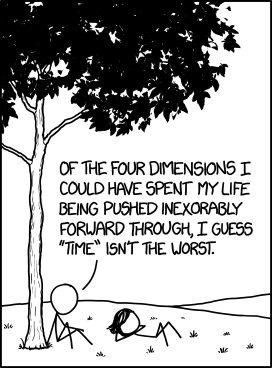
Dimensions

I would say time is definitely one of my top three favorite dimensions.
13 May 03:23

Let Me Tell You Why This Is Bulls**t

by Brad
076
12 May 23:48

Watch a singer realize the impact of his music mid-concert

by Caroline Siede

[unable to retrieve full-text content]

(more…)
12 May 14:59

The International Space Station is full of holes. Here's why.

by Xeni Jardin
Astronaut Don Pettit, the unofficial Don of space photography, explains some of the space oddities of the International Space Station's design in this episode of the YouTube video series 'Smarter Every Day.'

It's all about about the cupola, and features a demo from Italian astronaut Samantha Cristoforetti.

"7 HOLES in the Space Station - Smarter Every Day 135" [youtube.com, HT: Mitch Youts]

ezgif-2499354238

This entry passed through the Full-Text RSS service - if this is your content and you're reading it on someone else's site, please read the FAQ at fivefilters.org/content-only/faq.php#publishers.

11 May 20:18

Wyden: If Senate tries to renew NSA spying authority, I’ll filibuster

by Joe Mullin

The National Security Agency's authority to collect US phone data en masse is set to expire at the end of this month, and key votes on the program in both houses of Congress are expected to come up this week. But if the bill that reaches the Senate floor is Sen. Majority Leader Mitch McConnell's straight renewal of the program and doesn't include any reforms, Sen. Ron Wyden (D-Ore.) has said he'll filibuster it.

"I'm tired of extending a bad law," Wyden said on MSNBC yesterday. "If they come back with that effort to basically extend this for a short term without major reforms like ending the collection of phone records, I do intend to filibuster."

Wyden, who sits on the Senate Intelligence Committee, has been talking about surveillance overreach since well before the Snowden leaks occurred in 2013. It isn't clear how many Senators would support a straight renewal of Section 215 of the Patriot Act, but it seems very unlikely that they would get the 60 votes needed to overcome a filibuster.

Read 5 remaining paragraphs | Comments

11 May 16:51

Why Stealing Things in Video Games Is So Damned Enjoyable

by Joe Donnelly
Bewarethewumpus

Behold yonder ancient wonders of the world and marvel.

Now let's go kill the inhabitants and take their stuff.

Why Stealing Things in Video Games Is So Damned Enjoyable

I remember the first time I went shoplifting.

The sun was shining, Marin was singing, and I needed a shovel. Two hundred Rupees was well outside my price range, but as I slipped into the village store I clocked my prize: back shelf, far left. The elderly shopkeeper rubbed his hands together at the thought of a sale, but I shamefully used his frailty against him as I snatched, grabbed, and ran behind his till. The clerk turned, but I turned quicker as I darted towards the door. He’d asked kindly that I pay, but the allure of acquiring something outside my means proved too much to resist. “Guess what?” read the caption above my head as I stepped outside. “You got it for free. Are you proud of yourself?”

(This article originally appeared on Kotaku UK.)

The question hung in the air like a bad smell. Was I proud of myself? I’d gotten used to being ushered around linear landscapes, being channelled towards foregone conclusions. Now, I was faced with a query that not only questioned my actions, but also my morals. I don’t think I quite appreciated how significant this little segment of Zelda: Link’s Awakening was when I first played it back in 1994.

But it didn’t stop there.

Why Stealing Things in Video Games Is So Damned Enjoyable

Thief. Hitman. The Elder Scrolls. Fallout. Assassin’s Creed. Dishonoured. Dragon Age. The Clue. The Sting. Broken Sword. Final Fantasy. Suikoden. Mafia. Saint’s Row. Grand Theft Auto. Mercenaries. Fable. The list of games wherein stealing became a fun distraction would grow and grow and grow. Why was I doing this? I wasn’t stealing in real life and have never felt the urge, so I was intrigued to explore the psychology behind why people steal in reality, in an attempt to understand the draw of virtual theft.

Professor Graham Scott of the University of the West of Scotland suggests that internal reasons, such as personality and lack of empathy, as well as external reasons, such as physically needing something or socio-economic factors, are the basis upon which people steal. The anonymity, or at least perceived anonymity, of the online spectrum drives this desire further still.

“There is a higher propensity of people who commit fraud and identity theft online as opposed to offline,” explains Scott. “One of the reasons for this is that within the online world you feel sort of isolated, and the consequences of your actions are much less apparent. If you steal from someone in the street, the risks of getting caught - the physical consequences - are greater. If you do something like that to someone online, they’re not likely to come after you, therefore you’re not going to see the damage it causes. You may be abstractly aware, but it probably won’t have the same impact.”

In the case of video games, Scott suggests that players might not actually be particularly bothered by how the act of theft directly affects others, but that they are scared of the consequences in reality. Games present an outlet. Another possibility, of course, is that certain games require the player commit theft in order to progress levels or storylines.

“Take Grand Theft Auto, for example,” says Scott. “The appeal of playing something like that wouldn’t be the actual act of stealing the car, it’d be driving the car and completing the mission. In that situation, you’re given a character with a personality and you’re given a script that you must follow.

“The player wouldn’t see stealing as being something bad - most adults in real life can tell the difference between fantasy and reality - they would just see it as following the script and completing it. The danger is that, even though it’s a game, repeated exposure to these types of behaviours could desensitise you to it and normalise it so that you’re more likely to do it in real life.”

Although I don’t necessarily agree with Scott’s concern about the transference of learned in-game behaviours to real life, I think considering the process in reverse perhaps best illustrates his points. As outlined in the Zelda shovel-thievery above, stealing in times of need within video games tends to be the most necessary and/or fulfilling time to do so.

If you bankrupt your bomb and rope stockpiles in the opening levels of Spelunky, for instance, you can always rob the shop - though you’d best be quick enough to escape the ricochet of the aggrieved shopkeeper’s shotgun blast as you scramble back into the depths of the caves. Hey, you’ve only got to worry about him and his relentless, bloodthirsty revenge-quest for the rest of your game, popping up in every single level thereafter - to the point where ‘wanted’ posters adorn his walls with your face.

But the rush of swiping a shotgun or teleporter of bomb box from the old-timer’s stash is pretty damn amazing, isn’t it?

“Most people will tell you that they fell in with the wrong crowd, but I never believe anyone who says that,” David tells me. David, a pseudonym decided upon before our conversation, is from Glasgow and served an eight-year prison sentence for armed robbery in the 1970s.

He asks me if I’ve ever stolen anything before. I tell him no, because I’m fairly certain swiping a shovel in Zelda doesn’t count. “Well, let me tell you, the buzz you get is second to none - no matter if your friends are idiots or otherwise. Even if you’re in a group, you’re not doing it for them, you’re doing it squarely for yourself.”

David begun stealing from a relatively young age, taking shoplifting on as his full-time job, before graduating to more aggressive acts of theft. When he was eventually sentenced to prison, he and a few others had been caught holding up a city centre bookmakers at knifepoint.

“I started shoplifting when I was younger, around my early twenties or so,” he continues. “Mostly clothes, sometimes aftershaves, perfumes, things you could always sell on at pubs or at the pawnie (pawn shop) or the football, really. This was long before the internet so you had to be creative with your audience. I’ve been in and out of employment all of my life, you see, so most of the time shoplifting was easier than holding down a shitey, boring job.

“I knew a lot of folk who could get me things too and I was really good at it on my [own], so I was making far more money than working for someone else would’ve given me. When we robbed the bookies it was like taking that buzz further. There was risk, sure - fuck I know that, and some, now - but the reward trumped the risk. Thinking back, it’s hard to put yourself in that mindset, I thought I was fucking invincible. I obviously wasn’t.”

Why Stealing Things in Video Games Is So Damned Enjoyable

David goes on to explain how his sentence was the maximum he could’ve received, due to his previous convictions. I ask David why I, as a player of games, might find stealing enjoyable if the act takes place in virtual reality, even though I have no desire, consciously at least, to steal in the real world.

“Well I know next to nothing about computer games,” he admits. “But my grandson is mad for that one that looks like it’s from the 80s. Minecraft, is it? Let me put it this way - you said before that you’d never stolen before, but you said there just now about games that allow you to steal?”

I nod.

“So you have stolen - at least in these games. Let me ask you then, why did you do it in one of your games? Because the game asked you to? Because it felt good? It’s the same thing, as far as I’m concerned. The only difference is the real police have more concern catching up with people like me [laughs].

“What I’m trying to say is that everyone would steal if they thought they could get away with it - just look at the rich and famous [people] who blag things. They’ve got enough money to buy things twice. As I say, I don’t really get computers, my phone is hard enough to work, but I suppose I could see how you could enjoy acting out crimes knowing there’s no real police to face up to.”

When I consider the amount of things I’ve swiped in digital spaces, I wonder if there’s any truth in what David suggests. Again, consciously, I have no desire to steal anything in the real world, but is that to do with social convention and rules and empathy? If I thought there were no repercussions, would I snatch a shovel from my local store? Am I a digital kleptomaniac?

David rightly points out that there are no real police officers chasing us down in our virtual playgrounds - but there are definitely angry shopkeepers. Lots and lots of angry shopkeepers.

Why Stealing Things in Video Games Is So Damned Enjoyable

“I wasn’t kidding when I said pay!” harked the elderly clerk as I returned to the Mabe Village store on Koholint Island. Finished with the shovel, I now needed a bow and arrow.

“Now, you’ll pay the ultimate price!!” he said, before unsheathing sort some of lightning wielding weapon and pulling the trigger.

Oh, bollocks.


Contact the author at evan@kotaku.com.

This entry passed through the Full-Text RSS service - if this is your content and you're reading it on someone else's site, please read the FAQ at fivefilters.org/content-only/faq.php#publishers.


11 May 16:43

Satisfying rant about how broken everything on the web is

by Rob Beschizza
Bewarethewumpus

#firstworldproblems

The shit about google chopping off it's own limbs at random is real tho.

This entry passed through the Full-Text RSS service - if this is your content and you're reading it on someone else's site, please read the FAQ at fivefilters.org/content-only/faq.php#publishers.

10 May 06:07

Smart Grid consortium rolled its own crypto, which is always, always a bad idea

by Cory Doctorow


When you make up your own crypto, it's only secure against people stupider than you, and there are lots of people smarter than the designers of the Open Smart Grid Protocol, who rolled their own (terrible) crypto rather than availing themselves of the numerous, excellent, free public cryptographic protocols.

It's impossible to overstate how stupid it was for them to do this. "Only use well-established public ciphers and don't make up your own" is literally the first rule of good crypto.

And of course, the risk to power infrastructure that's secured with this amateur hour crypto is real, not theoretical. Dumb Crypto in Smart Grids: Practical Cryptanalysis of the Open Smart Grid Protocol, a paper by Philipp Jovanovic and Samuel Neves, shows that the OSGP's "OMA Digest" function, used to sign messages and updates, is trivial to break: " Since the encryption key is derived from the key used by the OMA digest, our attacks break both confidentiality and authenticity of OSGP."

Which is to say: the whole work product of the consortium is unsafe at any speed. Let this be a lesson to anyone else doing standardization.

“Protocol designers should stick to known good algorithms or even the ‘NIST-approved’ short list,” Crain said. “In this instance, the researchers analyzed the OMA digest function and found weaknesses in it. The weaknesses in it can be used to determine the private key in a very small number of trials.”

By comparison, Crain said he implements DNP3 Secure Authentication, which is an IEEE standard.

“By contrast, they use the NIST-approved digest functions known as HMAC-SHA256 and AES-GMAC which are currently considered ‘strong authentication,'” Crain said. “The No. 1 rule of cryptography is ‘Don’t invent your own.'”

The Open Smart Grid Protocol handles communication for smart grids. It was developed by the Energy Service Network Association (ESNA), and since 2012 is the standard of the European Telecommunications Standards Institute (ETSI), according to the paper.

The weaknesses discovered by Jovanovic and Neves enabled them to recover private keys with relative ease: 13 queries to an OMA digest oracle and negligible time complexity in one attack, and another in just four queries and 2^25 time complexity, the paper said.

Weak Homegrown Crypto Dooms Open Smart Grid Protocol [Michael Mimoso/Threat Post]

(Image: Smoking, Chuck Grimmett, CC-BY-SA)

This entry passed through the Full-Text RSS service - if this is your content and you're reading it on someone else's site, please read the FAQ at fivefilters.org/content-only/faq.php#publishers.

10 May 01:40

Texas Tea Party rep wants legal weed

by Mark Frauenfelder

Texas State Rep. David Simpson has introduced a bill to remove all references to marijuana from the state’s legal code. And he has the best argument I've heard: "Rattlesnakes are dangerous, but we eat ’em for meat. And some people, you know, they eat other rodents. But we don’t ban them."

This entry passed through the Full-Text RSS service - if this is your content and you're reading it on someone else's site, please read the FAQ at fivefilters.org/content-only/faq.php#publishers.

08 May 15:41

Meanwhile in Florida...

by Brad
947
08 May 15:36

Might Not Be Terrible Now – Orion: Prelude Free All Week

by Graham Smith
Bewarethewumpus

A friend recommended this to me a few months ago, and I don't regret my $0.99.

The last time we wrote about dinosaurs-versus-jetpacks multiplayer shooter Orion: Prelude [official site] it was 2012, after which I suspect we realised it was broken and rubbish and stopped paying attention. It’s three years later however and its developers haven’t stopped updating it in that time, and in canny fashion they’re now bragging about their support, noting their improved Steam user review rating, and making the game free to play all this week. Watch the trailer below.

… [visit site to read more]

08 May 14:17

Infinite Crossover Potential

There's a lot of reasons to be excited about Disney Infinity 3.0, but there's only one that truly interests Elliott!
07 May 23:36

Drug pump is "most insecure" devices ever seen by researcher

by Cory Doctorow

Security researcher Jeremy Richards has called the Hospira Lifecare PCA 3 drug-pump "the least secure IP enabled device" he's examined.

The device attracted a NIST/DHS warning that classed the risk from the Lifecare product a 10/10.

Though the Lifecare product makes some particularly egregious security blunders, many of its mistakes are typical of medical devices.

What's worse than buggy, insecure software is buggy, insecure software that's illegal to research. Between the Computer Fraud and Abuse Act's ban on "exceeding authorization" on a computer (the law under which Aaron Swartz was charged) and the Digital Millennium Copyright Act's ban on publishing information that would help subvert an "effective means of access control," researchers who uncover these critical flaws face real jeopardy just for telling us information that we need to know in order to make good choices in matters of life and death.

Governments are terminally compromised when it comes to this stuff. On the one hand, they don't want voters dropping dead in the streets as hackers pwn their implanted defibrillators. On the other hand, they rely on weak computer security (ever going so far as to sabotage our systems and devices by deliberately introducing exploitable bugs in them) as a means of attacking "bad guys," who use the same computers as the rest of us. They also actively encourage the trade in offensive tools that weaponize bugs, even turning a blind eye to the sale of these tools to despotic regimes who use them to hack their adversaries in the USA (and elsewhere).

You can't have it both ways. Either we have real security, in which researchers aggressively root out flaws in our systems and get them patched; or we make life easier for the Tom Clancy LARPers in the security services, who do everything they can to turn all our systems into reservoirs of long-lived digital pathogens that they can exploit, threatening researchers who report bugs, and giving them big, military-industrial-complex-style paydays when they sell those bugs to digital arms dealers.

Someone you love already has an implanted medical device -- a pacemaker that can cook their hearts in seconds if it's badly secured, a cochlear implant that could serve as the world's most invasive listening device, a lethally compromised insulin pump. You probably spend part of every day in a car, building, or other enclosure whose informatics could kill, maim, or compromise you if it was compromised. When spooks, cops and politicians decide that catching bad guys is more important than keeping you secure against crooks, griefers, identity thieves, spies, dirty cops and other adversaries, they show themselves to be unfit for office. As Aaron Swartz said, "It's not OK not to understand the Internet."

What he found was shocking. Among other things, Richards noted that the device was listening on Telnet port 23. Connecting to the device, he was brought immediately to a root shell account that gave him total, administrator level access to the pump.

“The only thing I needed to get in was an interest in the pump,” he said.

Richards found other examples of loose security on the PCA 3: a FTP server that could be accessed without authentication and an embedded web server that runs Common Gateway Interface (CGI). That could allow an attacker to tamper with the pump’s operation using fairly simple commands.

The PCA pump also stored wireless keys used to connect to the local wireless network in plain text on the device. That means anyone with physical access to the Pump could gain access to the local medical device network and other devices on it. Furthermore, if pumps are not properly wiped prior to being sold, those keys may be transmitted to unknown buyers on the second-hand market, Richards warned.

Like other medical devices that independent security researchers have looked at, Richards said the Hospira LifeCare pump did not validate the authenticity of firmware updates prior to installing them – a common problem in the medical device sector.

Researcher: Drug Pump the ‘Least Secure IP Device I’ve Ever Seen’ [Paul/Security Ledger]

(via /.)

This entry passed through the Full-Text RSS service - if this is your content and you're reading it on someone else's site, please read the FAQ at fivefilters.org/content-only/faq.php#publishers.