Amazon and Hachette recently patched up their public feud, but that's not stopping the book publisher from experimenting with new ways of selling its titles. Hachette has announced that it plans to start offering book purchases directly through Twitter this week. To do so, it's partnered up with Gumroad, whose platform will power the native in-Twitter buying experience. Only a few authors will be taking part in Hachette's first attempt to turn tweets into sales; Amanda Palmer, astronaut Chris Hadfield, and The Onion are slated for this round, but others will likely follow.
Gervasius Redler came to Paris from Alsace in the early 19th century, and set up shop as a piano teacher. Around 1840, he began publishing dance music in the popular styles of the day, particularly quadrilles.

*98TW-10.355 title page

*98TW-10.356 title page
The Musical Bouquet series printed several of his quadrilles in 1855, and true to their style of the time, printed topical lithographed illustrations on the covers. I just love all the different characters made evident by the seriousness of the musicians.

*98TW-10.357 title page
John M. Ward, the donor of the collection in which these quadrilles appeared, was particularly interested in social dance, and how it reflected and documented the popular culture of the day. This gloomy, rainy day has been brightened considerably for me, by imagining how Professor Ward must have loved these little orchestras.

*98TW-10.358 title page
Clearly the illustrations were popular with the public as well, since the one from Les souris above, has been reproduced here, now featuring the monkeys. With the Crimean War taking such heavy casualties, all luridly reported in illustrated detail in the newspapers, the year 1855 must have been hard on England. But I’m guessing that these little ambassadors of cheer did their part to help lift spirits.
[Thanks to Andrea Cawelti, Ward Music Cataloger, for contributing this post.]
This post is part of an ongoing series featuring items from the newly acquired Julio Mario Santo Domingo Collection.
 In his book Practical lessons in hypnotism & magnetism, L.W. DeLaurence states that “Occult force” is simply personal magnetism that if well developed is able to control man, woman, child or beast at will. If a person possesses this occult force they can then project thoughts, desires, and even habits into the minds of those that have no knowledge of this mental science. DeLaurence saw a hypnotist on stage and decided to take it up himself, so he took a grand total of one lesson and then began touring around the country doing lectures and exhibitions.
DeLaurence was a pretty shady character even within the 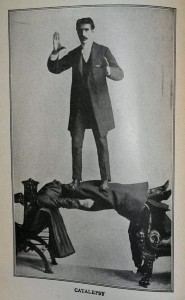 world of spiritualism and occult. His publication of The Key to the Tarot: Oracles Behind the Veil was a blatant almost word for word plagiarism of Arthur Edward Waite’s Pictorial Key to the Tarot : being fragments of a secret tradition under the veil of divination. He was able to do this due to a loophole in the US copyright law at the time. He also established DeLaurence, Scott and Company which sold spiritual amulets, candles, herbs, and other items. Carolyn Morrow Long’s book Spiritual Merchants: Religion, Magic, and Commerce includes a detailed section about DeLaurence.
According to Long he was the subject of a mail order fraud investigation in 1919 where the prosecuting attorney seemed determined to expose him as a fake. When DeLaurence was asked about the products he sold he admitted that they lacked any spiritual qualities and that the candles came from a nearby church, the amulets from a jewelry manufacturer, and the herbal remedies from a pharmaceutical company. Transcripts show that he was given two weeks to remove the “fradulent and objectionable claims” but there is no final outcome noted, nor is there a police record of DeLaurence.

To brush up on your own personal magnetism take a look at Practical lessons in hypnotism & magnetism : giving the only simple and practical course in hypnotism and vital magnetism which starts the student or practitioner out upon a plain, common sense basis–prepared especially for self-instruction / by L.W. DeLaurence. Chicago : De Laurence Co., c1937 which can be found in Widener’s collection.
Thanks to Alison Harris, Santo Domingo Project Manager for contributing this post.


Verne, Jules, 1828-1905. Vingt mille lieues sous les mers, 1871.
Houghton Library, Harvard University
Russian Sledgesvia rosalind
While at the the Taipei Zoo (previously), visitor Audi Yu captured this lovely footage of a thoughtful giant tortoise gently helping an overturned chelonian get back on his feet. Once accomplished, however, the two tortoises walked away like nothing ever happened.
via The Dodo
Russian Sledgesvia rosalind

Few people heading out for a night on the town stop at the door and think, Hmmm, better splash some booze on me first. Yet that's basically the service being offered by designers at Heriot-Watt University, who are developing a tweed fabric imbued with the sweet, peaty scent of scotch.
Such a concept could only originate in one place, and sure enough, Heriot-Watt is located in Scotland, a couple hours south of Edinburgh. The university's School of Textiles and Design is leading the push to make this whisky-scented fabric, with partners including Johnnie Walker and Harris Tweed Hebrides on the Isle of Lewis.
According to industry rag The Drinks Business, the cloth will incorporate a smoky Aqua Alba fragrance meant to mimic Johnnie Walker Black; it will emit aromas of "rich malt" and "golden vanilla," as well as "red fruit and dark chocolate tones."
Best or worst of all, depending on one's concern over being taken for the town souse, the whisky perfume is driven so deep into the fabric that it won't come out in the laundry. Here's The Drinks Business again with details on the pungent tweed, reportedly soon to be available in Berlin:
Donald Mackay, in charge of finishing at Harris Tweed’s Shawbost mill, said this was the first smart fabric he has worked with that had been successfully designed to withstand multiple dry cleans.
“I have worked with aromas in the past but they were only meant to withstand one dry clean. The process we have devised for Johnnie Walker means that this scent is layered into the fabric throughout the finishing process and is permanently imbued in the tweed,” he said.
Top image by Stokkete on Shutterstock. H/t DesignTAXI


Boston's Innovation District is so new that on Google Earth, this former working waterfront—set on one-and-a-half square miles of landfill—is still just a wasteland of surface parking. But those windswept lots are quickly disappearing as office towers and condos spring up to house the start-ups, tech companies, and hip young workers that the city has been trying to lure since before former Mayor Tom Menino christened the neighborhood with its optimistic name in 2010.
The district is already home to some 200 companies—established biotech operations, venture capital firms, and buzzy robotics start-ups—along with a gigantic convention center, hotels, trendy restaurants, Irish bars, and the city's Institute of Contemporary Art. While the neighborhood has had no problem drumming up business, manufacturing the sense of community one might find in a place that developed more organically is another matter.
While the neighborhood has had no problem drumming up business, manufacturing the sense of community one might find in a place that developed more organically is another matter."The Innovation District has all the charm of an office park in a suburb of Dallas," the Boston Globe's Pulitzer-winning architecture critic, Robert Campbell, wrote last month, in a scathing front page review of the district's boxy new buildings. While the area's architectural merits might be up for debate, the coldness that Campbell wrote of also speaks to the difficulty of building an urban neighborhood from scratch.
His review noted one bright spot, however: District Hall, a single-story, 12,000-square-foot building with big windows and a funky slanted roof. In the words of its 27-year-old general manager, Nicole Fichera, it is meant to serve as the Innovation District's "living room."

District Hall began with Menino (who died in October) calling for an "innovation center," a nebulous concept that a design team working for Boston Global Investors, developers of 23 acres of the new district, was forced to figure out on its own. Fichera, who trained as an architect and has been involved with the Innovation District since she was a co-op student at Northeastern University, was in those early meetings.
"It was intoxicating to be part of something so big," she says. "But it was a confusing process. The mayor's office wanted a gathering space for the innovation economy, and that could be 100 million things. We had to figure out what the space would be, imagine everything that would take place here. We did these brainstorming sessions, like, 'What the heck is this?'"
What the designers at the Boson firm of Hacin + Associates eventually came up with is something like a college campus's student union. Open 7 AM to 2 AM on weekdays and from noon on weekends, District Hall was built with private funds and is run by a local non-profit called the Venture Café Foundation. It houses a restaurant, a coffee shop and bar, a public lounge with tables and armchairs, and a set of leasable conference and event rooms. The walls are all writeable, and the Wi-Fi is strong and speedy.
It's a place where a start-up founder can meet with potential investors, where office workers can bring their laptops for a change of scenery, and where, as people actually move here, neighbors can socialize over a beer and a plate of roasted duck tacos.

The building's interior was meant to be flexible, Fichera says, but when it came to the outside, the designers were very clear about the role District Hall would play in this new neighborhood. The interesting angles were meant to signal civic space, in the manner of a museum or concert hall. Sticking with a one-story layout gave the building a human scale, and it was important that District Hall be freestanding so that it would look and feel independent from the office towers going up around it.
Fichera left Hacin to take a job focusing on the Innovation District with the city's redevelopment authority in 2012, and then became District Hall's manager when it opened last year. She acknowledges that it's unusual for a designer to manage a building she helped to conceive. But after spending so much of her short career on District Hall, she found it tough to let the project go.
"I remember sitting in design meetings, talking about 'What do we do here?' I could see it, and I remember thinking at the time, 'I could totally run this.'""I've had the chance to be here and thinking about it since it was just a concept," she says. "I remember sitting in design meetings, talking about 'What do we do here?' I could see it, and I remember thinking at the time, 'I could totally run this.'"

She laughs at what she says was the "arrogance" of a 22-year-old, but after spending four years on District Hall, eventually she became the right person for the job. And that meshed well with Fichera's idea that architects, if they really want to understand how people use the spaces they create, ought to stay involved after construction is complete.
In Fichera's eyes, District Hall is still an experiment, a case study in place-making that she expects will be adopted and adapted in other cities as the "innovation district" trend takes off. And whatever the verdict on the rest of the district's architecture, she is proud of her own corner of it.
"[Menino] used to talk about 'relationship architecture,'" says Fichera. "There's a lot you can do to build community regardless of the physical context. But you can also make the physical context conducive to relationships."

Russian Sledgesvia willowbl00
me and kyle at opus
Russian Sledgesvia firehose
didn't click through; reshared for image
Russian Sledgesvia multitask suicide

Peter O’Toole Tells You How To Carefully Knot Your Tie.
But, will you listen?
This post is part of an ongoing series featuring items from the newly acquired Julio Mario Santo Domingo Collection.
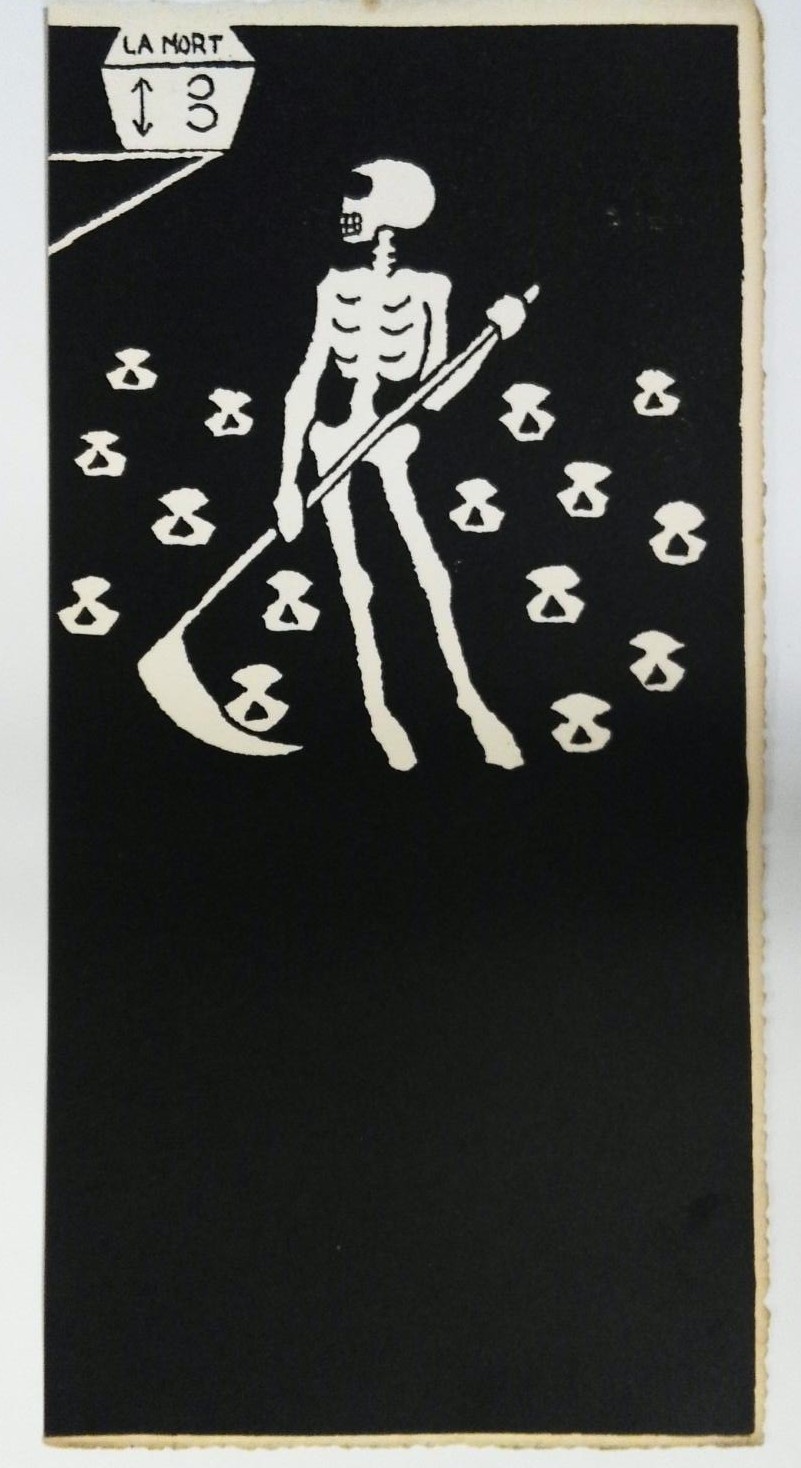
Death. Typically depicted as a skeleton with a sickle, one might suppose that if this card appeared in a tarot reading that you should prepare for an untimely demise, but it rarely signifies a physical death. Tarot card readings are a highly subjective topic depending on what you believe, but according to A.E. Waite, a recognized authority on the occult and tarot, the Death card usually means an end to a cycle or a transition into a new stage in your life.
Le Taro sacerdotal : reconstitué d’après l’astral et expliqué pour ceux qui savent déja published in 1951 consists of 22 beautiful lithograph cards, most of which are hand-colored with watercolors. The cards consist of an iconographic image with a corresponding description of the archetype below it, one of the exceptions being Death.


You can see that the style of the description scripts vary according to the image. Again according to Waite the Hermit represents guidance, introspection, solitude, and seclusion. The Hanged Man is based on a pittura infamante, a shameful image of a traitor being punished in a manner common at the time in Italy. Waite suggests the Hanged Man is associated with sacrifice, passivity, contemplation, and inner harmony.
The illustrator of these cards, Lucien Laforge, is also known for his illustrative work in magazines including  La Charrette : “Charrie” Aujourd’hui which was a short lived serial publication in 20th-century France. Courtesy of the JMSD collection we have the very last issue no. 24 in Widener and it is possible we may uncover more as we continue to catalog.
Hoping to find more information about Laforge I discovered the Database of Modern Tarot Art. Adam MacLean, who is an enthusiast for alchemical texts and symbolism, is creating a database from his own collection of tarot decks. They are currently sorted by geographic regions though there is also a keyword search function. The description of the entries vary depending on the information MacLean has on the specific deck, but it is a pretty robust database with at least two images from the deck for each entry.

Le Taro sacerdotal : reconstitué d’après l’astral et expliqué pour ceux qui savent déja / Lucien Laforge [and] André Godin : prints, 1951. MS Fr 606 can be found at the Houghton Library.
Thanks to Alison Harris, Santo Domingo Project Manager and Susan Wyssen, Manuscript Cataloger, for contributing this post.

Behavioral Science Center, University of Illinois at Chicago, 1970
(Walter Netsch of SOM)
Russian Sledgeshttp://fuckyeahbrutalism.tumblr.com/
shared to troll overbey

Girls’ High School, Oita, Japan, 1968
(Arata Isozaki)
Russian Sledgesattn overbey, multitask: viewing party?

If you're a fan of spy thrillers, you'll enjoy BBC America's miniseries The Game the way you might a dog-eared novel and a cup of tea on a winter's night. The pace is leisurely, and the plot elements familiar (an enigmatic young spy with tangled loyalties, a possible mole inside MI5).
The show is also a particular visual treat if, like me, you can appreciate a muted 1970s color palette and the Cold War Britain it evokes—the Britain of the three-day week, unfortunate cardigans, and National Health Service glasses. It's like Tinker, Tailor, Soldier, Spy, with just as much suspense as you can handle before bed.
There is one area where The Game—which premiered Nov. 5 and is available on-demand—does make an original contribution: in its use of Brutalist architecture.
Filmmakers have, of course, long used muscular concrete buildings to connote dystopia and decay, especially in Britain. In Stanley Kubrick's A Clockwork Orange (1971), the antihero Alex lives in a Brutalist housing estate in London and undergoes "aversion therapy" at a Brutalist facility played by the campus of Brunel University. Get Carter, a gritty gangster drama starring Michael Caine and released the same year, features a punch-up in the Trinity Square parking garage, a significant Brutalist structure (now demolished) in Newcastle.
The Game is set in a British Brutalist landmark, too, but it's different from those precursors. The series was filmed in Birmingham, and the primary location is the Birmingham Central Library, a massive inverted ziggurat of concrete that opened in 1974. The library was designed by John Madin, a local architect who found inspiration across the Atlantic in the equally imposing Boston City Hall.
It was the era of ambitious urban renewal, and Madin, along with Birmingham's city fathers, imagined the library surrounded by water gardens, the proud icon of a new and thoroughly modern civic center that would include schools, offices, and stores, all connected by skywalks.
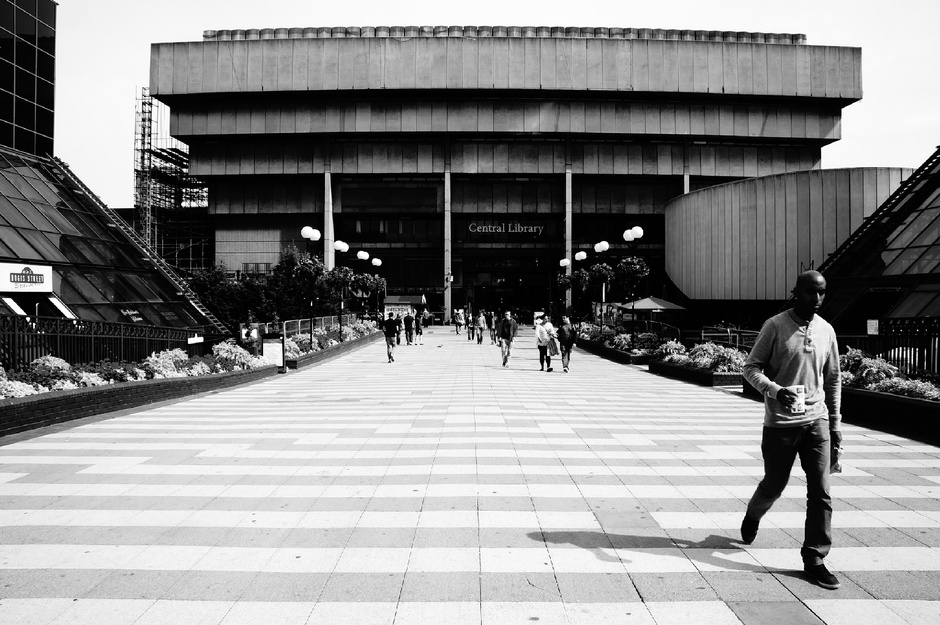
The money ran out before that vision could be achieved. However, as critic Jonathan Glancey noted in a 2003 ode to the library, "[t]his was not a cheap building: concrete slabs were faced in Hopton Wood stone; ceilings were coffered in much the same way as the great libraries of Ancient Rome would have been; furniture was custom-designed by the architects."
The Game makes the most of these material riches. In the show, the library is a stand-in for the headquarters of MI5, the U.K.'s counter-intelligence agency. The operation's nerve center is a board room where "the fray," a special committee, meets to discuss a mysterious KGB plot. And what a room it is: deeply coffered, sparsely furnished, and looking across an atrium to the stacked glass-and-concrete layers of the ziggurat.
Rough, ribbed-concrete walls provide the backdrop for scene after scene, giving this viewer the urge to reach out and touch her TV.


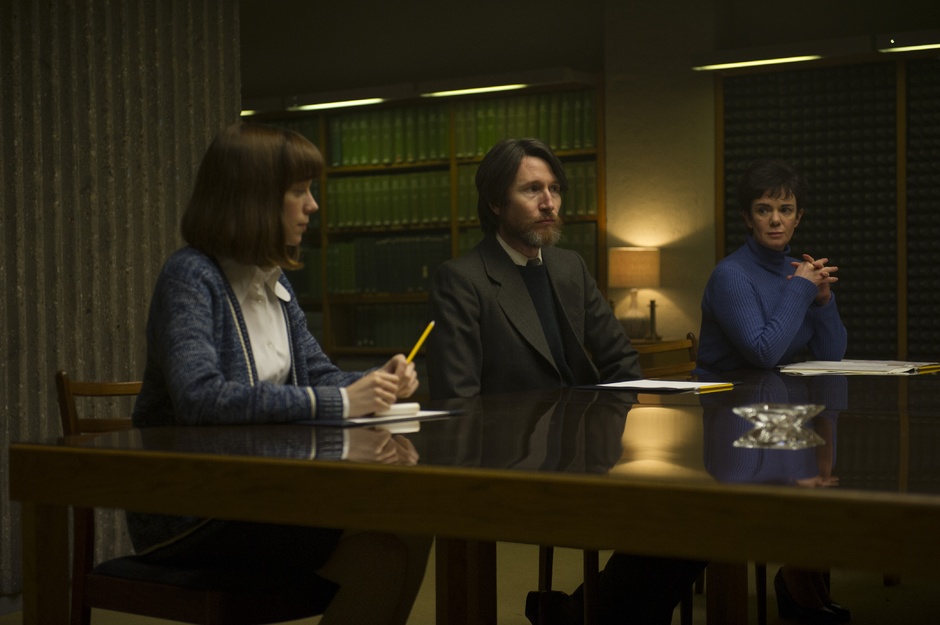

The Game is about the Cold War, and yes, there's an atmosphere of menace and paranoia hanging over it. But this is no dystopia—it's 1970s Britain, and MI5 agents are the good guys (well, basically). We see the characters in the show—men and women, it should be noted—whisper and kiss in a Brutalist setting. The Game humanizes Brutalist architecture. It makes Brutalism the scene of interactions that for once aren't thuggish or sinister.
The show's set design helps, warming up the concrete with furnishings in jewel and earth tones. Leather sofas, paintings, bookshelves, and lamp lighting make the spy agency seem not quite domestic, but lived-in.
The BBC crew built a number of sets inside the "fantastic basic structure" of the library, bringing in new items but also making use of existing bookshelves and other "stuff that was lying around," says the show's production designer, Michael Howells. They painted walls in dull blues and grays, and for the offices of the senior MI5 officials, carefully chose objects—a golf tchotchke for one, contemporary art for another—that suited the respective characters.
"My age group, in their 40s and 50s—the fact that we've grown up in the '60s and '70s, in a way it almost becomes nostalgic," Howells says. "You get into your 50s, you have the money and start buying those pieces. That's when you start really looking at it ... People do respond to it."
The Game humanizes Brutalist architecture. It makes Brutalism the scene of interactions that for once aren't thuggish or sinister.Mad Men, which first aired in 2007, helped push the long-percolating revival of mid-century modern design into the mainstream (as a glance at any homewares catalog today will prove). Could The Game signal a comeback, a similar wave of nostalgia, for the Brutalist era? There have been glimmers of it for a while now, in, for example, the writings of Owen Hatherley and the popular Fuck Yeah Brutalism Tumblr (which spawned the #fuckyeahbrutalism hashtag). The successful campaign to save the U.K.'s Preston Bus Station proves the style has admirers outside of a coterie of designers and historians.
The Game may tap into a growing appreciation for Brutalism, but it wrapped up shooting in the nick of time: Birmingham Central Library is slated for demolition next month. A blingy new ziggurat of a library by the Dutch architects Mecanoo opened in Birmingham last year, and soon, Madin's more austere one will join Chicago's Prentice Women's Hospital and Baltimore's Mechanic Theatre up in Brutalist heaven.
The library will be mourned. Howells, for one, is sorry to see it come down, and thinks it could be reused as a museum. "I completely fell in love with the building," he says. "It was a real shame in the end, thinking, 'Well, when we leave and close the door, this will be demolished.'"
In the fate of buildings, lovability counts for a lot.The Game may not be able to save the Birmingham library, but it makes a difficult style more accessible than any book or lecture could. It reveals the softer, tactile insides of an architecture that can seem hard and blank from the outside, which is all we're usually able to see.
In the fate of buildings, lovability counts for a lot. If we want more people to care about Brutalism, we shouldn't preach to them about architectural history—we should tell them to watch The Game.

Russian Sledgescarrel of doom

Berkeley Library, Trinity College, Dublin, Ireland, 1961-67
(Ahrends, Burton & Koralek)
Russian Sledgeshttp://fuckyeahbrutalism.tumblr.com/
shared to troll overbey

Andrew Melville Hall, University of St. Andrews, St. Andrews, Fife, Scotland, 1971
(James Stirling)

August Perez III had an incredible impact on the way New Orleans looks today, from its skyline to Mardi Gras. Perez, one of the city's most important architects of the 20th century, passed away last week at the age of 81. His funeral will take place on Saturday in Metairie, just outside the city he helped transform.
Taking over his father's architecture firm in 1975, Perez quickly made his mark on postmodern architecture, teaming up with Charles Moore to design the Piazza D'Italia in 1978. The public plaza, filled with architectural winks, remains one of the most defining pieces of postmodern design to this day.
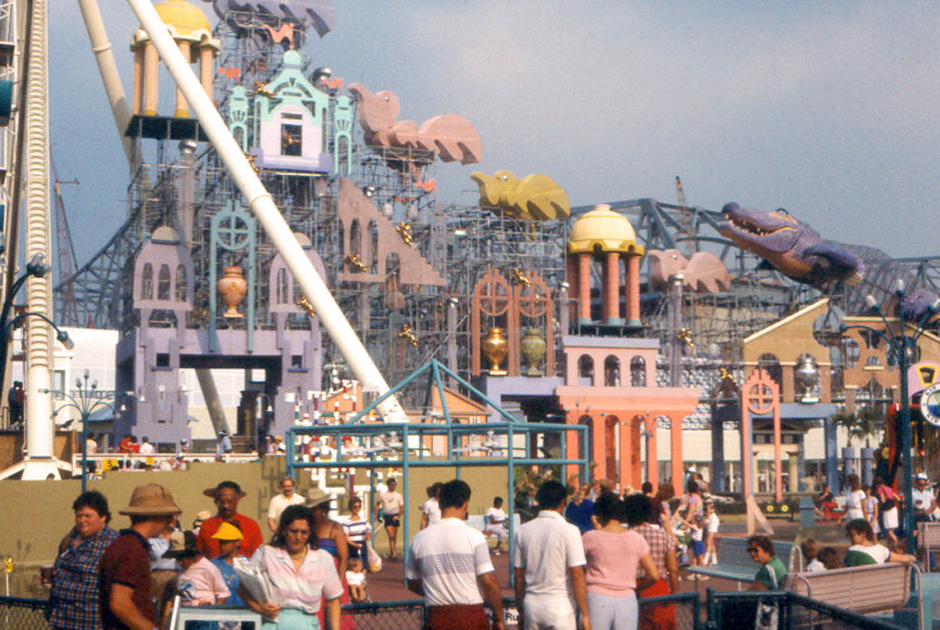
Perez and his firm were given an even bigger responsibility soon after the plaza's completion, the 1984 World's Fair. The event's architecture expressed a playfulness much like Moore and Perez's piazza.

It also introduced the gondola lift commute to the United States. Developed by Perez along with the Mississippi Aerial River Transit, the network took riders over the Mississippi River from the West Bank to the Warehouse District, where the fairgrounds were located. Like the rest of the event it was built for, MART was a financial disaster. Shut down due to low ridership in 1985, the group behind it defaulted on an $8 million loan that same year, and in 1989 the gondolas themselves were seized by U.S. Marshals. (They live on in a climactic chase scene in the 1986 thriller French Quarter Undercover.)
The fair's financial woes and low attendance dampened its legacy, but the event accomplished what Perez and its organizers had hoped for: a revitalized Warehouse District. After years of decline, the former industrial area (where Perez moved his firm to before the fair) began a slow transformation into an arts and culture district. Today, galleries and restaurants have turned the area into a popular tourist spot.
Even outside the world of architecture, Perez found ways to make an impact on New Orleans. The Krewe of Bacchus, of which Perez was a founding member, built larger, more elaborate Mardi Gras floats than the typical krewe and, breaking convention, invited celebrities to be parade kings.
It's hard to look at the New Orleans skyline today without seeing something that Perez had his hands on. From hotels to casinos to public squares, the architect stayed busy until his retirement in 2000. "He was responsible for half, if not more, of the high rises going up in the city at the time," says Perez's successor at the firm, Angela O'Byrne. "He was deeply committed to improving the city."

Russian Sledges'Other non-profits can be involved, he said, only if they involve all three of the other groups. Partnerships between just schools, business and a community non-profit won't qualify.
'"The faith-based organization is clearly at the heart of the vision of the governor," Harris said after the session.
'"We do not forsee any proseletyzing happening between mentors and students," Harris said. "That's not really what we're seeking."
Asked why the governor is mixing religion with a state program - items usually required to be kept separate - Kasich spokesman Rob Nichols said: "The governor believes faith-based organizations play an important role in the lives of young people."'
Russian Sledgesbloomberg piece: http://www.bloomberg.com/news/2014-12-12/ferguson-to-increase-police-ticketing-to-close-city-s-budget-gap.html
capitol city of the state of #nevergo

Russian Sledgesvia multitask suicide
You couldn't make this shit up.
The post Scott Stapp Thought He Was a CIA Agent Assigned to Kill President Obama appeared first on MetalSucks.
Russian Sledgesvia firehose
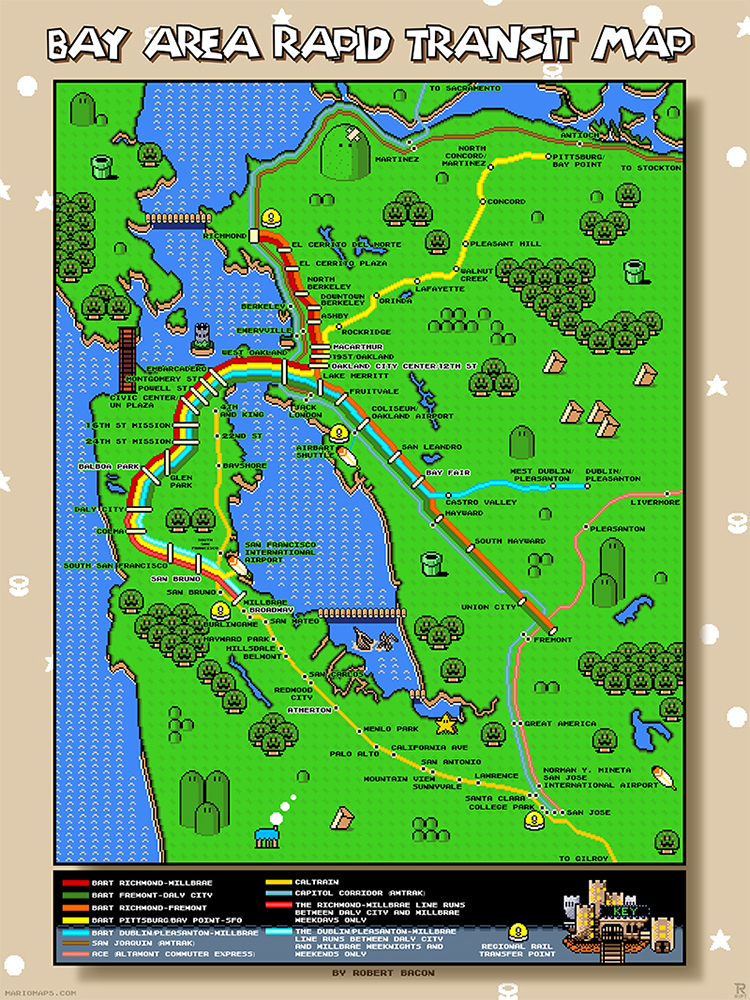
Chicago-based comedian and artist Robert Bacon, whose design work we’ve written about in the past, has designed a map of San Francisco’s Bay Area Rapid Transit system (BART) in the style of the classic SNES video game Super Mario World. Posters of Bacon’s BART map are available to purchase online at RIPT Apparel, along with many others from his Video Game City Maps Collection.

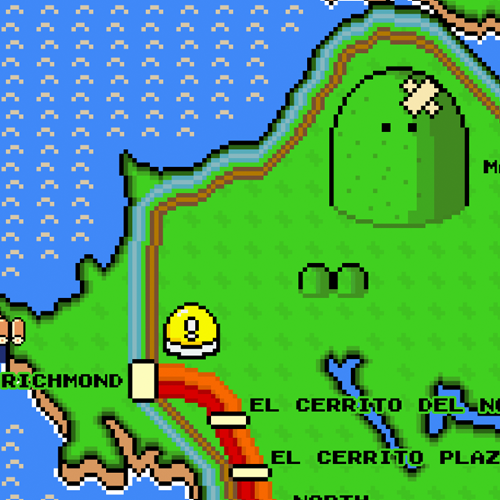
images via RIPT Apparel and Some Chicago Improvisor
via Boing Boing
Russian Sledgesvia rosalind
Russian Sledgesvia bernot
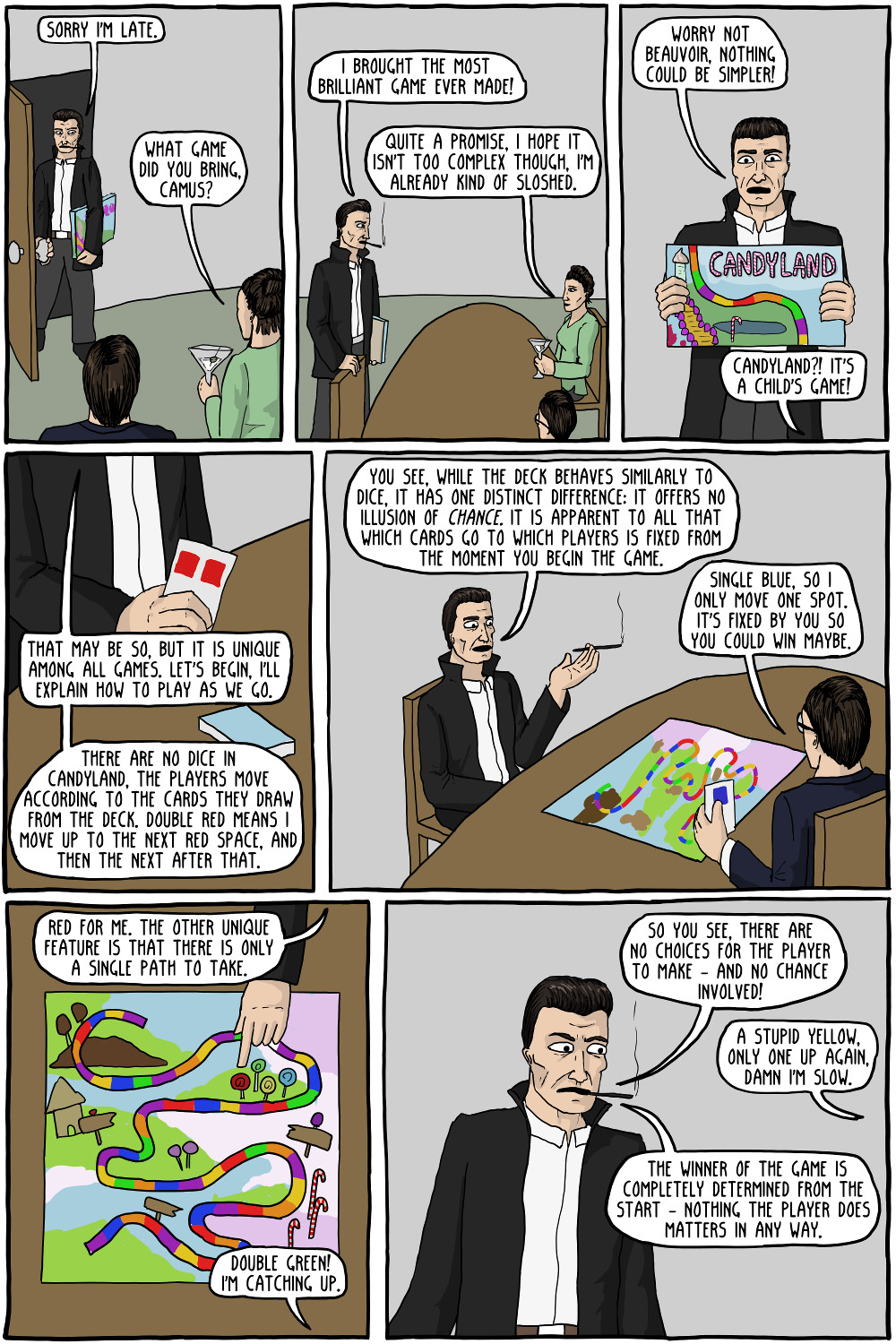
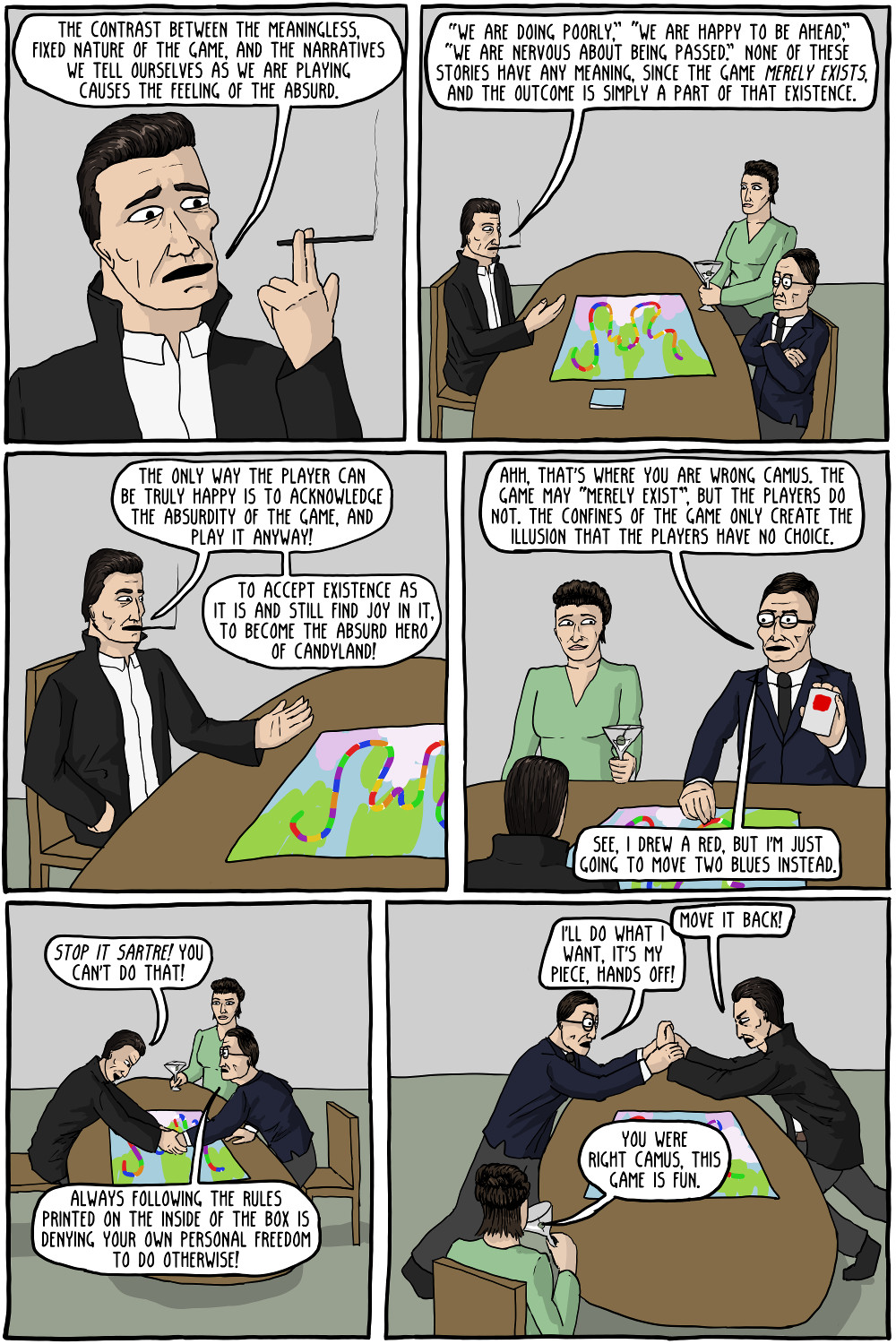
I always hated candyland
Russian Sledgesvia firehose
This post is part of an ongoing series featuring items from the newly acquired Santo Domingo collection.
 Liber Null, a book by Pete Carroll, was originally written as a sourcebook for the magical organization, Illuminates of Thanateros. It includes spells and magical exercises ranging from mind control to transmogrification.
 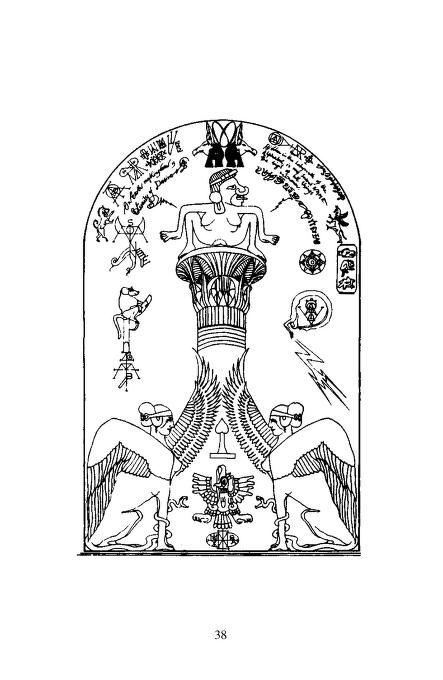 A warning at the beginning of the book states “Liber Null contains a selection of extremely powerful rituals and exercises intended for committed oculists who are aware of the extent of their own state of being.” Not for the magical novice, this book discusses intense rituals that are akin to sensory deprivation that should not be tried if the reader has any health issues. Much if the IOT magic discussed in Liber Null is from the darker side of magic and is devoted to the black arts.
Illuminates of Thanateros, or IOT, was founded in 1978 by Pete Carroll and Ray Sherwin as a hierarchical organization based on the Greek gods of sex and death and the idea of chaos magic. Related to the Zos Kia Cultus and Thelmic Magick, Carroll combines both traditional magic with new forms of thought and focus. Although he debunks astrology, he grounds his new system in similar terms. Carroll, who studied science in college, attempts to demystify magic much like Aleister Crowley.  However, chaos magic lives up to its name, creating a realm where everything can contradict itself. As Carroll says in Liber Kaos, “Chaoist magic is characterized by it’s cavalier attitude to metaphysics…”
Liber Null : an I.O.T. publication in class 4,3 and 2 comprising liber MMM, liber LUX liber NOX millenium, liber AOM by Pete Carroll ; illustrations, Andrew David can be found in Widener Library’s collection. A later publication that includes both Liber Null and the related text Psychonaut is also available here: Liber Null & Psychonaut Peter J. Carroll; BF1611 .C38 1987.
Thanks to Emma Clement, Santo Domingo Library Assistant, for contributing this post.
Russian Sledgesvia multitask suicide ("Look at this precious wooden shelf for “shot glasses.” It’s for Precious Moments figurines, dude. I know what’s up. You got your Precious Moments in there so they don’t knock together and chip the paint.")