Shared posts

27 Jan 14:00

I have a client that I’ve had to babysit for nearly two years. She’s never content and always wants...

I have a client that I’ve had to babysit for nearly two years. She’s never content and always wants to add more projects, but gets shocked when she sees the bill and insists on splitting it into payments and gets upset when I won’t start on a new project until she’s paid up.

She also loves to send ten emails saying she needs changes made immediately or “by tomorrow at 8am” but then sends contradictory requests and doesn’t reply when I ask for clarification.

The last straw was when I was going in for major surgery on my face and I wake up to an email that she’d sent at 4:00am the morning of my surgery, despite me having emailed all of my clients a month in advance, a week in advance and the day before to let them know that I’d be unavailable for the following week.


Client: Can you call me? I have a checklist of things I need to go over and I need them for a presentation with one of my clients by tomorrow.

Me: Today is my surgery. I’m not going to be available until next week, as I stated in my email. I also won’t be able to make any more edits until you’ve paid up for the design work and site edits from two weeks ago.

Client: Are they putting you under general anesthesia?

Me: Yes, why?

Client: Oh, I guess that is a good excuse then. Can you at least call me tomorrow to go over everything? I think I can only push this off for a day.

Me: No, I’m going to be taking percocet for the next week and I will not be doing any business while taking any pain killers. You were told about this three times. I can give you the email to another designer I work with if this is urgent.

Client: Sure, can you get them my logo and files?

Me: I sent you copies of all of these files last week. They’re in your email.

Client: I know, but I don’t want to dig through them.

Me: Fine, I’ve got to go.

Client: Okay, remember, marijuana is God’s painkiller.

18 Nov 17:20

The strange, weird geopolitics of time


Daylight saving time by country. Blue means "Northern hemisphere summer time" is used, while orange means "Southern hemisphere summer time" is used. Dark gray is countries who have never used DST, while light gray means they once used it but do not any longer. (TimeZonesBoy/Wikipedia)

On Sunday morning, Americans awoke to an extra hour, the result of the country's adherence to daylight saving time. With it came a reignited debate. Wonkblog's Chris Mooney was among those who criticized the practice, writing that "turning our clocks back Sunday makes no sense," and argued that the original logic that made America switch to daylights saving time was flawed.

Whatever you think of America's daylight savings debate, it's a useful reminder that the time we set our clocks to are not set in stone. It's decided upon by politicians — and all around the world, it causes controversy.

For a start, while more than 70 countries use some form of daylight saving time (it is particularly popular in North America and Western Europe), the rest of the world doesn't. And among those countries that do use it, there are some strange, unexplainable differences: In Europe, for example, clocks are changed on the last Sunday of March and on the last Sunday of October, one week earlier than the U.S.

Those countries that regularly change their clocks often debate the logic of doing so. In Britain, for instance, the changing of the clocks has led to some quite significant controversy. One idea put forward by environmental groups has become known as "Single/Double Summer Time," and would require the U.K. to keep its clocks in "summer time" during winter. The clocks would then go forward one extra hour in summer, for what would be known as "double summer time."

The U.K. has come fairly close to changing its policy. In 2010, one politician put forward a bill that would have required the government to investigate whether moving the clock forward for part of or all of the year was actually beneficial to the country. It proved remarkably controversial, and while the bill saw some backing from Prime Minister David Cameron, it did not make it past the House of Commons before the allocated time and thus was abandoned.

Other countries that have used daylight saving in the past have turned their back on it. In 2011, Russia's then-President Dimitry Medvedev pushed through a plan to end the practice in Russia, which the country had observed since the Soviet era, and shift to permanent summer time. Medvedev cited a medical report that said that the number of heart attacks increase by 1.5 times and the rate of suicides grows by 66 percent in the period when clocks were changed.

However, there were problems. Some residents complained that it meant that the sun would be rising at 9 a.m. in certain locations. Angry lawmakers cited health data that suggested that the time change was causing damage to Russians' health. In July, Vladimir Putin, who had returned to the president's office, announced that Russia would do away with permanent summer time. Instead, Russia would go to permanent winter time.

It was a politically notable event. Putin had in effect destroyed one of the few real legacies of his protege Medvedev's time in office. And along with the move to winter time, Putin also announced that there he would reintroduce two time zones that had been removed by Medvedev, pushing the country's total number of time zones from nine to 11.


Time zones around the world, as of October 2014. (TimeZonesBoy/Wikipedia)

Time zones may be an even more politically charged subject than daylight saving. While Russia may have the most time zones of any country in the world, a symbol of its grandiosity, other large countries don't bother with them at all. In 1918, for example, the nascent Republic of China established five time zones. However, in 1949, the new Communist government decided to reverse this: The entire country would have one time zone, and clocks would be set to Beijing time.

This causes some pretty obvious problems for cities far from Beijing. "In the summer, for instance, it isn’t uncommon in Ürümqi, Xinjiang's capital, to see people enjoying a beautiful sunset ... at midnight," Matt Schiavenza noted in the Atlantic last year. In practice, many in China's far west adopt an informal "Ürümqi Time."

China is not alone. India, another large country, has a single time zone, creating similar problems. In that country, some are now challenging the time zone hierarchy: Earlier this year, Assam, a northeastern Indian state, announced plans to shift its clocks one hour forward.

As my colleague Ishaan Tharoor has pointed out, this probably has a lot to do with nation building: Benedict Anderson, a leading modern theorist, listed the clock as one of the two most important inventions for modern European state-building (the other was the newspaper). By having one time zone in China and India, you strongly strengthen the idea that these are single nations with a unified people. It's worth noting that after Crimea voted to become part of Russia this year, it changed its time zone to Moscow time.

As problematic as such a practice might seem, the reality is that most of the world's time zones are "wrong" to some degree or another. Take a look at the map below, charted by Google engineer Stefano Maggiolo, which shows how far off some of the world's time zones are from what they should be, according to solar time.


The difference between solar time vs official time (Stefano Maggiolo)

As you can see, it's not just India and China who have some time zone issues: Virtually every nation does. Some of these are understandable — Argentina, which has significant economic ties with Brazil, follows the same time zone as the big cities in Brazil's east rather than the sparsely populated Brazilian regions. But why is the Russian city of Vladivostok, just north of Japan, two hours behind Japan?

So, perhaps America's adherence to daylights saving time doesn't make sense. Perhaps, the country should move to two time zones instead (one widely floated idea). But it's worth remembering that such a decision will no doubt be political and controversial. And evidence suggests that any way we do it, it may be imperfect.

Bookmarked at brandizzi Delicious' sharing tag and expanded by Delicious sharing tag expander.
18 Nov 16:55

The mummy meets the wild west

18 Nov 16:51

O que é mais importante?

by O Criador


Pô… sem água dá pra viver, sem internet não, porra!!! =X

The post O que é mais importante? appeared first on DrPepper.com.br.

18 Nov 00:27

Human Land

13 Nov 19:09

Best Sleep Ever

13 Nov 19:08

Someone in Your Office Probably Needs This Mug

13 Nov 19:08

Do We Really Have to Spell it Out?

13 Nov 19:07

Procrastination of the Day: Over 900 Arcade Games Added to Internet Archive

internet archive,arcade,video games,g rated,Video Game Coverage

Well, there goes the workday.
The Internet Archive, a non-profit working to build a library of the Internet, has added over 900 originally coin-operated arcade games to its site this week, all playable in your browser without any additional downloads.
"A lot of people are going to migrate to games they recognize and ones that they may not have played in years. They'll do a few rounds, probably get their asses kicked, smile, and go back to their news sites," writes Jason Scott the man who put this all together, effectively destroying workplace productivity across the country.
Last year the Internet Archive added a "Console Living Room" section, that included games from Atari and Sega.

Submitted by: (via PC World)

13 Nov 19:06

Not Everything Makes a Good Free Sample

13 Nov 17:34

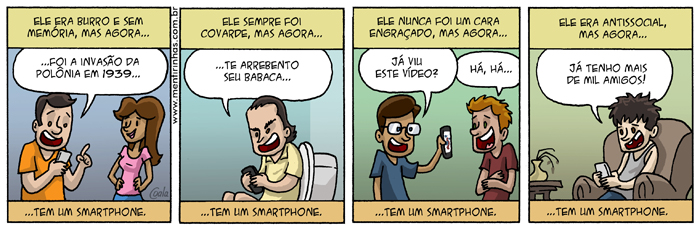
Mentirinhas #724

by Fábio Coala

mentirinhas_713Saudade daquela época em que as pessoas não olhavam a cada dez minutos no celular.


O post Mentirinhas #724 apareceu primeiro em Mentirinhas.

13 Nov 17:09

Sketchy Report Claims Apple May Discontinue iPad Mini to Focus on 'iPad Pro'

by Juli Clover
Apple may be planning to discontinue its iPad mini lineup in order to focus its efforts on the upcoming larger-screened "iPad Pro," according to a somewhat questionable rumor from Taiwan's Economic Daily News [Google Translate] (via GforGames). The site believes Apple will cease updating the 7.9-inch iPad mini next year, making the new iPad mini 3, released in October, the last tablet in the series.

A preference towards larger screen sizes, the introduction of the 5.5-inch iPhone 6 Plus, declining iPad sales, and "fierce competition" in the tablet market are said to have led to Apple's alleged decision to discontinue the tablet.

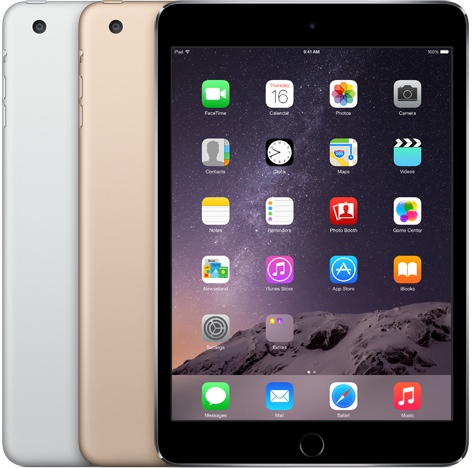
ipadmini3
It was a bit of a surprise when Apple announced a major update to the iPad Air in October, introducing an upgraded A8X processor, Touch ID, slimmer form factor, improved camera, and more in the iPad Air 2, while the iPad mini 3 gained no new features aside from Touch ID support. Rumors have suggested that the relatively minor update was due to the iPad mini's lack of popularity compared to the 9.7-inch iPad Air.

Apple has been known to pull resources away from products that are not selling well. For example, Apple has been investing fewer resources in the iPod touch, a device that no longer receives regular updates. The fifth-generation iPod touch was released in 2012 and while the device received a major update at that time, only a few changes have been made since then, tweaking storage capacities and prices. It's possible the iPad mini could go the way of the iPod touch -- remaining in the product lineup but receiving few updates.

Economic Daily News, much like Taiwanese news site Digitimes, appears to have some solid supply chain sources, but lack of context and ever-changing production plans have resulted in some serious rumor misses. For example, the site said that the iPad mini 3 would be 30 percent slimmer when it launched, and suggested the larger iPhone 6 Plus would not be called an iPhone. Some accurate information has come from Economic Daily News, however, including several correct rumors pointing towards Apple Watch sizing and release dates.

Apple's "iPad Pro," which is said to be replacing the iPad mini as a companion to the iPad Air, is rumored to have a screen size between 12.2 and 12.9 inches. It's said to be slightly thicker than the iPad Air 2, coming in at around 7mm, and it may have stereo speakers and an ultra high-definition display. A release date for the iPad Pro remains unclear, as Apple was said to be targeting an early 2015 launch but pushed back production in order to focus on the iPhone 6 Plus.


13 Nov 17:06

Microsoft Adding Dropbox Integration to Mobile and Web Office Suites

by Kelly Hodgkins
Microsoft and Dropbox today announced a partnership that will bring Dropbox support to Microsoft's suite of Office mobile apps. Microsoft will add this new Dropbox feature in upcoming versions of Word, Excel and PowerPoint for the iPhone and iPad.

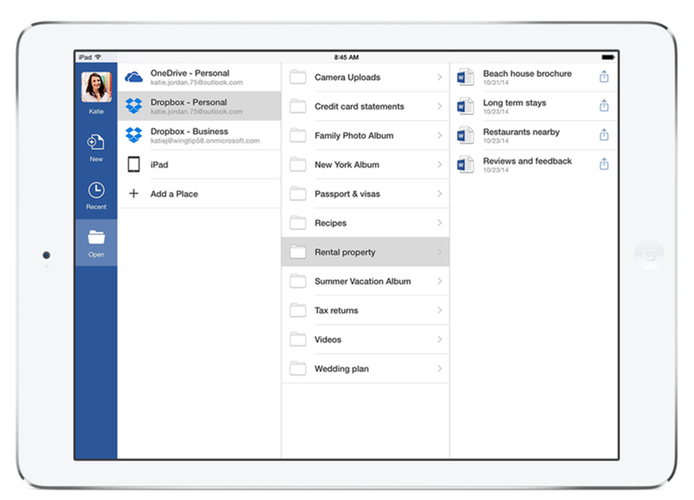
office apps
The new Dropbox integration would allow Office users to open, edit and share files that are stored in Dropbox. After adding a Dropbox account to an Office app, users will be able browse their Dropbox contents, which appear alongside OneDrive and locally stored files. All mobile edits will be synced to Dropbox automatically with a sharing option available within the Office app.
Over the coming weeks, we’re updating Office apps so that they work with Dropbox, too. With the next updates to Word, Excel and PowerPoint on iPhone, iPad and Android Phone you’ll be able to connect to your Dropbox account, so you can access, edit and share your Dropbox files right from your Office apps. Once you’ve added your Dropbox account to Word, Excel or PowerPoint, you can navigate folders and files on Dropbox for viewing and editing in the native Office apps. And accessing Word, PowerPoint and Excel from your Dropbox app is just as easy. Navigate to the file you want, and the Dropbox app will open the Office app you need.
This collaborative effort is only in the beginning stages, with plans to expand Dropbox integration to other Microsoft products over time. After updating its mobile apps in the coming weeks, Microsoft is planning to add Dropbox support to its Office online web apps early next year.


13 Nov 16:54

Emoji to Gain Expanded Racial Diversity With Skin Tone Modifier Option in Mid-2015

by Mitchel Broussard
The Unicode Consortium has released a technical report (via Emojipedia) detailing a new method for handling the representation of multi-ethnic groups in emoji. Previous guidelines have stated that emoji people be "as neutral as possible regarding race, ethnicity, and gender". Unless the emoji calls out specific gender or racial cues, then a "generic (inhuman) appearance, such as a yellow/orange color or a silhouette" should be used in its place.

A forthcoming update, Unicode 8.0, plans to change all of that. It proposes to introduce a skin-tone modifier which could be added to certain emoji, allowing users to send any emotion using any skin tone. Plans even reach as far as to allow emoji couples to feature individually different skin tones. Planned for release in the middle of next year, Unicode 8.0's skin tone and racial diversity proposals are only proposed drafts at the current stage.

rmcxpoczekf4cg_smallMockup via Emojipedia
Although the wide acceptance of new emoji is rather slow-going (no major platforms yet support Unicode 7.0 emoji released earlier this year), Apple has shown previous interest in updating the diversity in its emoji lineup. Earlier in the year, Apple's then-vice president of worldwide corporate communications, Katie Cotton, spoke to vocalized support in working with the Unicode Consortium and updating its emoji character offerings.
"Tim forwarded your email to me. We agree with you. Our emoji characters are based on the Unicode standard, which is necessary for them to be displayed properly across many platforms. There needs to be more diversity in the emoji character set, and we have been working closely with the Unicode Consortium in an effort to update the standard."
The most recent major change to emoji on Apple platforms was for iOS 6, when the company expanded native support beyond Japan and made the feature accessible to all users without the use of a third-party app.

Note: Due to the political nature of the discussion regarding this topic, the discussion thread is located in our Politics, Religion, Social Issues forum. All forum members and site visitors are welcome to read and follow the thread, but posting is limited to forum members with at least 100 posts.


13 Nov 16:51

Researchers Discover New 'WireLurker' Malware Affecting Macs and iOS Devices in China [Updated]

by Juli Clover
lightning_usb_cable_0_5_mResearchers from Palo Alto Networks (via The New York Times) have published a research paper on WireLurker, a malware new family that's been infecting both Mac OS and iOS systems over the course of the past six months. The researchers say that WireLurker, which is targeting users in China, "heralds a new era in malware attacking Apple's desktop and mobile platforms."

The WireLurker malware is the "biggest in scale" in the trojanized malware family, and it is able to attack iOS devices through OS X using USB. It's said to be able to infect iOS applications similar to a traditional virus, and it is the first malware capable of installing third-party applications on non-jailbroken iOS devices "through enterprise provisioning."

Thus far, WireLurker has been used in 467 OS X apps in the Maiyadi App Store, which is a third-party Mac app store in China. The apps have been downloaded 356,104 times, infecting hundreds of thousands of users.

According to the researchers, WireLurker looks for iOS devices connected via USB to an infected Mac, installing malicious third-party applications onto the device even without a jailbreak.
WireLurker monitors any iOS device connected via USB with an infected OS X computer and installs downloaded third-party applications or automatically generated malicious applications onto the device, regardless of whether it is jailbroken. This is the reason we call it "wire lurker". Researchers have demonstrated similar methods to attack non-jailbroken devices before; however, this malware combines a number of techniques to successfully realize a new brand of threat to all iOS devices.

WireLurker exhibits complex code structure, multiple component versions, file hiding, code obfuscation and customized encryption to thwart anti-reversing. In this whitepaper, we explain how WireLurker is delivered, the details of its malware progression, and specifics on its operation.
Once installed, WireLurker can collect information from iOS devices like contacts and iMessages, and it's able to request updates from attackers. It's said to be under "active development" with an unclear "ultimate goal."

Palo Alto Neworks offers several recommendations for avoiding apps infected with WireLurker, including an antivirus product and Mac App Store installation restrictions that prevent apps from unknown third parties from being installed. Users should not download and run Mac apps or games from third-parry app stores, download sites, or other untrusted sources and jailbreaking should be avoided.

Unknown enterprise provisioning profiles must be avoided as well, and users should avoid pairing their iOS devices with unknown computers or charging with chargers from untrusted or unknown sources.

Palo Alto Networks has notified Apple of the malware, but an Apple spokesperson declined to offer a comment.

Update: Apple has issued a statement to iMore about the issue:
"We are aware of malicious software available from a download site aimed at users in China," an Apple spokesperson told iMore, "and we've blocked the identified apps to prevent them from launching. As always, we recommend that users download and install software from trusted sources."


13 Nov 16:48

How to Enable Text Message Forwarding and Answer Phone Calls on Your Mac [iOS Blog]

by Richard Padilla
With the release of OS X Yosemite, Apple has included a new set of "Continuity" features that connect iOS devices and the Mac in a number of ways. Most notably, Continuity allows users to place and answer calls with their Macs and iPads that are forwarded through the iPhone.

Similarly, Macs and iPads can now receive SMS messages, even ones sent from non-Apple devices. Before the launch of iOS 8.1 and OS X Yosemite, Macs and iPads could only receive iMessages, as SMS messages were limited to the iPhone via traditional delivery. iMessages are a part of Apple's proprietary messaging service made for the iPhone, iPad, and Mac, while SMS messages are usually intended for communications between mobile phones. Users can now also send SMS messages to any kind of device from the Mac and iPad. Apple previously referred to this feature as "SMS Relay" before the debut of iOS 8.1, but officially refers to it as "Text Message Forwarding" in the Settings app.


The ability to answer calls and SMS messages on a Mac is especially useful when an iPhone is across the room charging or otherwise inaccessible. The iPhone being used to relay calls and texts can even be in sleep mode, meaning that users can manage all incoming calls and text messages entirely through their Mac and iPad.

Before You Start


You need iOS 8.1 and OS X Yosemite in order to forward phone calls and SMS messages from your iPhone to your Mac or iPad. You also need to make sure that both your Mac and iPhone are logged into the same iCloud account. Phone calls and SMS routing are compatible with any iPhone and iPad running iOS 8.1 and any Mac that supports OS X Yosemite. Also, the Wi-Fi calling feature needs to be off to enable call forwarding, so ensure it is disabled by going to by going to Settings > Phone > Wi-Fi Calls.

Steps to Enable Text Message Forwarding


1. Turn on Wi-Fi on your iPhone (Settings -> Wi-Fi) and Mac (Menu Bar -> Wi-Fi -> Turn Wi-Fi On. SMS forwarding will still work between the Mac and an iOS device even if both are using different Wi-Fi networks.

2. On your Mac, open the Messages app and navigate to Menu Bar -> Messages -> Preferences -> Accounts -> Click on iMessage account -> Check the boxes next to your phone number and email. If your email is not listed, click Add Email and enter your email.

3. On your iPhone, add your email address to your iMessage by going to Settings -> Messages -> Send & Receive. A registered email for iMessage is required in order to enable text message forwarding.

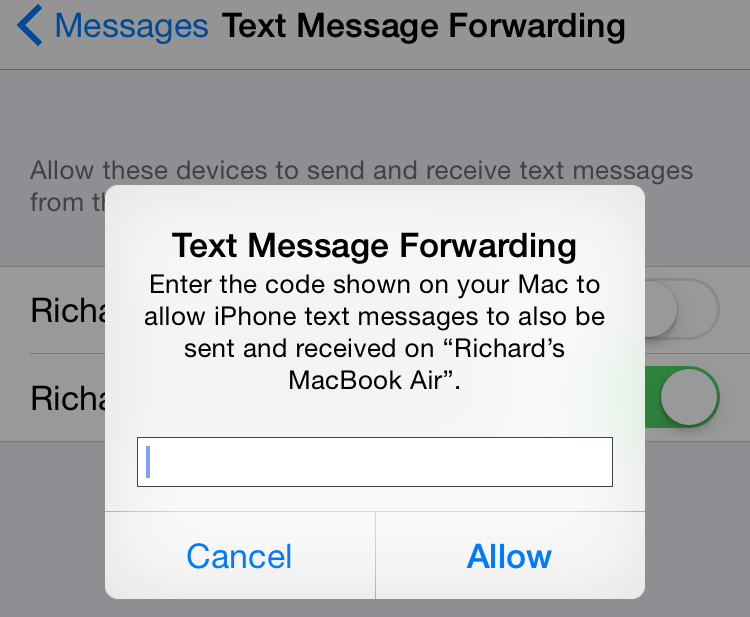
4. Turn on Text Message Forwarding on your iPhone by going to Settings -> Messages -> Text Message Forwarding -> Turn Text Message Forwarding On. A prompt will appear asking you to enter an activation code. The activation code will appear in your Mac's Messages app. Enter the activation code from your Mac in the prompt shown on your iPhone. An activation code is required for every device that you want to include in text message forwarding.

smsforwarding
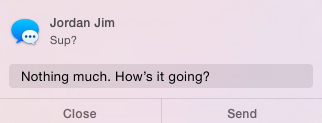
5. You will now be able to answer any incoming text message on your Mac. Text messages sent to your iPhone will also automatically appear as a push notification on your Mac in the upper-right corner. When a text message appears, you can answer it by clicking "Reply". Text messages will also appear in the Messages app on your Mac.

textmessageanswering

Steps to Enable Phone Call Forwarding


1. Turn on Wi-Fi on your iPhone (Settings -> Wi-Fi) and Mac (Menu Bar -> Wi-Fi -> Turn Wi-Fi On. Call forwarding requires both of your devices to be on the same Wi-Fi network.

2. Turn on iPhone Cellular Calls on your Mac (FaceTime -> Preferences -> Turn On iPhone Cellular Calls) and iPhone (Settings -> FaceTime -> iPhone Cellular Calls).

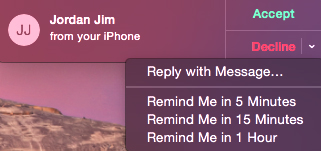
3. You may now begin placing and answering phone calls on your Mac. Incoming calls to your iPhone will appear as a push notification on your Mac in the upper-right corner. When a call appears, you have the option to answer it by clicking "Accept" or ignore it by clicking "Decline". You can also click on the arrow to the right of the Decline option and can then choose to send a text message or create a reminder to return the call later.

phonecallmenu
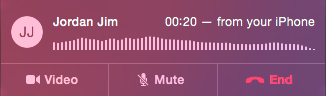
When you're on a call, you can silence yourself by clicking "Mute" or switch to a FaceTime video call by clicking "Video". If another person calls during your current phone call, you will also have the option to click "Hold & Accept" and can even switch between calls by clicking the connected arrows. You can also click "Merge" to merge both calls. If you want to transfer the call from your Mac back to your iPhone, unlock your iPhone tap the "Touch to return to Call" banner.

phonecallanswered
You can also make phone calls from a number of apps on the Mac, including Contacts, Safari, Mail, Maps and Spotlight. For example, you can call a business after searching for its information in Maps, and can highlight and call a phone number when one is displayed in Safari.

phonecallmaps

Troubleshooting


A number of users have had difficulty with trying to enable text message and phone call forwarding for their Macs. For text message forwarding, users on our forums have reported that a combination of logging out and back into iCloud on their devices, turning iMessage off and on in the iPhone's Settings app, disabling and enabling Wi-Fi, and restarting both devices fixed their problems. If the activation code to set up text message forwarding is not showing up on your Mac, ensure that an email address is activated for iMessage on your iPhone. Once again, you can activate an email for iMessage on your iPhone by going to Settings -> Messages -> Send & Receive.

Meanwhile, users attempting to fix problems with call forwarding have found that the most common solutions include rebooting both devices, logging out and back into iCloud on their devices, and turning FaceTime off and back on in the iPhone's Settings app. Other users have found that having Wi-Fi Calling enabled on the iPhone has caused call forwarding to not work, so once again ensure that setting is off by going to Settings > Phone > Wi-Fi Calls.


12 Nov 18:01

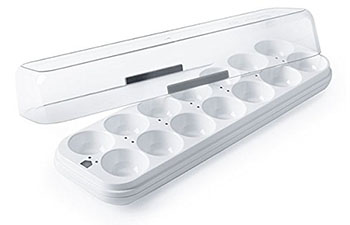
UPDATE: Egg App Is Still Stupid

by drew

quirky-egg-minder-2014

The Quirky Egg Minder, a wi-fi tray which monitors how many eggs you have in it, is now only $24. That’s way cheaper than it was when I wrote about it last year! Unfortunately, it’s still twenty-four bucks too much for an app that’s competing with opening your fridge door.

12 Nov 18:00

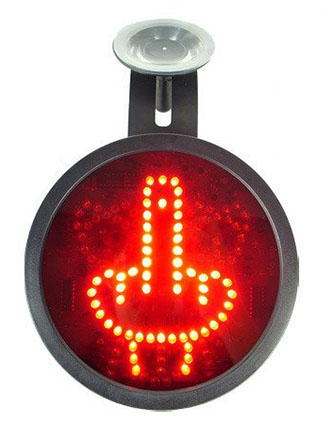
Middle-Finger Car Light

by drew

middle-finger-car-light

Hanging an LED sign for your car that flashes a big red middle-finger graphic to the person behind you at the touch of a button is a great way to become the target of someone’s road rage.

11 Nov 14:35

Quitting Your Job

by Doug

Quitting Your Job

Here’s more quitting!

11 Nov 02:43

My everyday struggle… #9gag


My everyday struggle… #9gag

11 Nov 02:42

A visit to Grandmother. #9gag


A visit to Grandmother. #9gag

11 Nov 02:42

Philosophical cat strikes again! #9gag


Philosophical cat strikes again! #9gag

11 Nov 02:29

It’s so hard to be happy as an introvert… #9gag


It’s so hard to be happy as an introvert… #9gag

11 Nov 02:27

The face of regret. #9gag


The face of regret. #9gag

11 Nov 02:27

Camouflage level 9999. #9gag


Camouflage level 9999. #9gag

11 Nov 02:27

So Whatsapp had unleashed hell. #9gag


So Whatsapp had unleashed hell. #9gag

11 Nov 02:27

Do I look like I am kidding? 👿 #9gag


Do I look like I am kidding? 👿 #9gag

11 Nov 02:27

Let’s play spot the Canadian. #9gag


Let’s play spot the Canadian. #9gag

10 Nov 16:52

Film company does the inevitable: shoots porn using a drone

by Mariella Moon
Here's the deal: if a device has a camera, it will be used to shoot porn. No exceptions -- not even if that device is a drone. Brooklyn film company Ghost+Cow shot a project called, erm, Drone Boning, using only unmanned aerial vehicles. Despite the...
01 Nov 11:51

Alemanha 70 X 1 Brasil

by Alexandre Versignassi

cafe

O porto de Santos é a cafeteira do mundo: um terço do café tomado na Terra passa por ali, numa jornada que começa nas fazendas do Brasil e termina nas xícaras de Madrid, Milão, Moscou, Kiev… Não só nas xícaras. O maior comprador do nosso estimulante preto, ao lado dos EUA, é a Alemanha. Mas eles não tomam tudo. Revendem uma parte razoável, porque é um negocião: os alemães pagam mais ou menos R$ 400 em cada saca de 60 quilos e reexportam para o resto da Europa por R$ 800. Sem industrializar nada, só revendendo café “cru” mesmo, do jeito que ele sai das roças daqui.

Não é malandragem, é logística: eles podem fazer isso graças à sua malha ferroviária cheia de tentáculos, veias e artérias. Reexportar dali para o resto da Europa é fácil. Num ano típico, os caras importam 18 milhões de sacas e revendem 12 milhões. Isso faz da Alemanha o terceiro maior exportador de café do mundo, atrás apenas do Brasil e do Vietnã. Tudo sem nunca ter plantado um pé de café. 

Tem mais. Das 6 milhões de sacas que ficam dentro da Alemanha, uma parte vai para Schwerin, uma cidadezinha de conto de fadas perto da fronteira com a Dinamarca. Por lá, os grãos brasileiros reencarnam na forma de cápsulas de Nespresso. E ganham preços que até outro dia só eram praticados no mercado de outro estimulante – branco. Um quilo dessas cápsulas acaba saindo por R$ 400 no varejo, quase setenta vezes o quilo do café cru. 70 X 1 para a Alemanha.