18. March, 2013
With today's technology, would it be possible to launch an unmanned mission to retrieve Voyager I?
—Elliott Bennett
Voyager I is farther from Earth than any other manmade object. After getting a pair of gravitational kicks from Jupiter and Saturn, it’s headed out of the Solar System at a pretty high speed, and nothing else we’ve built is on track to pass it.
Strangely, as of the day I’m writing this, Voyager is actually getting closer to us, because Earth is in a part of its orbit where it’s approaching Voyager faster than Voyager is fleeing. But in a few months, we’ll swing around the Sun and Voyager will again be getting farther away.

It has a 35-year head start, so it would be hard to catch. But catching up isn’t the problem.
New Horizons, the spacecraft currently headed out of the Solar System by way of Pluto, is never going to catch up to Voyager—it’s not moving fast enough and it’s headed in the wrong direction. But it could have.
The reason Voyager is moving so fast is that it got gravitational assists from Jupiter and Saturn, while New Horizons only got one from Jupiter.

Gravity assists aren’t paradoxical magic. It’s just like bouncing a tennis ball off a passing truck. Gyroscopes, on the other hand, ARE magic.
If New Horizons had ditched the Pluto objective and waited for the right planetary alignment (the 2030s look promising), it could have swung by Jupiter and Saturn, then caught up to Voyager in as little as a century or two! (Assuming we could manage to hit Voyager from that far away. But I bet we could; our rocket scientists are pretty good at rocket science.)
Of course, getting there’s the easy part. The hard part is getting back.
Voyager weighs a little less than a ton and is moving away at 17 kilometers per second (if it were in the atmosphere, that would be Mach 50). And since it’s out in interstellar space, there are no speeding Jupiters to grab on to. Stopping Voyager is going to take a lot of fuel.
It’s what engineers call the tyranny of the rocket equation: As the amount that you want to change your speed (“delta-v”) goes up, the fuel required increases exponentially. The equation tells us that to turn the 720-kilogram Voyager around, we’re going to need at least 30 tons of fuel.
But to get that fuel out there, we need even more fuel. And to get that fuel, we need even more fuel. (This is where the tyrannical rocket equation gets its exponential term.) In fact, to rescue Voyager, we’d have to launch a fleet of—at minimum—60 New Horizons-sized spacecraft loaded with nothing but fuel.
Could we do it? Sure. There are a couple plausible ways. Instead of building five to ten dozen fuel-laden Titan IIIEs, we could just build a fleet of ten or fifteen Saturn Vs, and do the whole thing with fewer launches. But however we did it, it would be a massive and expensive operation similar in scale to the Apollo program.
The difference between the launch vehicle we’d used to get Voyager out of the Solar System and the fleet we’d need for a round trip is striking:

Fortunately, there’s one way around the tyranny of the rocket equation: Ditch the rockets.
Ion engines—which use electric fields to accelerate exhaust gas to high speeds—are far more efficient than chemical rockets, and they make accelerating to high speeds much more plausible.
The reason we’re not using them for everything is that they produce very little thrust, so it takes a long time to get up to speed. It’s like if you had a car that gets amazing mileage but has a one-horsepower engine. (Actually, are you sure that’s not just a horse?) Ion engines are great; the current ones just take forever to get you moving.
But since catching Voyager is going to take a long time anyway, ion engines are fine. We could launch a probe (like this one), send it out to Voyager, latch on, turn everything around, and let it spend a few decades slowing Voyager down.
Once Voyager had lost nearly all its speed, the Sun’s gravity would take over, and the probe would begin a long slow slide toward the inner Solar System. This would take about 200 years, and with some extremely careful nudges, we could make sure it falls in an Earth-crossing orbit.
Two centuries later, Voyager would reach Earth and, with no way to slow down, burn up in our atmosphere, because we didn’t think to send out an aerobraking shell with the rescue craft. So that was a waste of a few centuries of work and billions upon billions of dollars.

Maybe a better idea would be to borrow a salvage vessel and set sail for the coast of New South Wales, Australia. There, in the waters off Jervis Bay, the Australian Royal Navy ship Voyager sank in 1964 after an accidental collision.
That one’s probably easier to retrieve.


For the past few years I have used Google Contacts to store my contacts and Google Calendar to store my calendars. These services really are excellent, particularly because they allow me to keep my data synchronized between my Android phone and numerous instances of Thunderbird on PCs and Laptops. Unfortunately, I have had issues with my contacts becoming duplicated and even disappearing altogether. I figure that out of roughly 500 contacts I have lost around 200. This really got me thinking, I mean, should I really rely on somebody else to look after my data?
I don’t know exactly why Google run these services but that is part of the problem. They are an advertising company, after all, and the more data they can collect about me and the people I know the better they can target me with their adverts. Maybe I am paranoid but now that they are dropping Google Reader I just don’t trust them to the extent that I once did.
Don’t get me wrong, I am not a Google hater, I truly believe that their search engine is excellent and that nothing else comes close to providing such accurate search results, at least when I am not logged in.
There are a number of services that allow this kind of synchronization but I have chosen to use ownCloud as it appears to be the most capable open source solution. I have included installation instructions here for the good of the web.
Follow the instructions here.
At the time of writing, exporting contacts from Google Contacts as a .vcf file only exports one name, phone number and email address per contact. Fortunately, if you export your contacts from an Android phone you will keep all of your contact information including mugshots. To do this:
A file with the .vcf extension will be saved to the root directory of your phone’s internal storage. This file contains all of your contacts including their photos. Transfer this file to your computer via a USB cable or email.
Congratulations, you now no longer need an external service to synchronize your contacts and calendar. As a bonus there are a bunch of ownCloud add-ons that give you much more power than you previously had.
Existem poucas empresas mais odiadas pelos comunistas de butique do que a Coca-Cola, chega a ser divertido ver as acusações bestas, inclusive a de que o Sangue do Capitalismo tira empregos. Devem achar que todas as latinhas são enviadas por drones, de Atlanta, e na volta aproveitam para bombardear orfanatos.
Na verdade a Coca-Cola, tirando ser uma das marcas mais conhecidas do mundo, é uma empresa como qualquer outra, e como toda empresa inteligente, está aberta a novas idéias.
Simon Berry por sua vez é um cara inteligente e sabe que os problemas do mundo NÃO são causados pela Coca-Cola (talvez pela Pepsi), e descobriu uma forma de não odiar o refrigerante, mas usar sua estrutura para melhorar a vida de outras pessoas.
A idéia –genial- é que boa parte do custo de suprir regiões carentes e remotas de países pobres com medicamentos e outros bens essenciais é logística. Você tem que ter equipes de terra, que serão assaltadas, precisam de salários, levam tempo demais para cobrir os territórios e no geral, não funcionam.
Por outro lado, em qualquer lugar do planeta você compra uma Coca-Cola.
Simon diz: Que tal pegar carona na PUTA logística de distribuição da Coca-Cola, aproveitar a capilaridade deles e distribuir os kits junto?
Com isso ele se saiu com a ColaLife, uma ONG que viabilizou o projeto. Um estúdio de design criou uma embalagem especial que se tornou o AidPod:
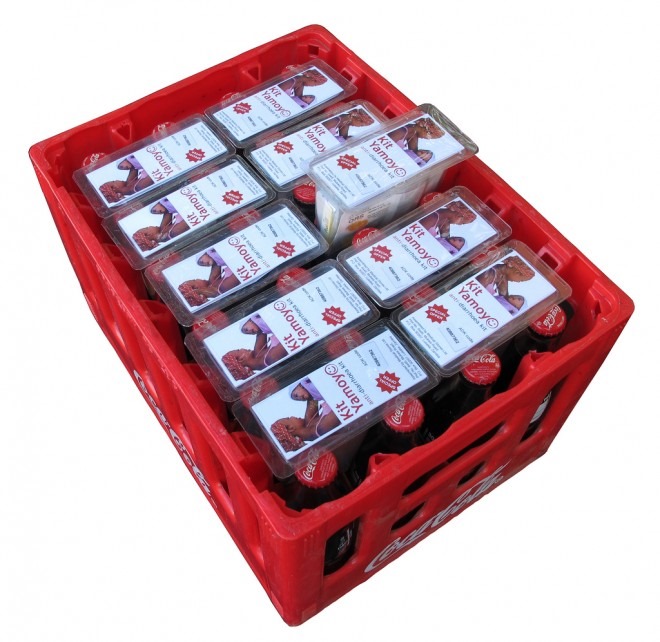
A embalagem é um kit anti-diarréia, uma das maiores causas da mortalidade infantil. Em formato de copo dosador, tem sabão, nutrientes, purificador pra água, tabletes de Sulfato de Zinco e pode significar a diferença entre a vida e a morte para uma criança.

O kit é projetado para ocupar o espaço entre as garrafas nas grades de Coca-Cola distribuídas… em qualquer lugar que Coca-Cola seja distribuída, lembrando que mais gente tem acesso a Coca-Cola do que a água encanada no mundo.
O incentivo aqui é que o Kit é vendido, custa US$1,00 e dura por vários dias. Toda a cadeia de distribuição está levando uma pequena margem, o que é essencial para que o comerciante lá na ponta não jogue os kits fora.
A iniciativa já está em testes operacionais na Zâmbia, e está se mostrando um sucesso. A Coca-Cola soube do projeto e não só deu carta-branca como colaborou com informações dos processos logísticos de seus distribuidores africanos e, provavelmente, com empurrões amigáveis para que eles embarcassem no projeto.
Nada mau para o sangue negro do Capitalismo. Sua vez, Kremlin-Cola.
Fonte: Wired
 Imperdível: leve 5, pague 6! Num supermercado aqui perto de casa.
There’s a treasure trove of excellent yet ancient games made for DOS that are nearly unplayable on modern computers. Awesome games like the Lucasarts SCUMM adventures, the original Civilization and SimCity, Starflight, the King’s Quest series and even Leisure Suit Larry aren’t played much today because of the near impossibilities of getting them to run on modern hardware or setting up an emulator with proper sound.
[Patrick] has been doing his best to help out classic gamers with an x86 emulator for the Raspberry Pi. It’s designed to be a very capable DOS box with 20 MB of extended memory, a 640×480 display with 256 colors, an ~20MHz 486 emulated CPU, and a Soundblaster 2.0 sound card.
There’s still a lot of work to be done, but outside of finding a 20-year-old computer, emulation on a Raspberry Pi it probably the most authentic DOS gaming experience you’ll get.


The career of a web developer is an interesting one with many slopes. Considering a learning curve this steep, you can fully expect to live through periods of frustration, enlightenment, self-righteousness, and every mindset in between. In this article, we’ll have some fun, by reviewing each of these phases through the lens of a meme!

We all have warm feelings for the early days of our careers; the period when you have absolutely no clue what you’re doing. Like a fish out of water, each new line of code is a mystery. Doctype? Huh? What the heck does a <div> do? The first phase is an intimidating, scary, but exciting one. How many dang languages are there?
Perhaps your greatest advantage, though, is that you have no idea how deep the rabbit hole goes. Learning HTML is the baby step.

Though it takes a while, you’ll eventually learn enough to begin taking your first steps into the coding world. While Phase 1 is the overwhelming “how/where do I start” period, Phase 2 is the one in which you slowly begin building your skill-set. Sure, the syntax for defining styles with CSS still feels foreign, but at least you’re able to make a change in your freshly bought code editor and see it reflected in a web browser. That’s a wonderful feeling!

Imagine being lost in a cave, shining your flashlight down each tunnel, as you search for a way out. With each step, you hope to see a glimmer of light. Unfortunately, the learning curve in our industry is a steep one. That speckle of light won’t come for a long time, I’m sorry to say. Expect to spend hundreds of hours in this phase, reading technical books over, and over, and over, as you desperately try to make sense of the madness!
If the frustration becomes too overwhelming, find peace in the fact that every one of us felt that exact way at one point or another in our careers. You’re not alone. Stick with it, and, before long, you’ll reach the aha phase!

An “aha” moment is one of the greatest feelings in the world: that brief instance when, suddenly, you “get it.” “Ohhhhh, now I see!” Personally, I’ve found that these coding break-throughs occur late at night, when the rest of the world is sleeping. After the eighth read, what was once blurry is now, at least somewhat, clear!
This is the phase when all of the technologies and languages you’ve been learning begin to click.

Like it predecessors, the Fragile phase is a lengthy one. At this point, you are successfully building applications and achieving your desired end result, but the underlying code is one client feature-request away from popping. In this phase, your methods are dozens of lines long, and the concept of testing hasn’t yet entered your brain.
But at least you’re building things! For now, though, keep your GitHub pull requests limited to documentation and typos fixes. Don’t underestimate how helpful that can be!

The copycat phase is an important one. There’s no better way to learn proper coding techniques than to spy on the code that your heroes write – even to the point of reproducing their code line by line. Don’t feel badly; every artistic career has its copycat phase! Luckily, GitHub has made this form of silent envy easier than ever before. Of course, copying will only get you so far, but it’s an excellent start! Mimic the people who inspire you, and, eventually, you’ll begin to develop your own style.

At this point, you’re finally beginning to get into a groove. There’s certainly vast room for improvement, but your confidence is quickly rising – perhaps too quickly! They say that, in the first few years, you still don’t know enough to realize just how little you know!
Resist the urge to become too cocky at this stage. It benefits no one, and will only make your future, far more talented, self look back and shake his head. When you feel the need to leave a sarcastic “learn how to code, dude” comment in a GitHub, Reddit, or StackOverflow thread, don’t. It wasn’t too long ago that you, yourself, were a complete noob. Pay it forward; don’t knock people down. We’re all in this together – just at different phases.

If you’ve ever looked over a fellow developer’s shoulder, and found yourself amazed by the speed at which they maneuver in their code editor, then, chances are, they were using Vim. Though it comes with a massive learning curve, once you’ve reached the top, your workflow, too, will look like magic to onlookers!
This is the phase when you begin harnessing, not only your coding techniques, but your workflow as well. Proper tooling is equally as important as technique.

Though it takes thousands of hours, one day, you will look at your code and the ease with which you breeze through the command line, and realize that it’s nothing short of art. Your code is under version-control, well-abstracted, perfectly testable, scalable, and easy to read. At one point in your career, you might have prided yourself on your ability to write cryptic, confusing, but functional code. Leveraging every possible language quirk or hidden feature is not a sign of a mature developer. Neither is reducing complex logic down to a single line, all for the purpose of patting yourself on the pack for being so clever. It instead signals a cocky developer who doesn’t think about the future maintainer of his code.
Code becomes art when its readability is easily as important to you as the action it performs. In this phase, you code for human beings; not machines.

When code becomes instinct, you’ve reached the next phase of your career. No longer do you think in terms of language or framework. Instead, you simply see problems, and choose the correct tool from your coding tool chest to provide the solution. A seasoned developer understands why the cowboy path is rarely the correct route. Each new feature is discussed with all members of the project, whiteboards are prepared, stories are written, and tests are generated…all before writing a single line of production code.
You’ve become a mature, thoughtful developer who others want to work with. Congratulations.

Few make it this level. The rockstar phase is the tip of the mountain. In addition to your day job, you regularly speak at conferences, serve as the lead behind countless popular open source projects, yet still find time to participate and contribute to the future of the web through mailing lists, while simultaneously assisting newcomers on IRC. You’re the type of person who writes compilers and parsers for fun.
You’re what others refer to as rock star or ninja, despite the fact that you hate such labels. You know better than anyone how much more there is to learn!

We won't go too verbose as no words can render the celestial charm of those sites. "A picture costs a thousand words" - they say. So, come on, pack your bags and join our thrilling expedition to the most surreal places on Earth!
Can you imagine that even not all Nevada residents know about this wonder? Fly Geyser is located on the territory of a private Fly Ranch which makes it extremely difficult to access. High fence and locked gate with spikes on top guard the geyser from tourists. To be absolutely honest, we should mention that the Geyser is not a completely natural phenomenon. It was created by chance during well drilling. The well went out of order after several decades of operation as warm geothermal water has found a weak spot and began to leak onto the surface. Dissolved minerals started their sculptor job, which is still going on. Geyser coloration is explained by the variety of minerals it is made of.

The Wave, Arizona
The Wave is a sandstone rock formation in the United States of America near the Arizona and Utah border on the Coyote Buttes slopes. Travelers and photographers from all over the world are attracted by its colorful, wavelike forms. The Wave's intersecting U-shaped troughs are the result of erosion of the Navajo Sandstone during the Jurassic period.

Lake Retba or Lac Rose is located in the north of the Cap Vert peninsula of Senegal. It got its name due to the Dunaliella salina algae making its water look like strawberry milk shake. Pink color is clearly visible during the dry season. The lake is also famous for its high salt content, allowing people stay on the surface similar to the Dead Sea experience.


Have you ever stood at the Hell's Door? Go to Derweze village, which name means "The Gate" in Turkmen language if you search for extreme! This terrifying attraction is located in the middle of the Karakum Desert, about 260 km north from Ashgabat. The Derweze area is rich in natural gas. Soviet geologists got into a cavern filled with natural gas while drilling. Due to the ground collapse, a large hole has created. It was decided to burn off the gas, but the roasting breath of the inferno is still trying to break into the world of living!

Socotra is considered to be a unique archipelago in the Indian Ocean for the diversity of its exotic flora and fauna. Its weird alien plants are the result of island's long geological isolation together with unbearable heat and drought. One of the most unusual Socotra's plants is the dragon's blood tree, resembling a strange umbrella. Aboriginals believed its red sap to be the blood of a dragon.

Have you ever walked through the clouds guessing are you in the top or the bottom? Salar de Uyuni gives you such unique possibility! Salar de Uyuni or Salar de Tunupa is the world's largest salt flat occupying the area of about 10,582 square kilometers. Today's Salar is a result of transformations between several prehistoric lakes. Its surface is covered by a few meters of salt crust possessing the utmost flatness, which varies within one meter over the entire area. Actually, the crust serves as a source of salt and makes a pool of brine, rich in lithium as well. The sky over the Salar is always clear, which in combination with large area and exceptional flatness makes it a perfect object for calibrating the altimeters of Earth observation satellites.

Five-Color Pond is one of the smallest but the most amazing water basins in Jiuzhaigou lakes. Despite the shallowness, it has a breathtaking colored underwater landscape and some of the brightest and clearest waters in the area. As the legend goes, the Goddess Semo used to wash her hair here and the God Dage brought her water every day.

Deadvlei is one more surreal attraction of Sossusvlei, Namibia. It is a clay pan located about 2 km from Sossusvlei. It used to be an oasis with several acacia trees before, but the river that watered the oasis has changed its course. Now the dead acacia trees make an odd contrast to the shiny white salty floor of the pan and the intense orange of the dunes.

Badab-e Surt's terraces are made of travertine, which is a sedimentary rock deposited by flowing water from two distinct mineral springs. Thousands of years the water from these two springs had been streaming down from the mountain, it mixed up and gradually created a number of orange, red and yellow colored pools which now have the form of a staircase.

Yueyaquan is a crescent-shaped lake in the oasis, lying 6 km south of the city of Dunhuang. Its name comes from the Qing Dynasty. The lake itself and the surrounding deserts attract the tourists appreciating camel and 4x4 rides.

The queer lake's hue is normal for water basins with extremely high evaporation rates. During the dry season, as the water evaporates, salinity level increases to the maximum point and specific salt-loving microorganisms begin to thrive. Some of them produce red pigment colorizing the water and turning it into the Martian landscape.

This cave in the glacier appeared as a result of glacial mill. The rain and melt water on the glacier's surface are forming streams that flow into the crevices. The streams melt holes in the glacier forming long ice caves with intricate walls and ceilings. Cold wind finishes the job and we can observe a momentary marvel ready to collapse at any time. Due to the constant glacier movement one can hear a scaring cracking sound inside the cave. The incipient crevices let the indirect daylight into the tunnel and we can observe its mysterious play on ice bubbles.

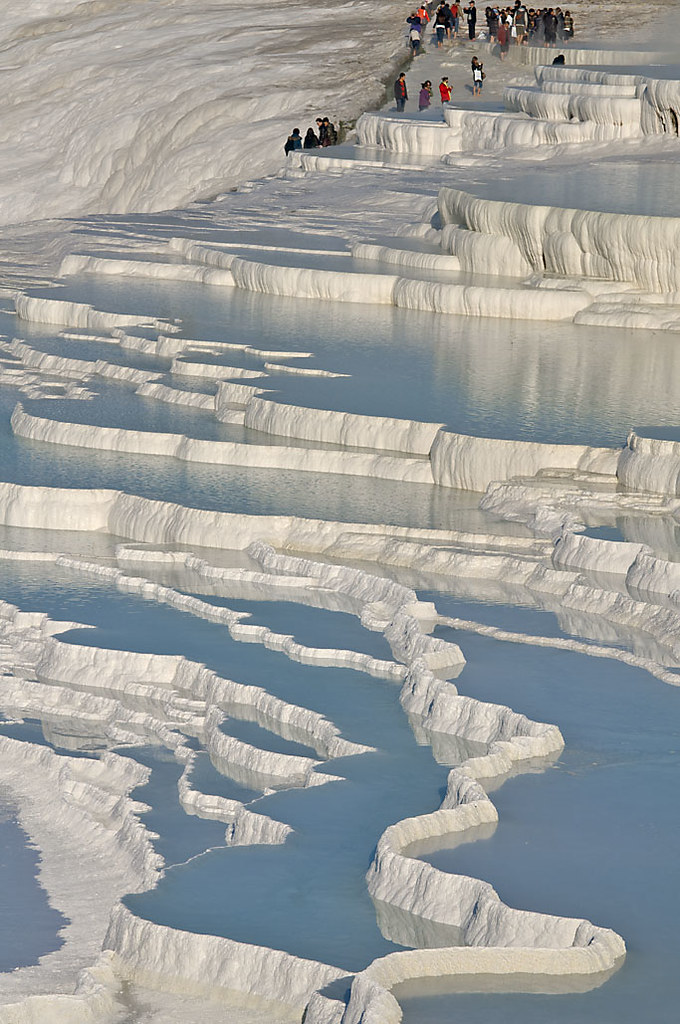
Pamukkale can be translated as "the cotton castle" from Turkish. It is a natural attraction in Denizli Province in southwestern Turkey. Snow white Pamukkale's terraces are made of travertine, a sedimentary rock, deposited by water flowing from the hot springs.
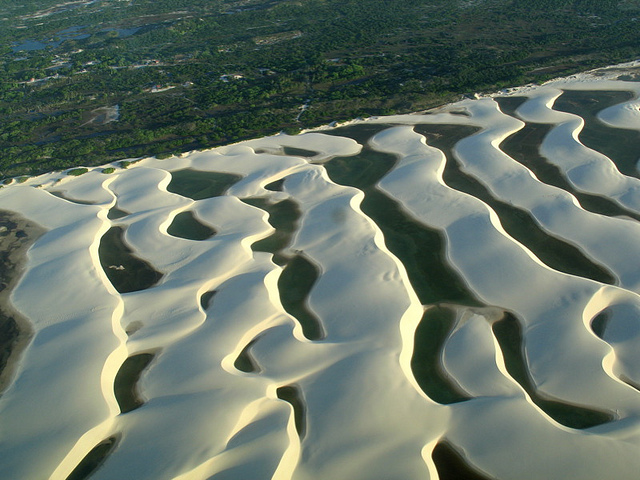
The Lencois Maranhenses National Park is a low, flat, occasionally flooded land, covered with large, white discrete sand dunes. Though it looks like a desert, in fact it is not. Due to the regular rain season in the beginning of the year, fresh water accumulates in the valleys between the sand dunes, reviving the desert with blue and green lagoons. It's rather surprising, but those water basins are inherited by fish, even despite the dry season.
Angkor is a huge complex of the 12th century temples in Cambodia. No doubt that it's a place of historical and cultural interest. The buildings are ancient and magnificent. But what do you think is really strange about this place? Just look at those trees! They look like ancient nation of Ents, the walking trees from "The Lord of the Rings" movie! Do you think they can really exist?

Have you ever seen anything like that? Chand Baori is a famous stepwell in the village of Abhaneri near Jaipur in the Indian state of Rajasthan. It is located opposite Harshat Mata Temple and was constructed in 800 CE. Can you imagine that those 3500 narrow steps in 13 stories extend 100 feet into the ground, making it one of the deepest and largest stepwells in India.

These waves look like decorations from popular "Ice Age" cartoon. It seems as if they were frozen immediately at the will of a snow Queen. In fact, the waves are the result of melting, not freezing. Melting has created those downward pointing spikes, which are simple icicles.

Hidden from stranger's eyes, the beach of Marieta Islands, Puerto Vallarta can be called a lost secret world. Marieta Islands are archipelagos formed as a result of volcanic activity. This natural wonder possesses its unique marine ecosystem. The beach is a real paradise for people fond of snorkeling and scuba diving. Diverse, virgin flora and fauna in combination with transparent crystal water make the experience unforgettable. Humpback whale, sea turtles and dolphins are just a few animals that can be seen there.

The Waitomo Glowworm Caves are definitely worth seeing not only because of their historical and geological significance. The glow worm, Arachnocampa luminosa, is a unique creature living in New Zealand. Thousands of these small worms radiate their otherworldly luminescent light hanging from the cave rocks during your unforgettable boat ride. The glowworms create a really magical view, every tourist should see at least once in a lifetime.

In this photo you see the abandoned railway track, located nearly 350km from Kiev, which has transformed into a special romantic place, frequently visited by couples. The Tunnel of Love is especially beautiful in spring, when the green trees growing from both sides of the track form an improvised arch around it. This arch stretches for up to three kilometers and looks like a green picturesque tunnel of trees. The railway is occasionally used by the fiberboard factory, which preserves the tunnel in its initial look.

Glen Brittle is a large glen in the south of the Isle of Skye, in Scotland. The magic Fairy Pools you see in the picture run down from the mountains into the glen. The area is extremely popular among hikers and mountain bikers. The marvelous lilac slopes above the Fairy Pools are covered with thick forests full of rare plants and animals and who knows, maybe even elves and fairies have found their refuge in this mystical place.

Cano Cristales is a unique biological wonder often referred to as "the river of five colors" or "the river that ran away from paradise" and "the world's most beautiful river". Greater part of the year, Cano Cristales looks like any other river, but during a brief period of time yearly, it bursts into blossom and turns into the vibrant explosion of colors. Between wet and dry seasons, when the water level is just as required, a unique Macarenia clavigera plant turns the river into a sparkling ruby red stream, contrasting to the patches of yellow and green sand, blue water, and the enumerable shades in between.

This rock soaring in the clouds is called Mount Roraima, the highest mountain of the Pakaraima chain of tepui plateau in South America. The mountain includes the triple border point of Venezuela, Brazil and Guyana. The tabletop mountains of the park are considered some of the oldest geological formations on Earth, dating back to nearly two billion years ago. The mountain's highest point within Venezuela is Maverick Rock, which is 2810 m high.

Look into the Eye of Sahara, isn't it impressive? The Richat Structure is a prominent circular feature in the Sahara desert lying in the west-central Mauritania near Ouadane. This structure is a deeply eroded, slightly elliptical dome, 40-km in diameter. Differential erosion of the resistant layers of quartzite has created these high-relief circular cuestas. Its center consists of a siliceous breccia covering an area of approximately 3 km in diameter. Initially, there was a theory that the structure appeared as a result of an extraterrestrial asteroid impact. Looking at the circularity of the Eye, you might be inclined to believe it, but the point is now argued to the favor of highly symmetrical and deeply eroded geologic dome.

If you want to see something really magnificent, put Grand Prismatic Spring in Yellowstone National Park, Wyoming into your list. This hot spring is the largest in the United States and the third largest in the world. The devilish colors of the spring strike the imagination! The water is saturated blue, with red lava-like color surrounding it. Would you like to know the secret? This amazing tint is produced by the pigmented bacteria. They form microbial mats around the edge of the water. Seasonal temperatures as well as levels of chlorophyll and carotenoids greatly influence the hue of the bacteria. The mats do not form in the center of the spring because the water is too hot for bacterium's live cycle. The water is heated by the underground vents, which are a part of the volcanic system, the Yellowstone stands on.

Helga Moreno is a copywriter for TemplateMonster Blog and one of those bloggers, absolutely cranky on writing and always hungry for new experience. When not writing about WordPress or responsive design, she loves sightseeing and travelling and always strives to capture everything beautiful on her way.
Tags: inspiration photography surreal places earth guest guest post
Muito tempo atrás nem impressões digitais existiam. Quer dizer, elas existiam mas ninguém sabia o que fazer com elas. As técnicas de investigação forense avançaram muito, ao ponto em que CSI é só exagero, não mentira pura, exceto na hora de criar GUIs em Visual Basic.
Uma dessas técnicas é o reconhecimento facial, bem mais preciso e eficiente do que retratos falados, e agora que temos câmeras por todos os lados, ficou mais fácil ainda enquadrar um elemento que pisou na bola e mostrou a fuça.
A Polícia de Nova York tem inclusive um grupo especializado nisso, a Unidade de Reconhecimento Facial. (aguardem Lei & Ordem: FRU)
Agora estão expandido. Não só usam imagens de câmeras de segurança como fazem datamining de Facebook, Google, Instagram e outras fontes, para identificar os suspeitos. Como criminosos além de supersticiosos são burros, participam ativamente de redes sociais, sem entender que ao postar trocentas fotos, junto com perfil, dados, dias, horários, amigos, conhecidos e associados estão entregando de bandeja sua vida para as autoridades.
Aqui entra o clássico quem não deve não teme, mas se você deve e sai mostrando a fuça por aí, é BURRO.
O melhor é que o trabalho da FRU é bem ágil, não dependem de ordens judiciais, usam informação pública. Não constitui sequer invasão de privacidade. O trabalho só engastalha quando chega na parte de mandados de busca, mas estão acostumados.
Um dos casos mais fáceis foi uma vítima que teve jóias roubadas pelo namorado de uma conhecida. Ela não sabia o nome do elemento, mas apontou o cidadão numa foto do Facebook, e os puliça fizeram o resto.
Até hoje a multidão era uma excelente forma da bandidagem se esconder, mas com a tecnologia conseguimos ser indivíduos mesmo dentro de um mar de pessoas. Quem quiser levar uma vida de crime terá que se exilar do convívio social, e principalmente, parar de se gabar de seus crimes.
É possível? Até seria, mas convenhamos, criminosos fora Lex Luthor raramente são gênios.

Fonte: DNI

 |
 |

Submitted by: igcse
Posted at: 2013-03-25 04:10:43
See full post and comment: http://9gag.com/gag/6899818


In a scientific discovery some five decades in the making, the findings of scientists and engineers at the Large Hadron Collider have confirmed the existence of the long-theorized Morgan Freeman. First hypothesized by physicist Peter Higgs in 1964, Freeman’s stately presence and velvety voice are said to be the sources of gravitas and dignity in films where such qualities wouldn’t otherwise exist. Freeman was one of the major quarries of the Hadron Collider, the massive particle accelerator located some 175 meters below the France-Switzerland border that was previously used to simulate the spontaneous creation of a six-part BBC nature documentary narrated by Richard Attenborough. Though not prepared to report their complete findings, officials for the European Organization for Nuclear Research are currently wondering if a less-expensive Shawshank Redemption joke could’ve been achieved with a hole in a wall and a big goddamn poster.

[photo by @grimkat; h ...
Read more


Here's TammieRD's compilation of all the alternate endings to the Animaniacs theme song, each better than the last. As I mentioned before the complete seasons 1-3 DVDs are a huge hit around our house. Really some of the best kids' (and grownups') TV of the last century.
Animaniacs alternate theme song lyrical endings
(Thanks, Fipi Lele!)
Engana-se quem pensa que eu não sobreviveria ao primeiro dia usando o Nexus 4. Hoje vou falar sobre quais foram minhas primeiras impressões a respeito do aparelho, quais minhas expectativas e as minhas primeiras horas utilizando o telefone.
Muitos falam que Android você não usa, você contrai. Isso talvez funcione como uma piada, mas na prática não há nada de verdade. O grande diferencial do Android em relação ao iOS é que ele é mais democrático. Obviamente por ser aberto, terá muito mais problemas, mas a vantagem disso é que há dezenas de fabricantes com celulares para todos os bolsos. iPhones são muito bons mas continuam sendo muito caros.
Para entender melhor os motivos que me levaram a abandonar o iPhone depois de possuir 5 modelos, vou falar sobre minha experiência e expectativa de uso. Por trabalhar com/na Internet, usar muito o telefone é quase que mandatório. Responder emails na rua, usar o WhatsApp, navegar e até mesmo agendar posts é possível dessa forma. Porém, eu imagino que em algum momento a lógica seja subvertida e os smartphones ganhem outro nome. Ao menos no meu caso, telefonar é a coisa que menos faço no aparelho. Os celulares modernos são mais computadores do que nunca.
Por quase nunca fazer/receber ligações, meu uso concentra-se muito mais nos olhos que nos ouvidos. Não sei exatamente quantas horas por dia passo olhando pro celular, mas não são poucas. Passo mais tempo nele do que no computador. Anos atrás você só olhava pro celular pra discar um número, passar uma mensagem ou jogar cobrinha. Dessa forma, sempre achei que uma tela grande demais seria exagero ou que eu não sentia falta de 1 polegada a mais de tela, mas é mais ou menos quando a banda larga surgiu no Brasil. As pessoas diziam “pra que você vai ter Internet 24/7 se você só fica meia hora por dia?”. Ninguém ficava muito tempo porque era lento e caro, não era algo que estava a disposição o tempo inteiro. Era mais ou menos assim que eu pensava sobre a tela, já que não ficava muito tempo no celular, uma tela grande demais era desnecessário pois as tarefas mais complexas eu faria no computador.

Globalização: foto de um Nexus 4, tirada com um iPhone 5 em cima de um teclado Microsoft.
Acontece que mesmo trabalhando em casa, eu fico muito mais tempo no celular do que no desktop. É mais prático para a maioria das tarefas e eu fico livre para circular pela casa. No desktop fico preso dentro do escritório. Com o celular na mão eu consigo vigiar meu filho e trabalhar ao mesmo tempo. Obviamente algumas tarefas vão demandar que eu sente na cadeira e utilize teclado e mouse, mas elas são minoria. Resumo: passando tantas horas olhando pro telefone, a tela do iPhone começou a parecer muito pequena.
Ao manusear o Nexus 4 nas primeiras horas, não senti muita diferença com relação ao tamanho da tela. Achei que seria incômodo segurar um celular tão grande, mas me enganei. O uso, apesar das dimensões é bem confortável. Mas o que me fez perceber que realmente eu tinha tomado a melhor decisão aconteceu minutos depois, quando fui usar o iPhone 5 de novo. Eu me senti como Guliver usando um celular de Lilliput. A tela simplesmente era pequena demais! Mais ou menos a mesma sensação de usar um tablet e voltar pro celular. A sensação de usar o iPhone 5 depois de passar um tempo com o Nexus na mão foi de frustração, quase desgosto. Não dava vontade de ficar usando o telefone da Apple, 1h depois eu já achava a tela pequena demais.
Concluindo: para mim, que faço um uso constante, porém básico de um smartphone (emails, mensagens, fotos e redes sociais), o mais importante nesse momento é uma tela confortável para visualizar o conteúdo. E o iPhone nisso peca em duas coisas fundamentais: a tela é muito pequena e muito estreita. Não será estranho se num futuro próximo a Apple lançar um iPhone 5S ou mesmo um iPhone 6 com uma tela bem maior.
Amanhã falarei sobre apps, a configuração inicial e como é migrar do iOS para o Android. Até lá!
Leia também:

|
|

Hoje as interwebs quase não acreditaram quando a Ana Maria Braga dedicou parte de seu programa para falar de… impressão 3D. Fora momentos divertidos como ela segurar um crânio 3D e chamar de cérebro, foram mostradas várias tecnologias, gente que já utiliza impressão 3D como forma de produzir arte, e foi traçado um perfil bem promissor da tecnologia, mesmo com o especialista consultado sendo realista e dando prazo de 5 a 10 anos para a popularização.
Minha birra com a impressão 3D todo mundo conhece: É uma tecnologia em sua pré-história, que já realiza pequenos milagres, mas tem tanto potencial que me deixa impaciente, pois sei aonde ela pode chegar. Só que os desafios para essa popularização e evolução dependem de uma área crítica, essencialmente de uma empresa, a Autodesk.
Eles são “A” referência (fora o Blender e o FreeCad) em 3D, Metade do faturamento da empresa vem do Ouro dos Oscars de efeitos visuais que ganham todos os anos, possuem softwares de modelagem e simulação capazes de criar as mais complexas estruturas mecânicas e mandá-las direto para uma impressora 3D.
Do mesmo jeito que o Adobe Ilustrator gera imagens maravilhosas e inesquecíveis, mas na minha mão não sai uma linha reta.
Essas empresas vendem ferramentas, que facilitam o trabalho mas demandam uma curva de aprendizado longuíssima. Modelar algo em 3D que vá além de um sólido básico um uma chaleira vai além da capacidade do geek mediano, e passa longe de ser uma atividade de leigos. A Autodesk nem ninguém tem NADA que facilite essa área, pois é algo que não pode ser facilitado.
Existem idéias de utilizar Kinect para capturar modelos, mas aí partimos de algo existente. Se eu quiser imprimir uma estátua da Luciana Vendramini na minha linda PowerSculpter 3D 3000 teria que passar horas escaneando-a, limpando o modelo, corrigindo erros em vértices, e convenhamos, seria abusar da paciência da menina
Isso, claro, se eu tivesse competência para mexer nas ferramentas da Autodesk. Ou na Luciana Vendramini.
Se a Autodesk, ou os proverbiais dois caras numa garagem quebrarem o código e conseguirem uma forma de facilitar a vida dos criadores de modelos 3D, irão se afogar em dinheiro, criarão O padrão, tornando a modelagem algo simples como subir um vídeo para o YouTube, atividade que é feita sem conhecimento de codecs, resolução, framerate e qualquer outra das centenas de tecnologias envolvidas.
Não acho que vão conseguir, mas não considero que isso seja um beco sem saída. Afinal, quantas músicas a Apple produz por ano?
O grande sucesso do iTunes e da Amazon é a comodidade: Automatizaram o processo de disponibilização, venda e gerenciamento de conteúdo digital, tirando do usuário a responsabilidade de fuçar em seus equipamentos e softwares. Não há sofrimento em comprar uma música no iTunes ou um livro para o Kindle. Se 0,1% dos usuários Apple souber que as músicas do iPod são em formato AAC, eu me surpreenderia. O usuário da Amazon também não tem muita idéia do que seja AWZ, só sabe que clicou e o livro apareceu automagicamente no Kindle.
A Autodesk deve investir nos próximos anos criando versões econômicas de suas ferramentas, escondendo complexidade e até disponibilizando gratuitamente para criadores que disponibilizem seus momentos na 3DStore deles. Ao mesmo tempo precisam brigar por formatos unificados entre os vários fabricantes, aproveitando de seu know-how para dar um passo adiante.
Imagino uma App em um tablet acessando uma loja online, fazendo a interface entre os modelos disponíveis e a impressora, atrelada a um desktop. Se eu só quero imprimir uma capa de iPhone, não deveria precisar abrir um arquivo .3DX (ou seja lá a extensão) num Inventor da vida, meus livros não são abertos do Indesign quando os baixo.
Idealmente essa aplicação teria funções de replicador. Imagine que você tire uma foto de um botão ou outro objeto, uma busca seja feita e caso o objeto exista em algum banco de dados, é baixado e impresso. Agora imagine que caso não exista você possa mandar várias fotos para uma área comunitária e voluntários modelem o negócio, ganhando pontos de karma por isso.
Essa tecnologia só vai pegar se se tornar social. Não há problema em modelagem 3D ser algo complicado e sob domínio de poucos, se no Universo atual esses poucos ainda assim são um monte de gente.

|
|

Talvez em 1985 se comprasse plutônio em farmácias, mas hoje em dia não é tão simples botar as mãos em alguns quilogramas de Pu-238, e isso para a NASA é um problema, pois precisa desse elemento para suas missões.
Calma, como expliquei neste artigo, a NASA não usa reatores nucleares na Curiosity nem em nenhuma de suas naves. Não que não tenha sido tentado. Em 1965 os americanos testaram um satélite com um reator nuclear, o SNAP-10A, e entre 1967 e 1988 a União Soviética colocou em órbita nada menos que 33 satélites alimentados por reatores nucleares. Sim, houve acidentes, contaminação, a festa toda.
Os RTGs – radioisotope thermoelectric generators não tem nada a ver com isso. Não funcionam com fissão nuclear, não atingem massa crítica nem explodem. Se resumem a usar o efeito Peltier-Seebeck, que aprendemos no colégio: Um conjunto de dois condutores diferentes, quando aquecidos, produzem uma corrente elétrica. Os RTGs são basicamente isso: pedrinhas que geram calor por decaimento radioativo (como a de PuO2 acima) junto de condutores.
Com a meia-vida de 88 anos do Pu-238, um gerador desses funciona por um LONGO tempo. A Voyager 1, lançada em 1977 e dotada de 3 RTGs terá energia pelo menos até 2025.

Aqui podemos ver, no canto esquerdo o cilindro preto com aletas de resfriamento, é o RTG da New Horizons, sonda lançada em 2006 e que se tudo der certo passará por Plutão em 2015. São 11 kg de plutônio que além de energia elétrica ajudam no aquecimento da sonda, mesmo truque usado pela Curiosity.
O lado ruim é que com tantas missões a NASA ficou sem plutônio, por vários anos comprava dos russos, na falta dos líbios. Com o fim do acordo em 2010, tiveram que correr atrás, chegando a reciclar plutônio de missões canceladas.
Agora iniciaram um projeto junto com o Departamento de Energia para produzir 1,5 kg por ano. Não resolverá o problema, mas amenizará a situação. Nas condições atuais o estoque da NASA dura até 2020.
É possível criar RTGs com outros isótopos, mas o Pu-238 é o ideal, pois a maior parte de sua emissão radioativa é de partículas alfa, núcleos de hélio, com dois prótons e dois nêutrons. Uma folha de papel é suficiente para bloqueá-las, o único risco é se você for burro o bastante para comer o Plutônio.
Claro, se começarmos a lançar missões tripuladas, ou mais sondas para o Sistema Solar exterior, onde painéis solares não funcionam direito, teremos uma escassez de combustível, e aí, senta e chora. Mesmo os russos pararam de produzir Pu-238.
Fonte: ET.

|
|