Shared posts

09 May 05:36

Helen Keller was a militant anti-capitalist radical


Today is International Workers’ Day. Happy May Day comrades!
 

“The few own the many because they possess the means of livelihood of all ... The country is governed for the richest, for the corporations, the bankers, the land speculators, and for the exploiters of labor. The majority of mankind are working people. So...

21 May 01:32

kanayahummel: theperksofbeingdornish: ohanameansfamily24: -beh...


kanayahummel:

theperksofbeingdornish:

ohanameansfamily24:

-behindbars:

the-grand-highboob:

thusmylife:

b1ush:

condescendingchristian:

image

oh my god

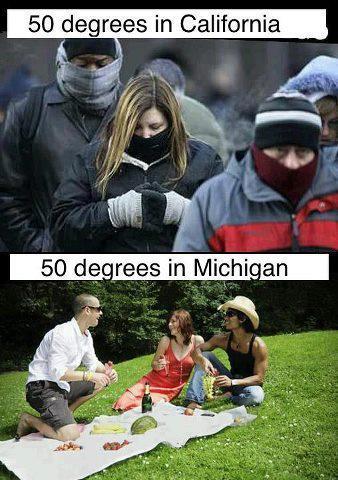
As a person from California, this is 100% accurate

As a person from Michigan, this is 100% accurate

As a person from England I was so confused because I forgot you use the Fahrenheit system 

50 degrees in England 

100 degrees in England


I don’t know why I found the skeletons so funny, it’s almost like they’re dancing really sarcastically?

they’re british skeletons of course they’re dancing sarcastically. 

21 May 01:30

Photo


17 May 15:43

‘Mad X-Men’, A Clever Parody That Shows What Happens When The X-Men Try To Tame Don Draper

by Lori Dorn

Mad X-Men“, a very clever parody created for Quiznos‘ entertainment channel “Toasty TV“, shows what happens when various members of The X-Men team try to rein in the perpetually reckless Don Draper from Mad Men. Needless to say, with these superheroes around, Don doesn’t get to bully people in the way he’s used to.

Peggy it’s not about an appliance. When a man walks into his kitchen in the morning he doesn’t see a toaster, he sees an opportunity a chance to escape the monotony of his life. He knows that when he puts a piece a bread in that magical aluminum box, it will come out transformed – better. He becomes the master of his own destiny. That is what every man wants, not this drivel. Stop wasting my time until you understand what we do here and trying try harder…I mean FANTASTIC work, great job thank you.

via Ross Marquand

17 May 15:11

Study of 1.3 Million Kids Reveals Vaccines Aren't Associated with Autism

by Jason G. Goldman on Animals, shared by Charlie Jane Anders to io9

Study of 1.3 Million Kids Reveals Vaccines Aren't Associated with Autism

A meta-analysis including nearly 1.3 million children posted online last week in the journal Vaccine has demonstrated, once again, that there's no causal link between vaccines and autism.

Read more...


17 May 15:11

cabell: harrysflaccidcock: Someone at my school made these in...


cabell:

harrysflaccidcock:

Someone at my school made these in response to my principal announcing a dress code that, as usual, only applied to girls, and I’m kind of proud

If one of my kids did this, their bedtime would be never.

I want a time machine so I can do this to my high school for our shitty dress code

12 May 00:17

"You keep these kids ignorant and then suddenly they’re in a situation that they don’t even have the..."

““You keep these kids ignorant and then suddenly they’re in a situation that they don’t even have the words for and they have no idea what to do,” she says. “They’re not taught how to ask for consent, how to give consent, how to revoke consent and stop mid-way through. They don’t know to use protection or to demand it if it’s absent, they don’t know this will spread STIs and pregnancy. They don’t know it’s not supposed to hurt. Can you believe that? So, so, so many people think that sex is supposed to hurt the partner with a vagina when they have sex for the first time. They think that’s just the way it is, that’s just how it goes. *That* is obscene to me. Enforced ignorance that inevitably results in physical and emotional damage, *that’s* obscenity.””

- Rich Goldstein asked me what I consider to be obscene in his article on my work, ‘Oh Joy Sex Toy’: The Internet’s Most Radical Sex-Fueled Comic Strip (via erikamoen)
11 May 17:03

Tumblr | cd2.png

cd2.png
09 May 10:36

05.09.2014

Cyanide and Happiness, a daily webcomic

Copy this into your blog, website, etc.
<a href="http://explosm.net/comics/3552/"><img alt="Cyanide and Happiness, a daily webcomic" src="http://www.flashasylum.com/db/files/Comics/Rob/god-jr.png" border=0></a><br />Cyanide & Happiness @ <a href="http://explosm.net">Explosm.net</a>

...or into a forum
[URL="http://explosm.net/comics/3552/"]
[IMG]http://www.flashasylum.com/db/files/Comics/Rob/god-jr.png[/IMG][/URL]
Cyanide & Happiness @ [URL="http://explosm.net/"]Explosm.net[/URL]
<—- Share this comic!

09 May 02:28

johnnythehorse: Shaun Tan 'Never leave a red sock on the...


johnnythehorse:

Shaun Tan

'Never leave a red sock on the clothesline' 2012, oil on canvas, 84 x 73 cm (34” x 30”)

08 May 16:26

Charlie Stross: The Snowden leaks; a meta-narrative

Charlie Stross: The Snowden leaks; a meta-narrative:

At every step in the development of the public internet the NSA systematically lobbied for weaker security, to enhance their own information-gathering capabilities. The trouble is, the success of the internet protocols created a networking monoculture that the NSA themselves came to rely on for their internal infrastructure. The same security holes that the NSA relied on to gain access to your (or Osama bin Laden’s) email allowed gangsters to steal passwords and login credentials and credit card numbers. And ultimately these same baked-in security holes allowed Edward Snowden—who, let us remember, is merely one guy: a talented system administrator and programmer, but no Clark Kent—to rampage through their internal information systems.

The moral of the story is clear: be very cautious about poisoning the banquet you serve your guests, lest you end up accidentally ingesting it yourself. And there’s an unpalatable (to spooks) corollary: we the public aren’t going to get a crime-free secure internet unless we re-engineer it to be NSA-proof. And because of the current idiotic fad for outsourcing key competences from the public to the private sector, the security-industrial contractors who benefit from the 80% of the NSA’s budget that is outsourced are good for $60-80Bn a year. That means we can expect a firehose of lobbying slush funds to be directed against attempts to make the internet NSA-proof.

Worse. Even though the pursuit of this obsession with surveillance in the name of security is rendering our critical infrastructure insecure by design, making massive denial of service attacks and infrastructure attacks possible, any such attacks will be interpreted as a rationale to double-down on the very surveillance-friendly policies that make them possible

07 May 16:26

Why There's So Much Confusion Over Nutrition and Health

by Alan Henry

Why There's So Much Confusion Over Nutrition and Health

If you believed the internet, you'd think there's huge debate over whether eggs, coffee, or salt are good or bad for you. In reality, there's significant agreement on diet and health issues among experts, but the general public is conflicted. So why are we so confused when experts agree? Let's clear the air.

Read more...


07 May 12:10

fuckinstoned: skateeverydamnday: rizelkahle: angelicasucks: Y...


fuckinstoned:

skateeverydamnday:

rizelkahle:

angelicasucks:

YAAAASSSS

GOD FUCKING BLESS THIS WOMAN

THANK YOU!!!!

Wow

07 May 12:10

fuck-yeah-feminist: Neither can we, my badass friend. Neither...


fuck-yeah-feminist:

Neither can we, my badass friend. Neither can we.

06 May 23:45

Photo


06 May 23:44

You Don’t Have To Apologize For Being White — Medium

by hodad

Tal. Hey bro.

I want to talk to you for a minute.

I read your article, ‘Why I’ll Never Apologize For My White Male Privilege’. First off, congrats on landing an article on Time. That’s huge.

And I get it, dude. You’re annoyed with the ‘check your privilege’ line. Hey, I am too. I think it’s overused, and it’s basically turned into a meme at this point.

I read your piece. You’re Jewish. Your family, or at least your family a couple generations ago, had it pretty damn rough. And your dad worked his ass off so that you could have the opportunities that he didn’t. That’s great.

But, I want to talk about this line right here:

It was [my grandparents’] privilege to come to a country that grants equal protection under the law to its citizens, that cares not about religion or race, but the content of your character.

This is where you messed up, bro.

This country actually does care about your race. A lot.

You brought up some of the horrors of the Holocaust. That’s a pretty heavy card to play off the bat, but it’s not going to work on me.

I forgot to tell you: I’m black. And I bet you can already guess where I’m going with this. You want to tell me about the systematic extermination of six million? I see that and raise you to ten million. You want to talk about a few years of forced labor? Let’s try for a few hundred. You seem to be able to trace your family’s history back pretty far. That’s awesome. I can’t, because they didn’t really keep records for property like that back then.

I’m sure that if you wanted, you could come up with some ways that somewhere in history, Jewish people had it rougher than black people. Or maybe even now. And we could go back and forth about this, endlessly.

But realistically, in the court of general opinion on historical victimhood, you’re not going to win. I will. Black people always do.

But really, is this a game that you want to win? Would you like to be at the bottom rung of the social ladder? Is pity what you want?

Probably not. And right there — that annoyed feeling that you probably had when I asked if you wanted people to be sorry for you — that’s the same feeling that a lot of people probably have when you accuse them of coming up with ‘imaginary institutions’.

It’s not imaginary, bro. It’s real.

It’s good that you’ve put effort into understanding your past. But we also need to understand everyone’s present.

What I’m trying to get at here is that bringing up various ways that your ancestors’ lives sucked isn’t a good defense for racism.

I’m not saying that you’re racist (but it’s okay if you are). I’m saying that you are, probably unwittingly, defending the racism that exists in society.

But, let’s stop talking about the past.

Tal, have you ever had a gun pointed at you?

I have, but only by police. The most recent time was when I was driving home and my car broke down, so I walked up to a highway police station for help. As I knocked on the door, two officers came up from behind me out of the bushes, guns drawn, and shouted at me to freeze. It turns out they thought I was trying to rob them. That wouldn’t have happened if I was white.

I bet you worry about your grades, or how you’re going to finish that last paper before the deadline. All college students deal with that. But you’ve probably never had to worry about whether or not you might die at a routine traffic stop. White people don’t have to deal with that. Because you don’t fit the ‘profile’ of a criminal.

That’s part of what people mean when they talk about ‘privilege’.

The ‘equal protection under the law’ you mentioned — it doesn’t quite work that way for people that look like me.

And again, I’m not trying to ‘win’ a comparison game here. I don’t feel sorry for myself, and I don’t want you to either. I could hit you with a ton of scenes from my life that would be hard to imagine for a dude like yourself. On the flip side, you talked a lot about your family, but I bet you’ve personally dealt with some stuff yourself that I couldn’t imagine.

But I can try to understand, which is what I also ask of you.

Tal, I am upset, but I’m not upset at you.

I want you to know that. I’m not upset at you. I’m upset at Time.

I’m upset at Time for publishing your essay. I’m upset at them for taking advantage of you.

I’m a graduate student, Tal, which means I sometimes teach college classes. Next year, I’ll be teaching a writing course. If you’d handed that essay in to me, you’d get, maybe, a C. Your claims just don’t hold water. You’re good at arguing, but not good at thinking (yet).

Your essay isn’t even particularly well written. There are grammatical and spelling errors all over the place. And that overwrought first paragraph, full of bizarre metaphors and SAT vocabulary, is pretty typical of a kid that still thinks that big words make you sound smarter. (Protip: this only works on dumb people.)

But you seem like a bright kid. I’m pretty sure that with a bit more life experience, some patient friends, and some guidance from a dedicated teacher or two, you’ll start to figure things out.

That’s why I’m so upset that Time would let you make a fool out of yourself on the Internet. It’s precisely because you’re such a smart kid. Because in a couple of years, you’re going to look back and feel horribly embarrassed.

I can’t understand why Time would give a kid that hasn’t even decided on his major, that can’t even use a spellcheck, and that can’t formulate a coherent argument, a national platform.

Actually, no. Tal, I think I know why Time did this. I think somebody over there wanted an article that would stir things up, and put the ‘privilege’-shouters in their place. They had a frankly racist agenda, but nobody had the guts to put their name on something so asinine. So somebody found your piece on the Princeton Tory, and scooped it up.

They needed a front. Someone with some credibility. You’re not perfect, but you’re a pretty good fit. You’re young, you’re at an Ivy League, and you’ve got the whole historical victim/rags to riches/American Dream backstory thing going on. Trust me, if some black or Asian or more interestingly ethnic kid had offered to write a similar article, you would have been dropped like a bad habit, for reasons we’ve already discussed. But they took what they could get.

So, Time, you’re not fooling anyone. And that’s really cowardly of you to use a kid who can’t even drink yet to do your dirty work.

But back to you, though, Tal.

Or more specifically, back to us.

You said that you won’t apologize for your privilege. That’s fine, man. I don’t think anyone actually wants you to apologize for anything. Really, all we can ask of you, especially at this early stage in your development of thinking about the world, is that you give it some thought. It’s hard, I know. If it was easy, all the bad stuff we have today — racism, sexism, homophobia, wars, all that — would be gone. But it’s not easy. These are hard problems.

I said earlier that it’s okay if you’re racist. It is. As long as you’re working at it, as long as you’re trying your best to listen, and to understand, and to not be racist, or sexist, or whatever, that’s all anyone can ask. It’s a hard battle, man. I’m racist and sexist too, but I’m doing my best not to be.

I’ll be honest, man. I don’t have an easy solution for you. But I do know that shutting down and rejecting what your friends are saying isn’t going to help, and really, it’s not an option. Your friends aren’t asking for pity, they’re asking you to understand them and work with them.

One last thing.

I can tell that you read a lot. I know you’re probably going to be busy hanging out and discovering life this summer, but I want to recommend a book. It’s called The Fire Next Time, by a really smart dude named James Baldwin. It’s short, but heavy. Read it slowly. I think you’ll like it.

I know it’s rough being a college student, so if funds are tight, hit me up and I’ll be happy to mail you a copy. I just landed a pretty lucrative fellowship, so I’m in a position of relative financial privilege.

And if you ever want to talk, my twitter is @dexdigi.

Have a good summer, Tal.

Original Source

06 May 23:34

What Not Dying Looks Like

It’s always odd to hear people say RSS is dead. The fact is, RSS is easily the most successful stealth, insurgent technology on the web. It is pervasive and is the engine for much of the Internet.

Apple uses it to syndicate computer updates. Your podcast subscriptions rely on RSS. Every Wordpress blog is RSS enabled and every major news site is broadcasting via RSS. They’re all syndicated. They all have an RSS feed. It’s the background hum of the Internet.

There are millions of feeds out there, continually connecting users to their favorite content. Just about everything online except Facebook and Twitter is available via RSS.

Even more importantly, RSS has proven to be resilient and durable regardless of what corporate interests want to do with it. Netscape invented the underlying code in the late 90’s, and then took away all documentation and support in 2001 after AOL bought them out. But even that didn’t slow the dissemination. 

And then last year, the biggest player on the Internet took its ball and went home when Google killed its Reader. Despite the fact that Google retired the most popular RSS application on the Net, it did not affect RSS in any appreciable way. All of those feeds are still available and users are still getting their content delivered exactly as they want it. What greater proof is there of the resiliency of RSS?

In fact, what might have seemed like a disaster at first is perhaps the best thing that could happen to the technology. Remember, RSS is a technology and a service; it is not a product. AOL thought they could squash this great idea, but a community of developers took the idea and ran. Then Google thought they could abandon the technology and assumed everyone would gravitate to their social networks instead.

In fact, any number of companies can go out of business, but nobody can stop anybody from publishing and reading RSS feeds. 

However, just because a technology is widely available does not guarantee success. What makes RSS truly powerful is that users still have the control. The beauty of the system is it that no one can force you to be tracked and no one can force you to watch ads. There are no security issues I am aware of and no one ever has to know what feeds you subscribe to. This may be the last area of the Internet that you can still say things like this.

Google Reader was a monopolist product built on an anti-monopolist technology. Now that they’re gone, RSS is once again anyone’s game. You’re going to see a lot more innovation and new stuff for RSS. I never know if its supposed to be a blessing or a curse to live in interesting times. But I have to believe this RSS is entering maybe the most interesting time in its long history.

05 May 16:54

spiritual-realm: queennubian: note-a-bear: missbananafish: gi...


spiritual-realm:

queennubian:

note-a-bear:

missbananafish:

gingerish—gal:

Baby Elephants!

-high pitch screaming-

probably my favorite part of elephants is the fact that you’re literally seeing one of few species that not only is probably on par with human sentience/intelligence, but also ages, matures and has proven itself to have a fairly similar growing up process as humans.

So like, we see this largeish gamboling elephant baby, but you’re basically looking at a giant toddler.

the babies!!!! OMGOMGOMGOMGOMG!!!

Elephants are the greatest

I love elephants so much. I really wish the world would get together and make a global law that they can never be trapped and forced to perform in circuses again.

04 May 23:28

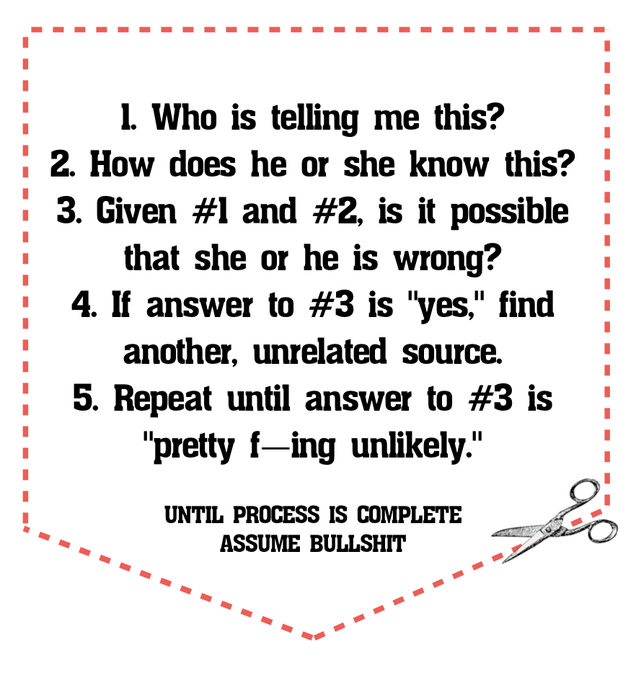
The Pocket Guide to Bullshit Prevention

by Michelle Nijhuis – The Last Word on Nothing

The Pocket Guide to Bullshit Prevention

Here for sharing far and wide is a handy guide to stemming the flow of nonsense in your daily life. Originally written by science writer Michelle Nijhuis for the outstanding science blog The Last Word on Nothing, these words have the power to make you a more discerning consumer – and sharer – of information. No bullshit.

Read more...


04 May 16:45

Straczynski: "The New Aristocracy"

by Cory Doctorow

Babylon 5 creator J. Michael Straczynski has posted a brilliant, inflammatory set of "rules of the new aristocracy: "We are the New Aristocracy because we were born into it. We got our money the old fashioned, Medieval way: our parents gave it to us. We were born into the wealth that we stole from you and your family over the last fifty years."

It doesn’t matter how much an education costs, doesn’t matter if your kids can’t afford to go to college or come out with massive debt, we will always be able to send our kids to university. And because a lot of our income is derived from tax incentives and taxpayer-financed bailouts your taxes are sending our kids to school. But you do not have the right to any of our money to send your kid to school.

If you or your kids want to start a business, you will find that because we’ve sucked all the money out of the economy, there is simply no available cash around to help you finance your startup. (Unless you want to go to your friends online at sites like Indiegogo, and isn’t that just cute?) We just cut our kids a check and tell them to go have fun.

Your kids are born with a glass ceiling above which they will almost certainly never have the opportunity to rise. Our kids are born with a marble floor beneath which they will never be allowed to fall.

If you accidentally provide incorrect information on your tax return, you could lose your house, your possessions, and your livelihood. We lie all the time on our tax information and none of us ever have to deal with this. We squirrel away trillions of dollars in overseas accounts and do all we can to ensure that your money never leaves our control because we'll doubtless need to scoop out more of it soon.

You live in a Company Town; we pay you to work for us, while making sure that we own all the stores in town that sell our goods, the doctors offices where you go in town, the restaurants where you eat, and that we charge you just enough to make sure that at the end of the week you don’t have any leftover money to squirrel away, so you can never leave the company town, can never get ahead, and can never risk criticizing the company town. You work for us. We own the town where you live. We own you.

THE RULES OF THE NEW ARISTOCRACY (Thanks, Dave!)


04 May 16:31

Standardized testing and schools as factories: Louis CK versus Common Core

by Cory Doctorow

My kids used to love math. Now it makes them cry. Thanks standardized testing and common core!

— Louis C.K. (@louisck) April 28, 2014

Louis CK is the latest high-profile voice to join the chorus against the US educational Common Core and the educational system's emphasis on standardized testing. A great New Yorker piece explores the movement against standardized testing and one-size-fits-all pedagogy.

I think it falls short of the mark, though. The rise of standardized testing, standardized curriculum, and "accountability" are part of the wider phenomenon of framing every question in business terms. In the modern world, the state is a kind of souped up business. That's why we're all "taxpayers" instead of "citizens." "Taxpayer" reframes policy outcomes as a kind of customer-loyalty perk. If your taxes are the locus of your relationship with the state, then people who don't pay taxes -- people too young, old, disabled, or unlucky to be working -- are not entitled to policy outcomes that reflect their needs.

"Taxpayers" are the shareholders in government. The government is the board of directors. School administrators are the management. Teachers are the assembly-line workers. Kids are the product. "Accountability" means that the product has to be quantified and reported on every quarter. The only readily quantifiable elements of education are attendance and test-scores, so the entire educational system is reorganized around maximizing these elements, even though they are only tangentially related to real educational outcomes and are trivial to game.

The vilification of teachers and teachers' unions go hand-in-hand with this idea. At the heart of teachers' unions' demands is the insistence that teaching is a craft that requires nonstandard, difficult-to-quantify approaches that are incompatible with factory-style "accountability." The emphasis on the outliers of teachers' unions -- the rare instances in which bad teachers are protected by their trade unions -- instead of the activity that constitutes the vast majority of union advocacy -- demanding an educational approach that is grounded in trust, respect, and individual tutelage -- the "taxpayer" types can make out teachers as lazy slobs who don't want to jog on the same brutal treadmill as the rest of us.

Some observers, among them Arne Duncan, the Education Secretary, have been quick to dismiss parental critiques of education policy as whining. Duncan may have apologized for sneering about “white suburban moms” who find that after exposure to the Common Core “their child isn’t as brilliant as they thought they were,” but that he expressed the thought in the first place is telling. It’s easy to make fun of privileged parents who can see no fault in their charmed offspring; one can even imagine Louis C.K. doing it.

But the issue identified by Louis C.K., and by other less well-known but equally furious parents, is not that the material children are expected to learn is too hard. It isn’t unreasonable to expect kids to have learned to multiply and divide numbers up to a hundred by the time they leave third grade—and in all likelihood, Louis C.K.’s child will have done so by June, if she hasn’t already, and be the better for it. The greater problem lies with the ways in which the achievement of those standards is measured. An emphasis on a certain kind of testing has become a blight upon the city’s classrooms. “The teachers are great,” C.K. tweeted. “But it’s changed in recent years. It’s all about these tests. It feels like a dark time.”

Louis C.K. Against the Common Core [Rebecca Mead/New Yorker]

(via Kottke)


01 May 12:00

5 Complaints About Modern Teens (That Are Statistically BS)

By John Cheese  Published: May 01st, 2014  One of the most surreal parts of being an adult is finding yourself in a conversation with other adults about "today's youth." It happens to all of us -- in my experience, the first one takes place roughly four seconds after high school graduation. B
26 Apr 22:36

Cliven Bundy Wants to Tell You All About 'the Negro'

by Ta-Nehisi Coates

Let's be honest, 70% of teams in NBA could fold tomorrow + nobody would notice a difference w/ possible exception of increase in streetcrime

— Rep. Pat Garofalo (@PatGarofalo) March 9, 2014

A couple days ago Jonathan Chait asserted that modern conservatism is "doomed" because it is "rooted in white supremacy." The first claim may or may not be true, but there's little doubt about the second. Whether it's the Senate minority leader claiming that America should have remained legally segregated, a beloved cultural figure fondly recalling how happy black people were living under lynch law, a presidential candidate calling Barack Obama a "food-stamp president," or a campaign surrogate calling Barack Obama "a subhuman mongrel," the preponderance of evidence shows that modern conservatism just can't quit white supremacy.

This is unsurprising. White supremacy is one of the most dominant forces in the history of American politics. In a democracy, it would be silly to expect it to go unexpressed. Thus anyone with a sense of American history should be equally unsurprised to discover that rugged individualist Cliven Bundy is the bearer of some very interesting theories:

“I want to tell you one more thing I know about the Negro,” he said. Mr. Bundy recalled driving past a public-housing project in North Las Vegas, “and in front of that government house the door was usually open and the older people and the kids—and there is always at least a half a dozen people sitting on the porch—they didn’t have nothing to do. They didn’t have nothing for their kids to do. They didn’t have nothing for their young girls to do.

“And because they were basically on government subsidy, so now what do they do?” he asked. “They abort their young children, they put their young men in jail, because they never learned how to pick cotton. And I’ve often wondered, are they better off as slaves, picking cotton and having a family life and doing things, or are they better off under government subsidy? They didn’t get no more freedom. They got less freedom.”

Prick a movement built on white supremacy and it bleeds ... white supremacy. That said, I think it's always worth clarifying what we mean when we use words like "slavery" and "freedom" in an American context.

I took a flight to L.A. last night and brought with me Thavolia Glymph's bruising monograph Out of the House of Bondage. Glymph is mostly concerned with the plantation house as a workspace during enslavement, and thus the scene of horrendous violence primarily dished out by "ladies of the house."

In general, a silence surrounds white women's contributions to the basic nature of slavery, its maintenance, and, especially, one of its central tendencies, the maiming and destruction of black life.

The maiming and destruction of black life. This is key. What Glymph is discussing is not merely the theft of labor but the total plunder of the human body. Slavery is torture as a system of governance, corporal destruction taken as the mere cost of doing business.

Here are a few additions, courtesy of Glymph, to your morning reading:

  • Item: Enslaved woman Mandy Cooper was not quick enough churning milk, and thus her mistress had no butter to serve her party along with the cornbread and biscuits. Cooper's mistress and her two guests—all women—then set upon Moore and "beat me from angah." Moore's mistress grabbed a heavy board. Another friend grabbed a whip.
  • Item: Enslaved woman Alice Shaw was given the task of fanning flies and clearing the dinner table. When she dropped a dish, her mistress "beat her on her head."
  • Item: Clara Young did not always respond quickly enough to her mistress's summons. Her mistress lifted her dress and beat her.
  • Item: Lila Nichols failed to gather enough eggs. She was beaten by her mistress. This same mistress later set upon an enslaved woman whom she suspected of poisoning her, "leaving her back 'in gashes.' She then ordered the slave woman chained until she had recovered sufficiently enough to be sold."
  • Item: Delia Garlic was responsible for nursing and caring for her mistress' baby. "One day I was playin' wid de baby," she reported. "It hurt its li'l han' an' commenced to cry, an' [my mistress] whirl on me, pick up a hot iron an' run it all down my arm an' han'. It took off de flesh when she done it."
  • Item: "Slaves was punished by whip and starving," reported freedwoman Harriet Robinson. "Master Sam didn't never whip me but Miss Julia whipped me everyday in the morning. During the war she beat me terrible. She say 'Your master's out fighting and losing blood trying to save you from the Yankees, so you kin get your'n here.'" 
The idea that Robinson's master was fighting on behalf of the slaves is both rich and telling. Mostly it shows that Cliven Bundy's theories are not original but inherited via white supremacy.
 
Enslaved black people were, with some regularity, beat with cowhide whips, tongs, pokers, chairs, and wooden boards. Nails were driven through their palms, pins through their tongues. Eyes were gouged out for the smallest offense.
 
When people like Cliven Bundy assert the primacy of the past it is important that we do not recount it selectively. American enslavement is the destruction of the black body for profit. That is the past that Cliven Bundy believes "the Negro" to have been better off in. He is, regrettably, not alone.


26 Apr 22:21

foxinu: nsfwjynx: the-pink-mist: There was a split second...


foxinu:

nsfwjynx:

the-pink-mist:

There was a split second there where his like, “wait, what? bro what are you doing?” 

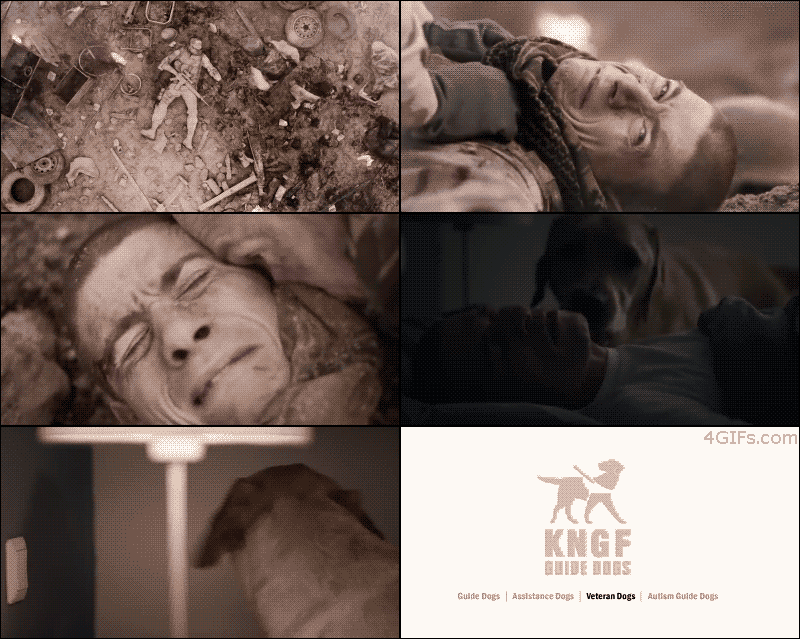
On more serious note, PTSD dogs for veterans are so fucking therapeutic. They’re like the one person you can spill your guts to and never worry about ever being judged or have that secret divulged. There are times when I definitely prefer the company of a dog over a human. 

Therapy animals save lives.

These dogs are even still so much more amazing. They check rooms before their handler enters, so they can clear it to help the person feel safe. Like in the gif, they are there when panic attacks or nightmares occur, to be something for the person to help ground themselves on, or yes just to turn on the lights. Even more amazing, many people are able to reduce their medication when they have a PTSD service dog there to help them. These dogs are useful for not just veterans, but also victims of abuse, accident trauma, natural disasters, and others. Their training allows them to be useful in situations where medical assistance is needed, as well. Some PTSD dogs are trained to recognize repetitive behaviours in handlers, and signal the handler to break the repetition and stopping the behaviour and possibly injury. 

Service dogs in general are just awesome. Remember to respect any that you see out in public. They are not there for you to walk up to and play with, even the puppies!

21 Apr 22:50

eviko: Basically this is a 3am drawing ramble i did a while ago...


eviko:

Basically this is a 3am drawing ramble i did a while ago that i decided to throw some colour on. 

Dragons are the best though.

18 Apr 10:33

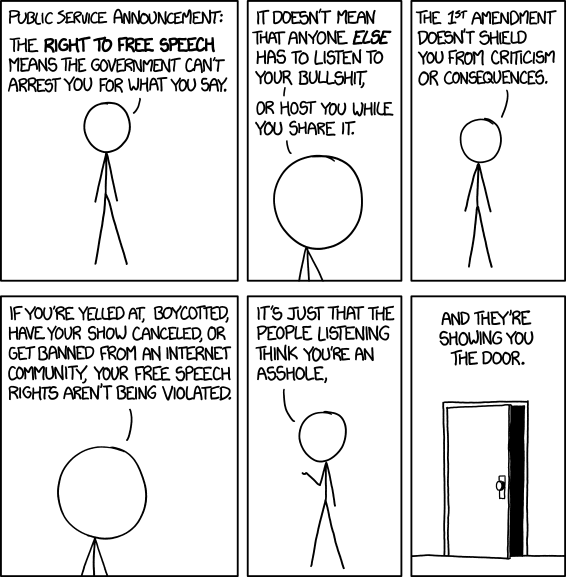
Free Speech

I can't remember where I heard this, but someone once said that defending a position by citing free speech is sort of the ultimate concession; you're saying that the most compelling thing you can say for your position is that it's not literally illegal to express.
05 Apr 21:33

A Series of Tweets Regarding My Own Personal Sexism

by John Scalzi

Apropos to a discussion on Twitter about this Slate article, a discussion of sexism, specifically, my own:

(Quick multitweet spree about to commence in roughly 10 seconds, lasting no more than five minutes. Be prepared!)—
John Scalzi (@scalzi) April 04, 2014

Parallel to everyone should be able to acknowledge their own racism, I'll give a recent example of my own sexism –—
John Scalzi (@scalzi) April 04, 2014

I meet a LOT of people these days. If you're a guy, it's almost certain I will not remember you the next time we meet. BUT –—
John Scalzi (@scalzi) April 04, 2014

If you're an attractive woman? I have a MUCH better chance of remembering who you are. Because I'm straight and my brain responds.—
John Scalzi (@scalzi) April 04, 2014

Is that a sexist response? Hell yes, it is.—
John Scalzi (@scalzi) April 04, 2014

I acknowledge that it's a sexist response; I also work to make sure that my own innate sexism there DOES NOT affect how I treat people.—
John Scalzi (@scalzi) April 04, 2014

(Note that the remembering you means I remember your face, I forget EVERYONE'S name)—
John Scalzi (@scalzi) April 04, 2014

It's the fact I acknowledge my sexism that allows me to try to correct for it when I am dealing with people. If I tried to deny it –—
John Scalzi (@scalzi) April 04, 2014

– I would be more likely to screw up my response. So yes, I'm still a little sexist. I keep working on it because that what you do.—
John Scalzi (@scalzi) April 04, 2014

Or should do, anyway.—
John Scalzi (@scalzi) April 04, 2014

Multi-tweet spree now ended.—
John Scalzi (@scalzi) April 04, 2014

And then, the conversational addendums:

To the people going "But that's biology!" Well, guys, surprise: Your sexism can have a (partly) biological root! Who knew!—
John Scalzi (@scalzi) April 04, 2014

RT @GreyDuck: @scalzi Sexism isn't the biology. Sexism is not trying to be better than just your biology.—
John Scalzi (@scalzi) April 04, 2014

I'm not going to worry too much that I remember attractive women better. I will worry about whether that affects how I treat people.—
John Scalzi (@scalzi) April 04, 2014

Which is to say I don't find "but it's biological!" a sufficient excuse to leave sexism unexamined and unaddressed.—
John Scalzi (@scalzi) April 04, 2014

RT @NeilaK20: @scalzi I need to eat meat when my bloodsugar gets too low. It's biological, but I'm not eating someone's pet. Because I can …—
John Scalzi (@scalzi) April 04, 2014

@NeilaK20 Also, pets are wiley.—
John Scalzi (@scalzi) April 04, 2014

I will note that, anecdotally, all the "But it's biology!" protestations so far appear to be coming from men.—
John Scalzi (@scalzi) April 04, 2014

NB: Outside the "attractive woman" thing, I will be more likely to remember you if there's something memorable about your appearance –—
John Scalzi (@scalzi) April 04, 2014

– i.e., I don't ONLY remember attractive women. But it's still a notable bias for me.—
John Scalzi (@scalzi) April 04, 2014

Reminder, however: I WILL NOT REMEMBER YOUR NAME. Whoever you are. I once forgot my wife's name (briefly). I am terrible.—
John Scalzi (@scalzi) April 04, 2014

To everyone asking if/hoping that I will remember you for your cleverness, I may. But remember what the failure mode of clever is.—
John Scalzi (@scalzi) April 04, 2014

NB also that I directly meet/interact with literally thousands of people a year at conventions/signings, etc. Special conditions apply.—
John Scalzi (@scalzi) April 04, 2014

And now, for everyone else, a cat picture. http://t.co/MzTHDTh67b
John Scalzi (@scalzi) April 04, 2014


05 Apr 21:33

A nation of slaves

by Charlie Stross

George Osborne has committed the Conservatives to targeting "full employment", saying that tax and welfare changes would help achieve it.

Firstly, this is impossible. Secondly, explaining why is ... well, George Orwell coined a word to describe this sort of thing, in 1984: Crimestop

The faculty of stopping short, as though by instinct, at the threshold of any dangerous thought. It includes the power of not grasping analogies, of failing to perceive logical errors, of misunderstanding the simplest arguments if they are inimical to Ingsoc, and of being bored or repelled by any train of thought which is capable of leading in a heretical direction.
Today, in the political discourse of the west, it is almost unthinkably hard to ask a very simple question: why should we work?

There are two tests I'd apply to any job when deciding whether it's what anthropologist David Graeber terms a Bullshit Job.

Test (a): Is it good for you (the worker)?

Test (b): Is it good for other people?

A job can pass (a) but not (b) — for example a con man may enjoy milking the wallets of his victims, but their opinion of his work is going to be much less charitable. And a job can pass (b) but not (a) if it's extremely stressful to the worker, but helps others—a medic in a busy emergency room, for example.

The best jobs pass both (a) and (b). I'm privileged. I have a "job" that used to be my hobby, many years ago, and if Scrooge McDuck left me £100M in his legacy (thereby taking care of my physical needs for the foreseeable future) I would simply re-arrange my life to allow me to carry on writing fiction. (I might change the rate of my output, or the content, due to no longer being under pressure to be commercially popular in order to earn a living—I could afford to take greater risks—but the core activity would continue.)

On the other hand, many of us are trapped in jobs that pass neither test (a) nor test (b). If Scrooge McDuck left you £100M, would you stay in your job? If the answer is "yes", you're one of the few, the privileged: most people would run a mile. I've had jobs like that in the past. We let ourselves get trapped in these jobs because our society is organized around the principle that we are required to work in order to receive the money we require in order to eat. On a higher level (among the monied classes) the principle is different: work is performed for social status, financial income may be a side-effect of receiving rent. But people are still supposed to do something. People are, in fact, defined by what they do, not by who they are.

Now for a diversion.

As John Maynard Keynes observed in the 1930s, we produce material goods more efficiently today than during previous eras of history: our economic growth is predicated on this. Why should we not divert some of our growth into growing our leisure time, rather than growing our physical wealth? We ought to be able to make ends meet perfectly well with an average 15 hour working week—or, alternatively, a 40 hour week for 20 weeks a year, or a 40 hour week for 48 weeks a year for a ten year working lifetime.

And indeed in some cultures and countries this happens, to some extent. Here are some handy graphs of European working hours and productivity per week. Workers in Germany average a little over 35 hours a week, compared to the 42 hours worked in the UK. Want vacation days? German law guarantees 30 working days of vacation per year (and I am told medical leave for attending a spa resort on top of that). But it's all pretty paltry compared to the 15 hour target.

It's also quite scary when you consider that we're entering an era of technological unemployment. More and more jobs are being automated: they aren't going to provide money, social validation, or occupation for anyone any longer. We saw this first with agriculture and the internal combustion engine and artificial fertilizers, which reduced the rural workforce from around 90% of the population in the 17th-18th century to around 1% today in the developed world. We've seen it in steel, coal, and the other 19th century smokestack industries, which at their peak employed 30-50% of the population in factories—an inconceivable statistic today, even though our net output in these areas has increased. We're now seeing it in mind-worker fields from law (less bodies needed to search law libraries) through architecture (3D printers and CAD software mean less time spent fiddling with cardboard models or poring over drafting tables). Service jobs are also being automated: from lights-out warehousing to self-service checkouts, the number of bodies needed is diminishing.

We can still produce enough food and stuff to feed and house and clothe everybody. We can still run a growth economy. But we don't seem to know how to allocate resources to people for whom there are no jobs. There's a pervasive cultural assumption that people who don't work are shirkers or failures, rather than victims of technological change, and this is an enabler for populist politicians who campaign for support from the frightened (because embattled) working majority by punishing the unlucky, rather than admitting that the core assumption—that we must starve if we can't find work—is simply invalid.

I tend to evaluate the things around me using a number of rules of thumb, one of which is that the success of a social system can be measured by how well it supports those at the bottom of the pile—the poor, the unlucky, the non-neurotypical—rather than by how it pampers its billionaires and aristocrats. By that rule of thumb, western capitalism did really well throughout the middle of the 20th century, especially in the hybrid social democratic form: but it's now failing, increasingly clearly, as the focus of the large capital aggregates at the top (mostly corporate hive entities rather than individuals) becomes wealth concentration rather than wealth production. And a huge part of the reason it's failing is because our social system is set up to provide validation and rewards on the basis of an extrinsic attribute (what people do) which is subject to external pressures and manipulation: and for the winners it creates incentives to perpetuate and extend this system rather than to dismantle it and replace it with something more humane.

Meanwhile, jobs: the likes of George Osborne (mentioned above), the UK's Chancellor of the Exchequer, don't have "jobs". Osborne is a multi-millionaire trust-fund kid, a graduate of Eton College and Oxford, heir to a Baronetcy, and in his entire career spent a few working weeks in McJobs between university and full-time employment in politics. I'm fairly sure that George Osborne has no fucking idea what "work" means to most people, because it's glaringly obvious that he's got exactly where he wanted to be: right to the top of his nation's political culture, at an early enough age to make the most of it. Like me, he has the privilege of a job that passes test (a): it's good for him. Unlike me ... well, when SF writers get it wrong, they don't cause human misery and suffering on an epic scale; people don't starve to death or kill themselves if I emit a novel that isn't very good.

When he prescribes full employment for the population, what he's actually asking for is that the proles get out of his hair; that one of his peers' corporations finds a use for idle hands that would otherwise be subsisting on Jobseekers Allowance but which can now be coopted, via the miracle of workfare, into producing something for very little at all. And by using the threat of workfare, real world wages can be negotiated down and down and down, until labour is cheap enough that any taskmaster who cares to crack the whip can afford as much as they need. These aren't jobs that past test (a); for the most part they don't pass test (b) either. But until we come up with a better way of allocating resources so that all may eat, or until we throw off the shackles of Orwellian Crimestop and teach ourselves to think directly about the implications of wasting a third of our waking lives on occupations that harm ourselves and others, this is what we're stuck with ...

01 Apr 01:41

ecumenicalseeker: ramavoite: curious-commodities: submariet: ...


ecumenicalseeker:

ramavoite:

curious-commodities:

submariet:

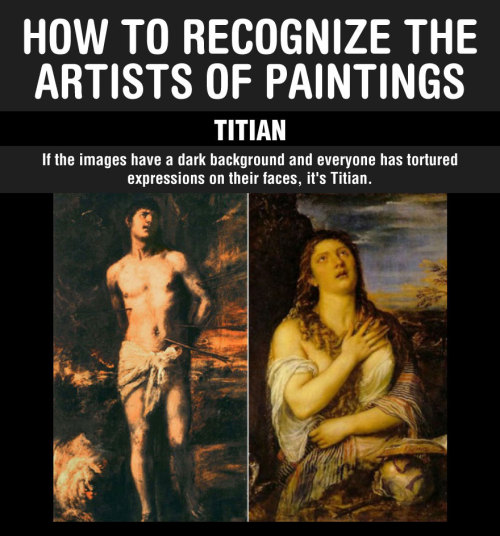
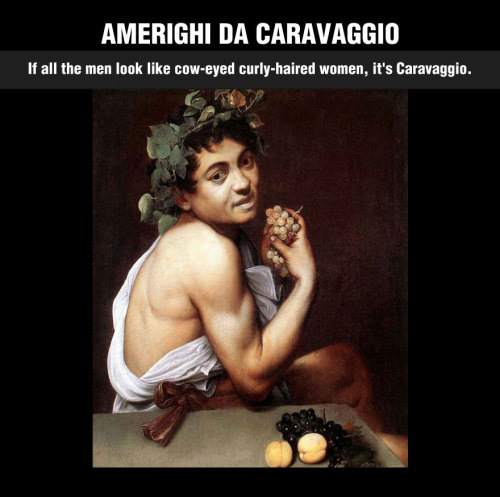
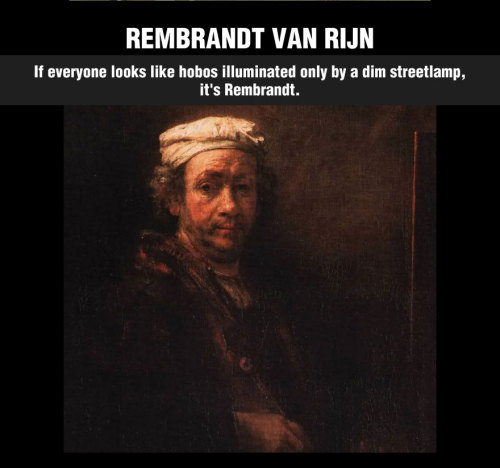
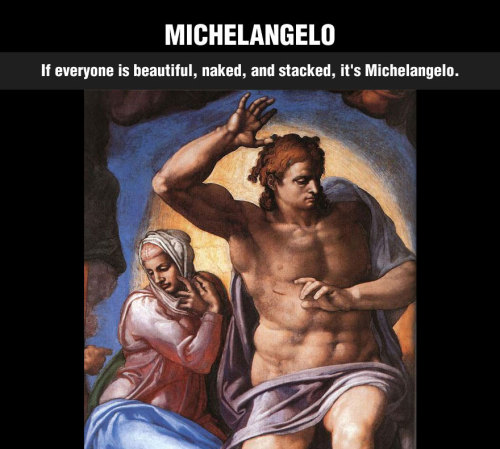
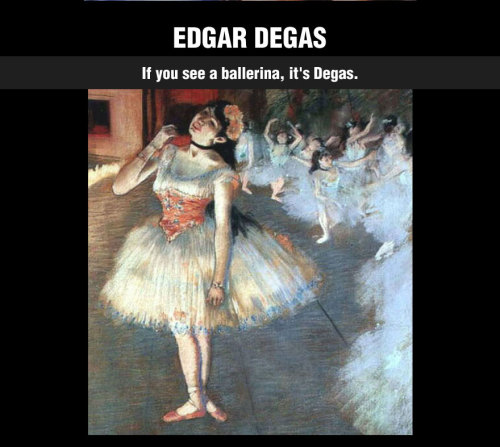
VAN EYCK

IM SENDING THIS TO MY ART HISTORY TEACHER

/dying

I CAN’T EVEN TELL YOU HOW HELPFUL THIS IS

30 Mar 16:53

Some Powerful Thoughts