I will never be a bystander to bullying and teasing language. If I hear it, I will call it out and if I can, I will stop it. By adding my name I promised to stand up for fairness, kindness and never be a bystander.
Dyslexia is typically seen as a reading disorder, but many dyslexics are also known to have trouble processing sensory information. Research now reveals that dyslexics find it especially difficult to shift their attention between visual and audio stimuli. This suggests that brain training with action video games could actually improve dyslexics' literacy skills.
You have no problem with the gender wage gap. But you hate having to pay for dates.
You insist that it’s a scientifically proven fact that men are stronger than women. But you complain about society believing that it’s worse for a man to hit a woman than for a woman to hit a man.
You believe that the age of consent is unfair and that there’s nothing wrong with having sex with teenage girls. But when you find out that a teenage girl enjoys sex, you believe she’s the biggest slut in the world.
You hate when a woman automatically assumes that a man is a douchebag before getting to know him. But when you like a woman who likes another man, you assume he’s a douchebag just because he’s not you.
You believe that if women want equality, they should be drafted into the military. But you also believe that the military is not a place for women.
You hate when women assume that men are like wild animals. But you believe that a woman who doesn’t cover up and make herself invisible to men is just like someone wearing a meat suit around wild animals.
You hate the fact that men are bullied for not conforming to their male gender roles. But when you find out that a man disagrees with your beliefs about women’s rights, your immediate response is to try to emasculate him by comparing him to a woman as an insult.
You hate when women assume that there are no nice guys. But you call yourself a nice guy and act like it’s a rare quality that should cause women to be all over you.
You hate when women assume that men just want to get laid. But when you find out that a man is a feminist, you assume that he’s just doing it to get laid.
You hate when women make generalizations about all men. But when a woman calls you out for being sexist, you claim that all men think like you.
You insist that women should be responsible for protecting themselves from being raped. But when they follow the one piece of advice that actually works, which is being aware of red flags, you complain about them assuming that all men are rapists.
O artista Penny Byrne cria mensagens políticas poderosas usando estatuetas de porcelana e outros pequenos objetos. Esses figuras, sombrias e humorísticas abragem questões políticas globais, cultura pop e meio ambiente.
Byrnes mistura a fragilidade da porcelana com a força dos elementos pintados/colocados na porcelana.
In his photo series “façades,” French photographer Zacharie Gaudrillot-Roy uses digital wizardry to turn buildings into eerie, movie set-style facades. The series is divided into three parts: see series 1, series 2, and series 3.
In this video, BuzzFeed demonstrates how creepy it would be if you did some of the things that cats do in real life. It’s just not socially acceptable to ask someone to rub your belly, run and hide when being introduced to a new person, and to knock breakable objects off of a coworker’s desk.
“No, you can’t deny women their basic rights and pretend it’s about your ‘religious freedom.’ If you don’t like birth control, don’t use it. Religious freedom doesn’t mean you can force others to live by your own beliefs.”
by Erin Gloria Ryan on Jezebel, shared by Rob Bricken to io9
Yesterday, Seth Rogen testified before a Senate subcommittee, pleading for more awareness of and support for Alzheimer's research. It was — like most things Rogen does — endearing as hell. But unlike the characters Rogen typically plays, it was also brave, altruistic, and kind of badass.
In his sculpture series “Voyageurs” (Travelers), French artist Bruno Catalano makes surreal figure sculptures in which sections of the figure’s bodies are eerily missing.
We’re celebrating the end of the year with our most popular posts from 2013, plus a few of our favorites tossed in. Enjoy!
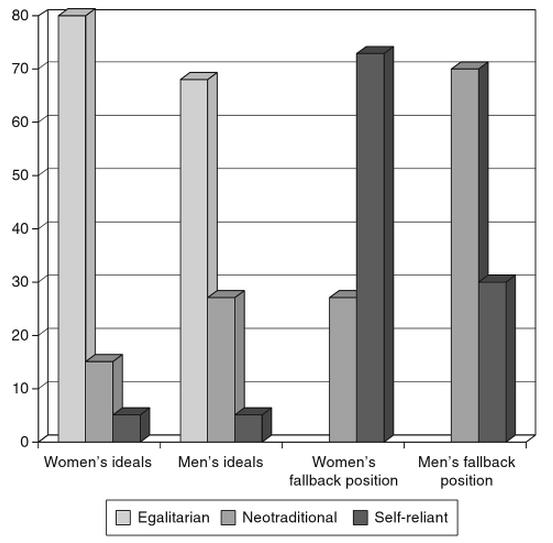
Here’s some great news. The vast majority of young people – about 80% of women and 70% of men across all races, classes, and family backgrounds — desire an egalitarian marriage in which both partners share breadwinning, housekeeping, and child rearing. The data come from Kathleen Gerson‘s fabulous 2010 book, The Unfinished Revolution.
In practice, however, egalitarian relationships are difficult to establish. Both work and family are “greedy institutions,” ones that take up lots of time and energy. Many couples find that, once children arrive, it’s impossible for both to do both with equal gusto.
With this in mind, Gerson asked her respondents what type of family they would like if, for whatever reason, they couldn’t sustain an equal partnership. She discovered that, while men’s and women’s ideals are very similar, their fallback positions deviate dramatically.
Men’s most common fallback position is to establish a neotraditional division of labor: 70% hope to convince their wives to de-prioritize their careers and focus on homemaking and raising children. Women? Faced with a husband who wants them to be a housewife or work part-time, almost three-quarters of women say they would choose divorce and raise their kids alone. In fact, despite men’s insistence on being breadwinners, women are more likely than men to say they value success in a high-paying career.
Look at this absolutely stunning data (matching ideals on the left; clashing fallback positions on the right):
One of Gerson’s interviewees, Matthew, exemplifies the egalitarian willing to fallback on a neotraditional family form:
If I could have the ideal world, I’d like to have a partner who’s making as much as I am—someone who’s ambitious and likes to achieve. [But] if it can’t be equal, I would be the breadwinner and be there for helping with homework at night.
And this is what women think of that:
My mother’s such a leftover from the fifties and did everything for my father. I’m not planning to fall into that trap. I’m really not willing to take that from any guy at all.
Alas, what appears to be a happy convergence between men’s and women’s ideals — both are egalitarians — can turn into an intractable situation: a man who won’t give up his role as the breadwinner and a woman who would rather do anything than be a housewife.
We’re celebrating the end of the year with our most popular posts from 2013, plus a few of our favorites tossed in. Enjoy!
Hip-hop music is frequently described as violent and anti-law enforcement, with the implication that its artists glorify criminality. A new content analysis subtitled “Hip-Hop Artists’ Perceptions of Criminal Justice“, by criminologists Kevin Steinmetz and Howard Henderson, challenge this conclusion.
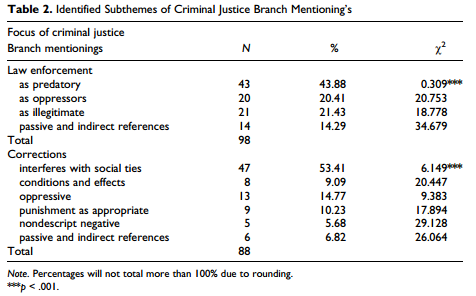
After an analysis of a random sample of hip-hop songs released on platinum-selling albums between 2000 and 2010, Steinmetz and Henderson concluded that the main law enforcement-related themes in hip-hop are not pleasure and pride in aggressive and criminal acts, but the unfairness of the criminal justice system and the powerlessness felt by those targeted by it.
Lyrics about law enforcement, for example, frequently portrayed cops as predators exercising an illegitimate power. Imprisonment, likewise, was blamed for weakening familial and community relationships and described a modern method of oppression.
Their analysis refutes the idea that hip-hop performers are embracing negative stereotypes of African American men in order to sell albums. Instead, it suggests that the genre retains the politicized messages that it was born with.
Steinmetz and Henderson offer Tupac’s “Crooked Nigga Too” (2004) as an example of a rap that emphasizes how urban Black men are treated unfairly by police.
Yo, why I got beef with police?
Ain’t that a bitch that motherfuckers got a beef with me
They make it hard for me to sleep
I wake up at the slightest peep, and my sheets are three feet deep.
The authors explain:
Police action perceived as hostile and unfair engenders an equally hostile and indignant response from Tupac, indicating a tremendous amount of disrespect for the police.
Likewise, Jay-Z, in “Pray” (2007), raps about cops who keep drugs confiscated from a dealer, emphasizing a “power dynamic in which the dealer was unfairly taken advantage of but was unable to seek redress”:
The same BM [‘‘big mover’’—a drug dealer] is pulled over by the boys dressed blue
they had their guns drawn screaming, “just move or is there something else you suggest we can do?”
He made his way to the trunk
opened it like, “huh?”
A treasure chest was removed
cops said he’ll be back next monthwhat we call corrupt, he calls payin’ dues
Henderson offers Jay-Z’s “Minority Report” as a great overall example:
We actually found that the overwhelming message in hip-hop wasn’t that the rappers disliked the idea of justice, but they disliked the way it was being implemented.
These communities, then, have a strong sense of justice… rooted in the sense that they’re not getting any.
From detritus like bicycle parts, chains, flashlights, corkscrews, spatulas, even steel toes from work boots, Edouard Martinet assembles these astonishing sculptures of birds, fish, and insects. Mainly insects. But WOW, what insects!
When Edouard Martinet was 10, one of his teachers introduced his pupils to insects, but in a rather obsessive way. Subliminally, the fascination sunk in to the young French boy. Fast-forward 40 years, and Martinet has become the art world’s virtuoso insectophile, transforming bits and pieces of cast-off junk culled from flea markets and car boot sales into exquisitely executed insect, fish and animal forms. What sets Martinet’s work apart is the brilliant formal clarity of his sculptures, and their extraordinary elegance of articulation. His degree of virtuosity is unique: he does not solder or weld parts. His sculptures are screwed together. This gives his forms an extra level of visual richness - but not in a way that merely conveys the dry precision of, say, a watchmaker. There is an X-Factor here, a graceful wit, a re-imagining of the obvious in which a beautifully finished object glows not with perfection, but with character, with new life. Martinet takes about a month to make a sculpture and will often work on two or three pieces at the same time. It took him just four weeks to make his first sculpture and 17 years for his most recent completion!
Not exactly the first thing that leaps to mind when one thinks of “scrap metal sculpture,” is this? Be sure to check the individual images on Martinet’s gallery page—he lists the specific materials used for every body part, and some of them will likely floor you. DM readers in London can see these on display at Sladmore Contemporary through January 31, 2014. If you can’t be there, a GORGEOUS book is available.
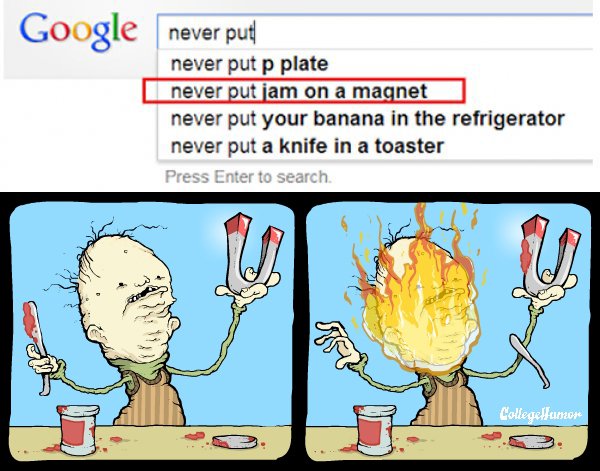
Twaggies artists illustrate the funniest tweets on the web, but in this instance Josh Mecouch of Formal Sweatpants (previously on Neatorama) took to Google search autocompletes for inspiration. And boy, people search for some really, really, really strange things:
From wearing their underwear outside their clothes to going on adventures with young boys, superheroes do a lot of things that’d be creepy if you did them in real life.
I know I’ve told this story before, but my abusive ex refused to let me take birth control. I was on the pill until he found them in my purse.
I went to the Student Health Center—they were completely unhelpful, choosing to lecture me about the importance of safe sex (recommending condoms) instead of actually listening to my problem.
Then I went to Planned Parenthood. The Nurse Practitioner took one look at my fading bruises and stopped the exam. She called in the doctor. The doctor came in and simply asked me: “Are you ready to leave him?” When I denied that I was being abused, she didn’t argue with me. She just asked me what I needed. I said I need a birth control method that my boyfriend couldn’t detect. She recommended a few options and we decided on Depo.
When I told her that my boyfriend read my emails and listened to my phone messages and was known to follow me, she suggested to do the Depo injections at off hours when the clinic was normally closed. She made a note in my chart and instructed the front desk never to leave messages for me—instead, she programmed her personal cell phone number into my phone under the name “Nora”. She told me she would call me to schedule my appointments; she wouldn’t leave a message, but I should call her back when I was able to.
And that was it. No judgment. No lecture. She walked me to the door and told me to call her day or night if I needed anything. That she lived 5 blocks from campus and would come get me. That I wasn’t alone. That she just wanted me to be safe.
I never called her to come to my rescue. But I have no doubt that she would have come if I had called. She kept me on Depo for a year, giving me those monthly injections in secret, helping me prevent a desperately unwanted pregnancy.
I cannot thank Planned Parenthood enough for the work they do.
Based in New York, the British-born photographer Alex John Beck takes on an interesting experiment that explores our perception of physical beauty. The term “Golden Ratio” is used to describe a face that is symmetrical, creating a plainly proportioned face which we perceive to be beautiful. However, in this project called Both Sides Of, Beck takes on the challenge of portraying seemingly symmetrical faces into something else. Offering two different portraits for one subject, the photographer takes the left and right halves of the image and mirrors it into a whole face.
The left and right halves both offer a seemingly different face.
None of these images offer the true portrait of the subject; each are photo-manipulated only. As Beck reproduces the left and right symmetries of several people, we discover that we each have our own beauty angle, and another unfavorable angle. By this project, viewers can discover that faces are in truth, unsymmetrical. Beck’s project allows us to rethink of our definition of beauty by the standards of Golden Ratio.