oh, boy, that nytimes piece on nail salon employees in new york city. oh boy. i mean, as some of the commenters have helpfully pointed out, it is not exactly a surprise to learn that the women who speak little english and often are undocumented staffing a salon that charges $20 for a manicure are not being well paid. there is no way those women could be well paid and the salon stay open.
but realizing exactly how un-well paid they are (pay $100 to get to work at a salon, 3 month period with no payment, then $30/day) and what an organized system of exploitation it is (they all live together in apartments organized by the salon owners, 12 women in a one bedroom apartment in queens, picked up in vans to go to the salon for their 12 hour shifts).
and people on twitter are immediately flipping to individualized solutions. we will all stop getting manicures! that will solve this problem! and while it feels ethically impossible to get a cheap manicure knowing these things, it is awfully naive to think that if we all do our own nails, these women will magically find a new career in which they will not be exploited. neither is it charitable to keep getting manicures to provide even this awful and exploitative employment for women in this precarious and vulnerable situation. there are no individualized solutions to this problem!
the solution needs to be systemic. the problems are the immigration system and capitalism.
A month ago, finally acting on the countless discussions about birth control I’ve had with small groups of women over the years, I got a hormonal IUD. It was a no-brainer, the perfect birth control: a long-lasting, tiny dose of hormones that more often than not stops your period entirely. I was set until 2020!
About two and a half weeks later, long after the mild cramps had subsided, I very rationally, very calmly realized that I had never loved J. The only possible way forward, it seemed clear, was for me to move out of the apartment we’ve shared since 2010. I was scared about the giant changes this would bring about, but even moving to a tiny sublet in an unfamiliar neighborhood, even explaining the breakup to all our friends, even never hosting a dinner party in an apartment of mine own ever again, seemed preferable to continuing to live with this sudden stranger.
This quiet, internal freaking out continued for about a week; I spent a lot of time taking long walks that gave me no pleasure, just to avoid being at home. At the end of that week I did three things:
I remembered something that my older sister S pointed out to me when I became very depressed and quit my job in 2012, which was that people in a healthy headspace don’t feel numb when they make giant life decisions.
I googled “mirena IUD depression” and found dozens of stories from women who felt like I did and worse.
I described how I was feeling, first to J, in the dark after we’d gone to bed because I couldn’t bring myself to say it while sitting at the dinner table, and then to S and JBA, via email.
As you might imagine, talking about it helped. This from JBA’s reply, in particular, really helped:
I think it is a tempting thing for people like you and me (and… many people we know), people who live largely in our heads, to form a conclusion after much careful analysis about how the body should be or should be treated and then just sort of impose it? I feel the body should be a more equal partner in this process. I’m not sure if this even makes sense.
It made beautiful sense to me. My body did not like the IUD, and so the IUD had to go. Which it did, a week later.
There’s a lot to be said here about how doctors don’t do enough to describe the possible side effects and outcomes of various types of birth control to their patients, to empower them to choose whether or not a chosen method is working – truly working for their lives, not just doing its pharmacological job. My doctor, when I described how I was feeling, asked first if I’d had a particularly stressful month and if I wanted to wait another few weeks to see if it would “even out” before saying it seemed like I was “very sensitive to hormones.” I guess I’m thankful that at least she didn’t offer me antidepressants as a fix, as has happened to plenty of other women. And although this shouldn’t need saying, I have nothing against birth control in general, or Mirena in particular – it just didn’t work for me.
But what I want to talk about instead is what the past 72 hours have felt like: the half-life of that tiny dose of hormones, it turns out, is very short, and feeling the color seep back into my life has been breathtaking. This morning I woke up thrilled to feel J’s limbs touching mine; he walked in the door a few minutes ago and I was so happy to kiss him hello.
It’s about more than just my relationship, though – I spent hours after work today walking circles around lower Manhattan, thankful that I was alive to see all these beautiful rooftops and beautiful dudes in skinny jeans and beautiful trees in the tiny beautiful parks. I was walking for a second time past Jackson Square in the West Village when a scene from The Chosen dropped into my head: Reuven Malter has just been discharged from the hospital after an eye accident. “There was newness everywhere, a feeling that I had been away a long time in a dark place and was now returning home to sunlight.” It’s very good to be back.
I love my Mirena; Noz super duper did not love hers. *This is why it’s great that they make so many forms of birth control and why they should all be readily available to everyone with a uterus*. Bodies are custom gear! What is a perfect solution for you is a giant question mark for any other person and they deserve to make their own informed decisions about what’s best for them.
(So glad the bad side effects are wearing off so fast btw Nozlee <3 <3 <3)
…Please note, I’m not saying the all-American heteronormative fantasy doesn’t make ANYONE happy, anywhere. Somewhere in the world right now, there is a cowboy mechanic breadwinner who brings home the fucking bacon, and his little babycakes fries that shit up in a pan and then does all the dishes and then puts the kids to bed and then rides the cowboy mechanic breadwinner into the multi-orgasmic sunset, and everything is peachy fucking keen. Their lives are a cross between a Pioneer Woman blog post, an episode of Martha Stewart, and a Playgirl photo spread. If these people actually exist, they are A-okay in my book! I applaud their passionate adherence to roles that satisfy them completely and feed their very souls!
I want to argue, though, that most of us do not fit neatly into such roles. Instead, we are gorgeously creepy melancholy artist-insects and superpowered geisha assassins. We are vibrant attack rats with a passion for white wine and science-fiction paperbacks. We are straight-male poets trapped in the bodies of fashion-loving lipstick lesbians. We are angelic wildebeests who love scrapbooking. We are gruff little skunks with a knack for verbal sparring. We are book-loving girly girls who just want to crochet crazy hats all day long. We are sexy man-worshiping tomboys with literal and figurative buns in the oven. We are alien demons with soft, childlike hands that long to be squeezed affectionately.
We are stereophonic kaleidoscopes, full of vivid colors and gigantic walls of sound, you and me and everyone else. We have worlds inside of us, and every single cell sings with longing and love for this strange life. It’s hard to serve the giant crowd of freaks that lives inside our bodies! When we let the alien inside us scream, the little kittens have to be quiet. The gay man and the predatory female wasp want to grab some man-ass, but the working breed of dog wants to bite some sheep-ass.
When no one wants anything, that’s when you have to worry.
…Relax and let your inner freaks come out to play. You are a million different creatures. Welcome them. There is no alpha and no beta. There is no power structure or hierarchy or strong pack leader. Let them all come rushing in, let them all have a voice. This is how it feels to be safe.
Some days all you can do is read about 14 Ask Polly columns in a row and remember some things that are true.
so we have a conversational safeword in my group of friends and it’s great, idk why more people don’t do this. whenever someone wants a subject to be dropped immediately no questions asked we just say “spleen” and we stop immediately and it’s a really good way to avoid crossing the line between teasing friends and genuinely upsetting them by accident, or stopping debates from turning into actual arguments
The Myth of the Extraordinary Woman doesn’t challenge sexism. Having one female character in a group of male characters who deserves to be there because she “earned their respect” by “being the best” does NOTHING to threaten the patriarchy, because it’ll just isolate her as an aberrant case. MOST women are useless, but THIS ONE is special.
You know what does threaten the patriarchy? Communities of women. Older female mentors taking younger ones under their wing. Presenting a united front to sexism. Women who don’t even WANT to join the boy’s club, who seek the approval of other women, and value THEIR opinions over gatekeeping sexists.
what would you think of a woman who addressed a club meeting of men by telling them how charming, how well gowned, how pretty, they were?
This is why I really like books that are set in oldey times with people who have views like this, and why it annoys me when people say but that’s not historically accurate
tbh, half the time ‘not historically accurate’ is code for ‘i wish things were still like my imaginary version of 19th century England only minus the cholera’
This just makes me absurdly happy, especially because it’s written by a man calling out other men for this shit.
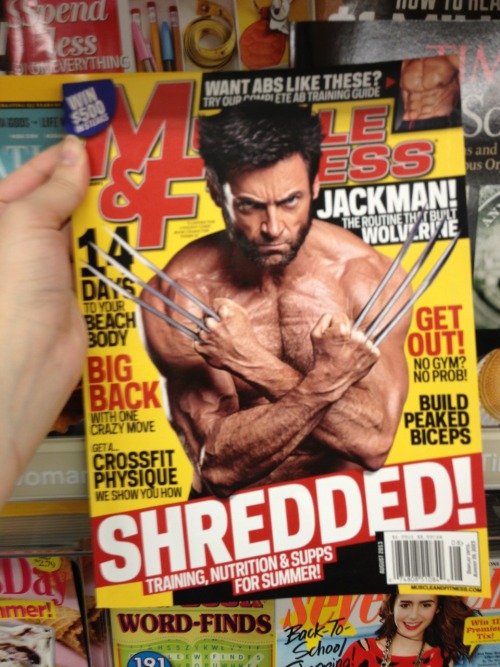
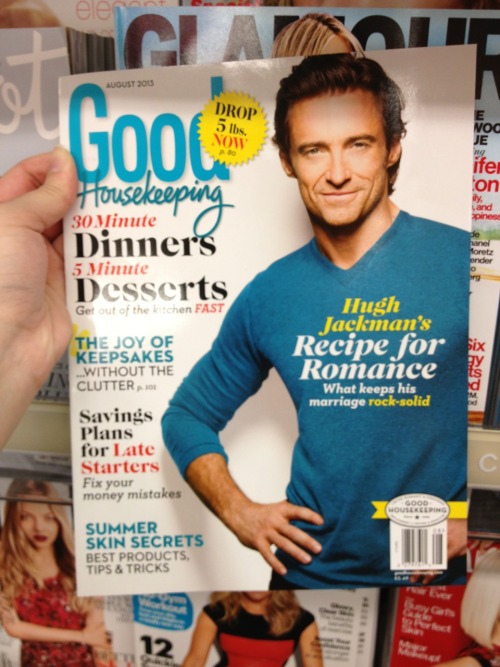
This works quite nicely at debunking the “beefcake guys in comics are objectified for women just like women in comics are for men!” imo. On the left: a magazine tailored for a male audience, showing him in full beefcake-type mode with headlines about how you, too, can look like this. On the right: a magazine tailored for a female audience, which has a headline about romance and shows him looking more or less like a normal dude.
Tell me again how comic book guys are designed for female sexual enjoyment, completely equivalent to anatomically-improbable spines and giant tits with their own individual centers of gravity, and totes aren’t just male power fantasies.
COMMENTARY
Women don’t treat men the way men treat women.
it’s also worth noting that despite all the geeks complaining about women’s impossible standards, the fantasy on the right sets a really really easy low bar to meet:
“cool clean friendly non-aggressive man who will cook a food for u”
yep what an unfair standard to be subjected to
that last comment was beautiful
Pretty sure I’ve RBd this before, but doing it again for the penultimate comment.
Gentrifiers focus on aesthetics, not people. Because people, to them, are aesthetics.
Proponents of gentrification will vouch for its benevolence by noting it “cleaned up the neighbourhood”. This is often code for a literal white-washing. The problems that existed in the neighbourhood - poverty, lack of opportunity, struggling populations denied city services - did not go away. They were simply priced out to a new location.
That new location is often an impoverished suburb, which lacks the glamour to make it the object of future renewal efforts. There is no history to attract preservationists because there is nothing in poor suburbs viewed as worth preserving, including the futures of the people forced to live in them. This is blight without beauty, ruin without romance: payday loan stores, dollar stores, unassuming homes and unpaid bills. In the suburbs, poverty looks banal and is overlooked.
In cities, gentrifiers have the political clout - and accompanying racial privilege - to reallocate resources and repair infrastructure. The neighbourhood is “cleaned up” through the removal of its residents. Gentrifiers can then bask in “urban life” - the storied history, the selective nostalgia, the carefully sprinkled grit - while avoiding responsibility to those they displaced.
”
- Sarah Kendzior - The peril of hipster economics (x)
The Star Wars films aren’t exactly complicated fare, particularly the original trilogy. (Not that there is anything wrong with that.) Luke Skywalker’s journey is pretty cut and dry, a solid line from farmboy to superbad in several short years. The Empire falls, the Rebels win, everyone is back on Endor in time for stormtrooper stew.
But how do you topple a galactic Empire, really? How do you get a boy who’s never known a life outside the sticks to become a galactic savior in the same amount of time that it usually takes to earn a bachelor’s degree?
The plan is likely less perfect than it appears.
[I’m coming with you to Alderaan. There’s nothing for me here now.]
but why do we have to get married and have children
why can’t we just get a group of friends and live happily ever after in an apartment and share the profits
i’d be much happier that way
this is the most millennial thing ive ever read
Nothing wrong with this, you can have roof parties and grill food. Better yet just save up together and buy a small house split the bills and mortgage.
- the nuclear family as an economic unit has really only existed for a few hundred years, across part but not all of the world
- the nuclear family unit is the easiest to exploit under capitalism, because parents have to work externally to provide for their children. They work to pay for child care for their children while they work. They work to earn money to feed their kids and to give them nice things to make up for all the time they spend away, at work.
- a huge amount of labour is necessary every day to keep a family fed, their house clean, etc. some families are wealthy enough to outsource this by hiring staff, most are not.
- capitalism is a pointless middleman in this. we should just live cooperatively.
- share houses and intentional communities are awesome
- people of different life stages function well together because they have complimentary needs and abilities
- kids are less of a stress and burden in a home with lots of different adults to provide support and love, as well as sharing household tasks.
“It turns out that the Wall Street bonus pool in 2014 was roughly twice the total annual earnings of all Americans working full time at the federal minimum wage.
You read that right: Just the annual bonuses for just the sliver of Americans who work just in finance just in New York City dwarfed the combined year-round earnings of all Americans earning the federal minimum wage.”
“The challenges facing our country are enormous. It’s not just that, for 40 years, the middle class has been disappearing. It’s that 99 percent of all new income is going to the top 1 percent, and the grotesque level of wealth and income inequality today is worse than at any time since the late 1920s. The people at the top are grabbing all the new wealth and income for themselves, and the rest of America is being squeezed and left behind. The disastrous decision of the Supreme Court in the Citizens United case and in other related decisions is undermining the very foundations of American democracy, as billionaires rig the system by using their Super PACS to buy politicians and elections. And the peril of global climate change, with catastrophic consequences, is the central challenge of our times and our planet. The middle class in America is at a tipping point. It will not last another generation if we don’t boldly change course now.”




















 Super Opinionated.