abed nadir + text posts. can’t stop won’t stop

Myth: women of color, particularly black women, abuse the system and are “welfare queens”.
Reality: white women/families are the biggest recipient group and are also more likely to abuse the service and commit fraud.
So I just woke up and my first thought was “what if in the four horsemen of the apocalypse, pestilence was one of those anti-vax moms?”
quite frankly the four white suburban soccer-moms of the apocalypse would scare me way more
Famine: Vegan warrior who promotes vegetarian diets for carnivorous pets, hothouse/year round agriculture that exploits workers, quinoa that destroys South & Central America, and seasonless one-color meals like boiled potatoes and steamed corn with baked tofu squares.
War: http://crabethics.tumblr.com/post/102468754710

Death:

One more time for those in the back: It is literally impossible to save money when you are poor.
This isn’t because of bad planning or irresponsibility. It is because everything costs money all of the time, poverty is engineered by capitalism, and being poor is fucking expensive.
I’ll never forget the time when my then-boyfriend told me that I should buy a $75 pair of work shoes instead of the $10 work shoes I’d bought only months ago that were already falling apart. His reasoning was that better-made shoes would last longer and I wouldn’t have to buy shoes so often. This didn’t take into account the fact that I would need that extra $65 for the power bill, groceries, gas, car insurance, etc.
I have never been given good advice from a non-poor person when it comes to money. Ever. Because all of their advice is predicated on the idea that somehow you aren’t working hard and that money is available to you if you just want it bad enough. Non-poor people have been made to think that they are somehow just naturally good with their money, but when you ask them to think critically when it comes to money, they lose all logic.
Let me be clear: Poor people are some of the hardest working, creative, and smartest people I have ever met. We wouldn’t survive otherwise.
To the woman who made nasty comments about my “turning radius” when I
had to move my electric scooter in front of Big Thunder Mountain; to the
person who let their children sit on the ground with their hands
pressed against my wheels, and scowled when I said this wasn’t safe; to
the people who stood on curb cuts and glared when asked, politely, if
they would let me pass; to the man who snickered and murmured about lazy
bitches when I drove by at Typhoon Lagoon; to everyone who sighed and
rolled their eyes when a bus had to be lowered to load me on:
I
do not wish you my experience. I do not wish you injury or handicap,
however temporary. I do not wish you pain. I do not wish you the
soul-bruising frustration of being limited by a body that refuses to
listen to your commands, or the salt in the wound that is knowing you
did nothing to deserve this: that you didn’t injure yourself running a
marathon or rock-climbing, but instead fell prey to something that can
strike anyone, at any time, for any reason. I do not wish you years
spent sedentary, watching your friends rush by able-bodied and healthy,
and struggling not to resent them for it.
Instead, I wish you empathy.
I
wish for a future where you can look at someone using an assistance
device, whether it be a cane, a wheelchair, or a motorized scooter, and
think “isn’t it wonderful how we live in a world where this person can
have the same experiences I do.”
I wish for a time where you can
see someone using a motorized scooter to enjoy something as large as
Disney World and think “isn’t that person kind, to spare their friends
and family the effort of pushing a manual wheelchair around this huge
place, just so that they don’t have to experience the nerve-racking
stress of navigating something so large and potentially dangerous
through a crowd.”
I wish for a society where you can listen to
simple, necessary requests and hear, not an inconvenience, but a
leveling out of a certain small imbalance in the world.
I wish
for a place where you can see a wheelchair user sitting to watch a
parade and not think “great, let’s stand in front of them, that’s open
space,” but instead “isn’t it lovely how we can all get a good view.”
I
am not asking for special privileges. I am not asking to go to the
head of the line just because my left foot doesn’t work sometimes.
All I am asking is to be allowed, unjudged and unresented, to join the line at all.
Seventeen of the twenty-one names on the list of advisers to the Bush campaign-in-waiting worked in his brother’s administration and a majority of those were in one way or another associated with the war in Iraq or its aftermath.
Three names stand out in particular: Paul Wolfowitz, John Hannah and Stephen Hadley, all of whom were intimately involved in promoting the war, and in deceiving not just the American people but the entire world. Wolfowitz and Hannah had their fingers all over the document that formed the basis for Secretary Powell’s speech to the UN in February 2003. Hadley, as President Bush’s Deputy National Security Adviser offered his resignation to then-President Bush after discovering three documents in his files from the CIA telling the White House not to include the claim of yellowcake from Niger in the case for war. These were but two of the many lies promulgated by the cabal that brought such disgrace to the Bush administration and to the country.
Emotionally, I have been in a prison since the age of 17; a prison where I lived a half-life, repressing an essential part of my humanity, the expression of my deepest self; my instinct to love.
It’s a part that heterosexual people take for granted, like breathing air. The world is custom-tailored for them. At every turn society assumes and confirms heterosexuality as the norm. This culminates in marriage when the happy couple is showered with an outpouring of overwhelming social approval.
For me, there was no first kiss; no engagement party; no wedding. And up until a short time ago no hope of any of these things. Now, at the age of 54, in a (hopefully) different Ireland, I wish I had broken out of my prison cell a long time ago. I feel a sense of loss and sadness for precious time spent wasted in fear and isolation.
Homophobia was so deeply embedded in my soul, I resisted facing the truth about myself, preferring to live in the safety of my prison. In the privacy of my head, I had become a roaring, self-loathing homophobe, resigned to going to my grave with my shameful secret. And I might well have done that if the referendum hadn’t come along.
”Ursula Halligan, a TV reporter in Ireland, wrote an incredible coming-out article for the Irish Times inspired by Ireland’s upcoming referendum on marriage equality. Read the entire article here. It’s breathtaking.
(via gaywrites)
Please, oh country of my birth, do not let me down here.
(via sarahreesbrennan)
when i was 5 years old my best friend was a boy named kyle who didn’t know how to knock on doors so he made dinosaur noises outside my window to wake me up in the summer until i demonstrated how to ball his fists and slam them against my doors. we collected caterpillars in my trailer park and built them houses while we traded pokemon cards. he wasn’t the only one. there was ben, and mitch, and noah—but kyle’s the only one who hurt me, because when he tried to kiss me and i asked him why, he told me “because you’re a girl and i’m a boy, shouldn’t we like each other?”
i missed him so much and i wondered why he couldn’t just be my friend like he always was
in the first grade there was rich and joseph and i got sent to detention with them almost every day with a smile on my face. we built block towers and sang to my teacher’s lion king soundtracks when she’d turn the lights off during lunch time. one day they got in a fist fight over me at recess, and i wondered why they felt they needed to share my friendship, like it was something they owned.
in the second grade zach and i played yu gi oh under our desks during free time and i got moved for talking to him constantly. everyone in the class would tease him and i for talking, asking when we were going to date already, asking him if he’d kissed me, and he stopped being my friend.
when i was 11 i met a chubby boy with the name of a colour who wore puffy vests and unwashed t-shirts, with greasy hair and bright blue eyes and a smile that hid hurt behind it. people didn’t like him because he was silly, but i liked him, because i was also silly. he became my friend the day he bought me 5 giant roses and asked me to be his girlfriend, and i politely declined but promised him i’d be his best friend because i’d always wanted a best guy friend that stuck around. we burnt our feet on the concrete during the summer and walked home with the sunset silhouetting us. he talked often about how he loved me, but never blamed me for being me, even though he refused to move on. that boy dyed his hair jet black and sat on the end of my bed playing songs to me on guitar, and all that pent up rage from before didn’t show until the first time he slapped me across the face and called me a dumb cunt.
in the 7th grade there was a boy named ryan who sat next to me on the bus and talked to me about manga. he’d ask me personal invasive questions but i didn’t mind because it was attention and i liked attention. i was dating another guitarist with curly brown hair, one who was much more kind-tempered than the other, and ryan mentioned how much of an asshole he was every day. i wondered, why, why does he think the love of my life is an asshole? but whenever i asked him, he just told me, “girls only date assholes. there’s no room for nice guys like me.”
i wondered, if he was so nice, why did he say such mean things?
he never stopped with me, taking me to movies, hanging out with me, you know. being friendly. i thought we were friends. but then, how many times had i thought that before?
how many times had i bonded with a boy, thought they got me, only for them to ask me if i wanted to make out?
how come when i told ryan i was coming out as a lesbian, he stopped being my friend, and said “damnit, the one girl i really want to pound into a mattress, and she’s only interested in chicks!”
there was a boy my junior year who stayed up all night with me until the sun rose, talking about life, past loves, hopes, dreams. beneath a million twinkling stars spanning forever, he brushed long brown hair out of his eyes and listened to me talk about the history that made me. then he asked me if i’d ever consider dating a guy, and complained about how he’d never get laid.
when i told him no a couple hundred times, he found new girls to listen to.
i would sit on the couch and play zelda with dakota, and he’d talk about all my favourite games with me. he was the closest thing to support i had, and the letters and poems he wrote me were always so kind and friendly. but he’d put his arms around me on the couch, and no matter how many times i told him i was uncomfortable, he’d still come over every day and do it.
“don’t you know how it feels to love someone and not have them love you back? don’t you know what it feels like to be friendzoned?”
when i meet guys who talk about the friendzone, who talk about the girls who don’t give “nice guys” like them i chance, i always want to just say
when i was 10 years old i met a girl whose brown hair fell across her shoulders and whos eyes sparkled when the sunlight hit them, whose voice was like velvet and whose scent was like mountain smoke, who made me dizzier than a fly climbing a sugar hill. and i’m 18 years old, and i still love her, and she knows, and she doesn’t love me.
but my first thoughts upon hearing her rejection were not “what a bitch,” were not “she just wants a douchebag and not a nice girl like me!” were not “im going to keep pushing her until she dates me,”
they were
“she is the best friend i have ever had, and i am the best she’s ever had, and i would hate to take that away from her.”
so before you play the victim, mr. Nice Guy, before you angrily throw your fedora on the ground and blame the girl you claim to adore so much:
put yourself in the shoes of a girl who thought she made a wonderful friend, only to find out that he just wanted her for sex. that he just wanted her for a relationship. a girl who was just an object to win, a prize. a girl who’s trust you’ve just shattered.
maybe she friendzoned you. but you girlfriendzoned her, first.
Even if you don’t read it all, read the last sentence. Then you will understand so much about me and other girls.
okay but this isn’t a gendered issue
also stop trying to make the “girlfriend zone” a thing
~Vanellope
#I just want to be friends #Yeah #but this is a gender issue #Girls don’t go around killing guys who reject them #Girls don’t throw hellacious hissy fits when a guy goes #so yeah #girlfriendzone is a thing #it’s been a thing for a long fucking time
It goes beyond relationships, too. I just listened to an amazing interview with filmmaker Lexi Alexander, who was told flat-out that she was being passed over for directing gigs because the execs wanted to have an active, adventurous, friendly relationship with their coworkers, and “If we had the relationship with you that we have with those guys, both of our wives would file for divorce.” (quote @ 24 min)
Men’s inability to have friendly relationships with women is sabotaging women’s careers.
girls don’t want boys, girls want a young avengers netflix series with actual teen actors and correct queer and racial representation
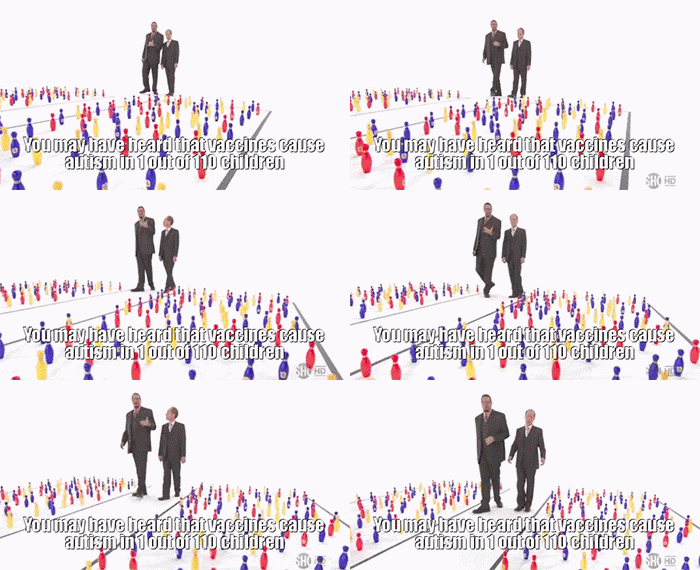

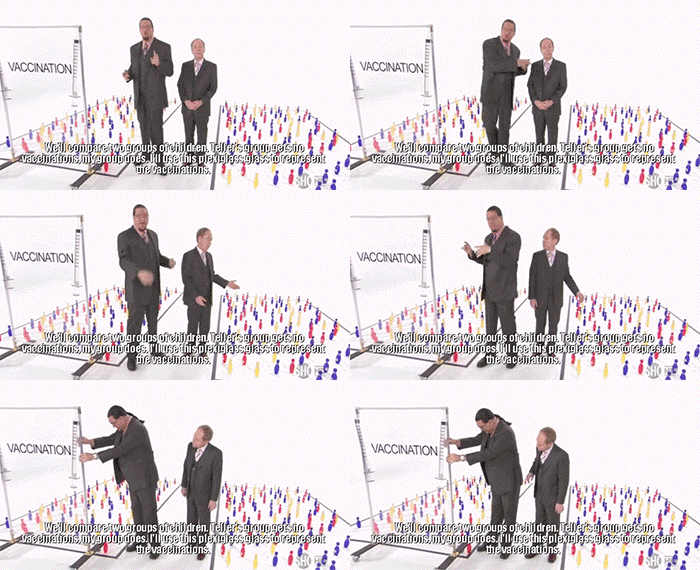
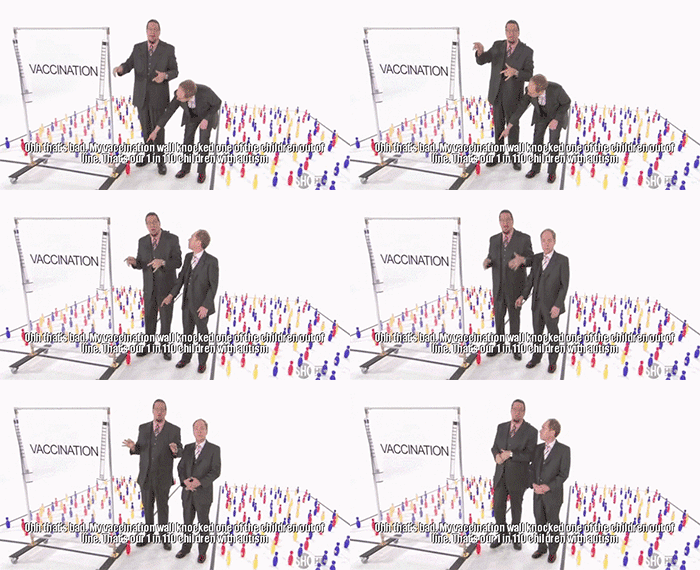
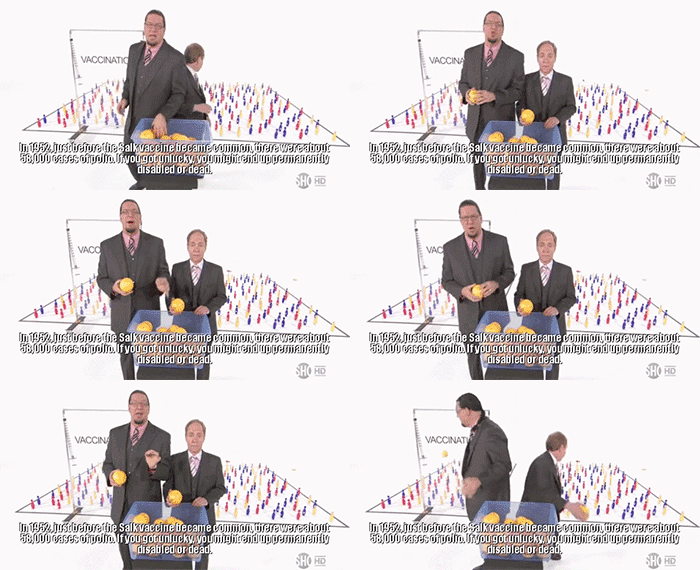
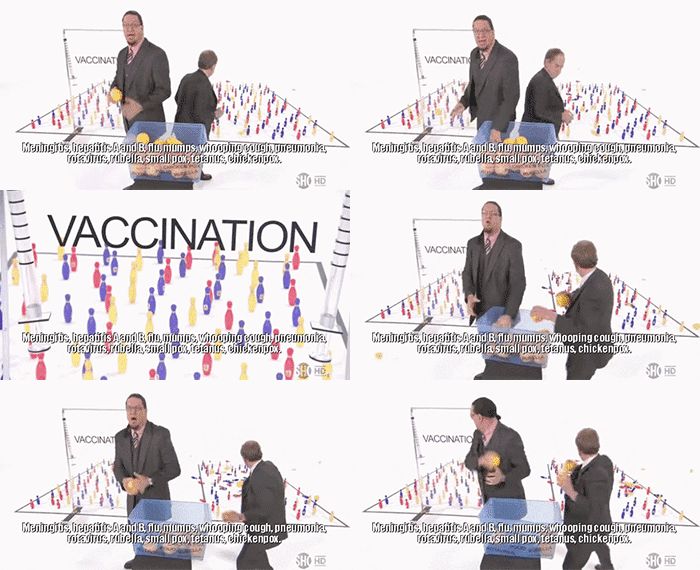
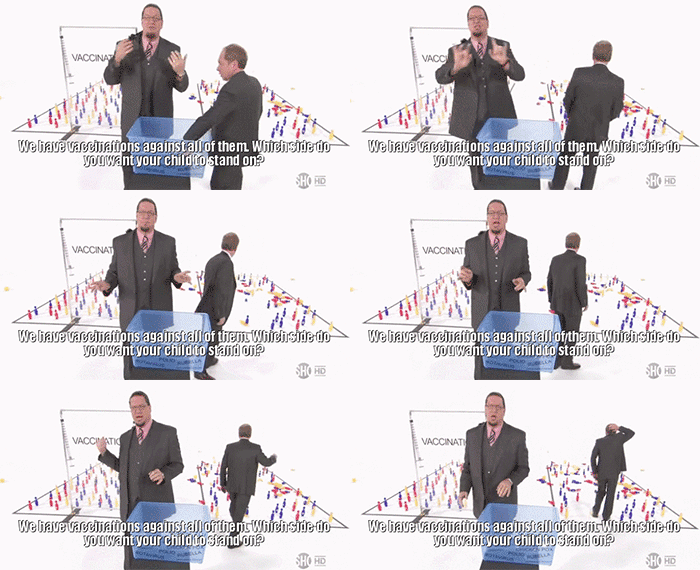

And even if that Autism thing was true (WHich it fucking isn’t) your kid is still safe from these diseases.
What’s fucking worse? You saying you’d rather have dead kid then and Autistic one? Seriously Anti-vaxxers need to banished to the moon something.
preach it
This is also why shit like Autism Speaks is fucking terrible.
People are so terrified of autism due to their campaigning that they’re willing to put LIVES at risk to avoid a child who has it.
Without that fear, the anti-vaccination campaign would have never taken off.Not to mention how fucking offensive it is to autistic people to treat autism like it’s worse than a literal plague
Like, 90% of infomercial style products were designed by/for disabled people, but you wouldn’t know that, because there is no viable market for them. THey have to be marketted and sold to abled people just so that any money can be made of off them and so the people who actually need them will have access.
I think snuggies are the one example
almosteveryone knows. They were invented for wheelchair users (Do you have any idea how hard it is to get a coat on and off of someone in a wheelchair? Cause it’s PRETTY FUCKIN HARD.) But now everyone just acts like they’re some ~quirky, white people thing~ and not A PRODUCT DESIGNED TO MAKE PEOPLES DAY TO DAY LIVES 10000X EASIER.But if at any point you were to take your head out of your own ass and go “Hey, who would a product like this benefit,” that would be really cool.
This makes informational make so much sense now.
Like… of course there’s no reason for that guy to knock over that bowl of chips. However, the person it was actually designed for has constant hand tremors that would make this pretty rad, but since we don’t want to show that in a commercial, here’s an able bodied guy who can’t remember how gravity works.
Shit. Those commercials suddenly get a lot less funny when you realize it’s pretty much just people ineptly trying to mimic disability.
Yeah, like. I’ve never really found exaggerated infomercial fails that funny, for that reason. That’s kind of. My disabled life, tbh.
davescheidtmy cat is v handsome and soft. he is Best Cat. your cat is also Best Cat, this is not a challenge. all cats are the Best, and that is science
thank you
Kathy Benjamin, 4 Ways We’re Programmed To Think Women Aren’t Funny
If a guy ever tells you that you aren’t funny because you’re a girl, reference this article to let him know he’s full of horse shit. (via vvoodsy)
The increasing isolation of America’s police
It’s a long read, but it’s a good one.

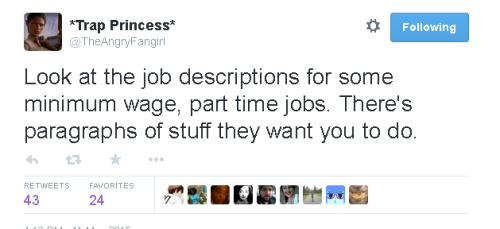


There is no part of this diatribe that is not amazing or 100% true.
SAY IT AGAIN FOR ALL TO HEAR
The line I saw a while ago that seems relevant: “There is no such thing as unskilled labor, only undervalued skills.”
I can’t find a counterexample.
here’s the deal with self care, for me:
pleasure, in the fun late-capitalism hellhole of present-day america, is treated like a luxury. it’s expensive. it’s frivolous. it’s guilty. if we want to eat ice cream out of the carton and be socially acceptable at the same time, we’d better have earned that ice cream. maybe by like running a marathon or getting dumped by an asshole. if we’re going to duck into the corner store and buy fresh flowers, it’s because we’ve had a hard week, not because flowers are nice. we can take a day off work, but only if we’re sick. we have to suffer before we’re allowed extra kindness.
in this equation pleasure is optional (irresponsible, even), except when it’s a balm for suffering.
however! we need pleasure to live. a life without nice feelings in it is like a diet with no vitamins in it. it’ll make you sick and eventually it’ll kill you. we know this because people with depression stop feeling pleasure, and they often kill themselves. left untreated, depression is a fatal disease.
pleasure is not optional. pleasure is not a luxury. without it, we die. that is literally the opposite of a luxury.
because pleasure is treated like a luxury, and priced accordingly, it is fucking hard to get. it’s hard to take time to relax and see loved ones when corporations aren’t required to offer paid vacation. it’s hard to buy that special face scrub or art print or pretty yarn when it costs $35 and student loans are breathing down your neck. so pleasure gets saved up for when things are really bad. pleasure gets budgeted. pleasure, once again, becomes something we have to earn by abstaining and hurting and gritting our teeth.
do this to people long enough and pleasure becomes potently associated with guilt. this thing we need desperately to stay alive is suddenly something we can’t seek out without looking over our shoulder and wondering if we’re allowed to have it.
that’s why it’s so important that we talk about self care, and tell ourselves and each other that it is okay to do things that feel good. it is necessary to do things that feel good. we have to uncouple suffering and pleasure, because the idea that we have to earn feeling good by first feeling bad is monstrous and wrong.
take care of yourselves, darlings. don’t feel bad about it.
Get a rat and put it in a cage and give it two water bottles. One is just water, and one is water laced with either heroin or cocaine. If you do that, the rat will almost always prefer the drugged water and almost always kill itself very quickly, right, within a couple of weeks. So there you go. It’s our theory of addiction.
Bruce comes along in the ’70s and said, “Well, hang on a minute. We’re putting the rat in an empty cage. It’s got nothing to do. Let’s try this a little bit differently.” So Bruce built Rat Park, and Rat Park is like heaven for rats. Everything your rat about town could want, it’s got in Rat Park. It’s got lovely food. It’s got sex. It’s got loads of other rats to be friends with. It’s got loads of colored balls. Everything your rat could want. And they’ve got both the water bottles. They’ve got the drugged water and the normal water. But here’s the fascinating thing. In Rat Park, they don’t like the drugged water. They hardly use any of it. None of them ever overdose. None of them ever use in a way that looks like compulsion or addiction. There’s a really interesting human example I’ll tell you about in a minute, but what Bruce says is that shows that both the right-wing and left-wing theories of addiction are wrong. So the right-wing theory is it’s a moral failing, you’re a hedonist, you party too hard. The left-wing theory is it takes you over, your brain is hijacked. Bruce says it’s not your morality, it’s not your brain; it’s your cage. Addiction is largely an adaptation to your environment.
[…]
We’ve created a society where significant numbers of our fellow citizens cannot bear to be present in their lives without being drugged, right? We’ve created a hyperconsumerist, hyperindividualist, isolated world that is, for a lot of people, much more like that first cage than it is like the bonded, connected cages that we need.
The opposite of addiction is not sobriety. The opposite of addiction is connection. And our whole society, the engine of our society, is geared towards making us connect with things. If you are not a good consumer capitalist citizen, if you’re spending your time bonding with the people around you and not buying stuff—in fact, we are trained from a very young age to focus our hopes and our dreams and our ambitions on things we can buy and consume. And drug addiction is really a subset of that.
”Johann Hari,
Does Capitalism Drive Drug Addiction?
(via bigfatsun)
As a recovering addict this is an interesting read. I’m constantly battling right-wingers telling me it’s my fault and always being told by doctors it’s in my nature. But hearing this about my environment makes a lot of sense, I fell into addiction in a very bad time in my life when I was very isolated, and most of the addicts I know are the same. Addiction is definitely related to depression and this is affected by environment. I like this article.
(via soymilkbitch)
Bruce Alexander did the Rat Park experiments in the seventies. I am kind of horrified and outraged that I’ve heard about the empty-cage rat experiments but never once about his.
(via animatedamerican)
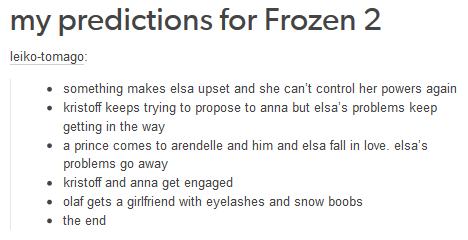
Have you visited Pleated Jeans today?
Public libraries started appearing in the mid-1800s. At the time, publishers went absolutely berserk: they had been lobbying for the lending of books to become illegal, as reading a book without paying anything first was “stealing”, they argued. As a consequence, they considered private libraries at the time to be hotbeds of crime and robbery. (Those libraries were so-called “subscription libraries”, so they were argued to be for-profit, too.)
British Parliament at the time, unlike today’s politicians, wisely disagreed with the publishing industry lobby – the copyright industry of the time. Instead, they saw the economic value in an educated and cultural populace, and passed a law allowing free public libraries in 1850, so that local libraries were built throughout Britain, where the public could take part of knowledge and culture for free.
In other words, they made explicit exceptions to the copyright monopoly for the benefit of public access to culture and knowledge. In most copyright monopoly legislation today, it says explicitly that monopoly holders to not have any kind of right to object to their works being displayed, read, and lent from public libraries. This can be traced back to the insights of 1850.
So how is this different from file-sharing? From manufacturing your own copies of knowledge and culture from others’ sources? Is it different at all?
Yes, it is different. It differs in efficiency. Where public libraries can educate one citizen at a time from one original book, file-sharing has the potential to educate millions at a time with the same effort spent.
Libraries and file-sharing do not differ in payment to copyright monopoly holders. You would frequently hear that authors are paid royalties when their books are borrowed from a library. This claim is not true. Authors do indeed get some slush money in most European countries, and this is based on library statistics, but it is no form of compensation for that library activity. The difference is crucial.
Rather, that money “from libraries” is a unilateral cultural grant that happens to use library statistics for data. It is not true that authors get money when their books are borrowed from libraries. In some cases, they do, but that’s mostly a coincidence. When Harry Potter in Swedish is borrowed from a Swedish library, for example, J.K. Rowling does not get a single penny for that. (The translator does, though. It’s a grant to promote culture availability in the local language, not to reward the author.) So the equivalence – the connection between lending and compensation – can be trivially disproven through examples.
Libraries and file-sharing do not differ in principle. The purpose of libraries was – is – to make culture and knowledge available to as many as possible, as efficiently as possible, for free – simply because of the greater socioeconomic benefit of an educated and cultural populace. How is this not file-sharing?
So we can observe that public libraries and file-sharing differ in scale and efficiency – and only in scale and efficiency. Quite a bit, even. But that’s a quantitative difference, not a qualitative difference. I sometimes hear people trying to defend the copyright monopoly by saying that file-sharing makes public libraries too efficient, and therefore cannot be allowed.
I can’t do anything but shake my head at that.
That has to be a first in the public debate: Are those people actually standing up and demanding that public services, such as public libraries, be made less efficient, to have less output for the tax money spent on it?
No. That does not make sense. And they deserve to hear it, to hear the absolute silliness of their own argument.
You just cannot defend public libraries and oppose file-sharing at the same time. They are one and the same phenomenon. One is just vastly more efficient.
In a quote from the 1850s that went past my information flow in February 2009, I noted that a publisher of the time had argued, paraphrased, that “you cannot possibly allow people to read books for free! If you pass this law, no author will ever make a penny from books again! Not a single more book will be written if you pass this law!”
(Sadly, I have lost the source of that quote. If somebody recognizes it, I would love to re-source it.)
Indeed, no book has been written since 1850. And no movie or piece of music has been created since large-scale file sharing with the Internet arrived around 1999. Either that, or these arguments are completely bogus, and there are only gains to be had from enabling the largest library ever created.
History does repeat itself. As do the people trying to defend obsolete guild-like privileges, even across centuries.
We have built the most amazing public library ever created. All of humanity is able to access the collective culture and knowledge of all of humanity, twenty-four by seven, as well as contribute to that collective pool. All the tools are already in place, all the infrastructure already rolled out, all the training already completed. Not a single tax penny needs to be spent to accomplish this. The only thing we need to do is to remove the ban on using it.
Why are we letting a cartoon industry stand in the way of this?

About The Author
Rick Falkvinge is a regular columnist on TorrentFreak, sharing his thoughts every other week. He is the founder of the Swedish and first Pirate Party, a whisky aficionado, and a low-altitude motorcycle pilot. His blog at falkvinge.net focuses on information policy.
Book Falkvinge as speaker?
Source: TorrentFreak, for the latest info on copyright, file-sharing, torrent sites and anonymous VPN services.


Is she outdated or progressive? How did I become the bad guy? Who knows! That’s my magical mum for yah. I haven’t won an argument ever. Happy Mother’s Day mummy! (sshhh I know I’m late.)
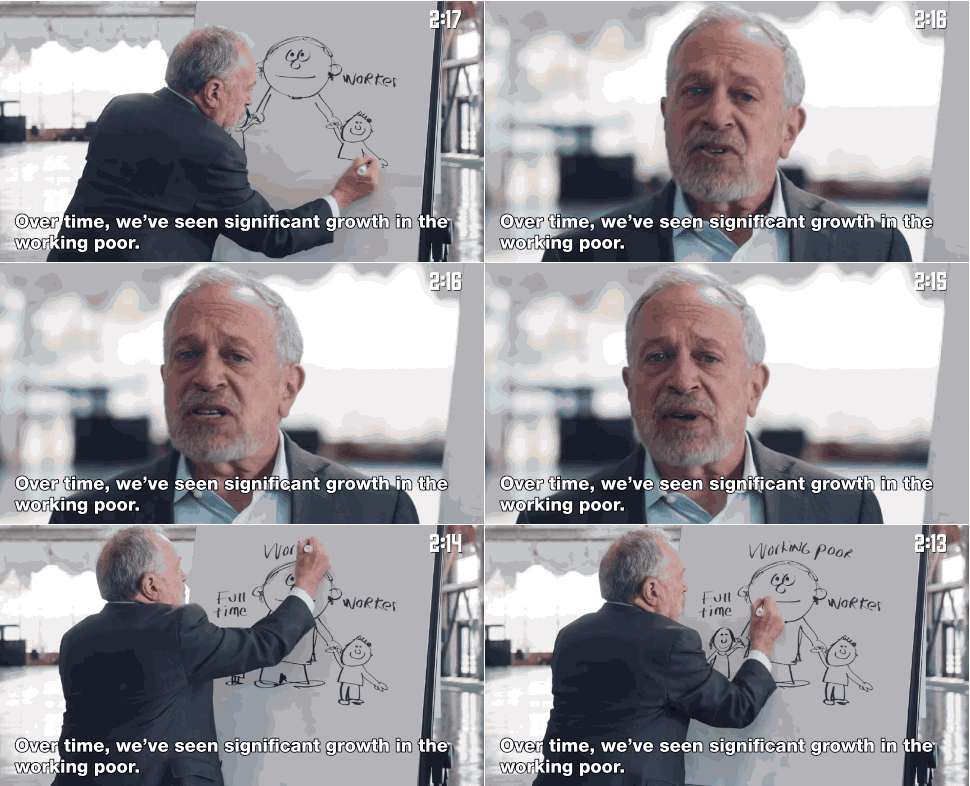

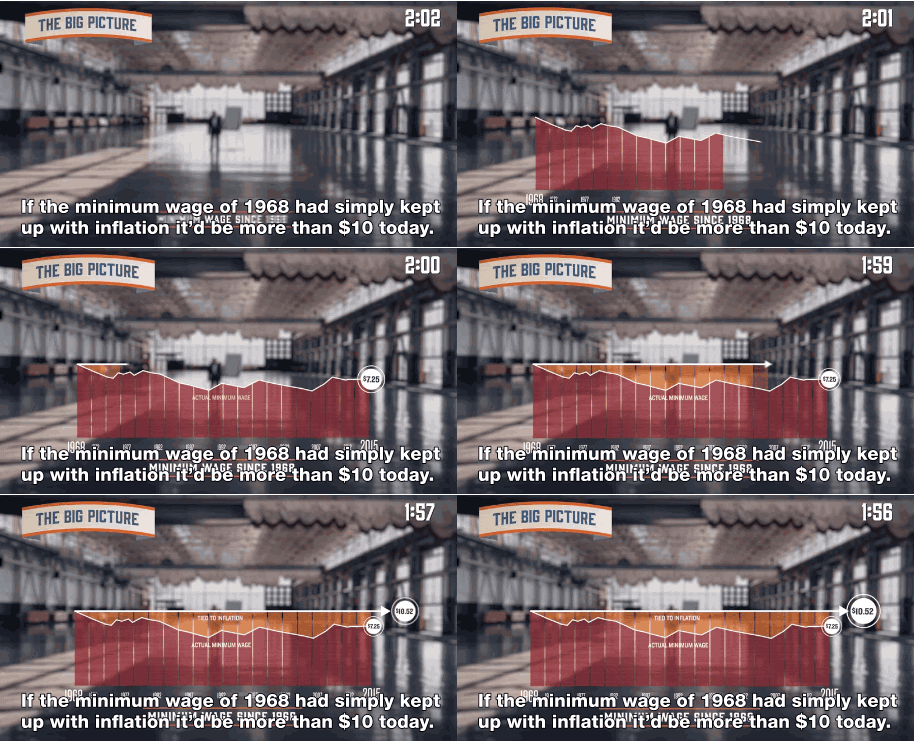
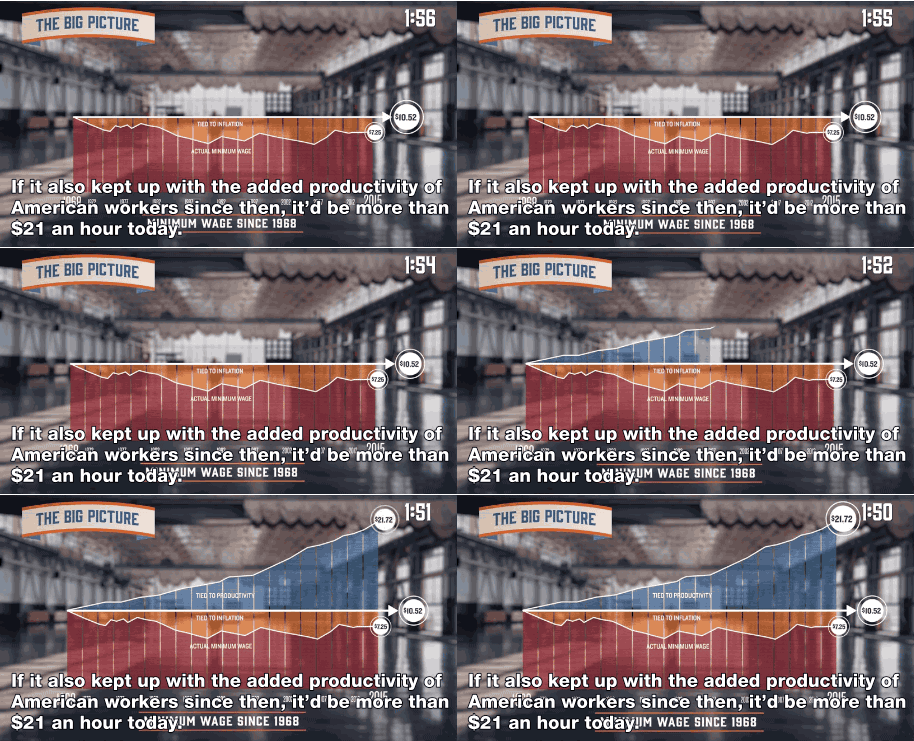
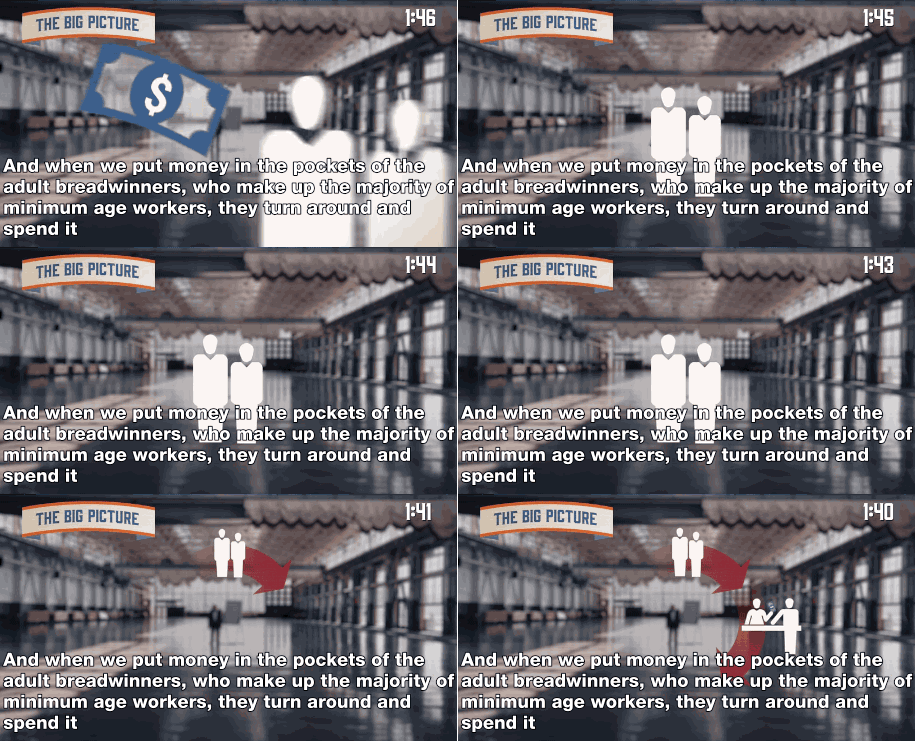
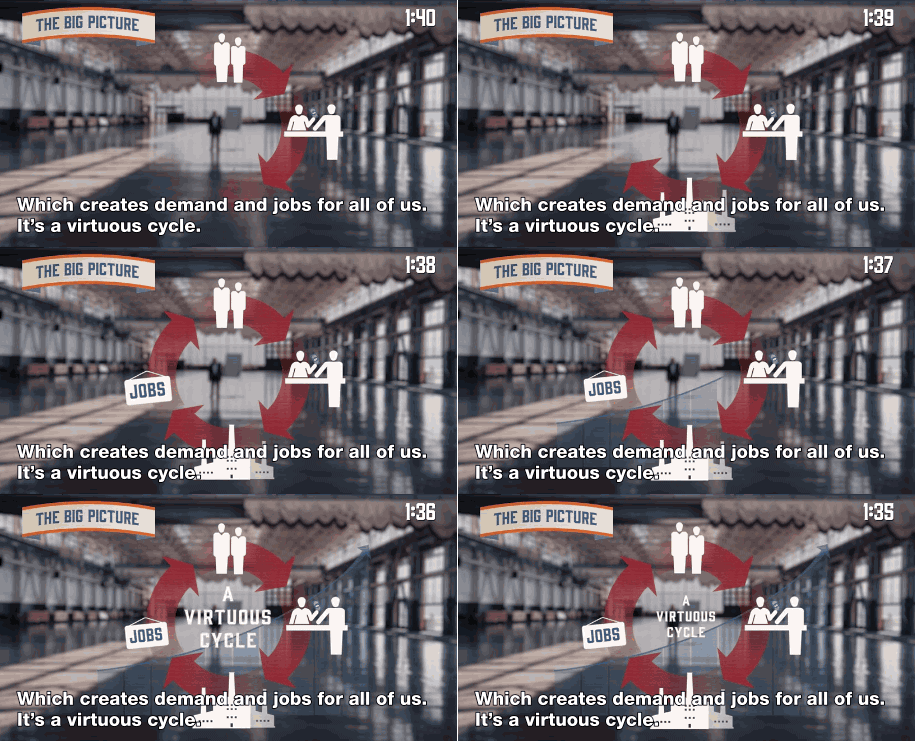
Watch Robert Reich explain why we need to raise the minimum wage in two minutes and 30 seconds.
It isn’t complicated, people.