Artist Dennis Wojtkiewicz (previously) finds creative nourishment in succulent slices of melons, lemons, and apples that appear to glow under studio lighting. Rendered in pastels with slightly blurred lines, his works focus on the seeds, fibrous veins cradling pockets of juice, and thick rinds visible only through clean crosscuts of the edible subject matter. Prints and originals of the luminous fruits are available on his site and from Moberg and M.A. Doran galleries. You can follow his latest pieces on Instagram.
Back in 2003, Kamikatsu, a town in Tokushima Prefecture, became Japan’s first municipality to go zero waste, establishing a whopping 45 categories for recycling. Today, the village reuses about 80 percent of the garbage it generates, and the Kamikatsu Zero Waste Center is at the forefront of the community’s charge to become entirely trash-free in the coming years.
Designed by the architect Hiroshi Nakamura (previously), the recycling facility is comprised mostly of upcycled materials, including a mishmash of 700 donated windows cloaking its facade. Unprocessed timber and trimmings—cedar logging once was one of Kamikatsu’s main industries—structures the building and forms tresses designed to be disassembled and reused. A terrazzo flooring made of glass and ceramic shards runs through the center, and a bookshelf made of bright blue storage containers from a nearby shitake farm covers an entire wall.
The curved facility features a central drive-through area for dropping off unwanted materials and houses offices, a community hall, and a shop where residents can bring items they no longer use and others can take them home for free. On the other end of the building is a four-room hotel that’s decorated with wallpaper made of old newsprint, and Nakamura stamped “Why?” on the pages to prompt questions about consumerism. He elaborates:
Not bringing things in from outside the region is the first step in reducing wasteful packaging, transportation costs and fuel. When designing, I often go to not only the old garbage station but also the abandoned house in the town, the old government building before dismantling, the abandoned junior high school, etc… Materials used for the building are those that consider garbage as a resource and utilize it.
For more architectural projects from Nakamura and his Tokyo-based studio, check out his site. (via Dezeen)
“A Tall Tsutsuji Tower” (2021), molded, carved, and hand-built porcelain, 34 x 27 centimeters. All images courtesy of Adrian Sassoon, shared with permission
Japanese artist Hitomi Hosono (previously) translates the billowing leaves of an underwater plant or the clusters of Hawthorn tree flowers into intricate sculptural assemblages devoid of their natural colors. The monochromatic bowls and vases appear to sprout incredibly detailed botanicals that Hosono layers in tight wraps and dense bunches, and while stylized in presentation, each form is derived from hours of research and observation of real specimens.
Currently living in London, Hosono draws on memories of her home in Gifa Prefecture to inform much of her work, and she allows the medium itself to dictate her practice. While some of the botanical forms are inspired by specific encounters with the environment like walks through the city’s parks, others are spontaneous and spurred by a hunk of material already evocative of a leaf or petal. “When handling the porcelain clay itself, then my old memories of nature in Japan come flooding back through my hands—abstract and uncertain when it was in my mind. Kneading, brushing, patting, carving, there are many processes before the shape emerges from the porcelain clay and begins to take the form of my tactile memory,” she explains.
In a note to Colossal, Hosono says she’s been interested lately in combining small florals with larger foliage, a contrast evident in “A Tall Peony and Leaves Vase” and “A Tall Tsutsuji Tower.” She describes the process for the latter:
This flower is so much a part of my childhood memories; we had Tutsuji in our home garden, at school, along the street, nearby parks, almost everywhere in Japan. Making the delicate tip of the Tsutsuji petal is challenging. I use a very small fine brush to curl the end of each petal. This must be done slowly and gently as the ends become incredibly fragile. Then I assemble the petals by hand to make each flower and place these one-by-one.
No matter the size, every element is hand-sculpted and arranged with similar pieces into a floret or layered onto the larger vessel, which typically takes a year or more to complete.
Hosono is currently represented by Adrian Sassoon, where you can explore more of her most recent works, and follow her on Instagram to stay up-to-date with her practice.
Detail of “A Tall Tsutsuji Tower” (2021), molded, carved, and hand-built porcelain, 34 x 27 centimeters
“A Very Large Hawthorn Leaves Bowl” (2021), molded, carved, and hand-built porcelain, 34 x 39 centimeters
“A Hawthorn Tower” (2020), molded, carved, and hand-built porcelain, 24.5 x 22 centimeters
Detail of “A Tall Peony and Leaves Vase” (2021), molded, carved, and hand-built porcelain, 31.5 x 21 centimeters
“A Tall Peony and Leaves Vase” (2021), molded, carved, and hand-built porcelain , 31.5 x 21 centimeters
Detail of “A Tall Tsutsuji Tower” (2021), molded, carved, and hand-built porcelain, 34 x 27 centimeters
“A Hawthorn Tower” (2020), molded, carved, and hand-built porcelain, 24.5 x 22 centimeters
Russian artist Alisa Lariushkina molds countless coiled ribbons and small twists from air-dry clay to create idyllic scenes brimming with color and texture. Reminiscent of Post-Impressionist styles, her sculptural landscapes are imbued with movement, and she uses undulating forms to convey a river’s gleaming surface and a mix of tiny discs to imitate grasses and wildflowers. Lariushkina currently lives in Vilnius and works primarily on commission, and you can follow her latest pieces on Instagram. (via Kottke)
“Heart Beating” (2020), oil on canvas, 33.3 x 33.3 centimeters. All images courtesy of Gallery Sumire, shared with permission
Wrapped within the piecey curls surrounding Miho Hirano’s subjects are twigs, vine fragments, and clusters of pink blossoms. Using a cool color palette tinged with blues, the Japanese artist (previously) paints ethereal, introspective portraits of women enveloped in movement whether through small fish swimming around their torsos or branches growing from under their hair. Hirano tells Colossal that she tends to center her oil-based works around finding harmony and the inevitability of change, particularly in relation to life’s fragile nature.
Many of the pieces shown here are on view at Beinart Gallery in Melbourne, and Hirano is currently preparing for a solo show in London next year. You can see more of her dreamy paintings on Instagram.
“Blooming Relaxedly” (2021), oil on canvas, 41 x 32 centimeters
“Rest” (2021), oil on canvas, 41 x 32 centimeters
“My Wishes” (2021), oil on canvas, 33.3 x 33.3 centimeters
“Fragrance” (2021), oil on canvas, 53 x 45.5 centimeters
“Spring Breeze Blowing Through” (2020), oil on canvas, 33.4 x 33.4 centimeters
Back in August, we shared news of a previously undiscovered jellyfish so vibrant that its brilliant red body was a stark contrast to its deepwater environment. Now thanks to researchers at the Monterey Bay Aquarium Research Institute, we can add another similarly spectacular sighting to this year’s collection of rare deepsea finds. A remote-operated vehicle spotted the elusive giant phantom jellyfish in the midnight zone, an area of the ocean about 3,200 feet below the surface, in one of just nine of the team’s encounters with the species since it was discovered in 1899.
Footage and photos from the expedition unveil the crimson animal’s bulbous body and its four billowing, blanket-like arms (these function as mouths) that have the capability to stretch 33 feet out into the water and uncannily resemble a hat and scarf flying in the wind. Because sightings are so uncommon, researchers suspect that the huge jellyfish eats plankton and small fishes, although they haven’t been able to study it enough to know for sure. (via Peta Pixel)
Make sure you’re plenty caffeinated before snacking on one of Ann Wood’s blackberries. The Minneapolis-based artist, who is half of the creative team behind Woodlucker (previously), crafts a vast array of florals, fruits, and insects so realistic that it takes a second glance to realize they’re made from paper. Delicate oyster mushrooms with wide caps and thinly folded gills grow from a hunk of wood, fuchsias with softly curved petals hang from a branch, and bundles of radishes with long, spindly roots appear like their plump, juicy counterparts.
Exquisitely sculpted and detailed with paint, wax, and colored pencils, Wood’s realistic creations are based on plants she grows in her garden and other forms she encounters. “I do this because I can see the intricate detail and have live fresh models longer. My paper botanicals take four days to a week to create each specimen,” she says, noting that she spends a significant amount of time observing the variations of a single bloom or sprout. “All plants are individuals, each with its own uniqueness. Many times it’s the flaws and the blemishes that make a specimen most interesting.”
Wood is currently working on shiitake mushrooms sprouting from a log, which you can keep an eye out for on Instagram. (via Creative Boom)
The grandest project in mathematics has received a rare gift, in the form of a mammoth 350-page paper posted in February that will change the way researchers around the world investigate some of the field’s deepest questions. The work fashions a new geometric object that fulfills a bold, once fanciful dream about the relationship between geometry and numbers. “This truly opens up a tremendous...
"Risk of backlash is all the more reason to lean into the achievement. Trump proved that if a president is stubborn, repetitive, and boastful enough, he can do a great deal to sway public opinion, especially among his loyal partisans. And here we have a policy that isn't some Trumpian dishonest exaggeration — it's a real achievement."
Why is the White House so silent about this significant achievement?
Newton’s third law tells us that for every action, there’s an equal reaction going the opposite way. It’s been reassuring us for 400 years, explaining why we don’t fall through the floor (the floor pushes up on us too), and why paddling a boat makes it glide through water. When a system is in equilibrium, no energy goes in or out and such reciprocity is the rule. Mathematically...
Working as Miguel Marquez Outside, artist Michael Pederson (previously) installs signage around urban areas that at first glance, might appear as an average city-issued nameplate or placard. His clever interventions mimic official warnings and notices in design and placement, disguising their witty messages and unusual purposes. In some of his more recent pieces, Pederson dubs a sagging bench the “Endless Waiting Area,” marks a grassy runway as a pigeon terminal, and installs a miniature wonderland down a drainage tube. Although the artist primarily works in Australia, you can find his unexpected projects in cities around the world, which you can see more of on Instagram.
“When you ride ALONE, you ride with Hitler! Join a car-sharing club TODAY” :-O
To avert environmental disaster, we need sudden and drastic change. Impossible? No, it has been done before.
By George Monbiot, published in the Guardian 20th October 2021
Fatalism creeps across our movements like rust. In conversations with scientists and activists, I hear the same words, over and again: “We’re screwed.” Government plans are too little, too late. They are unlikely to prevent the Earth’s systems from flipping into new states hostile to humans and many other species.
What we need, to stand a high chance of stabilising our life support systems, is not slow and incremental change but sudden and drastic action. And this is widely considered impossible. There’s no money; governments are powerless; people won’t tolerate anything more ambitious than the tepid measures they have proposed. Or so we are told. It’s a stark illustration of a general rule: political failure is, at heart, a failure of imagination.
Let’s set aside the obvious lessons of the pandemic, when the magic money tree miraculously burst into leaf, governments discovered they could govern (albeit with varying degrees of competence) and people were prepared radically to change their behaviour. There’s a bigger and more powerful example. It’s what happened when the US joined the second world war.
There’s discomfort in environmental circles with military analogies. But the war is among the few precedents and metaphors that almost everyone can grasp. And we would be foolish not to learn from this remarkable lesson.
Before the US declared war, President Franklin Roosevelt had begun to draft troops and build his “arsenal of democracy”: the materiel with which he supplied the allied forces. To “outbuild Hitler”, he called for levels of production widely considered impossible. But after the Japanese attack on Pearl Harbor on 7 December 1941, the impossible happened.
The day after the attack, Roosevelt requested and achieved a declaration of war from Congress. He immediately began to reorganise not only the government but the entire nation. He set up a series of agencies that were lightly overseen but coordinated through simple but effective measures such as the “controlled materials plan”.
He introduced, for the first time in US history, general federal income taxes. The government rapidly raised the top rate until, in 1944, it reached 94%. It issued war bonds and borrowed massively. Between 1940 and 1945, total government spending rose roughly tenfold. Astonishingly the US government spent more money (in current dollar terms) between 1942 and 1945 than it had between 1789 and 1941. From 1940 to 1944, its military budget rose by a factor of 42, outstripping Germany’s, Japan’s and the United Kingdom’s put together.
Civilian industries were entirely retooled for war. When the car industry was instructed to switch to military production, its massive equipment was immediately jack-hammered out of the floor and replaced, often in a matter of weeks, with new machines. General Motors began turning out tanks, aircraft engines, fighter planes, cannons and machine guns. Oldsmobile started making artillery shells; Pontiac produced anti-aircraft guns. By 1944, Ford was completing a long-range bomber plane almost every hour. During its three years of war, the US manufactured 87,000 naval vessels, including 27 aircraft carriers, 300,000 planes, 100,000 tanks and armoured cars and 44bn rounds of ammunition. Roosevelt described it as a “miracle of production”. But it wasn’t a miracle. It was the realisation of a well-laid plan.
The US war effort mobilised tens of millions of people. Between 1940 and the end of the war, the number of American troops rose 26-fold, while the civilian labour force increased by 10 million. Many of the new workers were women.
From 1942 until 1945, the manufacture of cars was banned. So were new household appliances and even the construction of new homes. Tyres and gasoline were strictly rationed; meat, butter, sugar, clothes and shoes were also limited. Rationing was considered fairer than taxing scarce goods: it ensured everyone received an equal share. A national speed limit of 35mph was imposed, to save fuel.
Posters warned people “When you ride ALONE, you ride with Hitler! Join a car-sharing club TODAY”, and asked “Is this trip really necessary?”. They cautioned: “Waste helps the enemy: conserve material”. Americans were urged to sign the Consumer’s Victory Pledge: “I will buy carefully; I will take good care of the things I have; I will waste nothing.” Every imaginable material – chewing gum wrappers, rubber bands, used cooking fat – was recycled.
So what stops the world from responding with the same decisive force to the greatest crisis humanity has ever faced? It’s not a lack of money or capacity or technology. If anything, digitisation would make such a transformation quicker and easier. It’s a problem that Roosevelt faced until Pearl Harbor: a lack of political will. Now, just as then, public hostility and indifference, encouraged by legacy industries (today, above all, fossil fuel, transport, infrastructure, meat and media), outweighs the demand for intervention.
The difference between 1941 and 2021 is that now the mobilisation needs to come first. We need to build popular movements so big that governments have no choice but to respond to them, if they wish to remain in office. We need to make politicians understand that the survival of life on Earth is more important than their ideological commitment to limited government. Preventing Earth’s systems from flipping means flipping our political systems.
So what is our Pearl Harbor moment? Well, how about now? After all, to extend the analogy, the Pacific seaboard of the US has recently come under unprecedented climatic attack. The heat domes, the droughts and fires there this year should have been enough to shock everyone out of their isolationism. But the gap between these events and people’s understanding of the forces that caused them is, arguably, the greatest public information failure in human history. We need bodies equivalent to Roosevelt’s Office of War Information, constantly reminding people of what is at stake.
As the US mobilisation showed, when governments and societies decide to be competent, they can achieve things that at other times are considered impossible. Catastrophe is not a matter of fate. It’s a matter of choice.
Japanese artist Taiichiro Yoshida (previously) continues his surveys into the possibilities of metalsmithing with a new series of elaborately layered sculptures. Spending between two and six months on each work, Yoshida meticulously molds copper, bronze, silver, and other materials by hand, creating countless metallic pieces with intricately impressed textures and edgings. Once wrapped around an armature of a dog, chick, or stuffed teddy bear, the fragile components ripple across the form, or as is the case with “The Dog in the Night Fog,” they appear as dozens of butterflies poised for flight. Explore a larger collection of Yoshida’s wrought sculptures on his site.
Italian artist Peeta (previously) uses the interplay between shadow and light to turn flat, monochromatic planes into deceptive three-dimensional murals. His large-scale works sever residences and public buildings with curved ribbons, angular shapes, and geometric blocks of color that appear to jump out from or be built directly into the existing architecture. Spanning locations across Europe, the spray-painted works shown here are some of the most recent additions to Peeta’s extensive archive of abstracted illusions, which shift in perspective depending on the viewer’s positions.
In September, the prolific artist will travel to Fidenza Village in Fidenza, Italy, for his next project, and you can follow progress on that piece on Instagram. Until then, check out his shop for prints, posters, and the sprawling fragmented sculptures that inform his murals.
This is... oddly hopeful, which is good news if it's coming from Ryan Grim
Kyrsten Sinema might be on the young side for a senator — less than half the age of some of her colleagues — but she represents the Democratic Party’s past. Think of her and Sen. Joe Manchin, D-W.Va., as the dead hands reaching out of the grave, grabbing at the party as it tries to move on from them. They might have managed to claw back spending on the Build Back Better Act, but the reality that their time has passed is clear. And the way you can measure this most directly is in terms of dollars.
For Sinema in particular, her approach to the negotiations — to push against social spending and tax hikes on the rich and corporations — has cost her badly in the polls at home and hasn’t had much of an upside when it comes to campaign cash. Her model of politics is outdated, though it has been the dominant form for most of her life.
In the 1980s, in response to the Reagan Revolution and the ongoing realignment that broke what Democrats thought was a permanent stranglehold on Congress, the party developed what was called at the time a “PAC strategy” but today is just called fundraising. Republican candidates in 1980 had heavily outspent Democrats, who believed that their name recognition and long record — they implemented the New Deal, won World War II, enacted the Great Society, and so on — meant that the GOP was wasting money on television. When that turned out not to be the case, Democrats realized that they needed comparable money of their own, and the fundraising idea was that since Democrats still had durable control of the House of Representatives — they could cling to it for 14 years after Reagan’s 1980 election — businesses that had interests before Congress needed to start ponying up for access.
Raising corporate money is not actually that efficient.
Access quickly turned to alliance, and the party drifted heavily in a pro-business direction. These “New Democrats” argued that the party had to beat back the power of special interests — and by special interests, they meant civil rights advocates, environmentalists, and labor unions. The presidential campaign of Jesse Jackson in 1988 pushed back against this hegemonic approach, but without a way to aggregate grassroots enthusiasm into the money needed for a national infrastructure, the threat was neutralized. Starting with Howard Dean in the 2004 presidential race, it finally started to look possible that a candidate funded by a large number of small, individual donations could compete with one funded by the rich and corporations. Technology was making it possible for people to quickly translate their enthusiasm not just into a honk and wave on a highway overpass, but also into actual money.
Then-presidential candidate Barack Obama showed the promise of small dollars in 2008, but he also raised an insane amount of money from Wall Street — and, once in office, he abandoned the network of small donors he had built and went with the big money. In his 2016 presidential campaign, Sen. Bernie Sanders, I-Vt., nearly toppled the Clinton machine with his famous $27 contributions. In 2018, the small-donor revolution spread to normie Democrats, with anti-Trump, #Resistance liberals throwing hundreds of millions of dollars at congressional Democrats, enabling them to retake the House. In 2020, small donors did it again, and the resource-rich Democrats took both the House and Senate.
One of the people who noticed this shift was Sen. Chuck Schumer, D-N.Y., once known as Wall Street Chuck. But thanks to all of these small donors, he now serves as Senate majority leader. A lot of people have chalked up Schumer’s pivot toward progressives as fear of a primary challenge from Rep. Alexandria Ocasio-Cortez, D-N.Y., and no doubt that’s part of what’s going on. Another factor is that Schumer is used to delivering for donors so that they keep the spigot flowing. And Schumer’s donors are now rank-and-file Democratic activists throwing in $27 at a time. In 2020, 41 percent of the money raised by Democratic Senate candidates came from donations of less than $200. What they want is to see Democrats fighting for what they ran on, so Schumer is happy to give them that fight.
Schumer also knows that raising corporate money is not actually that efficient, because each one of these lobbyists or rich people requires coddling, demands intimate access, wants internships for their kids, wants a dinner and a speech and photo, and on and on. Small donors just want you to win and then deliver what you promised. They don’t expect to ever meet you unless they’re volunteering at a headquarters where you happen to stop by.
Over the summer, Sinema showed just how much work it is. For the past few months, we were treated to endless stories about Sinema skipping important events in Washington to be at this or that fundraiser and even leaving the country to go to Paris to raise money. For all that trouble, Sinema broke her fundraising record, reporting $1.1 million in fundraising in third quarter.
Kyrsten Sinema fundraised $1.1 million in Q3 with a big assist from the pharmaceutical and financial industries amid reconciliation negotiations.
That's the most campaign money she's raised in any quarter since she became a senator. https://t.co/14a8IfdI3M
And it’s true that’s her record since she became a senator.
But when she was a candidate running for Senate — back in the third quarter of 2018, when Democratic voters thought she was a progressive and wanted to help her flip a Republican seat — she raised almost $7 million.
That’s not a fluke. You might think that 2018 was a special year and that Democratic small donors are no longer fired up since President Donald Trump is out of office and kicked off Twitter. That argument falls apart when you start looking at individual candidates. Fellow Arizona Democratic Sen. Mark Kelly is totally fine with the full $3.5 trillion proposal for the reconciliation bill, voted for a minimum wage increase, supports passing parts of the labor reform legislation called the PRO Act, and generally supports all kinds of reforms that Sinema is battling. Kelly, who’s up for reelection next year, raised $8.2 million this past quarter, while the Republican candidate expected to win that primary raised just over half a million.
OK, you’re thinking, maybe Kelly just has a ton more rich friends than Sinema. Well, the way to test that hypothesis is to look at the Federal Election Commission records for how many of the contributions were itemized, how many were unitemized, and how many were from PACs. Unitemized means that it was less than $200, and PACs are generally corporate PACS, but they could also be labor unions, and Kelly probably did well from them after supporting the PRO Act.
In the last three months, Kelly raised $3.4 million from small donors, according to his FEC report. In other words, he raised three times more than Sinema just from small donors even while Sinema was making a corporate-loving spectacle of herself and traveling the world to raise money. He made nothing from PACs. And his $3.8 million in itemized contributions shows that a Democrat in a swing state can back the Biden agenda and still raise money from big donors.
Sinema raised $914,000 from itemized contributions — those are big donations — and just $31,653.71 from small donors. She also raised $192,000 from PACs.
The fundraising profile that looks the most similar to Sinema’s is Manchin’s. Like Sinema, he’s up for reelection in 2024. He did better than Sinema in the third quarter, raising almost $1.6 million. But just $10,448 of that was made up of donations of less than $200. Of that, $1.3 million came from large donations, and $250,000 came from PACs.
Manchin, though, is distinguished from Sinema in that he can plausibly claim to be in a different political environment back home, a state that Trump carried in 2020 by nearly 40 points while losing in Arizona.
Sen. Tammy Baldwin is perhaps the best comparison, since she serves from Wisconsin, which Trump won in 2016, Biden won in 2020, and will be hotly contested in 2024. The last quarter, she raised $640,000, about half of which is from small donors. So if that’s Sinema’s game — selling out the entire Democratic agenda to do slightly better than Baldwin in the fundraising race — I guess congratulations are in order.
Over in Georgia, Sen. Raphael Warnock put Sinema’s haul to shame, raising $4.7 million from small donors in the third quarter on his way to raising $9 million overall. Maggie Hassan, the New Hampshire senator up for reelection this cycle, also raised more than Sinema: $2.5 million last quarter, more than $800,000 of which was from small donors.
And how did Sinema compare to a House member without a serious challenger?
Ocasio-Cortez raised just over $1.6 million to Sinema’s $1.1 million. In fact, she raised more from just small donors than Sinema raised total.
The simple fact is that Sinema’s style of fundraising just isn’t the best way to raise large sums of money anymore. And most politicians ultimately follow the money, which means that they’re now going to follow the people, especially if they’re in swing states that millions of people care about. So if you believe that politicians are corrupt and only do what their donors tell them to do, this is actually good news about the future of the Democratic Party. For now, however, the party’s past still has a death grip on the present.
French photographer Thibaud Poirier continues his Sacred Spaces series by capturing the modern architecture of dozens of temples across Europe. Similar to earlier images, Poirier uses the same focal point of the front pulpit and pews in all of the photographs, allowing easy comparisons between the colors, motifs, and structural details of each location. “I selected these spaces for the use of original materials, modern for their time in sacred architecture, like steel, concrete, as well as large aluminum and glass panels,” he tells Colossal. Because travel has been limited due to COVID-19, Poirier has mostly visited 20th- and 21st-century churches in France, Germany, and the Netherlands for Sacred Spaces II, although he plans to expand his range in the coming months. Keep an eye out for those shots on Behance and Instagram.
Saint-Rémy de Baccarat, Baccarat, France (Nicolas Kazis, 1957)
St. Johann von Capistran, Munich, Germany (Sep Ruf, 1960)
United States Air Force Academy Cadet Chapel, Colorado Springs (Walter Netsch, 1962)
Saint Ignatius, Tokyo, Japan (Sakakura Associates, 1999)
Cathédrale de la Résurrection, Evry, France (Mario Botta, 1999)
Saint-Jacques-le-Majeur, Montrouge, France (Erik Bagge, 1940)
Notre-Dame-du-Travail, Paris, France (Jule-Godefroy Astruc, 1902)
“Awear Glasses,” digital drawing for Charmant USA. All images Lui Ferreyra, shared with permission
Curved patches and geometric blocks comprise the layered portraits by Denver-based artist Lui Ferreyra (previously). Working both digitally and with colored pencil on paper, Ferreyra overlaps outlined fragments filled with thin lines to convey shadow and light, creating nuanced portrayals of his subjects. The prismatic works shown here are some of the artist’s more recent personal projects and commissions, which show the development of his distinct style during the last few years, in addition to the contrast he continues to draw between densely composed fields of color and larger expanses of negative space.
Ferreyra is currently a resident in The Ramble Hotel’s Art Can program, and his illustrations will be on view at the Denver location’s pop-up gallery through September 7. A few prints are available in his shop, and you can follow his work on Instagram.
Beating the heat in the town of Alhaurín de la Torre, in Malaga is an art, literally. A massive patchwork of crocheted squares now blankets the main shopping corridor thanks to local crochet teacher Eva Pacheco and more than one dozen students. Three years ago, the city council’s Department of the Environment decided to swap a large plastic tarp with a more eco-friendly and colorful solution. The textile tarp features geometric patterns, organic shapes that radiate like stepping stones, and other symbols and colors selected by the students. Pacheco and the group of women have expanded the canopy, and it now covers an area of nearly 500 square meters. A similar canopy can be found in the Spanish town of La Línea de la Concepción. (via Core77, #WOMENSART)
Detail of “登楼 / Going Upstairs” (2021), scroll, ink and color on silk, 50 × 600 centimeters (painting), 51 × 836 centimeters (scroll), 62 × 11 × 12 centimeters (camphor wood box)
“Playing music is my only hobby,” says artist Du Kun, who pairs his longtime passion for the auditory art form with the traditional Chinese landscapes his father taught him to paint as a child. This compilation takes shape in his sprawling, layered scenes that follow lush groves and steep rock formations across silk scrolls stretching nearly nine meters. Each one of the natural features is the artist’s translation of a sound wave, which turns an eccentric array of tracks into wide, serene landscapes.
In a short video detailing his multi-faceted process, Du (previously) strums an acoustic guitar and taps percussive beats that he then digitally manipulates to form arched bridges or a whimsically rendered cloud that blows the length of the scroll. He combines multiple instruments and tracks for greater perspective and depth than a single recording would provide, rendering rich works that transform sung melodies into birds and clouds or the repetitive rhythms of electronic music into segmented architecture.
“电音云龙图 (Cloud Dragon in Electronic Noise)” (2020), scroll, ink, and color on silk, 70 × 860 centimeters (painting), 75 × 1172 centimeters (scroll), 82 × 11 × 12 centimeters (camphor wood box)
There’s an implied conversation between the visual and audio elements, Du says, describing how he uses “the mood of the painting as an initial guiding foundation to break away from the conventional routines of music arrangement.” Painting styles typically associated with the Song Dynasty and contemporary audio converge in the works in a seamless mix of time and sensory experiences, which he explains:
By using painting to influence music, the elements of music are transformed into these landscape paintings, becoming a new kind of music score. This series of works bring traditional Chinese paintings and modern music together, where ‘static’ and ‘noise’ are simultaneously present in the works—causing mutual influence, interdependency, and translation with one another. Just like two people who speak different languages but find a special way to communicate with each other.
The works shown here are part of Du’s solo exhibition titled Scores of Landscapes, which is on view in-person and virtually at Mizuma Gallery in Singapore through July 18.
Detail of “登楼 / Going Upstairs” (2021), scroll, ink and color on silk, 50 × 600 centimeters (painting), 51 × 836 centimeters (scroll), 62 × 11 × 12 centimeters (camphor wood box)
“临江听筝 (Listening to the Guzheng While Overlooking a River)” (2021), ink and color on silk, 27 × 150 centimeters (painting), 33 × 180 centimeters (silk), 39 × 186 × 5 centimeters (framed)
Details of “三远即兴 (Sanyuan Improvisation)” (2021), ink and color on silk, 19 × 136 centimeters (painting), 25 × 180 centimeters (silk), 30 × 186 × 3 centimeters (framed)
“三远即兴 (Sanyuan Improvisation)” (2021), ink and color on silk, 19 × 136 centimeters (painting), 25 × 180 centimeters (silk), 30 × 186 × 3 centimeters (framed)
Detail of “登楼 / Going Upstairs” (2021), scroll, ink and color on silk, 50 × 600 centimeters (painting), 51 × 836 centimeters (scroll), 62 × 11 × 12 centimeters (camphor wood box)
Detail of “临江听筝 (Listening to the Guzheng While Overlooking a River)” (2021), ink and color on silk, 27 × 150 centimeters (painting), 33 × 180 centimeters (silk), 39 × 186 × 5 centimeters (framed)
“登楼 / Going Upstairs” (2021), scroll, ink and color on silk, 50 × 600 centimeters (painting), 51 × 836 centimeters (scroll), 62 × 11 × 12 centimeters (camphor wood box)
In much of the Western world, mentioning Transylvania tends to evoke sinister imagery of dimly lit Gothic castles and notoriously blood-thirsty vampires. The region in central Romania has long been tied to the horrors of Bram Stoker’s Dracula, an association that overshadows the area’s rich history.
Hungarian photographer Istvan Kerekes has spent the last 15 years upending that literary connection by documenting the shepherding communities that have farmed Transylvania for centuries. Bordered by the Apuseni and the Carpathian mountain ranges, the hilly landscape is ripe with greenery and open pastures for sheep, cattle, and other livestock to graze. “When walking in some parts of Transylvania one would often feel that you have traveled back in time,” he says. “There is hardly any sign of modern technology here. It is as if time had stopped, while beauty and nature are preserved”
Kerekes’s portraits and wider landscape shots capture the grit and determination of those who devote their lives to attending to their herds. Shot entirely in black-and-white, the photos glimpse the mutual bonds between the animals and their caretakers and the ways the traditional mode of living is passed from generation to generation. They’re powerful and raw, showing the tender embrace of a weathered man as he cradles a lamb in his coat or the way a child wraps one of the animals around her neck.
All of the images shown here are part of a virtual exhibition at All About Photo, which is up through August. They’re just a fraction of Kerekes’s larger collection, though, and you can see more on his site.
When an herbivorous insect like an aphid or mite needs a place to feed and reproduce, it sometimes seizes a tiny section of a plant where it establishes an abnormal growth or gall. These tissue pockets, which are spurred by a reaction in the host, provide shelter and nutrition for the creature, and although some can be unsightly blemishes, others, like these brightly colored growths of cynipid wasps, are bizarrely beautiful additions to the otherwise green leaves. Photographed by Timothy Boomer, the macro images capture the imperceptible details of the galls, which appear like fairytale-style mushroom houses, prickly sea urchins, and fuzzy, striped domes. See more of the whimsical growths, which generally only cause cosmetic damage to the host plant, on Instagram and Boomer’s site, where you can also purchase prints.
In Benjamin Sack’s imagined environments, it’s not uncommon to find angular mazes resembling dystopian structures, buildings packed so closely together it’s difficult to distinguish one from the next, and labyrinthine walkways that spiral like fractals. Working in pen and ink, the artist (previously) draws intricate black-and-white metropolises that waver between organization and chaos: He plays with geometry, angles, and dimension to render perplexing maps teeming with both traditional architecture and surreal additions, like treble clefs, astral shapes, and dizzying line- and dot-work.
While many of Sack’s works meld the past, present, and future into a single display, his recent feet-wide maze titled “Roots of Being (Per Aspera ad Astra)” is directly drawn from this last year. “This piece was a massive, Daedalian undertaking that was started at the outset of the initial lockdowns back in March 2020 and finished upon my receiving the first dose of the vaccine in April,” the artist tells Colossal. “A large labyrinth emblematic of the epoch we persevered.”
A guardian angel in the form of a grey heron watches over an allegorical mural at Burgos Cathedral in Spain. Painted by Louis Boidron and Edouard Egea, who work as MonkeyBird (previously), “Mymesis, beings and places” is an homage to the artworks and design of the church, which UNESCO designated a World Heritage site back in 1984 in part because it captures the evolution of gothic architecture: construction on the building began in 1221 and wasn’t complete until 1567, meaning it showcases the entire history of the style.
Translating many of the religious symbols and motifs found inside, the duo combines the cathedral’s profound history with its signature stenciled aesthetic and recurring monkey and bird creatures. The resulting mural is a dense display of ornate structural elements, airborne birds called papamoscas cerrojillo that typically nest in the building, and a gilded clock from the 18th Century. “Our intention was to offer an effect of complex depth and monumentalism, combining some of the most spectacular references of the temple, such as the main altarpiece, with its many details, the Golden Staircase, or the circular oculus in the center of Santa María façade,” MonkeyBird says.
Head to Instagram to see more of “Mymesis, begins and places” and to follow the duo’s projects and occasional print releases.
A famine is being forced on the people of Tigray, the scene of one of the world’s greatest environmental success stories.
By George Monbiot, published in the Guardian 30th June 2021
It is hard to believe it’s happening again, even harder to believe that so few people seem to know or care. A massive famine is unfolding in Tigray in northern Ethiopia. Five million people are in need of food aid, and perhaps 900,000 are already starving.
In other words, it’s looking horribly reminiscent of the start of the 1984 famine, in which a million people died, most of them in Tigray. Like the last cataclysm, this has nothing to do with “natural causes”. It’s caused by war and its associated crimes. This time, however, the man in charge is a Nobel peace laureate: the Ethiopian prime minister, Abiy Ahmed. A great weight of evidence suggests that his troops, and those of his Eritrean allies, are using hunger as a weapon of war.
In February, Abiy’s government dissolved the boards of the most effective aid groups: the Relief Society of Tigray and the Tigray Development Association. Since then, their warehouses have been destroyed by soldiers, their offices looted and their vehicles stolen. The Ethiopian and Eritrean armies have blocked supply lines, turned back convoys of food and medicine, burned grain stores, felled orchards, slaughtered oxen and ordered farmers not to till their fields.
This week the Ethiopian government declared a ceasefire, ostensibly to “enable farmers to till their land”, but more plausibly to regroup after an astounding reversal: Tigrayan rebels have recaptured the regional capital. In any case, it’s too late. Tillage should have happened over the past three months. People who are starving today can’t wait for possible harvests in November.
Like his homicidal predecessor, Mengistu Haile Mariam, Abiy flatly denies the famine. Last week he claimed: “There is no hunger in Tigray.” If justice is ever done, we might one day witness the remarkable spectacle of a Nobel laureate on trial for crimes against humanity.
All this would be bad enough. But what sharpens the crime is that Tigray was, until the war began last November, a world-renowned success story.
The traditional explanation of famine, which appears to resist all evidence, is that hunger is caused by a surfeit of people. A rising population overtaxes the land, which can no longer provide sufficient food for those who depend on it. But a fascinating study shows that in Tigray the opposite has happened.
It used photographs dating back to 1868, taken from the same vantage points, to assess the condition of the land. Since then, the population of Ethiopia has risen from 6.6 million to 115 million. A catastrophe? Far from it. The researchers found more trees, more vegetation, less erosion, less degradation. The region, they discovered, is “greener than at any time in the last 145 years”.
Why? Because the main driver of land degradation and hunger is not population. It’s policy. In 1868, the best land was owned by feudal lords. Other people were driven on to steep slopes. Pressed to the margins, without secure tenure, they were forced into destructive forms of land use: mostly uncontrolled grazing. But in the 1970s, land was redistributed to the people. Beginning in the 1980s, the rebels in Tigray, who later formed the national government, launched a programme to protect the soil, catch rainwater and reforest the land. Livestock were fenced out of large areas, steep slopes were terraced, stone walls and soil bunds were built to stop erosion, and trees planted and ponds dug to prevent water from flashing off the land.
The scale of these works is astonishing. Every fit person over the age of 18 spends 20 days a year on collective projects to rehabilitate the land. Entire landscapes, torn apart by gullies and sheet erosion, have been remodelled. The stone and soil moved by hand must amount to millions of tonnes. This might explain an extraordinary finding: the greenest places in Tigray are those with the highest population density. Because of the vast effort required, these works would have been impossible with fewer hands.
There have been similar results in other places: the Karoo Midlands in South Africa, Machakos in Kenya, the Loess plateau in China and the Adarsha catchment in India. In all these cases, population growth has been accompanied by environmental repair.
But Tigray is the outstanding example. The restoration works have caused a huge reduction in soil erosion and water loss, a resurgence of wildlife and improvements in crop production that have easily outstripped population growth. Incomes have risen. Children spend more time at school. In 2015-2016, when a major drought struck, the system helped to avert famine. The reason for its success is local control and enthusiasm for the programme: people feel it belongs to them. As welfare and security have improved, and women have greater rights and opportunities, population growth has fallen.
Of course, there are plenty of places where higher numbers of people, combined with total institutional failure, harm both the natural world and human welfare. But the important point is that population growth, degradation and famine are not intrinsically connected. What counts is the quality of government.
So there are no excuses. No part of the catastrophe in Tigray is natural or inevitable. Abiy, with his allies in Eritrea, is turning a thriving, prosperous region into the scene of another historic disaster. And he won’t stop until the world wakes up.
U.S. Environmental Protection Agency Administrator Michael Regan officially announced earlier this month that the Biden administration will reinterpret the Trump administration’s definition of what constitutes “waters of the United States” – waterways that are deserving of federal protection.
Trump’s definition was actually a reinterpretation (or rejection) of what the Obama administration delineated as waters worthy of federal oversight. Obama had sought to increase protections under the Clean Water Act, based on EPA science conducted under both his administration and that of his predecessor, George W. Bush. The agency’s researchers had determined that many wetlands and rain-fed intermittent and ephemeral streams were significantly connected to larger bodies of water than met the eye – and thus those tributaries warranted protection.
The Trump administration’s own scientific advisors agreed with Obama’s interpretation. No matter, the Donald’s EPA gutted the rule on behalf of industrial and agricultural polluters by removing half of wetlands and a fifth of streams and tributaries from protection. That shift amounted to an overall 25-percent drop in protected waters, according to the U.S. Army Corps of Engineers.
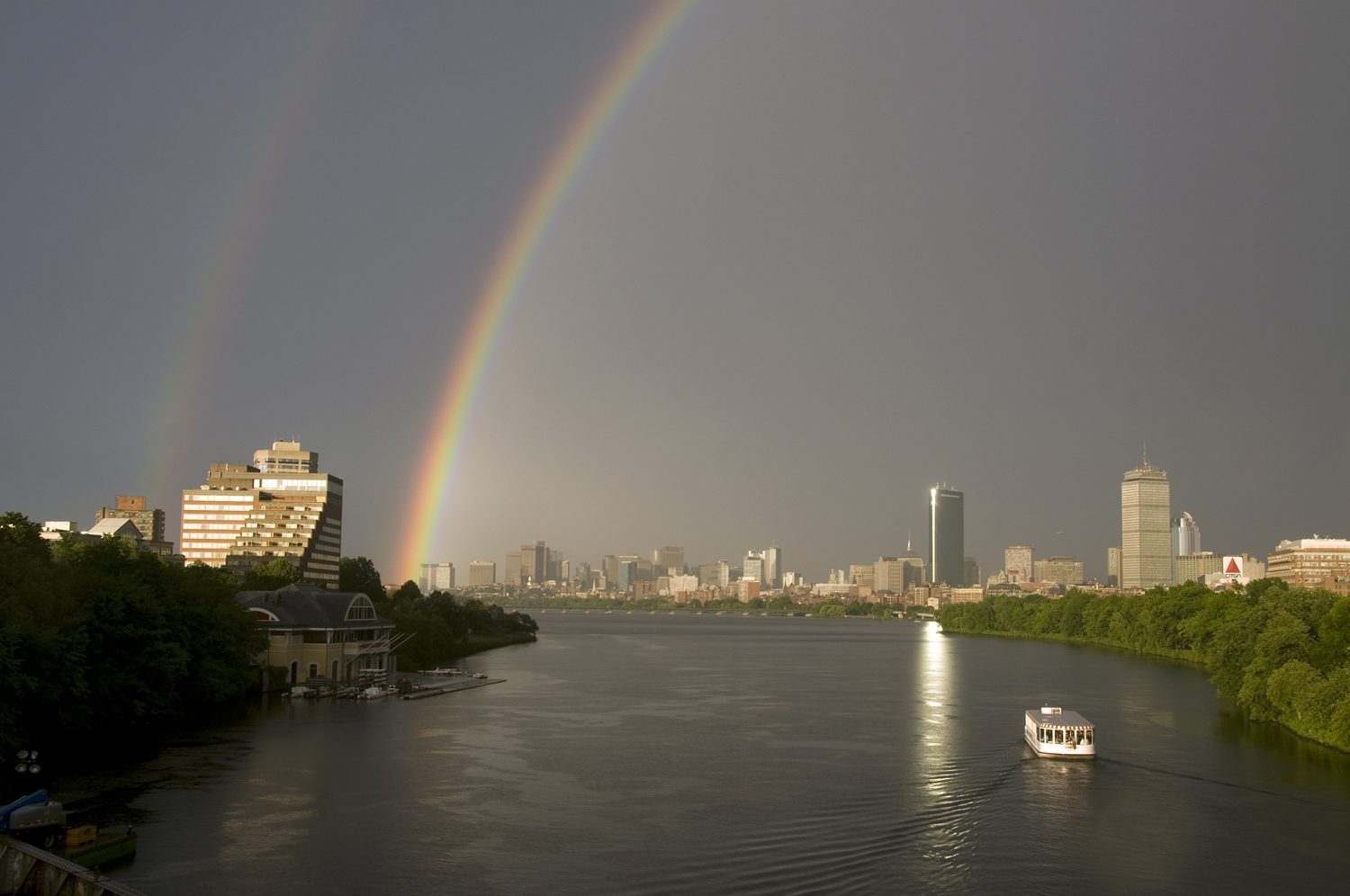
Noting that the Trump rule “is leading to significant environmental degradation,” Regan said he would work toward a “durable definition” of waters of the United States. And he begins that effort at a time of year when, precisely because of decades of federally enforced cleanups, New England’s most famous river – and once one of its most infamous— the Charles, is as magical as Florida’s Everglades.
The most stunning drama this spring along the banks of the Charles, walking distance from downtown Boston, has been a pair of mute swans. They nested at a landing alongside a walking and biking path in the Back Bay neighborhood and produced nine eggs. Seven hatched. By predation or sickliness, the number of cygnets eventually went down to five.
A pair of swans swims protectively around its chicks.
Derrick Z Jackson
Then, without warning, the mother died on the nest. A necropsy showed neither foul play nor ingested foreign objects did her in. The father then took on the chicks, sometimes letting them ride on his back. Even though the number of chicks has dwindled down to two as of late June, the family continues to stop strollers and joggers in their tracks, as do more familiar families of geese and goslings and ducks and ducklings cruising the waters and grazing on the grass.
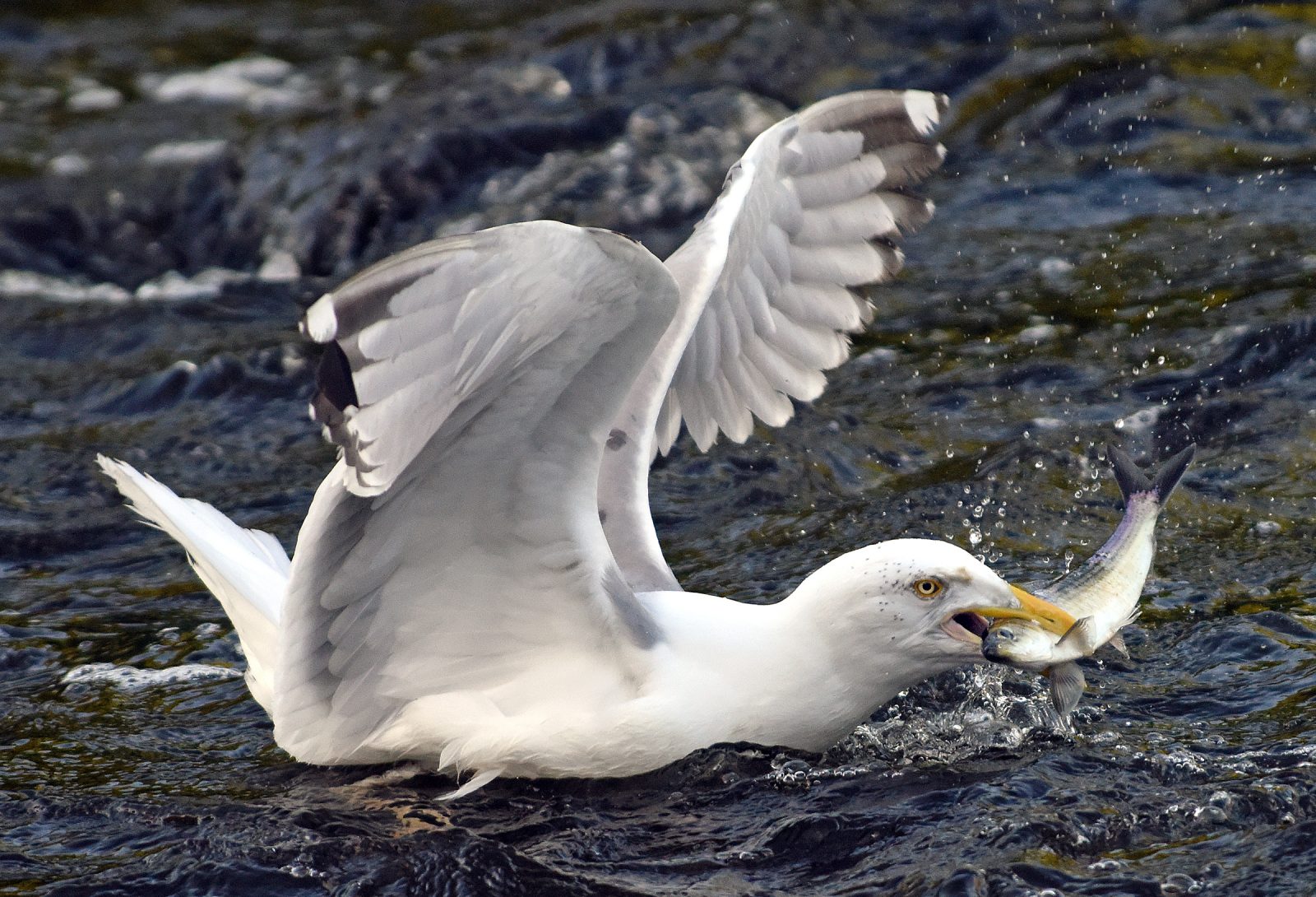
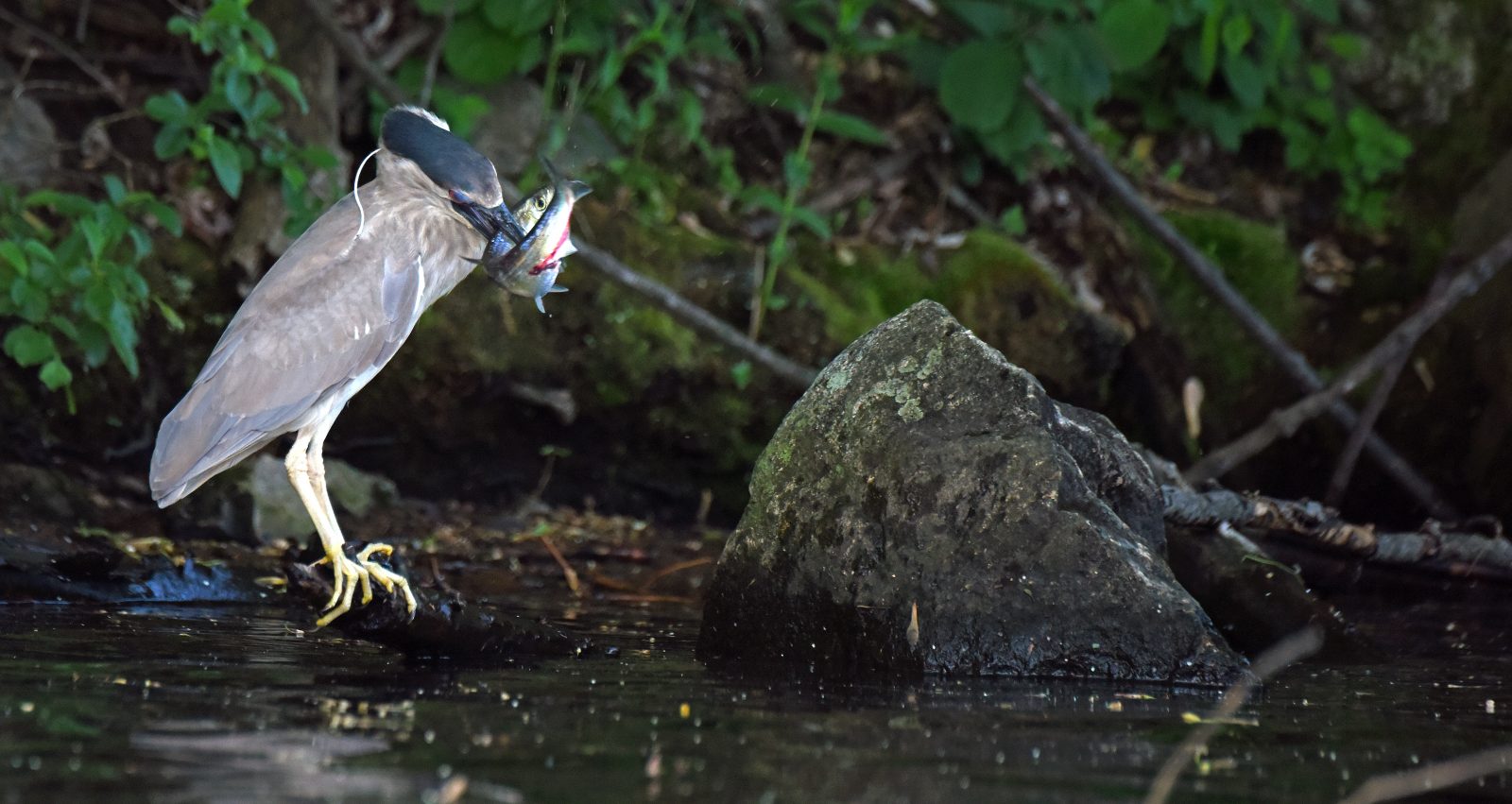
A couple miles up the river from downtown, black-crowned night herons and great blue herons patrol the banks, snapping up river herring that have been restored through federal and state efforts. During the herring run, gulls often wait at a dam in the suburb of Watertown to gobble up the fish that evaded the herons’ beaks.
Osprey occasionally fly in to dive for fish. Muskrat cruise the reeds as turtles bask on floating logs. As the river heads deeper into exurban Boston, bald eagles have been nesting, continuing their remarkable recovery from a point in the 20th century when pesticides had led to their disappearance in most states.
A gull (left) and a black-crowned night heron (bottom) snap up river herring. Those sightings — as well as a family of mallards (right) are all signs that the Charles River clean up has been successful. Derrick Z. Jackson
All this fauna can now be seen in a river once so polluted that the locals joked about people needing tetanus shots if they fell in. The foul Charles even inspired the Boston anthem “Dirty Water” by the Standells. As recently as 1995, the river earned a D for water quality at its mouth in Boston Harbor, a result of uncontrolled human sewage, railyard oil pollution, industrial waste, and landfills that crept up right to the water’s edge.
The river’s revival began in the 1980s when conservationists and the EPA joined forces to sue the state of Massachusetts over the levels of wastewater pollution in the Charles. That resulted in federal judicial oversight of more than $4.5 billion of mitigation projects managed by the state, most notably a massive waste-treatment facility and the overhaul of 100 miles of leaky sewage pipes and storm drains. Local conservation groups also convinced the Army Corps of Engineers to protect 8,000 acres of wetlands in the Upper Charles watershed.
The cleanup of the Charles River has won global acclaim for bringing back an urban body of water back from unspeakable industrial and human waste.
Derrick Z. Jackson
Today the water is technically swimmable most of the time — though one dares not touch the riverbed with bare feet as it is still laden with heavy metals. Recognized a decade ago as one of the world’s most well-managed rivers, the Charles is now a year-round wonder of wildlife. Last winter, its waters, as well as the Boston Harbor’s, were full of mergansers, scoters, goldeneye, eiders, bufflehead, and loons.
It is the protection of the Charles’ watershed that EPA Administrator Regan should keep in mind as he sets forth to protect more American waterways. Despite accounting for fewer than six percent of the United States landscape, freshwater scientists consider wetlands to be precious jewels of the ecosystem. These marshes and swamps, where plants grow thick in soil saturated with water, are natural traps and filters for runoff and sediment. They also provide nurseries for aquatic life.
A muskrat swims in Great Meadows National Wildlife Refuge in Concord, Massachusetts. Scientists have found wetlands to be critically connected to the health of larger bodies of water, like the Charles.
Derrick Z. Jackson
It is also the part of the ecosystem that industry and factory agriculture continue to plow over and foul when they can get away with it. Consider the ill-fated Foxconn electronics plant in southern Wisconsin. After promising 13,000 jobs in 2017, the state gave the company a sweetheart deal of billions of dollars in tax breaks, as well as waivers to fill in 38 acres of wetlands to build their facility. The company now is only pledging 1,500 jobs while flooding and erosion risks have risen in the region because of the wetland loss.
In advance of this month’s announcement, Regan told a House committee in April that, while Trump went too far in his reinterpretation of the waters of the U.S., the administrator was not going back “verbatim” to the Obama-era rules. The statement was a clear effort to placate the farm lobby, which has unfurled ridiculous exaggerations that the Biden EPA would patrol every ditch to see if each is connected to rivers.
While it is politically understandable that Regan must get, as he said, “input from a wide array of stakeholders,” federal science nevertheless does not quibble about the interconnectivity of our waters.
As he gathers input, perhaps a trip to Boston, to gather input from the swans, herons, and herring, is in order. They are illustrating the important of healthy watersheds and well-managed waterways via their nesting near the Charles, in their gathering along banks to feed, and by making their spring runs up the river.
Two swan chicks remain on the Charles River with their father as of late June.
Derrick Z. Jackson