

Adam Victor BrandizziFico meio #chatiado de ter de reblogar todo Tumblr legal que vejo nos trendings. Veja, é até bom que eu reblogue alguns (esse aí eg é mó legal) mas sei lá, queria compartilhar diretamente sem ter de dar reblog ou seguir alguém (que, às vezes, compartilhou faz tanto tempo que nem consigo encontrar o compartilhado). Enfim.
Dito isto, a estadia aqui está muito legal :)
A lenda é difusa, mas deve ter ocorrido nos anos 60, durante uma aula do professor Bento Prado Jr., na rua Maria Antônia. Terminada a explanação, em que o docente citou o filósofo Plotino várias vezes, um aluno respeitosamente levantou a mão e disparou: “Com licença, professor. Esse Plotino aí não seria o Platão, não?” Ao que o mestre respondeu: “Não, cretão.”
Momento de vergonha: já fui louco de plateia.
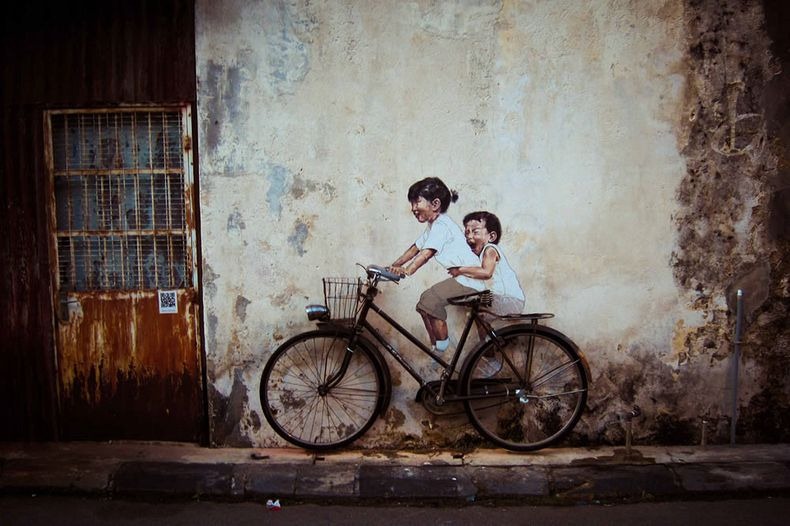
Lithuanian artist Ernest Zacharevic has been transforming the streets of Penang, Malaysia with a brilliant series of interactive murals. These murals combine a mixture of painted figures and found objects, like a couple of adorable children riding on a bicycle or a giant portrait of a girl pushing herself up on two windows.
These iconic, lighthearted pieces have become enormously popular across the city, where passersby get a kick out of taking photos of themselves immersed in the scene displayed on the wall behind them. By fusing the physical world with his imagination, the Penang-based artist makes street art that is realistic yet creative, engaging the public who stop and take in the view. Ernest rethinks outdoor art by adding something that breaks away from the 2D nature of graffiti. He uses props like old bicycles and motorcycles to bring his street art to life. Local people participate in his work as well by holding poses and making faces, becoming part of the scene and adding something spontaneous and human to it.


Peguei um velho papo do Louis CK como gancho pra falar da nossa insatisfação em relação à tecnologia na minha coluna da edição de hoje do Link.

Tudo é tão incrível, e ninguém está feliz
Reclamamos muito sem pensar no passado
A cada momento que o olho brilha graças aos avanços da tecnologia moderna, dois resmungos competem com o deslumbre: um deles lamenta que as coisas não são tão boas quanto no passado, o outro se inquieta com as falhas do recém-chegado. Muito já foi dito e escrito sobre a natureza insatisfeita do ser humano, mas vivemos numa época de ouro para a humanidade. Ela pode não ser a mais incrível da história, mas é, sem dúvida, aquela em que o maior número de pessoas vive bem e pode fazer o que quer. Mais do que isso: elas podem fazer coisas que nem sequer imaginariam fazer apenas alguns anos antes.
E nem estou falando das virtudes sempre exaltadas pela pauta do Link. Me refiro apenas a fatos triviais.
Estamos em contato com amigos e conhecidos o tempo todo. Hoje conversamos em vídeo pelo celular. É possível fazer compras, pagar contas e trabalhar ao mesmo tempo, sem que uma ação atrapalhe a outra. A maioria das perguntas que você pode fazer – tirando as existenciais – pode ser respondida em alguns cliques. Só o clichê do “computador de bolso” propagado na era do smartphone já justificaria tanto deslumbre: seu celular é um localizador de GPS, um tocador de mídia (música, vídeos, fotos), uma câmera que filma e tira fotos, um dispositivo de acesso à internet, um videogame portátil.
Mas, enquanto a foto não carrega, o mapa não aparece, o vídeo não sobe ou o game muda de fase, reclamamos da conexão, do aparelho, da rede, do software. Isso sem citar aqueles que esbravejam “antigamente é que era bom” e se esquecem das filas no banco, do tempo perdido para se achar um lugar, de impostos feitos em planilhas de papel, das as poucas fontes para descobrir música nova, como rádio e lojas de disco.
Sempre que vejo as pessoas confrontadas nesse dilema egoísta, minha memória me leva inevitavelmente a um texto, repetido em apresentações ao vivo e programas de TV do comediante norte-americano Louis C.K., que ficou conhecido com o título que usei nesta coluna.
“Tudo é incrível e ninguém está feliz”, começava. “Em minha vida, as mudanças que aconteceram no mundo foram incríveis. Quando eu era criança, o telefone em casa era de disco. Você tinha de ir onde ele estava e tinha que discá-lo. Você já parou para pensar como era primitivo? Você está produzindo faíscas em um telefone!”
Ele continuava falando do saudoso passado de que uns ainda fingem sentir saudade: “Se você quisesse dinheiro, você tinha de ir ao banco, que só ficava aberto por algumas horas. Você tinha de pegar uma fila, escrever um cheque para você mesmo feito um idiota e quando o dinheiro acabava você não tinha mais o que fazer. Acabou.”
“Estamos vivendo num mundo incrível e ele está sendo desperdiçado na geração mais rasa de idiotas mimados que não se importam porque é assim que as coisas são agora”, reclamava. “Estava num avião outro dia e tinha internet. E isso é o avanço mais recente que eu conheço: internet rápida no avião. Estou ali no avião e posso pegar um laptop, entrar na internet, que é rápida o suficiente para assistir a vídeos no YouTube. É incrível. E aí de repente a conexão falha, alguém da companhia aérea pede desculpas pela internet não estar funcionando e um cara do meu lado começa a reclamar que isso é uma merda!”
E conclui dizendo que nem sequer percebemos a maravilha que é voar, essa tecnologia de pouco mais de um século. “Alguém reclama que teve de ficar esperando a decolagem por 40 minutos. É mesmo?”, pergunta Louie. “E o que aconteceu logo em seguida? Você voou pelos céus como um pássaro? Você atravessou as nuvens, algo que era impossível? Você teve o prazer de participar do milagre do voo humano e depois pousou maciamente sobre pneus enormes que você nem consegue imaginar como foram parar o céu? Você está sentado em uma cadeira no céu. Você é um mito grego neste exato momento.”
Reclamamos muito e temos pouca consciência do nosso próprio contexto – e isso não diz respeito apenas à tecnologia. Mas graças a ela isso tem mudado.
Volto ao assunto em outras colunas.
Victoria Jaggard, physical sciences news editor

(Image: NASA/JPL-Caltech/MSSS)
Sifting through soil on Mars, NASA's rover Curiosity paused to take a picture - and exposed its own bad behaviour. The shot included a bright object lying in the Martian dirt, and a closer look suggests that the rover is guilty of littering: it appears the object is a piece of plastic wrapper that has fallen from the robot.
The discovery has put a twist on the rover's current mission to scrub out its soil scoop and take its first sample of Martian dirt for analysis. More bright specks of unidentified matter in the soil - at first thought to be from Curiosity shedding - may actually be Martian in origin, although what they might be is a mystery.
Curiosity had been in the midst of preparing to feed soil into its Chemistry and Mineralogy (CheMin) instrument, which bounces thin beams of X-rays off a sample to read its mineral composition. This involved taking scoopfuls of soil, shaking them vigorously and then dumping them back out, to be sure that any lingering traces of Earthly particles didn't make it into the science equipment.
After the first scoop-and-shake revealed the unexpected object, Curiosity took a quick break to examine the find. It then got back on course, taking a second scoop of soil on 12 October. But the hole Curiosity dug also contained bright particles, forcing the team to dump the load due to worries that the rover was picking up pieces of its own robotic debris.

(Image: NASA/JPL-Caltech/MSSS)
Further scrutiny now suggests that at least some of the unidentified particles are in fact native to Mars. Images show light-toned particles embedded in clumps of excavated soil, implying that they couldn't have been shed by the rover.
NASA is currently preparing to take a third sample from the site as well as more pictures, which should help them figure out whether the bright bits are unwelcome litter or something worthy of delivery to the rover's on-board lab equipment.
It wouldn't be the first rover glitch to uncover scientific treasure. In 2007, Curiosity's older cousin Spirit lost the use of one of its wheels and was forced to drag it across the Martian terrain. This scraped away a layer of soil, and when Spirit looked back, images showed the dead wheel had exposed a swath of bright material.
That patch turned out to be the first evidence of silica on Mars, and silica is a mineral that most often forms in the presence of hot water.

 |
 |
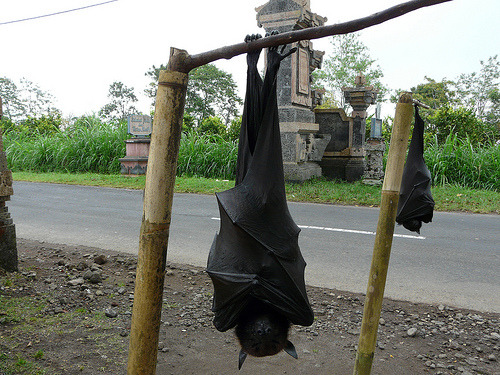

The giant golden-crowned flying fox (Acerodon jubatus), also known as the golden-capped fruit bat, is a rare megabat and one of the largest bats in the world. The species is endangered and is currently facing the possibility of extinction because of poaching and forest destruction. It is endemic to forests in the Philippines.


If mysterious illustrator Uno Moralez had created video games a few decades back, they would have simply blown our minds. The bizarre creations have a look unlike anything else, often mixing themes from film noir to gothic, anime to Indian religious iconography – all made with a distinctly pixilated 8-bit style. Not only are these intricate scenes highly entertaining… they’re often seriously creepy too.
See Also 8-Bit Polaroids Capture a Retro/Digital World
Uno Moralez (if that even is someones name), often creates equally mysterious stories, stacking images to form comic like progressions in plot. In one example, two girls go wandering in the night, find a frightening creature in the woods and slay it with a sword. Out of the creatures belly crawls a nude boy who they take home and fall asleep with. It is the kind of story reserved for the pages historic mythology or even our more mind-bending dreams. You can see more of Uno Moralez’s work at unomoralez.com (NSFW).


CARACAS, Venezuela (AP) -- Venezuelans awakened on Monday to the prospect of another six years under President Hugo Chavez as the leftist president's supporters celebrated his victory against a youthful rival and a galvanized opposition pledged to build on its gains.
Chavez emerged from Sunday's vote both strengthened and sobered, having reconfirmed his masterful political touch but also winning by his tightest margin yet. Challenger Henrique Capriles said while conceding defeat that his campaign had launched a new political force and that he would keep working for change.
With a turnout of 81 percent, Chavez only got 551,902 more votes this time around than he did six years ago, while the opposition boosted its tally by about 2.1 million.
 Supporters of Venezuela's President Hugo Chavez cheer after polling stations closed and before any results were made available in Caracas, Venezuela, Sunday, Oct. 7, 2012. Venezuela's electoral council says Chavez has won re-election, defeating challenger Henrique Capriles. AP / Rodrigo Abd
MORE IMAGES
Supporters of Venezuela's President Hugo Chavez cheer after polling stations closed and before any results were made available in Caracas, Venezuela, Sunday, Oct. 7, 2012. Venezuela's electoral council says Chavez has won re-election, defeating challenger Henrique Capriles. AP / Rodrigo Abd
MORE IMAGES
 Supporters of Venezuela's President Hugo Chavez perform a mock funeral for opposition candidate Henrique Capriles as they celebrate in downtown Caracas, Venezuela, Sunday, Oct. 7, 2012. AP / Ariana Cubillos
 Venezuela's President Hugo Chavez greets his supporters at the Miraflores presidential palace balcony in Caracas, Venezuela, Sunday, Oct. 7, 2012. AP / Rodrigo Abd
 Venezuela's President Hugo Chavez greets followers after winning Venezuelan presidential elections defeating opposition candidate Henrique Capriles Radonski at the Miraflores presidential palace in Caracas, Sunday, Oct. 7, 2012. ZUMA24.com / David Fernandez
 Supporters of Venezuela's President Hugo Chavez celebrate in downtown Caracas, Venezuela, Sunday, Oct. 7, 2012. AP / Ariana Cubillos
 Supporters of opposition presidential candidate Henrique Capriles cheer during a campaign rally in Barcelona, Venezuela, Tuesday, Oct. 2, 2012. AP / Fernando Llano
 Supporters of Venezuela's President Hugo Chavez celebrate in downtown Caracas, Venezuela, Sunday, Oct. 7, 2012. AP / Ariana Cubillos
 Supporters of Venezuela's President Hugo Chavez celebrate at the Miraflores presidential palace late Sunday Oct. 7, 2012. AP / Rodrigo Abd
 A motorcycle covered with posters with images of Venezuela's President Hugo Chavez sits on a street after polling stations closed in Caracas, Venezuela, Sunday, Oct. 7, 2012. AP / Rodrigo Abd
 Supporters of Venezuela's President Hugo Chavez celebrate at the Miraflores presidential palace in Caracas late Sunday Oct. 7, 2012. AP / Rodrigo Abd
 Supporters of Venezuela's President Hugo Chavez, celebrate his victory during Venezuela's Presidential elections in Caracas, Venezuela on Oct. 7, 2012. ZUMA24.com / Juan Carlos Hernandez
 Supporters of President Hugo Chavez celebrate outside the Miraflores presidential palace in Caracas, Venezuela, Sunday, Oct. 7, 2012. AP / Ramon Espinosa
 Supporters of President Hugo Chavez celebrate outside the Miraflores presidential palace in Caracas, Venezuela, Sunday, Oct. 7, 2012. AP / Ramon Espinosa
 Opposition presidential candidate Henrique Capriles is embraced by his mother Monica Radonski after he conceded defeat in the presidential elections at his campaign headquarters in Caracas, Venezuela, Sunday, Oct. 7, 2012. AP / Ariana Cubillos
 Opposition presidential candidate Henrique Capriles waves to supporters as he leaves a polling station after voting in the presidential election in Caracas, Venezuela, Sunday, Oct. 7, 2012. AP / Ramon Espinosa
 Venezuela's President Hugo Chavez arrives to a polling station during the presidential election in Caracas, Venezuela, Sunday, Oct. 7, 2012. Chavez is running for re-election against opposition candidate Henrique Capriles. AP / Rodrigo Abd
 Venezuela's President Hugo Chavez, left, speaks with an electoral worker at a polling station before casting his ballot for the presidential election in Caracas, Venezuela, Sunday, Oct. 7, 2012. AP / Fernando Llano
 A voter inks her thumb as part of the voting process during the presidential election at a polling station in the Petare neighborhood of Caracas, Venezuela, Sunday, Oct. 7, 2012. AP / Ariana Cubillos
 An elderly woman wearing a Bolivarian militia uniform stands before an election worker, who holds her identification as part of the voting process, before casting her ballot in the presidential election at a polling station in the Petare neighborhood of Caracas, Venezuela, Sunday, Oct. 7, 2012. AP / Ariana Cubillos
 Voters' shadows are cast on a wall as they wait at a polling station during the presidential election in Caracas, Venezuela, Sunday, Oct. 7, 2012. AP / Fernando Llano
 An elderly woman in a wheel chair is helped to enter a polling station during the presidential election in Caracas, Venezuela, Sunday, Oct. 7, 2012. AP / Ramon Espinosa
 Residents look for their names on voter lists at a polling station during the presidential election in Caracas, Venezuela, Sunday, Oct. 7, 2012. AP / Enric Marti
 People line up to vote in the presidential election in Caracas, Venezuela, Sunday, Oct. 7, 2012. AP / Enric Marti
 Voters line up at a polling station during the presidential election at Candelaria square in downtown Caracas, Venezuela, Sunday, Oct. 7, 2012. AP / Sharon Steinmann
 A giant inflatable doll representing President Hugo Chavez stands on top of a building in Caracas, Venezuela, Saturday, Oct. 6, 2012. AP / Ramon Espinosa
 A defaced election campaign poster of Venezuela's President Hugo Chavez hangs in Caracas, Venezuela, Saturday, Oct. 6, 2012. AP / Fernando Llano
 A defaced campaign poster of opposition presidential candidate Henrique Capriles hangs in Caracas, Venezuela, Saturday, Oct. 6, 2012. AP / Fernando Llano
 People walk by election campaign posters of President Hugo Chavez and a picture of independence hero Simon Bolivar in Caracas, Venezuela, Saturday, Oct. 6, 2012. AP / Rodrigo Abd
 An election campaign sticker promoting Venezuela's President Hugo Chavez covers another in support of opposition presidential candidate Henrique Capriles on a wall in Caracas, Venezuela, Friday, Oct. 5, 2012. AP / Ariana Cubillos
 Supporters of opposition presidential candidate Henrique Capriles, one wearing a mask representing Venezuela's President Hugo Chavez, attend Capriles' closing campaign rally in Barquisimeto, Venezuela, Thursday, Oct. 4, 2012. AP / Fernando Llano
 Supporters of Venezuela's President Hugo Chavez march during his closing campaign rally in downtown Caracas, Venezuela, Thursday, Oct. 4, 2012. AP / Sharon Steinmann
 Opposition presidential candidate Henrique Capriles, center, is helped to get off a vehicle as he arrives to attend his closing campaign rally in Barquisimeto, Venezuela, Thursday, Oct. 4, 2012. AP / Fernando Llano
 Under pouring rain, Venezuela's President Hugo Chavez holds a microphone during his closing campaign rally in Caracas, Venezuela, Thursday, Oct. 4, 2012. AP / Rodrigo Abd
 Supporters of Venezuela's President Hugo Chavez cheer during a campaign rally in Maracay, Venezuela, Wednesday, Oct. 3, 2012. AP / Rodrigo Abd
 A boy dressed as a soldier salutes during a campaign caravan of Venezuela's President Hugo Chavez from Barinas to Caracas, in Sabaneta, Venezuela, Monday, Oct. 1, 2012. AP / Rodrigo Abd
 Opposition presidential candidate Henrique Capriles, center, gestures from the top of a vehicle during a campaign rally in Maracaibo, Venezuela, Wednesday, Oct. 3, 2012. AP / Ariana Cubillos
 Supporters of Venezuela's President Hugo Chavez hold up an image of him during a campaign caravan from Barinas to Caracas, in Sabaneta, Venezuela, Monday, Oct. 1, 2012. Venezuela's presidential election is scheduled for Oct. 7. (AP Photo/Rodrigo Abd) AP / Rodrigo Abd

Here is a new service:
Over 250,000 weddings are called off every year.
We purchase cancelled weddings and resell them to new couples.Sellers recover deposits and upfront costs hassle-free.
Venues and providers enjoy uninterrupted business as usual.
Buyers find beautiful, pre-planned weddings at a fraction of the price.Register with us and help us build a new market for weddings.
For the pointer I thank John Farrier.
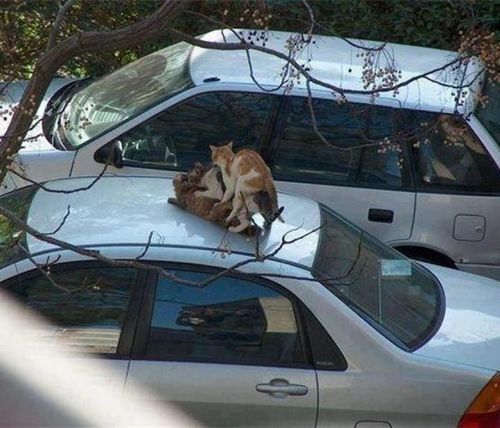
Me on the phone: Yeah I’m going to be late to work today.
Supervisor: Why?
Me: There’s a cat gang bang happening on top of my car.
Supervisor: (silence)
Supervisor: Well can’t you break it up?
Me: Who am I to break up a cat gang bang? They’ve probably been organizing it for days on Craigslist.
Supervisor: Good point. See you when you get here.
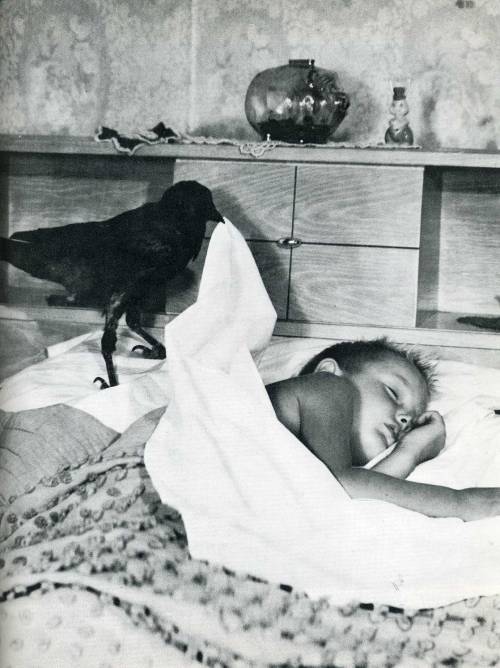
Date unknown
A crow tucks a little boy into bed.
(via submission)
Mildly surprised to see Robert Merry plug The American Spectator’s Frank Marshall Davis piece, at least so uncritically. It’s a review of Paul Kengor’s biography of Davis, the American communist who was some sort of mentor to Obama in his teenage Hawaii years. Merry wonders why the mainstream press hasn’t made more of the Davis story–and what it says about Obama. I think that most people have decided it doesn’t say much of anything about Obama, in that probably half the people in politics today had some kind of extremist associations during their late teens and early twenties–whether the League of the South or SDS radicals. There are well-worn cliches about this.
But the Davis phenomenon points to an interesting wrinkle about American history. In one of his interviews, Kengor breathes a bit heavily about finding that the father-in-law of Obama’s associate Valerie Jarrett was also a communist. We’re being ruled by the Chicago Reds! But you know what? If you were a black American in the 1930s and ’40s, educated, politically active–and (this is the important thing) wanted to be involved in integrated politics, and work cooperatively with white people, the CPUSA was, if not the only game in town, pretty close to it.
I haven’t worked my way through Mark Naison’s scholarship on the subject, but I do recall being taken aside long ago by my late friend, historian and democratic socialist Jim Chapin long ago and had it explained that many blacks involved in mainstream Democratic politics had some sort of old CP roots, exactly for that reason. It was no surprise that one finds pretty bright traces of pink in the backgrounds of Jesse Jackson’s or MLK’s old advisors, because that was where the openings were for ambitious black Americans. Once America began integrating more seriously (which coincided with the Soviets coming to terms with the crimes of Stalinism) this particular niche of black radicalism dried up.
Communism was flawed in theory and evil in practice, but a lot of people saw it differently in the 1930s, ’40s, and ’50s. To get some sense of the relatively normal, upstanding white people in the communist orbit, it might help to pick up Mary McCarthy’s highly readable The Group or Lionel Trilling’s sublime The Middle of the Journey. And they didn’t even have the excuse of segregation.
I was reading about vim the other day and found out why it used hjkl keys as arrow keys. When Bill Joy created the vi text editor he used the ADM-3A terminal, which had the arrows on hjkl keys. Naturally he reused the same keys and the rest is history!
Here is how the hjkl keys looked:
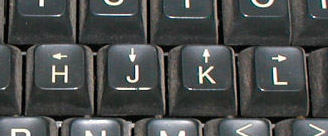
ADM-3A keyboard's hjkl keys with arrows.
And here is the whole terminal that vi was created on:
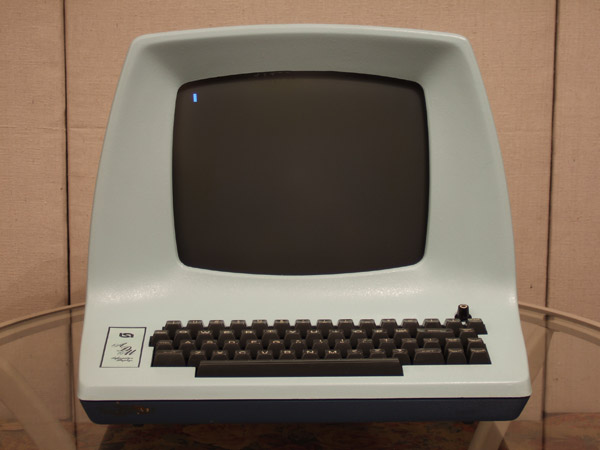
Lear Siegler's ADM-3A computer terminal.
Since vim is derived from vi, it uses the same hjkl keys.
And while we're at it, notice where the ESC key is positioned:
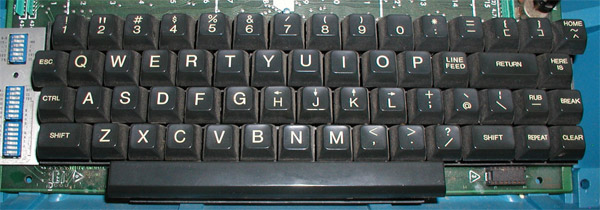
Lear Siegler's ADM-3A computer terminal's full keyboard.
That's why the ESC is used to change between vi modes! Because it's so close and easy to reach.
Also ever wondered why home directory is ~ in UNIX? Look at the HOME key in upper right corner!
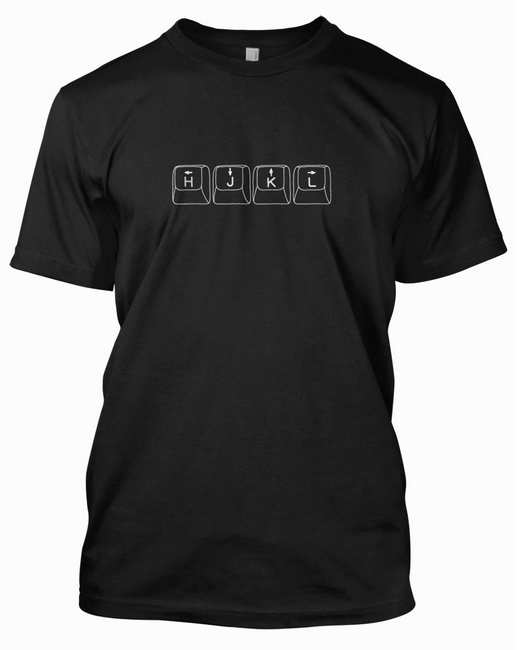
I just got a deal with Teespring for a hjkl t-shirt! Teespring is like kickstarter for t-shirts. If at least 30 people commit to buy the shirt the deal goes through and everyone gets the shirt. Otherwise nothing happens.
Get your limited edition hjkl t-shirt now! (Ships worldwide in 4-8 days.)
My post has generated a lot of awesome responses, see hacker news, osnews, and reddit discussions (two of them on /r/programming and /r/vim).
If you enjoyed my post, subscribe to my blog, follow me on twitter, google+ or github. Thank you!
Adam Victor BrandizziComo devem imaginar, naturalmente, eu aprovo a proposta.
 |
| Sibipiruna em Ouro Branco - MG. Clique para ampliar. |

This is not a post about programming, or being a geek. In all likelihood, this is not a post you will enjoy reading. Consider yourselves warned.
I don't remember how I found this Moth video of comedian Anthony Griffith.
It is not a fun thing to watch, especially as a parent. Even though I knew that before I went in, I willingly chose to watch this video. Then I watched it again. And again. And again. I watched it five times, ten times. I am all for leaning into the pain, but I started to wonder if maybe I was addicted to the pain. I think my dumb programmer brain was stuck in an endless loop trying to make sense out of what happened here.
But you don't make sense of a tragedy like this. You can't. There are no answers.
My humor is becoming dark, and it's biting, and it's becoming hateful. And the talent coordinator is seeing that there's a problem, because NBC is all about nice, and everything is going to be OK. And we're starting to buck horns because he wants everything light, and I want to be honest and tell life, and I'm hurting, and I want everybody else to hurt. Because somebody is to blame for this!
The unbearable grief demands that someone must be to blame for this unimaginably terrible thing that is happening to you, this deeply, profoundly unfair tragedy. But there's nobody. Just you and this overwhelming burden you've been given. So you keep going, because that's what you're supposed to do. Maybe you get on stage and talk about it. That's about all you can do.
So that's what I'm going to do.
Five weeks ago, I was selected for jury duty in a medical malpractice trial.
This trial was the story of a perfectly healthy man who, in the summer of 2008, was suddenly killed by a massive blood clot that made its way to his heart, after a surgery to repair a broken leg. Like me, he would have been 41 years old today. Like me, he married his wife in the summer of 1999. Like me, he had three children; two girls and a boy. Like me, he had a promising, lucrative career in IT.
I should have known I was in trouble during jury selection. When they called your name, you'd come up from the juror pool – about 50 people by my estimation – and sit in the jury booth while both lawyers asked you some questions to determine if you'd be a fair and impartial juror for this trial. What I hadn't noticed at the time, because she was obscured by a podium, is that the wife was sitting directly in front of the jury. I heard plenty of people get selected and make up some bogus story about how they couldn't possibly be fair and impartial to get out of this five week obligation. And they did, if they stuck to their story. But sitting there myself, in front of the wife of this dead man, I just couldn't do it. I couldn't bring myself to lie when I saw on her face that her desire not to be there was a million times more urgent than mine.
Now, I'm all for civic duty, but five weeks in a jury seemed like a bit more than my fair share. Even worse, I was an alternate juror, which meant all of the responsibility of showing up every day and listening, but none of the actual responsibility of contributing to the eventual verdict. I was expecting crushing boredom, and there was certainly plenty of that.
On day one, during opening remarks, we were treated to multiple, giant projected photographs of the three happy children with their dead father – directly in front of the very much still alive wife. She had to leave the courtroom at one point.
The first person we heard testimony from was this man's father, who was and is a practicing doctor. He was there when his son was rushed to the emergency room. He was allowed to observe as the emergency room personnel worked, so he described to the jury the medical process of treatment, his son thrashing around on the emergency room table being intubated, his heart stopping and being revived. As a doctor, he knows what this means.
On day two, we heard from the brother-in-law, also a doctor, and close friend of the family. He described coming home from the hospital to explain to the children that their father was dead, that he wasn't coming home. The kids were not old enough to understand what death means, so for a year afterward, every time they drove by the hospital, they would ask to visit their dad.
I did not expect to learn what death truly was in a courtroom in Martinez, California, at age 41. But I did. Death is a room full of strangers listening to your loved ones describe, in clinical detail and with tears in their eyes, your last moments. Boredom, I can deal with. This is something else entirely.
As a juror, you're ordered not to discuss the trial with anyone, so that you can form a fair and impartial opinion based on the shared evidence that everyone saw in the courtroom together. So I'm taking all this in and I'm holding it down, like I'm supposed to. But it's hard. I feel like becoming a parent has opened emotional doors in me that I didn't know existed, so it's getting to me.
Sometime later, the wife finally testifies. She explains that on the night of the incident, her husband finally felt well enough after the surgery on his right leg to read a bedtime story to their 4 year old son. So she happily leaves father and son to have their bedtime ritual together. Later, the son comes rushing in and tells her there's something wrong with dad, and the look on his face is enough to let her know that it's dire. She found him collapsed on the floor of her son's room and calls 911.
A week later, I was putting our 4 year old son Henry to bed. I didn't realize it at the time, but this was the first time I had put him to bed since the trial started. Henry isn't quite old enough to have a stable sleep routine, so sometimes bedtime goes well, and sometimes it doesn't. It went well that particular night, so I'm happy lying there with him in the bed waiting for his breathing to become regular so I know he's fully asleep. And then the next thing I know I'm breaking down. Badly. I'm desperately trying to hold it together because I don't want to scare him, and he doesn't need to know about any of this. But I can't stop thinking about what it would feel like for my wife to see pictures of me with our children if I died. I can't stop thinking about what it would feel like to watch Henry die on an emergency room table at age 38. I can't stop thinking about what it would feel like to explain to someone else's children that their father is never coming home again. Most of all, I can't stop thinking about the other 4 year old boy who will never stop blaming himself because he saw his Dad collapse on the floor of his room, and then never saw him again for the rest of his life.
Somebody is to blame for this. Somebody must be to blame for this.
Now I urgently want this trial to be over. I'm struggling to understand the purpose of it all. Nothing we see or do in this courtroom is bringing a husband and father back from the dead. The plaintiff could be home with her children. The parade of doctors and hospital staff making their way through this courtroom could be helping patients. The jurors could be working at their jobs. My God how I would love to be doing my job rather than this, anything in the world other than this. A verdict for either party has immense cost. Nobody is in this courtroom because they want to be here. So why?
I don't know these people. I don't care about these people. I mean, it's in my job description as a juror: I am fair and impartial because I don't care what happens to them. But finally I realized that this trial is part of our ride.
We get on the ride because we know there will be thrills and chills. Nobody gets on a rollercoaster that goes in a straight line. That's what you sign up for when you get on the ride with the rest of us: there will be highs, and there will be lows. And those lows – whether they are, God forbid, your own, or someone else's – are what make the highs so sweet. The ride is what it is because the pain of those valleys teaches us.
Sharing this tragic, horrible, private thing that happened to these poor people is how we cope. Watching this play out in public, among your peers, among other fellow human beings, is what it takes to for all of us to survive and move on. We're here in this courtroom together because we need to be here. It's part of the ride.I've heard and seen things in that courtroom I think I will remember for the rest of my life. It's been difficult to deal with, though I am sure it is the tiniest reflected fraction of what you and your family went through. I am so, so sorry this happened to you. But I want to thank you for sharing it with me, because I now know that I am to blame. We're all to blame.
That's what makes us human.
| [advertisement] Hiring developers? Post your open positions with Stack Overflow Careers and reach over 20MM awesome devs already on Stack Overflow. Create your satisfaction-guaranteed job listing today! |