Light

little known fact: coca-cola is still in business today.
.png)
Hey geeks! In case you missed it, you can enter to win a free EARLY copy of Soonish on Goodreads!
Adam Victor BrandizziCrying.
Many Western Buddhists would consider the following ideas obviously true, and perhaps as defining Buddhism:
These ideas come mainly from Protestant Christianity, not traditional Buddhism. They are not entirely absent in traditional Buddhism. However, mostly, in traditional Buddhism:
Buddhism is still understood and practiced this way in much of Asia.
I want to call some of the Protestant Buddhist ideas into question. Mostly, I think the “Protestant Reformation” of Buddhism has been a good thing. However, I find some aspects problematic.
My point is not that Protestant ideas should not be mixed with Buddhism, or that we should return to tradition. Rather, I will suggest that some of these ideas don’t work. Buddhists will need to find alternatives.
When Protestant ideas are misunderstood as essential to Buddhism, they cannot be challenged. Knowing they have only been added recently makes it possible to question them.
Most of the rest of this page discusses the history of the merging of Protestant ideas into Buddhism. Near the end, I begin to raise questions about whether it was good thing.
I’ll start by recounting a bit of the history of the Christian Protestant Reformation. Then I’ll look at Buddhism as it was in the mid-1800s, and the motivations for reform.
Before the Reformation, priests had a special, irreplaceable spiritual role. Only they could perform the public rituals that are the central religious practices: Mass, confession, extreme unction, and so forth. The Church functioned as intermediaries between lay (ordinary) people and God. Lay people had no direct access to the sacred.
Lay people attended rituals passively. The rituals were performed in Latin, which only priests knew. No one other than priests was authorized to teach the Gospel. The priesthood was (in theory) entirely and necessarily celibate.
The Bible was not available to ordinary people, and it was also written only in ancient dead languages. The interpretation of the Bible was fixed by institutional tradition; the ultimate source of religious authority was the Church itself.
“This world” (life on earth) was seen as defiled. The proper focus of religion was the “next world” (heaven or hell).
Despite that, religion provided this-wordly magical benefits to lay people. Particularly by praying to patron saints, one might receive practical benefits or protection. (There is a similarity between the role of Catholic saints and the many gods and spirits of Buddhism.)
The Church could also provide specific next-world benefits. It sold “indulgences,” which were widely understood as forgiving sins, and getting you out of purgatory, by transferring “merit” from the Church’s account to yours. (The theory of merit transfer is the main basis for lay donations to the Buddhist monastic Sangha. In Buddhism, too, its function is to improve your situation after death.)
The Protestant Reformation was a reaction to the wide-spread belief that the Church had become corrupt. It was immensely wealthy. It was seen as more concerned with pursuing money and power than proper religious matters. The selling of indulgences was seen particularly as abusive. The Church also licensed brothels, and instituted a tax specifically on priests who kept mistresses.
Moderate attempts at reform, from within the Church, failed.
The Protestant Reformation was a radical solution: it cut the Church out of the deal altogether. The central theoretical change was to give lay people direct access to God. That eliminated the special role of the Church.
According to Protestantism, each man can be his own priest. The Reformation rejected a separate priestly class, rejected monasticism, and closed monasteries where it could. (Similarly, Protestant Buddhism has extended the word “Sangha” to refer to lay believers as well as monks, and allows lay people to teach.) Protestantism rejected the theory of merit transfer.
According to Protestantism, lay people can access God in two ways: through scripture, and through prayer. It is the right, and the duty, of every layman to own a Bible written in his native language, and to read and understand it. The word of the Bible itself is the ultimate spiritual authority, not the Church’s interpretation of it.
Lay people also accomplish a direct, personal relationship with God, through private prayer. (This is analogous to the role of meditation in Protestant Buddhism. It supposedly gives you a direct connection with Ultimate Truth.) In silent contemplation, one should constantly examine one’s soul for impulses to sin. (This is analogous to the type of meditation in which one attends to ones’ own concrete thoughts and feelings, rather than contemplating often-abstract external matters—the more common practice in traditional Buddhism.)
Because you can have a direct relationship with God, you shouldn’t pray to saints. (Protestant Buddhism deemphasizes or eliminates celestial Buddhas, bodhisattvas, and so forth.)
Protestantism strips magical elements from the sacramental rituals (to varying degrees, according to sect). Ritual is often understood as providing a focus for community and an opportunity for personal experience, rather than being an irreplaceable sacred function.
Protestantism was iconoclastic, meaning that it encouraged the smashing of religious sculptures and paintings, because they were seen as false idols. It also opposed the wearing of priestly “vestments” (special clothes); this is mirrored in Protestant Buddhist contempt for Buddhist robes.
Some strains of Protestantism see everyday life as sacred. There should not be a special part of life set off for religious activity; the faithful should bring religious attention and intention to every part of the day. This is a major theme of Protestant Buddhism, too. It’s not usual in traditional lay Buddhist practice.
Here’s the Oxford Dictionary of Buddhism‘s take:
Protestant Buddhism… denies that only through the [monastic] Sangha can one seek or find salvation. Religion, as a consequence, is internalized. The layman is supposed to permeate his life with his religion and strive to make Buddhism permeate his whole society. Through printing laymen had, for the first time, access to Buddhist texts and could teach themselves meditation. Accordingly, it was felt they could and should try to reach nirvana. As a consequence lay Buddhists became critical both of the traditional norms and of the monastic role.
A classic definition is from Gombrich and Obeyesekere’s Buddhism Transformed:
The hallmark of Protestant Buddhism, then, is its view that the layman should permeate his life with his religion; that he should strive to make Buddhism permeate his whole society, and that he can and should try to reach nirvana. As a corollary, the lay Buddhist is critical of the traditional norms of the monastic role; he may not be positively anticlerical but his respect, if any, is for the particular monk, not for the yellow robe as such.
This kind of Buddhism is Protestant, then, in its devaluation of the role of the monk, and in its strong emphasis on the responsibility of each individual for her/ his ‘salvation’ or enlightenment, the arena for achieving which is not a monastery but the everyday world which, rather than being divided off from, should be infused with Buddhism.
The Protestant-style reformation of Buddhism began in Asia, in the 1860s. Protestant missionaries were aggressively preaching Protestant ideas to Buddhists. Some Buddhists accepted key Protestant ideas, while rejecting Christianity overall, and used them to reform Buddhism.
The Buddhist Sangha, like the Catholic Church, was an immensely powerful, rich institution, which naturally opposed change. In both cases, Reformation was possible only due to an alliance among other classes, who were newly increasing in power. It was the same three groups in both cases:
I’ll write more about this when I look at specific case histories (on Japanand Thailand).
The “Protestantization” of Buddhism has continued in the West in the past half-century. I’ll cover that as part of the recent history of “Consensus Buddhism.”
There are other important Protestant doctrines that have been partly imported into Buddhism. These include God and Christian ethics. I’ll write about God in Buddhism in my post on Japan, and about Christian influences on Buddhist ethics in a whole slew of posts later in this series. (Jeez, I’m issuing a lot of IOUs here!)
Overall, I think the Buddhist Protestant Reformation was a good thing:
I also see some problems in the merger of Protestant ideas into Buddhism. I’ll write about those in my next several posts. A preview:
There’s a large academic literature that discusses Protestant influences on Buddhism. Unfortunately, I haven’t found a single, comprehensive presentation. This post may be the first attempt to set out parallels between the Christian and Buddhist Protestant Reformations systematically.
This post was prompted by David L. McMahan’s The Making of Buddhist Modernism, in which Protestantism is a major theme.
The term “Protestant Buddhism” was introduced by Gananath Obeyesekere. His book with Richard Gombrich, Buddhism Transformed, has an extensive discussion. Unfortunately, the book considers only Sri Lanka, which is atypical in some ways. Also, they introduce some confusion by using “Protestant” to refer both to ideas imported from Protestant Christianity and to protest against colonialism.
If this post proves “controversial,” I would guess that it is more because of the parallels between traditional Buddhism and the pre-Reformation Catholic Church, than for the parallels between Protestant Christianity and contemporary Western Buddhism.
Protestant-style Buddhist reformers have found quotations from Buddhist scripture that suggest the Protestant ideas have always been Buddhist doctrine. It’s true that they are not entirely alien to Buddhism. However, in practice, they have almost always been marginal, almost everywhere. Buddhist scripture is vast, extremely diverse, and contradictory. You can find quotations in it to support almost anything, especially if you take short pieces out of context.
In any case, you can’t learn about traditional Buddhism, as practiced by lay people, from Buddhist texts. Scripture describes what ought to happen, rather than what does happen; and it is almost entirely about the Sangha, rather than lay people. And, the scriptures were written centuries ago, when things were often quite different.
To learn about traditional Buddhism, you either need to go to Asia and see for yourself, or read anthropology. If you have been to a Buddhist country, and observed lay practice (especially in rural areas where modern influences are least), you will probably recognize my description.
Otherwise, Melford Spiro’s Buddhism and Society is a classic study of Theravada Buddhist practice in Burma, and an excellent starting point. The Gombrich and Obeyesekere book is good for Sri Lanka. For Tibet, I recommend Geoffrey Samuel’s Civilized Shamans. All these books specifically address the nature of lay practice and the relationship between lay people and monks.
If anything in this post prompts incredulity, I will try to provide a citation to a reliable academic source.
Shock or horror I can’t help you with.

Eu expliquei pra psicanalista que eu ando sentindo uma raiva. E que toma conta de mim e eu racionalizo e passa. Eu não sou uma pessoa de sentir raiva, embora não seja nada calma. Eu posso mandar tudo a merda com facilidade e chutar coisas. Mas quando passa o acesso colérico eu raramente guardo raiva. Geralmente eu pondero “ah, a vida de fulano também não é fácil” ou “ah, eu também passei dos limites”. Aí fico com um pouco de culpa, né? E zero raiva.
Mas que agora eu estava com essa raiva. Que tem um pouco daquela palavra alemã que significa ficar feliz com o infortúnio alheio. Tá se lascando? Mas que bom saber, que se lasque mais etc. E obviamente não é algo bom de sentir. A psi ficou encantada com o meu relato que foi, ele mesmo, meio raivoso. Talvez ela esteja meio cansada do meu banho maria. E ela me disse que não há nada de mal em sentir coisas ruins. Que eu me apresso demais em me livrar das coisas ruins que eu sinto. Em nome dessa obsessão pela leveza que eu tenho. Mas que a gente tem que sentir as coisas ruins justamente para que elas nos deixem e possam ir em embora e seguir o caminho delas.
Ela é muuuuuuuito tranquila minha psi. Parece até uma monja. Eu falei que não conseguia imaginá-la com raiva. Ela riu e disse “eu sou capaz de quebrar um banco”. Fiquei querendo saber que banco ela quebrou. Mas só disse que ela me parecia muito equilibrada. Quase aristotélica no justo meio. E que eu queria essa maturidade aristotélica. Eu usei aristotélico. Ela entende essas coisas porque é sabida demais. Enfim, eu queria a mansidão da maturidade. Aí ela me interrompeu. E falou o que eu achei UAU. E que é o motivo do post.
Ela me explicou que não. Que maturidade não é equilíbrio necessariamente. Antes, envelhecer é começar a experimentar uma gama maior de sentimentos. “Como se mais sentimentos fossem ficando disponíveis e você pudesse transitar entre eles e experimentá-los”. E emendou dizendo que imaturo é aquele que sempre experimenta a mesma coisa. Que não varia o cardápio de sensações. Perguntei se a minha leveza era imaturidade. Ela disse que não. Que era um valor. Mas eu poderia enriquecer os caminhos para alcançá-la.
Eu adorei. Porque nunca tinha visto alguém definir maturidade assim.
ps: quando ela falou de um maior leque de sentimentos disponíveis, pensei em perguntar se ela leu A Amiga Genial. Mas fiquei na minha e não perguntei nada. Já tinha citado Aristóteles. Não vou ficar pagando de nerdinha que sempre leu um livro etc.
Adam Victor Brandizzi¡MANO!
It’s the end of the road for social bookmarking website del.icio.us. After almost fifteen years, the site has been acquired by rival Pinboard, and will be shuttered on June 15, when it goes into read-only mode. While the site will continue to be viewable, users won’t be able to save any new bookmarks.
Del.icio.us pioneered the social bookmarking paradigm. Its influence can be seen everywhere, from Reddit to Twitter.
Over its long life, it changed hands several times. Firstly, to Yahoo, who spent between $15 million and $30 million on it. After several years of mismanagement, Yahoo sold it to the Chad Hurley and Steve Chen-owned AVOS Systems, who then offloaded it to Science, Inc, who in turn sold it to Delicious Media. The latter was a short-lived alliance between Domainersuite and Science Inc.
And now, it’s at its final destination: Pinboard.
Pinboard’s decision to acquire del.icio.us is an incredibly shrewd one. Firstly, the two sites are inextricably linked. After del.icio.us was acquired by AVOS Systems in 2011, users fled to Pinboard in droves over complaints AVOS was fundamentally changing the makeup of the site.
By purchasing del.icio.us, Pinboard is able to coax the few remaining del.icio.us users to jump ship. Depending on how much Pinboard paid for the site, how many users remain, and how many users Pinboard is able to convert, this could be a financially lucrative move. A Pinboard subscription costs $11 per annum.
We’ve reached out to Pinboard for a statement. If we hear back from them, we’ll update this post.
UPDATE: I just spoke to Pinboard founder Maciej Cegłowski. In a statement, he said “I am the greatest.” Ceglowski also confirmed the purchase price for del.icio.us, which was $35,000.
> Pinboard Acquires DeliciousPinboard
Join over 260,000 subscribers!
Related Articles
Adam Victor Brandizzi"[...] the Kentucky Coal Museum is installing solar panels to save money."

A sign of the times: Fox News has reported, without comment, that the Kentucky Coal Museum is installing solar panels to save money. This is part of a larger trend.
On Saturday, the New York Times reported on shifts in power production in states like West Virginia and Kentucky. For instance, Appalachian Power has “closed three coal-fired plants and converted two others to gas, reducing its dependence on coal to 61 percent last year, down from 74 percent in 2012.” In response to an inquiry from the Governor, the company said it has no plans to build another coal plant. In Kentucky, the Public Utility Commission has advised companies about offering renewable energy packages in order to attract large corporations, many of whom have strong green energy programs.
Similarly, in Wyoming, Microsoft made a deal to get wind power for its new data center. In fact, according to the Energy Information Agency, Wyoming gets nearly 10% of its power from wind, making it 15th in the nation.
Corporate pressure has made a difference beyond these states, according to the Times:
Last year, utilities made deals with corporate customers through rate arrangements known as green tariffs for 220 megawatts of power, enough to run about 40,000 average American homes. Thus far this year, there have been 360 megawatts worth of agreements, with an additional 465 megawatts under negotiation.
It seems that efforts at corporate sustainability, which I’ve posted about previously, are actually having some tangible impacts.
The coal-producing states are still heavily dependent on coal for power. And the political pressure to stick with coal is strong. Nonetheless, coal is stronger losing ground, even in the places where it is most prized.

All greetings are weird, if you think about ’em.
Let me clarify that statement. It’s not that greetings are inherently weird, it’s that they all become weird if you give them the slightest thought. You want your greeting to come off as natural and effortless. That sense of effortlessness will be destroyed by even the slightest doubt in your mind, the kind of doubt that comes from briefly thinking should I wave and say “hi,” or just wave? Or just say “hi”?
Once you’ve given your greeting any thought whatsoever, whatever you do will come off as weird and forced.
Now that I’ve pointed this out, the next time you greet someone, this will happen to you. Feel free to curse me under your breath. That’ll make it even more awkward.
As always, thanks for using my Amazon Affiliate links (US, UK, Canada).
.png)
Thanks for buying, geeks! For this project in particular, it means a lot to us. For those of you who somehow haven't seen me mention the book, here's a little comic exlpainer:

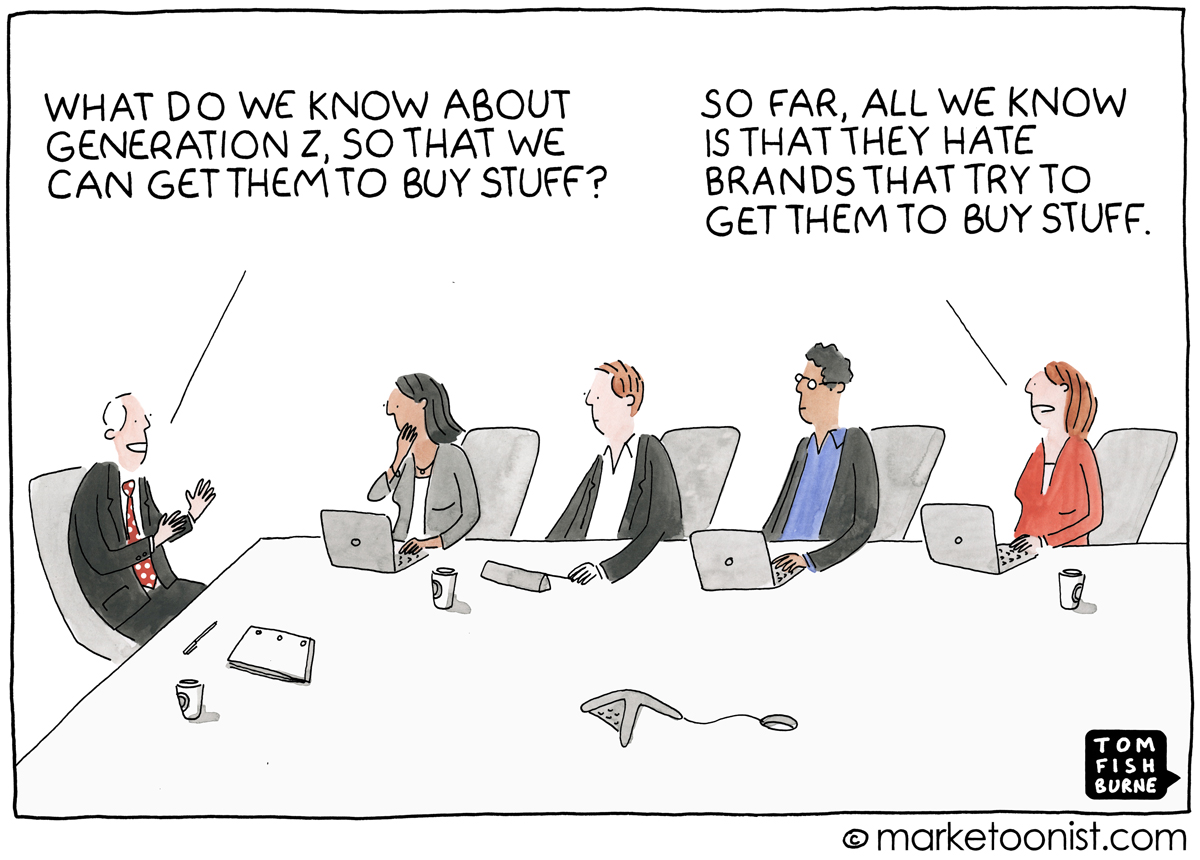
After a decade of Millennial obsession, the marketing world is increasingly buzzing about the next generation around the corner — Generation Z.
Studies highlight their buying power of $44 billion, that they’ll be 40% of the population of US, Europe, and BRIC by 2020, and that they are naturally immune to advertising. Agencies are lining up to offer tools and tricks for brands to “engage” with Generation Z.
And yet, as with Millennials, I’m not sure how useful these broad-brush generational stereotypes really are. Generations are not monoliths. Can a generation-level insight really help a brand engage with such a large and diverse group of people in a meaningful way?
I heard an expression somewhere that “it’s like saying everything living in the ocean is a fish.”
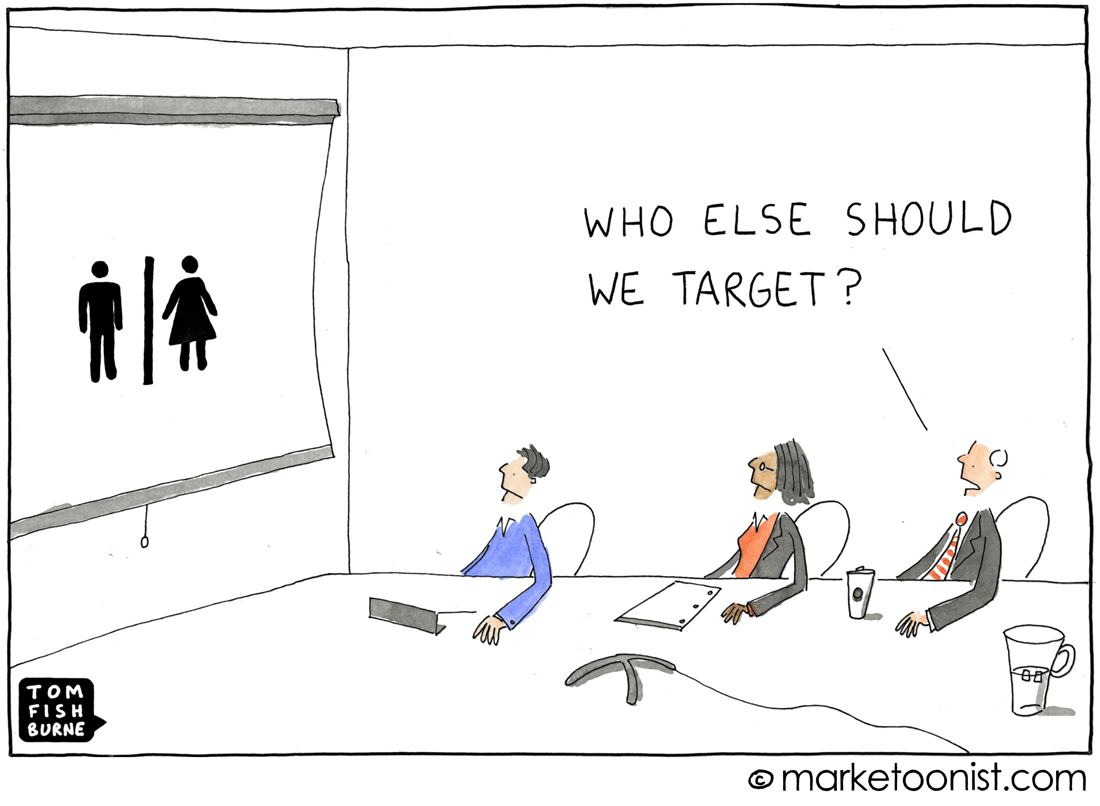
Here are a few related cartoons I’ve drawn over the years.
Who else should we target?, August 2014
Marketing to Generation Z, March 2015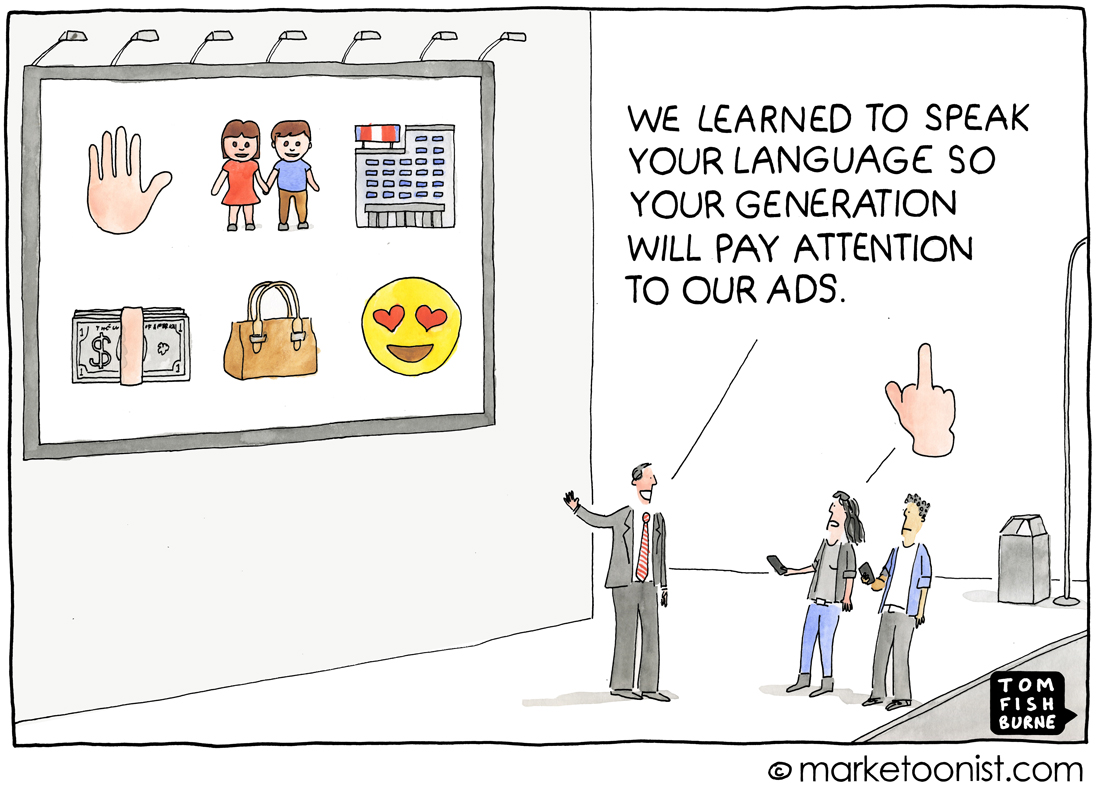

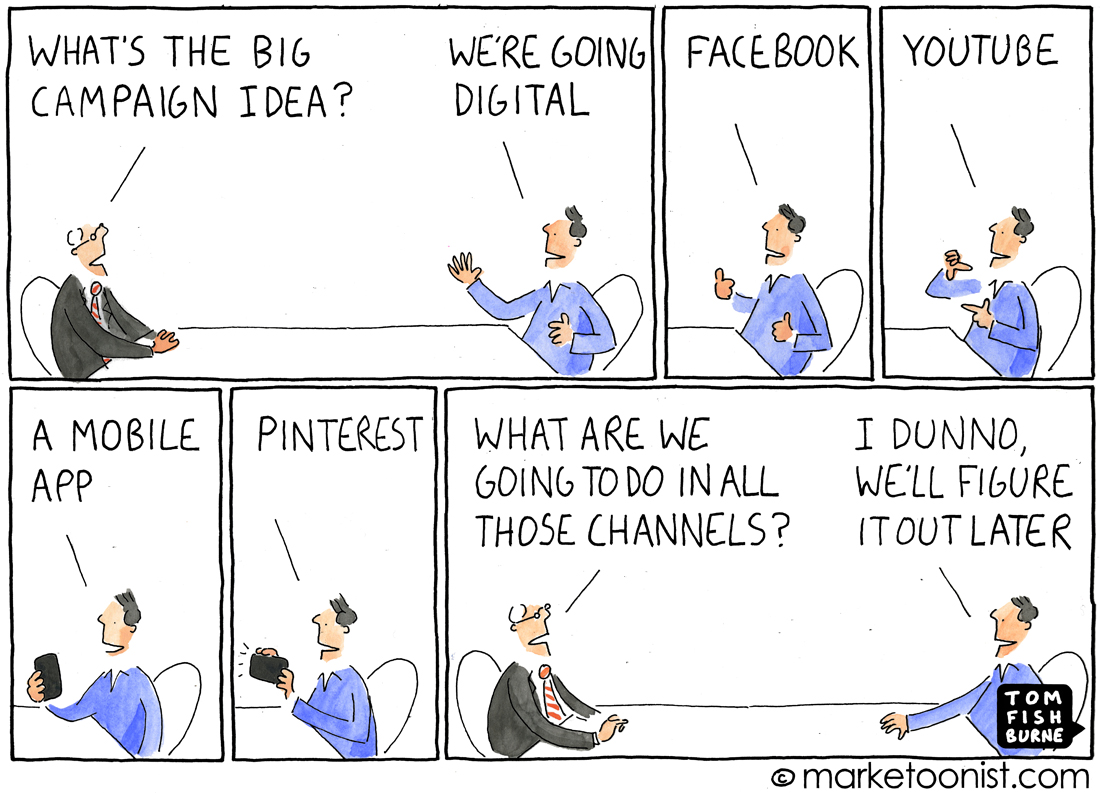
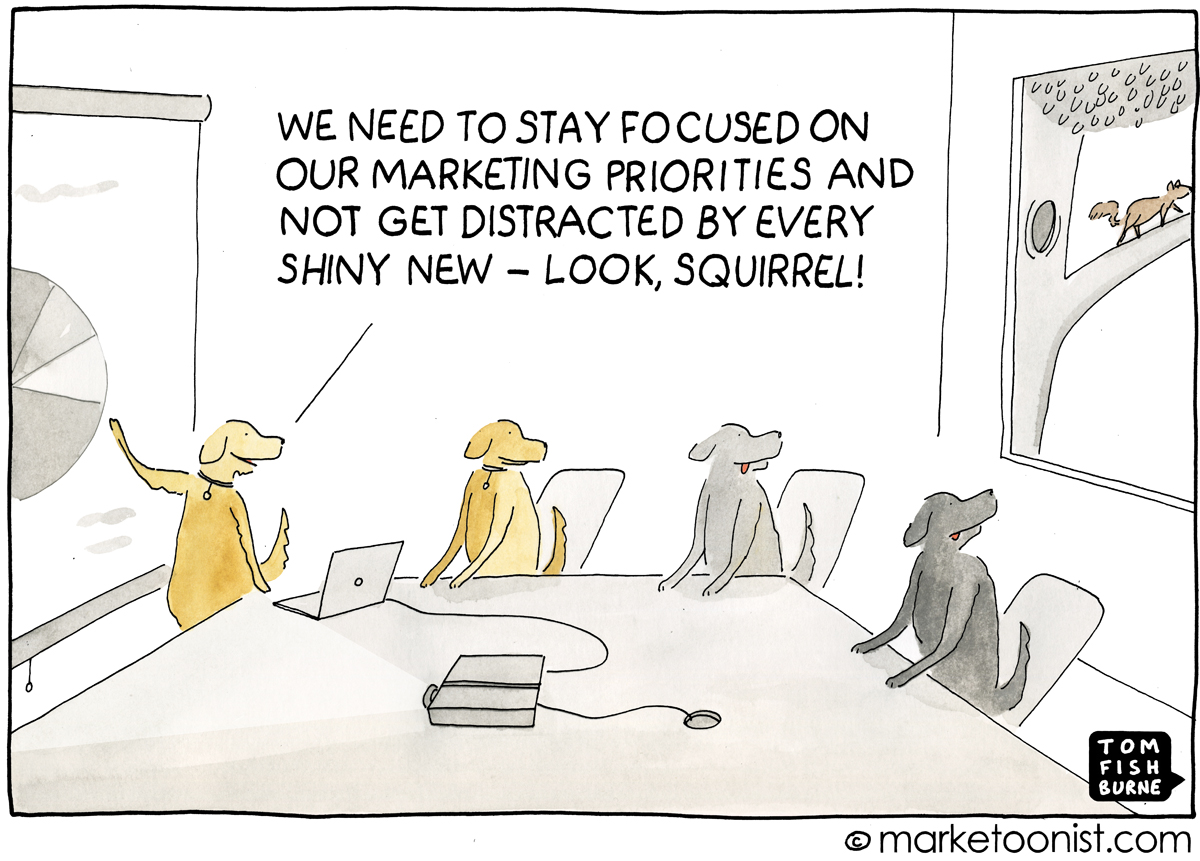
In these fast-paced days of digital marketing, there’s a continuous stream of new technologies for marketers to get excited about.
It’s tempting for marketers to drop everything in favor of the shiny new thing. Our sense-checking isn’t always caught up with our enthusiasm. We risk being caught without our clothes. Or pretending like we see the clothes, when we don’t.
Mark Ritson recently summarized the provocative results of a poll from the World Federation of Advertisers:
“The WFA surveyed 50 of the world’s top marketers who, in terms of combined marketing spend, represent a potential £62bn of global ad spend.
“Despite the fact that 45% of all marketers can’t see the value of digital advertising, 75% aren’t convinced of its effectiveness and 72% think marketers have over invested in digital, a massive two-thirds of that same sample expect to move more of their marketing money in to digital next year – many by as much as much as 40%. The majority will spend more on digital advertising next year.
“Yeah I know. 75% aren’t convinced of its effectiveness yet 66% will invest more next year. Pause, consider this data, and gulp.”
Here are a couple other cartoons I drew about the shiny new thing:
“We’re Going Digital“ (April 2012)
“Shiny Object Syndrome“ (May 2015)

.png)

We can all dream, right?

Adam Victor BrandizziIt is a fart joke, but it is a Boulet's fart joke, then it is intelligent :P


It's the last full day to get in your BAHFest Sydney proposal!