Shared posts

17 Sep 23:22

Quais as origens da desaceleração da indústria brasileira?

by Lucas Braga, Marwil Dávila e Thaís Vizioli

Desde o governo Lula foram lançadas três políticas industriais de grande relevância com objetivo central de alterar a dinâmica microeconômica entre os setores produtivos, de maneira a alcançar em seguida resultados no agregado da economia. Essas políticas industriais foram um importante instrumento de estímulo ao setor principalmente no que se refere ao desenvolvimento tecnológico e preparação do ambiente institucional. Entretanto, mesmo com várias medidas adotadas, nota-se no Brasil uma crescente desaceleração da indústria, a qual é frequentemente julgada maléfica à economia como um todo. As razões e os pontos que estrangulam a indústria são diversos e variam de acordo com o marco teórico adotado. O texto a seguir procura fazer uma análise crítica das políticas implantadas focando nos principais pontos de estrangulamento que não foram e não têm sido atacados pelo Governo.

A relevância da indústria para o crescimento econômico é amplamente reconhecida pelas mais diversas correntes da teoria econômica. Uma linha de raciocínio neste sentido seria o fato de o setor secundário ter um efeito positivo sobre todo o conjunto da economia, uma vez que permite dinamizar o sistema de produção através de encadeamentos produtivos forward e backward, potencializando efeitos multiplicadores em toda a produção da economia. Ainda, ressalta-se que este efeito de encadeamento não é observado com a mesma intensidade nos setores primário e terciário.

Também no contexto da relevância do setor secundário para o crescimento, a produção da indústria pode ser convertida em ganhos de produtividade superiores aos dos demais setores que se traduzem em aumentos da renda real. Neste sentido, a combinação entre os efeitos de encadeamento e a produtividade crescente no setor gera um ambiente propício para a difusão tecnológica e a inovação. Ou seja, a produtividade da indústria é uma função crescente da própria produção industrial. O resultado é um efeito cíclico em que o aumento do aprendizado e a inovação se traduzem em aumentos de produtividade que, por sua vez, em um efeito derrama, alcançam os demais setores da economia.

Há também de se reconhecer que o processo de inovação é a principal maneira pela qual um país ganha espaço no comércio internacional.

Se assumirmos que a indústria tem um papel crucial para o crescimento da economia, é motivo de preocupação a recente desindustrialização vivenciada pelos mais diversos países, em especial pelo Brasil.

Por um lado, a perda relativa da produção e do emprego industriais não constitui por si só um problema, dado que o processo de crescimento econômico naturalmente levaria todas as economias a convergir neste aspecto. Efetivamente, os EUA, Canadá e os países da Europa ocidental passaram e têm passado por um processo de perda relativa do setor sem que isso a princípio fosse encarado como um retrocesso. Por outro lado, em alguns casos esta desindustrialização pode representar um problema, principalmente quando referente aos países em desenvolvimento. Alguns teóricos diferenciam, então, a desindustrialização positiva da negativa utilizando como referência a balança comercial. Economias em que além do aumento de bens primários na pauta exportadora experimentam uma redução da participação de produtos com maior conteúdo tecnológico e de maior valor agregado, estariam passando por uma desindustrialização maléfica a economia.

Surgem destas considerações a necessidade e a grande relevância de se promover a indústria através de políticas industriais em países que possuem uma diminuição do valor agregado de suas exportações, como no caso brasileiro. Assim, com objetivo central de alterar a dinâmica microeconômica entre os setores produtivos de maneira a alcançar em seguida resultados no agregado da economia; as políticas industriais têm sido um importante instrumento de estímulo ao setor e, consequentemente, ao crescimento econômico.

No Brasil, as políticas industriais foram tradicionalmente direcionadas para a substituição de bens manufaturados, processo conhecido como Industrialização por Substituição de Importação (ISI). Já no segundo Governo Vargas instituiu-se modelo de proteção no qual se determinavam taxas de câmbio valorizadas para importação de bens de capitais e outros utilizados na produção industrial, concomitantemente, se determinava taxas desvalorizadas para importação de bens produzidos internamente. A Lei do Similar Nacional do período JK é outro exemplo bem ilustrativo de política de ISI na qual foi proibida a importação de bens que pudessem ser produzidos nacionalmente. O Governo Militar aprofundou esse modelo, protegendo um conjunto mais amplo de setores, desde a petroquímica até a informática.

Como lado positivo, tal modelo gerou um setor industrial dinâmico e bem integrado, com grande crescimento da década de 30 até 70. E assim foi durante todo o período, com exceção de algumas políticas industriais voltadas para exportação de manufaturas, como o II Plano Nacional de Desenvolvimento (II PND).

Contudo, tais estratégias também geraram sérios problemas para a indústria e desenvolvimento nacional. Elas implicaram baixa competitividade internacional, baixa produtividade e padrões tecnológicos relativamente atrasados. A existência de baixíssimos níveis de investimentos em P&D, de criação de patentes e de estratégias focadas para a inovação das empresas era nítido (e ainda é) no Brasil. Dado tais fatos, não é surpreendente o grande número de falências que se seguiu à abertura da economia na transição da década de 1980 para 1990, durante o Governo Collor.

A partir de meados dos anos 1990, a política que tomou conta da agenda econômica foi a estabilização macroeconômica, deixando de lado as políticas industriais, que apenas no Governo Lula voltaram a compor a agenda nacional. Assim, desde o Governo Lula até o atual Governo Dilma, foram lançadas três políticas industriais diferentes.

Uma vez que se iniciou um intenso processo de desaceleração da indústria, o Governo Lula lançou em março de 2004 o programa de Política Industrial, Tecnológica e de Comércio Exterior (PITCE), o qual se estendeu até 2008. Visando dar continuidade à PITCE, foi lançada a Política Desenvolvimento Produtivo (PDP), que durou de 2008 até 2010. Já no Governo Dilma, foi lançado em 2010 o Plano Brasil Maior, também focado para a Indústria e que durará até 2014.

A PITCE objetivou estimular a inovação e o desenvolvimento tecnológico com maior inserção externa e modernização do ambiente institucional e aumento da capacidade produtiva. Com este objetivo, diversas medidas foram tomadas. A Lei de Inovação (Lei nº 10973 de 2004), que estabelece um marco regulatório para incentivar a pesquisa científica no âmbito produtivo através de parceria entre institutos tecnológicos, universidades e empresas inovadoras, é um exemplo bem ilustrativo. Outras leis implantadas como a Lei do Bem (Lei nº11. 196 de 2005) e a Lei de Biossegurança (Lei 11.105 de 2005) também visavam estimular a inovação tecnológica através de incentivos à pesquisa científica e garantias de propriedade intelectual. Tais medidas revelam um claro foco da PITCE em relação ao marco regulatório e melhoria das instituições para a promoção de um ambiente favorável ao investimento em P&D e também de estímulo às inovações. Ademais, a PITCE desenvolveu linhas de financiamento  baixo custo para setores chaves como o Prosoft, que foca a indústria de software e serviços de tecnologia da informação (TI) e o Profarma, que foca o complexo industrial de saúde e de fármacos,  através de desembolsos do BNDES e também desonerações tributárias. Como resultado, houve um aumento dos desembolsos do BNDES, que atingiram um crescimento de 35,2% nos primeiros oito meses de 2007.

A Política de Desenvolvimento Produtivo (PDP) também focava no desenvolvimento tecnológico, mas com maior ênfase nas micro e pequenas empresas inovadoras. Para tanto, as principais medidas tomadas se referem à crescente expansão de linhas de financiamento a taxas reais nulas para capital de giro das médias e pequenas empresas e também para investimentos em P&D via FINEP (Fundo Nacional de Estudos e Projetos). Isenções fiscais para investimentos em bens de capital também foram amplamente utilizadas.

Com o intuito de dar continuidade à reinserção das políticas industriais na agenda nacional, o Plano Brasil Maior (PBM) foi lançado em agosto de 2011 já no Governo Dilma. O Plano, assim como seus antecessores, tem como foco o estímulo à inovação tecnológica para aumentar a produtividade da indústria nacional e promover o crescimento econômico. O PBM pode ser divido em duas grandes vertentes de ação: estímulos ao investimento e à inovação, e defesa da indústria e mercado interno. Como estímulo à inovação, muitas medidas de desoneração tributária foram adotadas, principalmente no que tange à folha de pagamentos, bens de capital e IPI. Como o Plano ainda está em implementação, seus instrumentos e resultados estão em contínua avaliação.

Mesmo com tantas medidas adotadas, os resultados da economia e da indústria não têm sido otimistas. Passados os efeitos mais severos da crise internacional sobre o Brasil, a economia cresceu 2,7% e 0,9% em 2011 e 2012, respectivamente. Fato que reflete uma contínua perda de dinamismo da economia brasileira. A exportação de bens manufaturados decresceu ao seu nível mais baixo no terceiro trimestre de 2012, atingindo uma queda de -9,4% neste período e -1,7% no ano inteiro. Enquanto a importação de bens de capital aumentou 1,5% por cento neste mesmo ano 1.

Partindo de participações da ordem de 20% do PIB na virada dos anos 1940 para 1950, a indústria aumentou seu peso quase continuamente até meados de 1980, atingindo 35% em 1985. Depois do pico, a perda de participação foi de tal ordem que a indústria respondia por apenas 15% do PIB em 2011, menos da metade do máximo observado.

São várias as explicações para tal perda de participação relativa da indústria. Uma pesquisa realizada pelo IPEA 2 responsabiliza principalmente a persistência de uma taxa de câmbio sobrevalorizada por um longo período de tempo, o que teria estimulado a importação de bens manufaturados desprotegendo a indústria nacional. Segundo o relatório, seriam as dificuldades com o manejo da política macroeconômica, as incertezas decorrentes do cenário externo e as mudanças na divisão internacional do

trabalho os responsáveis pela geração deste processo de retração da atividade industrial brasileira.

No entanto, várias críticas à política industrial brasileira mostram que, mais do que os fatores acima apontados, algumas falhas governamentais e o ambiente institucional no qual a indústria nacional opera tiveram impactos relevantes no que se refere à perda de participação deste setor na economia.

No Brasil, o protecionismo manteve-se ativo por um longo período de tempo e não se transmitiu às empresas nenhuma sinalização de redução da proteção. Conforme previsto pela teoria econômica, setores excessivamente protegidos e sem estímulos à competição tendem a se desenvolver utilizando tecnologias defasadas. Consequentemente, o País não conseguiu alcançar a produtividade necessária para competir internacionalmente.

Jones, um renomado teórico do crescimento econômico, aponta que o aumento da abertura da economia eleva o influxo de tecnologia no país, por meio da incorporação de bens de capital na economia, o que levaria a um aumento da renda e a uma maior proximidade da fronteira tecnológica, refletida na taxa de crescimento. A evidência empírica corrobora este argumento: um estudo realizado em 2008 pelo BID e o FUNDES, com mais de 400 pequenas, micro e médias empresas (PMMES) de países latino-americanos, aponta que as empresas exitosas são, em geral, as que aproveitam a experiência obtida ao operar em mercados estrangeiros, mais exigentes, para orientar e aumentar sua capacidade de inovação. A proteção excessiva e por tempo indeterminado, além de dificultar o processo de absorção de tecnologia, reduz os incentivos para investimento em P&D.

A Política de Desenvolvimento Produtivo (PDP) e a Política Industrial Tecnológica de Comércio Exterior (PITCE) foram muito importantes por indicarem o reconhecimento de que a estabilidade macroeconômica não é condição suficiente para a retomada do processo de desenvolvimento industrial e econômico como um todo, havendo a necessidade de outras medidas, particularmente as Políticas Industriais.

Ainda, a mudança de concepção sobre política econômica representada pela criação da PITCE não foi suficiente para retomar o processo de crescimento industrial sustentado no Brasil. O Plano Brasil Maior (PBM) é um avanço importante, dando continuidade às medidas da PDP. Apesar de vários pontos favoráveis, as políticas ainda carecem de maior agressividade, tendo em conta os enormes desafios impostos pelo ambiente de negócios.

As medidas de desoneração tributária implementadas nas três últimas políticas industriais, apesar de importantes para incentivar o investimento, representam redução pouco expressiva no custo total enfrentado pela indústria. Uma importante medida para redução do custo do investimento seria uma maior desoneração da folha de pagamentos do setor de bens de capital, cujos encargos representam 2,6% do faturamento, o que significa que sua desoneração poderia reduzir os custos das inversões no mesmo montante, estimulando o investimento e a produção local.

As medidas de financiamento do investimento, materializadas pelos programas do BNDES, são direcionadas especificamente para alguns setores e, portanto seu potencial dinamizador da economia é restrito. Mais ainda, há um elevado número de programas que, no entanto, apresentam objetivos semelhantes. Essa descentralização dificulta a adesão das empresas, que encontram empecilhos para identificar qual programa encaixa-se melhor às suas necessidades.

Apesar dos avanços dos últimos anos, ainda há muito que ser feito para que a indústria se consolide de forma autônoma e possa competir internacionalmente. O ambiente institucional em que as empresas operam é determinante na sua atuação, sendo seu aprimoramento fundamental para a criação de incentivos para o investimento em inovação e a consolidação de uma indústria com grande capacidade tecnológica, capaz de competir internacionalmente.

Observa-se a necessidade de coerência da política macroeconômica com a política industrial como um ponto fundamental a ser perseguido pelo governo. A política industrial não é condição suficiente para garantir a convergência para o nível de renda dos países mais ricos, pois por melhores que sejam, seus resultados serão frustrados na presença da elevada carga tributária concentrada de forma desproporcional no setor, dos grandes custos associados à infraestrutura sucateada, da ausência de mão de obra qualificada e da rigidez do mercado de trabalho, fatores que têm grande peso no chamado Custo Brasil.

Neste sentido, são necessárias políticas horizontais (políticas que afetam o agregado da economia) como provisão satisfatória de infraestrutura, investimentos em capital humano e inovação e um ambiente macroeconômico adequado. Mais ainda, o desenvolvimento do setor depende do compromisso dos atores envolvidos, tais como empresas comprometidas com a inovação.

Segundo sondagem realizada pela CNI 3, sete em cada dez empresas alegaram dificuldades com a escassez de trabalhadores qualificados e 62% delas afirmaram que essa escassez impacta diretamente a área de P&D, o que prejudica a eficiência de todo o processo produtivo.

O problema de qualificação profissional agrava-se pelo alto nível de segmentação do sistema educacional brasileiro, com grandes brechas nos resultados de alunos de diferentes grupos sociais, favorecendo a inserção produtiva de jovens provenientes de famílias ricas, o que reforça a transmissão de desigualdades para as gerações futuras. Os problemas pendentes do século XX se agregam, como desafio para o século XXI, à redução da brecha digital e melhoria da qualidade da educação pública em função de novos requisitos formativos. No entanto, dados do MEC mostram que o país investe 6,7 vezes mais nos universitários do que nos estudantes da educação básica, perpetuando as desigualdades.

Existe uma clara evidência da desintegração entre a política educacional e industrial brasileira ao observarmos dados de patentes e inovação no Brasil. Há um descolamento crescente entre essas variáveis, ao contrário do esperado e do que se observa em outros países. Entre 1985 a 2009, enquanto as publicações apresentaram crescimento médio de 9,5%, as patentes cresceram a um nível bastante inferior de 3,3% 4. O que reflete um isolamento das universidades em relação às necessidades industriais, dificultando ainda mais o alcance dos objetivos dos planos.

No que tange à infraestrutura, os serviços desta área podem ser definidos como um conjunto de ativos-base, essenciais para o desenvolvimento da atividade econômica, tais como: transportes, comunicações, energia e saneamento. Calderón e Sérven comparam o crescimento econômico latino americano com o do leste asiático entre 1980 e 1997, concluem que cerca 37,56% da diferença de crescimento entre o Brasil e os tigres asiáticos pode ser explicada pelo déficit em infraestrutura.

É evidente a insuficiência do investimento nele realizado para sustentar o crescimento econômico brasileiro de longo prazo, o percentual investido tem sido modesto mesmo para repor o capital fixo. Esta situação tem gerado uma brecha crescente de infraestrutura, resultado da evolução díspar entre o estoque disponível (oferta) em relação ao nível necessário de infraestrutura demandado pelas atividades produtivas.

O processo de privatização não foi capaz de expandir significativamente o nível de investimentos. Contudo, com um mercado em expansão, o espaço pra atuação pode ser rapidamente ampliado com a melhoria da qualidade das agências reguladoras, definição de uma estratégia clara de maior envolvimento do setor privado nos setores mais críticos e pela continuidade do processo de transferência de ativos e funções ao setor privado. Nos casos em que a concessão é incapaz de atrair o investimento, as parcerias público privadas parecem ser alternativas interessantes para garantir maior eficiência e minimizar os gastos do Estado.

A importância da indústria para o crescimento é reconhecida na literatura, embora o nível de importância e a relação de causalidade variem dentro das principais correntes. Isso se deve à capacidade do setor de dinamizar o sistema produtivo, à sua relação com a inovação e difusão tecnológica e ao seu papel preponderante em um contexto de restrição de divisas.

A análise das recentes políticas industriais brasileiras, feita a partir da construção de uma pequena síntese histórica das políticas industriais já implementadas no Brasil, permite uma avaliação crítica das medidas atuais e das consequências maléficas deixadas pelo elevado nível de protecionismo e por medidas imediatistas sem foco no longo prazo. O Plano Brasil Maior, ainda que este ainda esteja em andamento, carece de maior agressividade, levando em conta os desafios impostos pelo ambiente de negócios. As medidas de incentivo ao investimento, por exemplo, apesar de importantes, representam pouca redução do seu custo total e, assim, têm pouco impacto na prática.

Assim, há a necessidade de conciliar as políticas macroeconômicas, industriais, aquelas voltadas à inovação, à educação e à construção das condições básicas de operação das indústrias; devido à insuficiência da política industrial para garantir um crescimento sustentado de longo prazo. Ressalta-se a importância do ambiente institucional em que as empresas operam como determinante de sua atuação, sendo seu aprimoramento fundamental para a criação de incentivos para o investimento e a consolidação de uma indústria capaz de competir internacionalmente. Neste sentido, aponta-se o Custo Brasil (e suas várias dimensões constituintes) como ponto fundamental a ser solucionado pelo governo que busca tornar a indústria competitiva internacionalmente.

Finalmente, mais do que uma política industrial consistente, bem formulada e que implemente incentivos suficientes à consolidação do setor, são necessárias políticas horizontais como provisão satisfatória de infraestrutura, investimentos em capital humano e inovação e um ambiente macroeconômico adequado.

__________

1 IBGE. (2013). Banco Sidra. Retirado em 25 de Junho de 2013 de: http://www.sidra.ibge.gov.br/bda/acervo/acervo2.asp?e=c&p=PZ&v=28&z=t&o=22
2 IPEA. Conjuntura em foco, nº 18, março de 2012.
3 CONFEDERAÇÃO NACIONAL DA INDÚSTRIA. Sondagem industrial. 2011.
4 BANCO MUNDIAL. Dados sobre patentes e inovação no Brasil. Disponível em: http://data.worldbank.org/. Acessado em 19/06/2013.

Download:

  • veja este artigo também em versão pdf (clique aqui).
27 Aug 11:48

The Onion’s 2008 Miley Cyrus Prediction - [2:28]

26 Aug 22:57

Fixer-Upper

by Greg Ross

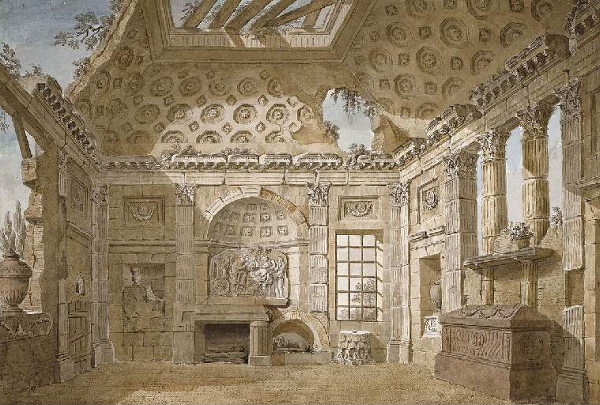
http://commons.wikimedia.org/wiki/File:Cl%C3%A9risseau.jpg

In 1766, French draughtsman Charles-Louis Clérisseau painted a room in the Trinità dei Monti convent in Rome to resemble a ruin, complete with a fallen ceiling and broken walls. A table was disguised as a damaged cornice, a desk as a shattered sarcophagus, and the kennel of the monks’ dog became a toppled urn.

“Building ruins in Rome might seem a waste of effort,” writes Robert Harbison in The Built, the Unbuilt, and the Unbuildable, “but the point was that one could comfortably inhabit this one, getting all the beauty of disorder without the inconvenience.”

26 Aug 22:47

kids rule while parents, in comparison, are the non-ceremonial seat of all actual power

archive - contact - sexy exciting merchandise - cute - search - about
← previous August 26th, 2013 next

August 26th, 2013: This weekend my dog Chompsky met Meredith Gran's dog Heidi so if you're so into comics that you know cartoonist's dogs then my friend have I got a link for you.

One year ago today: i'm not sure why i used the word "nightmare" when the word "frightmare" was sitting right there

– Ryan

26 Aug 22:37

A Living Casualty

by Greg Ross

On Feb. 1, 1918, a French soldier appeared in the railway station in Lyon. He had lost his memory: He muttered that his name was Anthelme Mangin, but he didn’t know who he was or where he belonged. His uniform lacked unit tags, and his pockets held only a cigarette lighter. The authorities placed him in an asylum and published his photograph in newspapers, hoping that his family would recognize him.

This gave desperate hope to scores of families whose loved ones had disappeared. World War I had claimed the lives of 1.4 million Frenchmen, and 300,000 of their bodies were unidentified or never found. Three hundred families claimed Mangin as their own, and dozens of these were given personal interviews with him. But he responded to none of them.

In 1930 he was identified tentatively as Octave Monjoin, a French waiter in the London embassy of the Ottoman State who had returned to his homeland to fight and been taken prisoner on the western front in August 1914. Judicial officers dropped him off near Monjoin’s hometown and observed him from a distance. He went from the railway station to the village, sat in a café that Monjoin had once enjoyed, walked to the house of Monjoin’s father, whom he did not recognize, and said, “The church has changed.”

But others, who had different hopes for Mangin’s identity, refused to accept the validity of the test, and Mangin remained in official limbo until his death in a French mental institution in 1942 — in the midst of another wrenching war.

26 Aug 22:01

Photo


26 Aug 20:16

Chas Freeman on Why the Kerry Initiative Will Fail

by Scott McConnell

Lost in the chaos of Egypt and horror of Syria is the ever present Israel-Palestine question, now being dealt with by John Kerry’s initiative for Israeli-Palestinian Authority talks. Of course a fair compromise peace orchestrated by American diplomatic pressure could transform the American image in much of the Arab world, where we are now pretty much despised by moderate “allies” and “radicals” alike. William Pfaff makes the point here, arguing that the current turmoil makes a reset and a change of direction all the more necessary:

As for America’s assumed continuing relevance to the Islamic world, the advice from a leading American foreign policy figure in a New York Times op-ed Monday was that “the United States should do what it can to shepherd the arrival of liberal democracy in Egypt and other parts of the Middle East. But the best way to do that is to go slow and help the region’s states build functioning and responsible governments. Democracy can wait.” What sound advice! Just what Egyptians, Syrians, Libyans, Iraqis, Yemenis, Tunisians, Lebanese, and the others were waiting to hear from the United States.

President Obama could then remain on the golf course, or play with the new puppy, and the nineteen American diplomatic missions across the Islamic world that closed during the past two weeks in order to protect the United States and its allies from new Islamic assaults (or protect the president from the Republicans – take your choice), might be left closed.

But critics are expected to propose solutions. I have a radical one, which I offer in full confidence that it will universally be regarded as frivolous and certainly not be adopted. It changes the scene of action to Israel-Palestine.

I propose that President Barack Obama and Secretary of State John Kerry inform Israeli Prime Minister Benjamin Netanyahu that Israel must agree within a defined and brief period to that two-state settlement with the Palestinians whose inevitable terms have long ago been negotiated, and are currently understood by both sides, as by every observer and bystander, except the most fanatical.

These terms are territorial partition and such population transfers as are necessary to restore slightly modified 1967 frontiers, with Jerusalem a dual capital; acknowledgement by the new Palestinian state of Israel’s Jewish character; and only symbolic Palestinian right of return.

Unless Prime Minister Netanyahu and his electorate agree to this within the set period, the White House would endorse a Palestinian claim to the prosecution in international courts of Israel’s continuing occupation and settlement of Palestinian territory as crimes of war under the Geneva conventions. While this proceeds, the United States would suspend the usual exercise of its UN Security Council veto on Israel’s behalf.

This, of course, would utterly transform the political situation in the Middle East, and bewilder the Arabs, leaving them with their own problems of Syrian revolutionary civil war, sectarian violence in Iraq as well as war in Syria between Shias and Sunnis, threatening to sweep into Lebanon, and impending crises in Libya and Tunisia. But who can solve these problems if not the Arabs themselves? Certainly not the United States, as has been amply demonstrated.

My proposal would embitter U.S.-Israel relations by its substance and by treating Mr. Netanyahu in the curt and disdainful way in which he is accustomed to treat American leaders, but in this case would be to the long-term benefit and security of the Israeli nation and of the United States itself.

Unfortunately, that is almost certainly not where the Kerry sponsored talks are headed. Instead leaders of a politically weak Palestinian Authority, lacking in political charisma or legitimacy, have had their arms twisted to sit down with Israel and make concessions. Surely there will be trade-offs, ample opportunities for selected Palestinian luminaries to cash in on the capitalist windfalls that “peace” would bring. And if the talks somehow fail because of Palestinian insistence on a real state with control of its own borders and natural resources, the full weight of American and Israeli propaganda will be brought to bear on the Palestinians for “once again” missing an opportunity.

Recently an Arab newspaper published purportedly leaked documents indicating what the Palestinian Authority has agreed to already. It’s hard to discern whether the leak is accurate, but it asserts that in order to sit down for talks, the PA has already agreed to accept Israel’s territorial grabs around Jerusalem, and the seizure of the water reserves under the Israeli side of the “separation wall” and beneath the large settlements planned and sited so as to deny a Palestinian state’s contiguity. Many Palestinians would call the enclaves they would receive around the large Israeli settlements and connecting infrastructure “bantustans” and they would be right.

Perhaps this kind of negotiating result is inevitable between a party as weak as the Palestinian Authority and as strong as Israel. But it doesn’t guarantee peace so much as oppression of the Palestinians under a modified guise. Moreover, it excludes the interests of many Palestinians with the capacity to undermine it. Former ambassador Chas Freeman shared this analysis with TAC:

It seems to me that the structure of these talks (even if it is not built on the preposterously one-sided formulas cited in Sam’s report) overlooks and violates a basic maxim of diplomacy. An agreement that excludes and fails to address the interests of those with the capacity to wreck it is no agreement at all. All Palestine has now been divided into four parts. The Palestinian Arab citizens of Israel are ignored by both the Israeli authorities and forgotten by the international community. The other three parts of Palestine are the West Bank, Gaza, and the Diaspora Palestinians driven from their homes into residence in refugee camps and foreign countries. Of these three parts, the Palestinian Authority, which the United States has appointed to represent Palestinian interests in negotiations with Israel, and which is now talking to the government of Israel under U.S. auspices is the weakest. It lacks a popular mandate, is dependent on foreign subsidies and tax revenue collected by Israel, relies on Israel’s staunchest foreign backer to extract Israeli concessions that will permit self-determination by Palestinians, polices the Jewish state’s occupation of the West Bank and isolation of Gaza, and whines ineffectually as Israel’s colonial enterprise consumes its territory and displaces its people. The PA cannot speak for Palestinians in Gaza or in the Diaspora, neither of whom would be bound by any agreement it might reach with Israel.

In January 2006, Hamas gained a popular mandate to govern all of Palestine beyond the 1967 borders of Israel. It is now besieged in Gaza by both Israel and Arab opponents of Islamist democracy. Neither Hamas nor Gazan Palestinians are represented in the so-called “peace process.” Neither will have a stake in making anything that might emerge from it work. The 7 million Palestinians who live outside their homeland have not been represented in discussions of its future since the Oslo accords created the PA. Revanchism on their part would not be cured by a deal between Israel and the PA. I don’t see how the “peace process’ Kerry has contrived is a path to peace even for the fifth or so of the Palestinians (those on the West Bank) whose future it purports to address. A peace that proposes to exclude about four-fifths of Palestinians is a fatally flawed diplomatic fraud — not, of course, the first one in this arena.

If Kerry’s goal is simply to ratify Israel’s seizure of critical Palestinian territory, while taking the steam out of the expanding civil society movements, like BDS, which oppose the Israeli occupation, then his initiative is right on track. But if his purpose is reach an accommodation that, as closely as possible, approximates a “just peace”, the signs are he is headed to failure.

On a personal note, blogging will be lighter over the next few months as I redirect my energies to a much delayed longer project.

26 Aug 00:08

Photo


26 Aug 00:08

nevver: Safety matches

26 Aug 00:06

Photo


26 Aug 00:05

paulsgroovypalace: i’m trying to imagine him asking these guys...


paulsgroovypalace:

i’m trying to imagine him asking these guys to take this picture

25 Aug 18:21

Photo


25 Aug 18:17

“Why America is the greatest country in the World?”

by Manuela

The Newsroom, série da HBO, conseguiu uma façanha nunca antes realizada comigo: me cativou nos primeiros DEZ minutos do piloto.

A série trabalha em torno de um âncora de TV que se acomodou. Não emite opinião própria, evita confronto, é apenas mais um jornalista no meio de uma comunicação totalmente influenciada pelos interesses políticos dos Estados Unidos. Até que o colocam contra a parede para falar, afinal, por que Estados Unidos é o melhor país do mundo?

Se eu tivesse que dar x razões para qualquer pessoa ver The Newsroom, seriam:

1. é muito difícil definir qual é meu personagem favorito. Will McAvoy, com sua fachada de durão porém coração mole? Mackenzie McHale, a produtora de sucesso que envia email privados para o staff por não saber usar o BlackBerry? Maggie Jordan, gente como a gente, que sofre com dívidas educacionais?

2. Jim Harper: GUENTA. Estou desenvolvendo um novo amor platônico e aceito pedido de casamento do John Gallagher Jr.

3. a dinâmica Jim x Maggie. Eu não sei se eles vão ficar juntos, mas é sempre um plus a mais (sic) ter um casal a torcer por.

4. as respostas rápidas. Adoro diálogos bate-e-volta, bem estruturados. A série é cheia deles.

5. piadas. São rápidas, são inteligentes, têm bom timing e eu rolo de rir numa série que nem pretende ser comédia. Tipo:

Maggie Jordan: But that wasn’t what he was actually mad about. The wife of a board member died and Will asked me to send flowers. I wrote on the card, “I’m sorry about your loss. LOL”.
Jim Harper: LOL?
Maggie Jordan: I thought it meant “lots of love”.
Jim Harper: How are you still working here?

Acho que eu só seria capaz de me apaixonar mais por essa série se arranjassem um jeito de deixar o Jim seminu.

25 Aug 18:03

I was almost hit by a guy driving while reading an iPad. I feel...


I was almost hit by a guy driving while reading an iPad. I feel his pain. 

25 Aug 18:00

dboybaker: the awakening

by sixfourthree


dboybaker:

the awakening

25 Aug 17:58

Kordian Lewandowski, polish artist, has taken inspiration from...


Kordian Lewandowski, polish artist, has taken inspiration from Michelangelo pieta sculpture and reinterpreted it using Nintendo characters - Mario.

(via turecepcja)

25 Aug 15:17

allcreatures: Great grey owl photo gallery by Jules Cox

25 Aug 14:10

Living In The Wrong Century

by DOGHOUSE DIARIES

Living In The Wrong Century

Moral of the story:  Living in the dark ages is not as glamorous as it may seem.

25 Aug 14:06

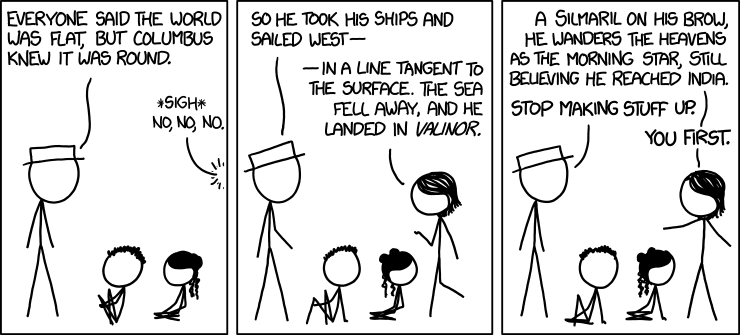
Columbus

And thus was smallpox introduced into the previously Undying Lands.
25 Aug 14:00

Remembering Futurism

by Grant


Filippo Tommaso Marinetti was a man of inherited wealth, artistic vision, controversial political views, and a well-curled mustache. His “Futurist Manifesto” is an outlandish and entertaining document that would be difficult to parody. I’ve paraphrased parts of the manifesto in this comic while trying to stay true to the spirit of the original.

This comic appeared as the first in my series "Who Needs Art?" for Medium.com.


25 Aug 13:57

Don't Fly During Ramadan

chimeracoder:

A couple of weeks ago, I was scheduled to take a trip from New York (JFK) to Los Angeles on JetBlue. Every year, my family goes on a one-week pilgrimage, where we put our work on hold and spend time visiting temples, praying, and spending time with family and friends. To my Jewish friends, I often explain this trip as vaguely similar to the Sabbath, except we take one week of rest per year, rather than one day per week.

Our family is not Muslim, but by coincidence, this year, our trip happened to be during the last week of Ramadan.

By further coincidence, this was also the same week that I was moving out of my employer-provided temporary housing (at NYU) and moving into my new apartment. The night before my trip, I enlisted the help of two friends and we took most of my belongings, in a couple of suitcases, to my new apartment. The apartment was almost completely unfurnished - I planned on getting new furniture upon my return - so I dropped my few bags (one containing an air mattress) in the corner. Even though I hadn’t decorated the apartment yet, in accordance with Hindu custom, I taped a single photograph to the wall in my bedroom — a long-haired saint with his hands outstretched in pronam (a sign of reverence and respect).

The next morning, I packed the rest of my clothes into a suitcase and took a cab to the airport. I didn’t bother to eat breakfast, figuring I would grab some yogurt in the terminal while waiting to board.

I got in line for security at the airport and handed the agent my ID. Another agent came over and handed me a paper slip, which he said was being used to track the length of the security lines. He said, “just hand this to someone when your stuff goes through the x-ray machines, and we’ll know how long you were in line.’ I looked at the timestamp on the paper: 10:40.

When going through the security line, I opted out (as I always used to) of the millimeter wave detectors. I fly often enough, and have opted out often enough, that I was prepared for what comes next: a firm pat-down by a TSA employee wearing non-latex gloves, who uses the back of his hand when patting down the inside of the thighs.

After the pat-down, the TSA agent swabbed his hands with some cotton-like material and put the swab in the machine that supposedly checks for explosive residue. The machine beeped. “We’re going to need to pat you down again, this time in private,” the agent said.

Having been selected before for so-called “random” checks, I assumed that this was another such check.

"What do you mean, ‘in private’? Can’t we just do this out here?"

"No, this is a different kind of pat-down, and we can’t do that in public." When I asked him why this pat-down was different, he wouldn’t tell me. When I asked him specifically why he couldn’t do it in public, he said "Because it would be obscene."

Naturally, I balked at the thought of going somewhere behind closed doors where a person I just met was going to touch me in “obscene” ways. I didn’t know at the time (and the agent never bothered to tell me) that the TSA has a policy that requires two agents to be present during every private pat-down. I’m not sure if that would make me feel more or less comfortable.

Noticing my hesitation, the agent offered to have his supervisor explain the procedure in more detail. He brought over his supervisor, a rather harried man who, instead of explaining the pat-down to me, rather rudely explained to me that I could either submit immediately to a pat-down behind closed-doors, or he could call the police.

At this point, I didn’t mind having to leave the secure area and go back through security again (this time not opting out of the machines), but I didn’t particularly want to get the cops involved. I told him, “Okay, fine, I’ll leave”.

"You can’t leave here."

"Are you detaining me, then?" I’ve been through enough "know your rights" training to know how to handle police searches; however, TSA agents are not law enforcement officials. Technically, they don’t even have the right to detain you against your will.

"We’re not detaining you. You just can’t leave." My jaw dropped.

"Either you’re detaining me, or I’m free to go. Which one is it?" I asked.

He glanced for a moment at my backpack, then snatched it out of the conveyor belt. “Okay,” he said. “You can leave, but I’m keeping your bag.”

I was speechless. My bag had both my work computer and my personal computer in it. The only way for me to get it back from him would be to snatch it back, at which point he could simply claim that I had assaulted him. I was trapped.

While we waited for the police to arrive, I took my phone and quickly tried to call my parents to let them know what was happening. Unfortunately, my mom’s voicemail was full, and my dad had never even set his up.

"Hey, what’s he doing?" One of the TSA agents had noticed I was touching my phone. "It’s probably fine; he’s leaving anyway," another said.

The cops arrived a few minutes later, spoke with the TSA agents for a moment, and then came over and gave me one last chance to submit to the private examination. “Otherwise, we have to escort you out of the building.” I asked him if he could be present while the TSA agent was patting me down.

"No," he explained, "because when we pat people down, it’s to lock them up."

I only realized the significance of that explanation later. At this point, I didn’t particularly want to miss my flight. Foolishly, I said, “Fine, I’ll do it.”

The TSA agents and police escorted me to a holding room, where they patted me down again - this time using the front of their hands as they passed down the front of my pants. While they patted me down, they asked me some basic questions.

"What’s the purpose of your travel?"

"Personal," I responded, (as opposed to business).

"Are you traveling with anybody?"

"My parents are on their way to LA right now; I’m meeting them there."

"How long is your trip?"

"Ten days."

"What will you be doing?"

Mentally, I sighed. There wasn’t any other way I could answer this next question.

"We’ll be visiting some temples." He raised his eyebrow, and I explained that the next week was a religious holiday, and that I was traveling to LA to observe it with my family.

After patting me down, they swabbed not only their hands, but also my backpack, shoes, wallet, and belongings, and then walked out of the room to put it through the machine again. After more than five minutes, I started to wonder why they hadn’t said anything, so I asked the police officer who was guarding the door. He called over the TSA agent, who told me,

"You’re still setting off the alarm. We need to call the explosives specialist".

I waited for about ten minutes before the specialist showed up. He walked in without a word, grabbed the bins with my possessions, and started to leave. Unlike the other agents I’d seen, he wasn’t wearing a uniform, so I was a bit taken aback.

"What’s happening?" I asked.

"I’m running it through the x-ray again," he snapped. "Because I can. And I’m going to do it again, and again, until I decide I’m done". He then asked the TSA agents whether they had patted me down. They said they had, and he just said, "Well, try again", and left the room. Again I was told to stand with my legs apart and my hands extended horizontally while they patted me down all over before stepping outside.

The explosives specialist walked back into the room and asked me why my clothes were testing positive for explosives. I told him, quite truthfully, “I don’t know.” He asked me what I had done earlier in the day.

"Well, I had to pack my suitcase, and also clean my apartment."

"And yesterday?"

"I moved my stuff from my old apartment to my new one".

"What did you eat this morning?"

"Nothing," I said. Only later did I realize that this made it sound like I was fasting, when in reality, I just hadn’t had breakfast yet.

"Are you taking any medications?"

The other TSA agents stood and listened while the explosives specialist and asked every medication I had taken “recently”, both prescription and over-the-counter, and asked me to explain any medical conditions for which any prescription medicine had been prescribed. Even though I wasn’t carrying any medication on me, he still asked for my complete “recent” medical history.

"What have you touched that would cause you to test positive for certain explosives?"

"I can’t think of anything. What does it say is triggering the alarm?" I asked.

"I’m not going to tell you! It’s right here on my sheet, but I don’t have to tell you what it is!" he exclaimed, pointing at his clipboard.

I was at a loss for words. The first thing that came to my mind was, “Well, I haven’t touched any explosives, but if I don’t even know what chemical we’re talking about, I don’t know how to figure out why the tests are picking it up.”

He didn’t like this answer, so he told them to run my belongings through the x-ray machine and pat me down again, then left the room.

I glanced at my watch. Boarding would start in fifteen minutes, and I hadn’t even had anything to eat. A TSA officer in the room noticed me craning my neck to look at my watch on the table, and he said, “Don’t worry, they’ll hold the flight.”

As they patted me down for the fourth time, a female TSA agent asked me for my baggage claim ticket. I handed it to her, and she told me that a woman from JetBlue corporate security needed to ask me some questions as well. I was a bit surprised, but agreed. After the pat-down, the JetBlue representative walked in and cooly introduced herself by name.

She explained, “We have some questions for you to determine whether or not you’re permitted to fly today. Have you flown on JetBlue before?”

"Yes"

"How often?"

"Maybe about ten times," I guessed.

"Ten what? Per month?"

"No, ten times total."

She paused, then asked,

"Will you have any trouble following the instructions of the crew and flight attendants on board the flight?"

"No." I had no idea why this would even be in doubt.

"We have some female flight attendants. Would you be able to follow their instructions?"

I was almost insulted by the question, but I answered calmly, “Yes, I can do that.”

"Okay," she continued, "and will you need any special treatment during your flight? Do you need a special place to pray on board the aircraft?"

Only here did it hit me.

"No," I said with a light-hearted chuckle, trying to conceal any sign of how offensive her questions were. "Thank you for asking, but I don’t need any special treatment."

She left the room, again, leaving me alone for another ten minutes or so. When she finally returned, she told me that I had passed the TSA’s inspection. “However, based on the responses you’ve given to questions, we’re not going to permit you to fly today.”

I was shocked. “What do you mean?” were the only words I could get out.

"If you’d like, we’ll rebook you for the flight tomorrow, but you can’t take the flight this afternoon, and we’re not permitting you to rebook for any flight today."

I barely noticed the irony of the situation - that the TSA and NYPD were clearing me for takeoff, but JetBlue had decided to ground me. At this point, I could think of nothing else but how to inform my family, who were expecting me to be on the other side of the country, that I wouldn’t be meeting them for dinner after all. In the meantime, an officer entered the room and told me to continue waiting there. “We just have one more person who needs to speak with you before you go.” By then, I had already been “cleared” by the TSA and NYPD, so I couldn’t figure out why I still needed to be questioned. I asked them if I could use my phone and call my family.

"No, this will just take a couple of minutes and you’ll be on your way." The time was 12.35.

He stepped out of the room - for the first time since I had been brought into the cell, there was no NYPD officer guarding the door. Recognizing my short window of opportunity, I grabbed my phone from the table and quickly texted three of my local friends - two who live in Brooklyn, and one who lives in Nassau County - telling them that I had been detained by the TSA and that I couldn’t board my flight. I wasn’t sure what was going to happen next, but since nobody had any intention of reading me my Miranda rights, I wanted to make sure people knew where I was.

After fifteen minutes, one of the police officers marched into the room and scolded, “You didn’t tell us you have a checked bag!” I explained that I had already handed my baggage claim ticket to a TSA agent, so I had in fact informed someone that I had a checked bag. Looking frustrated, he turned and walked out of the room, without saying anything more.

After about twenty minutes, another man walked in and introduced himself as representing the FBI. He asked me many of the same questions I had already answered multiple times - my name, my address, what I had done so far that day. etc.

He then asked, “What is your religion?”

"I’m Hindu."

"How religious are you? Would you describe yourself as ‘somewhat religious’ or ‘very religious’?"

I was speechless from the idea of being forced to talk about my the extent of religious beliefs to a complete stranger. “Somewhat religious”, I responded.

"How many times a day do you pray?" he asked. This time, my surprise must have registered on my face, because he quickly added, "I’m not trying to offend you; I just don’t know anything about Hinduism. For example, I know that people are fasting for Ramadan right now, but I don’t have any idea what Hindus actually do on a daily basis."

I nearly laughed at the idea of being questioned by a man who was able to admit his own ignorance on the subject matter, but I knew enough to restrain myself. The questioning continued for another few minutes. At one point, he asked me what cleaning supplies I had used that morning.

"Well, some window cleaner, disinfectant -" I started, before he cut me off.

"This is important," he said, sternly. "Be specific." I listed the specific brands that I had used.

Suddenly I remembered something: the very last thing I had done before leaving was to take the bed sheets off of my bed, as I was moving out. Since this was a dorm room, to guard against bedbugs, my dad (a physician) had given me an over-the-counter spray to spray on the mattress when I moved in, over two months previously. Was it possible that that was still active and triggering their machines?

"I also have a bedbug spray," I said. "I don’t know the name of it, but I knew it was over-the-counter, so I figured it probably contained permethrin." Permethrin is an insecticide, sold over-the-counter to kill bed bugs and lice.

"Perm-what?" He asked me to spell it.

After he wrote it down, I asked him if I could have something to drink. “I’ve been here talking for three hours at this point,” I explained. “My mouth is like sandpaper”. He refused, saying

"We’ll just be a few minutes, and then you’ll be able to go."

"Do you have any identification?" I showed him my drivers license, which still listed my old address. "You have nothing that shows your new address?” he exclaimed.

"Well, no, I only moved there on Thursday."

"What about the address before that?"

"I was only there for two months - it was temporary housing for work". I pulled my NYU ID out of my wallet. He looked at it, then a police officer in the room took it from him and walked out.

"What about any business cards that show your work address?" I mentally replayed my steps from the morning, and remembered that I had left behind my business card holder, thinking I wouldn’t need it on my trip.

"No, I left those at home."

"You have none?”

"Well, no, I’m going on vacation, so I didn’t refill them last night." He scoffed. "I always carry my cards on me, even when I’m on vacation." I had no response to that - what could I say?

"What about a direct line at work? Is there a phone number I can call where it’ll patch me straight through to your voicemail?"

"No," I tried in vain to explain. "We’re a tech company; everyone just uses their cell phones". To this day, I don’t think my company has a working landline phone in the entire office - our "main line" is a virtual assistant that just forwards calls to our cell phones. I offered to give him the name and phone number of one of our venture partners instead, which he reluctantly accepted.

Around this point, the officer who had taken my NYU ID stormed into the room.

"They put an expiration sticker on your ID, right?" I nodded. "Well then why did this ID expire in 2010?!" he accused.

I took a look at the ID and calmly pointed out that it said “August 2013” in big letters on the ID, and that the numbers “8/10” meant “August 10th, 2013”, not “August, 2010”. I added, “See, even the expiration sticker says 2013 on it above the date”. He studied the ID again for a moment, then walked out of the room again, looking a little embarrassed.

The FBI agent resumed speaking with me. “Do you have any credit cards with your name on them?” I was hesitant to hand them a credit card, but I didn’t have much of a choice. Reluctantly, I pulled out a credit card and handed it to him. “What’s the limit on it?” he said, and then, noticing that I didn’t laugh, quickly added, “That was a joke.”

He left the room, and then a series of other NYPD and TSA agents came in and started questioning me, one after the other, with the same questions that I’d already answered previously. In between, I was left alone, except for the officer guarding the door.

At one point, when I went to the door and asked the officer when I could finally get something to drink, he told me, “Just a couple more minutes. You’ll be out of here soon.”

"That’s what they said an hour ago," I complained.

"You also said a lot of things, kid," he said with a wink. "Now sit back down".

I sat back down and waited some more. Another time, I looked up and noticed that a different officer was guarding the door. By this time, I hadn’t had any food or water in almost eighteen hours. I could feel the energy draining from me, both physically and mentally, and my head was starting to spin. I went to the door and explained the situation the officer. “At the very least, I really need something to drink.”

"Is this a medical emergency? Are you going to pass out? Do we need to call an ambulance?" he asked, skeptically. His tone was almost mocking, conveying more scorn than actual concern or interest.

"No," I responded. I’m not sure why I said that. I was lightheaded enough that I certainly felt like I was going to pass out.

"Are you diabetic?"

"No," I responded.

Again he repeated the familiar refrain. “We’ll get you out of here in a few minutes.” I sat back down. I was starting to feel cold, even though I was sweating - the same way I often feel when a fever is coming on. But when I put my hand to my forehead, I felt fine.

One of the police officers who questioned me about my job was less-than-familiar with the technology field.

"What type of work do you do?"

"I work in venture capital."

"Venture Capital - is that the thing I see ads for on TV all the time?" For a moment, I was dumbfounded - what venture capital firm advertises on TV? Suddenly, it hit me.

"Oh! You’re probably thinking of Capital One Venture credit cards." I said this politely and with a straight face, but unfortunately, the other cop standing in the room burst out laughing immediately. Silently, I was shocked - somehow, this was the interrogation procedure for confirming that I actually had the job I claimed to have.

Another pair of NYPD officers walked in, and one asked me to identify some landmarks around my new apartment. One was, “When you’re facing the apartment, is the parking on the left or on the right?” I thought this was an odd question, but I answered it correctly. He whispered something in the ear of the other officer, and they both walked out.

The onslaught of NYPD agents was broken when a South Asian man with a Homeland Security badge walked in and said something that sounded unintelligible. After a second, I realized he was speaking Hindi.

"Sorry, I don’t speak Hindi."

"Oh!" he said, noticeably surprised at how "Americanized" this suspect was. We chatted for a few moments, during which time I learned that his family was Pakistani, and that he was Muslim, though he was not fasting for Ramadan. He asked me the standard repertoire of questions that I had been answering for other agents all day.

Finally, the FBI agent returned.

"How are you feeling right now?" he asked. I wasn’t sure if he was expressing genuine concern or interrogating me further, but by this point, I had very little energy left.

"A bit nauseous, and very thirsty."

"You’ll have to understand, when a person of your… background walks into here, travelling alone, and sets off our alarms, people start to get a bit nervous. I’m sure you’ve been following what’s been going on in the news recently. You’ve got people from five different branches of government all in here - we don’t do this just for fun."

He asked me to repeat some answers to questions that he’d asked me previously, looking down at his notes the whole time, then he left. Finally, two TSA agents entered the room and told me that my checked bag was outside, and that I would be escorted out to the ticketing desks, where I could see if JetBlue would refund my flight.

It was 2:20PM by the time I was finally released from custody. My entire body was shaking uncontrollably, as if I were extremely cold, even though I wasn’t. I couldn’t identify the emotion I was feeling. Surprisingly, as far as I could tell, I was shaking out of neither fear nor anger - I felt neither of those emotions at the time. The shaking motion was entirely involuntary, and I couldn’t force my limbs to be still, no matter how hard I concentrated.

In the end, JetBlue did refund my flight, but they cancelled my entire round-trip ticket. Because I had to rebook on another airline that same day, it ended up costing me about $700 more for the entire trip. Ironically, when I went to the other terminal, I was able to get through security (by walking through the millimeter wave machines) with no problem.

I spent the week in LA, where I was able to tell my family and friends about the entire ordeal. They were appalled by the treatment I had received, but happy to see me safely with them, even if several hours later.

I wish I could say that the story ended there. It almost did. I had no trouble flying back to NYC on a red-eye the next week, in the wee hours of August 12th. But when I returned home the next week, opened the door to my new apartment, and looked around the room, I couldn’t help but notice that one of the suitcases sat several inches away from the wall. I could have sworn I pushed everything to the side of the room when I left, but I told myself that I may have just forgotten, since I was in a hurry when I dropped my bags off.

When I entered my bedroom, a chill went down my spine: the photograph on my wall had vanished. I looked around the room, but in vain. My apartment was almost completely empty; there was no wardrobe it could have slipped under, even on the off-chance it had fallen.

To this day, that photograph has not turned up. I can’t think of any “rational” explanation for it. Maybe there is one. Maybe a burglar broke into my apartment by picking the front door lock and, finding nothing of monetary value, took only my picture. In order to preserve my peace-of-mind, I’ve tried to convince myself that that’s what happened, so I can sleep comfortably at night.

But no matter how I’ve tried to rationalize this in the last week and a half, nothing can block out the memory of the chilling sensation I felt that first morning, lying on my air mattress, trying to forget the image of large, uniformed men invading the sanctuary of my home in my absence, wondering when they had done it, wondering why they had done it.

In all my life, I have only felt that same chilling terror once before - on one cold night in September twelve years ago, when I huddled in bed and tried to forget the terrible events in the news that day, wondering why they they had happened, wondering whether everything would be okay ever again.

24 Aug 02:01

http://voyaager.tumblr.com/post/58399202231


24 Aug 01:43

America’s Forgotten Pin-Up Girl

by Miss Cellania
Adam Victor Brandizzi

Haha, adorei ela. Vejam o link ao final

Among the many popular pinup illustrations of the 20th century, the character called Hilda is one of the most delightful, if rarely seen these days. Created by artist Duane Bryers, Hilda was a woman of dimension. She was pleasingly plump (without the belly that real women have), but more than that, she was pictured in real-life situations, having fun and reacting to surprises, instead of the standard sexy poses and sultry stares of other pinups. Hilda graced American calendars from the 1950s to the 1980s. See more of her at Messy Nessy. No actual nudity, but some images may be NSFW. Link -via Metafilter

24 Aug 01:33

berdych: for some reason i ended up on urbandictionary and i...

Adam Victor Brandizzi

Excelente definição.


berdych:

for some reason i ended up on urbandictionary and i found the most accurate description of switzerland ever

(via TumbleOn)
24 Aug 01:30

O Manual ainda está em promoção

by Leonardo Monasterio
O algoritmo da Amazon resolveu deixar o Manual de sobrevivência na universidade por R$3,99 (56% de desconto). Não sei quanto vai durar, mas já deu para ver que a demanda pelo livro é bem mais elástica do que eu pensava.
23 Aug 00:56

seja elitista

by Guy Franco

Por Guy Franco

Dos poucos orgulhos que tenho, um é ser chamado de elitista. Se não sou chamado de elitista por um tempo, sei que estou no caminho errado. Procuro mudar os hábitos alimentares, horário de banho e o trajeto até o ponto de ônibus.


Não sei de outro elitista que tenha recebido um mendigo em casa. Uma vez um mendigo e o cachorro dele entraram aqui. Ele queria comida, mas como chovia, achamos melhor ele e o cachorro entrarem. Era um mendigo educado, falava direito, via-se que era confiável. E que gostava do cachorro. Educação, vista do ângulo em que estou, é um pouco elitista. O mendigo só conquistou a gente porque falava direito e era educado.


No banco onde trabalhei, sempre fui simpático com os clientes educados. As velhinhas educadas gostavam de mim porque eu era simpático e paciente com elas. Muitas tentaram me dar gorjeta, que eu era obrigado a recusar. Passaram então a me dar balinhas de velhas, aquelas de café ou de doce de leite.


Uma vez um colega do banco me falou para eu tentar ser ainda mais simpático com um cliente que eu estava para atender, afinal, ele tinha milhões na conta. Mas meu elitismo nunca se baseou na renda da pessoa, e sim em sua educação. Se o tio com milhões no banco quisesse que eu fosse educado com ele, que não chegasse me pedindo para pagar as contas daquele jeito que me pediu.


Há quem goste de gente bagaceira sem educação. Que fala alto, gritando, te cutucando. Se for pobrinho, então, melhor ainda.

De pobre e rico bagaceiro eu quero distância.


É pedir muito que todos sejam mais elitistas? 

23 Aug 00:46

dearninety: part of my studio (2)


dearninety:

part of my studio (2)

22 Aug 23:42

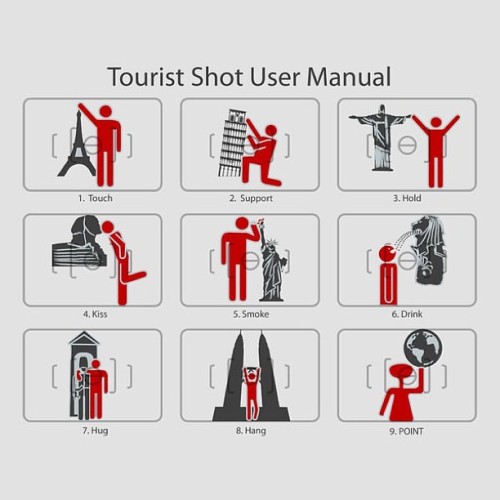
9gag: Tourist Shot User Manual


9gag:

Tourist Shot User Manual

22 Aug 23:41

Photo


22 Aug 00:49

Qual o seu grau de daltonismo?

by Neto
fundo

Ok. O título deste post está errado. Era só pra trazer você até aqui. Explico. Apesar de todos lutarmos pela igualdade entre os sexos, numa coisa as mulheres são comprovadamente melhores que os homens: na média, mulheres enxergam as cores melhor do que homens. Pesquisas mostram que 20% das mulheres nascem com um talento especial para detectar sutis variações de cor, que homem nenhum é capaz. Então, na próxima vez que sua mulher disser que sua roupa não está combinando, acredite.

E tem mais. Apenas 1 em cada 255 mulheres nasce com problemas para detectar variações de tom, versus 1 em cada 12 homens.

Pensando nisso, o site X-Rite desenvolveu um teste para medir a sua capacidade de observar variações de tonalidade, ordenando diversos quadradinhos. Confira aqui e poste seu resultado nos comments. O meu deu 12 (ah…quanto mais baixo o resultado, melhor. E se você não mexer nenhum quadrado, a pior pontuação é aproximadamente 1000 pontos).

Author information

Neto
If your children ever find out how lame you really are, they'll murder you in your sleep. - Frank Zappa