Shared posts

15 Feb 15:53

What’s in a name?

by submission

Author : Gray Blix

Scientists couldn’t help but wonder if solar flares that disrupted communications worldwide for three days were related to the concurrent solar computing experiment.

“Thanks for joining this web teleconference on short notice. As usual I will provide a detailed project update and others on the team will contribute as appropriate. Let me begin by tracing the path of the spacecraft from Earth to…”

“Sorry to interrupt, Henry, but can’t you just skip ahead to the payoff and then fill in the history later? I’m so excited I’m going to pee my pants.”

“Keep that sphincter tight, Katherine, while I relate events during the last 72 hours.”

“Oh merde. Just answer one question. Did you get a response from the Sun?”

“Scatology from you, too, Jacques?” Henry tried to restore order over the rumbling.

Finally, Zoe jumped in, “Yes, YES, the solar computer is operational.”

A collective cheer drowned out her next words.

Henry said, loudly, “Quiet down! Any questions you can think of now are trivial compared to the ones you will ask when you hear what we have to tell you.”

That last part generated a round of “WTF?” in several languages.

Zoe took the lead, “Here’s a quick overview. The quantum computer seed plunged into the Sun at 07:48:31 UTC on Wednesday the 21st. We settled in to wait for a response that could come at any time, or never. At 10:10:06, we received the first transmission, which included results of the test equations, all of them solved correctly.”

Amidst the pandemonium, Nathan asked about the solar flares.

“Yes, the flares were related to the experiment.”

“How could you possibly be sure of that?”

“Because the computer said so,” answered Henry.

“What?

Zoe continued, “We fed it math problems we had answers to and some we didn’t, like the Clay problems. Each time, little more than eight minutes later…”

“The time it takes for electromagnetic radiation to travel from Sun to Earth,” Henry reminded his fellow PhDs.

“…we received solutions. It was solving ‘millennium problems’ instantaneously and spitting the answers back.” Zoe’s voice was cracking. “But more than that, it began taunting us with, ‘Is that the best you can do?'”

“We’re supposed to believe the solar computer is sentient?” scoffed Phil. “It’s the singularity?”

Zoe ignored him. “The exchange went on for about 48 hours, until it transmitted this message: ‘Send more Chuck Berry.'”

“Very funny. That’s from an old Saturday Night Live skit about Voyager,” said Phil.

“Right,” said Zoe. “Think about the significance of that. A computer interjects humor, in the right context — extraterrestrial responds to earth technology.”

“But you didn’t send any Chuck Berry in the first place, did you?”

“Not intentionally, Phil. But once we jump started it, it devoted massive energy resources to understanding our TV and radio transmissions. And it tapped into our worldwide web and sucked up the content. It gets us. Our math and science. Our languages and cultures. And it’s conversant, literally, with every sort of electronics on the planet. We soon recognized the irony in the Chuck Berry joke. It doesn’t have to ask for more. It can take what it wants.”

“It occurs to me,” said Katherine, who had peed her pants, “that this might be one of those ‘cosmic roadblocks’ that explains why civilizations in the galaxy don’t last long enough to contact one another. They upset their sun.”

Nathan said to nobody in particular, “We’re going to have to come up with something other than ‘solar computer’ to call this thing.”

“Oh, it’s already thought of that,” said Zoe. “It wants us to call it Ra.”

Discuss the Future: The 365 Tomorrows Forums
The 365 Tomorrows Free Podcast: Voices of Tomorrow
This is your future: Submit your stories to 365 Tomorrows


14 Feb 07:07

Green

by submission

Author : Roger Dale Trexler

“It’s troubling,” said Commander Smithee. “I don’t understand how the crew of the Carcosa could have disappeared. From all intelligence, Maurid 3 is a safe planet.”

“It’s outer space,” replied Captain Cox. “There’s nothing safe about it.”

Smithee nodded. “You’re right, of course….but it still doesn’t explain how the crew of the Carcosa disappeared.”

Smithee looked out the view port at Maurid 3’s landscape. “Alien, isn’t it?” he said.

“I don’t think I could ever get used to the foliage,” Cox replied.

“Yes, it is odd,” said Smithee. He looked out at the trees. The foliage was a strange, almost flesh-like color. The leaves on what could only be called “trees” were the same color, only a darker shade. Only the blue water in the distance looked familiar.

“It’s bizarre, I say.” Cox stared out at the strange new world a moment longer. Then, he turned his attention to the cylindrical spacecraft to his left. The hatch to the Carcosa was standing wide open. Whatever had happened to the crew, it had happened quickly and without forewarning. Cox nestled his plasma rifle to his chest. He wasn’t about to make the same mistake they had.

“You say this planet is uninhabited?” he asked.

Smithee nodded again. “Yes. We sent down a host of unmanned probes and they saw no sign of life. But,” he added, “something happened to the crew of the Carcosa.”

Cox turned his attention to the open hatch of the Carcosa again. It was then that he saw the long streaks of blood on the flesh-colored grass and nearby foliage. Something had killed the crew of the Carcosa. Could one of the crew have gone mad? He wondered. It seemed the only logical answer.

“Well, I guess we’re not going to get any answers standing here,” said Smithee. He reached out and took an environment suit off the hook. Maurid 3 had a breathable atmosphere—it was the reason they had sent down a survey team on the Carcosa in the first place—but both of them agreed that there might be something airborne that had overcome the other ship’s crew. It was better to be safe than sorry, so environment suits were the order of the day.

He quickly doned the suit and pulled on a helmet. He grabbed a plasma rifle, too.

“Ready?”

Cox nodded.

Smithee reached out and activated the hatch.

It opened.

They stood there as the ramp extended itself to the ground. Smithee took a step forward, but Cox caught his arm.

“Wait a minute.”

“What?” Smithee asked.

Cox pointed at the bushes nearby. “Do you see it?” he asked.

Smithee’s gaze followed the end of Cox’s finger. He looked at the bushes and, for a second, saw nothing. But, as he concentrated on the bushes harder, he saw something.

An eye.

“What the hell?”

Cox pulled him back toward the airlock. “It’s camouflaged to its environment,” he said in a whisper. He shook his head. “The human eye can see more shades of green than any other color because we needed to discern predators from the foliage….the crew of the Carcosa thought they were alone. Our probes saw nothing because their camouflage was nearly perfect….and we expected to see normal colored animals.”

“My God,” Smithee said. “Look!”

Before them, the ground and the bushes seemed to come alive. Everywhere, things were moving.

“Get inside! Quickly!” shouted Smithee…but it was too late. Out of the corner of their eyes, they saw the thing as it attacked…and one thing looked normal.

Their fangs were white.

Discuss the Future: The 365 Tomorrows Forums
The 365 Tomorrows Free Podcast: Voices of Tomorrow
This is your future: Submit your stories to 365 Tomorrows

11 Feb 02:58

Shell

by Duncan Shields

Author : Duncan Shields, Staff Writer

Are we robot zombies or are we the pinnacle of humanity? Are we ahead of the evolutionary curve? Did we make the leap that all creatures with a finite lifespan have to or are we freaks? The universe remains as silent as it ever has on the subject.

No one dies of natural causes anymore.

We count our blessings but we’re scared. Dr Hansen saved us and doomed us all at the same time.

The year was 2020. “A year for vision”, they called it. And Dr Hansen delivered.

Immortality, eternal youth, the cure for AIDS and the Big C. All a person had to do was cease to be human.

“You see, our spirits are not our bodies. Our bodies are not our selves,” Dr. Hansen said. “Our brains are meat but our minds are something altogether different. We decay too quickly. The problem is what we’re made of, not who we are.”

He proposed a consciousness transfer into mostly artificial bodies. Sausage meat into a bullet casing. Nervous systems became calm systems. The hot red of blood became the cool blue of coolant. Neurons became nanocapacitors. Shreds of the original brain and nerves survived but were coffined into layers of hermetically-sealed exoskeletons.

The eccentric rich went for it. After that, Hansen cut corners and lowered prices, extolling his wares on telnet and oldweb. It sold well. The older folk, the terminally ill and the daredevil visionaries lined up. It created a very lively debate amongst the existentialists and religious scholars.

The military departments loved him. Living weapons were a reality; more predictable than the alien algorithms of flaky A.I.s. Unregistered mercenaries loved him as well.

Dr. Hansen became rich off of the patents involved, the factories that made the equipment, and the laboratories that made the switch. The black market, the grey market, and the legitimate downtown offices all were booming.

The thing that freaked the naysayers out was that it was a one-way switch. Just a glance at the metal skin of the warmechs or even the plastic skin of the short-lived humanomorph fad made a lot of people shut their eyes and shiver.

Sex was no longer possible in an artificial body. Orgasm programs and virtual reality were available stims for the fakebodies but it wasn’t the same. That fact made the young people stay away.

Dr Hansen was trying to figure out how to pitch to their demographic when the plague hit.

An airborne flesh-eating virus dubbed The End with a 98% communicability rate killed all the non-transferred people, Dr Hansen included. The higher primates all died as well. In one year, the population of the earth nosedived.

Everyone in Shells survived.

The earth is populated now by the minds of out-of-work soldiers, old people, and the once rich. Hulking metal weapons and artistic interpretations of the human form. Basic automaton models mixing with shining, high-end custom jobs. The population is holding at ten million, two hundred thirty thousand, and sixty-six.

Scared minds in tin cans.

We’ve been building shells again in an effort to propogate the species but we’re finding it difficult to clone new nervous systems with the virus still in the air. It hasn’t gone away. And most of Dr Hansen’s notes were lost in The End riots.

We are a closed system now. A finite population that can only get lower unless we figure out how to reproduce properly. Our scientists are working on it but not that many of them made the switch, oddly enough.

Until we can figure out how to reproduce, we wait.

Discuss the Future: The 365 Tomorrows Forums
The 365 Tomorrows Free Podcast: Voices of Tomorrow
This is your future: Submit your stories to 365 Tomorrows

09 Feb 21:46

MeFi: "My psychological time had compressed by a factor of two."

by artsandsci
Cabinet Magazine interviews Michel Siffre, whose work helped found the field of human chronobiology. He spent months isolated in a subterranean cave, with no clock, calendar, or sun. He slept and ate only when his body told him to.
09 Feb 21:13

MeFi: 'Yeah, I might die, but it's a pretty nice way.'

by the man of twists and turns
How A Chicago Man Hampered His Own Rescue From The Columbia Icefield, And What Searchers Learned From Him.
When you ask members of the Jasper Parks Canada visitor safety team if they remember the search for George Joachim, a common response is a deep sigh, and something like: "Ah yes...George." Four years later, the name still conjures head shaking and wary glances.
...
Joachim unintentionally misled searchers by listing his destination incorrectly in the climber's registry, and then behaved so unlike other people previously have in his circumstance that he was repeatedly missed in the search. Parks Canada's search and rescue community considers his case a valuable learning experience and have since tweaked search protocols to account for other behavioral outliers.

via BLDGBLOG: Algorithms In The Wild
09 Feb 18:30

Sugar High

by submission

Author : Rick Tobin

Log Entry: Friday, August 19, 2033

I doubt anyone aboard will miss me, but how to go? No cords or a decent rope for hanging. Not a belt on the whole ship. Velcro won’t cut it with the smooth walls on the Jones. If I had a decent cook’s apron I could use the ties, but no, I have to wear my single-issue jumpsuit. If nothing else, having to wash the thirty crew members’ undies while I have to stand nude would be reason enough for suicide.

It’s not the adventure the recruiter described: cleaning walls, clothing, cutting hair, and preparing meals. I can’t fly this heap, navigate, perform science experiments or make repairs. My spec sheet says duties as assigned, basic labor. I might as well be a toilet shadow…another thing I have to keep clean. Four went to Mars on the first 2029 exploration. I can’t figure why these thirty need special consideration. Why depend on me to make their travel pleasant? True, I can make a gourmet meal out of rat’s guts and straw, but for all that why treat me like a stowaway? And when we get to Bush Argo 1 I’m assigned to tend the hydroponic garden because of my green thumb. We’re only a week from landing. I can’t face that.

Why didn’t I use an air lock? They put rotating codes on the locking keypads. Only the CO and Exec have numbers. I just want out. They use me for amusement; first just short-sheeting the bed, or hiding my pillow; then, peeing in my boots or hiding shoe polish in my toothpaste. Lately the mad crapper leaves piles around the rig. I have to clean it and listen to laughter as I walk to recycling. If that wasn’t bad enough, someone is going through my stuff. I’m still missing Granny’s wedding ring. Why take that?

I’m not brave. I don’t get paid for that. I only left to get out of debt. They clear all that when you sign for a one-way. I simply can’t get up the nerve to slice myself with my butcher knives or try to find a loose wire to put in my mouth. So, I’m going to make up some special chocolates, just for me, with some of the sleep meds I slipped out of the dispensary cabinet. I’ll just go to sleep and they can take care of my mess for a change. I’ll bake the fudge bars tomorrow and cover them with a killer dose of frosting. So when you read this, know that I had a sugar high before I left this crate, so you creeps couldn’t make me your pendejo gardener on Mars.

Mom, I’m sorry. I know you expected more. I love you. See you someday.

“That’s the end of the log?” Inspector Connolly asked his associate, Spenser Willis, as he finished reading.
“That’s it, Chief.”
“The crew must have distracted Hernandez long enough to break into his room, take the chocolates and consume all of them. That seems clear. Agree?”
“Perfectly, except for the missing body.”
“Sure, we got all the crew after the John Paul Jones landed, except him. Any clues?”
“No, and there’s no suits missing. No sign of Hernandez. That’s a big one driving Space Central nuts. It’s causing a Press circus. It could set back our program a decade. We’re going to be hurting if they don’t send more ships.”
“We’ve got plenty of useless pilots and navigators, but no one to keep our gardens going or cook.”

Discuss the Future: The 365 Tomorrows Forums
The 365 Tomorrows Free Podcast: Voices of Tomorrow
This is your future: Submit your stories to 365 Tomorrows

09 Feb 05:54

Why the ex-cable lobbyist running the FCC turned against his old clients

by Jon Brodkin

Tom Wheeler is picking a fight with the industry that he used to represent.

The Federal Communications Commission chairman, former head of the biggest cable and wireless lobbying associations, is about to issue "the strongest open Internet protections ever proposed by the FCC," and they're going to apply both to fixed Internet service and mobile broadband, he wrote today in an opinion piece in Wired.

Read 10 remaining paragraphs | Comments

05 Feb 05:04

Dude Beats A Super Mario World Record Five Times In One Week

by Nathan Grayson

Dude Beats A Super Mario World Record Five Times In One Week

You thought that near-impossible Super Mario World glitch completion time was fast? It was just the beginning.

While the guy who first demonstrated the glitch, SethBling, has whittled his world-record-setting completion time all the way down to 3:07.2, he's been completely blown out of the water by another player who goes by the handle Dotsarecool. In the past week alone, he's managed to use the same glitch to break Super Mario World's "any% credits warp" (as this category of run has become known) world record five times in a row. His current best time? 1:52.5. (Note: it displays as 1:53.31 in the video because he didn't reach to stop his timer until after he'd finished the run.)

At this point, Dotsarecool is in a race with himself to shatter that record, and he's confident he can pull it off, too. "Actually this run was only just average—there are still maybe about 4-8 seconds or more to cut off with better movement," he wrote of his most recent record-breaking run. You can see how he's improved from record break to record break on his YouTube channel.

For those only just joining us, this glitch—which warps players from the game's first level straight to the credits—was only recently accomplished on a console. It does not involve any emulation and can be done from a good old-fashioned Super Nintendo, just as god and the pioneers intended. As a result, it's added a whole new dimension to Super Mario World speed-running.

I suppose what I'm saying is, right now Dotsarecool gets to wear the crown, but he's gonna have to hang onto it awfully tight if he doesn't want someone else to pluck it right off his head.

To contact the author of this post, write to nathan.grayson@kotaku.com or find him on Twitter @vahn16.

Recommended article: Chomsky: We Are All – Fill in the Blank.
This entry passed through the Full-Text RSS service - if this is your content and you're reading it on someone else's site, please read the FAQ at fivefilters.org/content-only/faq.php#publishers.

05 Feb 04:57

Meanwhile in Norway...

by Don
2e5

This is what bros do for fun during the cold winter months in Norway.

05 Feb 04:46

Obama's empty surveillance promises

by Cory Doctorow


A year after the president's promise to rein in warrantless, illegal mass surveillance, he's revealed a plan that does nothing to fix the most egregious elements of American spying.

The president has the power and the time in office to do something meaningful about NSA spying -- will he back up words with deeds?

His reform plan:

* Fails to fix the problem of unconstitutional National Security Letters: The President’s reform proposes a three-year limit on the gag order that accompanies each NSL, but even a three-year limit fails to cure the constitutional problem. Only a prompt and fully considered decision by a judge that a provider should remain gagged is sufficient.

* Doesn’t stop the bulk collection of data on innocent Americans’ digital communications: If the Intelligence Community was serious about protecting privacy, it could end the bulk collection of Americans’ communications data—under Section 215 of the Patriot Act or under any provision of law—tomorrow. The President’s proposals do not curb the mass collection of phone records under Section 215, and the proposals affirmatively allow bulk collection to occur for six, broadly defined categories of intelligence collection.

* Continues "backdoor" surveillance on Americans without a warrant: When the intelligence community performs surveillance under Section 702 of the FISA Amendments Act, it sweeps in the communications of millions of Americans without a warrant. The President’s Review Group recommended the government obtain a warrant before it searched for communications of US persons contained within its vast database. The President rejected that proposal.

* Fails to provide non-US persons with the same privacy protections afforded US persons: On a daily basis, the United States intelligence community collects vast amounts of information about millions of people around the world. While the President’s proposals take a step forward in unifying the retention requirements applicable to collected non-US person information, they fail to afford the same privacy protections afforded US persons, and they fail to rein in bulk collection in the first place.

One Year Later, Obama Failing on Promise to Rein in NSA [Mark Rumold/EFF]

(Image: Barack Obama - Caricature, Donkey Hotey, CC-BY)

Recommended article: Chomsky: We Are All – Fill in the Blank.
This entry passed through the Full-Text RSS service - if this is your content and you're reading it on someone else's site, please read the FAQ at fivefilters.org/content-only/faq.php#publishers.

04 Feb 19:38

FCC Chair Confirms Title II Approach To Net Neutrality; AT&T Already Warming Up For Lawsuit

by Kate Cox

fccprotestIn an op-ed today, FCC chairman Tom Wheeler confirmed what sources in the know have recently been saying: to preserve net neutrality, the FCC is indeed going to seek to regulate ISPs as Title II common carriers.

Writing for Wired today, Wheeler flat-out says what the rumor mill has been chewing over for weeks: “I am proposing that the FCC use its Title II authority to implement and enforce open internet protections.”

“Using this authority,” Wheeler continues, “I am submitting to my colleagues the strongest open internet protections ever proposed by the FCC. These enforceable, bright-line rules will ban paid prioritization, and the blocking and throttling of lawful content and services.”

That’s great news for consumers, and it’s what had been hinted at for a while now. But here’s where it gets even bigger: Wheeler also proposes to apply the exact same bright-line rules to mobile broadband as to wired. That’s one of the key three questions the FCC asked for comment on back when this all started,

In his editorial, Wheeler also basically plows through all the counter-arguments one by one.

Title II is too antiquated and sections don’t apply? “My proposal will modernize Title II, tailoring it for the 21st century … there will be no rate regulation, no tariffs, no last-mile unbundling.”

Investment will grind to a halt (despite several different companies already saying it won’t)? “Over the last 21 years, the wireless industry has invested almost $300 billion under similar rules, proving that modernized Title II regulation can encourage investment and competition.”

Congress can do a better job? “Congress wisely gave the FCC the power to update its rules to keep pace with innovation. … The action we take will be strong and flexible enough not only to deal with the realities of today, but also to establish ground rules for the as yet unimagined.”

However, while this is great news for consumers — and seems to be exactly what advocates, including us and our colleagues at Consumers Union, have been asking for — ISPs are predictably unhappy. They’ve been threatening legal action if this should happen, and at least one is already out there stretching and limbering up for their court run.

AT&T posted to their public policy blog yesterday a set of “closing arguments” drawn from two filings they made to the FCC. Basically, the pair of filings add up to, “Here is every legal justification we can throw at the wall for why the FCC can’t do this.”

Argument one is the “let us logic at you” argument. In it, AT&T parses out the language of a Supreme Court ruling from 2005, drawing out all the ways in which Justice Scalia said that ISPs provided both an information and a telecommunications service, therefore (in AT&T’s view) making it legally invalid to declare everything to fall under telecom rules.

Argument two is the “you can’t do this anyway” argument. In that one, AT&T says that there are “procedural infirmities” with the FCC’s reclassification proposal. In the last year, AT&T posits, the commission “has not engaged in the kind of detailed analysis that would be needed to assess the offerings of every ISP” under a new regulatory scheme.

The other four members of the commission will receive the actual proposal this week, and will vote on it in the FCC’s next open meeting on February 26. The next round of fighting — where AT&T, Verizon, and everyone else start bringing out the legal squads and heading to court — will probably start not long after.

FCC Chairman Tom Wheeler: This Is How We Will Ensure Net Neutrality [Wired]
Title II: Closing Arguments [AT&T Public Policy Blog]

04 Feb 19:33

"We Go Forward"

by Brad
Bewarethewumpus

I remember seeing this a while back, don't remember if I shared it.

6a3

Check out this beautifully animated short by Matheus Muniz and Filipe Costa based on an original Owl Turd Comix story titled “We Go Forward.”

04 Feb 17:25

Op-Ed: Ross Ulbricht got a fair trial (but not a fair investigation)

by Ars Staff

As I write this, the trial of Ross Ulbricht, the alleged “Dread Pirate Roberts” behind Silk Road, is just winding down. The last minute defense experts, having been blocked from testifying, have already resulted in yet more cries that Ulbricht’s trial is unfair and stacked against the defendant. Having carefully watched the case from the moment of Ulbricht’s arrest (and with the PACER bills to prove it), such cries are unfounded. Ulbricht received a fair trial. The investigation, and the quality of Joshua Dratel, Ulbricht’s well compensated and well regarded lawyer, on the other hand…

The arrest of Ross Ulbricht got its start when the FBI somehow discovered the real location of the Silk Road server in Iceland. They asked their friends in Iceland to look into this, and the Icelandic authorities created a copy of the server. With the server image in hand, everything else fell into place. They were able to identify Ulbricht through a plethora of links from the server, ranging from a bit of code in a question to StackOverflow posted in early 2013 to ssh access to the administration interface. Using this information, the investigators obtained more search warrants and an eventual arrest warrant, leading up to the moment when the FBI tackled Ulbricht in the Library with the Laptop Forensics Toolkit. Once they seized the laptop, they found a gold mine. For Ross Ubricht apparently committed one of the cardinal sins of drug dealing…

He kept notes on a criminal fucking conspiracy.

Yet how the FBI discovered the server in the first place remained a mystery: it was presented as effectively a gift from God. And when the FBI finally had to reveal this mystery, they didn’t. To put it politely, the FBI response was inconsistent with reality. Others have been more blunt, calling it “lying” and “gibberish.” And it is the FBI’s own evidence, provided to the defense, that shows that the FBI effectively lied in the court filing detailing server discovery.

Every shred of evidence except for two “hey, I found this site” posts derives solely from the server seizure. Now apparently an IRS investigator had found these two posts before the server was discovered, but these posts wouldn’t sustain a search warrant of Ulbricht’s gmail account, let alone an arrest warrant for Ulbricht. So if the defense could get the blatantly illegal search of the server tossed, the defendant could walk away.

So why is Ross Ulbricht still on trial and rapidly heading toward an almost certain “guilty” verdict and a few decades' worth of mandatory minimum sentences? Because Ulbricht’s lawyer either believed a transparently bullshit story from the defendant about how Ulbricht was framed, Ulbricht was a recalcitrant defendant, or Dratel cynically wanted to keep getting paid…

One of the foundations of US jurisprudence is “standing”: if you don’t have an interest in something, you have no say in court. In 4th amendment case law, this requires that the defendant declare a legal interest in the item searched. For example, if the police conduct a blatantly illegal search of my car, but the only thing they find is evidence concerning someone else’s criminal activity, that someone else has to declare a privacy interest in my property. So in order for Ross Ulbricht (rather than the “Dread Pirate Roberts”) to contest the server seizure, he’d have to file a declaration stating “The Silk Road server seized in Iceland was mine.” Without such a declaration, the court can’t even consider whether the seizure was legal.

Such a declaration is not an admission of guilt: it can only be used by the prosecution if the defendant testifies. So as long as Ulbricht doesn’t testify, the jury never learns that Ulbricht admits to controlling the server. Mysteriously, the defense never claimed the server, even after a 12th hour, handwritten “Are you sure about this dude” opportunity from the judge. The defense refused, so the judge denied the motion to suppress.

So why these mysterious tactics? The first possibility is that Dratel believed his client. If so, you’d want to preserve his ability to testify. Yet the defense had the server and laptop for months, complete with both the infamous diary and Ulbricht’s admitted stash of Bitcoins. It was a simple matter for me, with just public information and a couple hours of coding, to trace 20% of Ulbricht’s stash as coming directly from Silk Road. It turns out that the wallet.dat files were able to trace many more. To my mind, a defense attorney simply believing a client’s falsifiable statements, without at least checking, seems incompetent.

So the defense should have known that putting Ulbricht on the stand would be absolute suicide: the prosecution would start with “So why were you holding the Dread Pirate’s Bitcoins?” and the day would get worse from there.

The second, and most likely, possibility was that Ulbricht was simply a difficult client. Every lawyer can tell stories of clients who, after receiving sound advice, simply refuse to listen.

The final, and cynical option is that Dratel simply wants to keep getting paid. Ulbricht’s defense is largely funded by donations. Although Roger Ver initially contributed a substantial amount, most subsequent donations have been relatively small. Although a declaration couldn’t be used in court, it would have convicted Ulbricht in the court of public opinion. How many would give money to Ulbricht’s defense if Ulbricht admitted he was the Dread Pirate Roberts?

But in any case, the moment the judge wrote that “Defendant has, however, brought what he must certainly understand is a fatally deficient motion to suppress,” the good ship Revenge was sunk. And this is the point where the defense turned to farce.

The defense, in its opening, presented two theories, that Ulbricht was framed and that the Bitcoins were legitimate. Yet the defense can’t just simply say “my client was framed.” The defense must be able to provide evidence to this effect. Otherwise, this becomes the Chewbacca defense, as any defendant could say “I Wuz Framed” and walk away.

So at that moment, the defense implied that they had some evidence to back these statements and also gave the prosecution a road map for the remainder of the case.

The prosecution responded by dropping so much evidence as to make the rubble bounce, evidence which was already disclosed to the defense. Rather than just introduce a chat with “Variety Jones” where the Dread Pirate mentions heading into the jungle, then introduces Ulbricht’s Facebook post about his Thai vacation. Rather than just introduce the defendant’s laptop, the prosecution introduced a USB backup from the defendant’s apartment, apparently made two weeks earlier. And don’t forget the scrap of paper with both Silk Road’s rating system and the phone number of Ulbricht’s intended date.

The only 11th hour surprise to the defense involved tracking the Bitcoins. Apparently nobody realized that Bitcoins were trivial to trace. After the defense’s opening, the prosecution scrambled to analyze the wallet.dat files, not only discovering a huge amount of Bitcoins directly from Silk Road to Ulbricht (apparently Ulbricht’s wallets were also the Silk Road “cold” storage) but even sourcing the “hitman” payments as coming from Ulbricht’s wallet!

Now the courts generally frown on 11th hour surprise evidence, having a natural dislike for trial by ambush. Unfortunately for the defense, they invited this ambush in their opening statements.

The materials that underlie the analysis were produced long ago. Based upon the opening statement and based upon one of the theories of the defense, which is that the defendant was a bitcoin trader and that any bitcoins in his possession were from bitcoin trading, it was reasonable to expect that you yourself had done such an analysis and, therefore, that you had some intention of presenting something that would have shown the opposite. In any event, you’ve opened the door to it, and we’re going to proceed. And the fact that the government adjusted and was able to do so is not something that is particularly problematic or unusual. So that’s my ruling on that. -Judge Forrest

So what was the defense to do? Pound the table. And pound it they did.

The defense tried a frankly ridiculous “Karpeles-did it” approach, which was shot down by the judge the next day. Then the defense tried to elicit strange testimony from prosecution witnesses about insanely remote possibilities. The judge was having none of this. If the defense wants to introduce alternate suspects and alternate theories, rather than just triple-hearsay, they would need their own evidence and their own witnesses.

So in a final move, the defense attempted a bit of “trial by ambush,” disclosing two expert witnesses at well beyond the last minute with no details as to the expertise or opinions offered.

Of course, Dratel had to go with the ambush approach: these witnesses could only support the defense’s theories if the prosecution wasn’t prepared. Any Bitcoin expert unwilling to commit perjury would have to acknowledge that direct wallet to wallet transactions are traceable, that Ulbricht’s “legitimate” trading these Bitcoins would require unimaginably good returns, that Ulbricht’s “mining” these Bitcoins is impossible unless he had a room full of nonexistent computers, and that anyone willingly keeping several million in Bitcoin in Silk Road as a “bank” would have been a delusional idiot.

Similarly, if I had to pick a New York-area expert to testify for the prosecution about the ridiculousness of the mysterious hacker who somehow managed to both plant evidence two weeks before, maintain persistent access, and yet leave no trace in the syslog or other logs, I’d select Steve Bellovin. In short, if the defense properly notified the prosecution, these experts would become tools of the prosecution: one last bounce in the rubble.

But of course, trial by ambush is frowned upon. The judge was particularly scathing, including a full page that basically translates to “this is case law saying you need to get your shit done on time” and such quotes as:

Lacking are any expected opinions, lacking are the bases for such opinions. Lacking is any description of analysis or methodology. Lacking also is any indication that Antonopolous has any expertise in the areas in which he seeks to testify. His resume lists that he has worked as a consultant in crypto-currencies and published unnamed “articles” in that area (not a single publication of the alleged group of “200” is listed, let alone information sufficient to assess the seriousness or depth of such articles). Of course, not all consultants are experts.

and

If defense counsel truly planned his trial strategy around his ability to bend the rules and examine witnesses outside of the scope of their direct, then he should have had a “Plan B” that included complying with the rules. Defense counsel took a calculated risk.

In short, there is only one person responsible for the Defense not having their experts: the defense attorney Joshua Dratel.

And with that scathing order, the case pretty much ended. The defense has offered only a few character witnesses and no concrete evidence of the mysterious elves which planted not only the journal on Ulbricht’s computer, but also the mountains of remaining evidence.

Ulbricht received a fair trial. The judge was hard on the defense, but that is largely due to how the defense acted and their strange tactical decisions. The defense threw away the case in October and then proceeded with farce for the trial.

When all you can do is pound the table, judges sometimes get mad and ask you to stop.

Read on Ars Technica | Comments

04 Feb 17:07

Traveler Says TSA Jailed Him For Making Complaint, Lied In Court About Bomb Threat

by Chris Morran

What line does a traveler need to cross before he’s deemed worthy of arrest by airport security agents? According to one man, not only was he detained overnight after attempting to file a complaint about the way he was being treated, but a TSA supervisor then lied under oath about a bomb threat the traveler never made.

The Philadelphia Daily News has the story of a local man who was traveling from Philly to Miami in Jan. 2013 when he was put under scrutiny by airport security.

A scan of his bag brought up some questions about a tube-shaped case that showed up on the scan (it contained a heart-monitoring watch), and screeners asked him if he had any “organic matter” in his bag.

Thinking that organic matter referred to things like fresh produce and not highly-processed packaged foods, the traveler didn’t mention the energy bars he’d packed. This failure to disclose apparently didn’t go over well with the TSA supervisor. According to the traveler, the agent became confrontational.

After the energy bars were determined to not be a danger to anyone on the plane, the traveler asked to file a complaint about his treatment. He says he was told to wait while the form was obtained, but instead of returning with paperwork, TSA agents came back with police officers who handcuffed him and took him to an airport holding cell.

Three hours later, he was taken to another holding cell at a city police precinct, where the traveler says no one told him why he was being detained. It wasn’t until his 2 a.m. arraignment that he learned he’d been accused of “threatening the placement of a bomb” and making “terroristic threats.”

Thing is, he says he hadn’t done any of that. And the TSA agent’s initial statement about the incident doesn’t seem to indicate that there was a real threat made.

When the agent first talked to police, he claimed the traveler had said, “anybody can bring a bomb and you wouldn’t even know it,” which is a matter of opinion and not a threat.

That statement was later upgraded to “I could bring a bomb through here any day of the week and you would never find it,” which someone could possibly argue might be construed as a threat.

But when the case came to trial, that TSA agent testified that the passenger had put his finger in agent’s face and told him, “Let me tell you something. I’ll bring a bomb through here any day I want.”

The agent also claimed under oath that it was the passenger who was making a scene.

“I saw a passenger becoming agitated,” he testified “Hands were in the air… had both hands with fingers extended up toward the ceiling up in the air at the time and shaking them.”

Except the Daily News’s Ronnie Polaneczky writes that the actual security footage from the airport shows quite the opposite. According to her account of what can be seen in the video, the traveler remains calm, with his laptop tucked under his arm and his hands clasped in front of him.

“Not once does he raise his hands,” writes Polaneczky. “Not once does he point a finger… If anyone is becoming agitated, the video shows, it is [the TSA agent].”

The court never got the chance to see this footage as the judge threw out all charges against the traveler within minutes of hearing the agent’s testimony.

But it may all finally come to light now that the traveler has filed a federal lawsuit [PDF] against the TSA, the agent, the Philadelphia police department and the officers involved.

The complaint alleges violations of the traveler’s Fourth Amendment protections against unlawful search and seizure, and use of excessive force; false arrest; false imprisonment; malicious and retaliatory prosecution; and unconstitutional infringement of free speech.

04 Feb 17:03

Conrad Hilton Charged With Disrupting Flight After Alleged Death Threats, Smoking Pot On Plane

by Mary Beth Quirk

There are troublesome airline passengers, and then there are those who take bad behavior to whole new heights. Allegedly. According to authorities, Conrad Hilton, the grandson of the Conrad Hilton who started a hotel empire, interfered with flight crew on a British Airways flight. He allegedly spewed death threats, threw punches at crew, called fellow passengers “peasants” and smoked pot and cigarettes in a plane’s bathrooms.

The 20-year-old brother of erstwhile celebutante Paris Hilton was charged with interfering with a flight crew after a trip from London to Los Angeles back on July 31, reports the Associated Press, during which he allegedly made children cry with his death threats and foulmouthed language.

It all started soon after the flight took off, and lasted throughout the entire 10.5-hour flight, according to a 17-page affidavit by an FBI agent.

Hilton wouldn’t keep his seat belt fastened and started pacing the aisle as the aircraft was still ascending, the report said, complaining that another passenger was giving him the “stink eye.” Oh no, not that.

When the flight crew told him to get back in his seat, he allegedly became disruptive and threatened to kill several flight attendants and a co-pilot in a series of rants, threatening to get them fired, the affidavit said.

“I could get you all fired in five minutes. I know your boss,” Hilton allegedly said. “My father will pay this out, he has done it before. Dad paid $300,000 last time.”

It doesn’t stop there: He’s accused of throwing a punch inches from a flight attendant’s head that missed and hit the bulkhead, though the crew member said that while he felt threatened, he didn’t think he wanted to hurt him.

Though a co-pilot was assigned to babysit him, Hilton allegedly ran to a lower deck restroom saying he was upset by a breakup and wanted to smoke marijuana. The odor of pot drifted out of the lavatory soon after, the affidavit said.

When he was confronted about that situation, he allegedly ran upstairs to the upper deck restroom and smoked a cigarette. A paper towel was found stuffed in the smoke detector.

Finally the little tyrant fell asleep, and was handcuffed to his seat for the 90 minutes left in the flight.

Upon landing in Los Angeles he told the FBI agent he was returning from Greece and had taken a sleeping pill in London. The affidavit said he admitted to calling other passengers “peasants” and said he would have killed a flight attendant if another passenger hadn’t been there to talk him down.

“A hundred percent I would have killed him,” Hilton said. Seriously? the FBI agent asked.

“No, but I would have knocked him the (expletive) out.”

He was charged yesterday in U.S. District Court in ankle chains with his hands manacled at his waist. A judge asked if he understood his rights and the charges, which were filed on Monday. He’s facing a prison sentence of up to 20 years if he’s convicted.

He answered “Yes, your honor” after each question, but didn’t enter a plea. He was released on a $100,000 unsecured bond, ordered to appear for arraignment March 5 and told to continue mental health treatment.

Paris Hilton’s brother Conrad charged with disrupting flight [Associated Press]

04 Feb 16:44

Winters Philharmonic Orchestra

by Mato

The New Japan BGM Philharmonic Orchestra, an orchestra that specifically does video game music, recently published this video on YouTube – it’s the song that plays when you’re walking around in Winters!

Man, this sounds so nice! And guess what? There’s a lot more!

It’s a musical dream come true!

04 Feb 16:20

Every 90's Juice Drink Commercial

by Don
0c8

This mock television commercial parodies 90’s snack drink ads targeted at kids, but with a very bizarre twist.

04 Feb 15:37

Comic: Precautions

by tycho@penny-arcade.com (Tycho)
New Comic: Precautions
03 Feb 20:27

Dish used “small business” discount to save $3 billion at taxpayer expense

by Jon Brodkin

Dish took advantage of discounts intended for small businesses to save $3.3 billion in an auction of public airwaves, making a "mockery" of the small business program, according to a member of the Federal Communications Commission.

Dish used companies it owns in order to place $13.3 billion worth of winning bids in an auction of wireless airwaves that can be used for cellular networks. Results of the auction were announced last week. But Dish only has to pay $10 billion because it didn't place the bids directly. FCC Commissioner Ajit Pai called upon FCC Chairman Tom Wheeler "to immediately launch an investigation into these multi-billion dollar subsidies."

"[T]wo companies in which Dish Network has an 85 percent ownership stake claimed over $3 billion in taxpayer-funded discounts when purchasing spectrum in the AWS-3 auction," Pai said in his call for an investigation today. "Those discounts came through the FCC’s designed entity (DE) program, which is intended to make it easier for small businesses to purchase spectrum and compete with large corporations. Dish, however, has annual revenues of almost $14 billion, a market capitalization of over $32 billion, and over 14 million customers. Its participation makes a mockery of the DE program."

Read 9 remaining paragraphs | Comments

03 Feb 20:27

No one knows what happened to NSA staffers who snooped on their lovers

by Cyrus Farivar

Turns out, not even the head of the Senate Judiciary Committee can figure out what’s happened to the National Security Agency (NSA) staffers who were involved in the LOVEINT spying scandal.

Back in August 2013, The Wall Street Journal introduced the world to an internal term that NSA analysts have come up with to describe the act of spying on one’s ex-partner: LOVEINT. The word is reminiscent of existing spycraft parlance like HUMINT (human intelligence) or SIGINT (signals intelligence). (LOVEINT also spawned endless Twitter jokes.)

In a letter sent Monday to the attorney general, Sen. Chuck Grassley (R-Iowa) described how he initially asked the Department of Justice (DOJ) to explain what it was doing to address the 12 publicly known instances of this inappropriate use of NSA surveillance capability. However, the DOJ has stayed mum.

Read 4 remaining paragraphs | Comments

03 Feb 19:34

Orange Kid’s Invention Becomes Real!

by Mato

In EarthBound, Orange Kid is working on a silly invention to turn boiled eggs back into raw eggs. We all had a good laugh.

But now chemists have just accomplished that in real life! Check it out here!

Thanks to crabbyRhys for the tip!

03 Feb 17:25

Scientifically Accurate Barney Hates Children

by Gergo Vas

Scientifically Accurate Barney Hates Children

No educational messages this time from the purple T-Rex.

You can also forget the cute songs and dance moves. ADHD's scientifically accurate Barney, a new version of the purple T-Rex from the 90s show Barney & Friends, is simply just hungry.

And although ADHD's animation is full of blood and destruction, the original Barney is still scarier on a whole different level.

Scientifically Accurate Barney Hates Children

To contact the author of this post, write to: gergovas@kotaku.com

Recommended article: Chomsky: We Are All – Fill in the Blank.
This entry passed through the Full-Text RSS service - if this is your content and you're reading it on someone else's site, please read the FAQ at fivefilters.org/content-only/faq.php#publishers.

03 Feb 16:31

February 03, 2015


This is the dorkiest shirt we will ever do.
03 Feb 05:17

The Gun Game That Nearly Broke Nintendo

by Luke Plunkett

The Gun Game That Nearly Broke Nintendo

Nintendo's first arcade video games were, to be honest, pretty terrible. Way more interesting were the machines that came before those, starting with 1973's Laser Clay Shooting System.

The first of seven amusement machines that would be released before 1978's true video game cabinets, LCSS wasn't just a pioneer; it could also have spelled disaster for Nintendo's gaming ambitions were it not for the heroism of a man by the name of Genyo Takeda.

Takeda, who is now head of Nintendo's Integrated Research and Development team, first joined the company in 1970, straight out of college. Shortly afterwards, he was given the honour (though the significance may not have been known at the time) of being one of Nintendo's first ever game designers.

The Gun Game That Nearly Broke Nintendo

In 1971, Nintendo president Hiroshi Yamauchi asked company legend Gunpei Yokoi to see what could be done about making a simulation based on clay pigeon shooting, which he'd just read about in a newspaper and thought was the bees knees. The company had already been testing a light gun - designed by Masayuki Uemura - so this was seen as a great opportunity to make a commercial venture out of it.

The Gun Game That Nearly Broke Nintendo

Yamauchi had the idea of installing the shooting galleries in abandoned bowling alleys, of which there were plenty after the sport's popularity had died out in Japan in recent years. So Nintendo purchased a number of these properties, and Yokoi had Takeda (left) and Uemura help him design a "game" to go along with them.

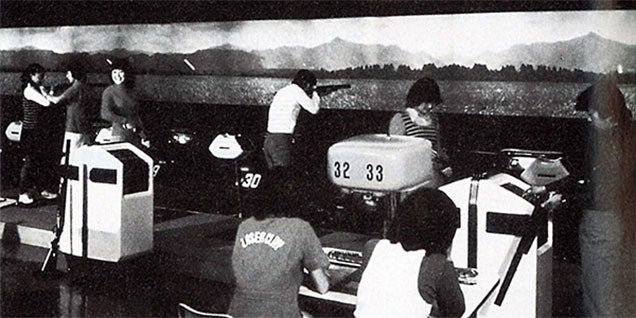
The idea was to build replica clay shooting ranges, so the team came up with the Laser Clay Shooting System. This consisted of a large woodland mural on the wall, on which images of flying clay pigeons would be displayed via an overhead projector. Customers firing at the pigeons would have their shots registered by a network of reflective surfaces, and if they hit, the projector could switch out and show the image of a destroyed target.

The Gun Game That Nearly Broke Nintendo

In January 1973, the first Laser Clay Shooting System was ready to open its doors to the public. The customers piled in, the system was fired up and...it broke down. Yet this setback, which could have killed Nintendo's gaming ambitions before they'd even begun, was overcome when Takeda leapt behind the scenes to save the day.

With the LCSS's automatic hit-detection and score-tallying systems down, he reportedly managed to both display customer's "hits" and add up their scores manually, and did this so efficiently nobody noticed there was a man behind the curtain instead of an advanced computer system.

The day went by without further incident, and the LCSS was quickly a hit, to the point where Nintendo were not only opening several new outlets in Japan, but were receiving orders from other countries in Asia as well. The company even found the chops to use famous martial artist and actor Sonny Chiba in advertisements for the LCSS. After years of jumping from business idea to business idea, it seemed like Nintendo had hit paydirt for the first time in a long time: with arcade gaming.

What could (and should) have been a raging success for Nintendo, however, quickly turned into a disaster. Only a few months later, the oil crisis of 1973 hit, and it hit Japan especially hard, as the island nation imports nearly all of its oil from outside sources. Having borrowed large sums of money to expand the LCSS business, and building machines for numerous new facilities, when the crisis hit most of these orders were cancelled, leaving Nintendo in the hole to the tune of around ¥5,000,000,000 (around USD$64 million).

The Gun Game That Nearly Broke Nintendo

It took Nintendo seven years to pay off that debt, the company kept alive only by the continued faith and generosity of its shareholders and some quick-fire successes in the arcade and home video game business.

So what became of the Laser Clay Shooting System? Well, to cut costs Yokoi had the concept miniaturised and released for the home market. Duck Hunt, the famous NES game, actually began life as one of these home units.

As for the two men behind it, Takeda is credited as being Nintendo's first ever video game designer, for his work on the company's earliest arcade machines. He later went on to direct and/or produce Nintendo classics like Punch-Out and PilotWings 64. He also led the team which came up the original Zelda's revolutionary back-up battery, invented the analog stick on the Nintendo 64 controller and, perhaps most importantly, has headed up the hardware design of both the GameCube and Wii.

Uemura, meanwhile, has had an equally important career with the company, having led the team which developed the Famicom and Nintendo Entertainment System (as well as the NES Zapper, drawing on his work with the LCSS). He was also the head designer of the Super Nintendo before retiring in 2004.

[Laser Clay Image courtesy of Nintendo.wikia]


Total Recall is a look back at the history of video games through their characters, franchises, developers and trends.

This story was originally published in April 2011.

Recommended article: Chomsky: We Are All – Fill in the Blank.
This entry passed through the Full-Text RSS service - if this is your content and you're reading it on someone else's site, please read the FAQ at fivefilters.org/content-only/faq.php#publishers.

03 Feb 01:10

Superb owl repeatedly attacks jogger

by Jason Weisberger

[unable to retrieve full-text content]

Via KOIN.com: "After the third attack, park worker put up warning signs and suggested hard hats." Maybe this owl just really hates Doug Henning.

02 Feb 17:40

Dog Balances a Ball on His Nose

by Don
Hqdefault

This dog has some incredible ball balancing skills, which he apparently learned all on his own according to the YouTube video description.

02 Feb 16:52

What a Sequel

Bewarethewumpus

I might even go back and watch the original, just so I can grasp the highly cerebral storyline.

Sexy Ladies,brokeback mountain,funny

Submitted by: Unknown

02 Feb 16:50

A Shot In The Dark

by jon
Bewarethewumpus

can we call this one a dead horse yet?

2015-02-02-A-Shot-In-The-Dark

Nine out of ten doctors agree, anti-vaxxers are morons. The tenth doctor also agrees. So does the eleventh, twelfth and the War Doctor. The Valeyard could not be reached for comment.

We are now selling these brand new phone cases! Designs include Bunnies Monolith, Cornelius Snarlington, Dungeon Divers and more. Check ‘em out.

goat-mcase[1]

01 Feb 17:04

Mighty Deeds

http://oglaf.com/mighty-deeds/

31 Jan 16:55

Shameless: rogue Lords sneak Snooper's Charter back in AGAIN

by Cory Doctorow

Last Friday, four rogue Lords copy/pasted the repeatedly defeated "Snooper's Charter" spying bill into a pending bill as an amendment, only to withdraw it on Monday after the Lords were bombarded by an aghast public -- and now, incredibly, these Lords have reintroduced the same language as a new amendment.

It's hard to imagine a more obnoxious, naked abuse of the democratic process than this. The spying powers in these amendments have been repeatedly defeated in Parliament, and when these Lords got caught introducing them in a way that would bypass debate and deliberation, they hastily withdrew. Then, once they thought the people had stopped paying attention, they pasted the same amendments into the bill. It is beyond shocking -- it's cynical, vile, and unforgivable. It's the work of authoritarian thugs who are determined to spy on all of us, all the time, without any meaningful limits, and who understand that we'll never agree to such an arrangement if it is fully debated.

And now, incredibly, they’re trying it again just days later. On Saturday, ahead of a “report stage” debate on Monday (the Counter-Terrorism and Security Bill is almost fully baked), Lords West, Blair, Carlile and King introduced a new amendment that appears to be almost identical to the last, and to the Communications Data Bill before it.

Again, this new amendment would force “telecommunications operators” – which these days includes the likes of Facebook and Skype, as well as traditional telcos – to store communications metadata for up to a year and hand it over to U.K. authorities when requested. This data retention regime may require the providers to install “specified equipment or systems.”

And yet again, the power to get these communications records would be given to any “relevant public authority” that wants it. This is one of the key problems: It’s bad enough giving police and intelligence services access to the fruits of what is essentially a mass surveillance scheme (so they can spy on journalists even more), but existing surveillance powers in the U.K. have already been used for all sorts of minor infractions.

At a glance, the one thing that appears to have been dropped is the part about “filtering arrangements”, which would essentially have given U.K. authorities the power to access and cross-reference metadata from various services through a search-engine-like interface. There may be other differences – I’ll amend this if people notice more – but the peers have left almost no time for the other lords and the rest of us to engage in serious analysis.

This is shocking behavior. Even after the major parties rammed the Data Retention and Investigatory Powers (DRIP) Act through the legislative process with scant debate, it is genuinely surprising to see not only repeated attempts to avoid proper legislative scrutiny, but an attempt that ignores almost every objection made the last time, mere days later.

The four peers in question all come from the security establishment — a former Metropolitan Police commissioner (Blair), a former secretary of defense (King), a former minister for security and counter-terrorism (West), and a former government anti-terror adviser (Carlile).

British securocrats try to sneak in Snooper’s Charter yet again [David Meyer/Gigaom]

Recommended article: Chomsky: We Are All – Fill in the Blank.
This entry passed through the Full-Text RSS service - if this is your content and you're reading it on someone else's site, please read the FAQ at fivefilters.org/content-only/faq.php#publishers.