
Arnvidr
Shared posts

21 Jul 09:24
One Direction Offers Remix Competition, Then Sony/Soundcloud Punish The Entrants As Copyright Infringers
by Mike Masnick
ArnvidrLabels....
Soundcloud has been having some issues of late trying to "balance" (stupid word, but we'll get to that) the interests of copyright holders and people who use its platform for remixes. Soundcloud -- a site that is essentially a YouTube for audio, and which has long been a key place for DJs and remixers to upload their crafts -- has been going back and forth with an angry recording industry for a few years, trying to appease the industry, often by defaulting to the "take it down!" side of the ledger to avoid lawsuits. There was a big kerfuffle a year ago when Soundcloud gave more power to the labels to take content down from its service. However, in the last few months things have gotten much crazier, as Soundcloud clearly ratcheted up its takedown procedures leading to many vocal complaints from angry Soundcloud users. We've even seen the company tell someone that "fair use" is no defense, since fair use is only in the US and Soundcloud is available globally. That's beyond troubling for a variety of reasons, and as someone who pays Soundcloud to host our Techdirt podcasts, it has me concerned and looking for alternatives.
But even getting beyond the fair use question, things are getting even more ridiculous. TorrentFreak has the story of a UK-producer and songwriter named Lee Adams who took part in an official remix competition of boy band One Direction's music, put on by the band and its label, Sony Music. The stems for remixing were released on Soundcloud. The rules of the contest required entrants to upload their remixes on Soundcloud... and that's exactly what Adams did. And yet those works still got taken down via copyright claims from Sony Music as infringing.
Hey, Sony Music, if you want people to participate in your remix contests, maybe don't accuse them of being infringers when they do?
In this case, it's even more ridiculous, because it initially happened during the contest period, held last year, and Adams reached out to everyone and finally got the work reinstated. As Adams told TorrentFreak:
Permalink | Comments | Email This Story


But even getting beyond the fair use question, things are getting even more ridiculous. TorrentFreak has the story of a UK-producer and songwriter named Lee Adams who took part in an official remix competition of boy band One Direction's music, put on by the band and its label, Sony Music. The stems for remixing were released on Soundcloud. The rules of the contest required entrants to upload their remixes on Soundcloud... and that's exactly what Adams did. And yet those works still got taken down via copyright claims from Sony Music as infringing.
Hey, Sony Music, if you want people to participate in your remix contests, maybe don't accuse them of being infringers when they do?
In this case, it's even more ridiculous, because it initially happened during the contest period, held last year, and Adams reached out to everyone and finally got the work reinstated. As Adams told TorrentFreak:
“I messaged SoundCloud back saying it was part of a remix contest. Then they told me that doesn’t mean I own the copyright,” Lee says.All good, right? Nope. Because with the latest expansion of Soundcloud takedowns, Adams finds himself back in the same situation again:
“I then explained that if the stems had been put out by the record company officially, then they had given permission. They still argued that I didn’t own the copyright.”
Undeterred, Lee contacted the company running the competition on Sony’s behalf.
“As it was only a couple of days before the contest closed, I emailed TalentHouse themselves to see if they could do anything,” Lee explains.
“They were very good and after a couple of emails SoundCloud reinstated my track. Interestingly, TalentHouse made the comment that ‘this kind of thing happens all the time with SoundCloud’.”
@onedirection your record company are a joke. Copyright infringement takedown on a track that I made for a remix contest that THEY put on
— Lee Adams (@LeeAdamsMusic) July 15, 2015
It's great that labels like Sony are embracing "remixing" as a legitimate form of expression by holding contests like this in the first place, but issuing takedowns on people who enter seems kind of backwards, doesn't it? And then they wonder why no one "respects" copyright any more?Permalink | Comments | Email This Story
Tertiarymatt likes this
21 Jul 09:24
But it's not just the threat of attacks. The lack of support from its peers and their accusations of racism have also contributed to this decision. Not only is it literally dangerous to "attack" one particular religious figure, it's also unpopular.
I'm sure the terrorists feel they have won. We should ask Teju Cole, Joyce Carol Oates and the other 200+ signers of the anti-Charlie Hebdo petition if they feel they've achieved a victory as well.
Permalink | Comments | Email This Story


Charlie Hebdo Bows To Assassins' Veto, Hecklers' Veto; Will No Longer Mock Mohammed
by Tim Cushing
ArnvidrThe terrorists won.
For years, Charlie Hebdo waged a brutal, often ugly war on good taste, restraint and self-righteousness. The satirical magazine took on every major religion, along with anything else it could satirize. It only had problems with one particular target: Islam. Rather, it only had problems with followers of Islam who believed brutal acts of violence were a perfectly acceptable way of resolving religious differences.
After years of publication that were marked with multiple attacks (some political, some physical), the worst case scenario finally happened. Two Islamist gunmen entered Charlie Hebdo's offices and killed twelve employees.
This was met with outrage by journalists, satirists and cartoonists around the world. For weeks, people who felt free speech -- no matter how offensive -- should never be punishable by death, expressed their solidarity using the phrase "Je Suis Charlie."
This attack was also met with outrage by government officials, who expressed their concern in the usual way: by calling for more surveillance and restrictive laws. To these figures, the attack had very little to do with free speech and everything to do with terrorism. It was just another nail and governments had plenty of unused legislative hammers just dying to be deployed. That their proposals were the antithesis of free and open societies -- the sort of thing espoused indirectly by Charlie Hebdo's satirical War on Everybody -- was completely lost on them. It was an opportunity to seize more control, provided by some very helpful terrorists.
The solidarity expressed in the immediate aftermath of the attacks soon fell apart, however. Charlie Hebdo, still mourning its dead, was attacked by its own colleagues -- journalists and artists from around the world. The PEN American Center chose to bestow its annual "Freedom of Expression Courage" award on Charlie Hebdo, a move that was met with protests from other PEN members including Teju Cole, Joyce Carol Oates and Eric Bogosian. To them, the award did nothing more than award "racists" for "punching down" and adding to anti-Islamic sentiment.
Not only was the protest completely tone-deaf in the wake of the massacre, it was a willful and very selective misreading of Charlie Hebdo's body of work. While Charlie Hebdo was famous for its caricatures of Muhammad, it also attacked other major religions. The only difference was that no other religion's acolytes did anything more than fire off angry letters. That these writers and artists would basically side with those who killed Charlie Hebdo's staffers -- even inadvertently -- is sickening.
Even if these artists felt Charlie Hebdo's work was reprehensible, there were -- and continue to be -- much greater issues at stake. Hundreds of journalists, satirists and artists around the world have been imprisoned by governments in order to silence them. By siding against Charlie Hebdo, these artists sided with not only extremists who feel killing is an appropriate reaction to being mocked indirectly, but these governments who feel creative efforts targeting certain individuals or ideas should be punishable by imprisonment or death. What happened to Charlie Hebdo could happen to anyone. All it takes is angering the wrong people. But the 145 artists and writers who signed the protest letter felt this abandonment of their colleagues was the high moral ground.
Fortunately, PEN didn't see it this way. It offered a succinctly brilliant response to the misguided protest:
PEN, in a statement posted on its website earlier this week, reiterated its position that the intent of Charlie Hebdo’s cartoons “was not to ostracize or insult Muslims but rather to reject forcefully the efforts of a small minority of radical extremists to place broad categories of speech off limits.”But now, a few months later, the terrorists have won. And they had help.
Last week, in an interview with German newsweekly Stern, Charlie Hebdo editor-in-chief Laurent “Riss” Sourisseau waved a white flag, stained with the blood of 12 murdered colleagues and comrades, when announcing that he would no longer draw cartoons of the Muslim prophet Muhammad. It was clear that Charlie Hebdo — of which Riss owns 40 percent — was also done with Muhammad mockery. This comes just a few months after cartoonist Renald “Luz” Luzier said that drawing Muhammad “no longer interested” him. He quit Charlie Hebdo not long after. The editor of Danish newspaper Jyllands-Posten was more forthcoming about why he too was done with the prophet. As the newspaper that kicked off the “Muhammad cartoon crisis” in 2005, Jyllands-Posten would not be republishing anything from Charlie Hebdo, he stated bluntly, because the staff feared a repeat of the the massacre in Paris.This is why terrorists do what they do. These are the results they want. And as much as it is disheartening to see this decision being made, it's also a completely understandable reaction. Dying for your art may be a romantic ideal, but it's hardly the sort of thing any person should honestly expect themselves or others to do. We may be disappointed that Charlie Hebdo no longer has the strength of its convictions that saw it weather previous attacks, but when 12 people are gunned down for making fun of one religious figure, those who wish to avoid the same fate know exactly what to remove from the equation.
But it's not just the threat of attacks. The lack of support from its peers and their accusations of racism have also contributed to this decision. Not only is it literally dangerous to "attack" one particular religious figure, it's also unpopular.
The relentless campaign against Charlie Hebdo by those accusing it of “racism” or “punching down” has had an effect. Because once deployed, as the surviving staff of Charlie Hebdo discovered, the racism charge sticks to the accused’s skin like napalm. And no one is immune — even murdered cartoonists — because there are no penalties for filing a false report. So if they expected unmitigated solidarité after their staff was machine gunned (while planning their participation, it should be noted, in an anti-racism event), they were surely disappointed when non-Francophone writers who hadn’t previously heard of Charlie exploded with denunciations of its racist intent.It's one thing to work while keeping an eye out for gunmen in the hall. It's even harder to do when other beneficiaries of free speech protections decide your speech isn't worthy of similar respect. Charlie Hebdo didn't lose its courage. It lost its comrades.
So one can't begrudge Riss and Luz and all the other survivors at Charlie Hebdo the decision to go soft on those who most demand mockery and derision. But we should begrudge those in media who shrugged at the assassin’s veto, claiming they couldn’t publish satirical cartoons out of respect for religion, for whom Je Suis Charlie was merely social media signaling.Those who went soft were those whose convictions couldn't even hold up to an attack that happened to someone else. Then there were plenty who never held these convictions at all, but Je Suis Charlie'd right up to the PEN Award nominations before deciding the few people shouting "racist!" were the voice of reason. And they sold out Charlie Hebdo -- along with every persecuted artist and journalist in the world -- by decrying its offerings as being unworthy of their consideration, respect and support.
I'm sure the terrorists feel they have won. We should ask Teju Cole, Joyce Carol Oates and the other 200+ signers of the anti-Charlie Hebdo petition if they feel they've achieved a victory as well.
Permalink | Comments | Email This Story
20 Jul 08:50
How Morally Justifiable is Advertising?
by martyb
c0lo writes:
Australian Broadcasting Corporation carries a piece of analysis/commentary on the societal ethics of advertising. I found it fascinating by the depth of arguments (true, there is a bias, but it's likely that most of us soylents share it); do take your time to read it in full, my attempts to summarize it below is bound to fail:
Advertising is a natural resource extraction industry, like a fishery. Its business is the harvest and sale of human attention. We are the fish and we are not consulted.
Two problems result from this. The solution to both requires legal recognition of the property rights of human beings over our attention.
First, advertising imposes costs on individuals without permission or compensation. It extracts our precious attention and emits toxic by-products, such as the sale of our personal information to dodgy third parties.
Second, you may have noticed that the world's fisheries are not in great shape. They are a standard example for explaining the theoretical concept of a tragedy of the commons, where rational maximising behaviour by individual harvesters leads to the unsustainable overexploitation of a resource.
A classic market failure
The advertising industry consists of the buying and selling of your attention between third parties without your consent. That means that the cost of producing the good — access to your attention — doesn't reflect its full social cost.
...Since advertisers pay less to access your attention than your attention is worth to you, an excessive (inefficient) amount of advertising is produced.
...It's a classic case of market failure. The problem has the same basic structure as the overfishing of the seas or global warming. In economics language, people's attention is a common good.
Read more of this story at SoylentNews.
Dark.saian, Rosalind and 2 others like this


19 Jul 10:26
Comic for 2015.07.19
ArnvidrSchool gives drugs.
New Cyanide and Happiness Comic
Binaryjesus, Rosalind and 2 others like this
18 Jul 09:14
Original Submission
23% Of New Cars In Norway Are Now Electric Cars
by NCommander
Phoenix666 writes:
Electric car sales keep climbing and climbing in Norway. In 2013, many of us were shocked to learn that electric cars were account [sic] for about 10–15% of new car sales in the country. We are now well aware of the fact that the Norway electric vehicle market is in a league of its own, and just yesterday I wrote about the breakdown of June electric car sales in the picturesque country. But I skipped one important note, the percentage of new car sales that were electric car sales.
Jeff Cobb reminded me of this important matter when he published an article yesterday highlighting that 22.9% of new cars in Norway are now plug-in electrified cars. And if you want some serious perspective here, catch this line: "Comprised of battery electric cars and plug-in hybrids, if the same thing were to happen in the US on a percentage basis, it would have meant 1,943,177 new [Plugin Electric Vehicles] PEVs on American roads since January." We have 50,503 new PEVs on our roads since January, about 2.6% of that number....
It's still a small fraction of the total vehicle fleet in Norway, but it signals a shift in car buyer preferences. What percentage or absolute number of EV purchases constitutes a tipping point?
Editor's Note: It's worth noting that while Norway exports a fair amount of North and Berents Sea oil and gas products, their domestic production of electricity is primarily from hydro-electric schemes with thermal and wind schemes thrown into the mix as minor contributors. Reference with interesting stats in the tables here: Statistics Norway
Original Submission
Read more of this story at SoylentNews.
Tertiarymatt, Cooper Griggs likes this

17 Jul 21:24
Cone Zone
by nedroid
ArnvidrFood everywhere, all the time.

Coolhemacha, Pete Mecum and 9 others like this

16 Jul 11:03
bonus panel


Home Again
by Justin Boyd
ArnvidrReal problems? That never happened!
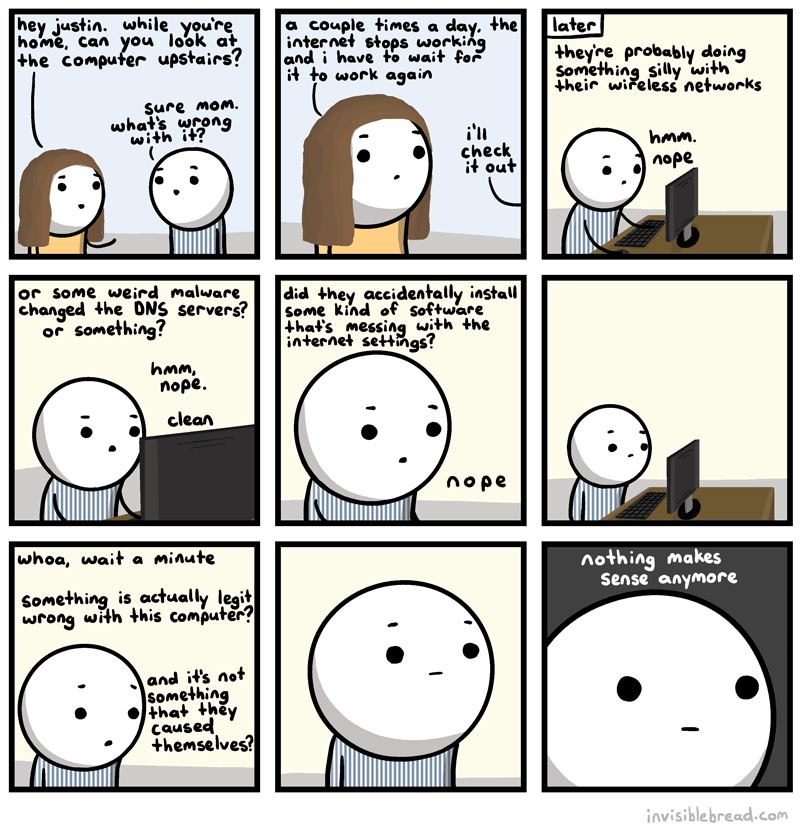
True comic. The computer was failing to get an IP address from the network several times a day for no apparent reason. My parent’s computer had The Real Problems™
–CON BRAVO–
I’m gonna be in Hamilton, Ontario in like a week for Con Bravo! Whoa! Are YOU gonna be there? Because I will be!
I’ll be doing a webcomic panel with I AM ARG (who is also a server pal/real pal) along with some other webcomic folks!
bonus panel
Artnemiz1, David Mulhern and 3 others like this

15 Jul 07:35
Wednesday, July 15, 2015
ArnvidrEthics are so annoying.
Get Fuzzy by Darby Conley for July 15, 2015
Rosalind, Tertiarymatt likes this

13 Jul 06:41


Mondays
by Kristian
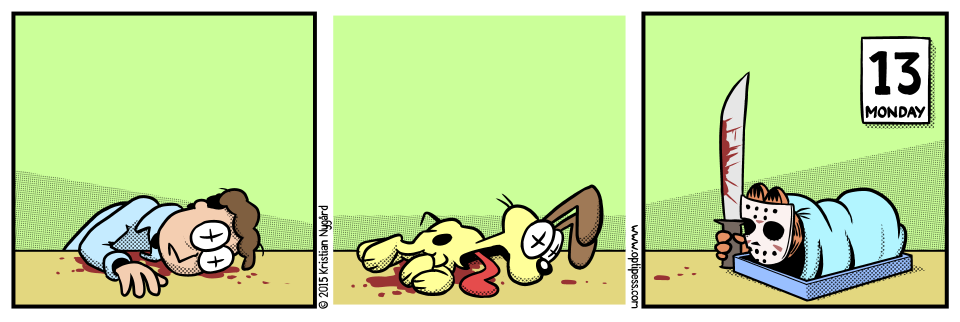
Ahem, this comic comes with huge apologies to Jim Davis…
Sophianotloren, bernot and 3 others like this
10 Jul 17:30
pootTumblr — Twitter — Facebook— Buy my books

Coolhemacha, Rosalind and one other like this
09 Jul 20:27
Two Of The Most Ridiculous Statements From Senators At Yesterday's Encryption Hearings
by Mike Masnick
ArnvidrMcCain seems to be even more of a one-track mind than I knew.
We already wrote a bit about the two Senate hearings that FBI Director James Comey participated in yesterday, concerning his alleged desire to have a "discussion" about the appropriateness of backdooring encryption. The phrase tossed around at the hearings was about the FBI's fear of "going dark" in trying to track down all sorts of hypothetical bad guys (and it always was hypothetical, since no actual examples were given). However, not all of the crazy statements came from Comey. There was plenty of nuttiness from Senators as well. It is, of course, difficult to pick out the most ridiculous, so here are two that stood out to me, personally. And, to avoid any charges of bias, I'll include one from each hearing and one from a Democrat and one from a Republican.
Let's start with the first hearing, the one before the Senate Judiciary Committee, where Senator Sheldon Whitehouse decides to add his bizarrely ignorant statements (starting around 1 hour, 18 minutes into the recording). Whitehouse starts out with a hypothetical (again!) story of a girl being kidnapped outside of her home ("taken into a van"), but having her phone left inside. He claims that in the past, law enforcement could get a warrant for the phone "to help locate the girl." And now "they cannot do that." This hypothetical makes no sense for a variety of reasons. First, the number of actual abductions like that is pretty rare. But, more importantly, if the phone is at home then it's not exactly going to help law enforcement locate her any more. He's mixing up a variety of different things involving location versus stored data encryption. It's just a scare story that has little to do with the issue of stored data encryption, which is what the hearing is supposed to be about.
But, from there, he goes on to make an even more bizarre statement, claiming that companies pushing encryption are doing so solely for their own corporate benefit, creating harm for the public. In fact, he compares encryption to pollution, and then argues that there could be civil liability because encrypted phones make it difficult to find hypothetical kidnapped girls:
Here, he's just wrong that companies employing encryption are "privatizing value and socializing costs." In fact, as many, many, many people will argue, companies that are putting in place end-to-end encryption actually can make it more difficult for them to make money, since they close off avenues such as targeted advertising, since they lose access to the information being transmitted. But, even more to the point, this entire argument is based on the simply wrong (and completely ignorant) argument that the there's a "cost" to the public of greater encryption. That's not just wrong, it's so wrong as it should call into question the career choices of whatever clueless staffer fed that line to Senator Whitehouse. The whole crux of the argument, as has been explained over and over again, is that greater encryption better protects the public from cyberattacks, from those seeking to violate their privacy and from other potential malicious actors.
In other words, the actual scenario that Whitehouse should be concerned about is not the mythical girl being abducted into a van (again, a scenario that rarely happens), but the malicious online actors who are seeking to break into the girl's bank account or other online accounts in order to cause all sorts of actual problems for her in real life. That's the much more likely threat, and it's the one that strong encryption helps protect. The whole idea that strong encryption is the equivalent of pollution is hilariously wrong. Pollution is a negative externality. But strong encryption is not a negative externality. It better protects the public. It's a public benefit.
Senator Whitehouse's argument is based on a near total misunderstanding of what encryption does and how it protects people, and is devoid of any understanding of actual threats that people face in the world -- both the low likelihood of random abduction and the high likelihood of having your online accounts under attack. It's so far from reality that it feels like Senator Whitehouse ought to issue an apology.
On to the second hearing before the Intelligence Committee. In this case, the Senator we'll pick on is Senator John McCain. His part starts a little after the 1 hour and 15 minute mark into that video. And he's focused on the worst kind of political grandstanding, hyping up FUD around ISIS, followed by a "but we must do something!" argument that ignores the simple fact that the plan he supports actually makes the problem worse, not better. As you'll see, Senator McCain doesn't care about that. He just wants something done. This one involves some back and forth with Comey, starting with the scare stories to start things out:
That a Senator who has been in office as long as McCain is flat out ignoring the Oath he's taken many times, and actually arguing for a policy that he is admitting violates that oath is somewhat stunning. He is flat out saying, in violation of his oath, that his job is to undermine the Constitution if he believes it will protect the American people from attack.
And, just to highlight how incredibly stupid this statement is, pushing for backdoors on encryption doesn't even do what he thinks it does. It actually makes Americans more open to attack by making their digital information less safe and secure. So even if we took McCain's argument at face value and ignored that it's directly in contrast to his oath of office, he's still wrong, because he's putting more Americans at risk, rather than "protecting" them.
As for Comey agreeing that this is a first priority, he's wrong about that too. Some might think that is the first priority for the FBI, even if it isn't for Congress, but it's not. The FBI's oath is also to "support and defend the Constitution against all enemies, foreign and domestic."
McCain then drags out a bunch of leading questions in which he continues to try to make it out like "something must be done to stop this nasty encryption" stuff, getting Comey to (mostly) agree, even to completely bogus statements.
Don't we deserve Senators who don't spout pure ignorance, focused on scaring the American public in ways that make us both less safe and take away the Constitutional rights they've sworn to defend?
There were plenty of other ridiculous claims made by Senators in both hearings, but these were the two nutty ones that stuck out for me. We deserve better elected officials.
Permalink | Comments | Email This Story


Let's start with the first hearing, the one before the Senate Judiciary Committee, where Senator Sheldon Whitehouse decides to add his bizarrely ignorant statements (starting around 1 hour, 18 minutes into the recording). Whitehouse starts out with a hypothetical (again!) story of a girl being kidnapped outside of her home ("taken into a van"), but having her phone left inside. He claims that in the past, law enforcement could get a warrant for the phone "to help locate the girl." And now "they cannot do that." This hypothetical makes no sense for a variety of reasons. First, the number of actual abductions like that is pretty rare. But, more importantly, if the phone is at home then it's not exactly going to help law enforcement locate her any more. He's mixing up a variety of different things involving location versus stored data encryption. It's just a scare story that has little to do with the issue of stored data encryption, which is what the hearing is supposed to be about.
But, from there, he goes on to make an even more bizarre statement, claiming that companies pushing encryption are doing so solely for their own corporate benefit, creating harm for the public. In fact, he compares encryption to pollution, and then argues that there could be civil liability because encrypted phones make it difficult to find hypothetical kidnapped girls:
It strikes me that one of the balances that we have in these circumstances, where a company may wish to privatize value -- by saying "gosh, we're secure now, we got a really good product, you're gonna love it" -- that's to their benefit. But for the family of the girl that disappeared in the van, that's a pretty big cost. And, when we see corporations privatizing value and socializing costs, so that other people have to bear the cost, one of the ways that we get back to that and try to put some balance into it, is through the civil courts. Through the liability system. If you're a polluter and you're dumping poisonous waste into the water rather than treating it properly somebody downstream can bring an action and can get damages for the harm they sustained, can get an order telling you to knock it off.This appears to be a thing that Senator Sheldon Whitehouse does. He makes up ridiculous hypotheticals of situations that aren't happening and then jumps to flat out wrong arguments based on those hypotheticals.
Here, he's just wrong that companies employing encryption are "privatizing value and socializing costs." In fact, as many, many, many people will argue, companies that are putting in place end-to-end encryption actually can make it more difficult for them to make money, since they close off avenues such as targeted advertising, since they lose access to the information being transmitted. But, even more to the point, this entire argument is based on the simply wrong (and completely ignorant) argument that the there's a "cost" to the public of greater encryption. That's not just wrong, it's so wrong as it should call into question the career choices of whatever clueless staffer fed that line to Senator Whitehouse. The whole crux of the argument, as has been explained over and over again, is that greater encryption better protects the public from cyberattacks, from those seeking to violate their privacy and from other potential malicious actors.
In other words, the actual scenario that Whitehouse should be concerned about is not the mythical girl being abducted into a van (again, a scenario that rarely happens), but the malicious online actors who are seeking to break into the girl's bank account or other online accounts in order to cause all sorts of actual problems for her in real life. That's the much more likely threat, and it's the one that strong encryption helps protect. The whole idea that strong encryption is the equivalent of pollution is hilariously wrong. Pollution is a negative externality. But strong encryption is not a negative externality. It better protects the public. It's a public benefit.
Senator Whitehouse's argument is based on a near total misunderstanding of what encryption does and how it protects people, and is devoid of any understanding of actual threats that people face in the world -- both the low likelihood of random abduction and the high likelihood of having your online accounts under attack. It's so far from reality that it feels like Senator Whitehouse ought to issue an apology.
On to the second hearing before the Intelligence Committee. In this case, the Senator we'll pick on is Senator John McCain. His part starts a little after the 1 hour and 15 minute mark into that video. And he's focused on the worst kind of political grandstanding, hyping up FUD around ISIS, followed by a "but we must do something!" argument that ignores the simple fact that the plan he supports actually makes the problem worse, not better. As you'll see, Senator McCain doesn't care about that. He just wants something done. This one involves some back and forth with Comey, starting with the scare stories to start things out:
McCain: Is it true that, you have stated on several occasions, that ISIS poses over time a direct threat to the United States of America?Okay, let's just cut in here first of all to note that it's not actually true. I mean, it's possible that this is happening, but there still has yet to be a single credible story about ISIS successfully "recruiting" people in the US to perform an attack in the US. All of the ISIS "arrests" so far have been part of the FBI's own plots, where it's an FBI informant doing the "recruiting and motivating."
Comey: Yes.
McCain: And that is the case today?
Comey:: Yes. Everyday they're trying to motivate people here to kill people on their behalf.
McCain: And every day that they take advantage of this use of the internet, which you have described by going to unbreakable methods of communicating, the more people are recruited and motivated to, here in the United States and other countries to attack the United States of America. Is that true.
Comey: Yes sir.
McCain: So this is not a static situation. This is a growing problem, as ISIS makes very effective use of the internet. Is that correct?Actually, it's not fair. It's wrong. I mean, it depends on what kind of "action" we're talking about -- but since the entire hearing focused on backdooring encryption, it's difficult to argue that the "ability to respond diminishes" over time because any plan to backdoor encryption wouldn't be an actual response that matters. ISIS would quickly just switch to encrypted systems that aren't backdoored by the US government, and there are plenty to choose from.
Comey: That's correct sir.
McCain: So with all due respect to your opening comments, this is more than a conversation that's needed. It's action that's needed. And, isn't it true that, over time, the ability of us to respond is diminished as the threat grows and we maintain the status quo?
Comey: I think that's fair.
McCain: So, we're now -- and I've heard my colleagues, with all due respect talking about attacks on privacy and our Constitutional rights etcetera -- but it seems to me that our first obligation is the protection of our citizenry against attack. which you agree is growing. Is that a fact?Okay, first off, you should really watch this point to see the dismissive way he shrugs off the part about "privacy" and "our Constitutional rights etcetera." It's really quite disturbing, frankly. And that's because the next line is just wrong. The Oath of Office given to Senators is that they will "support and defend the Constitution of the United States against all enemies, foreign and domestic." It does not say anywhere that they are to "protect our citizenry against attack." And it especially does not say that the role of a Senator is to protect the citizenry from attack over protecting the Constitution. It says the exact opposite. It says that his sole job is to protect the Constitution.
Comey: I agree that is our first responsibility. But I also...
McCain: So the status quo is not acceptable if we support the assertion that our duty is to protect the lives and property of our fellow citizenry. That is our first priority. You agree with that?
That a Senator who has been in office as long as McCain is flat out ignoring the Oath he's taken many times, and actually arguing for a policy that he is admitting violates that oath is somewhat stunning. He is flat out saying, in violation of his oath, that his job is to undermine the Constitution if he believes it will protect the American people from attack.
And, just to highlight how incredibly stupid this statement is, pushing for backdoors on encryption doesn't even do what he thinks it does. It actually makes Americans more open to attack by making their digital information less safe and secure. So even if we took McCain's argument at face value and ignored that it's directly in contrast to his oath of office, he's still wrong, because he's putting more Americans at risk, rather than "protecting" them.
As for Comey agreeing that this is a first priority, he's wrong about that too. Some might think that is the first priority for the FBI, even if it isn't for Congress, but it's not. The FBI's oath is also to "support and defend the Constitution against all enemies, foreign and domestic."
McCain then drags out a bunch of leading questions in which he continues to try to make it out like "something must be done to stop this nasty encryption" stuff, getting Comey to (mostly) agree, even to completely bogus statements.
Comey: I agree that this is something that we have to figure out what to do about.Now, to his very slight credit, after this misleading back and forth, Comey eventually plays a slight devil's advocate here, and at least attempts to channel the views of all of those computer security experts who have pointed out that backdooring encryption makes people less safe.
McCain: So now we have a situation where the major corporations are not cooperating and saying that if we give the government access to their internet, that somehow, it will compromise their ability to do business. Is that correct also?
Comey: (Shakes his head back and forth in a way suggesting he disagrees, but then says): That's a fair summary of what some have said.
McCain: So we're discussing a situation in which the US government -- i.e., law enforcement and the intelligence community -- lack the capability to do that which they have the authority to do. Is that correct?
Comey: Certainly with respect to the interception of encrypted communications and accessing locked devices, yes.
McCain: So we're now in an interesting situation where your obligation is to defend the country, and at the same time, you're unable to do so, because these telecommunications... these organizations are saying that you can't, and are devising methodology that prevents you from doing so, if it's the single key, only used by the user. Is that correct?
Comey: I wouldn't agree, Senator, that I'm unable to discharge my duty to protect the country. We're doing it every single day using all kinds of tools...
McCain: Are you able to have access to those systems that only have one key?
Comey: No, we can't break strong encryption.
McCain: So, you can't break it. And that is a mechanism which is installed by the manufacturer prevent you [sic] from using... that there's only one key that is available to them... to you.
Comey: That's correct.
McCain: So suppose that we had legislation which required two keys. One for the user and one that, given a court order, requiring a court order, that you would be able to -- with substantial reason and motivation for doing so -- would want to go into that particular site. What's the problem with that?At which point McCain totally ignores that point to go back to his but we need to do something! mantra.
Comey: Well, a lot of smart people, smarter than I, certainly, say that would have a disastrous impact on broader security across the internet, which is also part of my responsibility.
McCain: Do you believe that?
Comey: I'm skeptical that we can't find a solution that overcomes that harm. But a lot of serious people say "ah, you don't realize, you'll rush into something and it'll be a disaster for your country. Because it'll kill your innovation, it'll kill the internet." That causes me to at least pause and say "well, okay, let's talk about it."
McCain: But, we've just established the fact that ISIS is rushing in to trying... attempting... to harm America and kill Americans. Aren't we?Except, we can protect Americans' Constitutional rights and, at the same time, protect America: by enabling strong encryption that better protects the security and privacy of everyone, without adding unnecessary vulnerabilities in the form of government backdoors. McCain completely ignored the rebuttal point that his position actually makes America less safe by opening things up to those who wish to attack us.
Comey: They are.
McCain: So I say with respect to my colleagues, and their advocacy for our constitutional obligations and rights, that we're facing a determined enemy who is, as we speak -- according to you and the director of Homeland Security -- seeking to attack America, destroy America and kill Americans. So it seems to me that the object should be here, is to find a way not only to protect Americans' rights, but to protect American lives. And I hope that you will devote some of your efforts -- and I hope that this Committee... and I hope the Congress will -- understand the nature of this threat. And to say that we can't protect Americans' Constitutional rights in the same time protect America, is something that I, simply, won't accept.
Don't we deserve Senators who don't spout pure ignorance, focused on scaring the American public in ways that make us both less safe and take away the Constitutional rights they've sworn to defend?
There were plenty of other ridiculous claims made by Senators in both hearings, but these were the two nutty ones that stuck out for me. We deserve better elected officials.
Permalink | Comments | Email This Story
09 Jul 15:15
Bless This (and Your) Mess
by Adam
ArnvidrThe mess. It's there sometimes (often).

Tertiarymatt, Rosalind and one other like this


08 Jul 09:00
The FBI needs your help finding 250 sextortion victims
by Andrew Tarantola

Lucas Michael Chansler is a 26-year-old sexual predator sentenced to 105 years in prison after pleading guilty to multiple counts of child pornography production. Over several years, he tricked roughly 350 teenage girls from 26 states into giving him explicit pictures of themselves by posing as a teen boy and befriending them online before threatening to distribute the photos on social media. He was eventually tracked down to his Jacksonville, Florida home when one victim reported his extortion attempts to the FBI and the The National Center for Missing and Exploited Children. While the Feds have been able to locate more than 100 of his underage victims, nearly 250 young women have yet to be identified. And that's where you come in.

"It's important that we find these girls so that they don't have to be looking over their shoulder, wondering if this guy is still out there and is he looking for them and is he going to be coming back," Special Agent Larry Meyer said in a statement. "Some of these girls, now young women, need assistance. Many probably have never told anyone what they went through." To identify victims, the FBI has posted a list of aliases, email addresses, MySpace accounts and AIM logins Chansler used. So if you suspect that you, or someone you know, may have been victimized by this creep, contact the FBI or NCMEC right away.
[Image Credit: Getty Images]
Filed under: Internet
Source: Federal Bureau of Investigation
Rosalind, Tertiarymatt likes this
07 Jul 11:09
Tonight There’s Gonna Be a Failbreak
by Adam
ArnvidrGreat title.

Rosalind, Tertiarymatt likes this
07 Jul 08:34
Tuesday, July 07, 2015
ArnvidrThe comic character's bane
dro-mo by dro-mo for July 07, 2015

