Submitted by: (via Thecus)
Shared posts
26 Aug 19:08
If You Do Something Well, Never Do it For Free
firehose, Sempretesouro and -1 others like this






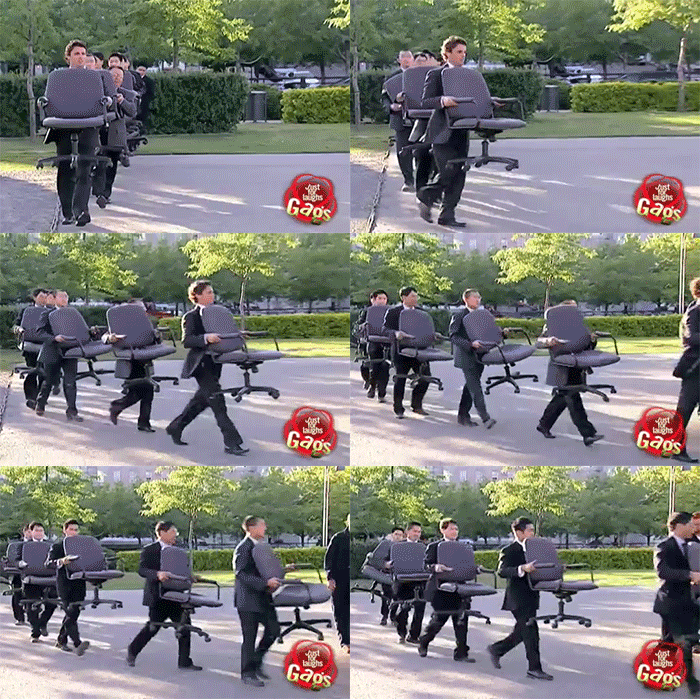
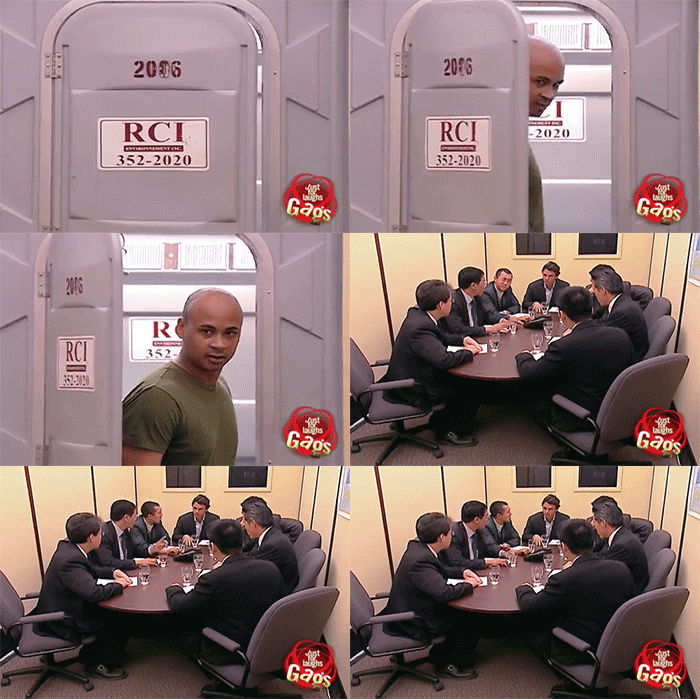


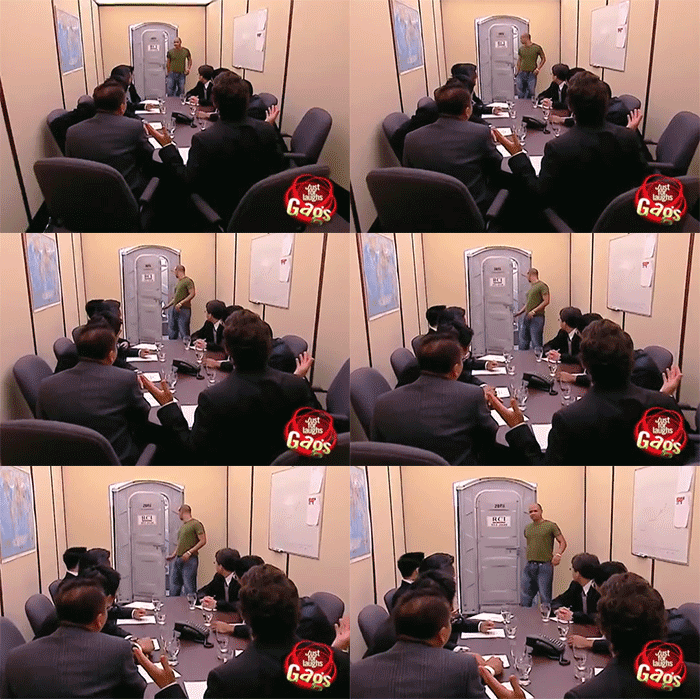



21 Apr 23:46
Mentirinhas #620
by Fábio Coala
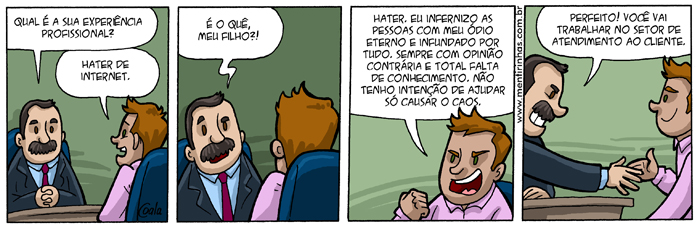
Acho que já falei com esse cara ao telefone.
O post Mentirinhas #620 apareceu primeiro em Mentirinhas.
Damiani.guilherme, Carla Castilhos and one other like this

20 Apr 22:17
FutureWatch: Infrared Night Scope in a Contact Lens
by Kevin Murray
Thermal imaging has already found its way onto smartphones, but a team of researchers from the University of Michigan (U-M) have gone even further with the creation of an ultrathin graphene-based light detector.
 Being only slightly thicker than two sheets of graphene, the approach has the potential to put infrared heat detecting technology into a contact lens...
“We can make the entire design super-thin,” states Zhaohui Zhong, assistant professor of electrical engineering and computer science at U-M, "It can be stacked on a contact lens or integrated with a cell phone." (more)
“We can make the entire design super-thin,” states Zhaohui Zhong, assistant professor of electrical engineering and computer science at U-M, "It can be stacked on a contact lens or integrated with a cell phone." (more)
20 Apr 22:16
Putin on the Taps
by Kevin Murray
Russian President Vladimir Putin said Thursday that his country is not conducting mass wiretapping of its citizens...
"Certainly, we do not take liberty of such a vast scale, an uncontrolled scale. Hopefully, we will never take this liberty," Putin said in his four-hour live chat with Russian citizens. "Besides, we do not have the hardware and funds the United States currently possesses..." (more)
 |
| Click to enlarge. |
20 Apr 22:16
Special ed student records proof of bullying, threatened with charges of wiretapping - RESOLVED
by Kevin Murray
The Allegheny County district attorney will drop a disorderly conduct conviction being appealed by a high school student who recorded others who bullied him.
 The prosecutor's decision Wednesday comes a day after South Fayette High School student, Christian Stanfield, publicly criticized the charge.
Township police charged Stanfield with violating the state's wiretapping law for using his iPad to record the taunts of other students in February. (more) (original post) (more coverage)
The prosecutor's decision Wednesday comes a day after South Fayette High School student, Christian Stanfield, publicly criticized the charge.Township police charged Stanfield with violating the state's wiretapping law for using his iPad to record the taunts of other students in February. (more) (original post) (more coverage)



20 Apr 20:01

Found at the library
Found at the library
Tertiarymatt, firehose and -1 others like this

20 Apr 20:00

The person who tries to keep everyone happy
The person who tries to keep everyone happy
18 Apr 23:34
Google's 'Project Tango' Smartphone Uses Apple's PrimeSense Technology
by Juli Clover
Earlier this year, Google unveiled "Project Tango," an experimental smartphone that incorporates 3D sensors to allow users to map indoor and outdoor environments.
Reports suggested that the smartphone's 3D capabilities were powered by the Movidius Myriad 1 3D-sensing chip, but as it turns out, Project Tango is also powered by Apple technology. Alongside two Myriad 1 vision co-processors, Project Tango utilizes a PrimeSense Capri PS1200 3D imaging system-on-a-chip [PDF], technology that Apple acquired when it purchased PrimeSense late last year.
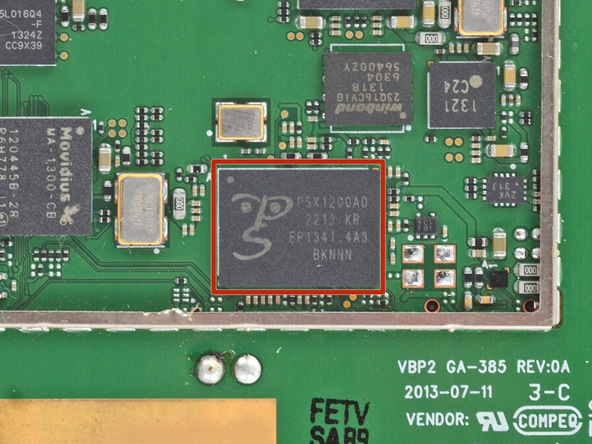
The unexpected PrimeSense chip was discovered in a teardown of the Project Tango smartphone by iFixit that was posted this morning.
Project Tango is essentially a mapping tool, capturing the world around each user to provide directions, dimensions, and environmental maps. Google also has plans to use the technology to create immersive augmented reality games and apps that merge the digital world with the real world.
According to iFixit, Project Tango works very similarly to the original Microsoft Kinect, which also used technology developed by PrimeSense. Tango displays a bright grid of dots that are captured by IR sensors to build a depth map.
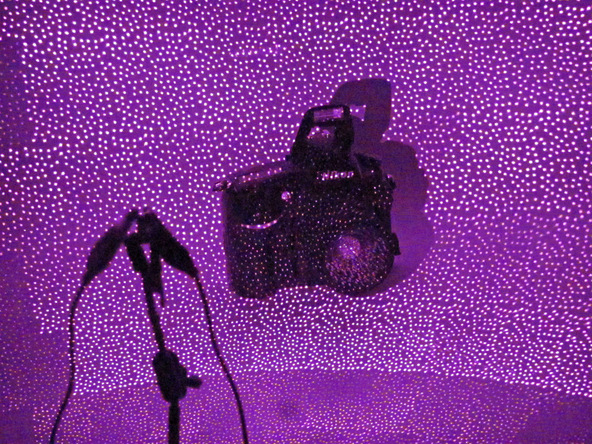
Along with the Capri 3D chip and the Myriad vision co-processors, Project Tango incorporates four separate cameras to capture its environment. Amazon is said to be working on a similar device that incorporates multiple cameras for 3D mapping and with Google and Amazon both working on 3D projects, it is reasonable to assume that Apple is also experimenting with the technology.
There have been no hints that Apple intends to incorporate PrimeSense technology in the upcoming iPhone 6, but motion control capabilities similar to the Kinect have been rumored for the next-generation Apple TV set-top box, so the first Apple device to use PrimeSense technology may very well be the Apple TV. Project Tango proves that PrimeSense's 3D chips are ready for mobile devices and it is likely that the company is continuing development on its Capri chips, improving the technology for possible inclusion in future iPads and iPhones.


Reports suggested that the smartphone's 3D capabilities were powered by the Movidius Myriad 1 3D-sensing chip, but as it turns out, Project Tango is also powered by Apple technology. Alongside two Myriad 1 vision co-processors, Project Tango utilizes a PrimeSense Capri PS1200 3D imaging system-on-a-chip [PDF], technology that Apple acquired when it purchased PrimeSense late last year.
The unexpected PrimeSense chip was discovered in a teardown of the Project Tango smartphone by iFixit that was posted this morning.
This appears to be PrimeSense's new Capri PS1200 SoC 3D imaging chip, unexpected for a couple of reasons:Google's Project Tango smartphone is one of the first mobile devices to use the diminutive Capri 3D sensor and it offers a glimpse at what Apple could possibly do with the technology in the future.
Just last year, Apple bought PrimeSense, manufacturer of the Kinect's 3D vision hardware. Speculators assumed we would be seeing this hot new hardware in an upcoming iOS device, with intent of mapping 3D spaces. Looks like Tango beat Apple to the punch with their own tech?
Project Tango is essentially a mapping tool, capturing the world around each user to provide directions, dimensions, and environmental maps. Google also has plans to use the technology to create immersive augmented reality games and apps that merge the digital world with the real world.
According to iFixit, Project Tango works very similarly to the original Microsoft Kinect, which also used technology developed by PrimeSense. Tango displays a bright grid of dots that are captured by IR sensors to build a depth map.
Along with the Capri 3D chip and the Myriad vision co-processors, Project Tango incorporates four separate cameras to capture its environment. Amazon is said to be working on a similar device that incorporates multiple cameras for 3D mapping and with Google and Amazon both working on 3D projects, it is reasonable to assume that Apple is also experimenting with the technology.
There have been no hints that Apple intends to incorporate PrimeSense technology in the upcoming iPhone 6, but motion control capabilities similar to the Kinect have been rumored for the next-generation Apple TV set-top box, so the first Apple device to use PrimeSense technology may very well be the Apple TV. Project Tango proves that PrimeSense's 3D chips are ready for mobile devices and it is likely that the company is continuing development on its Capri chips, improving the technology for possible inclusion in future iPads and iPhones.
18 Apr 23:29
Nubrella: A Hands-Free Umbrella
by drew
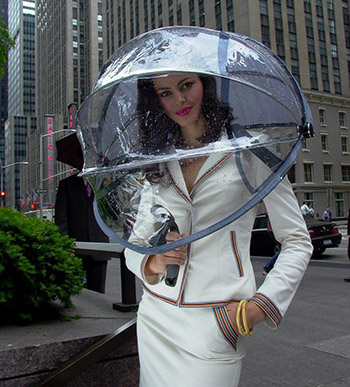
The Nubrella is a “hands-free umbrella” perfect for the space-traveling flight attendant in your life. Make sure you see the other pictures on the manufacturer’s listing, so you can see how the manufacturer suggests you use your Nubrella. (Hint: Snow tractor.)
18 Apr 23:27
Dima Clarity: A $12,000 iPhone case
by drew

The Dima Clarity is a $12,000 case for your iPhone 5. It also fits the iPhone 5C, in case you want to protect your $99 phone with something 121 times more expensive.


18 Apr 21:04
1355 – Outras hipóteses
by Carlos Ruas

Albener Pessoa, Damiani.guilherme and one other like this
18 Apr 20:57
1360 – Grandes negócios
by Carlos Ruas

Damiani.guilherme, Barciella and one other like this



14 Apr 23:24

Independent decision making
by John
Suppose a large number of people each have a slightly better than 50% chance of correctly answering a yes/no question. If they answered independently, the majority would very likely be correct.
For example, suppose there are 10,000 people, each with a 51% chance of answering a question correctly. The probability that more than 5,000 people will be right is about 98%. [1]
The key assumption here is independence, which is not realistic in most cases. But as people move in the direction of independence, the quality of the majority vote improves. Another assumption is that people are what machine learning calls “weak learners,” i.e. that they perform slightly better than chance. This holds more often than independence, but on some subjects people tend to do worse than chance, particularly experts.
You could call this the wisdom of crowds, but it’s closer to the wisdom of markets. As James Surowiecki points out in his book The Wisdom of Crowds, crowds (as in mobs) aren’t wise; large groups of independent decision makers are wise. Markets are wiser than crowds because they aggregate more independent opinions. Markets are subject to group-think as well, but not to the same extent as mobs.
***
[1] Suppose there are N people, each with independent probability p of being correct. Suppose N is large and p is near 1/2. Then the probability of a majority answering correctly is approximately
Prob( Z > (1 – 2p) sqrt(N) )
where Z is a standard normal random variable. You could calculate this in Python by
from scipy.stats import norm
from math import sqrt
print( norm.sf( (1 - 2*p)*sqrt(N) ) )
This post is an elaboration of something I first posted on Google+.
Damiani.guilherme, Tadeu and 2 others like this