Rhapsody, the Seattle-based streaming music service, has received
new loans totaling $10 million from RealNetworks and another of
its investors, according to a regulatory filing this afternoon.
Which fact is more surprising about this story: that Rhapsody still exists, or that RealNetworks not only still exists but has the money to loan Rhapsody?
Worth a little pain? Back in 1990, a school boy got a measles shot in the U.K., and it turns out, he got more than protection against the measles.
Photofusion/UIG via Getty Images
Back in the 1960s, the U.S. started vaccinating kids for measles. As expected, children stopped getting measles.
But something else happened.
Childhood deaths from all infectious diseases plummeted. Even deaths from diseases like pneumonia and diarrhea were cut by half.
Scientists saw the same phenomenon when the vaccine came to England and parts of Europe. And they see it today when developing countries introduce the vaccine.
"In some developing countries, where infectious diseases are very high, the reduction in mortality has been up to 80 percent," says Michael Mina, a postdoc in biology at Princeton University and a medical student at Emory University.
"So it's really been a mystery — why do children stop dying at such high rates from all these different infections followingintroduction of themeasles vaccine," he says.
Mina and his colleagues think they now might have an explanation. And they published their evidence Thursday in the journal Science.
Now there's an obvious answer to the mystery: Children who get the measles vaccine are probably more likely to get better health care in general — maybe more antibiotics and other vaccines. And it's true, health care in the U.S. has improved since the 1960s.
But Mina and his colleagues have found there's more going on than that simple answer.
The team obtained epidemiological data from the U.S., Denmark, Wales and England dating back to the 1940s. Using computer models, they found that the number of measles cases in these countries predicted the number of deaths from other infections two to three years later.
"We found measles predisposes children to all other infectious diseases for up to a few years," Mina says.
And the virus seems to do it in a sneaky way.
Like many viruses, measles is known to suppress the immune system for a few weeks after an infection. But previous studies in monkeys have suggested that measles takes this suppression to a whole new level: It erases immune protection to other diseases, Mina says.
So what does that mean? Well, say you get the chicken pox when you're 4 years old. Your immune system figures out how to fight it. So you don't get it again. But if you get measles when you're 5 years old, it could wipe out the memory of how to beat back the chicken pox. It's like the immune system has amnesia, Mina says.
"The immune system kind of comes back. The only problem is that it has forgotten what it once knew," he says.
So after an infection, a child's immune system has to almost start over, rebuilding its immune protection against diseases it has already seen before.
This idea of "immune amnesia" is still just a hypothesis and needs more testing, says epidemiologist William Moss, who has studied the measles vaccine for more than a decade at Johns Hopkins University.
But the new study, he says, provides "compelling evidence" that measles affects the immune system for two to three years. That's much longer than previously thought.
"Hence the reduction in overall child mortality that follows measles vaccination is much greater than previously believed," says Moss, who wasn't involved in the study.
That finding should give parents more motivation to vaccinate their kids, he says. "I think this paper will provide additional evidence — if it's needed — of the public health benefits of measles vaccine," Moss says. "That's an important message in the U.S. right now and in countries continuing to see measles outbreaks."
Because if the world can eliminate measles, it will help protect kids from many other infections, too.
Fluxo de pessoas segue intenso nos cartórios para emissão de novas vias de certidões
As horas de espera em cartórios de registro civil podem ser substituídas por poucos minutos em frente ao computador. Muita gente ainda não sabe, mas já é possível solicitar a segunda via de certidões emitidas em todo o Estado pela internet. No serviço, disponível há dois meses, 4.799 pessoas foram cadastradas.
Sem conhecimento da novidade, o fluxo de pedidos nos cartórios continua intenso. No de Registro Civil do 3º Subdistrito de BH, na rua São Paulo, além das filas para pedir o documento, é preciso esperar cerca de uma hora para pegar a certidão.
A terapeuta Aparecida Amaral, de 50 anos, foi pela segunda vez ao local para tirar uma outra via da certidão de nascimento. “Da outra vez, não pude esperar porque tinha um compromisso”, contou. Se soubesse da alternativa digital, ela teria optado pelo serviço. “Com certeza teria feito pelo site, mas eles não informaram essa opção. Aqui estou pagando estacionamento e ainda tem que esperar”, reclamou.
A operadora de turismo Gabriela Braga, de 33 anos, também não foi informada sobre a possibilidade. “Se conhecesse, teria pedido pelo site”, afirmou Gabriela, que solicitou a segunda via da certidão de nascimento da mãe.
Funcionamento
Por meio do registrocivilminas.org.br, o cidadão solicita a segunda via de certidões de nascimento, casamento e óbito. A novidade por enquanto só vale para registros a partir de 1985, mas, até o fim do ano, será expandida para documentos desde 1970.
Todos os 1.436 cartórios nos 853 municípios mineiros estão cadastrados no sistema. “Significa mais agilidade nos pedidos, principalmente para as pessoas que não moram em BH. Quem está em Poços de Caldas e precisa de uma certidão de Manga, por exemplo, pode solicitar por meio do site”, explica o presidente do Sindicato de Registro Civil das Pessoas Naturais de Minas Gerais (Recivil), Paulo Risso.
Para quem precisa do serviço, o procedimento é bem simples. Após se cadastrar no site, é preciso pesquisar a certidão, informando a cidade, o ano e o nome. Com a localização do documento, o usuário solicita a via com apenas um clique. O processo é acompanhado por meio do link “pedidos de certidão”.
Além da comodidade para solicitar as certidões, o usuário ainda pode receber o pedido em casa ou retirar no cartório. O custo é de R$ 36,01, variando de acordo com o frete e quando há averbação (alguma observação que altere a certidão, como divórcios). O pagamento é feito por boleto ou transferência bancária.
Localidades
Em seis meses, haverá expansão da rede com a integração de outros estados que já utilizam o sistema on-line. Assim, em Minas Gerais, será possível solicitar segunda via de certidões emitidas em São Paulo, Espírito Santo, Santa Catarina, Paraná e Rio Grande do Sul. Documentos emitidos entre 1950 e 1960 serão incluídos a partir do ano que vem.
O sistema é uma parceria entre a Corregedoria-Geral de Justiça de Minas Gerais e o Recivil, a partir da criação da Central de Informações de Registro Civil do Estado.
Até o fim do ano, poderão ser solicitadas certidões de ausência, de interdição e de emancipação e transcrições de documentos emitidos no exterior
It occurs to me that failure to properly worldbuild an SFFnal story is - sometimes, though not always - less reflective of a writer’s creative ability than it is a consequence of their real-world privilege. The concept of culture as something with multiple facets, that can be experienced from different perspectives and which - crucially - has consequences beyond the obvious is learned rather than innate, and if, in your own life, you’ve never stopped to consider (for instance) how class differences impact access to basic necessities, or the problem of social mobility, then that’s going to influence how you craft, or fail to craft, those elements in your narratives. Because while, in stories set in the present day, you can either compensate with research or write wholly within familiar contexts, in an invented setting, it’s going to be harder to hide the gaps in your knowledge.
And so we get stories whose cultures are founded on stereotypes: Noble Elves vs the Barbarian Orcs, an endless parade of faux-medieval Europes, and dystopias built around a single, reductive premise with no effort made to explore its wider consequences. This last seems especially troublesome to me, given that dystopias are, generally speaking, meant to be the sort of stories that understand class and subversion - but when written by someone who’s never considered that their own society operates on more than one level, that nuance may well be lost. The point of worldbuilding is to create new worlds, but they’re always going to be influenced by how we view our own.
I also think about these fantasy and science-fiction worlds. These authors - usually American - trying to describe some ~*~exotic market~*~ or ~*~bustling spaceship port~*~ with words they’ve read in other people’s books. Think about how they falteringly describe those markets: “They had lots of spices and some colorful rugs.”
(But is it bright turmeric and cumin, cut with flour, glowing yellow in glass jars to attract the tourists? Is it the cinnamon and star anise of the Christmas market, the paper cup of mulled cider? Where are we supposed to be, again?)
But these authors copy-paste the rising and falling call of the muezzin and the air heavy with foreign spices and the hungry children with flies in their eyes - maybe even take a beautiful woman with her face veiled out of the box, or some exotic songbirds - and think “Nailed it.” Check out this exotic worldbuilding - we’ve really traveled here! Look: colorful silks and barbarians. Is this a good story, or what!
And it’s splendidly, laughingly obvious that they’ve never seen a street sign in Arabic, never walked through a North African market at nightfall, couldn’t tell silk from satin if their life depended on it, and that they don’t even know their own local songbirds, let alone how to identify an exotic one. Armchair tourists, copying and pasting the TripAdvisor reviews of other tourists, coloring half the people green, and calling it worldbuilding: oh deary me.
Then there’s the realism of research. Knowing where goods and products and knowledge came from. If your elves are eating chocolate they’d better have contact with the Aztecs. Don’t put poison ivy in England. Your medieval faux-European story had better justify itself if people are wearing cotton and eating potatoes and tomatoes.
(Pictured: someone whose civilization has apparently had contact with the indigenous peoples of the Americas. So THAT’s what all of that “into the west” stuff is about… elves seeking out new sources of carbohydrates!)
Don’t even get me started on science realism in science fiction; I am personally plagued by every written fictional description of viruses AND I’M JUST LIKE
So the Western SF/F canon swallows itself endlessly, a snake chasing its tail. It’s fun, but the tiresome bits get recycled, because people think that’s what forests and markets and ships are really like.
“That’s not realistic in this setting,” we scoff when someone wants a disabled princess or a lady king or - gasp! - a black woman in their literature.
But most of this shit is so unrealistic, say people like me, rolling their eyes politely: “What spices were they, precisely? They’re wearing silk, are they? Are you sure of that? Are you absolutely sure? And then the virus killed everybody, did it? In seven minutes? much wow.”
So it sounds like I’m going “don’t write about markets unless you’ve been to a market” or “don’t write unless you have a really expensive education” or “don’t write.
But of course - this isn’t fair. Who am I to demand that people be well-traveled? Most people cannot afford to. And those who do travel rarely pay attention. They are expecting foreign spices and children with flies in their eyes, and they come back and regurgitate them.
(The spices were cardamom and cinnamon, you silly fool, and the children in your hometown are hungrier. The songbird was a woodlark, and the only exotic thing there was you.)
You don’t have to actually travel. You just have to care. As you type that someone is eating a potato you have to ask “where did they get the potato?” and as you type that someone is ugly you have to ask “why are they ugly?” and if you’re going to write about a prairie, look it up on Google Maps and sit with it for a while until you’ve got your own words for it.
People know the difference between waving your hands dismissively, using other people’s words because you don’t think it’s important, and when genuinely caring, especially when you’re touching something they love. You’ll fuck up, but people will usually forgive fuck-ups if you were being honest and wondering and respectful.
It’s the difference between the standard Western method of travel - showing up sneeringly in someone else’s house and expecting to be hailed as a savior, to be served by the unimportant natives - and the kind of travel where OH MY GOD WAS THAT ONE OF YOUR MAGPIES? THAT’S WHAT YOUR MAGPIES LOOK LIKE? ARE YOU KIDDING ME RIGHT NOW? OH MY GOD THIS CHANGES EVERYTHING. GUYS. HAVE YOU HEARD ABOUT THEIR MAGPIES?
Because wherever you go in this universe, you are going to somebody’s home. Tread lightly, because you tread as a guest. If you fail to lovingly respect your beggar woman and lowly engineer because they’re more “boring” than your hero - well, you’ve just described what kind of person you are, and it’s not the sort that comes to my dinner parties.
Whether you are learning, or traveling, or writing, you have to care and you have to care about getting it right. You can be tongue-tied and broken-hearted and fundamentally lost. My favorite people usually are. But you have to care about the magpies and the trade routes and the cardamom. You’ll have to bring me with you, or you’ll lose me. (Believe me, I have so many wonderful places to be.)
So I don’t ask that authors be perfect in their worldbuilding. I only ask that they try, and take my hand, and believe that this place they have created is important and worthy and full of the most interesting things, and worthy of thought and care, because all places are.
“The spices were cardamom and cinnamon, you silly fool, and the children in your hometown are hungrier. The songbird was a woodlark, and the only exotic thing there was you.”
In which elodieunderglass takes one of my posts and makes it about 9000% better. Honour on your cow.
Apple has been leveraging its power within the music industry in an attempt to push music labels to stop licensing freemium tiers offered by Spotify and other streaming music services, according to The Verge. The company has also reportedly offered to pay YouTube's music licensing fee to Universal Music Group if the label stops allowing its songs on the website, a popular destination for music videos.
The report claims that U.S. Department of Justice officials are looking into Apple's business practices in relation to its upcoming streaming music service, expected to be a rebranded version of Beats Music that will debut at WWDC next month. "DOJ officials have already interviewed high-ranking music industry executives about Apple’s business habits," the report claims.
Apple's much-rumored Beats streaming service would naturally be a more competitive alternative over two of its biggest rivals in Spotify and YouTube if it successfully convinces music labels to force streaming services to ditch their freemium tiers. Apple's service is expected to have lots of exclusive content, and only about one-quarter of Spotify's 60 million customers have paid subscriptions.
Apple faces a similar probe from the European Commission over concerns that it's persuading labels to abandon free, ad-supported services such as Spotify in Europe as well. Apple's own Beats streaming service will reportedly not offer a free tier, requiring customers to pay a recurring fee of around $9.99 per month, similar to paid tiers offered by Spotify, Rdio and Google Play Music.
Apple's Beats-based streaming music service will reportedly be deeply integrated into iTunes on Mac and the stock Music app for iPhone, iPad and iPod touch, and apps will also be available for Apple TV and Android. Last month, the company seeded iOS 8.4 beta to developers with a redesigned Music app featuring a new MiniPlayer, a redesigned look for "Now Playing," global search capabilities, a streamlined design and more.
A common criticism aimed at those of us who are highly critical of various alternative medicine treatments and, in particular, of the “integration” of such treatments into conventional medical treatment is: What’s the harm? What, they ask, is the harm of homeopathy, acupuncture, iridology, or traditional Chinese medicine? They argue that it’s pretty much harmless, or, to quote Douglas Adam’s The Hitchhiker’s Guide to the Galaxy about earth, harmless. Of course, fans of the novels know that Ford Prefect, a contributor to the guide, reacting to Earthling Arthur Dent’s outrage that the entry for the planet earth consisted of only one word, assured him that in the next edition the entry would be expanded to read “mostly harmless.” An analogy to this sort of quackery could be made, except that it is anything but “mostly harmless.” It can—and is—often harmful to individual patients, not to mention the corrosive effect integrating pseudoscience into conventional medicine has in general.
I’ve documented various examples over the years, examples such as Madeleine Neumann, a 11-year-old diabetic girl who died of diabetic ketoacidosis when her parents relied on prayer instead of medicine to treat her diabetes. Then there have been children like Daniel Hauser, Katie Wernecke, Abraham Cherrix, Jacob Stieler, an Amish girl named Sarah Hershberger, Cassandra C, and, most recently, two aboriginal girls from Canada, Makayla Sault (who died) and JJ (who will, hopefully, live, although her chances of ultimately surviving were greatly compromised by her mother’s insistence on pursuing a Florida quack‘s medicine instead of chemotherapy). These were all children or teens with cancer whose parents chose (or supported their choice) not to undergo chemotherapy and to pursue quackery instead. Then there was Mazeratti Mitchell, who suffered a spinal cord injury while wrestling, whose mother wanted to rely on a naturopathic quack instead of surgery to fuse his spine. The list goes on and on and on; depressingly so, in fact.
I’m sighing with sadness as I add another one to the list: Aidan Fenton of Sydney, Australia, a seven-year old boy with type I diabetes who died undergoing quack treatments associated with using traditional Chinese medicine:
A Chinese healer, who slaps patients until they produce dark bruising and is now under investigation over the death of a Sydney boy, had brought his treatments to Perth.
Self-proclaimed healer Hongchi Xiao was using slapping therapy on seven-year-old Aidan Fenton to treat type 1 diabetes when the boy died in Hurstville New South Wales on Monday evening.
Mr Xiao brought his traditional Chinese medical treatments to Perth in 2013 and was sponsored by Perth traditional medicine practitioner Chai Chua.
Mr Chua told 6PR Mornings on Friday that anyone, especially children, undergoing Chinese therapy for serious health conditions should be supported by conventional medical advice.
It sounds to me as though Mr. Chua is trying to cover his proverbial posterior here. Basically, Aidan Fenton was taking part in a seven day workshop in Huntsville when his parents found him dead in their hotel room:
Police and paramedics were called to the Ritz Hotel in Hurstville about 9pm on Monday to reports that the boy had collapsed and was not breathing.
His parents’ screams alerted staff at the hotel, who called triple zero. A NSW Police spokesman said the boy died at the scene.
It is believed Aidan, from Prospect, had type 1 diabetes, and police are investigating whether he was no longer taking insulin before his death.
Mr Xiao’s week-long Sydney workshop cost $1800 for participants to attend, and was held at the Pan Health Medical Centre.
This Australian news story includes a video of the sort of “therapy” that Hongchi Xia teaches. I encourage you to watch the brief clip. It shows people undergoing Paida, or “slapping therapy,” during which they are seen slapping themselves on the legs, body, face and other locations until the skin was turning black and blue with some rather impressive bruising, and I call this bruising impressive as a surgeon who’s seen a lot of trauma in his residency and, for a few years after, covered trauma call as an attending. Included with the news story is a photo from Xia’s website showing a man with bruising on his abdomen that wouldn’t have been out of place in a trauma patient pulled from a crashed car.
I perused Xia’s website, PaidaLajin Self-Healing and it’s a frightening place on the Internet. Right on the English home page, it advertises Paida as “DIY,” effective, simple, low cost, safe, and universally applicable, as in “effective on about all diseases” (an exact quote). Elsewhere, we learn that Paida means to “pat and slap external skin areas to expel poisonous waste (in the form of Sha) and to restore health by facilitating the smooth flow of Qi throughout the meridians (energy channels in the body). .” (Detoxification. Of course it had to be “detoxification,” complete with acupuncture meridians.) Xia tells us that he uses disease categories “for convenience only,” and “to self heal and to help others regain health, you are advised to ‘forget the disease name.'” What is the rationale for this treatment? Vitalistic, prescientific nonsense, of course:
Paida /Inducing Sha = Elimination of the toxic waste in the body
Our skin is closely related to meridians (energy channels in the body), limbs, five internal organs, six entrails and nine apertures (including the eyes, ears, nostrils, mouth, urethra and anus).
Paida enhances one’s faith and power of the heart, stimulates and cleanses relevant meridians to facilitate the Qi flow. Smooth Qi flow will in turn help the circulation of blood. Clearing meridians could cure diseases.
The patted and slapped parts of the body will automatically gather Qi and blood, which then facilitates their circulation. As a toxin-sweeper, the enhanced Qi automatically scans the body to locate and cleanse the blocked meridians. As a result, toxic waste, illnesses and even tumors can be cleared.
From the perspective of Western medicine, Paida is a “proactive sabotage technique” that stimulates the central nervous system, which then activates energy and blood flow, secretions, and the lymphatic, nervous and immune systems to help repair the damaged parts. This is a process of self-healing and rehabilitation, and enhances the body’s immune functions.
Supposedly, you can even tell what sort of effect the Paida is having by the Sha it produces, which supposedly appears only where diseases are present. in this way of thinking, the amount of Sha indicates the severity of disease and the intensity of the Sha color correlates with the amount of “toxic qi” in the body, with darker colors corresponding to more “toxins”:
According to the position of Sha, one can tell the illness (or potential illness) of the corresponding organs and the Sha itself also shows the body has started the reduction of body endotoxin and the treatment.
The Sha will come out in a minute after Paida with those who suffer from obstructed blood circulation and their Sha comes faster and the color of the Sha is darker than usual.
Some people will have red Sha first, and after more Paida, the color will turn dark purple or even into dark masses.
Yes, it’s called bruising. It’s what happens when the skin is traumatized sufficiently. First it turns red with inflammation, and then the breakage of small blood vessels under the skin leads to bleeding under the skin; i.e., bruises (or, to use the medically fancy term, ecchymoses). Then, as the bruises resolve, as virtually every human being knows, having experienced at least small bruises in his or her lifetime, such bruises turn all sorts of lovely colors from purple to green to yellow, before fading away. Xia notes that sometimes “people will have Sha the first time they have Paida and don’t have Sha afterwards and may have Sha again later, which means their body and mood are undergoing some changes.” No, what it means is that they probably didn’t hit themselves hard enough to cause immediate bruising the first time around and the bruises are showing up later, as they often do with lesser injuries. I know TCM has some really dumb ideas at its heart, such as a concept that links various organs to regions on the tongue, much as reflexology links them to parts of the palms of the hand and soles of the feet, but somehow I had gone all these years without having ever encountered Paida before. This is even dumber than Tong Ren, because at least in Tong Ren the person is hitting a doll instead of himself.
So how, specifically, is Paida done? Xia’s website describes that the proper sequence is to start hitting yourself from the “top down”; i.e., starting at the head and working your way down to the feet until, apparently, you’ve beat your entire body to a bruised pulp. Xia helpfully notes that if you feel the pain of slapping then “you are on the right way” and recommends that you chant mantras while patting or slapping for better results. He even recommends “Paida with your mind,” observing that “when slapping the skin, you can imagine that you are injecting fresh Qi into the body and bringing out the dirty Qi.” You know, it occurs to me that Dirty Qi would be a totally awesome name for a rock band. For a rationale for slapping yourself silly to bring out the “toxins” and treat disease? Not so much.
In fairness, we don’t know yet whether Aidan Fenton died of Paida, whether he had stopped his insulin, or whether he died of something else. However, as noted in Doubtful News, the circumstances look very, very suspicious. It’s also been reported in The Daily Telegraph that Fenton had been made to fast before slapping therapy and that he vomited and died:
It is understood Mr Xiao has claimed participants in the seminar were asked to fast for three days and to undertake the slapping and stretching exercises that can prompt vomiting and dizzy spells, known as a “healing crisis”.
Aidan was among those vomiting during the seminar.
Mr Xiao said Aidan looked well during the seminar and had eaten rice but became ill on Monday evening after Mr Xiao had gone to dinner.
Police and paramedics were called to the nearby Hurstville Ritz Hotel where the Year 1 student had been staying with his parents after the little boy was found unconscious at 9pm.
Hotel staff said they rushed to the family’s aid after hearing screams coming from their room.
Aidan was found in bed. His heart stopped beating on the way to the hospital.
Police are now investigating if the “healer” advised his parents to take Aidan off insulin and instead encouraged alternative therapies to treat him, including massages and slapping.
Consider the pain and fear of a seven year old. He’s made to fast, and doesn’t understand why. He’s made to slap himself all over until he’s bruised, which is painful, and he doesn’t understand why. Why, he wonders, why are you doing this to me, Mommy and Daddy? If Aidan underwent Paida as it’s described on Xia’s website, it’s hard not to conclude that he was tortured, either by Xia or his parents. That’s why reading quotes like this drives me crazy:
Neighbours of the Fenton family described Aidan as a “beautiful, really good boy” and said his parents had been too traumatised to speak about the incident.
“All we can hear is them crying, all the time,” said a neighbour, whose daughter was the same age as Aidan and played with him over the school holidays.
“They were such good parents, it is really hard to understand why it happened and how it happened.”
Yes, it is hard to understand how this happened—very hard—if you’re a rational, science-baed person. There is no physiologic rationale why raising welts and bruises would have therapeutic effect for diabetes or any other serious diesease and lots of reasons for it to be harmful. If, as is alleged, Aidan was forced to fast before, then it might actually be even worse if he had still been taking his insulin, because, as all type I diabetics know, taking the same dose of insulin if you haven’t eaten can lead to dangerously low blood sugar. Be that as it may, I must strenuously disagree with the next part. While I have no doubt that they both loved Aidan and are, as described, completely traumatized by his death and suffering profound grief at his lost, it must be said that Aidan’s parents were most definitely not good parents if, as it appears, they took their seven-year-old diabetic child to a week-long session with a quack who advocates beating the “toxins” out of people until they’re bruised all over their body. To subject a diabetic child to such torture—yes, torture—is unconscionable and unquestionably in my mind child abuse, regardless of the parents’ love or good intentions in doing it. Even if Aidan is found to have died of something else, it would still be child abuse in my mind.
What’s the harm? Sadly, Aidan Fenton appears to have learned the answer to that question.
ADDENDUM: Here is a video of Hongchi Xia speaking about his Paida method. Wow, the quackery is thick here.
Some remarks: 1) Wasn't the professor doing this on Gilligan's Island? 2) Do only women do laundry ? 3) It seems to be be incomplete. How to load/drain water ?
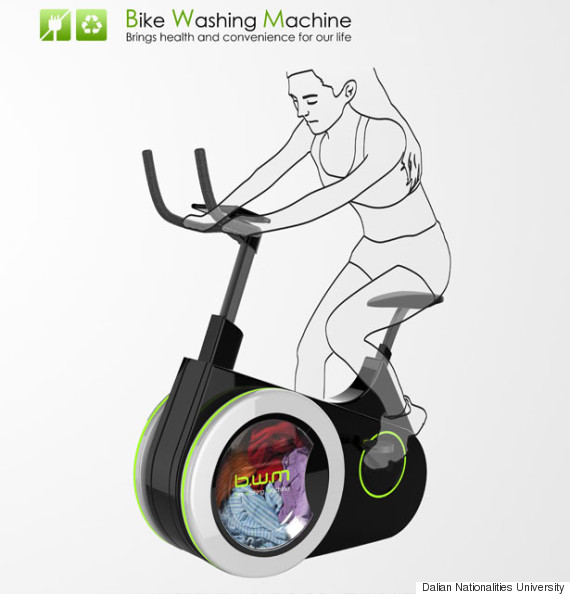
Students at the Dalian Nationalities University in China have designed a bike washing machine that will wash your clothes while you pedal. The invention is aptly called "Bike Washing Machine" or "BiWa," and it aims to "bring health and convenience to our life" by combining a stationary bike and a washing machine.
According to a description on Tuvie provided by the students who designed the bike, the way it works is quite simple: "When you ride this bike, the pedaling motion causes the drum of the washing machine to rotate; at the same time, superfluous electricity is generated which can be used to power the display screen or [be] stored for future use."
Credit: Designer: Xuefei Liu, Di Fang, Linhao Su, Zhanbing Li, Xiaoyu Gao Xueyi Wang, Wen Fan, Liying Zhu, Deqian Zhao, Huan Li, Mengmeng Hu and Weiwei Li of Dalian Nationalities University
Considering the small size of the washing machine, it would undoubtedly take multiple spin cycles to complete your laundry. Much like the Drumi, a pint-sized washing machine that can fit almost anywhere, both inventions will probably not completely replace a laundry machine or a trip to the laundromat.
The concept isn't new, as other designers have tried their hand at designing similar machines. However, none have made it successfully to market, so it will be interesting to see if the "BiWa" becomes successful. Until then, we'll continue to work around both our laundry spin cycle and our spin class schedule.
Are you an architect, designer or blogger and would like to get your work seen on HuffPost Home? Reach out to us at homesubmissions@huffingtonpost.com with the subject line "Project submission." (All PR pitches sent to this address will be ignored.)
When consumers taste cheap wine and rate it highly because they believe it is expensive, is it because prejudice has blinded them to the actual taste, or has prejudice actually changed their brain function, causing them to experience the cheap wine in the same physical way as the expensive wine? Research in the Journal of Marketing Research has shown that preconceived beliefs may create a placebo effect so strong that the actual chemistry of the brain changes.
Related experiments were run with milkshakes, by Hilke Plassmann and Bernd Weber. There is more here, of considerable interest, hat tip goes to Samir Varma. Do any of you know of an ungated copy?
This new article asks how much placebos are affected by your DNA.
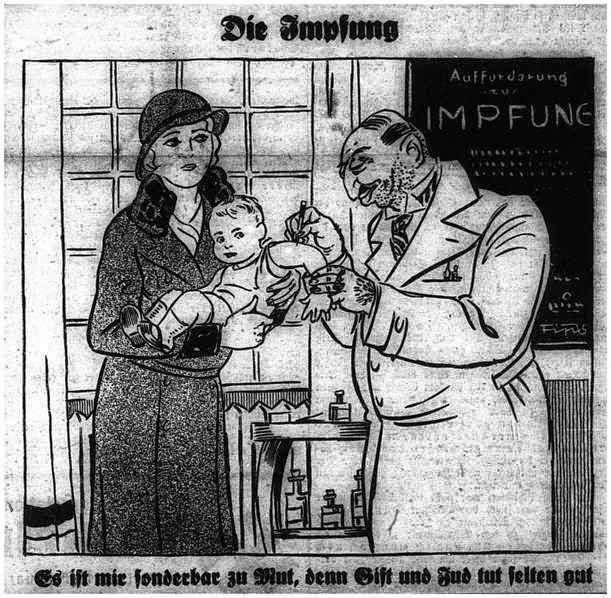
Antisemitism is rampant in the anti-vaccine community, and it goes a long, long way back. In 1932, an antisemitic magazine published a drawing of a smug-looking Jewish doctor immunizing a baby in a cartoon labeled, "Die Impfung," or "The Vaccination," with a caption reading: "It seems to me that poison and Jews seldom do good things."
We haven't moved much further beyond the early premise that vaccines are poisons concocted by a Jewish conspiracy. It's not a surprise, really: Judaism is the Kevin Bacon of conspiracy theorist culture. You just have to scratch the surface of any conspiracy theory to the Jews who are allegedly behind it. Children missing? Jews stole them and drank their blood. Recession? Must have been the Rothschild family. Problems on Wall Street? Jews did it. Federal Reserve conspiracies? Definitely Jews. Media cover-ups? Jews. Subliminal messages in Hollywood? Jews. 9/11? Jews. Chemtrails? Jews. Vaccines? Jews, of course.
I've encountered it time and time again in my passion for vaccine advocacy. People who might otherwise take me seriously latch on to mentions of my cultural background as evidence that I'm being paid by Big Pharma. After I'd seen a post that said that fellow vaccine advocate Dorit Reiss and I were "buddies," I sent her a message for the first time, introducing myself. I mentioned in passing that her maiden name, Rubinstein, is similar to my stepfather's name, Rubenstein, and said we could be distant relatives. Of course, I couldn't help but quip that we were both part of the Jewish shadow government.
It was literally one day later that I received a message from someone telling me that "Everyone knows your Aunt Dorit is feeding you money to peddle her lies." The day after I encountered fellow Jewish vaccine advocate, she was suddenly my wealthy aunt who was funding my advocacy for vaccines.
This is just the painless surface of antisemitism in the anti-vaccine movement. I've seen how ugly-- and how ridiculous-- it gets. Anti-vaccine activists have told me, you see, that it's my fault that my daughter has autism, because my "Jewish genes" from my "tribe" are full of "mental, physical, etc disabilities due to the years/centuries of inbreeding." (Joke's on them, anyway, since autism rates in Israel are half that of the U.S., and my daughter is culturally but not ethnically Jewish.)
They say that our children get special vaccines. One man, based on kids he's seen staring at him in Walmart, as arrived at the brilliant conclusion that Jews get special vaccines and that all other children get poisonous vaccines.
If this were true, I'm a little upset that I missed the part of Hebrew school where I was supposed to learn the secret handshake to let my pediatrician know that I'm Jewish and that my kids should get the vaccines that don't cause them to stare when an antisemitic stranger is creeping on them in Walmart.
It's all part of a Zionist conspiracy, though-- so they say. These people envision a future dominated by militant Jews with Magen Davids and the words "Zionist" written on their uniforms. This Jew-dominated future police state apparently involves vaccine checkpoints where mothers scream and are restrained as their babies are helplessly injected with lethal chemicals.
And this panic over some future Zionist police state seems to bleed into every single discussion they have with Jewish vaccine activists. They tell us that we are just part of a plot.
...Something to do with the "Judaification of America." And they want us to go back to Russia and East Europe. You know, those places were we were slaughtered by the millions.
But they also want us to go back to Israel. They can't seem to make up their minds.
They call us "cockroach."
They call us communist, and in the same breath, call us fascist. They insult our appearance. They call us "mindless, money-driven, greedy heathens."
My, isn't that familiar.
The scary thing is that, the closer and closer anti-vaccine activists get to utter Nazism, the more they begin to claim that they themselves are victims of a modern Holocaust. They flippantly dismiss the actual horrors of the Holocaust-- the brutal deaths of 6 million innocent people by gas, disease, starvation, and labor-- by comparing their experience of refusing to immunize their kids to the experience of being a Jew in Nazi Germany.
"Their doing the same thing to us that they are they jews," one anti-vaxxer screamed, taking the time to edit her comment to eliminate one of her seventeen grammatical errors.
Meanwhile, one of the most popular articles cries, "First, They Came for The Anti-Vaxxers," a reference to a poignant poem about the Holocaust by Martin Niemoller. It implies that the anti-vaxxers are the "Jews" of today, the first victims in what will become a total Holocaust.
Although it was popular, it wasn't the first or only vaccine/Holocaust comparison to go viral. Amy Barajas, an insufferable schmuck of a mommy-blogger, posted an image of herself in Holocaust Chic, wearing a self-imposed anti-vaccine badge and comparing it to the badges my people wore to the gas chambers. The image spread like wildfire among anti-vaxxers with persecution complexes.
Another anti-vaccine activist compared his resistance to vaccines to August Landmesser's refusal to give a Nazi salute. August Landmesser was tortured for years in concentration camps because of his resistance to the Nazi party and his relationship with his Jewish wife. Anti-vaxxers, on the other hand, have yet to even be denied access to public health insurance and public school. Don't worry, though: he "don't mean to be insulting."
The anti-vaxxers know how much it stings when I, as a Jew, am told that they are victims of a modern Holocaust. They exploit this when speaking to me and my fellow Jewish vaccine advocates:
Anti-vaxxers aren't always hateful people. I know that because I used to be one of them. But I come from a culture that values reason. I was taught as a child that the highest mitzvah, or commandment, is to nurture human life-- that it goes above and beyond any other duty we have to ourselves and others. My background plays a role in my vaccine advocacy not because it's part of a global conspiracy, but because it's a culture that prizes science and human life.
All joking and stereotypes aside, it's not a coincidence that a disproportionate number of Jews are drawn to careers in medicine. It's not (despite what some may say) because it's a well-paid career, but rather, because we tend to value science and its role in improving and strengthening the bodies that we're given. We are commanded not to accept human life as short and brutal, but to use our minds, and the minds of those who came before us, to build a better future.
I'm not a "good" Jew. I've got tattoos on both of my forearms, I'm queer as a ten-cent nickel, and my son's still got his foreskin. I have a Christmas tree and I get my daughter a real birthday cake every year even though her birthday tends to fall during Passover. Plus, I can't stand Benjamin Netanyahu or gefilte fish. But I know I'm at least doing one thing right. I'm standing up for the use of science to prolong and protect the lives of my children and others.
Apparently, all other things aside, my vaccine advocacy combined with my Judaism mean that I am an ugly communist fascist money-grubbing Zionist cockroach shill. My reasons for advocating for vaccines are called into question, my children are labeled the defective products of incest, and my opinion is taken with a grain of antisemitic salt.
The anti-vaxxers are right when they say that today sometimes looks suspiciously like 1932. But I think they're wrong about who among us is actually the target of hate.
A new Facebook bug is causing major problems for users, with posts disappearing and new links apparently blocked from posting. The issue has been disastrous for organizations that rely on the Facebook to communicate with the public. Media brands, which have come to rely on Facebook for an increasing share of traffic, have been particularly quick to voice their displeasure.
The problems began last night with issues in the image-scraping system, which automatically pulls pictures from posted links. The issue was reported in Facebook's developer forums and Facebook's ops team promised a fix — but the resulting fix seems to have broken the system entirely. A number of posts containing links seem to have vanished, including dozens from The Verge's own page, although they have reappeared intermittently. More seriously, users attempting to post new links have been met with cryptic security warnings. Notably, the bug seems to be only affecting posts containing links to content outside of Facebook.
that sound is the sound of a Facebook Publishing bug mixed with the collective aneurysm of social media managers everywhere
When unexpected events happen — be they natural disasters or terrorist attacks — the consequences can be dire. As a result, governments have gone to great lengths to prepare for the unexpected as best they can, stockpiling scarce resources in case supplies get cut off.
With a capacity of 727-million-barrels, U.S. Strategic Petroleum Reserve is the largest stockpile of government-owned emergency crude oil in the world. Established in the aftermath of the 1973-74 oil embargo, the SPR provides the President with a powerful response option should a disruption in commercial oil supplies threaten the U.S. economy. [Energy.gov]
But not every strategic reserve is so straightforward. In fact, some are downright weird — at least at first glance. Here are four of the strangest:
1. China’s strategic pork reserve
(CHINA DAILY/Reuters/Corbis)
China’s economy has grown by leaps and bounds in the last three decades, averaging over 10 percent growth per year. This has lifted millions of Chinese out of poverty and into the middle class. That new middle class has developed a taste for meat — and pork is at the top of the menu. China now consumes over half of the world’s pork.
The communist Chinese government created the pork reserve in 2007 with the aim of stabilizing prices and reducing market volatility.
When pork prices rise, the reserve releases meat to the market in a bid to push down prices for consumers. When the price falls, the reserve buys up pigs in order to keep farmers profitable.
2. Canada’s maple syrup reserve
(Philippe Henry/First Light/Corbis)
Canada's Federation of Quebec Maple Syrup Producers — which produces more than 70 percent of the world’s maple syrup — maintains a strategic reserve of the gooey stuff. Officially known as the International Strategic Reserve, it is located in warehouses in three rural Quebec towns, and has a capacity of over 10 million kilograms of maple syrup.
Maple syrup is harvested from the sap of maple trees, which do not produce sap in consistent quantities. Maple trees require cold nights and mildly warm days to yield sap, and the wrong weather can lead to little or no sap. This means that production levels can vary wildly based on the weather.
That isn’t good news if you’re trying to maintain a large-scale industry. Corporate buyers demand consistency, because they don’t want to sink capital into developing and marketing a product, only to have no product to sell. So Quebec’s producers aim for a large harvest in the good times and sock away surpluses for the lean times, which helps them produce a consistent flow at a consistent price.
3. America’s helium reserve
(Thinkstock)
Helium is lighter than air, giving balloons their buoyancy. But helium is not just used in balloons. The largest commercial use of helium — which has a uniquely low boiling point of just four degrees above absolute zero — is as a coolant for superconducting magnets necessary to build magnetic resonance imaging (MRI) machines. Helium is also used as a shielding gas for high-temperature welding, as a coolant in telescopes, and as a coolant in high-capacity hard disk drives.
And although helium is the second-most abundant element in the observable universe — accounting for up to 24 percent of total universal mass — it is quite rare on Earth. That’s because its mass is so low — as anyone who has lost his grip on a helium balloon knows, the gas will rise and rise until it escapes into space.
This means that helium has to be stored and conserved. Most of the helium on Earth was formed as a byproduct of the radioactive decay of rocks, and is currently obtained as a byproduct of the extraction of natural gas.
The National Helium Reserve in Amarillo, Texas, provides 42 percent of America’s helium and 35 percent of the world’s supply. Established in 1925 with the aim of supplying airships, today it holds over one billion cubic meters of helium gas. Worryingly, at current rates of usage, known global supplies of helium are estimated to be entirely depleted in 20 to 30 years.
4. Russia’s steam locomotive reserves
(pasmal/amanaimages/Corbis)
During the Cold War, the threat of nuclear annihilation hung over the world. Military training exercises, troop movements, or intercepted communications could all be misinterpreted as a signal of an imminent nuclear strike. In fact, in 1983 malfunctioning computer equipment in the Soviet Union — mistakenly displaying data showing that the U.S. had launched a first strike — brought the world very close to an accidental nuclear conflict.
And what would follow a nuclear conflict? Well, countries wanted back-up power in case their electricity systems failed as a consequence of an electromagnetic pulse from a nuclear bomb. The Soviet Union kept and serviced a fleet of steam-powered trains — the strategic steam reserve — that could run on coal. The strategic steam reserve still exists today, but it has been decaying since the breakup of the Soviet Union in 1991. According to Russian defense journalist Anton Morasdov:
Only 12 steam locomotives remain at the only preserved base of the Strategic Steam Resource near Roslavl in Smolensk Region and they may be scrapped soon.
Representatives of the locomotive repair depot Smolensk say that all locomotives are already rotten, and are being scrapped little by little. [Defense and Security]
Editor's note: This article has been revised since it was first published in order to more clearly include proper attribution to source material.


 Super Opinionated.






 (CHINA DAILY/Reuters/Corbis)
 (Philippe Henry/First Light/Corbis)
 (Thinkstock)
 (pasmal/amanaimages/Corbis)