
Scott Akerman
Shared posts
26 Jul 23:42
 Robert Krulwich/NPR
Alex Tirabasso/Courtesy of Canadian Museum of Nature
Charles Douglas/Courtesy of Canadian Museum of Nature
Robert Krulwich/NPR
Alex Tirabasso/Courtesy of Canadian Museum of Nature
Charles Douglas/Courtesy of Canadian Museum of Nature
 Robert Krulwich/NPR
 Robert Krulwich/NPR
Look What You've Done, North America!
Look What You've Done, North America!
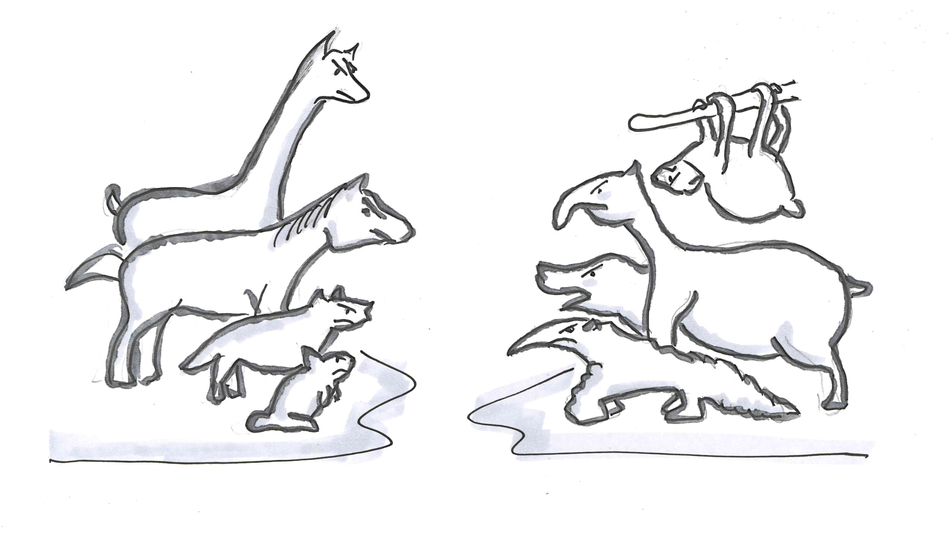
This is the story of two continents doing battle, North America versus South America. It is also a biological mystery.
For a very long time, North America and South America were separate land masses. The Pacific Ocean slipped between them, flowing into the Caribbean. The Isthmus of Panama was there, but it was underwater. The two continents didn't touch.
As a result animals on both continents, especially mammals, evolved independently. They didn't, couldn't, interbreed. And yet, both North and South America had mountains, plains, long lazy rivers, deltas and supported similar forms of mammalian life. In fact, when biologists look back at the fossils, they found almost mirror like populations.
North America had horses. They were a little thicker and hairier back then.
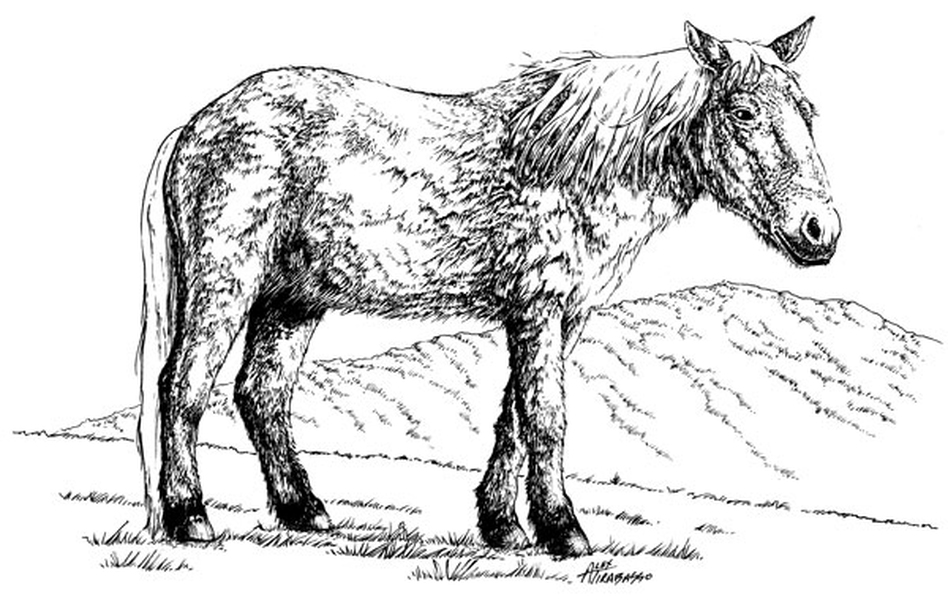
South America had a parallel version called "litopterns" with dangly Snuffleupagus-like noses.
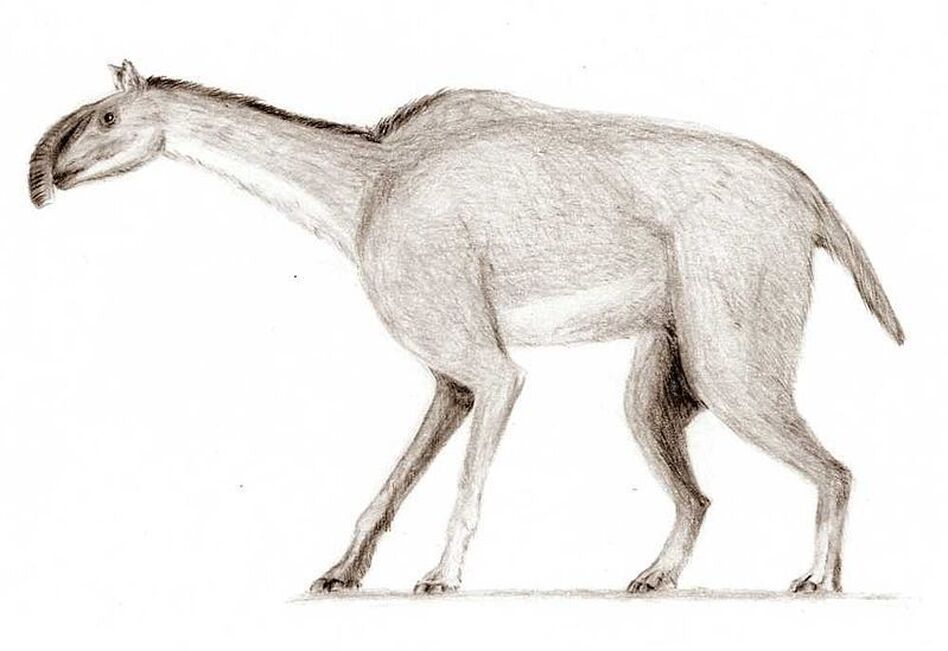
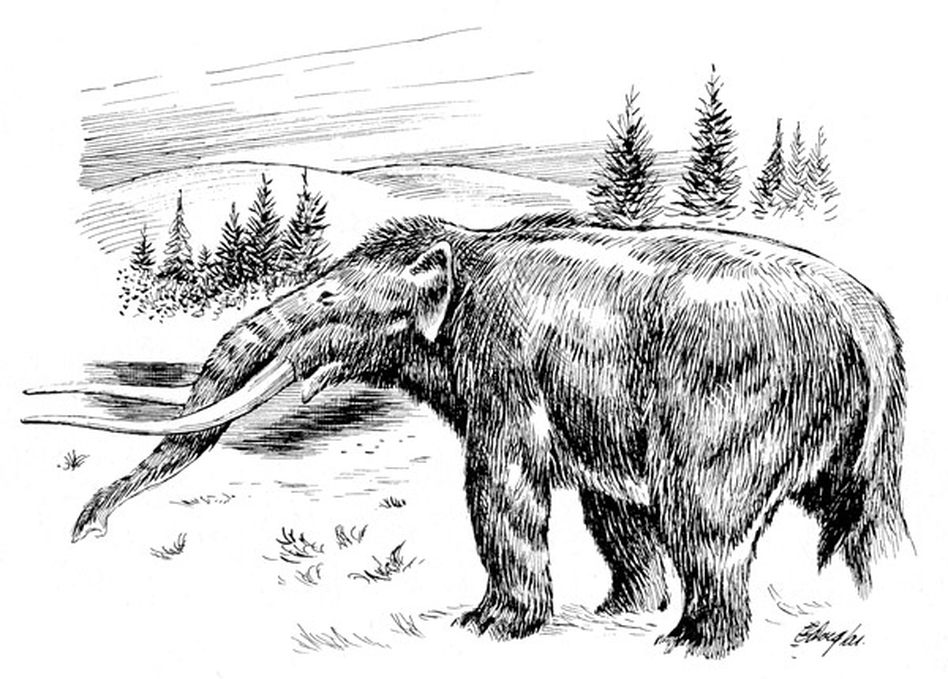
North America had elephants and rhinos (gone now, but they once were natives).
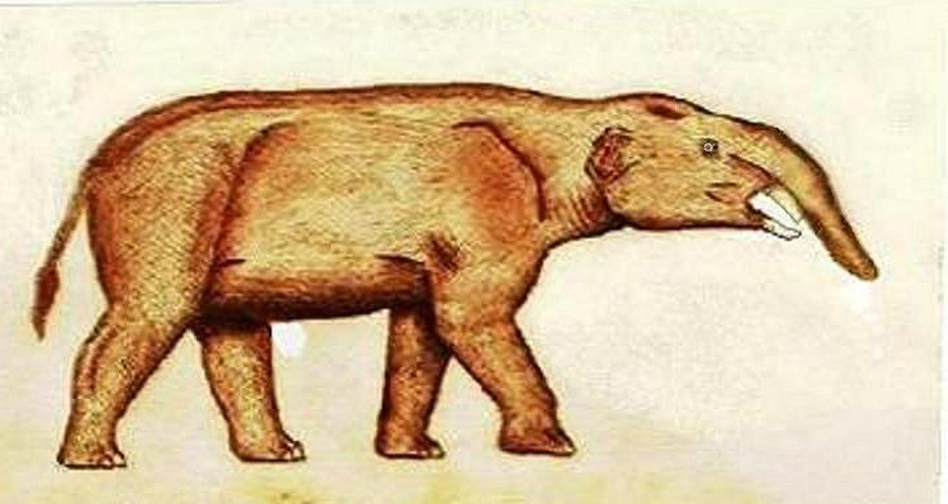
South America had Astrapotheres and pyrotheres, who looked quite similar, being tusk-bearing, water-friendly mammals.
North America had a saber-toothed tiger.
So did South America.
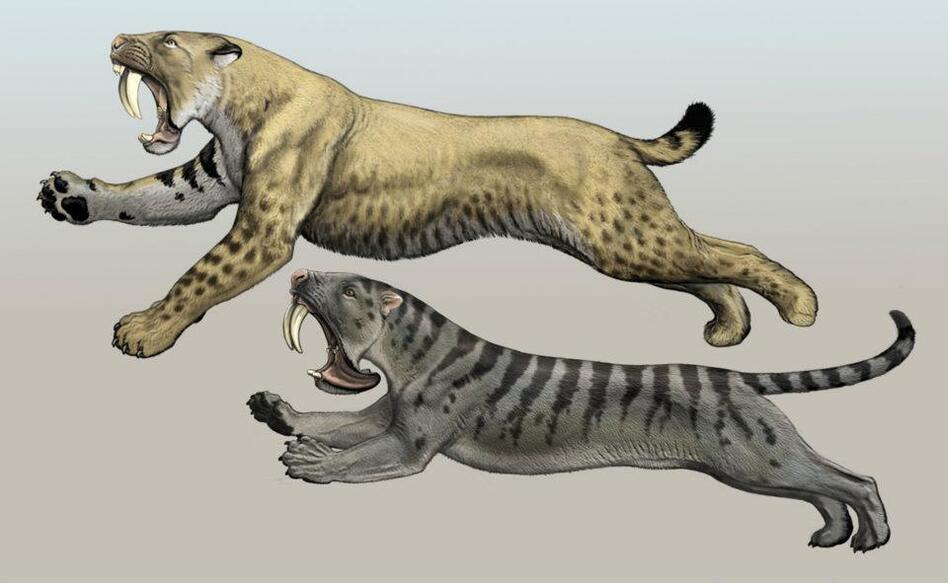
Again, while they looked the same, on close inspection you'd find the northern one carried its fetuses in a uterus, while the southern tiger was marsupial; its fetuses grew in an outside pouch.
"This evolutionary convergence was the greatest on land that the world has ever seen," writes biologist E.O. Wilson. The two continents had their own versions of shrews, weasels, cats and dogs. And then 2.5 million years ago, the two continents attached.
And Then There Was One ...
Long, long before any humans prowled the hemisphere, the Isthmus of Panama emerged, and all of a sudden it was possible for mammals in the north to meet (and compete) with mammals from the south.
So, as Ed Wilson puts it: "What happens when two full blown, closely similar dynasties meet head on?"
Well, it had to get rough. There was no accommodating everybody. Some of these animals lived in the same kinds of places and ate the same kinds of foods as their new competitors. The land couldn't support both, unless each side somehow managed to avoid the other.
Yet neither side had any obvious natural advantage. They'd survived and struggled to dominate their respective continents. Any gambler would have said, "I'm figuring half the time the northern mammals will prevail, half the time the southerners."
Which is why what actually happened is such a mystery.
According to Ed Wilson, "In general, where close ecological equivalents met during the interchange, the North American elements prevailed." In group after group, the southerners succumbed. Big cats with pouches lost out to big cats with none. South American toxodonts fell away, to be replaced by northern style tapirs and deer.
It wasn't a total rout. South American anteaters persist, so do tree sloths, monkeys. Armadillos have moved deep into Texas.
But overall, the northern mammals were better at invading and adapting. At this point nearly half the mammals in South America (if you count large groups, families and genera) come from lineages that came down from North America over the last 2.5 million years. The losers suffered a losers fate: they disappeared.
But why? What did the northern mammals have that the southern ones didn't?
"No one knows for sure," says Wilson. This is one of those puzzles that biologists keep coming back to, he says.
But they have a notion. The northern continents, America, Europe and Asia have spent eons attaching and detaching. Russia with Alaska, Canada with Greenland, Greenland with its eastern neighbors, Europe with Africa. Northern lands, therefore have regularly exchanged animals, and those animals have had to diversify, compete, adapt. They've had to deal with fierce winters and ice.
South America, on the other hand, since edging off from Africa, spent a long time as an island continent, untouched by other lands. And like Australia, it has produced highly unusual creatures, like kinkajous, guinea pigs, piranhas, weird frogs, toads, turtles, boa constrictors and tall, running birds like rheas — who can thrive because there aren't regular invaders to cope with.
What the northerners have that southerners lack, perhaps, is a tougher life. Northern animals have competed against more, different animals, accommodated more parasites, tested their immune systems in more ways; they've learned to expand more quickly, producing more babies when they need to — and it's that Northern worldliness, say some biologists, that gave them an edge.
But this is only a hypothesis. It's only begun to be tested. Thinking about it, I realized there is one southern mammal, a plains creature that stepped out of the southern forests that's been monstrously successful, spilling its offspring everywhere, north, south, east, west, even up...to the moon. We are that creature.
And while we weren't involved in the north/south encounter in the Americas, (we arrived later), technically, we are of African, that is southern, origin, so ... before biologists get too giddy about successful northern mammals, they might remember where they came from.
Just saying.
E.O. Wilson summarizes the North/South encounter in his book Letters to a Young Scientist. And special thanks to Carl Buell whose drawing of northern and southern big cats demonstrates, yet again, that he is king of paleo-illustration. I feel embarrassed to have my scribbles anywhere near his.
Copyright 2013 NPR. To see more, visit http://www.npr.org/.9())
Scott Akerman, Cary Renquist likes this
16 Jul 00:12

Buttercup Festival by David Troupes


5 August 2013
It's been three weeks since the last comic, and here I am with a page from the sketchbook. I had a new watercolor comic
underway last night, really I did, but then disaster struck, as it often does with watercolor, and I didn't have the
emotional strength to start again. I'll have a new strip for you next week, but it won't be on Monday. Perhaps Wednesday?
It's one of those summers. But behind the scenes, on top of day job and baby duties, I am making good progress on getting
Renaming of the Birds ready for its Kickstarter launch. I'm thinking now that September is the best month to open it up, so
everyone is back from summer tripping. I'm also working on some academic articles on Ted Hughes, because why not?
Scott Akerman and -1 others like this
16 Jul 00:12
 by Caroline Lawrence (Wonders and Marvels contributor)
Caecilius’ Willy
by CarolineLawrence
by Caroline Lawrence (Wonders and Marvels contributor)Students and teachers familiar with the Cambridge Latin Course were in for a shock at the British Museum Pompeii exhibition this summer. We saw Lucius Caecilius Iucundus as never before and many of us exclaimed Herclé! (By Hercules!)
Everybody knows his face from the famous orange textbook 1. His first appearance in the garden is now a meme – Caecilius est in horto – and he has even met Dr. Who. Using delightful line drawings and deceptively simple stories, the clever authors lull us into a false sense of security until the story ends in tears with < Spoiler Alert!> Caecilius’ moving death during the eruption of Vesuvius. The faithful slave Clemens finds his dying master under a partly collapsed wall. Clemens wants to stay, but Caecilius tells him to make sure his son and wife survive. “Clemens, abi!” he gasps. (“Clemens, go!”) Then he dies with the faithful watchdog Cerberus refusing to leave his master’s body. *Sob!*
 The Cambridge Classics School Project textbook informs us that a bronze portrait bust of Caecilius was found in his house in Pompeii, along with a dog mosaic: one of about half a dozen examples that have survived from the ancient world. There were also lots of wax tablets showing us that he was an argentarius, a cross between a banker and auctioneer. Today we would call him an entrepreneur.
What the book doesn’t tell us is that wax tablets and other records bearing his seal cease a few days before the big earthquake of AD 62, leading many scholars to believe that Caecilius died in that earthquake, 17 years before the infamous eruption. There is also a famous relief of the earthquake in the lararium of the townhouse that he (presumably) left to his children.
Caecilius’s ugly-yet-loveable mug appears throughout the book and when you enter the atrium of the British Museum’s exhibit you first get a thrill of recognition, and then a shock when you see how the artist really has depicted him warts and all. But a bigger shock awaits as you lower your gaze and see that Caecilius’s head is part of a herm, a rectangular plinth with a head on top and male genitalia half way down the front. Sure enough, there is Caecilius’ willy! Edepol! (Pollux!) They never let on about that in the Cambridge Latin Course!
 So what on earth is going on? Is someone playing a nasty practical joke on our beloved banker?
As ever, the answer lies in the fact that the Romans are like us, and yet not like us. I keep blogging about how superstitious the Romans were and Evil Eyes and such things, and this herm of Caecilius is a perfect example.
Nobody is exactly sure what a herm is or how they originated. The best theory is that they started as piles of rocks at crossroads or boundaries, always dodgy places in ancient Rome. Later this pile-o-rocks was superseded by a wooden or stone plinth topped with the head of a god and with the genitals about midway down. The penis (usually erect but sometimes flaccid) was a very common apotropaic device, to turn away evil. It represents the animal nature or power of a man. It also has an “eye”. As the poet Martial says of the male member: sit lusca licet, te tamen illa videt. (“Although it has only one eye, it’s looking at you!” Martial IX.37).
But a herm is doubly apotropaic because a staring face is another very powerful means of frightening away evil and/or evil doers. You can see the place where glass paste or a gemstone would have given Caecilius realistically staring eyes. Remember the recent story about how bike thefts in Newcastle went right down when this sign was put up?

In effect, herms were like ancient scarecrows that kept away trespassers, thieves and bad luck.

The oldest recognisable herms are from the Archaic period. The head on top is usually that of Hermes, Dionysus or Hercules, all deities of fertility or power. (The name Hermes probably comes from the Greek word herma which means “a stone set up”.) Herms changed appearance as sculpture evolved. You may remember the story of how a volatile young statesman named Alcibiades (allegedly) defaced the herms of Classical Athens.
Later, in Hellenistic times, Greeks started to put the heads of ephebes (high born youths) on the herms. Again we’re not sure exactly why, only that these herms adorned and protected the gymnasium where these young men worked out.
 By Cicero’s time (1st century BC) intellectual Romans thought it would be fun to put realistic portraits on herms. We have a roomful of examples from the opulent House of the Papyri near Herculaneum (template for the marvellous Getty Villa in Malibu). This house was famously owned by a man who followed the Epicurean philosophy.
The Greek ideal of beauty was a small penis, whereas the Romans thought the bigger the better when it came to turning away evil. The fact that Caecilius’ member is small and limp hints at possible connections with Greece. Perhaps, like many higher-born Romans, he studied rhetoric in Athens. The modest, stylised, almost apologetic willy does not really match the portrait bust above it, which as I have said is literally warts and all. (In a recent lecture at the British Museum, curator Paul Roberts commented that the face is as close as possible to the man’s to give the spirit of him.)
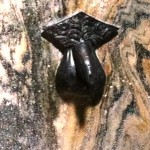 The herm was not set up by Caecilius himself, but by one of his freedmen, and possibly after his death. It is dedicated to the “genius” or spirit of Caecilius: GENIO L[UCII] NOSTRI FELIX L[IBERTUS] “To the Genius of our Lucius. I, Felix, his freedman [commissioned it]” It was probably a kind of ancestor statue, designed to be worshipped along with the other household gods. But it also served another function. With face and phallus facing the front door, the herm averted evil and protected not only the contents and inhabitants of the house, but perhaps also his entire legacy.
Just as we find the contrast of his realistic face and coy genitals incongruous, so the Romans might have had a chuckle upon first seeing it. But laughter is another apotropaic device. So this herm is triply apotropaic while still hinting at the founder’s wit and erudition. (below: antique print shows the possible original location of Caecilius’ herm at the back of the atrium and just before the tablinum, facing the front door.)
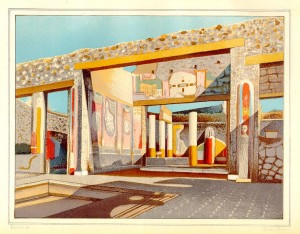
This herm of Caecilius serves to remind us how pervasive was the daily threat of random calamity and how charmingly the Romans addressed it. Ironically, it also underlines how ineffectual all their charms, offerings and prayers were against the power of Vesuvius.
For a clearly-written article on the apotropaic nature of the penis, read Claudia Moser’s delightful undergraduate thesis, Naked Power. It will tell you everything you wanted to know about the apotropaic phallus but were afraid to ask.
To introduce children to the concept, buy them The Colossus of Rhodes, which has winged willies on the very first page. But all in the best possible taste.
Scott Akerman likes this
11 Jul 11:46


Horticultural art in Canada
by Arnold Chao

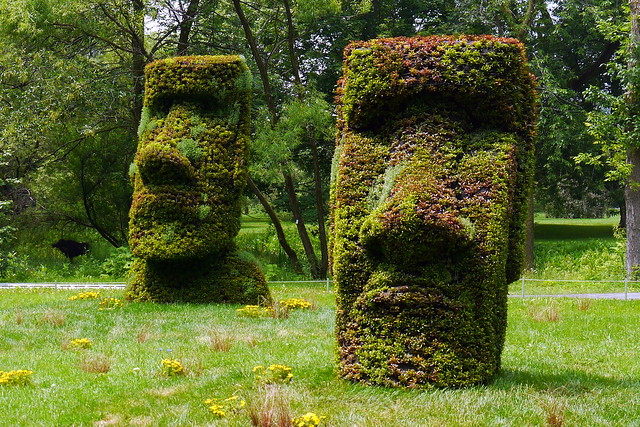

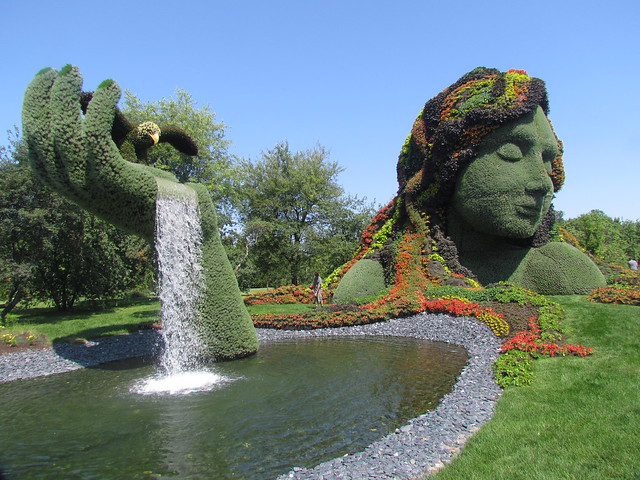
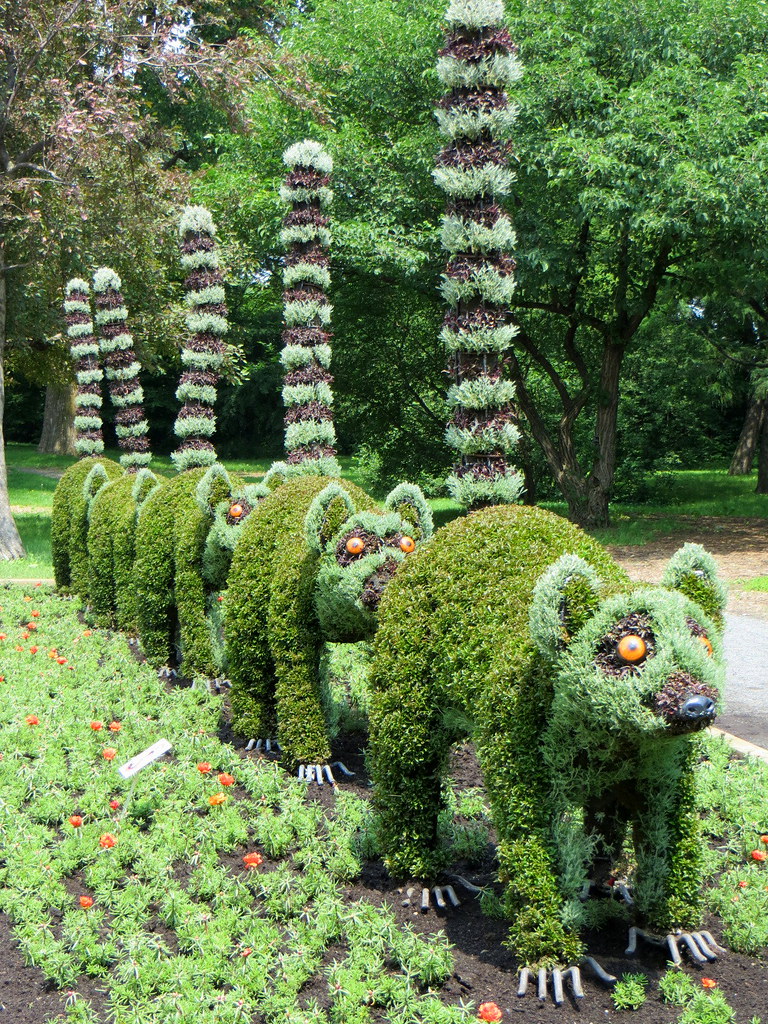
We noticed recent appearances of these plant-covered sculptures in photos from an exhibition called the Mosaïcultures Internationales Montréal (June 22 to September 29). This year’s edition covers the “Land of Hope” theme and includes over 50 “giants of the horticultural arts” on display in Canada’s impressive Montréal Botanical Garden. With 20 countries represented by 200 participating artists, the event is also an international art competition, and the winners will be picked for the Grand Honorary Jury Award and People’s Choice Award.
See more photos in the Mosaicultures Montreal 2013 gallery and Mosaiculture – International group.
Photos from AV Dezign, DeannaVY, Cosmar, Robert Perron, and lusignan.

 facebook
  reddit
10 Jul 00:31
Update: In the comments, Bill Morgenthien points out that a boycott isn't the same thing, precisely, as a blacklist. That's very true, and it's an important distinction.


Why I'm not boycotting Ender's Game
by Cory Doctorow
Earlier today, Mark wrote about a boycott of the Ender's Game movie; called for on the basis of Orson Scott Card's public statements opposing gay marriage. Unlike Mark, I really enjoyed Ender's Game and read it several times; later, I read John Kessel's brilliant essay about it and realized some of the ways in which it brilliantly -- and troublingly -- snuck in a message of justifiable pre-emptive violence.
I've been concerned and upset about Card's views on homosexuality since his "Hypocrites of Homosexuality" came out in 1990. But I won't be signing onto the boycott call for the Ender's Game movie, for the same reason I didn't sign onto the call for a boycott of the Superman comic Card was tapped to write. A Steven Brust essay changed my thinking on this:
So, then, the question immediately stops being, “is it morally wrong to try to convince DC to blacklist Scott Card.” It becomes, “Is it a good tactic to try to convince DC to blacklist Scott Card.” In the previous discussion, Emma pointed out, quite correctly, that it’s an ineffective way to create change. I agree, but there’s more. Just like in a good work of fiction, what we need to examine are consequences. And the consequences of creating a blacklist are simple: it opens the door for it’s use against us. And, frankly, we’re a lot more vulnerable than they are; they have the entire power of the massive machine of capital and the State; we have only what we can pull in with our voices.
Later, Brust posted an anaecdote where he quoted Oscar Brand: "We on the left do not blacklist."
Update: In the comments, Bill Morgenthien points out that a boycott isn't the same thing, precisely, as a blacklist. That's very true, and it's an important distinction.
    
|
Scott Akerman likes this
04 Jul 13:00


This High
by Justin Boyd

Hey, it’s Comic Me!
I have a very exciting life, as you can see. Another variation of this is walking through gaps that are barely wider than me.
–ALSO–
I did some guest comics for Chris Hallbeck of The Book of Biff! Three of them!
Here’s the one for The Book of Biff.
And the one I did for Maximumble!
Let’s not forget the one for Minimumble!
And then, while you’re there, check out all of his comics! ALL OF THEM!
Richi.moran, Scott Akerman likes this
03 Jul 21:39
The real reason Google wants to kill RSS
by Rob Beschizza
Marco Arment:


RSS represents the antithesis of this new world: it’s completely open, decentralized, and owned by nobody, just like the web itself. It allows anyone, large or small, to build something new and disrupt anyone else they’d like because nobody has to fly six salespeople out first to work out a partnership with anyone else’s salespeople.
That world formed the web’s foundations — without that world to build on, Google, Facebook, and Twitter couldn’t exist. But they’ve now grown so large that everything from that web-native world is now a threat to them, and they want to shut it down. “Sunset” it. “Clean it up.” “Retire” it. Get it out of the way so they can get even bigger and build even bigger proprietary barriers to anyone trying to claim their territory.
Well, fuck them, and fuck that.
Lockdown [marco.org]
|
|
Binaryjesus, Faezehya and one other like this


28 Jun 02:44


50' chain of beads leaps and cavorts its way out of a jar
by Cory Doctorow
Steve Mould, Britain's Brightest's "science guy," showed that if you put coil a 50' chain of magnets in a jar and then casually toss out one end, the whole chain goes berzerk leaps and cavorts like an innocent colt on crystal meth, defying gravity and gravitas. In this video, Earth Unplugged gets Steve to explain what's really happening.
Amazing bead chain experiment in slow motion - Slo Mo #19 - Earth Unplugged (via IO9) 
|
|
21 Jun 02:38


The real problem with Curtis White's The Science Delusion
by Maggie Koerth-Baker
Scott AkermanI didn't read this all but this caught my eye:
"Much in the same way that reading some of the commentary written by White's least-favorite people, Richard Dawkins and Christopher Hitchens, has always been frustrating for me. With all these authors, I see an undercurrent of an argument I'm happy to agree with. But that reasonable position is bogged down with layer upon layer of cheap jokes, "gotcha" quotes removed from their context, critiques of cultures and communities they clearly haven't taken the time to understand, caricatures, and the sort of comic rant style that looks very good on Lewis Black and fits sort of awkwardly (at best) on most other people."
I've had trouble formulating why I dislike Dawkins and Hitchens but Maggie gets it pretty close to my feelings on them. They're very much a holier-than-thou set of people.

So, here's a new writing nightmare. What do you do if, after your book is published, and the reviews start to come in, it slowly dawns on you that you've accidentally written the wrong book ... a book which you would not actually agree with?
Apparently, this is what is happening to Curtis White, author of The Science Delusion
All the invective? White thought he was just being funny and satirical, like Jonathan Swift. The over-generalizing about what all scientists believe and what the culture of science is like? He thought it was clear that he just meant the subset of scientists who don't think there's any value other than entertainment in art, that philosophy is dead, and that culture has no affect on how we interpret science or what we do with it. The weird, pseudo-Deism? He thought he was explaining that science is part of culture, that the questions being asked and the way answers are interpreted are culturally bound and and we have to take that into account. The humanities triumphalism and points where he totally dismisses science and acts like he doesn't understand why somebody would find meaning in being curious about how the mind works? Not what he meant at all, apparently. He just wants to make the case for us needing both science and the humanities to properly understand the world. And White is deeply confused about why reviews of his book keep getting all of this wrong.
I recently had a chance to interview White — both live and in some email follow-up after the live event — and I've come to the conclusion that I can't properly review this book without including that information. There's just too big a gap, from my perspective, between how the book reads and what White wanted you to take away from it.
Reading The Science Delusion was an intensely frustrating experience for me. Much in the same way that reading some of the commentary written by White's least-favorite people, Richard Dawkins and Christopher Hitchens, has always been frustrating for me. With all these authors, I see an undercurrent of an argument I'm happy to agree with. But that reasonable position is bogged down with layer upon layer of cheap jokes, "gotcha" quotes removed from their context, critiques of cultures and communities they clearly haven't taken the time to understand, caricatures, and the sort of comic rant style that looks very good on Lewis Black and fits sort of awkwardly (at best) on most other people. In this case, the result is a book that carries a message it clearly believes science needs to hear, but which is written in such a way as to nearly ensure that it will quickly alienate anybody who identifies with science as their community, their career, or their passion.
And that's a shame, because, as I say, White makes some good points in the book and he makes those points somewhat better when he's just talking to you.
For instance, nearly half the book is dedicated to a critique of pop-culture, self-help neuroscience — the sort of stuff that is the once and future bread-and-butter of Jonah Lehrer. It is absolutely ridiculous, as White says, to look at an fMRI scan and declare that we are seeing a thought, let alone an emotion. It is problematic when we extrapolate the findings of fMRI studies to suggest that they can help fix your marriage, give you a leg up in business, or really do much at all beyond supplying a rudimentary understanding of what happens in certain parts of the brain in response to certain stimuli. We are learning the basics of brain function here, not discovering the secrets that will help you make yourself more creative. (Unfortunately, in the book, much of White's argument against this hinges on framing pop-neurobollocks as a problem created by and supported by scientists, and a problem that very few people have spoken out about. Neither of which is true. If you want to read more about why this type of neuroscience is wrong and how it distorts our understanding of ourselves, I'd recommend reading Brainwashed: The Seductive Appeal of Mindless Neuroscience
White also has something important to say about the way cultural context influences science. Science is a tool for understanding the world. But while that tool can produce very good data, it can't really tell us exactly what we should do with that data, or how we should think about it. More importantly, it's easy to lose sight of the fact that culture helps decide which questions about the world we investigate, to begin with.
Culture explains why anthropology was once a field pretty much dedicated to proving the superiority of white, Western colonial powers over their brown subjects. The societal context shaped the questions those early anthropologists were asking, it shaped how they chose to study the world, and it shaped how they chose to interpret the data they came back with. The fact that, by the time I got to anthropology school in 1999, the field had been drastically realigned as a challenge to its former self also says something about the influence of culture and the importance of questioning ourselves and our values in ways that are not purely scientific.
Another example: There's not technically any reason, from a simplified rational perspective, why it should bother a woman to be invited back to a man's room late at night while the two are riding alone in a hotel elevator. But if you take into account the metric crap-ton of cultural context and subjective experience at play, that same scenario becomes something entirely different and more threatening. One of Richard Dawkins' biggest problems (as far as I have seen) is his tendency to look at situations like this and refuse to see the cultural context.
That's not to say most people aren't aware of the way culture influences science (and vice versa). But it is something we could stand to have more conversations about. Ultimately, that's what made The Science Delusion disappointing for me. It feels like a wasted opportunity. Wasted, in that White's book seemed more concerned with scorning scientists and painting a picture of science as a would-be philosophy for cheerfully bourgeois, materialistic robots (and the people who aspire to be them) than with actually engaging anybody in a conversation about why we can't ignore the cultural context that science floats in.
Even more disappointingly, that was kind of White's intention.
Not that he was actually trying to say "Science sucks!" (although, the book does come across as saying that), but that he was specifically not trying to communicate with the scientific community or science fans. He was, instead, intending to really only talk to other people outside the sciences who already share his frustrations with the place science holds in our popular culture and who think that comes at the expense of the humanities. If you read the book and don't like it, chances are good that you weren't intended to read it, anyway. Despite the equally strong chance that the book was about you and things you feel strongly about.
And that brings me to the more interactive portion of this book review. I interviewed Curtis White on June 12, in a live event at Minneapolis' Magers & Quinn Bookstore. It was a great chat. Not at all what I expected from just having read the book. And it revealed White as somebody who does love science, who isn't particularly angry, and who could actually make me think past the tone of his book to talk about the stuff that needed talking about. You can listen to the whole thing via Soundcloud. (Quick note: There was an audience Q&A session that I cut out of this recording, on account of the fact that my microphone didn't pick up any of the questions, making White's answers kind of confusing, to say the least.)
After that interview, I sent White a few more questions via email, trying to better understand the apparent disconnect between the style of The Science Delusion (and its' apparent message) and the style of White's speaking presence (and his apparent message). You can read that exchange below.
Maggie Koerth-Baker: When we were talking before the interview, you mentioned that you don't really write your essays to convince anyone of anything, that you're instead writing to provide aid and comfort to people who already agree with you. Why do you think that's useful/important? How do you think it affects the way you write?
Curtis White: Writing to change your opponent’s position is a mostly hopeless task. I have written for Harper’s. Does anyone read that magazine who is not already convinced by its left/liberal point of view? Not many. Culture War is a permanent state of affairs. (Some neuroscientists have actually suggested that this is so because the liberal and conservative brains are structurally different!) I try to show those who are skeptical of radical materialism and mechanism and technophilia why they feel that way. Romanticism is not dead, it’s not even the past. Contemporary art countercultures, just like the counterculture of the ‘60s, are part of the living spirit of that epochal moment in Western history that we call Romanticism. But do the mostly young people who vote with their feet and move to Portland, Seattle, San Francisco, New York understand this old connection? It wouldn’t seem so. I try to aid in their self-understanding.
MKB: When we spoke, you talked about being really surprised by the response you're getting from critics. In particular, you said that you didn't mean to write an angry book, but a satirical one. And you also said that you meant to critique specific people in the sciences, rather than critiquing science and scientists in a more generalized way. I'm curious, now that you've had more time to think about it, what you think went wrong here. Honestly, as a writer, the idea of having accidentally written a book I didn't mean to write seems like a kind of nightmare, and I'm curious about how you're processing these reviews now and thinking about your own writing.
CW: I hope you won’t be entirely surprised if I say that I don’t think anything went wrong. The Science Delusion is much like my earlier work, especially The Middle Mind. One person’s “angry screed” is another person’s “passionate defense.” My native audience tends to be among artists, lefty intellectuals, humanists, and other species of the socially dispossessed. This particular book has generated a broader audience, much of which is sensitive to criticism of the sciences. I just received a review by Mark Kingwell, a Canadian philosopher, for the Globe and Mail. It’s a sympathetic review although he complains of the “bad jokes.” (At least he noticed there were jokes!) But the on-line comments about his review hacked him to pieces in the name of the superiority of the scientific worldview. Utter disdain. Baseless contempt. I have to say, the comments made me feel a little better about some of the treatment I’ve received.
MKB: I was really surprised that you came into this not very aware of the popular science writing being done by scientists and journalists online. To me, that makes up a huge part of the representation of science, and a huge force behind the culture of science. It felt a bit like you were writing a book about what/how scientists think while completely skipping over a major source of them telling you what/how they think. Do you feel like you missed something in your research by not looking at that? Or was this really just meant to be about Dawkins and Hitchens and Lehrer and wasn't intended to reflect on what is happening in science culture, as a whole?
CW: As a science journalist and blogger, you are no doubt rightly disappointed that I didn’t go there. I’ve read your work and I appreciate what it does and I don’t think there is anything in it that is socially suspect. What I am more concerned with is the broadest and most public representations of science, and for me that means these books. They are symptomatic of what I take to be a serious social and political problem. But then I’m old enough to still believe that books and not the Web are what is important. That may be a delusion on my part. But then most of the books that I cite, and a good many more that I don’t cite, are really good books. I love John McPhee’s Annals of the Former World, but I don’t mention it. But McPhee is not in the business of using science to produce pernicious ideology.
MKB: Talking about this book with my husband, he brought up something I thought was kind of interesting. Back in high school, he used to be an Objectivist. And one of the big revelations for him, coming out of that, was the realization that a philosophy could be logically consistent and could make total sense, on paper, but could also be 100% wrong about people and wrong about the way the world actually works. For him, science is incredibly valuable because it focuses on “how this works” rather than well-constructed, logical arguments about how somebody thinks things ought to work. What do you think the limits of philosophy are when it comes to that dichotomy between what makes sense with internal, consistent logic and what makes sense when you study people?
CW: I’m not clear on how your husband has ceased to be an objectivist. As Friedrich Schelling (whom I discuss in the book) observed, empiricism has a fundamental dogma: there are objects. But in order to make this claim, empiricism must presuppose that there are subjects/selves to observe these objects. Empiricism tends to ignore the difficulty in saying what in the world a self is. Another way of putting this is that empiricism is insufficiently interested in the fact that all access to objects and all access to “how this works” is mediated by one kind of model or symbolic construct or another, whether that means language or math or instrumental experimentation. As Immanuel Kant argued, we have no access to the “thing itself,” it is forever unknowable. Our knowledge is never the thing. We are modelers, not knowers. We are condemned to life in the analogue, a glorious thing if it is looked at properly.
The Science Delusion: Asking the Big Questions in a Culture of Easy Answers

|
|
Ronald.phillips, Scott Akerman likes this
14 May 23:18


Highest-paid state employees: usually a school sports coach, sometimes a med school dean
by Cory Doctorow

Good to see America's educational priorities on such sound footing:
You may have heard that the highest-paid state employee in each state is usually the football coach at the largest state school. This is actually a gross mischaracterization: Sometimes it is the basketball coach.
Based on data drawn from media reports and state salary databases, the ranks of the highest-paid active public employees include 27 football coaches, 13 basketball coaches, one hockey coach, and 10 dorks who aren't even in charge of a team.
...Coaches don't generate revenue on their own; you could make the exact same case for the student-athletes who actually play the game and score the points and fracture their legs.
It can be tough to attribute this revenue directly to the performance of the head coach. In 2011-2012, Mack Brown was paid $5 million to lead a mediocre 8-5 Texas team to the Holiday Bowl. The team still generated $103.8 million in revenue, the most in college football. You don't have to pay someone $5 million to make college football profitable in Texas.
Infographic: Is Your State's Highest-Paid Employee A Coach? (Probably) [Reuben Fischer-Baum/Deadspin]
(via JWZ) 
|
|
Scott Akerman likes this

13 May 22:59


Sugar and salt
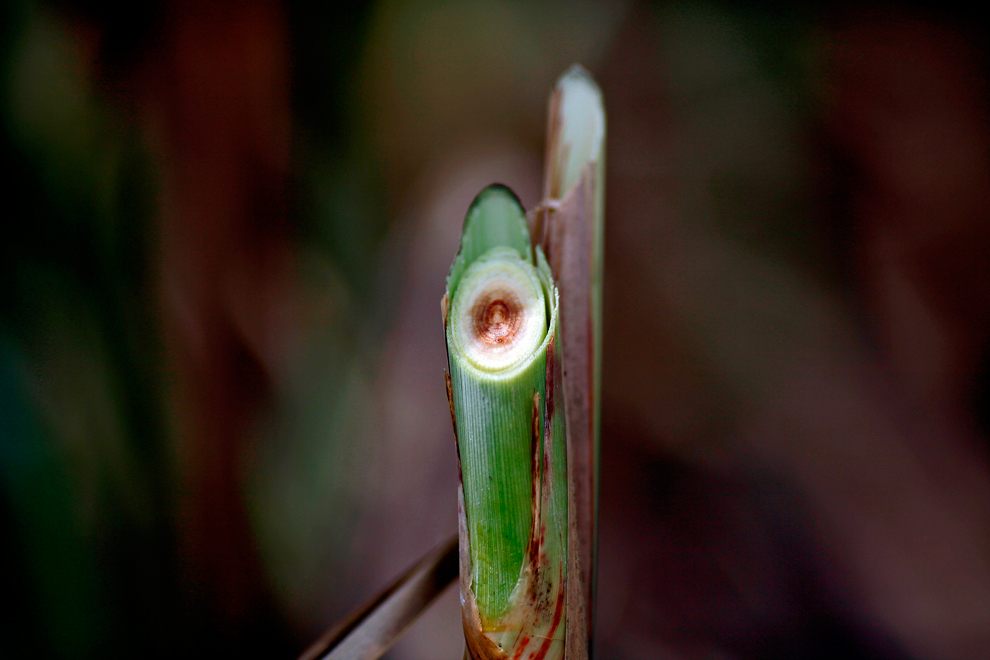
Although modern techniques often bring sugar and salt to our tables, these two simple treats for the palate are still harvested and processed in traditional, if not ancient methods the world over. Over 160 million tons of sugar is produced annually in well over 100 countries, most of it processed from cane in tropical countries. The world uses 240 million tons of salt every year in everything from food to industrial applications. Gathered here are images of the toils that result in two of our favorite flavors. -- Lane Turner (32 photos total)
A cut stem of sugar cane stands in a field in Saraburi province, Thailand on May 9, 2012. Thailand is the world's second-biggest exporter. (Dario Pignatelli/Bloomberg)
|
|
Scott Akerman likes this

11 May 02:30


Bike lanes led to 49% increase in retail sales
by Cory Doctorow

Back in November 2012, the New York Department of Transportation released a report called Measuring the Street: New Metrics for the 21st Century, which had some compelling figures on the way that local business benefits from bike-lanes, for the fairly obvious reason that cyclists find it easy to stop and shop, as compared to drivers, who are more likely to continue on to a mall with a big parking lot, or shop online.
In many ways, these data come as no surprise. We know that when towns invest in bicycle infrastructure, people will ride more — the number of people traveling by bicycle increases when there is infrastructure to make traveling by bike safe and easy.
We also know that people who travel along a street by bicycle have fewer barriers to stopping at a local business than people who travel along the same street by car. It's very easy to hop off a bicycle and find a place to secure the bike; not so with finding parking for an automobile. In fact, a recent study suggest that bicycle riders tend to spend more at local businesses over the course of a month.
This new study makes it clear: investing in bicycle improvements boosts small businesses. And what town or city doesn't want to boost activity at local businesses?
NYC Study Finds Protected Bicycle Lanes Boost Local Business (via Kottke) 
|
|
11 May 01:32


National Geographic Traveler Magazine: 2013 Photo Contest
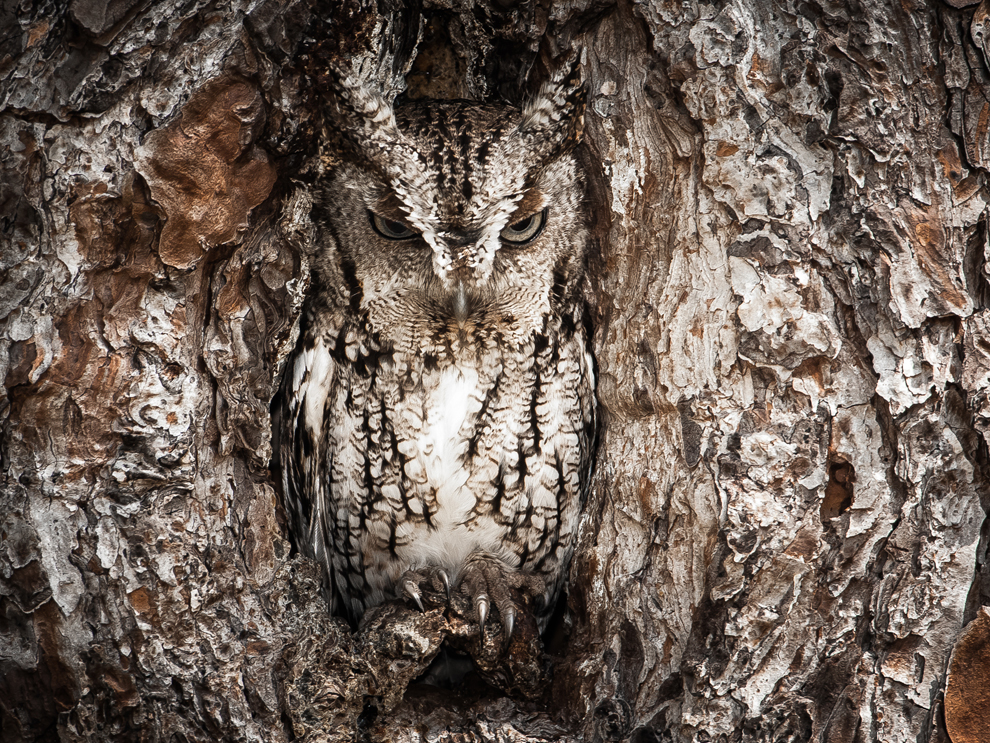
The National Geographic Traveler Magazine photo contest, now in its 25th year, has begun. There is still plenty of time to enter. The entry deadline is Sunday, June 30, at 11:59 p.m. Entrants may submit their photographs in any or all of the four categories: Travel Portraits, Outdoor Scenes, Sense of Place and Spontaneous Moments. The magazine's photo editors showcase their favorite entries each week in galleries. You can also vote for your favorites. "The pictures increasingly reflect a more sophisticated way of seeing and interpreting the world, making the judging process more difficult," says Keith Bellows, magazine editor in chief. (The captions are written by the entrants, some slightly edited for readability.) As always, you can take a look at some of last year's entries and winners.. -- Paula Nelson ( 40 photos total)
OUTDOOR SCENES - Portrait of an Eastern Screech Owl - Masters of disguise. The Eastern Screech Owl is seen here doing what they do best. You better have a sharp eye to spot these little birds of prey. Okeefenokee Swamp, Georgia, USA. (Photo and caption by Graham McGeorge/National Geographic Traveler Photo Contest)
|
|
Scott Akerman likes this
11 May 01:29


Why are barns red?
by Maggie Koerth-Baker

If you've ever spent much time in American farm country, then you've probably noticed that there's a strong tradition there of coating barns and outbuildings with red paint. Why?
Because nuclear fusion.
Okay, the actual answer is simply because red paint has long been a cheap color to buy. But, explains Google engineer Yonatan Zunger, there is some really interesting physics lurking in the background of that price point.
What makes a cheap pigment? Obviously, that it’s plentiful. The red pigment that makes cheap paint is red ochre, which is just iron and oxygen. These are incredibly plentiful: the Earth’s crust is 6% iron and 30% oxygen. Oxygen is plentiful and affects the color of compounds it’s in by shaping them, but the real color is determined by the d-electrons of whatever attaches to it: red from iron, blues and greens from copper, a beautiful deep blue from cobalt, and so on. So if we know that good pigments will all come from elements in that big d-block in the middle, the real question is, why is one of these elements, iron, so much more common than all of the others? Why isn’t our world made mostly of, say, copper, or vanadium?
The answer, again, is nuclear fusion.
You can read the full story on Zunger's Google+ page. In my experience, white is another really common barn color, due to the fact that whitewash — a paint made from calcium hydroxide and chalk (which is also calcium) — is way cheap, as well. Calcium is also one of the most abundant elements in the Earth's crust ... clocking in at number 5, right under iron in the top 10. I'm sure there's some different science that accounts for the high concentrations of calcium on our planet, but the same principal applies. Cheap paint is paint made with abundant (and easily accessible) elements. And abundant elements happen because of physics.
Image: Red Nebraska Barn, a Creative Commons Attribution No-Derivative-Works (2.0) image from 50779843@N03's photostream
|
|
11 May 01:29


Disney gives Brave princess a body makeover
by Rob Beschizza
 Gone are the wild tight curls, relaxed now into auburn waves. Her waist is cinched, her bust inflated: skinnier and sexier is the new Merida, star of Brave. And gone, in some of the new art, is that troublesome weapon: no fit thing for a Disney princess, after all. Fans and websites lamenting the changes, chief among them A Mighty Girl, have spearheaded a change.org petition seeking to convince Disney to change its mind.
The redesign of Merida in advance of her official induction to the Disney Princess collection does a tremendous disservice to the millions of children for whom Merida is an empowering role model ... In an interview with Pixar Portal, "Brave" writer and co-director Brenda Chapman stated, "Because of marketing, little girls gravitate toward princess products, so my goal was to offer up a different kind of princess — a stronger princess that both mothers and daughters could relate to, so mothers wouldn't be pulling their hair out when their little girls were trying to dress or act like this princess. Instead they'd be like, ‘Yeah, you go girl!’”
There seems a deliciously vile bait-and-switch element to it all: design a character that will attract parents resistant to the traditional messaging, then recast it in same old mold once they've sold it to their daughters for you.
But you can see the problem in that Chapman quote, which is never really about the character. When "marketing" is the first principle of your art, even something opposing its dictates is doomed to gravitate around it in fast-decaying orbit.
|
|
Scott Akerman and -1 others like this
11 May 01:26
Why (Almost) No One In Myanmar Wanted My Money
Why (Almost) No One In Myanmar Wanted My Money
by Robert Smith
When you arrive in Myanmar, you can see how eager the people are to do business. At the airport in Yangon, new signs in English welcome tourists. A guy in a booth offers to rent me a local cellphone — and he's glad to take U.S. dollars. But when I pull out my money, he shakes his head.
"I'm sorry," he says.
He points to the crease mark in the middle of the $20 bill. No creases allowed.
So I pull out another, which he rejects because it's a little bit faded, and a third, which he doesn't want because of a tiny tear, and a fourth, which he calls "not very acceptable" because of a little ink spot.
Myanmar, also known as Burma, was largely closed to the world for decades. It's just getting used to the business of international currency exchange. And, like other countries that have gone through economic turmoil (Russia, Iraq, Argentina), Myanmar wants U.S. dollars to look like they just rolled off the presses.
When I start to ask people in Myanmar, they laugh and say they know it's crazy. But they've learned in their history that the last thing you can trust is an old piece of money.
You've probably heard about the human rights abuses under the former dictatorship in Burma. But the old government also used to screw with the money all the time. Officials would suddenly announce that certain denominations of the local currency were worthless. It would be like waking up to find that the $100 bill was worthless.
The old socialist government was worried that some people were getting rich, Zeya Thu, an editor with The Voice, told me. So without warning, they would take the largest denominations out of circulation.
When it happened in 1987, Zeya's parents were getting ready for retirement. They had just cashed out their life savings to buy a plot of land. They were in the room with the seller, about to buy the land, and the government came on the radio and said the bills were worthless.
The country's leader created new bills overnight in denominations that were multiples of nine — his lucky number. Zeya says the math of adding and subtracting 45s would give people headaches.
So people started to sock away their extra money in U.S. currency. And when your life savings is a few U.S. $100 bills, you want to keep them pristine. Like other people in Myanmar, my translator kept his U.S. bills pressed flat in the pages of a book. Like baseball card collectors, people in Myanmar want their bills in mint condition.
The banks in Myanmar could have solved this problem by accepting old U.S. currency. But for a long time they were cut off from U.S. banks by sanctions, so they didn't want the old bills, either.
As a result, visitors to Myanmar have to bring bills so crisp you can cut tomatoes with them. And bills that are less than perfect end up on the black market. I took my $20 bill with a tiny ink spot on it to a black-market money changer. He gave me $17.75 for it.
Copyright 2013 NPR. To see more, visit http://www.npr.org/.9())
Nathanstodola likes this
11 May 01:23


#936; The Too Explicit Date
by David Malki !

Digitman801, Tertiarymatt and one other like this
11 May 01:18


The "Nice Shot" Comment Myth
by udijw

Don't Let The Comment Haters Slow You Down
Most people appreciate and maybe even crave feedback, especially positive. When it comes to photography, there are those who are very comfortable providing constructive, well crafted critiques. These paragraphs of personal opinions are often (at least hopefully, always) provided with the best intentions in mind, to help the photographer understand what works, and what doesn't, in a particular photograph.
But there has been a growing trend of fellow photographers withholding their positive encouragement for the most silly of reasons: embarrassment and shame.

heya, reading this via Google reader? It is closing soon. If you are looking for alternatives, try feedly an awesome free RSS reader
11 May 01:17
A picture of Earth through time
by Emily Wood
Today, we're making it possible for you to go back in time and get a stunning historical perspective on the changes to the Earth’s surface over time. Working with the U.S. Geological Survey (USGS), NASA and TIME, we're releasing more than a quarter-century of images of Earth taken from space, compiled for the first time into an interactive time-lapse experience. We believe this is the most comprehensive picture of our changing planet ever made available to the public.
Built from millions of satellite images and trillions of pixels, you can explore this global, zoomable time-lapse map as part of TIME's new Timelapse project. View stunning phenomena such as the sprouting of Dubai’s artificial Palm Islands, the retreat of Alaska’s Columbia Glacier, the deforestation of the Brazilian Amazon and urban growth in Las Vegas from 1984 to 2012:
The images were collected as part of an ongoing joint mission between the USGS and NASA called Landsat. Their satellites have been observing earth from space since the 1970s—with all of the images sent back to Earth and archived on USGS tape drives that look something like this example (courtesy of the USGS).
We started working with the USGS in 2009 to make this historic archive of earth imagery available online. Using Google Earth Engine technology, we sifted through 2,068,467 images—a total of 909 terabytes of data—to find the highest-quality pixels (e.g., those without clouds), for every year since 1984 and for every spot on Earth. We then compiled these into enormous planetary images, 1.78 terapixels each, one for each year.
As the final step, we worked with the CREATE Lab at Carnegie Mellon University, recipients of a Google Focused Research Award, to convert these annual Earth images into a seamless, browsable HTML5 animation. Check it out on Google’s Timelapse website.
Much like the iconic image of Earth from the Apollo 17 mission—which had a profound effect on many of us—this time-lapse map is not only fascinating to explore, but we also hope it can inform the global community’s thinking about how we live on our planet and the policies that will guide us in the future. A special thanks to all our partners who helped us to make this happen.
Posted by Rebecca Moore, Engineering Manager, Google Earth Engine & Earth Outreach
Built from millions of satellite images and trillions of pixels, you can explore this global, zoomable time-lapse map as part of TIME's new Timelapse project. View stunning phenomena such as the sprouting of Dubai’s artificial Palm Islands, the retreat of Alaska’s Columbia Glacier, the deforestation of the Brazilian Amazon and urban growth in Las Vegas from 1984 to 2012:



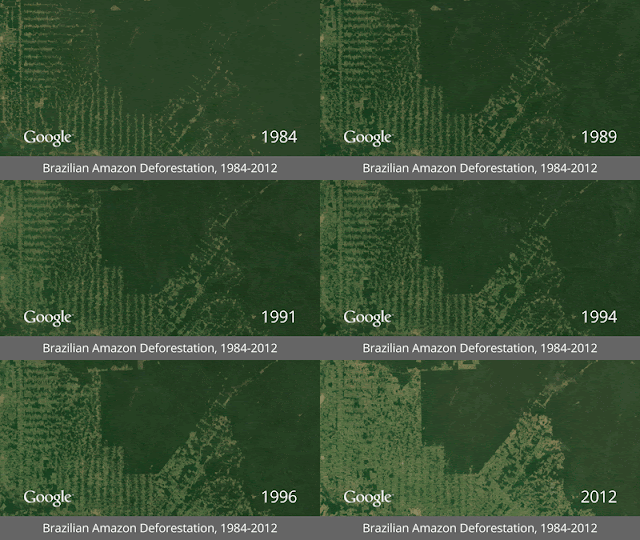
The images were collected as part of an ongoing joint mission between the USGS and NASA called Landsat. Their satellites have been observing earth from space since the 1970s—with all of the images sent back to Earth and archived on USGS tape drives that look something like this example (courtesy of the USGS).
We started working with the USGS in 2009 to make this historic archive of earth imagery available online. Using Google Earth Engine technology, we sifted through 2,068,467 images—a total of 909 terabytes of data—to find the highest-quality pixels (e.g., those without clouds), for every year since 1984 and for every spot on Earth. We then compiled these into enormous planetary images, 1.78 terapixels each, one for each year.
As the final step, we worked with the CREATE Lab at Carnegie Mellon University, recipients of a Google Focused Research Award, to convert these annual Earth images into a seamless, browsable HTML5 animation. Check it out on Google’s Timelapse website.
Much like the iconic image of Earth from the Apollo 17 mission—which had a profound effect on many of us—this time-lapse map is not only fascinating to explore, but we also hope it can inform the global community’s thinking about how we live on our planet and the policies that will guide us in the future. A special thanks to all our partners who helped us to make this happen.
Posted by Rebecca Moore, Engineering Manager, Google Earth Engine & Earth Outreach
Vincent.rech, Rodrigo.flores and -1 others like this
07 May 23:36
Drunk on Horse Milk: Fermented Koumiss
by AdrienneMayor
by Adrienne Mayor (Wonder & Marvels contributor)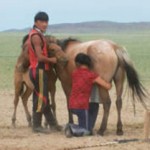
Amazons, those fabled women warriors of the steppes, were working mothers too busy to breastfeed. According to the ancient Greeks, they nourished their infants with mare’s milk. Since Homer, nomadic tribes from the Black Sea to Mongolia were known as “mare-milking Scythians.” That notion was exotic enough, but the Greeks would have been surprised to learn that the babies’ milk contained alcohol.
Milk from horses is nutritious but because of its high lactose content raw mare’s milk is a strong laxative. It requires fermentation to be a viable source of nutrition, even for babies. During fermentation the milk is agitated or churned like butter. The lactobacilli bacteria acidify the milk and yeasts create carbonated ethanol. The result is mildly alcoholic koumiss high in calories and vitamins. (Koumiss is similar to kefir, a fermented, less alcoholic milk drink of the Caucasus.) Scythian men and women preferred a stronger alcoholic punch than the drink given to babies. (One ancient Amazon’s name translates as “Drunkard.”) The nomads discovered how to enrich fermented milk by the process now known as “freeze distillation.” No strangers to snow, the nomads would allow the fermented milk to freeze, thaw it, remove the ice crystals, refreeze, and repeat until the desired alcoholic level was reached.
The Greek historian Herodotus (ca 450 BC) observed mare milk churning on a large scale among the settled Scythians on the Black Sea. They poured the milk into deep wooden casks, then stirred vigorously as it fermented. What rose to the top was drawn off and drunk. The early European traveler William of Rubruck, who trekked across the steppes ca AD 1250, watched the same process: “As the nomads churn the milk it begins to ferment and bubble up like new wine.” He sampled the effervescent beverage and found it pungent and intoxicating. “Koumiss makes the inner man most joyful!” Smaller batches of koumiss were fermented in leather bags by families on the move. In Inner Asia, the custom was to hang the sack where passersby could periodically punch the bag to agitate the koumiss. Koumiss is a favorite drink from the Black Sea to western China.
How ancient is koumiss? Historical linguistics and archaeology provide clues. The three most ancient alcoholic beverages are mead (fermented honey), kvass (beer), and koumiss. Kvass and mead have cognates in Proto-Indo-European languages, while koumiss derives from the ancient Central Asian Turkic language family. So koumiss originated along with the domestication of the horse on the steppes more than 5,000 years ago.
Lipids from horse milk can be identified on artifacts in ancient burials. Bowls containing residue of mare’s milk have been discovered in Botai culture dwellings of about 3500 BC in Kazakhstan. These people were among the first to tame wild horses. Evidence for fermented mare’s milk is also found in the graves of Scythian men and women. Special utensils for beating koumiss and drinking vessels with traces of horse milk are common grave goods. The famous Golden Warrior of Issyk (Kazakhstan) was accompanied by koumiss beaters and bowls that held traces of mare’s milk. In the grave of the tattooed “Ice Princess” (Ukok, Russia) archaeologists discovered a wooden stirring stick in a cup decorated with snow leopards. Inside the cup was the residue of koumiss that would sustain her in the Afterlife.
About the author: Adrienne Mayor is a Research Scholar in Classics and History of Science, Stanford University. She is the author of “Greek Fire, Poison Arrows, & Scorpion Bombs: Biological and Chemical Warfare in the Ancient World” (2009); and “The Poison King: The Life and Legend of Mithradates, Rome’s Deadliest Enemy,” nonfiction finalist for the 2009 National Book Award.
Scott Akerman likes this


02 May 22:45


Photographs Of Little People Show An Alternate World Hidden In The Streets
by udijw
London based artist, Slinkachu, uses model humans and everyday objects to create and photographs alternate happenings that may have been in your everyday-normal street.

In his project titled Little People, Slinkachu creates tiny installations of small people and leaves them on the street (as his clever tag line goes - Abandoning little people since 2006).
While the installations are an art by themselves, the photos of those installations are an important part of the art.
Each project is accompanied by a set of images (usually 3 ) showing the world (1) as seen by a fellow little person, (2) as seen by us humans, and (3) something in between. Here are the ones that go with the title image:
heya, reading this via Google reader? It is closing soon. If you are looking for alternatives, try feedly an awesome free RSS reader
Mr.michaelcox, Scott Akerman likes this
02 May 01:07

Extremely Bad Advice: Nude For Thought
by Steve Murray
Dear Steve, At what point in a conversation do I finally tell someone I’m picturing them naked?
 STEP ONE My mother always told me that honesty is the best policy, but she never took into account how horrible my brain would turn out to be. Ninety-five per cent of my thoughts are terrible little nuggets of nastiness, my base desires playing out scenarios unfit for whatever environment I’m in. Everyone around me becomes bit players in the tawdry production my mind concocts, no one the wiser to their second lives within my brain. If I ever told Janice that I imagine her as a 10-foot tall erotic clown she’d never speak to me again, or, I should clarify, would never begin speaking to me. Would I ever act on my thoughts of setting fire to my shoes and running across the office to make love with (not to) a photocopier? Probably not. So it’s sometimes best to just keep these ideas in our head where they hurt no one and don’t cause an unpleasant phone call with the copier repair person.
 STEP TWO So, the question here is, does your desire to tell people that you picture them naked fall into the “never tell” category? Of course not! What better way to let someone know that you’re summing them up as a potential sexual partner! Are you supposed to request that people disrobe so you can assess their bodies? That’s ludicrous and potentially embarrassing and probably illegal! And sure, you could keep your imagined disrobings to yourself, but a person’s reaction to the disclosure can reveal a lot about them. If they’re weirded out, they’re probably a normal person and not a good match for you. If they’re like, “Great! How do I look in your intrusive mind?” then I guess you’ve found your next spouse!
 STEP THREE But you can’t just spring this kind of thing on somebody right away, friend. You need finesse. A conversation needs to lead there. I often find myself trying to shoehorn discussions about Batman into relationship talks, so I know there needs to be a natural way in or my girlfriend will get really upset (again). It’s like travelling down a road and picking the best route to get to your destination instead of driving straight across a field or through a dog park. Try to maneuver the conversation towards bodies in general, either by discussing fitness or lesions that you may have. Then, casually drop, “Man, my body is terrible. I bet yours is pretty great though. I can totally picture it. I’m picturing it right now! Ha ha! No, seriously.”
 STEP FOUR Sometimes it’s just best to keep your thoughts to yourself. If you still feel a strong desire to reveal, then do what I do and keep a diary. Of course mine’s not so much a traditional “diary” as it is a sketchbook. A sketchbook called “Pictured Naked,” where I draw every adult I meet as I imagine them naked. Maybe start a similar sketchbook? And if you meet someone who you really feel you should open up to about your nude imaginings, you can always mail them your sketch. Who wouldn’t want to receive a nude sketch of themselves? I know I would, ℅ National Post, 1450 Don Mills Rd., Toronto, ON M3B 3R5.
Have a question for Steve? Then email smurray@nationalpost.com. Though it may be safer to snapchat.
Scott Akerman likes this
02 May 00:52
"Metrics of Affection" Raleigh Release Party!
by bombi
Scott AkermanYay! Not Cat's Cradle!
We're very excited to announce the release party for our new record "Metrics of Affection." We've got new songs to share and our friends Plume Giant will open the evening.
Saturday, July 27 at Lincoln Theatre in Raleigh, NC
Tickets on sale now. BUY HERE!

Photo by Harry Taylor
01 May 02:14
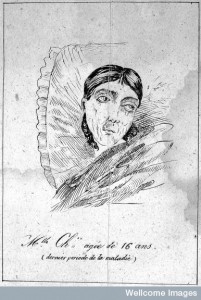
Masturbation and the Dangerous Woman
by Lisa Smith
By Lisa Smith, W&M Contributor
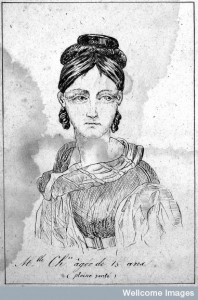
Before masturbation. Mlle Chxx aged 15 years (1836). Credit: Wellcome Library, London.
Remember all those playground stories about masturbation causing hairy palms and blindness? Those tales go way back. During the eighteenth and nineteenth centuries, much ink was spilled on the devastation that masturbation would cause. Men’s frequent self-pleasuring would destroy the fibres of their penis, and the masturbator would become effeminate, weak, infertile and leaky. The female masturbator, however, was discussed less often. But for a woman, there were two greater dangers: that she might lose control of her body and that her husband might lose control of her.
The anonymous author of The Ladies Dispensatory (1739) recounted two cautionary tales of masturbating women. One young woman abused herself between the ages of 14 and 19, resulting in a furor uterinus (nymphomania). During increasingly violent fits, the woman undressed and violently attacked any man nearby. She soon after died, at which point doctors and surgeons anatomized her. They found that her clitoris had swollen abnormally and that her blood appeared especially sharp and corrosive. In the other story, a young woman discovered masturbation at the age of eleven with her mother’s chambermaid. Seven years later, she had developed a clitoris so large that she appeared to be a hermaphrodite. The doctors attributed this to clitoral relaxation. Through masturbation, both young women became ‘masculine’ and sexually aggressive, with uncontrollable bodies.
Taken to its logical conclusion, the body of a female masturbator might even create its own offspring, independent of human action. Physician G. A. Douglas argued in his book, The Nature and Causes of Impotence in Men, and Barrenness in Women (1758), that false conceptions could be caused by self-abuse. He suggested that women needed vaginal stimulation in order to make an egg descend. If a woman used “those shameful implements” to stimulate herself, she would produce an egg that would remain unfertilised and grow so that it resembled a pregnancy. Women, he warned, “should know this and tremble”. Given the loss of bodily control, it is no wonder that female masturbation was seen as dangerous. Masturbation resulted in inverted social and sexual hierarchies: men became womanly and women became manly.
After masturbation. Mlle Chxx aged 16 years (1836). Credit: Wellcome Library, London.
However, this was not the only reason why the secret vice of women “strikes at the very root of fertility.” Most importantly, according to The Ladies Dispensatory, a wife who masturbated might be beyond her husband’s will. The fear was that barrenness would result from a woman’s “Indifferency to the Pleasures of Venus, and in Time a Total Ineptitude to the Act of Generation itself.” For example, one young lady wrote a letter to the anonymous author of Onania (1716) that she had learned masturbation at boarding school. She married at seventeen and produced three children within two years. Then her husband died and, for two more years, she eased her desires and comforted her loneliness through excessive masturbation. She became concerned three years into her second marriage when she had failed to produce any children. The physical symptoms included weakness, a bearing down of the womb and a pain in the back. Worst of all, though, she was not interested in “the Act of Procreation.” She complained that she had “very little or no Pleasure in the Act, which I am thinking may be as much as anything, the Reason I can have no children.”
The author of The Ladies Dispensatory included the case of a young woman who had been married for four years, from the age of seventeen. She masturbated regularly from the age of eleven and continued after marriage, even in preference to her husband. Her womb was so slippery that her periods had stopped and she had not yet become pregnant. The authors of Onania and The Ladies Dispensatory sympathised with the plight of the husband: “How must it grieve them [the women] when they find the ends of it [marriage] unanswered, and have room to charge their ineptitude to Procreation on their own fault? Both Husband and Wife perhaps may be passionately desirous of Issue, and the good man may think it a Defect in himself.” Through her lack of self-control, the masturbating woman brought disorder to the marital relationship. The husband, unaware of his wife’s activities, blamed himself for the failure to conceive and was unable to keep her sexuality under his control.
Overgrown clitorises? False pregnancies? Sterility? Failed marriages? The twentieth-century playground fears about masturbation had nothing on the eighteenth-century ones!
Lisa Smith is an Associate Professor of History at the University of Saskatchewan. She writes on gender, family, and health care in England and France (ca. 1600-1800). She also blogs weekly on history of medicine and science at her Sloane Letters Blog and edits The Recipes Project. She tweets as @historybeagle.
Scott Akerman likes this