Shared posts

19 May 16:56

embonpoint: Dictionary.com Word of the Day

embonpoint: excessive plumpness; stoutness.
17 May 21:35

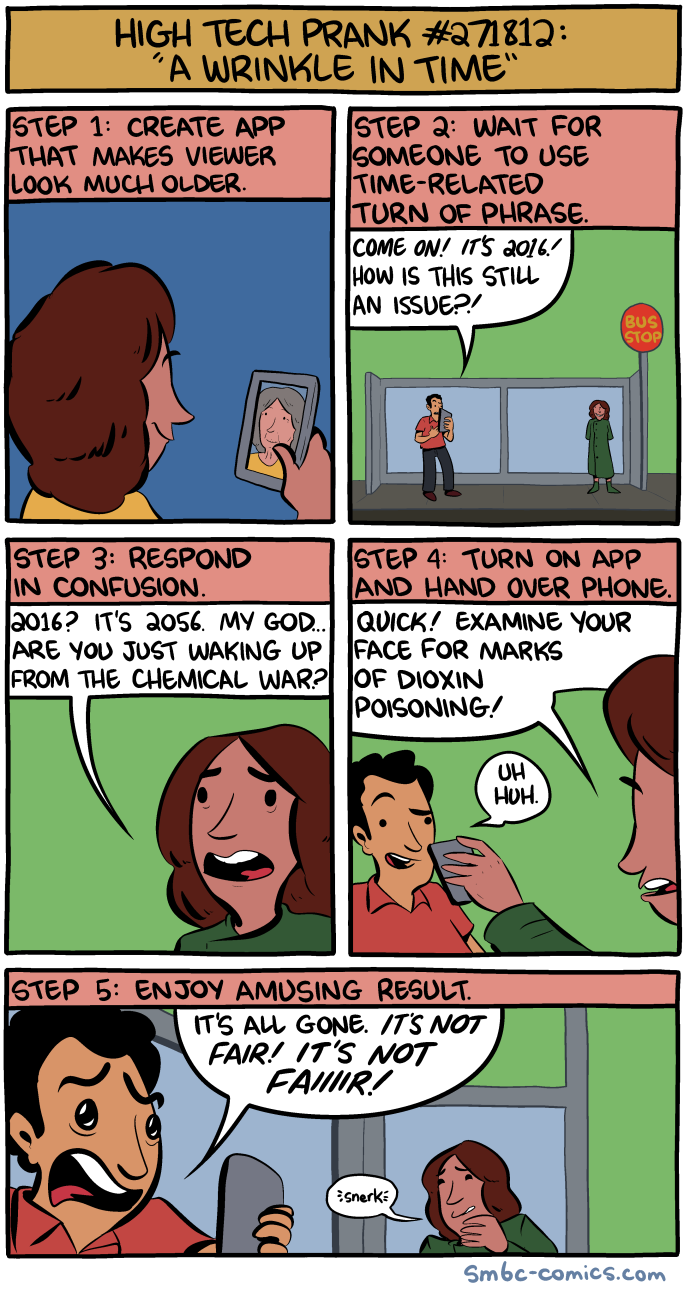
Saturday Morning Breakfast Cereal - Time Prank
by admin@smbc-comics.com

Hovertext: Anyway, Happy New Years 2032!


New comic!
Today's News:
16 May 15:31

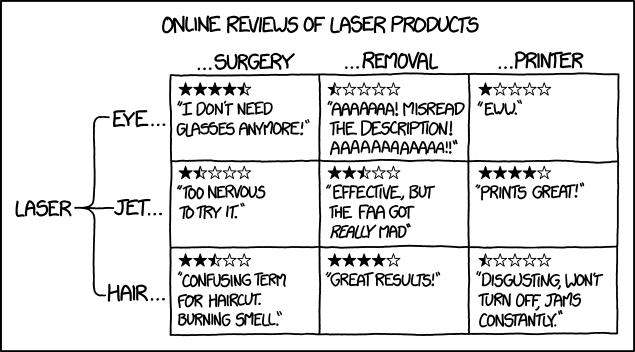
Laser Products

ERRORS: HAIR JAM. COLOR-SAFE CONDITIONER CARTRIDGE RUNNING LOW. LEGAL-SIZE HAIR TRAY EMPTY, USING LETTER-SIZE HAIR ONLY.
16 May 15:30

botryoidal: Dictionary.com Word of the Day

botryoidal: having the form of a bunch of grapes.
13 May 13:28

trophic: Dictionary.com Word of the Day

trophic: of or relating to nutrition.
13 May 13:26

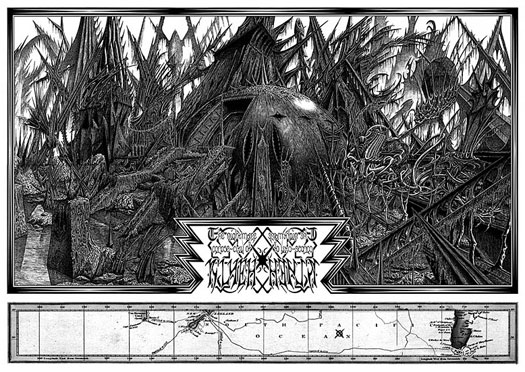
Lovecraft, Nerds And The Uses of Ick

by Zak Sabbath
You might not like Lovecraft, but chances are you like something Lovecraftian--like this or this. So, one more time, let's talk about Lovecraft....

Imagine someone loved, someone you know the story of: your brother, your dog, your lover, your parent, Prince, Lemmy, yourself--someone with a definite content you can imagine, with unique details that apply only to them.
Then imagine you discover their story has ended. They're done, as are their works. Something was continuous and unique and now it isn't anymore.

That's fear of death. That fear is not Lovecraftian. The weak, worried man and his bleak work were afraid of many things, not death so much.


In his most classic works, the ones that make him important to later writers, artists, filmmakers and game designers, death is rarely the point. Death is one of many by-products (insanity, disturbing hybridization, obsessive Cassandrian documentation) of a more terrible revelation. Half the time the monsters are barely active, much less murderous. The horror is simply that there was contact.

Alien is a lot like At The Mountains of Madness (and Prometheus is even more like it, as many folks have noticed) except when it's being a thriller--Jones! Here kitty kitty--that is, when it's afraid of death.

The old gothic horror's set dressing is death: skulls, skeletons, vampires--and the gothic has love in it, so that you care about the victim when death happens. Lovecraft was another thing: characters you didn't come to care much about discontinuing--or living right past the moment they might've died and instead, at the real climax, being made witness to a horror. And what was the horror of, if not of death?

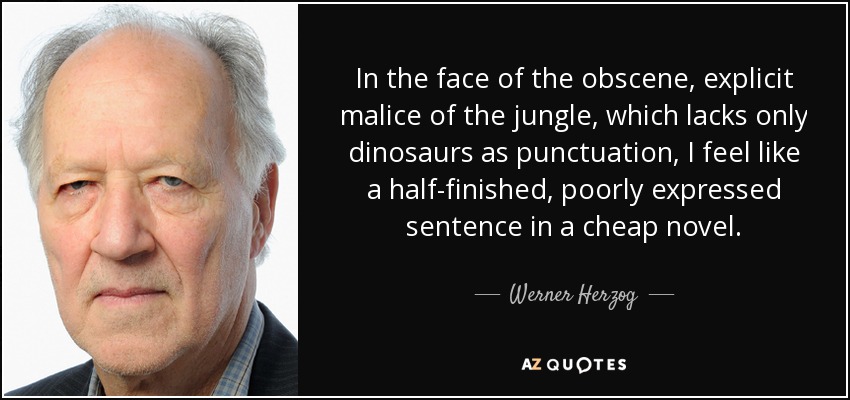
It was a horror of a pullulating, spawning, unknowable, inevitable and important otherness--that thing Werner Herzog was talking about when he went into the jungle and described as "…this overwhelming misery and overwhelming fornication...overwhelming growth and overwhelming lack of order." That is: life.


Autobiographically:

He faced death with courage. Struck by a cancer of the intestine which had spread throughout his body, he is taken to Jane Brown Memorial Hospital on the 10 March 1937. He will behave as an exemplary patient, polite, affable, of a stoicism and courtesy which will impress his nurses, despite very great physical suffering (happily attenuated by morphine).

That's from Michel Houellebecq's H.P. Lovecraft - Against the World, Against Life, which argues, well, that HP Lovecraft was against the world and against life. Ok, so he wasn't scared of dying, was he so weird as to be scared of living? Absolutely, totally and--in a letter written a few days before his improbable marriage--articulately:

And as for Puritan inhibitions-I admire them more every day. They are attempts to make of life a work of art - to fashion a pattern of beauty in the hog-wallow that is animal existence - and they spring out of that divine hatred for life which marks the deepest and most sensitive soul...An intellectual Puritan is a fool - almost as much of a fool is an anti-Puritan - but a Puritan in the conduct of life is the only kind of man one may honestly respect. I have no respect or reverence whatever for any person who does not live abstemiously and purely.

Lovecraft was so grossed out by sex, commerce and casual social ties that he left them entirely out of his fiction. As for race:

 The organic things inhabiting that awful cesspool could not by any stretch of the imagination be call'd human. They were monstrous and nebulous adumbrations of the pithecanthropoid and amoebal; vaguely moulded from some stinking viscous slime of the earth's corruption, and slithering and oozing in and on the filthy streets or in and out of windows and doorways in a fashion suggestive of nothing but infesting worms or deep-sea unnamabilities. They — or the degenerate gelatinous fermentation of which they were composed — seem'd to ooze, seep and trickle thro' the gaping cracks in the horrible houses ... and I thought of some avenue of Cyclopean and unwholesome vats, crammed to the vomiting point with gangrenous vileness, and about to burst and inundate the world in one leprous cataclysm of semi-fluid rottenness. From that nightmare of perverse infection I could not carry away the memory of any living face. The individually grotesque was lost in the collectively devastating; which left on the eye only the broad, phantasmal lineaments of the morbid soul of disintegration and decay ... a yellow leering mask with sour, sticky, acid ichors oozing at eyes, ears, nose, and mouth, and abnormally bubbling from monstrous and unbelievable sores at every point …

There are two remarkable things here: first--it's vintage Lovecraft. Second, it's not from The Horror at Red Hook, it's from HP's letter to a pal describing my grandfather's neighborhood in NYC. 

Lovecraft's specific brand of racism arose from disgust, the disgust from ignorance, the ignorance from another and larger fear: fear of unmediated intercourse with other people. That is: life.


Lovecraft is what happens when we take a familiar figure--the shy, nervous, fragile, conflict-averse, fastidious, introverted bookworm who is hopeless with money and whose main social outlet is nerd conventions--and put him in an era, class, family and professional situation where avoiding The Other is the path of least resistance. This is a man who never learned anything in a bar or a short-order kitchen or on a ballfield; he learned from parents and books and nothing he learned there taught him about these “italico-semitico-mongoloids” he lived among.

In these conditions his fear of life--which we can just go ahead and call his nerdiness--could only encourage his racism. I just want to be alone in bed with my books. And he is kind of a perfect test-case because he wasn't otherwise generally an asshole: people who he did mix with reported a courteous, kind, generous man, eager to reach out through amateur press associations (the pre-internet) to help fellow aesthetes through the terror and darkness that is this mortal coil and its ungentlemanly expectations.

He looked on New Yorkers with repulsion but he looked on New York with awe:

I fell into a swoon of aesthetic exaltation in admiring this view – the evening scenery with the innumerable lights of the skyscrapers, the mirrored reflections and the lights of the boats bobbing on the water, at the extreme left the sparkling statue of Liberty, and on the right the scintillating arch of the Brooklyn bridge. It’s something even more powerful than the dreams of the legend of the Ancient world – a constellation of infernal majesty – a poem in the fire of Babylon! (…) All of this happens under the strange lights, the strange sounds of the port, where the traffic of the whole world is concentrated. Foghorns, ships’ bells, in the distance the squeals of winches… visions of the distant shores of India, where birds with brilliant plumage are set singing by the incense of strange pagodas surrounded by gardens, where camel-handlers in their colourful robes barter in front of the sandalwood taverns with deep-voiced sailors whose eyes reflect all the mystery of the sea. 

...and, though not experience-curious, he was book-curious. He knew at least that the amoebas and pithecanthropoids that occupied its streets came from faraway places and these places had cultures--and it might be to this vision of the city and this knowledge that we owe an insight that makes his stories more than the sum of his terrified parts. The honest, perceptive, innovative artist in Lovecraft is decisively getting the upper hand over the arrogant racist whenever the stories remind us that the incomprehensible and inimical aliens are not just bigger, but older, wiser and immensely more sophisticated and significant than those they disturb.

This reveals a strange paradox of the imperial racist--the works of these foreigners are magnificent, their physical presence is loathsome. In Lovecraft, the "primitiveness" and "degeneracy" only come when the xenomorphs mix with-, or are worshipped by-, the humans--again, it is contact that is bad.

The racist made these stories horror stories, but the artist made them about gods. And if there are any gods, we should all be afraid of them. This is a fear that can be about many other things, it has legs.

Lovecraftian horror--the genre--is easy to copy: books, neuraesthenia, tentacles, all that. But if the ideas were all there were to it, we could just read Burroughs instead. Lovecraftian horror--the emotion--is rarer: disgust and awe in the face of the alien. 

Lovecraftian disgust and awe can be evoked in relation to things that don't appear anywhere in Lovecraftian fiction--for example, in Alien it's about the processes of human reproduction.


The awe is the reputable part, we understand awe, if not the objects of awe. So let's look at the disgust:

Mandy instantly dislikes anyone wearing a one-sleeved dress and I am suspicious of those who, for any reason, wear Crocs. Very many people, far past any genuine concern for physical safety, are scared to go into a porn theatre--or to certain bars.

These are minor examples of Lovecraftian disgust.

While Lovecraft was afraid of life and intercourse with people unlike himself, Lovecraftian disgust more generally--the kind the stories expand on and incarnate--is aesthetic, taste-based: an aesthetic fear so severe that it overrides the curiosity or sense of fairness that would discover whether that fear was justified.

It is kind of the opposite of Stendahl syndrome.

Lovecraftian disgust is not disgust at clear signifiers that death is near--wounds and wolf tracks--that would be rational. Lovecraftian disgust is never rational, it is emotional and emotions are evolution's first-drafts of thoughts, made for when there's no time for evaluation, or no imperative demanding one.

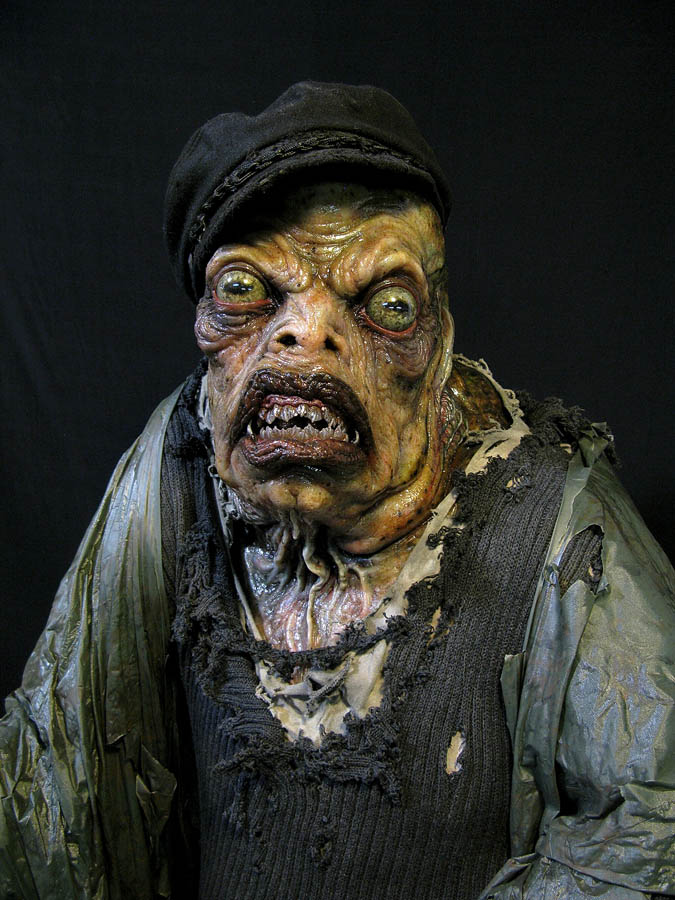
Lovecraftian disgust is visceral, the kind that goes ick. The feeling of having a gun to your head isn't ick. Ick is a fear of life--someone else's icky life. Fear of mollusks, for instance--which are totally harmless--is Lovecraftian.
ick

Once I met an art student who was making a really ugly painting of bearded men at prayer and doing it on purpose. I asked why and she said they were Muslim fundamentalists and she (she was of Middle Eastern descent) wanted to make Muslim fundamentalists look ugly and ridiculous and gross, and make people associate the image of fundamentalists with grossness. This was an attempt to recruit Lovecraftian disgust as a propaganda tool.

Likewise Trump complaining about how John Kasich eats is an attempt to recruit Lovecraftian disgust to political ends. But then so is the way we retweet how hideous Trump's toupee and terrible pigleather face are. 

In Taxi Driver, DeNiro's disgust is supremely Lovecraftian:

Whatever it is, you should clean up this city here, because this city here is like an open sewer you know. It's full of filth and scum. And sometimes I can hardly take it. Whatever-whoever becomes the President should just really clean it up. You know what I mean? Sometimes I go out and I smell it, I get headaches it's so bad, you know...They just never go away you know...It's like...I think that the President should just clean up this whole mess here. You should just flush it right down the fuckin' toilet. 

...as is Rorschach's disgust in Watchmen (created by avowed Lovecraft disciple Alan Moore)--in both cases the filth is clearly literal grime and a metaphor for every other sin in the city.

The dirt in a city, the tan, the toupee, eating, praying, the simple ugliness of people we think are ugly: all signs of life, not death. And icky.


Silence of the Lambs is a fascinating case: Hannibal Lecter is pure gothic--cold, crisp, polite, intelligent, quiet, patient, efficient, articulate, inevitable, living in a stone room, arguably charming. Like Dracula, he is asexual but apparently capable of a weird kind of romantic or at least personalized affection toward our hero and he is as bald as a skull. And he is seen killing, repeatedly, because people are in his way.

Buffalo Bill--whom he never shares a shot with--is sloppy, shifty, loud (always listening to music--and pop music, not dead people music like Lecter likes), awkward, breeds moths, has a dog and long hair and moans about fucking. Bill is all about life and therefore Bill is icky. He is a whole subculture of one down in his lived-in basement. (A trans friend who loves this film said she feared transitioning for years because she was afraid of being like Buffalo Bill.) And we never see him kill anyone--and even Lecter points out that for Bill, the murder is incidental--it's simply a result of Bill's total indifference to the lives of others while carrying out his own imperatives.

Lecter is bone, Bill is flesh.


As even the dullest bulbs notice, DIY D&D and OSR gaming in general emphasize the horror end of D&D--a lot more than TSR ever did. Part of it is the high mortality rate of the low-level game: If you're playing zero-to-hero D&D, then you'll lose a lot of zeroes and when this happens the only consistent aesthetic this really fits is either Dungeonmirth/Python style life-is-cheap black humor or survival horror. Horror is totally metal and horror is grimdark and those things, done well (ie like Warhammer used to do it) are both good.

LotFP: Weird Fantasy and other DIY D&Ders have often foregrounded horror--and occasionally even went ahead and claimed horror is helpful and good for you and worth pondering.

A formidable example comes from the poet Patricia Lockwood contemplating a Donald Trump rally, which I recommend you read but which I'll excerpt a bit of here to keep life linear:

It’s us, was the undercurrent. It’s just us in here. A handshake moved through the air as the speech walloped on, and then something more than a handshake. The more he spoke, the more Trump sounded like a rich man at dinner with a young woman whose passport is her face and her freshness, explaining to her the terms of the arrangement: that he would wear her on his arm, turning her toward the lights, that she would defer to him in public, that he would give her just enough of what he has to sustain her. I wrote in my notebook, “Trump is offering to be our sugar daddy? He wants to make America his trophy wife?” What he was really promising was freedom to move in the world the way he does, under his protection, according to his laws. Nobody owns me, he keeps telling us, not the lobbyists, not the Republican high-ups, not the Washington insiders. I’m not in anybody’s pocket; hop in mine. His wives, you might have noticed, grow lovelier and lovelier. It is a practiced seduction; it has worked before. We ignore it at our peril.

An example of the dangers of avoiding horror is offered by the RPG community itself:
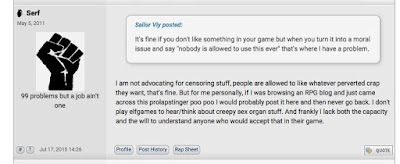
From Something Awful's RPG forum--where people go to reaffirm each others' Lovecraftian disgust about women not playing the same edition of D&D they do.
There's a decent chunk of people who think Lovecraftiana and other disturbing horror themes in games are badwrongfun--and in fact that all not-power-fantasy themes are badwrongfun--and they all have something in common: they definitely do not want to talk to gamers who disagree with them. They're cool with attacking them, smearing them, and even reading their books to make fun of them, but they view the idea of engaging them as a contaminating anathema. A good chunk of them would be suspicious of this essay simply because it contains someone talking about Lovecraft (who is icky).

Again: an aesthetic fear so severe that it overrides the curiosity or sense of fairness that would discover whether that fear was justified.

This person who attacked Scrap Princess for inventing a biohorror stinger monster said "I lack both the capacity and the will to understand anyone who would accept that in their game".

The person on RPGnet who attacked Shanna Germain and a part of the game Numenera she wrote said "When I read the Numenera page in question, I thought/felt 'Whoever wrote this is probably evil”--and many game designers and moderators piled on.

Fred Hicks--the game publisher who attacked Kingdom Death--refused to talk to the women who defended it or the creator of the game explicitly on grounds of his (Fred's) fragile mental health.

The designer who claimed sexy zombies appear in games because people are secret necrophiliacs explicitly refuses to talk to, say, women who cosplay as sexy zombies, refuses to talk to anyone who disagrees with them, like Fred, on grounds of fragile mental health and deletes them when they talk.

These acts of Lovecraftian disgust are the result of years spent in sheltered internet pockets being told there are no personal or professional consequences to dehumanizing someone just because they like something you think is icky--and nothing good can come of talking to someone less than human.

These sheltered, life-phobic souls: shy, nervous, fragile, conflict-averse, fastidious, introverted bookworms, whose main social outlet is nerd conventions, with their small circle of gentle hobbyist correspondents are, ironically, imitating Lovecraft because they haven't read Lovecraft, or haven't learned anything from reading him. They aren't recognizing the disgust they're feeling for what it is despite having its consequences cleanly personified in the historical record.

When there is ick, there is fear, where there's fear there is ignorance, where there's ignorance there's disgust, and where there's disgust, prejudice.

Not everyone needs to face every horror---but if you never learn from horrors, you become one.


12 May 16:47

Succubi Image of the Week 434

by TeraS

One of the characters in the Planescape universe is a Succubus who calls herself Fall-From-Grace. She is a Lawfully Neutral Succubus who owns the Brothel for Slating Intellectual Lusts. For me, at least, she’s the most interesting kind of Succubus there can be, one that has come to realize that she can be more, will be more, and in doing so, has found her own path in the universe.

I found a lovely work of art that I think gives a glimpse into her character, her strength, and most of all, the truth that she holds within herself. “I am more.”

Fall-From-Grace by SirTiefling

Fall-From-Grace by SirTiefling

This work is by the artist SirTiefling on DeviantArt and you can find the original page with this work here and this artist’s page can be found on DeviantArt here.

What strikes me most about this art is the haunting look in her eyes. It seems to me that the life that has lead her to this moment is reflected in them so very strongly. There is a force of will, of pushing against her own self, what she was expected to be and overcoming that in herself. But there also in her expression seems to be the constant reminder, ache, presence of her own nature that keeps tempted, pushing, trying to push her back towards what she was in the past.

In giving that look, her pose, the outstretched hands and wings, there’s a unspoken power there that just calmly says: “I shall not.” For me, that’s just an amazing reflection of her character, her story, and it is told well.


Tera

12 May 01:00

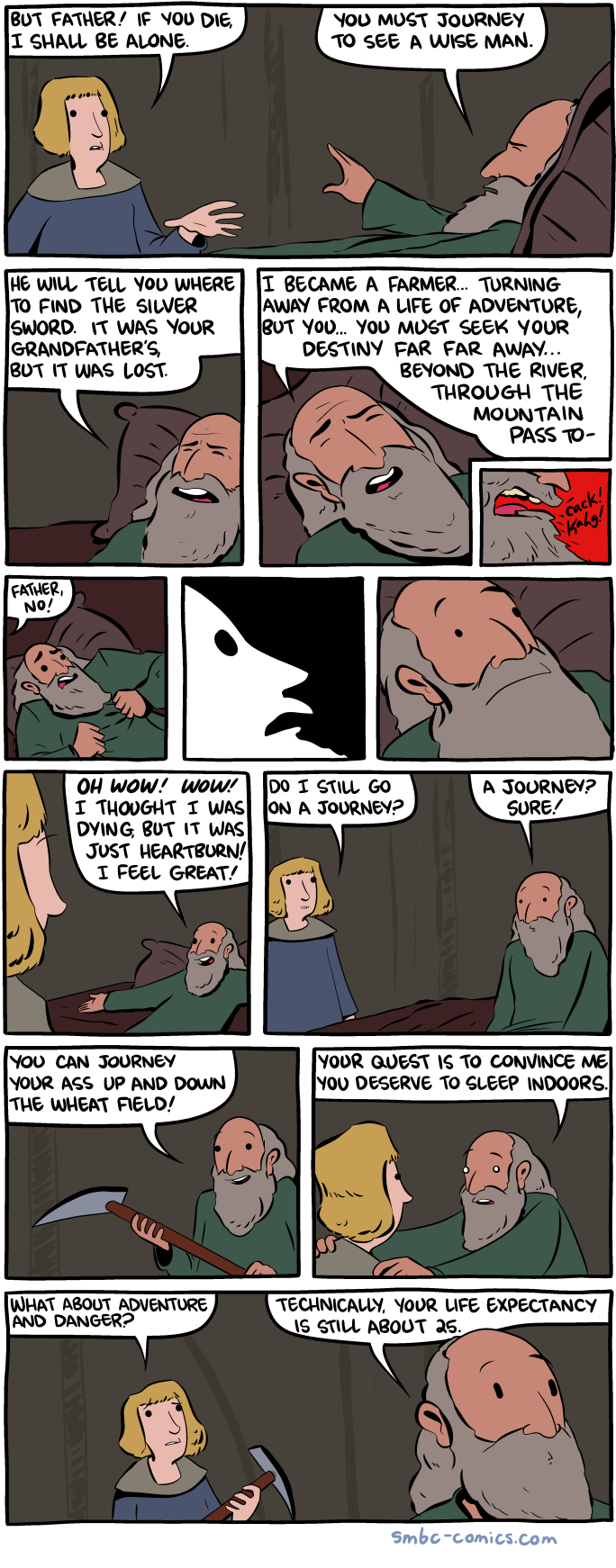
Saturday Morning Breakfast Cereal - Path of the Hero
by admin@smbc-comics.com

Hovertext: Peril lurks behind every bacterial infection!


New comic!
Today's News:
12 May 00:58

Facebook biased?

What? You can’t be serious!  I know we rip on Facebook a lot, but the idea that 63% of Facebook users consider it a news service is frightening.

Among Facebook users, 63 percent consider the platform to be a news service, according to a Pew Study. - New York Times

That’s not to say that people don’t get news from Facebook.  We know that they do.  But when did people give up on the process of getting informed?  I mean actual pursuit of information and knowledge.  Hanging out on Facebook, browsing US weekly in the checkout aisle, and watching John Oliver really shouldn’t count.

Seriously though, it’s fine.  You can read or not read whatever you like.  At least you can on a non-biased platform.  And I’ll step up to Facebook’s defense on this one and say that as a closed private network they can serve whatever the heck they want.  If conservative publications want more coverage, all they have to do is pay.

11 May 16:36

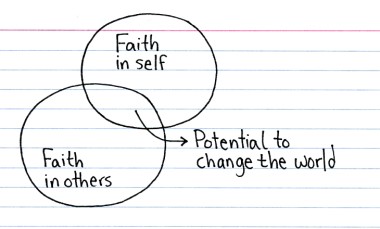
A society built on trust.

by Jessica Hagy

card4886

The post A society built on trust. appeared first on Indexed.

10 May 15:55

#745 Improper Fractions

by treelobsters
10 May 15:50

larruping: Dictionary.com Word of the Day

larruping: very; exceedingly.
08 May 16:20

oenomel: Dictionary.com Word of the Day

oenomel: something combining strength with sweetness.
08 May 16:19

quaff: Dictionary.com Word of the Day

quaff: to drink a beverage copiously and with hearty enjoyment.
06 May 16:34

A Mere Wrecca

by Zak Sabbath

Participants in- and gawkers at- the tabletop RPG scene will have noticed a theme in commentary on D&D and its ilk: Played in the default style, D&D doesn't come out like Tolkien, and this is the subject of much wroth and writhing. For instance, Burning Wheel--one of many attempts to remedy that and the world's accidentally funniest RPG--introduces itself like thiswise:

Like the old grand-daddy RPG, Dungeons and Dragons, Burning Wheel is nothing more than a template—a trellis for the vines of imagination to grow on. But unlike it’s [SIC] predecessors, this system is versatile and powerful; it can handle any fantastic situation with consistency and accuracy.... 
Without being hokey or gimmicky, the system attempts to create an accurate portrayal of the model that inspired all of these games, epic fiction. Initially my mission was only to build the proverbial “better system,” but my true motive emerged as the system took root. I wanted to construct a game that could create better stories—something closer to the thrilling narratives that we all grew up on and that still grip our imaginations.

One of the very many absolutely undyingly adorable things about this intro is the author's faith that everyone of literate age grew up on "epic fiction" and not, say, Conan or Fafhrd & Grey Mouser or Arzach or James and the Giant Peach thus justifying his game's desire to be "closer" to a model he presumes all stabgames aspire to.

JRR Tolkien himself addresses just this kind of confusion in his lecture on Beowulf...

Nearly all the censure, and most of the praise, that has been bestowed on Beowulf has been due either to the belief that it was something that it wasn't, for example, primitive, pagan, Teutonic, an allegory (political or mythical), or most often, an epic; or to disappointment at the discovery that it was itself and not something that the scholar would have liked better--for example, a heathen heroic lay, a history of Sweden, a manual of Germanic antiquities, or a Nordic Summa Theologica.

At the heart of the concern that D&D isn't a Tolkien epic is the figure of the murderhobo--the greedy engine of unplotted terror that haunts the dreams of aspirationgamers everywhere. Urban Dictionary:

Murderhobo: The typical protagonist of a fantasy role-playing game, who is a homeless guy who goes around killing people and taking their stuff. The term originated in discussions of tabletop role playing games by authors seeking to create games aimed at styles of play not supported by traditional games like Dungeons & Dragons.

Typical forum post dredged up by random googling:

The murder hobo has been a problem for RPGs for years. These characters have no purpose or reason aside from killing people, taking their stuff, and then buying better tools to kill more people with. While we all admit these characters are a problem, we don't always have a suggestion for ways to fix them.

Typical blog dredged up by random googling:

If you feel you or players at your table are at risk of allowing a murder hobo (or worse a pack of them!) to flourish then follow these simple steps to inject genuine character and pathos into your game...

Heavens! A pack you say?

Notwithstanding the fact that even Robin Laws seems to not grasp the awesome storytelling possibilities of murderhoboes, intelligent gamers have long been aware of them. However, it's interesting to note Tolkien, the sore spot and source-point of all these dreams of morally-redemptive mythopoesis, himself creeps up to the edge of a similar complaint against Beowulf:

The plot was not the poet's; and though he has infused feeling and significance into its crude material, that plot was not a perfect vehicle of the theme or themes that came to hidden life in the poet's mind as he worked upon it. Not an unusual event in literature. For the contrast--youth and death--it would probably have been better, if we had no journeying. If the single nation of the Geats had been the scene, we should have felt the stage not narrower, but symbolically wider. More plainly should we have perceived in one people and their hero all mankind and its heroes. 

This at any rate I have always myself felt in reading Beowulf; but I have also felt that this defect is rectified by the bringing of the tale of Grendel to Geatland. As Beowulf stands in Hygelac's hall and tells his story, he sets his feet firm again in the land of his own people, and is no longer in danger of appearing a mere wrecca, an errant adventurer and slayer of bogies that do not concern him.

...and if you're fun you immediately go Who's this wrecca? Tell me all about this motherfucker. And if you're really fun you have access to Bosworth's Anglo Saxon Dictionary:

Wrecca, Wræcca: one driven from his own country, a wanderer in foreign lands, an exile, a stranger, pilgrim.

From wrecan--to drive (out) or to avenge--like the Swedish vrak--trash, the Icelandic rek--anything drifted ashore, related to wreck, of course, and wretch and wreak (as in vengeance or havoc).

Wrecca. Good name for a game.
-
-
-
06 May 16:29

The IKEA effect.We love it more if we made it. Or, more...


The IKEA effect.

We love it more if we made it. Or, more scientifically perhaps, the IKEA effect is ‘the increase in valuation of self-made products,’ when we have put more effort into it. 

Watch Dan Ariely do a great job explaining some experiments that lead to this conclusion, or read the full paper, The “IKEA effect”: When Labor Leads to Love (pdf), Norton, Mochon, Ariely HBS working paper, 2011.

Turns out, if we’ve put effort in ourselves we’re also likely to think that others will like it even more just as we do—usually not the case. But for us at least, more effort = more love.

Dan points out that kids are the ultimate expression of the IKEA effect: they’re very hard, they don’t come with instructions and they take a lot of effort…

Also see The Betty Crocker Effect, or ‘the egg theory.’

02 May 11:55

jeremiad: Dictionary.com Word of the Day

jeremiad: a prolonged lamentation or mournful complaint.
30 Apr 15:45

prink: Dictionary.com Word of the Day

prink: to fuss over one's dress, especially before the mirror.
30 Apr 15:45

gonzo: Dictionary.com Word of the Day

gonzo: filled with bizarre or subjective ideas, commentary, or the like.
30 Apr 15:44

amanuensis: Dictionary.com Word of the Day

amanuensis: a person employed to write what another dictates; secretary.
30 Apr 15:44

flivver: Dictionary.com Word of the Day

flivver: an automobile, especially one that is small, inexpensive, and old.
30 Apr 15:33

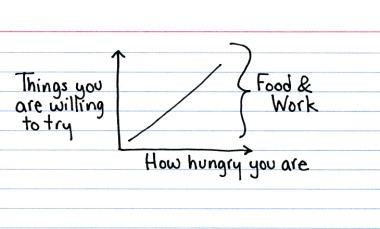
Okay; I’ll try it.

by Jessica Hagy

card4878

The post Okay; I’ll try it. appeared first on Indexed.

30 Apr 15:31

Oh, my bad.

by Jessica Hagy

card4877

The post Oh, my bad. appeared first on Indexed.

30 Apr 15:30

Volunteer your own booking fee.Whenever I think of the...


Volunteer your own booking fee.

Whenever I think of the convenience of someone doing something for me I usually conclude it’s easily worth a tip. So I have taken to adding one. Then hopefully they’ll be happy to do it again in the future too.

30 Apr 15:30

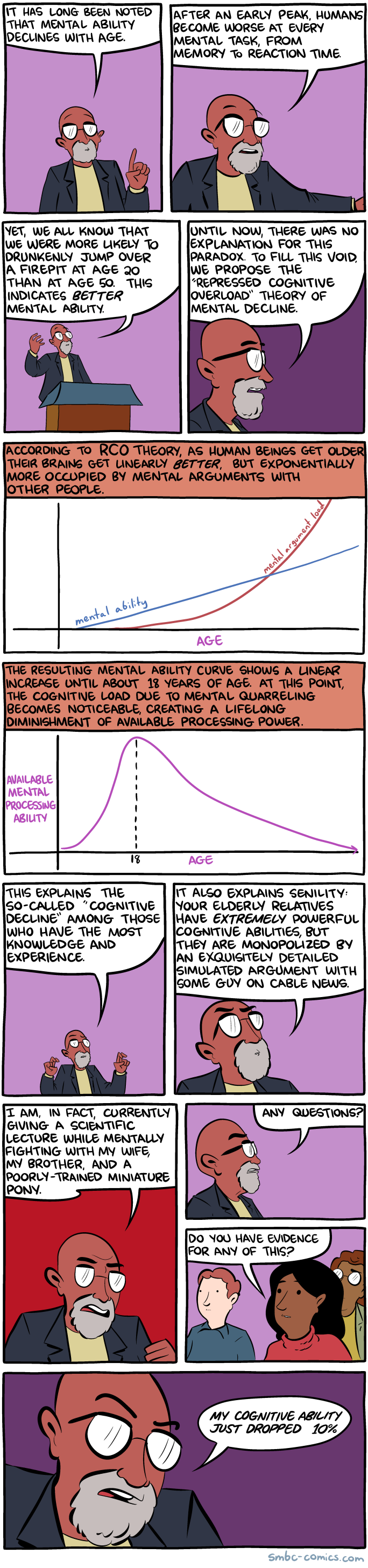
Saturday Morning Breakfast Cereal - Cognitive Decline
by admin@smbc-comics.com

Hovertext: Interestingly, YOU'RE getting dumber too!


New comic!
Today's News:

Hey Patreon patrons-- tomorrow's comic will be posted a bit late, since I've got a bad stomach flu. Sorry! 

30 Apr 15:30

dippy

by Author

dippy

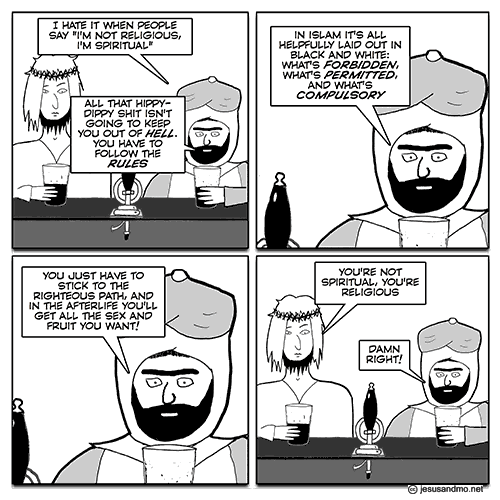
Support J&M via Patreon. It’s not compulsory, but it is permitted.

26 Apr 11:50

#744 Host of Problems

by treelobsters
26 Apr 11:46

Women on 20s

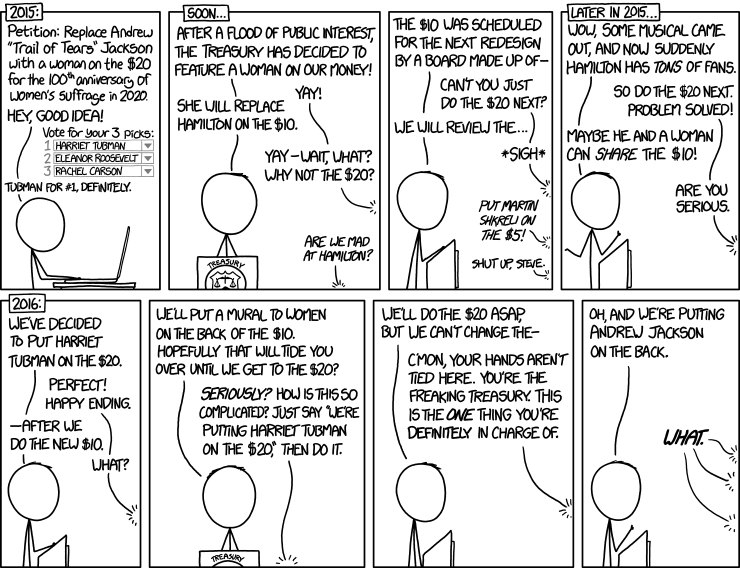
I get that there are security reasons for the schedule, but this is like the ONE problem we have where the right answer is both easy and straightforward. If we can't figure it out, maybe we should just give up and just replace all the portraits on the bills with that weird pyramid eye thing.
23 Apr 16:26

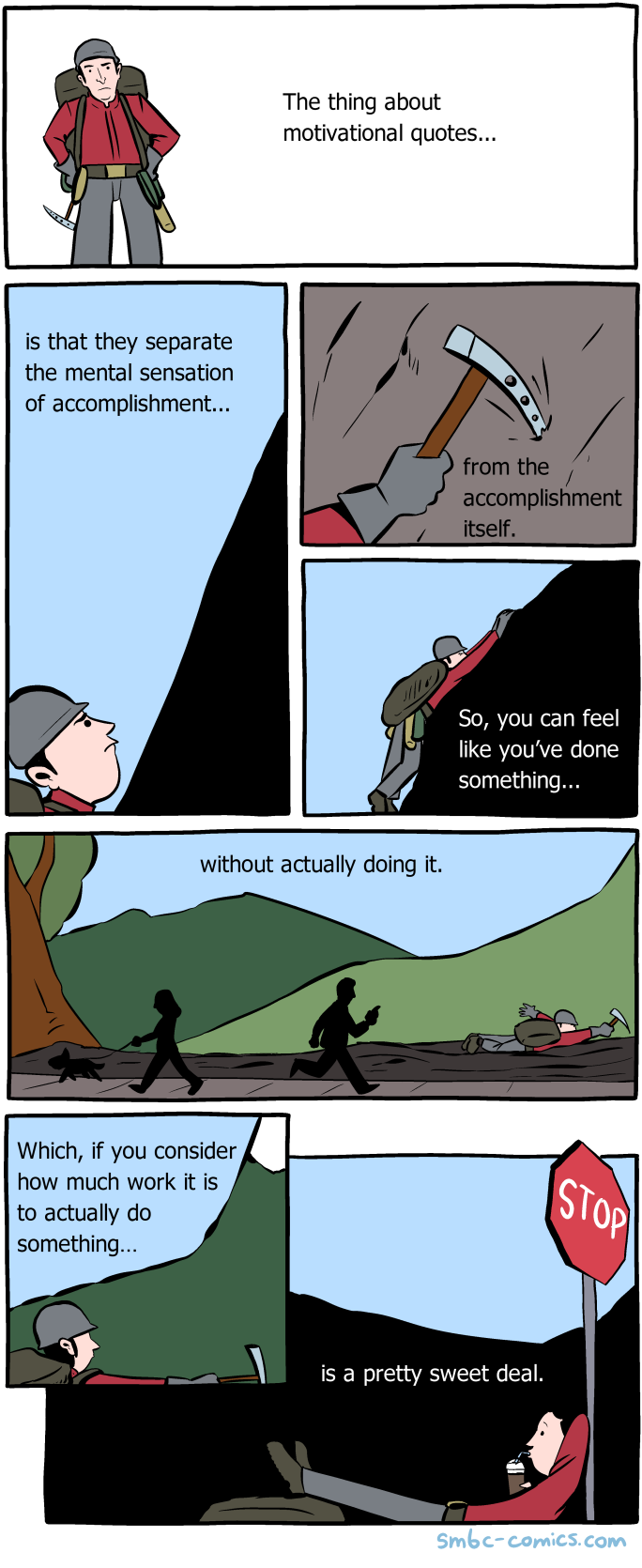
Saturday Morning Breakfast Cereal - Motivation
by admin@smbc-comics.com

Hovertext: Let it never be said that Weinersmith stopped crapping all over people's hopes and dreams.


New comic!
Today's News:
23 Apr 16:23

Important people in your life.

by Jessica Hagy

card4872

The post Important people in your life. appeared first on Indexed.