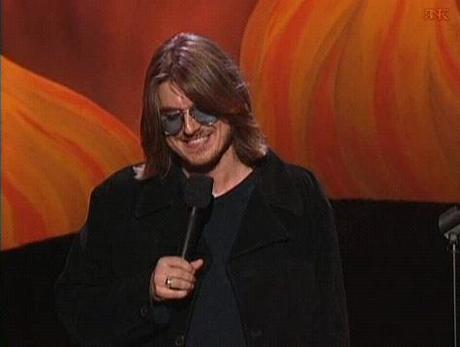
Hey, polar bear! Dirt's not food!

David Gordon Green’s new movie Joe, in theaters this weekend, is a bleakly funny rural noir about an ex-convict trying very hard to keep his rage in check. Because Joe is played by Nicolas Cage, you can imagine how well that goes. We believe in Joe’s struggle to maintain control because we’re also watching Cage keeping his Cageness holstered; we also know the explosion is inevitable, that life can pour only so much vinegar into Joe’s baking soda before science takes its course. But Green lets the story wander, pause, digress. A girl moves into Joe’s house, then moves out. A lost dog gives Joe and his teenage buddy — played by Mud’s Tye Sheridan, just about the only other recognizable actor in the cast — an excuse to get drunk during the day and practice their cool-guy faces. After I saw the movie at a film festival in March, I wrote that this sequence is the best intentionally comedic acting Cage has done since Adaptation back in 2002.
Did I mean that as an outright dismissal of everything he’s done since then, comedically and otherwise? Not exactly, not quite — but I wrote it knowing it could be read that way. Many years ago, Jonathan Lethem suggested that rock critics love to hail each new Bob Dylan album as “Dylan’s best work since Blood on the Tracks” because it frees them from the hard work of grappling with Dylan’s confusing output between 1975 and the present. There’s a point at which an artist’s productivity becomes inconvenient; the idea of a “return to form” gives messy oeuvres the illusion of shape and cuts them down to manageable size. I felt guilty about doing this to Cage, though. By writing off the last 10-plus years of his filmography, I was dismissing movies I mostly hadn’t seen, made by a gifted and enthrallingly odd actor who’s never required stellar material to do interesting work. Plus, I totally forgot that Bad Lieutenant: Port of Call — New Orleans came out in 2009, years after Adaptation, and — among its many other virtues — is really fucking funny.
I started to think about Cage’s narrative, and whether it had become a truism. The narrative goes like this: As Nicolas Coppola, nephew of Francis, he breaks in with a bit part as one of Judge Reinhold’s fry-cook buds in Fast Times at Ridgemont High. As Nicolas Cage, he breaks out as a sweetheart punk rocker in Valley Girl. He builds a reputation with unaccountably eccentric and tempestuous comedic performances in Peggy Sue Got Married, Raising Arizona, and Moonstruck, then somehow cements it by actually eating an actual cockroach onscreen in Vampire’s Kiss.
In 1995, he plays a man whose resolution to kill himself with booze brings on a kind of beatific clarity in Leaving Las Vegas, and wins an Oscar. Then, between 1996 and 1997, he appears in The Rock, Con Air, and Face/Off, three massively successful summer blockbusters, each better than the one before it, and after that the through-line kind of disappears. He works with Scorsese, he works with Brett Ratner, he makes the sleazy/brilliant Snake Eyes and the sleazy/laughable 8MM, he plays an angel, he plays the mandolin for Penélope Cruz.
He makes a lot of money and spends it like a tipsy sultan. Eventually, this becomes an issue. His profligacy is reportedly rap-video-ish. He buys houses all over the country, a fleet of cars and motorcycles, Gulfstream jets, yachts, a Bahamian island, rare Superman and Batman comics, exotic animals, and a possibly stolen Tyrannosaurus bataar skull that he obtains at auction after outbidding fellow fossil-collecting leading man Leonardo DiCaprio. He buys two castles, one in England and one in Germany. He buys a mansion in New Orleans that’s putatively haunted by the ghost of a deranged 19th-century French Creole socialite and the slaves she’s said to have tortured and murdered on the premises.
In 2009, the IRS hits him up for $6 million in back taxes, after which his filmography takes a turn for the paycheck-y. Over the last decade, Cage’s films have made hundreds of millions of dollars — 2007’s National Treasure: Book of Secrets is his highest-grossing film ever, edging out 1996’s The Rock — and he’s been paid handsomely to star in them. His involvement with the National Treasure franchise alone should logically have freed him up to spend his off years making weird art films, or doing nothing, but he needs the money, so he works, three or four times a year, and seems to be what I will clear my throat and call somewhat indiscriminate about what kinds of jobs he takes.
Gradually the outlandish bug-eating-weirdo image he cheerfully cultivated in the ’80s and ’90s and the outlandish purchases and the outlandishly stylized performances and the increasingly lopsided bad-to-good-movie ratio all fuse together into one giant joke about the whole idea of Nicolas Cage, until Cage himself becomes the joke. Online, he becomes not just a meme but a whole branching forest of memes; he becomes the subject of that unique-to-the-Internet kind of love that’s essentially indistinguishable from hatred. People Photoshop him onto everything. Picolas Cage becomes a thing that exists.
All of it is understandable and none of it is fair. Since the turn of the century, Cage has made more good movies (and more interesting bad ones) than Johnny Depp, but somehow Depp remains One of Our Finest Actors and Cage is Grumpy Cat. He’s always been a fascinating actor whose greatest performances were riven with fascinating faults; now he’s been reduced to just those faults by a degraded cultural marketplace that can increasingly do nothing but point and say, LOL, fail. Cage deserves better. As Ethan Hawke, who costarred with Cage in 2005’s Lord of War, put it in a Reddit AMA a few years back: “He’s the only actor since Marlon Brando that’s actually done anything new with the art of acting; he’s successfully taken us away from an obsession with naturalism into a kind of presentation style of acting that I imagine was popular with the old troubadours. If I could erase his bottom half bad movies, and only keep his top half movies, he would blow everyone else out of the water.”
But wait, Ethan Hawke: What if we’re ignoring Cage’s work in the bottom-half bad movies just because they’re bad? What if Cage is a kind of actor whose output can’t be properly valued without some serious recalibration of our entire value system? I decided it was time to reopen the case. I wasn’t about to watch or rewatch Cage’s whole filmography — it’s been done, and it didn’t go well for Abed when he tried it on Community this season. Besides, you don’t need me to tell you that Raising Arizona and Face/Off are masterpieces, and that 1993’s Deadfall, in which Cage seems to be basically playing Tony Clifton, may in its own way be one, too. No — just to put my own assumptions to the test, I’d focus on his most universally maligned decade of work, the from-hunger-prolific 10-year period between 2004 and today.
I would dispense with the notion of ranking these movies from best to worst. “Best to worst” is a useless concept here. Ranking Cage’s post-2004 filmography based on how much his hair does or doesn’t resemble Ralph Cifaretto’s would tell us as much and as little. And I dispensed with chronology in favor of chance, hoping hidden themes would reveal themselves.48 I kept a diary. As I read over it, I see that I am not the same man I was a week ago.
Forgot that Ghost Rider begins with narration by Sam Elliott, as if Johnny Blaze were the Dude of the netherworld. Decent gonzo-Cage performance, upstaged by (of all people) Peter Fonda, who really serves up the hellfire fondue as Mephistopheles.
Unofficial rule for this week: no clicking around on the Internet while Cage movies are in progress, unless it’s to seek out and read supplemental Cage material. During Ghost Rider, I read about the nine-foot pyramid-shaped tomb Cage bought himself a few years ago, to the unending delight of those who delight in snickering. For what it’s worth, the pyramid is a not-atypical example of a memorial from the mid-1800s Egyptian Revival period, an era of American architecture that also produced buildings like the Washington Monument.
As the website The Curator of Shit notes in a post headlined “Omnia Ab Uno: Nicolas Cage’s Tomb Is Not As Dumb As You Are!” Cage’s pyramid is “quite appropriate within a cemetery that is largely from before the Civil War in New Orleans.” The same post also suggests that “it wouldn’t hurt any of our social commentators to learn at least a little bit about our national history, if in fact they wish to accurately report on culture in a national context.” Hilarious!
Over and above that, though: Why should Cage’s deathstyle not be in keeping with his lifestyle? The more I read about Nicolas Cage, the more I empathize with his status as an eccentric genius persecuted by a brain-dead culture and/or this country’s unfair tax system. That I just did my taxes and learned that, as an all-1099 employee, I owe Uncle Sam the cost of a small pyramid has nothing to do with this.
Watched Cage in Bangkok Dangerous, directed by the Chinese brother team Danny and Oxide Pang, remaking their own 2000 Thai-language film.
Cage plays an assassin gearing up for one last job. His hair is preposterous. Shoe-polish black, like Skrillex’s. There’s a sense throughout the film of more being done with less, as in the scene where Cage answers the door in a black tank top, shoulders and chest fur misted with sweat, a costuming decision that indicates his character has just finished working out without requiring Cage to actually exert himself onscreen.
Some good wordless face-acting on Cage’s part in his falling-in-love scenes with a mute Thai woman (Charlie Yeung, from many Kar Wai Wong and Hark Tsui movies) but the rest is as pointless/hard to follow as the movie’s reputation and 9 percent Rotten Tomatoes score would suggest. Plot: Cage, on aforementioned last job, agrees to teach a young Bangkok dude how to assassinate people the Nicolas Cage way. Training montage: Young Bangkok Dude shoots at lined-up melons ineffectually while Nicolas Cage, watching from his left, strikes comically exaggerated it-pains-me-to-watch-this poses.
Lots of dad/mentor figures for Cage in this period: He has an apprentice in this, and presumably in The Sorcerer’s Apprentice, which I never got around to. As the Adam West–inspired Big Daddy in Kick-Ass, he has a daughter who’s also an apprentice. He has a kid in Stolen. He has a kid in The Weather Man. Even Bad Lieutenant: Port of Call — New Orleans gives him a teenage witness and a dog to take care of, for a while. Compare and contrast with Tom Cruise, who’s only one year older than Cage and like Cage is a father in real life, but seems determined to play one onscreen as infrequently as possible, as if safeguarding some aura of action-hero youthiness even as he settles into his fifties.
I read an October 2013 Hollywood Reporter story about Cage, in a press conference with Chinese state television, bemoaning Hollywood’s refusal to cast Asian male actors in things. Cage says he’d like to someday work with Tony Leung, star of seven Kar Wai Wong movies. Cage says, “One of my goals is to have a base near mainland China.” Noted: Cage’s oddly Cobra Commander–ish use of “base,” rather than a word like “home,” and his oddly specific use of “near,” as if a base on mainland China would be unsuitable for his purposes. Do they not have hollow-outable volcanoes there?
I read a Time magazine article about a Nicolas Cage–themed art show taking place April 12 in San Francisco. Person responsible: 35-year-old Ezra Croft, “who works at Bed Bath & Beyond and moonlights as a DJ and event planner.” Time notes that Croft came up with the idea after attending “an art show that seemed boring and stuffy. Art, he felt, should be more fun and more interactive than what he was used to seeing.” Art shows: boring and stuffy! Hypothetical scene: sound of needle skipping across record as Ezra, a.k.a. DJ Bed Bath & Beyond — in two-different-colored Converse and possibly blazer with sleeves pushed up — leaps onto art-museum pedestal, dislodging boring old statue. Elderly arts patrons look on scandalized as Croft’s minions begin tearing down Monets and Rembrandts and replacing them with funny coffee-shop art of Nicolas Cage.
Croft assures Time he means Cage no offense. “It’s kind of like when you’re in grade school and you draw a picture of your teacher with a horse body or something funny like that,” Croft says. Actually having a point of view w/r/t your subject: not fun/interactive, apparently! Croft’s upcoming projects include a show inspired by Bill Murray — “whose face Croft just so happens to have tattooed on his arm” — and possibly an exhibition of mustache-themed art. Fingers crossed. Croft is clearly a Buzzfeed bacon/kitten slide-show-building algorithm that has achieved sentience. This is how the Age of Ultron starts.
And I read some Netflix comments about Trespass, the 2011 thriller with Cage and Nicole Kidman as a married couple menaced by burglars, Cage’s first Joel Schumacher collab since 1999’s 8MM. From a five-star member review: “This movie is about a bunch of disorganized burglars: That is true. What is also true is that many burglars are indeed disorganized, especially when they are portrayed as drug addicts and pole dancers, which is the case in Trespass.” (Who are you to impugn the organizational skills of pole dancers, anonymous Netflix member? Tidy your own queue!) I make a note to not watch Trespass.
Bad movies/scripts leave Cage exposed. His waving looks more like drowning.
Thought of this while watching Stolen. Cage plays a master thief who’s also a doting father and a superstitious Credence fan. He listens to their music before every job, annoying his partner, played by Josh Lucas. This is not all they disagree about. During a bank-vault heist, Cage wants to just take the cash and run, but Lucas has his eye on a giant pile of gold bars, valuable but tough to move. “In this bag is enough for us to disappear!” Cage insists. “No need for any more jobs.” But Josh Lucas won’t listen.
Oh, and: director is Simon West, of Con Air fame. First thing Cage does upon release from prison, practically, is buy a big blue teddy bear for his once-little daughter, just like Cameron Poe with the bunny. Except his daughter is now angst-ridden/in college and therefore too old to be bought off with stuffed animals. Very effective pan from the teddy bear’s goofy-cute face to Cage’s own, sporting that please-love-me-although-I-am-a-monster look Cage is so good at.
Thought: Cage loves to play a bad man with a good side (usually a good side that feels added during the revision phase of the screenwriting process, possibly in response to script notes from Nicolas Cage). Is there a part of him that feels similarly divided/doubled and wishes to express that? First thing you read in every bio of him ever written is the part about how Nicolas Coppola changed his last name — supposedly to avoid the appearance of having exploited his connection to uncle Francis Ford Coppola, although not accepting roles in Rumble Fish or The Cotton Club or Peggy Sue Got Married might have scotched that notion more effectively. Was the name change really about something else, some deeper self-effacement?
Stolen is trash, but some intriguing dual-identity/masking themes run through it. Cage steals a Mardi Gras mask at one point to elude pursuing feds. An FBI agent (Danny Huston) puts on a Popeye Doyle hat for the big bust. The movie itself was originally called Medallion, but was released as Stolen to capitalize in some tenuous way on the success of Taken; it’s a film with a stage name. Most important, when Josh Lucas’s character resurfaces, he’s lost a leg below the knee and changed his whole look to fool the law. New look: blond stringy wig, tattoos, yellow aviators. He looks like an evil Mitch Hedberg. You know who he really looks like, though? Nicolas Cage! Accordingly, it’s Lucas and not Cage who gives the great Cage performance in this movie — weird mannerisms, questionable hair, gets to stick his face in the camera and say things like, “I used to be a golden boy, dollface! Now, I’m a freakin’ Picasso!” In that sense Stolen is a Cage-vs.-Cage film, part of a subgenre that also includes Adaptation and Face/Off (Travolta-playing-Cage vs. Cage-playing-Travolta vs. your ability to suspend disbelief vs. the Caesar haircut vs. flocks of slow-motion doves).
Great expository turn by M.C. Gainey, as another of Cage’s old associates: “After he lost the leg, something changed in him … He said he just felt numb to everything. Numb, like a statue … He blames it all on you, Will. He blames the leg on you, so he blames the numb on you.” Got it.
Netflix suggests jumping right into Seeking Justice (2011, Roger Donaldson), so I do. Cage plays a New Orleans high school teacher. Sparse goatee, fake hairline sculpted into approximation of receding hairline. As regular a guy as he’s played since Mr. Asswipe Johnson.
Cage is married to January Jones. They have those fancy leaning bookshelves and engage in effete leisure-time activities — Jones plays the cello, Cage plays chess with his cool black friend Harold Perrineau. You can tell they’re soft-handed intellectuals doomed to get Straw Dogs’d by violent reality. Soon Jones is raped at gunpoint. A bald Guy Pearce shows up at the hospital and tells Cage he can arrange for her rapist to be killed if Cage agrees to do him a favor TBD. Other than Pearce turning out to represent a shadowy group that takes recent personal-tragedy sufferers and dangles the promise of revenge to trick them into working as hit men, what could go wrong?
Again, trash. You maybe do not look to the director of Cocktail for a psychologically nuanced depiction of the aftereffects of sexual assault on a marital partnership. Flip side of the Cage-exposed-in-bad-movies thing, though: His work is still fascinating to observe even when it looks like work. Some actors make their acting invisible; Cage makes you think about what acting is and how weird it must be to do it for a living.
There’s this scene where Cage stands at a vending machine, trying to decide whether or not to buy two candy bars and thereby signal to Guy Pearce that he’s taking Pearce up on his rapist-killing offer. This scene requires Cage to communicate, in wordless close-up, that he is (1) deciding whether or not to sanction the killing of his wife’s rapist, (2) feeling paranoid that the overweight cop who’s watching him buy the candy bars knows what he’s up to, and (3) thinking of his poor wife, how she smacked his hand away when he tried to touch her cheek as she lay on her hospital bed. Imagine trying to sell those three ideas just by doing things with your face muscles. It’s amazing that all actors aren’t more insane.
Watching The Wicker Man, thinking about how meme culture pathologizes the inherent strangeness/willingness to Go There that is Cage’s greatest strength, inadvertently reinforcing a set of conservative ideas about what is and isn’t good screen acting. Not defending The Wicker Man per se by saying this, but is there any actor whose body of work would not seem silly if reduced to a “craziest moments” supercut or looped to a techno beat? This, to me, is what’s heroic about Cage — his willingness to hand this much ammunition to people determined to misunderstand his intentions.
Regarding The Wicker Man per se: It’s totally unnecessary, like the Wallflowers’ cover of David Bowie’s “Heroes.” Cage is a cop from California who travels to an island off the coast of Washington to help his ex-fiancée look for her missing daughter. The island turns out to be the home of a matriarchal society that may have diabolical plans for the missing girl, and holy honeyballs does a lot of screen time elapse between the moment we the audience figure out what’s going on and the moment Nicolas Cage does. It kind of works if you pretend it’s a movie about the worst detective in the world — a man whose only investigative technique is being incredibly rude to people — and that Cage’s performance is a deliberately outlandish parody of male ego and obliviousness. And I have to agree with the Internet about the moment when Cage punches a woman in the face while dressed as a bear, which is hilarious.
Best moment of Neil LaBute’s career/best use of “whilst” in a YouTube video title:
Morning: In a New York Times profile, Nicolas Cage paraphrases Flaubert’s famous quote about being orderly in one’s life in order to be violent and original in one’s work, but attributes it to “A friend of mine … I think it was Rob Zombie.”
Evening: I drive to Santa Monica to see Cage in Werner Herzog’s Bad Lieutenant: Port of Call — New Orleans at the Aero. After the screening, there’s a Q&A with Cage and Herzog, moderated by critic F.X. Feeney.
Cage wears jeans, a casual white jacket, some weird orange necklace. He shows off a charcoal portrait of himself that a fan gave him and signs a copy of the Declaration of Independence for another fan who’s brought one to the theater. Cage talks about meeting Herzog for the first time at a party in Mill Valley. Cage was 8; he noticed that Herzog had a tattoo of a top-hat-wearing skeleton on his arm and thought, This is a pretty cool guy! Cage reveals that one of the movie’s funniest beats — the little look Cage’s cokehead cop gives when his commanding officer assigns him to the property room — was his way of paying tribute to Daffy Duck, a key early influence.
Asked if he has any unrealized dream projects, Cage says, “I want to get out on the water in a movie. I need to be on the water so I can express my love of the ocean.” He says he wants to play Captain Nemo in Jules Verne’s 20,000 Leagues Under the Sea or Captain Ahab in Herman Melville’s Moby-Dick. He actually says the titles that way — “Herman Melville’s Moby-Dick,” the way you’d say Lee Daniels’ The Butler or Francis Ford Coppola’s Bram Stoker’s Dracula.
And then someone asks Cage how ironic his performances are meant to be, especially the recent ones — if we’re meant to laugh at or with them, essentially. Suddenly everyone’s on the edge of their seats, wondering how self-aware or un-self-aware the answer’s going to be. Or maybe that’s just me. Cage talks about making Bad Lieutenant. He says he’s never done drugs, that he doesn’t believe in them, but that he enjoyed playing a character who was always high, because it gave him an excuse to mess with expectations.
“I like characters that have some mechanism — some engine, if you will — and that allow me to explore my more abstract dreams with film performance in contemporary cinema.
“Even movies like Ghost Rider: Spirit of Vengeance — if you’re playing a guy that sold his soul to the Devil, and his head bursts into a flaming skull in black leather, and you want to become a moving tattoo in a modern movie, that’s a great way to do it. Yeah — I sold my soul to the Devil and my head’s on fire. I’ll scream all I want. [Applause break.] Don’t get stuck in a naturalistic style if you can try something new. As long as it has emotional content. If you’ve really got feeling behind it, from the heart, you can design a performance and go as big as you want.
“Which is why I have umbrage with the words ‘over the top,’” he says, a note of genuine Rage Cage indignation creeping into his voice. “Well, you tell me where the top is, and I’ll tell you if I’m over it.”
Fuckin’ iguana:
It’s 11:30 at night, I have had a few drinks, I am watching National Treasure. I write down, “Cage’s madness and Disney’s madness doing that Patty Duke thing where they pretend a doorway is a mirror,” then spend awhile trying to figure out what I mean by that. It’s amazing I’ve never been invited back to speak at the journalism school I dropped out of.
The main problem with the notion that Cage squandered his post-Oscar momentum on dumb action movies and thereby lost something irretrievable is that Cage’s sellout movies are more consistently entertaining than just about anybody else’s. His inherent absurdity infects and elevates them; Cage’s own expansive persona fills in the gaps in action-movie characters without qualities. Here, he’s perfectly cast as an Indiana Jones–like treasure hunter whose greatest gift is his ability to make totally deranged leaps of logic. When he pauses while stealing the Declaration of Independence to read aloud from it and sigh, “People don’t talk that way anymore,” it seems like something Nic Cage would totally do; I absolutely believe that Cage could convince himself that the only way to show proper respect for the Declaration is to steal it.
“Ben,” somebody says to Nic Cage in this one, “the treasure of the Knights Templar is the treasure of all treasures.”
“Oh, I didn’t know that, really,” Cage says, his voice dripping sarcasm. He sounds a little like Napoleon Dynamite. (Proposed: Just as every Nicolas Cage impression is to some extent a Richard Nixon impression, every Napoleon Dynamite impression is to some extent a Nicolas Cage impression. Therefore, by the transitive property, all of Kanye West’s Napoleon Dynamite ad-libs49 are also Kanye doing Nicolas Cage, and there will come a day for all of us when we look at this intermittently amusing and terrifying and depressing Tumblr and see our own bodies wearing Nicolas Cage’s face.)
Bailed out of the dismal Season of the Witch (“Extensive reshoots by Brett Ratner,” raves Wikipedia) after 32 minutes.
Surfing the CageNet. There are more Nicolas Cage pillowcases for sale on Amazon than you’d think. How many is “more”? If you start typing the words “Nicolas Cage” into the search field, “Nicolas Cage pillowcase” is one of the autofill phrases that comes up, that’s how many.
Lunch with a friend who’s in town from Chicago. I spend five to 10 minutes more than is socially acceptable talking about Nicolas Cage. Sorry, Jon.
Later: double feature of semi-serious Nic Cage movies from 2005, the last year on record when Actual Actor Cage didn’t have to compete in the marketplace with Paycheck Cage or his sheepish brother Wage-Slave Cage. Lord of War has Cage and Jared Leto as Ukrainian American arms dealers. At one point, Cage and Leto do cocaine while Eric Clapton sings “Cocaine” on the soundtrack. It’s that kind of movie.
There are moments, though. Cage rhapsodizing about the Kalashnikov. And the part where Cage smokes a cigarette and stares down rival dealer Ian Holm in a fancy restaurant. He’s wearing a black suit. The light is scotch-colored. A Nino Rota–ish mandolin ripples on the soundtrack, and for a second Nicolas Cage gets to be a Corleone.
Gore Verbinski knocked out The Weather Man as a kind of palate/soul-cleanser in between filming the first Pirates of the Caribbean movie and the second and third. I go in expecting a comedy with a sappy and life-affirming third act. I’m wrong — this is an almost determinedly downbeat film, like an Alexander Payne movie with less faith in people’s inherent goodness.
Also feels like the most explicit statement we’ve ever seen from Cage — by all accounts a genial signer of autographs and Declarations of Independence and whatnot — about fame and its discontents. As Dave Spritz, he’s enough of a public figure to be denied privacy but not enough of one to command respect. Not until late in the film does Dave give way to Rage Cage, and when it happens, it’s totally ineffectual — he’s in an empty parking lot in winter, punching the cold air because he can’t beat up his own clownish image.
Later, he sits in a mall food court and experiences a painful epiphany about his place in the universe — “I’m fast food” — and the line between Dave and Cage basically dissolves.
Watching World Trade Center, with Cage and Michael Peña as Port Authority policemen entombed alive on 9/11. The only acceptable place for a movie star in this story: pinned under concrete, stripped of nearly all his expressionistic tools except half his face, still somehow unfairly lucky. Wicker Man came out one month later.
Didn’t intend to spend today watching Nicolas Cage movies about 9/11, but that is what ends up happening. Evening selection: 2009’s Knowing, gloomy prog sci-fi thriller by The Crow /Dark City’s Alex Proyas. In a time capsule that’s been buried for 50 years, Cage discovers a piece of paper with a bunch of numbers on it. One of the numbers is 9/11. Frantic-Googling montage ensues. Cage figures out that the numbers are the dates, locations, and casualty counts of five decades of calamities, including the attacks of September 11th and the fire that killed Cage’s wife.
“Don’t you think you’re acting kind of awkward today?” asks Cage’s son, who clearly has not figured out that his dad is Nicolas Cage. Later, the world is destroyed by solar flares.
Cage’s character is an astrophysicist, a widower, a drinker, a believer in the idea that there’s nothing to believe in. “There is no grand meaning,” he tells a classroom full of college students. “There’s no purpose … Shit just happens.”
I’m being forced by this project to confront this same possibility. In 2007, Cage made Next, a bad movie about precognition, which grossed only $18 million. And yet, two years later, he makes this movie, also about precognition, and it’s a hit — decent reviews, wins its opening weekend, makes $80 million domestic. Everything about Cage’s career makes me think of what John Updike said, via Rabbit Angstrom, about Ronald Reagan: “The powerful thing about him as President was that you never knew how much he knew, nothing or everything, he was like God that way, you had to do a lot of it yourself.”
Ghost Rider: Spirit of Vengeance roars out of the gate strong, then seems to tire of itself before you do. It’s still the only recent Marvel adaptation with any real comic-book mania in it, thanks to Crank Adderall auteurs Neveldine & Taylor, who’d never get to make this movie for Marvel today. There are moments in which Cage seems to be gunning for some as-yet-nonexistent Academy Award presented to “Most Actor”; I’m particularly fond of a scene known to the Internet as SCRAPIN’ AT THE DOOOOOOAHHH.
“So many times,” Cage says in voice-over, “I’ve tried to keep the Rider from coming out, but tonight I need him.” He’s agreed to save a missing child; he’s clutching the kid’s photo, trying to summon the spirit. At the Aero, Cage talked about having to get angry for a bar-fight scene in Joe, how he worked himself up by thinking about a news story he’d read, this awful item about a kid falling into a pen at the zoo and getting torn apart by hyenas or something. Trying to bring the Rider out. Imagine how many times Cage has had to do stuff like that.
These movies are all about Cage enduring the emotional whiplash of screen acting. You force yourself to get so angry you become somebody else, so angry your brain catches fire. It takes a toll. You wear a lot of leather and wake up in strange places. Sometimes you don’t know who you are anymore. This movie is about what it’s like to be Nicolas Cage. All Nicolas Cage movies are about what it’s like to be Nicolas Cage. I think I understand everything now. Later, the Ghost Rider ghost-rides a crane.
Illustration by Simon Greiner.

KrankotaSuper good.

Well, the #CancelColbert people got their wish. Sort of. Stephen Colbert will leave the Colbert Report to replace David Letterman on the Late Show. Since we'll be getting a lot more of the real Stephen next year when he moves from Comedy Central to CBS, we thought you'd want to familiarize yourself with the man behind the character by reading our November 2012 conversation with Colbert. Enjoy the full Q&A here and to read every article the magazine has ever published—from 1953 until today—visit the complete archive at iplayboy.com.

KrankotaKEEP. CHILD. AWAY. FROM COMMERCIALS AND DISNEY STORES.

It has become impossible to get any official merchandise from Disney's animated megahit Frozen—toys and clothing are sold out everywhere, even after a recent, large-scale restocking effort. Enterprising individuals are charging up to $1,000 for Frozen items on eBay, which has driven parents completely insane. Frustrated moms are currently freaking out all over Disney's Facebook page, posting angry messages in the middle of the night.

KrankotaNeat!

Getty Image
In a world already filled with hate, few things enrage people more than fonts. People don’t like Comic Sans for all the reasons the internet likes to make fun of, and one graphic designer aims to change that. Via The Next Web:
Developed by Craig Rozynski, an Australian graphic designer in Japan, Comic Neue is a new take on the oft-criticized Comic Sans font. “The squashed, wonky and weird glyphs of Comic Sans have been beaten into shape while maintaining the honesty that made Comic Sans so popular,” a description for the new font states.
So, how does this new font look? Internet rage and criticism is easy to gain by doing literally anything.
Looks fine to me, I guess? It’s a font so I’m sure people will love, hate, or be completely indifferent to it. And who does this brown fox think he is by jumping over a perfectly innocent lazy dog? That’s what I want to know.
(Via The Next Web)
KrankotaThis is the cutest goddamn thing I have seen in a long time.
We as a nation — and the world at large — could learn a lot by watching the video below, in which a pair of tiny girls do battle in a judo competition. How great would the world be if every altercation began with hilariously out-of-sync standing bows and each act of malice quickly devolved into an adorable hug-roll hybrid? VERY GREAT. Especially if we partook in impromptu wiggle sessions between each battle.
KrankotaFlorida!
A Florida woman wearing nothing but a thong rampaged through a St. Petersburg McDonald's Monday, banging her head on the counter and then attempting to take apart the kitchen with her bare hands. Eventually, she chilled out by eating soft-serve straight out of the machine.

KrankotaThis is great! Also, the other two articles at http://dog.gawker.com are lovely. I adore this.

Gawker is pleased to present a new column from a dog, Gawker's most prolific columnist. In today's dispatch, a dog considers the banana and the Froot Loop: "No dog should eat those. There's no peanut butter inside."


Feast your eyes on a genuine relic from the late 20th century: "When You Meet a Lesbian: Hints for the Heterosexual Women." It is a handout from a women's studies class at the University of Wisconsin at Madison, circa 1988, and it is really something.

“Where is the Final Four?” sounds like a headline handcrafted for SEO. It’s actually a question that’s been haunting the NCAA tournament all weekend. In a break during Saturday night’s Wisconsin-Kentucky game, Common stood at half court of AT&T Stadium and yelled, “Where you at, North Texas?” The big sign posted outside contained the same vague term. North Texas?
North Texas is the Sun Belt’s answer to New York City’s tri-state area, a nonplace referred to by weather forecasters and auto salesmen (“your North Texas Chevy dealers”). The real site of the Final Four is Arlington, a little big city, as one resident called it, of 375,000. Arlington is worth studying. It’s the new sports capital of America.
Somehow it was decided — without any of us fans getting a vote — that just about every big game would happen in Arlington. In the last five years, Arlington has hosted a Super Bowl, a Final Four, two World Series, an NBA All-Star Game, every Dallas Cowboys home game, two Manny Pacquiao fights, the Cotton Bowl, some big “neutral site” college football games, and the Texas high school football state championships. The first college football playoff championship game will be played here next year.
Yet no one raised outside “North Texas” knows much of Arlington — nor do they seem eager to find out. The NCAA’s parties during March Madness took place 20 miles east of Arlington, in Dallas. ESPN built its open-air set in Fort Worth, 15 miles west. These slights activated Arlington’s inferiority complex, as if the city were a puny referee throwing a tipoff between two all-conference centers. A former Arlington mayor once declared, “We’re nobody’s damn suburb.”
“Arlington’s always had an identity crisis,” said Allan Saxe, a UT Arlington political science professor. “It has been on the psychiatrist’s couch for 100 years. You know what they say when you go to a psychiatrist: ‘Find out who you are.’”
All right, doc: What is Arlington?
♦♦♦
I put the question to Vinnie Paul Abbott — Arlington resident, strip club magnate, and founding member of the metal band Pantera. How would you describe Arlington?
“Very convenient,” Abbott said.
That’s an unintentional echo of the answer once offered by Arlington’s legendary mayor from 1951 to 1977, Tom Vandergriff: “We think of ourselves as the dash between Dallas–Fort Worth.”
Arlington was bound to grow because of its location. But its place at the center of the sports universe came thanks to an inexplicable faith in its own destiny — a belief that Arlington wouldn’t just be a nice place to put stadiums but a nice place in and of itself. In 1950, Arlington was a town of 7,600 people. It had a lot of car lots. You could get a car for a few hundred bucks cheaper than in the big cities, the ads boasted.
Vandergriff was the son of a Chevy dealer. He was small, with slicked-back hair and a soothing baritone. (He had once tried out to be a sports broadcaster.) Vandergriff heard that General Motors was looking to build an assembly plant in the area. So he got himself elected mayor, went to Detroit, and wooed GM “on bended knee,” he said later. It would become Arlington’s signature pose, at least when it came to moneyed out-of-towners.
Last week, I hopped in a truck with two locals to take a look at the GM plant. There was Saxe, the political science professor and also a noted mensch — you can find the Allan Saxe Parking Lot at a local Catholic church, complete with a rendering of Saxe with a halo and wings. And along with him was Charlie Parker, an Arlington city councilman. His district contains AT&T Stadium, Globe Life Park, and Six Flags Over Texas.
We drove under the tracks of the Judge Roy Scream roller coaster. “I think of this as downtown Arlington,” said Parker, gesturing at the tourist magnets around us.
The GM plant is a long, low-slung building that sits about half a mile from AT&T Stadium. It began producing cars in 1954. Six decades later, it is still turning out Tahoes and Suburbans. Whenever GM made noise about closing the factory, Arlington’s knees bent. The plant stayed open.
Snaring GM gave Vandergriff’s confidence a boost. In the 1950s, he and a local developer named Angus Wynne decided Arlington would be the perfect spot for a Disney park. Walt Disney responded with the obvious question: Why? So with Vandergriff’s support, Wynne built Six Flags Over Texas — the first Six Flags amusement park.
“Angus Wynne,” Saxe said. “I love that name. I want that name! ‘Angus Saxe.’ They’ll respect me more.”
By 1971, Vandergriff was really feeling his oats. He started wooing MLB’s Washington Senators. President Nixon fought the move. But Texas banks gave loans to the cash-strapped Senators owner, and Arlington’s citizenry, in the first of many sports-related votes, passed $10 million in tax bonds. The newly christened Rangers played their inaugural season in Arlington in front of just 8,600 fans per game.
It might have been easy for Arlington to go the way of, say, Irving — a suburb that lost the Cowboys when the next suitor came along. But when the Rangers began making noise about a new stadium, in 1990, Arlington was back on bended knee. The City Council approved a half-cent sales tax hike and put it before residents in a special election. It passed 65-35. “More people voted in that special election than voted in the Democratic and Republican primaries combined,” said Tom Schieffer, who later became president of the Rangers.
Globe Life Park — as it’s been known since February — has the red brick and cattle-horn accents of a New West McMansion. If the park’s retro interior is a symptom of Camden Yards chic, it still looks good 20 years after its construction. “It had a tremendous psychological impact on the club itself, but also on the city,” Schieffer said. “When you walked in there, you said, ‘Now that is the way it is in the major leagues.’” By 1990, Arlington’s population had grown to more than 260,000.
That might have been the end of Arlington’s dazzling run if not for Jerry Jones. In 2004, when Jones was planning to leave Irving’s Texas Stadium and he began shopping around for new locations, the city of Dallas balked at providing more than $400 million in public funding for a new Cowboys stadium. Other nearby suburbs had already spent sales-tax increases trying to fight crime, or on other matters. Arlington still had its money. The irony of Arlington is that its generosity with sports owners doesn’t always extend to its own citizens. Until recently, Arlington was the largest city in America without public transportation. It has now installed a small bus system.
For the Cowboys, another half-cent sales tax hike — to raise $325 million for the new arena — was put on the ballot. Jones described the election as if he were running for office. The tax passed again. As we drove around AT&T Stadium, Parker noted that the only downside was the corporate lettering, which had been stuck on the roof for the inevitable blimp shot.
Vandergriff’s giddiest dreams had been realized. Arlington was no longer just a dash between Dallas–Fort Worth. It was Anaheim East. And this only made Arlington’s search for an identity more acute. “You know those T-shirts Austin has — ‘Keep Austin Weird’?” Saxe said. “I think we need T-shirts to hand out at the Final Four that say ‘Make Arlington Weird.’”
Indeed, after AT&T Stadium opened, the city began to chase off what it calls the SOBs — the sexually oriented businesses, also known as strip clubs. Local politicians deny a link between the events — their interest in cleaning up the city was purely a coincidence, they say.
During the closings, one strip club owner felt overcome by Arlington’s sense of possibility. The feeling that anything could happen if he just put his mind to it. You know what the strip club owner did? He put out a hit on the mayor.
♦♦♦
What is Arlington? I asked Bill and Jamie Beatty.
“It’s a beautiful town,” Bill said. “Everybody we’ve met and talked to has been so nice.”
“We wore our shirts everywhere and people asked, ‘Are you from Kentucky?’” Jamie said. “Almost like we were cool because we were from Kentucky. We wanted to be like, ‘No, you’re cool.’”
After Aaron Harrison buried his 3-pointer on Saturday night, the Beattys had flown to Arlington for the championship game.
“I’m a Cowboys fan, and she’s a Kentucky fan,” Bill said.
“It was win-win for us,” Jamie said.
They were agog at the sight of AT&T Stadium. “I thought, Man, TV does not do this place justice,” Bill said.
“I got a bigger kick out of the Walmart across the street,” Jamie said. “It’s not the place you would expect to see a Walmart.”
The Beattys were ideal Arlington tourists. They were ready and willing to spend. The problem was, they were leaving Tuesday after the game. Arlingtonites have found that their city’s shelf life is even shorter than that of Las Vegas.
Politicians like Charlie Parker would prefer to keep tourists here. Send ’em to the International Bowling Museum or have ’em try Babe’s chicken downtown. But Arlington lacks a big, luxurious resort hotel that could glue tourists into place. So tourists like the Beattys will come to a game, have a great time, then leave. When they walk out of AT&T Stadium, they will hear a recorded message on a loudspeaker that says, “Thank you for attending the 2014 Final Four in North Texas! Please travel home safely!”
♦♦♦
You get a sense that everyone in Arlington, resident and visitor alike, is going somewhere else. One afternoon, I met O.K. Carter at a restaurant called J. Gilligan’s, which sits in the shadow of AT&T Stadium. An architect once assured citizens that the stadium wouldn’t intrude on Arlington’s “skyline.” Carter, who was publisher of the Arlington Star-Telegram at the time, had a nice laugh about that. AT&T Stadium is to Arlington what Vesuvius was to Pompeii. With its bulging retractable roof, it looks like a Band-Aid that has been placed on top of a blister.
Arlingtonites, Carter explained, are always leaving. Every morning, 120,000 residents leave town. They go to Fort Worth or Dallas or points in between for work. At the same time, another 90,000 people come in to Arlington. They work at the stadiums or Six Flags or the businesses that have nested in office parks close to them, like the headquarters of American Mensa.
“It’s like a human tidal population,” Carter said. And the tide doesn’t just roll in and out daily. Every four or five years, 100,000 residents move out of Arlington. Arlington has a reputation as a great “starter” city, a place where you can buy your first house for about $200,000. But you may not buy your second house there. Arlingtonites like to note that many Cowboys and Rangers who play there live elsewhere. “If you make a lot of money, you move to Colleyville,” Carter said. “You don’t make a lot of money, you move to Haltom City.”
Yet as those 100,000 residents move out of Arlington, another human tide — greater than that of the people leaving — move in.
The city lacked a sense of permanence. After leaving Carter, I climbed into a Jeep with Bob Kembel, a real estate developer who was trying to fix the problem. Kembel is a bluff, handsome guy who looks like Dirk Benedict. He drove me through his new development, 1,800 acres of oak and willow trees about two miles from the stadium. “Homes in Arlington go for about $85 a square foot,” Kembel said. “We’re $120 out here and we’re killin’ it.”
When Kembel’s partners bought the land, they found the City Council willing to forge a public-private partnership. (It wasn’t quite bended knee, but it was very cordial.) Kembel’s partners named their tract Viridian, a shade of green. We drove through streets with names like Ivy Charm and Rose Spirit and Plum Vista. How did you come up with these names? I asked.
“We took names that were green names … put ’em in a bag, and stuck ’em together,” Kembel said. “We wound up with one called Possum Fire. It actually got put up there. My wife came and said, ‘Nobody wants to live on Possum Fire.’ So Possum Fire is now Autumn Mist.”
One home at Viridian had already been sold as a “sports house.” A man arrived in a private plane for Cowboys games and used it as a crash pad. That the man left as fast as the Final Four visitors was bound to feed Arlington’s neurosis. But Kembel also planned to have seven-figure homes that would sit on an island in the middle of Viridian. We drove to a lookout point where we could see the spot.
“There’s these pergolas here,” Kembel said, conjuring the future. “You got these pergolas and lawn chairs and you sit here and look out over the lake. Look, there’s a blue heron!” A heron strutted through an unfilled lake bed. “That’s real common. And there’s a white egret! A white egret is walking around by the blue heron.”
“These are going to be the finest custom homes that have ever been built in the D-FW area” — I noticed he didn’t say Arlington. “Where are you going to find an island in the middle of a lake?”
It’s kind of the place, I said, a Cowboy or Ranger would happily live.
“Happily,” Kembel said.
♦♦♦
On Monday morning, after the first two games of the Final Four, I got up early, when Arlington’s tidal human population was beginning to ebb outward. I walked toward Interstate 30, one of the two mega-highways that run on parallel paths through Arlington. Spiritually, Interstates 30 and 20 are Arlington’s main streets.
I’d been told that the perfect way to appreciate Arlington’s ebb and flow was from atop an overpass. I climbed a wet embankment and hopped over a guardrail. There was no sidewalk, but I took a spot at the edge of the overpass and looked west, toward Fort Worth. I could see AT&T Stadium and the Six Flags roller coasters in the distance. But what caught my eye were the cars traveling toward me: three lanes’ worth of headlights traveling at crazy speeds. I crossed to the other side and looked toward Dallas. Three more lanes’ worth of headlights barreled toward me. I felt like I’d been sucked into the 2001: A Space Odyssey light tunnel.
Pretty soon, I could feel the speed behind me, the whole overpass shaking as cars and trucks and SUVs raced toward the on-ramps so they could get out of town, too.
That is Arlington’s anxiety: that for all its success and its great stadiums, it had become a way station of the sports world, the Casablanca of “North Texas.” Arlington was easy to love and it was easy to leave.
“Every morning and evening I cross both of those highways,” Saxe said. “I can look east and west and it’s just a sea of lights. Just a sea of lights. It’s amazing! It’s a Los Angeles image. Car after car, thousands of cars. They’re not staying in Arlington necessarily, they’re just going through.”

KrankotaSo good.
Office meeting presentation: “RHINOS ACTUALLY smALL Draggins.”


KrankotaWe should show the kid some of these
The lesson, as always: Science is the coolest.

What you need:
Glass, water, and printed arrows.
How to:
Simply pour the water in the glass in front of the arrows and watch it magically flip.
Science:
Light refracts or bends when it passes from one material to another. It also acts like a magnifying glass, bending the light towards the center.

What you need:
Water, pepper, bowl, and soap.
How to:
Fill the bowl with water and sprinkle the pepper on top. Notice when you touch it with your finger nothing happens. Put some soap on your finger, touch it again, and watch the pepper spread like magic.
Science:
Due to surface tension, the pepper floats on top. The soap interferes with the hydrogen bond between water molecules, breaking the surface tension. Naturally, water molecules are strongly attracted to each other. So when the surface tension breaks, the water spreads out. It's attracted to the outside water molecules, making it spread out and taking the pepper particles with it.

What you need:
Water, 2 shot glasses, whiskey and a card.
How to:
Fill one glass with water and one with the alcohol. Place the card on the glass filled with water. Flip it carefully using the card to prevent it from spilling. Place it on top of the glass with alcohol and move the card slightly to create a small gap. Wait about 10 min. and watch the water switch places with the alcohol.
Science:
Liquids have different densities. The Jack simply floats up because it’s lighter than the water.
KrankotaThat was quick.

Chili's has announced that it will cancel its National Autism Association Give Back Event in the wake of negative customer feedback and press coverage.
KrankotaI still can't stop laughing at this.
19-year-old Brian McCurren had few regrets when police picked him up from the South Bend, IN massage parlor he had just destroyed the night before. He busted his way into the business, helped himself to the contents of the fridge and proceeded to trash the trash the place like it was his own personal playground. From WNDU:
Late Saturday evening or early Sunday morning, McCurren appears to have attempted to force entry into the day spa through three separate entrances, causing damage to them all.
Sara Ros Frazier, owner of Therapeutic Indulgence, tells NewsCenter 16 that the suspect finally gained access by throwing a flower pot through a stained glass window and crawling through the hole.
“Then he grabbed a hammer and pounded his way through a wall to get inside,” Frazier said. “It’s just so senseless.”
Once inside, the evidence of vandalism includes broken lamps, mirrors, furniture and other day spa equipment. It appears the suspect also began spraying a fire extinguisher throughout the building.
And that doesn’t even cover the point he made it to the kitchen. That’s when the destructive behavior took a very dark turn. From ABC 57:
“I guess he got hungry and found his way up to the kitchen that we have as a break room and he got out mac-and-cheese and Hot Pockets that looked good and finished it off with the drumsticks that he was found passed out on,” said Frazier.
Charred mac-and-cheese set off the fire alarm.
“The police actually pulled it out and threw it in the sink because it was so toasted, but he was sleeping through the fire alarm and everything. He could have burned the house down. Thankfully we had someone coming in here,” Frazier said.
A moment of silence for that mac and cheese, please. The loss of it’s cheesy goodness was probably the greatest of the crimes reported here. A list of acts that McCurren showed little remorse for committing:
South Bend Police tell NewsCenter 16 that McCurren was still intoxicated in the morning, blowing a .106 in a standard breath test.
“What really burned me the most was he wasn’t apologetic when he came down the stairs,” Frazier said. “You would think, even if you were that out of it when you come down, you’re coming down in cuffs… but he just had a smile on his face.” (via)
No word on any further punishment at this point, but you have to think he was in hell after eating all that food on top of all of that alcohol. If anything, I hope he has to give massages in jail or the burn ward. Either place would provide fitting punishment.
Oh silly baby elephant. Don't you know your adorably whole-hearted attempts to conquer the ball are futile? Thank you Columbus Zoo for not only giving us this video, but also providing the only appropriate music to go along with it. Hats off.

Here is a dog that fancies itself an athlete. It has impressive distance and terrible coordination. Everything about this video is perfect, and deserves your full attention for its entire (brief) running time. Dumb, adorable dog.

    
|
KrankotaThe world of ladybitgrooming is really complicated, man.

Though all possible ways to feel about pubic hair have already been exhaustedly outlined, it appears that all possible options for ways to actually groom one's own pubic hair have not. Enter: "the full-bush Brazilian."

|
|
KrankotaSo good.

Honey Maid released a glorious response to homophobic idiots who didn't like the snack company's ads depicting gay couples with their children.

|
|
KrankotaMostly shared for assessment of the Triple Baconator.

Here at Kitchenette, we love comically bizarre foods, and nowhere will you find more misplaced creativity than in the Fast Food industry. Jezebel Night Editor Rebecca Rose joins us to talk about some of the weirdest, grossest, and most laughable fast food items we could find, both nationally and from around the globe.
Ron Lester has perfected his “I am a former fat guy” spiel. The actor better known as Billy Bob, the morbidly obese offensive lineman in the 1999 hit movie Varsity Blues, is wandering the floor of the Dallas Fort Worth Auto Show promoting a movie that might never get made. But he’s got his shtick down pat. His aw-shucks smile appears whenever a stranger inevitably gushes, “You look great!” The self-deprecating jokes come easy. And he keeps the business cards that feature before-and-after photos at the ready.
“I love fans. They don’t blow up my phone,” says Lester, who once tipped the scales at 508 pounds. “They’re respectable, or they don’t believe it’s me.”
Lester, who weighs in at 198 pounds today, is here to pitch Racing Legacy, a faith-based NASCAR drama he wrote. To raise awareness, and hopefully some funding for the project, he has wrapped his 2001 Chrysler 300M in elaborate vinyl decals transforming his everyday car into a rolling billboard for the movie. “It’s totally ridiculous,” he says, gazing at the vehicle.
Foot traffic inside the Kay Bailey Hutchison Convention Center is slow this afternoon, but Lester, an opportunistic salesman, pounces when he spots a woman photographing his car. “Have you seen Varsity Blues?” he asks her. She looks perplexed. “I’m Billy Bob!” Lester blurts, grinning and pointing to the windshield where his royal blue no. 69 jersey from the movie hangs.
“Oh my God,” she says, feigning an openmouthed knee-buckle. “You’ve changed.”
“A lot has changed,” he says.
Lester is nearly unrecognizable in his new body. Maybe it’s the plastic surgery, but he looks young for 43 years old. Lester had six inches of skin removed from each side of his face after losing the weight. He’s undergone 17 surgeries in all to remove excess skin. He wears a black button-down short-sleeve shirt and heavily distressed Royal jeans with unsightly white stitching on the seams; Red Wing boots add an extra inch or two to his 5-foot-10 frame. Aside from a few specks of gray, he has a privileged head of hair — full on top, tight on the sides, and spiked in front. He reeks of Burberry cologne.
“You got Paul on there,” she says, noticing Paul Walker’s face decaled on the rear driver’s-side door.
“I’m dedicating the movie to Paul,” Lester says of his late Varsity Blues costar.
“Are you doing car wraps now?”
“No,” Lester says, sounding crestfallen. “I’m doing a movie.”
Once she departs, he sits on the front grill of a Jeep to rest his feet. It’s a little past two in the afternoon. Only eight more hours of hustling. He sips his soda, then sighs.
“I need to become famous for something else.”
♦♦♦
What happens to a man who loses more than half of himself? Ron Lester has searched for the answer since December 2000, when he underwent Roux-en-Y gastric bypass surgery with a duodenal switch.20 Since he realized in the third grade that his massive girth could draw laughs, Lester knew his fate was as the funny fat guy. When he moved to Hollywood — a town where funny fat guys can become millionaires — he was an overnight success. There was one problem, though: His moneymaker was slowly killing him. With a family history of heart problems, the 500-pound Lester wasn’t long for this world. Surgery saved his life. It also ended his career.
A shrinking man with loose skin greeted casting directors expecting the funny fat guy, and Lester struggled to score roles post-op. Now living in Dallas nearly 15 years after his glory days, he is left to ponder whether choosing life was the right decision.
“Am I alive? Yes. Am I happy? No. Did I throw away my career to be skinny? Yes,” he says. “I wouldn’t do [the surgery] again. I would much rather have died happy, rich, and kept my status and gone out on top.”
♦♦♦
Lester was raised in a trailer park in Kennesaw, Georgia, a city that became infamous when it introduced a law requiring its citizens to own guns. His father was an independent truck driver. Lester’s mother, his best friend, painted and sculpted. As a kid, Lester was fascinated with baseball and explosives — one of his favorite pastimes was assembling a model toy car and then blowing it up with an M-80.
He struggled at North Cobb High School and was held back three times. He didn’t graduate until he was 21. But before that, he found his calling in film class. “Ron knew it all,” says Cliff Biggers, a teacher at North Cobb. “I thought it would be much more likely he would go into film production. I did not know he had an interest in acting.”
But Lester was a natural in front of the camera, and booking jobs came easy. He was discovered on the set of a Formula 409 commercial in Georgia, where he was plucked from a sea of extras and elevated to a principal character. From there, he traveled the standard route for a young actor and comedian: sets at local dives, stand-in work, a feature in a country music video, and finally a move to Los Angeles in 1995. A friend from Georgia invited Lester to stay in the massive downtown loft she lived in with her boyfriend Christopher McQuarrie, the soon-to-be Oscar-winning screenwriter of The Usual Suspects.
“When he first came out, as a housewarming present, he brought me a mason jar full of moonshine that had been distilled on a radiator of a Ford F-150 somewhere in Georgia,” McQuarrie remembers.
Lester’s Southern-boy demeanor worked to his advantage. “He was such a character and completely alien to anything else anyone was doing in Los Angeles,” McQuarrie says. “We had a pretty good idea he was going to take off. His determination, his personality — you just had a feeling when you met him that things were going to be all right.”
In the few weeks Lester lived with McQuarrie, he booked stand-up gigs at the Ice House, Laugh Factory, and Melrose Improv. A spot with the heralded improvisational sketch comedy troupe the Groundlings soon followed. Movies were the logical next step, and he nailed his first audition, landing the role of head fry cook Spatch in the Kenan & Kel tween comedy Good Burger. Released in July 1997, the film took in $23 million against a $9 million budget. More important, Lester impressed the film’s young director, Brian Robbins, who kept him in mind while casting his next movie, Varsity Blues.
“Ron really is a sensitive, sweet guy. Billy Bob as a character was such a sensitive soul. He was Billy Bob,” Robbins says. “There was no second choice.”

Set in the fictional town of West Canaan, Texas — where football, a voice-over tells us, is a way of life — Varsity Blues was envisioned as Porky’s meets Friday Night Lights. The plot merged clichés from the sports and teen genres: After star quarterback Lance Harbor (Paul Walker) hurts his knee, can backup Jonathon Moxon — a.k.a. Mox (James Van Der Beek at the height of Dawson’s Creek hysteria) — stand up to his immoral coach (Jon Voight), stay true to himself, win the big game, and get the girl (Amy Smart)? (Yes, yes, yes, and of course.)
When audiences first saw Lester in Varsity Blues, he was driving a pickup truck, dipping a folded pancake into a jar of peanut butter, and chasing it with a swig of maple syrup. Other than Lester’s distaste for peanut butter, Billy Bob wasn’t much of a stretch. Lester owned a pickup truck in high school and got hammered at wild house parties, but at heart he was a sensitive mush — just like the character. Convincingly portraying a football player was a greater challenge.
“Ron’s weight was a major concern,” says Mark Robert Ellis, the film’s football coordinator. “I usually double all these guys because I can’t let the actors take the big, big hit. I knew I couldn’t find a football player in Texas [Lester’s size]. I found a big kid and then built a fat suit for him to double Ron.”
Filming in the oppressive Austin heat wasn’t easy. During the three weeks of two-a-days, Ellis protected Lester by making sure he took enough plays off, drank plenty of Gatorade, and always had an ice towel nearby. Still, Lester tore a patellar tendon, jeopardizing the film’s climactic scene.
“The biggest problem was, when it was time for him to get that close-up right before the hook-and-ladder play,” Ellis remembers. “Getting him into that three-point stance was the hardest thing to do. He could make the catch on the hook and ladder. He had good hands, was a good athlete; he just had all that weight.”
The dramatic interplay was more in Lester’s wheelhouse, particularly the scene where Billy Bob contemplates suicide. Wracked with guilt over disappointing his coach (and, in retrospect, possibly suffering from post-concussion syndrome), Billy Bob sits on the back of his pickup with his football trophies, a bottle of tequila, and a Mossberg 12-gauge pump shotgun when he’s confronted by Mox.
“Championship trophy. Steelers. We were 9. Remember this shit? Playing Pee Wee?”
“Yeah,” Mox says. “It was fun.”
“No, it wasn’t. I remember being yelled at.” Billy Bob throws the trophy. “Too fat, Billy Bob!” Bang! “Too slow and dumb!” He pulls the pump handle. Bang!
“It was great,” Robbins, the director, says. “I remember that night shooting that scene, and you don’t do that once, you do it over and over again from different angles. And he was just able to deliver that performance over and over again, and those were real tears and real emotion coming out of him.”
Lester drew on pain from his personal life, thinking of his late father and his sister Linda, who died at 35. He also pulled from his own struggles with suicide. Inconsolable after Linda passed, he had put a loaded gun to his head and pulled the trigger. Nothing happened. “God,” he says, is the only explanation.
“I actually have the bullet, still. It’s not a dud; it’s live. It just didn’t go off,” Lester says. “I was kind of dreading [that scene] because I knew where I’d go. But I’m an actor and I’m making a commitment to the character. To do that, you have to go 100 percent and just hope you pull yourself out of it.”
♦♦♦
Varsity Blues is probably remembered best for three things: Ali Larter in the whipped cream bikini, “I don’t want your life!” — and Billy Bob. Lester agrees, for the most part.
“I don’t mean this in an ego way, but I have never met anyone who has seen the movie who hasn’t said to me, ‘You stole that movie,’” he says. “In fact, there was a point where Paramount was getting complaints from Van Der Beek’s people that I was stealing the movie from him.” As far as Van Der Beek’s signature line, Lester isn’t impressed.21 “The accent, the way it’s delivered, it bones me, it bends me over and bones me bad.”
Paramount thought Varsity Blues was a potential sleeper when it was released on January 15, 1999. The movie debuted at no. 1, earning more than $52 million domestic in its run. And with its successes, Lester quickly joined an enclave of Young Hollywood, with a penthouse apartment in Koreatown. Nights at Jerry’s Deli with Topher Grace, Ashton Kutcher, and Wilmer Valderrama followed, along with $1,600 sushi dinners with Melissa Joan Hart and friends at Yamashiro. His career kept rolling, too, with a recurring part on Freaks and Geeks and a starring role as Michael “Sugar Daddy” Bernardino in the WB ensemble Popular. Lester banked $35,000 an episode — but money alone couldn’t make him happy.
He says the set of Popular was as cliquey as the high school depicted on the show and that there were times — like when he wasn’t invited to a nightclub outing with the cast — that made him feel like the uncool fat kid all over again. One night he vented to Kutcher and Valderrama. “Ashton goes like this: ‘It’s a job. If you walk away friends, it’s a plus,’” Lester says. “There is not one moment where that thought process would’ve been introduced on the set of Varsity Blues. It was a family, and it was kind of like a drug. Every project, every TV show, every movie I’ve done, I keep hoping to relive the camaraderie we had on Varsity Blues.”
♦♦♦
But there were moments of tough love even on the set of Varsity Blues. At one point, Paul Walker and Eliel Swinton, the former Stanford strong safety who played running back Wendell Brown in the movie, told Lester he needed to lose weight. “It was like, ‘Dude, I hate to be that guy, but you’re not healthy, bro,’” remembers Swinton, Lester’s roommate during filming and still a friend today. “We went to Sam’s Warehouse and I just remember him buying an extreme amount of junk food.’”
To this day, Ron Lester has a complicated relationship with food. “Can I get some mayonnaise?” he asks a waiter. Lester sits in the W XYZ Bar of the Aloft hotel in downtown Dallas, drinking a gin martini. An Angus burger and fries rest on his plate. “I’m a dipper, bro,” he says later, dunking a fry into the watery mayo. “You want a fry and dip?” Lester eats all his fries, but only a small bite of the burger. He takes the leftovers home in a doggie bag. With only one quarter of his stomach remaining, he can’t handle much more than that. If he overindulges, the food settles in his esophagus. His limit, he says, is a Wendy’s Jr. Bacon Cheeseburger. “When I’m done eating that — no fries, no soda — I feel uncomfortable.”
Still, he frequents fast-food joints. The next day at the car show, I see him digging into a bag of McDonald’s fries. Earlier in the day, he picked up Jack in the Box. “Sometimes it’s just to have the taste,” he says. Certain eating habits are strict. He avoids milk shakes and cereal and can’t drink certain kinds of alcohol, like beer. He definitely can’t handle a Billy Bob shot.22
Lester says nervousness caused him to overeat when he was a kid. A typical after-school snack was a half loaf of bread and a half gallon of milk. He hid cookies in the bathroom. Food was a coping mechanism — he ate when he was sad, happy, or bored. When he was living in Los Angeles, Lester mapped every drive-thru within a 12-mile radius of his house. He knew which restaurants were open until 10 p.m. and which were 24/7 joints. And there were epic binges, of course. Once, he sat alone in his room at the Plaza hotel devouring three steaks, a plate of creamed spinach, two loaded potatoes, dessert, and three bottles of wine.
By the second season of Popular, the weight had slowed Lester down. His breathing became heavy and labored. He’d lost 40 pounds that summer at a $20,000 “fat camp” at Duke University, but gained it all back, plus an extra 20, upon returning to L.A. He tried every diet.
“Jenny Craig is a liar,” Lester says today. “Weight Watchers is just nothing but a whole bunch of women complaining, then measuring food, and then coming back and complaining the next week. Horrible food, by the way. I remember when fen-phen came out, I tried it. That was a good one. Then of course you had the chips made with that oil [Olestra]; it gave you a leaky ass. That’s fun.”
His breaking point came while shooting a scene for Popular parodying Madonna’s video for “Music.” The plan was for Lester to play the Ali G role of chauffeur, but he couldn’t fit behind the steering wheel. For nearly an hour, the crew tried everything, even ripping out the front seat and replacing it with an apple box, to no avail. Lester left the set in tears. The next day he saw a segment on Entertainment Tonight about Carnie Wilson’s August 1999 gastric bypass surgery. He was determined to change himself.
Within a week of making the decision, Lester says, he was in New York consulting with surgeons. The next day, December 21, 2000, he was on the operating table, but there were complications,23 his heart couldn’t handle the trauma, and he flatlined. He never saw “a light” while he was under. He thought he was trapped in purgatory.
Over the next month and a half, Lester lost 100 pounds. To celebrate, he decided to play one last funny fat guy. As Reggie Ray, a fat, dumb football player — essentially, a Billy Bob sendup — in the spoof Not Another Teen Movie, Lester saw his chance to retire the act. It would be his last role in a major studio motion picture.
♦♦♦

While not subjected to the cruel weight-shaming and body-type expectations faced by their female counterparts, there’s limited room for overweight actors in Hollywood. Casting directors always need an oafish henchman or a massive offensive lineman or a pratfalling buddy. But those roles are rare, and rarely leads.
Upon losing the weight, Lester entered a wider pool: He was just another good-looking and talented guy competing against thousands of actors for the same “normal-size” roles. “It was definitely a big transition,” says his former agent Karen R. Forman. “I think he didn’t realize how hard it was going to be.”
At first, Lester thought his talent would translate regardless of his size. After all, he was the same actor, remarkable body transformation notwithstanding.24 But as the awkward auditions piled up, Lester realized his career had gone into free fall.25 At one point, he joked about showing up for auditions in a fat suit. “It’s an emotional roller coaster, because you’re not just learning how to be a new person,” Lester says. “You’re in an industry where it’s about [your] image.”
Lester’s size had been his identity, his currency — and in Hollywood, that is everything.
“Hollywood is a very fickle and strange place,” Brian Robbins says. “I remember joking with him: ‘Don’t get skinny. You’ll lose your weight and your career.’ I didn’t really mean it.”
Lester chased women to fill the void. A virgin until 30,26 he was already making up for lost time. In addition to indiscriminate flings, there were a few serious relationships, including a woman with a giant butterfly tattoo he married after dating for only one month and a girlfriend from the Flagstaff, Arizona who dumped him after seeing his chest. “I can’t be in this relationship because all I see is your skin,” she told him. Distraught, he considered suicide again after the breakup.
“That turned into a disaster, and after four weeks it fell apart,” says Lester’s friend Damien Lewis.27 “He’s so quick to jump into something. He feels like if he locks her up and gets married, there won’t ever be that sense of abandonment he’s felt so many times.”
Lester was dealt a more devastating blow in early 2006, when his mother was diagnosed with ovarian cancer. Putting his career on hold, he left Los Angeles immediately and for the next year he spent countless nights in her Georgia hospital, spending precious time with his best friend. His mother died in March 2007. Lester stayed in Georgia afterward.
“I threw away my career to save my life, and if I hadn’t done that, I wouldn’t have been around long enough to be there for my mom,” he says. “To me, that’s the payoff. Yeah, it sucks. I’ll totally call myself a has-been. I don’t care. Let’s just be realistic: I filled a niche. I was the funny fat guy.”
Memories of a recent audition keep him raging. “I walk in, they have my head shot as of now, and they actually made the comment, ‘Oh, you’ve lost a lot of weight.’ Motherfucker, where have you been? I’m VH1’s top celebrity slim-down! I beat Jared [Fogle]! What, did you think I was going to walk in and be 500 pounds again? I’m not Carnie Wilson. What the fuck!”
♦♦♦
Lester arrived in Dallas last February — true to form, for a girl. After meeting her on the dating website Plenty of Fish, he left Georgia and proposed to her within a month. The couple split in December, and he now lives in a studio in uptown Dallas. But Lester thinks of it as a business move, as well; he sees Dallas as the perfect place to get Racing Legacy off the ground.
Inspiration for the project hit Lester after seeing a friend’s 13-year-old cousin race Legends cars — 5/8th-scale replicas of cars from the 1930s that can hit 100 mph28 — at the Dixie Speedway in Georgia. He started writing the screenplay in September 2010. At the time, he was contemplating suicide again. “When I was writing this movie, I had a .45 on my desk. That first draft saved my life,” he says. “I was at such a low point in my life again, but I was distracted by what I was writing. Then when I wrote it, I forgot about [suicide].”

Racing Legacy is the story of a teenage Legends racer who loses his dad and goes to live with his uncle, a disgraced former NASCAR driver. Lester hopes to play Uncle Roger, a hard man — neither funny nor fat. He has high hopes for the cast: He wants Tim McGraw for the dad (“We’ve talked to his management and agent in Nashville,” Lester says); Robert Duvall for the grandfather (“I got a producer who worked with him on Get Low — apparently, he likes the idea”); and Stephen Baldwin as the heavy (“I think it would be fun to work with him”).
Then there’s the price tag. At a projected $25 million, Racing Legacy doesn’t fit into Hollywood’s $200 million tent-pole-or-bust ideology. Even Ron Howard struggled getting the Formula One period piece Rush to the starting line. “Twenty-five is realistic,” Lester says. “I have explosions, car wrecks, I’m going to need stunt drivers. I have to rent racetracks, there’s insurance, and then there are the names I want to use. Those names alone are half my budget.”
He’s filmed an effective sizzle reel.29 But at the moment, there is no funding or director attached.
“This movie may never get made,” he says. “I’m not saying I’m counting everything on Racing Legacy being made. It’s not about getting my career back. I don’t care about being famous. I don’t even care about going back to Hollywood, man. C’mon, man, I turn 44 this year, let’s be realistic.”
What’s worse, Lester’s early career earnings are gone.
“I lost every penny,” he says. “I’ve invested pretty much everything into getting this movie made. My [former] business manager was stealing from me, so I took all my money and put it in mom’s name. When she was dying of ovarian cancer, I wasn’t thinking of bills and didn’t realize that her name was on the account. Then on the night she died, I lost everything. When a person dies, they close the bank account because the money in there goes to paying taxes and hospital bills first, and then the family gets what’s left and that’s part of the inheritance. I lost a little over $300,000 in one night, and my mom.”
♦♦♦
Lester is positioning Racing Legacy as a “faith-based” film, a choice informed by his own religious awakening. Born to a Jewish mother and Catholic father, he avoided organized religion for most of his life. But upon moving to Dallas, he began attending Elevate Light, a nondenominational megachurch in nearby Frisco. Then last September, he wound up in Duck Dynasty patriarch Phil Robertson’s Sunday school class.
“Next thing you know, I’m getting baptized,” Lester says. “They take me in the back, do their whole confession thing, prayer, they put you in these scrubs, and you’re walking out to this pool in front of the congregation. It’s like waist-deep, enough to dunk you in. Here’s Jase, wearing his camouflage waders up to his chest as if he was out hunting. He says his thing he always says,30 and the next thing you know he’s dunking me in the water. The water was so freaking hot.”31
Marketing Racing Legacy as “faith-based” seems a shrewd business move here in the Bible Belt. At the auto show, he meets a woman who works in a church group that doubles as a production company. Lester leaps into pitch mode, playing the sizzle reel for her and her husband while breezing through the plot. “Single mom?” the woman in cowboy boots asks about the main character’s upbringing. “Yeah, single mom,” Lester confirms. He shows off his car. “You won’t miss me driving around Dallas,” he jokes for the 50th time today. Then they exchange information.
Lester is upbeat afterward. “You don’t know who knows who,” he says, beaming. It’s the happiest he’s looked all day. At this point, Ron Lester’s reclamation project comes into focus. It’s not his career he’s trying to save. It’s his life.
Racing Legacy may not get the financing it needs or attract the cast Lester wants. But it offers something that’s been missing. He promises the suicide attempts are behind him. He started therapy earlier this year. And he loves teaching — two acting classes full of eager, paying students. There’s still a chance, however small, that he becomes famous for more than just Billy Bob. He’s still auditioning, still hunting for gigs. Though recently, he made one major change to his process: He took Varsity Blues off his résumé.
Thomas Golianopoulos (@Golianopoulos) is a writer living in New York City. He has contributed to the New York Times, Wired, the New York Observer, and Spin. Previously he wrote about a tragic day in Buffalo.
Illustration by PJ McQuade (@LandoMcQuade).

Krankotathe fuck.

They say there is someone out there for everyone. There is also something out there for the everyone's who are dissatisfied with the taste of their partner's semen or vaginal discharge.

|
|

We had a polling malfunction last week: The Bulltron and Sithole polls inexplicably closed early. Our bad, and thanks for letting us know on Twitter so we could re-open them; we might not have caught the error otherwise.

|
|
KrankotaPretty fun.
Like "hipster" and "douchebag," the word "bro" has been applied to such a vast swath of American culture that it seems no one is really sure what it means anymore. Turns out, much of that confusion can be attributed to the fact that a bro is different depending on where in the Bronited States of Bromerica you're currently bro'ing down.

|
|
KrankotaThis is hilarious.

Remember that list of Cosmo's Craziest Food-Related Sex Tips from a while back? One of our readers volunteered to try them all with the help of her boyfriend. The following are her actual scientific findings as she performed each experiment. I swear to God I'm not making this up.