Shared posts

09 Sep 08:52

On being Creepy

by lensman

I’m not a creep.
At least, I don’t think so.

But sometimes I’ll catch a glimpse of a stranger looking back at me through a shop window, and think ‘what a creep’; only to find that it’s my reflection I’m looking at… Maybe George Orwell was right when he said “At 50, everyone has the face he deserves.”

Sometimes I’ll notice a question in a woman’s eyes as she realises I have neither girlfriend nor wife.

Sometimes there’s a flicker of alarm when a mother notices that I maybe looked at her little daughter that fraction of a second too long, that the ‘pull-away’ of my gaze was a trifle too lingering.

It’s the women who seem to notice, the women to whom it maybe matters most. It’s also something that some girls learn to identify young:

Lia’s Creepercut

Published on 18 Aug 2013
“A fun collection of Lia of The Fine Bros’ “Kids React” and “Teens React” fame, talking about Creepers.”

Is it that sometimes women notice whatever it is which lies below, subtly distorting the mask of appearances to its own shape..?

There. That last image is creepy. I’m being a creep.

Most value-laden words have both positive and negative equivalents, which allow us to free our thinking from a single evaluation of whatever is being described: ‘courageous’ or ‘reckless’? ‘freedom-fighter’ or ‘terrorist’? ‘pig-headed’ or ‘firm’?

But there is no positive equivalent for ‘creep’.

‘Creep’ is a horrible word. It’s the verbal equivalent of depression: it undermines everything you’ve ever valued in yourself, every quality, every love and every achievement.

And if I’m writing about it here it’s because it’s the word invariably applied to paedophiles. I also fear that it is an identity we sometimes can’t help but recognise in ourselves, an identity that, despite ourselves, we sometimes assume.

The dancer and choreographer Paul Christiano, whom persecution drove to suicide this July, created a piece set to Scala & Kolacny Brothers’ cover of Radiohead’s “Creep”. An extract of this dance, called “What r u Wearing?”,  can be seen in the following video, starting at 24:30 (though the whole video is very much worth watching as Christiano speaks very intelligently about his struggle, and the dancing is a revelation).

Unspeakable

Published on 7 Mar 2013
a film by Christopher Perricelli and Paul Christiano
Produced by Christopher Perricelli

We hear Christiano say in the voice-over:

“The song ‘Creep’ by Radiohead has been my personal anthem since my junior year of high school.”

What is it to accept such an identity so young? Maybe it is, to some extent very likely that a paedophile will do so, since our culture offers the paedophile no other persona or role model. What happens when such a person is an artist?

Art is about communication, and, at it’s best, it’s about communicating those things that are difficult, or impossible, to communicate through rational statements. I suspect that Art has a great deal to teach us on this question, as I hope what follows will demonstrate (I use the word ‘Art’, and its derivations, in a broad sense which could include painting, dance, architecture, music, photography, poetry and literature &c).

As a paedophile who was also an artist one might expect Christiano’s work to be awash with references and representations of the objects of his desires – in his case little girls. However as far as I can tell, little girls do not feature in his work.

There are artists, whether paedophile or not, who’ve engaged directly with child sexuality and with the love that can exist between an adult and a child: photographers such as David Hamilton and Jock Sturges, painters Graham Ovenden and Balthus, the poet Ernest Dowson, novelists Vladimir Nabokov and Richard Hughes.

But what interests me here is something different: if I were to write of ‘Paedophile Art’ I’m not referring to something defined by its subject matter but by something more subtle, more elusive. After all it is simply not in the nature of paedophiles living in the West today to too openly display their desires or the objects of their desires.

All artists create within an Existential Space. We’ve all got one – it is made up of those things that are so persistent and in-grained in our relationship with reality that we no longer notice them: things which determine how we look at life, how we understand ourselves, how we relate to others, how we think, how we fit in to the reality we find ourselves in. They are ‘the ground and gravity’ of our lives. Some people have Existential Spaces that seem to correspond closely to the society they find themselves in, others don’t.

This existential space gives an artist’s work its ‘tone’, or, to take a musical analogy, its ‘key’. And what can unify an artist’s work over a life-time’s production is that they, despite changes of technique, style and subject matter, all explore aspects of the same existential space.

I would also suggest that no-one becomes an artist because their existential space is easy, untroubled and un-troubling: uncomplicated people might ‘do’ art, but they don’t become ‘artists’. Artists are invariably trying to work something out – trying to understand the disparities between their existential space and the reality they have to inhabit.

A good example of a distinct existential space is to be found in the work of Francis Bacon, someone who, as a sadomasochistic homosexual, born in Ireland in 1909, had a great deal to be secretive about. He consistently explores the same existential space, a space where identity and humanity are in a constant state of decay, fear and crisis, a space in which we see violence done to the integrity of the human form:

Francis-Bacon-Three-Studies-for-a-Self-Portrait
Francis Bacon – “Three Studies for a Self-Portrait”

This is maybe what Lucien Freud, Bacon’s friend and colleague, meant when he said “Everything is autobiographical and everything is a portrait, even if it’s a chair”:  that what Art shows us is someone reporting back the discoveries made in their explorations of their ‘existential space’. A good artist is one who manages to communicate this as effectively and truthfully as possible.

I could fall under the broad category of ‘artist’. I’ve long been puzzled by my own work. When it succeeds there is an intensity about it. It can be creepy, without there being anything actually creepy in it. Indeed I seek out that creepiness when I am creating, focusing on it and trying to intensify it (though I always seek to counterbalance it through developing the work’s aesthetic qualities too).

I’ve long wondered why this was. My own work makes little reference to children, so I’ve long looked for the source of this ‘creepiness’ elsewhere than in my attraction to children.

Then only a few months ago, after several decades of being a creative practitioner, walking home from town, I was halted in mid-step when the word ‘Stigma’ surfaced into my consciousness and I realised that this was what had defined the existential space my art explores.

I was shocked by this.

I thought that I’d escaped stigma: I discovered my paedophilia in the best circumstances one could hope for, supported by loyal friends who used it as a pretext for teasing and banter rather than persecution. Afterwards there was, yes, a bumpy first year at university, during which I learnt that I couldn’t have the same relaxed, open attitude with my fellow students as I had had with my home friends. But I’ve never been accused, confronted, found out, prosecuted or victimised.

Being a paedophile has largely been a joy for me. It has given me periods in my life when I have unashamedly (but chastely) shared love with some wonderful, beautiful child, and where my love and desires were as a fuel energising me in my work, creativity and thinking.

Even the many sorrows and heart-breaks and regrets were ones that came from loving too much rather from any overt persecution or stigma (but of course, the fact that I was obliged to keep ‘platonic’ those friendships which seemed to be wanting to progress into closer intimacy and beyond the boundaries of the Law is itself a form of stigmatisation and persecution: the refusal of love leaves its proper scars).

But this revelation that my existential space is significantly defined by stigma seemed retrospectively so self-evident; Stigma undoubtedly infects our lives in subtle ways as well as the more spectacular and visible ones.

But at least ours is a stigma which we can hide from others, even when we ourselves are in plain view.

What about those who can’t hide the source of stigma – those who suffer conditions which leave them physically deformed, the albino Africans who are taken to be ‘witches’, or those who visibly suffer from mental illnesses, or who belong to a stigmatised race?

I think that this brings us to another aspect of ‘creepiness’ – it’s inextricably linked to the sense that something is being hidden: the sight of someone with a terribly deformed face is disturbing, but the sight of someone walking round with a hessian bag over their head with eye holes cut out is ‘creepy’. We know something is not right but we don’t know exactly what. We, as spectators, are suspended between fear and curiosity.

The British composer, Benjamin Britten (1913-76) was a homosexual ephebophile. His music is preoccupied with good and evil, how lonely people act under pressure, and the outsider.

I suggest that Britten was an artist who felt a compunction to communicate and incorporate into his work something which Society considered unsayable, unthinkable, unhearable.

Listen to the opening of the first movement of his second string quartet:

Britten String Quartet No. 2 in C, Op 36 – 1. Allegro calmo senza rigore

Uploaded on 6 May 2011
“The Maggini Quartet performing Benjamin Britten’s String Quartet No. 2 in C.
1. Allegro calmo senza rigore”

The tempo marking of this movement is ‘fast but calm and without rigour’ – and indeed the opening is ‘calm’ and free of rigour. The harmony is diatonic: the opening chord gives us the skeleton of C major, the simplest key, the key children play their first beginnners pieces in. The melody has something of the meandering feel of plainsong, is sweet, almost too sweet. The melody teases us with a minor 6th and then a minor 3rd  – we’re no longer sure if we’re in sunny C major or the more troubled, furrowed-browed C minor.

All in all the effect of the introduction to this movement (0:00 – 1:00) is of at the same time being beckoned closer by something incredibly sweet, yet at the same time being made to sense that there’s something not quite right lying not far below the surface.

This is creepy music par excellence: listen to what is going on at 1:42 – Britten here has taken off the hessian bag.

And Britten does this throughout his music – there is a sweet, accessible, seductive side which is constantly undercut by some ghostly, eerie, uneasy presence. Sweetness and accessibility was something which interested few composers at the time this quartet was written (1945) – this was a time when diatonic harmony was viewed with suspicion, as having been ‘played out’, as no longer relevant to a world that was coming to terms with the Second World War and the Shoah.

But Britten, like a caricature stranger hanging round the playground with his bag of sweets, used this sweetness to lure us in closer so we could feel more intensely the troubling thing which counterbalances this sweetness: his stigma.

.


.

Imagine you’re watching the dissection of a cadaver, the body belonging to someone who was perfectly healthy and who was murdered or maybe died in an accident.

As the prosector cuts open up the body cavity and displays the various organs you are both fascinated and disgusted at what you are seeing.

You’re not seeing something ‘wrong’, ‘unnatural’ or ‘diseased’: after all, all vertebrates have a liver, a spleen and a digestive tract. And every time you put a hand against your chest or abdomen your fingers are only a few centimeters away from these very organs.

Nor is it about ‘healthy’ or ‘unhealthy’ since the disgust experienced at the sight of a healthy spleen is, as far as the lay-man is concerned, little different to the disgust we feel at a diseased one.

No, it seems that there are things which we are not meant to see, things that we are not meant to know about or feel.

Evolution has worked out that eviscerated members of your own species (and, to a lesser extent, other species) generally spell danger and given us an appropriate response.

But if you are to understand the human body you will learn more from watching one dissection than from reading countless anatomy books. And understanding how your body works is, I would suggest, an indisputably good thing.

Likewise some Art (I would suggest the most interesting Art) shows us that which we are not meant to see. Such Art makes us feel uneasy, or even disturbs us, because it is telling us truths that we would not otherwise be able to face.

To be continued….


08 Sep 04:29

Feminist Street Art of Cairo

child-of-the-univerrse:

image

“Women’s uprising in the Arab world.”

image

“A girl is just like a boy.”

image

Nefertiti (wife of Egyptian pharaoh Akhenaten) wears a gas mask as a symbol of women’s involvement in the revolution.

image

“Justice.”

image

“No to harassment.”

image

“Fear us, government!”

image

“Don’t label me.”

image

“You can’t break me down.”

(x)

08 Sep 04:29

celtic-forest-faerie: {Freyja} by {Seb-M} This is awesome.


celtic-forest-faerie:

{Freyja} by {Seb-M}

This is awesome.

08 Sep 04:29

Labor Day Rundown

by Erik Loomis

COMQQsRUcAEX9vd

Rather than blog a bunch about Labor Day I took to Twitter, where I wrote a Twitter essay and a bunch of follow up stuff about my views on the history of American workers. The core tweets were storified and you might be interested in them.

Some other things of note today on labor.

Will Missouri go right to work? No one is sure.

Good for Obama ordering paid sick leave for federal contractors. Another point in his late-term actions for workers, other than that Trans-Pacific Partnership thing, which pretty much counters all of it.

Welfare no longer serves the poorest Americans.

Slate pulled a pretty good Labor Day #slatepitch by suggesting that anti-union Yuengling is a great beer to drink on this holiday.

There’s a lot of organizing happening in the Silicon Valley. Can’t happen fast enough.

Texas governor Greg Abbott is a terrible human.

We celebrate Labor Day in Texas where employees have the right to work free from union coercion & free to reap rewards from hard work.

— Greg Abbott (@GregAbbott_TX) September 7, 2015

Of course, this comes the same day yet another Texas worker died in a refinery. He was expressing his true freedom through death.

Here’s a 1981 ad from the International Ladies Garment Workers Union about buying union label clothing. Union clothing made in the U.S. definitely is part of history, sadly.

08 Sep 04:28

thestray: There’s no other commentary I can add, this is just...


thestray:

There’s no other commentary I can add, this is just perfect. There’s no logical or sane rebuttal.

08 Sep 04:28

Digestive System, Part 1: Crash Course A&P #33

by CrashCourse

Nachos are delicious. And versatile because today they're also going to help us learn a thing or two about your digestive system. Nachos can provide us with energy and raw materials, by first ingesting something nutritious, propelling it through the alimentary canal where it will be mechanically broken down, and chemically digested by enzymes until my cells can absorb their monomers and use them to make whatever they need. And eventually, there will be pooping.

Table of Contents
Ingestion 6:24
Propulsion 7:00
Mechanical Breakdown 7:38
Digestion 8:01
Absorption 8:30
Defecation 8:50


***

Crash Course is on Patreon! You can support us directly by signing up at http://www.patreon.com/crashcourse

Thanks to the following Patrons for their generous monthly contributions that help keep Crash Course free for everyone forever:

Mark , Elliot Beter, Moritz Schmidt, Jeffrey Thompson, Ian Dundore, Jacob Ash, Jessica Wode, Today I Found Out, Christy Huddleston, James Craver, Chris Peters, SR Foxley, Steve Marshall, Simun Niclasen, Eric Kitchen, Robert Kunz, Avi Yashchin, Jason A Saslow, Jan Schmid, Daniel Baulig, Christian , Anna-Ester Volozh

***

Episode co-sponsors:
Bryan Drexler
Peter Rapp, Lightbow - www.lightbow.net
Sigmund Leirvåg
Mikael Modin - http://www.msf.org/
Jeremy Bradley

--

Want to find Crash Course elsewhere on the internet?
Facebook - http://www.facebook.com/YouTubeCrashCourse
Twitter - http://www.twitter.com/TheCrashCourse
Tumblr - http://thecrashcourse.tumblr.com
Support Crash Course on Patreon: http://patreon.com/crashcourse

CC Kids: http://www.youtube.com/crashcoursekids
07 Sep 23:10

Tumblr | 953.jpg

953.jpg
07 Sep 23:10

Tumblr | c77.jpg

c77.jpg
07 Sep 23:10

Image

Image
07 Sep 23:09

Tumblr | 9cb.jpg

9cb.jpg
07 Sep 23:09

Movie Scenes Without CGI | ee0.jpg

ee0.jpg
07 Sep 23:05

"Davis opposes gay marriage for what she claims are religious reasons. No one is forcing her to marry..."

“Davis opposes gay marriage for what she claims are religious reasons. No one is forcing her to marry a woman, officiate at a same sex marriage or do anything else. But there’s a hitch. She’s also county clerk, a job which has been handed down within her family as a sort of property. And the job - like police officers, judges and a slew of other government positions - is in the business of enforcing laws. But now the laws of the state and country include a law which she says violates her religious beliefs.
 
This is a tough position and her only real choice in line with her religious beliefs is to resign her position so as not to violate those beliefs - even though it was a good paying job she inherited from her mother and plans to pass on to her son. But Davis doesn’t want to give her job! Who does? She wants a job enforcing the public laws. But there’s a public law she doesn’t want to enforce, which means she really can’t do the job without violating her religious beliefs. But she doesn’t have the courage of her convictions that would allow her to quit her job. It’s a classic case of wanting to have your cake and eat it too. So she wants to be able to keep her job but just not do part of it, sacrifice for her religious beliefs but also hold on to the job. This is never what religious liberty has meant in any context ever.”

- Having Her Cake
07 Sep 23:05

RT @DepressedDarth: Kids this is the story http://t.co/8odKgxwYUX

by Pai Osias
800px-Coturnix_coturnix_eggs_normal.jpg
Author: Pai Osias
Source: Buffer
RT @DepressedDarth: Kids this is the story http://t.co/8odKgxwYUX
COLg1ooWsAA_-SY.jpg:large
07 Sep 23:05

Russian Anti-Meme Law | 4da.jpg

4da.jpg
07 Sep 17:09

President for a week

by Paul Campos

smith

After exceeding his $1 million crowd-funding goal, Harvard Law School professor Larry Lessig announced today on “This Week” that he is running for president.

“I think I’m running to get people to acknowledge the elephant in the room,” he told ABC’s George Stephanopoulos. “We have to recognize — we have a government that does not work. The stalemate, partisan platform of American politics in Washington right now doesn’t work.”

If elected, he says he will be the first “referendum president,” promising to serve only as long as it takes to pass his Citizens Equality Act of 2017 — a bill aimed at reforming campaign finance, voting rights, and Congressional representation. Once the bill is passed, Lessig said he would then step down, handing over the reins to his vice president.

His second in command, according to Lessig, has to be “consistent with the values of the Democratic Party” and should be able to excite the base. While he did not name a running mate, his website has a vice president poll featuring the likes of Sheryl Sandberg, Jon Stewart, and Hillary Clinton.

The concept of a referendum president is new, but Lessig said if elected, fixing the “corrupted system” should be his first and only priority.

“If you have seven other issues that you’re running on, that of course you get into Washington and everybody thinks your mandate is one of this or one of that,” he said. “That’s not going to make it possible to take this on.”

While critics have accused him of “dumbing down” the debate, Lessig believes his plan will actually “elevate” it above the partisan divide by taking on an issue he said Americans agree on: campaign finance reform. Lessig said his proposed platform “would fix this democracy and make it possible for government to actually do something without fear of what the funders want them to do.”

Thoughts:

(1) As a law professor who blogs on a site founded and administered by political science professors, this is all rather embarrassing.

(2) It says something about something that Lessig thinks the problem with American politics is that it’s too partisan, and that it would be dominated by reasonable people like Larry Lessig if you could just get money out of it.

07 Sep 16:25

At Least Republicans Only Do This Metaphorically

by Scott Lemieux

The vetting processes of the Ontario Tories apparently leave something to be desired:

Conservative candidate Jerry Bance was caught on CBC-TV’s Marketplace in 2012 urinating in a homeowner’s coffee mug and dumping the contents into the sink.

Bance, the Conservative candidate for the battleground Toronto riding of Scarborough Rouge Park, has been a service technician for the last 25 years. He owns and operates XPress Appliance Service, an appliance repair company in the Greater Toronto Area.

In 2012, Bance responded to a service call at a house where Marketplace had hidden cameras set up as part of an investigation into the skills and ethics of home repair service companies.

The cameras caught Bance urinating in a coffee mug and then dumping the contents into the kitchen sink while the homeowner was in the next room.

Hey, it could have been worse — he could have poured a Bud Light into the mug.

07 Sep 16:23

Drink Up and Be Somebody

by Erik Loomis

index

If the writers of LGM ever got together in the same place, I believe the alcohol consumption would look something like Soviet soldiers in Afghanistan:

As it should now be clear to you, dear reader, Soviet soldiers were not that discriminating when sourcing their sauce. When I was interviewing veterans of the Soviet–Afghan War for my doctorate, many and horrifying were the accounts of parties fueled by aftershave, rosewater, and rubbing alcohol. The military hierarchy denied the enlisted men legal access to drink, yet fighting a high-stress and — in the early years, at least — officially unacknowledged war, they were nothing if not committed to the quest.

Boot polish, for example, would be spread on a hunk of bread, which was then toasted. The alcohol in the polish would soak into the bread; the polish itself would crisp on the surface of the toast. You’d scrape off as much as you could, then eat the bread. The same could be done with some ethanol-based toothpastes.

Alternatively, take that polished bread, sit it on top of a glass of water over night, and then drink it, as a certain amount of alcohol will have infused it. And then eat the bread, hoping it hasn’t gotten moldy in the meantime.

If you had the misfortune to be based in one of the so-called “eagle’s nest” observation posts up in the mountains, where supplies were heaved out of an Mi-8 helicopter precariously balancing one of its wheels on the slope, then you needed to turn to your surroundings. Some solvents used for cleaning weapons contained ethanol along with all kinds of toxic additives. Pour some into a metal pan and then leave it out for a while in the bitter Afghan winter; the belief was that the ethanol would stay liquid, atop a frozen layer of everything else. Fortunately, such solvents were often in scarce supply.

The soldiers would also — despite official warnings not to, as much to avoid poisoning as anything else — buy drinks from Afghan traders. Ranging from the internationally renowned brandies of the Afghan-Clemd distillery to rotgut brewed in backstreet stills, the drinks on sale, especially at venues dotting Kabul’s Chicken Street bazaar, were numerous. The Soviet Commandant’s Service military police patrols meant to prevent off-duty soldiers from stocking up on drink would, instead, “tax” their victims a share of their purchases. As one soldier reminisced, “it’s the only time in my military career I actually didn’t mind wearing the red armband” of a patroller.

The field expedients the Soviets poured into their hapless bodies may have brought a degree of oblivion to their wartime misadventures. These noxious and innovative drinks were competing with the opium that was so readily available and also with such alternatives as chifir’, a punishingly strong tea that was actually used in the Gulags to induce a mild high or stave off pain and exhaustion. They also contributed to as much as 20 percent of the cases addressed by the Military-Medical Service in Afghanistan. One army doctor recounted to me a tale of having to operate on a soldier hit by shrapnel from a rebel mortar, whose innards still smelled of cheap cologne.

Speaking of such things, I just finished On the Bowery, the amazing 1956 early cinema verité film about drunks on the Bowery. This might also look like the LGM writing crew on any given night.

Also:

07 Sep 16:21

On Right To Live vs Right To Autonomy; And Why Fetuses Aren’t People

by Ampersand

chair-as-person

This post is part of an ongoing discussion I’m having on Tumblr with “Sirwolffe.” I’ve edited the post before putting it on “Alas.”

Sirwolffe writes:

You are comparing the right to life with the right to refuse pregnancy. Isn’t it obvious that one is more important than the other? Life is the greatest gift we have, and the most important one too. How can your right to use your body how you wish override that?

It’s not self-evident that a right to life always overrides a right to bodily autonomy.1

Suppose I’m dying, and the only thing that can save me is being medically hooked to you for nine months, so your kidneys will take the poisons out of my blood.2 You are the only person in the world with the rare blood type necessary for this to work. The procedure carries a high chance of having permanent effects on your body, and a low chance of killing you.

In that circumstance, should the police force you to be hooked up to me for nine months, whether you want to or not?

If you’re consistent in your belief that right to life overrides the right to bodily autonomy, then you’d have to agree that the police should force you to do this for me. For that matter, even if it takes nine years – or the rest of your life – you should agree to the principle that the police can force you to do this for me.

But in fact, no court in this country will force you. Because there is no legal or moral rule that my right to life always overrules your right to bodily autonomy. You cannot be legally forced to let anyone use your internal organs for their benefit. Because you have the right to bodily autonomy.

Pregnant people should have that same right.

* * *

Next, a fetus isn’t just human. It is both wholly human, and a live human. A brain-dead patient is dead, not living. An ear growing in a vat is not a whole human.

An embryo3 is not a whole and complete person, any more than a foundation of a building is a whole and complete building. An embryo is made, and there is a person making it, providing all the resources and doing all the work. The embryo is literally incapable of continued existence without a pregnant person filling in the gaps of the many ways it is not yet complete.

Your argument erases that pregnant person from consideration; your argument treats them like a non-person whose rights don’t merit a moment’s consideration. A baby doesn’t magically appear, whole and finished; it is made by a person. A person with rights.

Now, why isn’t a fetus a person? Because it can’t think or feel? It will surely develop those properties within several months.

Earlier in our discussion, you agreed that a brain-dead patient is dead – and that could be a difference of only a day. If you’re allowed to say that a difference of a day, during which a person’s brain dies, can nonetheless be a morally important difference, then why can’t I say the same about a difference of four or five months?

It doesn’t matter if the brain-dead patient was alive yesterday. If they’re brain-dead now, then they are no longer a person with a right to life. Because without a brain capable of sustaining some sort of consciousness, it isn’t a person with rights.

By the same logic, it doesn’t matter if the embryo or fetus will in theory be able to be a person four months from now. The abortion isn’t being performed four months from now; it’s being performed today, on an embryo. And an embryo isn’t a person, and a non-person cannot have rights.

A pregnant person is a person, who has consciousness and rights. An embryo is, at most, a hypothetical person; it has no more ability to think or feel than a brain-dead person does, or a chair does. Maybe in several months it’ll gain that ability – or, then again, maybe not. (Even without an abortion, there could be a miscarriage, it could be born brain-dead. Etc).

So what we’re weighing here, is the rights of a real, existing person, versus the “rights” of a hypothetical person who doesn’t exist and might never exist. When these things are in conflict, shouldn’t the rights of the person who exists take precedence?

There was a time when black people were not legally considered persons.

Regardless of what the law said, there’s never been a time when black people weren’t morally and logically people.4

Hey, what if I say chairs are people? And when you disagree, I imply that you’re being like a racist saying Blacks aren’t people. Is that a fair or logical argument? Or by making that comparison, am I assuming what’s at issue – that chairs are people?

I do agree with one thing you wrote: Being legal doesn’t make something moral. A pregnant person is a person, and morally they should have rights. Morally, you should not have the right to force them to be pregnant against their will.

Even if pro-lifers manage to create laws that treat pregnant people like slaves who don’t own their own bodies, that will just change the law. It won’t change that forced childbirth is immoral.

* * *

One last question: Imagine you’re in a burning building. There’s a hallway with two rooms, far from each other, so you only have time to run into one of the rooms and escape before the roof collapses.

In one room is an adorable four-year-old girl. (Or even a mean, grumpy four-year-old girl who hates puppies. Makes no difference to my example.) In the other room is a suitcase containing fifty petri dishes with one-day-old viable embryos, each of which has been assigned to a person who wants the embryos implanted in their wombs. So if you save those embryos, many or all of them will, six months from now, be babies.

If that were me, I would dash to save the four-year-old girl, and leave the embryos to die. No question at all. Would you really run to save the suitcase of one-day embryos, leaving the girl to die? And if you’d save the girl, aren’t you admitting that there is a moral difference between the life of a born human, and the life of an embryo?

Thanks for the discussion. I appreciate it.

  1. You said “your right to use your body how you wish,” but I’m going to shorten that to “bodily autonomy.”
  2. I’m swiping this example from Judith Thomson.
  3. I deliberately use the word “embryo,” even though Sirwolffe said “fetus,” to emphasize that abortions typically happen to either embryos or early fetuses. According to Guttmacher, one-third of abortions occur at six weeks into the pregnancy or earlier, and 90% of abortions occur in the first twelve weeks. 99% of abortions take place in the first 20 weeks. The biological structures needed for any thought or consciousness to exist aren’t in place until the 28th week.
  4. This is a side issue, but your understanding of history is wrong.
07 Sep 16:17

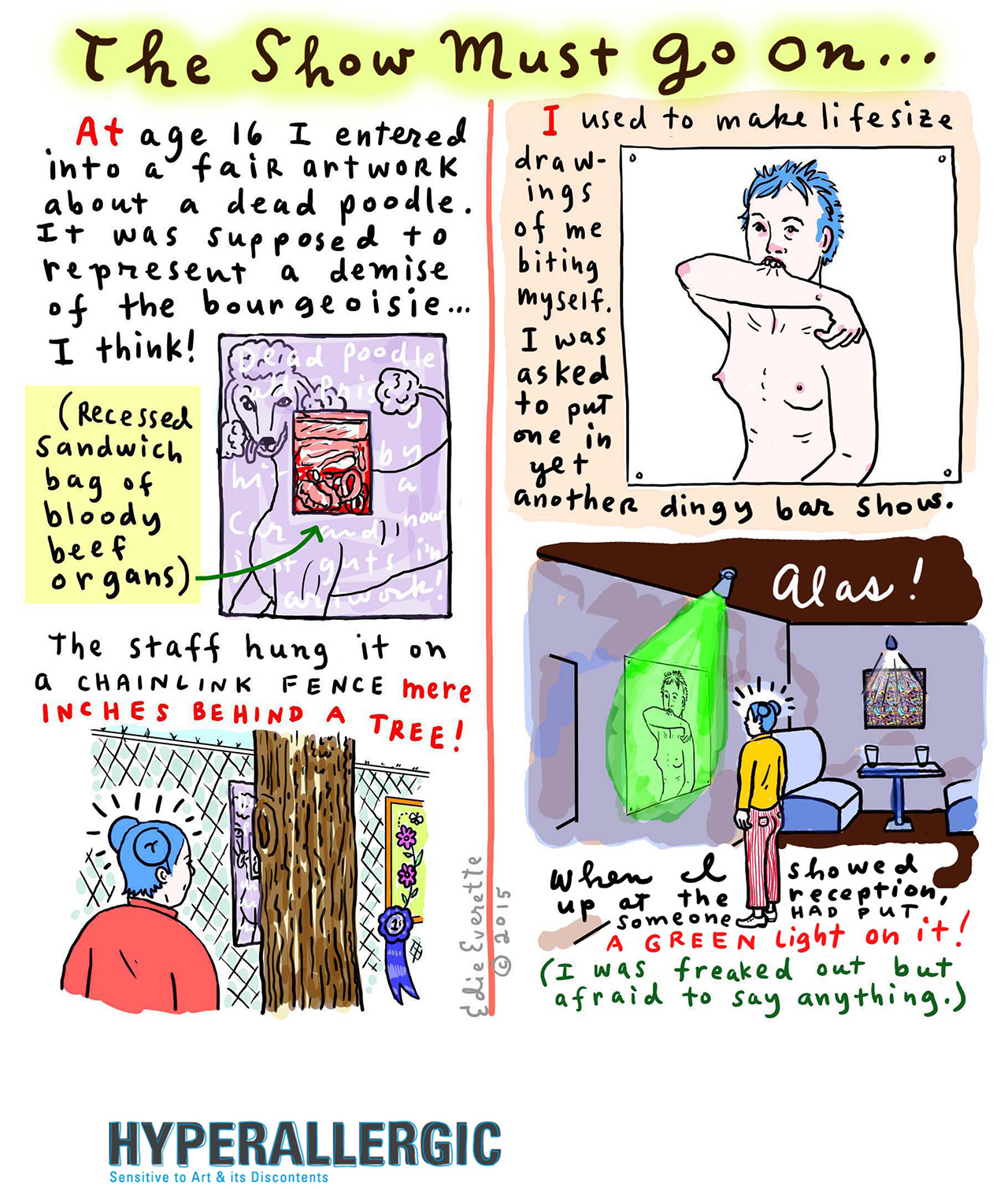
A Victim of Bad Curation

by Edie Everette

EEExhibitShockHyperSize5-1280

07 Sep 16:15

Photo


07 Sep 16:15

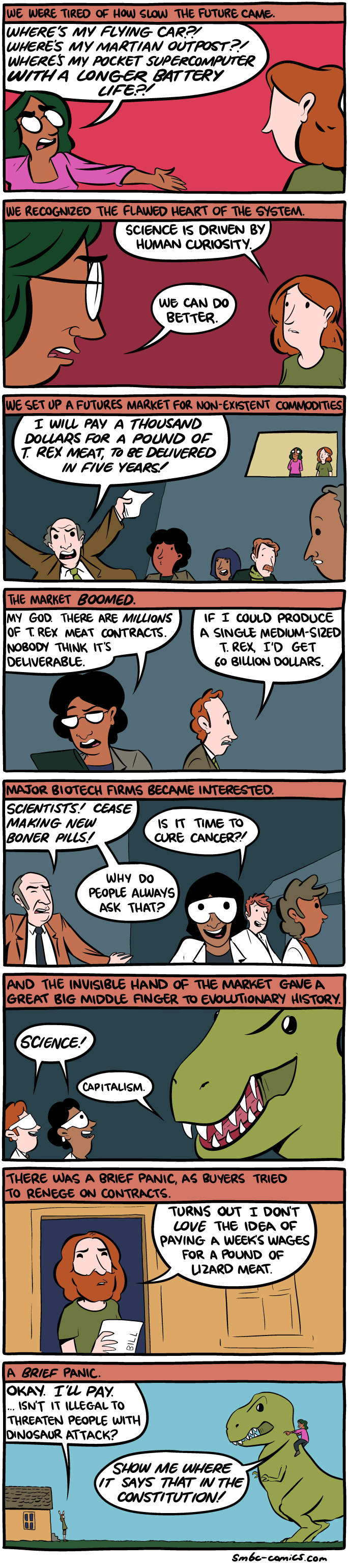
Saturday Morning Breakfast Cereal - Commodities

by admin@smbc-comics.com

Hovertext: Can we please have this? Please please please?


New comic!
Today's News:
07 Sep 16:14

Photo


07 Sep 16:14

gray-jane: the other day at work, i asked a woman her name– like i do for everyone, because we have...

gray-jane:

the other day at work, i asked a woman her name– like i do for everyone, because we have to write it on the cup–and she goes “we come in here all the time. you should really know our names by now” as if i don’t serve hundreds of people a day or as though a nondescript middle aged white woman made such an impact upon me that i’d remember her. i was feeling pretty impatient and irritable though, so i covered my name tag with my hand and asked her my name and she didn’t know it and at least had the decency to change demeanor from haughty and superior to sort of quietly embarrassed and i’m fairly sure that’s the only thing i’ve ever done at work that matters to me. 

07 Sep 16:13

^*^


^*^

07 Sep 02:18

drunk and horny and frustrated

by Sophia, NOT Loren!
Sophianotloren

no, but really... please. Fuck me.

Went out tonight. Got more drunk than I planned, which is nice, especially since at least two of my drinks were “on me, friend!” from the bartender (super hot but also super hetero and less than couple of weeks away from getting married to a long-term monogamous partner.) Chatter with a couple who were in the area from out of town, thought the hot chick was single until her husband showed up.  Talked for quite a while — probably a couple of hours — with a couple of hot (but again, gah! straight!) ladies, ended up passing along contact info to both of them but I’ll be genuinely shocked if I hear from either of them again. That’s just how it always seems to happen, and I can’t invest any emotional energy in hoping that I manage to end up with friends, even.

Drank more, since I could afford to, and I’m back in bed wishing I had flesh down my throat and in my ass and I am so fucking sick and tired of being alone, being lonely, being single, being un-fucked and wishing anyone wanted me.

I need to be taken, used, fucked, and it’s been over three years since the last even halfway decent fucking I’ve had. And, of course, that was from a woman who I’ve barely ended up seeing since, but who has ended up becoming fantastically close friends with The Rabbit, who I introduced to The Rec that night. I’m just over here out of the way, wishing anyone gave a fuck (or that anyone cared, which doesn’t happen much, either.)

I have posted so many entries here expressing my need, my unfulfilled need, for sex. And there are countless other times when I’ve simply said “fuck it, I’m just repeating myself, it won’t accomplish anything anyway…” and said nothing.

People I know — acquaintances, geographically distant folks who say they want me, whatever — often remark that they’re astonished that I don’t have all the lovers, all the sex, all the needs addressed that are always left unmet. Attractive female friends tell me they can’t believe I don’t have a girlfriend, when I’m always so stunning. And honestly, it’s a slap to the face. YOU. I’d love for you to fuck me, and there are more than a few “yous” who have expressed surprise that somebody else isn’t taking me to bed when you’ve made it clear that you won’t, you’re not interested, nothing personal, just… nah, not gonna happen… but surely somebody else will!

Bah. Angry and horny and drunk and alone. I’ll just quit trying to say anything, since I’m not going to change my situation by writing about it.


Filed under: General
07 Sep 00:57

RT @rablivingstone: It's always heartbreaking to see your old favourites reduced...

by Pai Osias
800px-Coturnix_coturnix_eggs_normal.jpg
Author: Pai Osias
Source: Twitter Web Client
RT @rablivingstone: It's always heartbreaking to see your old favourites reduced to living on the streets. http://t.co/roQGWcxSN3
COEWoQvWoAAjx51.jpg:large
07 Sep 00:53

"Well, first of all, you’re using Internet Explorer."

“Well, first of all, you’re using Internet Explorer.”

- Helping adults on the computer (via spoopy-jess)
06 Sep 23:52

#1154; In which a Lesson is imparted, Part 2

by David Malki

this is how you learn boundaries

06 Sep 23:47

tokomon:The Sorcerer and the White Snake (2011), dir. Tony Ching


tokomon:

The Sorcerer and the White Snake (2011), dir. Tony Ching

06 Sep 23:47

Facial Rigging based on FACS (Update1)Project from SoukiZERO can...


Facial Rigging based on FACS (Update1)

Project from SoukiZERO can create realistic human expressions in 3D software with a simplified graphical interface. This is certainly not the first, but the method and interface respresentation is interesting:

Thank you everyone for following me and liking my previous video and after a long time I update the rig with lots of improvements, but still a WIP.
In this video I show the wireframe of the model and joints.

Displacement maps also can be blended to make all the wrinkles more realistic.
Some AUs are added. Some textures updated.

Link