Submitted by:
Shared posts



18 Aug 19:30


C.S. Lewis’s Ideal Daily Routine
by Maria Popova
Damiani.guilhermeNice
“It is essential of the happy life that a man would have almost no mail.”
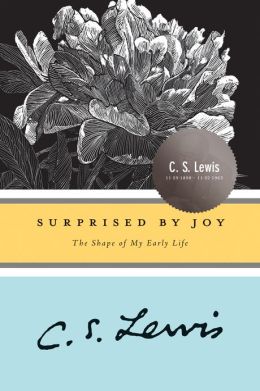 I’ve had a longtime fascination with the daily routines of notable writers and their creative rituals. One of the most lyrical, opinionated, and altogether wonderful comes from C.S. Lewis — a man of great wisdom on writing and extraordinary capacity for nuance in existential matters. In his 1955 spiritual memoir, Surprised by Joy: The Shape of My Early Life (public library), Lewis outlines his ideal daily routine, modeled after his time studying privately at Great Bookham with his father’s old tutor at the age of fifteen:
[I] settled into a routine which has ever since served in my mind as an archetype, so that what I still mean when I speak of a “normal” day (and lament that normal days are so rare) is a day of the Bookham pattern. For if I could please myself I would always live as I lived there. I would choose always to breakfast at exactly eight and to be at my desk by nine, there to read or write till one. If a cup of good tea or coffee could be brought me about eleven, so much the better. A step or so out of doors for a pint of beer would not do quite so well; for a man does not want to drink alone and if you meet a friend in the taproom the break is likely to be extended beyond its ten minutes. At one precisely lunch should be on the table…
Like artist Maira Kalman, who has long advocated for walking as a creative catalyst, Lewis was an avid walker — but with a key disclaimer:
By two at the latest I would be on the road. Not, except at rare intervals, with a friend. Walking and talking are two very great pleasures, but it is a mistake to combine them. Our own noise blots out the sounds and silences of the outdoor world; and talking leads almost inevitably to smoking, and then farewell to nature as far as one of our senses is concerned. The only friend to walk with is one … who so exactly shares your taste for each mood of the countryside that a glance, a halt, or at most a nudge, is enough to assure us that the pleasure is shared.
(Of course, walking with the right kind of companion can only amplify our capacity to pay attention, rather than diminishing it.)
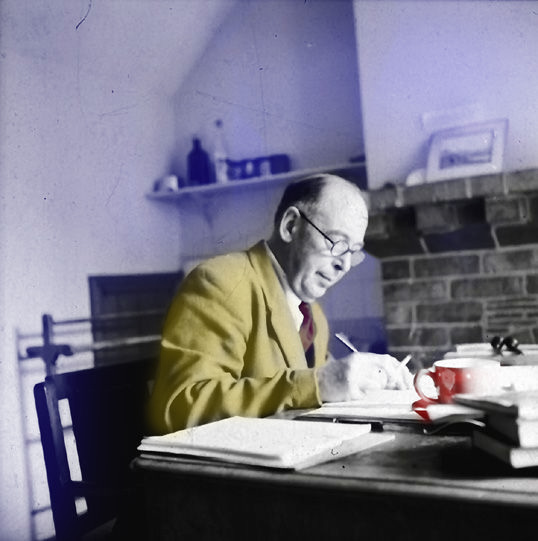
Lewis holds equally strong opinions about his tea. One can almost picture him demanding a strict adherence to George Orwell’s eleven golden rules for the perfect cup of tea as he describes the afternoon ritual:
The return from the walk, and the arrival of tea, should be exactly coincident, and not later than a quarter past four. Tea should be taken in solitude…
He goes on to outline the qualitative norms for permissible multitasking during mealtime, with some humbling criteria for what he considers light — “gossipy, formless” — reading:
Eating and reading are two pleasures that combine admirably. Of course not all books are suitable for mealtime reading. It would be a kind of blasphemy to read poetry at table. What one wants is a gossipy, formless book which can be opened anywhere. The ones I learned so to use at Bookham were Boswell, and a translation of Herodotus, and Lang’s History of English Literature. Tristram Shandy, Elia and The Anatomy of Melancholy are all good for the same purpose.
And then, it’s back to work until bedtime, the latter being a matter of strict discipline — because, lest we forget, the correlation between sleep and literary productivity is not to be dismissed:
At five a man should be at work again, and at it till seven. Then, at the evening meal and after, comes the time for talk, or, failing that, for lighter reading; and unless you are making a night of it with your cronies (and at Bookham I had none) there is no reason why you should ever be in bed later than eleven.
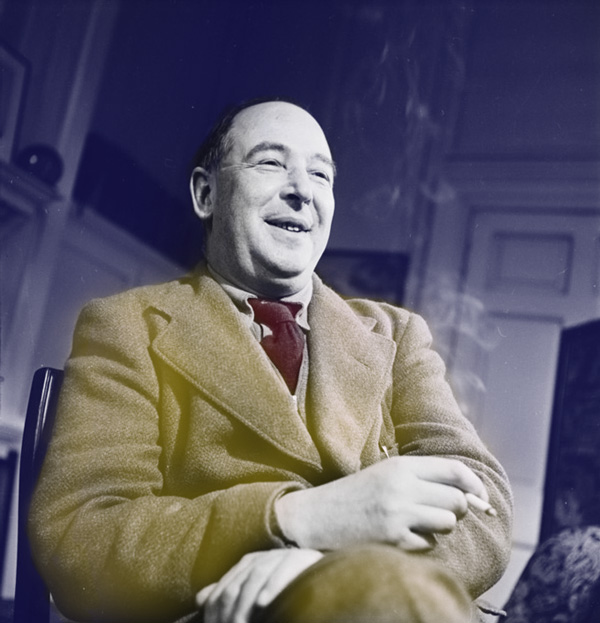
But Lewis’s most prescient money-quote — the one likely to elicit a bitter cackle from today’s inbox-weary writer — comes at the very end:
But when is a man to write his letters? You forget that I am describing the happy life I led with Kirk or the ideal life I would live now if I could. And it is essential of the happy life that a man would have almost no mail and never dread the postman’s knock.
Complement with Lewis on how to write with authenticity and what free will really means, then revisit the daily routines of Charles Darwin, William S. Burroughs, Charles Bukowski, John Updike, Joy Williams, Kurt Vonnegut, Herman Melville, Henry Miller, Mark Twain, Gertrude Stein, Vladimir Nabokov, James Joyce, and other literary titans.
Donating = Loving
Bringing you (ad-free) Brain Pickings takes hundreds of hours each month. If you find any joy and stimulation here, please consider becoming a Supporting Member with a recurring monthly donation of your choosing, between a cup of tea and a good dinner:
|
♥ $7 / month ♥ $3 / month ♥ $10 / month ♥ $25 / month |

You can also become a one-time patron with a single donation in any amount:
 Brain Pickings has a free weekly newsletter. It comes out on Sundays and offers the week’s best articles. Here’s what to expect. Like? Sign up.
Brain Pickings takes 450+ hours a month to curate and edit across the different platforms, and remains banner-free. If it brings you any joy and inspiration, please consider a modest donation – it lets me know I'm doing something right.










18 Aug 18:50
Your Girlfriend Would Just Take Up That Space Anyway
Damiani.guilhermetosco, mas eu ri
Albener Pessoa, Tadeu and -1 others like this




18 Aug 18:37

Werner Herzog on Creativity, Self-Reliance, Making a Living of What You Love, and How to Turn Your Ideas Into Reality
by Maria Popova
“If your project has real substance, ultimately the money will follow you like a common cur in the street with its tail between its legs.”
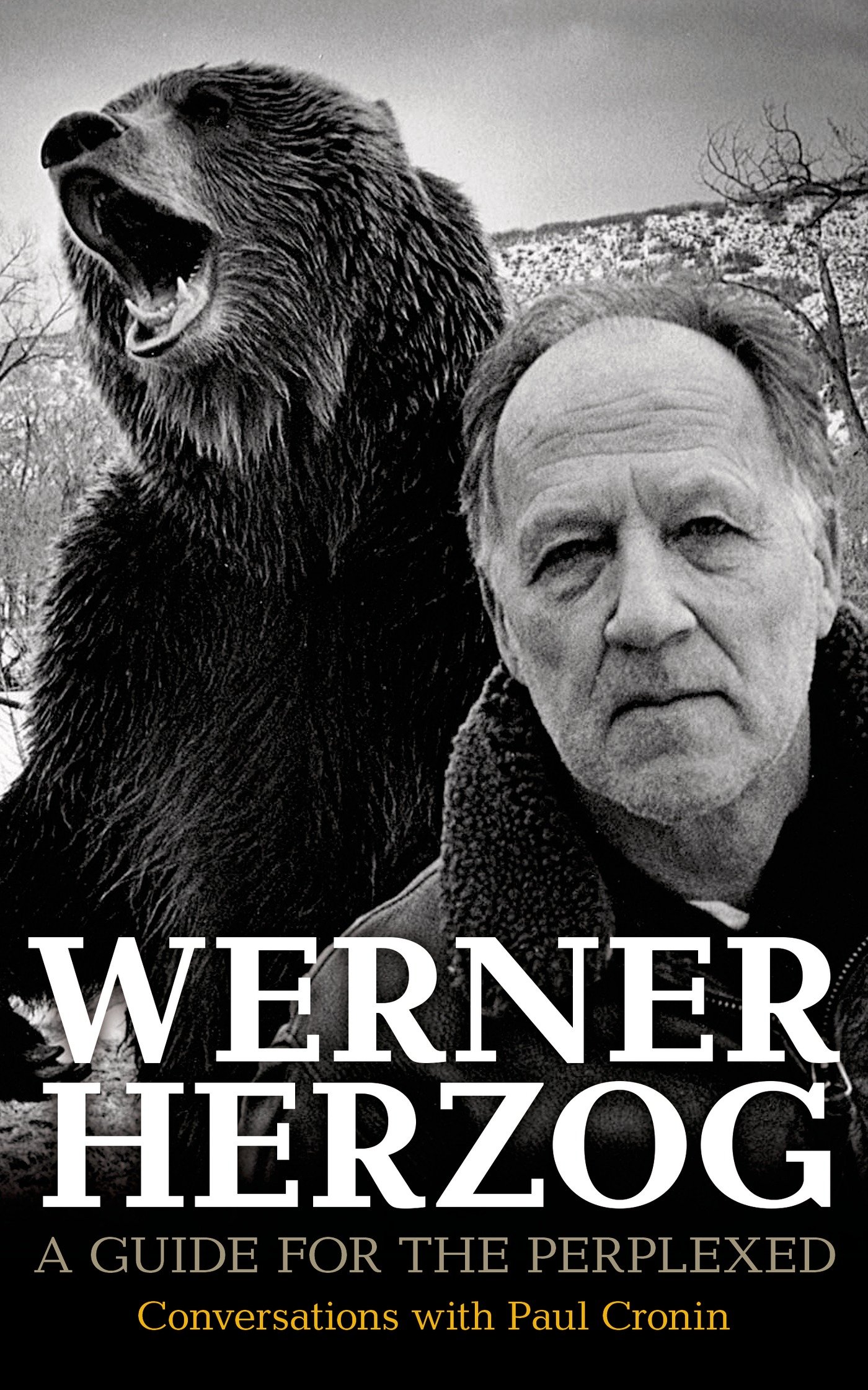 Werner Herzog is celebrated as one of the most influential and innovative filmmakers of our time, but his ascent to acclaim was far from a straight trajectory from privilege to power. Abandoned by his father at an early age, Herzog survived a WWII bombing that demolished the house next door to his childhood home and was raised by a single mother in near-poverty. He found his calling in filmmaking after reading an encyclopedia entry on the subject as a teenager and took a job as a welder in a steel factory in his late teens to fund his first films. These building blocks of his character — tenacity, self-reliance, imaginative curiosity — shine with blinding brilliance in the richest and most revealing of Herzog’s interviews. Werner Herzog: A Guide for the Perplexed (public library) — not to be confused with E.F. Schumacher’s excellent 1978 philosophy book of the same title — presents the director’s extensive, wide-ranging conversation with writer and filmmaker Paul Cronin. His answers are unfiltered and to-the-point, often poignant but always unsentimental, not rude but refusing to infest the garden of honest human communication with the Victorian-seeded, American-sprouted weed of pointless politeness.
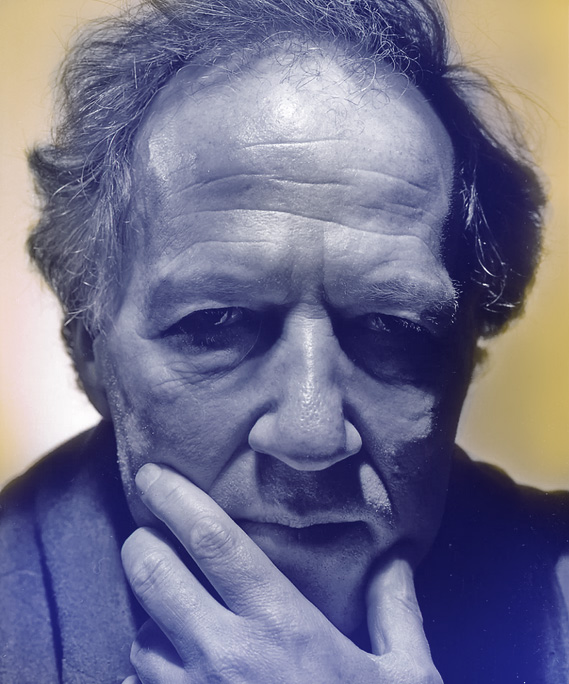
Herzog’s insights coalesce into a kind of manifesto for following one’s particular calling, a form of intelligent, irreverent self-help for the modern creative spirit — indeed, even though Herzog is a humanist fully detached from religion, there is a strong spiritual undertone to his wisdom, rooted in what Cronin calls “unadulterated intuition” and spanning everything from what it really means to find your purpose and do what you love to the psychology and practicalities of worrying less about money to the art of living with presence with an age of productivity. As Cronin points out in the introduction, Herzog’s thoughts collected in the book are “a decades-long outpouring, a response to the clarion call, to the fervent requests for guidance.”
And yet in many ways, A Guide for the Perplexed could well have been titled A Guide to the Perplexed, for Herzog is as much a product of his “cumulative humiliations and defeats,” as he himself phrases it, as of his own “chronic perplexity,” to borrow E.B. White’s unforgettable term — Herzog possesses that rare, paradoxical combination of absolute clarity of conviction and wholehearted willingness to inhabit his own inner contradictions, to pursue life’s open-endedness with equal parts focus of vision and nimbleness of navigation.
A certain self-reliance that permeates his films and his mind, a refusal to let the fear of failure inhibit trying — a sensibility the voiceover in the final scene of Herzog’s The Unprecedented Defence of the Fortress Deutschkreuz captures perfectly: “Even a defeat is better than nothing at all.” He tells Cronin:
There is nothing wrong with hardships and obstacles, but everything wrong with not trying.
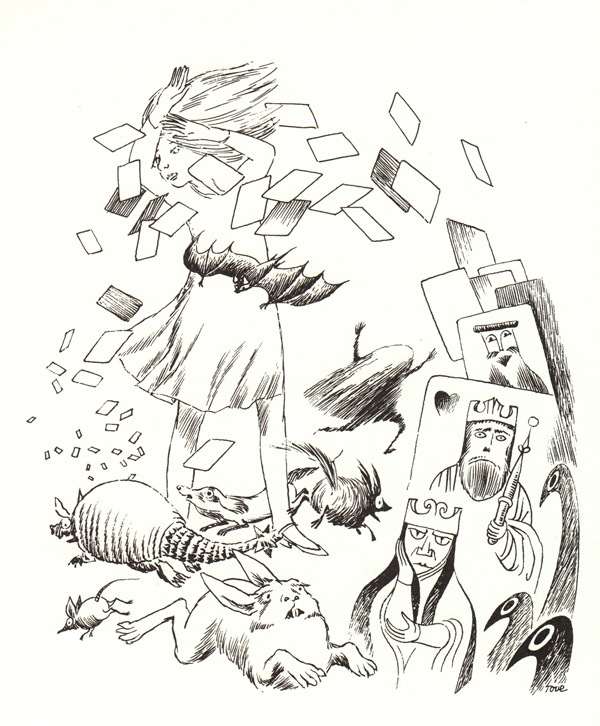
Illustration by Tove Jansson from 'Alice in Wonderland.' Click image for more.
Herzog reflects on failure as a prerequisite for creative mastery:
The bad films have taught me most about filmmaking. Seek out the negative definition. Sit in front of a film and ask yourself, “Given the chance, is this how I would do it?” It’s a never-ending educational experience, a way of discovering in which direction you need to take your own work and ideas.
He takes this notion of self-reliance — as he does most things he believes — to an almost religious degree:
I did as much as possible myself; it was an article of faith, a matter of simple human decency to do the dirty work as long as I could… Three things — a phone, computer and car — are all you need to produce films. Even today I still do most things myself. Although at times it would be good if I had more support, I would rather put the money up on the screen instead of adding people to the payroll.
Indeed, having grown up without money and earned every penny himself, Herzog considers this self-reliance closely intertwined with the question of financial struggle — a circumstance he always refused to mistake for a fatal roadblock to the creative drive. His wisdom on the subject extends beyond film and applies just as perceptively to almost any field of endeavor in today’s creative landscape:
The best advice I can offer to those heading into the world of film is not to wait for the system to finance your projects and for others to decide your fate. If you can’t afford to make a million-dollar film, raise $10,000 and produce it yourself. That’s all you need to make a feature film these days. Beware of useless, bottom-rung secretarial jobs in film-production companies. Instead, so long as you are able-bodied, head out to where the real world is. Roll up your sleeves and work as a bouncer in a sex club or a warden in a lunatic asylum or a machine operator in a slaughterhouse. Drive a taxi for six months and you’ll have enough money to make a film. Walk on foot, learn languages and a craft or trade that has nothing to do with cinema. Filmmaking — like great literature — must have experience of life at its foundation. Read Conrad or Hemingway and you can tell how much real life is in those books. A lot of what you see in my films isn’t invention; it’s very much life itself, my own life. If you have an image in your head, hold on to it because — as remote as it might seem — at some point you might be able to use it in a film. I have always sought to transform my own experiences and fantasies into cinema.
He later revisits the subject even more pointedly:
A natural component of filmmaking is the struggle to find money. It has been an uphill battle my entire working life… If you want to make a film, go make it. I can’t tell you the number of times I have started shooting a film knowing I didn’t have the money to finish it. I meet people everywhere who complain about money; it’s the ingrained nature of too many filmmakers. But it should be clear to everyone that money has always had certain explicit qualities: it’s stupid and cowardly, slow and unimaginative. The circumstances of funding never just appear; you have to create them yourself, then manipulate them for your own ends. This is the very nature and daily toil of filmmaking. If your project has real substance, ultimately the money will follow you like a common cur in the street with its tail between its legs. There is a German proverb: “Der Teufel scheisst immer auf den grössten Haufen” [“The Devil always shits on the biggest heap”]. So start heaping and have faith. Every time you make a film you should be prepared to descend into Hell and wrestle it from the claws of the Devil himself. Prepare yourself: there is never a day without a sucker punch. At the same time, be pragmatic and learn how to develop an understanding of when to abandon an idea. Follow your dreams no matter what, but reconsider if they can’t be realized in certain situations. A project can become a cul-de-sac and your life might slip through your fingers in pursuit of something that can never be realized. Know when to walk away.
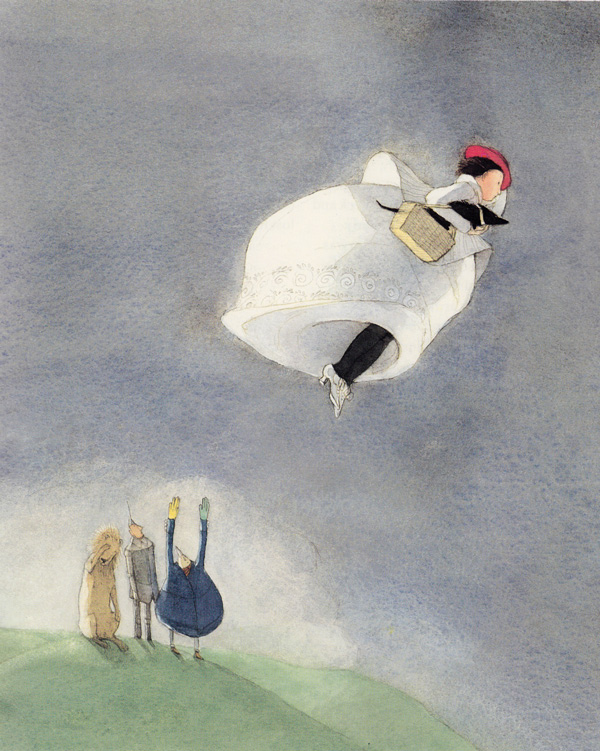
Illustration by Lisbeth Zwerger from 'The Wizard of Oz.' Click image for more.
This question of money parlays into what’s perhaps Herzog’s most urgent and piercing point — a testament to the idea that anything worthwhile takes a long time:
Perseverance has kept me going over the years. Things rarely happen overnight. Filmmakers should be prepared for many years of hard work. The sheer toil can be healthy and exhilarating.
Although for many years I lived hand to mouth — sometimes in semi-poverty — I have lived like a rich man ever since I started making films. Throughout my life I have been able to do what I truly love, which is more valuable than any cash you could throw at me. At a time when friends were establishing themselves by getting university degrees, going into business, building careers and buying houses, I was making films, investing everything back into my work. Money lost, film gained.
Ultimately, this notion of doing what you love is rooted in defining your own success, which often requires the bravery of not buying into the cultural template. Herzog captures this elegantly:
Even if I went broke, I wouldn’t be able to sell anything to the highest bidder. What makes me rich is that I am welcomed almost everywhere. I can show up with my films and am offered hospitality, something you could never achieve with money alone… For years I have struggled harder than you can imagine for true liberty, and today am privileged in the way the boss of a huge corporation never will be.
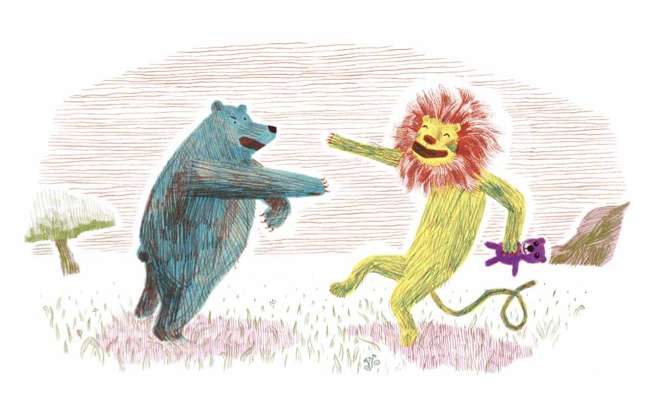
Illustration by Gaëtan Dorémus from 'Bear Despair,' a wordless story about obsession and perseverance. Click image for more.
Observing that happiness and meaningfulness are not necessarily the same thing — something researchers have since confirmed — Herzog echoes artist Agnes Martin’s assertion that doing what you were born to do is the secret of happiness and tells Cronin:
I find the notion of happiness rather strange… It has never been a goal of mine; I just don’t think in those terms.
[...]
I try to give meaning to my existence through my work. That’s a simplified answer, but whether I’m happy or not really doesn’t count for much. I have always enjoyed my work. Maybe “enjoy” isn’t the right word; I love making films, and it means a lot to me that I can work in this profession. I am well aware of the many aspiring filmmakers out there with good ideas who never find a foothold. At the age of fourteen, once I realized filmmaking was an uninvited duty for me, I had no choice but to push on with my projects. Cinema has given me everything, but has also taken everything from me.
(This calls to mind a line Susan Sontag wrote in her diary in March of 1979: “There is a great deal that either has to be given up or be taken away from you if you are going to succeed in writing a body of work.”)
Herzog describes his ideation process in almost violent terms, framing the creative act as an inherently ambivalent one, oscillating between creation, destruction, and purging:
The problem isn’t coming up with ideas, it is how to contain the invasion. My ideas are like uninvited guests. They don’t knock on the door; they climb in through the windows like burglars who show up in the middle of the night and make a racket in the kitchen as they raid the fridge. I don’t sit and ponder which one I should deal with first. The one to be wrestled to the floor before all others is the one coming at me with the most vehemence. I have, over the years, developed methods to deal with the invaders as quickly and efficiently as possible, though the burglars never stop coming. You invite a handful of friends for dinner, but the door bursts open and a hundred people are pushing in. You might manage to get rid of them, but from around the corner another fifty appear almost immediately… Finishing a film is like having a great weight lifted from my shoulders. It’s relief, not necessarily happiness. But you relish dealing with these “burglars.” I am glad to be rid of them after making a film or writing a book. The ideas are uninvited guests, but that doesn’t mean they aren’t welcome.
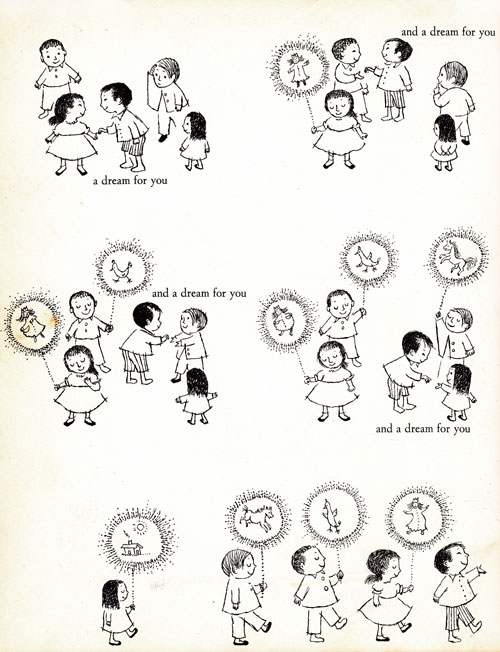
Illustration by Maurice Sendak from 'I’ll Be You and You Be Me' by Ruth Krauss, 1954. Click image for more.
Channeling T.S. Eliot’s notion of the mystical quality of creativity and Bukowski’s assertion that true creative work “comes unasked out of your heart and your mind and your mouth and your gut,” Herzog — who, like Maira Kalman, sees walking as a creative catalyst — considers how his ideas arise:
My films come to me very much alive, like dreams, without explanation. I never think about what it all means. I think only about telling a story, and however illogical the images, I let them invade me. An idea comes to me, and then, over a period of time — perhaps while driving or walking — this blurred vision becomes clearer in my mind, pulling itself into focus.
[...]
When I write, I sit in front of the computer and pound the keys. I start at the beginning and write fast, leaving out anything that isn’t necessary, aiming at all times for the hard core of the narrative. I can’t write without that urgency. Something is wrong if it takes more than five days to finish a screenplay. A story created this way will always be full of life.
In that creative act, Herzog argues, lies the artist’s broader cultural responsibility to continually reinvent the established forms:
We need images in accordance with our civilization and innermost conditioning, which is why I appreciate any film that searches for novelty, no matter in what direction it moves or what story it tells… The struggle to find unprocessed imagery is never-ending, but it’s our duty to dig like archaeologists and search our violated landscapes. We live in an era when established values are no longer valid, when prodigious discoveries are being made every year, when catastrophes of unbelievable proportions occur weekly. In ancient Greek the word “chaos” means “gaping void” or “yawning emptiness.” The most effective response to the chaos in our lives is the creation of new forms of literature, music, poetry, art and cinema.
And yet being preoccupied with form can be limiting — it should emerge from the story organically rather than seek to shape it:
I don’t consciously reflect on aesthetics before making a film because, for me, the story always dictates such things. Of course, aesthetics do sometimes enter unconsciously through the back door, because whether we like it or not our preferences always somehow influence the decisions we make. If I were to think about my handwriting while writing an important letter, the words would become meaningless. When you write a passionate love letter and focus on making sure your longhand is as beautiful as possible, it isn’t going to be much of a love letter. But if you concentrate on the words and emotions, your particular style of longhand – which has nothing to do with the letter per se — will somehow seep in of its own accord. Aesthetics, if they even exist, are to be discovered only once a film has been completed.
Herzog doesn’t shy away from touching on the existential:
We can never know what truth really is. The best we can do is approximate… Truth can never be definitively captured or described, though the quest to find answers is what gives meaning to our existence.
In one of his most endearingly characteristic proclamations, Herzog tells Cronin why he has never taken vacation:
It would never occur to me… I work steadily and methodically, with great focus. There is never anything frantic about how I do my job; I’m no workaholic. A holiday is a necessity for someone whose work is an unchanged daily routine, but for me everything is constantly fresh and always new. I love what I do, and my life feels like one long vacation.
Above all, however, Herzog reveals himself as a rare master of prioritizing presence over productivity:
I work best under pressure, knee-deep in the mud. It helps me concentrate. The truth is I have never been guided by the kind of strict discipline I see in some people, those who get up at five in the morning and jog for an hour. My priorities are elsewhere. I will rearrange my entire day to have a solid meal with friends.
Theoretical physicist Lawrence Krauss captures Herzog’s singular spirit in the afterword:
The Werner Herzog I have come to know is not the wild man of his press clippings. He is a caring, thoughtful, playful and essentially gentle human being. Possessing a restless mind, with a fertile and creative imagination, he is a man interested in all aspects of the human experience. Self-taught, he is widely read and deeply knowledgeable. I like to think that one of the reasons we enjoy each other’s company is that we both share a deep excitement in the human experience.
Werner Herzog: A Guide for the Perplexed is a spectacular read in its hefty 600-page totality, offering a rare glimpse of one of the most ravenously imaginative minds of our time. Complement it with other spectacular interviews with David Foster Wallace, Jeanette Winterson, Leonard Cohen, Seth Godin, Dani Shapiro, William Faulkner, Bob Dylan, Adam Phillips, Pablo Picasso, Malcolm Gladwell, and Susan Sontag.
Donating = Loving
Bringing you (ad-free) Brain Pickings takes hundreds of hours each month. If you find any joy and stimulation here, please consider becoming a Supporting Member with a recurring monthly donation of your choosing, between a cup of tea and a good dinner:
|
♥ $7 / month ♥ $3 / month ♥ $10 / month ♥ $25 / month |
You can also become a one-time patron with a single donation in any amount:
Brain Pickings has a free weekly newsletter. It comes out on Sundays and offers the week’s best articles. Here’s what to expect. Like? Sign up.
Brain Pickings takes 450+ hours a month to curate and edit across the different platforms, and remains banner-free. If it brings you any joy and inspiration, please consider a modest donation – it lets me know I'm doing something right.

18 Aug 17:49
Artist Creates Elaborate Black And White Scratchboard Illustrations By Etching Into The Black Ink
by Justina Bakutyte


Paris-based illustrator Nicolas Delort creates mysterious black and white scratchboard illustrations. Using nothing but black ink and sharp tools, Delort etches his elaborate drawings into the surface of a clayboard. Despite the monochromatic palette, his works carry out a sense of colorfulness through their dynamic and wondrous scenarios.
Because of his scratchboard technique, Delort‘s works are focusing more on the negative space and its function in the art world. His high-contrast illustrations are full of apocalyptic dynamism, accentuated by the eccentric compositions, intrinsic etching and attention to every minuscule detail. Despite that, artist says his workflow is pretty chaotic.
“Up until the final inking stage, my work is mostly improvisation, because I’m basically never happy with my stuff until it’s finished <…> I start out with a bunch of thumbnails and when I find one that I like open it up in Photoshop and move stuff around until I’m satisfied. I make a final sketch, transfer it on to the scratchboard and scratch away till my wrist hurts.“
While some of Delort‘s narratives might be utterly unknown, others illustrate scenes from literary works such as Harry Potter, American Gods, or are designated movie posters. Although modern in content, Delort‘s works remind us of such artists as Gustav Doré and even Albrecht Dürer who‘ve been advocating the noteworthy art of etching years past. (via Lost At E Minor; Hypocrite Design)


The post Artist Creates Elaborate Black And White Scratchboard Illustrations By Etching Into The Black Ink appeared first on Beautiful/Decay Artist & Design.



18 Aug 17:09


merryweatherblue: I took my little brother (who falls on the...
by aishiterushit
Damiani.guilhermeQ daora
I took my little brother (who falls on the autism spectrum) to see Guardians of the Galaxy and after this scene he lit up like a Christmas tree and screamed “He’s like me! He can’t do metaphors!” And for the rest of the film my brother stared at Drax in a state of rapture.
So for the last 6 days I have heard my brother repeatedly quote all of the Drax lines from the movie verbatim (one of his talents), begin studying vocabulary test words, and tell everyone he knows that people with autism can also be superheroes.
Now I am not saying that Drax the Destroyer is, or was ever, intended to be autistic. All I am saying is that it warmed my heart to see my brother have an opportunity to identify himself with a character known for his strength, badassness, and honor. And that is pretty damn awesome.
So while I adored Guardians of the Galaxy as a great fun loving film with cool characters I can do nothing but thank Marvel Studios and Dave Bautista for finally bringing a superhero to the screen that my little brother can relate to.
Damiani.guilherme, Vvicked and 7 others like this
18 Aug 17:01
New Eden – A Book Celebrating Great Game Environment Design
by The Book Design Blog

New Eden is a book showcasing a selection of hand-picked computer game environments.
Each spread features a high-resolution in-game render of a different game environment, plus an iconographic key and a mini-map ‘HUD’ that denotes the genre and environment styles, such as ‘space’, ‘swords’, or ‘apocalyptic’.
Quotes from game designers are interspersed throughout, and the book is finished off with a wooden cover and lazer-etched design.
Designed and created by Christian Ernst, Alexander Venus & Robyn Soyka.


14 Aug 18:28

Mercury

Venus

Earth

Mars

Jupiter

Saturn

Uranus

Neptune

Pluto
jonyorkblog: Steve GildeaPlanetary Suite, circa 1990
Mercury
Venus
Earth
Mars
Jupiter
Saturn
Uranus
Neptune
Pluto
Steve Gildea
Planetary Suite, circa 1990
14 Aug 18:28
Pope Francis to Young People: Stop Wasting Time on the Internet
by gguillotte
Damiani.guilhermeBom senso. Era só isso q faltava num papa. Isso e beijar pés de prisioneiros.
“Maybe many young people waste too many hours on futile things,” he said in a speech to 50,000 German altar servers who were visiting on pilgrimage, according to NBC News. “Our life is made up of time, and time is a gift from God, so it is important that it be used in good and fruitful actions.”
He went on to cite specific online activities, such as “chatting on the Internet or with smartphones, watching TV soap operas, and (using) the products of technological progress, which should simplify and improve the quality of life, but distract attention away from what is really important.”
Tertiarymatt and -1 others like this

13 Aug 17:31


girlwhowasonfire: deans-avenging-angel: girlwhowasonfire: Foun...
Found a better use for the wine glasses.
That’s a martini glass.
I’m literally using it for milk and cookies does it look like I care about the finer points of debauchery.
13 Aug 17:29


Jane Goodall Answers the Proust Questionnaire
by Maria Popova
Damiani.guilhermeNice
A dead writer meets one of the greatest scientists alive.
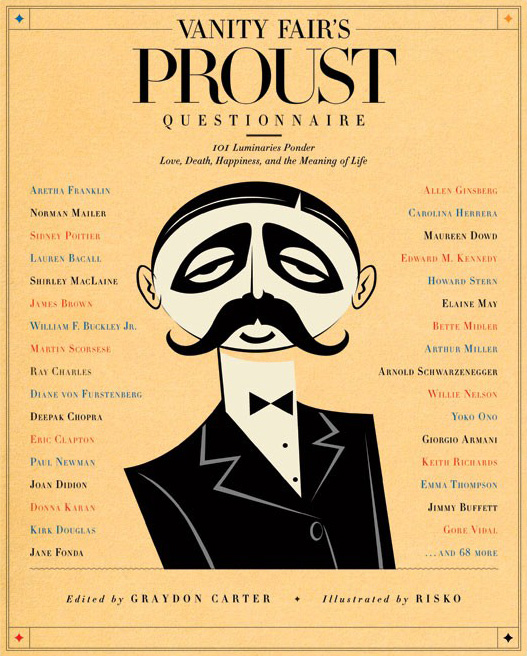 A century before today’s popular personality quizzes, Victorian “confession albums” served essentially the same role, presenting a series of simple questions designed to reveal the respondent’s sensibility and aspirations. In the 1880s, teenage Marcel Proust was given one such questionnaire by his friend Antoinette, the daughter of France’s then-president, which he promptly answered. The original manuscript, titled “by Marcel Proust himself,” lay dormant for decades, until it was discovered in 1924, two years after the writer’s death. Half a century later, French television host Bernard Pivot resurrected the questionnaire as a backbone for his literary interviews. In 1993, Vanity Fair transplanted the tradition to the last page of the magazine, which began featuring various public figures’ answers to the Proust Questionnaire.
In 2009, the magazine released Vanity Fair’s Proust Questionnaire: 101 Luminaries Ponder Love, Death, Happiness, and the Meaning of Life (public library). Among the respondents is legendary primatologist and environmentalist Jane Goodall, she of great wisdom, who answered the famed survey in May of 2004.
Portrait of Jane Goodall by Robert Risko for Vanity Fair
What is your idea of perfect happiness?
Sitting by myself in the forest in Gombe National Park watching one of the chimpanzee mothers with her family.What is your greatest fear?
That I shall be tortured and be a coward.What is the trait you most deplore in others?
Hypocrisy.What is your greatest extravagance?
Long-distance phone calls to my friends.What is your favorite journey?
My favorite ever journey was my first trip from Nairobi City to the Serengeti to Olduvai Gorge before it was famous, when there were no roads and all the animals were there. We were in an overloaded Land Rover, four people and two Dalmatians.What do you dislike most about your appearance?
Aging skin!What or who is the greatest love of your life?
My childhood companion and teacher — my dog, Rusty.When and where were you happiest?
In the early 60s, when I was alone at Gombe with the chimpanzees.What talent would you most like to have?
Ability to learn languages.What is your current state of mind?
Deep concern at the state of the planet, environmental and social.If you could change one thing about yourself, what would it be?
I need to be 20 years younger — there is too much to do.What do you consider your greatest achievement?
Starting our youth program, Roots & Shoots, along with helping to blur the line between humans and the rest of the animal kingdom.What do you regard as the lowest depth of misery?
Knowing you have let someone down, betrayed their trust.What is your favorite occupation?
Observing animals alone in the wilderness.What is your most marked characteristic?
Determination/optimism.What do you most value in your friends?
Being able to share happiness and sadness and have a good laugh.Who are your favorite writers?
Shakespeare, Tolkien, Mary Wesley.Who is your favorite hero of fiction?
Robin Hood.Who are your heroes in real life?
My mother, until her death; dedicated teachers; Kofi Annan; Nelson Mandela; Muhammad Yunus.What is it that you most dislike?
Receptions and dinners in noisy places with people talking too loud, riding in stretch limos, waste.How would you like to die?
Peacefully and before losing my physical and especially my mental facilities.What is your motto?
“As thy days, so shall thy strength be.”
That Goodall — one of the greatest scientists of the past century — should answer this last question with a quote from the fifth book of the Hebrew Bible and the Jewish Torah only speaks to her sensitivity to the spiritual aspect of science and her conviction that religion is useful only when and if it inspires us to do better.
Vanity Fair’s Proust Questionnaire features more responses by such cultural icons as Allen Ginsberg, Hedy Lamarr, Gore Vidal, Julia Child, and Joan Didion. Sample it further with David Bowie’s playful and poignant answers and complement it with LIFE magazine’s similarly-spirited 1991 volume The Meaning of Life.
Donating = Loving
Bringing you (ad-free) Brain Pickings takes hundreds of hours each month. If you find any joy and stimulation here, please consider becoming a Supporting Member with a recurring monthly donation of your choosing, between a cup of tea and a good dinner.
| ♥ $7 / month ♥ $3 / month ♥ $10 / month ♥ $25 / month |
You can also become a one-time patron with a single donation in any amount.
Brain Pickings has a free weekly newsletter. It comes out on Sundays and offers the week’s best articles. Here’s what to expect. Like? Sign up.
Brain Pickings takes 450+ hours a month to curate and edit across the different platforms, and remains banner-free. If it brings you any joy and inspiration, please consider a modest donation – it lets me know I'm doing something right.
13 Aug 16:48
The Struggle of Finding People Into Things You Are Into






13 Aug 16:44
My Neighbors Are My Enemies
Damiani.guilherme=||||||||||||||||||

12 Aug 18:34

Margaret Mead on Female vs. Male Creativity, the “Bossy” Problem, Equality in Parenting, and Why Women Make Better Scientists
by Maria Popova
Damiani.guilhermeM. Mead S2
"In the long run it is the complex interplay of different capacities, feminine and masculine, that protects the humanity of human beings."
“In the long run it is the complex interplay of different capacities, feminine and masculine, that protects the humanity of human beings.”
 Margaret Mead is celebrated as the world’s best-known and most influential cultural anthropologist, having not only popularized anthropology itself but also laid the foundation for the sexual revolution of the 1960s. She brought the essential tools of anthropology — the art of looking, coupled with a great capacity for listening, for asking and answering questions — to her prolific university lectures, public talks, and presentations at various organizations that claimed her time and thought. In the sixteen-year period between 1963 and January of 1979, Redbook Magazine published Mead’s answers to the best questions she had received from audience members over her extensive career — questions about love, sex, religion, politics, social dynamics, gender equality, personal choices, and the human condition.
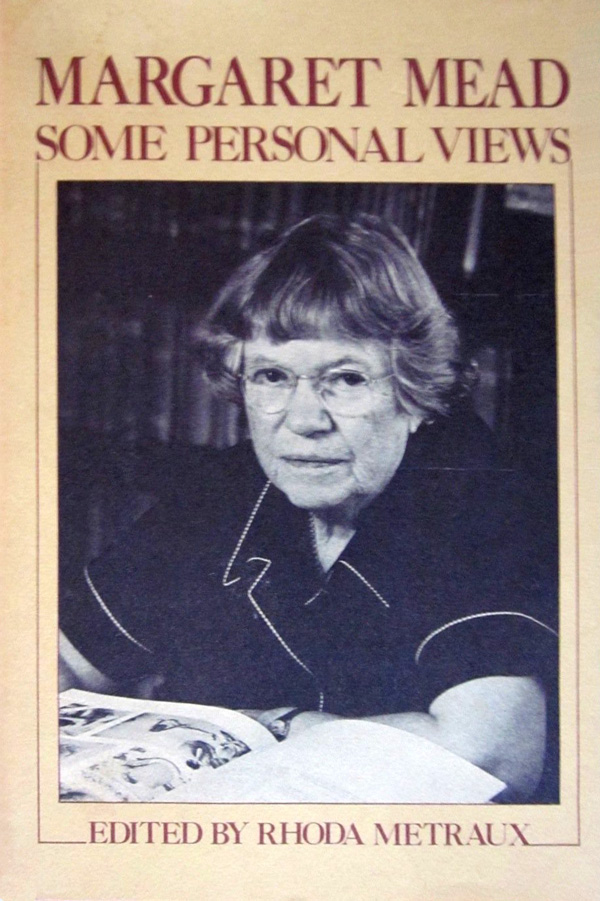
After Mead’s death in late 1978, her partner for the last twenty-two years, the anthropologist and Redbook editor Rhoda Metraux, collected the best of these questions and answers in Margaret Mead: Some Personal Views (public library). As Metraux writes in the foreword, “Margaret Mead’s most winning gift was surely her capacity for immediate, zealous response… She took for granted that a sophisticated question required a sophisticated answer, but she never rebuffed the person who had to struggle to find words. One thing exasperated her: without hesitation she pricked the balloon of the pompous, pretentious questioner.”

With her characteristic blend of scientific rigor, humanistic wisdom, and strong personal conviction, Mead addresses a number of issues all the timelier today, but none with more prescience than the question of the shifting social norms and responsibilities for women and men.
In 1963, she offers a wonderfully dimensional answer to a question about why “the most outstanding creative people in all fields have been predominantly men,” folding into her rationale the still-radical assertion that women make naturally better scientists:
There are three possible positions one can take about male and female creativity. The first is that males are inherently more creative in all fields. The second is that if it were not for the greater appeal of creating and cherishing young human beings, females would be as creative as males. If this were the case, then if men were permitted the enjoyment women have always had in rearing young children, male creativity might be reduced also… The third possible position is that certain forms of creativity are more congenial to one sex than to the other and that the great creative acts will therefore come from only one sex in a given field.
There is some reason to believe that males may always excel — by just the small degree that makes the difference between good capacity and great talent — in such fields as music and mathematics, where creativity involves imposing form rather than finding it. There is also reason to believe that women have a slightly greater potential in those fields in which it is necessary to listen and learn, to find forms in nature or in their own hearts rather than to make entirely new ones; these fields could include certain areas of literature, and some forms of science that depend on observation and recognition of pattern, such as the study of living creatures or children or societies.
But Mead argues that the capacity for achievement is, above all, a matter of context, which is invariably a social construct — something that only intensifies our responsibility in creating a cultural context that allows all creative abilities to shine:
When women work in a creative field, even one that is particularly congenial to them, they must generally work with forms that were created by men, or else struggle against special odds to develop new forms. Until we have an educational system that permits enough women to work within any field — music, mathematics, painting, literature, biology and so on — so that forms which are equally congenial to both sexes are developed, we shall not have a fair test of this third possibility.
We do not know that what one sex has developed, members of the other sex can learn — from cookery to calculus. In those countries of the Eastern bloc in which women are expected to play an equal part with men in the sciences, great numbers of women have shown a previously unsuspected ability. We run a great risk of squandering half of our human gifts by arbitrarily denying any field to either sex or by penalizing women who try to use their gifts creatively.
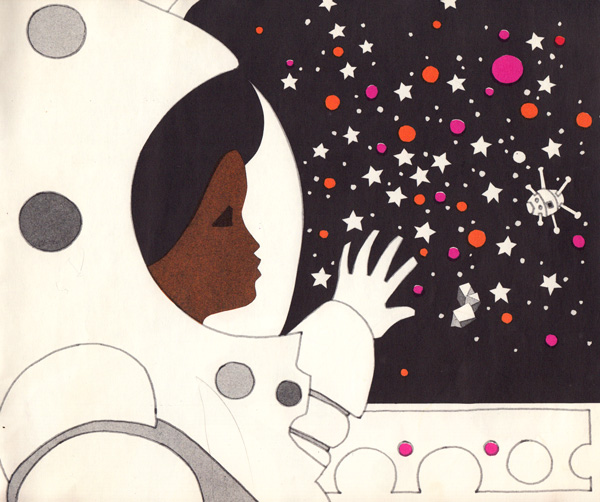
In another question from December of the same year, Mead returns to the cultural differences across the Iron Curtain. A few months earlier, in June of 1963, Soviet cosmonaut Valentina Tereshkova had become the world’s first woman in space. It would be twenty years until the second, American astronaut Sally Ride, launched into the cosmos. Considering the cultural context Russian vs. American women have for achievement in space exploration, Mead writes:
On the question of woman cosmonauts, the Russians have been able to be realistic and practical. If we are going to do anything important with space, especially with space colonization, then we need to know at once how well women can withstand the new conditions. The American tendency to protect men’s sense of masculinity by keeping women out of things results — as does our handling of race — simply in an American loss.
Illustration from 'Blast-Off,' a visionary 1973 children's book celebrating gender equality and ethnic diversity in space exploration. Click image for more.
In November of 1965, Mead answers a question about women’s evolving identity outside “their purely feminine role” and how they are to seek fulfillment beyond the qualities of beauty and charm traditionally rewarded as the height of female accomplishment:
It is probable that far more women can achieve lasting contentment … where a woman can be honored as a person because she has borne and cared for children, has taught in a school or cared for the sick, has managed a business, has practiced a profession, has written poems.
[...]
When marriage was for life and when death was likely to come early, a woman’s career as wife and mother was often completely circumscribed by her husband’s career as provider and achiever.
Today, however, this is no longer true. We educate girls so that they are capable of greater intellectual accomplishment than our form of marriage and housekeeping permits them to use. Marriages are not always for life. And child rearing takes up only part of a woman’s adult life. These three major changes have refocused our attention on the question of woman’s identity and the relationship between the feminine arts and feminine accomplishments.
But as these changes were afoot in the 1960s — the cusp of monumental cultural change, propelled by such landmark events as the 1963 publication of Betty Friedan’s The Feminine Mystique and the introduction of the oral contraceptive pill in the early 1960s — many bemoaned the “defeminization” of society. Mead handles this term with enormous semantic skepticism and addresses it in answering a question from March of 1966:
Defeminization [may] refer to role. Where men have been the traditional breadwinners, initially it seems defeminizing when women go out to earn their living. Where all secretaries were men, as at one time they were in the English-speaking world, it was defeminizing for a woman to take a position as a secretary. Most roles of this kind are a matter of convention in a particular society at a given time. Their specific definitions as “masculine” or “feminine” often have very little to do with the capacities of men and women.
There is a sense, however, in which certain changes in women’s roles may be regarded as dehumanizing. Traditionally women have had to consider their children’s long-time protection and well-being to be their central goal. Where a society, by its moral conventions and standards of living or by various coercive rules and regulations,* forces women to neglect any of the necessary forms of prenatal and maternal behavior, there may be a dehumanizing effect on the members of that society — both men and women.
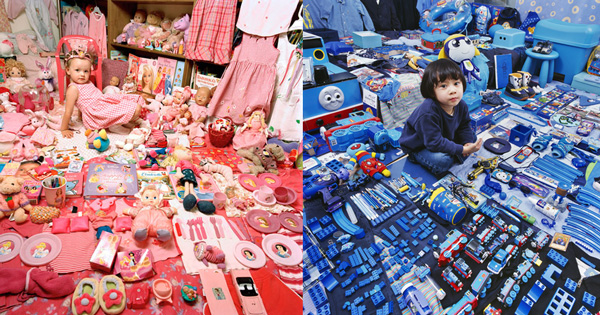
Before WWII, pink was a color associated with masculinity, considered a watered-down red symbolizing the power generally associated with that color. Photographs from Korean visual artist JeongMee Yoon's 'Pink and Blue Projects.' Click image for details.
Mead’s words ring with particular poignancy half a century later, in the Lean In era and its crusade against “bossy”, as she considers how women can counter these claims of “defeminization,” rooted in old values and male ideals, by claiming a new context of evaluation:
Whenever women become part of an organization or an activity that is defined as aggressively and ruthlessly competitive, they must develop a style of behavior different from that of men in the same occupation if they are not to become “defeminized.” … In the conference room, women do better to insist on high standards of courtesy, comfort and consideration in a mixed group of which they are an integral part. In the long run it is the complex interplay of different capacities, feminine and masculine, that protects the humanity of human beings.
Mead’s prescience doesn’t end there — half a century before Shonda Rhimes addressed the issue in her superb commencement address, Mead considers the impossible standards for women as they try to reconcile inhabiting their capacities fully with fulfilling traditional roles. In June of 1967, upon being asked whether modern women are becoming “increasingly narcissistic,” Mead offers a brilliant answer at once thoughtful and feisty:
The ideal of the all-purpose wife is perhaps the most difficult any society has set for its women.
[...]
It is taken for granted that [a woman] ought to be able to do everything, however hard and tedious, and still give the impression that she spends her days pleasantly and restfully, that she has the leisure to keep her hair shining and smoothly waved, her skin soft and glowing, her clothes fashion-model perfect and her smile warm and welcoming.
[...]
Educated women have never before been asked to pay so high a price for the right to be wives and mothers. The demand that in spite of their hard work they should be soignée, perfectly turned out and always charming puts an almost intolerable burden on them. Calling them narcissistic adds insult to injury.
All of this brings up an inevitable question: In June of 1967, nearly fifty years before our present age of “Be a man. Take paternity leave,” Mead explores the changing role of men in parenting:
We are evolving a new style of fatherhood, in which young fathers share very fully with mothers in the care of babies and little children… One question one can ask is what effect this is likely to have on the next generation and the life of the wider community.
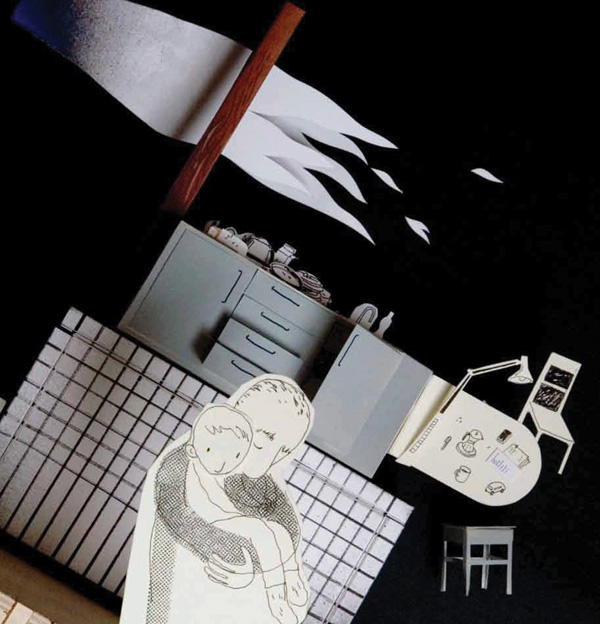
Illustration by Øyvind Torseter from 'My Father's Arms Are a Boat' by Stein Erik Lunde. Click image for details.
Noting that the invention of bottle feeding and instant baby food has enabled fathers to do for their children everything mothers can physically do, she peers into the broader cultural liberation that equal parenting makes possible, returning to the question of male and female creative achievement:
Perhaps we are in the process of developing a style of parenthood that has never before been attempted by a civilized people, a style that will set children of both sexes free of some of the constraints that have forced on them narrow occupational and personality choices because of narrow sex identification. On the other hand, we may be destroying the set of motives that have made men the great achievers and innovators of civilization. At the same time we may not be developing enough ambitious and highly motivated women to take the place of the men whose chief delight is their children. It is still an open question how our children, as adults, will respond to the challenges of the wider society to become active in its concerns and interests.
In answering two questions in August of 1975, Mead considers the necessary shifts in gender dynamics that would help both men and women ease into such cultural change rather than tensing against it. Once again, her words resound with extraordinary prescience and emanate the bittersweet reminder that however far we may have come in resolving these issues, they still gape raw and vulnerable for both sexes. Mead writes:
It will take genuine commitment, not to labels such as chauvinist or liberationist, but to the value of human relationships to work out new ways for men and women to live together.
[...]
It isn’t really a question of men’s “getting over” [the liberation of women], but of men’s and women’s finding a new balance in their relationships.
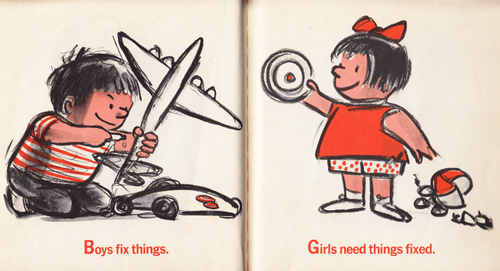
Illustration from the parodic 1970 children's book 'I’m Glad I’m a Boy!: I’m Glad I’m a Girl!' by New Yorker cartoonist Whitney Darrow, Jr. Click image for details.
Mead examines the broader social dynamics underpinning the shift, which apply equally to other, present-day areas of resistance to social change, from immigration to marriage equality:
Whenever there are changes in the way tasks and roles, obligations and privileges, opportunities and responsibilities are apportioned between the sexes, among people of different ages or among people of different national backgrounds or races, some group is bound to feel threatened. But the curious thing is that those who are proposing — insisting on — change tend to believe that those who feel threatened must be hostile, and often they themselves become hostile in response to what they believe they perceive.
I emphasize these feelings of threat and counterthreat because I think that today, in the face of the Women’s Liberation Movement, we are making far too much of the point of necessary anger on the part of women and inevitable hostility on the part of men.
Roles are changing for both women and men. Women are being pressured on every side to insist on living in a different way and to believe that their past status was brought about by male oppression. At the same time men who thought that they were being good husbands and fathers and were working hard to care for and protect the mothers of their children are being accused of being oppressors — and angry oppressors at that. The whole process of change is taking place in an atmosphere of the greatest bad temper and a tremendous amount of secondary hostility is being generated that in itself poses a threat to a good outcome.
[...]
We should begin to realize that both men and women need liberation from a life-style that is stultifying and destructive to both sexes.
But despite the challenges of her time — challenges still very much present today — Mead saw the future of gender dynamics with unflinching optimism:
I believe we are already beginning to create new manly and womanly roles that will permit a great deal more individual choice as well as better health for men and a fuller, more gratifying sense of themselves for women.
Above all, she championed a vision for unmooring human potentiality from imprisoning stereotypes about gendered creative ability — something Susan Sontag memorably echoed a decade later — and creating the best possible conditions for individual gifts, male and female, to blossom:
There is encouraging evidence [that society] is moving — gradually, at least — toward recognition of individual aptitudes and inclinations, away from the automatic assignment of tasks based on stereotyped expectations of the capacities of either sex.
Margaret Mead: Some Personal Views is excellent in its entirety, brimming with Mead’s farsighted wisdom on culture and society. Complement it with her equally prescient views on same-sex love and her symbolic dream about the meaning of life.
* Mead is most likely referring to anti-abortion laws, which she consistently condemned for forcing girls and women into motherhood who may be unfit, unwilling, or socioeconomically unequipped to be mothers. In answering a question on the subject in 1963, she asserted: “I believe that our abortion laws should be changed… I believe that we should not prescribe the conditions under which abortion is permissible… Wherever abortion is illegal, unnumbered girls and women, married and unmarried, run frightful risks…”
Donating = Loving
Bringing you (ad-free) Brain Pickings takes hundreds of hours each month. If you find any joy and stimulation here, please consider becoming a Supporting Member with a recurring monthly donation of your choosing, between a cup of tea and a good dinner.
| ♥ $7 / month ♥ $3 / month ♥ $10 / month ♥ $25 / month |
You can also become a one-time patron with a single donation in any amount.
Brain Pickings has a free weekly newsletter. It comes out on Sundays and offers the week’s best articles. Here’s what to expect. Like? Sign up.
Brain Pickings takes 450+ hours a month to curate and edit across the different platforms, and remains banner-free. If it brings you any joy and inspiration, please consider a modest donation – it lets me know I'm doing something right.
Peter.mahowald likes this