Luke.stirling
Shared posts


Human-induced global warning. 1912.

This article’s authenticity is supported by the fact it can be found in the digital archives of the National Library of New Zealand.
Further attesting to its authenticity (and perhaps its role as a bit of stock news used to fill space) is that an identical story had appeared in an Australian newspaper a month prior, in the 17 July 1912, issue of The Braidwood Dispatch and Mining Journal, as found in the digital archives of the National Library of Australia.
An even deeper dive reveals that the text of this news item has its origins in the March 1912 issue of Popular Mechanics, where it appeared as a caption in an article titled “Remarkable Weather of 1911: The Effect of the Combustion of Coal on the Climate — What Scientists Predict for the Future”:

Saturday Morning Breakfast Cereal - The Event

Click here to go see the bonus panel!
Hovertext:
Why are you so favored as to get a comic drawn by Abby Howard? She has a new book out! See the blog below the comic.
Today's News:
Dinosaur Empire 2 is out!

Take it easy for a little while
Everything appears chill and cozy in Heikki M’s LEGO scene of an attic apartment room. The attic implied with the sloped ceiling and the brick wall in the back of the room are top notch techniques in a scene full of fantastic detail to take in. I also appreciate the use of textured bricks in the rug. Is it suggesting a raised texture, or someone who walked through? You decide, but it’s great either way.

The post Take it easy for a little while appeared first on The Brothers Brick.
Hovenring

From Twisted Sifter:
Hovenring is the world’s first suspended bicycle path roundabout. Located in the Netherlands, Hovenring can be found between the localities of Eindhoven, Veldhoven and Meerhoven which accounts for its name, Dutch for “Ring of the Hovens“.I'll use this opportunity to start a new category for blog posts: Nice Things We Could Have Instead of a Border Wall.
Firestorm aftermath


Everyone has seen photos and videos of the wildfires ravaging the western states. What always startles me is how many of the destroyed homes are not cabins nestled in a woodland - just ordinary houses in a residential subdivision. Also, as shown in the second photo, the startlingly narrow margin between survival and devastation.
Second image cropped for emphasis from the original, both of which credit City of Redding (California), via a gallery at The Guardian.
Related: The Hinckley Firestorm of 1894
Return to an alternate Paris in 1889 with this sprawling steampunk scene
Like all great cities, Castor Troy’s steampunk Paris continues to grow. Previously we’ve featured Casotor’s models of the Colonial Office and the Louvre, both of which feature in the layout. This time around we’ve been treated to a new row of buildings running alongside Notre Dame.

Each contains the kind of beautiful architectural details we’ve come to expect, from the Egyptian Art Deco building with its innovative use of ornamental fencing for doors and gold claw elements to represent two opposing sphinxes, to the new maritime office with its wall mounted ship’s wheel. Let’s hope that Castor’s passion for development continues to see new wonders being added to this splendid city.

The post Return to an alternate Paris in 1889 with this sprawling steampunk scene appeared first on The Brothers Brick.
All aboard the tiny train!
All aboard! We’re taking the train through Taiwan, and our next stop is the Taichung train station. The station began operations in 1908 and was closed down after an elevated station was built and opened in 2016. The original station is a beautiful piece of architecture, and Maxime Cheng’s microscale rendering is superbly detailed. His model is rich in texture, right down to the ornate architectural accents along the perimeter of the roof. While the building itself is stunning, the tiny train is an equally impressive-looking feature that really helps bring this model to life. Dare I say, Cheng’s Taichung station feels like it would be a great companion to sets in LEGO’s Architecture series?

The post All aboard the tiny train! appeared first on The Brothers Brick.

Saturday Morning Breakfast Cereal - Fortune
.png)
Click here to go see the bonus panel!
Hovertext:
You're only reading this comic to signal that you want to not be invited to parties.
Today's News:
Land use in the United States

This is a schematic diagram, not a "map" - obviously. But it's also a visually dramatic presentation of some information that is not intuitive.
The actual mapping is available in the first image at the Bloomberg source, where there are other derived graphic images. Very interesting, with much to ponder.
Saturday Morning Breakfast Cereal - Gaia

Click here to go see the bonus panel!
Hovertext:
Then, Earth can wipe its nose with Enceladus.
Today's News:
Saturday Morning Breakfast Cereal - Quantified Self
Click here to go see the bonus panel!
Hovertext:
You really have to pity all the people who lived perfect lives without any of their peers finding out.
Today's News:
Big Fukang meteorite

Slab shown above (via). The original weighed 1,000 kg.
The Fukang pallasite contains large, gem quality olivine, or peridot, in a nickel-iron matrix. The olivines vary in shape from rounded to angular, many are fractured and they range in size from less than five millimetres to several centimetres. The main mass contains several regions of massive olivine clusters up to eleven centimetres (4.3 inches) in diameter with thin metal veins.Here's more (via):

Very impressive. I didn't know they could be so beautiful - thought they were just stone or metal. More on pallasites. You learn something every day.
Beautiful. And sad.

Every summer, phytoplankton spread across the northern basins of the North Atlantic and Arctic Oceans, with blooms spanning hundreds and sometimes thousands of kilometers. Nutrient-rich, cooler waters tend to promote more growth among marine plants and phytoplankton than is found in tropical waters. Blooms this summer off of Scandinavia seem to be particularly intense.
On July 18, 2018, the Operational Land Imager (OLI) on Landsat 8 acquired a natural-color image [below] of a swirling green phytoplankton bloom in the Gulf of Finland, a section of the Baltic Sea. Note how the phytoplankton trace the edges of a vortex; it is possible that this ocean eddy is pumping up nutrients from the depths...
In recent years, the proliferation of algae blooms in the Baltic Sea has led to the regular appearance of “dead zones” in the basin. Phytoplankton and cyanobacteria consume the abundant nutrients in the Baltic—fueled largely by runoff from sewage and agriculture—and reproduce in such vast numbers that their growth and decay deplete the oxygen content of the water. According to researchers from Finland’s University of Turku, the dead zone this year is estimated to span about 70,000 square kilometers (27,000 square miles).
A research team from Finland and Germany reported this month that oxygen levels in recent years in the Baltic Sea are at their lowest levels in the past 1500 years. More frequent and massive blooms, combined with warming seas due to climate change, are making it harder for fish and other marine life to thrive in this basin.
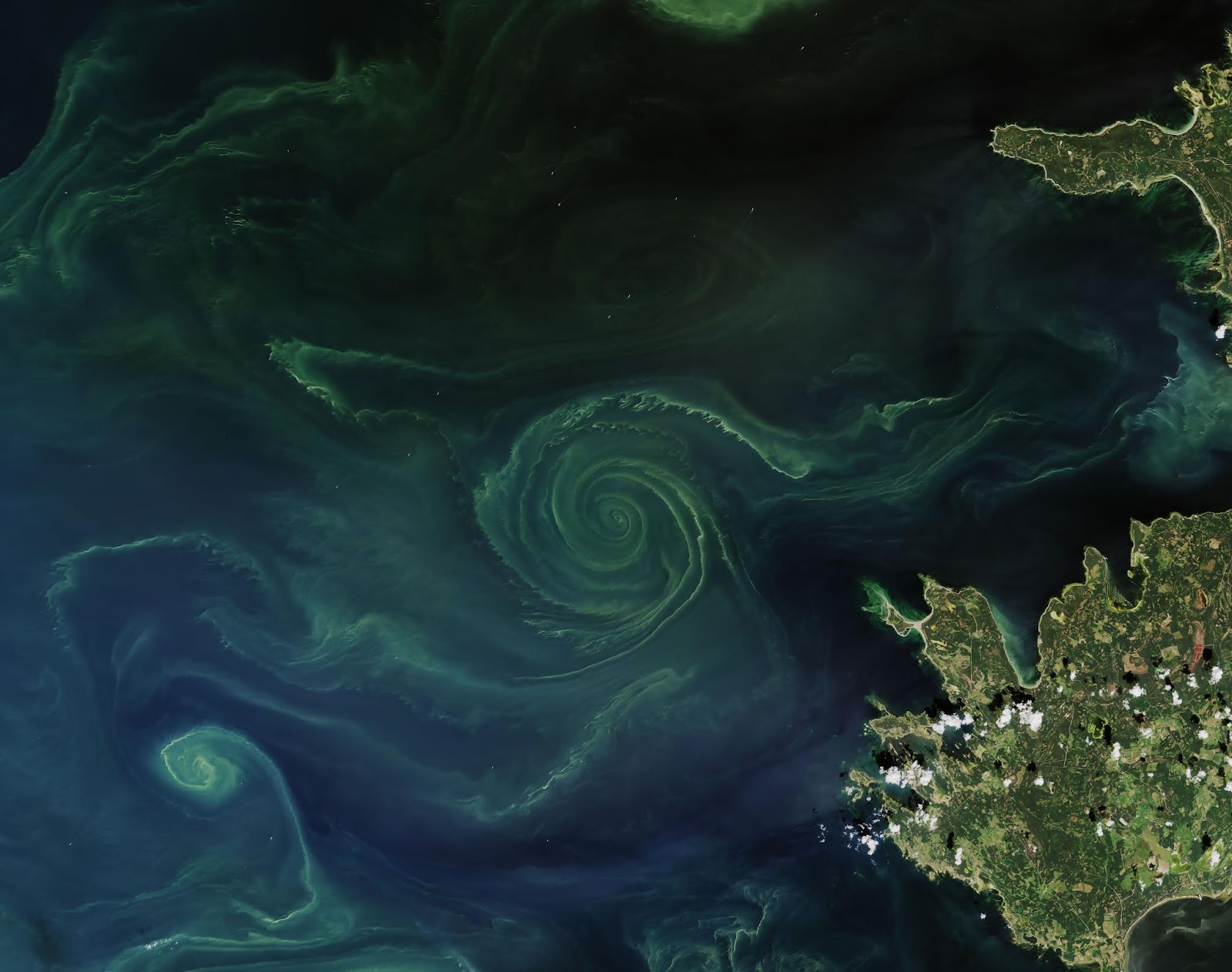
I cropped the top photo from the lower one; the tiny white dots are boats.
Saturday Morning Breakfast Cereal - The Horrible Future
.png)


Saturday Morning Breakfast Cereal - Autonomous

Click here to go see the bonus panel!
Hovertext:
From now on, if you don't like a comic of mine, just append the last panel of today's strip to it.
Today's News:
God is now available in our store:

Pingu! Pingu!
Anyone who has ever watched an episode of Pingu! will instantly recognize this lovable penguin with a big heart and an even bigger knack for getting into trouble. CHUNG-HENG CHENG has captured his likeness, along with his adorable baby sister Pinga perfectly. Be sure to take a closer look, as the scale might easily fool you.

The post Pingu! Pingu! appeared first on The Brothers Brick.
Cropmarks as guides to archaeology
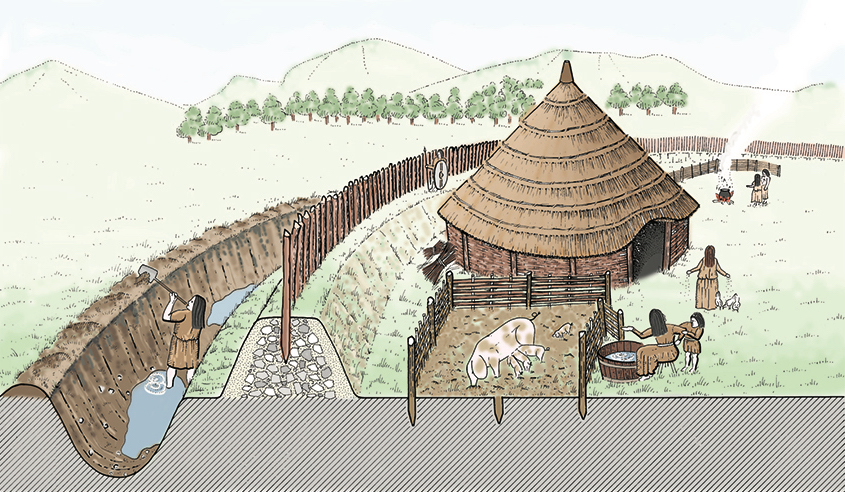
Not crop circles, mind you, but variations in crops that are indicative of subsurface archaeological features. A heat wave and partial drought in Great Britain have rendered such marks unusually prominent.

Last week the Royal Commission on the Ancient and Historical Monuments of Wales posted a well-illustrated article (schematic images embedded), showing how ancient earthworks create alterations in crop size and color by allowing water to be retained during times of scarcity. The advent of drone photography has obviously simplified the detection process immensely.
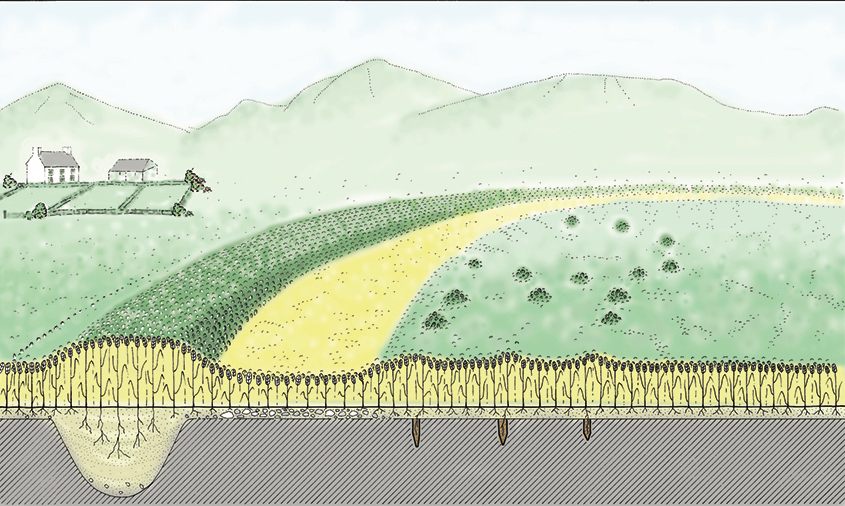
I recommend visiting their link to see the awesome gallery of British cropmarks, but today I'll embed a different image I found today at Wired:
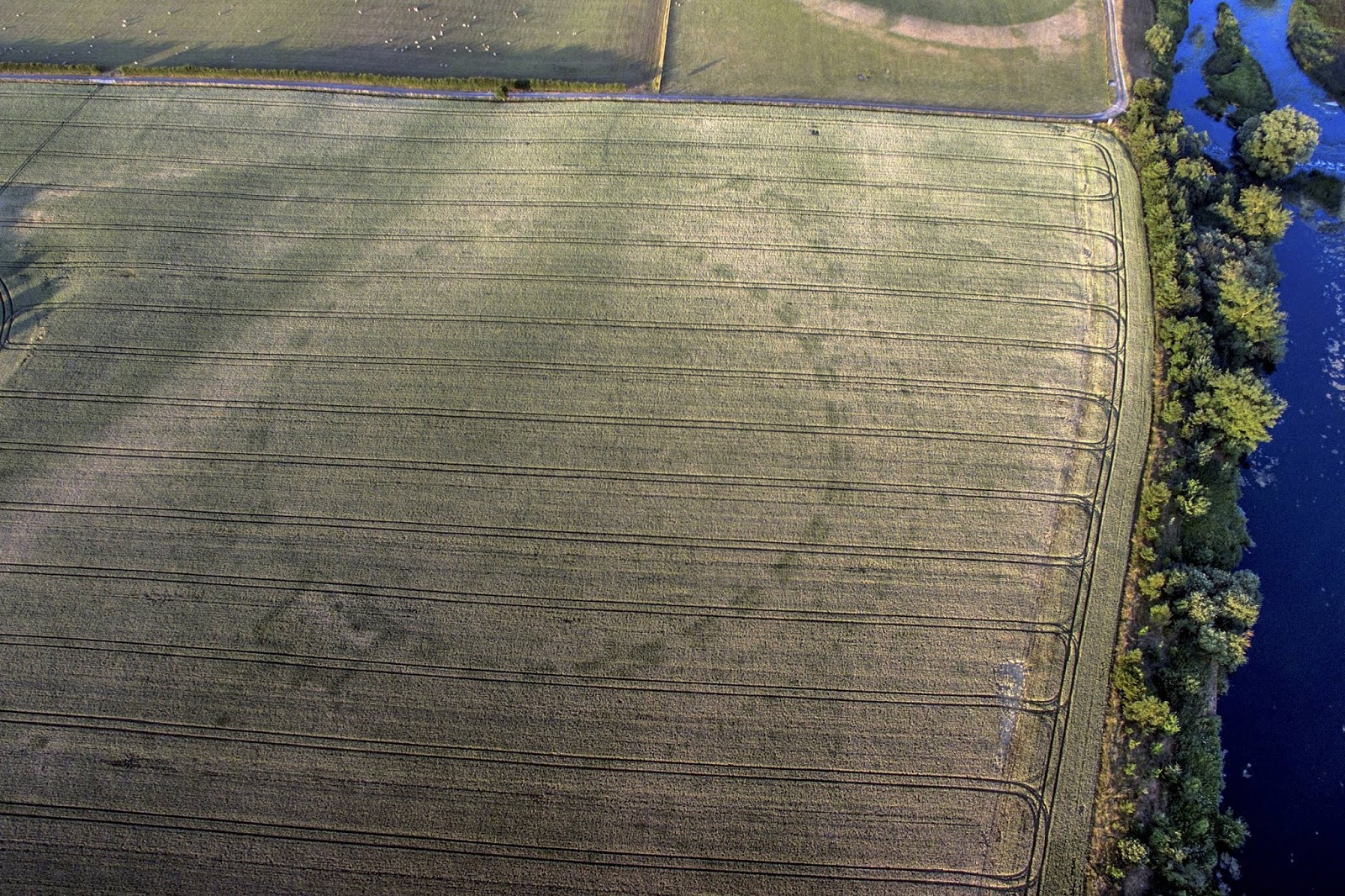
A previously unknown henge has been revealed in Boyne Valley, in the Brú na Bóinne UNESCO world heritage site, in Ireland's County Meath. Stretching 200m in diameter, 750m from the famous Newgrange monument... The henge is thought to date from the late Neolithic period, up to possibly the Bronze Age, from about 3,000 BCE...Wow. I think I'll go climb a ladder in my front yard...The henge would have been made out of timber with two concentric circles, which would possibly have been 'linteled' with horizontal supports as well. "This is a time period where they're building particularly in timber and earth, as opposed to stone which went before," Davis says."We have this bizarre broken ditch, which we don't really necessarily understand yet and that's the most unusual thing about it," Davis says. This ditch is causewayed, broken into lots of little bits, forming a "permeable boundary" meaning it's not a form of defense. Although there are discernible entries and exits, you could in theory enter the structure at any point. "It makes it much more like a symbolic enclosure, rather than a real enclosure."This all points to the idea that the structure was used for ritual ceremonies that involved feasting, gathering and trading together.


The world's oldest known wild bird - 67 years old

Wisdom, the albatross supermom, has done it again. At 67, the world's oldest known wild bird has laid an egg at her home on the Midway Atoll. Wisdom and her mate, Akeakamai, return each year to the Papahānaumokuākea Marine National Monument to nest and raise a single chick. On December 13, the U.S. Fish and Wildlife Service (USFWS) confirmed the pair were incubating a new egg.
In her long life, Wisdom has outlived several mates and raised anywhere from 30 to 35 chicks.Photo via.
She's also remarkable for having logged an estimated two to three million miles [migrating] since 1956.

The UK is phasing out coal
Britain has been powered for more than a thousand hours without coal this year, in a new milestone underscoring how the polluting fuel’s decline is accelerating... The pace of coal power’s demise is speeding up. Throughout the whole of 2017 there were 624 coal-free hours, up from 210 hours in 2016.This kind of change is triggered by scientific advances, but implementation requires policy changes by an intelligent and progressive government. Most countries with enlightened leaders are doing the same as the UK.
The fall of coal power has been swift. In 2012 it supplied two fifths of electricity – this year so far it has provided less than 6%... The decline will deepen in the second half of this year, with the planned closure in September of a Yorkshire coal plant and one in Northern Ireland...
Coal’s fortunes have been in contrast to a series of record highs for renewable sources of energy, including wind, solar and biomass. Renewables supplied 30.1% of electricity in the first three months of the year...