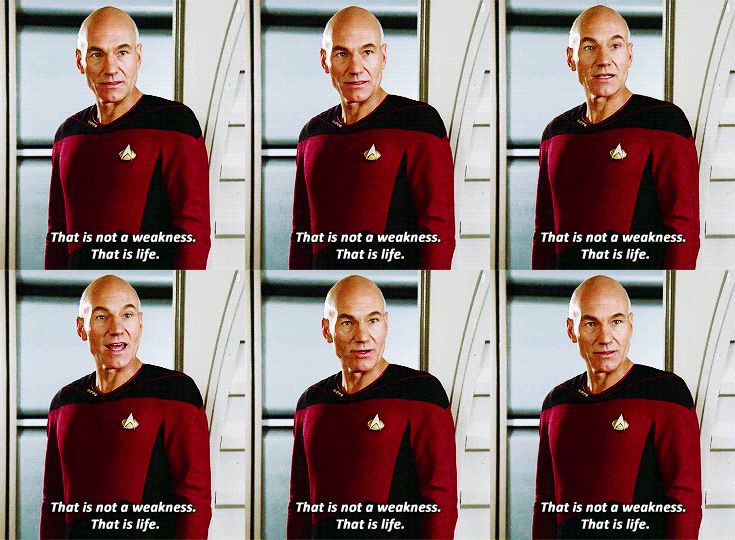
Yeah, we know.

The anti-intellectualism of the American citizenry is just killing us. They won’t be impressed: they’ll just point to the 13th panel and say, “Haw haw, we can kick your ass.”
Yeah, we know.
The anti-intellectualism of the American citizenry is just killing us. They won’t be impressed: they’ll just point to the 13th panel and say, “Haw haw, we can kick your ass.”
 The year was 1929. Ruined stock brokers were throwing themselves out of windows on Wall Street in desperation from the horrible stock market crash. The economy was in a shambles. People were literally starving, something that had been inconceivable just a few years back.
That same year, record sales in the USA plummeted along with Wall Street brokers – from $75 million to a mere $5 million. The copyright industry was certain: it was all the fault of the broadcast radio. Certainly so.
It couldn’t possibly be their own business failure or the fact that the entire economy had gone belly-up. No, it was definitely the fault of broadcast radio. They went to politicians and policymakers and demanded (and got!) fees from broadcast radio to compensate for the damage done to the copyright industry by the new medium, as evidenced by the fact that sales were down from $75 million in the mid-1920s to $5 million in 1929. And so, politicians thought it was a good idea to hamper the promising new medium of broadcast radio in order to benefit the old record industry and their sales.
Fast forward to the 1940s, when television arrived. The copyright industry was furious: who would possibly pay to go to the movies, if you could watch a movie for free at home? The decade had barely started when the U.S. FCC adopted the television standard NTSC, and at the same time, people almost stopped buying movie tickets. The copyright industry was certain: in 1941 through 1944, it was definitely television’s fault that they didn’t sell as many movie tickets as they used to. They complained to politicians and policymakers as they always do, but these particular years, politicians were busy doing something else, something that might just have affected the overall economy. Nevertheless, it was the perfect scapegoat – again – for the copyright industry’s own business failures: who would possibly pay to see a movie at the cinema when they could see it for free at home?
Then, a decade later, in the 1950s, cable television arrived. By now, the copyright industry had learned to profit off of broadcast TV, and they were absolutely furious at the new cable TV medium. They were required to broadcast for free, after all. How could they possibly be expected to compete with a paid service? This was grossly unfair and they went to politicians and demanded the new cable TV medium to be hindered, hampered, and regulated.
Skipping some twenty episodes of the same pattern, we arrive at the Internet.
Unlicensed home manufacturing of copies had started with the cassette tape, but took off with the net. The copyright industry, once their business failed for completely unrelated reasons, had the perfect scapegoat: young people who didn’t respect their distribution monopoly. Damned be civil liberties, damned be the internet, damned be jobs, entrepreneurship, innovation, and progress: by blaming unlicensed manufacture, they didn’t have to face the music of a business failure toward their board and shareholders, but – again – had a convenient external scapegoat for their own damn utter incompetence.
(We can easily observe, that now that unlicensed home manufacturing of music has practically ceased, copyright industry sales of music still hasn’t changed a bit. Unlicensed manufacturing was never the business problem or a cause. But it was a very convenient scapegoat.)
The copyright industry has managed to kill civil liberties for their own children, ushering in a dystopian surveillance machine, merely to avoid taking responsibility for their own business failures. I lack words to quantify my contempt for these utter parasites.

About The Author
Rick Falkvinge is a regular columnist on TorrentFreak, sharing his thoughts every other week. He is the founder of the Swedish and first Pirate Party, a whisky aficionado, and a low-altitude motorcycle pilot. His blog at falkvinge.net focuses on information policy.
Book Falkvinge as speaker?
Source: TorrentFreak, for the latest info on copyright, file-sharing, torrent sites and anonymous VPN services.
Danish builder Lasse Vestergård has created this gigantic microscale map of Denmark, featuring tiny versions of many of its landmarks. Not as much Viking stuff as I’d expected – but they sure have a lot of cathedrals! And of course, LEGOLAND Billund is in there too – can you locate it?

Check out the entire album for closeups and explanations of all the landmarks, including Roskilde Cathedral, which Lasse has created in LEGO before…


 Defensive architecture: keeping poverty unseen and deflecting our guilt:
Defensive architecture is revealing on a number of levels, because it is not the product of accident or thoughtlessness, but a thought process. It is a sort of unkindness that is considered, designed, approved, funded and made real with the explicit motive to exclude and harass. It reveals how corporate hygiene has overridden human considerations, especially in retail districts. It is a symptom of the clash of private and public, of necessity and property.Pavement sprinklers have been installed by buildings as diverse as the famous Strand book store in New York, a fashion chain in Hamburg and government offices in Guangzhou. They spray the homeless intermittently, soaking them and their possessions. The assertion is clear: the public thoroughfare in front of a building, belongs to the building's occupant, even when it is not being used. [...]
Defensive architecture acts as the airplane curtain that separates economy from business and business from first class, protecting those further forward from the envious eyes of those behind. It keeps poverty unseen and sanitises our shopping centres, concealing any guilt for over-consuming. It speaks volumes about our collective attitude to poverty in general and homelessness in particular. It is the aggregated, concrete, spiked expression of a lack of generosity of spirit.
Ironically, it doesn't even achieve its basic goal of making us feel safer. There is no way of locking others out that doesn't also lock us in. The narrower the arrow-slit, the larger outside dangers appear. Making our urban environment hostile breeds hardness and isolation. It makes life a little uglier for all of us.
Lots of good stuff at the Dismal Garden gallery (I think this is what used to be the "Anti-Sit archives" -- many of the photos look similar, anyway.)


And, one of my favorite background gags from Transmetropolitan, 1999. It took me a little while to dig these out. Can you believe that these images aren't googleable?


 "This bench releases level 8 virus 10 PM - 6 AM."
  "Warning: Writing graffiti on these walls will induce a chemical spray causing blindness."
 “When did slavery end in America?”
If you ask a white teenager, you might get the answer, “Four hundred years ago.” But that’s not the answer. Four hundred years ago was 1615, when the Jamestown colony had only existed for eight years and chattel slavery was just beginning.
Others might say, “When Lincoln signed the Emancipation Proclamation, of course.” But that’s not right either. That only freed slaves in Confederate territory seized by the Union. The Union slave states—Missouri, Kentucky, Maryland, Delaware, and the then-in-formation West Virginia—were exempt and allowed to keep their slaves, along with Tennessee, which had more or less been returned to the Union, and Union-loyal areas of Louisiana (including New Orleans) and coastal Virginia. Because it was unenforceable in most of the Confederate states, only about 1-2% of slaves were freed by the Emancipation Proclamation.
“Well, then,” they might say, “it was definitely when the Thirteenth Amendment was passed.” And still, they would be wrong. While that pivotal law did free the vast majority of America’s slaves, the text of the law is this: “Neither slavery nor involuntary servitude, except as a punishment for crime whereof the party shall have been duly convicted, shall exist within the United States, or any place subject to their jurisdiction.“
So when did slavery end in America? The answer is, “Never.”
As discussed in the PBS documentary Slavery By Another Name (available in full by clicking the link), as the federal government withdrew funding and support for Reconstruction, the South began a system of leasing prisoners—allowed by law to be used as slaves—to the plantations to replace their free labor. Those affected by this system were treated even worse than those held in bondage under slavery before the Civil War, as slaves were an expensive investment—the $800 average cost of a slave in 1860 is roughly $21,000 in today’s dollars—but leased prisoners were replaced by the prison if killed and payment continued as scheduled, deincentivizing what little humane treatment was afforded slaves.
It was so profitable and in such high demand that, within ten years of its implementation, the stereotype of black people in America had changed. Prior to the Civil War, the stereotype of black people was that we were inherently docile, servile, and loyal. This only makes sense, because if we were viewed as inherently violent and thieving and criminal like we are today, why would they have trusted us with their livelihoods, their crops, and their children? (Side note: this is also where the stereotype of black people loving watermelon came from—the idea that if we were just given a cool slice of watermelon on a hot day, we would work forever). But once they were no longer allowed to own us outright and had to lease us from prisons, police and judges did everything in their power to make sure they had a robust source of free labor. Black people were arrested on false or trumped-up charges, and within ten years, the recorded arrest and conviction rate for black people had skyrocketed so much that the stereotype was entirely inverted from what it had been previously.
The prison system may have stopped leasing prisoners to plantations, but they still lease prison labor to corporations and local governments. Prisoners—primarily black, of course, because we are targeted—are forced to fight wildfires, manufacture consumer goods, and even make goat cheese for Whole Foods. Our economy was built on slave labor, and it still runs on it to a disconcerting extent. And to make that work, black and Latino neighborhoods are targeted by law enforcement and manipulated through things like school closings and schools being unfathomably underfunded to ensure an ever-growing population of prisoners, an ever-growing population of slaves.
So the next time someone asks you when slavery ended in America, tell them the truth. Tell them, “Never.”

Terry Crews, seriously, all allies should aspire to be as excellent as you.
Speaking with Dame Magazine, Crews spoke eloquently about gender and how we represent ourselves when talking about how much of himself he brings to his character on Brooklyn Nine-Nine. “Every man and every woman has both sexes in them [...] We have to embrace the duality that we are,” said Crews. “I’m an artist – I love painting and drawing, and I play the flute, and people go, ‘Man, that’s feminine!’ But why is that feminine? That’s just human. If you feel that is feminine, you’re judging yourself based on what other people’s reactions might be.”
The former NFL player, who is now married with five children (four of whom are girls) and one granddaughter, said that he has had to do some “serious thinking” about the world in which he’s raising his children, and that’s part of what made him want to actively speak out about feminism and the fight for equality. “When I see the world and the way people are treated, I see so many domination and control issues,” said Crews. “The truth is, everyone is equal and valuable, and everyone is necessary, but there tends to be a dismissal of certain groups.”
But, Crews clarifies, he’s not trying to speak for women, but rather to be the best ally he can. “Women are more than capable of handling themselves, and have been doing so wonderfully for years,” explained Crews. “What I am saying is, as one man to another man, examine your own mind-set. Examine what makes you tick. Because if you feel that you are more valuable than your wife and kids, that’s a problem.” In his book Manhood, Crews cites male pride as something that stops men from changing their outlook on how they treat women.
Crews also spoke at length about rape culture and its prevalence in the world of sports and football, noting that he’s known many men who believed women were responsible for their own sexual assaults because of how they were dressed. “Once I realized that I was part of that culture, I knew that I had to change it,” Crews said, citing 50 Shades of Grey as an example of pop culture projecting abuse as romance, and said that it’s simple in our society for men to use lies, guilt, and shame to control women – something he’s seen at length in his work with the Polaris Project to stop human trafficking.
“We’re not talking Game of Thrones stuff,” added Crews. “we’re talking very subtle mind games that change cultures, and change how people live. We’ve got to address these mindsets that say that’s cool. A reaction I get from certain people is, ‘Hey man, chill, it’s not that deep.’ Everything’s that deep. Don’t wash your hands, and serve food at a restaurant, and you’ll find out how deep things get real quick. It starts with one small thing, and you can cause a whole chain reaction.”
If you want to check out the whole interview – and I think you should, because this dude is awesome – head over to Dame Magazine.
Are you following The Mary Sue on Twitter, Facebook, Tumblr, Pinterest, & Google +?


"A recent survey detected a steep decline in part of the Japanese breeding population which has presumably occurred because of forest loss and degradation in its winter range."That seems to be true for everything beautiful and awesome in our natural world. Our grandchildren will have to be satisfied with jellyfish and cockroaches.

Stefan Lanka, a "vaccination skeptic" who claims that measles are a psychosomatic condition brought on by "traumatic separations," publicly challenged people to prove that measles was caused by a virus.
Read the rest

An article about the bomb-drive, first posted on the Russian website Habrahabr.ru by its designer, describes its design and intended effect:Scary. Of course, anyone who picks up a thumb drive and pops it into their computer is asking for trouble."The basic idea of the USB drive is quite simple. When we connect it up to the USB port, an inverting DC/DC converter runs and charges capacitors to -110V. When the voltage is reached, the DC/DC is switched off. At the same time, the filed transistor opens. It is used to apply the -110V to signal lines of the USB interface. When the voltage on capacitors increases to -7V, the transistor closes and the DC/DC starts. The loop runs till everything possible is broken down."
"The Wilhelm scream is a stock sound effect first used in 1951 for the film Distant Drums. Actor-singer Sheb Wooley is considered to be the most likely voice actor for the scream, having appeared on a memo as a voice extra for the film.Addendum: Reposted from 2008 (!) to embed an updated video compilation and this graph -
The Wilhelm scream has been featured in many films and television programs since. Alongside a certain recording of the cry of the Red-tailed Hawk, the "Universal telephone ring", the Goofy holler, the Tarzan yell and "Castle thunder", it is probably one of the best-known cinematic sound clichés.
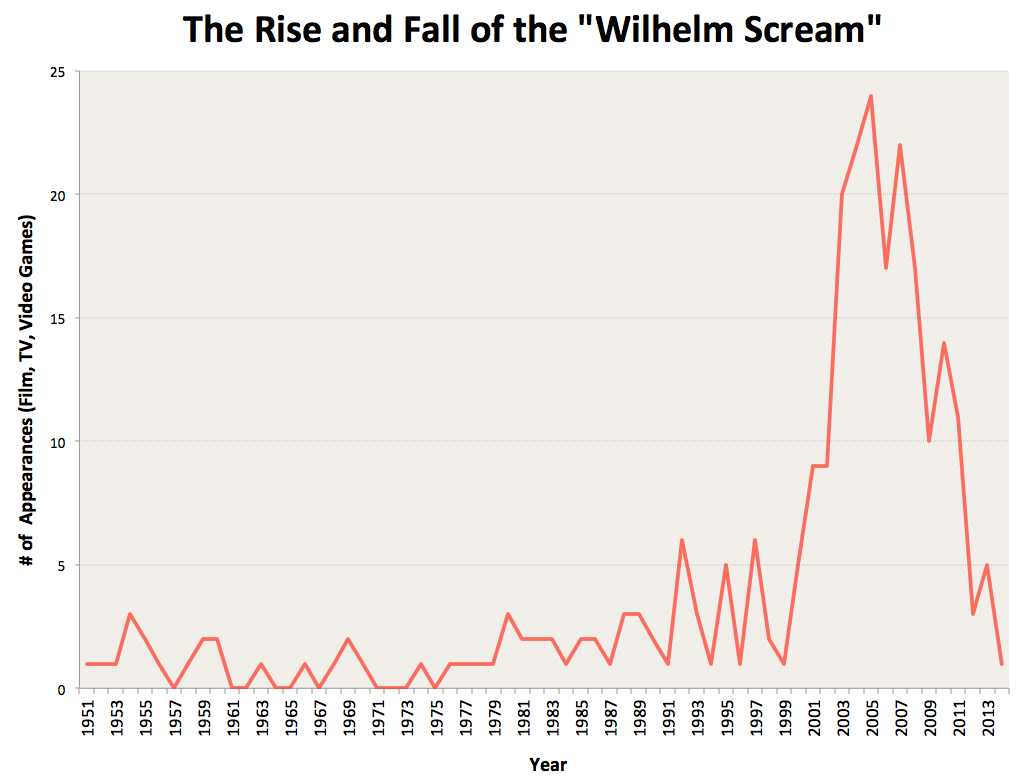
“[The Wilhelm] was something that was so below the radar, that the only people who noticed were the ones who knew,” reminisces Ben Burtt, the man who rediscovered the scream nearly 45 years ago. “Now that it's above ground, it isn’t nearly as much fun to use anymore.”The Priceonomics link above has a list of several hundred uses of the scream in movies.
The government is using the word "contraption," and that is probably more accurate but "robot" made the headline funnier. I don't know why. That's just how this works sometimes.
As I mentioned the other day, Paul Ceglia, who previously demanded half of Facebook and was later charged with fraud, is now a fugitive from justice. Just now I learned two additional facts (thanks, Elizabeth): (1) his whole family is also on the run, including the dog; and (2) Ceglia constructed a machine that was designed to keep his GPS bracelet in motion to give the illusion that he was still at home.
Because the Task Force Officers had been informed that Ceglia’s GPS bracelet was indicating that he was at his home, and because they could hear a mechanical noise coming from inside the home, the Task Force Officers forced entry into the home, both to check on the welfare on anyone inside, and to execute the arrest warrant. While conducting a security sweep of the home, the Task Force Officers observed, among other things, a hand-made contraption connected to the ceiling, from which Ceglia’s GPS bracelet was hanging. The purpose of the contraption appeared to be to keep the bracelet in motion using a stick connected to a motor that would rotate or swing the bracelet. A photograph of the contraption is attached as Exhibit C [see above]. Although the motor was making noise and appeared to be running, part of the contraption was disconnected, and was not in motion when observed by the Task Force Officers. They also observed a timer connected to the bracelet’s charger, a photograph of which is attached as Exhibit D. The bracelet reports to pretrial services when it is charging, and the timer’s purpose was apparently to mimic the report that would have been sent if Ceglia had been present and had plugged the charger in.
That's from the government's motion, posted here at Ars Technica, to dismiss Ceglia's interlocutory appeal of the trial judge's refusal to dismiss the indictment. (It's "interlocutory" because it's in the middle of a still-pending case. Trial was set for May 4.) Turns out that becoming a fugitive might jeopardize one's entitlement to appeal, at least according to the seemingly aptly named "fugitive disentitlement doctrine" that the pleading discusses.
I think this shows at least two things: (1) there are limits on what technology can do to protect us and/or control potential criminal behavior, and (2) Paul Ceglia has never heard of a Roomba. Seriously, Paul? This was what you came up with?
I will give him some small credit for not putting the bracelet on the dog and leaving him behind for this purpose. Maybe he can bring that up at the sentencing hearing.


Cities: Skylines [official site] has sold 250,000 copies in the 24 hours since launch, including preorders as day one sales. That’s more than any other Paradox game in the same period – Europa Universalis IV surpassed 300,000 sales around six months after release – and around a quarter of SimCity 2013’s first fortnight of sales.
Paradox are understandably pleased by the reception but they’re already looking to the future of the game. When I played it before release, Colossal Order CEO Mariina Hallikainen told me that the team already had free content lined up – features that weren’t quite ready for release, including tunnels. Support should continue for years though, as with Paradox’s grand strategy mainstays, and will come in the form of paid expansions and free patch updates.
LEGO unveiled a second set from The Simpsons today, 71016 The Kwik-E-Mart, which will be available later this year.

Click through for the full album.
As a child of the ’90s, The Simpsons was my favorite show, and naturally Lego was my favorite toy. My reaction to the combination of the two was ambivalence; as much as I still love Lego and hold nostalgia for the golden years of The Simpsons, their merging still feels somewhat unnatural, a feeling continuously reinforced by the uncanny valley nature of the bulbous cartoon heads on classic minifig bodies.
All that said, I’m excited for this set. I don’t believe Lego has ever tackled the inside of a convenience store before, and the set is chock full of nicely designed accessories and a plethora of printed and stickered details. But enough of my reaction based on a set of photos, here’s the press release;
71016 – The Kwik-E-Mart
Ages 12+. 2,179 pieces.
US $199.99 – CA $229.99 – DE 199.99€ – UK £169.99 – DK 1699.00 DKK
*Euro pricing varies by country. Please visit shop.LEGO.com for regional pricing.Visit The Kwik-E-Mart—Springfield’s favorite convenience store!
Welcome to The Kwik-E-Mart—your one-stop shop for convenience foods at inconvenient prices! This highly detailed and iconic LEGO® version of The Simpsons™ store is packed with more rich, colorful details than a Mr. Burns birthday cake has candles! Walk under the huge Kwik-E-Mart sign and join Homer, Marge and Bart as they browse the aisles filled with beauty products, diapers, dog food, pastries, fruits, vegetables and more—including Krusty-O’s and Chef Lonelyheart’s Soup for One. Then head over to the refrigerated cases where you’ll find Buzz Cola, chocolate milk, various other drinks and snacks… and frozen Jasper! There’s also a Buzz Cola soda fountain, juice dispensers, coffee machine, arcade games, ATM and stacks of Powersauce boxes. At the counter, Apu is ready to tempt you with a variety of printed magazines, comic books, cards, tofu hot dogs, freshly expired donuts and his ever-popular hallucination-inducing Squishees. At the back, there’s a storage closet complete with rat and an exit. On the roof you’ll discover Apu’s secret vegetable garden, while outside this amazing model features bright-yellow walls, 2 phone booths, a stack of purple crates, and a dumpster area with ‘El Barto’ graffiti, opening door and an iconic blue dumpster that also opens. You can also remove the roof and open out the rear walls for easy access. This set also includes Snake (a.k.a. Jailbird), who loves nothing more than stealing cars and robbing the Kwik-E-Mart—but this time Chief Wiggum is hot on his tail in his police car. Capture this bandit and return peace to the town of Springfield and the amazing Kwik-E-Mart. This fantastic set includes 6 minifigures with assorted accessory elements: Homer Simpson, Bart Simpson, Marge Simpson, Apu Nahasapeemapetilon, Chief Wiggum and Snake (a.k.a. Jailbird).
- Set includes 6 minifigures with assorted accessory elements: Homer Simpson, Bart Simpson, Marge Simpson, Apu Nahasapeemapetilon, Chief Wiggum and Snake (a.k.a. Jailbird)
- Features opening rear walls, a removable roof with secret vegetable garden, Kwik-E-Mart signage, light-blue walls, dusty blue floors, turquoise welcome mat, shelves, refrigerated cases, counter, Buzz Cola soda fountain, juice dispensers, coffee machine, 2 arcade games, ATM, crates of Powersauce bars, surveillance cameras, rear storage closet with a rat, cheese, rat hole and an exit door.
- Shelves feature beauty products, diapers, dog food, pastries, fruits, vegetables and more—including Krusty-O’s and Chef Lonelyheart’s Soup for One
- Refrigerator cabinets feature a variety of beverages including cans of Buzz Cola… and frozen Jasper!
- Counter features a cash register, magazine and card display, lottery machine, hot dog oven, donut display and a Squishee dispenser with 2 Squishees
- Also includes Chief Wiggum’s police car featuring an opening trunk, removable roof and space for 3 minifigures
- Accessory elements include Bart’s spray can, Marge’s shopping basket, Apu’s broom and Chief Wiggum’s cuffs and truncheon
- Snake (a.k.a. Jailbird) is exclusive to this set for fall 2015
- Removable roof features rare, dark-orange bricks
- Lift off the roof and open out the rear walls for easy access
- Drink a Squishee and get that sugar-high feeling!
- Apprehend Snake before he robs again!
- Stock up with overpriced convenience goods
- Discover frozen Jasper!
- Relax in Apu’s utopian vegetable garden
- Have a donut…. mmm, dooonuts!
- Kwik-E-Mart measures over 5″ (14cm) high, 14″ (38cm) wide and 10″ (27cm) deep
- Police car measures over 2″ (6cm) high, 2″ (6cm) wide and 5″ (15cm) deep
In 2003, a reporter asked candidates for the mayor of San Francisco questions from the Voight-Kampff test. Most of them failed.
Someone needs to administer this test to the Republican presidential candidates, and to Hillary Clinton*, as soon as possible. I fear we’ve been overrun by replicants, and most of them are crude, older models.
*Is there any other Democratic candidate? We seem to be drifting towards a mediocre non-choice.
(via Skippy)
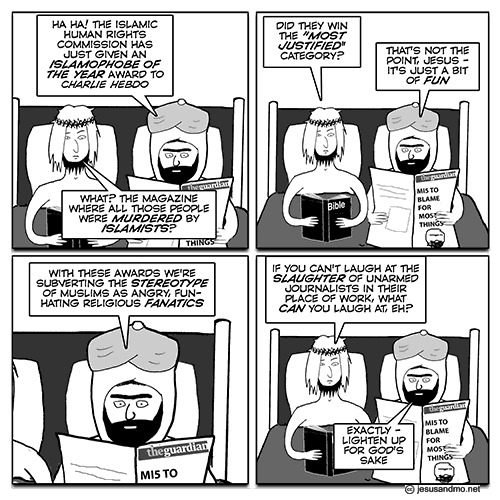
It isn’t funny because it’s true.
Please do me a favor and reblog or like this post if you are a cis person who feels 100% okay about sharing restrooms, changing rooms, and other public spaces with folks who are trans.
(Sometimes I don’t know how to help the folks in my life who are trans and have to put up with bigoted shit like this all the time, but I thought seeing lots of notes on this post might help at least a tiny bit.)
Luke.stirlingNo. Just, no. One cannot reasonably separate someone's "work" contributions from their other contributions to the public sphere. While it is certainly unreasonable to interrogate someone about their private thoughts and then condemn them for those, it is entirely reasonable to judge someone on the basis of how they treat others.
There are consequences to certain actions. Prop 8 harmed the lives of other people. Support of that is an action with consequences to others' freedoms to their private lives. A public action that suppresses the rights of others isn't the kind of protected action that everyone else should be forced to ignore for the sake of being professional.
An incredibly shrinking Firefox faces endangered species status, says Computerworld, and reports their user market share at 10% and dropping. It doesn’t look good for the Mozilla Foundation – especially not with so much of their funding coming from Google which of course has its own browser to push.
I wish I could feel sadder about this. I was there at the beginning, of course – the day Netscape open-sourced the code that would become Mozilla and later Firefox was the shot heard ’round the world of the open source revolution, and the event that threw The Cathedral and the Bazaar into the limelight. It should be a tragedy – personally, for me – that the project is circling the drain.
Instead, all I can think is “They brought the fate they deserved on themselves.” Because principles matter – and in 2014 the Mozilla Foundation abandoned and betrayed one of the core covenants of open source.
I refer, of course, to the Foundation’s disgraceful failure to defend its newly promoted Mozilla CEO Brendan Eich against a political mob.
One of the central values of the hacker culture from which Mozilla sprang is that you are to be judged by the quality of your work alone. We aspire to be a pure meritocracy, casting aside irrelevancies of race, sex, nationality, and of political and sexual preferences.
Brendan Eich lived those values. Though he was excoriated for donating to California Proposition 8, it was never even claimed – let alone established – that he judged gay hackers on the Firefox project by anything but their code.
Another central value of the hacker culture, intertwined with judgment only by the work, is free expression – the defense of people holding and expressing unpopular opinions. It must be this way, because suppression of dissent prevents us from discovering and acknowledging that our beliefs do not align with reality. That hinders the work.
When Brendan Eich was attacked, the correct response of the Mozilla Foundation from within hacker and open-source values would have been, at minimum “His off-the-job politics are none of our business.” Ideally, it would have continued with an active defense of Eich’s right to hold and express unpopular opinions, including by donating to the causes of his choice.
That’s not what happened. Instead, the Foundation truckled to that political mob, putting Eich under enough pressure that he felt he had no alternative but to resign. By failing to defend and support Eich, the Mozilla Foundation wronged a man who had every right to expect that he, too, would be judged by his work alone.
There, are of course, also technological factors in the decline of Mozilla – an aging codebase and failure to rapidly deploy to mobile devices are two of the more obvious. But in any market-share battle, hearts and minds matter too. It’s a significant advantage to be universally thought of as the good guys.
The Mozilla Foundation threw that away. They abandoned the hacker way and trashed their own legitimacy. It was a completely unforced error.
That is why I can only think, today, that they brought their end on themselves. And hope that it serves as a hard lesson: to thrive you must, indeed judge by the work alone.


Dr. Mae Jemison, MD, the first black woman in space and first actual astronaut to appear on a Star Trek show, one of the very few people on this planet of whom two pictures can be posted depicting them doing their job on a spaceship with entirely different contexts.
Holy shit this is a serious contender for the best post I’ve ever seen on tumblr.
my hero