Shared posts

22 Aug 17:48

Are we seeing skill mismatch after all?

by Tyler Cowen

Peter Orszag writes:

An odd puzzle is taking shape in the labor market: Over the past three years, the number of job openings has risen almost 50 percent, but actual hiring has gone up by less than 5 percent. Companies are advertising a lot more jobs, in other words, but not filling them.

To get some sense of how significant this is, consider that if, since June 2010, hiring had risen a third as much as advertised jobs have (rather than only a 10th), and nothing else were different, job creation would be roughly 500,000 higher each month, and the unemployment rate would already be back to normal levels.

One possibility is that companies are offering jobs, but at wages too low to attract takers:

Some support for this perspective comes from experimental data in the jobs survey, which show that the job-offer rate has risen most sharply (relative to hiring) for establishments with 10 to 250 workers.

Alternatively, companies may be filling positions internally, or they may be advertising without much intention of hiring.  Or we are back to the skills mismatch hypothesis.  Are companies simply expecting too much perfection in their new hires?  If so, why has the demand for (near) perfection gone up?

Here is commentary from Reihan.  And here is commentary by Ashok Rao (did you know he is 18 years old and from Chennai?).

22 Aug 15:18

Glasses that solve colorblindness

by Tyler Cowen

…I heard from another company that makes color-enhancing glasses — this time, specifically for red-green colorblind folks. The company’s called EnChroma, and the EnChroma Cx sunglasses are a heartbeat-skipping $600 a pair.

“Our lenses are specifically designed to address color blindness,” the company wrote to me, “and utilize a 100+ layer dielectric coating we engineered for this precise purpose by keeping the physiology of the eyes of colorblind people in mind.”

That is from David Pogue, there is more here.  For the pointer I thank Samir Varma.

14 Aug 17:23

teach

by Author
13 Aug 18:36

The surprising ages of the Founding Fathers on July 4, 1776

by Jason Kottke

For the Journal of the American Revolution, Todd Andrlik compiled a list of the ages of the key participants in the Revolutionary War as of July 4, 1776. Many of them were surprisingly young:

Marquis de Lafayette, 18
James Monroe, 18
Gilbert Stuart, 20
Aaron Burr, 20
Alexander Hamilton, 21
Betsy Ross, 24
James Madison, 25

This is kind of blowing my mind...because of the compression of history, I'd always assumed all these people were around the same age. But in thinking about it, all startups need young people...Hamilton, Lafayette, and Burr were perhaps the Gates, Jobs, and Zuckerberg of the War. Some more ages, just for reference:

Thomas Jefferson, 33
John Adams, 40
Paul Revere, 41
George Washington, 44
Samuel Adams, 53

The oldest prominent participant in the Revolution, by a wide margin, was Benjamin Franklin, who was 70 years old on July 4, 1776. Franklin was a full two generations removed from the likes of Madison and Hamilton. But the oldest participant in the war was Samuel Whittemore, who fought in an early skirmish at the age of 80. I'll let Wikipedia take it from here:

Whittemore was in his fields when he spotted an approaching British relief brigade under Earl Percy, sent to assist the retreat. Whittemore loaded his musket and ambushed the British from behind a nearby stone wall, killing one soldier. He then drew his dueling pistols and killed a grenadier and mortally wounded a second. By the time Whittemore had fired his third shot, a British detachment reached his position; Whittemore drew his sword and attacked. He was shot in the face, bayoneted thirteen times, and left for dead in a pool of blood. He was found alive, trying to load his musket to fight again. He was taken to Dr. Cotton Tufts of Medford, who perceived no hope for his survival. However, Whittemore lived another 18 years until dying of natural causes at the age of 98.

!!!

Tags: history   lists   Revolutionary War   Samuel Whittemore   Todd Andrlik   USA   war
12 Aug 17:25

Bloomberg's stop-and-frisk initiative found unconstitutional

by Jason Kottke

A federal judge ruled this morning that NYC's controversial stop-and-frisk practice violated the rights of "tens of thousands" of New Yorkers.

In a decision issued on Monday, the judge, Shira A. Scheindlin, ruled that police officers have for years been systematically stopping innocent people in the street without any objective reason to suspect them of wrongdoing. Officers often frisked these people, usually young minority men, for weapons or searched their pockets for contraband, like drugs, before letting them go, according to the 195-page decision.

These stop-and-frisk episodes, which soared in number over the last decade as crime continued to decline, demonstrated a widespread disregard for the Fourth Amendment, which protects against unreasonable searches and seizures by the government, according to the ruling. It also found violations with the 14th Amendment.

To fix the constitutional violations, Judge Scheindlin of Federal District Court in Manhattan said she intended to designate an outside lawyer, Peter L. Zimroth, to monitor the Police Department's compliance with the Constitution.

This is good news. Treating every young black male in the city like a criminal is not a policing strategy and it's embarrassing it has gone on this long. This kind of thing, along with the recent NSA revelations and other issues, make me wonder if "innocent until proven guilty" is still something the US citizenry and its law enforcement agencies still believe in. (via @beep)

Tags: legal   Michael Bloomberg   NYC   racism
12 Aug 14:27

The Great Reset, labor market edition

by Tyler Cowen

The lowest-wage sectors have consistently produced 40 percent to 50 percent of the job gains in recent recoveries.

Here is more, and there are further pictures here.

09 Aug 21:19

Liberalization Increases Growth

by Alex Tabarrok

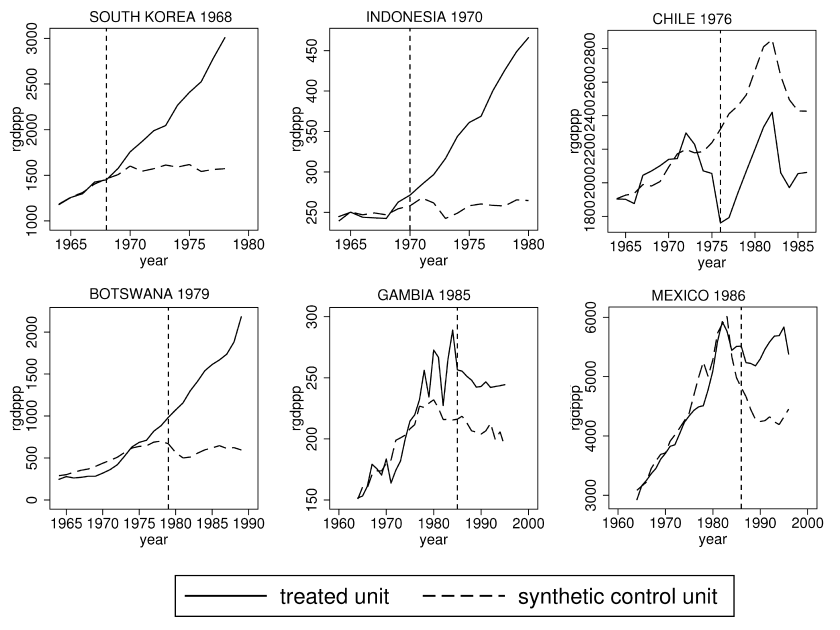
In Assessing Economic Liberalization Episodes: A Synthetic Control Approach (wp version), Billmeier and Nannicni evaluate economic liberalizations, defined as “comprehensive reforms that extend the scope of the market, and in particular of international markets,” over the period 1963-2005. The authors compare real per-capita GDP in treatment countries with that in a synthetic control, a weighted average of similar countries with the weights optimized so that the synthetic control matches as well as possible a variety of pre-treatment characteristics including secondary school enrollment, population growth, and the investment share as well as GDP. The results are often impressive, for example.

[In Indonesia] the average income over the years before liberalization is literally identical to that of the synthetic control, which consists of Bangladesh (41%), India
(23%), Nepal (23%), and Papua New Guinea (13%). After the economic liberalization in 1970, however, Indonesian GDP per capita takes off and is 40% higher than the estimated counterfactual after only five years and 76% higher after ten years.

Here is a selection of figures (see the paper for more). In each case the solid line is the liberalizing country and the dashed line the synthetic control.

Liberalizations

To be sure, not all liberalizations are successful. In particular, liberalizations in Africa especially after 1991 appear to be less successful. Whether this is because these liberalizations were half-hearted, were not combined with other institutional improvements or because countries that liberalized earlier were better able to link to global supply chains, is unclear. See the paper for more discussion.

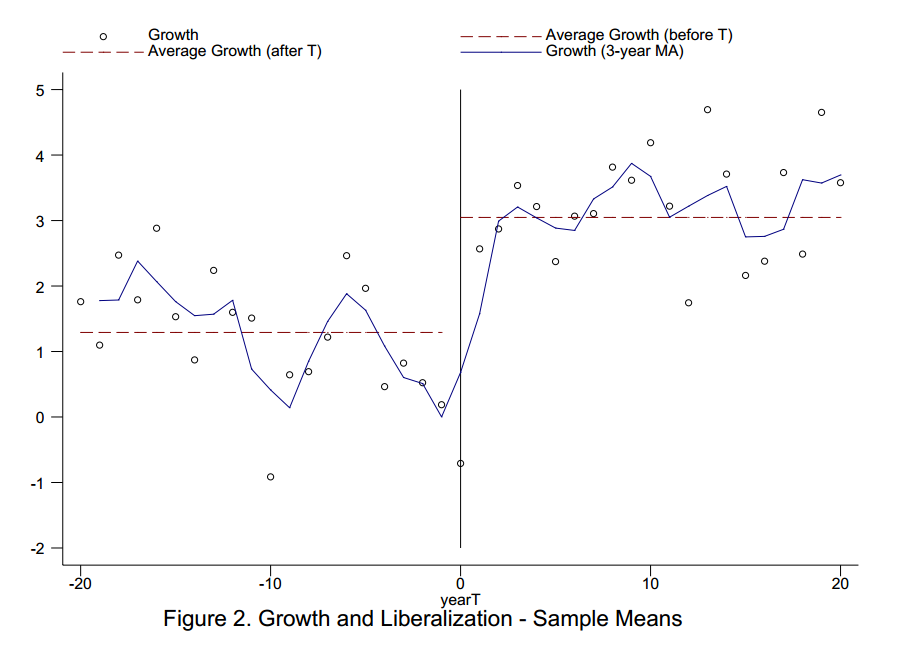
These results bolster similar earlier findings from Warciarg and Welch (2008) who, using different methods, examined the average effect of liberalizations on growth from a wide variety of countries over a 50 year period. They found that on average growth increased after liberalization by a remarkable 1.5 percentage points. Here is the key figure.

liberalizations3

See Development and Trade: The Empirical Evidence, a video from MRU, for more on the WW study as well as other types of evidence.

09 Aug 21:16

The Animals are Also Getting Fat

by Alex Tabarrok

In a remarkable paper Allison et al. (2011) gather data on the weight at mid-life from 12 animal populations covering 8 different species all living in human environments. Dividing the sample into male and female they find that in all 24 cases animal weight has increased over the past several decades.

Cats and dogs, for example, both increased in weight.  Female cats increased in body weight at a rate of 13.6% per decade and males at 5.7% per decade. Female dogs increased in body weight at a rate of 3% per decade and males at a rate of 2.2% per decade.

One ready, although not necessarily correct explanation, is that fat people feed their cats and dogs more and exercise them less. Thus, the authors also looked at animals not directly under human control such as rats.

…For the 1948–2006 time period, male rats trapped in urban
Baltimore experienced a 5.7 per cent increase in body
weight per decade from 1948 to 2006 and a nearly
20 per cent increase in the odds of obesity. Similarly,
female rats trapped in urban Baltimore experienced a
7.22 per cent per decade increase in body weight, along
with a 26 per cent increase in the odds of obesity.

that too has a ready, although not necessarily correct, explanation:

fat mouse… just as human real wealth and food
consumption have increased in the United States, rats
which presumably largely feed on our refuse, may also
be essentially richer.

To counter both of these objections the authors do something very clever, they gather data on the weight of control mice used in many different experiments over decades.

Among mice in control groups in the National Toxicology
Programme (NTP), there was a 11.8 per cent
increase in body weight per decade from 1982 to 2003
in females coupled with a nearly twofold increase in the
odds of obesity. In males there was a 10.5 per cent
increase per decade.

Control mice are typically allowed to feed at will from a controlled diet that has not varied much over the decades, making obvious explanations less plausible. Could mice have gained weight due to better care? Possibly although that is speculative.

More generally, there are specific explanations for the weight gain in each of the animal populations, just as there are for humans. Each explanation looks plausible taken on its own but is it plausible that each population is gaining weight for independent reasons? Could there instead be a unifying explanation for the weight gain in all populations? No one knows what that explanation is: toxins? viruses? epigenetic factors? I am not ready to jump on any of these bandwagons and in some cases the author’s samples are small so I am not yet fully convinced of the underlying facts, nevertheless this is intriguing and important research.

Hat tip: David Berreby writing in Aeon about The Obesity Era.

09 Aug 21:05

The trees of Chernobyl

by Jason Kottke

This is what the trees look like near Chernobyl when you cut them down. It's a biiiit tricky but see if you can spot when the nuclear plant disaster happened...

Chernobyl trees

Not surprisingly, researchers have found evidence that the radiation has affected the growth of trees near the accident site. From the paper:

Mean growth rate was severely depressed and more variable in 1987-1989 and several other subsequent years, following the nuclear accident in April 1986 compared to the situation before 1986. The higher frequency of years with poor growth after 1986 was not caused by elevated temperature, drought or their interactions with background radiation. Elevated temperatures suppressed individual growth rates in particular years. Finally, the negative effects of radioactive contaminants were particularly pronounced in smaller trees. These findings suggest that radiation has suppressed growth rates of pines in Chernobyl, and that radiation interacts with other environmental factors and phenotypic traits of plants to influence their growth trajectories in complex ways.

Tags: biology   Chernobyl   science
02 Aug 15:11

Will Uruguay legalize marijuana?

by Tyler Cowen

Members of Uruguay’s House of Representatives have passed a bill to legalise marijuana.

If it goes on to be approved by the Senate, Uruguay will become the first country to regulate the production, distribution and sale of marijuana.

The measure is backed by the government of President Jose Mujica, who says it will remove profits from drug dealers and divert users from harder drugs.

Under the bill, only the government would be allowed to sell marijuana.

There is more here, and reports indicate that approval for the bill is expected.

31 Jul 14:53

teslasexual: -via pictures for sad children

26 Jul 14:54

July 25, 2013


Pow!
26 Jul 14:50

Fake bungie jump

by Jason Kottke

This is the perfect Friday thing: a man is tricked into thinking he's bungee jumping at his bachelor party while actually standing in front of a kiddie pool.

I laughed entirely too hard at this. (via ★interesting)

Tags: video
26 Jul 14:45

The Dos and Don’ts of African American Cosplay by Ron Funches

by Kimber Streams

Fuck Jar Jar Binks!

In this video, comedian Ron Funches breaks down which awesome African American characters to cosplay — and which ones to avoid at all costs — at this year’s San Diego Comic Con.

submitted via Laughing Squid Tips

15 Jul 13:18

Enlightenment

Joswald1

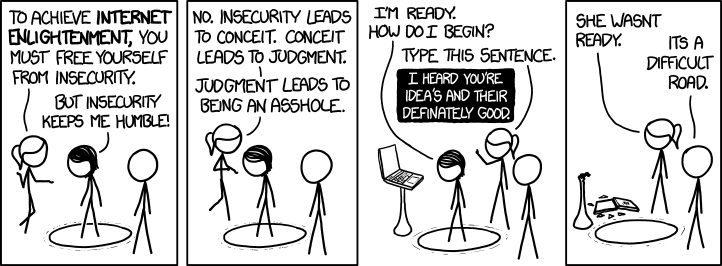
I didn't notice any errors in the black text until I reread it.

But the rules of writing are like magic spells. If you never acquire them, then not using them says nothing.
11 Jul 17:24

Keeping to the beat

by Jason Kottke

A study by researchers in Sweden indicates that the heartbeats of singers in a choir quickly synchronize.

Using pulse monitors attached to the singers' ears, the researchers measured the changes in the choir members' heart rates as they navigated the intricate harmonies of a Swedish hymn. When the choir began to sing, their heart rates slowed down.

"When you sing the phrases, it is a form of guided breathing," says musicologist Bjorn Vickhoff of the Sahlgrenska Academy who led the project. "You exhale on the phrases and breathe in between the phrases. When you exhale, the heart slows down."

But what really struck him was that it took almost no time at all for the singers' heart rates to become synchronized. The readout from the pulse monitors starts as a jumble of jagged lines, but quickly becomes a series of uniform peaks. The heart rates fall into a shared rhythm guided by the song's tempo.

(via @stevenstrogatz)

Tags: music   science
10 Jul 14:28

Surgery price wars in Oklahoma City?

by Tyler Cowen

I don’t have deep background knowledge on this particular hospital, but here is a new and interesting article:

An Oklahoma City surgery center is offering a new kind of price transparency, posting guaranteed all-inclusive surgery prices online. The move is revolutionizing medical billing in Oklahoma and around the world.

Dr. Keith Smith and Dr. Steven Lantier launched Surgery Center of Oklahoma 15 years ago, founded on the simple principle of price honesty.

“What we’ve discovered is health care really doesn’t cost that much,” Dr. Smith said. “What people are being charged for is another matter altogether.”

Surgery Center of Oklahoma started posting their prices online about four years ago.

Click here to see the online prices at Surgery Center of Oklahoma.

The prices are all-inclusive quotes and they are guaranteed.

“When we first started we thought we were about half the price of the hospitals,” Dr. Lantier remembers. “Then we found out we’re less than half price. Then we find out we’re a sixth to an eighth of what their prices are. I can’t believe the average person can afford health care at these prices.”

Their goal was to start a price war and they did.

Their first out-of-town patients came from Canada; soon everyday Americans caught on.

Here is a bit more:

Dr. Smith said federal Medicare regulation would not allow for their online price menu.

They have avoided government regulation and control in that area by choosing not to accept Medicaid or Medicare payments.

I would like to know more about this example (maybe Cherokee Gothic can go buy something there), but the article is here and some further coverage is here.  For the pointer I thank Jake Seliger and also Craig Fratrik and Timothy Miano.

08 Jul 14:20

July 07, 2013


Last day for the new project! Thanks, geeks!

27 Jun 13:43

June 27, 2013


SMBC Theater has created... a love compilation.

26 Jun 16:31

What’s the most intellectual joke you know?

by Tyler Cowen

That query is from AskReddit, the link is here, and here are a few of the nominations:

It’s hard to explain puns to kleptomaniacs because they always take things literally.

And:

Jean-Paul Sartre is sitting at a French cafe, revising his draft of Being and Nothingness. He says to the waitress, “I’d like a cup of coffee, please, with no cream.” The waitress replies, “I’m sorry, Monsieur, but we’re out of cream. How about with no milk?”

And:

Werner Heisenberg, Kurt Gödel, and Noam Chomsky walk into a bar. Heisenberg turns to the other two and says, “Clearly this is a joke, but how can we figure out if it’s funny or not?” Gödel replies, “We can’t know that because we’re inside the joke.” Chomsky says, “Of course it’s funny. You’re just telling it wrong.”

I don’t find that latter one funny at all, as they are telling it wrong.

The pointer is from Jodi Ettenberg of Legal Nomads fame.

What are your picks?  You get mine every day.

24 Jun 20:00

No Parkinson's with the flip of a switch

by Jason Kottke

Andrew Johnson has been diagnosed with Early Onset Parkinson's Disease and recently underwent deep brain stimulation (DBS) surgery to implant a brain pacemaker that supplies his brain with regular and reliable electrical pulses. In this incredible video, Johnson turns the pacemaker off and you can see the effect that DBS has had on his life.

Understatement of the year at the end of the video. Wow. Johnson writes about his experience with Parkinson's on his site, Young and Shaky. (thx, eamon)

Tags: medicine   Parkinson's Disease   science   video
21 Jun 13:35

Comic for June 21, 2013

Dilbert readers - Please visit Dilbert.com to read this feature. Due to changes with our feeds, we are now making this RSS feed a link to Dilbert.com.
21 Jun 13:20

No One is Innocent

by Alex Tabarrok

I broke the law yesterday and again today and I will probably break the law tomorrow. Don’t mistake me, I have done nothing wrong. I don’t even know what laws I have broken. Nevertheless, I am reasonably confident that I have broken some laws, rules, or regulations recently because its hard for anyone to live today without breaking the law. Doubt me? Have you ever thrown out some junk mail that came to your house but was addressed to someone else? That’s a violation of federal law punishable by up to 5 years in prison.

Harvey Silverglate argues that a typical American commits three felonies a day. I think that number is too high but it is easy to violate the law without intent or knowledge. Most crimes used to be based on the common law and ancient understandings of wrong (murder, assault, theft and so on) but today there are thousands of federal criminal laws that bear no relation to common law or common understanding. The WSJ illustrates:

Last September (2011), retired race-car champion Bobby Unser told a congressional hearing about his 1996 misdemeanor conviction for accidentally driving a snowmobile onto protected federal land, violating the Wilderness Act, while lost in a snowstorm. Though the judge gave him only a $75 fine, the 77-year-old racing legend got a criminal record.

Mr. Unser says he was charged after he went to authorities for help finding his abandoned snowmobile. “The criminal doesn’t usually call the police for help,” he says.

Or how about this:

In 2009, Mr. Anderson loaned his son some tools to dig for arrowheads near a favorite campground of theirs. Unfortunately, they were on federal land….

There is no evidence the Andersons intended to break the law, or even knew the law existed, according to court records and interviews. But the law, the Archaeological Resources Protection Act of 1979, doesn’t require criminal intent and makes it a felony punishable by up to two years in prison to attempt to take artifacts off federal land without a permit.

The Anderson’s didn’t even find any arrowheads but the attempt to find was punishable by imprisonment. Under statutes such as the Lacey Act one can even face criminal prosecution for violating the laws of another country. Ignorance of another  country’s laws is no excuse.

If someone tracked you for a year are you confident that they would find no evidence of a crime? Remember, under the common law, mens rea, criminal intent, was a standard requirement for criminal prosecution but today that is typically no longer the case especially under federal criminal law .

Faced with the evidence of an non-intentional crime, most prosecutors, of course, would use their discretion and not threaten imprisonment. Evidence and discretion, however, are precisely the point. Today, no one is innocent and thus our freedom is maintained only by the high cost of evidence and the prosecutor’s discretion.

One of the responses to the revelations about the mass spying on Americans by the NSA and other agencies is “I have nothing to hide. What me worry?” I tweeted in response “If you have nothing to hide, you live a boring life.” More fundamentally, the NSA spying machine has reduced the cost of evidence so that today our freedom–or our independence–is to a large extent at the discretion of those in control of the panopticon.

20 Jun 12:22

trust

by Author

trust

Many thanks to this week’s guest script writer, Chief Rabbi Jonathan Sacks. And a big hello to all J&M’s Danish readers.

Flattr this for Jesus Book shop here

19 Jun 14:00

Do Presidents become more interventionist once they take office?

by Tyler Cowen

Andrew Sullivan is upset with President Obama over Syria.  I’d like to consider the background question of whether individuals, upon assuming the presidency, subsequently come to look more kindly on foreign intervention (and perhaps also surveillance?) than before holding office.  I can think of a few reasons why this might occur:

1. Presidents become used to holding power, and this makes them more statist, including more interventionist.  It’s not that they wake up one morning as evil, but rather they must make many small compromises along the way, and since they are committed to holding good images of themselves, their moral views shift subtly over time to accommodate this positive self-image.  Many libertarians favor this kind of explanation.

2. Presidents learn the actual truth about the international situation, and becoming more interventionist is a rational implication of Bayesian updating.  Many Presidents favor this kind of of explanation.

3. Presidents must live with a great sense of responsibility for their decisions, and this makes them more utilitarian and less deontological.  Arguably the same is true of CEOs of major companies, and of the major characters in the new Superman movie.  Superman seems willing to toss around infrastructure to increase his chance of taking out some bad guys, and none of the viewers in the Angelika Mosaic multiplex seemed to find this implausible or undesirable.

4. Presidents come to rely on the national security and defense establishment as an important part of their coalition, and this establishment is, for reasons of its own, often favorably predisposed to intervention, at least if done according to their self-imposed standards.  There is a bit of trade going on here and also a bit of cognitive capture, but in any case presidents move closer to the views of their national security establishments over time.

5. Presidents, upon assuming office, become increasingly aware of what it takes to maintain America’s network of global alliances.  For instance behind any Syria decision are a variety of pressures from the Gulf States, from Israel, from the Europeans, from ongoing push-and-shove with Russia, and so on.  The President has a stronger sense of how inaction can lead to an unraveling of America’s credibility and previous agreements, both explicit and implicit.  We are never playing from t = 0.

6. Presidents come to favor actions which correspond to them receiving a stronger place in history.  In their second terms this is especially likely to involve foreign affairs.

Perhaps there is something to all of these hypotheses.  Is there a way to describe them all under a common heading of what loses salience to an individual, once he or she becomes President of the United States? It doesn’t seem quite right to postulate “they forget about the little people.”  So what is it then?

The follow-up question whether these are on the whole destructive biases, or are they useful counters to other, less cosmopolitan biases which otherwise favor too little intervention?

I sometimes wonder how much Presidents trust their own judgments.

14 Jun 12:45

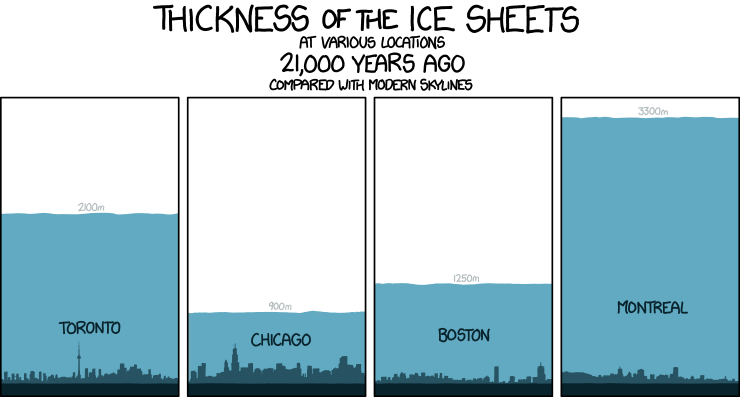
Ice Sheets

Data adapted from 'The Laurentide and Innuitian ice sheets during the Last Glacial Maximum' by A.S. Dyke et. al., which was way better than the sequels 'The Laurentide and Innuitian ice sheets during the Last Glacial Maximum: The Meltdown' and 'The Laurentide and Innuitian ice sheets during the Last Glacial Maximum: Continental Drift'.
14 Jun 12:44

All of the rivers

by Jason Kottke

Perhaps inspired by All Streets, Ben Fry's map of all the streets in the US, Nelson Minar built a US map out of all the rivers in the country.

All Rivers

All Rivers detail

Minar put all the data and files he used up on Github so you can make your own version.

Tags: Ben Fry   maps   Nelson Minar   USA
11 Jun 20:52

From the comments

by Tyler Cowen

Rahul writes:

Just for the heck of it, I tried an alternative list:

1. Ramp up drastically the training output of new doctors and nurses: More med schools, larger intakes per school, elimination of 4 years of pre-med university etc. More med school student scholarships and subsidies?

2.Massively expand other lower tiers of the medical system: Physicians assistants, Nurse Practitioners etc.

3. Liberalize drug imports both commercial and personal. Allow direct import of any FDA-licensed drug sold in equivalent nations (western EU / Canada etc.). Mostly ignore Big Pharma’s opinions in this context.

4. Fully recognize all medical degrees from similarly developed nations (e.g. Canada / UK / Japan / Australia etc.) to the point that doctors from these nations can register and practice almost instantly in the US. Provide an almost limitless immigration quota for doctors from western nations. Even better, aggressively recruit doctors from abroad. Mostly ignore APA’s opinions in this context.

5. Allow and encourage Medicare / Insurance procedures to be carried out abroad where cheaper locales (Mexico? Canada? Argentina? ) exist. Incentivize recipients using these options. Premium rebates? Encourage private insurers to offer plans that economize on major procedures by treating abroad.

11 Jun 19:22

Tools for thinking

by Jason Kottke

An excerpt from Daniel Dennett's new book, Intuition Pumps and Other Tools for Thinking, outlines seven of Dennett's tools for thinking. His second tool is "respect your opponent":

The best antidote I know for this tendency to caricature one's opponent is a list of rules promulgated many years ago by social psychologist and game theorist Anatol Rapoport.

How to compose a successful critical commentary:

1. Attempt to re-express your target's position so clearly, vividly and fairly that your target says: "Thanks, I wish I'd thought of putting it that way."

2. List any points of agreement (especially if they are not matters of general or widespread agreement).

3. Mention anything you have learned from your target.

4. Only then are you permitted to say so much as a word of rebuttal or criticism.

Tags: books   Daniel Dennett   Intuition Pumps   lists
10 Jun 19:11

Millennials in the Workplace: A Helpful Guide

by EDW Lynch

“Millennials in the Workplace: A Helpful Guide” is a hilarious mock educational video that explains how to deal with a new kind of worker: the whiny and difficult millennial. The video was created by Official Comedy.

submitted via Laughing Squid Tips