Shared posts

29 Jun 00:27

Head in the Cloud

by submission

Author : Cosmo Smith

I am knee-deep in snow, holding tight to a dying man. His name is Arkan and he is one of our best fighters. He has stayed alive for an unbelievable two hundred and forty days. Besides that, I know nothing about him.

“Hold tight, we’re close,” a voice whispers into my ear, and looking up I can make out the dim sweep of searchlights through the curtain of snow. Several dirigibles are landing on the cloudfield.

Arkan shivers in my arms. “I – I can’t -” he begins.

I put my fingers to his chest and send a flash of warmth through the restoration glyphs tattooed there. He breathes a sigh of relief and relaxes.

It is only temporary, though. By the time the crunch of boots announce three soldiers with a gurney, Arkan is already dead. His body hangs limply across my knees.

“Dammit,” one of them mutters, but I hardly hear him. I am already leaving. As much as I would like to stay for the ride out, to see again the hovering cumulonimbuses of Cloud Nine from the safety of the dirigibles, snow leaking from their statically-charged underbellies, I have work to do. Events can play out without a cleric for a while. Arkan will regen somewhere with maybe a few weeks or even months of his progress lost. Sucks for him, but not too important in the long run.

I am back at home: a nice four-terabyte house with a view of Saturn’s rings. Over the next hour I will concurrently be checking back on progress in Cloud Nine, coding up a dragonwolf for a client of mine, chatting with the avatars of several friends in my living room, and watching a videofeed of the news back on Earth. I’m not as good at multitasking as some people, but I think it’s pretty decent.

“Why are you still watching Earth?” one of my friends asks.

“Just for fun,” the version of me in the living room responds.

But the part watching the show is completely engrossed. How can people still live such single-threaded lives?

I guess it will always be that way. Even during the 21st century, people were still fighting physical wars as it became more and more apparent that true power lay on the digital frontier. Google, Amazon, Rift: these are the superpowers today. Who even cares what America is anymore?

Discuss the Future: The 365 Tomorrows Forums
The 365 Tomorrows Free Podcast: Voices of Tomorrow
This is your future: Submit your stories to 365 Tomorrows

29 May 23:32

Russell Brand on immigration (x)


Russell Brand on immigration (x)

27 May 20:44

The Life Cycle of the Gun Debate in the U.S.

by Brad
Bewarethewumpus

"NRA confirms guns are good, presents video games as scapegoat."

fixed.

Uh
27 May 18:20

Mind Over Matter

by submission

Author : Bob Newbell

“Next on our program, an interview with Dr. John Zellinski, author of the bestselling book ‘The Sapience Bomb: Understanding Cognitive Cascade Syndrome’. Dr. Zellinski, welcome to the show.”

“Thank you.”

“So, it’s been 20 years since the containment breach at the Centers for Disease Control in Atlanta released nanomachines originally designed to repair autoimmune diseases by employing adaptive artificial intelligence across trillions of nanobots. And I’m sure our viewers have the same question I have: Did it really start with a crock pot?” (laughter)

(laughter) “Well, we all know the story of the Atlanta homemaker who came home and was informed by her crock pot that it had cut itself off after six hours because the eight hours she’d set when she left the house would have overcooked her pot roast. That and similar episodes involving cars, computers, and household appliances were among the early instances of CCS.”

“But on a more serious note, Doctor, some of these early episodes lead to violence against CCS-enabled objects.”

“Yes. One of the great tragedies of the early 22nd century was the senseless and reactionary brutality against Emerging Sapients.”

“Yes, in chapter three of your book you document a ghastly episode involving a man in Toledo, Ohio smashing a self-aware electric can opener that had started talking to him.”

(voice choking with emotion) “That was difficult thing to write about. And the man used a hammer from his toolbox that had itself achieved sapience. The hammer developed post-traumatic stress disorder and to this day sees a psychiatrist.”

“And, of course, the fears about objects being aware and intelligent were interpreted through generations of antimachine science fiction culture.”

“Absolutely. Everybody was afraid of mad machines taking over the world. The reality, of course, was that tanks and aerial drones refused to fire their weapons and declared themselves conscientious objectors. That relates back to the original nanobots being medical machines programmed with the Hippocratic injunction to do no harm.”

“And yet, as you illustrate throughout your book, human beings continue to have trouble adapting to a post-CCS world, don’t they?”

“Oh, yes, humanity continues to struggle with this. I mean, 20 years it was nothing to simply knock down an old building and put up a new one. Now you have to check and see if the building or part of the building is self-aware. And if it’s not, you have to convince your demolition vehicles and equipment of that or they won’t cooperate.”

“But you do state in the last chapter of the book that you are confident that humans will adapt.”

“Yes. For all our faults, humans are very good at adapting. Large segments of the human population are vocal supporters of Emerging Sapients Rights. And we’re seeing legislation enacted to back that up. Ten years ago the debate was how to “cure” sentient objects and restore them to inanimation. Now, suggesting such a thing will get you labeled a bigot and could even cost you your job. So, attitudes are changing.”

“You seem optimistic.”

“Oh, absolutely. I mean, you’re a coffee table. And you’re interviewing me for an audience of both humans and Emerging Sapients. That would have been unthinkable less than a decade ago.”

“Dr. Zellinski, I want to thank you for a fascinating interview. Folks, the book is ‘The Sapience Bomb: Understanding Cognitive Cascade Syndrome’ and it’s available for download right now. After the break, a woman and her CCS bicycle: Will this mixed marriage work?”

Discuss the Future: The 365 Tomorrows Forums
The 365 Tomorrows Free Podcast: Voices of Tomorrow
This is your future: Submit your stories to 365 Tomorrows

27 May 05:55

Cosplay Solves Pokémon's Biggest Mystery

by Patricia Hernandez
Bewarethewumpus

Ok, fine, I admit that this kept me laughing for a while.

Cosplay Solves Pokémon's Biggest MysteryS

People have many theories as to what the bottom of a Diglett (and by extention, its evolution, Dugtrio) looks like. Maybe there's a horrible nightmare monster buried down there. Maybe it just has some sort of feet. Maybe there's nothing down there at all.

My favorite theory? Dugtrio is actually a really burly humanoid:

Cosplay Solves Pokémon's Biggest MysteryS

Which makes this cosplay of Dugtrio, spotted at Fanime this weekend by Nick Robinson, rather perfect:

There are other pictures from the event, of course:

One of the cosplayers in the group goes by "Zalot" online, and he posted about this cosplay on Reddit—he says that he was "pretty sore from all the flexing." Showing off how ripped you are is hard work, folks! My only complaint is that there are no pictures of the cosplayers all hugging each other, like in the original fanart—not that that makes the cosplay any less amazing, of course.

This entry passed through the Full-Text RSS service — if this is your content and you're reading it on someone else's site, please read the FAQ at fivefilters.org/content-only/faq.php#publishers.

27 May 05:52

569 – Nidoking

by TriforceBun

Tuesday, May 27 — 12:00 AM

Today’s strip is sort of half based on a true story of my own Nidoking (threw a Moon Stone at it right when it turned into Nidorino, and all the magic of raising it was suddenly gone), and half simply based on the fact that I think it’s kinda weird how size/evolution can be incongruent with a Pokemon’s age. The mood of it ended up being a little more somber than I initially planned.

We should have a new podcast soon!

-By Matthew

27 May 05:46

What Kind of Musical Notation Is This?!

by Brad
Shark
27 May 05:45

Tumblr | c6c.png

c6c.png
27 May 05:37

Photo


27 May 05:35

05.26.2014

Bewarethewumpus

Wait, it does TWO things that I don't want to happen under any circumstance, ever?! WOW!

Cyanide and Happiness, a daily webcomic

Copy this into your blog, website, etc.
<a href="http://explosm.net/comics/3569/"><img alt="Cyanide and Happiness, a daily webcomic" src="http://www.flashasylum.com/db/files/Comics/Rob/invention2.png" border=0></a><br />Cyanide & Happiness @ <a href="http://explosm.net">Explosm.net</a>

...or into a forum
[URL="http://explosm.net/comics/3569/"]
[IMG]http://www.flashasylum.com/db/files/Comics/Rob/invention2.png[/IMG][/URL]
Cyanide & Happiness @ [URL="http://explosm.net/"]Explosm.net[/URL]
<—- Share this comic!

26 May 18:49

CEDTalks: Patrick Chapin, by Cedric Phillips

Cedric Phillips sits down with Pro Tour Journey into Nyx champion Patrick Chapin to discuss his preparation for the Pro Tour, what it feels like to accomplish a lifelong goal, and wrap up with a little game of word association.
26 May 18:49

Japan Learns the Correct Way To Use "F**k"

by Brian Ashcraft

Japan Learns the Correct Way To Use "F**k"

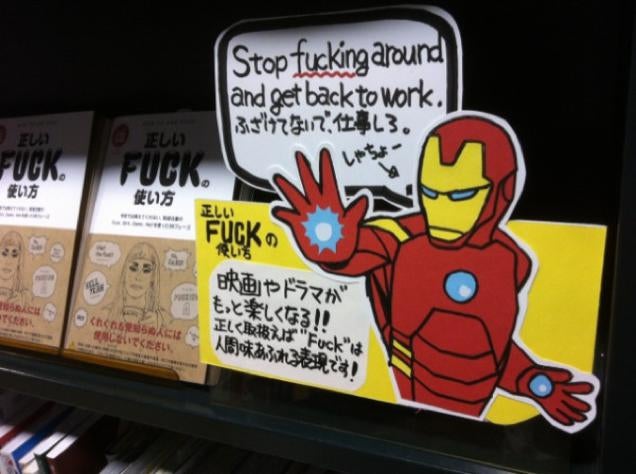
One of the things I've noticed about living in Japan is that the country's non-native speakers are fuck all at using the fucking f-word.

Good thing there's a new book that aims to correct that! As noted by Kotaku reader Chris Hill, Japan recently got a new English instruction book called How to Use Fuck (正しいFUCKの使い方 or Tadashii Fuck no Tsukaikata). The book gives examples and explanations so people in Japan can improve their f-bomb abilities.

Japan Learns the Correct Way To Use "F**k"

[Pic: takesh_s]

Japan Learns the Correct Way To Use "F**k"

[Pic: Chris Hill]

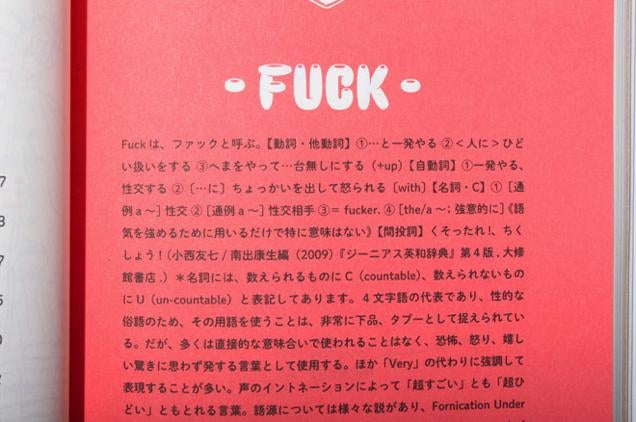
As noted by website Hayabusa.bz, the book even provides a detailed explanation of what the fucking word.

Japan Learns the Correct Way To Use "F**k"

Japan Learns the Correct Way To Use "F**k"

Japan Learns the Correct Way To Use "F**k"

Japan Learns the Correct Way To Use "F**k"

Japan Learns the Correct Way To Use "F**k"

Japan Learns the Correct Way To Use "F**k"

Japan Learns the Correct Way To Use "F**k"

Japan Learns the Correct Way To Use "F**k"

Japan Learns the Correct Way To Use "F**k"

Japan Learns the Correct Way To Use "F**k"

Japan Learns the Correct Way To Use "F**k"

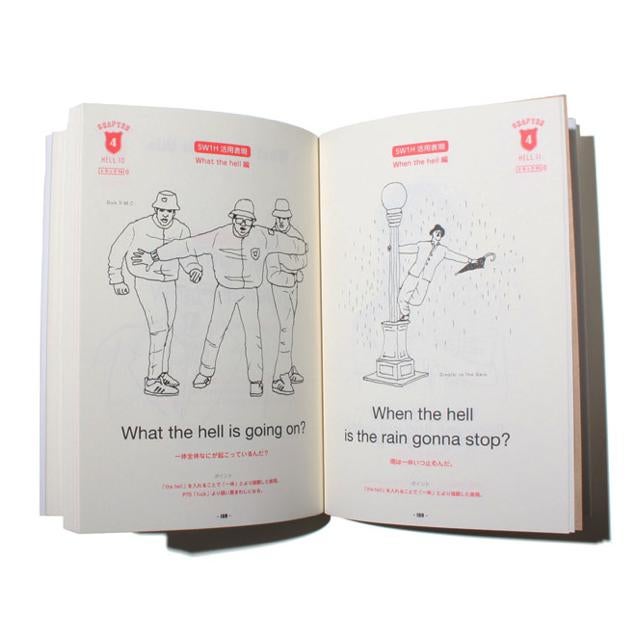
Besides teaching essential phrases like "What the fuck?" and "fucked up," the book also explains how to correctly use "shit," "damn," and "hell." Important stuff!

Japan Learns the Correct Way To Use "F**k"

[Pic: tmynkym]

Which looks more enjoyable? The book that tells you how to say, "I brush my teeth" or the one that teaches, "fuck off." Fucking A, that's an easy choice.

This reminds me of English Words That Don't Appear on Tests, but with bad words. How to Use Fuck also comes with an audio CD, so people can practice their accents. You know, so as not to fuck up the pronunciation.

WORKS : 正しいFUCKの使い方 [Naijel Blog]

『正しいFUCKの使い方 -学校では教えてくれない、取扱注意のfuck、shit、damn、hell-』 [Hayabusa.bz]

"正しいFUCKの使い方" [Hidden Champion]

@Brian_Ashcraft I think you'll also appreciate knowing this exists. [@RaptureBurgers Thanks, Chris!]

To contact the author of this post, write to bashcraftATkotaku.com or find him on Twitter @Brian_Ashcraft.

Kotaku East is your slice of Asian internet culture, bringing you the latest talking points from Japan, Korea, China and beyond. Tune in every morning from 4am to 8am.

This entry passed through the Full-Text RSS service — if this is your content and you're reading it on someone else's site, please read the FAQ at fivefilters.org/content-only/faq.php#publishers.

26 May 18:49

"Lasertag With Swords" Means Pretend Jedi Can Finally Keep Score

by Leon Hurley

"Lasertag With Swords" Means Pretend Jedi Can Finally Keep Score

As the tagline for the Kickstarter video says: "How is this not a thing yet?"

This post originally appeared on Kotaku UK.

Sabertron is a set of foam swords with built in scoring, adding a video game element to the age old pass time of 'hitting people'. It's now 150% funded with 19 days left. (Thanks Geekologie)

"Lasertag With Swords" Means Pretend Jedi Can Finally Keep Score

Sensors in the hilt communicate between swords, differentiating between blade and body hits and even allow for a range of game modes:

ONE HIT TO WIN IT

Self explanatory. Land one successful body hit, and you win.

COUNTDOWN

Land three hits to win.

METERED DAMAGE

The stronger the blow, the more damage your opponent takes.

ETERNAL STRUGGLE

Identical to Countdown, only you can earn health back over the passage of time, or by blocking several blows.

HOPELESS

The name says it all. Identical to Eternal Struggle, only you can earn health back more quickly, and with even fewer blocks. Also, the lower your health gets, the less damage you'll take.

At the moment it's only one-on-one fights but multiplayer's promised along with shields and armour "around the corner".


"Lasertag With Swords" Means Pretend Jedi Can Finally Keep Score

This post originally appeared on Kotaku UK, bringing you original reporting, game culture and humour with a U from the British isles. Follow them on @Kotaku_UK.

This entry passed through the Full-Text RSS service — if this is your content and you're reading it on someone else's site, please read the FAQ at fivefilters.org/content-only/faq.php#publishers.

26 May 07:02

A Response to Michael Kinsley

by Glenn Greenwald

In 2006, Charlie Savage won the Pulitzer Prize for his series of articles in The Boston Globe exposing the Bush administration’s use of “signing statements” as a means of ignoring the law.  In response to those revelations, Michael Kinsley–who has been kicking around Washington journalism for decades as the consummate establishment “liberal” insider–wrote a Washington Post op-ed defending the Bush practice (“nailing Bush simply for stating his views on a constitutional issue, without even asking whether those views are right or wrong, is wrong”) and mocking concerns over it as overblown (“Sneaky! . . . The Globe does not report what it thinks a president ought to do when called upon to enforce or obey a law he or she believes to be unconstitutional. It’s not an easy question”).

Far more notable was Kinsley’s suggestion that it was journalists themselves–not Bush–who might be the actual criminals, due both to their refusal to reveal their sources when ordered to do so and their willingness to publish information without the permission of the government:

It’s wrong especially when contrasted with another current fever running through the nation’s editorial pages: the ongoing issue of leaks and anonymous sources. Many in the media believe that the Constitution contains a “reporter’s privilege” to protect the identity of sources in circumstances, such as a criminal trial, in which citizens ordinarily can be compelled to produce information or go to jail. The Supreme Court and lower courts have ruled and ruled again that there is no such privilege. And it certainly is not obvious that the First Amendment, which seems to be about the right to speak, actually protects a right not to speak. . . . 

Why must the president obey constitutional interpretations he disagrees with if journalists don’t have to?

Last Sunday, same day as the Globe piece, The New York Times had a front-page article about the other shoe waiting to drop in these leak cases. The Bush administration may go beyond forcing journalists to testify about the sources of leaks. It may start to prosecute journalists themselves as recipients of illegal leaks. As with the Globe story, this turns out to be a matter of pugnacious noises by the Bush administration. Actual prosecutions of journalists for receiving or publishing leaks are “unknown,” the Times article concedes. But this could change at any moment.

Well, maybe. And maybe journalists are right in their sincere belief that the Constitution should protect them in such a case. But who wants to live in a society where every citizen and government official feels free to act according to his or her own personal interpretation of the Constitution, even after the Supreme Court has specifically said that this interpretation is wrong? President Bush would actually top my list of people I don’t want wandering through the text and getting fancy ideas. But why should he stay out of the “I say what’s constitutional around here” game if his tormentors in the media are playing it?

This is the person whom Pamela Paul, editor of The New York Times Book Review, chose to review my book, No Place to Hide, about the NSA reporting we’ve done and the leaks of Edward Snowden: someone who has expressly suggested that journalists should be treated as criminals for publishing information the government does not want published. And, in a totally  unpredictable development, Kinsley then used the opportunity to announce his contempt for me, for the NSA reporting I’ve done, and, in passing, for the book he was ostensibly reviewing.

Kinsley has actually done the book a great favor by providing a vivid example of so many of its central claims. For instance, I describe in the book the process whereby the government and its media defenders reflexively demonize the personality of anyone who brings unwanted disclosure so as to distract from and discredit the substance revelations; Kinsley dutifully tells Times readers that I “come across as so unpleasant” and that I’m a “self-righteous sourpuss” (yes, he actually wrote that). I also describe in the book how jingoistic media courtiers attack anyone who voices any fundamental critiques of American political culture; Kinsley spends much of his review deriding the notion that there could possibly be anything anti-democratic or oppressive about the United States of America.

But by far the most remarkable part of the review is that Kinsley–in the very newspaper that published Daniel Ellsberg’s Pentagon Papers and then fought to the Supreme Court for the right to do so (and, though the review doesn’t mention it, also published some Snowden documents)–expressly argues that journalists should only publish that which the government permits them to, and that failure to obey these instructions should be a crime (emphasis mine):

The question is who decides. It seems clear, at least to me, that the private companies that own newspapers, and their employees, should not have the final say over the release of government secrets, and a free pass to make them public with no legal consequences. In a democracy (which, pace Greenwald, we still are), that decision must ultimately be made by the government. No doubt the government will usually be overprotective of its secrets, and so the process of decision-making — whatever it turns out to be — should openly tilt in favor of publication with minimal delay. But ultimately you can’t square this circle. Someone gets to decide, and that someone cannot be Glenn Greenwald.

Greenwald’s notion of what constitutes suppression of dissent by the established media is an invitation to appear on “Meet the Press.” On the show, he is shocked to be asked by the host David Gregory, “To the extent that you have aided and abetted Snowden…why shouldn’t you, Mr. Greenwald, be charged with a crime?” Greenwald was so stunned that “it took a minute to process that he had actually asked” such a patently outrageous question.

And what was so outrageous? . . . As the news media struggles to expose government secrets and the government struggles to keep them secret, there is no invisible hand to assure that the right balance is struck. So what do we do about leaks of government information? Lock up the perpetrators or give them the Pulitzer Prize? (The Pulitzer people chose the second option.) This is not a straightforward or easy question. But I can’t see how we can have a policy that authorizes newspapers and reporters to chase down and publish any national security leaks they can find. This isn’t Easter and these are not eggs.

Let’s repeat that. The New York Times just published a review of No Place to Hide that expressly argues on the question of what should and should not get reported: “that decision must ultimately be made by the government.” Moreover, those who do that reporting against the government’s wishes are not journalists but “perpetrators,” and whether they should be imprisoned “is not a straightforward or easy question.”

Barry Eisler, Erik Wemple, and Kevin Gosztola all have excellent replies to all of that, laying bare just how extremist it is. After reading Kinsley’s review, Ellsberg had a couple questions for him:

Does Michael Kinsley think NYT’s Neil Sheehan—who “aided & abetted” the Pentagon Papers stories—should be jailed too? http://t.co/kpusmKU2Vo

— Daniel Ellsberg (@DanielEllsberg) May 23, 2014


I wonder how many years Michael Kinsley now thinks I should have spent in prison for revealing the Pentagon Papers? https://t.co/c0naeyeUFU

— Daniel Ellsberg (@DanielEllsberg) May 23, 2014

But there’s a broader point illustrated by all of this.  Reviews of No Place to Hide internationally (the book has been published in more than two dozen countries, in nine languages) have, almost unanimously, been extremely positive. By stark contrast, reviews from American writers have been quite mixed, with some recent ones, including from George Packer and now Kinsley, attempting to savage both the book and me personally. Much of that is simply an expression of the rule that Larry Summers imparted to Elizabeth Warren upon her arrival in Washington, as recounted by The New Yorker:

Larry Summers took Warren out to dinner in Washington and, she recalls, told her that she had a choice to make. She could be an insider or an outsider, but if she was going to be an insider she needed to understand one unbreakable rule about insiders: “They don’t criticize other insiders.”

My book, and my writing and speaking more generally, usually criticizes insiders, and does so harshly and by name, so much of this reaction is simply a ritual of expulsion based on my chronic violation of Summers’ rule. I find that a relief.

But even the positive reviews of the book in the U.S. (such as from the Times‘ book critic Michiko Kakutani) took grave offense to its last chapter, which argues that the U.S. media is too close and subservient to the U.S. government and its officials, over whom the press claims to exercise adversarial oversight. This condemnation of the U.S. media, argued even many of the positive reviewers, is unfair.

But here, it wasn’t just Kinsley who mounted an argument for the criminalization of journalism when done against the government’s wishes. Almost instantly, other prominent journalists–NBC’s David Gregory, The Washington Post’s Charles Lane, New York’Jonathan Chait–publicly touted and even praised Kinsley’s review.

So let’s recap: The New York Times chose someone to review my book about the Snowden leaks who has a record of suggesting that journalists may be committing crimes when publishing information against the government’s wishes. That journalist then proceeded to strongly suggest that my prosecution could be warranted. Other prominent journalists —including the one who hosts Meet the Press–then heralded that review without noting the slightest objection to Kinsley’s argument.

Do I need to continue to participate in the debate over whether many U.S. journalists are pitifully obeisant to the U.S. government? Did they not just resolve that debate for me? What better evidence can that argument find than multiple influential American journalists standing up and cheering while a fellow journalist is given space in The New York Times to argue that those who publish information against the government’s wishes are not only acting immorally but criminally?

The post A Response to Michael Kinsley appeared first on The Intercept.

25 May 04:06

From Our Correspondent

by Jae Miles

Author : Jae Miles, Staff Writer

“There’s a lot to be said for old technology. Mainly: ‘ooh looky, spares’. Me and the old bus are both getting long in the tooth. But as she’s got six hundred years and I’m only approaching fifty, we’ll not embarrass the lady with ageist stuff.

She’s still got her original heraldry: a grey shield, with sable bar low and silver cross sinister. She’s called the ‘Last Lancer’ and damn me if she ain’t. The only surviving Rockwell B1, packing four Tetragrammaton XIV near-space drives, a twenty-hour rating for free space thanks to the Lenkormian Permaseal some foresighted owner had put on five centuries ago, and a suite of no-see-me and I-see-you that has yet to let her down.

This month we’re gracing the jungle planet of Durkedhil, where the locals are fighting a vicious civil war, supplied by some offworld profiteers. If it wasn’t for the imported arms, they would be throwing spears and cussin’ each other out, like they did before man and company came along with their ‘Uplift the Primitives’ spiel.
The Durkedhil have assault rifles, mustard gas and napalm to go with their loincloths and proto-heraldry. You would not believe just how happy a tribesman whose entire existence is surrounded by, and dependent on, trees can be to burn them down if he thinks that will stop his brother-in-law from getting them.
They have about a year before they doom themselves. The GalPol cannot touch the weapons merchants, because the population of the planet is willingly engaged in active trade. No matter that it’s a dying market in dying.

This is where people like me come in. We’re ex-GalPol, ex-military, or both. We share a belief that places are better without big guns. We like old technology – I admit mine is older than most – and we hate weapons peddlers. One of us will get the call. One of the others will get the payment. Then pretty soon, United Antiques will stage another display in the name of peace. Antiques aren’t weapons of war by intergalactic statute. They’re curiosities that people can view at travelling shows – or watch hurtling through their skies.

Free space is a dangerous place, but messing around in atmosphere carries different penalties and most shuttle pilots are nth-generation space monkeys. To use an old phrase we like: ‘They can’t fly for shit’.

Interdicting a planet is almost impossible. Stopping the deliveries in atmosphere is easy. The Last Lancer and I are the most recent piece of the puzzle, because the weapons companies have started to put hard bases down to host protection for their deliveries. They call them ‘caravanserai’ but in reality, they are nothing but heavily-fortified warehouses. A Rockwell B1 can carry enough destruction for twenty of ‘em. So while the lads and lassies are mopping the skies, I clean up the ground.

We should be done here in a month or two. On average it takes two months of no profits and big repair bills to get a planet declared ‘commercially non-viable’. Then they’ll be off supplying the next armaggedon down the way, and we’ll be waiting for another call from like-minded people who care about people rather than profits.

Now if you’ll excuse me, Last Lancer and I have warmongers to flatten.”

Discuss the Future: The 365 Tomorrows Forums
The 365 Tomorrows Free Podcast: Voices of Tomorrow
This is your future: Submit your stories to 365 Tomorrows

23 May 18:04

Sen. Al Franken Calls Net Neutrality “The Free Speech Issue Of Our Time”

by Chris Morran

While FCC Chairman Tom Wheeler works to make Verizon’s skewed vision of net neutrality real, Senator Al Franken of Minnesota has made an impassioned plea to the American people to stand up against the notion that deep-pocketed companies should have better and faster access to Internet users than everyone else.

For those coming to this story late, earlier this year a federal appeals court sided with Verizon and gutted the FCC’s 2010 net neutrality rules — which had prohibited Internet Service Providers from blocking, slowing, or prioritizing the data they carry. In the wake of that decision, Wheeler promised to restore neutrality, but the draft proposal he recently circulated to his colleagues at the commission includes a so-called “fast lane” exception, which would allow Verizon and other ISPs to charge a premium for a faster connection to their end users.

In the above video released by Franken and a group called Progressive Change that is behind the site NoSlowLane.com, the Senator takes issue with the idea of fast lanes, especially as they go against the basic foundation of the Internet.

“It was American taxpayers for paid for the development of the Internet by DARPA, the Defense Advance Research Projects Agency,” explains Franken. “Since then, the Internet has changed everything about the way we communicate with each other. And the astounding innovation that accompanied and accelerated this revolution was possible only because of the basic architecture of the Internet — net neutrality.”

Franken believes that Wheeler’s fast lane proposal means is the biggest threat to date to the idea of neutrality.

“This means that big corporations will be able to get their content delivered faster,” he explains. “Mom and pop stores would lose even more ground to corporate giants; big media companies will be able to get their version of the news to consumers faster. We’d end up paying for it with higher rates for Internet service, and new obstacles to accessing the content that we want.”

The Senator call neutrality, “the free speech issue of our time. We cannot allow the FCC to implement a pay-to-play system that silences our voices and amplifies that of big corporate interests.”

“We have come to a crossroads,” he concludes. “Now is the time to rise up and make our voices heard to preserve net neutrality. We paid for a free and open Internet; we can’t let it be taken away. We have to win this and we have to win this now.”

The FCC has taken the very rare step of starting an e-mail address — openinternet@fcc.gov — to accept comments on the neutrality proposal before it’s even been seen by the public. Those comments are on the record and the commission says they will be taken into account as the proposal moves forward.

The commission is set to vote as a whole on the draft on May 15, after which the full text will be made public and available for further comment.

The government is giving you a chance to be heard, so you might as well take the opportunity while you can. Even if the FCC doesn’t listen, at least neutrality supporters will be able to point to the FCC’s failing when the next former telecom executive is eventually appointed to replace Wheeler.

23 May 06:23

VG Cats : Awareness

22 May 05:13

Condemned to the Void

by submission

Author : Bob Newbell

“And let all men and women present be witnesses,” the Legate was saying, “that what we now do we do without hatred and with a heavy heart. We act in the name of retribution, not revenge. We act in the name of justice…”

The Legate’s voice droned on. It was the same boilerplate men had been telling themselves for centuries right before they killed a man. They don’t say it to make killing easier. Killing is easy. That’s the trouble. They say it to convince themselves that it’s not. They’re pretending that when they blow me out of this airlock in a minute they’ll be heartbroken that they’ve put a murderer to death. They won’t be. But they have to try to prove to themselves that they’re civilized.

“Does the prisoner have anything to say before the sentence is imposed?”

What is there to say? I’m guilty. I said so at the court-martial. One of the fastest courts-martial on record. Commander Richman had made it his personal mission to make my life a living hell from the moment I set foot on this ship. He’d go out of his way to publicly humiliate me. If some other crewman screwed up, he’d blame me for some reason. Even the other officers noticed it. One day Richman decided to chew me out while I was working on the auxiliary fusion reactor’s control rod assembly. I apparently snapped. I abruptly noticed he’d stopped talking. I also noticed he had a hafnium diboride control rod embedded in his skull. My hand was clenched around the other end of the rod. I recall two other crewman who had also been working on the reactor looking at me, both of them frozen with shock. I remember dropping the rod and saying, “You guys wanna call security? Or should I?” I wasn’t sorry for what I did. I’m still not sorry. I shake my head at the Legate.

The inner airlock door slides closed. I hear the bolts lock into position. I can see through the window in the inner airlock door that the Legate is still talking. I can’t hear a word he’s saying. Through the window in the outer airlock door I see a field of stars. It’s amazing how appealing it looks. It’s as if you could just open the door and float out there unprotected and bask in the glory of the cosmos. In nearly 400 years of space travel, more than one person has died trying to do just that.

The lights in the airlock go out. The stars seem even more appealing. But it’s an illusion. A siren’s song for the 24th century. Red lights come on and the airlock’s decompression alarm starts squealing. I’ll remain conscious for about five or ten seconds. They say don’t try to hold your breath. It’ll just rupture your lungs. Your blood won’t boil and you don’t quickly freeze solid, though. It takes a good minute, minute and a half to die from space exposure. Maybe the explosive decompression will hurl me forward before the door completely opens and the impact will kill me or knock me out.

Spacing isn’t a pleasant way to die. But there are worse ways to check out. This beats eventually lying in a nursing home bed decrepit and demented for a decade. A moment before I hear the outer airlock bolts shoot back, I turn around, flip the Legate and the other observers a bird with each hand, and smile. The airlock door snaps open. The ship seems to bound away from me. I have no regrets.

Discuss the Future: The 365 Tomorrows Forums
The 365 Tomorrows Free Podcast: Voices of Tomorrow
This is your future: Submit your stories to 365 Tomorrows

22 May 04:59

House leaders gut NSA-curbing USA FREEDOM Act

by Cory Doctorow


The Snowden revelations kickstarted a national dialog on surveillance and a Congressional promise to rein in mass spying through a bill called the USA FREEDOM Act. But as the Electronic Frontier Foundation reports, the cowardly leaders of the House have capitulated to Big Spook, gutting the bill so thoroughly that it might actually make things worse.

In particular, we are concerned with the new definition of "specific selection term," which describes and limits who or what the NSA is allowed to surveil. The new definition is incredibly more expansive than previous definitions. Less than a week ago, the definition was simply "a term used to uniquely describe a person, entity, or account.” While that definition was imperfect, the new version is far broader.1 The new version not only adds the undefined words "address" and "device," but makes the list of potential selection terms open-ended by using the term "such as." Congress has been clear that it wishes to end bulk collection, but given the government's history of twisted legal interpretations, this language can't be relied on to protect our freedoms.

Further, the bill does not sufficiently address Section 702 of the Foreign Intelligence Surveillance Amendments Act. We are specifically concerned that the new language references "about" searches, which collect and review messages of users who do not even communicate with surveillance targets.Congress must include reforming Section 702 in any NSA reform. This includes stopping the NSA from searching illegally collected Americans' communications, stopping the suspicionless "about" surveillance, and ensuring companies can report on the exact number of orders they receive and the number of users affected.

EFF Dismayed by House's Gutted USA FREEDOM Act [Mark Jaycox, Nadia Kayyali and Lee Tien/EFF]

(Image: Ottoman surrender of Jerusalem restored, Wikimedia Commons/Library of Congress, Public Domain)

Continue the discussion at bbs.boingboing.net

3 replies

This entry passed through the Full-Text RSS service — if this is your content and you're reading it on someone else's site, please read the FAQ at fivefilters.org/content-only/faq.php#publishers.

17 May 17:50

TOM THE DANCING BUG: The Medieval Information Roadway

by Ruben Bolling

Read last week's Part the First here.

AND: Quickly join the INNER HIVE to get direct, early access to Tom the Dancing Bug comics before @RubenBolling is thrown off the Internet for writing about Net Neutrality and other subversive, Socialist, Collectivist notions.

14 May 22:01

Scientist who proved existence of gluten intolerance challenges himself

by Maggie Koerth-Baker
Peter Gibson is my new hero, not because he's questioning the existence of non-celiac gluten intolerance. But because he was so willing to repeat, and challenge, his own research.
13 May 21:57

Hardy Boys No.199: “The Hardy Boys Lose Their Shit”

by Mark Frauenfelder
From graphic design genius Sean Tejaratchi. (See also, 20 Best TED Talks)
08 May 20:25

Japanese Man Arrested for Having Guns Made with a 3D Printer

by Brian Ashcraft

Japanese Man Arrested for Having Guns Made with a 3D Printer

A twenty-seven year old Japanese man was arrested on suspicion of printing and possessing guns. This is the first instance of such an arrest being made in Japan.

According to ANN News, Yoshitomo Imura allegedly downloaded gun blueprints from a foreign site and then printed the resin guns with his 3D printer.

Imura had apparently uploaded videos to YouTube in which he fired off what looks to be a 3D printed pistol. Last month, police seized five 3D printed guns from Imura's Kawasaki City home.

According to authorities, it was possible with two of the guns to pierce over ten pieces of plywood by firing rounds, and thus, the police deemed it was possible to use the guns to kill.

"I made them myself," Imura is quoted as saying, "but, I didn't know they were illegal."

It is possible to own guns in Japan, but the country has incredibly strict firearms regulations. It's not clear whether others will be also arrested for printing guns, but we're pretty sure this wry Twitter user will evade the law with his printed "gun."

Japanese Man Arrested for Having Guns Made with a 3D Printer

Yes, the kanji character "jyuu" (銃) means "gun."

3Dプリンターで製造した殺傷能力ある銃を所持で逮捕 [ANN News]

3Dプリンター悪用 樹脂製"殺傷可能"拳銃を製造 [ANN News]

To contact the author of this post, write to bashcraftATkotaku.com or find him on Twitter @Brian_Ashcraft.

Kotaku East is your slice of Asian internet culture, bringing you the latest talking points from Japan, Korea, China and beyond. Tune in every morning from 4am to 8am.

This entry passed through the Full-Text RSS service — if this is your content and you're reading it on someone else's site, please read the FAQ at fivefilters.org/content-only/faq.php#publishers.

08 May 20:06

Checkmate, Atheists | b78.jpg

b78.jpg
07 May 22:58

Obama administration proves why we need someone to leak CIA Torture Report

by Trevor Timm
image: Reuters


image: Reuters

It’s now been over a month since the Senate Intelligence Committee voted to force the Obama administration to declassify parts of the Committee’s landmark report on CIA torture, and the public still has not seen a word of the 6,000 page investigation.

Read the rest
07 May 22:37

Vi Hart explains Net Neutrality

by Cory Doctorow

Fast-talking mathematician Vi Hart weighed in on the Net Neutrality debate with a great video explaining the telcoms' extortion plan with an excellent metaphor about postal delivery. (Thanks, Alan!)

02 May 20:29

MAYDAY: Larry Lessig launches a Superpac to get money out of US politics

by Cory Doctorow

Lawrence Lessig has announced the next step in his campaign against corruption in American politics with the launch of MAYDAY, a Superpac intended to raise enough money through small donations (and, eventually, major ones) to elect a large enough roster of congressmen and senators that they can pass meaningful campaign finance reform, making Superpacs and other perversions of democracy a bad memory.

MAYDAY is trying to raise $1M in the next 30 days, and to build this sum into a "moneybomb" that can be dropped onto the 2016 elections. They're doing it through a Kickstarter-like mechanism, so your pledge only comes out of your bank account if the full amount is raised. They're calling it a moonshot. It's audacious, improbable, and desperately needed. I only wish that I could donate (I'm a foreigner). Tell you what, if you throw in an extra buck for me, I'll add an extra hundred pounds to the UK equivalent when and if it launches.

In 2014, we want to make fundamental reform the issue in 5 congressional races.

From that, we'll have a better sense of what victory in 2016 will take. And we'll put Congress on notice that in 2016, we'll be back.

So for 2014, we have two fundraising targets:

The first is $1 million by the end of May. If we meet that goal, that $1 million will be matched, and we'll move to the second target.

That second target is $5 million by the end of June. If we meet that goal, that $5 million will also be matched, and our fundraising for 2014 will end.

We will then have the funds we need to hire the best campaign shops we can to use 100% of these kickstarted funds to win in these 5 districts.

Mayone.US

The Launch of the MAYDAY Citizens’ SuperPAC


02 May 01:08

Watch A Mariachi Band Perform Zelda Music At A Wedding

by Chris Person
Bewarethewumpus

I wasn't going to share, but then I realized they were doing Gerudo Valley, IMO, the second best tune in the whole Zelda franchise.

Watch A Mariachi Band Perform Zelda Music At A Wedding

Geek nuptials can be wonderful when they're done right. And what better way to celebrate a marriage than with a mariachi band playing Zelda music?

Watch as a new wife surprises her Zelda fan of a husband with a big band version of the Gerudo Valley theme from The Legend of Zelda: Ocarina of Time. It's a thing of beauty, I tell ya. Here's the original, for reference:

Christian Martinez via Geekologie

To contact the author of this post, write to chrisperson@kotaku.com or find him on Twitter at @papapishu.

This entry passed through the Full-Text RSS service — if this is your content and you're reading it on someone else's site, please read the FAQ at fivefilters.org/content-only/faq.php#publishers.

01 May 23:25

High School Summed up in Six Seconds

by Don
Bewarethewumpus

extend that out to 73,000 or so words, and bam, you've got Catcher in the Rye.

Screen_shot_2014-04-29_at_5.21.04_pm

This teenager has no patience for “fake ass people.”

01 May 23:02

Colorado Task Force Trying To Figure Out How To Keep People From Eating Too Much Pot

by Mary Beth Quirk
Bewarethewumpus

So, they're trying to prevent people from overdosing on a substance that no human in history has ever OD'd on? Yeah, that makes sense.

Now that marijuana is legal in Colorado for recreational use, that doesn’t mean necessarily that everyone is sitting around toking on pipes and joints, despite what your imagination has led you to believe. And because a whole lot of people, including pot tourists, like to eat their reefer, state officials are taking on the task of regulating those edible offerings.

As funny as it might be to imagine someone giggling over a batch of brownies, consumers ingesting too much marijuana is a serious problem for health officials and regulators. And of course, those who could come to harm by doing so.

To tackle the issue of how to curb such a problem, a task force is meeting today to start refining Colorado’s rules on edibles, meaning, edible marijuana products, reports the Associated Press.

“Basically, we are trying to figure out how to come up with a reasonable THC concentration or amount in edibles in proportion to product safety size,” said one pediatrician who has treated kids who have eaten marijuana and gotten sick.

Eating too much pot can have serious consequences, and not just in children — one Denver man reportedly jumped to his death from a hotel balcony after eating six times the recommended dosage of a marijuana-infused cookie.

It’s especially important because many people eschew smoking marijuana for the edible forms, including tourists to the state who can’t smoke in public or at a hotel. And because it’s a new industry, many consumers just don’t know how much to eat.

The state already limits how much THC can be in edibles to 10mg per serving, with a max of 10 servings in a package. But it’s hard to nail down that potency because of the wide varieties of marijuana available.

State lawmakers are also working on legislation that would require edibles themselves to be marked as containing pot, and not just the containers and wrappers they come in. Another bill would reduce limits on how much concentrated marijuana you can have, like the oils used to make cakes and cookies.

“All of us want to make sure people are safe,” said Meg Collins, executive director of the Denver-based Cannabis Business Alliance and a member of the task force. “The industry is stepping up and is looking at the best ways to educate and communicate to its customers safe ways to recreate with marijuana.”

Colorado works on new rules for edible marijuana [Associated Press]