Shared posts

11 Jul 01:12

The Parity Paradox

by Greg Ross

Consider a finite list of n statements:

S1: At least one of statements S1-Sn is false.
S2: At least two of statements S1-Sn is false.

Sn-1: At least n-1 of statements S1-Sn is false.
Sn: At least n of statements S1-Sn is false.

Is this a paradox? It depends: The statements form a self-consistent system if n is even, but not if it’s odd.

From Roy T. Cook’s new book Paradoxes — which is dedicated in part to “anyone whom I don’t discuss in this book.”

11 Jul 01:10

Strategy

by Greg Ross

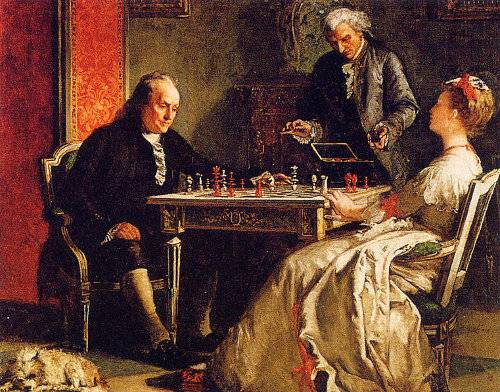
http://commons.wikimedia.org/wiki/File:Benjamin_Franklin_playing_chess.jpg

When Franklin was negotiating in Paris, he sometimes went into a café to play at chess. A crowd usually assembled, of course to see the man rather than the play. Upon one occasion, Franklin lost in the middle of the game, when composedly taking the king from the board, he put him into his pocket, and continued to move. The antagonist looked up. The face of Franklin was so grave, and his gesture so much in earnest, that he began with an expostulatory, ‘Sir.’ ‘Yes, Sir, continue,’ said Franklin, ‘and we shall soon see that the party without a king will win the game.’

– From a letter by Frances Wright to Jeremy Bentham, relaying an anecdote from Lafayette, Sept. 12, 1821

11 Jul 01:03

Unquote

by Greg Ross

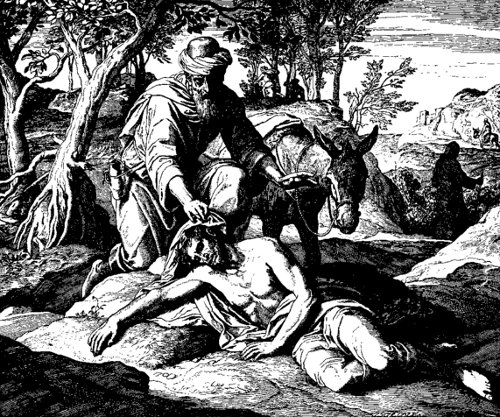
http://commons.wikimedia.org/wiki/File:Schnorr_von_Carolsfeld_Bibel_in_Bildern_1860_197.png

“It is the law of life that if you are kind to someone you feel happy. If you are cruel you are unhappy. And if you hurt someone, you will be hurt back.” — Cary Grant

“When I do good, I feel good. When I do bad, I feel bad. That’s my religion.” — Abraham Lincoln

“It all comes to this: the simplest way to be happy is to do good.” — Helen Keller

27 Jun 23:00

Succinct

by Greg Ross

In 2011 M.V. Berry et al. published “Can apparent superluminal neutrino speeds be explained as a quantum weak measurement?” in Journal of Physics A: Mathematical and Theoretical.

The abstract read “Probably not.”

In 1978 John C. Doyle published “Guaranteed margins for LQG regulators” in IEEE Transactions on Automatic Control.

The abstract read “There are none.”

(Thanks, Dre.)

27 Jun 22:48

Desperate Measures

by Greg Ross

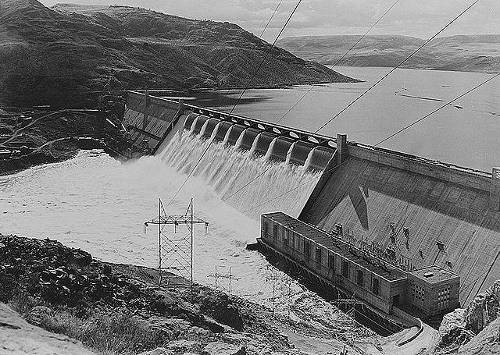
http://commons.wikimedia.org/wiki/File:Grand_Coulee_Dam_no_forebay.jpg

Shortly after the completion of Washington’s Grand Coulee Dam in 1942, engineers faced a difficult challenge: how to feed a cable through a 24-inch drain, two-thirds filled with grout, that wound 500 feet through the galleries inside the huge concrete structure.

The workers were stumped at first, but they hit on a novel solution. “An alley cat, raised on scraps from the construction men’s lunch pails, was summoned and one end of the 500-foot string was tied onto his tail,” reported the Spokane Daily Chronicle. “He was placed inside the drain, and an air hose was turned on to ‘encourage’ him to go forward.

“The feline scampered through the drain and was caught emerging at the other end, where he was freed. From then on it was a simple matter to tie a rope onto the string and then the cable and draw it through the drain.”

Physicist R.W. Wood had hit on the same technique 30 years earlier.

27 Jun 22:44

Red and Black

by Greg Ross

Jokes from the Soviet Union, from University of Louisville historian Bruce Adams’ 2005 collection Tiny Revolutions in Russia:

A man is walking along the road wearing only one boot. ‘Did you lose a boot?’ a passerby asks sympathetically. ‘No, I found one,’ the man answers happily.

What is it that doesn’t knock, growl or scratch the floor?
A machine made in the USSR for knocking, growling, and scratching the floor.

It is the middle of the night. There is a knock at the door. Everyone leaps out of bed. Papa goes shakily to the door. ‘It’s all right,’ he says, coming back. ‘The building’s on fire.’

A shopper asks a food store clerk, ‘Are you all out of meat again?’ ‘No, they’re out of meat in the store across the way. Here we’re out of fish.’

Why doesn’t the Soviet Union send people to the Moon?
They are afraid they won’t come back.

A man fell asleep on a bus. When someone stepped on his foot, he woke with a start and applauded. ‘What are you doing, citizen?’ ‘I was dreaming I was at a meeting.’

‘What is the difference between Pravda [Truth] and Izvestia [The News]?’
‘There is no truth in The News, and no news in the Truth.’

“In the Soviet Army,” said Stalin, “it takes more courage to retreat than advance.”

27 Jun 22:41

Self-Service

by Greg Ross

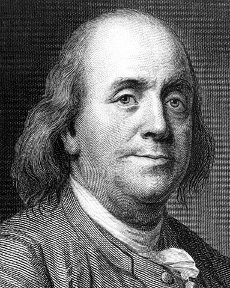
http://commons.wikimedia.org/wiki/File:Franklin-Benjamin-LOC-head.jpeg

One day [Ben Franklin] came, half-frozen from his long ride, to a wayside inn. A great crowd was about the fire, and for some time Franklin stood shivering. Suddenly he turned to the hostler.

‘Hostler,’ said he in a loud voice, ‘have you any oysters?’

‘Yes, sir.’

‘Well, then,’ commanded Franklin in still louder tones, ‘give my horse a peck!’

‘What!’ exclaimed the hostler, ‘give your horse oysters!’

‘Yes,’ said Franklin, ‘give him a peck.’

The hostler, decidedly astonished, prepared the oysters and started for the stable. Everybody instantly arose from the fire-place and rushed out to see the marvellous horse eat oysters. Franklin took the most comfortable seat before the roaring blaze, and calmly awaited developments. Soon all returned, disappointed and shivering.

‘I gave him the oysters, sir,’ said the hostler, ‘but he wouldn’t eat them.’

‘Oh, well, then,’ answered Franklin nonchalantly, ‘I suppose I shall have to eat them myself. Suppose you try him with a peck of oats.’

– Carl Holliday, The Wit and Humor of Colonial Days, 1912

27 Jun 22:41

Tender Minded

by Greg Ross

Artist J.S.G. Boggs hand-draws depictions of U.S. banknotes and exchanges them for goods and services — he’ll trade a drawing of a $100 bill for $100 worth of goods. The drawings are one-sided, and the patrons understand that they’re not actual currency; they’re choosing to trade goods for artwork rather than for money.

Is this counterfeiting? Well, what is money? A $100 bill is valuable only because we all agree that it is — it’s an arbitrary social convention. If someone can create an alternative that people value equally, shouldn’t he be free to trade it in the same fashion, if all parties are informed?

“It’s all an act of faith,” Boggs says. “Nobody knows what a dollar is, what the word means, what holds the thing up, what it stands for. … That’s … what my work is about.”

20 Jun 16:58

Comic for June 13, 2013

20 Jun 16:57

Comic for June 16, 2013

20 Jun 16:56

Comic for June 19, 2013

Mohan K. V

Active non-listening is the shit!

Dilbert readers - Please visit Dilbert.com to read this feature. Due to changes with our feeds, we are now making this RSS feed a link to Dilbert.com.
20 Jun 16:55

Comic for June 20, 2013

Dilbert readers - Please visit Dilbert.com to read this feature. Due to changes with our feeds, we are now making this RSS feed a link to Dilbert.com.
20 Jun 16:53

the party next door

Mohan K. V

This is EXACTLY how so many things have worked for me

where_ever_i_go

...

20 Jun 03:29

National Insecurity Agency

by Jason Kottke
Mohan K. V

This guy is a complete idiot, but wow.

By now, you've likely heard of Edward Snowden, the former NSA contractor who leaked secret documents to the press regarding that agency's electronic surveillance activities. From Glenn Greenwald's excellent coverage for The Guardian, here are a few of the most interesting passages from interviews with Snowden.

From the moment he decided to disclose numerous top-secret documents to the public, he was determined not to opt for the protection of anonymity. "I have no intention of hiding who I am because I know I have done nothing wrong," he said.

--

Despite these fears, he remained hopeful his outing will not divert attention from the substance of his disclosures. "I really want the focus to be on these documents and the debate which I hope this will trigger among citizens around the globe about what kind of world we want to live in." He added: "My sole motive is to inform the public as to that which is done in their name and that which is done against them."

He has had "a very comfortable life" that included a salary of roughly $200,000, a girlfriend with whom he shared a home in Hawaii, a stable career, and a family he loves. "I'm willing to sacrifice all of that because I can't in good conscience allow the US government to destroy privacy, internet freedom and basic liberties for people around the world with this massive surveillance machine they're secretly building."

--

"All my options are bad," he said. The US could begin extradition proceedings against him, a potentially problematic, lengthy and unpredictable course for Washington. Or the Chinese government might whisk him away for questioning, viewing him as a useful source of information. Or he might end up being grabbed and bundled into a plane bound for US territory.

"Yes, I could be rendered by the CIA. I could have people come after me. Or any of the third-party partners. They work closely with a number of other nations. Or they could pay off the Triads. Any of their agents or assets," he said.

"We have got a CIA station just up the road -- the consulate here in Hong Kong -- and I am sure they are going to be busy for the next week. And that is a concern I will live with for the rest of my life, however long that happens to be."

--

He left the CIA in 2009 in order to take his first job working for a private contractor that assigned him to a functioning NSA facility, stationed on a military base in Japan. It was then, he said, that he "watched as Obama advanced the very policies that I thought would be reined in", and as a result, "I got hardened."

The primary lesson from this experience was that "you can't wait around for someone else to act. I had been looking for leaders, but I realised that leadership is about being the first to act."

--

"I carefully evaluated every single document I disclosed to ensure that each was legitimately in the public interest," he said. "There are all sorts of documents that would have made a big impact that I didn't turn over, because harming people isn't my goal. Transparency is."

And from a second piece with a straight-up interview:

Q: Why did you decide to become a whistleblower?

A: "The NSA has built an infrastructure that allows it to intercept almost everything. With this capability, the vast majority of human communications are automatically ingested without targeting. If I wanted to see your emails or your wife's phone, all I have to do is use intercepts. I can get your emails, passwords, phone records, credit cards.

"I don't want to live in a society that does these sort of things ... I do not want to live in a world where everything I do and say is recorded. That is not something I am willing to support or live under."

--

Q: What do the leaked documents reveal?

A: "That the NSA routinely lies in response to congressional inquiries about the scope of surveillance in America. I believe that when [senator Ron] Wyden and [senator Mark] Udall asked about the scale of this, they [the NSA] said it did not have the tools to provide an answer. We do have the tools and I have maps showing where people have been scrutinised most. We collect more digital communications from America than we do from the Russians."

--

Q: What is your reaction to Obama denouncing the leaks on Friday while welcoming a debate on the balance between security and openness?

A: "My immediate reaction was he was having difficulty in defending it himself. He was trying to defend the unjustifiable and he knew it."

--

Q: Washington-based foreign affairs analyst Steve Clemons said he overheard at the capital's Dulles airport four men discussing an intelligence conference they had just attended. Speaking about the leaks, one of them said, according to Clemons, that both the reporter and leaker should be "disappeared". How do you feel about that?

A: "Someone responding to the story said 'real spies do not speak like that'. Well, I am a spy and that is how they talk. Whenever we had a debate in the office on how to handle crimes, they do not defend due process - they defend decisive action. They say it is better to kick someone out of a plane than let these people have a day in court. It is an authoritarian mindset in general."

Both of these pieces are very much worth reading in entirety. Also worth a read is Timothy Lee's piece for The Washington Post, Has the US become the type of nation from which you have to seek asylum?

Four decades ago, Daniel Ellsberg surrendered to federal authorities to face charges of violating the Espionage Act. During his trial, he was allowed to go free on bail, giving him a chance to explain his actions to the media. His case was eventually thrown out after it was revealed that the government had wiretapped him illegally.

Bradley Manning, a soldier who released classified documents to WikiLeaks in 2010, has had a very different experience. Manning was held for three years without trial, including 11 months when he was held in de facto solitary confinement. During some of this period, he was forced to sleep naked at night, allegedly as a way to prevent him from committing suicide. The United Nations' special rapporteur on torture has condemned this as "cruel, inhuman and degrading treatment in violation of Article 16 of the convention against torture."

Tags: Edward Snowden   NSA   politics   security
19 Jun 14:57

India fact of the day

by Tyler Cowen
Mohan K. V

The only problem is, the infrastructure right now can't even support the present load. It is not at all clear if the conventional infra would expand

One statistic above all explains the excitement India kindles: just 18 people in every 1,000 own a car. In China the figure is 58, according to the World Bank, while in most European countries it is more than 500. “India’s level of car ownership per capita is even lower than in Sudan, or Afghanistan,” says Tomas Ernberg, head of Volvo in India. “So in the long term there is bound to be growth, enormous growth.”

The market is also strikingly new. Barely 20 years ago India’s “Licence Raj” restricted aspirant motorists to two basic choices: the grand Hindustan Ambassador, an imitation of the venerable British Morris Oxford; and the boxy Maruti-Suzuki 800 hatchback, the country’s first (and then only) people’s car.

From the FT, here is more.

19 Jun 05:54

On Time

by Greg Ross

In Max Beerbohm’s 1916 short story “Enoch Soames,” an unsuccessful poet sells his soul to the devil for the chance to travel 100 years into the future to see how time has favored his work.

Under the agreement, Soames is transported to the Reading Room of the British Museum at 2:10 p.m. on June 3, 1997. He searches for references to his work but finds himself mentioned only once, as an “imaginary character” in a story by Max Beerbohm, and is whisked off to hell.

But, Beerbohm writes, “You realize that the reading-room into which Soames was projected by the devil was in all respects precisely as it will be on the afternoon of June 3, 1997. You realize, therefore, that on that afternoon, when it comes round, there the selfsame crowd will be, and there Soames will be, punctually. … The fact that people are going to stare at him and follow him around and seem afraid of him, can be explained only on the hypothesis that they will somehow have been prepared for his ghostly visitation.”

On June 3, 1997, about a dozen onlookers collected in the Reading Room of the British Museum to see what would happen. To their surprise, at precisely 2:10 p.m. a man matching Soames’ description — “a stooping, shambling person, rather tall, very pale, with longish and brownish hair” — appeared and began to search catalogs and speak with the librarians. Dejected, he finally disappeared among the stacks.

Among the onlookers was Teller, of the magician duo Penn & Teller.

18 Jun 17:16

Lecture Notes

by Greg Ross

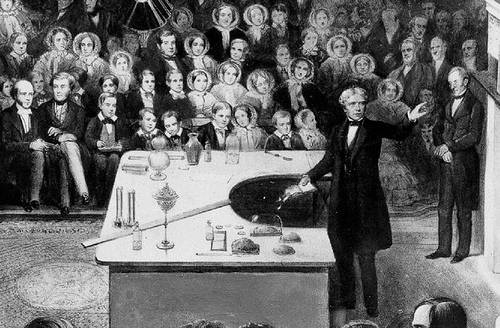
http://commons.wikimedia.org/wiki/File:Faraday_Michael_Christmas_lecture_detail.jpg

“While I am describing to you how Nature works, you won’t understand why Nature works that way. But you see, nobody understands that.” — Richard Feynman

“I am no poet, but if you think for yourselves, as I proceed, the facts will form a poem in your minds.” — Michael Faraday

“Now, this case is not very interesting,” said Bell Labs mathematician Peter Winkler during a lecture at Rutgers. “But the reason why it’s not interesting is really interesting, so let me tell you about it.”

Ernest Rutherford addressed the Royal Institution in 1904:

I came into the room, which was half dark, and presently spotted Lord Kelvin in the audience and realised that I was in for trouble at the last part of the speech dealing with the age of the Earth, where my views conflicted with his. To my relief Kelvin fell fast asleep, but as I came to the important point, I saw the old bird sit up, open an eye, and cock a baleful glance at me. Then a sudden inspiration came and I said Lord Kelvin had limited the age of the Earth, provided no new source was discovered. That prophetic utterance referred to what we are now considering tonight, radium! Behold! the old boy beamed upon me.

When Antonie van Leeuwenhoek declined to teach his new methods in microbiology, Leibniz worried that they might be lost. Leeuwenhoek replied, “The professors and students of the University of Leyden were long ago dazzled by my discoveries. They hired three lens grinders to come to teach the students, but what came of it? Nothing, so far as I can judge, for almost all of the courses they teach there are for the purpose of getting money through knowledge or for gaining the respect of the world by showing people how learned you are, and these things have nothing to do with discovering the things that are buried from our eyes.”

18 Jun 17:11

Three by Three

by Greg Ross

three by three puzzle

What’s the ratio between the areas of the two triangles?

Click for solution …

18 Jun 16:57

New Units

by Greg Ross

Since Helen’s face launched a thousand ships, Isaac Asimov proposed that one millihelen was the amount of beauty needed to launch a single ship. And one negative helen is the amount of ugliness that will send a thousand ships in the other direction.

When the taciturn Paul Dirac was a fellow at Cambridge, the dons defined the dirac as the smallest measurable amount of conversation — one word per hour.

Robert Millikan was said to be somewhat conceited; a rival suggested that perhaps the kan was a unit of modesty.

And a bruno is 1158 cubic centimeters, the size of the dent in asphalt resulting from the six-story free fall of an upright piano. It’s named after MIT student Charlie Bruno, who proposed the experiment in 1972. The drop has become an MIT tradition; last year students dropped a piano onto another piano:

18 Jun 16:55

Unquote

by Greg Ross

http://commons.wikimedia.org/wiki/File:Peter_Fendi,_Die_Lauscherin.jpg

“It is not that I have accomplished too few of my plans, for I am not ambitious; but when I think of all the books I have read, and of the wise words I have heard spoken, and of the anxiety I have given to parents and grandparents, and of the hopes that I have had, all life weighed in the scales of my own life seems to me a preparation for something that never happens.”

– Yeats, Reveries Over Childhood and Youth, 1914

18 Jun 16:03

Who are the three highest paid officials on the Pentagon budget?

by Tyler Cowen

The football coaches at Army, Navy and Air Force.

Here is more (mostly on other topics), hat tip to @jtlevy.  Here are some comparable answers for state government employees.

18 Jun 16:03

Detroit facts for today

by Tyler Cowen

…the city’s per capita income, averaged over its 684,799 residents, is just $15,261 per year. (That’s less than half the income of neighboring Livonia.) Auto insurance alone eats up a good $4,000 of that, for residents with a car.

And then comes the litany of municipal woes: Detroit has the highest violent crime rate of any major US city, at five times the national average; there were 344 murders in 2011, of which just 39 were solved. Right now, the average response time, if you put in an emergency call to the Detroit Police Department, is 58 minutes.

Detroit’s infrastructure is crumbling: 40% of its street lights are out of order, and it has 78,000 abandoned and blighted structures, of which 38,000 are considered dangerous buildings. Those buildings account for a large proportion of the 12,000 fires Detroit has every year. At the moment, firefighters are instructed not to use the hydraulic ladders on their firetrucks unless there is an immediate threat to life, because the ladders have not received safety inspections for years. Detroit also has just 36 ambulances, of which generally no more than 14 are in operation at any given time. And in terms of the city’s IT infrastructure — well, you can probably guess; suffice to say that a recent IRS audit characterized the city’s income tax system as “catastrophic”.

As far as Detroit’s balance sheet is concerned, there is $9 billion of debt, excluding pension liabilities, and also excluding healthcare and life insurance obligations which are calculated at roughly $6 billion. Debt service in 2013 is projected at more than $240 million, or about 22% of total revenues. Worryingly, under the section of the proposal headed “Realization of Value of Assets”, one finds the priceless collection owned by the Detroit Institute of Arts…

That is all from Felix Salmon.

18 Jun 15:58

Malcolm Gladwell on the new Albert Hirschman biography

by Tyler Cowen
Mohan K. V

Compare with gopniks theory of small barriers stopping big problems, and the general fakeness of sunk cost falliciestwCompC

It is an excellent overall review, here is one good excerpt of many:

“We may be dealing here with a general principle of action,” Hirschman wrote:

“Creativity always comes as a surprise to us; therefore we can never count on it and we dare not believe in it until it has happened. In other words, we would not consciously engage upon tasks whose success clearly requires that creativity be forthcoming. Hence, the only way in which we can bring our creative resources fully into play is by misjudging the nature of the task, by presenting it to ourselves as more routine, simple, undemanding of genuine creativity than it will turn out to be.”

And from there Hirschman’s analysis took flight. People don’t seek out challenges, he went on. They are “apt to take on and plunge into new tasks because of the erroneously presumed absence of a challenge—because the task looks easier and more manageable than it will turn out to be.” This was the Hiding Hand principle—a play on Adam Smith’s Invisible Hand. The entrepreneur takes risks but does not see himself as a risk-taker, because he operates under the useful delusion that what he’s attempting is not risky. Then, trapped in mid-mountain, people discover the truth—and, because it is too late to turn back, they’re forced to finish the job.

You can buy the book here.

11 Jun 19:02

Tools for thinking

by Jason Kottke

An excerpt from Daniel Dennett's new book, Intuition Pumps and Other Tools for Thinking, outlines seven of Dennett's tools for thinking. His second tool is "respect your opponent":

The best antidote I know for this tendency to caricature one's opponent is a list of rules promulgated many years ago by social psychologist and game theorist Anatol Rapoport.

How to compose a successful critical commentary:

1. Attempt to re-express your target's position so clearly, vividly and fairly that your target says: "Thanks, I wish I'd thought of putting it that way."

2. List any points of agreement (especially if they are not matters of general or widespread agreement).

3. Mention anything you have learned from your target.

4. Only then are you permitted to say so much as a word of rebuttal or criticism.

Tags: books   Daniel Dennett   Intuition Pumps   lists
11 Jun 19:01

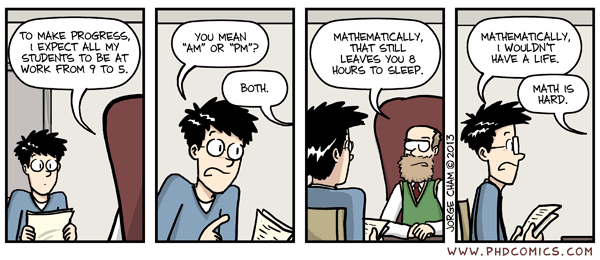
05/25/13 PHD comic: '9 to 5'

Piled Higher & Deeper by Jorge Cham
www.phdcomics.com
Click on the title below to read the comic
title: "9 to 5" - originally published 5/25/2013

For the latest news in PHD Comics, CLICK HERE!

11 Jun 18:57

June 08, 2013


WOOH!

11 Jun 18:55

June 10, 2013


One more nag about the new kickstarter and then I'll stop bugging you geeks. Thanks again, everyone. It means a lot to me.
11 Jun 18:52

Comic for June 9, 2013

11 Jun 14:36

You commit three felonies a day

by Jason Kottke

In a book called Three Felonies A Day, Boston civil rights lawyer Harvey Silverglate says that everyone in the US commits felonies everyday and if the government takes a dislike to you for any reason, they'll dig in and find a felony you're guilty of.

The average professional in this country wakes up in the morning, goes to work, comes home, eats dinner, and then goes to sleep, unaware that he or she has likely committed several federal crimes that day. Why? The answer lies in the very nature of modern federal criminal laws, which have exploded in number but also become impossibly broad and vague. In Three Felonies a Day, Harvey A. Silverglate reveals how federal criminal laws have become dangerously disconnected from the English common law tradition and how prosecutors can pin arguable federal crimes on any one of us, for even the most seemingly innocuous behavior. The volume of federal crimes in recent decades has increased well beyond the statute books and into the morass of the Code of Federal Regulations, handing federal prosecutors an additional trove of vague and exceedingly complex and technical prohibitions to stick on their hapless targets. The dangers spelled out in Three Felonies a Day do not apply solely to "white collar criminals," state and local politicians, and professionals. No social class or profession is safe from this troubling form of social control by the executive branch, and nothing less than the integrity of our constitutional democracy hangs in the balance.

In response to a question about what happens to big company CEOs who refuse to go along with government surveillance requests, John Gilmore offers a case study in what Silverglate is talking about.

We know what happened in the case of QWest before 9/11. They contacted the CEO/Chairman asking to wiretap all the customers. After he consulted with Legal, he refused. As a result, NSA canceled a bunch of unrelated billion dollar contracts that QWest was the top bidder for. And then the DoJ targeted him and prosecuted him and put him in prison for insider trading -- on the theory that he knew of anticipated income from secret programs that QWest was planning for the government, while the public didn't because it was classified and he couldn't legally tell them, and then he bought or sold QWest stock knowing those things.

This CEO's name is Joseph P. Nacchio and TODAY he's still serving a trumped-up 6-year federal prison sentence today for quietly refusing an NSA demand to massively wiretap his customers.

You combine this with the uber-surveillance allegedly being undertaken by the NSA and other governmental agencies and you've got a system for more or less automatically accusing any US citizen of a felony. Free society, LOL ROFLcopter.

Update: For the past two years, the Wall Street Journal has been "examining the vastly expanding federal criminal law book and its consequences". (thx, jesse)

Tags: books   Harvey Silverglate   John Gilmore   Joseph Nacchio   politics   privacy   security   Three Felonies A Day   USA
11 Jun 14:33

The Internet Fingerprint

My hypothesis is that science will someday be able to identify sociopaths and terrorists by their patterns of Facebook and Internet use. I'll bet normal people interact with Facebook in ways that sociopaths and terrorists couldn't duplicate.

Anyone can post fake photos and acquire lots of friends who are actually acquaintances. But I'll bet there are so many patterns and tendencies of "normal" use on Facebook that a terrorist wouldn't be able to successfully fake it.

The main reason you can't fake Facebook use patterns is that you can't control how others respond to you. Good friends respond entirely differently than acquaintances, both in quantity and content. I think that sort of difference would show up.

Years ago, during my banking career, a coworker developed a program that looked through bank records for patterns suggesting possible fraud. It worked well enough that he formed his own company, sold the program to banks, and became a wealthy man. The key to the program's success is that crooks don't know there is a normal pattern and so they don't know when they violate it. I think the same would be true for Facebook. There must be dozens of normal Facebook patterns that sociopaths and terrorists wouldn't know about, and therefore couldn't fake.

I imagine that Internet usage patterns could tell experts as much about your brain as an MRI. To put it in simpler terms, if you tell me which web pages you browsed this week, I can come up with a good estimate of your odds of being a terrorist.

Do you think the government is already monitoring your Internet use pattern, if not the specific pages? If not, they will.