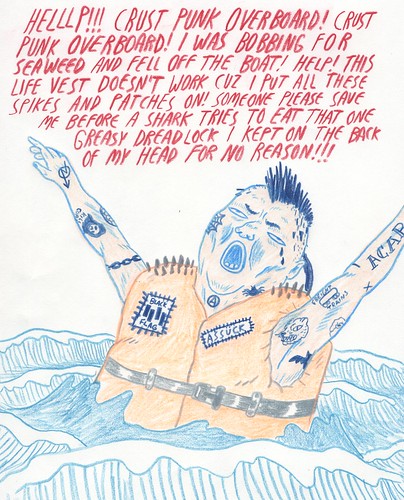
Florence and the Machine.

London Underground Quilt
Made as a wedding gift for two transit nerd friends, this is beautiful work. The artist wasn’t content with just Zone 1 or a simplification: this is the whole map, including the DLR and the Overground with their distinctive white centre-stroked route lines.
Click here to view the entire set of photos on Flickr, including lots of work-in-progress shots. Simply stunning!
(Source: moorina/Flickr)

Game of “1870”
A railroad-building board game set in the 19th century, complete with stock market shenanigans. Part of the “18xx” series of games, this particular game is set in the Mississippi Valley of the United States. Looks like the game allows for some creative and unusual track layout: I love the the loop-de-loop in the middle of the board!
This totally reminds me of a misspent youth playing Railroad Tycoon and beating those robber barons into submission.
(Source: petelovespurple/Flickr)
Russian Sledgesdon't do that
#prometheus #was #not #good
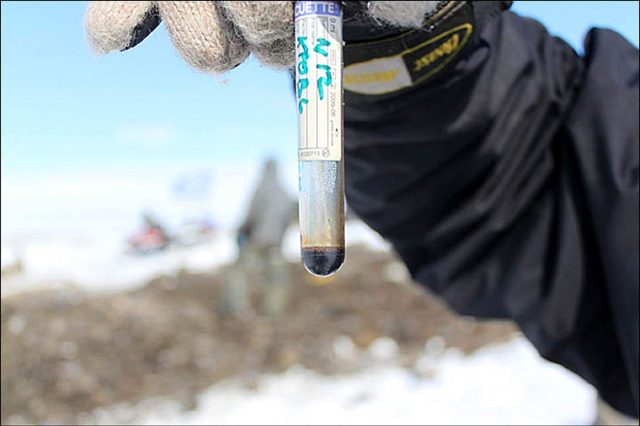
The frozen remains of a mammoth have been discovered on an island north of Siberia—with blood that is still liquid.
The 10,000-year-old beast was found on one of the Lyakhovsky Islands in the Novosibirsk archipelago off the northern coast of Siberia. Researchers from the Northeastern Federal University in Yakutsk poked the remains with an ice pick and, incredibly, blood flowed out.
"The fragments of muscle tissues, which we've found out of the body, have a natural red color of fresh meat," said Semyon Grigoriev, chairman of the university's Museum of Mammoths and head of the expedition. "The reason for such preservation is that the lower part of the body was underlying (sic) in pure ice, and the upper part was found in the middle of tundra. We found a trunk separately from the body, which is the worst-preserved part."
Read 6 remaining paragraphs | Comments
Russian Sledgesetc

Laura sez, "My sister, who works for how about we & is an avid gaming fan, got an amazing proposal from her now-fiance. Pete, with the help of a crafty friend, created a new development card and sat playing for 2 hours until he could purchase the 'proposal' development card and play it! (fyi, they were playing the 2 person version so there was no chance that someone other than the future bride or groom could accidentally play that card!)"
“He said, ‘I hate playing two-player Catan because I feel like I’m being really aggressive and attacking you.’ So I assumed he had a monopoly card and was going to steal my brick (a crucial game-winning resource) from me. So of course I called him an asshole and literally said ‘I can’t believe you’re about to do this.’ And then he laid down the proposal card – which I really didn’t believe he was going to do. I then dove across the board to kiss him, he managed to get the ring out, and eventually I remembered to say yes (many kisses and tears later).”
How to Propose to a ‘Settlers of Catan’ Fan [Chiara Atik/The Date Report] 
    
|


sherlock-has-got-the-blue-box:
everythingthelighttoucheskingdom:
sabrina-is-at-221b-bakerstreet:
LOOK AT THIS POOR OPPRESSED WOMAN AND WHAT HER COUNTRY IS MAKING HER DO.
Even in her eyes it says “help me”.
This is why we have to stop these misogynistic societies.
I’m sorry but no. I acknowledg that this is terrible, but don’t you think we should fix our own countries mishaps before we deal in other countries affairs? We have corrupt businesses, crime, poverty, homelessness, and believe it or not starvation.
Does anyone even know the threat that walmart has to this country?!
I hope you’re being ironic ouo
everything about this is horrible tbh
Isn’t that Benedict Cumberbatch?
That’s Benedict Cumberbatch.
Guys that’s obviously Benedict Cumberbatch.
Oh my god I’ve never imagined this situation
IVE BE EN LAGUHING FOR THE PAST 500 YEARS
OMGGG YOU GUYS
#when gifs are taken out of context
I was going to reblog this b/c it is an awesome gif of benedict as sherlock and then i read the comments *dies laughing*
Benedict Cumberbatch = Oppressed Muslim woman.

The Wedding Topper.
Desmond Parsons and Lord Oxmantown, 1960.
Russian Sledgesvia firehose
multitask suicide: "you know the back is a giant CRASS patch"
Russian Sledgescf. http://talkingpointsmemo.com/news/japanese-politician-is-sorry-for-suggesting-us-troops-use-porn-to-reduce-sex-assaults.php?ref=fpa
"you cannot control the sexual energy of those tough guys," etc.
 In a really fantastic post at Shakesville, Time Machine argues that rape jokes are problematic, even when uttered by people who would never assault anyone, because they signal to actual rapists that their behavior is acceptable and normal.
A lot of people accuse feminists of thinking that all men are rapists. That’s not true. But do you know who think all men are rapists? Rapists do.
So, when someone drops a rape joke and people laugh, the small percent of men who are rapists think that they’re surrounded by like-minded friends. Speaking to the joke-teller:
That rapists who was in the group with you, that rapist thought that you were on his side. That rapist knew that you were a rapist like him. And he felt validated, and he felt he was among his comrades.
What’s interesting about this observation is that it reminds us that we need to be more aware of the impact of our words not on victims (as the usual argument against the rape joke goes), but on perpetrators. This is a much-needed re-framing of the problem that we call, passively, “violence against women,” but should really be called “men’s violence against women and men.” While both men and women are victims, the vast majority of interpersonal violence is committed by men.
The need for a shift in frame — from the survivor to the perpetrator — is also a theme of this TedTalk by anti-violence educator Jackson Katz. He uses another really interesting way of showing the linguistic erasure of men in this discussion (at 4:08).
He also dismisses “sensitivity training” because it, too, centers the survivor of the violence instead of drawing our attention to the perpetrator (sensitivity to who?). Instead, Katz argues, men need to step up and be leaders in the fight against men’s violence against women and men. Because violence is not a “women’s issue,” it’s a men’s issue.
Lisa Wade is a professor of sociology at Occidental College. You can follow her on Twitter and Facebook.
(View original at http://thesocietypages.org/socimages)

Girl, was your father John Cage? Because that ass… *three minutes of silence*
— Musky Lozenge (@LostCatDog) January 4, 2013
Rhode Island governor Lincoln Chafee makes his second party switch. The Republican turned independent will become a Democrat, according to Politico:
Rhode Island Gov. Lincoln Chafee has notified senior Democratic Party officials that he intends to switch his party registration and join the Democratic Party, multiple sources familiar with Chafee’s decision told POLITICO.
Othermill is an small computer-controlled mill that allows the user to precision cut small objects like circuit boards. The mill is encased in a 10″ cube and weighs just 15 pounds, so it can be easily transported and used in a small workspace. While it is optimized for creating custom circuit boards, it can also cut metal, wood, wax, and plastic. Othermill is currently be developed by Otherfab in San Fransisco. They’re raising funds for the project on Kickstarter.

Russian Sledgesclass of 1722: a ban on "pies of any kind"
By Arturo R. García

Promotional poster for “Doctor Who.” Image via crimsontear.com
Calling this past season of Doctor Who uneven might be doing it a favor. Presented as two separate seasons marked by a change in companions for the Eleventh Doctor and capped by the prelude to the show’s 50th anniversary special in November, critiques of the show under Steven Moffat’s watch got louder than ever. That discussion, we hope, will only get louder when Doctor Who and Race is released in August.
Edited by Dr. Lindy Orthia — who has published several academic works dealing with the shows including one on Who’s “inability to acknowledge the material realities of an inequitable postcolonial world shaped by exploitative trade practices, diasporic trauma and racist discrimination” — the anthology will feature more than 20 essays explicitly tackling several aspects of the show’s presentation (and, one presumes, lack thereof) regarding issues regarding racial issues.
Naturally, some people are out to silence her efforts before the book’s even released. Warning: Misogynist language just under the cut.
These were the responses to Orthia’s announcement earlier this month of the release date and that the book’s royalties were being donated to charity:


And remember: Doctor Who fans are supposed to be the smart ones. This guy below sent the same tweet to Orthia on consecutive days:

The UK-based site Digital Spy didn’t help matters when it made this claim, seemingly sight-unseen:
A new collection of essays titled ‘Doctor Who and Race’ claims that the sci-fi program is racist for failing to cast a black or Asian actor as the Time Lord and accuses the title character of being dismissive of black companions.
Now, do you get that impression from this abstract for Roseanne Welch’s “When white boys write black: Race and class in the Davies and Moffat eras”?
This essay discusses the different ways former “Doctor Who” show runner Russell T Davies and his successor, Steven Moffat, handle race in writing the show. It concludes that while Davies’ characters of colour (Mickey, Martha and Rosita) are all three-dimensional, sexualized human beings, Moffat’s (Liz Ten, Mels and Rita) tended toward more one-dimensional, Talented Tenth types.
Or this one for Stephanie Guerdan’s “Baby steps: A modest solution to Asian under-representation in Doctor Who“?
This essay points out the lack of previous Asian representation in both the casting choices and storylines of Doctor Who. It goes on to suggest some small steps that could be taken to rectify this lack while also keeping in mind some of the BBC’s previous racial faux pas.
Methinks DS and the BBC doth protest too much. The network responded by citing the casting of Freema Agyeman as Martha Jones and Noel Clarke as Mickey Smith — both moves that occurred during the Davies era.
Digital Spy and other outlets also seized on a statement by Orthia that, “the biggest elephant in the room is the problem privately nursed by many fans of loving a TV show when it is thunderingly racist.” She elaborated on that remark in another statement:
In the book this sentence comes towards the end of my conclusion chapter, in a section which discusses the fact that many people who study “Doctor Who” are also fans, and so are personally invested in what they study and write.
The sentence is not stating that “Doctor Who” is thunderingly racist. The sentence is saying that fans often feel inner conflict at those times when Doctor Who has moments of racism, because we love the show but don’t love racism. An example is the Doctor’s line in “Doctor Who”‘s first episode, “An Unearthly Child,” in which he talks about “the savage mind” of “the Red Indian” – the episode may be 50 years old, but we still watch it today, and the line still sits uncomfortably because of its casual racism. My reflection on this is simply asking how we should best deal with that discomfort.
I end the conclusion by quoting from Kate Orman’s essay in the book, in which she says: “because we are fans, we’re capable of being sophisticated, thoughtful viewers, able to see both a story’s successes and its failings.”
I hope that this is true, and that future discussions about this book and its subject will be considered and thoughtful.
It would seem that, despite their self-appointed reputation, these Who fans aren’t interested in that.
[h/t The Mary Sue]
Russian Sledgesfuck this.
Russian SledgesI'll miss your crazy eyes
Rep. Michele Bachmann, the notorious four-term congresswoman whose political star power, like the Tea Party movement she came to embody, has quietly faded almost as quickly as it so vehemently burst onto the national scene, will not seek reelection in Minnesota's 6th Congressional District.
The firebrand 57-year-old tax attorney's staunch pro-life, anti-gay, anti-Obamacare, and generally anti-government positions made her a Tea Party darling who won the Iowa Straw poll in a vacillating 2012 Republican presidential primary field. But after dropping out of that race last January and winning re-election to her seat, she became ensnarled in an investigation into her campaign finances that the FBI is now joining. And as Politico's Alex Isenstadt explained just yesterday, Democrat Jim Graves, who lost to Bachmann by just 1.18 percentage points in November and had major backing from his party, posed "the gravest threat to her political career yet" in 2014. Bachmann, who was never fully embraced by the fractured leadership of her own party, denied in a video (below) released on her Facebook page announcing the decision early Wednesday morning that either threat affected her decision not to run:
Be assured, my decision was not in any way influenced by any concerns about my being reelected to Congress. I've always in the past defeated candidates who are capable, qualified, and well-funded. And I have every confidence that if I ran, I would defeat the individual who I defeated last year, who recently announced that he is once again running. And rest assured, this decision was not impacted in any way by the recent inquiries into the activities of my former presidential campaign or my former presidential staff. It was clearly understood that compliance with all rules and regulations was an absolute necessity for my presidential campaign, and I have no reason to believe that that was not the case.
 Her Democratic challenger might have been a serious enough threat to not risk a near certain future as an anti-government crusader and high-paid speaker and/or consultant, but the investigation into alleged campaign finance violations during her failed presidential campaign may have been nipping at Bachmann's heels. Minnpost.com's Cyndy Brucato reported on May 17 that the FBI was joining the FEC, the Office of Congressional Ethics, and an Iowa State Senate ethics committee to investigate whether Bachmann hid payments to an Iowa state senator who worked on her campaign, and whether "the state senator stole the email list of an Iowa home-school group from another Bachmann staffer, Barbara Hekki, prior to the Iowa caucuses in January, 2012." Bachmann was actually plagued by a tailspin of scandal from inside her campaign as her former staffers revolted against her quite publicly: In October 2011, her New Hampshire staff quit en masse, and this January, a high level-staffer for her presidential run alleged that Bachmann's financial chairman was stiffing staffers on campaign paychecks because they didn't sign a non-disclosure agreement. Her aides just wouldn't let 2012 go away.
Bachmann is also leaving as her national political clout is a shade of its former self. That's partly due to the shifting dynamics of the Tea Party, which as The Atlantic Wire's Elspeth Reeve explained in March, has shifted its attention to the likes of Ted Cruz and Rand Paul. Reeve wrote:
Why the change? They didn't fare so well in 2012. The Tea Party Express endorsed 16 Senate candidates in 2012; only four won. Bachmann's Tea Party Caucus once had 60 members, but 10 lost their seats in 2012 ... That's a pretty bad showing, given the that 90 percent of the House was reelected last year.
A survey conducted by Public Policy Polling released on May 20 showed Graves holding a slight edge, 47 percent to 45 percent, over Bachmann in the 2014 contest — a race in which Michele Bachmann, after being so outspoken on so many things she would not let go away herself, will not be participating. But Michele Bachmann, fading star or not, won't be going away completely: "There is no future option or opportunity, be it directly in the political area or otherwise, that I won't be giving serious consideration," she says in the video — all eight-plus minutes of which you can watch right here:

|
|

Photo by Romain Laurent
My mother and I used to marble paper on the weekends when I was younger. To this day, I still feel like I am a mad scientist when I marble, experimenting with new colors and testing new patterns.
Even if you don’t have experience with marbling, it’s a fun project to try with friends. It requires about an hour prep time, but once you’re all set up you’ll be able to marble to your heart’s content. You can get great results on your first try, but the more you play with the paint and pattern-making, the better it gets.

You Will Need:
Water
Alum (to set the paint into the fabric)
Methocel (to thicken the water and create a “size” so the paint floats on the water’s surface)
Household ammonia (helps thicken the “size”)
Bucket
Whisk
Large, shallow plastic storage container (your container will serve as a tray and needs to be the size of the fabric you want to print on)
Liquid acrylic paint
Paper
Paper towels
Iron and ironing board
Paint brushes
Newspaper (or scrap paper)
Large-toothed comb
100% silk or 100% cotton white fabric with a high thread count
Golden GAC 900 (to help the paint adhere to the fabric)
Stage One: Preparation
For your designs to adhere to the fabric, you will need to pretreat using a mordant called alum. Alum has been used for centuries as a natural ingredient when dyeing fabric.

Pretreat the Fabric
Dissolve ¼ cup of alum in a quart of warm tap water. (Note: double this mixture if you are dyeing a large piece of fabric, so the fabric will be fully immersed.)

Soak your fabric for 20 minutes and remove. Wring out the fabric in the sink or tub (do not rinse!) and let it line dry. Once the fabric has dried, iron it out completely, making sure to use the appropriate heat setting.
Prepare the Marbling Size
A marbling size is a suspension mixture which your marbling paint floats upon. I used methocel to create my marbling size, which will thicken the water just enough so the paint will rest on the water’s surface. There are other products on the market that you can use to thicken the water, but I prefer methocel because it’s quick to prepare and the mixture will keep for 3 days at room temperature or a week when stored in the fridge.

To create your size, slowly add 4 tablespoons of methocel per gallon of warm tap water to your bucket. (Note: double this mixture if printing on a large piece of fabric.) Blend the methocel and water with your whisk for about 5 minutes. You’ll feel the mixture start to thicken as you go. While you are whisking, add 1 tablespoon of household ammonia per gallon of water to the bucket.

When the 5 minute mixing frenzy has passed and your mixture is clear, pour it slowly into your tray and let it stand for at least 45 minutes. Rinse the bucket and fill it with cold tap water.

While you are waiting for the size to set, start mixing your paints. You’ll need to add an acrylic polymer (like GAC-900) to every paint you plan to use to ensure that your finished scarf is washable. The ratio should be one part GAC-900 per one part acrylic paint. For this project, consistency matters. You want the paint to be thin enough so that it will float on top of your methocel mixture – if it’s too thick, it will fall to the bottom. Aim to make all your paint mixtures the same consistency as whole milk, adding water if needed.


After the mixture has rested for at least 45 minutes, check to see if there are any bubbles. If there are, hold a sheet of paper that’s the size of your container on both ends and slowly lower it down until the middle touches the surface of the size. Let go of both ends and let it float on top of the size for a few seconds. Carefully peel it off the surface of the size and discard. You can use this technique to clear your size of any remaining floating paint as well.

Now you’re ready to start adding paint to the methocel mixture. To do this, take your paint brush and gently drop your first color on the surface of the mixture. You can place your drops at random or in a pattern to create different effects, but keep in mind that the more paint you put on the water’s surface, the less pastel your print will turn out. Don’t be shy if you have a large container; it’s going to take more paint than you think to cover the size’s surface completely. If you’re using a small container, take care not to add too much paint – if so, you will lose the surface tension of your size and your colors will sink.

Once you’ve added all the color you want, I recommend printing a test run on white paper to see how your paint colors may show on your scarf. Follow the same steps you took to remove the bubbles from the surface of your size, and this time, “pick up the paint” with your paper. If you like the results, you can lightly rinse the paper with water and lay it on a paper towel to dry.
Stage Two: Pattern-Making and Printing
Once you’re happy with the colors and arrangement, the fun really starts: it’s time to make your patterns. Experimentation is key – try any of the techniques below to make a pattern, or create your own!

Turkish Stone: Create different sized spots or “stones” with paint on your size. This is the beginning step to most other marbling patterns, and it’s the one you used above when you tested your paint colors on paper. Try using different tools, like a brush or dropper, to create drops in varying sizes. I like repeatedly tapping the brush with my index finger while moving across the surface to create smaller drops of paint. You can create concentric circles in your stone pattern by adding drops of different colors in the center of previous circles.


Back and Forth: Start with the Turkish stone. Next, draw through the size with an upside-down paint brush in a back and forth snake pattern. Repeat this movement in the opposite direction if desired.

Nonpareil: Create the back and forth pattern. Use your rake or a wide-tooth comb and draw it across your size in the direction opposite your back and forth pattern. Prepare for the psychedelic results!

Once you’ve created your desired pattern (I used back and forth), you’re ready to print on fabric! Holding the fabric on both ends, slowly lower it onto the surface so the center sags down and touches first. Let go, and let it rest for a few seconds. Carefully lift the fabric off the surface and put it straight into your bucket of tap water.

Slush it around in the water and rinse, being careful not to rub the fabric (or you might smear the design!) Gently wring it out and hang to dry.

Once your fabric is completely dry, you can heat-set the paint by ironing. Make sure to complete this step in a well-ventilated room – GAC 900, the fabric paint medium, can release fumes.

Hand-wash your fabric in warm water, air dry, and you’ve got a chic marbled scarf!
All photographs by Romain Laurent.

Clare McGibbon is a Brooklyn-based designer and maker. When she's not working on Etsy's international support team, she's dreaming up new DIYs or making jewelry for her shop, AWAYSAWAY. Keep up with her latest creations on Instagram, Facebook and Pinterest.
Russian Sledgesetc
Russian Sledges"We take a kitten and split it, and then we use one of the two parts to measure an input light beam which we would like to teleport. And then we do it."
Russian Sledgesetc.
For the third installment of Anti-Anniversary Week (explanation here), I'm reposting Stefan Prins's Generation Kill, which I encountered at the 2012 Donaueschingen Festival and chose as one of my events of the year. It's a musical meditation on video-game technology, social media, and drone warfare, in which live performers undergo instant manipulation by way of Playstation devices. "Meditation" is, in fact, not quite the right word; this is a work of fierce, unsettling tension, one that got under the skin even of a seen-it-all German new-music audience. Performing above are members of the Nadar Ensemble, with the composer himself supervising the sound mix.

Over the Memorial Day weekend, Jamie Malanowski called for [NYT] the government to rename Army bases named for generals who served the Confederacy:
Changing the names of these bases would not mean that we can’t still respect the service of those Confederate leaders; nor would it mean that we are imposing our notions of morality on people of a long-distant era. What it would mean is that we’re upholding our own convictions. It’s time to rename these bases. Surely we can find, in the 150 years since the Civil War, 10 soldiers whose exemplary service not only upheld our most important values, but was actually performed in the defense of the United States.
Erik Loomis focuses on the soldiers asked to serve at these forts:
[Malanowski asks] a fair question. And it is indeed an insult to ask African-American soldiers to serve at a fort named after P.G.T. Beauregard or John Gordon, who followed his war career by becoming the head of the KKK in Georgia.
Josh Marshall doesn’t mince words:
There’s a major difference between respecting and honoring sacrifice – which exists separately from the political movement you’re fighting on behalf of – and honoring people in this way. Today most of us probably see the problem as the fact that these guys fought to protect slavery. And whatever revisionist nonsense you hear out there that is unquestionably true. But that’s only one part of the equation. At least as big in my mind is that these men were traitors – rebels against the democratic ideal and the federal union around which any American patriotism has to be based. Taken together these two things are a really, really big deal. One can only begin to imagine what Union soldiers who died on the battlefield would make of all this. … Perhaps we’ve come far enough – regardless of the equities at stake 100 or 75 years ago – that we can revisit this question.
Dr. Charles Cogan counters:
These are memorials to the great and not-so-great Confederate generals: Fort Lee (understandable) but also Fort Bragg. I do not object to such a practice, as it is a recognition that both sides suffered during the war –just as Memorial Day honors the dead of both Union and Confederate soldiers. (Though at the beginning, Memorial Day was solely a Northern commemoration.)
This joint mourning has been central in achieving a reconciliation between North and South that has been truly remarkable – to the extent that talk of re-secession is never taken seriously. Indeed the South has become the most “patriotic” and military-oriented section of the country – partly due to its long and pre-bellum tradition of military honor. But while we can hardly object to the South’s honoring of its Pantheon of Civil War generals and of the thousands who died in the service of the Confederacy, we should not lose sight of the underlying imperatives of the Civil War: the preservation of the Union, and the abolition of slavery.
Slog’s David Goldstein explores the justification for honoring Confederates:
Over the years, I’ve had the chance to talk to a few proud Southerners about what it is exactly that they are so proud of, and while they may not use these exact words, invariably they say it was the nobility of the struggle that they honor. But whether or not they acknowledge it, the cause the South struggled for was preserving (and expanding) the institution of slavery. I don’t mean to go all Godwin and everything, but I’m sure many Nazi soldiers fought courageously too, yet you don’t see Germany building monuments to its World War II heroes.
TPM reader and Southerner CH worries about the potential backlash:
Before President Obama was elected, I would have agreed that maybe it is time to rename some military bases (and colleges) and maybe even consider doing something about the carving on Stone Mountain. And I would have agreed with you that after 1865 it was never again seriously considered that history might repeat itself. But as things now stand, I’m not sure that those same considerations which led to the mollification decisions back then, have become irrelevant; I’m not sure that the rationale for those decisions has outlived its usefulness.
Most rural Southern white men already feel that “their” country has been “taken” from them by a black Muslim. They watch Fox exclusively and without ceasing so they are constantly on edge and genuinely and earnestly believe that President Obama’s sole mission is to destroy America. I don’t know if we are sitting on a powder keg again or not. On a rational and academic level, I think that notion is absolutely ridiculous. But on a gut and emotional level, I worry. Sometimes I think all they need is a final straw to rally around. So maybe we could wait until a new president is in office again before we risk giving them a rallying point. Maybe the temperature down here will drop some by then.
(Photo: Detail of the southeast corner of the frieze on the Confederate Monument at Arlington National Cemtery in Arlington, Virginia, in the United States. The goddess of war, Minerva (l), looks at the fallen “The South” while “spirits of war” trumpet for assistance. To the right, a sapper (with bag) and a soldier answer the call. An African American soldier answers the call to defend slavery with his white master. From Wikimedia Commons)

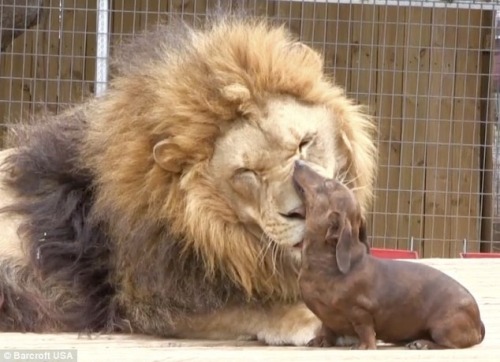
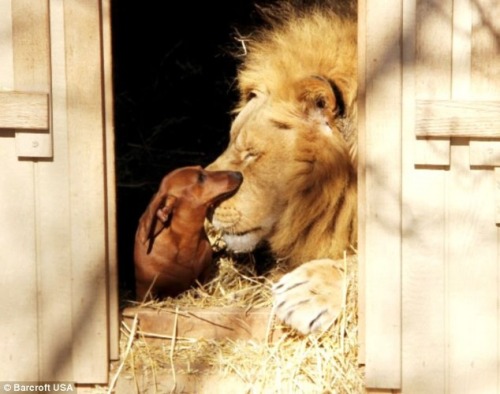
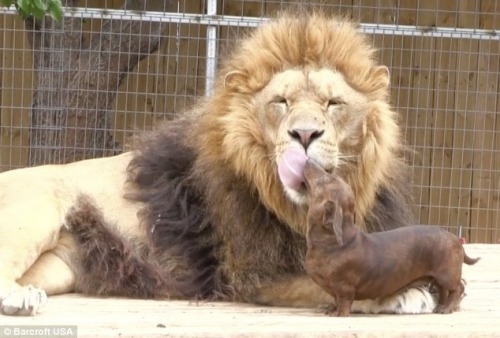
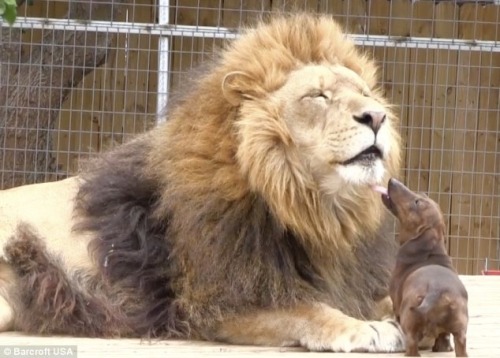
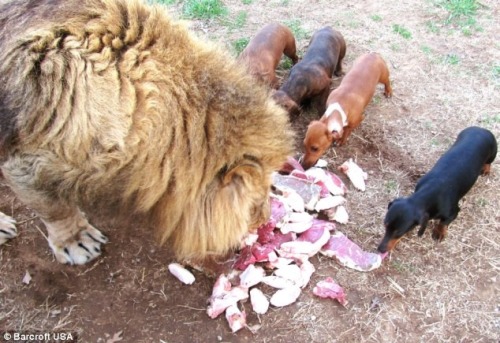
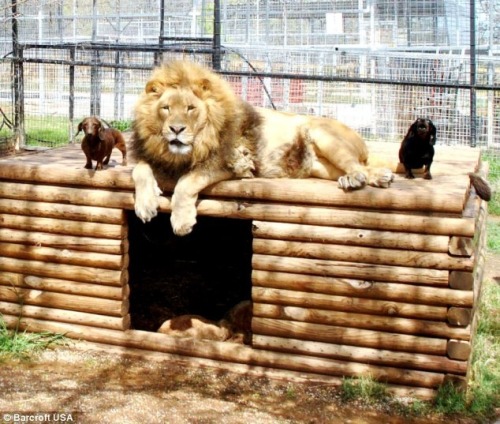
A lion and a miniature sausage dog have formed an unlikely friendship after the little dog took the king of the jungle under his wing as a cub.
Bonedigger, a five-year old male lion, and Milo, a seven-year old Dachshund, are so close that Milo helps the lion clean his teeth after dinner.
The 500lbs lion dwarfs little Milo, yet after the dog took the disabled lion into his protection as a cub, Bonedigger has rarely left his side.
Russian Sledgesglenn close as denethor

We all know that Middle-Earth is a sausage fest. But what would happen if you flipped all the genders? Could Peter Jackson's Lord of the Rings still work as well if you replaced Sean Bean, John Noble and Sean Astin with women? This dream cast proves it would. It's... a diversion.

|
|
I was about to write a very similar article, but Adrian Kingsley-Hughes covered it already. In short:
The extra terabyte costs Yahoo more than the cost of a single 1 TB consumer hard drive. They’ll need multiple copies of every photo for redundancy, scaling, and practicality (for instance, storing smaller sizes for web display and storing JPEG renders of RAWs), so your 2 TB of photos may occupy 5–10 TB of actual hard drive space. Server-grade hard drives are also usually smaller and more expensive than consumer drives, so I bet Yahoo’s not making significant profit on the upgrade.
More importantly, most people on the free “1 TB” plan won’t use anywhere near 1 TB.1 I’m guessing the average user’s storage total, mostly shot by smartphones, will be more like 3–5 GB. But by definition, if you buy the storage upgrade, you are using 1–2 TB.
So they’re not charging $500/year for twice as much space — they’re charging you $500/year for what’s probably 200 times the average space.
It’s very similar to Gmail’s usage pattern and storage economics. And Flickr is much cheaper than Gmail’s extra-storage pricing, which is $600/year for 1 TB and $1200/year for 2 TB.
All of my photos currently occupy about 260 GB, not counting thumbnails or JPEG renders of RAWs, and only a small percentage are good enough to share on Flickr. And I’ve been shooting huge RAW files for five years. ↩
Russian Sledgesgotta start that tumblr
can anybody help me find that comment thread on here? I don't think comments are searchable at this point




Russian Sledgesattn overbey
this seems like the kind of thing you like to put on when you are coding
Anna Þorvaldsdóttir's Streaming Arhythmia, from her 2011 CD Rhízōma. As noted below, Anna will be featured in a Miller Theatre Composer Portrait next season.