Photo detail of a "chipper" via The U.S. National Archives, 1942.
Riveting in penny loafers. FTW.
With the help of friends on Twitter, I've found the title for the top new job in a politicians' office for the social media age: ScapeTern. That's an intern who's kept around solely for the purpose of being fired when the boss does something really stupid or offensive on Twitter. Like here.
Usage: "It's a mystery why Scott Brown still hasn't hired a scapetern."
Actually, I can think of so many cases of these people. But I'm sort of at loss at the moment. What are your favorite scapetern stories?
Russian Sledgesvia firehose
#yitb

It's an astounding sight: Buddha carved into a tall rock formation at the Ngyen Khag Taktsang Monastery in China. People talked breathlessly about how they visited the place, saw it with their own eyes. Except that they didn't. Because it's a fake. And this is the guy who faked it.

    
|

Salmon expects Facebook to crack down on the site:
Facebook assumes that people click on exactly the material that they want to click on, and that if it serves up a lot of clickbaity curiosity-gap headlines, then it’s giving its users what they want. Whereas in reality, those headlines are annoying. … It’s basically a way of hacking real-world friendships for profit, and there’s no way Facebook is going to allow it to continue indefinitely.
All of which is to say that the massive advantage which Upworthy has, as seen in the chart at the top of this post, is certain to go away. It’s a temporary phenomenon, a function of the fact that Upworthy is better than anybody else at turbocharging virality by using artificially-optimized curiosity-gap headlines as a way of sending a (false) message to Facebook that those headlines are the stories its users really want to read. Upworthy’s formula will work until it doesn’t. Which is why I think that Dennis Mortenson is going to win his bet against James Gross.
(Chart from Derek Thompson)

German media say Angela Merkel's predecessor was put under surveillance after opposition to military action in Iraq in 2002
US intelligence agencies began monitoring the mobile phone of the German chancellor more than 10 years ago when Gerhard Schröder was leader, according to German media.
The Social Democrat chancellor was put under surveillance from around 2002, according to research by newspaper Süddeutsche Zeitung and TV network NDR, reportedly because of his government's opposition to military intervention in Iraq.
Last October the current chancellor, Angela Merkel, accused the National Security Agency of tapping her phone and was later given assurances by the US president, Barack Obama, that the US "is not monitoring and will not monitor the communications of Chancellor Merkel".
It now emerges she was not the first chancellor to have phone calls and text messages monitored, with the NSA said to have collected metadata from Schröder's phone as well.
The source of the latest information is a document leaked by NSA whistleblower Edward Snowden.
The document, containing information about the so-called National Sigint Requirement List, had previously been interpreted as referring only to Merkel's mobile.
But Süddeutsche Zeitung and NDR claim to have confirmation from NSA insiders that the surveillance authorisation pertains not to the individual, but the political post – which in 2002 was still held by Schröder.
"I would never have imagined that I was being bugged by American services then," Schröder said in response to the revelations, "but now I am no longer surprised."
There has been speculation for some time that German politicians other than Merkel have been under NSA surveillance, but the latest revelations seem to confirm these rumours.
Unlike Merkel, who has been an enthusiastic user of her mobile phone since taking office, her predecessor Schröder had an ambivalent relationship with electronic gadgets. In 2005, he claimed in an interview that he didn't have a mobile phone at all: if someone wanted to get hold of him, he said, they would just call his personal assistants who would hand over the phone.
Schröder's former spokesman Béla Anda expressed his surprise via Twitter, saying the former chancellor "didn't have his own phone, but kept on changing it"
Caitlin Hayden, spokeswoman for the Obama administration's national security council, declined to comment on the specific allegations but pointed out that the president has announced a series of reforms to surveillance activities involving foreign targets that would address "significant questions that have been raised overseas". The reforms, announced in a speech last month, would "ensure that we take into
account our security requirements, but also our alliances", she said..
The latest revelations about NSA surveillance of German politicians come as US diplomats are working hard to repair trust. On Tuesday night the US ambassador in Berlin, John B Emerson, had given a talk in front of the Association of Berlin Traders and Industrialists (VBKI), in which he reassured his audience that their concerns "are being taken very seriously at the highest political level" and that listening to the chancellor's mobile "had nothing to do with preventing terrorism".
"We've done a number of stupid things in the US", Emerson said in his speech, "the [monitoring of Merkel's] cell phone being one of them.
"Friends can disappoint one another", the ambassador insisted, "but they work hard to get through it."

Russian Sledgesvia firehose
Russian Sledgesvia rosalind (and caitlin on facebook)

More readers offer their nominations:
My vote goes to Alexandra David-Néel: explorer, opera prima donna, anarchist, spiritualist, and author. She was an acquaintance of the 13th Dalai Lama and the Panchen Lama, studied Buddhism at the Royal Monastery of Sikkim (becoming the Maharaja’s lover), trespassed into Tibet disguised as a pilgrim, traversed China, traveled through the Soviet Union during WWII, completed a circumambulation of the holy mountain Amnye Machen. She died in France at age 100, having written over 30 books about Eastern religion, philosophy, and her travels. Her ashes were mixed with those of her lifelong traveling companion and dispersed in the Ganges.
Another:
As a general rule, the women featured on the site Badass of the Week (especially the real-life ones) are pretty damn interesting. Some examples include a Somali gynecologist who gets terrorists to stand down with stern dressing down (Hawa Abdi) and the “Joan of Arc” of India (Rani Lakshmibai). Plus, I need to throw in a nomination for a personal heroine of mine, Dr. Francis Kelsey, a.k.a the woman who saved the United States from the ravages of thalidomide.
Another:
Thank you for this. I find myself needing to search for interesting and inspiring people, to renew my faith in humanity. I have two nominees who may be unknown to many Dish readers:
Celia Sánchez and Emily Hahn.
Alice Walker, at the beginning of her article on Sánchez, wrote: “Nothing makes me more hopeful than discovering another human being to admire”:
My wonder at the life of Celia Sánchez, a revolutionary Cuban woman virtually unknown to Americans, has left me almost speechless. In hindsight, loving and admiring her was bound to happen, once I knew her story. Like Frida Kahlo, Zora Neale Hurston, Rosa Luxemburg, Agnes Smedley, Fannie Lou Hamer, Josephine Baker, Harriet Tubman, or Aung San Suu Kyi, Celia Sánchez was that extraordinary expression of life that can, every so often, give humanity a very good name.
Hahn was a free spirit, an adventurer, and a book-lover who said, “I have deliberately chosen the uncertain path whenever I had the choice.” She was called “Ms. Ulysses” in her obituary in the New Yorker. She lived in the Congo in the 1930s, “young and impulsive, because I’d always wanted to.” She lived in China in the 1930s and 1940s, immersing herself in writing and politics and love (with a touch of opium addiction). After the war, after her lover, a British intelligence officer, was released from a Japanese prisoner-of-war camp, they married and lived in England, when “she called herself a ‘bad housewife’ since, in reply to his concern about money, she said: ‘Then let’s not spend money on anything else, except books.‘”
This little search has made my day.
(Photo of Alexandra David-Néel in Tibet circa 1933 via Wikimedia Commons)

This fragment from the Western Times was just surfaced by the British Newspaper Archive . The Edwardian version sounds a lot more fun.

Via blog.britishnewspaperarchive.co.uk
The latest novelty for wiling the time in a country house is known as a "Face-book." Everyone who comes to stay has to draw a face in the album, however badly, and sign his name underneath. The result is very amusing, and the worst drawings frequently cause the greatest entertainment.
“One of the first items sold on AuctionWeb (eBay) was a broken laser pointer for $14.83. Astonished, Pierre Omidyar contacted the winning bidder to ask if he understood that the laser pointer was broken. In his responding email, the buyer explained: “I’m a collector of broken laser pointers.”
from the eBay Wikipedia Page
Russian Sledgesvia otters ("your moms")


Recueil de la diuersité des habits, qui sont de present en vsage, tant es pays d’Europe, Asie, Affrique & isles sauuages, 1564.
Houghton Library, Harvard University
Russian Sledgesvia firehose
That was the helpful advice offered to one victim of prison rape when he went to the authorities. Christopher Glazek is horrified that "before this year, the federal government had never bothered to estimate the actual number of rapes that occur in prisons":
In January, prodded in part by outrage over a series of articles in the New York Review of Books, the Justice Department finally released an estimate of the prevalence of sexual abuse in penitentiaries. The reliance on filed complaints appeared to understate the problem. For 2008, for example, the government had previously tallied 935 confirmed instances of sexual abuse. After asking around, and performing some calculations, the Justice Department came up with a new number: 216,000. That’s 216,000 victims, not instances. These victims are often assaulted multiple times over the course of the year. The Justice Department now seems to be saying that prison rape accounted for the majority of all rapes committed in the US in 2008, likely making the United States the first country in the history of the world to count more rapes for men than for women.
Adam Gopnik confronted prison rape earlier this week.
Russian Sledgesvia firehose

|
|
Russian Sledges/cape
Russian Sledgesvia everyone I know
I couldn't be less interested in Super Bowl commercials... and in fact? I'm done. HOWEVER! If someone could guarantee that commercials as excellent as the following two-minute ad—shown only in Georgia and starring personal injury lawyer Jamie Casino—would be shown every season? I'd be there every year for the rest of my life. In fact? Screw the Super Bowl. Just give me two hours every year of CASINO'S LAW.
Russian Sledgesvia firehose
multitask suicide: "Aka: Wizard People is canon (which we already knew)"
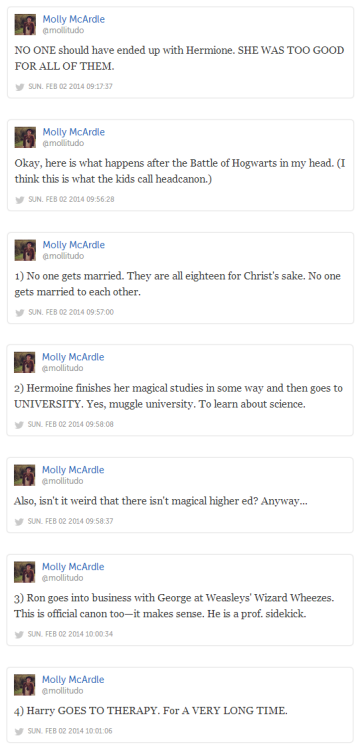
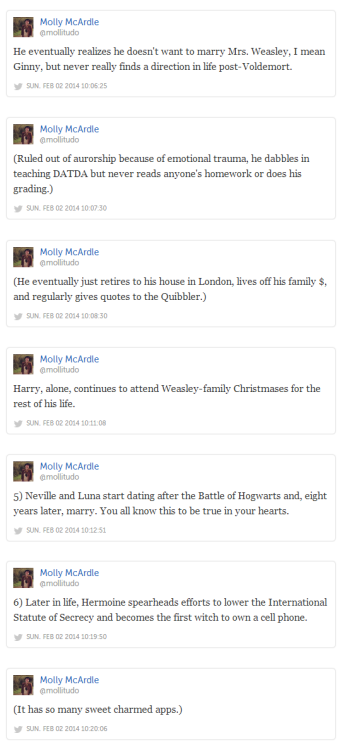
My feelings.
SAME
Nice.
"Nobody wants a hero when there isn’t something to save."
I forget where I read that, and I’m probably paraphrasing, but that just stuck with me. Post War Useless and Unwanted Harry makes sense, not that its his fault, really. But heroes in peaceful times are trouble.
Russian Sledgesvia multitask suicide
#manchvegas

Russian Sledgesvia firehose
I just put a lunar globe on my desk at work, fyi

Attention fellow globe-enthusiasts: The good folks at Sky & Telescope Magazine have collaborated with members with NASA's Mercury-mapping MESSENGER team to create the first complete globe of our solar system's innermost planet, and it's beautiful. Do want!

|
|
Russian Sledgestonight, in my neighborhood
Russian Sledgesvia saucie
<3 <3 <3

Skulls and friends
Russian Sledgesneedless to say, my cubliclemate is currently drinking a cup of malcolm reynolds
Russian Sledgesvia overbey
#datascience
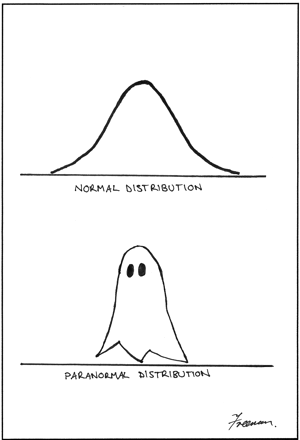
Credit Matthew Freeman.
Original title and link: Data science: Introducing the (para)normal distribution (NoSQL database©myNoSQL)
Russian Sledgesvia rosalind