Shared posts

22 Dec 20:18

SPEKTRMODULE: Podcast 28 – Witchroom

by Warren Ellis
SPEKTRMODULE
28  
Witchroom
  
70 minutes and 42 seconds


If you don’t know what you’re looking at: SPEKTRMODULE is a podcast of haunted, ambient and sleepy music I compile for my own amusement.

Direct mp3 link.  Or press Play on the player.  iTunes link.

@warrenellis / warrenellis@gmail.com / t-shirt? mug?

Please tell other people about this podcast for sleepy people if you like it.  We are #SPEKTRMODULE.


1. logotone

2.  “Tribal Zone”-  Vasilisk     (album: Tribal Zone)

3.  “Eygptian Sports Network” -  Egyptian Sports Network     (album:   Interstitial Luxor)

4.  “SuperSymmetry” – Helicopter Quartet    (album: Where Have All The Aliens Gone?)

5.  “Dissipatas Dominis (CBG Main Theme)” -  Ajoura       

6.  “Surrender” -  Black Swan     

7.  “Sympathy for the Devil [Single/Instrumental]” -  Dionysus 

8.  “Thistle synthesizes a Rust” -  Beifuslied                  

9.  “V (Vocal Improvisation) “ -  Almias    (album:    Almias)

10.  “Untitled I” -   Bog Vider      (album:  Cahuilla)

11.  “I AM JACK’S NIGHTLIGHT” – FOOD STAMPS   

12.  logotone


All previous SPEKTRMODULE podcasts live under this category header or at spkmdl.libsyn.com.

03 Oct 22:23

Al Fresco….

by tom

A rising demand for ‘Fresco’ cloth this summer has warranted a short review of why it is unique, and why it’s proving such a big hit this year.

Provided exclusively by Hardy Minis, Fresco is extremely breathable and hard-wearing – making this cloth ideal for the travelling gentleman. Being able to keep cool in hotter climates as well the ability for coats and trousers to survive hours of ‘over-head locker class’, is a common priority when selecting the right cloth. The creases that often develop in the front of the trousers and elbow fold of the coat, are certainly reduced with a Fresco. Actually, being a fan himself, Mr Mahon made himself a mid-grey Fresco two piece for trips to Tokyo this year. He was more than delighted with how it has traveled and how well it dealt with the high humidity of Japan.

How is it milled? – good question. Made of multiple yarn, high twisted wool and has a plain weave. The high twist allows for an open weave which makes the fabric very airy, in fact if it is held to the light you will be able to see through it. This could leave the layman feeling it may not be hard wearing, but the truth is quite the opposite.

It has to be said though, as with life in general, there is usually some sort of trade off, and in this case it’s feel in the hands… for durability and coolness. Due to it’s high twist, it does have somewhat of a dry feel to it, and will not be something a regular worsted wool wearer will be used to. Weights range from 8oz–15oz.

So…. what are your initial thoughts? – Will you be dining Al Fresco??

Wishing you the very best from all of us here,

Tom Ritson

Apprentice to Mr Mahon.

photo (3)
A recently completed jacket made of 100% wool Fresco, for one of our our American clients)
26 Sep 05:39

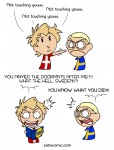
Name Calling

by Scandinavia and the World
Tertiarymatt

Nords can't get along.

Name Calling

Name Calling

View Comic!


25 Sep 03:38

On a wing and a prayer

by Rusty
Tertiarymatt

Bees kind of just wear out, I guess.

We know that honey bee workers live an average of four to six weeks in the spring and summer, but the same is true for most adult bees that go foraging for nectar and pollen. The wings, it seems, are one of the first things to go. Not only do the wings move incredibly fast, […]
25 Sep 03:37

From China to Mexico with the bees

by Rusty
If you recall, Maggie S was a student at the University of Puget Sound who spent a semester abroad with beekeepers in Australia, New Zealand, Thailand, and China. Since her return from China, she has been busier than ever. Just recently she relocated to Chiapas, Mexico, where she will spend the next nine months on […]
21 Sep 22:05

When heavier atoms move faster: bizarre behavior in ozone formation

by Aaron Wiegel
Tertiarymatt

This is interesting, but contains such a horrible, horrible explanatory blunder that I had to comment on the blog and point it ou.

(This is the topic of my dissertation, and I have also published a few articles related to it. I thought I'd try to explain it without using too much jargon for friends and family who may wonder what I've been doing with my life. :) Feedback is always appreciated!)

Stable isotopes of different elements have many interesting applications in areas such as geophysics and archaeology. While the identity of a given element is determined by the number of protons in the nucleus, the nucleus also contains a certain number of neutrons that help keep the nucleus stable. (When a nucleus has too many or too few neutrons, it will become radioactive.) These neutrons usually do not affect most of the chemistry of an element with notable exceptions. Variations in the number of neutrons do lead to different isotopes of each element with different masses, such as carbon-12 (12C), carbon-13 (13C), and carbon-14 (14C). The number next to the element is the total number of protons and neutrons, which is the atomic mass of that atom. The amount of each stable isotope on Earth stays relatively constant. For example, 13C makes up about 1.1% of all carbon on Earth. However, the differences in masses can cause small changes in the amount of each isotope in a chemical through different reactions or physical processes such as evaporation. Usually the differences between isotopes are related to their mass differences through atomic or molecular speeds in a gas or the spring-like vibrations of chemical bonds. These small changes in the amount of an isotope allow researchers to learn new information about the physical, chemical, or biological processes that affected an object.

While in almost all cases stable isotopes move and react in ways that depend on their mass, the three stable isotopes of oxygen (16O, 17O, 18O) in ozone formed in the laboratory or the atmosphere like to break the rules. Scientists expected that 16O would form ozone the fastest, 18O would form ozone the slowest, and 17O would form ozone at a speed about halfway in between. Instead, not only does 16O form ozone the slowest, but 17O and 18O form ozone at the same faster speed! To understand just how strange this is, imagine that you have three blocks of the same material and shape, one light, one heavy, and one in between. If you tried lifting each of them, the heaviest block would be the hardest to lift, the lightest block would be easiest, with the ball in between of moderate difficulty, right? What if the lightest block was hardest to lift, and then the two heavier blocks were equally easy to lift? That's a lot like what happens in ozone formation.

Scientists call this phenomenon "mass-independent", but it probably should be called "mass-bizarre". It's not necessarily unique to ozone, either. Scientists have discovered this strange isotope behavior in oxygen isotopes in some meteorites and in sulfur and mercury isotopes as well. More than a mere curiosity, the signal in the isotopes from these processes is unique and so could potentially be useful as a tool for understanding many different geophysical processes. This "mass-independent" signal finds its way into all sorts of other chemicals in the atmosphere, such as CO2. Despite its potential use as a tool to trace different processes in the atmosphere, the chemistry and physics of this weird effect remains poorly understood. Improving our understanding of what leads to these strange effects is key to using them to understand more about the Earth's atmosphere.

21 Sep 05:14

Photo


18 Sep 09:16

The New Nietzscheans

by cvickrey
Tertiarymatt

Barf? Verily. Via Wilson.

Ah, Nietzsche. The first and last resort of disaffected males in their late teens—of the type that keeps such an ironic detachment from life as to refer to men and women as “males” and “females.” They read about The Philosopher and The Overman and The Antichrist and self-flatteringly assume that he’s talking about them. So God isn’t Great after all! So those things we call “manners” are actually vices; morality is an ancient and useless ghost from the Levant, one that has colonized our sadistic superegos and turned them against us! They rush to their keyboards, informing fellow travelers in r/atheism about their discovery. We might indulge their bright-eyed enthusiasm and forgive them for never getting to the passages where Darwin appears as a villain and—what is worse to Nietzsche—a plodding and pedantic bore.

Why do I now relive the combination of admiration and revulsion I felt when I first read Nietzsche? Well, a gentleman by the name of weedguy420boner introduced me to this:

Cyber-dystopia, meet your new official philosopher.

Society has for many years showered the computer-literate with special favors. We have in wholesale fashion displaced our old stereotypes about scientists—heroic men and women, living as ascetics, grasping towards new truths without fear of the consequences—onto coders, social media gurus, and the venture capitalists who enable them. We have thought their characters’ more chivalrous those of other subcultural votaries. (They’re not in some cases, as a Google News query for “Penny Arcade” would reveal). We have treated their cultural products as somehow embodying a greater authenticity than whatever we might categorize under the dread rubric “mainstream.” The Revenge of the Nerds franchise has aged worse than other cinematic classics—yes, even the hammy and ham-fisted On the Waterfront—because the idea that programmers are eo ispo persecuted outcasts has no basis in sociological fact.

We’ve reaped the consequences in the form of Silicon Valley Nietzscheans, digital Leopolds and Loebs. The visionaries behind Candy Crush and the rest of the app-based grab bag now feel so above hoi polloi that finding new ways of taking their money is not so much an exercise in business strategy—which is as it should be—as it is a deeply expressive release. Nietzsche tells us that creative power is a value higher than truth—“the will to truth” of so many Enlightenment milquetoasts was nothing but the covert discharge of the impulse to dominate, the will to power—and such power comes from recognition. It is not enough that I think that I’m noble and that my creative output is great, but others must think so as well. These ideas are narcotic to people who, like me, earn a living through the manipulation of abstract symbols; Nietzsche offers our ever-insecure selves a way to constitute our identity through others’ groveling before out “creative genius,” even—or, rather, especially—as we treat these others with contempt.

Fun and Games at the 2013 Video Music Awards

Fun and Games at the 2013 Video Music Awards

Nietzsche in fact hated the capitalism and its entrepreneurial avatars for all the unusual reasons. It wasn’t objectionable as an engine of exploitation or inequality or social disruption. (In fact, in one of the few passages that directly addresses politics, he presciently writes without rancor that in the future private actors will assume responsibility for even the most public forms of human activity, like war). It was objectionable rather because the elites it produces are wholly unlike the Greek aristocracy that sired Aristotle. He accused them of being uncurious and uncourageous “last men,” addicted to comfort and material plenty, inferior to even the devout farmer because they treat nothing with reverence and touch everything with their unwashed hands—guilty above all of “the introduction of parliamentary imbecility, including the obligation of everyone to read his newspaper at breakfast.” Abolishing suffering, which the liberals and socialists of Nietzsche’s day earnestly championed, held out not the promise of a New Jerusalem, but rather the threat of a hedonistic commonwealth in which art is impossible and Farmville is the primary obsession.

(An aside: it is unclear if Nietzsche deliberately tinged this portrait of the last man under bourgeois capitalism with anti-Semitism. What is clear is that, despite explicitly disavowing the label of “materialist,” he believed that there is no body-mind dualism, a falsehood derived from the structure of Indo-European languages, and that biology therefore produces ideas. He wrote the Europe’s salvation from “decay” and the looming threat of Russian power lay in breeding a super-race of Jews [embodying adaptability and the virtues of the modern age] with Prussian nobles [embodying time-tested traditional qualities]. Now would be a good time to draw your attention to the fact that Nietzsche, though a great German writer and unrivaled detector of hypocrisy, was not a great philosopher in the conventional sense and was also completely insane).

Are the brave entrepreneurs in Silicon Valley more like the Last Man than they are the Overman who delivers us from spiritual oblivion? The answer may be a matter of taste. But what is clear is that if we do not want their deliverance—if we do not want to live under Ayn Rand’s Nietzschean interpretation of capitalism—we will need to cool our ardor for digital hero-worship and take stock of our values. Neoliberalism consolidates and fails to improve the world by the sensible standards that David Hume and Adam Smith set for evaluating the market economy: the provision of abundance; the amelioration of the struggle of existence in the earthly world. In light of this, it is no surprise that frankly anti-utilitarian defenses of capitalism are growing more common. Charles Murray warned against universal healthcare because, like Nietzsche, he believes that striving and suffering—other people’s striving and suffering—puts individuals on a higher moral and aesthetic plane and wards off the nightmare of the last man’s world.

As for me, I say we first end the scourges of want and privation and injustice, at least on a trial basis. If it turns out we miss them, we can always bring them back.

18 Sep 06:52

Doctor Whisky and the Radical Feminist Agenda

Tertiarymatt

Oh my.

I've got a couple new shirt designs today. Warren and Ariana made Doctor Whisky, which I present to you with much glee:

doctor whisky shirt

doctor whisky shirt

And I've made an "Ask Me About My Radical Feminist Agenda" shirt by request. It's based on the sign in this comic.

radical feminist agenda shirt


17 Sep 23:19

Statistical tests: beads for furs? - Web Exclusive Article - Significance Magazine

Tertiarymatt

Click thru for story. Thanks for butchering the feed, tumblr.

Statistical tests: beads for furs? - Web Exclusive Article - Significance Magazine:

You have no doubt heard the legend about the Native American tribe being seduced by European explorers with glass beads, and other trinkets. The myth has it that the natives made a bad choice failing to capitalize on the technologically superior visitors that had landed amongst them. Rather than choosing what the explorers held in high esteem, their hosts seemed bedazzled by shiny mirrors. Contemporary research has now proven that the ‘ignorant savage’ story distorts a more complex reality in which the natives viewed their strange guests as the gullible party parting with decorative items. As a matter of fact, the historical record shows axes, iron kettles, and woollen clothing exchanged for what were, to the local inhabitants, almost worthless beaver skins, often worn and ready to be thrown out, or signatures on title deeds to property, which meant nothing to the locals who entertained no concept of land ownership. Both sides in this historic barter were astonished at the preferences of the other. Equally, criticisms seem to be bidirectional when it comes to statisticians and the other ‘tribes’ with whom they collaborate, so to speak. From the wealth of analytical tools that end users of statistics need only ask for, there seems to be, from the statisticians’ viewpoint, an ill-informed clamour for items of dubious merit in preference to the high value items that ought to be craved. The process of exchange, as in our historical example, seems continually challenged by communication issues and lost-in-translation episodes, making early stages of collaboration hard going, as all engaged in these transdisciplinary voyages of discovery will be well aware. Two particular communication break-downs have intrigued me throughout my years as a statistician, from student days into my professional life. On the one hand, I have become accustomed to hearing time and time again the misconception that statistics is “all about probabilities”. Any reputation statistics has, then, becomes tarnished in the face of an unexpected turn of events such as rain on your wedding party after a forecast of a sunny day, which is routinely taken to invalidate the judgement that the outcome was improbable. While true that there is an important side to statistics that focuses on predictions, its main role of interpreting what data is saying and telling a story that is both understandable and relevant to its audience is often overshadowed by this sort of wrong-headed thinking. On the other hand, when talking to fellow, young practitioners, a common complaint seems to arise regarding the search for significance on the client´s side. To illustrate this idea, I recently introduced myself as a statistician to a new acquaintance who’s first thought was to enquire what my favourite statistical test was. Although my immediate reaction was to smile, it got me thinking. Not only did it make me more conscious of the association of tests with statisticians being common-place, but it also made me wonder whether we all have some sort of favouritism that can lead us to apply one test rather than another.

16 Sep 07:17

Tensioned Suspension

by Geoff Manaugh
Tertiarymatt

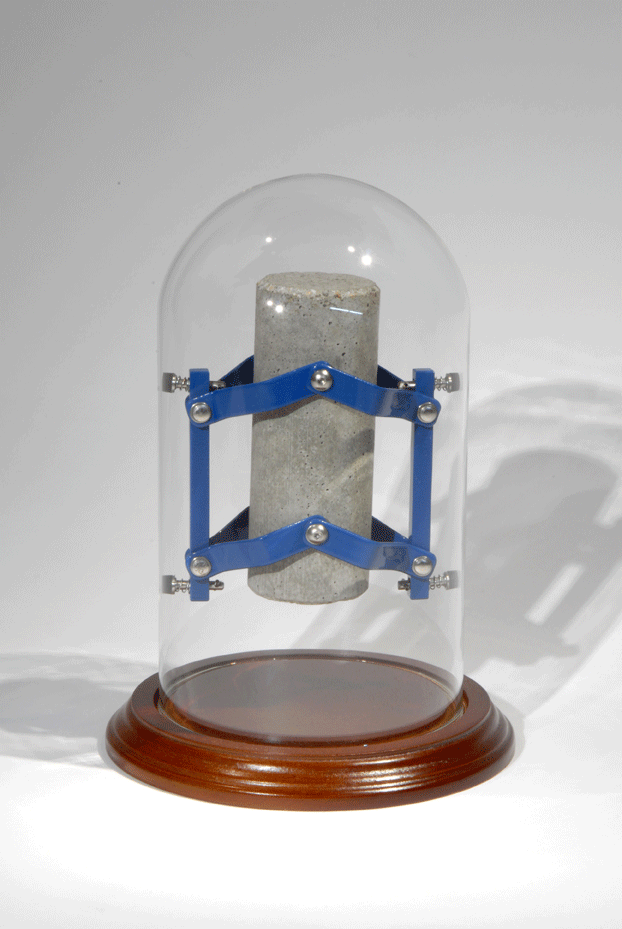
I sort of want to make one of these, now. via bl00.

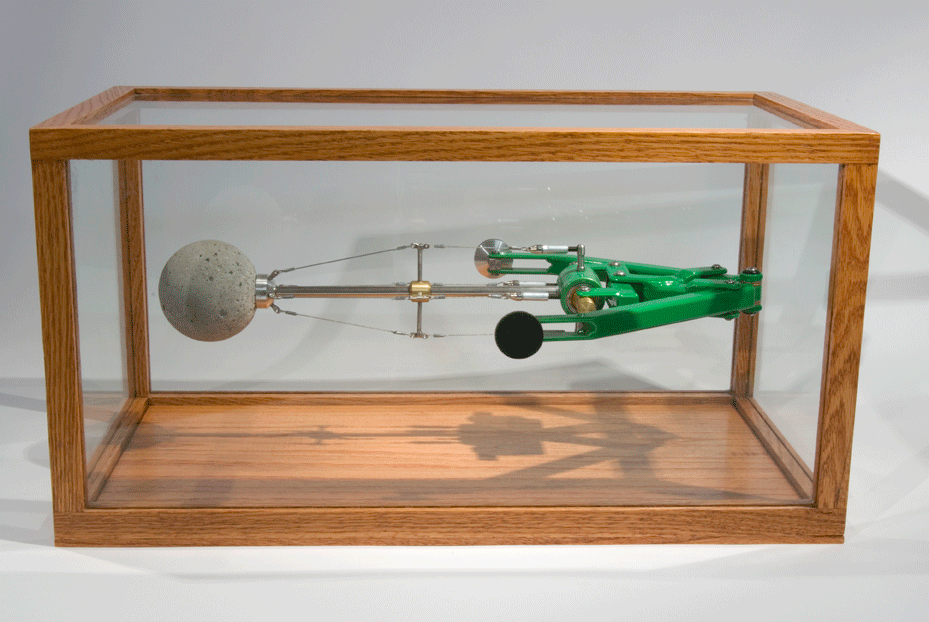
[Image: "Cavity Mechanism #12 w/ Glass Dome" (2013) by Dan Grayber].

We've looked at the work of Bay Area sculptor Dan Grayber here before, but he's got a small show of new work opening up at Oakland's Johansson Projects gallery next month and it seems worth stopping by.

[Image: Another view of "Cavity Mechanism #12 w/ Glass Dome" (2013) by Dan Grayber].

Grayber describes his work as a study in "self-resolving problems," where highly-tensioned devices hold themselves aloft inside glass vitrines, as if floating in space, fighting their own weight while pushing relentlessly against the walls that contain them.

[Images: "Cavity Mechanism #9 w/ Glass Dome" (2013) by Dan Grayber].

Graybar uses an over-arching description for many of pieces seen here, writing, for example, that each piece is "a counterweight driven mechanism that wedges itself into the inside of a cavity (the glass dome in this case), suspending itself."

[Image: "Cavity Mechanism #11 w/ Glass Dome" (2013) by Dan Grayber].

They are as much displays of gravitational potential energy—like staged moments in some avant-garde machine-ballet whose only plot and purpose is to resist the pull of the earth—as they are "art objects."

[Images: "Cavity Mechanism #10 w/ Glass Dome" (2013) by Dan Grayber].

While the highly contained, desktop scale of each piece adds to the overall feel of pent-up force and concentration, it's hard not to want to see this guy working at Richard Serra-like proportions, scaled-up to the point of architecture.

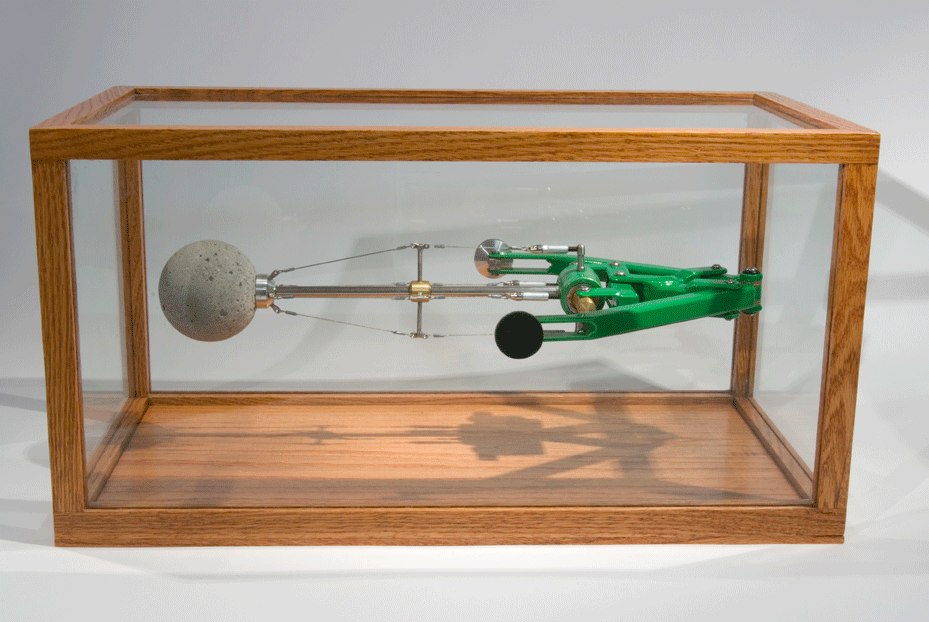
[Image: "Display Case Mechanism #1" (2013) by Dan Grayber].

You walk into Madison Square Park in Manhattan only to see a giant steel mantis weighing five or six tons, painted in fluorescent construction orange, poised kite-like inside a polarized glass dome, holding boulders the size of Fiats, sprung, tensioned, and impossibly buoyant, as if somehow lighter than air.

[Image: "Cavity Mechanism #7 w/ Glass Dome" (2013) by Dan Grayber].

There is an artist's reception and opening on October 4, so mark your calendars ahead of time and stop in to meet the machines. More examples of his work can be seen here on BLDGBLOG or at the artist's own website.
11 Sep 05:18

How Science Fiction and Fantasy Helped Me Conquer My Inner Demons By Being A Total Horse's Ass

by Christopher Wright
Tertiarymatt

Remember kids: if success means being a shitbag, fuck success.

Note: This was originally posted on my Google Plus account here. I'm re-posting it to my website because it's relevant, and also because so there. Slightly edited.

My name is Christopher Brennan Wright. I’m a writer. More specifically, and this is important, at the moment I am an unsuccessful writer. I’m trying to struggle on, and get noticed, and “gain traction” just like every other writer in my position. There are no guarantees.

When you deal with something like that, it’s important that you don't dwell on trivialities, but I think the truth is that everyone does. There are goals and achievements you want that have nothing to do with actually succeeding, and they can haunt you more than the real goals can. I could wake up tomorrow and discover that I sold a hundred eBooks overnight and I’d still find a way to get discouraged. If you're reading this, and you have a level of success where a hundred sales in a night is no big deal, keep in mind that I'm an unsuccessful writer—a hundred books in 24 hours would be a pretty big win for me, and I wouldn’t be able to take the good news at face value. I’d be finding a way to undermine it somehow. I’m my own worst enemy. That’s just the way it is.

One of the ways I undermined myself was by feeling like an impostor.

11 Sep 00:52

Absolutely Terrifying Two Sentence Horror Stories


Absolutely Terrifying Two Sentence Horror Stories

09 Sep 02:22

How to make an awesome nesting block

by Rusty
Tertiarymatt

Wish I had a place to set one of these up.

The conventional wisdom about nesting blocks is that you take a 5/16-inch bit and drill holes that are roughly 5-10 inches long. This will attract orchard mason bees, which is typically what people are trying to do with nesting blocks. But recently my whole attitude toward these blocks was changed by Michael Burgett, Emeritus Professor [...]
08 Sep 23:31

A tale of two neighbors

by Rusty
Tertiarymatt

Some people are stupid and irritating.

Beekeeper vs neighbor stories abound, but this is the best yet. It was sent in by “John” attached to the post “Thy neighbors’ bees.” I’m presenting it here because it’s too funny to be buried in the comments section. I have one better. I queried my neighbors about starting a hive. Most were receptive, except […]
08 Sep 22:31

Late summer forager

by Rusty
Tertiarymatt

Borage for courage.

Borage is a great bee plant. Not only are the flowers a bee-friendly color, but they bloom late in the summer when nothing else is showing signs of life. For this photo, I stretched out in the grass underneath a borage and aimed at the sky, blue on blue. I figured someone would show up […]
05 Sep 02:17

Re-Vetting

by Christopher Wright
Tertiarymatt

There must be a lot of this going down, at the moment.

02 Sep 23:22

Bee Orchid

Tertiarymatt

Nobody fucks like orchids.

In sixty million years aliens will know humans only by a fuzzy clip of a woman in an Axe commercial.
29 Aug 18:29

Man Crosses Twitter and Google Reader to Create Open Source Love Child | Wired Enterprise | Wired.com

Tertiarymatt

Sounds interesting.

Man Crosses Twitter and Google Reader to Create Open Source Love Child | Wired Enterprise | Wired.com:

Michael Powers wants to do what so many others have failed to do: build an online social network that’s outside the grip of any one company — and that people like you will actually use. We’ve seen countless underground hackers build decentralized alternatives to Facebook and Twitter over the years, but so far these open source contraptions have failed to attract anything close to the number of people who use Facebook and Twitter and other commercial services almost constantly. But Powers, a serial entrepreneur based in Washington, D.C., thinks he can finally crack the code. His project is called Trsst, a name that’s meant to engender a sense of trust, and after a summer when NSA leaker Edward Snowden opened the curtain on modern government surveillance, the Trsst message is particularly timely. “The PRISM revelations have made people more concerned about privacy and security,” Powers says. “So now is the time to give people an alternative.”

23 Aug 22:18

whisky review 386 (2/2) - Amazing Whisky improvement technique

by ralfy
Tertiarymatt

I think I am going to do this with the very, very cheap Trader Joe's single malt. I'm going to try with balsam poplar, among others.

23 Aug 08:01

SPEAK graphic novel announcement:

by Emily Carroll

'Speak' to be adapted as a graphic novel -- I talked a little to Publisher's Weekly about working on a future adaptation of Laurie Halse Anderson's 1999 book, Speak. I couldn't be more thrilled to finally announce this (to say nothing of working on it with Laurie, which I am very much looking forward to doing). The article has more details, but it's tentatively scheduled for a 2016 release.
23 Aug 08:01

Gone Home released!

by Emily Carroll
Tertiarymatt

Good things, as always.


GONE HOME was released last Thursday, and I would have posted about it sooner, but I was off visiting Portland to celebrate said release with The Fullbright Company. I'm proud to have had some small part in the game -- the above title image is drawn by me, as are the in-game maps, and the font used in game is based on my handwriting (there's a few other things too). My talented & generally fucking amazing wife Kate Craig was the 3D artist on the game, and the love that she & everyone else in Fullbright poured into it is completely, wonderfully, obvious.

I really think that if you enjoy my storytelling, and the sorts of things that I make, that you would be interested in this game. For those wary of video games in general, know that there are no enemies to kill in Gone Home, no abstract puzzles, and no need to keep your finger twitching over a trigger button. It's a game of exploration, of piecing together clues, of reading and assessing in your own time and in your own way. It's about human lives and relationships, some old, some new, some close, some distant and aching. I strongly urge you to check out its website and see if it's something you might be interested in.

And on the subject of creative storytelling, I wanted to take the time to post the art I did for Ryan North's To Be or Not To Be, a Hamlet Choose-Your-Own-Adventure novel! I was very pleased to be given the 'Canonical Ending' to illustrate (click for bigger version):


...and actually, while I'm here, these are some assorted drawings & general whatnots that I have posted to twitter in the last while. There's a few creatures, a few beaks, a few scales, and also some Animal Crossing: New Leaf fan art thrown in for good measure (not to be confused with the fan art of Honored Matres from Dune, though they should be pretty simple to tell apart). As ever, click to enlarge.


21 Aug 20:20

FP101: Fountain Pens for Students

by Brian Goulet
Tertiarymatt

For those who might want to venture into the territory. I love mine.


It's about time to gear up for back-to-school, and I thought it might be helpful to share with you some of the best pens for students in the $50 and under price range. Keeping in mind that value, reliability, and durability are some of the key factors for student pens, here are some that I will gladly recommend.

This is the first Fountain Pen 101 video I've made in about a year, so if you haven't seen my others already, definitely check them out here.

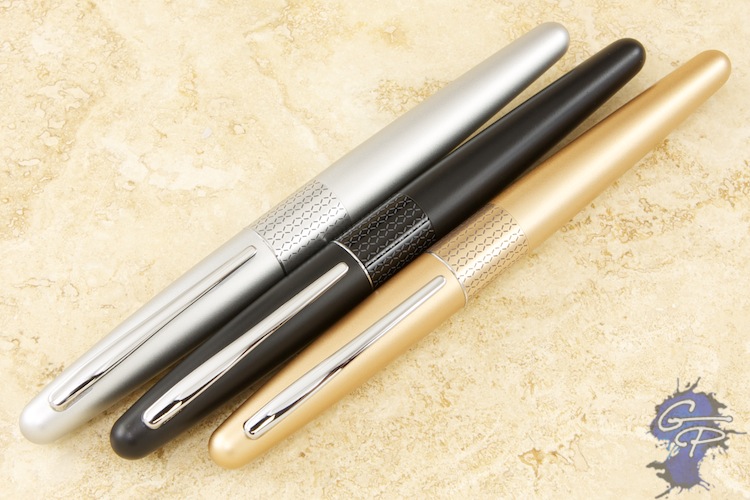
Pilot Metropolitan, ~$15+

Pros:
  • Great value
  • Attractive
  • Durable
  • Very reliable writer
  • Good ink capacity
Cons:
  • Limited to black, gold, and silver, pretty conservative colors
  • Only available in medium nib (though it's a Japanese medium, so it's pretty fine)
  • Cartridges and converters are proprietary to the Pilot/Namiki brand

Lamy Safari/Vista/Nexx, ~$26+

Pros:
  • Workhorses, they just write
  • Lots of fun colors to choose from
  • Durable despite the worst of abuses
  • Many nibs to choose from, including stubs
  • Nibs are swappable, so you can buy one pen and a variety of nibs to vary things up
  • Ink window shows you when you need to refill ink
  • Triangular grip makes it easy to hold for beginners
Cons:
  • Converter doesn't come with the pens, you have to buy separately
  • Grip is bothersome to some, especially with larger hands
  • Cartridges and converters are proprietary to Lamy

Platinum Preppy, ~$4

Pros:
  • Great value
  • Clear, easy to see ink level
  • Eyedropper convertible, able to hold huge volume of ink
  • Versatile, accepts cartridge, converter, or eyedropper
  • Not the end of the world if lost, broken, or stolen
  • Many different colors to choose from
Cons:
  • Doesn't come with converter, costs about twice what the pen does
  • Plastic is somewhat brittle, and can fracture if handled too rough (dropped on concrete, crushed in backpack, etc)
  • Cartridges and converter are proprietary to Platinum (though can be used with adapter to accept standard international cartridges)


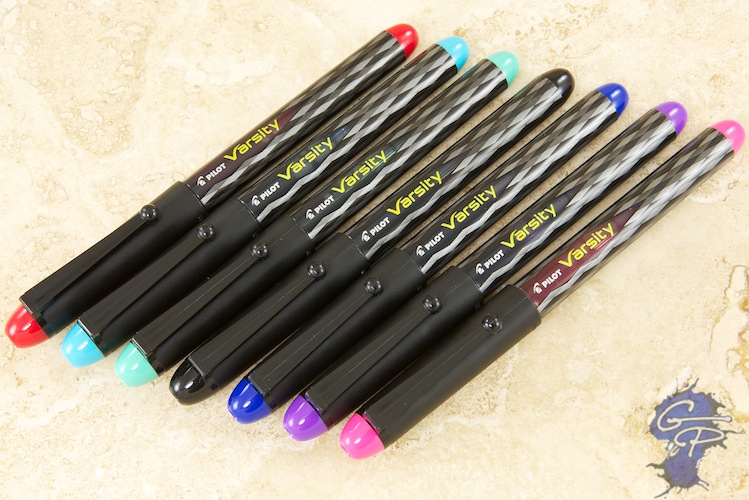
Pilot Varsity, ~$3

Pros:
  • Great value
  • Writes surprisingly well for the price
  • Durable
  • Refillable by hack, though marketed as disposable
  • Good ink capacity
  • Not the end of the world if lost, broken, or stolen
Cons:
  • Only one nib size
  • Come preloaded with ink, so limited color selection unless hacked and refilled

Noodler's Flex Pens (Nib Creaper, Ahab, Konrad), $14-20

Pros:
  • Great value
  • HUGE color selection
  • Durable, can drop or crush and won't crack
  • Flex nib, incredibly rare in this price range
  • Good ink capacity with piston mechanisms, no cartridges or converter needed
  • Nibs can be swapped with any #6 nib, such as the Goulet nibs for great variety
  • Easily disassembled for cleaning and maintenance
Cons:
  • Challenging to use for a newbie
  • Writes very wet, can be troublesome on cheap, absorbent paper
  • Can be finicky, requires patience on the part of the user 

Sheaffer VFM, ~$16.50

Pros:
  • Great value
  • Writes well
  • Durable
  • Lots of very fun and vibrant colors
Cons:
  • Only one nib size, medium
  • Only takes standard international cartridges, won't fit any converter 

Sheaffer 100, ~$40

Pros:
  • Classy design
  • Writes well
  • Durable
  • Comes with a converter
Cons:
  • Metal grip can be hard to hold for long writing sessions
  • Only accepts proprietary Sheaffer cartridges and converter
  • Might be a target for stealing, keep a close eye on it!

Platinum Cool, ~$42

Pros:
  • Nice fit and finish
  • Writes well
  • Insert in cap keeps nib wet very well
  • Very fine nibs, great for cheap paper
  • Flexible nibs, can make writing fun if you choose to flex it
  • Clear pens, easy to see ink level
  • Comes with a converter
Cons:
  • Only accepts proprietary Platinum cartridges and converter
  • Might be a target for stealing, keep a close eye on it!
  • Converter doesn't match the trim, but can be hacked to be made silver

TWSBI 580/Mini, ~$50-55

Pros:
  • Nice fit and finish
  • Writes well
  • Great value, for what they are
  • Insert in cap keeps nib wet very well
  • Wide variety of nibs to choose from, including stubs
  • Piston fillers, with large ink capacity
  • Clear pens, easy to see ink level
  • Easily disassembled for cleaning and maintenance
Cons:
  • Most expensive pens in this group
  • Might be a target for stealing, keep a close eye on it!


These are my recommendations, and take them for what they're worth. These are pens that I feel are worth consideration for students, though which pen is best for you will ultimately be your own decision. These are only pens I have experience with, and it's most certain there are others worth considering that I don't talk about here. But hopefully this will at least give you something to consider if you're a student and looking for a workhorse to help you make the most of your studies! If you have any other suggestions or questions, just let me know if the comments.

Write On,
Brian Goulet


20 Aug 03:57

How not to shoot a monkey: video analysis of a classic physics problem.

by aatish
Tertiarymatt

Knowledge about guns will hurt you here.

I came across a neat video, via Jennifer Ouellette, where a couple of MIT students re-enact a classic physics textbook problem. It’s a problem that I first heard over a decade ago, when I was in high school, and is one of the few physics 101 problems to have earned the distinction of its own wikipedia page.

See MIT physics students do the famous "Monkey and a Gun" demonstration with a golf ball gun, and a stuffed monkey. http://t.co/fOe1RGuDLA

— Jennifer Ouellette (@JenLucPiquant) June 21, 2013

Here’s the setup. A monkey hangs from a branch of a tree. A hunter aims their rifle at a monkey. At the very instant the hunter pulls the trigger, the monkey gets startled by the sound, lets go of the branch, and falls from the tree. The question is: will the bullet still hit the monkey? If not, where should the hunter have aimed the gun to hit the monkey?
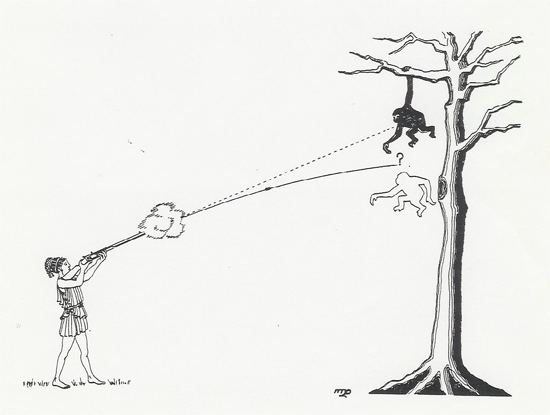
Source: UCLA physics lab manual

So, do you think the hunter should aim the gun:

  1. Above the monkey?
  2. At the monkey?
  3. Below the monkey?

Before reading on, take a moment to come up with your answer.

Thought about it?

This problem has somewhat of an amusing legacy. In an effort to revamp physics problems to fit more environmentally enlightened times, textbook authors have taken great pains to distance themselves from the barbaric act of shooting monkeys on trees.

Here’s the original version of the problem, from 1971, featuring a hunter and a monkey.
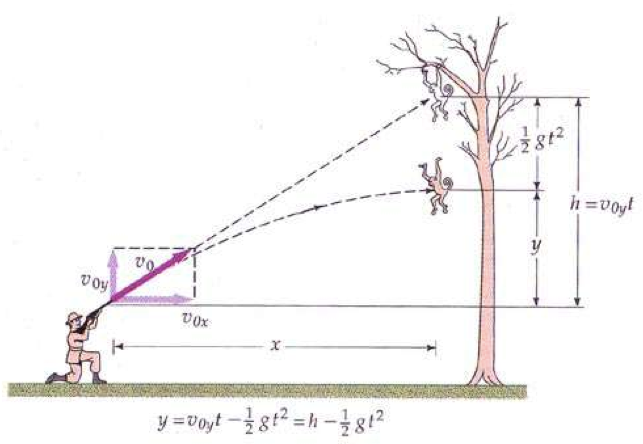
monkeyshot1

Shooting the monkey. Figure from Tipler, 1st Ed. (Worth, 1971)

Compare that to a modern variant, this one from 2000, featuring a distressed zookeeper who’s trying to coax an escaped monkey to climb down a tree. In the words of the authors, “After failing to entice the monkey down, the zoo keeper points her tranquilizer gun directly at the monkey and shoots.” If this is still a little alarming, some versions feature a friendly naturalist in place of the distressed zookeeper.
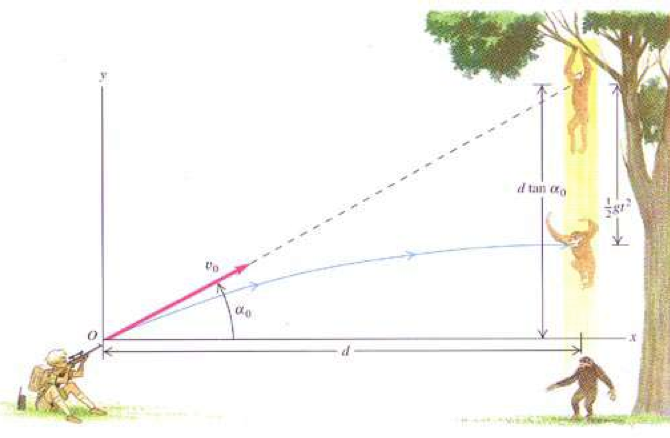
monkeyshot2

Sedating the monkey. Sears and Zemansky, 10th Ed. (Addison Wesley, 2000)

Here’s someone trying to feed a monkey a banana (I doubt the zookeeper would approve).
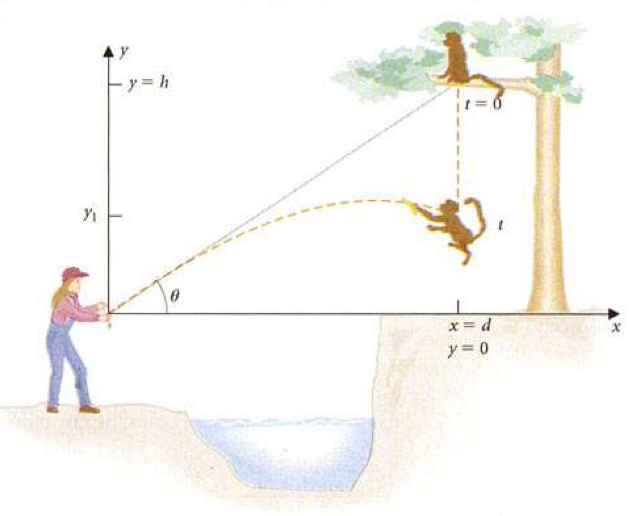
monkeyshot3

Feeding the monkey. Lea and Burke (Brooks/Cole, 1997)

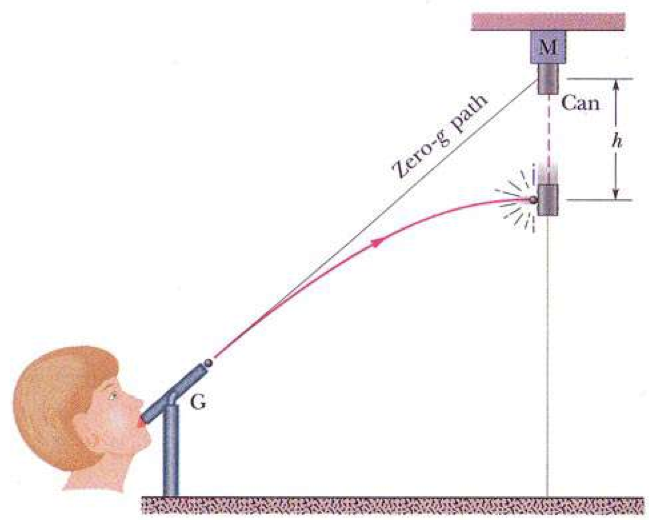
By the time I came across this problem, it had become somewhat more convoluted. I mean, well.. just look at the figure.
monkeyshot4

Umm… where’s the monkey? Haliday, Resnick, Walker, 5th Ed. (Wiley, 1997)

I believe what we have here is someone blowing into a pea shooter that shoots out tiny spherical magnets, which can then stick to a falling metal can. The can is somehow wired to fall at the exact moment she launches the magnet. You know, just your every-day magnetic pea shooter wired to a falling-metal-can scenario.

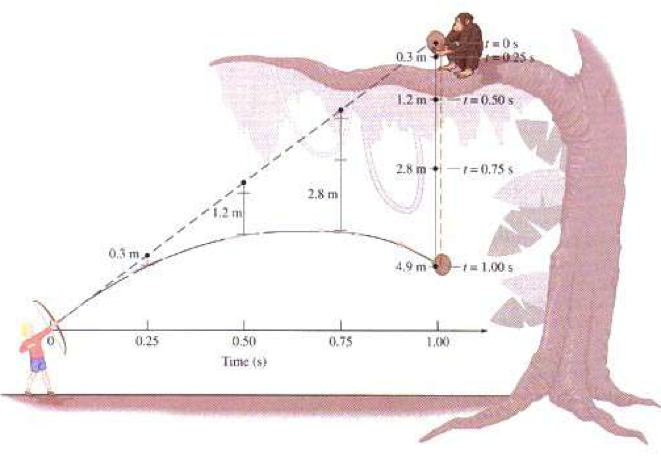
And that isn’t even the strangest version of the problem I’ve come across. That honor goes to this next version. See if you can figure out what’s going on from the figure.
monkeyshot5

Giambattista, Richardson, Richardson (McGraw Hill, 2004)

This is, of course, the less famous cousin of William Tell, who decided to shoot a coconut with an arrow. Oh, and the coconut happens to be held by a monkey. Unfortunately, the monkey is a somewhat unreliable stooge, and the moment the archer releases the arrow, the monkey lets go of the coconut. Silly monkey, you had one job! Just hold the darn coconut.

Needless to say, these figures are starting to get a little visually jarring, and perhaps detracting from the key physics principle.

The latest version of this age-old conundrum comes to you from two MIT students, who wired a sock puppet monkey to fall at the exact moment a golf ball cannon is fired. I decided to track the motion of the ball and the monkey in the video. Before watching the video, think back to your prediction.

Isn’t that neat? Even though the golf ball curves away from its aimed trajectory, it still hits the monkey dead on!

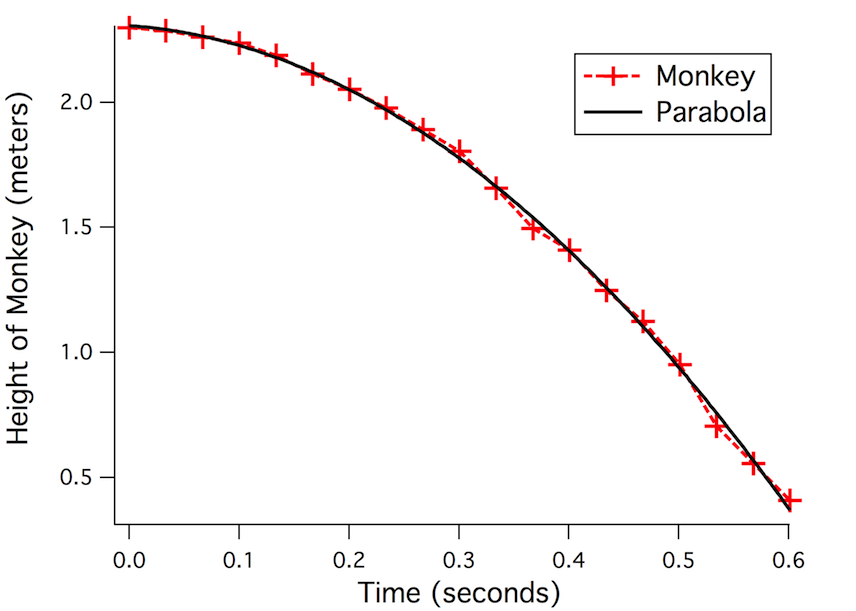
So why did this happen? First, look at the light blue curve above. The monkey falls downwards in a straight line. But say you were to plot the height of the monkey, measured from the ground, as it changed over time. What would that plot look like? If you haven’t seen this before, it’s kind of surprising.
MB1

What you see is that even objects that fall in a straight line trace out a neat curve, called a parabola, when you plot their height versus time. The red curve is the monkey’s trajectory, recorded from the video, and the black line is a curve representing a perfect parabola. See how nicely they line up! Physics isn’t just textbook stuff.

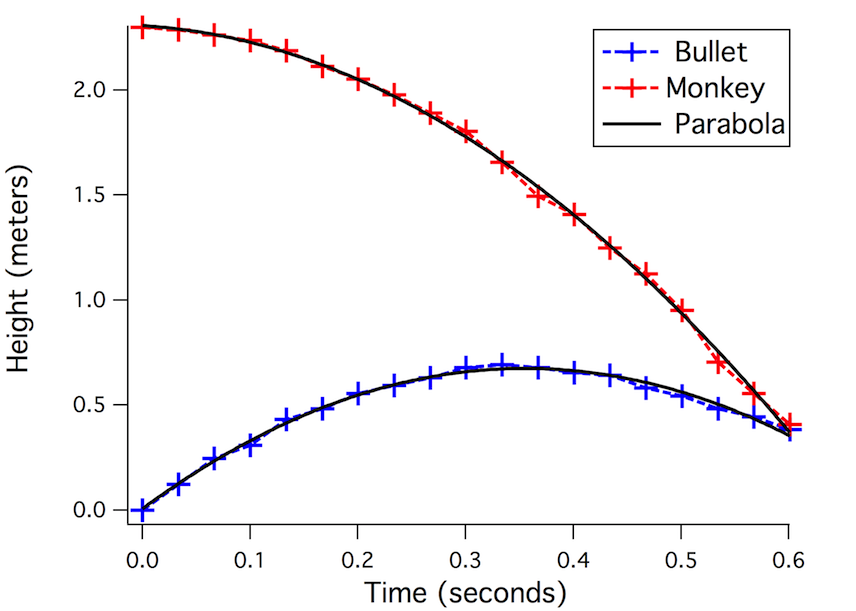
Now, let’s add the height of the bullet into this picture:
MB2

Again, notice how well the bullet’s motion lines  up with a parabola. This is the sort of thing that I find very cool about physics – you can abstract away the monkey, and discover a mathematical world that’s hiding  beneath.

When I look at this curve above, it strikes me a pretty startling that those two curves intersect. It seems like a cosmic coincidence that the bullet managed to hit the monkey. But this isn’t the whole picture.

Let’s imagine for a moment what would happen in a world without gravity. The bullet would just keep moving in a straight line path. Let’s call this the aiming line. The monkey would still be up in the tree (since it can’t fall without gravity). It’s obviously going to be a bulls-eye shot.

Now, switch on gravity. The bullet curves away from its original, intended path (the aiming line, shown in green in the above video). And the monkey falls from its perch. But here’s the kicker: both the bullet and monkey deviate from their original paths at exactly the same rate. What I mean is this: if at any moment, you measure how far the bullet has dropped below the green line, and at that exact moment, you measure how far the monkey has fallen from its perch, those two distances will be exactly the same.

The bullet and the monkey both ‘missed’ the branch, but they missed it by exactly the same amount! If you think about it, this single fact means that they are still going to collide.

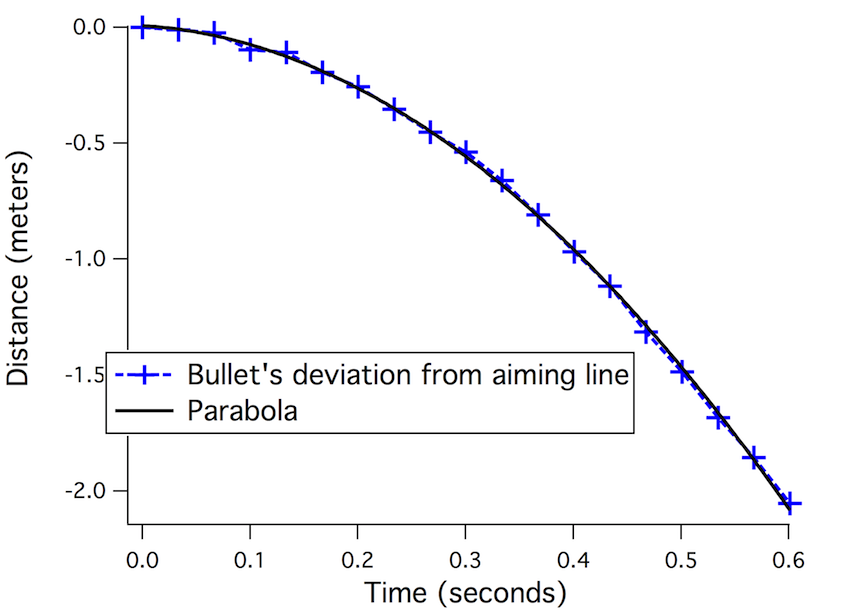
Let’s try it out and see if it works. Let’s measure how far the bullet strays from its original green aiming line. Here’s what this deviation looks like:
MB3

Surprisingly, it’s still a parabola, but a different parabola from before (in technical terms, we’ve subtracted off the linear term).

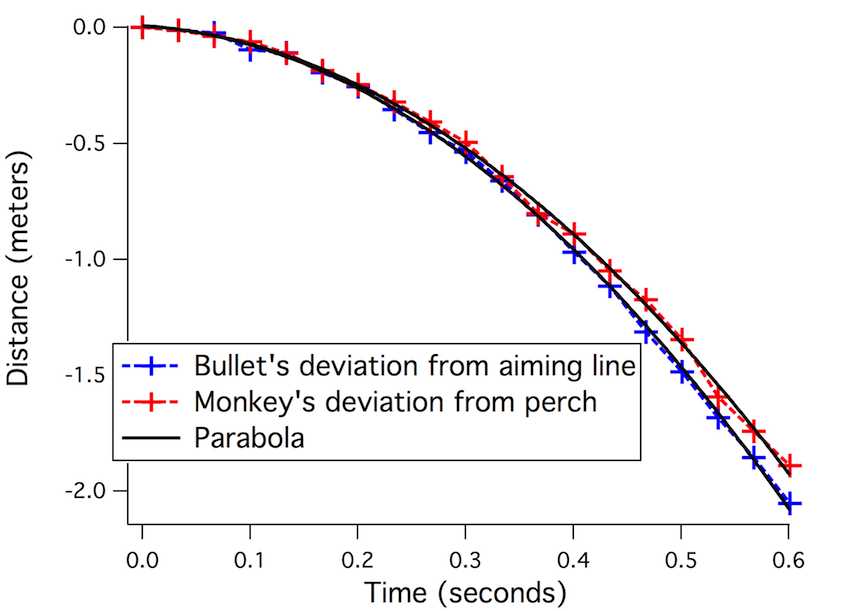
Now, we can do the same thing for the monkey. At zero seconds, the monkey sits on the perch. A tenth of a second later, it’s a few centimeters below the perch. Another tenth of a second and it falls further still. Let’s take this curve – the monkey’s deviation from its perch – and overlap it with the bullet’s deviation from the aiming line.
MB4

What do you know, it lines up pretty neatly.

This is why the bullet hits the monkey, why the archer hits the coconut, or why the magnet hits the tin can. It’s because the Earth affects the motion of all falling objects in exactly the same way.  No matter what you throw – coconuts, peas, golf balls, or bullets – they all deviate from their ‘aiming line’ at exactly the same rate. All falling objects play by exactly the same rules.

Footnotes:

In reality, a target rarely drops out of a tree the moment you fire a gun. In fact, gun manufacturers already take into account the fact that bullets fall. When you set the sight on a rifle, what you’re really doing is correcting for how far the bullet will fall by the time it hits its target.

The many variants of the hunter-monkey problem above are from the slides of an excellent talk by Eric Mazur where he emphasizes the importance of using simple, non-distracting figures.

Want to learn more about falling, and “the problem of the Moon”? Then definitely check out this superb Radiolab segment in their episode Escape, and another cool one on falling cats and why we fall.


16 Aug 21:17

whisky review 386 (1/2) - Amazing whisky improvement technique

by ralfy
Tertiarymatt

Ralfy rambles a bit in the beginning. Meat of things is around ten minutes in, if you're already familiar with aging of whiskey. I have done this, incidentally, and it works a treat.

10 Aug 00:08

(via Live At Seattle Center - Mural Concerts - KEXP and Seattle...

Tertiarymatt

Not sure how crowded it's going to be, or if we'll be able to make it before it's over, but such is life...


(via Live At Seattle Center - Mural Concerts - KEXP and Seattle Center present Concerts at the Mural)

Tonight is Chastity Belt, Deep Sea Diver, and Cloud Cult.  Free.  Starts at 5:30.  Might be going (have been invited out by Cloud Cult fans), though not until later. 

10 Aug 00:08

(via Three Panel Soul) We’ve all thought it.

Tertiarymatt

Babies, man.


(via Three Panel Soul)

We’ve all thought it.

06 Aug 23:37

American Drinkers Are Turning Against Beer

by Derek Thompson
Tertiarymatt

Liquor is making a comeback. We Americans used to drink most of our alcohol as liquor.

Poor beer.

Just 20 years ago, it was America's most popular alcoholic beverage by far. Since then, per capita consumption of beer down 20 percent and despite population growth, annual domestic production has fallen down, too.

Gallup's new alcoholic preferences survey, summed up in the image above, finds that beer's lead over wine has slipped by 20 percentage points since the early 1990s. But the demographic breakdown is even more brutal. Young drinkers and non-white drinkers saw the steepest falls in beer preference. In other words, the fastest-growing segments of the country are also running the fastest away from brews.

Here are drink preferences among the youngest generation:

Screen Shot 2013-08-05 at 12.21.32 PM.png

... and among nonwhites:

Screen Shot 2013-08-05 at 12.21.15 PM.png

So what's going on here? From interviews with beverage analysts, I've collected string for a few theories:

(1) Americans care more about our health, now (because we know more about it)

Here's a look at change in drinking volume by beverage in the decade after 2001. Bottled water exploded. Tea is up. Soft drinks, beer and juice, not so much.

Screen Shot 2013-01-14 at 1.09.03 PM.png

One explanation has been that American drinkers are more health-conscious today because there are so many studies and media reports of studies that make it impossible to be less health-conscious. This has hurt high-sugar and empty-calorie drinks that face relentless press criticism. "You're seeing that the consumer is taking a healthier look and having more alternatives [than soda], such as tea, and coconut water," Thomas Mullarkey, an analyst from Morningstar, has told me. "But also, Americans have aged, and soft drinks are most popular among teenagers and twentysomethings."

Still, that does not adequately explain why Americans would turn against light beer, which dominates the market. For that, we need another explanation ...

(2) Lower-class white guys are getting crushed.

Think of of cheap beer sales as a health indicator for blue-collar America, especially for men (they call him Joe Sixpack for a reason). Look at the chart at the top of the story again. Beer dips after the 2000/'1 recession and then begins to recover. Then beer preference falls again after the Great Recession, where the hardest hit industries (construction and manufacturing) were blue-collar-male industries. As the Wall Street Journal reported, light beer sales fell for three years after the recession and only bounced back in 2012 due to the resurgence of craft beer.

(3) Liquor ads work.

TV used to be a little less boozy and a lot more innocent. Liquor ads didn't air on U.S. television until 1996, according to WSJ, "when a local NBC station in Texas agreed to run a commercial for Crown Royal whiskey." It's only very recently that they've started running ads on broadcast networks. Since liquor marketing came out of the cabinet, liquor sales are up.

(4) Wine is delicious and affordable, and many Americans only recently realized that.

California's wine grape crush has grown by 160 percent since the famous Judgment of Paris in 1976. It's not just Americans who are ordering bottles in record numbers. Wine exports are growing every year, too. In this light, it's not that Americans are turning against beer so much as our preferences are turning somewhat more European as our capacity to produce good affordable wine has caught up to the old continent.

(5) Tastes just change.

I really do wish I could tell you that I know exactly what hundreds of millions of people drink every day and also why. I really don't. Maybe young people prefer higher-alcohol drinks nowadays, because they're more efficient? Maybe people decided Bud Light is awful? Tastes aren't always explicable.

Top image: Valentyn Volkov /Shutterstock.com

This post originally appeared on The Atlantic.


06 Aug 20:26

33GB later, fabric in games gets real-time boost

by Byron Spice-Carnegie Mellon
Tertiarymatt

Just brute force everything.

CARNEGIE MELLON / UC BERKELEY (US) — After six months of computing time, researchers are pretty sure they’ve simulated almost every important configuration of a piece of cloth over a moving human figure.

“I believe our approach generates the most beautiful and realistic cloth of any real-time technique,” says Adrien Treuille, associate professor of computer science and robotics at Carnegie Mellon University.

06 Aug 06:03

Most Americans are confused by health insurance

by Shilo Rea-Carnegie Mellon
Tertiarymatt

In other news, water is wet.

CARNEGIE MELLON (US) — Many Americans don’t understand how their health insurance policies work, even though they think they do, according to recent surveys.

This fall, as part of the 2010 Affordable Care Act (ACA), Americans will have a greater range of health care insurance options to choose from, including state-based plans. But will they make the right decisions?