ThePrettiestOneOK, this starts pretty but it gets dark pretty fast there.


Morgan Davidson, on Tumblr
YO. this should be on EVERYBODY’S BLOG
My pencil crayons never worked this much magicXD
ThePrettiestOne"the gun Houser used in the shooting was purchased legally last year in Alabama."
Seriously, can we give the "Only outlaws will have guns" thing a try? Because I think it will be a lot less hazardous than our current system.


Watch: Black Lives Matter protesters were pepper sprayed in Cleveland this weekend
The protest was part of a demonstration by the National Convening of the Movement for Black Lives, which met at Cleveland State University for a weekend conference on police brutality. Protests turned nasty, however, after the city’s Regional Transit Authority reportedly detained a 14-year-old for a seemingly minor reason.
Feminism didn’t teach me to hate men, but it did teach me to stop prioritising them over women.
And it turns out a lot of men think that’s the same thing as hatred.
Fast food workers in NY just won a $15/hr wage.
I’m a paramedic. My job requires a broad set of skills: interpersonal, medical, and technical skills, as well as the crucial skill of performing under pressure. I often make decisions on my own, in seconds, under chaotic circumstances, that impact people’s health and lives. I make $15/hr.
And these burger flippers think they deserve as much as me?
Good for them.
Look, if any job is going to take up someone’s life, it deserves a living wage. If a job exists and you have to hire someone to do it, they deserve a living wage. End of story. There’s a lot of talk going around my workplace along the lines of, “These guys with no education and no skills think they deserve as much as us? Fuck those guys.” And elsewhere on FB: “I’m a licensed electrician, I make $13/hr, fuck these burger flippers.”
And that’s exactly what the bosses want! They want us fighting over who has the bigger pile of crumbs so we don’t realize they made off with almost the whole damn cake. Why are you angry about fast food workers making two bucks more an hour when your CEO makes four hundred TIMES what you do? It’s in the bosses’ interests to keep your anger directed downward, at the poor people who are just trying to get by, like you, rather than at the rich assholes who consume almost everything we produce and give next to nothing for it.
My company, as they’re so fond of telling us in boosterist emails, cleared 1.3 billion dollars last year. They expect guys supporting families on 26-27k/year to applaud that. And that’s to say nothing of the techs and janitors and cashiers and bed pushers who make even less than us, but are as absolutely crucial to making a hospital work as the fucking CEO or the neurosurgeons. Can they pay us more? Absolutely. But why would they? No one’s making them.
The workers in NY *made* them. They fought for and won a living wage. So how incredibly petty and counterproductive is it to fuss that their pile of crumbs is bigger than ours? Put that energy elsewhere. Organize. Fight. Win.
”
In Oregon, a couple is being fined over $100,000 and being given a gag order not to comment on their case of refusing to bake a cake for a gay wedding.
There is also a lien on their house, so they might literally lose their home.
Do I agree with their beliefs? No. But they have every fucking right to choose who they bake a cake for, what they will put on that cake, and to refuse to bake a cake for anyone for any reason. I don’t give a fuck who you are, you don’t deserve special treatment
FUN FACT: You know why they’re paying that 135k fine? Not because they denied someone a cake. It’s not just that. They gave out the couples personal contact information. Their home address, phone numbers, and emails. This couple received death threats and nearly lost their foster children.
You know what that bakery got? A little bit of bad publicity (I use that lightly because their bakery has been blasted up and down the news pages and then some), and some protesters outside. This isn’t to say however that they didn’t have the full support of their own community who are constantly counter protesting and - if I remember correctly - raising funds for the Kleins.
In Oregon it is illegal (per The Oregon Equality Act of 2007) to refuse services & goods based on sexual orientation, race, sex, disability, age or religion). There are exceptions if you are religious school or organization. But Sweet Cakes by Melissa is a privately owned business and are not a registered / legitimate religious organization.
This isn’t a newly passed law. It’s been around since 2007. That’s eight years. It wasn’t even a change made after they had opened. Sweet Cakes is a business that opened in 2013. How you open a business and not know how the law works is beyond me. But people do amazing and incredulous things every day.
Also there was no “gag-order”. The owners - Melissa and Aaron - are free to discuss and publicize their case as much as they please. However they have been told that they cannot continue to broadcast that they plan to continue to deny services to same sex couples. Which, once again, is illegal in the state of Oregon. It would probably do them many favors not to discuss their plans to break the law.
There’s so much false information floating around out there regarding this case. It’s really important to have all the facts.THIIIIIIIS. The couple received DEATH THREATS and people threatened their CHILDREN. I would be asking for way more than 135k, tbh.


Did he just make a feminist period joke?
oh my god someone buy that man a beer
SOMEBODY FILL HIM IN
ThePrettiestOneYeah.
Plus maybe that weird thing where you think you're just staring out into space but you haven't noticed that your eyes happen to be directed at another person and it goes on way too long and they get more and more confused about whether you find them really attractive, or are planning to kill them.

There is no form of hating fat people - including concern trolling or hating fat acceptance - that doesn’t amount to you saying, “Uh, excuse me, what made you think you could go around having a body without justifying it to me?”
When you talk about “fat” diseases - you’re saying: “uh, that body better be perfectly healthy in all instances forever before I give you my approval.”
When you talk about “it’s just not attractive” - you’re saying: “I think I made it clear that if your body isn’t pleasing to me, I’m not signing off on it.”
When you talk about “just eat less and exercise more” - you’re saying: “who gave you permission to live your life as you see fit instead of how I see fit?”
So let me just be clear: all anti-fat arguments are always and completely invalid because fat people will never owe you an explanation or justification for their bodies, their health, or their lives.
Fat acceptance is simply the assertion of a right fat people have always had, and one it’s long past time others started accepting.
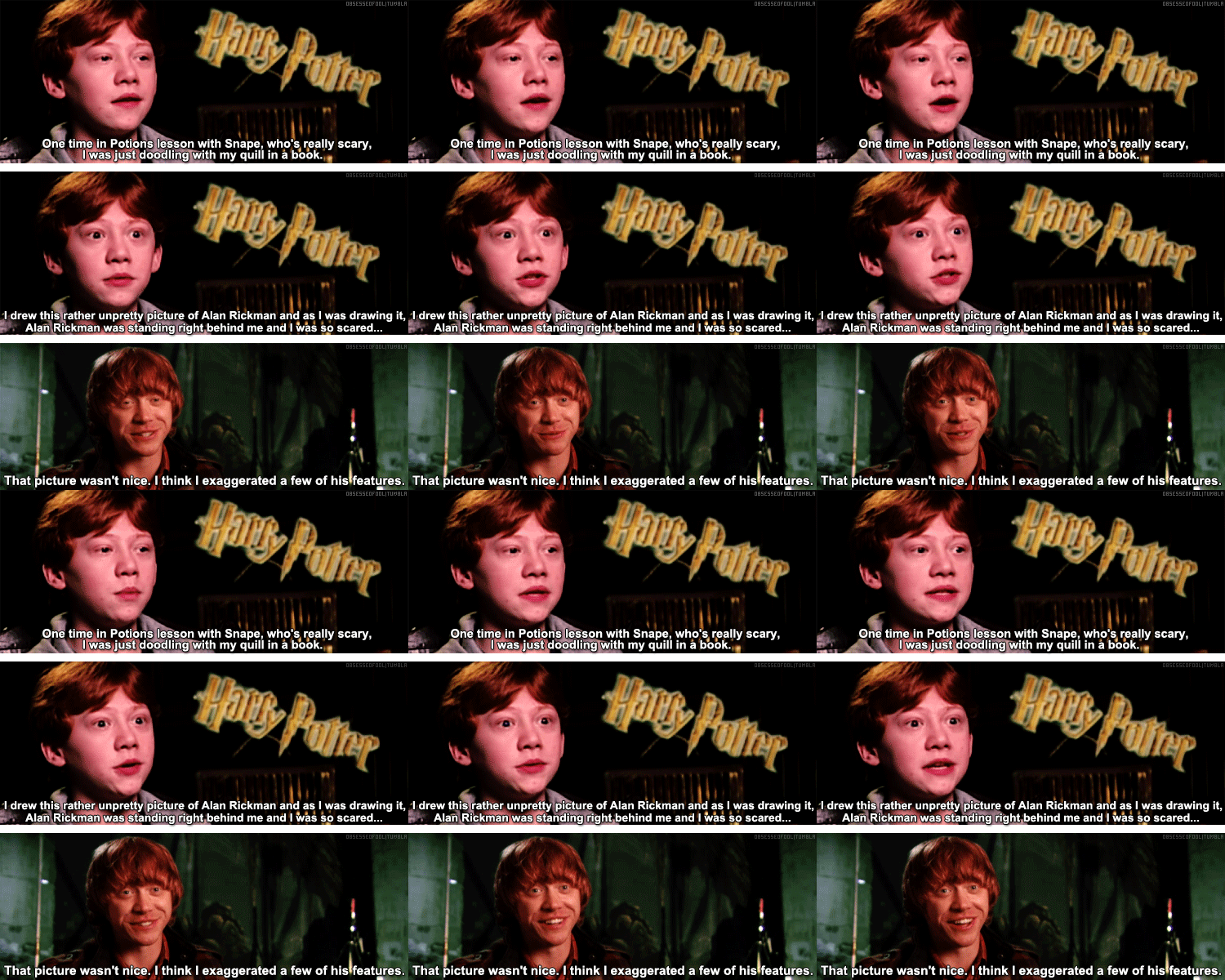
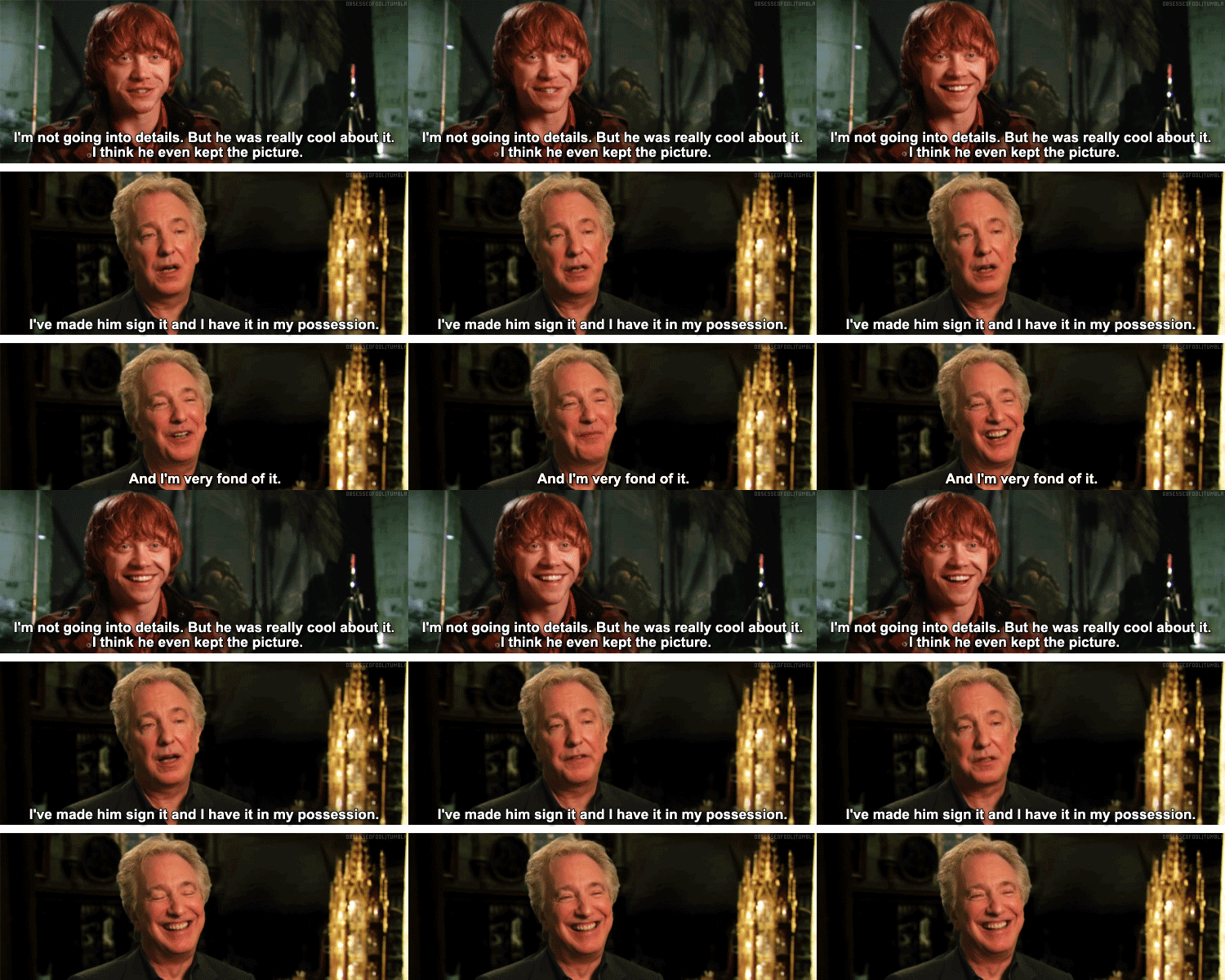
ThePrettiestOnePlease. Like Rickman can't use a drawing a child made to control the man the child became. This shit is, like, elementary.
Or sympathetic. I always get my schools confused.

‘I’m No Longer Afraid’: 35 Women Tell Their Stories About Being Assaulted by Bill Cosby, and the Culture That Wouldn’t Listen
By Noreen Malone and Portfolio By Amanda Demme
More has changed in the past few years for women who allege rape than in all the decades since the women’s movement began. Consider the evidence of October 2014, when an audience member at a Hannibal Buress show in Philadelphia uploaded a clip of the comedian talking about Bill Cosby: “He gets on TV, ‘Pull your pants up, black people … I can talk down to you because I had a successful sitcom.’ Yeah, but you rape women, Bill Cosby, so turn the crazy down a couple notches … I guess I want to just at least make it weird for you to watch Cosby Showreruns. Dude’s image, for the most part, it’s fucking public Teflon image. I’ve done this bit onstage and people think I’m making it up … That shit is upsetting.” The bit went viral swiftly, with irreversible, calamitous consequences for Cosby’s reputation.
Perhaps the most shocking thing wasn’t that Buress had called Cosby a rapist; it was that the world had actually heard him. A decade earlier, 14 women had accused Cosby of rape. In 2005, a former basketball star named Andrea Constand, who met Cosby when she was working in the athletic department at Temple University, where he served on the board of trustees, alleged to authorities that he had drugged her to a state of semi-consciousness and then groped and digitally penetrated her. After her allegations were made public, a California lawyer named Tamara Green appeared on the Today show and said that, 30 years earlier, Cosby had drugged and assaulted her as well. Eventually, 12 Jane Does signed up to tell their own stories of being assaulted by Cosby in support of Constand’s case. Several of them eventually made their names public. But they were met, mostly, with skepticism, threats, and attacks on their character.
In Cosby’s deposition for the Constand case, revealed to the public just last week, the comedian admitted pursuing sex with young women with the aid of Quaaludes, which can render a person functionally immobile. “I used them,” he said, “the same as a person would say, ‘Have a drink.’ ” He asked a modeling agent to connect him with young women who were new in town and “financially not doing well.” In the deposition, Cosby seemed confident that his behavior did not constitute rape; he apparently saw little difference between buying someone dinner in pursuit of sex and drugging them to reach the same goal. As for consent, he said, “I think that I’m a pretty decent reader of people and their emotions in these romantic sexual things.” If these women agreed to meet up, his deposition suggested, he felt that he had a right to them. And part of what took the accusations against Cosby so long to surface is that this belief extended to many of the women themselves (as well as the staff and lawyers and friends and others who helped keep the incidents secret).
Months after his depositions, Cosby settled the case with Constand. The accusations quickly faded from the public’s memory, if they registered at all. No one wanted to believe the TV dad in a cardigan was capable of such things, and so they didn’t. The National Enquirer had planned to run a big story detailing one of the women’s accounts, but the magazine pulled it when Cosby agreed to give them a two-page exclusive telling his side (essentially that these were instances that had been “misinterpreted”).People ran a story alleging that several of the women had taken money in exchange for their silence, implying that this was nothing more than an elaborate shakedown. Cosby’s career rolled on: In 2014 alone, there was a stand-up special, plans for a new family comedy on NBC, and a high-profile biography by Mark Whitaker that glossed over the accusations.
The group of women Cosby allegedly assaulted functions almost as a longitudinal study — both for how an individual woman, on her own, deals with such trauma over the decades and for how the culture at large has grappled with rape over the same time period. In the ’60s, when the first alleged assault by Cosby occurred, rape was considered to be something violent committed by a stranger; acquaintance rape didn’t register as such, even for the women experiencing it. A few of Cosby’s accusers claim that he molested or raped them multiple times; one remained in his orbit, in and out of a drugged state, for years. In the ’70s and ’80s, campus movements like Take Back the Night and “No Means No” helped raise awareness of the reality that 80 to 90 percent of victims know their attacker. Still, the culture of silence and shame lingered, especially when the men accused had any kind of status. The first assumption was that women who accused famous men were after money or attention. As Cosby allegedly told some of his victims: No one would believe you. So why speak up?
But among younger women, and particularly online, there is a strong sense now that speaking up is the only thing to do, that a woman claiming her own victimhood is more powerful than any other weapon in the fight against rape. Emma Sulkowicz, carrying her mattress around Columbia in a performance-art protest of her alleged rape, is an extreme practitioner of this idea. This is a generation that’s been radicalized, in just the past few years, by horrific examples of rape and reactions to rape — like the 2012 Steubenville incident, in which high-school football players brutally violated a passed-out teenage girl at a party and photographed and braggingly circulated the evidence. That same year, when a 14-year-old Missouri cheerleader accused a popular older boy at her school of sexual assault, her classmates shamed her on social media and the family’s house was burned down. The whole world watched online. How could this kind of thing still be happening? These cases felt unignorable, unforgettable, Old Testament biblical. Would anyone have believed the girls, or cared, had the evidence not been digitizable? And: How could you be a young woman and not care deeply about trying to fix this?
This generation will probably be further galvanized by the allegations that a national cultural icon may have been allowed to drug and rape women for decades, with no repercussions. But these younger women have given something to Cosby’s accusers as well: a model for how to speak up, and a megaphone in the form of social media.
Facebook and Twitter, the forums that helped circulate the Buress clip, were full of rage at Cosby’s perceived cruelty. Barbara Bowman, who’d come forward during the Constand case, wrote an op-ed in the Washington Post about her frustration that no one had believed her for all those years. Three days after Bowman’s op-ed, another woman, Joan Tarshis, came forward to say Cosby had drugged and raped her in 1969. By the end of November, 16 more women had come forward. Cosby resigned from Temple’s board of trustees and sought monetary damages from one of his accusers; he also told “Page Six” that he wanted “the black media to uphold the standards of excellence in journalism [and] go in with a neutral mind.” (Cosby, through representatives, has consistently denied any wrongdoing, and hasn’t been charged with any crimes. Emails to four of his lawyers and press reps went unanswered, although his team has begun a media tour to deny that his admission of offering Quaaludes to women was tantamount to admitting he’d raped anyone.) By February, there were another 12 accusers. Tina Fey and Amy Poehler joked about it at the Golden Globes: “Sleeping Beauty just thought she was getting coffee with Bill Cosby.” Attorney Gloria Allred got involved, representing more than a dozen of the women. Even President Obama said it was clear to him: “If you give a woman — or a man, for that matter — without his or her knowledge a drug, and then have sex with that person without consent, that’s rape.”
There are now 46 women who have come forward publicly to accuse Cosby of rape or sexual assault; the 35 women here are the accusers who were willing to be photographed and interviewed by New York. The group, at present, ranges in age from early 20s to 80 and includes supermodels Beverly Johnson and Janice Dickinson alongside waitresses and Playboy bunnies and journalists and a host of women who formerly worked in show business. Many of the women say they know of others still out there who’ve chosen to remain silent.
This project began six months ago, when we started contacting the then-30 women who had publicly claimed Cosby assaulted them, and it snowballed in the same way that the initial accusations did: First two women signed on, then others heard about it and joined in, and so on. Just a few days before the story was published, we photographed the final two women, bringing our total to 35. “I’m no longer afraid,” said Chelan Lasha, who came forward late last year to say that Cosby had drugged her when she was 17. “I feel more powerful than him.”
Accompanying this photo essay is a compilation of the interviews with these women, a record of trauma and survival — the memories that remain of the decades-old incidents. All 35 were interviewed separately, and yet their stories have remarkable similarities, in everything from their descriptions of the incidents to the way they felt in the aftermath. Each story is awful in its own right. But the horror is multiplied by the sheer volume of seeing them together, reading them together, considering their shared experience. The women have found solace in their number — discovering that they hadn’t been alone, that there were others out there who believed them implicitly, with whom they didn’t need to be afraid of sharing the darkest details of their lives. They are scattered all over the country — ten different states are represented — and most of them had no contact with their fellow accusers until recently. But since reading about each other’s stories in the news, or finding one another on social media, or meeting in person at the photo shoots arranged by New York, many of the women have forged a bond. It is, as Tarshis calls it, “a sorrowful sisterhood.” ■
Their stories, in their own words:
Rebecca Lynn Neal
Barbara Bowman
Beth Ferrier
Helen Hayes
Chelan Lasha
Margie Shapiro
Patricia Leary Steuer
Marcella Tate
Heidi Thomas
Sunni Welles
Jewel Allison
Linda Brown
Sarita Butterfield
Helen Gumpel
“Kacey"
PJ Masten
Joan Tarshis
Kaya Thompson
Sammie Mays
Victoria Valentino
Kathy McKee
Lise-Lotte Lublin
Linda Kirkpatrick
Autumn Burns
Louisa Moritz
Lili Bernard
Therese Serignese
Janice Dickinson
Linda Joy Traitz
Janice Baker-Kinney
Joyce Emmons
Tamara Green
Beverly Johnson
Carla Ferrigno
Cindra Ladd
ThePrettiestOneFull bars?
Full bars?!
FULL BARS!!
https://youtu.be/QHCtTtoPEKc?t=38s

ThePrettiestOneIt's not right to make these allocations without providing a link.
there is a sixy-seven THOUSAND word long fanfiction that is just ryan stiles and colin mochrie from the hit tv show whose line is it anyway driving to the mountains to meet their wives. no sex. no romance. just two improv comedians driving in a car for 268 pages. i’m confused but at the same time i want to take this author out for coffee
ThePrettiestOneSo... call out the problematic fave's behavior, but know they are a cinnamon roll too?
I'm only half joking. I'm not a Christian, for many reasons, but there are elements of the belief structure that I admire. One of those is the idea of hating the "sin" and loving the "sinner." This is, in context, vitally important, because everyone's a sinner. Everyone screws up. Everyone's a problematic fave.
Just like there are Christians who think that the point of being without sin is that you get to throw stones at people, there are people in any group who want to score the most points, and dig on those who score lower. Humans are humans.
I spend more of my time and energy talking about politics to strangers on the Internet than I ever thought I would, and over the last few years of participating in the events and conversations around Occupy, Ferguson, GamerGate, Baltimore, and every other flashpoint in this on-going culture war, I’ve noticed a problem.
Specifically, I’ve noticed a problem with the way the left-to-far-left folks – you know, the vast and contradictory coalition known as “progressives” – engage in political discourse online (and probably in person, too, though I can’t say I’ve noticed this as much). The problem starts, I think, because we often place too much emphasis on highlighting the fucked-up things people say or do, and demand that blood and sanctions be exacted upon the person who fucked up.
This behavior has yielded plenty of thinkpieces coming from across the political spectrum indicting the modern “call-out culture”, which leaves people afraid to make mistakes publicly or say the wrong thing for fear of being pounced on by the people they thought of as allies.
Thing is, I don’t think the problem is actually the call-out itself; I think that is a powerful tool in identifying our own problematic behaviors and becoming better people.
I think that the problem isn’t calling people’s behavior out so much as the lack of intellectual humility that I have been seeing in the execution of the public call-out. I feel like many times I see someone tweet about A Horrible Thing Someone Said with a slight sense of glee lying beneath a pious veneer.
I see people accumulating political capital – typically by accumulating masses of followers and influential retweeters to build their capacity to influence online discourse – by drawing attention to shitty things that people do and say. They’re consciously performing as a Good Person On The Internet, and people follow them so that they can also feel like Good People On The Internet.
That makes me feel super weird and uncomfortable for all kinds of reasons. We end up seeing Good People On The Internet disagree, and the conversations end up polarizing between two camps united behind personalities, not critical analysis. People aren’t arguing about whether X message or Y action was racist or sexist, they’re arguing about whether they think Person A is a better human being than Person B.
It’s demagoguery, not critical thinking, and it leads us to start reducing political ideologies down to factions and figureheads. What’s worse, we often end up reproducing the same damn privilege structures we’re fighting against in our own movements, as the influence and political capital ends up going to privileged allies who get to feel like they’re The Good People. (Just think about how much attention and fawning white dudes get for tweeting about social justice-y stuff.)
Hopefully if you’ve read this far, you should start feeling a little bit prickly. You’ve probably engaged in some of the same public performance of Good Personhood, or blindly retweeted an opinion by a known Good Guy just so you can make sure everyone knows you’re On The Level, or something like that. Good! That’s exactly how you should be feeling.
Learning to be good people
I originally titled this essay “The New Progressive Religion” because, from my outsider’s perspective of religion I see some parallels that might better help explain the issues I’m talking about.
I grew up in the Bay Area – born in San Francisco, moved to Oakland when I was about 14. I wasn’t brought up to be very religious, though my family on both sides were Catholic. I never quite understood what grown people got out of practicing religion as a kid, but as an adult, though, I think I get it: I want to be with people who have similar ideas about what it means to be a good person (and to be good people to each other) as I do, so if I can find an ideology that accurately captures this, all I need to do is find people who share that ideology and I’m set.
Both religion and politics are trying to answer an old question – “How can we be good people to each other?” – typically by laying out a system of ethics and then prescribing behaviors and rules based on those ethics. Organized religion tries to answer this question with texts that we use to parse a divine being’s will; intersectional feminism tries to answer the question by analyzing how our individual relationships to other people are mediated by power we wield over each other but don’t fully understand.
Now, when you start incorporating ideological teachings into the way you live your life, there isn’t really a lossless copying method. There is no perfect follower of Christ, just as there is no perfect feminist; practicing either is a constant process of study to figure out how to interpret ideology into action, and then learning from the results of the action to better clarify or refine the source ideology.
So, with religious folks, you get some people who put a whole lot of work in studying and analyzing, and you get some people who go to Church once a week and listen to the teachings because that’s what everyone in your city does. In my experience, the people who put more work into studying their religion are the ones that tend to be the most accepting and open-minded and are pretty good at Being Good People, while the people who treat the learning process as one-way end up holding a set of rules as sacred even when doing so seems contrary to the end goal of Being Good People.
This is what I’ve been seeing in progressive spaces: There are people who study and critically interrogate their practice of their ideologies, and there are people who treat Progressive Social Justice Politics Stuff as a dogmatic set of behaviors and attitudes and use their adherence to and others’ deviance from to define themselves as Good People.
Which is ridiculous, because the experiences and ideologies at the core of that Progressive Social Justice Politics Stuff are constantly being challenged, iterated on, and added to, so the idea that anyone could be dogmatic about it seems kind of bizarre.
The need for intellectual humility
I never felt a strong need for religion in my life. I think this is because when I was in college, I started being actively involved in my campus Asian American community, working in both social and political organizations, and cultivating my knowledge of intersectional feminism through study and practice. It was kind of funny, actually – I majored in Philosophy and generally felt like all the ethics stuff we studied was more of a logician’s circlejerk, while the electives I took in the Asian American Studies department were directly relevant to giving me the tools I needed to start trying to make sense of the world and How To Be A Good Person.
One of the side effects of studying this kind of thing in school is that our professors did a great job impressing upon us that this field of knowledge is incomplete. The words and theoretical frameworks they gave us so that we could begin to describe the experiences we shared but couldn’t name were still works in progress. The academic roots of ethnic studies, like any other political theory or philosophy work, came from intelligent people finding ways to understand the people around them. We were just testing the waters. We read selections of the core texts, but never the full texts, or perhaps never all the texts. Not that you need to find this in school, mind you – but for a guy like me who is prone to thinking he is smarter than he actually is, it sure fucking helped.
This inculcated in us a certain kind of ideological humility. When you see thinkpieces explaining why X action is actually kind of racist, the part that explains why it’s racist isn’t handed down from a monk on a mountain; it’s the intellectual outcome of applying a theory of power that helps us understand how we can unintentionally hurt or suppress each other. This theory is constantly being challenged, iterated, and refined as people continue to build this body of knowledge based on contributing their experiences and understandings to the pile. Being Good is not a solved problem.
So we continue to study, and we continue to practice our politics expecting these theories to change – expecting someone smarter than us to come by and explain to us that we’re wrong, that we missed something.
And when it comes to applying the knowledge we have of How To Be Good People to criticize each others’ behavior, we should strive to do so knowing that our understanding is imperfect and we are seeking to improve upon it, not to draw battle lines between mini-celebrities or jockey for social and political position.
Here’s the thing, though: I arrived at my current political beliefs by taking a bunch of really great college classes with a bunch of really great (and endlessly patient) professors, and then taking than knowledge and working through it in daily life with my friends, family, and loved ones. It’s a painful process, and near as I can tell, it never stops.
And when I see people tweeting up a storm about some fucked up shit, it sometimes comes off as though that speech isn’t coming from an ideological base that is carefully cultivated, but from a set of internalized rules. Kind of like the guy in your local health and fitness forum who spouts off all the “right” advice for lifting and dietary regime but couldn’t actually tell you how it works (and where it might not).
People go to school specifically to study this kind of thing!
People who haven’t even been born yet are going to go to school for this shit, and write some amazing books that will make everything we know about being Good People look as hopelessly barbaric as slavery does now!
Some people don’t really have to go to school for this shit because they live it every day!
We’re all complicit in interlocking systems of oppression that ruthlessly fuck over our fellow human beings and we’ll probably never in our lifetime manage to be even net-neutral in terms of our impact on other people!
Forget being a Good Person – the best we can hope for is probably “Less Shitty People Than Everyone Around Us”!
None of the above factors should stop anyone’s desire to be a Good Person in the slightest – but it should put our own efforts to do work on ourselves in perspective, I think. Especially when we choose to take on the responsibility of pointing out how someone else could be a Good Person.
Asking people to change their lives super hard and we should treat it as such
I think that one of the hardest things to do as a person is tell someone that you know how to live their life better than they do. It’s a pretty bold assertion, and we shouldn’t do it lightly! But it’s kind of what we’re doing in a call-out.
When we call out shitty behavior, we are trying to communicate that a certain action caused injury: Hey, you said this thing and it was pretty hurtful for Reasons, and if you are trying to be a Good Person, I think it would be a good idea to make amends and not do this thing again.
But it’s very easy for that call-out to become something sinister: Hey, you said this thing and it was pretty hurtful for Reasons, and I want people to know that I am a Good Person and you are a Not Good Person.
One comes from a place of desire for mutual improvement; the other comes from a desire for personal validation at another’s expense. One is productive; the other is not.
What’s more, I don’t actually think it’s easy to tell in the moment how much of a call-out is motivated by selfish vs. selfless reasons. These are a few questions that I often ask myself, though, and they might help you as well:
- Are you publicly broadcasting your call-out because you want the attention, or because you feel like your call-out’s success depends on others’ signal boosting?
- Are you privately communicating your call-out because you think it’ll be more helpful for the recipient, or because you want them to save face?
- Are you using your voice instead of amplifying others’ because you want the spotlight, or because you want to put yourself on the line as a visible supporter?
- Are you signal boosting someone else because you want to amplify marginalized voices, or because you don’t want to stick your own neck out?
- Are you being witty because you want your hot take to be the one that wins Twitter, or because you feel like your wit serves to better illustrate the damage done?
- Are you as vocal in sharing the good as you are in calling attention to the bad?
- Are you holding strangers on the Internet to higher standards of behavior as you do your friends?
If you have your own suggestions on ways to keep yourself honest, I’d sure as hell love to hear ‘em.
Be excellent to each other
I know there are some people reading this thinking, “Patrick, you jerk, you just wrote this thing so people will think you’re a Good Person. You’re performing Good Person just like everyone else.”
I can see why you would think that way! I used to be much more invested in the idea of appearing like a Good Person than actually behaving as such; it’s a thing I am still working on.
Believe me: I don’t like getting in Twitter fights with people because I think it’s super hard to actually change people’s opinions most of the time, and so it just becomes mutual public grandstanding in order to appeal to and broaden your follower base. I don’t think my opinions are anything special, and I wish people would pay attention to me for the neat stuff I would like to someday make or the stupid jokes I write on Twitter, not this post. And when I do call something out, I have a sinking feeling of dread in my stomach as it starts to spread around the Internet, because I know that there are lots of people out there smarter than I am about this stuff. If you see me grandstanding, tell me.
Let’s stay humble, be excellent to each other, and…
https://www.youtube.com/watch?v=W0uVwVUVsbY
…you know the rest.
when you don’t know who the person who is talking is or what their face means or what they’re saying or if they’re talking to you or to someone else
The problem comes from people whose opinions are actually misconceptions. If you think vaccines cause autism you are expressing something factually wrong, not an opinion. The fact that you may still believe that vaccines cause autism does not move your misconception into the realm of valid opinion. Nor does the fact that many other share this opinion give it any more validity…
You can be wrong or ignorant. It will happen. Reality does not care about your feelings. Education does not exist to persecute you. The misinformed are not an ethnic minority being oppressed. What’s that? Planned Parenthood is chopping up dead babies and selling them for phat cash? No, that’s not what actually happened. No, it’s not your opinion. You’re just wrong.
”Yes, Your Opinion Can Be Wrong | Houston Press
This whole article. Education does not exist to persecute you. (via redcloud)
“In other words, you can form an opinion in a bubble, and for the first couple of decades of our lives we all do. However, eventually you are going to venture out into the world and find that what you thought was an informed opinion was actually just a tiny thought based on little data and your feelings. Many, many, many of your opinions will turn out to be uninformed or just flat out wrong.“
good read.
No, people aren’t “More sensitive” now. People aren’t too “Politically Correct” now. Nor are people “Just looking for a reason to be offended” now.
We, as a people, know better now. Therefore we, as a people, are trying to do better now.
Also, more humans have been allowed their rightful societal status of “people.” Rather than the chattel/possessions/prey/targets that they were previously assigned.
Those who express annoyance about “people being more sensitive these days” or “political correctness gone mad” are annoyed because a diversity of humans are now considered to be genuine “people,” who thus deserve respectful treatment. Previously you didn’t have to bother, because they weren’t “people.”
I think that’s where the tone of outrage and betrayal comes from. Having been generously granted the probationary status of “people,” all of these marginalized folks should now be grateful, polite and decorative, and, you know, not bother the, uh…
… the Real People.


Best of Marvel Cinematic Universe.