Shared posts

16 Jun 05:17

Savage Love Letter of the Day: What Should the Duggars Have Done?

by Dan Savage

You've written about "gold star pedophiles," people who are attracted to children but have not and would not touch a child, and the trap they're in when seek treatment. Which really gave me unexpected empathy for them.

As a parent myself, I struggle to know what would be the appropriate steps to take if we were ever faced with a Josh Duggar situation. I think a lot of people, while condemning the Duggars (for so very very many things) also wonder what the hell they would do if it was their 14-year-old son, wanting to get the kid and the victims treatment without ruining his or their lives.

Any guidance?

Seeking Unexpected Empathy

Your letter arrived moments after I watched a TED talk given by a Licensed Marriage and Family Therapist (LMFT) who works with juvenile sex offenders. Meghan Fagundes lives in California, where she works with minors who've committed sex offenses. Most of the sex offenders she works with are boys and most have offended against family members, usually younger female siblings. Fagundes' TED talk focuses on stereotypes and myths about juvenile sex offenders and the harm these myths do—to juveniles who've offended, to victims and potential future victims, and to families. Everyone should take the time to watch Fagundes' 2014 presentation at TEDxAustinWomen:

One thing Fagundes didn't address in her presentation: What the hell parents should do if they discover that one of their children has sexually abused a sibling or a friend. I reached out to Fagundes, SUE, and shared your letter with her. My conversation with Fagundes is after the jump...

•••••••••••••••••••••••••••••••••••

Dan Savage: What should Josh’s parents have done?

Meghan Fagundes: From what I understand about the way they handled the abuse, it seems that it could have been addressed differently. Ideally, as soon as you make the discovery that your child has sexually abused someone, you help your child get treatment for sexually abusive behavior. If your child has abused one of your other children, you also immediately obtain mental health services for the child who has been abused and take steps to make sure that child, and any other children at risk, are kept safe from further abuse. You commit yourself to be supportive and involved with your child’s treatment (both abuser and abused), and in addition, you find your own support for working through the multitude of inherent emotions—sadness, guilt, shame, anger, grief, etc.

That said, watching the Duggars describe how they did handle it was like watching so many families I’ve worked with. For those of us who have never been in their shoes, it’s tempting to say how we would have done things “better”; however, we underestimate the tremendous lengths the human psyche will go to in order to protect us from potentially damaging psychological experiences. Most parents who discover their children have sexually abused are hoping that the problem will go away on its own, that it won’t happen again, that the victim wasn’t really harmed, etc. They oftentimes don’t want to talk about it or address it because it’s shameful, uncomfortable, heartbreaking, and because doing so means that they have to accept the reality that this has happened in their family. They frequently feel a tremendous sense of guilt. So they might use denial, or minimize the abuse; sometimes, they don’t address it at all until it turns into a legal issue and they have no choice. Additionally, most parents have no idea who to turn to for support, and with such a stigma attached to sexual abuse, it takes an incredible amount of courage to speak up and ask for help. Because of that, many of them react in ways that those of us not in their position don’t understand.

DS: What would you tell a parent who discovered that their kid had sexually abused a younger sibling to do?

MF: First and foremost, I would encourage them to ensure the safety of their children and/or any other children who might be at continued risk for sexual abuse. For example, by having the child who sexually abused someone stay for an agreed upon period of time with a supportive relative or friend, and/or by keeping all of the children highly supervised at all times if they are together. Having a conversation with the child who has been abused is imperative; to find out what they need in order to feel safe, to help them understand they did not do anything wrong and that they can come to you if they need to, and to connect them to a mental health professional that can provide them with age-appropriate support for sexual abuse. As soon as possible, I would encourage the parents to talk to the child who has sexually abused to better understand what happened and to connect that child with treatment specifically for sexually abusive behavior.

Together with the mental health professionals, the family should be able to create a safety plan and to get a better idea of how they can create a healing, safe environment for their children. Also, I would want the parents to know that their feelings—angry, confused, guilty, appalled, grief-stricken, ashamed, numb—are all a natural reaction, and that no matter how they feel, their child’s choice to engage in sexually abusive behavior is not their fault. If they are struggling to deal with the aftermath of the sexual abuse, I would encourage them to get their own mental health support. This is especially critical if the parent has their own history of abuse.

DS: How do you get your kid into treatment without potentially ruining your kid’s life?

MF: That question so profoundly reflects society’s feelings towards those who sexually abuse.

The idea of getting treatment for something is typically associated with improving the quality of one’s life, but because of the stigma, saying, “I sexually abused someone” means taking a risk that your life—personally, professionally, financially, emotionally—could be destroyed. If we want people to get better, to hold themselves accountable for what they’ve done and to get help, we can’t slap labels on them and treat them as some sort of pariah when they do. We can hold them accountable for their actions and express our feelings about what they’ve done without treating them in a way that makes them fearful to speak up. So, unfortunately, there’s no easy answer to this. Families who engage in treatment for sexually abusive behavior have to be prepared to navigate the reactions they receive if they choose to be open about their decision. It’s not the treatment itself that has the potential to ruin the child’s life—on the contrary, it’s been shown to be helpful—the destruction comes from stereotypes perpetuated out of anger, fear, and misinformation.

DS: Should parents go to the police? Must parents go to the police? Are parents required to report this kind of abuse to the authorities? Or can parents seek treatment without involving the authorities?

MF: The laws about who is a mandated reporter vary from state to state. In most cases, the mandate for reporting suspected child abuse applies to certain professional roles only, with other parties being encouraged, but not required to report. This website is a great tool for looking up the specific requirements for each state: https://www.childwelfare.gov/topics/systemwide/laws-policies/state.

When the parents seek out treatment for sexually abusive behavior, they are reporting the abuse to a mental health professional, who is a mandated reporter. That mental health professional will be required to report the abuse to that state's Child Welfare Services, who will then make their own decisions about whether to intervene, depending on the situation. Some parents call Child Welfare on their own, because they find it's a good way to get connected to resources they otherwise wouldn't have known about. Many are scared about what might happen if they call. And yes, some parents call the police. I know kids who have gotten the help they needed because their parents called the police and the court required them to complete a treatment program for sexually abusive behavior. And I know of kids whose parents called the police and they were sent straight into a detention facility for a very long time and then were released without ever completing the treatment that they needed. It really depends on so many things. But the more open we are to discussing these things, the more likely it will be that we can figure out how best to get these kids the help they need, which ultimately prevents more victims.

DS: The stigma is so great, and there's so much misinformation out there, and both combine to create a disincentive to report abuse or seek help. Families will try to “handle it” privately—that’s apparently what the Duggars did. Is that always a recipe for disaster?

MF: Secrecy is a fundamental piece of sexual abuse. Breaking the silence is the healthy way to address that. Most families are not well-equipped to deal with the reality of having a child who has sexually abused, especially if one of their other children is the victim. Having someone who is professionally trained to provide the kind of support and safety necessary is critical. Reach out. You are not alone. There are thousands of families who have experienced what you’re going through—you don’t have to try to figure it out all by yourself.

And for all of us, it’s important to remember that as long as we continue to perpetuate the stigma around sexually abusive behavior, families will continue to be less inclined to seek help. I’m not at all saying that we have to be okay with what they’ve done, but as long as we continue to vilify juvenile offenders (for example, by perpetuating the erroneous belief they are all pedophiles who cannot be helped), we actually silence the people who need the help the most.

Some helpful links and resources:

Association for the Treatment of Sexual Abusers

Rape, Abuse and Incest National Network

National Sexual Violence Resource Center

National Child Abuse Hotline: 1-800-4-A-Child (1-800-422-4453)

[ Comment on this story ]

[ Subscribe to the comments on this story ]

09 Jun 06:15

A Specialized ‘Laser Art’ System Etches a Design onto a Chalkboard at Astonishing Speed

by Christopher Jobson
TimB

:-O

Filmed in December of last year, this specialized laser system at LasX Industries in Minnesota is capable of drawing on surfaces at a rate of up to 6 meters per second. In this example, a design by Andy Gikling is executed in a two-step process. First, the laser moves back and forth in a more familiar raster mode similar to an inkjet or typical laser printer, but at the 1:40 mark things get insane as the system switches to a “vector” process and starts drawing all over the place in real time. If I understand this correctly you’re seeing almost 100,000 vectors drawn in about two minutes and thirty seconds.

fire-1

08 Jun 20:11

Do we really want to fuse our brains together?

by Peter Watts

Illustration by Richard Wilkinson

You already know that we can run machines with our brainwaves. That’s been old news for almost a decade, ever since the first monkey fed himself using a robot arm and the power of positive thinking. Nowadays, even reports of human neuroprostheses barely raise an eyebrow. Brain-computer interfaces have become commonplace in everything from prosthetic […]

The post Hive consciousness appeared first on Aeon Magazine.

07 Jun 00:44

Bird Portraits Painted On Secondhand Books Featuring Their Native Brazilian Habitats Carved from the Pages

by Kate Sierzputowski

book-1

book-2

Guy Laramée‘s (previously) new series Onde Elles Moran (Where They Live) captures the mystique of the native birds of the Brazilian region Serra do Corvo Branco (Range of the White Raven) through both portrait and carved landscape. The series contains nine sculptures sourced from secondhand bookstores within the country—tomes of the Classicos Jackson which is a series of literature classics published in the ‘50s in Brazil. The rich linen covers inspired the palettes of many of the portraits, the original colors working their way into Laramée’s artistic remodeling.

Although Laramée had originally planned to photograph the vast canyons of the region during his 4-month visit, the diversity, songs, and liveliness of the native birds kept persuading him to eclipse the beautiful scenes with their portraits. The series is dedicated to these birds and their habitat, each book containing a portrait of one on the cover against a faded background and an environmental carving into the pages of the book on the opposite side. The size ratio of the bird to corresponding landscape highlights the creatures’ importance, acknowledging their role as the true owners and rulers of the region.

“Being in the company of these lively beings were one thing, painting them was another story,” explained Laramée while discussing his process. “They became like ghosts on a theater backdrop, posing in front of wallpaper, looking at a vanishing scenery.”

Laramée hopes that this series exudes the stark differences between Man and bird, recognizing that we do not live within the same world. Man’s world has been transformed into an object from which we now feel alienated he explains—we live within our heads and books, not the canyons or earth. “Maybe where they live is where we should live,” says Laramée. “In the solitude of virgin landscapes, we might rediscover our intimate relationships to the world.”

Laramée is represented by JHB Gallery in New York City.

book-3

book-4

book-5

book-6

book-7

book-8

book-9

book-10

book-11

book-12

book-13

book-14


06 Jun 21:52

New Mouse on the Keys song

TimB

Mmm delicious fusion

Japanese post rock/jazz fusion band Mouse on the Keys have released a new song, "leviathan". The song is off their new album The Flowers of Romance, which will be released on July 15th in Japan, and September globally.

[y]84fbU39V0Ko[/y]
04 Jun 15:34

Are State Republicans Addicted to Marijuana?

by Brendan Kiley
TimB

Where am I

Rep Reuven Carlyle accuses Republicans in the state senate of reckless over-reliance on pot taxes to fill out their proposed budget.
Rep Reuven Carlyle accuses Republicans in the state senate of reckless over-reliance on pot taxes to fill out their proposed budget. (This illustration is a little misleading since we don't even know if there will be much money to grab out of the till.)Robert Ullman

Rep. Rueven Carlyle has a theory about why the Republican-controlled Senate and Democrat-controlled House of Representatives continue to fail at finding a budget both can agree on: State Republicans are addicted to marijuana.

Carlyle, chair of the House finance committee, says the Senate's budget is over-reliant on cannabis tax revenue to cover state obligations like education—a strategy he argues is both irresponsible (since we don't know how many pot dollars the state is going to earn in a new and volatile market), and a way to avoid more meaningful, long-term tax reform.

"The Senate budget is predicated on marijuana from top to bottom," Carlyle says. "That's a precarious and fiscally irresponsible approach... those dollars allow them to avoid the more responsible approach to tax policy—and discuss things like capital gains, closing tax breaks, and other important steps."

In a detailed blog post published last week, Carlyle outlined the dangers of Republican dependence on yet-uncollected marijuana taxes to fix the state's budget problems:

Washington forecasters are anticipating our 7 million residents will consume a total of 6.2 million ounces per year. Colorado forecasters are anticipating that their 5 million residents will consume 1.4 million ounces in that same year. As I understand it, both state forecasters used the same core data and operating assumptions, metrics and customized studies provided by the respected Rand Corporation.

Here’s the difference: Colorado legislators conservatively slashed the projections in half, delayed recognizing any revenue on their books for a year, and even then revised their estimates down substantially after actual revenue collections came in at less than 40% of projections in order to avoid the uncertainty. Legislators rejected the initial estimates as too large. Our Senate is pushing to do the opposite with the same basic data: Recognize and book every penny of the initial estimates without questioning the common sense of it all...

I find it ironic that on the issue of marijuana taxation it is Democrats—who generally supported I-502—who are more cautious and fiscally conservative and Republicans—who generally opposed I-502—who are acting more like big spending addicts.

In short, he argues that the market is too new and too volatile on its own (not to mention that it's being tinkered with and that that Oregon is about to open its low-tax recreational market) to trust rosy forecasts.

"Maybe I'm being too fiscally conservative and they [Senate Republicans] are right," Carlyle says, "but it seems odd to me to meet your fiduciary, legal, and constitutional obligations to fund education based on $1.12 billion dollars of untested revenue."

Back in April, the ACLU condemned legislators' proposal to "raid" pot taxes for K-12 education—while underfunding the drug treatment and prevention provisions that were part of Washington's legalization law—as "dangerously shortsighted and unwise."

Carlyle says he is trying to rationalize the state's marijuana tax system with House Bill 2136, which would streamline state taxes to 30 percent at the time of sale instead of the current system that taxes pot repeatedly as it moves from grower to processor to retailer. The Senate is proposing a 37 percent tax—an untenable rate, Carlyle says, since Oregon's pot tax will be "a mere 10 percent," and will compete rigorously with Washington's marijuana marketplace.

Beyond the details, Carlyle adds, there are "deeper moral and philosophical questions about having just one more sin tax and pretending that that is a replacement for capital gains, closing loopholes, and having a rational tax system."

Washington State still has the country's most regressive tax system—and sales taxes are regressive taxes.

The office of Sen. Adam Hill, the Republicans' senate budget writer, did not respond to requests for comment.

[ Comment on this story ]

[ Subscribe to the comments on this story ]

31 May 06:55

Anish Kapoor’s Perpetual Black Water Whirlpool Installed in the Floor of a Former Movie Theater in Italy

by Christopher Jobson
TimB

\m/

decension-3

decension-1

vortex

decension-4

decension-12

Churning and frothing just below the old wooden floor of a former movie theater in San Gimignano, Italy, a mysterious vortex of ominous black water seems to perpetually drain into nothingness. The artwork is a new iteration of artist Anish Kapoor's Decension installation that appeared earlier this year in India. The former cinema and theatre space is now the home of Galleria Continua that hosted the exhibition. Kapoor shared about the piece:

All my life I have reflected and worked on the concept that there is more space than can be seen, that there are void spaces, or, as it were, that there is a vaster horizon. The odd thing about removing content, in making space, is that we, as human beings, find it very hard to deal with the absence of content. It’s the horror vacui. This Platonic concept lies at the origin of the myth of the cave, the one from which humans look towards the outside world. But here there is also a kind of Freudian opposite image, that of the back of the cave, which is the dark and empty back of being. Your greatest poet, Dante, also ventured into a place like that. It is the place of the void, which paradoxically is full – of fear, of darkness. Whether you represent it with a mirror or with a dark form, it is always the “back”, the point that attracts my interest and triggers my creativity.

Descension was on view through May 9th of this year. (via My Amp Goes to 11)

31 May 05:41

Respecting Women By Erasing Them: Ultra-Orthodox Papers Remove Female Cabinet Members From Official Photo Including Justice Minister and Gender Equality Minister

by jonathanturley
TimB

It's almost TOO literal

150521-israel-cabinet-newspaper_a39aac85fa58c87afb06bebfd083fdc5.nbcnews-ux-680-520We have yet another triumph of Orthodoxy in the removal of all female cabinet members from an official picture with Prime Minister Benjamin Netanyahu. There are three new female cabinet members — Israeli Justice Minister Ayelet Shaked, Culture Minister Miri Regev and Minister for Senior Citizens Gila Gamliel — but you would never know it from the pictures in Jewish ultra-Orthodox publications which either removed them or even replaced them in the shot with male cabinet members.

One publication appears to have pixelated the faces of the women while others edited them out. You will recall recently how such publications removed the image of German Chancellor Angela Merkel.

Ironically, ultra-Orthodox and Orthodox parties were allies of Netanyahu in the recent election, but balked at showing his full cabinet team. In airbrushing away of the new Justice Minister and first-ever minister of gender equality (Gamliel) completed the overwhelming irony.

Many Orthodox publications simply refused to publish the picture due to the inclusion of the women.

Yomleyom, an ultra-Orthodox weekly newspaper run by the Shas political party, actually transplanted a man in the place of one of the women. Yomleyom’s deputy editor, Rabbi Moshe Shafir, did not see anything ridiculous in the exercise and explained “We honor the women specifically because of their special merits and we have reservation from looking upon women as an object.” In other words, we value them so much that we delete them from historic photos and government images. Call it elevation through elimination.

Source: NBC


Filed under: Bizarre, International, Religion
25 May 14:05

The bow for the octobass needs "lots of horsehair"

by Minnesotastan
TimB

Reminds of Spinal Tap: "on lead bass... on rhythm bass... and on bass bass"


More on the instrument here.
25 May 13:53

Asian American Groups File Complaint Against Harvard Over Discrimination in Admissions

by jonathanturley
TimB

Somehow I never learned that affirmative action in college admissions is illegal

220px-Harvard_Wreath_Logo_1.svgWe have previously discussed how schools have rejected students with substantially higher scores for college admissions to allow the admission of African-American and hispanic students. Some academics, myself included, have raised concerns about the significant differences in academic scores — a difference that is particularly great with regard to Asian Americans. For that reason, I share the concern that this constitutes a form of discrimination based on race. While there remains a permissible range in which schools can select students to achieve a diverse and pluralistic student body, the differential of admissions scores can be alarming in some cases and suggest that students are being rejected simply because of their race.

I have previously discussed how schools have largely circumvented prior rulings against affirmative action programs. While many defend race-conscious admissions in terms of the need for affirmative action to correct historic discrimination, the Supreme Court barred such affirmative action in 1978 in Bakke. Justice Lewis Powell allowed for only a limited use of race for the purpose of achieving “diversity” in classes. Notably, in Bakke, the Medical School at the University of California at Davis had a more modest program over all by setting aside 16 of the 100 seats for “Blacks,” “Chicanos,” “Asians,” and “American Indians.” Those slots were justified as a matter of diversity, but found unconstitutional by the Court. However, the Court was deeply fractured. Five justices Powell and the plurality found that Bakke had to be admitted and that the weight given race was unconstitutional.

The exception however soon swallowed the rule as schools fought to maintain levels of minority students as a diversity rather than an affirmative action program. Many academics privately admit that the real purpose of these programs remains the original affirmative action rationale to ensure greater numbers of minorities in higher education.

The fact that the case continues to be referred to as the “affirmative action case” shows how little has changed since Bakke when the Court supposedly closed the door on affirmative action in admissions. By allowing race to still be used for diversity, educators sought to achieve the same numerical goals as a matter of diversity and achieving a racial “critical mass.”

In the most recent case, more than 60 Chinese, Indian, Korean and Pakistani groups filed a complaint with the civil rights offices at the justice and education departments. The Obama Administration is viewed as disinclined to pursue such claims and to support the use of race as part of a “critical mass” approach to admissions.

Robert Iuliano, Harvard University General Counsel, insisted that the university uses a “holistic admissions process” that is “fully compliant with federal law” to build a diverse class. That “holistic” approach is permissible but it can also hide the same type of affirmative action approach that the Court rejected. It comes down to the numbers and the record, which may only be made fully apparent with an investigation or litigation or both.

Source: USA Today


Filed under: Academics, Constitutional Law, Society
16 May 17:05

Churches Can No Longer Hide the Truth: Daniel Dennett on the New Transparency

by Andrew Aghapour

If Daniel Dennett is anything, he is a champion of the facts. The prominent philosopher of science is an advocate for hard-nosed empiricism, and as a leading New Atheist he calls for naturalistic explanations of religion. Dennett is also the co-author (along with Linda LaScola) of the recently expanded and updated Caught in the Pulpit: Leaving Faith Behind, which documents the stories of preachers and rabbis who themselves came to see…the facts.


Caught in the Pulpit: Leaving Faith Behind
Daniel C. Dennett and Linda LaScola
Pitchstone Publishing, May 2015

Caught in the Pulpit is a close cousin to The Clergy Project, an outreach effort to “current and former religious professionals who no longer hold supernatural beliefs”—many of whom must closet their newfound skepticism to preserve their careers and communities.

For Dennett, closeted atheist clergy are not simply tragic figures, they are harbingers of great things to come. Peppered amongst Caught in the Pulpit’s character vignettes are mini-essays in which Dennett predicts a sea change in religious doctrine and practice. Our digital information age, he argues, is ushering in a “new world of universal transparency” where religious institutions can no longer hide the truth. To survive in an age of transparency, religions will need to come to terms with the facts.

Dennett spoke recently with The Cubit about institutional transparency, the parallels between religious and atheistic fundamentalism, and the future of religion.

You describe non-believing clergy as “canaries in a coal mine.” Why does this group hold such significance for understanding the future of religion?

I think that we are now entering a really disruptive age in the history of human civilization, thanks to the new transparency brought about by social media and the internet. It used to be a lot easier to keep secrets than it is now.

In the March issue of Scientific American, Deb Roy and I compare this to the Cambrian Explosion. The Cambrian Explosion happened 540 million years ago, when there was a sudden, very dramatic explosion of different life forms in response to some new change in the world. Oxford zoologist Andrew Parker argues that the increased transparency of the ocean made eyesight possible, and this changed everything: now predators could see prey, and prey could see predators, and this set off an arms race of interactions. Well, we think something similar is happening in human culture. Institutions—not just religions but also universities, armies, corporations—are now faced with how to change their fundamental structure and methods to deal with the fact that everybody’s living in a glass house now.

Protecting your inner workings is becoming very difficult; it’s very hard to keep secrets. Religions have thrived in part because they were able to keep secrets. They were able to keep secrets about other religions from their parishioners, who were largely ignorant of what other people in the world believed, and also keep secrets about their own inner workings and their own histories, so that it was easy to have a sort of controlled message that went out to people. Those days are over. You can go on the Internet and access to all kinds of information. This is going to change everything.

Which do you think will be more likely: a shift from religiosity to atheism, or a change within religious groups towards more liberal interpretation of scripture?

I don’t see how the traditional credal models of religion are going to be able to withstand this sort of epistemological pressure. I think that we see trends even in traditional evangelical churches that are moving away from doctrine and more into allegiance and ceremony and letting people be more relaxed about what they actually believe.

Now, how well this is going to work, I don’t know. I think there’s a place in the world for organizations that are bound together by tradition, by music and ceremony and texts that they treat as sort of mythic texts, and I think the religions that survive this period are going to deserve to survive. They will be a far cry from what we see today. 

But propositional beliefs about the world are just a small part of religious life. There is much more to religion: family, community, rituals and practices, modes of being. Is the Clergy Project itself perhaps a way for atheists to do more than just talk about belief and non-belief?

"Daniel Dennett 2" by Dmitry Rozhkov - Own work. Licensed under CC BY-SA 3.0 via Wikimedia Commons

“Daniel Dennett 2″ by Dmitry Rozhkov – Own work. Licensed under CC BY-SA 3.0 via Wikimedia Commons

My own view is that we ought to pay attention very closely, gather as much evidence as we can, take advantage of the new transparency: learn, learn, learn, and in turn inform, inform, inform. Get the information out there. And then I’m very laissez-faire about what should happen next. Let people figure out what they’re comfortable with and what they want to do. I don’t want to disturb traditions, unless they are toxic in some way. There are some traditions that are clearly toxic.

The recent Pew survey shows that Islam is the fastest growing religion, not because people are converting to Islam, but because they’re having more babies. The fertility rate is much higher than that of any other religious group. That means we’re going to have more and more children growing up with the default presumption that they’re Muslims.

I think, however, that it’s not going to be as standard, obvious, or routine for them to stay Muslims when they grow up. Islam has a long, unfortunate tradition of treating apostates very severely, and I think that we’re going to see more of that. And I think that it’s going to backfire.

How former Muslims or children of Muslims engage in the world in the next 20 years is a very, very important question. And I don’t have any clue as to how it’s going to work out.

The Pew Research Center predicts that the growth in world Muslim populations will increase not only in sub-Saharan Africa and the Middle East, but also in North America. Their demographic study validates your prediction that there will be more religious switching within Western culture from Christianity to non-affiliation. But the percentage of unaffiliated believers will actually go down as a percentage of the global population.

But of course that’s a projection, and it’s based on the analysis of trends that are seen today.

My suspicion is that they are underestimating the importance of this new transparency. It takes twenty years to grow a Baptist, and twenty minutes to lose one.

And I think that people may be in for some real surprises in those areas. After all, it’s only been a decade or two that this has been an issue for Muslim children. Are they going to let their children have cell phones and be on the Internet? If they forbid them, that’s going to be very tough, and if they permit them, they’re going to introduce a huge new force into the world of child rearing and education. Religious education is going to have to make some drastic shifts. And it’ll be interesting to see how it works.

This is still hinged on belief. This next generation can be Muslim even if they don’t endorse literalist scriptural interpretations of, say, the origin of the universe.

I think that the transparency is not just about belief; it’s about facts, too. There’s a long tradition of how to get around prohibitions in the Qur’an so that you can live in the modern world. I think all of that will accelerate, and so the ways of being a Muslim twenty years from now is going to expand dramatically from what they are today. And I think largely in good directions. I think that there will be more and more diversity, more and more openness, less credal rigor.

This goes back to a theme from your book: that it’s difficult to navigate through the modern world using literalist religious beliefs. You also find symmetry between fundamentalist Christians and New Atheists: both think that truth claims need to be taken very seriously. How do you respond to the accusation that there is a fundamentalism to New Atheism, where science is often treated as an absolutist metaphysics?

Well, absolutism is almost always a mild term of abuse. Nobody champions absolutism. Whenever anybody is called an absolutist it’s usually meant in criticism. And yet you don’t hear a certified public accountant accused of being absolutist about the bottom line in the books of a corporation. Those are taken as facts, and we have to take the facts seriously, and we don’t wave our hands and go all postmodern about what happened to the money.

So people have a respect for facts, even when they aren’t absolutists, and even the churches have respect for those facts. The facts are pretty serious.

But there is an important difference between pragmatic empiricism and scientism, which denies the plurality of ways to understand our human world. We can’t measure every aspect of human life using scientific metrics.

Of course that’s true. And I think that there are definitely occasions where some New Atheists have erred on the side of brusquely dismissing very important, very legitimate claims for adopting a different perspective on things. Nobody wants a disquisition on the biomechanics and physiology of orgasm when you’re making love—there are times when you want to turn the lights off and forget about that stuff.

To the extent that religions are very much engaged in enriching lives with meaning, with ceremony, and even with a sense of mystery and awe, that’s all good. I think the problem comes when they think that they have to put their awe-inspiring myths in competition with the equally – or I would say more – awe-inspiring discoveries of science.

Gods and flaming chariots are nothing, they’re cheap comic book fare, compared to what we actually have learned about stars and galaxies and the like.

I think that there’s a sort of mirror image, an opposite of scientism, which has a real tin ear for the breathtaking awesomeness of science. All you have to do is listen to David Attenborough or Carl Sagan or other brilliant expositors of science to see just how jaw-droppingly beautiful the world is.

Do you think that there is a future for science that includes awe, social outreach, communal gatherings, and other functions that these clergymen engaged in before they fell out of their faith?

I think that over the centuries, one of the great things that churches of all varieties and religious groups have been able to do is to give people lives of importance, and provide love for people that otherwise don’t get love, along with a sense of community and belonging. This is extraordinarily valuable and important. And the state isn’t going to do it, and many other sorts of organizations seem incapable or unwilling to try. And I do think we want to preserve and enhance that function in society.

I think that’s the one function of religions that I would most want to see fostered and protected. How you can do that, and whether you can do that, with a frank acknowledgment of the mythic character of their creeds? I’m not sure it can be done, but I hope it can.

06 May 13:58

Simon Stålenhag’s Retro Sci-Fi Images of a Dystopian Swedish Countryside Published In Two New Books

by Christopher Jobson

simon-11

Across the backdrop of an expansive retro-Scandinavian landscape, Swedish illustrator Simon Stålenhag has spent the last few years imagining a world of science fiction inhabited by roaming mech robots, dinosaurs, and other technological innovations plopped right onto the Swedish countryside. The digitally painted images spread far and wide across the internet over the last few years, capturing the imagination of legions of fantasy and sci-fi fans who clamoured for comic books and even a feature film. For now, we’ll have to make do with old-fashioned art books.

Stålenhag and Free League Publishing just announced a Kickstarter project for two new books featuring Stålenhag’s dystopian vision of the future that will pair illustrations with short stories written in English. You can explore many more illustrations on his website (just start scrolling), and some are available as individual prints.

simon-2

simon-3

simon-4

simon-5

simon-6

simon-7

simon-8

simon-9

simon-10

simon-1

03 May 20:12

Stackable Brain Specimen Coasters Reveal a 3D View of the Human Brain

by Christopher Jobson

brains1

brains2

The brilliant minds at ThinkGeek just launched this set of 10 glass coasters printed with sequential illustrations of the brain. When stacked in the correct order they reveal a complete three-dimensional “scan” of human brain. Available here. (via Laughing Squid)

03 May 19:14

Peruvian farmers restoring 7th century canals

Non-governmental agency helping farmers restore ancient system in Andean region and revitalise their water supplies.
28 Apr 09:47

collectorsweekly: 19th Century escort cards. (Via Alan Mays,...


collectorsweekly:

19th Century escort cards. (Via Alan Mays, H/T Messy Nessy Chic)

25 Apr 18:28

Photo


25 Apr 18:06

Artist Adam S. Doyle Utilizes Simplified Brushstrokes to Organically Conjure Animals to the Blank Page

by Kate Sierzputowski

top

Adam S. Doyle (previously) creates sweeping monochromatic animals, painting creatures that jump, fly, and swim from his simplified brushstrokes. Doyle’s environmental details are limited, instead focusing on the subject which takes up the majority of the painting’s frame. His howling wolves and pensive rabbits have an illustrative quality to their compensation, something that may stem from his interest in interpreting narratives for book covers, greeting cards, and show posters.

Doyle doesn’t attempt to mask his brushstrokes, but rather lets them evolve organically. He explains that his work always begins with his love of the magic of creation, transforming a blank surface into a living thing. “This act has been with mankind forever and yet never ceases to be awe-inspiring,” said Doyle. “I always want my marks to be visible, to keep this sense of wonder present. I’m committed to making images that speak truth to power, that provide space to breathe, and that use simple forms to reveal and make accessible the heart of stories.”

Doyle has exhibited his lively paintings internationally including New York, Los Angeles, and Hong Kong. Currently his paintings are part of the two-person exhibition Wild at Utah-based J GO Gallery. More images of his works can be found on the artist’s Artsy. (via Samsara)

harken_colossal hiatus_colossal

callcanyon_colossalkeeperhill_colossal kinsmangrove_colossal legacyforest_colossal prince_colossal repose_colossal solacemeadow_colossal

12 Apr 16:52

An interview with a conscientious objector

by Lyle Jeremy Rubin

Photo by Gary Cameron/Reuters

First Lieutenant Jacob Bridge is stationed in Hawaii as a logistics officer. He started Reserve Officers’ Training Corps at the University of Colorado Boulder in 2007, received his commission in 2011, and was assigned to the Fleet Marine Force in Honolulu in 2013, after graduating in the top 10 per cent at The Basic School […]

The post A conscientious objector appeared first on Aeon Magazine.

25 Mar 19:37

Surrealist Sculptures by Ellen Jewett Merge Plant and Animal Life

by Christopher Jobson

ellen-1

Artist Ellen Jewett refers to her sculptural work as “natural history surrealist sculpture,” a blend of plants, animals, and occasionally human-made structures or objects. Her artwork is deeply informed by an extensive background in anthropology, medical illustration, exotic animal care, and even stop-motion animation, all of which accentuate the biological structure of each piece, while freeing her imagination to pursue more abstract ideas.

Over time, Jewett has become more focused on minimizing materials and relying a negative space. “I find my sculptures are evolving to be of greater emotional presence by using less physical substance,” she shares. In addition, she eschews any potentially toxic mediums like paints, glazes, and finishes, opting to use more natural, locally-sourced materials. “This, unavoidably, excludes most of what is commonly commercially available, and has sent me on a journey of unique material combination and invention.” By employing these more uncommon materials, and leaving traces of fingerprints and other slight imperfections Jewett hopes her work leaves a more authentic impression.

You explore more of Ellen’s work on her website, and many of her pieces (some of which you see here) are available for purchase online.

ellen-2

ellen-3

ellen-4

ellen-5

ellen-6

ellen-7

ellen-8

ellen-9

ellen-10

21 Mar 15:57

You Decide: Which Is The Greater Draw – The Singer Or The Signer?

by jonathanturley

We have previously discussed some pretty animated sign language interpreters, but I just had to share this video of a Swedish interpreter.

I am not sure what the singer is saying, but the sign is good enough to dance to.


Filed under: Bizarre, International
15 Mar 17:54

Death Is Optional

by thuudung
TimB

A little wild, but in a thought-provoking way

Theologically, the most interesting place today is Silicon Valley, says Yuval Noah Hariri. Its religion, not the ones coming out of Syria and Iraq, will take over the world… more»

13 Mar 15:08

Will women's gains be sold out in Taliban peace deal?

Afghan women are anxious for assurances that their gains will not be compromised in an eventual deal with the Taliban.
09 Mar 15:25

Solar-powered Swiss plane attempts flight around world

Aircraft takes off from the UAE without a drop of fuel for flight aimed at raising awareness about clean technologies.
06 Mar 05:00

Why Does Seattle Still Have a Race Problem?

by Charles Mudede
TimB

Just in case you thought Massachusetts was bad with its flat state taxes, all of Washington State's taxes are *regressive*! So much for living in the two liberal meccas of the US.

http://www.itep.org/whopays/states/washington.php

A view of the diverse half of Seattle.
A view of the diverse half of Seattle. Charles Mudede

The Globalist post "Time to shed the ‘progressive mystique’ and confront racism in Seattle" by Sharon H. Chang says something that many people of color say day after day: that Seattle is not as progressive as it thinks itself to be, that it has a serious and worsening race problem, that the city's wealth is distributed strongly along racial lines. Though there's a great amount of realism in this picture of the situation, we, as people of color, seem to accept this racism as a matter of course. White people are racist even when they vote for brown/gay/female politicians who promote greater cultural tolerance. But we must ask this question: How is this possible? Why do so many white people in Seattle speak with forked tongues? One that promotes cultural diversity, and the other that supports a system that oppresses blacks, Asian Pacific Islanders, and Native Americans? This is strange, no? My thinking is that the source of the problem, and the strange forked tongue thing, must be found in the very structure of our social environment, which, in one way, can be seen as being defined by a long-growing separation between culture and economics, the superstructure and the base.

This separation began as a solution to the cultural movements of the '60s—the feminist movement, the gay rights movement, the black power movement, and so on. All of these represented a powerful challenge to capital, which at that time had maintained a 30-year truce with working-class white males (labor unions, high wages). The solution? End this truce with white males, which is one of the reasons why wages in general have been flat or stagnant, and grant rights of recognition to minority groups and women as a whole.

However, there was no real redistribution or restructuring of wealth and its processes of accumulation. All that happened is that they were synchronically detached or separated from culture. In a sense, the system that responded to the social critique (honest wages, job stability) of a part of the working class was completely abandoned and replaced by one that enthusiastically responded to cultural critiques of capitalist society—which began (but did not end) with a Hegelian demand for recognition: "I Am a Man!" The reproduction of social power in its dominant form of monetized relations did not intrinsically change, and cultural tolerance, recognition of differences, was normalized and, for legitimacy, codified by law. This is the Seattle we have today: a gay mayor, an Indian-born socialist in the council, two female senators, and so on (progressive), combined with an economic system (regressive) that, though detached from culture, continues to have racial consequences because cultural empowerment was never linked with economic empowerment—a move that would have added a diachronic solution to the main demands of the black power movement of the '60s.

You can vote for Obama or Norm Rice or, in the future, a black lesbian, and yet do everything in your power to keep your white child out of a school with lots of black kids. This is not irrational. This is indeed your social environment speaking with two tongues. What must never stop worrying us is that capital will give us all the cultural tolerance we ever wanted.

[ Comment on this story ]

[ Subscribe to the comments on this story ]

05 Mar 06:44

How the Scientific Revolution made an honest man of God

by Dallas G Denery II

From the Great BIble, St Jerome edition, 1405-1415. Courtesy the British Library

Anyone who has ever read the Bible knows that God can speak. Over the course of six days, God speaks the world into existence and then speaks to both Adam and Eve in the Garden of Eden. Later he speaks to Cain and Abel, to Noah, to Abraham and many others. What sorts of things […]

The post Can God lie? appeared first on Aeon Magazine.

28 Feb 04:03

Wings of Desire

by thuudung
TimB

Out. of. control.

When a man loves a pigeon. Nikola Tesla had one true object of affection. She was pure white, with light-gray tips on her wings… more»

20 Feb 00:25

The Jubilee

The Jubilee
05 Feb 00:22

Hagfish slime

by Minnesotastan

First, this incredible information about the technology of the threads of slime:
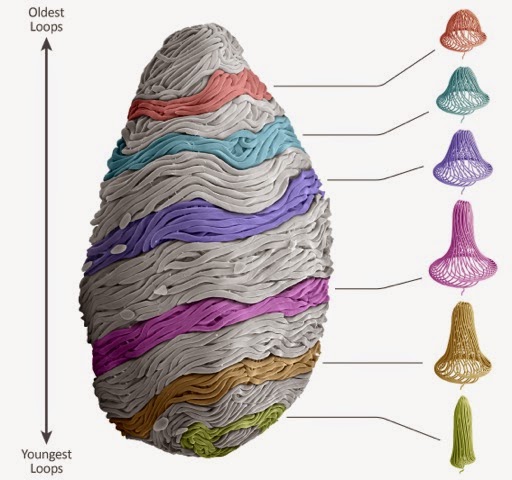
In self-defense the hagfish produces from its glands a slime that is composed of nanometer width threads and what is likely sugar or glyco-modifications.  The slime is thought to impede capture by making the hagfish slippery, and possibly by clogging the gills of a predator.  The nanothreads are remarkable: comparable to spider silk in tensile strength (800 megapascals or near 1 gigapascal) and lightness, and 5 times stronger than steel on a weight basis. Moreover, each thread is only 12 nanometers wide but 15 centimeters long.  Amazingly, a full thread is wrapped up in so that it fits within a single cell, highly specialized and called a gland thread cell (GTC).

Scientists have uncovered, using electron microscopy, the organization of a single hagfish nano-sized thread, helping resolve the mystery of why extrusion of such a long (compared to its width) thread from the cell does not cause tangling.  The thread is coiled up in a conical “skein” in 15-20 layers.  As a GTC matures, its nucleus migrates to an extreme pole, leaving most of the cell volume packed with a single coil of thread.

For a quantitative comparison, spider drag line silk has a tensile strength of up to 1100 megapascals, whereas hagfish thread goes up to 800 megapascals.  Steel has higher tensile strength up to 5000 megapascals but it is also much denser.  Two rather unusual materials more recently discovered, graphene and carbon nanotubes, have stratospheric tensile strengths of 63 and 130 gigapascals.

The research was carried out by PhD student Timothy Winegard, a team of scientists, and led by senior author Professor Douglas Fudge at the University of Guelph.
Here's a scanning EM of a disrupted thread cell (from the Journal of Cellular Biology):


And finally a video of a hagfish defending itself with slime:

29 Jan 15:25

Smart Pipe

by schneier
TimB

PERFECT

Pretty impressive surveillance-economy satire.

28 Jan 16:00

Volume II: Page 17

by aszabla
TimB

Have I shared this webcomic yet? The art is AMAZING. The story is just getting started, but so far it's also really engaging. Give it a whirl, see if you like it!

(Start from the beginning: http://bird-boy.com/comic/2010-09-6-promo-page/)

image

Happy New Year! Once again, an update from my phone, since I’m currently in southern AZ to look at some fiine rocks and cactuses. Enjoy the page! This was a fun one.