at home what do you have
a snack
Mahmoud:|

Syrian refugees who found their way to Canada have been placed in a hotel hosting a furry convention. Wonderfully surreal scenes of displaced kids dancing with fursuiters were captured on video and posted to YouTube. The New York Daily News described an "aww-inspiring" encounter. (more…)
MahmoudEven their polls PLUS forecast, not just the polls, Ben. It's got the plus.
Bernie Sanders made folks like me eat a stack of humble pie on Tuesday night. He won the Michigan primary over Hillary Clinton, 50 percent to 48 percent, when not a single poll taken over the last month had Clinton leading by less than 5 percentage points. In fact, many had her lead at 20 percentage points or higher. Sanders’s win in Michigan was one of the greatest upsets in modern political history.
Both the FiveThirtyEight polls-plus and polls-only forecast gave Clinton a greater than 99 percent chance of winning. That’s because polling averages for primaries, while inexact, are usually not 25 percentage points off. Indeed, my colleague Nate Silver went back and found that only one primary, the 1984 Democratic primary in New Hampshire, was even on the same scale as this upset. In that contest, the polling average had Walter Mondale beating Gary Hart by 17 percentage points, but it was Hart who won, with slightly more than 9 percentage points over Mondale.
Indeed, my initial thought was to compare the Sanders upset with Clinton’s over Barack Obama in the 2008 New Hampshire Democratic primary, but that undersells what happened Tuesday night. I was in New Hampshire when Clinton won in 2008 and sat in stunned disbelief — Obama lost by about 3 percentage points, when the polling average had him ahead by 8 percentage points. In other words, tonight’s error was more than double what occurred eight years ago.
The question I am asking myself now is whether this means the polls are off in other Midwestern states that are holding open primaries. I’m talking specifically about Illinois and Ohio, both of which vote next Tuesday. The FiveThirtyEight polling average in Illinois gives Clinton a 37 percentage point lead, while the average in Ohio gives her a 20 percentage point lead. If Michigan was just a fluke (which is possible), then tonight will be forgotten soon enough. If, however, pollsters are missing something more fundamental about the electorate, then the Ohio and Illinois primaries could be a lot closer than expected.
Either way, this result will send a shock wave through the press. Heck, I’m a member of the press, and you might be able to tell how surprised I am. This will likely lead to increased news coverage of the Democratic race, which Sanders desperately needs in order to be competitive next Tuesday and beyond.
Sanders must rack up big wins, and fast. Thanks to an 83 percent to 16 percent win in Mississippi, Clinton gained in the overall delegate count on Tuesday and leads Sanders by more than 200 pledged delegates. Her strong performance in Mississippi also put Sanders further behind his FiveThirtyEight delegate targets. That may not be as sexy as the tremendous upset in Michigan, but math is rarely sexy.
Sanders, however, can breathe a deep sigh of relief that all the states in the Deep South have already voted. He can hope that tonight’s Michigan win will help propel him to victory or at least make him more competitive in states with large delegate prizes left, like California, Florida, Illinois, New York, New Jersey, Ohio and Pennsylvania. We’ll see if it does.
Listen to the latest episode of the FiveThirtyEight elections podcast.

Wired: “Due to an oversight involving a haphazardly-installed Chrome extension during the editing process, the name Donald Trump was erroneously replaced with the phrase ‘Someone With Tiny Hands’ when this story originally published.”
The F-35 Joint Strike Fighter has run into yet another software bug, according to a report in IHS Jane's Defense Weekly.…
Mahmoudthis gag will never get old, will it? this is good because i can perpetuate my feeling that i could be an onion writer.


Mahmoudohhh yeaahhh
The KLF themselves, however, are absolute geniuses and I truly admire their commitment. First they published a book in 1988, The Manual (How to Have a Number One the Easy Way):
WE GUARANTEE THAT WE WILL REFUND THE COMPLETE PRICE OF THIS MANUAL IF YOU ARE UNABLE TO ACHIEVE A NUMBER ONE SINGLE IN THE OFFICIAL (GALLUP) U.K. CHARTS WITHIN THREE MONTHS OF THE PURCHASE OF THIS MANUAL AND ON CONDITION THAT YOU HAVE FULFILLED OUR INSTRUCTIONS TO THE LETTER. TO RECEIVE THIS GUARANTEE PLEASE WRITE TO KLF PUBLICATIONS, BOX 283, HP21 7HG, U.K. WITH YOUR NAME, ADDRESS AND A PHOTOCOPY OF YOUR PURCHASE RECEIPT AND AN S.A.E. YOU WlLL RECEIVE YOUR GUARANTEE WITHIN 28 DAYS. [...]Firstly, you must be skint and on the dole. Anybody with a proper job or tied up with full time education will not have the time to devote to see it through. Also, being on the dole gives you a clearer perspective on how much of society is run. If you are already a musician stop playing your instrument. Even better, sell the junk. It will become clearer later on but just take our word for it for the time being. Sitting around tinkering with the Portastudio or musical gear (either ancient or modern) just complicates and distracts you from the main objective. Even worse than being a musician is being a musician in a band. Real bands never get to Number One -- unless they are puppets.
It's really pretty amazing. But then they followed their own instructions, and got a number one single later that year. And then they did it again in 1990. And all of this was wrapped up inside a whole lot of Robert Anton Wilson Illuminatus mythological nonsense.
(If you're like me, you might assume that the unrelenting awfulness of their music was, in fact, part of the joke.)
Then they retired in 1992 with a wonderful table-flip mic-drop:
The KLF and crust punk group Extreme Noise Terror performed a live version of "3 a.m. Eternal" at the BRIT Awards, the British Phonographic Industry's annual awards show; a "violently antagonistic performance" in front of "a stunned music-business audience". Drummond and Cauty had planned to throw buckets of sheep's blood over the audience, but were prevented from doing so due to opposition from BBC lawyers and "hardcore vegans" Extreme Noise Terror. The performance was instead garnished by a limping, kilted, cigar-chomping Drummond firing blanks from an automatic weapon over the heads of the crowd. As the band left the stage, The KLF's promoter and narrator Scott Piering announced over the PA system that "The KLF have now left the music business". Later in the evening the band dumped a dead sheep with the message "I died for you -- bon appetit" tied around its waist at the entrance to one of the post-ceremony parties.Reactions were mixed.
And then in 1994 they withdrew the remaining £1M they had in the bank, and they set it on fire:
"If we had gone and spent the money on Rolls Royces and swimming pools, I don't think people would be upset. It's because we burnt it. [...] Seeing as you're talking about the charity angle: our burning that money doesn't mean there's any less loaves of bread in the world. Any less apples. Any less anything. The only thing there's less of, is a pile of paper.""But there could have been a little more. More bread, more apples."
"No. We didn't burn any loaves of bread. We didn't burn any apples. Those loaves of bread still exist. There's nothing less in the world."
People rarely commit like these fellows did. Slow clap.
Mahmoudpoor peter jackson, poor greg turkington
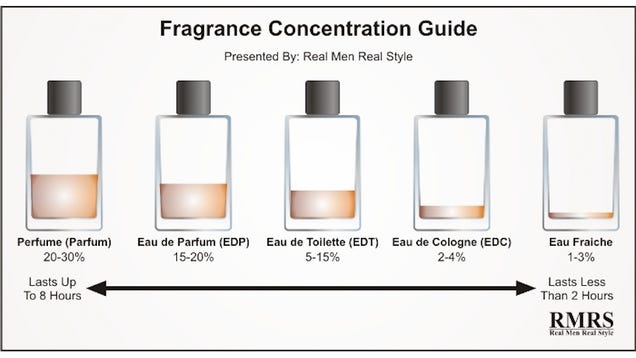
You might think that the difference between “perfume” and “cologne” is who the bottle is intended for, or which counter it’s sold at—the reality is a little more subtle than that. Simply, all fragrances are largely the same, but they’re given a name based on the concentration of oil in alcohol and water.


what has science given us beyond timekeeping devices, that when stopped, are far less accurate than their humble stone counterparts??
if you leave out all the things science has given us beyond that, you’re not left with much #flatearth
Mahmoudaccurate

my favorite episode is where they see a moonman but it’s not a moonman……..
Mahmoudftp
Mahmoudalbert einstein is trolling us from his avocado grave

Welcome to I Love Lists Friday! Let’s surf the internet together.
Recipes from the archives for your weekend adventures:
Books to Inspire:
Things that caught my eye:
The post I LOVE LISTS appeared first on Shutterbean.
Mahmoudgreat, now humans are taking goat jobs too, wow

MahmoudRIP
(FishCenter is like SportsCenter about a specific tank of fish, also with more photoshop.)
Mahmoudted cruz is right

The history of the world in famous people’s lifespans.
Mahmoudnobody needs to backdoor windows projects, they basically backdoor themselves.
 In other news, water is still wet.
Bill Gates has joined Donald Trump in condemning Apple for refusing to backdoor its products at the behest of the FBI, promising that the company that he founded, a waning firm called Microsoft, would happily compromise its security on demand for the US government.Though Microsoft's Bitlocker full-disk encryption was considered very secure at its launch, questions have since been raised about its integrity. The company was an early participant in the NSA's Prism program.
Update: Gates has issued a non-denial nonpology insisting that he stands behind his words, but he's still a good guy, so cut him some slack.
Mahmoudum, just wanted to point out, this post looks sexy as hell in this here feedreader.
In modern software development, a project isn't a project without a proper versioning scheme.
 Weak version management neglects clients like lack of source control
neglects collaborators. Dependency management and migration rely on
versions. Beyond the technical, a project's version bears a huge
impact on the perception of the project. It informs adoption and
entices users to upgrade. The version is attached to the name of the
project — appearing closer and more often than the names of the
maintainers. Versions are how a project builds a legacy.
Weak version management neglects clients like lack of source control
neglects collaborators. Dependency management and migration rely on
versions. Beyond the technical, a project's version bears a huge
impact on the perception of the project. It informs adoption and
entices users to upgrade. The version is attached to the name of the
project — appearing closer and more often than the names of the
maintainers. Versions are how a project builds a legacy.
So why do projects leave versioning to afterthought? What do clients expect and what do projects need?
Followup: This post culminated in the announcing CalVer and launching calver.org. This page provides a thorough background to the CalVer best practices.
Currently, the go-to versioning system for open-source software is referred to as Semantic Versioning, or SemVer.
Take a quick look at the
40 most recent updates on the Python Package Index
(PyPI). My glance showed all but six packages had the
comfortable three-part versioning scheme, major.minor.micro. Among
those packages the highest minor version was 108. The highest micro
version was all the way up to 595.
So, if SemVer is so popular, it must be easy, right? Follow a couple straightforward steps. Pick a number, add one to it. With arithmetic that simple, what could go wrong?
Everyone knows it's more exciting to announce 2.0 than 1.7.0, even if there's more user demand for the latter than the former. This is especially true with SemVer, because a SemVer major version change implies breaking the API.
As we will see, there are consequences to this. People judge value based on version number. SemVer supports this opaque apples-and-oranges comparison, punishing libraries that get it right on the first try, and encouraging libraries to break APIs to appear more mature and get that coveted 2.0.
More damaging than the fatuous 2.0 is the epidemic of Zeno's 1.0.
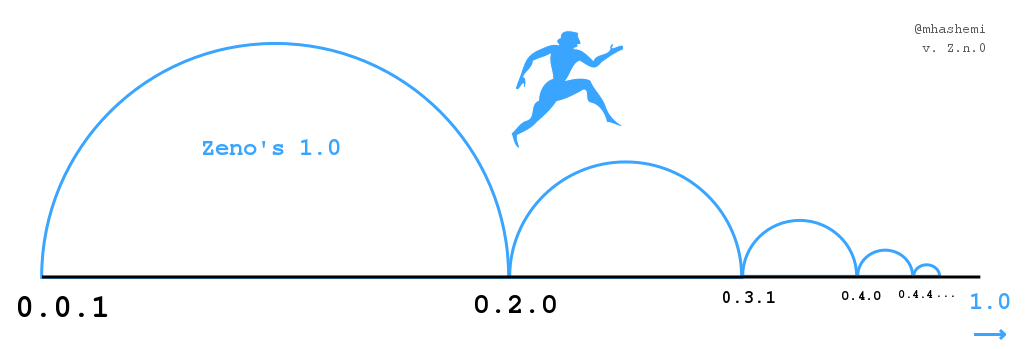
Witness the version, racing to numeric motionlessness. (Image based
on Martin Grandjean's.)
To quote the second answer in SemVer's own FAQ:
If your software is being used in production, it should probably already be 1.0.0. If you have a stable API on which users have come to depend, you should be 1.0.0. If you’re worrying a lot about backwards compatibility, you should probably already be 1.0.0.
On this count, SemVer might be found not guilty.2 If so, it's the SemVer users that didn't get the memo — myself included. Maybe if it had been in the spec itself.
The problem is the heavy emphasis on "public API" breakage. Conservative library authors end up indefinitely preferring the semantic power of 0.x: The ability to break APIs. Whether the cause is conservatism, humility, or misunderstanding, the effect is misrepresenting the release state of many major libraries.
A more practical scheme might help represent accurate versions for mature, production libraries like Cython (0.23) and SciPy (0.17), both of which have books and nearly a decade of release history still on PyPI.
Appealing to engineering aesthetics, SemVer is presented as a "specification". But, unlike the vast majority of successful RFCs, there is no validation or certification that can determine whether a project has a correct implementation. Yes, if a project API changes, but the major version is not incremented, the SemVer specification has been violated. But there's no way to test that generally, and no one does it specifically.
SemVer is a detailed suggestion. Software breaks as quickly as SemVer's promise. The remediations do not happen. Better to embrace the realities of versioning, rather than argue over the MUSTs and MUST NOTs of an unenforceable specification.
Let's take a brief moment to reconsider the humble version.
We encounter far more software than we write. Few, if any, expect compliance with all the suggestions in SemVer. So what do we expect from our versions?
There are three main expectations driving modern software versioning:
The later the release, the greater the version. Sofware should not change without a version change, and the version must go up, and never come down.
A project name communicates an ideal. The project version communicates current progress toward that ideal. Vision pursued by version: The greater the version, the greater the software.
Here's where things get hairy. Numeric versions are the default, but non-numeric versions and version components abound.
Version vernacular is now thoroughly mainstream: "alpha", "beta", "dev", "nightly", "stable", and so on. There are also named project versions, like those used in Linux distributions, such as Debian's "jessie", Ubuntu's "trusty", and Windows' "longhorn". Non-numeric versions are often hijacked for branding purposes. Numerical versions' technical utility is much more important to preserve.
We take our version expectations for granted, but a convention this fundamental has profound effects at scale. As mentioned above, higher versions are expected to be better, especially within a project. But there is at least one case where this impact very publically spilled out across projects: The Chrome-Firefox Version Wars.
When Google Chrome entered the browser race, it brought with it a fast feature release schedule and a versioning system to match. This versioning system had Chrome see a dozen major releases while Firefox was still 3.x. Firefox looked like it was being left in the dust, despite the fact that Chrome was less mature and, as anyone who used it at the time can attest, Chrome 4 wasn't half the browser Firefox 4 ended up being.
After a couple years of this onslaught, Firefox switched its versioning system to match. Now, despite browsing for hours a day, few users or even developers could tell you off the top of their heads what version of Firefox/Chrome they use.3
SemVer ignored this huge precedent, harshly judging fast-moving projects. Let's call that our last straw and look at an alternative.
 If you're an earnest engineer with honest intents of creating,
releasing, and maintaining a project, then calendar versioning may be
for you. CalVer fulfills all of
the versioning expectations, so what
advantages does it bring?
If you're an earnest engineer with honest intents of creating,
releasing, and maintaining a project, then calendar versioning may be
for you. CalVer fulfills all of
the versioning expectations, so what
advantages does it bring?
People are calendar-oriented. Practically, it's just easier to remember that a library was causing a live issue back in 2013 than it is to remember that up until version 1.6.18 that library had a lot of bugs.
Furthermore, in long-term development, releases pile up and increasingly large major versions blur together. Browser versions have been rendered meaningless. But the calendar is one construct where numbers increase and cycle regularly. Leveraging that natural understanding anchors otherwise arbitrary versions.
Ironically yes.
"Semantic" Versioning is all relative. One developer's 1.0.0 is another's 0.0.1alpha. As authors, we try to ignore this and write others off as wrong. But as clients, we make snap judgments, and SemVer lets us forget and pretend. Calendar versioning is absolute and neutral, with practical advantages to boot.
As application developers adding functionality, evaluating a new library means ascertaining maintenance status, usually by looking at the most recent release date. CalVer puts us in the ballpark right away. As maintainers depending on many libraries, calendar versioning allows us to look at the dependency list and quickly ascertain which libraries are good candidates for updating. CalVer even lets us take that a step further, with date-based deprecation.
Many might not realize it, but the oh-so ubiquitous Ubuntu
is in fact calendar versioned. For example, version 15.04 came out in
April, 2015. It gets better when you remember Long-Term
Support. Ubuntu's LTS support lasts for five years. So, 14 + 5:
Ubuntu 14.04's end of life will be in 2019. You don't have to look
anything up. It's all right there in the CalVer semantics.4
If you care about the future of the project, then guard it against one of the worst fates: the fatuous 2.0. Give your project a future. Guard against the learned expectation of 2.0 or death.
A 1.x always carries one advantage over a 2.0: the code is deployed and working. Avoid contempt for past decisions and current users. In engineering, utility is half of correctness.
SemVer is set up so that every major release implies a minimum threshold of change. If the project is founded on and aiming for correctness, fewer and fewer changes are required. Donald Knuth embraced this in the extreme by having TeX's version approach π asymptotically. Suffice to say with CalVer, you are safe to add as much or as little functionality as needed.
Too often projects become a victim of versioning. New projects end up masquerading as new versions. D3 could have been Protovis 2.0, but instead, a successor was created. Both projects coexisted and we are all the better for it. Same with characteristic and attrs. Successors and CalVer protect projects and do justice by clients and code.
Consider adding a calendar component to your next library's versioning schemes. As for my opinion, I've joined other maintainers in doing so for boltons and ashes. I've found it makes a lot of sense for libraries, and a little less sense for protocols and services.5
Either way, think about project versions. The version is part of your project's face and your clients' integration. After spending days, weeks, and months on a project, it's worthwhile to spend a few minutes or hours designing a versioning system tailored to the needs of project users and maintainers.
If you're into enterprise software considerations like these, subscribe or follow me on Twitter for some details about my upcoming O'Reilly project.
Astute readers will note that it's Semantic Versioning 2.0.0. "Oh, cute, Tom used his own scheme for the document." But did you wonder what public API changed to trigger that major version bump? SemVer's public API has been semver.org since before 1.0. How about those semantics? ↩
I've actually been saying something similar, but more practical, for a long time:
If both you (or your team) and a stranger (someone not directly advised) are both using a library in a production environment, the time for a major version has come.
If it's just you and yours, that's understandable. Many great scientists took great risks with themselves for the sake of progress. If it's just a stranger going against your explicit advice, then there's no accounting for such wildcards. But, if both of groups are using something in production, then it's time to face the facts. Tie up the loosest of ends and give it a major version. ↩
Here are some more resources for those interested in the Firefox release switch up:
At the very least this should illustrate that versions matter. They're part of your project's identity. Design them to help your user. ↩
To illustrate the prevalence, there are actually many other examples of calendar versioning we take for granted. Off the top of my head I could think of Twisted, Windows 95/98/2000, and probably most ubiquitous: every mainstream car in circulation. Email me with more examples and I'll compile them somewhere. ↩
To illustrate, if I could have it my way, we'd have OpenSSL 16.x.x. That way I can easily complain if I find someone using 10.x.x in production. That said, TLS/1.3 seems better than TLS/16.0.
My current thought is that protocols live outside of time, because I believe it's possible to complete a protocol, but an implementation is never done. ↩
Mahmoudtimes are crazy
 Russia requested permission on Monday to fly a surveillance plane equipped with an advanced electro-optical imaging sensor over the US, despite objections from American officials. Both the US and Russia are signatories on the Open Skies Treaty, an in...

“and this one is in the shape of the word ‘gamer,’ and bios starts up with a shotgun noise, a chainsaw noise, and a sexy moan. you can disable the shotgun noise though”
Stick around until 2:00 to witness the ritual Sharpening of the Toecutters.