Shared posts

02 Feb 18:14

The Supreme Court’s new death penalty order should make your skin crawl

by Ian Millhiser
A close-up on the straps on a bed that will hold a prisoner receiving a lethal injection.
A lethal injection death chamber in Texas. | Paul Harris/Getty Images

The Court’s new death penalty order is almost too cruel to be believed.

Hamm v. Reeves, a death penalty order that the Supreme Court handed down Thursday night, is an epilogue to a longstanding tension between drug companies that do not wish their products to be used to kill people, and states that are willing to use unreliable drugs to conduct executions if effective sedatives are not available.

It’s also unsettlingly cruel.

The upshot of the Court’s 5-4 decision in Hamm is that a man was executed using a method that may have caused him excruciating pain, most likely because that man’s disability prevented him from understanding how to opt in to a less painful method of execution.

There is significant evidence that Matthew Reeves, a man convicted of murder that the state of Alabama executed after the Supreme Court permitted it to do so on Thursday, had an intellectual disability. Among other things, as Justice Sonia Sotomayor noted in a 2021 dissenting opinion, an expert employed by the state gave Reeves an IQ test and determined that “Reeves’ IQ was well within the range for intellectual disability.”

The Supreme Court held in Atkins v. Virginia (2002) that “death is not a suitable punishment” for someone with an intellectual disability. Nevertheless, in its 2021 decision in Dunn v. Reeves, the Supreme Court voted along party lines to effectively prevent Reeves from avoiding execution.

The issue in Hamm, the decision that the Court handed down Thursday night, is quite narrow. After Dunn, it was no longer a question of whether Alabama could execute Reeves. The only question was how Alabama could conduct this execution — and whether the state was allowed to use a method that may very well amount to torture, even over Reeves’s objection.

This time the Court split 5-4, with Justice Amy Coney Barrett crossing over to vote with the three liberal justices. But, in a Court with a 6-3 Republican supermajority, Barrett’s vote was not enough to save Reeves from the fate that Alabama chose for him. He was executed by lethal injection.

The Supreme Court’s decisions impose a terrible burden on death row inmates and their lawyers

Many states used to use a three-drug combination to execute people on death row. First, the inmate would be injected with sodium thiopental, an anesthetic that was supposed to prevent the inmate from feeling the effects of the drugs that would kill them. The inmate would then be injected with a paralytic drug, and finally with a lethal drug that would stop their heart.

But supplies of sodium thiopental dried up, at least for executioners, around 2010 — in part because pharmaceutical companies refused to sell the drug for use in executions, and in part because the European Union forbids companies from exporting drugs for such a purpose. As a result, some states turned to less reliable sedatives.

The result was botched executions, where inmates were visibly in excruciating pain during their executions. As Sotomayor wrote in a 2015 dissenting opinion, these unreliable execution drugs leave death row inmates “exposed to what may well be the chemical equivalent of being burned at the stake.”

But the Supreme Court’s Republican majority has not shown much sympathy for inmates who ask not to be tortured to death. Among other things, the Court has held that an inmate who objects to one form of execution must suggest an alternative method or their objection will fail. As Justice Neil Gorsuch wrote for the Court in Bucklew v. Precythe (2019), “a prisoner must show a feasible and readily implemented alternative method of execution that would significantly reduce a substantial risk of severe pain and that the State has refused to adopt without a legitimate penological reason.”

Meanwhile, some states have responded to these developments by authorizing new methods of execution. South Carolina, for example, recently enacted a law making electrocution the default method of execution in that state, and also permitting some inmates to be executed by firing squad.

Alabama, meanwhile, passed a law that nominally allows people on death row to choose a method of execution other than lethal injection, but only if they act within a very short window of time. As Justice Elena Kagan describes this Alabama law in her dissenting opinion in Hamm, “a recently enacted state law gave those inmates one month to select execution by nitrogen hypoxia” — where the inmate is placed in a gas chamber filled with nitrogen gas and asphyxiated — “rather than lethal injection.”

Many experts believe that nitrogen hypoxia is much less painful than lethal injection, especially if the state does not have access to reliable anesthetics. Although, for obvious reasons, it’s impossible to conduct an ethical experiment on actual people to determine if one method of killing is less painful than others.

The specific legal issue in Hamm concerns the paper form that the state gave inmates, which allowed them to choose nitrogen hypoxia over lethal injection. As Kagan notes, “the form was written in legalese, and according to unrebutted evidence, an inmate needed at least an 11th-grade reading level to understand it.” But Reeves had “cognitive limitations.” He had “the same reading ability as an elementary-school child,” and “one expert testified that Reeves’s ‘reading comprehension was at the 1st grade level.’”

A lower court determined that, under the Americans With Disabilities Act, the state needed to help Reeves understand the form before he could be executed. But five justices, in a two-sentence order that offers no explanation whatsoever of why they reached this decision, permitted Alabama to move forward with the execution — and to do so using lethal injection.

If you’ve read this far, your skin is probably crawling right now

The Eighth Amendment is supposed to prohibit “cruel and unusual punishments.” But the Court has held that the death penalty enjoys a kind of super-constitutional status that requires executions to move forward, even if there is no way to conduct them humanely.

This was the holding of Glossip v. Gross (2015), one of several Supreme Court decisions confronting the shortage of reliable anesthetics for use in executions. “Because it is settled that capital punishment is constitutional,” Justice Samuel Alito wrote for the Court in Glossip, “it necessarily follows that there must be a [constitutional] means of carrying it out.” (The name of the logical fallacy on display in Alito’s opinion is “begging the question.”)

So if the only available method of killing a death row inmate is “the chemical equivalent of being burned at the stake,” Glossip’s response to this dilemma is to allow the execution to happen anyway.

Several justices, moreover, have indicated that they have a different, more personal reason for denying relief to death row inmates. As an execution draws nigh, lawyers representing the inmate typically file a flurry of motions seeking to save their client’s life — or, at least, to make the execution less painful. Often, this last-minute litigation involves issues that neither the lawyers nor the client could reasonably have known about in advance. In one case, for example, a prison did not inform an inmate about key details of its execution policy until about two weeks before his execution.

But many of the justices appear quite bothered by the fact that they need to decide these last-minute appeals, which may arrive at the Court on a night when a justice has other plans. In Bucklew, Gorsuch complained that “last-minute stays should be the extreme exception,” and he claimed that death row inmates and their lawyers are engaged in “manipulation” of the system.

More recently, during an oral argument concerning the religious liberties of death row inmates, several justices complained that, if the Court honored the particular application of the First Amendment rights of the inmate in that case, it would open the floodgates to future litigation seeking to vindicate similar rights. As Justice Brett Kavanaugh complained to the inmate’s lawyer, “if we rule in your favor in this case, this will be a heavy part of our docket for years to come.”

One might think that, given the gravity of killing another human being, the courts should pay special attention to death penalty cases — if for no other reason than because an execution can never be reversed if a court later discovers that it was unlawful or unjustified. But that is not the attitude of this Supreme Court.

02 Feb 13:56

A new Supreme Court case could make it nearly impossible to stop racial gerrymanders

by Ian Millhiser
People hold signs representing legislative districts as they protest against gerrymandering in front of the Supreme Court in March 2019. | Evelyn Hockstein/Washington Post via Getty Images

The Court takes up its first big redistricting case since Republicans gained a 6-3 supermajority. What could go wrong?

The Supreme Court is likely to hand down a decision soon in Merrill v. Milligan, a case where the worst-case scenario for democracy would neutralize one of the few remaining prongs of the Voting Rights Act that the Court has not yet dismantled.

The case concerns Alabama’s new congressional districts, and whether they violate the Voting Rights Act’s prohibitions on racial gerrymanders. Days before the state of Alabama asked the justices to carve another chunk out of America’s voting rights laws, a three-judge panel ordered the state of Alabama to redraw its congressional maps. Notably, two of the judges on this panel were appointed by former President Donald Trump.

Among other things, the panel’s opinion in Singleton v. Merrill explains that Black Americans make up about 27 percent of Alabama’s population, but they would only have a real shot of electing their candidate of choice in one of the state’s seven congressional districts under the new map based on the 2020 census. Thus, while Black Alabamans represent more than a quarter of the state’s population, they only control 14 percent of the state’s congressional delegation.

The lower court ordered the state legislature to redraw the map, relying on a provision of the Voting Rights Act banning racial gerrymanders. To reach that decision, the three judges spent 225 pages walking through the exceedingly complicated test announced in Thornburg v. Gingles (1986), which asks whether a state election law that imposes a disproportionate burden on racial minorities “interacts with social and historical conditions to cause an inequality in the opportunities enjoyed by [minority] and white voters to elect their preferred representatives.”

As I’ve written, the legal rule that the Court announced in Gingles — which governs many redistricting cases filed under the Voting Rights Act — is a mess. It advises courts to weigh at least nine different factors. And it would be reasonable for a state to ask the Supreme Court to come up with something less unwieldy to help lower courts sort through these sorts of cases. Alabama could have gone this route, and if it had proposed a reasonable modification to the Gingles test, it’s possible that such a modification could have helped them defend their maps.

But Alabama does nothing of the sort in the Merrill case. Instead, it proposes a new rule that, if adopted by the Supreme Court, could effectively make it impossible to challenge a racial gerrymander in federal court.

At one point, for example, Alabama quotes favorably from a 1994 opinion by Justice Clarence Thomas, which was joined only by one other justice, and which suggests that no voting rights violation occurs even if a state gerrymanders its districts to make it impossible for racial minorities to elect their preferred candidate. Under this theory, “minorities unable to control elected posts would not be considered essentially without a vote; rather, a vote duly cast and counted would be deemed just as ‘effective’ as any other.”

The state’s primary argument, meanwhile, would trap voting rights plaintiffs in a kind of Catch-22.

Alabama’s arguments could impose an impossible burden of proof on voting rights plaintiffs

The Merrill case is actually two separate lawsuits, one brought by a group of plaintiffs led by Democratic state Sen. Bobby Singleton, and another brought by a group of voters and organizations that includes the Alabama State Conference of the NAACP.

The crux of the plaintiffs’ arguments in Merrill is that Alabama should have two congressional districts, instead of just one, where Black voters can elect their preferred candidate. Before such a lawsuit can proceed, however, Cooper v. Harris (2017) requires these plaintiffs to prove that it is actually possible to draw two such districts without having to rely on ugly, misshapen districts that could stretch across much of the state.

Under Cooper, the Merrill plaintiffs must show that Black Alabamans are a “sufficiently large and geographically compact” group that it is actually possible to draw two districts where they “constitute a majority.” If these plaintiffs cannot make such a demonstration, then their lawsuit will fail before a court even considers many of the more complicated questions demanded by the Supreme Court’s opinion in Gingles.

To overcome this initial burden, two different sets of plaintiffs hired separate experts. One group of plaintiffs, for example, hired Moon Duchin, a mathematics professor at Tufts University, who produced four separate maps with two Black-majority districts.

 US District Court for the Northern District of Alabama
Four maps produced by mathematician Moon Duchin show how Black-majority congressional districts could be drawn in Alabama.

Again, the purpose of these maps is limited. The state is not required to adopt any of these four maps. Indeed, the lower court explicitly stated that, should it determine that Alabama’s existing maps are illegal, and that a new redistricting plan must be drawn, “Supreme Court precedent also dictates that the Alabama Legislature ... should have the first opportunity to draw that plan.”

Rather, the purpose of these sample maps was just to show that it’s actually possible to draw two majority-Black districts that are reasonably compact.

Alabama’s brief to the Supreme Court, however, faults the Merrill plaintiffs for paying too much attention to race when they produced the sample maps demonstrating it is possible to draw two compact, majority-Black districts. To produce these maps, the state claims, the plaintiffs “must necessarily prioritize race first and consider other race-neutral factors second.” Alabama claims that map-makers must be absolutely forbidden from giving such a priority to racial concerns — even if they only do so to produce hypothetical maps which prove it is theoretically possible to draw two Black-majority districts.

It’s a stunning argument. Again, Cooper effectively requires these plaintiffs to produce sample maps where at least two districts have Black majorities. How is that even possible unless whoever produces these sample maps prioritizes race while drawing them? It’s like asking an artist to draw a picture of an elephant without ever permitting them to look at an elephant.

Indeed, if Alabama’s proposed rule were adopted by the Supreme Court, it’s unclear whether any similar racial gerrymandering lawsuit could prevail — or even get past the threshold of inquiry demanded by Cooper.

The Supreme Court has been systematically dismantling voting rights

Merrill involves a particular kind of racial gerrymandering suit, which permits voting rights plaintiffs to challenge such a gerrymander even if they cannot prove that the lawmakers who drew the maps acted with racist intent. If the Supreme Court adopts the bar proposed by Alabama — one potentially impossible to overcome — a voting rights plaintiff might still prevail if they can show that a map was enacted with a racist purpose.

Except that, in Abbott v. Perez (2018), the Supreme Court required voting rights plaintiffs alleging invidious intent to overcome such a high burden of proof that it is virtually impossible for them to prevail. Under Perez, lawmakers enjoy such a strong presumption of racial innocence that only the most egregious displays of racism are vulnerable to lawsuits.

Similarly, in Shelby County v. Holder (2013), the Supreme Court effectively eliminated a practice known as “preclearance,” which required states with a history of racist voting practices — including Alabama — to submit any new election rules for review by officials in Washington, DC, before those new rules could take effect.

The Court, in other words, appears to be systematically dismantling the law’s safeguards against racism in elections. Merrill could continue that project — indeed, it could accelerate it, since this will be the first major redistricting case heard by the Court’s new 6-3 Republican supermajority — and make it much easier for states to draw racially discriminatory legislative districts.

02 Feb 13:51

Tesla recalls 53,822 cars because they won’t stop at stop signs

by Jonathan M. Gitlin
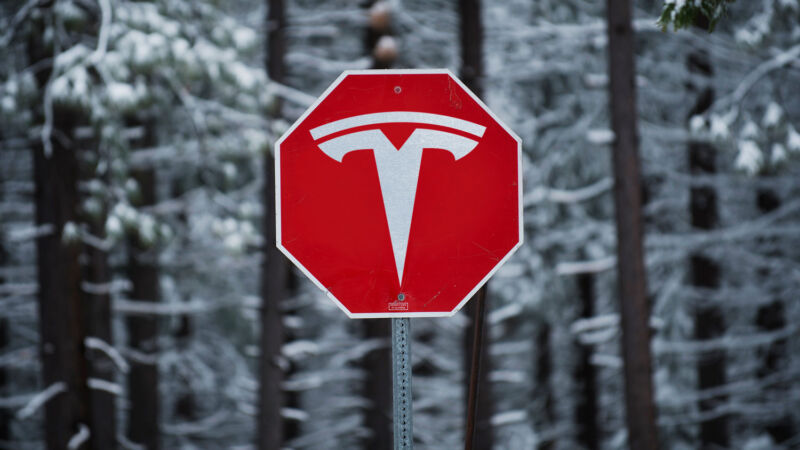
Tesla recalls 53,822 cars because they won’t stop at stop signs

Enlarge (credit: Aurich Lawson | Getty Images)

Tesla's controversial hands-free driver-assistance system is the subject of yet another safety recall. In November, the automaker had to recall nearly 12,000 cars after a software update affected some of the cars' forward-looking safety systems. Now, Tesla wants to recall 53,822 cars to remove a "rolling stop" feature that flouts traffic laws.

The issue affects Models 3, Y, S, and X running firmware 2020.40.4.10 or newer and participating in the "full self-driving" beta program. This software allows selectable moods for the car's driving style—chill, average, and assertive. And it's the last of those that's the problem.

In assertive mode, if a Tesla approaches a four-way stop intersection at less than 5.6 mph (9 km/h) and it detects no other road users or pedestrians near the intersection, it will carry on traveling at that speed instead of coming to a complete stop at the stop sign.

Read 3 remaining paragraphs | Comments

01 Feb 12:45

Omicron may have FDA rethinking vaccine strategy for kids under 5 [Updated]

by Beth Mole
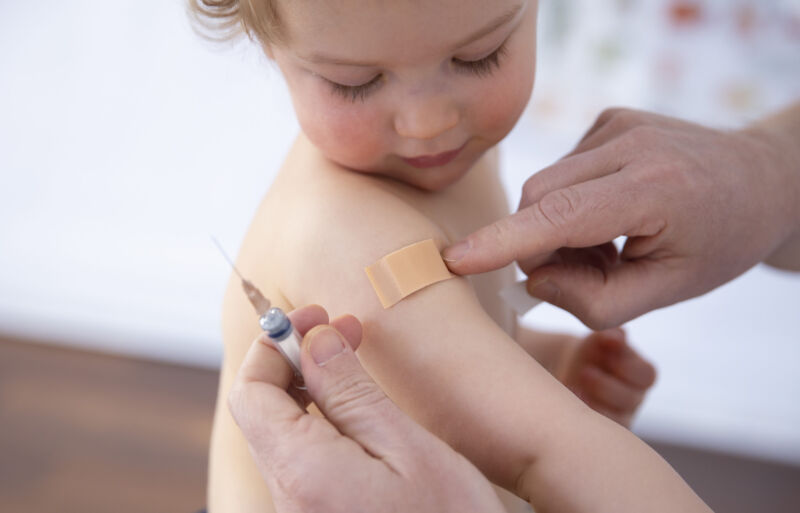
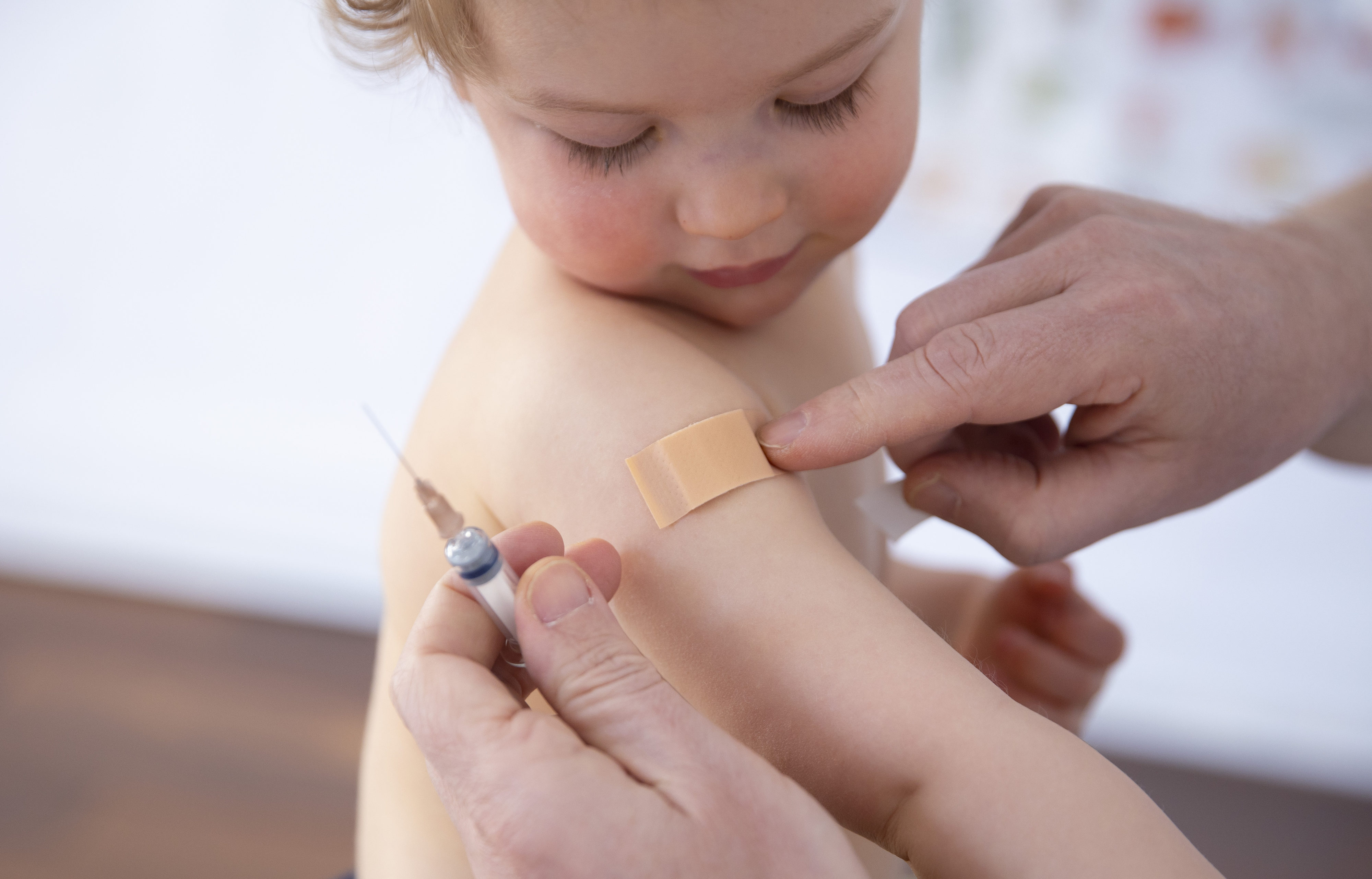
A small person looks at the band-aid being applied to their arm.

Enlarge / A child getting a vaccination on February 19, 2021, in Bonn, Germany. (credit: Getty | Ute Grabowsky)

Update 1/31/2022, 10:15pm ET: Pfizer and its partner BioNTech are expected to submit a request to the Food and Drug Administration as early as Tuesday, February 1, for emergency authorization of a two-dose COVID-19 vaccine for children ages 6 months to 4 years, according to officials familiar with the situation who spoke with The Washington Post and The New York Times. According to the Post, FDA officials encouraged Pfizer and BioNTech to submit the request and data in hopes of authorizing the two doses as early as the end of February. Meanwhile, the companies will continue to collect data on a third dose for the age group.

The original story follows.

Original story 1/31/2022, 5:21pm ET: The Food and Drug Administration may be reconsidering its criteria for authorizing COVID-19 vaccine doses for children under age 5, according to Scott Gottlieb, a former FDA commissioner and a current board member of vaccine-maker Pfizer. This opens the possibility that vaccine-ineligible youngsters could get protection from severe COVID-19 sooner than anticipated.

Read 8 remaining paragraphs | Comments

01 Feb 12:44

Of course pre-K and cash help kids … right?

by Dylan Matthews
Prekindergarten children color worksheets in class. | Astrid Riecken for the Washington Post via Getty Images

What one study finding pre-K harms kids, and another finding cash can change their brains, can tell us about public policy.

A team of neuroscientists and social scientists released a study on Monday finding that monthly cash payments of $333 to parents changed their infant children’s brain development. I wrote positively about it, as did the great Jason DeParle at the New York Times.

The main response I saw to the story on Twitter was some combination of “duh” and “we shouldn’t need this.” One science journalist sneered, “I think the NYT just discovered social determinants.” A historian wrote, “Something’s seriously wrong when we need brain scans to argue that moms and their kids shouldn’t live in poverty.”

Then I saw another study released around the same time, suggesting that universal pre-K in Tennessee led to worse academic outcomes and increased aggression and misbehavior once kids were in middle school.

The first lesson from these two studies is that very few questions in social science have obvious answers. Running a neurological experiment on the effects of cash isn’t inherently disrespectful to poor mothers or a waste of energy; it can uncover useful, surprising information.

My other takeaway is that child development is especially tricky to research, and focusing on just one study (which is something I and other journalists have certainly been guilty of) can lead you astray.

What the hell happened with Tennessee pre-K?

The pre-K study was conducted by researchers at Vanderbilt University and looks at Tennessee Voluntary Pre-K, or TN-VPK, which has existed in some form since 1996 and offers many 3- and 4-year-olds free access to pre-K services. The actual pre-K sites were often oversubscribed, and had to resort to random lotteries to pick enrollees. The researchers exploited that feature to track students who were randomly able to enroll in pre-K in 2009 and 2010, and compare them to students who, by random chance, couldn’t enroll.

In prior work, summarized here, the same authors found that kids who got into pre-K outperformed ones who didn’t on intelligence tests — when they were 5. By the end of kindergarten, however, the benefits seemed to evaporate and by third grade, the pre-K kids were actually doing worse, with lower test scores in math and science.

The new study follows the same children through sixth grade, adding three more years of data. The upshot? the results just keep getting worse. Reading, writing, and science scores in sixth grade were all lower among pre-K kids than other kids, and the gap has grown since third grade. The researchers also found that pre-K kids were likelier to skip school or get into disciplinary trouble as they got older.

Why? They don’t really know. The answer might depend on what the students who weren’t in the pre-K program were doing. The authors report that 63 percent were at home with a parent, relative, or other caretakers, and 34 percent were in private day care or Head Start. So you can read the study as suggesting that being home with a parent, grandparent, or nanny is better than going to pre-K; or maybe what’s going on is that Head Start and private care are better for kids than the Tennessee program. It’s hard to say.

But this isn’t just one study. Research into Quebec’s day care program found long-run negative effects on kids’ behavior, including increased crime. The idea that certain forms of pre-K or child care can harm kids has significant empirical support.

This stuff is complicated!

So, what’s my point? It’s not that we should just abandon pre-K as a concept. As Kelsey Piper has written for Future Perfect, you have to weigh any effects on kids alongside benefits for parents, who are less stressed and more able to work with pre-K. Several studies, including ones on the Quebec program that had negative effects on kids, find that pre-K and child care programs make mothers likelier to return to the workforce.

And less stressed, working parents could mean better-off kids in the very long run, even if that doesn’t show up in test scores.

My point, simply, is that some center-left folks, like those I cited complaining about the baby brain study above, have a tendency to assume that spending more on nice-sounding things, like pre-K and cash transfers, is obviously good, and that we don’t need any more evidence.

I think that’s dangerously wrong. And I think the discussion around the baby brain study helps illustrate why. After the study’s first release, commentators like Columbia statistician Andrew Gelman, King’s College London psychologist Stuart Ritchie, and psychiatrist/writer Scott Alexander raised a number of statistical questions poking holes in the finding of an effect on brain waves. Brain imaging is often noisy, Alexander noted, which can lead to spurious findings of effects. Some of the effects on specific brain waves weren’t statistically significant, Ritchie noted. It’s possible that brain scans will show some effect due to random chance even if there is no underlying effect, as Gelman illustrated with randomized simulations.

One possible response to these critiques is to stick your fingers in your ears and declare that the effect has to be there — or that the policy goal, in these cases of alleviating some of the effects of poverty, is so important that it’s a waste of time to keep looking for evidence. But I think the best response is to take the critiques seriously and allow them to inform your view on the science and the policy.

My own view is that the brain study itself slightly increased my confidence that cash transfers can help child brain development. The critiques reduced my confidence in turn, but the other effects of cash, like lower poverty and potentially lower hunger, are important enough that I still strongly support giving cash to parents. That kind of holistic analysis, I think, is healthy. Denial of evidence pointing against your viewpoint isn’t.

Similarly, the research on pre-K helps me think about how Democrats should prioritize Joe Biden’s universal pre-K proposal versus reviving the expanded child tax credit. The evidence that giving cash to parents helps them and their children seems stronger than the evidence that funding pre-K does — so if we have limited funds, the former seems like better policy (especially because the cash can be used for day care or pre-K, potentially getting more Republican support than just subsidizing the latter). Even without drawing an extreme conclusion like “pre-K is bad for kids in all cases,” the research helps us think through difficult policy problems.

The question of how to help young kids and their parents is really, really hard. Doing more research isn’t repeating the obvious; it’s a necessary and vital part of getting basic questions on how to help kids right.

28 Jan 23:14

Spotify support buckles under complaints from angry Neil Young fans

by Tim De Chant
Neil Young's fans aren't happy that the rocker's music is no longer available on Spotify.

Enlarge / Neil Young's fans aren't happy that the rocker's music is no longer available on Spotify. (credit: Dave J Hogan/Getty Images)

Neil Young was mad. Now his fans are, too, and they’re telling Spotify about it.

Earlier this week, Young had asked the music-streaming service to remove his music from its library in response to COVID misinformation aired on Joe Rogan’s podcast, which is available only on Spotify. “I want you to let Spotify know immediately TODAY that I want all my music off their platform,” Young wrote on his website. “They can have Rogan or Young. Not both.”

Spotify complied with the request, which ultimately came from Warner Brothers, Young’s label. Though the loss of Young’s music likely represents a small percentage of overall streams on Spotify, Young pointed out that “Spotify represents 60% of the streaming of my music to listeners around the world.” 

Read 6 remaining paragraphs | Comments

28 Jan 18:31

Because The Defense Department's Secure Communications Options Don't Work For Everyone, Soldiers Are Turning To Signal And WhatsApp

by Tim Cushing

The military has an obvious need for secure communications. It offered its support of encryption even as the NSA tried to find ways to undercut to make its surveillance ends easier to achieve.

The problem is the military doesn't have a great plan for securing communications between personnel. Due to tech limitations the Defense Department has yet to overcome (despite billions in annual funding), soldiers are turning to third-party messaging services to communicate orders and disseminate information.

The use of the encrypted messaging app Signal is ubiquitous within the Department of Defense. Service members have received briefings about operational security (OPSEC) and information security (INFOSEC) and have taken the dangers of living in a digital world seriously by making sure that the work-related text messages they send on their cell phones are encrypted. The contradiction is that using Signal for official military business is against regulations.

Securing communications apparently means breaking the rules. The DoD forbids the use of non-DoD-controlled messaging services to handle the distribution of nonpublic DoD information. The Defense Department insists personnel use its services, but those services can't be accessed by employees who don't have military-issued cell phones. And everyone has a cell phone, so it's often easier to use third-party platforms to communicate.

When this happens, it raises the risk that unauthorized access or sharing of information could occur. It also puts many communications beyond the reach of public records requests, which often cannot access communications between privately owned devices.

And there appears to be no fix on the immediate horizon. The Defense Department is quick to point out the use of Signal and WhatsApp violates regulations. But it has nothing in place that would allow the many military members not in possession of government-issued cell phones to communicate when out in the field.

This is what the Secretary of Defense's Public Affairs Officer (Russell Goemaere) told Audacy when asked about how military members were expected to use DoD-approved communications platforms they didn't actually have access to on their personal devices.

"DoD365 provides a messaging capability that is approved for CUI and use on DoD mobile devices. The Services are in the final stages of testing Bring Your Own Approved Device (BYOAD) and Bring Your Own Device (BYOD) solutions that provide access to the DoD365 collaboration capability on service member's personal devices," Goemaere said.

It's 2022 and the Defense Department is only at the "final stage of testing" for solutions it needed years ago. Cell phone usage has been ubiquitous for nearly two decades at this point. For the Department to still be weeks or months away from a solution should be considered unacceptable. Denying soldiers access to third-party options means cutting them off from communications that can often have life-or-death implications.

This also means the Defense Department is still weeks or months away from ensuring communications subject to FOIA law are being captured and retained. The priority should still be personnel safety, but this is another downside of the Defense Department's slow roll into the 21st century.

28 Jan 12:36

Omicron-specific vaccine boosters are now in humans as trials begin

by Beth Mole
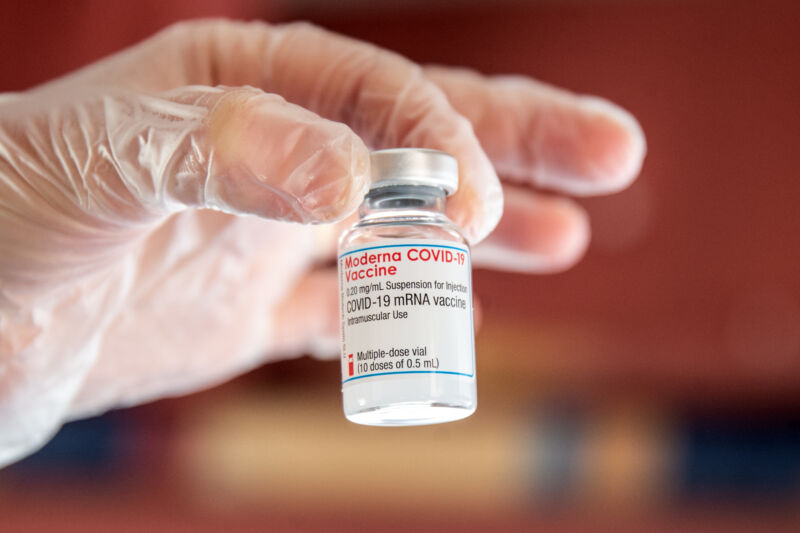
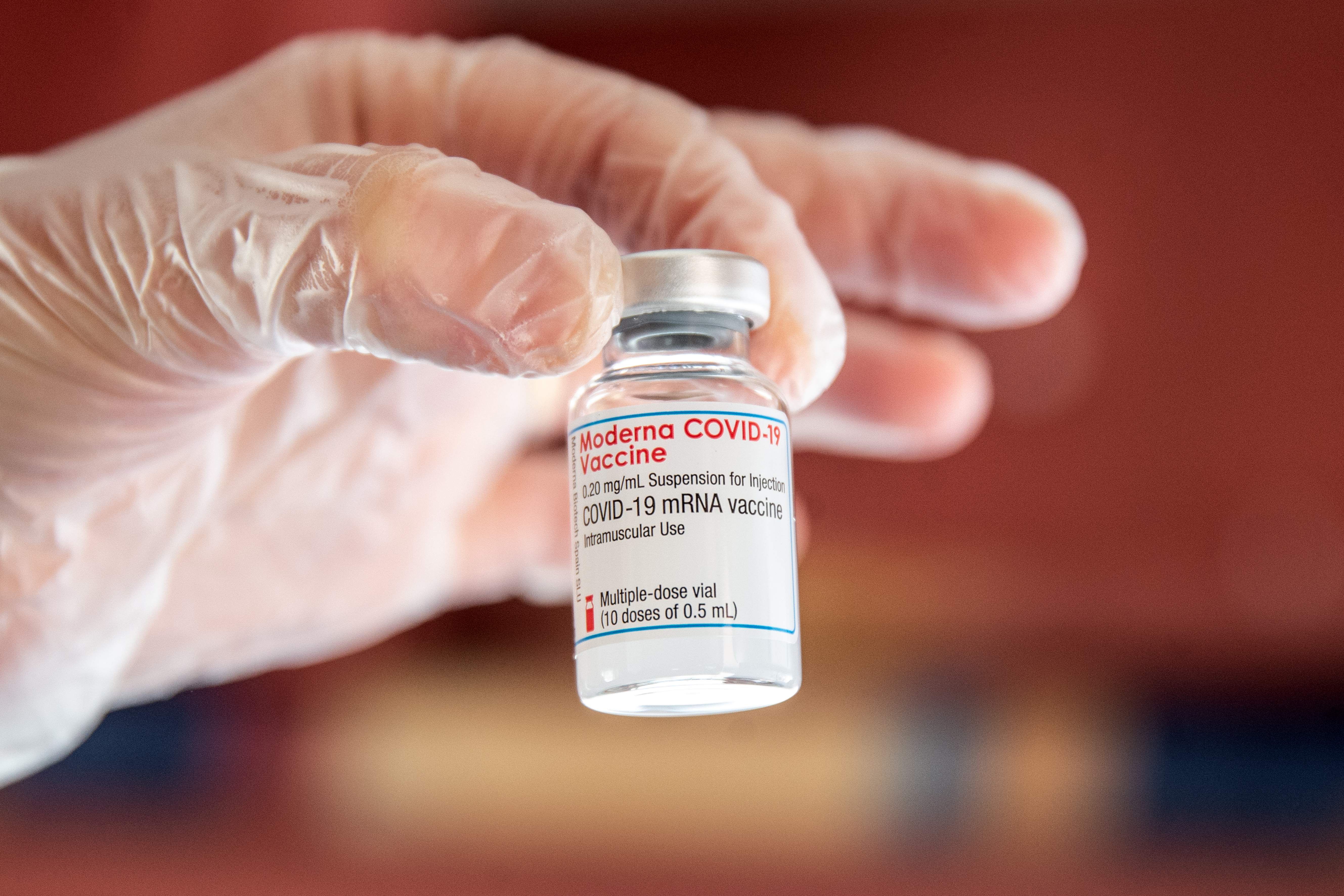
Extreme close-up photo of a gloved hand holding a tiny jar.

Enlarge / A vial of the current Moderna COVID-19 vaccine. (credit: Getty | Ivan Romano)

The first doses of omicron-specific COVID-19 vaccines went into the arms of clinical trial participants this week. This took place just as the towering wave of cases from the ultratransmissible coronavirus variant appears to be cresting in the US, and experts are unsure of what to expect next.

Leading mRNA-based vaccine makers Moderna and partners Pfizer and BioNTech each announced this week that they had dosed their first trial participants. The tweaked vaccine doses update existing formulations to match the mutations found in omicron's spike protein rather than the spike protein present in an earlier version of SARS-CoV-2.

The companies all emphasized that three doses of existing vaccines—two doses in the primary series, followed by a booster dose—are holding up against omicron. The doses provide strong protection from severe disease, hospitalization, and death, say the companies. Last week, the Centers for Disease Control and Prevention published data suggesting that three doses are 82 percent effective at preventing visits to urgent care clinics and emergency departments for COVID-19. Three doses, the CDC added, are also 90 percent effective at preventing hospitalization.

Read 7 remaining paragraphs | Comments

28 Jan 12:35

Chicken egg color spectrum

by Nathan Yau

Eggs aren’t always white, which is oddly calming in this photo by way of Bergs Fairytale Garden. [Thanks, all]

Tags: color, egg, physical

28 Jan 01:44

Building apps for Android Automotive OS

by Android Developers

Posted by Madan Ankapura, Product Manager

Today we’re announcing the availability of version 1.2 beta of the Car App Library, enabling app developers to start building their navigation, parking, and charging apps for Android Automotive OS.

Now, developers can begin building and testing apps for these categories using the Automotive OS emulator across both Android Automotive OS and Android Auto. For the entire list of changes in v1.2 beta, please see the release notes. To start building your app for the car, check out our updated developer documentation, car quality guidelines, and design guidelines.

As announced earlier, drivers of Polestar 2 and Volvo cars can now download charging (ChargePoint, PlugShare), parking (Spothero, Parkwhiz), and navigation (Flitsmeister, Sygic) apps developed with the Car App Library by joining the Google Group and opting-in to each app's beta on the Google Play store, with your Gmail account.

six spp icons

Car App Library apps on Android Automotive OS are automatically rendered to be consistent with the rest of the experience within each car, without additional work needed from developers.. For example,

Polestar 2 Volvo
Polestar 2 setting with labeled On / Off switches for PlugShare

Polestar 2 setting with labeled On / Off switches for PlugShare

Volvo settings with sliding switches for PlugShare

Volvo settings with sliding switches for PlugShare

Polestar 2 sign-in screen for SpotHero

Polestar 2 sign-in screen for SpotHero

Volvo sign-in screen for SpotHero

Volvo sign-in screen for SpotHero

Example of app customization on Android Automotive OS

Experience for yourself how your app will look within the different systems, by accessing the OEM emulator system images downloadable in Android Studio. You can begin developing your charging, parking and navigation apps for Android Automotive OS today, and we are working to enable you to publish your apps to the Google Play store in the coming months (stay tuned!).

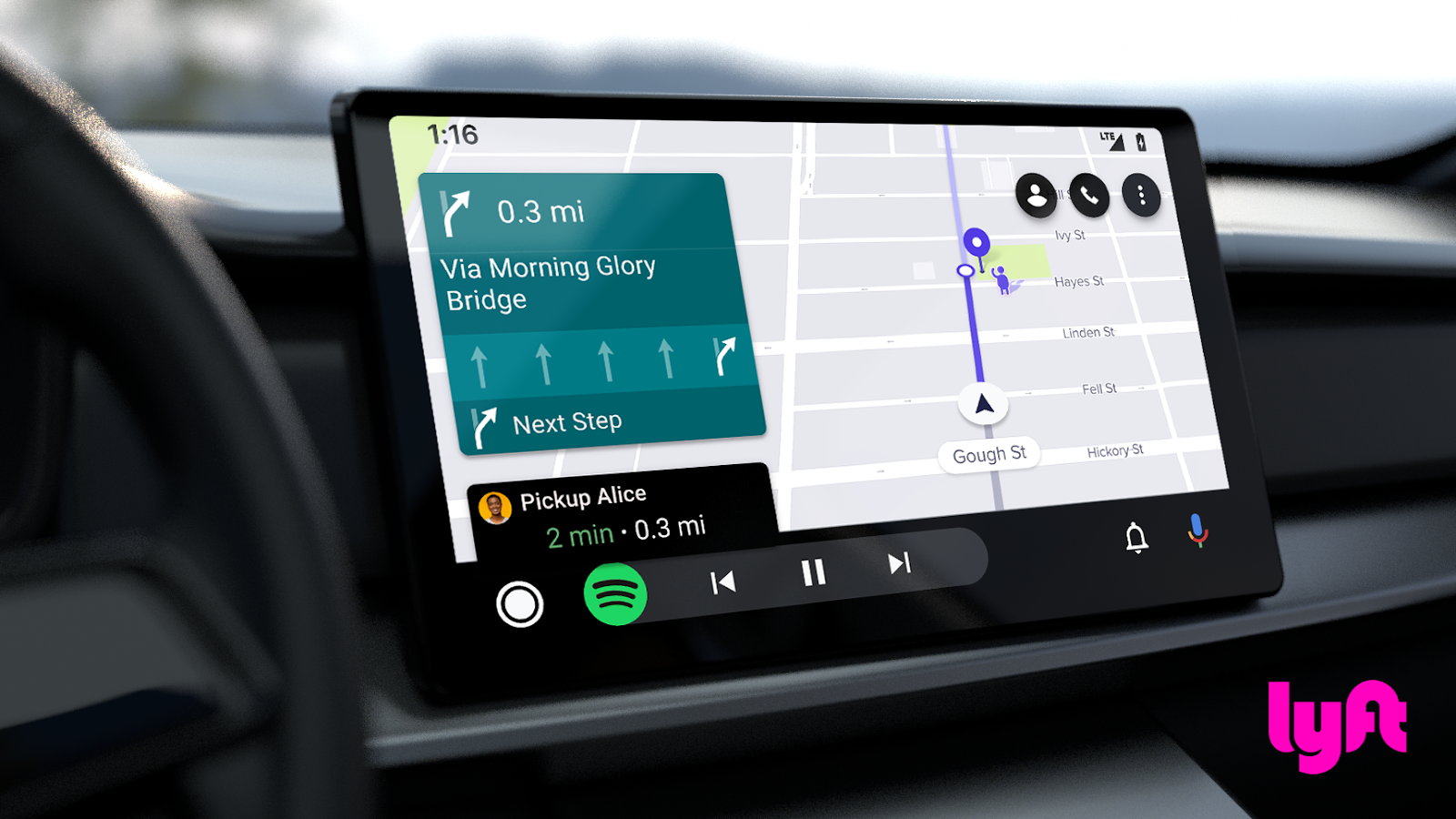
Beyond navigation, rideshare drivers spend a lot of time in their vehicles and will benefit from safer interactions if those apps can be brought to the car’s screen. We are working with Lyft and Kakao Mobility to bring their driver app experiences into the car in the coming months.

image of car screen with gps map and Lyft logo

We are also pleased to announce that we are expanding support to all Points of Interest apps. Beyond charging and parking, this allows any app that will help users discover and search for interesting locations on a map, and optionally enable them to navigate to such points. We are partnering with MochiMochi, Fuelio, Prezzi Benzina, and NAVITIME JAPAN as our early access partners.

If you’re interested in joining our Early Access Program in the future, please fill out this interest form. You can get started with the Android for Cars App Library today, by visiting g.co/androidforcars.

27 Jan 19:47

Your gas stove is always polluting, even when it’s turned off

by Rebecca Leber
A new Stanford study points to more climate pollution coming from the gas stove than previously understood. | Catherine Marois/Getty Images

Scientists may have just found a source of missing methane in cities.

When we fire up a gas stove, we’re releasing a powerful climate pollutant into kitchens and beyond. But a new study found that this isn’t just happening when the stove is on. Even when turned off, a typical gas stove will send methane up to the atmosphere.

The new peer-reviewed study, published in the journal Environmental Science & Technology, helps answer a particular question that’s been nagging scientists for years. The puzzle has been accounting for all the sources of methane as concentrations in the atmosphere have risen to record levels. They know the natural gas industry, and specifically leaks from its pipelines, is the biggest contributor (natural gas is mostly methane). Other well-documented sources are livestock and landfills.

But there was a mystery when it came to urban environments: In one study in Boston, researchers noted that pipeline leaks couldn’t explain the high levels of methane emissions they detected. There had to be other leaks, most likely from gas-burning appliances inside homes.

So Stanford scientist Robert Jackson, one of the study’s coauthors, set out to track down this missing methane inside homes and buildings. And he was surprised at what his team found.

Basically all stoves “leak a bit when they’re burning,” Jackson said. “And they all leak a bit when you turn them on and off, because there’s a period of time before the flame kicks in. The most surprising was almost three-quarters of the methane that we found emitting from the stoves came from when they weren’t running.”

In other words, the gas stove, a feature of 40 million American homes, is likely always releasing a greenhouse gas. Gas stoves are still a relatively small source of methane compared to pipelines and refineries, and they aren’t even the biggest gas-guzzling appliance in buildings — gas furnaces and water heaters use much more of the fuel through the day and night. But the methane emissions from stoves are roughly equivalent to the carbon dioxide released by half a million gas-powered cars in a year, the researchers found.

Methane also contributes to ground-level ozone that harms human health. Inside the home, the level of methane is low enough that the researchers don’t consider leaks to be a health threat. The bigger health problem is when the gas is lit, because that produces nitrogen dioxide as a byproduct. (The Stanford study didn’t measure other pollutants associated with gas stoves, like formaldehyde, particulate matter, and carbon monoxide.)

The Stanford study joins a small but growing body of work showing how gas appliances in buildings are releasing more climate and air pollution than previously understood.

“This is a really important study,” said Maryann Sargent, a Harvard research scientist unaffiliated with the study who has published research on methane readings in cities. “[It] is one piece that says these stoves are actually a pretty significant emitter. It’s filling in this gap of unknown emissions.”

The new data doesn’t just help scientists piece together a better understanding of gas stoves’ impact on climate change. It bolsters climate advocates’ arguments that the natural gas system is too leaky to continue. It could even hasten the transition away from gas reliance in cities.

The gas stove is responsible for methane, carbon dioxide, and nitrogen oxides in the kitchen

To figure out what was going on in the typical American kitchen, Stanford’s scientists knew they would have to go to people’s homes to test a variety of stove models to get as close to real-world conditions as they could. They ended up collecting measurements inside 53 California homes, rentals, and Airbnbs (because of Covid-19 precautions), using instruments that measure wavelengths of light to determine gas concentrations.

After installing big plastic partitions between the kitchens and other rooms (to block out other potential leak sources), they set out to measure three major pollutants coming from gas stoves and sometimes ovens when the appliances were off, turned on, and switched back off.

The main pollutant the scientists were looking for was methane, because that’s primarily what’s in natural gas. Methane has the power to warm the climate more than 80 times in a few decades compared to carbon dioxide, and it’s the second-biggest contributor to climate change. The stove emits the most methane with the puff of gas when it first turns on, and again when it turns off. Overall, they found that up to 1.3 percent of the gas that stoves use is leaked.

In addition to methane, the scientists also looked at how the gas stoves, when turned on, released some carbon dioxide, the single-biggest contributor to warming, too.

The third pollutant they looked at does not contribute to climate change, but it can harm human health. Nitrogen oxides are produced as a byproduct of burning methane, and increase risks of cardiovascular problems and respiratory disease when inhaled.

The study found that the bigger the burner, the worse the nitrogen oxide emissions. But in a small kitchen it only took a few minutes of usage for stoves (without range hoods) to generate levels above national health standards. (A separate study found that children in homes with gas stoves are 42 percent more likely to have asthma than children whose families use electric stoves because of relatively high levels of nitrogen dioxide.)

Even when the burner is off, it emits a small level of methane that the scientists called “steady-state emissions.” Jackson told me he suspected these steady-state emissions were coming from ill-fitting connections and leaky pipes feeding into the stove, though the study didn’t look for the exact source. The scientists didn’t find a correlation between methane leakage and how old the stove was or the model. And since most people only use their stove an hour or less a day, this slow trickle of pollution when the stove is off ends up adding up to most of the methane found leaking from the kitchen.

But finding these leaks is not so easy. Multiplied by 40 million kitchens that run on gas in the US, study coauthor Jackson said, “that’s a lot of methane. That’s a lot of natural gas reaching our air. And a lot of nitrogen oxides entering our homes for people who have asthma and health conditions.”

The Stanford researchers just looked at 53 homes. To figure out what the impact was nationwide, they extrapolated by using national survey data on how Americans typically cook.

The measurements from stoves alone suggest the Environmental Protection Agency is severely undercounting climate pollution coming from all residences, not to mention likely leaks coming from other gas appliances like furnaces, fireplaces, and water heaters.

Cities are starting to move to phase out the gas stove. And the gas industry is fighting back.

We don’t have to fix every leaky stove to eliminate this source of emissions because there’s already a better solution: Replace these stoves with ones that run on electricity. The best contender to replace the gas stove is the induction stove, which uses a magnetic field to heat pans.

But this transition to electric-powered cooking won’t happen without city, state, and even federal policy.

City councils have started looking at phasing out gas in new buildings across the country. In December 2021, New York became the largest city yet to begin to transition off of gas, banning hookups to gas in construction by the end of 2023. Now some states, including New York and California, are considering similar measures. These policies do not yet address how to transition away from the nation’s existing gas infrastructure, a much thornier topic that deals with retrofitting homes and remodels.

Though the gas industry is facing greater scrutiny of all of its operations, the stove is an important part of its strategy to beat back city climate action. The industry is counting on a steady stream of new customers for decades to come, and Americans’ devotion to the stove is its best hope to lock in new gas infrastructure. In the past, I’ve reported on the industry’s battle to stall city efforts banning gas hookups. In one case, the industry hired social media influencers to tout the benefits of cooking with gas. In other cases, gas lobby groups have worked to pass state laws that prevent cities from changing their building codes to discourage gas.

Not everyone agrees that the newly identified methane leaks from stoves are a significant factor in climate change. University of Illinois engineer Zachary Merrin, who was not affiliated with the Stanford study, noted these emissions overall are relatively small. Merrin did say the study yielded similar results as his own research, which looked at a stove while it was running, not when it was turned off. “This is very reassuring regarding the accuracy of the measurements,” he said over email. But, he added, “in my opinion, ultimately these emissions are small, and addressing them would be difficult.”

Merrin pointed out that some relatively larger leaks are coming from a small number of the stoves they measure: The Stanford study found that less than 10 percent of sites accounted for nearly half of the leaks, and those could be easily dealt with, he said.

“Stoves resonate with people,” Stanford’s Jackson said. “It is the only fossil fuel that we use where you’re standing right over the flame breathing everything that the stoves are emitting from their flame and from pipelines.” The advantage to electric or induction cooking is two-fold: “It not only cuts greenhouse gases, it makes indoor air safer to breathe.”

27 Jan 19:36

Google relents: Legacy G Suite users will be able to migrate to free accounts

by Ron Amadeo
Google relents: Legacy G Suite users will be able to migrate to free accounts

Enlarge (credit: Jericho (modified)/Google/Ron Amadeo)

There is hope for users of Google's "legacy" free G Suite accounts. Last week, Google announced a brutal policy change—it would shut down the Google Apps accounts of users who signed up during the first several years when the service was available for free. Users who had a free G Suite account were given two options: start paying the per-user monthly fee by July 2022 or lose your account.

Naturally, this move led to a huge outcry outside (and apparently inside) Google, and now, the company seems to be backing down from most of the harsher terms of the initial announcement. First, Google is launching a survey of affected G Suite users—apparently, the company is surprised by how many people this change affected. Second, it's promising a data-migration option (including your content purchases) to a consumer account before the shutdown hits.

Google Apps (today this service is called "G Suite or Google Workspace") allows users to have a Google account with a custom domain, so your email ends in your website address rather than "@gmail.com." It's typically used for businesses. The basic tier of G Suite was free from 2006 to 2012—anyone could sign up for a Google account with a custom domain, and apparently, a lot of geeks did this for friends, families, and other non-business uses. Google stopped offering free G Suite accounts in 2012, but it was previously unthinkable that Google would go after its most enthusiastic, early-adopter users and kick them off the service. You trust Google and store a ton of data on a Google account, so the accounts are forever, right?

Read 6 remaining paragraphs | Comments

27 Jan 19:00

US Air Force spends $60 million on supersonic commercial airliner

by Eric Berger
Promotional image of supersonic passenger jet.

Enlarge / Could Air Force officers fly on Boom Supersonic's Overture aircraft one day? (credit: Boom Supersonic)

The US military has indicated its interest in commercial supersonic flight by granting as much as $60 million to Boom Supersonic for its airliner development efforts.

The Colorado-based company has announced that the Air Force awarded a three-year contract to Boom to accelerate research and development of its Overture airliner. Separately this week, Boom selected Piedmont Triad International Airport in Greensboro, North Carolina, as the site of its first full-scale manufacturing facility. There, Boom plans to begin production in 2024, with the first Overture aircraft slated to roll out in 2025, fly in 2026, and carry its first passengers by 2029.

Boom is designing Overture to carry between 65 and 88 passengers at subsonic speeds over land and supersonic speeds over water—more than twice as fast as current commercial aircraft. The aircraft is designed to operate on 100 percent "sustainable" fuels, and the company says the vehicle will be net-zero carbon from day one.

Read 6 remaining paragraphs | Comments

27 Jan 17:31

AG says he forced Amazon to shut down “unlawful price-fixing” program

by Jon Brodkin
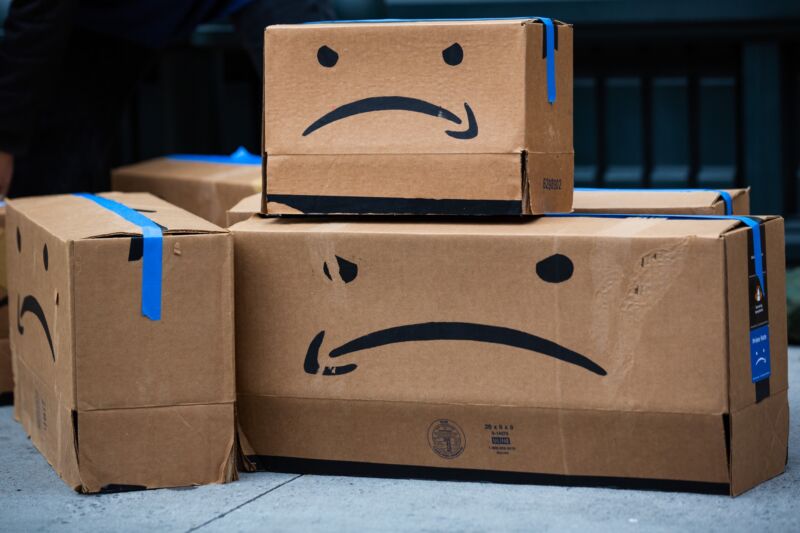
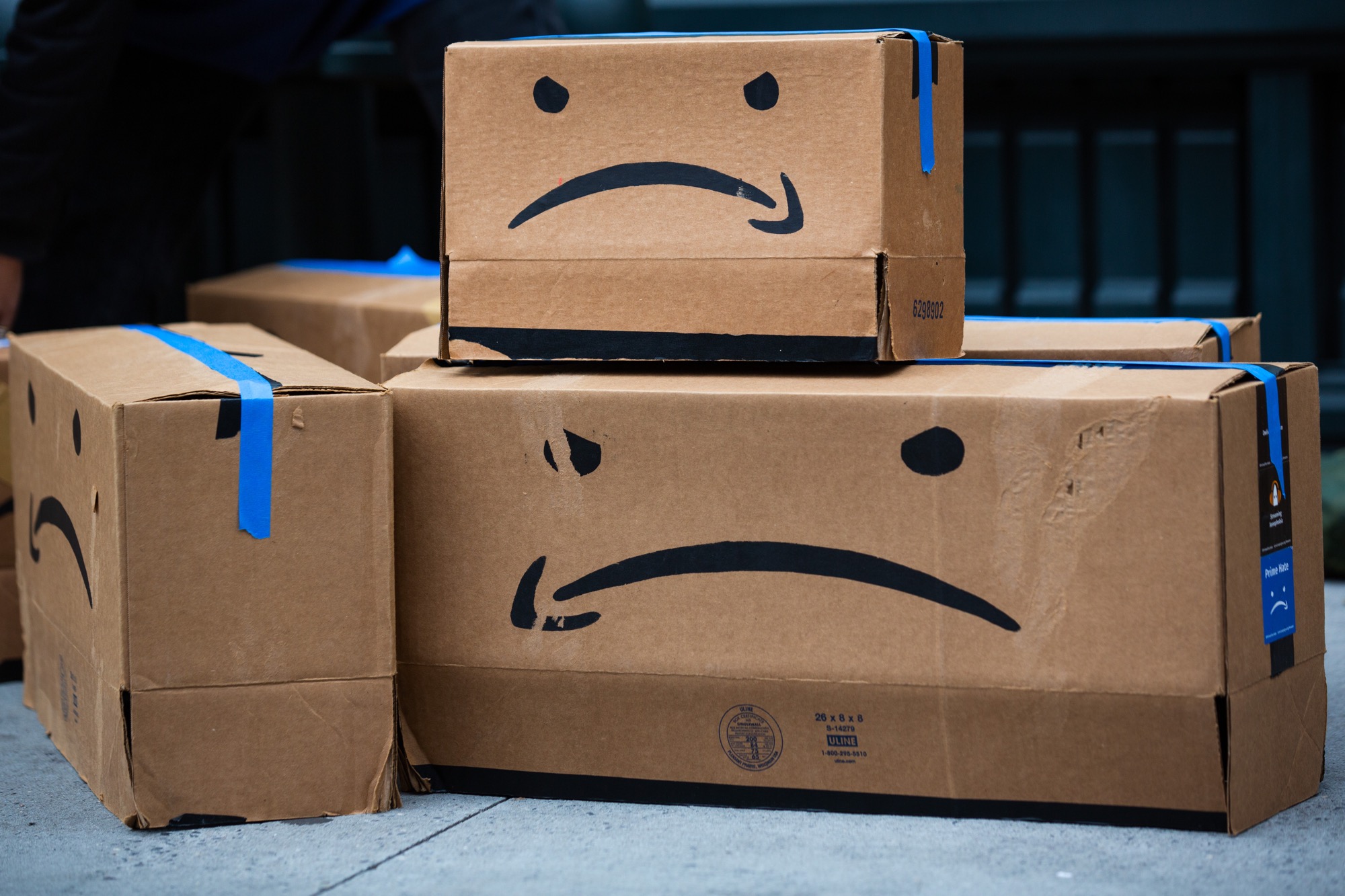
Cardboard boxes made to resemble Amazon packages, but with the logo in the shape of a frown.

Enlarge / Cardboard boxes made to resemble Amazon packages during a protest outside the home of Amazon Chief Executive Officer Jeff Bezos in New York on Wednesday, Dec. 2, 2020. (credit: Getty Images / Bloomberg Collection)

Amazon must shut down the price-fixing program known as "Sold by Amazon" (SBA) under a legally binding resolution announced today by Washington State Attorney General Bob Ferguson. Amazon had already suspended the program amid an investigation, but the settlement prevents the program from being restarted.

"The 'Sold by Amazon' program allowed the online retailer to agree on price with third-party sellers, rather than compete with them," the announcement said. Ferguson alleged that Amazon violated antitrust laws by "unreasonably restrain[ing] competition in order to maximize its own profits off third-party sales" and that "this conduct constituted unlawful price-fixing."

Ferguson filed a lawsuit against Amazon and the consent decree in King County Superior Court today.

Read 11 remaining paragraphs | Comments

27 Jan 17:30

Cops' New Favorite Junk Science Is Pretending Being Anywhere Near Fentanyl Will Literally Cause Them To Die

by Tim Cushing

The longer we live, the more we become accustomed to cop fiction.

We live and let (our rights) die when cops swear in courts they smelled jazz cigarettes while engaging in a pretextual stop. Who can challenge that? A cop says he smelled weed. The defendant says no he didn't. Who's more believable? The cop with the nose or the person accused of multiple felonies?

If cops need an assist, they can always call in another witness that can't be cross-examined: a drug dog. The dog "alerted" -- something that means a breed domesticated to please did nothing more than please its handlers. Courts will, again, often grant deference to "testimony" that can't be challenged.

The drug warriors of the USA are always in search of the next useful fiction -- something that can be written down on reports, delivered in statements in the press, but never objectively examined by a court of law. That new fiction involves the latest public enemy number one: fentanyl.

What cops can't understand is immediately converted into a threat. Brushing aside medical and scientific expertise, cops are now claiming simply breathing the same air as fentanyl is the equivalent of a death sentence -- especially for cops serving bog standard drug warrants. Suddenly, sweeping a house during warrant service is a potential death sentence for officers, no matter how much they've outmanned and outgunned the opposition.

The irrational fear of a drug that drug warriors apparently don't understand has resulted in all sorts of amazing claims by officers:

Every year, police officers claim to have suffered near-fatal overdoses after accidentally touching fentanyl, a synthetic opioid more powerful than morphine or heroin.

“Deputy Nearly Dies of Fentanyl Overdose,” read a headline from the Sacramento Bee this summer. “Officer Exposed to Fentanyl & Transported to Local Hospital,” stated a press release from the Santa Rosa Police Department in 2020. “Police Officer Overdoses After Brushing Fentanyl Powder Off His Uniform,” read the headline on a CNN story from 2017.

But there’s something off about this seeming epidemic of accidental overdoses: It is virtually impossible to overdose simply by touching or getting too close to fentanyl. Doctors and toxicologists warn that the hype around this perceived threat is harming overdose victims, taxpayers, and first responders.

If you ask cops, the mere existence of fentanyl is threatening cops' lives. If you ask medical professionals, cops are overstating the threat posed by the drug.

Accidental overdose by skin exposure “is chemically and physically implausible,” said Dr. Ryan Marino, a medical toxicologist and addiction medicine specialist who serves as an assistant professor at Case Western Reserve University School of Medicine.

Dr. Andrew Stolbach, an emergency physician and medical toxicologist at Johns Hopkins Hospital, said, “It's not possible to overdose on fentanyl by touching it. If it was absorbed well through the skin, people wouldn’t inject it and snort it in order to get high.”

Given this disconnect between cops' claims and medical professionals' assertions, the only logical conclusion would be for cop shops to tell their drug warriors to stop being so melodramatic. Instead, cops are ignoring the science and allowing their imaginations to act as the basis for serious criminal charges. Welcome to post-sci fi America, where cops are able to secure felony charges based solely on their inability to understand drug interactions.

Despite this, people who use the drug are facing serious legal repercussions — such as charges of assault or endangerment of officers — for supposedly causing these impossible overdoses.

“People should not be in jail for imaginary crimes,” [Dr. Ryan] Marino said.

Look, I don't have a problem with cops accessing their drug warring spank banks. My complaint is that their mastubatorial fantasies can take real years off real people's lives. And they're able to do this because, for the most part, the most powerful parts of our government are unwilling to challenge cops and their narratives. Instead, courts and lawmakers cut cops all sorts of slack under the assumption that cops should be given every opportunity to be wrong.

The man in the anecdote quoted above was sentenced to 6.5 years in jail -- a charge predicated on nothing more than an officer's statements that he didn't feel quite right after irresponsibly handling evidence.

This delusion infects every level of law enforcement, from the local cops who overreacted to a successful drug bust in Bickel's case to DEA agents who think nothing of throwing US citizens under the criminal justice wheel just because its agents aren't willing to read or comprehend information about drugs and drug interactions.

The good news is the mass hysteria encouraged by all levels of law enforcement reached its nadir when the San Diego Police Department released body cam footage it obviously hoped would show the public how dangerous exposure to fentanyl can be. This backfired spectacularly, exposing the San Diego PD and its PR wing as a bunch of Streisands in search of clicks -- an effort immediately undermined by hundreds of medical experts.

Over 400 physicians, nurses, and public health researchers signed a letter demanding retractions from the major outlets that credulously repeated the department’s claim. They highlighted the 2017 findings of a joint American College of Medical Toxicology and American Academy of Clinical Toxicology task force, which found that “incidental dermal absorption is very unlikely to cause opioid toxicity,” and “toxicity cannot occur from simply being in proximity to the drug.”

Who knows what really happened to this officer who claimed to be severely damaged by momentary exposure to an illicit substance? One unavoidable assumption is that years of claiming fentanyl can kill or maim on contact resulted in this officer reacting poorly to a stimulus he had been told repeatedly was instantly deadly. What was caught on camera was likely more panic attack (prompted by unscientific police training) than reaction to the substance cops had yet to determine was actual fentanyl. Dramatic as fuck, but so are any number of actors who have been provided with instructions on motivation during certain scenes. (As well as official deference when accused of domestic violence, but I digress…)

Cops are flopping. We're paying the salaries of a bunch of badged-up Bill Laimbeers who use their imagination and playacting to turn their carelessness at crime scenes into felony assault charges. We've posted nothing but losses since the inception of the Drug War. Nearly 50 years down the road, cops are expecting us to credit them with trash time scoring just because they can pretend to collapse when faced with actual work. LOL. Fuck them and the piss poor imagination they rode in on.

27 Jan 12:20

Deaths tell one story of the pandemic. The lives saved tell another.

by Umair Irfan
Staff and volunteers work vaccination stations during opening day of the Community Vaccination Site at the Lumen Field Event Center in Seattle on March 13, 2021. | Jason Redmond/AFP via Getty Images

Two charts show the extraordinary success of Covid-19 vaccines.


There are several ways to look at the Covid-19 pandemic. One is that a cataclysm we weren’t prepared for — worsened by policy mistakes, misinformation, and global inequity — claimed more than 5 million souls and stalled the lives and livelihoods of billions of people around the world. As the pandemic drags into its third year, it’s hard to see it any other way.

But another story of the pandemic focuses on its unprecedented scientific achievements: In record time, scientists went from discovering a new virus to unpacking its genome to developing multiple effective ways to prevent and treat it, fueling what may be the largest public health effort in history.

The most visible part of the pandemic is what has been lost. Trackers have counted the mounting death toll since 2020, each spike revealing setbacks and missteps. But these numbers can obscure the progress against the disease.

To understand the current moment, we need both — the harm done as well as the harm avoided. By studying the number of lives saved and how those deaths were averted, we can decide what to do next. Perhaps, we can even find some hope and optimism amid a stream of misery.

The question is, how do we figure out how many deaths were avoided? Scientists have modeled a world without vaccines and found some surprising answers.

From the start of the US vaccination campaign through the end of November 2021, Covid-19 vaccines prevented about 1.1 million deaths and 10.3 million hospitalizations in the United States, according to estimates by the health care foundation The Commonwealth Fund. Even without counting the continued impact of the omicron variant in 2022, it’s a stunning effect that presents a different side to the story of the pandemic.

Covid-19 has taken a terrible toll, as the graph of Covid-19 deaths shows in blue. But estimates of the potential death toll, in red, suggest that vaccines averted a catastrophe.

Chart: US Covid-19 deaths, with and without vaccines Christina Animashaun/Vox

The Commonwealth study wasn’t peer-reviewed, but it builds on a methodology that was. In a paper published this month in the journal JAMA Network Open, several of the same researchers estimated that Covid-19 vaccines averted more than 240,000 deaths between December 12, 2020, and June 30, 2021, before the worst of the delta variant ignited in the US.

In that same six-month window, vaccines were estimated to have prevented 1.1 million hospitalizations and halted 14 million infections, showing that more than 338 million doses had a powerful effect. “It was larger than we would’ve expected,” said coauthor Meagan Fitzpatrick, an infectious disease modeler at the University of Maryland.

Even now, Covid-19 vaccines are saving lives, and an estimate of the lives saved into 2022 would be even larger. The recent wave of infection in the United States spurred by the omicron variant may have already crested, and the proportion of deaths appears to be smaller than in previous surges. Vaccines have absorbed much of the shock.

The number of lives saved might not comfort those who have lost loved ones or are struggling with unemployment, social isolation, and the lasting effects of a Covid-19 infection. It may be a source of frustration, given that effective vaccines are going unused among millions of people, even as the unvaccinated form the dominant share of hospitalizations and deaths. Once vaccines were widely available, much of the suffering of the pandemic was avoidable. It still is.

The scale of the lives saved can still show how our actions now can prevent further misery and could shape the future of the pandemic for the better.

Covid-19 vaccines arrived in time to radically alter the pandemic

To figure out how many people would have died without vaccines, researchers drew on real-world observations of Covid-19 impacts on the population and actual vaccination rates across the US. They created a model of Covid-19 transmission and fit their model to what actually happened. From there, the scientists calculated what would have happened if there were no vaccines (as well as if the vaccination rate were halved).

The results showed that the timing of the vaccines — which were developed faster than any new vaccine in history — had a huge impact. In the US, vaccines began distribution in December 2020, and they were offered to all US adults by April 2021. The mass-vaccination campaign kicked in just as the country was facing a major wave of new cases.

“Not only did our vaccination program really suppress the ongoing surge ... but it also helped avoid a later spring wave that would have happened with variant emergence,” said Fitzpatrick. “I think the main takeaway is really focusing on speed and not just coverage. The emphasis that we had on getting the vaccines out fast ... was the right impulse.”

These conclusions line up with other estimates of lives saved. Sumedha Gupta, a health policy economist at Indiana University—Purdue University Indianapolis, created a model that used the varying vaccination rates between states as a natural experiment. Gupta and her team found that by May 9, 2021 — less than six months into the vaccination effort — vaccines had already prevented 140,000 people from dying.

Gupta found that the most vulnerable groups benefited the most: the elderly, the immunocompromised, those with preexisting health conditions. But the Covid-19 vaccines also had knock-on impacts because they slowed the transmission of the virus, which helped protect unvaccinated people too.

They were also an immense bargain. The US government spent upward of $40 billion to develop Covid-19 vaccines, but Gupta estimated their value in terms of lives saved — just a few months into the campaign — at as much as $1.4 trillion.

These studies focused on the US, which has managed to vaccinate a majority of its population. But the sheer impact of vaccines highlights how much unnecessary suffering is continuing in places that are still struggling to get enough shots. Continuing to invest in the ongoing vaccination effort, not only in the US but also globally, would likely tip the scale even further. “That seems like a no-brainer,” Gupta said.

How can vaccines reach their full potential?

Covid-19 is still here, and about a quarter of the US population — more than 80 million people — haven’t received the shots at all.

That means that the benefits of vaccines have not been exhausted, and some of the misery right now is avoidable. “We’re really leaving benefits on the table,” Gupta said.

It may seem puzzling that half of all US Covid-19 deaths — that’s more than 430,000 people — occurred after vaccines began rolling out. That share will grow for as long as people keep dying of Covid-19.

But the large majority of the people hospitalized and dying of Covid-19 right now are unvaccinated. Compared to vaccinated people, the unvaccinated are 15 times as likely to die from Covid-19, according to the Centers for Disease Control and Prevention.

At the same time, the virus is changing in ways that allow it to better evade vaccines, as the omicron variant has shown. Immunity from vaccines also wanes over time. “What we’re still seeing right now is that omicron is undermining the protection that we had previously seen from both vaccines and natural infection,” Fitzpatrick said.

While the US has leaned hard on vaccines in its Covid-19 strategy, it has neglected other ways to limit the impacts of the infection. The US government has only recently begun to distribute free rapid Covid-19 tests and high-quality face masks on a large scale. Much of the infrastructure for reporting tests and tracing contacts of infected people remains an ad hoc patchwork, making it difficult to track and respond to outbreaks. Public gatherings have resumed across the country and mask mandates have been lifted, even in places where Covid-19 transmission remains high.

Without these so-called non-pharmaceutical interventions, the shortcomings of the vaccination program have become more apparent as new variants have emerged. “It really was a problem of too much hubris, that [many believed] vaccines would be the only thing we needed,” said Fitzpatrick. “It’s not ‘either/or,’ it’s ‘both-and.’”

These lessons extend beyond the current pandemic. Covid-19 vaccines are an example of what’s possible with enough urgency, resources, and know-how. Deploying the same tactics to other illnesses could prevent even more suffering.

Looking at the pandemic through the lens of saving lives is a case for not giving up. We may not be able to prevent every death, every new mutation, or every future pandemic. But we have far more agency than we may realize, and with a more thoughtful public health strategy, many more lives can be saved.

27 Jan 12:18

Spotify says it will remove Neil Young’s music instead of dropping Joe Rogan

by Jon Brodkin
Neil Young playing guitar on stage.

Enlarge / Neil Young performs at FirstMerit Bank Pavilion at Northerly Island during Farm Aid 30 on September 19, 2015, in Chicago, Illinois. (credit: Getty Images | Raymond Boyd)

With Neil Young having told Spotify that it can keep him or podcaster Joe Rogan but not both, the streaming company today said it will remove Young's catalog of music.

"We want all the world's music and audio content to be available to Spotify users," Spotify said in a statement to Deadline and other media organizations. "With that comes great responsibility in balancing both safety for listeners and freedom for creators. We have detailed content policies in place, and we've removed over 20,000 podcast episodes related to COVID since the start of the pandemic. We regret Neil's decision to remove his music from Spotify but hope to welcome him back soon."

Young's music was still on Spotify as of this writing but will presumably be removed soon unless either Young or Spotify change their minds. Objecting to misinformation about COVID aired on Rogan's podcast, Young told Warner Records this week that Spotify "has a responsibility to mitigate the spread of misinformation on its platform."

Read 6 remaining paragraphs | Comments

27 Jan 12:17

Portraits of Anthony Fauci and José Andrés Will Join the Smithsonian’s Permanent Collection

by Andrew Beaujon
Three people with deep connections to the Washington, DC, region will be honored by the Smithsonian’s National Portrait Gallery. Dr. Anthony Fauci, José Andrés, and Marian Wright Edelman  are among the 2022 recipients of the Portrait of a Nation Award, which “recognizes extraordinary individuals who have made transformative contributions to the United States and its […]
26 Jan 19:57

Stephen Breyer’s retirement puts the spotlight on Joe Manchin — again

by Andrew Prokop
Senator Joe Manchin of West Virginia.
Sen. Joe Manchin (D-WV) speaks to reporters outside of his office on Capitol Hill on January 4, 2022, in Washington, DC. | Anna Moneymaker/Getty

The West Virginia senator has become even more important.

As furious as Democrats might be at Sen. Joe Manchin (D-WV), they really do still need him.

Justice Stephen Breyer’s reported decision to retire from the Supreme Court sets up a high-stakes Senate confirmation battle to succeed him. And Democrats’ bare 50 vote majority in the chamber means they’ll have to go back, hat in hand, to Manchin.

The West Virginia Democrat delivered two blows to President Biden’s agenda recently, pulling out of negotiations over the Build Back Better Act, and voting against a Senate rules change to advance voting rights legislation. Recriminations have been fast and furious, with much of the party’s base united in loathing against Manchin, and others wondering if party leaders mishandled their relationship with this pivotal politician.

His colleague, Sen. Kyrsten Sinema (D-AZ), was also driving a hard bargain on Build Back Better, and joined Manchin in voting against the rules change. But Manchin, who represents a state Trump won by 39 percentage points in 2020, is generally viewed as the tougher vote to get. And his relationship with the White House has reportedly soured — Manchin has said staffers there did “inexcusable” things during negotiations. So some repair work needs to be done.

But Democrats are optimistic. Manchin has voted for every lower court judge Biden has nominated so far, including now-DC circuit court judge Ketanji Brown Jackson, who is often mentioned as a possible choice for Breyer’s seat. Manchin also voted for two of Trump’s three Supreme Court nominees — Neil Gorsuch and Brett Kavanaugh — so he can argue he is simply being bipartisan by supporting Biden’s pick as well. (Manchin voted against Amy Coney Barrett, but said that was because of the rushed process of her nomination.)

They likely won’t get a clear answer anytime soon. Manchin’s typical practice is to wait until very late to announce his voting intention on controversial bills or nominees. (Infamously, he waited to announce his support of Kavanaugh until just minutes after Kavanaugh locked down the Republican votes he needed to be assured of confirmation.)

It’s also not certain that Manchin’s vote will be necessary to confirm Biden’s nominee. Supreme Court confirmation votes have become more polarized by partisanship in recent decades, but Sen. Susan Collins (R-ME) voted to confirm both of Barack Obama’s Supreme Court nominees who made it to the floor. Importantly, the stakes are not so high in this case compared to recent vacancies — conservatives have a 6-3 majority on the Court, and this nominee would merely be replacing one of the three liberals with another. So if Biden’s nominee isn’t so controversial, some Republicans could well be on board.

But if controversy does embroil Biden’s nominee — something that conservative politicians and media outlets will surely try to bring about — he probably won’t be able to rely on Republican votes for a rescue. In that circumstance, the best would be getting 50 votes from his own party, and that means getting Joe Manchin. So prepare for some diplomacy.

26 Jan 16:37

OSHA will try a different route to a vaccine mandate for businesses

by John Timmer
Image of a gloved hand holding a cotton ball to a person's arm.

Enlarge (credit: OSHA)

On Tuesday, the Occupational Safety and Health Administration (OSHA) announced that it was withdrawing its planned vaccine mandate for businesses with 100 or more employees. The decision comes in the wake of a Supreme Court ruling that blocked OSHA from implementing the mandate while lawsuits opposing it made their way through the lower courts.

But the agency also indicated that it is still working on getting the mandate instituted via a completely different, albeit slower, mechanism.

OSHA's initial attempt to implement a vaccine mandate was done under a clause of US law that allows the agency to issue temporary emergency standards in response to "new hazards." Reasoning that SARS-CoV-2 represents a new hazard, the emergency standard would require vaccination or testing and apply to companies with 100 or more employees, provided those employees were not consistently working outdoors.

Read 5 remaining paragraphs | Comments

26 Jan 15:41

Fabs stretched thin as chip shortage shrinks inventories to just 5 days

by Tim De Chant
A masked work in gloves holds up a computer component.

Enlarge / A worker checks a mainboard at a Vingroup production facility in Hanoi, Vietnam. (credit: NHAC NGUYEN/AFP)

US chip supplies are close to the breaking point as a new survey reveals diminished inventories and overstretched fabs.

The numbers put the chip shortage in stark relief. In 2021, companies that purchase semiconductors had less than five days of inventory on hand as opposed to the 40 days of inventory they had in 2019, according to a survey of more than 150 companies conducted by the US Department of Commerce. At the same time, demand was up 17 percent. Many of the companies surveyed said that demand exceeded their internal forecasts.

“We aren’t even close to being out of the woods as it relates to the supply problems with semiconductors,” Commerce Secretary Gina Raimondo said on a press call Tuesday. “The semiconductor supply chain is very fragile, and it’s going to remain that way until we can increase chip production in the United States.”

Read 7 remaining paragraphs | Comments

26 Jan 15:35

The quest to avert an asteroid apocalypse is going surprisingly well

by Brian Resnick
What if? | Tobias Roetsch/Future Publishing/Getty Images

NASA is studying how to dodge giant space rocks.

Many disasters — volcanic eruptions, earthquakes, hurricanes, tornadoes — are unavoidable. Scientists talk about when, not whether, they’ll strike. Though humans make some calamities worse, natural disasters have been happening since long before we were here. They’re a fact of life on Earth.

But one kind of disaster need not be inevitable: a collision between an asteroid or comet and the Earth. “It’s the one natural disaster, essentially, that you could cancel out,” says the science journalist Robin George Andrews on a new episode of Unexplainable, Vox’s science podcast about unanswered questions.

“You can’t stop volcanoes erupting, or an earthquake happening, or hurricanes,” Andrews says. “But an asteroid? If you just flick it out of the way of the Earth, the threat is gone.” This may sound like science fiction, but scientists are already working on it. It’s arguably going a lot better than depicted in the film Don’t Look Up in which two astronomers struggle to convince the world that a deadly comet is coming. The US government is spending time and money to avert a future asteroid disaster.

“We’re laying the groundwork here that would allow a threat to be addressed in the future and save lives,” says Kelly Fast, a NASA scientist who works in the Near-Earth Object Observations Program, part of the space agency’s Planetary Defense Coordination Office. Her job, she says, “is finding asteroids before they find us.”

Fast and her colleagues still have a lot of work to do, both to find and catalog asteroids and comets that could pose a threat to Earth and also devise a concrete plan of action if one were on a collision course. But the work is well underway, making comets and asteroids a rare example of a risk that’s getting attention before it’s too late.

After disasters strike, people often wonder why humans didn’t do more to prepare for — or even prevent — the worst. We ask that about the pandemic and climate change. Humanity often seems more reactive than proactive. In that light, our preparations for asteroids and comets are a feel-good story. It’s a story of how, when scientists described a threat, the government actually decided to do something about it.

How to prevent an asteroid disaster

Step 1: Find the asteroids

In 1993, scientists spotted pieces of a huge comet heading straight for Jupiter. Before the comet broke apart, it was around a mile wide. If this object had hit the Earth, it could have caused a mass extinction. For astronomers, it was something of a fireworks show. They knew the pieces would strike in July 1994, so they watched via telescope.

“Oh, boy. It was amazing,” says Fast, a planetary scientist at the time. “You could fit a few Earths, or more, across some of the larger impact regions.”

In the bottom left of this infrared video of Jupiter, you can see part of the impact exploding out from the planet’s atmosphere (one of Jupiter’s moons, Io, is the bright sphere on the right).

The scientists were both enthralled and concerned. It became a wake-up call: “This does happen, can happen, in the solar system,” Fast says.

Lawmakers noticed too. In 1998, Congress asked NASA to find at least 90 percent of the asteroids and comets 1 kilometer wide or larger that would come close to the neighborhood of Earth’s orbit. (Whereas asteroids are pieces of rock and metal in orbit around the sun, comets contain ice and tend to come from farther out in the solar system; when it comes to their potential for destruction, they’re pretty much the same.) Large objects like these strike Earth once every half a million years and could threaten life as we know it.

We can’t do anything about an asteroid or comet if we don’t know it’s coming for us, so identifying them is a good first step to preventing a disaster. Once an asteroid is spotted, scientists can project its trajectory forward in time and see if it’s likely to come dangerously close to Earth.

 Vox
In 2017, the journal Geophysical Research Letters published an analysis of likely sources of casualties from an asteroid impact. “Effects such as cratering, seismic shaking, and ejecta deposition [i.e., ejected debris] provide only a minor contribution to overall loss,” the study concluded. The biggest source of casualties: wind generated from the impact blast.

The good news: NASA says it’s found more than 95 percent of huge, doomsday-size asteroids. None seem to pose a threat to Earth.

But there are more out there. In 2005, Congress raised the bar on the mission, directing NASA to find asteroids 140 meters and larger, or about the size of a skyscraper. They’re sometimes called “city killers” because they could flatten a city and cause massive regional damage, even if they wouldn’t necessarily cause a global apocalypse. There’s around a 1 percent chance of one of these asteroids hitting in any given century.

 Catalina Sky Survey
Here’s what astronomers are looking for in their search for asteroids. These images — taken on January 1, 2014, by the Catalina Sky Survey — show a very small asteroid (circled faintly in red and purple) streaming past static stars.

“The odds are so slim” of it happening in our lifetimes, Fast says. Then again, an asteroid of around this size passed between the Earth and the moon in 2019, and NASA didn’t see it coming. Rare things can happen, sometimes with devastating consequences. Rarity is not an excuse for inaction. (Even smaller asteroids — like the 17-meter rock that exploded with the force of a nuclear bomb over Chelyabinsk, Russia, in 2013 — are more common and harder to spot. Luckily, our atmosphere tends to break up these smaller asteroids before they have a chance to reach the ground.)

NASA has a lot more work to do toward cataloging potential city-killers. “We’ve found about 40 percent of them,” Fast says. At the rate scientists are going, it could take 30 more years to find the rest, though there are some plans to launch a specialized space telescope to speed up the search.

Step 2: Boop the asteroids

Let’s say scientists discover a 200-meter asteroid heading for the Earth. Could they do anything about it? That’s the question NASA scientists are currently in the process of answering.

Hollywood has had some flamboyant ideas about how to deal with an asteroid, namely using nuclear weapons to break them or knock them off course — this is the basic plot of the ’90s-era epics Armageddon and Deep Impact. There’s some merit to this strategy. But there might be a much easier and safer way to deal with an asteroid on a collision course with Earth: Simply nudge it out of the way.

Last year, NASA launched the Double Asteroid Redirection Test (DART), which is a car-size box outfitted with solar panels. It’s currently on its way to a 160-meter asteroid called Dimorphos. In the fall, DART will crash into Dimorphos at 24,000 kilometers an hour (about 15,000 miles per hour).

 NASA
Illustration of the DART spacecraft

Dimorphos is a “moonlet” asteroid, which means it orbits a larger asteroid named Didymos, much like the moon orbits the Earth. If all goes according to plan, the collision will change its orbit, proving that it’s possible to redirect a big hunk of rock in the middle of space. (The larger asteroid’s gravitational pull will help ensure that Dimorphos doesn’t fly off in a new direction, say, toward Earth.)

DART is the definition of a long shot. “This has never been tried before,” Andrews explains on Unexplainable. If it doesn’t work, that doesn’t mean we couldn’t ever deflect an asteroid. But perhaps it will take more force than DART can supply.

“Basically, this test is answering: How big a wallop do we need to give these city-killer asteroids to save the planet, if we need to?” Andrews says.

If DART works, NASA can build a similar strategy into its anti-asteroid game plan. If they spot an asteroid heading toward Earth, “they can send a precursor mission to observe it beforehand,” Andrews says. In those initial observations, scientists can study the asteroid’s composition and make calculations for how much force it will take to deflect the rock. “You could then send a DART-like mission.”

The problem of asteroids potentially crashing into the Earth is not yet solved. Still, a couple hundred years in the future, it’s possible that scientists like Fast will be hailed as forward-thinking heroes who laid the groundwork of a planetary defense system. “There’s no greater gift that America’s space agency can give” than protection for humans of the future, Fast says.

Even though these disasters might not arrive in our lifetimes, we can still feel good about the progress being made. It’s a way to be good ancestors to the generations that follow us. On the long list of problems to solve and disasters to mitigate, maybe we can actually solve one.

26 Jan 13:19

A bug lurking for 12 years gives attackers root on every major Linux distro

by Dan Goodin
A laptop screen filled with stylized illustration of cybercrime.

Enlarge (credit: Getty Images)

Linux users on Tuesday got a major dose of bad news—a 12-year-old vulnerability in a system tool called Polkit gives attackers unfettered root privileges on machines running any major distribution of the open source operating system.

Previously called PolicyKit, Polkit manages system-wide privileges in Unix-like OSes. It provides a mechanism for nonprivileged processes to safely interact with privileged processes. It also allows users to execute commands with high privileges by using a component called pkexec, followed by the command.

Trivial to exploit and 100 percent reliable

Like most OSes, Linux provides a hierarchy of permission levels that controls when and what apps or users can interact with sensitive system resources. The design is intended to limit the damage that can happen if a user isn’t trusted to have administrative control of a network or if the app is hacked or malicious.

Read 8 remaining paragraphs | Comments

25 Jan 17:06

0785

by siiri@joanofbark.fi
24 Jan 20:46

Scale of the Tonga eruption

by Nathan Yau

Manas Sharma and Simon Scarr used satellite imagery to show the scale of the Tonga eruption, which spurted a 24-mile cloud that grew to 400 miles in diameter in an hour. Notice the little Manhattan in the bottom left corner in the image above.

However, instead of leaving it at that, Sharma and Scarr animated the eruption over familiar geographic areas to better see how big it was. The cloud was big enough to cover whole countries.

Tags: Reuters, satellite imagery, scale, Tonga, volcano

24 Jan 20:44

New Phone

by Reza
24 Jan 12:13

Democrats have had enough of Sen. Kyrsten Sinema’s obstruction

by Ellen Ioanes
Sen. Kyrsten Sinema (D-AZ) walks outside of the US Capitol on October 28, 2021.
Sen. Kyrsten Sinema (D-AZ) arrives for a Senate vote in the US Capitol on October 28, 2021. | Tom Williams/CQ-Roll Call, Inc via Getty Images

Sinema’s political future is murky after her filibuster vote.

Sen. Kyrsten Sinema (D-AZ) is facing a series of rebukes from elected Democrats, progressive organizations, and members of her own state party after her refusal last week to support an exception to the filibuster to advance a major voting rights bill.

Sinema, along with Sen. Joe Manchin (D-WV), spurned a Democratic effort to restore the talking filibuster for voting rights legislation in order to pass the Freedom To Vote and John Lewis Voting Rights Advancement acts, and the effort ultimately failed by a vote of 48 to 52 on Wednesday.

Now, however, her vote could cost her politically: Donors and progressive organizations have announced they are pulling their support this week, and Sinema could also face a serious primary challenge in 2024, should she run for reelection to the Senate.

Notably, Emily’s List and NARAL Pro-Choice — both national political organizations focused on electing pro-choice women to political office withdrew their support for Sinema on Thursday.

“We believe the decision by Sen. Sinema is not only a blow to voting rights and our electoral system but also to the work of all the partners who supported her victory and her constituents who tried to communicate the importance of this bill,” Emily’s List president Laphonza Butler said in a statement Thursday, formally withdrawing the organization’s support for Sinema.

That announcement, notes Ben Giles, a reporter for NPR affiliate KJZZ in Phoenix, Arizona, is significant for multiple reasons. First, it’s unusual for pro-choice organizations to come out against the filibuster, because it’s historically been a tool used to protect abortion rights. Additionally — and perhaps more importantly for Sinema’s political future — Emily’s List was by far the largest donor to Sinema’s 2018 campaign, according to OpenSecrets, contributing nearly half a million dollars.

NARAL, which also backed Sinema during her successful 2018 Senate race, tweeted Thursday that “there’s no reproductive freedom without the freedom to vote” and said the organization would change its endorsement criteria to only endorse “senators who support changing the Senate rules to pass the critical legislation that will protect voting rights.”

“The freedom to vote underpins our fight for reproductive freedom and every other freedom we hold dear,” the group said in a statement following the vote on Wednesday. “Absolutely nothing should stand in the way of urgent action to ensure every voter has the freedom to participate in safe and accessible elections.”

According to Politico, 70 major donors to Sinema’s 2018 campaign also wrote Sinema a letter prior to Wednesday night’s vote, saying they would ask for their donations to be returned should she vote against filibuster reform, as she ultimately did.

“We must draw a line,” the donors wrote. “We cannot in good conscience support you if you refuse to use your office to protect our fundamental rights to vote, and we will be obliged to back alternatives for your seat who will do the right thing for our country.”

Most recently, the Arizona Democratic Party executive board voted Saturday to censure Sinema, setting up a potential vote of no confidence.

According to one Arizona Democratic operative who spoke with Vox on the condition of anonymity, the state party isn’t likely to take that step — but Sinema’s political future in the state could still be in trouble.

“I really don’t see a path for her to win the Democratic primary right now,” the operative told Vox, and even if she does, it’s not a sure thing the party will choose to support her in 2024. “I really do feel like we were forced into this position,” they said. “This isn’t about, ‘she isn’t progressive enough,’ it’s a pattern.”

Sinema has been frustrating Democratic leadership all year, particularly with her refusal to back elements of President Joe Biden’s proposed social spending and climate change bill, the Build Back Better Act. The senator initially opposed the bill’s $3.5 trillion price tag, which was whittled down to around $1.75 trillion by the time Congress took its holiday break, and she has also said she opposes an increase to the corporate minimum tax rate to help pay for the bill’s proposals.

Sinema’s continued defense of the filibuster, however — even at the cost of major Democratic legislation which Sinema herself supports — proved to be a step too far for many Democrats. As Norm Ornstein, a political scientist at the American Enterprise Institute, explained in conversation with Vox’s Li Zhou earlier in January, Sinema’s filibuster rhetoric bears little resemblance to the rule’s actual function.

“We’re finally seeing, I think, a level of frustration, over the misuse of the filibuster, not as an infrequently applied tool by a minority on an issue about which they feel very, very strongly, but as a cynical weapon of mass obstruction,” Ornstein explained. “Certainly there was a time when we had well-established norms in the Senate that fostered problem-solving and bipartisanship. That time is long gone.”

Is Sinema really at risk in 2024?

In addition to the immediate backlash to her stance on the filibuster, Sinema’s long-term political prospects could be in jeopardy. Sen. Bernie Sanders (I-VT) has already voiced support for a potential primary challenge against Sinema, and Rep. Ruben Gallego (D-AZ), who is considered a likely candidate to challenge Sinema in 2024, says he has spoken with multiple Senate Democrats about doing so.

Gallego also called out Sinema by name in a floor speech earlier this month, following Sinema’s announcement that she would not support an exception to the filibuster for voting rights. “We won’t shrink from protecting our democracy and the voting rights of all Americans,” Gallego said. “It’s past time for the US Senate and Senator Sinema to do the same.”

On Sunday, Sanders also told NBC’s Chuck Todd on Meet the Press that he supports the Arizona Democratic Party’s decision to censure Sinema. “That was a terrible, terrible vote,” Sanders said. “And I think what the Arizona Democratic Party did was exactly right.”

In an emailed statement to Vox, Sinema press secretary Hannah Hurley defended Sinema’s record and reiterated her support for voting rights legislation, despite Sinema’s decision to oppose changes to the filibuster.

“Kyrsten has always promised Arizonans she would be an independent voice for the state — not for either political party,” Hurley said. “She’s delivered for Arizonans and has always been honest about where she stands.”

The Arizona Democratic operative, though, told Vox that Sinema’s stance is particularly out-of-step with the reality of Arizona’s political climate when it comes to voting rights.

“The stakes are incredibly high,” they said. “We are ground zero for voter suppression.”

Sinema’s support among Arizona Democrats has already begun to flag in recent months in some polls. In September, 56 percent of Democrats viewed her favorably, according to a poll from OH Predictive Insights with a sample size of 882 Arizona voters, but a January 18 poll from Public Policy Polling of 554 Arizona voters found only 15 percent of Democrats viewed her favorably.

“All I’ll say is that she created the circumstances she now finds herself in,” Tré Easton, the deputy director of Battle Born Collective, a progressive advocacy group, told Vox via text message regarding a potential primary challenge to Sinema. “The people of Arizona deserve better — either from her or another Democrat.”

And while Sinema hasn’t lost all of her backing — she still has substantial support from big donors in the pharmaceutical and financial industries — it may not be enough to keep her seat come 2024. In addition to a potential primary challenge, Arizona is a purple state where the eventual Democratic Senate nominee will likely find themselves in a close general election race, and the state has been home to aggressive voter suppression efforts by Republican state officials.

It makes for a puzzling stance from “one of the smartest people in Arizona politics” and someone who’s previously been seen as a long-term thinker, the Arizona Democratic operative told Vox.

“A lot of folks are really struggling to answer the question of, ‘What is the strategy here?’” they said.

Update, January 23, 9:10 pm ET: This story has been updated to include a statement from Sen. Kyrsten Sinema’s office.

22 Jan 16:52

Airline CEOs make U-turn, now say 5G isn’t a big problem for altimeters

by Jon Brodkin
An airplane cockpit seen during flight.

Enlarge / Airbus 320 cockpit. (credit: Getty Images | Skyhobo)

The Federal Aviation Administration's fight against AT&T's and Verizon's new 5G deployment appears to be coming to a temporary close, with the FAA having cleared about 78 percent of US planes for landing in low-visibility conditions. Airline CEOs are striking an upbeat tone, with one saying the process of ensuring that airplane altimeters work in 5G areas is "really not that complicated."

Over the past week, the FAA announced clearances for 13 altimeters that can filter out 5G transmissions from the C-band spectrum that is licensed to wireless operators, accounting for those used by all Boeing 717, 737, 747, 757, 767, 777, 787, and MD-10/-11 models; all Airbus A300, A310, A319, A320, A330, A340, A350, and A380 models; and some Embraer 170 and 190 regional jets. More approvals will presumably be announced soon, bringing the US closer to 100 percent capacity.

Unfortunately, there could be another showdown in about six months, when AT&T and Verizon lift temporary 5G restrictions around airports—we'll cover that later in this article. For now, airline CEOs appear to be satisfied, even though the FAA hasn't said definitively that altimeters will continue working after the temporary 5G limits around airports are lifted.

Read 24 remaining paragraphs | Comments

21 Jan 17:14

Sunday’s Anti-Vaccine Mandate March: Here’s What You Need to Know

by David Tran
On January 23, opponents of vaccine mandates are expected to gather on the National Mall as part of the “Defeat the Mandates: An American Homecoming” rally. The thought of a big group of anti-vaxxers coming to our city for a potential superspreader event would be a downer any time. But it’s a particular bummer now […]
21 Jan 16:41

Nutrition and Food Education in Japan

by Kayoko Hirata Paku

Tonjiru (Pork and Vegetable Soup) served with grilled salmon, steamed rice, and vegetable side dishes.

Why is Japanese cuisine healthy? It's all about the investment in food education to build awareness of one's health and nutritional habits.

READ: Nutrition and Food Education in Japan