firehose
Shared posts
The Expendables: How Game Development Standards Are Inherently Harmful
Harper Lee’s Forgotten True-Crime Project
Pride And Prejudice And Dragons?

Pride And Prejudice And Dragons? Naomi Novik won't ever have Jane Austen show up as a character in the Temeraire books — but she is working on a story about "the adventures of Captain Elizabeth Bennet and her dragon Wollstonecraft." HECK YEAH.

la-rinascente:smoothiesandbooks:MY LIFE WAS SO INCOMPLETE BEFORE...


MY LIFE WAS SO INCOMPLETE BEFORE THIS EPISODE
A scene with three women of color including one massively influential and accomplished transwoman in a TV show about a woman of color who is well-educated, intelligent, and successful. Love it.
Report: Growing Workforce of People of Color Shoulders Growing Inequity

The burdens of the working poor are increasingly borne by a growing class of people of color. That's the latest finding from a new report (PDF) from the Working Poor Families Project.
This is the way it shakes out: in 2013, people of color made up 58 percent of the 10 million low-income working families in the U.S., even though people of color are just 40 percent of all working families across the country. The dynamic has only worsened since the start of the recession in 2007 and during a time when the nation's workforce has become more racially diverse.
People of color are well on their way to constituting the majority of people in the U.S. As such, their share of the U.S. workforce is growing, even as white people's growth in the U.S. has stagnated. Between 2012 and 2022, the number of people of color in the U.S. workforce is expected to grow by 21 percent while the number of white people working in that same period is set to decline by 2 percent. The dropoff is due largely to white people's stagnating growth in the U.S. The year 2013 marked the first that white deaths in the country outnumbered white births, according to the Washington Post.
Given that people of color are the nation's fastest-growing groups, their economic well-being is of pressing concern to the nation's, the report argues. But while the country is celebrating signs of economic revival, low-income workers and people of color are being left behind. Between 2009 and 2013, the numbers of low-income families grew from 10.1 million to 10.6 million, with people of color making up a disproportionate amount of that growth. Today, the racial wealth gap between whites and blacks is at its highest level since 1989, and white households have a median net worth that's 13 times that of black families' net worth, and 10 times that of Latinos'.
Different racial groups are also more likely to work in different kinds of low-wage jobs, report authors point out. Asians in the bottom rungs of the income scale are more likely to work in salons, or as retail workers. African-Americans are most likely to be concentrated among the ranks of health aides, cashiers, and as caregivers. Latinos, meanwhile, are more likely to work in cleaning and in restaurants.
"Racial/ethnic minorities are not disproportionately low-income because of a lack of work effort," according to the report, "but because they are more likely to be working in low-paying jobs."
(h/t Los Angeles Times)
Kendrick's Only Competition is Himself

Dropping his second studio album a week early has proven to be a brilliant move for Kendrick Lamar.
Today Billboard announced that "To Pimp a Butterfly" is set to become No. 1 on the Billboard 200 albums chart next week. "Industry sources are forecasting the set to move over 325,000 equivalent album units in the week ending March 22," the publication reports.
"To Pimp a Butterfly" broke the Spotify record for the album most streamed on on Monday, the day of its release. The spot was previously held by Drake's equally surprising premiere of "If You're Reading This It's Too Late" with 6.8 million streams. Lamar's album far surpassed the precedent collecting 9.6 million streams in its first 24 hours, according to the company's statement.
According to a tweet from TDE President Punch, the album racked up an additional, record breaking 9.8 million streams on Tuesday.
How Did A Company Selling Rubber Tires Become The World’s Authority On Restaurants?
Death, Redesigned
Hulu nabs exclusive streaming rights to TV phenomenon Empire
Empire is an unprecedented ratings juggernaut. It's the only show in at least 23 years (since Nielsen began tracking) to grow its audience every single week, every single episode. Early ratings for last night's finale reveal that over 16.5 million people watched it live. That's 7 million more viewers than its closest competitor, CBS's Survivor.
Point is, Empire is a Really Big Deal — and now a huge win for Hulu. The streaming company today announced that it has grabbed exclusive streaming rights "for all past and future episodes." The entire first season is currently available for Hulu Plus users, and future episodes will continue to debut on the service the day after it airs on Fox.
To be fair, Hulu is a joint venture among broadcasters, and Empire's network Fox owns a substantial chunk of the company. But while Hulu would presumably have a natural advantage over competitors like Netflix and Amazon, the fight over streaming rights has been especially heated and pricey as of late. This past summer, Netflix picked up The Blacklist for a reported $2 million per episode, and it secured exclusive streaming rights to Gotham before the show even premiered.

New nonstop 3D printing process takes only minutes instead of hours
3D printing, or additive manufacturing, has the potential to revolutionize how we make things, enabling custom production of almost anything you could want. Researchers are looking into applications of 3D printing ranging from printing entire houses to artificial human organs. But 3D printing hasn’t fully caught on yet, in part due to the time-consuming nature of the process—it typically relies on building items up through a layer-by-layer approach that can take many hours. For additive manufacturing to become more generally useful, printing speeds need to increase by an order of magnitude.
A team of researchers at UNC-Chapel Hill have developed a new 3D printing process that may be fast enough to change the tide for 3D printing. Their process allows for the continual printing of objects using a liquid interface in a single step, unlike the previous step-wise processes.
To accomplish this, these scientists took advantage of a problem typically associated with 3D printing methods that relies on light to initiate polymerization (photo-polymerization): the ability to control oxygen levels. When present, oxygen reacts with the polymerizing chains, which significantly slows down the reaction. Oxygen must therefore be limited for the curing process, which hardens the product. In 3D printing, the material is typically printed in air and cured under a UV light; since oxygen is likely present, this process is slower than it could be.
Read 7 remaining paragraphs | Comments
Update: Clinton’s e-mail is on a hosted Exchange 2010 server, not in Chappaqua
There's been a lot of controversy over how Hillary Clinton apparently used a mail server running in her Chappaqua, New York, home when she started her tenure as secretary of state. But if you want to know what she's using now, all you have to do is point your browser at it—you'll get a login page for Outlook Web access from a Microsoft Exchange 2010 server. And so will anyone who wants to brute-force guess her e-mail password or simply take the server down with a denial-of-service attack. (This is not a suggestion that you should.)
Clinton has probably changed her e-mail address since the scandal began—particularly since the hdr22 account she used has been widely published and has likely become a magnet for all sorts of unwanted messages. And the hosted Exchange server is certainly an upgrade from her original server configuration—Until October of 2010, based on historic DNS records viewed by Ars, Clinton's e-mail server was in fact at a static IP address provided by Optimum, a Cablevision subsidiary, that corresponded to the Clintons' Chappaqua address. The domain was registered on January 13, 2009, just days before Clinton's confirmation as secretary of state—but it did not gain a certificate for secure client connections until March. The current certificate for clintonemail.com was issued by GoDaddy in 2013 just as the original certificate was about to expire.
At some point shortly after the home server was dropped in 2010, the mail exchange record for clintonemail.com was moved to a hosted Exchange server. Currently, that server appears to be running out of a data center in Huntsville, Alabama. The server uses McAfee's MXLogic e-mail filtering service to screen for malware and spam (though it's not certain when the service was added).
Read 3 remaining paragraphs | Comments
Taxi Companies Sue Uber For False Advertising On Safety


Read more of this story at Slashdot.
sixpenceee:Geometric Pond Ice in South Oregon. This occurs...
firehosevia Rosalind

Geometric Pond Ice in South Oregon. This occurs because of undisturbed slow freezing. The lake was kept just at or slightly below the freezing point for a significant amount of time. The center of each triangle is a nucleation site. The slower it cools the larger each one can grow before more nucleation sites form.
For more interesting posts visit sixpenceee
Daughter of Two Moms Comes Out Against Gay Marriage
firehose"I loved my mom’s partner, but another mom could never have replaced the father I lost.”
this isn't an argument against same-sex marriage
this is an argument that her dad is a piece of shit
if she got another dad instead of a second mom, would he "have replaced the father I lost"?
Students Protest After Principal’s Racist Comment Caught on Camera
Twitter Adds Tool To Report Tweets To the Police
Read more of this story at Slashdot.
Lighting theory for 3D games, part 2: a formal approach to light design, and light as depth

In part 1, I talked about how different light sources have different connotations to the viewer, and these meanings are culturally constructed. In New York City today, an antique Edison bulb connotes trendy bourgeois expense, but 50 years ago it might've been merely eccentric, and 150 years ago it would've been a thrilling phenomenological novelty.
But people rarely intellectualize lighting this way, in, like, your own bedroom. In your daily middle class Western life you don't usually agonize over the existential quandaries of electricity, you just flip the light switch without looking. When in familiar places, we experience light as a resource or tool and take it for granted. So much of our everyday relationship with light concerns its functionality and what it enables us to do.

Lighting intended for a specific purpose is called task lighting, as opposed to merely cosmetic or decorative lighting. My thinking is that it's NOT about establishing a rigid binary of which lights are what, but rather it's to get you to imagine what particular tasks a particular light lets you do. Many lights can be both functional and decorative -- for instance, a candle flickering on a restaurant table is moodily dim and romantic, but it also helps you discern different tables and see your food.
In games, we are concerned with making the world readable (or selectively unreadable) for the player, to help them navigate and wayfind through a space, as well as discern different game objects. We also want to reassure the player that the world was competently constructed with some sort of intent, and that they aren't wasting their time and/or money.
For now, let's try thinking about light more formally. How does light let us read a game more easily, and what are some common patterns?
 |
| from Magnar Jenssen's excellent "Functional Lighting" |
Sometimes this flatness is a good thing that can simplify our scenes and make them easier to read, or sometimes we'll want to trick the player, but much of the time this is a distraction that prevents a player from understanding what they are seeing and interacting with your game -- and because we are trying to depict a 3D object on a flat 2D screen, we often need all the depth cues we can get.
Look at the round shapes below, and look at how relying only on silhouettes means they will LIE TO YOU:

(Again, lying to the player or viewer is great if you have a purpose in doing so... but purposeless lying is just some trolling bullshit.)
At "fullbright", or when a game engine renders models unlit at default 100% brightness, it is difficult to tell the difference between the cylinder and the sphere. To help read 3D depth into a 2D image, we need to use texture, fog, similar objects near us and far from us -- we need spatial context.
Light is the main tool for creating this context. With light, we can read the contour and a mesh's surface normals -- the direction(s) that a given 3D surface is pointing, whether it is concave / convex, round or flat, etc.
Reading this surface topology is often very important for playing 3D games. Is this hill too steep to climb, am I supposed to go here? If I throw a grenade, which way will it roll down, and how quickly? How far is it to the top or bottom of the room, can I jump up or fall down safely? A lot of this type of lighting is about signposting for the player to help them understand their surroundings.

The image above is a scene from Residue Processing in Half-Life 1. Note the hanging ceiling spotlights focus on the floor, leaving the wall relatively dim -- this helps emphasize the neon green splashes from the toxic sludge, which is an important hazard throughout this chapter. It also establishes visual hierarchy; the bottom of the room is much more important than the top of the room. (One criticism: the hidden light strips along the ceiling edges are lazy and thoughtless, and don't feel industrial to me. If they wanted to isolate the metal ceiling from the concrete shell, they should've used geometry to do that. And there's already a trim! As it stands, it's just a mostly flat plane separated for no reason.)
On the left, the exit out of this room is lit prominently, so we know where we're going and don't linger for too long. (The NPC also shoots the headcrab monsters and runs out that exit. Valve really wanted you to follow.) The simplest way to light a space is to light every crucial game object / affordance, and make sure the player can see where they want to go. If something isn't important, then don't bother lighting it.
The point of the Residue Processing chapter is low-combat platforming and weapon inventory build-up in an industrial setting that re-uses the silo art assets from Blast Pit -- the point is not to fumble in shadows or to stage elaborate story events where you're locked in a room as NPCs talk. Fittingly, the lighting is very functional and utilitarian, and you don't really stay still for too long.

In this scene from Half-Life 2 (d3_c17_03.bsp), most of the courtyard is in shadow except for a neon teal Combine spotlight, an orange fire giving off lots of smoke, and a friendly NPC shooting at nearby enemies. Gee, Batman, I wonder where we're supposed to go?
Traditional thinking about game lighting is that it is garnish on top of a strong floorplan, but I think lighting is so powerful that it can help compensate for an unclear floorplan too. This is technically just a long room that ends in a blind corner; this is the textbook wayfinding problem that Brendon Chung refers to in his wayfinding talk at GDC 2015. In cases of equal value and flat lighting, as in the fullbright frame above, you won't see anything. But if you put a light around the corner, then we can easily discern the corner. Valve's consistent use of Combine spotlights even lets players estimate how far the blind light source is, based on its intensity and falloff.
The keyword here is "contrast", between shadow and not-shadow, between static lighting and flickering lighting -- between complementary colors blue and orange which are opposite each other on a color wheel and help emphasize each other.
 |
| A master class in how NOT to light a game? Note the blorange, note lazy glowy bits everywhere, etc. |
Similarly, "follow the flickering light" or "follow the perpetually burning trash fires" or "follow the red glowing thing" is barely a step up from "follow this giant glowing arrow" or "follow the word FOLLOW." These are not novel nor compelling ways to explore a world.
Don't get me wrong. I'm a big fan of tackiness and tastelessness.
... Except when I've seen that same kind of tastelessness over and over.
 |
| the evolution of video games; from Jack Monahan's "Visual Clarity in Character Design" |
Sure, now we'll notice this thing, but at what cost?
When we focus too strongly on the functional aspects of lighting. and apply guidelines blindly, the result is often overly instrumental, emotionally hollow, and basically artless. This is the danger of any rule-making in art -- to assume what worked in what situation will work flawlessly in another situation and produce similar results.

For instance, players don't always flock toward light.
Thief 1, a first person stealth game about hiding in shadows, makes you afraid of light. Here, light makes you vulnerable to being spotted by hostile NPCs -- it doesn't just signify a hazard, it is also a hazard in itself. Every step toward a light source is a risk. Much of the gameplay in Thief consists of huddling in darkness, anxiously watching the well-lit doorway from a safe distance, wondering if there's a way for you to go around and avoid that lit area entirely. In this game, we gravitate toward shadows instead.
It makes sense that lighting in stealth games, or more broadly, games about avoiding direct conflict and confrontation, would operate very differently from games about fighting and gun battles. If you want to design light for function, you should be aware of what that function actually is.
 |
| from "Thief 1's Assassins and environmental storytelling." |
In the level "Assassins" from Thief 1, Looking Glass Studios used a raised blind corner on purpose to force you to hang back and rely more on the sound of NPC footsteps. The point of this setpiece was to be visually unreadable, and so make you panic about lingering too far behind the NPCs you're supposed to follow. Instead of following a breadcrumb trail of random trash fires, or red cage lights, or (ugh) bl-orange spotlights, we are instead following an invisible mental abstraction and all this fucking light is really unhelpful.
This is one of the most beautiful moments of that level, and it relies on purposeful, nearly transcendent confusion and uncertainty. If games like challenge so much, why not elevate perceptual challenges?
 |
| from "Dark Past, part 4: a valence theory of level design" |
Formal approaches to light help us think about the way we use light, but remember that form does NOT follow function. Rather, form follows worldview; much of the orthodoxy around game aesthetics presumes a certain function, certain player, and a certain type of game. That's why part 1 of this series started conceptually -- if you lose sight of what your thing is to different people, then even all the blorange exit spotlights in the world won't save you.
NEXT TIME: part 3, on three-point lighting and why it kind of sucks for 3D games.
Charles Foster, Offering to Moloch, Bible Pictures and What They...
firehoseman these are baller

Charles Foster, Offering to Moloch, Bible Pictures and What They Teach Us, 1897
Charles Foster, Moloch, 1897
firehoseCONGRATULATIONS COW GOD, IT'S A GIRL

Charles Foster, Moloch, 1897
Athanasius Kircher, Moloch, Oedipus Aegyptiacus, 1652-54
firehoseGAZE YE UPON MY PIZZA OVEN CROTCH AND DESPAIR

Athanasius Kircher, Moloch, Oedipus Aegyptiacus, 1652-54
Athanasius Kircher, Oedipus Aegyptiacus, 1652
firehosedon't know what's happening here but I dig it all

Athanasius Kircher, Oedipus Aegyptiacus, 1652
‘I Pity the Tool’, A New DIY Network Home Improvement Show Starring Mr. T

Television icon Mr. T (The A-Team, Be Somebody… or Be Somebody’s Fool!) is returning with a new DIY Network show called I Pity the Tool, a play on his famous catchphrase “I pity the fool.” In the show, T will return to his home city of Chicago to help families rebuild and renovate their homes. The show will premiere sometime in 2015.
NEW show coming soon! #IPityTheTool with @MrT! https://t.co/Mx9SBqTWJr
— DIY Network (@DIYNetwork) March 19, 2015
Thank You to All My Fans! I Plan to Do Some Good in the neighborhood! One House at A Time! @DIYNetwork — Mr. T (@MrT) March 19, 2015
image via Business Wire
Mitt Romney Exclusive: Former GOP presidential candidate talks Clintons and facing off against Evander Holyfield - Yahoo News
firehoseMitt Romney's amazing taste in Republicans
A ‘Star Trek’ U.S.S. Enterprise Sushi Set With Warp-Trail Chopsticks

ThinkGeek has released a Star Trek U.S.S. Enterprise Sushi Set that looks just like the iconic starship U.S.S. Enterprise NCC-1701 from Star Trek: The Original Series. It comes with a wooden base to use as a plate, the saucer of the ship opens up into a soy sauce dish, and the blue warp trails pull off to be used as chopsticks. It is available to purchase online.
Uhura has a secret. It’s nothing bad, but it’s just nothing she’s shared with her crewmembers. Uhura loves Argoan sushi. Now, the food synthesizers can make an almost acceptable version, but nothing beats the real thing. And when Uhura can get 100% real Argoan sushi, she has a whole ritual involving how to eat it. And she always, ALWAYS, uses the Star Trek U.S.S. Enterprise Sushi Set she was given for her first anniversary onboard.
And now you can have a Star Trek U.S.S. Enterprise Sushi Set of your very own. Set it on your table, and it looks like a mid-warp U.S.S. Enterprise NCC-1701 on a wooden base. The Star Trek U.S.S. Enterprise Sushi Set is just the thing to elevate sushi… into the final frontier!

photos via ThinkGeek
Someone Keeps Photocopying Their Cat at the University of Wisconsin Library
firehosevia Russian Sledges: "my hero"
College campuses are full of mysteries, and there’s a major one developing right now at the University of Wisconsin. Somebody has allegedly been using one of the campus libraries to photocopy a cat. But so far, nobody knows who is doing this.
A staffer at the university’s Badger Herald newspaper stumbled upon the following photo while studying at the Steenbock Library Tuesday:
Apparently someone keeps bringing their cat to the library to photocopy it. I'm serious. Here's a copy. pic.twitter.com/8mlYxZhZBx
— Amy Sleep (@SleepAmy) March 18, 2015
Apparently, these photos have been spotted several times at Steenbock, which is the library for agriculture and life sciences, human ecology and, wait for it, veterinary medicine. So maybe this mysterious photocopier is actually doing this for some kind of research purpose.
So far, it looks like only one person has been committing this strange act — but there could be some copycat crimes soon.

yungchub: This is more dramatic than the endof lost in...
firehosevia Tadeu
first-ballot eternal autoreshare hall-of-famer featured exhibit











sopranish:blackbarmitzvahs:Can you imagine the conversation...
firehosevia Tadeu
cake can do anything
http://www.bbc.com/news/uk-england-manchester-17499716
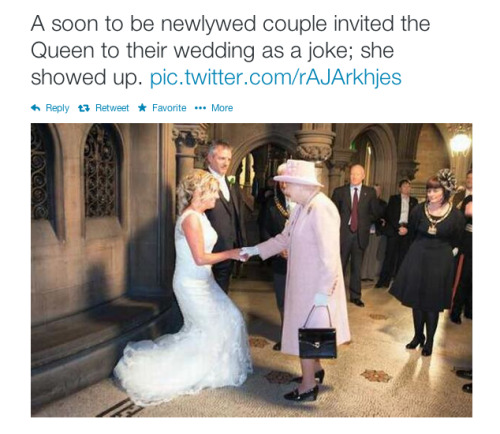
Can you imagine the conversation though?
Queen: I’m going
Chief of Staff: But, Your Majesty, the security risks…
Queen: I’m going I want cake
Chief of Staff:
Queen:
Chief of Staff:
Queen: I want cake
Bride: Eh, it’s fine, it’s not like the Queen is coming
Groom: Totally
Queen: Heyoooo
Hey. Tangency? You're supposed to let me know about these things.
firehoseautoreshare
36 million views already.
This is what I get for going away for three months, I tells you what!
Scully in 2x16 - ‘Colony’
firehosevia Tadeu
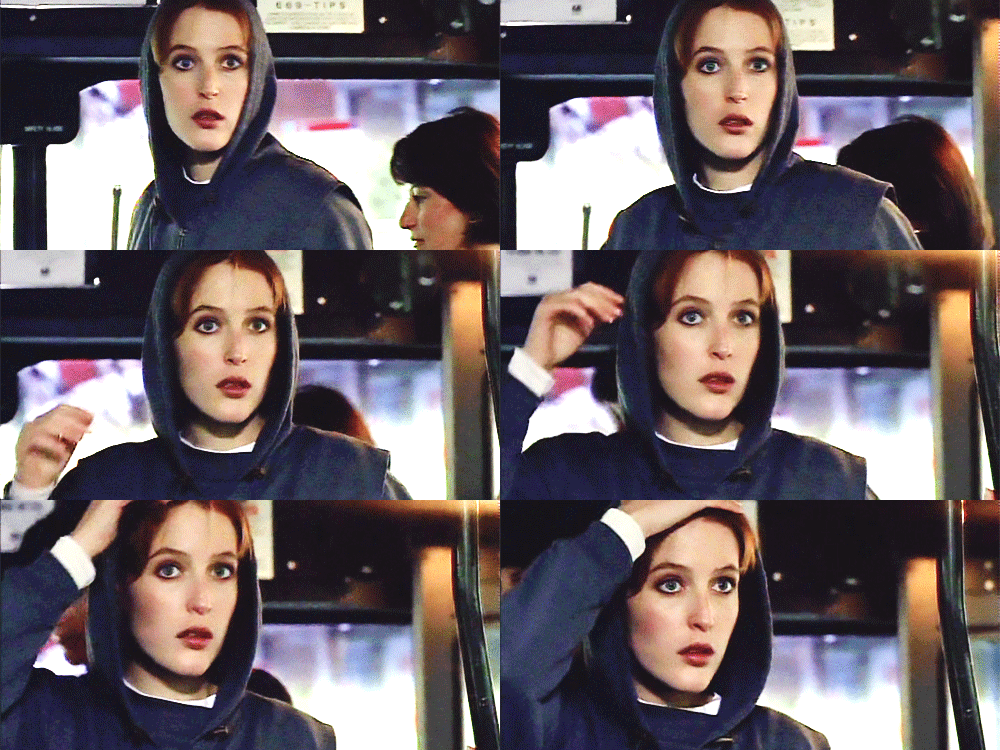

Scully in 2x16 - ‘Colony’