firehose
Shared posts
02 Jun 15:52
Negroni by Colette Patterns
by russiansledges
firehosevia Russian Sledges
meanwhile, in Portland
For men that like a classic, slightly retro shirt with a more modern cut, this shirt pattern is just the thing. The instructions will guide you gently through every step of creating a well-crafted casual shirt: felled seams, a lined back yoke, and sleeve plackets on the long sleeve version. Subtle details include a convertible collar (also known as a "camp collar") and midcentury style collar loop detail.
Tertiarymatt, firehose likes this
02 Jun 15:50


Nicholas Galanin Is Part of a Generation That Is Redefining “Native”
by Erin Joyce
firehosevia Elena Bulygina
exhibition title: “I Looooove Your Culture: Hipsters in Headdresses"
Nicholas Galanin, “Things Are Looking Native, Native’s Looking Whiter” (2012) (all images copyright the artist)
SAN FRANCISCO — How would you describe the art of Native Americans? If you were unfamiliar with the field of Native American contemporary art then you might muse on woven rugs in rich hues, ceramic vessels, silver jewelry inlaid with turquoise, petroglyphs etched or painted on sandstone walls, and carved totems with animal motifs. However, it is not the whole truth of what is going on in the indigenous art world as recent exhibitions, including at the Power Plant in Toronto and Wilmer Jennings Gallery in New York, suggest.
“I Looooove Your Culture: Hipsters in Headdresses” bowties
For several decades, younger generations of Native American artists, more commonly called First Nations artists in Canada, have ventured beyond their traditional aesthetics to make work that deals with and references contemporary culture in tandem with their indigenous roots. Artists like Da-ka-xeen Mehner (Tlingit/N’ishga), C. Maxx Stevens (Seminole), and Tanis Maria S’eiltin (Tlingit), to name a few, are widely exhibited both domestically at major museums and galleries, as well as internationally. In addition to the rising presence of Native Americans on the contemporary art scene, they are making their mark in the fashion world too.
It is clear that interest in Native American design is ripe, if controversial. A number of recent debacles in the fashion and entertainment industry appropriated “native” motifs in various unauthorized and disrespectful contexts. From the 2012 Victoria’s Secret controversy surrounding the lingerie ensemble donned by model Karlie Kloss, which featured a war-bonnet and squash blossom necklace to the photo shoot of actress Michelle Williams done up in “redface” on the cover of AnOther magazine or singer Gwen Stefani scantily clad in “Indian” garb for her 2012 music video “Looking Hot” (that was subsequently removed from all media outlets), and event the lawsuit against Urban Outfitters for its “Navajo” panties that same year, the use of native imagery as if it is not a living and breathing culture is shocking. These were shameful transgressions, but some Native American artists are venturing into the world of fashion too, reclaiming the respectful use of their culture’s aesthetic in new and interesting ways.
Nicholas Galanin, “Inert” (2009)
One such voice is that of Tlingit/Aleut artist Nicholas Galanin, whose recent Vancouver exhibition was satirically titled I Loooove your Culture and took place at Trench Gallery. From conceptual art installations to his career as a musician, and newer projects flowing into the world of fashion and even salmon fishing, Galanin lets his creativity bleed into a myriad of avenues of expression, both visual and auditory. Galanin represents the hybridity that occurs living on the reservation in the digital age.
Portrait of Nicholas Galanin
Born in in Sitka, in southeastern Alaska, Galanin first got involved in the visual arts by learning the traditional crafts of his tribe from his father and uncle, then headed to London to study at London Guildhall University — an experience that pushed him to explore new artistic terrain. “They [Guildhall] thought my work was too literal,” says Galanin. “They didn’t want me to do it.” Galanin confesses that the Native-American aesthetic he began with while studying in London was not met with approval, and that he was encouraged to go beyond what he knew as a Native-American artist and embrace a more diverse approach to aesthetics and practice. Following his stint in London, where he received a bachelor’s degree in jewelry design, Galanin headed down south, way down south, and enrolled in the graduate school at Massey University in New Zealand, where he furthered his study of native arts and earned a graduate degree in Indigenous Visual Arts in 2004.
Galanin embraces contemporary aesthetics but laces them with elements of his own culture. From pieces like his recent print series that take Andy Warhol’s factory aesthetic of pop-bright colors and graphic contrast and marries that with iconic, historical images of Native Americans superimposed with text, to his film project featuring a break-dancer dancing to the beat of Native chanting and drums, hybridity is a driving force.
Nicholas Galanin, “Operation Geronimo” (2013)
Galanin wants his work to link his heritage and contemporary culture, but does not want to impose any predetermined idea of what that means. “I don’t want to force them to sit together,” he adds. Galanin stresses that “you have to use your own unique perspective, we all have one. Use your own unique perspective and try to contribute and not just consume.”
There is a give and take, an engagement between the politics of seeing and the act of creating that exists in Galanin’s work. This tension is interestingly echoed in a recent foray into fashion. “I’ve made some ties and recently completed a course on shoemaking,” he explains. The fashion label Beyond Buckskin Boutique, which calls itself “the first ever Native American-operated online gallery store specializing in Native-made fashion, jewelry, and accessories,” features Galanin’s work, which is partly an attempt to reclaim agency in the aesthetic of tribal-influenced garb.
Nicholas Galanin, “White Carver” (2012) installation
Galanin is sure to be more visible this year. His work will be included in group shows at the Museum of Fine Arts Houston, Five Myles in Brooklyn, the Craft and Folk Art Museum in Los Angeles, and the National Gallery of Canada. He also recently received a fellowship from the Eiteljorg Museum in Indianapolis.
Nicholas Galanin, “Get Comfortable” (2012), C-print, 1 of 10 32in x 44in
“Culture cannot be contained as it unfolds,” he explains in his artist statement. “My art enters this stream at many different points, looking backwards, looking forwards, generating its own sound and motion. I am inspired by generations of Tlingit creativity and contribute to this wealthy conversation through active curiosity. There is no room in this exploration for the tired prescriptions of the ‘Indian Art World’ and its institutions. Through creating I assert my freedom.”
This Is Not A Silent Movie: Four Contemporary Alaska Native Artists continues at the Craft and Folk Art Museum in Los Angeles (5814 Wilshire Boulevard, Miracle Mile, Los Angeles) until September 8.
Natalia Pokrovskaya, Masha Vorslav likes this
02 Jun 15:46



Photo
firehosevia Snorkmaiden
Clara is a master of thoon
Tertiarymatt and -1 others like this
02 Jun 14:43
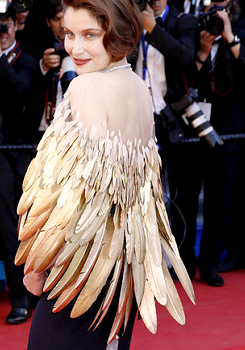
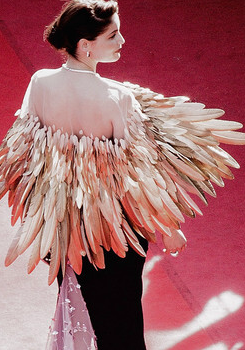

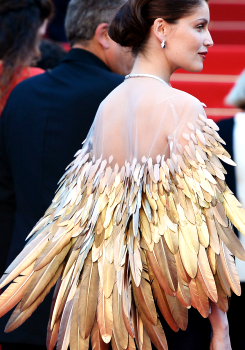
manticoreimaginary: Laetitia Casta, Cannes Film Festival (May...
Laetitia Casta, Cannes Film Festival (May 26, 2013)
Memo to Laetitia: don’t forget, Freya needs her featherhame back by Saturday.
Rickatyahoodotcom, Tertiarymatt likes this

02 Jun 08:12
Addressed The Race Issue
by Not Always Right
Call Center | Edmonton, AB, Canada
(I work at a technical service call centre. A call is taken by an African-Canadian tech.)
Tech: “Thank you for calling [name of company]. My name is [name]. How can I help you?”
Caller: “Oh, thank God they gave me somebody white! The last time I called they expected me to talk to some stupid n*****.”
(The tech is perfectly calm.)
Tech: “Sorry about that, sir. How can I help you?”
(The call proceeds as normal. The tech troubleshoots with the caller, and decides new software is needed. He offers to ship the software.)
Tech: “Just to make sure, can I reconfirm your address?”
Caller: “Oh, sure. It’s [full street address].”
Tech: “Thank you. Oh, and before you go, you ought to know that I’m the biggest, blackest mother-f***** you’ll ever meet in your life, and I know where you live. Good day.”
Tertiarymatt, Rmahmud77 and 3 others like this
02 Jun 05:39
Michele Bachmann Figures Why Not, Introduces Homosexual-Beheading Bill
WASHINGTON—Saying that she’ll be gone soon anyway so she might as well, Minnesota congresswoman Michele Bachmann introduced H.R.
firehose likes this
02 Jun 05:36

Journal site Xanga tries to fend off an impending shutdown with fundraising drive
by Adi Robertson
firehoserofl
It's a sad day for the old internet. Xanga — which has long tagged behind LiveJournal as a journaling platform — is running out of time: in a blog post, the team behind it said they'll be forced to shut the site down if they can't raise $60,000 by July 15th. "The status quo is no longer possible," says the team, revealing that the "expensive" lease on its network facility is almost up. And while the team could try to revamp the site or sell to a larger platform, they're realistic about their prospects. "The thing is, it's really hard to grow a social site that has fallen from previous heights. MySpace, Friendster, LiveJournal... lots of people have tried to resurrect these sites, and it has rarely, if ever, worked."
"Lots of people have tried to resurrect these sites, and it has rarely, if ever, worked."
The $60,000, Xanga's developers say, wouldn't be used to keep the site in its current form. Instead, it would pay for a new, cheaper data center and a webmaster, who would port Xanga's existing journals to an open-source blogging platform like WordPress. If it survives, Xanga won't be free for bloggers: the company's crowdfunding page will grant a one-year membership for $48, or $4 a month. Accounts for non-writing users will be free, allowing people to leave comments or follow others.
If the goal is reached by July 15th, "Xanga 2.0" will launch soon after, with all existing accounts migrated; otherwise, users will be given time to download posts before they're deleted. Some new features will be thrown in to sweeten the deal for paying writers, including group blogs, threaded comments, and better moderation tools. The main goal is clearly to keep the site open for dedicated community members, turning it from a business effort to a safe haven kept mostly afloat by volunteers. Unfortunately for users, even the Xanga team doesn't seem terribly optimistic about its future. This could be Xanga's chance to rally its supporters, but somewhere, my teenage self is crying.
- Via Valleywag
- Source Xanga
- Image Credit Loop_oh (Flickr)
- Related Items social media social network shutdown journaling xanga
02 Jun 05:16



Bunday Bunny Flip
firehoseI DO PARKOURRRRRRR
Submitted by: Unknown
Russian Sledges, Cooper Griggs and 3 others like this
02 Jun 05:13


Film: Newswire: Whoopi Goldberg cast in Teenage Mutant Ninja Turtles and it's the weekend so whatever, bye
by Sean O'Neal
Comedian and View sass-pot Whoopi Goldberg has joined the eclectic cast of the Michael Bay-produced Teenage Mutant Ninja Turtles, and also it’s 5 p.m. on a goddamn Friday. According to a report from Comic Book Movie, Goldberg will play “Bernadette Thompson,” a gender-flipped revision on the “Burne Thompson” character who bossed around April O'Neil in the Ninja Turtles cartoon series. According to us, it’s the motherfucking weekend.
Anyway, here’s a picture of Goldberg leaving the Ninja Turtles set in a weirdly gigantic jumpsuit, and her hair is all crazy, and whatever, we'll see you on Monday.

02 Jun 05:10
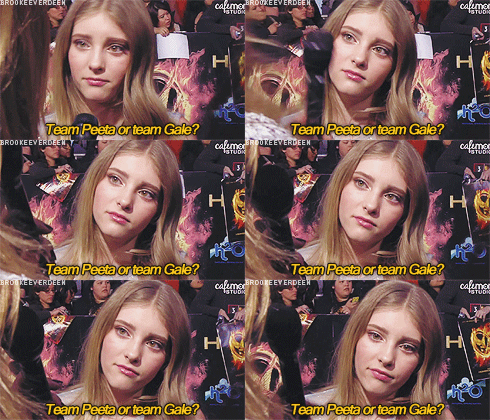

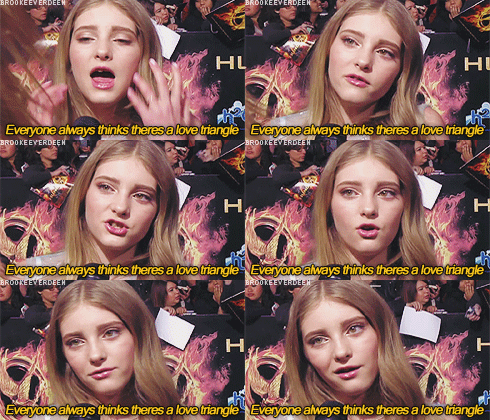


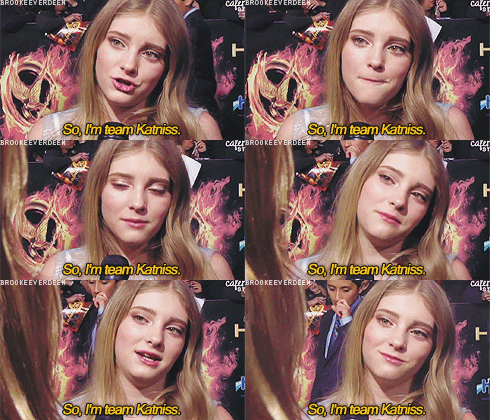
peetaslongbun: Oh hey look, a 12 year-old just grasped the main...
firehosevia Osiasjota, Lori
her expression in GIF 2, A+
Oh hey look, a 12 year-old just grasped the main concepts of The Hunger Games more accurately than most media networks.
Fpviper, Jeffchisholm and 2 others like this

02 Jun 05:00
Study: Generation X Fares Poorly During Recession
by gguillotte
A Pew Charitable Trust study, titled "Retirement Security Across Generations," examined the savings behavior of five age groups before the Great Recession hit and found that Gen Xers - the group of Americans following the baby boomers and range in age from 38 to 47 - fared especially poorly during the recent economic down swing. As a result, their retirement years will likely be more tarnished than golden.
The study, using data from 1989 through 2010 collected by the Federal Reserve Board and the University of Michigan, found that between 2007 and 2010, Gen Xers lost nearly half of their overall net worth, an average of about $33,000, and also had higher levels of debt than previous generations.
A large part of the reason their debt is so high is because of student loans and credit card debt, Erin Currier, who directs Pew's economic mobility project, told ABC News. "They're younger in their professional career relative to other cohorts," she said. "Wealth is a mixture of all kinds of things - savings, personal accounts, investments."
What's more, although Gen-Xers (who earned their moniker from Douglas Coupland's 1991 novel, " Generation X: Tales for an Accelerated Culture"), did see high financial gains as a result of the housing boom, their overall rate of home ownership is lower than that of previous generations.
02 Jun 04:52


meerminshoes: Meermin’s Balmoral boot now available in Black...
firehosevia multitasksuicide
Meermin’s Balmoral boot now available in Black Shell Cordovan.
Check them here: http://www.meermin.es/ficha_articulo.php?idioma=eng&id=4053
We hope you like them!
02 Jun 04:35
After Earth Is Will Smith's Love Letter to Scientology -- Vulture
by OnlyMrGodKnowsWhy
Wow, thanks, @jhw. No wonder Jaden wants to be emancipated!
Will Smith has never spoken openly of his connections to the Church of Scientology, but they are well documented. Whether or not Smith is a devout member or simply curious about this Hollywood faith, he has visible ties to the group. In 2007, he donated $122,500 to several Scientology rehabilitation organizations. Two years later, he and wife Jada Pinkett Smith opened California's New Village Leadership Academy, a private school founded on the teachings of Scientology creator L. Ron Hubbard. Yet to this day, when asked about his own involvement, Smith suggests close friend Tom Cruise introduced him to the practices of Scientology, but that he's not a member. He's simply a "student of world religion."
The clearest evidence of Smith's investment in Scientology might be his newest blockbuster film — this weekend’s After Earth. Based on a story by Smith (and a script by Gary Whitta and director M. Night Shyamalan), the film is a father-son adventure that teams the superstar with his wunderkind offspring Jaden. Together, they traverse the dangerous landscapes of a creature-ridden future Earth. Surprisingly, what's been advertised as an Avatar remix plays out more like Battlefield Earth, another film that hews to the tropes of a science-fiction epic — just like Hubbard's doctrines for Scientology. Here’s how the film parallels the faith’s teachings:
The Movie's Villain Is Emotion
"Danger Is Real. Fear Is a Choice," reads the tagline on the After Earth posters. Its vast cosmology aside, at its core, Scientology is about setting doubts and conflict aside in order to value the self. That's the main hurdle for Jaden's character Kitai Raige, who finds himself failing to measure up to his commander father, Cypher. The film is set 1,000 years after humans have departed an ecologically devastated Earth. Mankind is asserting itself as an intergalactic military presence on the outskirts of the universe. There is only one problem: Their new planet, Nova Prime, hosts a vicious alien race that feeds on fear. Luckily they have Cypher — he's known as a "ghost," a human who can suppress his emotions and the accompanying pheromones that allow the aliens to sniff people out.In Scientology terms, Cypher is a properly cleansed "thetan," the Church's version of a soul. He's calm and collected, empowered without having to demonstrate that power. As Cypher puts it in the film, "fear is imaginary," and if a person is able to see past that illusion, they can be maximally effective. Kitai is the opposite of his father. In Church terms, he is a misguided thetan — full of rage, haunted by memories, and terrified when out of his comfort zone. He has a desire to be a hero, but it’s not instinctual. His choices are guided by what he thinks are his father's demands. Hubbard's writing has indicated that Scientology's goal is to rehabilitate a thetan's control over MEST (matter, energy, space, and time). Kitai’s journey over the course of the film is that pursuit. He must regain control over the physical world through management of his fear.
Will "Audits" Jaden Over the Course of the Movie
One of the most powerful moments in 2012's The Master is when Lancaster Dodd (Philip Seymour Hoffman) "processes" Freddie Quell (Joaquin Phoenix). An interrogation meant to peel back the layers of the emotionally damaged sailor, it's a riff on Scientology's practice of auditing. The Church believes people are stricken by engrams, mental images akin to memories that cause pain and confusion. Members of Scientology are audited to rid themselves of these emotional blockades by talking through them while using an E-meter (a device that tracks electrical resistance) to measure precisely where the engrams live.The bulk of After Earth is essentially that scene from The Master on a blockbuster scale. Following a crash landing on Earth, circumstances require Cypher to remain at a control panel while his son battles his way through the wild. Kitai can barely take a step outdoors without flashing back to a moment when he witnessed someone's death back home. Thankfully, Cypher is able to audit him from afar. Coached by his Dad, Kitai finds inner peace, the knowledge that he's stronger, faster, and more capable than anything Earth throws at him. Cypher even has a futuristic version of an E-meter at his disposal — Kitai's "Smart Fabric" suit delivers up-to-date health stats to his auditor. Heart rate is going up? Kitai must be lying or afraid or unable to cope with his pesky engrams.
Level Up
After Earth is essentially a map of Scientological development. It's a man-vs.-nature story because Scientology suggests that all of life is just that. Before Kitai is set on his journey of personal discovery, he trains to be a Ranger (like his father) in the fashion of Scientology students. Smith's New Village Leadership Academy is said to employ the techniques of "Study Tech," a Hubbard concept that focuses on climbing the ladder. Kitai's biggest woe is that he can't reach the next level of military school. That's par for the course in Scientology, where learning is described as a gradient, "a gradual approach to something, taken step by step, so that, finally, quite complicated and difficult activities or concepts can be achieved with relative ease." It’s one of the parts of Scientology that many have focused on — the idea of having to pay for classes in order to advance upwards through the religion’s levels. Some critics have compared After Earth's structure as being like that of a video game, Kitai going from level to level. That's really Study Tech.It's only when he reaches Earth and is audited by his father that the trainee looks inward and aligns himself with the priorities of Scientology. For the Church, life is subdivided into eight "urges of survival," known as dynamics. The first dynamic prioritizes survival of the individual over everything else. In the film, Kitai confronts harsh elements and outruns hoards of animals all to save his father, but he's only able to succeed because of self-actualization. Typically, a hero might pick up skills and adapt to an alien environment. Not in After Earth, where Kitai separates himself from everything he knows in life and invests in his potential invincibility. He quests on, trusting his own abilities even when there hasn't been an established reason to trust them.
Anti-Psychiatry Aliens?
With After Earth's Scientology roots in mind, every element starts to ring familiar in the context of the religion. The threatening alien, turned murderous by the scent of emotion, is a literalization of the organization's hard stance against psychiatric medicine. From the very beginning, Hubbard was critical of psychiatry, calling it an evasive practice that sidelined spiritual thinking. In his paper "Crime and Psychiatry," he claims that psychiatrists "advertise man as a push-button stimulus-response robot" and use inhumane practices to elicit response. That's the role of After Earth's blind, carnivorous beast, who hungers for fear while simultaneously provoking it.Without being too obvious, Smith has delivered an incredibly mainstream platform for the Church's ideology. After Earth’s subtext makes every beat feel like a nod to the lessons of L. Ron Hubbard. Fleeing Earth to another planet only to return to home mirrors the idea of thetan resurrection. The ship Cypher and Kitai take on their mission isn't that far off from the Douglas DC-8–esque ship that took Xenu's kidnapped souls to earth. And the prominently advertised volcano that functions as a backdrop to a large After Earth set piece? Just look at the cover to Hubbard's book that started it all —Dianetics.
02 Jun 04:29
Why-Bunnies-Dont-Swim-632x842.jpg (JPEG Image, 632 × 842 pixels) - Scaled (95%)
by OnlyMrGodKnowsWhy

firehose and -1 others like this
02 Jun 04:25
BBC - Blogs - Doctor Who - Matt Smith announces he is to leave Doctor Who
by gguillotte
firehoselol!
The BBC is today announcing that Matt Smith is to leave Doctor Who after four incredible years on the hit BBC One show. Matt first stepped into the TARDIS in 2010 and will leave the role at the end of this year after starring in the unmissable 50th Anniversary in November and regenerating in the Christmas special. During his time as the Doctor, Matt has reached over 30 million unique UK viewers and his incarnation has seen the show go truly global. He was also the first actor to be nominated for a BAFTA in the role.
02 Jun 04:21


Cool, cool, cool: Dan Harmon is officially back on Community!
by Lauren Davis
firehosewhaaaaaaat

Earlier this week, we heard that Dan Harmon was in talks to return to Community, and today, our greatest hopes have been confirmed. Hugs all around, people.
    
|
firehose and -1 others like this

02 Jun 02:21
A Feast of Fire and Ice
by Jill Harness
firehosevia Tadeu
"Westeros-themed bakery"
what

Thursday night, New York City residents who are fans of Game of Thrones were able to enjoy A Feast of Fire and Ice at Percy's Tavern, thanks to the bar's owner, Larry Watson, and Westeros-themed bakery owner Claudia Smith. The event featured a costme contest, dead boars, goblets of poppy milk, fortune telling and more.
Victoria McNally of Geekosystem was there and her pictres from the event are the next best thing to going in person.
Toaster Strudel, Tadeu and -2 others like this
02 Jun 02:10

Can you smell what the Doc is cookin’? #dropsmic
Can you smell what the Doc is cookin’? #dropsmic
firehose likes this



02 Jun 02:06
Opposition Mounts To Oracle's Attempt To Copyright Java APIs
by timothy
An anonymous reader writes with a bit from Groklaw: "The remarkable outpouring of support for Google in the Oracle v. Google appeal continues, with a group of well-known innovators, start-ups, and those who fund them — innovators like Ray Ozzie, Tim O'Reilly, Mitch Kapor, Dan Bricklin, and Esther Dyson — standing with [Thursday's] group of leading computer scientists in telling the court that Oracle's attempt to copyright its Java APIs would be damaging to innovation." As usual, Groklaw gives a cogent, readable introduction to the issue. 


Read more of this story at Slashdot.