firehose
Shared posts
How Japan Copied American Culture And Made it Better
Cards Against Humanity and the art of hyper-local crowdsourcing
firehose'Temkin began a video call with a woman who turned out to run a Boston-area printing house, and she brought her phone over to a press to show the attendees freshly cut sheets of the cards they had created together with the Cards Against Humanity developers less than an hour beforehand.
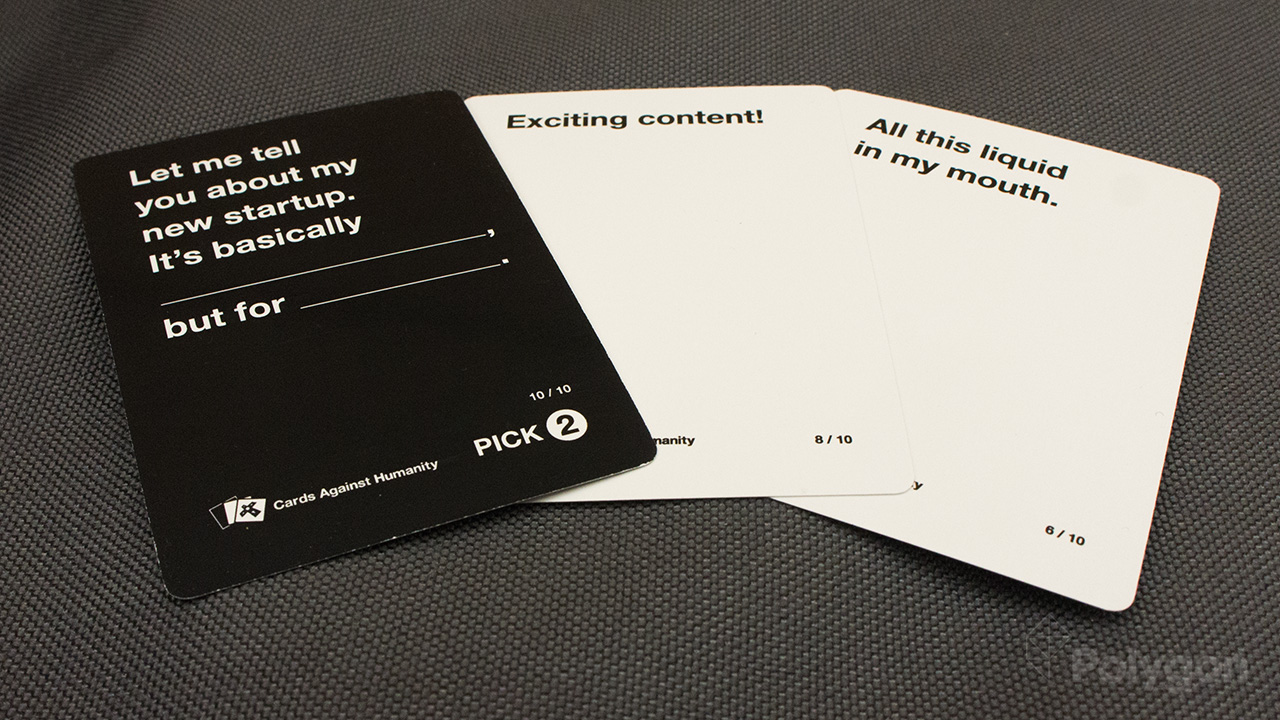
Temkin followed up with the kicker. The cards being printed at the time would be packed up and shipped to the Boston Convention and Exhibition Center for Saturday, April 11. He told everyone to find the pin taped under their seat — a pin good for a pack of brand-new, PAX-East-2014-panel-exclusive Cards Against Humanity cards that they had a hand in making. You can see three of them working together below.'
Seven co-creators of Cards Against Humanity spent much of their PAX East 2014 panel soliciting suggestions that would, presumably, make it into future expansions for "the party game for horrible people." It's unlikely, however, that the audience expected to see their ideas realized quite so soon.
Here's a brief primer for those unfamiliar with the game. Cards Against Humanity can be described as an adult-oriented version of the card game Apples to Apples. In the standard version of the game, one player selects a black card, which contains a prompt of some kind — a question to be answered or a statement with blanks to be filled in. Each of the other players submits a white card (or multiple ones, if there's more than one blank) to respond to the prompt, and the first person selects what they judge to be the best answer.
The co-creators used the panel — which took place in a room packed with hundreds of Cards Against Humanity fans — as a giant brainstorming session. The panelists explained that they can spend hours coming up with cards and refining them, and with an original game and four main expansions under their belt, they've developed pretty high standards for new entries into the game.
"that's a tweet"
They quickly dismissed plenty of ideas, and often for reasons that might not have been immediately apparent to the audience. Sometimes the suggestions simply weren't funny, or they were too crass or too tasteless (in other words, crass or tasteless without being funny). Sometimes, the cards were too similar to existing cards. Some white cards wouldn't work with enough of the black cards; some black cards were too limiting. Some white cards worked as jokes on their own, but wouldn't fit as responses to black cards — "that's a tweet," co-creator Max Temkin (pictured above at left) explained.
But in many cases, the panelists found a nugget of something compelling about a particular card, then spitballed alternate ways of wording it. Comedians know that the presence or lack of a single word, or a shift in the order of a sentence, can make all the difference in how hard a joke hits.
One attendee suggested some version of the phrase "the floor is actually made of lava" as a white card. The Cards Against Humanity makers immediately tweaked it to "a floor that is literally made of lava. Later on, when the panelists were winnowing down the list of suggested cards, co-creator David Pinsof (fourth from left above) said, "I could lose the 'literally' on 'the floor made of lava.'" But the others downvoted that thought, and an audience vote agreed, so 'literally' stayed.
"a floor that is literally made of lava"
The panelists kept teasing a special surprise for the end of the show, and they didn't disappoint. Temkin began a video call with a woman who turned out to run a Boston-area printing house, and she brought her phone over to a press to show the attendees freshly cut sheets of the cards they had created together with the Cards Against Humanity developers less than an hour beforehand.
Temkin followed up with the kicker. The cards being printed at the time would be packed up and shipped to the Boston Convention and Exhibition Center for Saturday, April 11. He told everyone to find the pin taped under their seat — a pin good for a pack of brand-new, PAX-East-2014-panel-exclusive Cards Against Humanity cards that they had a hand in making. You can see three of them working together below.


How to mitigate tracking risks: wrap your phone in tinfoil, quit Google

WASHINGTON, DC—When author Julia Angwin has to post a photo of herself online, she now prefers to use a stencil image of her face in order to avoid detection by facial recognition software. Welcome to her paranoid world of trying to frustrate increasingly sophisticated snoops.
In conducting research for her impressive new book, Dragnet Nation: A Quest for Privacy Security and Freedom in a World of Relentless Surveillance, the investigative reporter delved deep into the current state of ubiquitous online surveillance and data mining by corporate and government actors. Speaking at the New America Foundation in the nation's capitol on Wednesday afternoon, Angwin described how, in the year leading up to the book’s publication, she decided to internalize the focus of her inquiry. She used her own attempts to “reclaim her privacy” as a case study for the challenges in eluding the digital dragnets.
As any number of articles from the last year may indicate, privacy in a post-Snowden culture is extremely difficult to attain. Angwin’s book describes the current dragnets as “indiscriminate” and “vast in scope,” explaining that the East German secret police, known as the Stasi—described by some as one of the most effective and repressive intelligence and secret police agencies to ever have existed—would have been in awe of the National Security Agency’s current capabilities. "The Stasi managed to generate fear with a fraction of the tools we currently have,” she explained in her talk.
Read 15 remaining paragraphs | Comments
Elite Dangerous, Nostalgia, Joysticks & Returning To Space
firehose'here I sit, a 35 year old man sat at a desk, with a £120 joystick stuck to it with suction pads, flying a pretend spaceship, and I couldn’t be happier. A big part of me wishes it weren’t Elite, it didn’t come from the Rich Old Men Of Kickstarter, it hadn’t been funded based only on vague promises, that it wasn’t doing the the increasingly discomfiting, high cost alpha/beta funding it’s currently using to print money, that it was something brand new – but it isn’t, and it is still so good. Already so good, with so much more to come.'
By Alec Meer on April 11th, 2014 at 3:00 pm.

I come and go on old franchises and old ideas being resurrected by rich old men for rather less rich and old men and women. Sometimes it seems like a roadblock to fresh invention, other times it seems like returning to roads that games were forcibly and unfairly turned away from as forces of marketing and demographic-chasing decided they weren’t suitably commercially viable. For example: space sims didn’t all but die out because the possibilities were exhausted. They all but died out because they required huge budgets to pull off well, but could not command the sort of easily advertised-at mainstream audience required to earn their keep. What remained turned inwards, servicing the very particular demands of a passionate few, and making themselves all the more inaccessible to those who were interested but not quite so fervent about it.
The comeback, thanks to the removal of almost all middlemen and the ability to engage directly with an audience large enough but spread far and wide, is something I find incredibly exciting. After having barely touched space games for years, I now find myself owning a £120 joystick and obsessed with Elite 4.

I peer back into the mist of early teenage years stranded in the countryside with a 486 as almost my only companion, and space games were so important to me. Elite: Frontier, TIE Commander and X-Wing, Privateer… Then, around 1997, it stopped, or at least seemed to. Part of that was me, as the earliest stages of an alcohol-orientated social life flickered into being, and part of that was the genre becoming less exciting and more elaborate – though it meant I missed out on some of greats, such as Freespace, I-War and the last worthwhile Lucasarts efforts.
Look to the turn of the century and the writing’s on the wall. Plenty of space games, yes, but what a mess: a split between poorly-received licensed drek and deep-dive sims with narrow appeal. Where’s the seat of the pants stuff? Where’s the fantasy of it all? Where’s the game that makes me want to stick a cardboard overlay on my keyboard, or buy a new joystick? Where’s the space game that matches the thrill and escapism of the first-person shooters of the time? Years later still, I dallied with Freelancer, but much as I liked it, somehow it wasn’t quite there.
April 2014. My desk is overwhelmed by an enormous flight stick, made of two shoebox-sized components bearing over 30 buttons and clad in surprisingly sleek, industrial black and chrome colours. This Saitek X52 Pro ‘HOTAS’ was designed for resolutely Earthly flight sims, but it absolutely looks like the controls for a spaceship. Springs and switches, resistances and triggers – just holding it, moving it, is incredibly satisfying even before it’s connected to anything. It cost me too much money. How I agonised over it. It was immediately worth it. I’ve never before been so enamoured of a game controller.

On my screen flickers alpha 3 of Elite: Dangerous, unofficially aka Elite 4, and David Braben and Frontier’s first return to the series which made him in almost twenty years. It has an extremely troubling alpha/beta access business model, and it is mere rudiments of the game it is promised to one day become, but it is beautiful. And it is thrilling. I reach for the throttle on the immense flight stick, ease it forward. The screen shudders in immediate response, and my cockpit glides towards and through an steroid field. It’s one of the best feelings on Earth.
I hit the afterburner button, and unconsciously push myself backwards into my chair in response to imagined g-force. I flip open a small hatch and hit the seductively red button beneath, which causes the ship’s weapons to deploy with a wonderfully mechanical sound. I flick a D-pad on the neck of the main stick, setting an enemy Sidewinder as my target.
Then…. Then it all becomes too instinctive to describe. This is 3D space. It needs 3D controls. ‘Left’, ‘right’, ‘up’ and ‘down’ mean so little here. A mouse would mean 2D space. A gamepad is better, but no, thumbs alone could not sell this fantasy. A clenched hand held aloft, a wrist rotating in all directions, another hand pushing and pulling a throttle to create speed, that’s what’s needed.
A short dogfight against AI, from one of my earliest experiences with Elite Dangerous. Video goes up to 1440p, if you like.
I twist and turn and strafe and drift, fighting to keep the Sidewinder in my sights, gradually scouring away its energy shield then burning destruction into the hull beneath. The noises are right. The colours are right. The sense of trying to haul several tonnes of metal through a vacuum is right. The movement is right.
Afterwards, I return to a space station and commence the singular pleasure of docking. Gentle, careful movements, easing my ship into an enormous space station that yawns around me like the maw of a metal god. It is mere pixels I know, but I am completely sold on the fantasy of this being the pinnacle of future-human engineering. I lower the ship to the landing pad, a little less messily than last time, but no less tense. This is extreme piloting. I don’t care it’s accurate, if it’s Newtonian or arcade pyhsics, I just care about how it feels. I care about getting back to what was left behind, or what I imagined was left behind.

So yes, the movement is what I imagined two decades ago, when there was so much more abstraction between eye and screen, hand and controls, when a controller like this was unimaginable. It is a strange and slightly sad thing, to have come full circle but to need hundreds of pounds worth’ of technology at my disposal, and hundreds of thousands of pounds’ worth of person-hours creating these scenes, in order to do what my imagination could do back in 1994. But the adult mind criticises in a way a childish one did not, and the tireless march of technology means expectations have inevitably raised. Meeting them, having a space game experience which feels like the space game experiences I had in my youth, is costly and elaborate. There is guilt to that, but there’s also excitement. We’re back where we left off. Maybe this is where we’d have ended up anyway. Who can know?
This much I know: here I sit, a 35 year old man sat at a desk, with a £120 joystick stuck to it with suction pads, flying a pretend spaceship, and I couldn’t be happier. A big part of me wishes it weren’t Elite, it didn’t come from the Rich Old Men Of Kickstarter, it hadn’t been funded based only on vague promises, that it wasn’t doing the the increasingly discomfiting, high cost alpha/beta funding it’s currently using to print money, that it was something brand new – but it isn’t, and it is still so good. Already so good, with so much more to come.

I think of the year ahead, the other space games to come, and the guilt is tempered, the excitement grows. No Man’s Sky, Infinity, Rodina, the even more unsettling but perhaps also even more promising Star Citizen – reasons for this joystick, reasons to escape from a gaming world of soldiermen and lanes and free to play cashgrabs that I feel increasingly disconnected from, reasons to be cheerful. Reasons, after all these years of finding flight games so unappealing, to fly.
I push the throttle forwards. An impossible engine shudders into life. The cockpit shakes. The stars melt around me. The separation between body and screen disappears. If anyone saw me now, they’d laugh at me. I wouldn’t care a jot. I needed this. I don’t know how I ever lost it.
The Elite Dangerous alpha is out now for an absurd £200, or the forthcoming ‘Premium beta’ is £100. Standard beta is £50. Honestly, just wait a while. Yeah, the stuff that’s in there so far is great, but it’ll still be great, and there’ll be loads more of it, a few months from now, when you won’t have to pay so much.
I’ll be writing more about the X52 Pro and some other joy/flight sticks very soon.
Blizzard reveals Hearthstone single-player campaign
firehoseonline single-player game beat; don't play Hearthstone beat
 Blizzard announced its upcoming Hearthstone: Heroes of Warcraft single-player Adventure Mode at PAX East today, detailing the challenges players will face as they progress through the new Curse of Naxxramas campaign.
Curse of Naxxramas features a...
Blizzard announced its upcoming Hearthstone: Heroes of Warcraft single-player Adventure Mode at PAX East today, detailing the challenges players will face as they progress through the new Curse of Naxxramas campaign.
Curse of Naxxramas features a...
The Internet is your storytelling campfire in Storium [Update]
firehoseI'll be dicking around with this shortly
 Ever tell ghost stories around a campfire? Or recount your life's adventures at a party? Storium by Stephen Hood aims to recreate those experiences, with the Internet acting not only as your audience, but your collaborators. You begin by choosing a...
Star Citizen's Arena Commander is the first tantalizing taste of a great space sim
firehose"Most delightful was the game's ability to cause a pilot to black out if they pulled too many Gs in a series of tight turns"? uhh
looking forward to actual gameplay footage and reviews before even considering throwing money at this
It started not with one crash, but two. But those dual crashes — one of a spaceship into an asteroid and the other of a Windows PC to a desktop — did little to dampen the enthusiasm of the hundreds crowded into Boston's Royale Club Thursday night.
They had come to witness the first really playable sign of a game they had so much faith in that they had backed its creation with cash, nearly $42 million in cash. And to this gathering of the space sim faithful, Cloud Imperium Games co-founder and CEO Chris Roberts was an icon.
So when, after several short delays, Roberts introduced the dogfighting module for the hotly anticipated Star Citizen to the crowd, they forgave his backing into an asteroid.
The crowd roared with delight when the minutely detailed space fighter exploded. They watched in rapt attention as the game went through it's animated introductory sequence again, and then a third time after a computer crash.
By the last time they were chanting for moments in the cut scene, and then cheered when it arrived.
For fans of a certain type of unforgiving space combat sim, games like Roberts' Wing Commander and Starlancer, Arena Commander was the first signs of a true predecessor for a genre many thought was dead.
The Arena Commander dogfight simulator will be the second major component of the game delivered to backers when it arrives in the next month or two.
The first piece of the game arrived last summer, when Cloud Imperium Games delivered a bit of software that allowed players to stroll through a digital hanger in the game's world.
This next step, Arena Commander, is actually a simulator built into the game's hangars that allow gamers to climb into their ships and sign into a virtual, virtual space to dogfight with other Star Citizen players.
During Thursday night's presentation, Roberts detailed the different play modes in the simulator, which includes eight versus eight free-for-all, four-on-four team play, capture-the-flag mode and player versus AI battles.
The dogfighting module, we were told, will also include leaderboards.
The next day, I had a chance to try my hand at a dogfight in the module. The game delivered as punishing and fantastic an experience as I recalled from my days playing those early space dogfighting titles, but with some major additions.
Most obvious was the incredible level of detail to the game's visual fidelity. Everything on the ship was animated, everything seemed to serve a purpose.
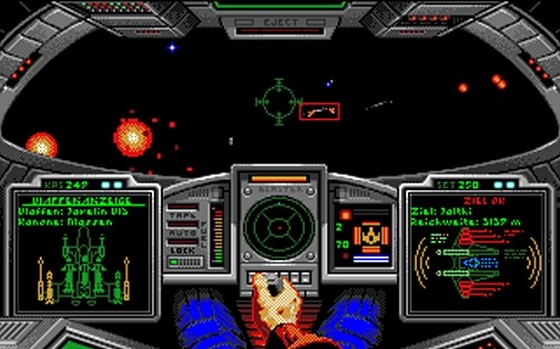
The ship's heads-up display was slick and futuristic and the controls allowed players to lean into the intricacies of space flight by doing things like quickly flipping the ship's view to travel backwards at high speeds and blast at following enemy ships.
Most delightful was the game's ability to cause a pilot to black out if they pulled too many Gs in a series of tight turns. The screen would begin to grey out and eventually go completely black for a few seconds, if a player wasn't careful.
The threat of a blackout caused me to completely change the way I flew and added a enjoyable level of tactics to my approach to a dogfight.
During the presentation Thursday night, Roberts also walked the gathered crowd through future plans for the long rollout of the game.
That includes plans for a Arena Commander 2 which would feature larger ships, the ability to fly and fight ships with larger crews, cooperative AI pilots and in-match communications.
Arena Commander 3, he said, would include more environments and the ability to enter a first-person shooter mode while trying to board and capture a ship.
Down the line, after the Arena Commander is fully realized, Roberts said the next steps will include the further development of the game's first-person shooter modes and the development and integration of the game universe's planetscape.
Crowd funding for Star Citizen launched on Oct. 10, 2012. Since then the game has brought in more than $41 million from nearly 500,000 backers.
‘This Is Iceland’, A Stunning Time Lapse Video Documenting the Northern Lights Over Iceland
Photographer Oli Haukur Myrdal has captured the stunning beauty of the Northern Lights over the Iceland sky in this time lapse video taken during the winter of 2014.





Mark on What’s Really Dangerous
Mark Bernstein: It’s Not C.
Any computer language capable of doing real work is also capable of being confusing, capable of being misused, capable of being subverted.
Mark’s right. Free computing is free speech.
I certainly don’t recommend banning C, as if anyone could. I don’t use it much, but when performance is an issue, I do. (Note that I need to update that code: needs more braces.)
However, it’s worth thinking about less-dangerous alternatives. Programmers will always make mistakes, and that’s why we do automated testing, static analysis, code reviews, and so on. That same reason — the inevitability of mistakes — is a reason to use higher-level languages when possible.
Unfortunately, “when possible” is just not very often when it comes to portable libraries such as OpenSSL. What would you write it in, if not C? I don’t know, but I think it makes sense to have an alternative language for this where you don’t have to be so damn careful with memory, where things like buffer over-runs are impossible.
I suppose that static analysis tools could get good enough to catch these errors. Maybe. C is so flexible that I just don’t know if they’ll ever be good enough. But if they get that good, then the culture and the tools have to make it so that no developer would ever fail to run and pay attention to static analysis results. That seems like a longshot to me, but I’d be pleased to be wrong.
An even bigger longshot is counting on developers to get better at testing. That’s like counting on people not to drink and drive. The culture has done a good job at stigmatizing this particular bad idea — but it still happens. That’s not to say we shouldn’t try — we should, definitely, for sure — but alone it’s not enough to fix the problem.
Though the OpenSSL bug affected servers, I note that most people don’t write their web services and sites in C. It’s do-able. You could, and surely some people are, somewhere. But to most of us it sounds crazy, and for good reason.
As computing evolves, the domains where C “sounds crazy” will continue to expand. Consider that people are already treating JavaScript as assembler (see CoffeeScript and TypeScript). As an industry we continue to move toward higher-level languages, and that’s a good thing.
I Was Assaulted For Wearing Google Glass - Business Insider
 |
firehose
shared this story
from  Tech. Tech.
|
After all, people acknowledge that the theft of someone's expensive jewelry is wrong, despite its price. Why were people laughing at my misfortune or implying I somehow deserved it?
But as responses have flooded in and I've looked back on the situation, I've started to understand where the people barraging me with angry tweets are coming from.
While I may not be a resident of San Francisco — I live across the Bay in Berkeley, where rent is affordable — or a wealthy young software engineer, I've worked in the city for three years. I'd like to live and work in or near San Francisco for the foreseeable future.
Unfortunately, anything associated with Google has come to represent gentrification in the city, from the buses that take young software engineers to their corporate campuses in Silicon Valley to Google Glass. This is especially true in areas where gentrification and income inequality have become points of conflict in the community.
stunningpicture: This is the first picture I was given of my...
dutchster: it took me a while to figure out what was wrong

Lynda Carter On Gal Gadot and the Return of Wonder Woman
firehose'"It's less about super powers and more about heart and intellect and a sense of right and wrong with a goodness in her.
"Often times, writers really want to take a male superhero and dress him up as a female - and that's just not who she is," Carter said.
Now wait just a minute, girlfriend! I've made a career out of such gender-bending.
"That's a whole different story," Carter said with a hearty laugh. "I'm saying they make Wonder Woman a macho Superman type character -- they make her mean -- and that's not who she is." '
 Glad as I am that Wonder Woman is getting some live-action screen time again, I do not envy Gal Gadot her job. Her role in the upcoming film Batman vs Superman will be the first time someone other than Lynda Carter has wielded the Lasso of Truth. Those are some big boots to fill.
As far as Carter's concerned, though, she's got Gadot's back. In a Huffington Post interview, she spoke positively about her successor, but was cautious toward the as-of-yet-unknown screenplay.
Glad as I am that Wonder Woman is getting some live-action screen time again, I do not envy Gal Gadot her job. Her role in the upcoming film Batman vs Superman will be the first time someone other than Lynda Carter has wielded the Lasso of Truth. Those are some big boots to fill.
As far as Carter's concerned, though, she's got Gadot's back. In a Huffington Post interview, she spoke positively about her successor, but was cautious toward the as-of-yet-unknown screenplay.

The Final Book In The Divergent Trilogy Will Be Split Into Two Films
firehoseno more trilogies
 News like this always makes me think of a quote from the movie Contact: "Why build one when you can have two at twice the price?"
As with The Hunger Games and the Twilight saga, Lionsgate/Summit has made plans to split the third book in the Divergent trilogy in twain. Allegiant, Part 1 is on track for release on March 18, 2016, with Part 2 hitting theaters March 24, 2017. Though Divergent didn't open as strongly as its predecessors, Lionsgate Motion Picture Group Co-Chairmen Rob Friedman and Patrick Wachsberger are confident that the tetralogy model will be a success once again.
News like this always makes me think of a quote from the movie Contact: "Why build one when you can have two at twice the price?"
As with The Hunger Games and the Twilight saga, Lionsgate/Summit has made plans to split the third book in the Divergent trilogy in twain. Allegiant, Part 1 is on track for release on March 18, 2016, with Part 2 hitting theaters March 24, 2017. Though Divergent didn't open as strongly as its predecessors, Lionsgate Motion Picture Group Co-Chairmen Rob Friedman and Patrick Wachsberger are confident that the tetralogy model will be a success once again.
I need to crop a very large tiff file
firehosepbrush.exe
for a book manuscript, without decreasing resolution or image quality. Can I do this for free on a mac?
Google Glass on the bench is too much

Technology continues to find its way into sports, but the arrival of Google Glass is clearly a bridge too far.
Technology is slowly becoming more and more a part of sports, and the world of soccer is no different. The arrival of goal-line technology at the international level, and in some leagues, is the most obvious example, but it hasn't stopped there.
Another good example is electronic sensors built into shoes and uniforms that are providing teams with new types of data to help them better train players and monitor their fitness Basically, technology is helping improve the way the game is played and also helping to ensure the correct calls are being made...and that's a good thing.
Unfortunately, not all technology finding its way onto the pitch is a positive step forward.
Enter Atlético Madrid assistant Germán Burgos, who was spotted Sunday on the bench during his team's match against Getafe wearing Google Glass.
Mono Burgos wearing Google Glass on the bench. This man is a legend. pic.twitter.com/I9MTTm5hzF
— Inside La Liga (@InsideLaLiga) April 13, 2014
Goal-line camera, sensors, tablets, that's all fine. Wearable technology that makes you look like a goober? No sir. Give this man a yellow card.
X-COM creator's Kickstarter game has a playable prototype online
Chaos Reborn, the turn-based role-playing game from the creator of the X-COM series, has a playable, browser-based prototype available now.
All that's needed is a Unity player plug-in, and to create an account with a user name and a password.
Julian Gollop, Chaos Reborn's developer, created UFO: Enemy Unknown in 1994; it was was called X-COM: UFO Defense in North America. Chaos Reborn is an expansion Gollop is basing on his 1985 game Chaos: The Battle of Wizards.
He is trying to raise $180,000 by Thursday to complete the project; his Kickstarter has raised about $150,000 as of publication.
Chaos Reborn's web prototype is "rough and ready," whose graphics, user interface and animation all are placeholders, Gollop writes on the title screen. "So judge it by the fun, not the bling." The game will offer procedurally generated 3D battle arenas, pitting magic users against one another. Some of the spells they use will be drawn from the original Chaos.


moulage, n.
firehoseA cast or impression, esp. of a person or a part of the body; ie. 'A detective making a moulage of a footprint in wet clay.'
20th Century Fox Sax - Ketchup Bot (by Peter Jensen) the sequel...
firehosedid you know these guys were on the Martha Stewart show with this thing
Tax season: discussion on tax reform in the city/county
firehoseall this and no sales or income taxes
I was doing my taxes at the final minute and thought this would be a salient discussion as it's the season as well as in the news there's been discussion of a new transportation tax/fee to be assessed on all homeowners.
Some background info on city/county taxes:
1) Portland and Multnomah County both assess business income taxes on business activity within its boundaries. If you're in the city limits you pay both. The county tax is 1.45% of business income and the city tax is 2.2% of business income for a combined flat rate of 3.65%.
The tax is complicated. Some businesses need to separate business done outside of city/county (like a lawyer doing work in Salem but may have an office in Portland).
It creates weird tax scenarios where leaving the city can save you hundreds of thousands of dollars in city/county taxes!:
http://www.oregonlive.com/beaverton/index.ssf/2013/08/rise_records_defends_tax_savin.html
- It can also create tax scenarios where being a privately held company versus a publicly traded company can save almost as much even if they make the same money and stay inside the city. Why should it matter...a business is a business?:
(link also offers some reform ideas)
- Other issues and inequities of the two taxes is a simple sole proprietor who nets a reasonable profit will pay thousands in city/county business taxes but someone who is equally paid (or even moreso) from a business they are not owners will pay $0 in taxes.
TL;DR The Multnomah County Business Income Tax and Portland Business License Fee are narrow tax bases that have major compliance and fairness issues and is highly complicated.
- 2) If the transportation tax passes it will be the fourth tax/fee the city assesses. Property tax, Arts Tax, Transportation Tax, and Leaf Fee. To me, this is getting complicated to manage and will result in compliance problems and low turnout and most of all will cost a shit ton to administer.
Getting people to pay and assessing these taxes is inherently cost ineffective. For instance, the Arts Tax collected 65% of the 12 million projected and took $1 million of the money collected to administer alone.
http://www.oregonlive.com/portland/index.ssf/2014/03/portlands_arts_tax_many_taxpay.html
We are essentially spending .15 cents to collect $1 owed but are being paid .65 cents instead.
My comment isn't about griping about tax increases, but rather making sure they're broad-based, equitable, and easy to pay -- and the overlapping interests of generating needed tax revenue to pay for things we all use as well as fostering business activity in the city.
In Denver, a business pays $4 a month per employee and an employee with X income as well pays a similar fee per month automatically deducted from their paycheck. Could we do something similar here...maybe with progressive rates?
TLDRx2 There has to be a better way of taxation than the way we're doing it. Any ideas?
[link] [comment]


asylum-art: Manal Al Dowayan’s installation illustrates Saudi...
firehosevia Rosalind


Manal Al Dowayan’s installation illustrates Saudi women’s struggle for freedom
“Suspended Together” is an installation that gives the impression of movement and freedom. However, a closer look at the 200 doves allows the viewer to realize that the doves are actually frozen and suspended with no hope of flight. An even closer look shows that each dove carries on its body a permission document that allows a Saudi woman to travel. Notwithstanding their circumstances, all Saudi women are required to have this document, issued by their appointed male guardian.