Adoption expert Elizabeth Bartholet calls it “the cliff.”
It started in 2004, a year in which Americans adopted nearly 23,000 children from overseas. That was a record-breaking year for international adoptions in the U.S.—but so was the year before that and the year before that. With few exceptions, adoptions from abroad had been rising steadily since the end of World War II.
But then something changed. From its historic peak in the mid-2000s, the number of international adoptions began to fall. It has been falling ever since. According to figures collected by the U.S. State Department, Americans adopted 5,647 children from other countries last year, the lowest figure since the early 1980s. That is a 75% decline in just over one decade.

Data Source: U.S. State Department Intercountry Adoption Statistics
The change has happened quickly, but the momentum behind it has been building for decades. Starting in the 1980s, a growing list of countries around the globe started tightening regulations and imposing moratoriums on foreign adoptions.
These reforms have not been coordinated per se. In some cases, accusations of baby selling and other unsavory child adoption practices have led countries to shutter their programs. In others, countries have acted at the behest of humanitarian NGOs who argue that a child should only be wrenched away from extended family and community when all other remedies have been tried. And in a number of instances, countries have restricted foreign adoptions as a chest-thumping exercise to assert their economic strength or political independence.
But taken together, the global tightening of the international adoption “market” represents a sea change in global child welfare policy. Though the practice is often viewed in developed countries as an unalloyed good—a way to simultaneously help poverty-stricken orphans on one side of the globe, and aspiring parents unable to conceive, on the other—a new, more ambivalent consensus is emerging that views international adoption as, at best, a necessary evil and a last resort.
Adoption Trends: A Brief History of Conflict and Disaster
The ebbs and flows of international adoptions in the United States have always been shaped by geopolitics.
Until the Second World War, the concept of a foreigner visiting a country with the explicit purpose of finding a child to bring home as one of their own was unfamiliar to most Americans. But as newspapers and soldiers brought word home of the war orphans of Europe and Asia, adoption emerged as a family-centric complement to the Marshall Plan.
These adoptions, often organized by American church groups, were not particularly common, but they introduced the notion to the public as a new kind of charity. The Family That Nobody Wanted, a memoir written by the adoptive mother of 12 mostly foreign-born children, became a runaway success in 1954.
By that year, the Korean War had come to an end, and once again sympathies for war orphans led to a spike in adoptions from the peninsula. Despite having no cultural precedent for American-style adoption, this trend was actively encouraged by the newly formed government of South Korea, which quickly put together a Child Placement Services agency in order to shepherd the unwanted progeny of Korean women and American soldiers out of the country. This program developed a reputation among adoption agencies in the United States and Western Europe as a "reliable source" for young, healthy infants. South Korea remains one of the top “sender” countries for U.S. international adoptions to this day.
Following the same pattern, there was also a spike in American adoptions out of Vietnam in the mid-1970s. This episode is associated with the famous (and for many, infamous) “Operation Babylift.” As South Vietnam was falling to the North in the spring of 1975, President Ford ordered cargo planes to ferry 2,500 children out of Saigon. The goal was to save these children, who were placed with adoptive families in the United States and elsewhere, but it was later discovered that many were not in fact orphans.
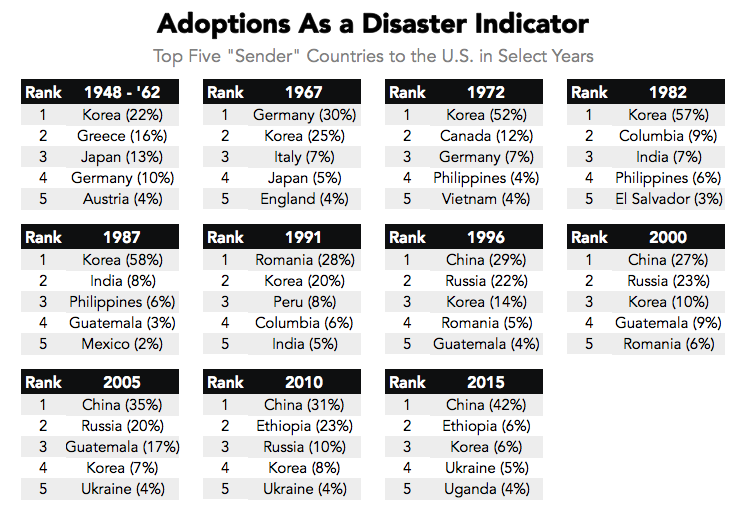
American adoptions don’t just follow American wars, but all types of global tragedy. An overview of the top five source countries for American adoptive parents over time serves as an abridged guide to international conflict and deprivation in the 20th century.
Data Source: Peter Selman and U.S. State Department Intercountry Adoption Statistics
The success of German economic reconstruction is signaled by Germany falling from the list of common “sender” countries. In the 1980s, civil war and poverty in Central and South America are reflected by an uptick in American adoption rates from El Salvador and Guatemala, and in the 1990s, we see the fall of the Iron Curtain in the rise of Romanian and Russian adoptions.
These figures are a strange lens through which to view the American public’s changing understanding of the world. But the fact that American adoption trends tend to track with conflict, disaster, and destitution also reflects a fairly obvious point: Americans adopt orphans from countries that are full of adoptable orphans.
In recent years, there have been far fewer orphans to be found at home. Since the 1970s, access to birth control, the legalization of abortion, falling fertility rates, and the acceptability of single parenthood have reduced the number of adoptable infants within high-income countries like the United States. This has not been an across the board reduction. As some experts have pointed out, though there has been a steep decline in the number of healthy, white infants surrendered for adoption, older children, children with disabilities, and African American children are still considered “difficult to place.” According to the most recent data from the Department of Health and Human Resources, of the over 100,000 children waiting to be adopted in the United States, 87% were at least two years old and over half were not white.
Nevertheless, over the last four decades, straight couples who are unable to have children, single parents, and gay couples have increasingly turned abroad. And that demand has always followed the supply.
Supply Side Constraints
Recently that supply has started to shrink—and not for Americans alone.
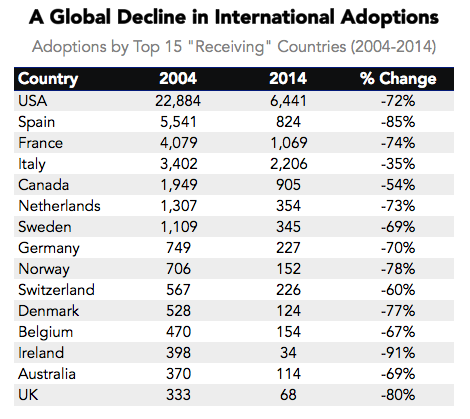
According to data gathered by Peter Selman at Newcastle University, parents in each of the top 15 “receiving” countries are bringing far fewer children home now than they were in the mid-2000s. This is not for lack of desire, he says.
“It’s not that the numbers are falling dramatically because there’s no demand for them, that there are all these children waiting to be adopted and nobody wants to adopt them,” says Selman. “It seems to me a matter of supply. The ‘sending’ countries are increasingly worried about pressures from receiving states and about continuing examples of illegality or profit-driven actions.”
Data Source: Peter Selman
Such examples always grab headlines. In the chaotic aftermath of the fall of the U.S.S.R., aspiring adoptive parents from the United States and Western Europe flocked to the infamously squalid orphanages of the former Soviet satellite state of Romania. Though the country adopted stringent adoption regulations on paper, its child welfare institutions were not up for the task, and in the years that followed, horror stories emerged. In 1991, the New York Times magazine ran an article called the “Romanian Baby Bazaar,” which documented a lucrative, under-regulated market for infants and children. Ten years later, Romania, in the face of mounting criticism, shuttered its international adoption program.
Romania’s is an egregious, but familiar story. Since the late 1980s, similar scandals have led to the imposition of restrictions and adoption moratoriums in South Korea, Cambodia, Guatemala, Vietnam, and Nepal, among others countries.
Abuses do not occur solely in so-called “source” countries. An investigative report published by Reuters in 2013 found more than 180 online advertisements posted by parents who expressed adopter’s remorse and were seeking “private re-homing” for the children that they had brought home from abroad. According to the report, these extralegal transfers of guardianship often led to the sexual or physical abuse of the children. A particularly notorious example of re-homing came to light last year when Arkansas state representative, Justin Harris, sent two of his adopted daughters to live in the home of a family friend, where one of them was raped.
But according to advocates like Elizabeth Bartholet, faculty director of the Child Advocacy Program at Harvard Law School, though abuses in source and recipient countries grab headlines, they are exceedingly rare. And when the alternative to foreign adoption is institutionalization or worse, she says, the benefits far outweigh the minimal risks.
“There is very little evidence that more than a very small percentage of international adoptions involve anything that would be illegal,” she says. "Whereas there is tons of evidence that the kids that are locked up in institutions and aged out of institutions are the ones that are especially likely to be exploited or trafficked.”
Whose Best Interest?
Tighter regulations on foreign adoptions are not always motivated by scandal. In 1993, the Hague Convention on the Protection of Children and Co-operation in Respect of Intercountry Adoptions was written to place the otherwise fragmented and ad hoc international adoption process within a universal legal framework.
As dozens of countries have signed the international treaty in the intervening years, many “sending” countries and international aid organizations such as UNICEF have promoted a specific interpretation of the treaty: international adoption should be considered only when all other alternatives have been tried.
The Hague Convention has hardly been cure all for corruption and abuse. Romania ratified the treaty in 1995, and allegations of shady dealings continued after. But with many high-income receiving countries signing on, including the United States, sending countries around the world have either been compelled to impose new restrictions on foreign adoption. In 2008, the U.S. State Department ceased approving adoptions from Guatemala in response to widely reported abuses.
But the Hague Convention has also enabled countries to unilaterally impose their own restrictions. After ratifying the treaty in 2006, China imposed a battery of new regulations on foreign adoptions. Though the language of the Hague Convention is intended to ensure that all international adoptions are carried out “in the best interests of the child,” Harvard’s Bartholet says the Chinese restrictions had an entirely different motive.
“They want to make a statement about how they're no longer a third world, but a first world nation,” she says. “One way to make that statement is to say: We can take care of our own kids. We don't need you."
Whatever the motives, a growing number of countries have instituted a common set of stricter adoption policies in the last two decades, such as mandatory waiting periods, residency restrictions for adoptive parents, and instructions that social service authorities seek domestic adoption, domestic fostering, and even informal arrangements with extended family members before considering foreign parents. The Chinese regulations imposed in 2006 went one step further by banning adoptions by foreigners who were unmarried, over a certain age, over a certain weight, or taking antidepressants.
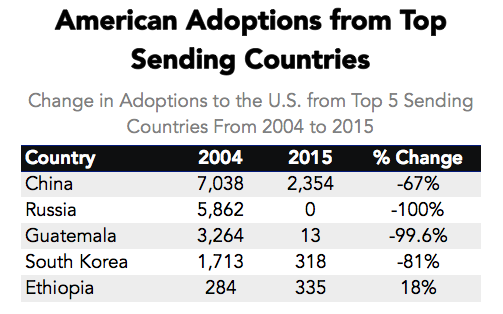
There is often a nationalistic bent to these types of policy. In 2012, the Russian government imposed an absolute adoption ban on all U.S. citizens. Though the law was ostensibly passed in response to the death of a Russian-born toddler while in the custody of his American adoptive father, many observers saw it as an act of retaliation against American financial sanctions from earlier that year. American adoptions of Russian children had been falling prior to the ban from a peak of 5,862 in 2004. The law brought the figure down to zero.
Data Source: U.S. State Department Intercountry Adoption Statistics
But according to a UNICEF report from 2014, the mere prioritization of domestic custody is not only justified, it's exactly the way that many receiving countries—such as Canada, Italy, the Netherlands, Sweden, and Greece—treat their own orphaned or abandoned children.
"It is apparently assumed that in devising their policies those countries are justified in deciding that, as a general principle, the best interests of their children will not be served by non-relative adoption abroad,” writes the report's author, Nigel Cantwell.
And if that’s good enough for Canada, these critics argue, why not Cambodia?
Not Just How Many, But Whom
The dramatic shift in international adoption has not only been one of quantity, but also of kind.
An unhappy but predictable reality of adoption—both foreign and domestic—is that adoptive parents have specific preferences for the children that they adopt. Namely, most parents want a healthy infant who has no memory of their home country, no attachment to their birth parents, and who is without disability. When countries place foreign parents at the back of the queue for adoptable children, they guarantee that a much higher proportion of these children will not fit this description.
This has certainly been the case in China, a country that has provided the largest number of adopted children to the United States in recent years. Amidst a general move to encourage domestic adoption and restrict adoption by foreigners, the Chinese government announced a plan to formally roll back the country’s longstanding one-child policy last year.
“Once that was done, they realized there was a big demand for domestic adoption that could easily take up the young, healthy children available,” says Selman from Newcastle University. “What we’re seeing now is that the children adopted [by foreigners] from China are older, in sibling groups, or have some sort of special need.”
What is true in China has been true among many sending countries. In 2005, nearly 85% of the children that Americans adopted from the most common source countries were younger than three years old. In 2015, the proportion was only 35%. This is not the result of an increase in the adoption of older children, which has in fact fallen modestly. But the adoption of infants and toddlers has fallen by much more—92%. When we talk about a “cliff” in international adoptions, this is it.

Data Source: U.S. State Department Intercountry Adoption Statistics
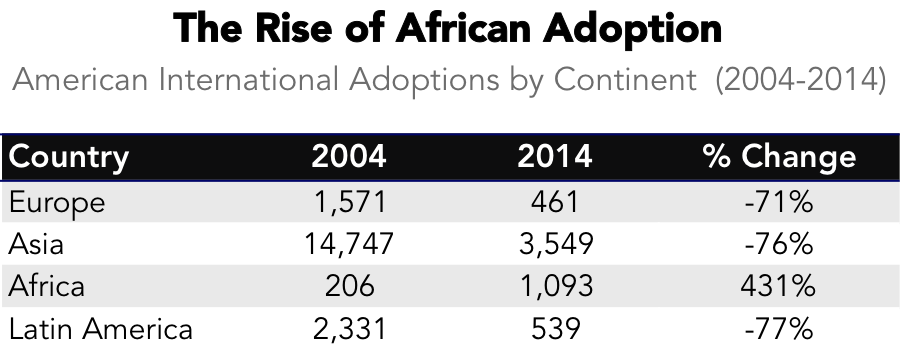
This is part of the reason why American adoptive parents are increasingly turning towards countries like Ethiopia, Uganda, and the Democratic Republic of the Congo. These are countries where poverty, limited social services, and few institutions for domestic adoption have created a relatively high number of adoptable children.
They are also disproportionately “non-Hague” countries (only three countries in Africa have ratified the treaty). Thus, as Americans and other foreign adoptive parents have turned to Africa, stories of child trafficking and unscrupulous adoption agencies have increased accordingly.
Most recently, Ugandan adoption organizations and orphanages have been accused of misleading biological parents into signing away legal guardianship of their children. According to Newcastle’s Selman, formal adoption as it exists in the United States and Europe is not a familiar concept in much of Africa. Many families may be placing their children and other young relatives in “orphanages” without fully understanding the implication of that choice.
Following a familiar pattern of scandal and reform, Uganda signed new restrictions on foreign adoptions last month.
But according to Selman, the rush to Africa is once again a simple matter of demand chasing supply.
“The market changes,” says Selman. “China goes down. Russia begins to get difficult. The number of children available in Thailand and Guatemala reduces substantially and so suddenly there’s an interest [in Africa].”
Data Source: U.S. State Department Intercountry Adoption Statistics
In the meantime, the shortage of adoption opportunities worldwide has also encouraged an increasing number of parents to seek out entirely different alternatives. Children born as a result of international surrogacy now outnumber international adoptees, says Selman. And there is no Hague Convention for cross-border surrogacy.
Coming Home and Asking Questions
Over the course of the last decade, we have witnessed an unprecedented decline in international adoptions. These are thousands of children who might have otherwise been raised in an American, Spanish, or French home, who have instead spent their childhood in their often very poor countries of origin. This presents the non-expert public with a conundrum: is this a global pandemic of child neglect or the end of one?
According to Harvard’s Elizabeth Bartholet, the dramatic decline in foreign adoptions is a silent human rights catastrophe.
“That drop-off represents the tens of thousands of kids every year who used to get loving, nurturing homes and now aren’t getting them,” says Bartholet. “I think it’s rank hypocrisy to talk as if these [restrictions on adoptions] are justified in terms of the child’s best interest.”
The counterargument made by many humanitarian groups and policymakers is that sordid orphanages or homelessness is not the only alternative. Given that foreign adoption wrenches children from their extended families, their communities, and their cultures, they argue, it should be considered only when all other alternatives fail.
In South Korea, this argument has been made especially forcefully from a surprising quarter: the adoptees themselves. Two-thirds of the nearly 200,000 children that have been adopted from Korea since 1954 are now over the age of twenty. Since the late 1980s, when international adoption first became a hot button issue following a series of scandals during the Seoul Summer Olympics, many adoptees have returned to Korea and set to lobbying the government.
“I don’t think it’s normal adopting a child from another country, of another race and paying a lot of money,” Kim Stoker, an anti-adoption activist, told the New York Times magazine in 2015. Stoker is one of thousands of Korean adoptees that have pushed for more restrictions on adoptions and more financial support and social acceptance for unwed mothers. “I don’t think it’s normal to put a child on a plane away from all its kin…it’s a very modern phenomenon.”
Korea has the longest running national adoption program in the world, and so it is hardly surprising that so many adoptees are now returning to the country of their birth and asking questions about the details of their separation. But as more children who have been adopted from Eastern Europe, Southeast Asia, Central America, and Africa come of age, we should expect them to start similar conversations.
That will make for some complicated moral arithmetic. The vast majority of the children who are adopted by parents in the United States and other common receiving countries are raised in what Elizabeth Bartholet calls “loving, nurturing homes.” For the adoptees who were taken from countries plagued by poverty or war or illness, it is easy to see what they have gained through their adoption. But how will they ever know what they have lost?
Our next article explores the largest (and worst) tax break in America. To get notified when we post it → join our email list.
The cover image comes from Tawheed Manzoor.

Want to write for Priceonomics? We are looking for freelance contributors.
A Al Qaeda acabou? Ainda não. Mas chama a atenção como a rede terrorista de Bin Laden ficou para o terrorismo global como o Yahoo! para a internet. Algo do passado, ultrapassado, que simplesmente deixamos de falar. Tão insignificante que, quando ocorre um atentado em Nice, sequer cogitamos a hipótese de sido a Al Qaeda.
George W. Bush e, acima de tudo, Barack Obama conseguiram enfraquecer Al Qaeda. Venceram. O atual presidente teve uma ultra bem sucedida ofensiva com Drones no Paquistão. Eliminou todas as lideranças da rede terrorista. O golpe final foi a morte de Osama bin Laden.
A Al Qaeda, do 11 de Setembro, do atentado contra a estação Atocha de trem em Madrid, contra o sistema de transportes de Londres, contra embaixadas na África não têm mais capacidade de organizar ataques terroristas pelo mundo.
Hoje, quando pensamos em terroristas radicais, logo nos vem à mente o ISIS, também conhecido como Grupo Estado Islâmico ou Daesh. Eles são o “Facebook” do terrorismo, com todo o respeito à rede social. Mas, basicamente, o ISIS sabe melhor do que ninguém usar as novas tecnologias para disseminar seus sanguinários ataques terroristas.
Mas teremos novidades pela frente. Primeiro, o ISIS, que surgiu como um braço da Al Qaeda no Iraque, tem apanhado feio no território iraquiano e sírio. Não para de perder território. Vai demorar um pouco, mas em breve o “Estado Islâmico” não terá mais um “Estado”. Seus ex-integrantes farão uma Diáspora de terroristas, intensificando ataques no Iraque e na Síria e também na Europa. Seguirá sendo uma ameaça grave no médio prazo. Sem o tal “califado”, no longo, tende a se enfraquecer. Isso demorará ainda.
Ao mesmo tempo, a Frente Nusrah, que é o “filho sírio” da Al Qaeda, tem inovado e pode ser o “Ubber” dos grupos terroristas. Tem uma estratégia local mais avançada e inovadora em relação ao ISIS. Um sinal disso foi o rompimento amistoso com a Al Qaeda nesta semana e a mudança do nome para Frente Fatah al Sham, ou Frente de Conquista do Levante.
A organização não está em regiões distantes da Síria, como ocorre com o ISIS. É bem mais centralizada. Também tem evitado atritos com outros grupos rebeldes. É tão extremista quanto o ISIS, mas evita a loucura total. Devagar, se consolida como a principal guerrilha que luta contra o regime de Bashar al Assad. Prega o genocídio de muçulmanos alauítas e xiitas.
Os EUA e a Rússia sabem do risco desta organização e já intensificaram as ações coordenadas contra este grupo. Não sei se surtirá efeito. Alguns analistas dizem que os americanos e russos cairão na armadilha da Frente Nusrah. De qualquer maneira, mesmo enfraquecida, a Al Qaeda vê seus filhos “rebeldes” ISIS dominando o terrorismo global e a Frente Nusrah dominando uma guerra regional. Em tempo, a Nusrah e o ISIS são inimigos entre si.
Guga Chacra, blogueiro de política internacional do Estadão e comentarista do programa Globo News Em Pauta em Nova York, é mestre em Relações Internacionais pela Universidade Columbia. Já foi correspondente do jornal O Estado de S. Paulo no Oriente Médio e em NY. No passado, trabalhou como correspondente da Folha em Buenos Aires
Comentários na minha página no Facebook. Peço que evitem comentários islamofóbicos, antissemitas, anticristãos e antiárabes ou que coloquem um povo ou uma religião como superiores. Também evitem ataques entre leitores ou contra o blogueiro. Não postem vídeos ou textos de terceiros. Todos os posts devem ter relação com algum dos temas acima. O blog está aberto a discussões educadas e com pontos de vista diferentes. Os comentários dos leitores não refletem a minha opinião e não tenho condições de monitorar todos os comentários
Acompanhe também meus comentários no Globo News Em Pauta, no Twitter @gugachacra , no Facebook Guga Chacra (me adicionem como seguidor) e no Instagram

The German papers reported that at Carlsruhe, toward the close of the late war, an aged mother came to the telegraph office carrying a dish full of sauerkraut, which she desired to have telegraphed to Rastadt. Her son must receive the kraut by Sunday. The operator could not convince her that the telegraph was not capable of such a performance. ‘How could so many soldiers have been sent to France by telegraph?’ she asked, and finally departed grumbling.
— “The Telegraph,” Harper’s New Monthly Magazine, August 1873

“‘Tis further from London to Highgate than from Highgate to London.” — James Howell, Proverbs, 1659
In his 1991 Dictionary of Scientific Quotations, Alan L. Mackay calls this “an example of a non-commutative metric.” Highgate is at the top of a hill.

On the night of April 17, I sat in the gallery of the lower chamber of Brazil’s Congress, and watched members vote in favour of opening an impeachment trial of the President, Dilma Rousseff. The scene on the floor was wild – people cursed, spat and on four separate occasions set off confetti canons. But the spectacle just offstage, out of the view of the television cameras, was even more enthralling – and perhaps more instructive about what was happening in Brazil that night.
As the session went on, and votes piled up against Rousseff, who heads the Workers’ Party, the families of opposition members thronged to the edge of the floor and giddily posed for pictures. The deputies were mostly men, nearly all of them white; their wives and daughters preened in stilettos and sequins, carrying giant designer handbags. Denouncing Rousseff in full force were the representatives of the conservative “three Bs” caucus – bullets, beef and Bibles – law-and-order hardliners, agro-business and evangelical Christians.
There was more than one father-son pair there to vote that night, and they represent the historic power brokers of this country, the people who have ruled Brazil through most of its history. The past 12 years of Workers’ Party rule, when machinists and teachers and even a former domestic worker became lawmakers, were a sharp deviation, and there was a palpable sense in the room that power was shifting with each passing hour of the marathon vote. The traditional rulers felt their fortunes turning.
Tucked in my bag that night, although I never had time to read a page, was a review copy of Brazillionaires, by Alex Cuadros, a reporter from the United States who covered the billionaires beat for Bloomberg out of Sao Paulo. I don’t know Cuadros personally, but we have friends in common in foreign correspondent circles, so I had known for some time of the book he was working on – and as Brazil’s economy fell apart (a GDP contraction of more than 4 per cent is forecast for 2016) I thought that his years of work might be overtaken by events.
I was also skeptical of his premise – why, I wondered, write about billionaires, when the really significant story in Brazil, until the past few tumultuous months, was the country’s success in moving 35 million people out of poverty. Brazil has racked up unprecedented progress improving social indicators in the past 12 years, using strategies that dozens of other countries have come here to try to understand better – surely that’s more interesting than a handful of people living behind high walls and zipping off in their private aircraft to parties in Miami,
But Cuadros’s book, far from being rendered obsolete by the political and economic crisis, has become more relevant than ever. It serves as both a playbook and a who’s who for the seismic shift in power that just occurred here, a map of the tightly meshed relationships between politicians, media barons and the titans of the construction companies at the heart of the giant corruption scandal that contributed to Rousseff’s fall. Brazillionaires is vital – and accessible – reading for anyone trying to decipher what just happened, and what may yet come, in Latin America’s largest country.
Cuadros moved here from Colombia in 2010 and started out covering Brazil’s markets. Before long, he was reassigned to the specific beat of the ultrarich – Bloomberg was already covering billionaires in other parts of the world but Cuadros would be breaking new ground in Brazil. Some of the people who were on his list for scrutiny were well-known: candidate No. 1 was Eike Batista, the eighth richest man in the world when Cuadros started his billionaires gig. Batista at the height of his success was like a caricature of a billionaire, married to a Playmate, with a one-of-a-kind luxury car parked in the living room of his mansion, constantly in the media trumpeting the soaring value of his oil company, his shipping company, his mining company. His story provides Cuadros with a sort of narrative arc, for Batista’s fortunes imploded and by 2015 the cheerleader billionaire set a new record, as the world’s most indebted person, more than a billion dollars in hock.
But the Batista story is less compelling than that of what Cuadros calls the “hidden billionaires,” the ones he begins to ferret out as he follows the trails to the construction companies that built the highway outside his window or the concrete towers where he goes for interviews. They own private companies that do not publish financial information, and they eschew Batista’s flashy cars and pink silk neckties. As Cuadros digs into their fortunes, he finds that many have dark origins: He compares a list of the wealthiest families with one of a list of key backers of the military dictatorship that seized power in 1964, with the express goal of preserving capitalism – and finds considerable overlap. Roberto Marinho, for example, founded the Globo media empire, worked hand in glove with the dictators, and benefited accordingly; his sons are three of the country’s billionaires today (and still control a huge swath of the media).
Cuadros shows how politics and public works are historically the most reliable routes to wealth in Brazil, facilitated by the wholesale transfer of public funds. As a person who has spent nearly every day of the past year trying to explain Brazil’s political crisis and its economic implosion to a foreign audience, I wondered how Cuadros would manage that, at book length, and make it readable. He’s pulled it off: Brazillionaires, its silly title notwithstanding, is gripping from the first page. And Cuadros proves to have a gift for elegant and straightforward explanations of some of the most befuddling aspects of the country’s politics and economics. He lays out all the connections, between cheap state loans and big infrastructure programs and cabinet ministers who rewrite legislation to make it more accommodating. He provides a taxonomy of the way the media, private capital and the political elite co-exist as a system to maintain the power and privilege of the wealthy – you don’t have to start wealthy but you have to acquire these alliances to be superrich and stay there. He takes his readers calmly through the labyrinthine, multibillion-dollar graft scandal at Petrobras, now known by its police code name Lava Jato.
But perhaps more valuable, he explains how Brazilians at every social level view those relationships, and how they choose to interpret and ignore them. He digs into rouba mas faz, “he steals but he gets things done,” the phrase Brazilians use for a dirty politician who delivers at least some level of a service to citizens – used not with resignation, but with admiration – for there is no point being rueful.
In addition to the forensic examination of Brazil, Cuadros also delves into what he calls the “squishier” aspects of billionaires: “How their minds worked and how they justified their wealth to themselves and the world.” The existence and impact of the superrich raise questions pertinent far beyond Brazil, he points out – “whether it was just plain wrong to be so rich in a country this poor – or in any country … Did the ultrarich take a society forward or hold it back? Could billionaires create progress at all, or did progress simply create billionaires?”
Some of the most fun bits of the book are the glimpses he provides into his quarry in their natural habitat. In Miami (where Brazil’s wealthy bought one in 12 of the homes that changed hands in 2012, and many paid cash), he meets a man who runs a firm that caters to solving the problems of the ultrarich. The man has created “a Monopoly-like game called ‘Shirtsleeves to Shirtsleeves’ – a reference to how fortunes built in the first generation tend to dissipate in the third,” to give to the eight-year-old children of anxious billionaires. A real estate agent shows Cuadros a Rio penthouse where the living room wall has a mosaic made from the wings of thousands of exotic butterflies (certified by the environmental agency, he is assured. Certified what? Insane?)
And he takes us with him as time as a spectator on the edge of this world starts to change him, too: “I heard myself using the word just like this: So-and-so is worth ‘just’ a hundred million dollars.” He stalks Eike Batista so closely, as the impresario’s promises begin to unravel, that “now and then he showed up in my dreams, and we were pals.”
Brazillionaires is peopled almost entirely with men – women make fleeting appearances as trophy wives and heiress daughters – and while this reflects the demographics of powerful Brazil, the sheer absence of female voices is painful. (Cuadros notes that of 150 Brazilians worth at least a billion reais, none is black.)
Cuadros may have been prescient in that Brazil’s crisis has made his book critical reading rather than irrelevant. The real beneficiary however is his reader – he’s just the right mix of knowledgeable insider, and arch, critical outsider, and Brazillionaires is a welcome addition to the very sparse canon of good books about Brazil.
Stephanie Nolen is the Latin America correspondent for The Globe and Mail.
Report Typo/ErrorFollow Stephanie Nolen on Twitter: @snolen
I.
Someone recently linked me to Bryan Caplan’s post A Hardy Weed: How Traditionalists Underestimate Western Civ. He argues that “western civilization”‘s supposed defenders don’t give it enough credit. They’re always worrying about it being threatened by Islam or China or Degeneracy or whatever, but in fact western civilization can not only hold its own against these threats but actively outcompetes them:
The fragility thesis is flat wrong. There is absolutely no reason to think that Western civilization is more fragile than Asian civilization, Islamic civilization, or any other prominent rivals. At minimum, Western civilization can and does perpetuate itself the standard way: sheer conformity and status quo bias.But saying that Western civilization is no more fragile than other cultures is a gross understatement. The truth is that Western civilization is taking over the globe. In virtually any fair fight, it steadily triumphs. Why? Because, as fans of Western civ ought to know, Western civ is better. Given a choice, young people choose Western consumerism, gender norms, and entertainment. Anti-Western governments from Beijing to Tehran know this this to be true: Without draconian censorship and social regulation, “Westoxification” will win.
A big part of the West’s strength, I hasten to add, is its openness to awesomeness. When it encounters competing cultures, it gleefully identifies competitors’ best traits – then adopts them as its own. By the time Western culture commands the globe, it will have appropriated the best features of Asian and Islamic culture. Even its nominal detractors will be Westernized in all but name. Picture how contemporary Christian fundamentalists’ consumerism and gender roles would have horrified Luther or Calvin. Western civ is a good winner. It doesn’t demand total surrender. It doesn’t make fans of competing cultures formally recant their errors. It just tempts them in a hundred different ways until they tacitly convert.
Traditionalists’ laments for Western civilization deeply puzzle me. Yes, it’s easy to dwell on setbacks. In a world of seven billion people, you can’t expect Western culture to win everywhere everyday. But do traditionalists seriously believe that freshman Western civ classes are the wall standing between us and barbarism? Have they really failed to notice the fact that Western civilization flourishes all over the globe, even when hostile governments fight it tooth and nail? It is time for the friends of Western civilization to learn a lesson from its enemies: Western civ is a hardy weed. Given half a chance, it survives, spreads, and conquers. Peacefully.
I worry that Caplan is eliding the important summoner/demon distinction. This is an easy distinction to miss, since demons often kill their summoners and wear their skin. But in this case, he’s become hopelessly confused without it.
I am pretty sure there was, at one point, such a thing as western civilization. I think it involved things like dancing around maypoles and copying Latin manuscripts. At some point Thor might have been involved. That civilization is dead. It summoned an alien entity from beyond the void which devoured its summoner and is proceeding to eat the rest of the world.
An analogy: naturopaths like to use the term “western medicine” to refer to the evidence-based medicine of drugs and surgeries you would get at your local hospital. They contrast this with traditional Chinese medicine and Ayurvedic medicine, which it has somewhat replaced, apparently a symptom of the “westernization” of Chinese and Indian societies.
But “western medicine” is just medicine that works. It happens to be western because the West had a technological head start, and so discovered most of the medicine that works first. But there’s nothing culturally western about it; there’s nothing Christian or Greco-Roman about using penicillin to deal with a bacterial infection. Indeed, “western medicine” replaced the traditional medicine of Europe – Hippocrates’ four humors – before it started threatening the traditional medicines of China or India. So-called “western medicine” is an inhuman perfect construct from beyond the void, summoned by Westerners, which ate traditional Western medicine first and is now proceeding to eat the rest of the world.
“Western culture” is no more related to the geographical west than western medicine. People who complain about western culture taking over their country always manage to bring up Coca-Cola. But in what sense is Coca-Cola culturally western? It’s an Ethiopian bean mixed with a Colombian leaf mixed with carbonated water and lots and lots of sugar. An American was the first person to discover that this combination tasted really good – our technological/economic head start ensured that. But in a world where America never existed, eventually some Japanese or Arabian chemist would have found that sugar-filled fizzy drinks were really tasty. It was a discovery waiting to be plucked out of the void, like penicillin. America summoned it but did not create it. If western medicine is just medicine that works, soda pop is just refreshment that works.
The same is true of more intellectual “products”. Caplan notes that foreigners consume western gender norms, but these certainly aren’t gender norms that would have been recognizable to Cicero, St. Augustine, Henry VIII, or even Voltaire. They’re gender norms that sprung up in the aftermath of the Industrial Revolution and its turbulent intermixing of the domestic and public economies. They arose because they worked. The West was the first region to industrialize and realize those were the gender norms that worked for industrial societies, and as China and Arabia industrialize they’re going to find the same thing.
Caplan writes:
A big part of the West’s strength, I hasten to add, is its openness to awesomeness. When it encounters competing cultures, it gleefully identifies competitors’ best traits – then adopts them as its own. By the time Western culture commands the globe, it will have appropriated the best features of Asian and Islamic culture.
Certainly he’s pointing at a real phenomenon – sushi has spread almost as rapidly as Coke. But in what sense has sushi been “westernized”? Yes, Europe has adopted sushi. But so have China, India, and Africa. Sushi is another refreshment that works, a crack in the narrative that what’s going on is “westernization” in any meaningful sense.
Here’s what I think is going on. Maybe every culture is the gradual accumulation of useful environmental adaptations combined with random memetic drift. But this is usually a gradual process with plenty of room for everybody to adjust and local peculiarities to seep in. the Industrial Revolution caused such rapid change that the process become qualitatively different, a frantic search for better adaptations to an environment that was itself changing almost as fast as people could understand it.
The Industrial Revolution also changed the way culture was spatially distributed. When the fastest mode of transportation is the horse, and the postal system is frequently ambushed by Huns, almost all culture is local culture. England develops a culture, France develops a culture, Spain develops a culture. Geographic, language, and political barriers keep these from intermixing too much. Add rapid communication – even at the level of a good postal service – and the equation begins to change. In the 17th century, philosophers were remarking (in Latin, the universal language!) about how Descartes from France had more in common with Leibniz from Germany than either of them did with the average Frenchman or German. Nowadays I certainly have more in common with SSC readers in Finland than I do with my next-door neighbor whom I’ve never met.
Improved trade and communication networks created a rapid flow of ideas from one big commercial center to another. Things that worked – western medicine, Coca-Cola, egalitarian gender norms, sushi – spread along the trade networks and started outcompeting things that didn’t. It happened in the west first, but not in any kind of a black-and-white way. Places were inducted into the universal culture in proportion to their participation in global trade; Shanghai was infected before West Kerry; Dubai is further gone than Alabama. The great financial capitals became a single cultural region in the same way that “England” or “France” had been a cultural region in the olden times, gradually converging on more and more ideas that worked in their new economic situation.
Let me say again that this universal culture, though it started in the West, was western only in the most cosmetic ways. If China or the Caliphate had industrialized first, they would have been the ones who developed it, and it would have been much the same. The new sodas and medicines and gender norms invented in Beijing or Baghdad would have spread throughout the world, and they would have looked very familiar. The best way to industrialize is the best way to industrialize.
II.
Something Caplan was pointing towards but never really said outright: universal culture is by definition the only culture that can survive without censorship.
He writes in his post:
The truth is that Western civilization is taking over the globe. In virtually any fair fight, it steadily triumphs. Why? Because, as fans of Western civ ought to know, Western civ is better. Given a choice, young people choose Western consumerism, gender norms, and entertainment. Anti-Western governments from Beijing to Tehran know this this to be true: Without draconian censorship and social regulation, “Westoxification” will win.
Universal culture is the collection of the most competitive ideas and products. Coca-Cola spreads because it tastes better than whatever people were drinking before. Egalitarian gender norms spread because they’re more popular and likeable than their predecessors. If there was something that outcompeted Coca-Cola, then that would be the official soda of universal culture and Coca-Cola would be consigned to the scrapheap of history.
The only reason universal culture doesn’t outcompete everything else instantly and achieve fixation around the globe is barriers to communication. Some of those barriers are natural – Tibet survived universalization for a long time because nobody could get to it. Sometimes the barrier is time – universal culture can’t assimilate every little valley hill and valley instantly. Other times there are no natural barriers, and then your choice is to either accept assimilation into universal culture, or put up some form of censorship.
Imagine that Tibet wants to protect its traditional drink of yak’s milk. The Dalai Lama requests that everyone continue to drink yak’s milk. But Coca-Cola tastes much better than yak’s milk, and everyone knows this. So it becomes a coordination problem: even if individual Tibetans would prefer that their neighbors all drink yak’s milk to preserve the culture, they want to drink Coca-Cola. The only way yak’s milk stays popular is if the Dalai Lama bans Coca-Cola from the country.
But westerners aren’t banning yak’s milk to “protect” their cultures. They don’t have to. Universal culture is high-entropy; it’s already in its ground state and will survive and spread without help. All other cultures are low-entropy; they survive only if someone keeps pushing energy into the system to protect them. It could be the Dalai Lama banning Coca-Cola. It could be the Académie Française removing English words from the language. It could be the secret police killing anyone who speaks out against Comrade Stalin. But if you want anything other than universal culture, you better either be surrounded by some very high mountains, or be willing to get your hands dirty.
There’s one more sense in which universal culture is high-entropy; I think it might be the only culture that can really survive high levels of immigration.
I’ve been wondering for a long time – how come groups that want to protect their traditional cultures worry about immigration? After all, San Francisco is frequently said to have a thriving gay culture. There’s a strong Hasidic Jewish culture in New York City. Everyone agrees that the US has something called “black culture”, although there’s debate over exactly what it entails. But only 6% of San Francisco is gay. Only 1% of New Yorkers are Hasidim. Only about 11% of Americans are black. So these groups have all managed to maintain strong cultures while being vastly outnumbered by people who are different from them.
So why is anyone concerned about immigration threatening their culture? Suppose that Tibet was utterly overwhelmed by immigrants, tens of millions of them. No matter how many people you import, Tibetan people couldn’t possibly get more outnumbered in their own country than gays, Hasidim, and blacks already are. But those groups hold on to their cultures just fine. Wouldn’t we expect Tibetans (or Americans, or English people) to do the same?
I’m still not totally sure about the answer to this one, but once again I think it makes more sense when we realize that Tibet is competing not against Western culture, but against universal culture.
And here, universal culture is going to win, simply because it’s designed to deal with diverse multicultural environments. Remember, different strategies can succeed in different equilibria. In a world full of auto-cooperators, defect-bot hits the jackpot. In a world full of tit-for-tat-players, defect-bot crashes and burns. Likewise, in a world where everybody else follows Tibetan culture, Tibetan culture may do very well. In a world where there are lots of different cultures all mixed together, Tibetan culture might not have any idea what to do.
(one more hypothetical, to clarify what I’m talking about – imagine a culture where the color of someone’s clothes tells you a lot of things about them – for example, anyone wearing red is a prostitute. This may work well as long as everyone follows the culture. If you mix it 50-50 with another culture that doesn’t have this norm, then things go downhill quickly; you proposition a lady wearing red, only to get pepper sprayed in the eye. Eventually the first culture gives up and stops trying to communicate messages through clothing color.)
I think universal culture has done a really good job adapting to this through a strategy of social atomization; everybody does their own thing in their own home, and the community exists to protect them and perform some lowest common denominator functions that everyone can agree on. This is a really good way to run a multicultural society without causing any conflict, but it requires a very specific set of cultural norms and social technologies to work properly, and only universal culture has developed these enough to pull it off.
Because universal culture is better at dealing with multicultural societies, the more immigrants there are, the more likely everyone will just default to universal culture in public spaces. And eventually the public space will creep further and further until universal culture becomes the norm.
If you don’t understand the difference between western culture and universal culture, this looks like the immigrants assimilating – “Oh, before these people were Chinese people behaving in their foreign Chinese way, but now they’re Westerners just like us.” Once you make the distinction, it looks like both Chinese people and traditional Americans assimilating into universal culture in order to share a common ground – with this being invisible to people who are already assimilated into universal culture, to whom it just looks “normal”.
III.
I stress these points because the incorrect model of “foreign cultures being Westernized” casts Western culture as the aggressor, whereas the model of “every culture is being universalized” finds Western culture to be as much a victim as anywhere else. Coca-Cola might have replaced traditional yak’s milk in Mongolia, but it also replaced traditional apple cider in America. A Hopi Indian saddened that her children no longer know the old ritual dances differs little from a Southern Baptist incensed that her kids no longer go to church. Universal values have triumphed over both.
Our society is generally in favor of small, far-away, or exotic groups trying to maintain their culture. We think it’s great that the Hopi are trying to get the next generation to participate in the traditional dances. We support the Tibetans’ attempt to maintain their culture in the face of pressure from China. We promote black culture, gay culture, et cetera. We think of it as a tragedy when the dominant culture manages to take over and destroy one of these smaller cultures. For example, when white American educators taught Native American children to identify with white American culture and ignore the old ways, that was inappropriate and in some senses “genocidal” if the aim was to destroy Native Americans as a separate people. We get excited by the story of Bhutan, the tiny Himalayan kingdom trying to preserve its natural and human environment and prevent its own McDonaldization. We tend to be especially upset when the destruction of cultures happens in the context of colonialism, ie a large and powerful country trying to take over and eliminate the culture of a smaller country. Some examples include the English in Ireland, the English in India, the English in Africa, and basically the English anywhere.
One of the most common justifications for colonialism is that a more advanced and enlightened society is taking over an evil and oppressive society. For example, when China invaded Tibet, they said that this was because Tibet was a feudal hellhole where most of the people were living in abject slavery and where people who protested the rule of the lamas were punished by having their eyes gouged out (true!). They declared the anniversary of their conquest “Serfs Emancipation Day” and force the Tibetans to celebrate it every year. They say that anyone who opposes the Chinese, supports the Dalai Lama, or flies the old Tibetan flag is allied with the old feudal lords and wants to celebrate a culture based around serfdom and oppression.
But opponents of colonialism tend to believe that cultures are valuable and need to be protected in and of themselves. This is true even if the culture is very poor, if the culture consists of people who aren’t very well-educated by Western standards, even if they believe in religions that we think are stupid, even if those cultures have unsavory histories, et cetera. We tend to allow such cultures to resist outside influences, and we even celebrate such resistance. If anybody were to say that, for example, Native Americans are poor and ignorant, have a dumb religion with all sorts of unprovable “spirits”, used to be involved in a lot of killing and raiding and slave-taking – and so we need to burn down their culture and raise their children in our own superior culture – that person would be incredibly racist and they would not be worth listening to. We celebrate when cultures choose preservation of their traditional lifestyles over mere economic growth, like Bhutan’s gross national happiness program.
This is true in every case except with the cultures we consider our outgroups – in the US, white Southern fundamentalist Christian Republicans; in the UK, white rural working-class leave voters. In both cases, their ignorance is treated as worthy of mockery, their religion is treated as stupidity and failure to understand science, their poverty makes them “trailer trash”, their rejection of economic-growth-at-all-costs means they are too stupid to understand the stakes, and their desire to protect their obviously inferior culture makes them xenophobic and racist. Although we laugh at the Chinese claim that the only reason a Tibetan could identify with their own culture and want to fly its flag is because they support serfdom and eye-gouging, we solemnly nod along with our own culture’s claim that the only reason a Southerner could identify with their own culture and want to fly its flag is because they support racism and slavery.
(one question I got on the post linked above was why its description of American tribes seemed to fit other countries so well. I think the answer is because most countries’ politics are centered around the conflict between more-universalized and less-universalized segments of the population.)
We could even look at this as a form of colonialism – if Brexit supporters and opponents lived on two different islands and had different colored skin, then people in London saying things like “These people are so butthurt that we’re destroying their so-called ‘culture’, but they’re really just a bunch of ignorant rubes, and they don’t realize they need us elites to keep their country running, so screw them,” would sound a lot more sinister. The insistence that they tolerate unwanted immigration into their lands would look a lot like how China is trying to destroy Tibet by exporting millions of people to it in the hopes they will eventually outnumber the recalcitrant native Tibetans (if you don’t believe me, believe the Dalai Lama, who apparently has the same perspective). The claim that they’re confused bout their own economic self-interest would give way to discussions of Bhutan style “gross national happiness”.
(I get accused of being crypto-conservative around here every so often, but I think I’m just taking my anti-colonialism position to its logical conclusion. A liberal getting upset about how other liberals are treating conservatives, doesn’t become conservative himself, any more than an American getting upset about how other Americans treat Iraqis becomes an Iraqi.)
And I worry that confusing “universal culture” with “Western culture” legitimizes this weird double standard. If universal culture and Western culture are the same thing, then Western culture doesn’t need protection – as Caplan points out, it’s the giant unstoppable wave of progress sweeping over everything else. Or maybe it doesn’t deserve protection – after all, it’s the colonialist ideology that tried to destroy local cultures and set itself up as supreme. If Western culture is already super-strong and has a history of trying to take over everywhere else, then surely advocating “protecting Western culture” must be a code phrase for something more sinister. We can sympathize with foreign cultures like the Tibetans who are actually under threat, but sympathizing with any Western culture in any way would just be legitimizing aggression.
But I would argue that it’s universal culture which is the giant unstoppable wave of progress, and that it was universal culture that was responsible for colonizing other cultures and replacing them with itself. And universal culture’s continuing attempts to subjugate the last unassimilated remnants of traditional western culture are just part of this trend.
IV.
I am mostly just on the side of consistency. After that I have no idea what to do.
One argument is that we should consistently support traditional cultures’ attempts to defend themselves against universal culture. Support the Native Americans’ ability to practice their old ways, support traditional Siberians trying to return to their shamanistic roots, support Australian Aborigines’ rights to continue the old rituals, support Tibetans’ rights to practice Vajrayana Buddhism, and support rural British people trying to protect Ye Olde England from the changes associated with increased immigration. For most people, this would mean extending the compassion that they feel to the Aborigines, peasants, and Tibetans to apply to the British as well.
But another argument is that we should consistently support universal culture’s attempt to impose progress on traditional cultures. Maybe we should tell the Native Americans that if they embraced global capitalism, they could have a tacqueria, sushi restaurant, and kebab place all on the same street in their reservation. Maybe we should tell the Aborigines that modern science says the Dreamtime is a myth they need to stop clinging to dumb disproven ideas. Maybe we should tell the Tibetans that Vajrayana Buddhism is too intolerant of homosexuality. Take our conviction that rural Englanders are just racist and xenophobic and ill-informed, and extend that to everyone else who’s trying to resist a way of life that’s objectively better.
I am sort of torn on this.
On the one hand, universal culture is objectively better. Its science is more correct, its economy will grow faster, its soft drinks are more refreshing, its political systems are (necessarily) freer, and it is (in a certain specific sense) what everybody would select if given a free choice. It also seems morally better. The Tibetans did gouge out the eyes of would-be-runaway serfs. I realize the circularity of saying that universal culture is objectively morally better based on it seeming so to me, a universal culture member – but I am prepared to suspend that paradox in favor of not wanting people’s eyes gouged out for resisting slavery.
On the other hand, I think that “universal culture is what every society would select if given the opportunity” is less of a knock-down point than it would seem. Heroin use is something every society would select if given the opportunity. That is, if nobody placed “censorship” on the spread of heroin, it would rapidly spread from country to country, becoming a major part of that country’s society. Instead, we implement an almost authoritarian level of control on it, because we know that even though it would be very widely adopted, it’s not something that is good for anybody in the long term. An opponent of universal culture could say it has the same property.
Things get even worse when you remember that cultures are multi-agent games and each agent pursuing its own self-interest might be a disaster for the whole. Pollution is a good example of this; if the best car is very polluting, and one car worth of pollution is minimal but many cars’ worth of pollution is toxic, then absent good coordination mechanisms everyone will choose the best car even though everyone would prefer a world where nobody (including them) had the best car. I may have written about this before.
I’m constantly intrigued (though always a little skeptical) by claims that “primitive” cultures live happier and more satisfying lives than our own. I know of several of this type. First, happiness surveys that tend to find Latin American countries doing as well or better than much richer and more advanced European countries. Second, the evidence from the Amish, whose children are allowed to experience the modern culture around them but who usually prefer to stay in Amish society. Third, Axtell’s paper on prisoner exchanges between early US colonists and Native Americans; colonists captured by the natives almost always wanted to stay and live with the natives; natives captured by the colonists never wanted to stay and live with the colonists. Many people have remarked on how more culturally homogenous countries seem happier. Bhutan itself might be evidence here, although I’ve seen wildly different claims on where it falls on happiness surveys. I’ve also talked before about how China’s happiness level stayed stable or even dropped during its period of rapid development.
(on the other hand, there’s also a lot of counterevidence. More democratic countries seem to be happier, and democracies will generally be the low-censorship countries that get more assimilated into universal culture. Free market economies are happier. Some studies say that more liberal countries are happier. And there’s a complicated but positive relationship between national happiness and wealth.)
I also think that it might be reasonable to have continuation of your own culture as a terminal goal, even if you know your culture is “worse” in some way than what would replace it. There’s a transhumanist joke – “Instead of protecting human values, why not reprogram humans to like hydrogen? After all, there’s a lot of hydrogen.” There’s way more hydrogen than beautiful art, or star-crossed romances, or exciting adventures. A human who likes beautiful art, star-crossed romances, and exciting adventures is in some sense “worse” than a human who likes hydrogen, since it would be much harder for her to achieve her goals and she would probably be much less happy. But knowing this does not make me any happier about the idea of being reprogrammed in favor of hydrogen-related goals. My own value system might not be objectively the best, or even very good, but it’s my value system and I want to keep it and you can’t take it away from me. I am an individualist and I think of this on an individual level, but I could also see having this self-preservation-against-optimality urge for my community and its values.
(I’ve sometimes heard this called Lovecraftian parochialism, based on H.P. Lovecraft’s philosophy that the universe is vast and incomprehensible and anti-human, and you’ve got to draw the line between Self and Other somewhere, so you might as well draw the line at 1920s Providence, Rhode Island, and call everywhere else from Boston all the way to the unspeakable abyss-city of Y’ha-nthlei just different degrees of horribleness.)
Overall I am not 100% convinced either way. Maybe some traditional cultures are worse than universal culture and others are better? Mostly the confusion makes me want to err on the side of allowing people to go either direction as they see fit, barring atrocities. Which are of course hard to define.
I like the Jewish idea of the Noahide Laws, where the Jews say “We are not going to impose our values on anyone else…except these seven values which we think are incredibly important and breaking them is totally beyond the pale.” Sometimes I wish universal culture would just establish a couple of clear Noahide Laws – two of them could be “no slavery” and “no eye-gouging” – and then agree to bomb/sanction/drone any culture that breaks them while leaving other cultures alone. On the other hand, I also understand universal culture well enough to know that two minutes after the first set of Noahide Laws were established, somebody would propose amending them to include something about how every culture must protect transgender bathroom rights or else be cleansed from the face of the Earth by fire and sword. I’m not sure how to prevent this, or if preventing it is even desirable. This seems like the same question as the original question, only one meta-level up and without any clear intuition to help me solve it. I guess this is another reason I continue to be attracted to the idea of Archipelago.
But I think that none of this makes sense unless we abandon the idea that “universal culture” and “western culture” are one and the same. I think when Caplan’s debate opponent talked about “protecting Western culture”, he was referring to something genuinely fragile and threatened.
I also think he probably cheated by saying we needed to protect it because it was responsible for so many great advances, like Coca-Cola and egalitarian gender norms. I don’t think that’s fair. I think it’s a culture much like Tibetan or Indian culture, pretty neat in its own way, possibly extra interesting as the first culture to learn the art of summoning entities from beyond the void. Mostly I’m just happy that it exists in the same way I’m happy that pandas and gorillas exist, a basic delight in the diversity of the world. I think it can be defended in those terms without having to resolve the debate on how many of its achievements are truly its own.
I.
There was a point in my post Monday that a few people commented on (and one person emailed me about a while ago for unrelated reasons) that I want to make explicit. In I Can Tolerate Anything Except The Outgroup, I wrote:
I want to avoid a very easy trap, which is saying that outgroups are about how different you are, or how hostile you are. I don’t think that’s quite right.
Compare the Nazis to the German Jews and to the Japanese. The Nazis were very similar to the German Jews: they looked the same, spoke the same language, came from a similar culture. The Nazis were totally different from the Japanese: different race, different language, vast cultural gap. But the Nazis and Japanese mostly got along pretty well. Heck, the Nazis were actually moderately positively disposed to the Chinese, even when they were technically at war. Meanwhile, the conflict between the Nazis and the German Jews – some of whom didn’t even realize they were anything other than German until they checked their grandparents’ birth certificate – is the stuff of history and nightmares. Any theory of outgroupishness that naively assumes the Nazis’ natural outgroup is Japanese or Chinese people will be totally inadequate.
So what makes an outgroup? Proximity plus small differences. If you want to know who someone in former Yugoslavia hates, don’t look at the Indonesians or the Zulus or the Tibetans or anyone else distant and exotic. Find the Yugoslavian ethnicity that lives closely intermingled with them and is most conspicuously similar to them, and chances are you’ll find the one who they have eight hundred years of seething hatred toward.
I didn’t coin a silly term for the relationship of the Yugoslavs and the Tibetans, but let’s use “fargroup” in order to remind us of the Near/Far distinction. We think of groups close to us in Near Mode, judging them on their merits as useful allies or dangerous enemies. We think of more distant groups in Far Mode – usually, we exoticize them. Sometimes it’s positive exoticization of the Noble Savage variety (understood so broadly that our treatment of Tibetans counts as an example of the trope). Other times it’s negative exoticization, treating them as cartoonish stereotypes of evil who are more funny or fascinating than repulsive. Take Genghis Khan – objectively he was one of the most evil people of all time, killing millions of victims, but since we think of him in Far Mode he becomes fascinating or even perversely admirable – “wow, that was one impressively bloodthirsty warlord”.
(this jars when other cultures do it to people we consider Near-Mode evil – for example India’s Hitler-themed clothing store, romance movies, and their use of Mein Kampf as a business advice book. It’s a bit strange, but not objectively stranger than us having a comedy movie about Kim Jong-un)
Fargroups aren’t always people who are literally distant from us. It seems more like it’s people who don’t threaten us, or aren’t in competition with us, or don’t get involved in the conflicts we care about, or something like that. There’s a Scientologist Church just a couple of miles from my house, and I recognize that Scientologists do some pretty horrible things, but none of them affect me, or people close to me, or values that I have a personal connection with, so I’m still more likely to find them cartoonishly funny, Kim Jong-un style, than I am to feel angry or afraid of them.
We exoticize fargroups, but we can also use them as props in our own local conflicts. For example, a lot of the time I hear about ISIS, it’s in contexts like the Democrats being weak on ISIS or Trump playing into ISIS’ hands, or how our immigration policy makes us easy prey for ISIS, or fundamentalist Christians are no different from ISIS, or something like that. We use sympathetic fargroups the same way. The Tibetans aren’t just wise and noble, they’re a foil to our overly materialist society, or an example of how religion can be based on reason instead of faith, or whatever. This is all as the theory would predict. The GOP view the Democrats as more of an outgroup and ISIS as more of a fargroup. It’s harder for them to have genuine outrage at ISIS for beheading a bunch of people, than for them to have outrage at the Democrats for not mentioning the beheading. Even in cases where they seem angry at ISIS in a non-Democrat related way, I would argue that a lot of it can be traced back to appreciating the way ISIS proves various domestic points, like “Muslims are scary” or “the barbarism vs. civilization axis is important”.
II.
Last month I asked on Tumblr:
I remember that when I was young and the Internet was young, people online were debating religion vs. atheism ALL THE TIME. It felt inescapable. Whatever else you were trying to discuss, eventually it would turn into a religion vs. atheism debate. Whenever it came up, people would sigh and say “Oh no, not another religion vs. atheism debate”.I remember spending a lot of time at talk.origins and infidels.org because religious people kept attacking me and I wanted to be able to rebut their points. And I remember a lot of people who seemed to genuinely believe that religion was like the #1 problem in the world, maybe even the only problem in the world because it was the root cause of all of the others.
I haven’t seen an online religion vs. atheism debate in years now. Occasionally somebody criticizes Richard Dawkins or something, but it’s always a tone argument and practically never about the nitty-gritty of Biblical contradictions or whatever. Now social justice vs. anti-social-justice seems to have totally taken over as the Annoying Thing Everybody On The Internet Has To Debate.
Has anybody else noticed this? Is it just me, or maybe a function of the places I hang out / used to hang out?
I got a lot of responses. Other people confirmed this was a real phenomenon and that they remember it the same way. The consensus explanation was that there was a moment in the 90s and early Bush administration when evangelical Christianity seemed to have a lot of political power, and secularists felt really threatened by it. This caused a lot of fear and arguments. Then everyone mostly agreed Bush was terrible, studies came out showing religion was on the decline, evangelicalism became so politically irrelevant that even the Republicans started nominating Mormons and Donald Trump, and people stopped caring so much.
Now I see atheists sharing things like this:

Not only have they stopped caring that much about religion, but they’re willing to adopt progressive religious people as role models and generally share stories that portray religious people in a positive light. Pope Francis gets to be the same sort of Socially Approved Benevolent Wise Person as the Dalai Lama.
I think once Christianity stopped seeming threatening, Christians went from being an outgroup to being a fargroup, and were exoticized has having the same sort of vague inoffensive wisdom as Buddhists.
I saw something that seemed very similar during my time interacting with movement atheists. There was a split between people who were raised in fundamentalist families and very traumatized about it and who viewed Christianity as an outgroup, versus people who were raised in agnostic families and pretty live-and-let-live and who viewed Christianity as an fargroup. I know it seems weird to say that movement atheists living in a majority-Christian country treated a religion they interacted with every day the same way the Yugoslavs treated Tibetans, and sure, they would make fun of them, but that was exactly it – they found religion funny – and even in the process of lightly mocking them they tried to avoid stepping on too many toes. The fundie-raised atheists would propose something really combative and offensive, and the secular-raised atheists would say “Oh, come on, we don’t want to be jerks about this, Christians are basically nice people who are just a bit deluded”. To the fundie-raised atheists it was real, it was a hot war, these people were monsters; to the secular-raised atheists, religious people were just kind of wacky in a problematic way, like the North Koreans, and nobody in America lives their life in a state of constant rage about how evil North Korea is.
And I think as the threat of movement fundamentalism declined, there was a shift among atheists from more emotional hostility to more of a live-and-let-live kind of attitude.
(and then movement atheism started tearing itself apart even more viciously than it was already. I don’t know if this was a coincidence and I’m still curious whether conservation of tribalism is a real phenomenon.)
III.
From Facebook the other day:

All good reasons. But I’ve been seeing more and more people lately saying things like this. There have always been primary elections, and there have always been intra-Left disagreements, but the level of Bernie vs. Hillary drama at the Democratic Convention this week seems to be something new. Ehrenreich-style leftists focus on critiquing Hillary instead of Trump – either within or outside of the context of supporting the Sanders campaign. And on the other side, Hillary-supporting liberals go after Sanders and his supporters instead of Trump – Freddie deBoer has written frequently (some would say incessantly) about this.
The right, of course, has its own conflicts between Trump partisans and Trump opponents, culminating in Cruz’s non-endorsement. Also relevant: the alt-right’s favorite slur of “cuck” is short for “cuckservative” – an insult not for leftists but for conservatives who they think are doing conservativism badly.
People are talking more and more about partisan bubbles. People dividing into political tribes, and cutting off contact with people on the other side. Cultural, geographic, and social differences isolate people so completely that for example my Facebook feed tends about 95% liberal; I’m sure there are other people out there with the opposite problem. I think that as bubbleification increases, the other party becomes less and less of an outgroup and more and more of a fargroup.
Republicans still “threaten” me in the sense of being able to enact policies that harm me. And people less privileged than I am face even more threats – a person dependent on food stamps has a lot to fear from Republican victories. But Republicans aren’t taking over my social circle or screaming in my face. In a purely social context they start to seem more like cartoonish and distant figures of evil, rather than neighbors and coworkers. The average Trump voter no longer seems like an uncanny-valley version of me; they seem like some strange inhabitant of a far-off land with incomprehensible values, just like ISIS.
I have yet to meet anybody in person (other than my patients) who supports Donald Trump. On the other hand, I’ve met a bunch of people on both sides with strong feelings about Bernie vs. Hillary. The Bernie vs. Hillary conflict is real to me in a way that the Hillary vs. Trump conflict isn’t. It has the potential to split my friend group. There are social advantages for me of taking either side, and I could reasonably take either side without people looking at me like I went to work stark naked. This is the kind of socially relevant conflict that produces ingroups and outgroups in a way that America vs. ISIS never will.
My guess is that this sort of thing is only going to become more common. Partisanism is going to give way to hyperpartisanism, where people hate other factions of their own party with the same venom they previously reserved for their opponents across the aisle.
At the same time, old outgroup hatreds will take on a different character. Even If You Don’t Like Donald Trump, You Should Understand The Pain Of His Poor White Supporters. And I Know Why Poor Whites Chant Trump, Trump, Trump. And Millions Of Ordinary Americans Support Donald Trump; Here’s Why. And The Incredible Crushing Despair Of The White Working Class. I’m not saying these articles are typical; for every one of these articles there are ten “Trump Voters Are Xenophobic Trailer Trash” pieces. I’m saying that it’s weird that they’re happening at all.
Same thing with Brexit. Yes, the usual xenophobic trailer trash articles. But also: In This Brexit Vote, The Poor Turned On An Elite Who Ignored Them. And Brexit Voters Are Not Thick Or Racist, Just Poor. And Outraged Elites Should Listen To Fed-Up Brexit Supporters.
(and of course this blog has been pushing a similar line for reasons that are probably not completely ahistorical or divorced from general trends)
People are starting to treat Trump voters and Brexit voters as interesting and worthy of respect, which means they’re not really an outgroup any more. Talking about how poor they are and how sympathetic we should be and how we need to be more educated in order to understand what they’re going through all sound like instances of fargroup exoticization to me.
I predict (50% probability) that the progressives most carefully bubbled and separated from any actual threat from Republicans – which disproportionately includes politicians, journalists, and other opinion-makers – will start treating the Trump-voting classes more like Tibetans. I predict when they talk about specific bad Republicans like Trump, they’ll focus more on the ways they are funny and cartoonish (far too easy with Trump, but maybe the next guy will be a better test) instead of the ways they’re threatening. I predict that conflicts within the progressive movement will be increasingly vicious and increasingly likely to use poor whites as a political football (“the other side is bigoted against poor whites!”). I predict this will happen much more if the Democrats win the election than if they lose it; it’s always easier to be gracious toward a vanquished opponent.
(I’m of course 100% guilty of all of this myself)
(Yeah, this is a change in predictions since Right Is The New Left, which talked about something similar but reached a kind of different conclusion)
I’m not sure how things will go on the Republican side. I haven’t seen the same signs of rapprochement from them – but then Republicans have never shown the same tendency to sympathize with poor exotic fargroups that Democrats do. But I also don’t know as many Republicans and maybe if this were happening I would miss it.

 Contents
Depending on the countries, different ways are used to create the names of big numbers. Between them, there are two most used: the short numeric scale and the long numeric scale. But what is the difference between them?
In the short scale, every new word greater than a million is one thousand times bigger than the previous term (the digits are grouped by three).
For example, one million is 106 and one billion is 109. Next scale word is one trillion, which is 1012.

In the long scale, every new word greater than a million is one million times bigger than the previous term (the digits are grouped by six).
For example, one million is 106, one thousand million is 109 and one billion is then 1012. One trillion jumps to the 1018 position, as the previous scale position, 1015, is occupied by another name matching one thousand billion, and the two naming series go on alternatively.

Historically, the long scale was used in France from the turn of the 15th century, spread out in Europe until the 17th century when the short scale was devised. The short scale was now in favor. In the meantime, the world was “discovered” by Europeans who spread out the short scale in their new colonies (and sometimes the long scale too, which was then replaced by the short one).
After some back and forth between the two scales, the situation can be summed up like that: European countries are now using the long scale (with the exception of the United Kingdom), whereas some previous colonies of the European empires kept the short scale system (Brazil, United States of America), and others kept the long scale (all the Spanish-speaking countries, with the exception of Puerto Rico).
Grouping numbers by three or six digits is not the only way to name big numbers. Modern Chinese groups them by myriads, or groups of four digits (亿 is 108, 兆 1012), as well as Japanese (万 is 104, 億 108) and Korean (만 is 104, 억 108). Hindi groups them by two after 1,000 (सहस्र is 103, लाख 105, करोड़ 107), traditional Tongan has a special name for intermediate powers of 10 (mano is 104, kilu 105)…
The beauty of languages is that they are full of possibilities. Even in such a restricted area as how to name big numbers, the differences in counting and naming are quite awesome, opening up new windows into the cultures supported by each language.

“Every honest researcher I know admits he’s just a professional amateur. He’s doing whatever he’s doing for the first time. That makes him an amateur. He has enough sense to know that he’s going to have a lot of trouble, so that makes him a professional.” — Charles F. Kettering
| Piled Higher & Deeper by Jorge Cham |
www.phdcomics.com
|
|
 |
||
|
title:
"Author Name" - originally published
7/25/2016
For the latest news in PHD Comics, CLICK HERE! |
||

Well, looks like our mini book review went well, so I'm going to try rolling out my whole June reading list. Thanks for clicking the links last time, geeks. We're going to see about making this a more regular feature, and we'll tweak as we go.
One thing I wanted to add just for transparency - as I understand it, the way it works if that once you click my affiliate link, anything you buy at amazon for the next 24 hours contributes a cut to me as an affiliate. I get a report of stuff that was bought, but none of it's attached to anyone's name or personal information.
So, basically, if you want to creep me out, click one of the affiliate links below, then buy something horrifying.
I'm also adding a rating system. I don't really like these, but I assume a lot of you are just looking for "what was your favorite book this month," so this should help. I want to stress that a 4/5 really does mean great:
June 4 - Why Does the World Exist (Holt)
-Kind of a meandering memoir of the author asking people the eponymous question. A somewhat light read, at least given the topic.
Verdict: 3/5
June 7 - The Quants (Patterson)
-Enjoyable history of the entry of mathematical modelers into finance, but I think I’ve read this story too many times to enjoy another book.
Verdict: 3/5
June 8 - On the Origin of Sports (Belsky, Fine)
-Fun, but it’s really more of a reference/trivia book than anything. This book is a collection of the first written rules of a whole bunch of different sports, plus a bit of commentary.
Verdict: 3/5 as a reference book. 2/5 as a book to sit and read.
June 9 - Grunt (Roach)
-Mary Roach is always a delight. This one is about stuff related to soldiering, though it’s a bit more wide-ranging than some of her other books.
Verdict: 4/5
June 10 - Diet Cults (Fitzgerald)
-I enjoyed this book a surprising amount - Fitzgerald does some mild debunking of a number of fashionable diets and also explains who complex nutrition can be. It’s a sort of skeptics guide to nutrition, though it’s (to my mind) fairly gentle in its handle of various non-empirical approaches to diet.
Verdict: 4/5
June 11 - Dreamland (Quinones)
-An excellent description of the rise of opiate use in the United States over the last several generations. My personal belief is that it all argues for a broad program of legalization, but I don’t think that’s Quinones’ take. One depressing part of the book is how enterprising a lot of the drug traffickers are. You end up wishing they could use that work ethic and competence toward some more productive end.
Verdict: 4/5
June 17 - The Looming Tower (Wright)
-A great history of events leading up to September 11th. It’s obviously the case, but I’m frequently amazed by just how much more rich and human the truth is, when compared to the nonsense you catch in daily newsmedia.
Verdict: 4/5
June 17 - Dr. Futurity (Dick)
-An early Dick book, though with hints of what’s to come. It’s a sort of mystery plus time travel story that threatens to implode from its own complexity, but manages to pull out at the last second. Not exactly deep stuff - Dick’s early work is quite pulpy - but enjoyable.
Verdict: 3/5
June 17 - Lean In (Sheryl Sandberg)
-Enjoyable, but honestly a bit disappointing. I was hoping this’d be a bit more data driven, but it’s more of a personal memoir. That is, of course, just fine, but there are better books on similar topics.
Verdict: 3/5
June 17 - Ava’s Man (Bragg)
-I am just in love with Bragg. Here he gives a biography of his grandfather, a moonshine-making mountaineer, really from a different era. Great prose and great stories.
Verdict: 5/5
June 18 - Ruth (Gaskill)
-Gaskill is starting to become a guilty pleasure. It’s Dickensish, though not quite as clever.
Verdict: 4/5
June 19 - All Creatures Great and Small (Herriot)
-A great little collection of semi-fictionalized stories about being a veterinarian to a small farming community in Yorkshire. I really enjoyed these. The two books to follow are more of the same, and each is slightly last good than the one that came before. Still, wonderful charming little stories.
Verdict: 5/5
June 19 - All Things Bright and Beautiful (Herriot)
June 21 - All Things Wise and Wonderful (Herriot)
Verdict: 4/5
June 23 - The Cosmic Puppets (Dick)
-Man, you get the feeling Dick banged this one out over a weekend. It’s like an okay episode of the Twilight Zone.
Verdict: 2/5
June 27 - Sapiens (Harari)
-A fun, somewhat light book on *all of human history*. Too simplified to be certainly true, but it’s a joyful little romp with a lot of clever ideas.
Verdict: 3/5
June 28 - Solar Lottery (Dick)
-You can see the hints of the writer to come - the complex world-building and the enormous number of weird ideas and the avoidance of the usual early sci fi tropes. But… this book wasn’t so great. There are all these wonderful concepts, but it’s like he hadn’t quite got the hang of a narrative yet.
Verdict: 2/5
June 29 - North Korea Undercover (Sweeney)
-Sweeney writes sort of like a gonzo journalist, but it’s enjoyable in this context. This book is a memoir of a trip to North Korea and all the strange sights. It also contains a number of asides telling weird DPRK history and tales of defectors.
Verdict: 4/5


German scientist Otto von Guericke conducted a memorable experiment on May 8, 1654: He connected two hemispheres, sealed their rims together, and drew out the air between them using a pump of his own devising. The resulting vacuum was so strong that 30 horses could not pull them apart.
At the time the experiment was seen as a strike against Aristotle’s dictum that nature abhors a vacuum. It’s repeated today as a dramatic demonstration of the power of atmospheric pressure.
I've been making a few more sketches about linux debugging tools / opinions in the last week. You can find them in this public Dropbox folder if you're interested. Here's one of them: