Shared posts

20 Mar 12:25

Concurrent Revisions

Adam Victor Brandizzi

Há alguns anos atrás, será que seria chamado de Windows Live MapReduce? :P (Piadas à parte, é um conceito interessante)

Concurrent Revisions is a Microsoft Research project doing interesting work in making concurrent programming scalable and easier to reason about. These papers work have been mentioned a number of times here on LtU, but none of them seem to have been officially posted as stories.

Concurrent Revisions are a distributed version control-like abstraction [1] for concurrently mutable state that requires clients to specify merge functions that make fork-join deterministic, and so make concurrent programs inherently composable. The library provide default merge behaviour for various familiar objects like numbers and lists, and it seems somewhat straightforward to provide a merge function for many other object types.

They've also extended the work to seamlessly integrate incremental and parallel computation [2] in a fairly intuitive fashion, in my opinion.

Their latest work [3] extends these concurrent revisions to distributed scenarios with disconnected operations, which operate much like distributed version control works with source code, with guarantees of eventual consistency.

All in all, a very promising approach, and deserving of wider coverage.

[1] Sebastian Burckhardt and Daan Leijen, Semantics of Concurrent Revisions, in European Symposium on Programming (ESOP'11), Springer Verlag, Saarbrucken, Germany, March 2011
[2] Sebastian Burckhardt, Daan Leijen, Caitlin Sadowski, Jaeheon Yi, and Thomas Ball, Two for the Price of One: A Model for Parallel and Incremental Computation, in Proceedings of the ACM International Conference on Object Oriented Programming Systems Languages and Applications (OOPSLA'11), ACM SIGPLAN, Portland, Oregon, 22 October 2011
[3] Sebastian Burckhardt, Manuel Fahndrich, Daan Leijen, and Benjamin P. Wood, Cloud Types for Eventual Consistency, in Proceedings of the 26th European Conference on Object-Oriented Programming (ECOOP), Springer, 15 June 2012

20 Mar 12:19

Q&A on Folha Internacional

by Rio Gringa

Maria folhaReflecting a number of changing realities in Brazil, one of the country's largest newspapers is looking to expand readership of its international section, with Brazilian news stories translated into English and Spanish. Increasingly, more and more Brazilian news is appearing in the international media, along with new English-language Brazil news sources. With the economy humming along--if not growing at previous rates--and large numbers of skilled jobs that need filling, Spanish and Portuguese professionals are flocking to Brazil. María Martín is the embodiment of these trends. Born in Alicante, this Spanish journalist now works as an editor at Folha Internacional, which was launched in July 2011. She moved to São Paulo from Madrid just a year ago, and chooses, translates, and edits web content for Folha Internacional. With native English and Spanish speakers on staff, Folha aims to reach an international audience interested in what's happening in Brazil. I asked María about Folha Internacional via email, along with her move to Brazil.

You've worked as a journalist in Spain. What brought you to Brazil?

Since I graduated five years ago, I have practiced journalism. I was trained at El País newspaper and I got hooked on the profession.  Unfortunately, the situation in Spain is not conducive to most people's professional expectations right now, and in this business, much less. Why Brazil? For some time, the news about the “economic giant of Latin America” reached Europe and I was interested in coming here, but I had no idea how I was going to make a living. It was tough: I did not speak a word of Portuguese and I didn't know anything about the culture. But I've always had the support of my sister, who I live with, and Brazilians are very welcoming.

Who is the intended readership for Folha International? Is all of the content translated from Portuguese, or do you have original pieces written specifically for Folha Internacional?

Our audience is the reader anywhere in the world with any interest in Brazil. Each day, we select the most important or interesting issues published by the newspaper and offer their translations for free. We still do not have articles written specifically for Folha Internacional, but it is an option that we haven't ruled out.

What's Folha's goal in launching these two sites?

The goal is not to limit, as a matter of language, the content of Folha, the most influential newspaper in Brazil. In general, sporting events, the economy, culture, and football are catching everyone's eye. Although the international media is responsible for informing their readers, Folha has more structure that allows it to publish great scoops, and has local journalists covering the information. The subjects are also chosen taking the reader into consideration, and edited for some specific references that can be understood by anyone who does not know the local terminology.

What advantages does Folha have over other English-language news sources that cover Brazil?

The foreign correspondent always has a different view than the local media and one that is more interesting to his readers--that is undeniable--but his infrastructure is limited: only one person covering a country of 190 million people. Folha is the largest newspaper in Brazil and covers many topics exclusively and invests a lot of work in original approaches. Also, the Folha Internacional site has free and unlimited access, while the most other online content out there is under a paywall system.

Follow María on Twitter.

Image: Courtesy of María Martín.

20 Mar 12:18

Think Piece

by Greg Ross
http://www.flickr.com/photos/daquellamanera/852950991/

Image: Flickr

To create the conceptual artwork Vertical Earth Kilometer, Walter De Maria drilled a hole in the Friedrichsplatz Park in Kassel, Germany, and inserted a brass rod 1 kilometer long.

The rod exists underground, but only its top, a coin of brass 5 centimeters wide, is visible. Is art still art if it can’t be experienced by the senses?

20 Mar 11:26

Rei da Jordânia destrói países vizinhos em entrevista

by Gustavo Chacra
Adam Victor Brandizzi

1. A entrevista parece muito, muito linteressante.
2. Até que o tal superblog do Chacra tem coisas legais, hein?


Começa hoje o super blog, com mais posts por dia. Veja abaixo os outros posts do dia. Os melhores comentários receberão destaque em posts diários

ENTENDA O USO DE ARMAS QUÍMICAS NA SÍRIA

EUA FORTALECERAM O IRÃ COM GUERRA DO IRAQUE

 POR QUE HILLARY DEMOROU PARA RECONHECER O CASAMENTO GAY? (Vídeo aqui)

O repórter Jeffrey Goldberg, da revista The Atlantic, realizou uma entrevista fantástica com o rei Abdullah, da Jordânia. Leiam alguns trechos abaixo e a íntegra, em inglês, aqui. Vale notar que o líder jordaniano tem um viés ditatorial. Mas suas críticas aos vizinhos são importantes e demonstra que ele não é tão cego para o mundo.

ISRAEL-PALESTINA

“Talvez já seja tarde demais para a solução de dois Estados. Não sei, mas parte de mim diz que já passou a chance”. Perguntado por Goldberg sobre que ele quer dizer, Abdullah responde “Isratine”. Isto é, se Israel não aceitar o Estado palestino rapidamente, precisará escolher entre “Apartheid ou democracia”. “A questão prática é se Israel pode exercer controle permanente sobre os palestinos ou se acabará se tornando uma África do Sul, que não conseguiu sobreviver como um Estado pária. A única forma de ser um Estado judaico é com a solução de dois Estados. Isto é, ficando com a parte judaica”

SÍRIA E ASSAD

Abdullah ofereceu asilo político a Bashar al Assad e sua família na Jordânia. “Eu ofereci duas vezes para ele vir com a mulher. Eles  (os Assad)responderam ‘muito obrigado, mas não por que você não se preocupa mais com o seu país do que com a gente’”

Para descrever o provincianismo de Assad, o rei Abdullah contou uma história. “Tivemos um jantar com ele e o rei do Marrocos no Cairo. E Assad se virou para gente e perguntou o que significava jet lag”.

TURQUIA E ERDOGAN

“Erdogan disse uma vez que a democracia para ele era como uma viagem de ônibus – ‘Uma vez que chegar o meu ponto, descerei”.

JORDÂNIA E SEU REINADO

“Quando completei dez anos de reinado, sentei com os membros da minha família e alguns amigos e disse ‘Não quero mais isso’”. Goldberg respondeu “mas você não pode renunciar”. “Foi o que eles disseram”, completou o rei.

Guga Chacra, comentarista de política internacional do Estadão e do programa Globo News Em Pauta em Nova York, é mestre em Relações Internacionais pela Universidade Columbia. Já foi correspondente do jornal O Estado de S. Paulo no Oriente Médio. No passado, trabalhou como correspondente da Folha em Buenos Aires

Comentários islamofóbicos, anti-semitas e anti-árabes ou que coloquem um povo ou uma religião como superiores não serão publicados. Tampouco ataques entre leitores ou contra o blogueiro. Pessoas que insistirem em ataques pessoais não terão mais seus comentários publicados. Não é permitido postar vídeo. Todos os posts devem ter relação com algum dos temas acima. O blog está aberto a discussões educadas e com pontos de vista diferentes. Os comentários dos leitores não refletem a opinião do jornalista

Acompanhe também meus comentários no Globo News Em Pauta, na Rádio Estadão, na TV Estadão, no Estadão Noite no tablet, no Twitter @gugachacra , no Facebook Guga Chacra (me adicionem como seguidor), no Instagram e no Google Plus. Escrevam para mim no  gugachacra at outlook.com. Leiam também o blog do Ariel Palacios


20 Mar 11:23

Por que Hillary demorou para reconhecer o casamento gay?

by Gustavo Chacra

Começa hoje o super blog, com mais posts por dia. O primeiro é de EUA. Ainda hoje, Síria, Líbano e Israel

Hillary Clinton precisou ser primeira-dama, senadora e secretária de Estado para, aos 65 anos, reconhecer o casamento entre pessoas do mesmo sexo. Inicialmente, era contra. Depois adotou a tática de se dizer a favor da “união civil”, mas sendo opositora ao matrimônio. Agora, finalmente, decidiu defender o casamento.

Ao contrário do que muitos imaginam no Brasil, a divisão nos EUA não se dá entre democratas “a favor” e republicanos “contra”. Não é uma divisão de esquerda e direita.  Há defensores e opositores nos dois partidos, embora os favoráveis  sejam bem mais numerosos entre os democratas. Mitt Romney, candidato republicano no ano passado, reconheceu o casamento gay há anos, embora tenha voltado atrás. Barack Obama, por sua vez, passou a apoiar apenas no ano passado.

Hillary também ficou para trás de Dick Cheney, vice-presidente de George W. Bush, e de Rob Portman, um senador republicano de viés conservador de Ohio que passou a apoiar o casamento gay na semana passada. Jon Huntsman, o bilionário político moderado do Partido Republicano, também agiu antes da ex-secretária de Estado. Temos ainda os libertários republicanos, que tampouco se opõem ao casamento gay.

Mas o que teria feito Hillary finalmente adotar esta posição? Foi similar a Portman, que passou a apoiar o matrimônio de pessoas do mesmo sexo depois de o filho se assumir como gay? Não, a Chelsea é heterossexual. A resposta está no crescimento do apoio ao da população americana ao casamento de pessoas do mesmo sexo  nos EUA. Segundo pesquisa do Washington Post divulgada ontem, 58% são a favor e 36%, contra. A margem deve aumentar até 2016, quando a ex-secretária de Estado deve disputar as eleições.

Apenas para ficar claro, a questão do casamento gay é decidida nos Estados, e não pelo presidente. Estes podem optar por referendos, decisões das Suprema Corte Estadual ou de câmara dos representantes. Agora, a Suprema Corte dos EUA estudará dois casos e existe uma chance de o tema passar a ser federal.

Guga Chacra, comentarista de política internacional do Estadão e do programa Globo News Em Pauta em Nova York, é mestre em Relações Internacionais pela Universidade Columbia. Já foi correspondente do jornal no Oriente Médio. No passado, trabalhou como correspondente da Folha em Buenos Aires

Comentários islamofóbicos, anti-semitas e anti-árabes ou que coloquem um povo ou uma religião como superiores não serão publicados. Tampouco ataques entre leitores ou contra o blogueiro. Pessoas que insistirem em ataques pessoais não terão mais seus comentários publicados. Não é permitido postar vídeo. Todos os posts devem ter relação com algum dos temas acima. O blog está aberto a discussões educadas e com pontos de vista diferentes. Os comentários dos leitores não refletem a opinião do jornalista

Acompanhe também meus comentários no Globo News Em Pauta, na Rádio Estadão, na TV estadão, no Estadão Noite no tablet, no Twitter @gugachacra , no Facebook Guga Chacra (me adicionem como seguidor), no Instagram e no Google Plus. Leiam também o blog do Ariel Palacios

19 Mar 09:26

Entrevista coletiva Made in China

by Cláudia Trevisan

Apesar de ser chamada de “entrevista coletiva”, o encontro que o novo primeiro-ministro da China, Li Keqiang, teve ontem com a imprensa não tem nenhuma semelhança com eventos que recebem o mesmo nome em países democráticas. Os jornalistas que se dirigiram ao líder comunista foram definidos previamente e as perguntas que apresentaram tiveram que ser aprovadas com antecedência de dias pelo governo.

Os temas foram aqueles que as autoridades de Pequim queriam abordar e incluíram crescimento econômico, reformas, combate à corrupção, degradação ambiental e relações com os Estados Unidos, Rússia, Taiwan e Hong Kong.Li Keqiang sorriu, gesticulou e falou com a confiança de quem sabia o script que seria seguido de ponta a ponta, não apenas por ele, mas também pelos jornalistas que estavam na plateia.

Não houve nenhuma palavra sobre as mais de cem imolações de tibetanos em protesto contra políticas chinesas para a região nem sobre os violentos conflitos entre camponeses e chefes locais do Partido Comunista em razão da expropriação ilegal de terras.

O Japão foi outro grande ausente da entrevista, apesar do recrudescimento recente do conflito entre os dois países em torno das ilhas que os chineses chamam de Diaoyu e Tóquio, de Senkaku. Mas Li Keqiang tocou no tema de maneira indireta, ao mencionar a determinação da China de proteger a “a integridade territorial do país”.

Das 11 perguntas apresentadas, 5 vieram de veículos oficiais chineses. As outras 6 questões foram apresentadas por jornalistas de Hong Kong, Taiwan, Cingapura, Rússia, França e Estados Unidos. Funcionários do Ministério das Relações Exteriores se sentaram ao lado dos profissionais escolhidos para se dirigir ao primeiro-ministro, o que permitia sua identificação pelo “mestre de cerimônias” em meio aos braços que se levantavam. Para os desavisados, parecia uma entrevista coletiva de verdade.

Além do credenciamento para o Congresso Nacional do Povo, os jornalistas tinham que ter um convite especial para participar da entrevista. Nenhum foi entregue a profissionais do The New York Times, que em outubro publicou reportagem segundo a qual a família do ex-primeiro-ministro Wen Jiabao acumulou fortuna de US$ 2,7 bilhões nos dez anos em que ele permaneceu no poder.

19 Mar 09:24

Conservar a natureza é estratégia de desenvolvimento?

by Habib Jorge Fraxe Neto
Adam Victor Brandizzi

O que acontece quando se junta echochatice com academaçada? Este excelente artigo, ao que parece. Ficou muito bom o texto.

As economias sustentam-se ou não a depender do adequado manejo dos bens e serviços fornecidos pelos ecossistemas. No Brasil, a conservação da natureza é fundamento para o desenvolvimento e a melhoria da qualidade de vida intergeracional, conforme o art. 225 da Constituição da República.

Em termos de pesquisas que balizem a racionalidade necessária ao tema, o estudo intitulado A Economia dos Ecossistemas e da Biodiversidade (na sigla em inglês, TEEB1) aponta a importância de se incorporarem variáveis ecológicas às políticas públicas, dada a dependência direta de bilhões de pessoas aos recursos naturais, base da segurança alimentar e de praticamente todas as atividades econômicas.O País participa do estudo por meio do projeto TEEB Brasil, ainda em fase de desenvolvimento, sem dados publicados.

O TEEB nasceu da Iniciativa de Potsdam2 para proteção da biodiversidade e analisa valores econômicos dos bens (por exemplo, água) e dos serviços ecossistêmicos (por exemplo, recarga natural de aquíferos e ciclagem de nutrientes) – definidos como externalidades ambientais positivas – com o intuito de incorporá-los ao processo decisório de governos e empresas. Esses bens são, em geral, públicos, sem mercados nem preços estabelecidos, o que dificulta sua regulação, mesmo quando próximos à exaustão.  Já os serviços ambientais são comumente prestados de forma gratuita e, consequentemente, sua perda ou degradação com frequência não é assimilada pelo sistema de incentivos econômicos. De fato, em especial no Brasil – dada sua abundância em recursos naturais – são insuficientes os mecanismos para incentivar indivíduos ou grupos a protegerem ecossistemas.

Destacam-se a seguir exemplos de impactos econômicos dos serviços prestados pela natureza, com dados apresentados no relatório do TEEB direcionado a formuladores de políticas públicas3:

  • Na Costa Rica, a presença de agentes polinizadores que habitam florestas nativas incrementa em 20% as colheitas de café das fazendas localizadas a menos de um quilômetro dessas matas;
  • Um terço das cem maiores cidades do mundo depende da água fornecida a partir de florestas localizadas em áreas protegidas, a um custo significativamente menor em comparação com outras formas de abastecimento. A título de exemplo, em Nova Iorque, o custo de preservação dos mananciais hídricos da bacia de Catskills, que fornece água para a metrópole, é de US$ 1 a 1,5 bilhão, em comparação com os US$ 6 e 8 bilhões necessários para a implantação de um sistema de tratamento da água captada em mananciais não preservados;
  • Áreas protegidas já cobrem cerca de 14% da superfície da Terra e o ecoturismo é uma das áreas mais dinâmicas da indústria de turismo. Nos EUA, essas atividades responderam por aproximadamente 1% do Produto Interno Bruto (PIB) em 2006, totalizando US$ 122 bilhões, de acordo com o Serviço de Pesca e Vida Selvagem.

Os impactos econômicos de medidas conservacionistas podem ser ainda maiores, a depender da realidade socioeconômica da região investigada, já que para populações rurais de baixa renda, por exemplo, tais bens e serviços são essenciais, devido à sua dependência direta desses recursos locais como alimento, abrigo, medicamento e energia. De fato, segundo a Organização das Nações Unidas para a Alimentação e a Agricultura (FAO), 70% das populações que passam fome encontram-se em áreas rurais.

Populações sujeitas à fome foram fortemente atingidas pela alta do preço de alimentos ocorrida em 2008, e aqui cabem ressalvas acerca da valoração econômica de bens oriundos da natureza, no caso da comoditização e da conversão de ativos naturais em derivativos financeiros. Em 1999, o Governo dos EUA desregulamentou o mercado futuro de commodities, o que permitiu aos bancos moldar derivativos agrícolas como um mercado de ações e atuar com uma liberdade de negociação antes restrita aos setores diretamente relacionados à produção agrícola.

Com as crises da década de 2000, esses derivativos eram um porto seguro para grandes investidores. Isso criou uma bolha especulativa e determinou parte considerável do aumento dos insumos agrícolas e de quase 80% no preço mundial de alimentos, de 2005 a2008. A alta explica o ingresso de 250 milhões de pessoas em situação de vulnerabilidade alimentar, classificação que alcançou 1 bilhão de pessoas em 2008, de acordo com a FAO4.

Portanto, deve-se avaliar com olhar crítico a valoração econômica da natureza –em especial se servir à comoditização e à criação de derivativos financeiros (como no exemplo dos alimentos) – de maneira a torná-la um instrumento de proteção ambiental e de promoção da dignidade humana, em vez de mera forma de lucro aos mercados.

De todo modo, estudos como o TEEB reforçam a racionalidade na utilização dos recursos naturais. O marco regulatório brasileiro também, ao vincular o conceito de conservação ao uso racional, em vez de uma natureza intocada.

Os princípios ambientais definidos na Constituição – em especial o dever imposto ao Poder Público de preservar os processos ecológicos essenciais, proteger a diversidade genética e definir espaços protegidos – já haviam sido previstos pela Lei nº 6.938, de 31 de agosto de 1981, que instituiu a Política Nacional do Meio Ambiente, e que no art. 1º definiu como uma de suas finalidades assegurar condições ao desenvolvimento socioeconômico. Esses princípios foram reforçados por meio da Lei nº 9.985, de 15 de julho de 2000, que instituiu o Sistema Nacional de Unidades de Conservação (Lei do SNUC) e trouxe a definição de conservação da natureza no art. 2º, inciso II. Esses dispositivos legais determinam o manejo do uso humano da natureza e sua utilização sustentável com vistas ao desenvolvimento econômico e social.

Um exemplo dessa racionalidade pode ser encontrado no caso das culturas de grãos, que em geral envolvem processos agrícolas modernos, com métodos adaptados aos trópicos, como o plantio direto5. Nos cultivos de soja em cerrados do Piauí, os custos de fertilização e controle de processos erosivos nas terras que utilizaram esse tipo de plantio foram cerca de 6% menores que os custos no plantio convencional, na safra de soja 2007/2008. O manejo racional de um agroecossistema, portanto,resulta em melhoria na estrutura do solo e na produtividade agrícola, em função da melhor ciclagem de nutrientes6.

Um dos maiores desafios econômicos das próximas décadas será atender a demanda por alimentos e, ao mesmo tempo, manter os sistemas naturais de suporte à atividade. Entretanto, no Brasil, a modernidade agrícola mencionada no caso do plantio direto da soja convive com um histórico de ineficiência no campo, incluindo técnicas rudimentares adotadas desde o Século XVI, como as queimadas, que acarretam a literal combustão de nossa diversidade biológica.

Nesse sentido, a expansão da fronteira agrícola tem resultado na instalação de grandes extensões de propriedades dedicadas à pecuária de baixa produtividade, que ocupam 211 milhões de hectares, cerca de 25% das terras brasileiras (e que correspondem a 76% da área ocupada pela agropecuária). A adoção de técnicas mais eficientes propiciaria um aumento médio de produtividade que liberaria em torno de 69 milhões de hectares (hoje dedicados a esse tipo de pecuária) ao estoque de terras agrícolas7. Um dos principais benefícios seria a preservação do repositório de patrimônio genético contido em matas nativas, dado seu incalculável valor potencial diante dos avanços em biotecnologia.

Na Amazônia, a pecuária ocupa cerca de 60% da área desmatada e tem sido considerada um dos principais vetores do desmatamento. Por outro lado, desde pelo menos 2008, ações coordenadas de comando e controle têm conseguido conter e até diminuir os índices de desmate, mesmo com as altas nos preços das commodities agrícolas8.

Se conservar implica uso racional de recursos naturais (e não natureza intocada), esperam-se avanços de eficiência no caso da agropecuária, com destaque para a governança fundiária e a disseminação de tecnologias, em especial por meio de assistência técnica adaptada à agricultura tropical. Dado o potencial de avanço da fronteira agrícola, dessas medidas dependem, de forma considerável, a manutenção dos bens e serviços fornecidos pelo estoque de ecossistemas ainda existentes: cerca de 85% da Amazônia, 51% do Cerrado e 88% do Pantanal, apenas para citar os biomas mais preservados.

Conservar a natureza é estratégia de desenvolvimento, e o Brasil pode consolidar-se como um dos países com maior capacidade biológica do planeta, em áreas que estão na vanguarda do avanço econômico e científico, destacando-se a biotecnologia9 para fins medicinais e alimentares, assim como a produção de energia. Além disso, temos uma das mais fortes capacidades do mundo em ciência da conservação. Em próximo artigo, abordaremos essas questões, com foco na associação entre diversidade biológica e desenvolvimento e nas principais políticas públicas de proteção da natureza brasileira.

(Este texto tem por base o trabalho “Serviços e Bens Fornecidos pelos Ecossistemas: Conservação da Natureza como Estratégia de Desenvolvimento”.  O estudo integral consta do Texto para Discussão nº 120 do Núcleo de Estudos e Pesquisas do Senado, disponível no seguinte link: http://www.senado.gov.br/senado/conleg/textos_discussao.htm)

_____________

1The Economics of Ecosystems and Biodiversity, versão em português do relatório preliminar disponível em http://www.teebtest.org/wp-content/uploads/Study%20and%20Reports/Additional%20Reports/Interim%20report/
TEEB%20Interim%20Report_Portuguese.pdf
(acesso em 6/11/12).

2 A iniciativa resultou da reunião entre ministros do meio ambiente de países do G8, ocorrida em Potsdam, na Alemanha, em março de 2007. Foram estabelecidas metas, destacando-se avaliações sobre o impacto econômico da perda da diversidade biológica e sobre padrões de produção e consumo. Essas avaliações fundamentam o TEEB.

3Disponível em http://www.teebtest.org/teeb-study-and-reports/main-reports/local-and-regional-policy-makers/ (acesso em 6/11/12).

4Cultivo conservacionista em que se busca manter o solo sempre por plantas em desenvolvimento e por resíduos vegetais, com a finalidade de protegê-lo da erosão, de potencializar a ciclagem de nutrientes e de aumentar sua capacidade de retenção de água.

5Dantas, K. P. e Monteiro, M. S. L. (2010). Valoração econômica dos efeitos internos da erosão: Impactos da Produção de Soja no Cerrado Piauiense. Revista de Economia e Sociologia Rural, Vol. 48, nº 4, pp. 619-633. Piracicaba/ SP.

6Sparovek, G., Barreto, A., Klug, I. ePapp, L. (2010). A Revisão do Código Florestal Brasileiro, Novos Estudos vol. 88,), pp.181-205. Centro Brasileiro de Análise e Planejamento (CEBRAP), São Paulo/ SP.

7How Goldman Sachs Created the Food Crisis, por Frederic Kaufman.ForeignPolicy, 27/11/11. Disponível em http://www.foreignpolicy.com/articles/2011/04/27/how_goldman_sachs_created_the_food_crisis?page=0,1 (Acesso em 28/11/12).

8Avaliação do Plano de Ação para Prevenção e Controle do Desmatamento na Amazônia Legal (PPCDAm), 2010. Elaborado, a pedido do MMA, pela Comissão Econômica para a América Latina e Caribe (Cepal), pela Cooperação Alemã para o Desenvolvimento por meio da Deutsche GesellschaftfürInternationaleZusammenarbeit (GIZ) e pelo Instituto de Pesquisa Econômica Aplicada (Ipea). Disponível em http://www.eclac.org/ddsah/publicaciones/sinsigla/xml/7/45887/
IPEA_GIZ_Cepal_2011_Avaliacao_PPCDAm_2007-2011_web.pdf
(acesso em 14/12/2012).

9Conjunto de tecnologias que utilizam sistemas biológicos, organismos vivos ou seus derivados em produtos e processos para usos específicos (médicos, industriais, agrícolas, alimentares, etc.).

Download:

  • veja este artigo também em versão pdf (clique aqui).
19 Mar 02:04

Photo


19 Mar 02:04

Photo


18 Mar 11:46

Wicked !

by Kal D
My piece for "Not in Kansas anymore", a tribute to the Wizard of Oz, at Gallery Nucleus. Original available for sale hereInk on claybord - 11"*15"
18 Mar 11:38

Unquote

by Greg Ross

“Anger makes dull men witty, but it keeps them poor.” — Francis Bacon

18 Mar 11:36

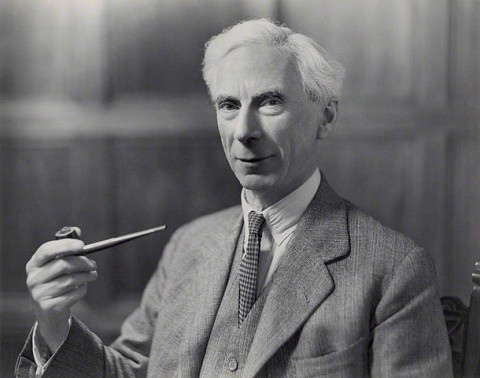
Bertrand Russell’s Ten Commandments for Living in a Healthy Democracy

by Mike Springer

Bertrand_Russell_photo

Bertrand Russell saw the history of civilization as being shaped by an unfortunate oscillation between two opposing evils: tyranny and anarchy, each of which contain the seed of the other. The best course for steering clear of either one, Russell maintained, is liberalism.

“The doctrine of liberalism is an attempt to escape from this endless oscillation,” writes Russell in A History of Western Philosophy. “The essence of liberalism is an attempt to secure a social order not based on irrational dogma [a feature of tyranny], and insuring stability [which anarchy undermines] without involving more restraints than are necessary for the preservation of the community.”

In 1951 Russell published an article in The New York Times Magazine, “The Best Answer to Fanaticism–Liberalism,” with the subtitle: “Its calm search for truth, viewed as dangerous in many places, remains the hope of humanity.” In the article, Russell writes that “Liberalism is not so much a creed as a disposition. It is, indeed, opposed to creeds.” He continues:

But the liberal attitude does not say that you should oppose authority. It says only that you should be free to oppose authority, which is quite a different thing. The essence of the liberal outlook in the intellectual sphere is a belief that unbiased discussion is a useful thing and that men should be free to question anything if they can support their questioning by solid arguments. The opposite view, which is maintained by those who cannot be called liberals, is that the truth is already known, and that to question it is necessarily subversive.

Russell criticizes the radical who would advocate change at any cost. Echoing the Enlightenment philosopher John Locke, who had a profound influence on the authors of the Declaration of Independence and the U.S. Constitution, Russell writes:

The teacher who urges doctrines subversive to existing authority does not, if he is a liberal, advocate the establishment of a new authority even more tyrannical than the old. He advocates certain limits to the exercise of authority, and he wishes these limits to be observed not only when the authority would support a creed with which he disagrees but also when it would support one with which he is in complete agreement. I am, for my part, a believer in democracy, but I do not like a regime which makes belief in democracy compulsory.

Russell concludes the New York Times piece by offering a “new decalogue” with advice on how to live one’s life in the spirit of liberalism. “The Ten Commandments that, as a teacher, I should wish to promulgate, might be set forth as follows,” he says:

1: Do not feel absolutely certain of anything.

2: Do not think it worthwhile to produce belief by concealing evidence, for the evidence is sure to come to light.

3: Never try to discourage thinking, for you are sure to succeed.

4: When you meet with opposition, even if it should be from your husband or your children, endeavor to overcome it by argument and not by authority, for a victory dependent upon authority is unreal and illusory.

5: Have no respect for the authority of others, for there are always contrary authorities to be found.

6: Do not use power to suppress opinions you think pernicious, for if you do the opinions will suppress you.

7: Do not fear to be eccentric in opinion, for every opinion now accepted was once eccentric.

8: Find more pleasure in intelligent dissent than in passive agreement, for, if you value intelligence as you should, the former implies a deeper agreement than the latter.

9: Be scrupulously truthful, even when truth is inconvenient, for it is more inconvenient when you try to conceal it.

10. Do not feel envious of the happiness of those who live in a fool’s paradise, for only a fool will think that it is happiness.

via Brain Pickings

Bertrand Russell’s Ten Commandments for Living in a Healthy Democracy is a post from: Open Culture. You can follow Open Culture on Facebook, Twitter, Google Plus and by Email.

18 Mar 11:32

Is Minimalism Just for Rich People?

image

In a much cited piece in The New York Times this week, entrepreneur Graham Hill lays out the case for not having much stuff. After selling his first company, he bought a home and filled it with beautiful possessions. But the large house and nice things became a burden. He expended too much mental energy on the acquisition and maintenance of his possessions.

Only when Hill traveled to Europe to “see about a girl” did he realize the freedom he felt when separated from his massive house and many gadgets. Everything he needed was in a small backpack. He could travel anywhere, start companies with just his laptop, and embark on any adventure that presented itself. He was free. Eventually, he made this sort of lifestyle more permanent and now lives in a 420 square foot apartment.

We found Graham Hill’s story thought-provoking. People go to work every day in order to make money. The primary use for money is to buy things. If things are worthless, what’s the point of all this rigamarole?

Charlie Lloyd provides an interesting rebuttal to Hill’s thesis. He argues that only the wealthy can afford to live an asset-light life because they have options. Being rich is not measured by how much stuff you can buy, it’s measured by how many options you have, including the option to not have much stuff.

Wealth is not a number of dollars. It is not a number of material possessions. It’s having options and the ability to take on risk.

Lloyd also hypothesizes that if you watch people on the streets, it’s the wealthy people that are able to walk around carrying less things:

If I were rich, I would carry a MacBook Air, an iPad mini as a reader, and my wallet. My wallet would serve as everything else that’s in my backpack now. Go out on the street and look, and I bet you’ll see that the richer people are carrying less.

His central point is that wealthy people have the option to carry less things with them. If it starts raining, the wealthy can buy an umbrella instead of carrying one around all the time. Less wealthy people don’t have the option to get things depending on the circumstances, so they need to store up their possessions in case of future need.

It’s an interesting point. Is it easier to be minimalist if you are rich?

Well, it’s probably easier to be anything when you’re rich. It’s harder to be a minimalist when you are poor because everything is harder to do when you’re poor in America. It quite likely that people in America could stand to have less stuff, regardless of their income.

What do you think? Is having fewer things a luxury?

This post was written by Rohin Dhar. Follow him on Twitter here or Google.

17 Mar 21:45

Magic

by Greg Ross

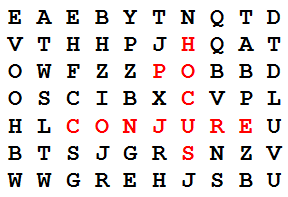
pi alphabet grid

If π is expressed in base 26, then each of its digits can be associated with a letter of the alphabet (0=A, 1=B, … 25=Z). This produces an endless string of letters:

D.DRSQLOLYRTRODNLHNQTGKUDQGTUIRXNEQBCKBSZIVQQVGDMELM …

If the digits of π are truly random, then this string “emulates the mythical army of typing monkeys spewing out random letters,” writes Mike Keith. “Among other things, this implies that any text, no matter how long, should eventually appear in the base-26 digits of π.”

In examining the first million letters, Keith has found that the word CONJURE appears at position 246,556. If a carriage return is added after each 2,736 letters, then we have a two-dimensional field in which further words appear, in the style of a word search. Now HOCUS and POCUS appear, intersecting CONJURE (with POCUS in the shape of an L).

When each row is 14,061 digits long, then ALPHA, OMEGA, and GOD appear in a group near position 148,655. And when rows are 13,771 digits long, then DEMON and SATAN appear interlocked near position 255,717. Keith even found the makings of a charming haiku near position 554,766 when rows are 1,058 letters long:

Sun, elk in water;
Oho! For her I’ll try to
Be a hero yet.

More here. See also A Hidden Message and Equidistant Letter Sequences.

17 Mar 21:41

10 Fascinating Typographical Origins

by JFrater

A typographical character is simply a printed symbol—this includes letters, numbers, and punctuation marks. The ? is called a question mark; ( and ) are called parentheses; and ; is known as the semicolon. But you know that already, and I suspect you’re beginning to wonder how one could possibly wring drops of “fascinating” from the dry towel of typography. And that’s fair. But did you know the division sign has a name? What about the mysterious origins of the paragraph sign? Where did the % sign come from? ¿Why on Earth do Spanish-speakers put those upside-down question marks at the beginning of their sentences? Read on!

10 The Pilcrow—

Gazette Pilcrow

The pilcrow, also less elegantly called the “paragraph mark,” serves a number of purposes, most of which involve denoting the presence or location of a paragraph in one way or another. Most commonly, it’s used in word processing programs to indicate a “carriage return” “control character;” that is to say, a non-permanent mark showing where a paragraph ends. There is disagreement over the origin of the name; The Oxford English Dictionary, for one, likes to think it comes from a string of corruptions of the word “paragraph.” I prefer to side with the Oxford Universal Dictionary, which suggests that the sign itself looks a lot like a featherless crow—a “pulled crow.” The symbol itself derives from the letter C—you can still see it in there—which stood for the Latin “capitulum,” or “chapter.” The two lines that ended up vertically crossing the C were a sort of editorial note from the writer.

The pilcrow was used in the Middle Ages, in an earlier form, as a way of marking a new train of thought before the paragraph became the standard way of accomplishing this. Now, among its myriad uses are in academic writing (when citing from an HTML page), legal texts (when citing a specific paragraph), and in proofreading (an indication that a paragraph should be split in two).

9 The Ampersand—&

Ampersand-1

The ampersand is a logogram used to mean “and.” The symbol itself is based on a shorthand version of the Latin word for “and”—et—and in certain fonts, you can still clearly see an ‘e’ and a ‘t’ linked together (Adobe Caslon, for instance). The word ampersand has a somewhat unusual origin—it’s a corruption of the hard-to-parse, multilingual (English and Latin) phrase “& per se and,” which means “& by itself is ‘and.’” Confused? Don’t worry—that’s only natural. All it means is: “The symbol &, all by its little self, simply means and.” And where did this phrase come from? Well, in the early 1800s, & was considered the 27th letter of the English alphabet, and since saying “X, Y, Z, and” would be confusing, “and per se and” was said instead. It doesn’t take a major stretch of the imagination to fathom how this could quickly turn into ampersand, which it did by around 1837.

Because people like to make up urban legends based on everything, including stodgy ol’ typographical marks, there’s a vicious rumor floating around that French physicist and mathematician André-Marie Ampère used the mark so much that it eventually got called “Ampere’s and.” Don’t believe it for a second. In the end we’re left with a pretty little symbol that has more than a few variants.

8 Interrobang—!?, ?!, or ‽

Type-Talks-1

What?! You’ve never heard of the interrobang!? Really? Well, now you have, so all is forgiven. An interrobang is described as a “nonstandard punctuation mark” (it’s part of the punctuation counterculture), used to end sentences where you really want both the exclamation point and the question mark. While the use of both marks side by side had been prevalent for some time, it wasn’t until 1962 when an advertising executive named Martin K. Speckter decided that enough was enough—no longer would he withstand the tyranny of two separate punctuation marks when one would suffice. He asked readers to suggest names—rejecting such fine ideas as rhet, exclarotive, and exclamaquest—and ultimately settled upon interrobang, a combination of the Latin root “interro” (think “interrogate”), and “bang,” which is printer’s slang for the exclamation mark. The word is used to describe both the two side by side (!? or ?!), or the combined symbol ?.

7 At Sign—@

at_symbol800-640x360.jpg

What we know as @ has a lot of different monikers—including “at sign,” “at symbol,” “ampersat,” and “apetail”—but is unusual in that it doesn’t have a widely-accepted name in English. In Spanish, it is known as an arroba, and in French the arobase. @ has two primary usages—its original one, used in commerce to mean “at the rate of,” and more recently, “directed at” (primarily in email and in social media like Twitter). It has been claimed (by Italian professor Giorgio Stabile) that the symbol is actually over 500 years old, to represent an “amphora”—a unit of capacity used in commerce. It first made its way onto a typewriter as early as 1885, and has since found its way into our hearts.

A couple of fun facts:

- The Spanish arroba was a unit of weight equivalent to 25 pounds.
- The names for @ in other languages often derive from the idea that it looks like an animal. To wit: apenstaartje (Dutch for “monkey’s tail); papacy (Greek for “little duck); dalphaengi (Korean for “snail”); sobachka (Russian for “little dog”).

6 Guillemets—« »

Gui

Guillemets are what the French use instead of quotation marks. In addition to the physical differences, the usage differs as well—generally, guillemets open and close entire conversations or exchanges, rather than individual utterances. Amusingly, the guillemet is named after a French printer named Guillaume Le Bé from the 16th century; “Guillemet” is a diminutive of “Guillaume.” One can only assume that French people call our quotation marks “Willies,” “li’l Bills,” or “Mini Williams.”


5 Obelus—÷

Obelus

The Obelus, more commonly known as “the division sign” for reasons I can’t fathom, comes from an Ancient Greek word for a sharpened stick or other similar pointy object. It shares its roots with the word “obelisk.” The obelus was once used to denote sections of writing that were considered incorrect or suspicious; in other words, it would have been perfect for Wikipedia editors. It was first used to mean “division” in 1659 by Swiss mathematician Johann Rahn. While still used frequently in the US and in Britain, it is not commonly used to mean division in most of the rest of the world.

4 Inverted ? and !—¿ and ¡

Question Mark

In Spanish, when a sentence ends with a question mark or an exclamation point, it also starts with an inverted one. ¿Porque? Well, I’ll tell you porque. In 1754, the Spanish Royal Academy decided that the Spanish language had a dire problem: when you start reading a sentence, you often have no way of telling if it’s a question or not until you get to the very end.

Consider the sentence vas a ir a la tienda? (Are you going to go to the store?). Up until you get to the question mark, you are totally in the dark—is it a question, or simply a declarative sentence stating “you are going to go to the store”? In English, we have ways of indicating that a question is coming, so that proper inflection can be used, as well as to help with comprehension. In Spanish, you used to need contextual clues to help you out before the Royal Academy had its way. They also decided that the exclamation point would be lonely, so they advocated for its inverted use as well.

Though the language was slow to adopt this new convention, it is now a fully integrated part of the language. A few interesting usage notes:

- Short, unambiguous questions are often written without the inverted mark—Quien eres?
- In digital communication, the inverted mark is frequently left off (emails, instant messaging, texts).
- Some authors refuse to use inverted marks.
- Writers can get playful with the marks, including starting a sentence with a ¡ and ending it with a ?.
- ¿ can be used in the middle of a sentence if the whole sentence is not a question, but rather the final clause.
- Note that ¿ and ¡ are positioned differently than ? and !; they hang below the line.

3 Ditto mark

Quotes

File this under “things we use all the time but don’t know their name.” Ditto marks are those quotation-looking-guys you use to save your tired wrist from a few more seconds of writing, indicating that what’s directly above should be repeated. Though one might suspect (“one” being “me” before I researched it) that the word ditto may have been related to the Latin root “di” (meaning “two”, as in when you say “ditto” you mean “me too!”), it in fact derives from an early (c. 1620) form of the Italian word for “to say.” Originally, it was used to avoid needless repetition when writing a series of dates in the same month.

A “ditto mark” is a type of “iteration mark.” Other languages have their own, notably Chinese, Japanese, and Ancient Egyptian. It’s tough to fathom why Ancient Egyptian scribes might have needed a way to cut down on chiseling elaborate drawings into rock.

2 Percent Sign—%

M 506A91Feb7C37

Take a look at the percent sign. Look at each of the three individual marks—a circle, a line, a circle. Remind you of anything? Does it, perhaps, remind you of a certain number, with the digits rearranged and realigned? A very important number? Maybe . . . the number 100?

The % sign, of course, means that the preceding number should be understood as being divided by one hundred—”per cent.” The slash mark used to be straight across, with zeroes above and beneath, but it gradually became slanted—leading to what D.E. Smith, in 1925, called the “solidus form” of the percent sign. The solidus, aka slash, virgule, fraction bar, and other names, is this sign: /.

Because there is disagreement about everything, there is disagreement over whether there should be a space between the number and the % sign, over whether it should be per cent or percent, and when you should use the % symbol and when you should instead write out the word.

1 Upper Case and Lower Case letters

9 29 Upper & Lower Case

Once I learned the origins of the terms “upper case” and “lower case,” it seemed so obvious. I mused: does everyone know this but me? What else are my friends and family keeping from me? Instead, though, I decided to convince myself that legions of Listversers were in the dark like me, too embarrassed to say anything. Take comfort, fellow readers, for you may remain anonymous in your ignorance.

Now then: in the early days of printing, when each letter was set individually, the letters were kept in cases. The capital letters were kept in—you guessed it—the “upper case,” less convenient to the printer because of how relatively few capital letters are used, while the lower case letters were kept in the more accessible—wait for it—”lower case.” It’s as simple as that, really. This usage of the terms dates back to 1588.

Fun facts about cases:
- The use of two cases in a written language is called “bicameral script.” Languages with only one case are called “unicase.”
- So what were lower-case letters called before they used cases at all? Well, we have other words to describe them—Upper-case letters are called majuscules (and, of course, capitals), and lower-case letters are called minuscule. Note the spelling difference with the word miniscule.

The post 10 Fascinating Typographical Origins appeared first on Listverse.

16 Mar 20:24

Nazis in Brazil

by Rio Gringa
Adam Victor Brandizzi

Vale o vídeo também.

Screen shot 2013-03-14 at 11.42.57 PMDuring World War II, Brazil sent troops to fight with the Allies, and opened military bases to American forces. But after the war, Brazil became a destination for between 1,500 and 2,000 Nazi war criminals. One of the most notorious Nazis, Josef Mengele, lived for the last years of his life in Brazil, and died of drowning in the resort town of Bertioga in São Paulo. Alois Brunner, one of the most wanted Nazi war criminals who escaped capture, was rumored to have lived in Brazil.

But what fewer people know is that Nazis--both German and Brazilian--made attempts at establishing Nazi settlements in Brazil.

One of the known German attempts was the Guyana Project, as detailed in the 2008 book The Guyana Project: A German Adventure on the Amazon. A Nazi delegation traveled to the Amazon in the 1930s to search for land to colonize and to establish settlements. One of the explorers, Joseph Greiner, died of malaria or yellow fever, and a nine-foot high grave was erected near the Rio Jari. The author of the book found the grave, marked with swastikas, along with remains of dwellings. (See photos here.)

Another case is that of Octávio Rocha Miranda, a Brazilian landowner in rural São Paulo who sought to create a Nazi-inspired homestead. Between 1930 and 1940, orphan boys, many of them black, were taken to his farm called Cruzeiro do Sul, where they were forced into slave labor. Nazi symbols were later found in the area, including swastika-imprinted bricks and a Nazi flag.

Revista de História recently made a short documentary about this case, which includes interviews with the farmer who originally discovered the bricks and several of those who were forced to work on the farm. There are Portuguese subtitles available.

Image: Via "Entre a suástica e a palmatória"
16 Mar 20:11

Internship

Applications are invited for The Economist's 2013 Marjorie Deane internships. Financed by the Marjorie Deane Financial Journalism Foundation, the awards are designed to provide work experience for a promising journalist or would-be journalist, who will spend three months at The Economist writing about economics and finance. Applicants are asked to write a covering letter and an original article of no more than 500 words that they think would be fit for publication in the Finance and economics section. Applications should be sent to deaneintern@economist.com by March 30th. For more information, please visit marjoriedeane.com.

16 Mar 20:07

Comic for March 16, 2013

16 Mar 00:36

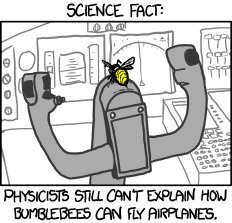
Bumblebees

Did you know sociologists can't explain why people keep repeating that urban legend about bumblebees not being able to fly!?
16 Mar 00:33

Impure Mathematics

the_universal_mathematical_impurity_conjecture
15 Mar 23:58

brandizzi: Gostei de um vídeo @YouTube http://t.co/fVwv0vZRc9 Liszt - Faust Symphony

brandizzi: Gostei de um vídeo @YouTube http://t.co/fVwv0vZRc9 Liszt - Faust Symphony
15 Mar 11:58

Cê Lá faz Idéia

by ricardo

regras do mundão
15 Mar 11:56

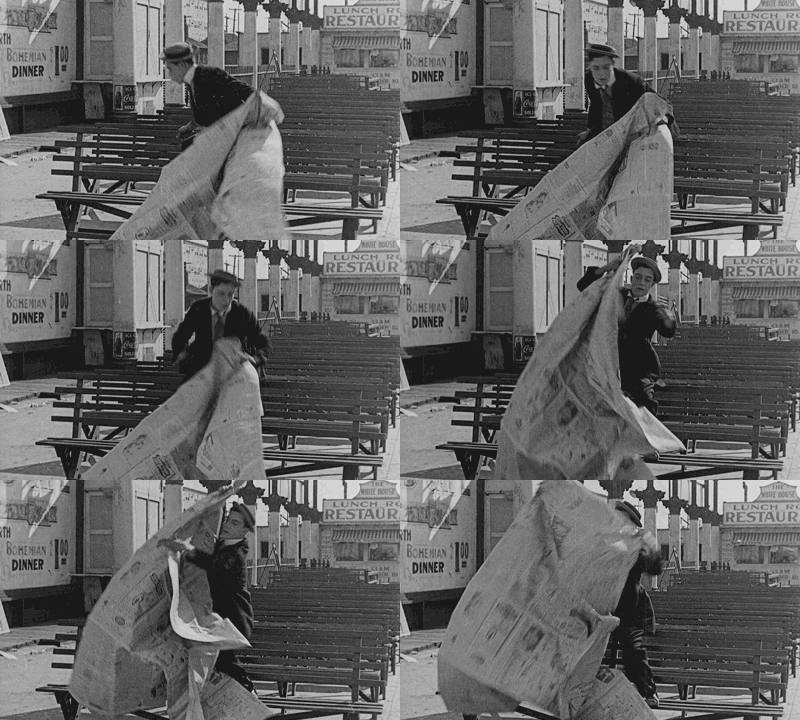
<3 buster

Adam Victor Brandizzi

Uma grande VDD.


14 Mar 17:38

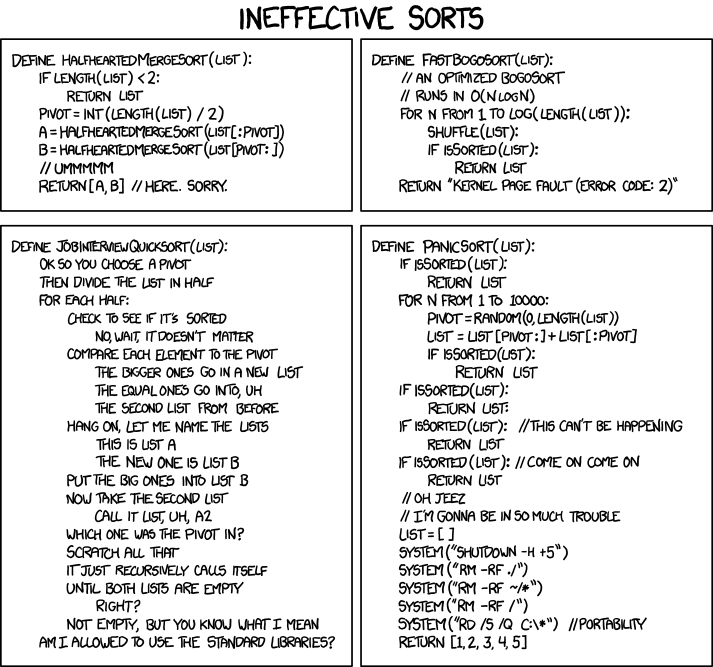
Ineffective Sorts

StackSort connects to StackOverflow, searches for 'sort a list', and downloads and runs code snippets until the list is sorted.
14 Mar 11:03

In taberna quando sumus

by noreply@blogger.com (Philipe Maciel)
Enquanto abstêmio, digo: masterpiece!

14 Mar 10:54

Comprando Livros no Abebooks - Irmandade Indiana

by noreply@blogger.com (Philipe Maciel)
Adam Victor Brandizzi

Interssante esse abebooks. Aliás, o post todo é interessante.

Comprei um livro-texto. num dos indianos do Abebooks e... funcionou! Chegou o livro bonitão e intacto. Detalhe: demorou apenas seis dias corridos para chegar.

Tem edições indianas ultrabaratas, mas muitas delas são feitas em papel de má qualidade. Infelizmente, às vezes elas são vendidas como edições internacionais. É que existe uma espécie de "hierarquia" nos livros-texto, que muitas vezes é mais ou menos assim:

Primeiro, sai a edição caríssima em capa dura -> depois, uma edição mais barata, em capa flexível, mas o conteúdo é o mesmo e o papel é bom -> depois, uma edição "internacional", para venda fora da Europa e América do Norte, mais barata ainda, com alguns exercícios, estudos de caso, etc. diferentes ou suprimidos, e capa sem graça -> alguns saem ainda em edições indianas ultrabaratas, com capa flexível e papel de baixa qualidade, mas com o mesmo ou quase mesmo texto da edição original.

Comprar de livreiros indianos é uma aventura, pois muitos deles vendem as edições ultrabaratas como se fossem as internacionais. Não são, são de pior qualidade.

Não foi o meu caso, muito bom! Até hoje, tudo que comprei via Abebooks foi 100% de satisfação.

Livros são um mercado interessante: produto físico com alto custo de elaborar, baixo custo de reproduzir. Caso semelhante é o dos farmacêuticos. Tem os de marca, os similares e os genéricos. Aliás, genéricos que os indianos também dominam...

14 Mar 10:46

30-01-2013

by Laerte

14 Mar 10:35

05-02-2013

by Laerte

14 Mar 10:35

06-02-2013

by Laerte

08 Mar 01:38

Endangered Species #67

by Doug

Endangered Species #67

It’s the first time I’ve drawn a gazelle that’s still alive. Here are more endangered species.