Now we all know ‘infomercials’ are designed to do two things, 1. Relate to your problem 2. Offer you a product that will solve it. The trouble is despite their best efforts to be compelling many of their products are either utterly useless to verging on the pointless. Yet for every 100 people that roll their eyes and change the channel, 1 person will pick up the phone and order an item which when it finally arrives, they will instantly regret.
To highlight just how ridiculous infomericals have become, here’s a series of 22 unliley scenarios they’ve created – all with the sole of aim of selling you a product for only 4 easy payments and a free set of cheap kitchen knives. Do let us know your favs! And own up, have you ever bought any from the shopping channel?















Durante as pesquisas para meu segundo livro Nem vem que não tem: A vida e o veneno de Wilson Simonal, uma das perguntas que eu deveria responder, era sobre como surgem os boatos. No caso do Simonal, como surgem lendas urbanas baseadas em boatos que foram, um dia, baseados em fatos. Pra quem ainda não leu o livro: em 1971, Simonal foi acusado de haver mandado torturar um ex-funcionário para obter dele uma confissão de desvio de dinheiro. Anos depois, o “fato” que se noticiava, e pelo qual Simonal foi alijado da cultura brasileira, era o de que ele trabalhava para o regime militar, prestando serviço à ditadura delatando outros artistas para que estes fossem torturados e, eventualmente, exilados.

Claro que boatos não surgem do nada. O ex-funcionário de Simonal foi torturado nas dependências da polícia política da época, o DOPS. O livro traz declarações e documentos em que o próprio Simonal dava a entender que ele, de alguma maneira nebulosa e jamais explicada, havia “colaborado” com a “revolução” de 1964. Mas daí para ser alcaguete havia uma distância tão grande quanto a que separa o fato do boato.
Nas últimas semanas, eu acompanhei intrigado a “evolução” de duas notícias ligadas ao mundo do entretenimento, e como elas se transformaram a cada nova republicação, a cada novo control+c control+v, em “fatos” cada vez mais assertivos e distantes da notícia original. Acompanhe os monstros se criando:

No dia 09 de abril, o produtor Mark Ronson, que está trabalhando em duas ou três faixas do novo álbum de Paul McCartney, deu uma entrevista à revista Rolling Stone tentando tirar a pecha de “retrô” que paira sobre seu nome. Ronson foi DJ na festa de casamento de McCartney em 2011 e contou na entrevista que certo dia no estúdio, o ex-beatle surgiu com algumas “coisas funk-moombahton pós-Bonde do Rolê” e lhe perguntou: “Como você consegue tirar esse tipo de energia do som?” e usou Usher como exemplo do que chamava de “energético”.
No dia seguinte, a notícia saiu no New Musical Express da Inglaterra como “baile-funk e Usher inspiram o novo álbum de Paul McCartney”.
O ClubNME brasileiro puxou a brasa pra sardinha brasileira. Era assim o seu lead: “Quem diria que Paul McCartney está apaixonado pela sonoridade do funk (sim, o carioca!) e do Bonde do Rolê? Mas são essas as influências que Mark Ronson, produtor do novo disco do ex-Beatle, revelou.”
No UOL, a gente descobre que “Paul McCartney está ouvindo funk carioca como inspiração para novo disco”.
O Bonde do Rolê, que nem é carioca, claro, aproveitou a demência coletiva, tirou foto atravessando alguma faixa de pedestre à moda de Abbey Road e ainda produziu um remix de “Get Back” pra provocar.
No dia 13, o amigo Ricardo Schott no jornal O Dia já estava algumas curvas na frente, entrevistando o DJ Sany Pitbull e Mr Catra pedindo dicas para que o velho roqueiro se inteire no movimento do funk carioca. Valeska Popozuda, por exemplo, se ofereceu para levá-lo ao morro do Alemão.
Aí a coisa degringolou. Na Mix TV a notícia era a de que “O produtor Diplo contou para a Rolling Stone que o ex-beatle Paul McCartney chegou em seu estúdio esses dias com uma música do Bonde do Rolê e perguntou: “Como a gente consegue esse tipo de energia?”. Sim, um dos músicos mais aclamados da história do rock estava ouvindo um brasileiríssimo funk”
Àquela altura, alguém já havia lembrado do inacreditável projeto Let it Baile que o não menos inacreditável João Brasil perpetrou em 2010, de mash ups do álbum Let it be com músicas do MC Buiu, Perlla e Deize Tigrona.
Segundo a Caras de alguns dias depois, “Bonde do Rolê conquista Paul McCartney”. Pedro D’Eyrot, do grupo curitibano, declarou: “Me sinto a nova Linda McCartney!”
Não se espante, se depois de tanta loucura, alguém agitar um encontro do ex-beatle com o trio de Curitiba. A farsa, às vezes, se repete como história.

A outra notícia mutante é mais séria e envolve a vocalista do grupo Calypso, Joelma. No dia 30 de março, a musa paraense deu uma entrevista à coluna social da revista Época e, entre outras coisas, falou sobre sexualidade: a sua e a dos outros. “Tenho muitos fãs gays, mas a Bíblia diz que o casamento gay não é correto e sou contra”. Acrescenta que, se tivesse um filho nessa situação, “lutaria até a morte para fazer sua conversão”. “Já vi muitos se regenerarem. Conheço muitas mães que sofrem por terem filhos gays. É como um drogado tentando se recuperar”. O título da entrevista foi um tanto malandrinho: “Joelma compara gays a drogados e diz ser contra o casamento homossexual”.
No UOL, a frase virou “gays são como drogados em recuperação”. No dia seguinte à publicação da entrevista à Época, o portal compilou a reação de artistas contrários à cantora paraense.
O coluna “Retratos da Vida” do jornal Extra “contribuiu” com a história: “A nuvem está negra para Joelma e Chimbinha da Banda Calypso. Os pedidos para shows com os astros da música brega despencaram após a mudança de escritório. Abalado, o cantor se consultou com um psiquiatra e iniciou um tratamento com antidepressivos.” O texto ainda dizia que a declaração de Joelma levou problemas ao casamento deles, já que o guitarrista não compartilharia da opinião da cantora.
O ator José de Abreu, no Twitter, declarou que também seria deprimido se tivesse de conviver com Joelma. Me lembrei do exército de cantores e artistas que, nos anos 70, se negavam a subir em um mesmo palco que Simonal porque “não dividiam palco com dedo-duro”. Era uma ótima hora pra todo mundo se mostrar engajado.
A assessoria da banda Calypso imediatamente emitiu comunicado dizendo que as palavras de Joelma foram distorcidas pela Época. Negou a depressão de Chimbinha e os problemas matrimoniais com Chimbinha. Mas no mesmo dia o sempre intrépido jornal Extra trouxe uma “novidade” ao caso de “inferno astral” do grupo paraense: “Filme sobre Calypso sobe no telhado”. Dizia o texto: “A produção do longa-metragem já vinha encontrando dificuldades de levar essa história para a tela, e a situação se agravou com a polêmica em torno das declarações recentes da cantora. O fato é que agora ninguém mais quer vincular o nome à banda, e o projeto tornou-se inviável.” Note a palavra “fato”. A única fonte procurada foi a produtora Vira-lata, que negou o cancelamento do filme. De onde surgiu essa notícia então? Mistério.
Aí a imprensa fez a festa: o Estadão contou que “Depois de Joelma se dizer contra o casamento gay e comparar homossexuais a viciados em drogas, o filme da banda Calypso não será mais realizado “até segunda ordem”. Sem checar a informação, limitou-se a dizer que a fonte era o jornal Extra.
A coisa continuou rolando: no dia 16 de abril o “Blog do Marrom”, ligado ao jornal Correio da Bahia afirmou que a banda Calypso teria sido limada das festas juninas de Jequié, Bahia, devido às “declarações da cantora sobre o casamento gay e os homossexuais em geral”. O “fato” chegaria às raias do insólito, já que, segundo a nota, os paraenses teriam sido substituídos justamente por Daniela Mercury, que, no mesmo período, assumiu publicamente seu relacionamento com uma mulher. Tanto a assessoria de Daniela quanto a do Calypso negaram a “informação” que, no entanto, continua a correr redes sociais como uma libelo contra o preconceito e a homofobia.
Aguardem desdobramentos de ambos os casos.
Ontem falei pessoalmente para o diretor do filme Isto é Calypso, Caco Souza, com um velho instrumento de comunicação chamado telefone. Ele, apesar de ter ligado aos jornais que deram o “furo”, até hoje não sabe de onde surgiu a história do cancelamento do filme. Caco disse que a produção segue em ritmo normal, tão fácil e tão difícil como sempre havia sido, e que a única reação de um dos cotistas já contratados foi um telefonema, confuso com as notícias de que o filme que sua empresa estava apoiando, ter sido cancelado. O cotista ficou aliviado em saber que tudo não passava de mais um boato espalhado pela imprensa brasileira como fato.


I am rereading Rawls’ A Theory of Justice, which is always a pleasure. I suppose it was never released on Vulcan.




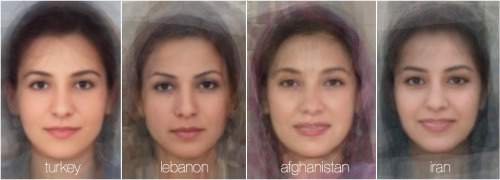


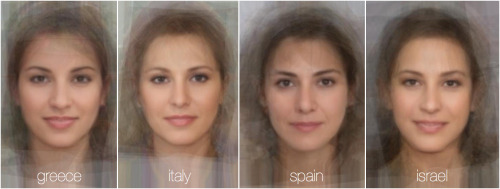

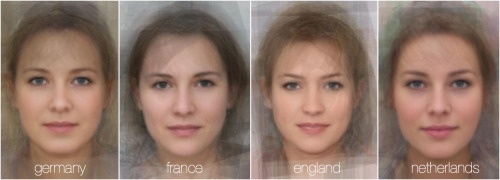
“world of averages” - composite images culled from thousands of individual portraits resulting in symmetrical average faces.
Adam Victor BrandizziPô, aí não...
Adam Victor BrandizziUm meme necessário.
Susan Griffiths died yesterday. She died by drinking poison that knocked her out, put her in a coma, and slowly killed her… all without pain.
It was her choice to drink the mixture. It was either that or eventually succumbing to a painful, debilitating brain disease.

Susan Griffiths (Ruth Bonneville – Winnipeg Free Press)
In her Winnipeg home, they wouldn’t allow her to die on her own terms, so she had to fly to Switzerland to end her life. Lindor Reynolds captured her story beautifully in this article (and accompanying video). Griffiths, an atheist, really was an incredible woman.
There’s a lot of conversation in the local Canadian press about end-of-life care and why Canada should allow people to die with dignity, but the most jaw-dropping response may have come from someone who read Reynolds’ story:
The day after my story about Susan ran, I got a phone call from a distressed man. He wanted me to give him Susan’s number. He was a Christian, he said, and he needed to tell her she’d go to hell if she went ahead with her plans. She was in Europe, I said, and an atheist with no belief in an afterlife. He insisted she was a sinner. I suggested, as gently as possible, that he add Susan to his prayer list. She was already on mine, I said. He said he’d pray she changed her mind. That was his right, I said.
I can’t tell if that gesture is loving or dickish. Maybe it’s both. Either way, I’m grateful to the religious reporter for politely declining his request.
It would be great if Griffiths’ decision could inspire lawmakers in Canada to change their laws. There’s no reason to deny people the opportunity to end their lives as they see fit. Want to require some counseling first? Fine. A few restrictions? Okay. But to deny it completely, especially after seeing what Tony Nicklinson had to go through, is simply barbaric.
(Thanks to Jackie for the link)
Adam Victor BrandizziToma, seu artista conceitual :P

Michael Craig-Martin’s 1973 conceptual artwork An Oak Tree presents a glass of water with a plaque explaining that it’s a tree — not symbolically but literally: “The actual oak tree is physically present but in the form of the glass of water.”
This is a comment on transubstantiation and, by extension, on the patron’s faith in an artist’s presentation of his work, but it backfired: When the National Gallery of Australia bought the piece in 1977, customs officials barred it as “vegetation.”
 GIZA PLATEAU, EGYPT—The 10,000 workers who built the pyramid of Menkaure are known to have lived in a town located to the south of the Sphinx. A new analysis of animal bones from the site suggests that those workers and their overseers were supplied with more than 4,000 pounds of meat from cattle, goats, and sheep a day, in addition to fish, beans, lentils, grain, beer, and other foods. “They probably got a much better diet than they got in their village,” said Richard Redding of Ancient Egypt Research Associates. The tens of thousands of animals and their caretakers would have been spread out across the Nile Delta, until they were brought to the workers’ town for consumption. Archaeologists have recently found a structure with a round pen where the animals may have been slaughtered.
Adam Victor BrandizziExcelente ideia!


“I’m pretty sure there’s a lot more to life than being really, really, ridiculously good looking. And I plan on finding out what that is.”
~Derek Zoolander, Zoolander
Humans like attractive people. Those blessed with the leading man looks of Brad Pitt or the curves of Beyonce can expect to make, on average, 10% to 15% more money over the course of their life than their more homely friends. Without being consciously aware that they are doing it, people consistently assume that good-looking people are friendly, successful, and trustworthy. They also assume that unattractive people are unfriendly, unsuccessful, and dishonest. It pays to be good looking.
This insight is not lost on Madison Avenue or Hollywood. This is why every beer commercial features an attractive woman and Catherine Zeta-Jones appeared in T Mobile ads. This is why companies hire beautiful women to stand in their tradeshow booths and why Abercrombie & Fitch clothing stores badger attractive customers into applying for sales positions. Consumers associate the perceived positive characteristics of attractive people with their products and companies.
Abercrombie & Fitch might be able to sell more clothes by having good-looking sales associates, but is that legal? Surely, there must be some controls to ensure that unattractive people are not excluded from large swaths of the labor market. So what protections exist for those of us without smooth skin and thin waists?
The surprising answer is none. America has no law preventing companies from using attractiveness as a hiring criteria, regardless of whether the job is exotic dancer, salesman, or software engineer. It’s pretty much okay from a legal standpoint to discriminate based on looks in America.
Is that a problem?
The Science of Beauty
Beauty is often considered subjective and “in the eye of the beholder.”
To some extent this is true. People argue over the attractiveness of various celebrities precisely because differences of opinion exist. Tastes also differ across times and cultures. Victorian England admired pale skin. During the Colonial Era, men showed off their calves like men show off their pecs and biceps today. And skinniness has not always been considered the ideal.
However, academic work on beauty finds that much of what we find attractive is consistent over time and across cultures. In general, people find symmetry and averageness of features attractive in faces. When images of perfectly symmetrical faces are created in Photoshop, people like them better. The same is true of photos created by merging many faces to get a composite. Scientists speculate that we prefer symmetry and average features because they (at least at some point) indicated healthy genes or other evolutionary advantages.

More evidence of a universal, objective basis for beauty comes from studies of babies presented with pictures of different faces. The pictures the babies gazed at the longest were consistently the ones rated as most attractive by panels of adults.
The Halo Effect
In the early 20th century, psychologist Edward Thorndike noticed that psychologists’ evaluations of very different traits in the same individual seemed suspiciously consistent. He suspected that a bias was to blame.
To test his finding, he asked military officers to rate their subordinates on characteristics such as neatness, physique, leadership skills, intellect, and loyalty. He again found that the results were too consistent. When officers rated a soldier especially high for one quality, they tended to rate him high for other unrelated traits where he did not necessarily excel. Soldiers rated especially poor in one area also received poor marks across the board. The officers opinion of their soldiers for one characteristic dominated their overall impression of them.
Thorndike called this the “halo effect.” Researchers have found it at work in many different ways, including physical attractiveness. Psychologist Robert Cialdini writes that “We automatically assign to good-looking individuals such favorable traits as talent, kindness, honesty, and intelligence.”
Attractive people benefit from the halo effect in two major ways in business, which are described by Cialdini in his bestselling book Influence.
The first is that people tend to “comply with those we like.” This is why magazine offers from neighborhood children are so irresistible and “Tupperware parties” (where mothers host parties to sell Tupperware to their friends) so successful. It’s also why Joe Girard, one of the most successful car salesmen of all time, sent all of his former customers holiday cards with the phrase “I like you” every year. Likeable people have an easier time selling products, and attractive people are eminently likeable due to the halo effect.
The second is that people tend to associate people with the products they sell and companies they represent. Cialdini points out that weathermen are blamed (by otherwise rational people) for storms and that messengers during the Persian Empire were either killed or treated as heroes depending on the nature of the news they brought. (“Don’t kill the messenger.”)
Ad agencies take advantage of this association principle all the time. Celebrity endorsements and imagery from popular events like the Olympics are used in commercials to link products or companies with their positive traits. The same is true of using attractive people in ads and showrooms, and it works even when people are perfectly aware of companies’ intent. Cialdini writes:
“In one study, men who saw a new-car ad that included a seductive young woman model rated the car as faster, more appealing, more expensive-looking, and better designed than did men who viewed the same ad without the model. Yet when asked later, the men refused to believe that the presence of the young woman had influenced their judgments.”

In combination, these two principles and the halo effect give attractive people a huge advantage in any job that involves interaction with customers, business partners, or the general public. Good looking public relations representatives are more likely to be trusted by the public and imbue their companies a positive image. Handsome salesmen will be more able to close deals. Sources will be more likely to trust beautiful journalists and tell them sensitive stories.
People generally recognize and tolerate the practice of hiring attractive people as actors and models. But the same principles that allow Angelina Jolie to do a better job selling makeup than the average girl next door are also at work in a huge number of professions.
A Quick Asterisk
While the halo effect has been robustly demonstrated to help attractive people in many personal and professional settings, there are important exceptions.
A 2010 study, for example, looked at how attractiveness benefitted men and women in different jobs. Attractive men had an advantage over their plain peers across the board. But for jobs considered “masculine,” such as mechanical engineer, construction supervisor, and even director of finance, women actually paid a penalty for being attractive. One of the researchers notes:
“In these professions being attractive was highly detrimental to women. In every other kind of job, attractive women were preferred. This wasn’t the case with men which shows that there is still a double standard when it comes to gender.”
This suggest that women may not benefit from attractiveness as much as men, or may even suffer reverse discrimination for it depending on the type of job.
The Best Looking Sales Staff in the Land
Although it is a clothing store, Abercrombie & Fitch is not strictly famous for its clothes. The company is also well known for it’s brand being tied to attractive people and pop culture. In their stores, pop music blares, perfume hangs in the air, and attractive sales staff use catchphrases like “Hey! What’s up?” Pictures on the wall feature their models’ six packs and bare backs more than the brand’s actual clothing.
Abercrombie & Fitch unapologetically hires only the most attractive people to work in their stores. Recruiters seek out attractive people in their stores, on the street, and at fraternities and sororities. The importance of their codified “Look Policy” is so important to hiring that managers reportedly throw applications from unattractive job seekers into the trash as soon as they leave the store.

Their focus on hiring attractive staff has worked. For its customers, A&F seems to have successfully associated the positive characteristics of its attractive employees with the brand and its clothing. Bought for $47 million in 1988 as an ailing sports focused clothing and goods company, its rebranding as a preppy and apparel store for teenagers resulted in strong growth. Abercrombie boasted $1.47 billion in revenue in 2012.
In 2004, 14 individuals launched a class action lawsuit against Abercrombie & Fitch. They charged that the company’s Look Policy of favoring a “natural, classic American style” was discriminatory. Their lawyers argued that a certain look was not central to the essence of A&F’s business. It helped market and sell clothing, but was unnecessary to the actual job of answering questions about polo shirts. A&F, rebuked, settled for $50 million and agreed to change their Look Policy.
But A&F did not get in trouble for hiring only hotties - they were charged with racism. Their accusers noted that A&F’s all-american look translated to “virtually all white.” The prosecution described how A&F sought out a sales staff that was mostly white and preppy, and relegated minority employees to positions in the back room.
Abercrombie & Fitch did not change their Look Policy to stop excluding unattractive people, it changed it to include good looking black, Asian, Indian, and Hispanic employees. The company still throws away resumes from people of average looks, and is proud of its good-looking sales staff.
No Law At All
There is no federal law against appearance-based discrimination or “lookism.” Companies in the US can freely use attractiveness as a basis for employment decisions in all but several cities that have passed local legislation against it. This is true regardless of whether attractiveness is central to the occupation (a stripper or actor), a branding or sales strategy (Abercrombie & Fitch’s sales staff), or completely irrelevant (personal assistant or software engineer).
Legal cases challenging companies’ use of physical appearance in hiring, promotion, or placement decisions have, as in the Abercrombie & Fitch example, linked the use of physical appearance to discrimination on the basis of race, gender, age, or disability.
Three laws exist that could be used to challenge lookism in company policy: the Age Discrimination in Employment Act, Title VII of the Civil Rights Act, and the Americans With Disabilities Act.
1) The Age Discrimination in Employment Act protects older Americans from assumptions about their inability to perform their job. It has not been used in a case over attractiveness, but commentators in the legal field note that in cases such as the reassignment of an anchorwoman due to her appearance, the prosecution could have a claim under this act if they proved that she was moved to a less visible role due to her old appearance.
2) Title VII of the Civil Rights Act “prohibits employment discrimination based on race, color, religion, sex and national origin.” The A&F case rested on this law’s prevention of racial discrimination. In the seventies, Southwest Airlines attempted to differentiate itself as the “love” airline. It hired only attractive female stewardesses and ticket clerks who dressed in hot pants and halter tops and called their check-in counters “quickie machines.” But in 1981, a man denied a job with Southwest successfully sued the company for sexual discrimination. Southwest began hiring male employees.
3) Although the Americans With Disabilities Act wasn’t originally intended to protect people without perfect, tanned bodies, its definition of a disability leaves room for interpretation:
“An individual with a disability is defined by the ADA as a person who has a physical or mental impairment that substantially limits one or more major life activities, a person who has a history or record of such an impairment, or a person who is perceived by others as having such an impairment. The ADA does not specifically name all of the impairments that are covered.”
This act has been applied to physical characteristics, mostly (but rarely) in cases dealing with obesity (and, in one case, a toothless individual whose dentures were painful). In one obesity case, the judge invoked the logic of the halo effect, noting the disabling nature of obesity in employment in “a society that all too often confuses ‘slim’ with ‘beautiful’ or ‘good.’”
These acts do prevent one major appearance-based employment practice: hiring only attractive women for certain jobs. Since this would exclude men and place obligations (in terms of dressing seductively) on female but not male employees, it is banned by Title VII.
And the law is quite strict. Companies must prove that their employment practices constitute a “bona fide occupational qualification” that is necessary for the essence of the business. A strip club can claim that seductive women are the essence of the business. Southwest Airlines can not: the judge ruled that the company’s purpose was not “forthrightly to titillate and entice male customers.” Even Hooters, the restaurant chain whose entire premise is for hot, scantily clad women to serve men buffalo wings, fell victim to this law. It has kept the “Hooter Girls,” mainly by settling lawsuits out of court, but has been compelled to open more staff positions to men and women that do not require good looks.

Appearance-based hiring policies are open to legal challenge if they can be linked to one of the above three laws. But as long as a company is open to hiring attractive people of every gender, race, creed, and age, it is free to hire and promote staff the same way fraternity boys play hot or not. Further, since “lookism” is not explicitly banned, legal concerns and norms are much less likely to impact employers actions in practice.
In Defense of Abercrombie & Fitch
Many people rebel at the idea of Abercrombie & Fitch choosing to hire only good looking young people. Others, however, find “discrimination” on the basis of looks not only natural but good. Harvard economist Robert Barro, for example, finds good looks a legitimate aspect of productive economic activity:
“I believe the only meaningful measure of productivity is the amount a worker adds to customer satisfaction and to the happiness of co-workers. A worker’s physical appearance, to the extent that it is valued by customers and co-workers, is as legitimate a job qualification as intelligence, dexterity, job experience, and personality.”
Barro compares looks to intelligence. Both are valued to varying degrees in different positions and professions. Both are also doled out unequally. So just as we should not prevent intelligence from being considered a legitimate hiring criteria, neither should the law prevent beauty from being considered.
No one objects to actors and actresses being hired on the basis of their looks; they rebel at it being applied to jobs in sales or the press. But Barro notes that the market can better determine where beauty is a permissible criteria than the law can:
“The difference between glamour fields and others in terms of the role of physical appearance is merely a matter of degree. If the government stays out, the market will generate a premium for beauty based on the values that customers and co-workers place on physical appearance in various fields. Probably the market will allocate more beauty to movies, television, and modeling than to assembly-line production and economic research. I have no idea how much beauty the unfettered market would allocate to flight-attendant jobs or CEO positions. But whatever the outcomes, are the judgments of government preferable to those of the marketplace?”
According to this line of thinking, economic incentives will make sure that beauty is not considered in professions where it is irrelevant. After all, companies generally want to hire the best possible candidate. And in situations where looks are relevant to the job, companies should be free to consider it, and we can expect them to prioritize attractiveness depending on its importance to the job. This is analogous to how employers consider how much to prioritize intelligence over other traits such as honesty and teamwork depending on the role.
The Case For Lookism as Discrimination
Other legal thinkers believe that lookism is a form of discrimination. Just as protections over race or gender seek a society that is merit-based where people are not limited due to physical appearance, they believe that new laws should be put in place or the Disabilities Act extended to cover appearance-based discrimination.
Holders of this view engage in healthy debate with their fellows over whether such a law could be feasibly implemented. Common doubts include that the subjective nature of beauty would result in inconsistent application and the difficulty of identifying the unattractive population in need of protection. They also fear that it would “open the floodgates” to spurious lawsuits or doubt that unattractive people have been discriminated against historically the way that minorities and women have - a justification for legal intervention.
Barro and his ilk believe that lawyers should stay out of the beauty game. They think that the government should not legislate away the productive aspects of attractiveness that inform business strategies. However, some proponents of legal protection for appearance-based legislation make another claim. Just as Title VII and the Age and Disability Acts protect people from irrational biases about their worth as employees based on their race, gender, and age, they believe that unattractive people face the same irrational biases.
What’s Behind a Million Dollar Smile

So far, this article has considered how attractiveness gives people an advantage in certain jobs. And it is to this perspective that Barro gives a compelling response. However, beautiful people also benefit from their looks, professionally and personally, in ways that have nothing to do with better work performance. It could be considered as irrational, discriminatory, and in need of legal protection as the case of a woman being passed up for promotion because her employer doesn’t believe that a woman can be a leader.
Regardless of whether you believe that it is discrimination, your looks have an incredible impact on your life. It goes far beyond people being more likely to hold the door for a pretty girl, and, unlike the case of an actress’s stunning looks propelling her to stardom, it often operates subconsciously.
Good looking people can expect to make more money during their life. Due to the halo effect, people assume from their good looks that they are also intelligent and competent, which bolsters their careers. One often cited study found a 10% to 15% “beauty premium” in people’s wages.
The effects of lookism can be seen viscerally in politics. In the first-ever televised presidential debate, viewers who watched on television believed that the good-looking John F. Kennedy won while those who listened on the radio believed that plain looking (and at the time, sick) Richard Nixon won the debate. Similarly, a study of Canadian federal politics found that attractive candidates received 2.5 times as many votes as unattractive candidates, but voters did not realize that candidates’ handsomeness impacted their decision.
This is true as well in the supposedly egalitarian world of the courtroom. Researchers have tracked the development of court cases to find that attractive (and guilty) defendants receive lighter sentences. Another study found that in an experiment where participants judged how much money to award the victim of a negligence case, they awarded more or less money depending on the attractiveness of the two parties. When the victim of the negligence was the more attractive of the two, the jurors awarded him $10,051. When the defendant was more attractive, the victim only received $5,623.
In a test performed by ABC News, elementary school kids matched pictures of men of differing heights to a series of words. They consistently matched the tallest man to words like strong, handsome, and smart, and the shortest to words like sad, scared, and weak or even “yucky” and “has no friends.” Maybe the kids just learned that unattractive people are bad from the fact that Disney villains are ugly while the heroes are beautiful, but even babies stare far longer at pictures of attractive people than an average looking individual.
Attractive people begin accruing benefits from their looks and climbing the success ladder at an early age. Studies of schoolchildren find that teachers view misbehavior by a good-looking child as less naughty and that they assume attractive children to be more intelligent than their less-attractive peers. One study notes that this can “become a self-fulfilling prophecy: teachers expect better looking kids to outperform in school and devote more attention to children who are perceived to have greater potential.”
Most importantly, the wage gap and other benefits that attractive people enjoy in the labor market seem to be only partially explained by their increased productivity in industries like film and sales. A study done by a Harvard and Wesleyan professor, for example, had participants perform a task in which beauty was of no help. They then had other participants act as bosses and set their wages. Some bosses did so based off a resume and prior performance at the task, while others also had varying levels of knowledge of the participants’ attractiveness via a photo or interview.
The professors did find a wage gap between the attractive and unattractive participants of roughly 12% to 17%, mirroring the real wage gap in the labor market. However, they also found that the increased confidence of attractive workers only explained 15% to 20% of the beauty premium. The lions share of the wage gap was explained by how “employers (wrongly) expect good-looking workers to perform better than their less attractive counterparts.”
In short, economists like Barro can point to the ways in which hiring attractive employees makes good business sense, but that may just be a story we tell ourselves to feel okay about the disadvantages unattractive people face. As these examples show, the stereotypes that cause us to view more attractive people as better overall begin at an early age, benefit attractive people outside of fields where attractiveness offers a productivity advantage, and operates subconsciously.
A Skin Deep World
Attractive people enjoy enormous advantages in life. People are positively biased towards them. Due to a halo effect people assume that they are as good in every way as their fine features and toned abs. This gives them an advantage in any business or career where public-interaction plays a role, whether in advertising and sales, or as press secretaries and CEOs.
For this reason, companies like Abercrombie & Fitch hire only attractive applicants to staff their stores. And they do so without breaking any law. Legal challenges can only be mounted when appearance-based employment practices can be linked to discrimination on the basis of a protected category like race or gender.
Beauty offers an edge in many occupations. There is no reason why thousands of companies should not adopt a policy of prioritizing attractive hires. Most probably already do so to some extent, just without the forthrightness or conscious intent of Abercrombie & Fitch.
The favorable bias toward attractive people also endows them with benefits in situations that seem entirely inappropriate. They receive lighter sentences from juries and better wages in positions where their attractiveness has little to no impact on their productivity. Even as schoolchildren they are doted upon more by teachers, which impacts their career trajectories. And all this bias frequently operates without people being aware of it.
We’re told not to judge a book by its cover. But we do. All the time. And everyone’s life is affected by it.
This post was written by Alex Mayyasi. Follow him on Twitter here or Google Plus. To get occasional notifications when we write blog posts, sign up for our email list.
Veja meu comentário sobre os Drones no Globo News Em Pauta
Leia também
A Guerra da Síria está péssima e ficará ainda pior
A Guerra ao Terror resultou em mais terrorismo
Os bombardeios com Drones, como são conhecidos os aviões não tripulados, aumentam o ódio aos Estados Unidos no Paquistão e no Yemen, que são os países alvejados por estes ataques. A afirmação foi feita ontem por um jovem iemenita ao Congresso dos EUA, em Washington, acentuando um debate já existente sobre o uso deste armamento.
No mesmo dia, a organização de defesa de direitos humanos Human Rights Watch lançou uma campanha para tentar banir o uso dos “robôs assassinos”, que é uma denominação muito utilizada pelos opositores ao uso dos Drones nos Estados Unidos.
Até o início deste ano, o debate sobre os Drones era restrito à academia e ocasionais matérias no New York Times. Em março, porém, o senador republicano Rand Paul, de viés libertário, decidiu levantar esta questão no Senado americano em votação para aprovar John Brennan, conhecido como o “pai dos Drones”, para dirigir a CIA.
Paul frisava que a administração de Barack Obama mata seres humanos, incluindo cidadãos americanos, com o simples argumento de eles serem combatentes inimigos. Esta classificação permite aos EUA eliminar ou prender supostos terroristas ao redor do mundo sem leva-los para a Justiça.
A estratégia de usar os Drones visa enfraquecer a Al Qaeda no Paquistão e no Yemen, onde estão os seus dois principais braços, e é uma alteração em relação à política de George W. Bush, que preferia a detenção. Basicamente, como dizem nos EUA, Bush “prendia e torturava” enquanto Obama “mata”.
Os resultados em contraterrorismo são ambíguos. Por um lado, dezenas de líderes da Al Qaeda foram afetados. A organização terrorista tem menos capacidade de organizar mega atentados como no passado, a não ser em cenários de guerra civil, como na Síria. Ao mesmo tempo, estas ações têm radicalizado muçulmanos que podem ficar mais propensos a lançar ataques mesmo sem uma aliança direta com a rede de Bin Laden.
Além disso, entre os mortos, há muitos suspeitos de envolvimento com o terrorismo ou figuras que possuem ameaça apenas local. Apenas para se ter uma ideia, dos 166 prisioneiros em Guantánamo atualmente, apenas seis foram considerados culpados. Imagina-se que uma proporção semelhante de vítimas dos Drones sejam inocentes equivocadamente acusados de terrorismo.
Para completar, nos bombardeios, por mais que tenha havido avanços nas operações, muitos civis inocentes, incluindo mulheres e crianças, acabam morrendo como efeito colateral destes bombardeios.
Hoje, os EUA são o único país a utilizar Drones para bombardeios. Mas, em breve, muitos outros países passaram a usar domestica e externamente, incluindo o Irã, Rússia e China. Isso sem falar de organizações como o Hezbollah, que já possui aviões não tripulados para espionagem. A guerra no futuro tende a ser entre robôs. Mas as vítimas serão seres humanos.
Guga Chacra, comentarista de política internacional do Estadão e do programa Globo News Em Pauta em Nova York, é mestre em Relações Internacionais pela Universidade Columbia. Já foi correspondente do jornal O Estado de S. Paulo no Oriente Médio e em NY. No passado, trabalhou como correspondente da Folha em Buenos Aires
Comentários islamofóbicos, antisemitas e antiárabes ou que coloquem um povo ou uma religião como superiores não serão publicados. Tampouco ataques entre leitores ou contra o blogueiro. Pessoas que insistirem em ataques pessoais não terão mais seus comentários publicados. Não é permitido postar vídeo. Todos os posts devem ter relação com algum dos temas acima. O blog está aberto a discussões educadas e com pontos de vista diferentes. Os comentários dos leitores não refletem a opinião do jornalista
Acompanhe também meus comentários no Globo News Em Pauta, na Rádio Estadão, na TV Estadão, no Estadão Noite no tablet, no Twitter @gugachacra , no Facebook Guga Chacra (me adicionem como seguidor), no Instagram e no Google Plus. Escrevam para mim no gugachacra at outlook.com. Leiam também o blog do Ariel Palacios
Adam Victor BrandizziEm 2011, li um artigo (http://theamericanscholar.org/affirmative-inaction/) que dizia:
"One important set of studies, by Thomas Espenshade of Princeton University and his colleagues, examined the records of more than 100,000 applicants to three highly selective private universities. They found that being an African-American candidate was worth, on average, an additional 230 SAT points on the 1600-point scale and that being Hispanic was worth an additional 185 points, but that being an Asian-American candidate warranted the loss, on average, of 50 SAT points."
Na época, fiquei chocado. Como assim, estudantes "asiáticos" recebem menos pontos? Como permitem um absurdo desses?
Nunca entendi isso direito, mas esse artigo do Priceonomics joga luz sobre esta esquisitíssima estatística, levantando pontos importantes e mostrando aspectos frequentemente esquecidos das histórias da Ivy League e quetais, olhando inclusive para um lado do "racial profiling" que passa desapercebido em debates sobre ações afirmativas.
TLDR; Priceonomics <3 <3 <3

Applying to colleges in the United States is a stressful, competitive process. In 1970, the acceptance rate at Stanford University was 22.4%. Today, only 5.7% of applicants are accepted into the school. Across the country, nearly every top school like Harvard, MIT and Yale are reporting record-low acceptance rates. The number of students applying to elite colleges is exploding, and those applicants have better test scores than ever. It’s never been harder to get into a selective university.

Asian-American students face an extra source of stress: deciding whether to respond to the application question asking for their race and ethnicity. True or not, there is a perception that Asians are at a disadvantage in the college admissions process. Asian students going through the process comment:
“I didn’t want to put ‘Asian’ down… because my mom told me there’s discrimination against Asians in the application process… Not to really generalize, but a lot of Asians, they have perfect SATs, perfect GPAs, … so it’s hard to let them all in”
…
“As someone who was applying with relatively strong scores, I didn’t want to be grouped into that stereotype… I didn’t want to be written off as one of the 1.4 billion Asians that were applying.”
Is their fear justified? Is it statistically more difficult to be accepted into top universities if you are Asian? Ivy League colleges and their ilk deny this to be true, but what does the data say?
Statistical Evidence of Discrimination Against Asians
Those who contend that selective colleges discriminate against Asians point to three main sources of data.
First, some top colleges have in the past (though not recently) released detailed admissions data. Second, in 1996 California banned state universities from considering race and ethnicity in admissions decisions. The result is a natural experiment where you can see what happens to the number of Asians accepted before and after this decision. Finally, researchers have tried to quantify whether the number of high performing Asians has been increasing and whether that has corresponded to more placements in selective schools.
The most cited, well-researched evidence that it’s harder for Asians to get into top colleges is presented by Princeton professor Thomas Espenshade and his collaborator Alexandria Radford in their 2009 book No Longer Separate, Not Yet Equal. In this book, the researchers analyzed the complete application histories of eight “elite” universities in 1997 (the last year these schools released this information). While the data is over 15 years old, it’s the most complete dataset publicly available.
Espenshade and Radford use the 1997 data to show the overall acceptance rates by race and class at public and private universities with highly selective admissions criteria. We will focus on the private institutions data since most elite schools fit in that category.
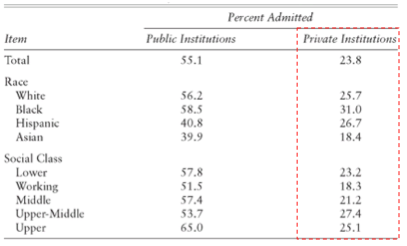
As the numbers show, Asians have the lowest acceptance rates at the selective private universities in this sample. The authors then lay out how admissions rates vary by race and SAT score:
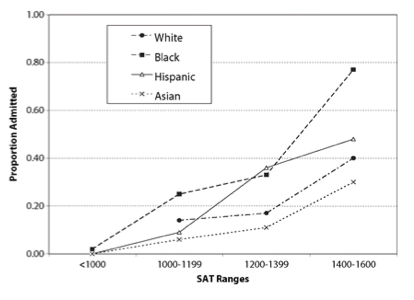
Asians have the lowest acceptance rate for each test score bucket.
While these descriptive statistics are useful, there could be additional factors at play. The authors next build up a regression model that controls for the applicants’ state of residence and academic performance. Model 5 shows the impact of race on likelihood of admissions after controlling for these factors at these private schools. (You can read about the rest of the models and methodology here.)

As model 5 shows, Asian applicants have 67% lower odds of admission than white applicants with comparable test scores.
Finally, the authors convert these findings into more intuitive results. With white students as a baseline, they look at how much of a bump or penalty students receive in terms of SAT scores on the basis of their race:

They find that being Asian is the equivalent of a 140 point score penalty on your SAT when applying to top private universities. For example, a white student that scored 1360 on the SATs would be on equal footing with an Asian student that scored 1500.
Ultimately, the authors come short of making any conclusions about whether Asians are discriminated against. Their data indicates that Asians needed higher standard test scores than whites to get accepted to top schools in 1997, but this doesn’t consider other parts of a “holistic” admissions process such as athletic prowess, legacy status (being the child of an alum), or quality of admissions essays and recommendation letters.
The next piece of evidence frequently cited in the debate is the the admissions data of public universities in California (Berkeley, UCLA, UCSD, Davis, etc). In 1996 it became illegal for these schools to consider race in their admissions criteria. This created a natural experiment showing what happens to the number of Asian students at a school when admissions officers are not allowed to consider that they are Asian.
Since these are state universities, the admissions data, which includes the race of students, is publicly available. Let’s consider the data for UC Berkeley, the most prestigious and selective public university in California.
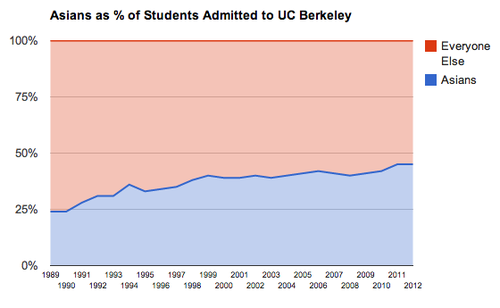
Over the the past 20+ years, students accepted into UC Berkeley has exploded from 25% Asian in 1989 to 45% Asian today.
While this is interesting, it’s not necessarily proof that Asians are discriminated against prior to the 1996 ruling. If the number of college-aged Asians rose dramatically during this time period, it would be natural that there are more Asians accepted at Berkeley.
So let’s look at what has happened to the the acceptance rate over time. Did it get easier for Asians to get in after you could no longer consider their ethnicity? Of course, it’s gotten a lot harder for everyone to get in over the last 20 years, so let’s compare the Asian acceptance rate to the acceptance rate for everyone else at Berkely.
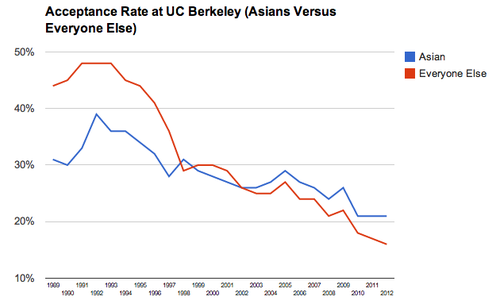
In 1989, it was a lot harder for an Asian-American to get into UC Berkeley than the average non-Asian. By 2012, that is no longer the case at all.
Finally, the fact that the growth in the Asian population has not been reflected in their numbers at top schools is cited as well. Not only have the the number of college-aged Asians increased in the last two decades, the number of academically high performing Asians has as well. This viewpoint is summarized quantitatively by Ron Unz, founder of The American Conservative - a publication that is quite vocal about this issue:

The data Unz has compiled shows that while the number of college aged Asians has increased dramatically, their presence at top schools has shrunk or remained flat. By contrast, Cal Tech, which has a strictly race neutral admissions policy, has kept pace with the growth in the the Asian population. (This is also true of the University of California school we previously examined). Unz also contends you should see a lot more Asians at these Ivy League schools during this time, because they were kicking ass and taking names academically:
“Asians were less than 10 percent of U.S. Math Olympiad winners during the 1980s, but rose to a striking 58 percent of the total during the last thirteen years 2000–2012. For the Computing Olympiad, Asian winners averaged about 20 percent of the total during most of the 1990s and 2000s, but grew to 50 percent during 2009–2010 and a remarkable 75 percent during 2011–2012.
….
“The statistical trend for the Science Talent Search finalists, numbering many thousands of top science students, has been the clearest: Asians constituted 22 percent of the total in the 1980s, 29 percent in the 1990s, 36 percent in the 2000s, and 64 percent in the 2010s.
…
“Although Asians represented only about 11 percent of California high school students, they constituted almost 60 percent of the [National Merit Scholars]… In Texas, Asians are just 3.8 percent of the population but were over a quarter of the NMS semifinalists in 2010, while the 2.4 percent of Florida Asians provided between 10 percent and 16 percent of the top students… Asian over-representation was enormous [in New York]: the Asian 7.3 percent of the population—many of them impoverished immigrant families—accounted for almost one-third of all top scoring New York students.”
According to standardized tests and talent competitions, there is strong evidence that Asian Americans aren’t just doing pretty well, they’re completely dominating.
The Counter Argument
“Harvard College welcomes talented students from all backgrounds, including Asian-Americans… The admissions committee does not use quotas of any kind.”
- Jeff Neil, Harvard University Communications Department
It’s hard to find evidence that contradicts what’s presented above. While the data is either stale or limited, all of it indicates that Asians are under-represented at top schools. At the same time, admissions officers vigorously deny that there is any bias against Asian Americans. Moreover, this author knows former admissions officers and they’re all really nice people. It’s very hard for this author to imagine them hatching dastardly plots to keep Asians from their schools.
The gist of the argument that top schools don’t discriminate against Asians is that academic qualifications are only one of the many criteria used in a “holistic” admissions process. There are so many students with great academic qualifications relative to the spots available that academic qualifications almost don’t matter for serious candidates. Given that so many students meet the minimum academic criteria (which are high), successful applicants need to contribute more than just brain power to their school of choice.
This viewpoint is crystallized by Rod Bugarin, former member of Brown and Columbia admissions committees:
“Yes, if you considered only test scores, Asian and Asian-American students would seem to be at a disadvantage.”
….
“But the students who rise to the top of the highly personal and subjective admissions process are those who have submitted the strongest comprehensive applications.”
The unstated implication of this quote is that while Asians have high test scores, the rest of their application, on average, is deficient in some manner.
The next argument is that top schools aren’t actually biased against Asians, they’re biased against people that aren’t athletes or children of alumni. In 1990, the US Office of Civil Rights concluded an investigation into whether Harvard discriminated against Asians. The commission concluded that most of the under representation could be explained by the fact that few Asians were recruited athletes or children of alumni.
This might explain why the number of Asians at Harvard was relatively low in 1990, but it doesn’t explain why that number is still about the same after two decades of growth in the Asian share of America’s population.
Finally, there are those who argue that the “Asian discrimination question” is merely being used as a “wedge issue” to overturn affirmative action and lower the number of blacks, hispanics, and historically under-represented minorities on campus. While this is a valid concern, it evades the question of whether Asians are held to a different academic standard than the baseline group, whites. That’s the question we’re focusing on.
Reading the universities’ responses to accusations of an anti-Asian bias in admission decisions is frustrating because they don’t provide any data to back their refutations. They simply state that there is no discrimination today. They refuse to even release recent admissions data in order to refute the old and stale data that suggest Asians have to score much higher on the SATs than whites in order to be accepted into college.
Holistic admissions policies, as they stand today, are a subjective black box that could be used for any purpose - good or evil, inclusion or exclusion. In absence of providing any data, Ivy League admissions offices are saying, “Trust us, we use our power for good.” But how have universities used this power in the past? Are they really worthy of trust?
A History of Discrimination

Colleges in the United States likely think of themselves as progressive institutions. They have forward-thinking faculties, a stated objective of inclusion, and commitments to public service. This author might even personally think they are wonderful, progressive places. But no generation ever thinks of themselves as being racist or discriminatory, even when they are. If the data suggests you’re discriminating against a group, and you’re forced to come up with qualitative, opaque explanations for why the discrepancy exists, historically, that has been a bad sign.
Has the Ivy League, for example, proven itself as an institution that should be given the benefit of the doubt over accusations of discrimination? Schools in the Ivy League have been around for almost 400 years. For the vast majority of that time, women, blacks, or anyone other than white men were not allowed to attend. During this period, the educators, admissions officers, and alumni undoubtedly considered themselves part of a great institutions bringing light to the world, but the hindsight of history proves they had racist and sexist admissions policies.
Holistic admissions criteria emerged at Ivy League schools in the early 20th century and were almost immediately twisted for virulently anti-semitic purposes. Until the 1920s, students took an admissions test and those that did well on the test were admitted to the colleges “almost entirely on the basis of academic criteria.” This resulted in lots of Jewish men on the campus of Harvard, Princeton, and Yale.
An alumni visiting the Harvard campus around this time was shocked by the scene:
“Naturally, after 25 years, one expects to find many changes, but to find that one’s University had become so Hebrewized was a fearful shock. There were Jews to the right of me, Jews to the left of me, in fact they were so obviously everywhere that instead of leaving the Yard with pleasant memories of the past I left with a feeling of utter disgust of the present and grave doubts about the future of my Alma Mater.”
It’s around this time that Ivy League schools switched from a strictly quantitative system of test scores to a more subjective, holistic approach. The holistic approach was used to squelch diversity and the number of Jews in American universities then plummeted. Wikipedia documents:
For instance, the admission to Harvard University during that period fell from 27.6% to 17.1% and in Columbia University from 32.7% to 14.6%. Corresponding quotas were introduced in the medical and dental schools resulting during the 1930s in the decline of Jewish students: e.g. in Cornell University School of Medicine from 40% in 1918–22 to 3.57% in 1940–41, in Boston University Medical School from 48.4% in 1929–30 to 12.5% in 1934–35.
Around this time, the concept of giving prominence to legacy of Alumni started to gain prominence. Wikipedia elaborates:
Legacy preference for university admissions was devised in 1925 at Yale University, where the proportional number of Jews in the student body was growing at a rate that became alarming to the school’s administrators. However, even prior to that year, Yale had begun to incorporate such amorphous criteria as ‘character’ and ‘solidity’, as well as ‘physical characteristics’, into its admissions process as an excuse for screening out Jewish students; but nothing was as effective as legacy preference, which allowed the admissions board to summarily pass over Jews in favor of ‘Yale sons of good character and reasonably good record’, as a 1929 memo phrased it.
As late as the 1950s, prominent administrators at Harvard and Yale publicly commented on the appearance of the kind of students they sought. David Brooks of the New York Times summarizes:
Paul Buck argued in several essays that Harvard did not want to become dominated by the “sensitive, neurotic boy,” by those who are “intellectually over-stimulated.” Instead, he said, Harvard should be seeking out boys who are of the “healthy extrovert kind.” In 1950, Yale’s president, Alfred Whitney Griswold, reassured alumni that the Yale man of the future would not be a “beetle-browed, highly specialized intellectual, but a well-rounded man.”
It wasn’t until the 1950s that these sort of barriers were dropped against Jewish Americans and their numbers started to rise again at elite universities.
The above section isn’t meant to imply that Asians are the “new Jews.” It’s meant to show the potential consequences of “black box” admissions criteria and how disgusting those practices can be. Opaque processes can be subject to considerable abuse.
Conclusion: Why This Matters

The elite schools of America hold considerable power. For much of this nation’s history they’ve been the gatekeepers of wealth, power, and knowledge. Entry into their club confers privilege - it’s a signal to the world that you are among the chosen to be selected for high paying jobs, leadership positions, and power.
In today’s world, it seems hard to swallow that federally-funded, tax-exempt institutions could continue to shroud their selection criteria in secrecy. It’s likely that admissions officers are wonderful people, but what if every time they see an Asian applicant, they subconsciously think “Another piano playing, hard working kid, with perfect SAT scores. Good candidate, but we can’t have a campus entirely full of people like that.” Is that an okay thought to think today? Does it lead to outcomes that represent our societal values? Will it be okay to think that way in 20 years?
The nature of what is “merit” is constructed by those who control the admissions decisions. Before the early 20th century, it was how good you were at Latin and Greek. Later, what kind of family you came from become important. Today, the holistic admissions criteria are a black box.
Many Asians believe they are being held to a different academic standard than whites. This belief might be true or false, but universities should release the data that puts the debate to rest. But if Asians are under represented on American college campuses relative to what their academic performance would predict, this seems like the sort of discrimination that history would ultimately judge very harshly.
This post was written by Rohin Dhar. Follow him on Twitter here or Google. To get occasional notifications when we write blog posts, sign up for our email list.
Submitted by: Unknown
The author of The Conservative Mind once described the automobile as “a mechanical Jacobin,” and when he found his daughters had smuggled a television up to the attic to watch more TV than they were allowed, he threw the offending device off the roof.
Kirk was young before his time. “Surveys suggest that young people ‘prefer to live places where they can easily walk, bike, and take public transportation’,” Brad Plumer notes in a Washington Post piece titled “Why Aren’t Younger Americans Driving Anymore?” For all Americans, “vehicle miles driven have fallen 8.75 percent. The decline has persisted for 92 months and there’s no sign it’s abating.”
Then there’s this Marketing Charts report on Nielsen’s fourth-quarter 2012 television viewership numbers:
In Q4, 12-17-year-olds watched roughly 21 and a half hours of TV per week, the lowest amount of any age group. Interestingly, that not only was about 45 minutes less than Q4 2011, it was about 1 hour less than the previous quarter, which may serve as another indication that teens are getting their political news (however much they consume) through sources other than TV.
Looking at year-over-year patterns, teen consumption on TV decreased by 45 minutes in Q4, dropped by 98 minutes in Q3, by 47 minutes in Q2, and by 127 minutes in Q1. Other than the fact that viewership dropped each quarter, there aren’t many linear trends to take away from that. Perhaps more significant is when the major drops in viewership occurred. Q1 and Q3 were the heaviest TV viewing periods for teens (coinciding somewhat with TV seasons), but those showed the biggest consumption declines.
The Associated Press, meanwhile, notes how nervous the National Association of Broadcasters is getting about “zero TV” homes. “There are 5 million of these residences in the U.S., up from 2 million in 2007,” reports Ryan Nakashima:
Nielsen’s study suggests that this new group may have left traditional TV for good. While three-quarters actually have a physical TV set, only 18 percent are interested in hooking it up through a traditional pay TV subscription.
Zero TVers tend to be younger, single and without children. Nielsen’s senior vice president of insights, Dounia Turrill, says part of the new monitoring regime is meant to help determine whether they’ll change their behavior over time. “As these homes change life stage, what will happen to them?”
I don’t think they’ll be tuning in even once they’re married and settled. As for the fact that three-quarters of this group does own TV sets, that has to be offset against anecdotes like this, from one Jeremy Carsen Young, who isn’t putting up the antenna to receive free transmissions because “‘I don’t think we’d use it enough to justify having a big eyesore on the house,’ the 30-year-old says.”
Whether Russell Kirk would altogether approve of the iPad is another question, but the new breed of devices does require more user input, as opposed to the passive receptivity that characterizes the television viewer. And as Plumer quotes from a Frontier Group report, “Websites and smart phone apps that provide real-time transit data make public transportation easier to use, particularly for infrequent users.”

Four male Blue Manakins from Brazil try to impress a female. (The Falls of Iguaçu - BBC)
This post has been featured on a 1000notes.com blog.
Adam Victor BrandizziParece inútil mas alguém pode ficar milionário como especulador usando isso aí....


Argentinos guardam no ‘colchão’ US$ 170 bilhões. Só no ano passado colocaram neste refúgio um total de US$ 12 bilhões. Os colchões – este magnífico invento do Neolítico que foi brilhantemente aperfeiçoado pelos árabes antes das cruzadas – são o símbolo do dinheiro em lugar seguro. Eles foram um dos diversos esconderijos que os argentinos utilizaram ao longo das últimas décadas para resguardar suas economias.
O refúgio financeiro preferido dos desconfiados habitantes deste país, os colchões, estão cada vez mais cheios de dólares que saem do sistema financeiro nacional. Segundo dados do Instituto Nacional de Estatísticas e Censos (Indec), em média, mensalmente em 2012, US$ 1 bilhão partiu em êxodo do sistema para formar parte daquilo que os economistas na city financeira portenha chamam de “riqueza oculta” da Argentina. No total, atualmente, os argentinos contariam com US$ 170,7 bilhões nos mais variados refúgios.
Mais além do simbólico colchão – cada vez mais king size – os argentinos, para esconder seus dólares recorrem livros nas estantes, potes velhos de conservas e buracos embaixo do assoalho, entre outros. Além destas alternativas improvisadas, guardam suas economias em lugares ortodoxos como caixas de segurança dentro de território nacional e contas bancárias no exterior.
O volume de dinheiro nos colchões e outros refúgios equivale a 40% do PIB da Argentina. Além disso, é quatro vezes maior que as reservas atuais do Banco Central, que na semana passada estavam em US$ 39 bilhões.
O ato de colocar o dinheiro nos colchões – e fora do país – é um clássico argentino há tempos. Mas, essa tendência acentuou-se desde a crise econômica, política e social de 2001. Logo antes da explosão da crise em dezembro daquele ano, os argentinos tinham um total de US$ 81,87 bilhões fora do sistema. Desde a crise o dinheiro fora do sistema aumentou em mais de 100%.

Neste colchão repousa Hermafrodita, a famosa figura da mitologia grega.A pintura é de Louis Gabriel Blanchet (1705-1772).
Por trás deste fenômeno estão quatro décadas de desconfiança nos governos de plantão (que volta e meia realizavam confiscos) e dos bancos instalados no país (que com frequência fechavam suas portas, deixando os correntistas sem suas economias). Segundo estimativas da city financeira portenha, o grau de bancarização dos argentinos é um dos mais baixos do ocidente: em 2010 53% das famílias do país não operam com banco algum.
Na última meia década o dinheiro nos “colchões” deu grandes saltos, acompanhando os momentos de crises e incertezas políticas. Esse foi o caso do ano 2008, quando o governo Kirchner manteve um duro confronto com os ruralistas. Nesse ano, o dinheiro fora do sistema aumentou em 23 bilhões. Em 2009, quando a presidente Cristina desatou uma guerra contra a mídia não-alinhada, gerando mais incertezas sobre a segurança jurídica, o volume aumentou em 14 bilhões.
Os analistas afirmam que o volume em 2012 poderia ter sido substancialmente maior ao registrado. Mas, o “corralito verde” (denominação das medidas de restrição para a compra de dólares) provocou uma desaceleração do fenômeno.
Metade do dinheiro fora do sistema estaria nos esconderijos domésticos, afirmam os analistas. A outra metade estaria em contas bancárias no exterior na Suíça, paraísos fiscais do Caribe e no Uruguai.

No colchão acima, São Martim de Tours (316-397) dormindo profundamente (embaixo do colchão, umas misteriosas grandes caixas). A obra, que está na capela de São Martim,na igreja de São Francisco, em Assis, Itália, é “O sonho de São Martim”, pintada entre 1312 e 1317 por Simone Martini (1284-1344), um dos grandes pintores do ‘trecento’ italiano (e o mais famoso no domínio da cor). São Martim de Tours, coincidentemente, é o patrono da cidade de Buenos Aires (e como ele se transformou no patrono portenho,bom… essa é uma história divertida que vale a pena contar em outra postagem, mais especificamente, no dia 11 de novembro, que é o dia deste santo).
FERRY BOAT E BANCOS - Uma das alternativas dos argentinos é o de colocar o dinheiro em bancos no Uruguai (país que também foi o tradicional ponto de refúgio de exilados políticos ao longo de quase dois séculos, que ali buscavam a segurança que não obtinham em seu país).
Para fazer isso, as pessoas que moram em Buenos Aires ou sua área metropolitana só precisam pegar um avião e estão em meia hora em Montevidéu. Ou, tomar o ferry-boat no porto de Buenos Aires e desembarcar uma hora depois na cidade uruguaia de Colônia, onde os bancos estão especialmente abertos nos sábados, para atender os argentinos.
Ali, desde milionários, passando por profissionais liberais, comerciantes, autônomos até aposentados colocam suas economias a resguardo. Isto é, desde volume milionários até contas com depósitos de US$ 3 mil.
Sketch do grupo Monty Python em seu programa de TV, o ”Monty Python’s Flying Circus”, no qual um casal tenta comprar um colchão.
ROMANOS, ÁRABES E O MARIO PUZO - Em diversas partes do planeta também usa-se a figura do colchão como uma quantia de dinheiro que serve de resguardo para imprevistos ou como base para um investimento.
A palavra em português e em espanhol vem do latim “culcita”, que significa colcha ou lugar para deitar. Dali vem o verbo francês “coucher” (deitar ou ter sexo).
Em outros idiomas, como o inglês (mattress), o francês (matelas), o alemão (matratze), o italiano (materasso) e o russo (Матрас) a origem da palavra provém do árabe máʈraħ (مطرح ), que significa lugar onde se joga alguma coisa (que deriva do verbo طرح (pronuncia-se ṭaraḥa, isto é, “jogar”).
No romance “O Poderoso Chefão” (The Godfather, de 1969) o escritor Mario Puzo cita a expressão mafiosa “to go to the mattresses” (ir aos colchões), como equivalente a ir para a guerra, usar táticas rudes, agira sem limites.
- I want Sollozzo. If not, it’s all-out war. We’ll go to the mattresses.
(Quero o Sollozzo. Se não for assim, será guerra total. Nós iremos aos colchões)

Va bene…mas quantos ministros mesmo, caro?
40 ANOS, 33 MINISTROS DA ECONOMIA, 33 PRESIDENTES DO BC E 19 PRESIDENTES DA REPÚBLICA
No dia 4 de junho de 1975, o então ministro da Economia, Celestino Rodrigo, anunciou um pacote de medidas que causou o primeiro grande colapso econômico e financeiro que o país sofria desde a crise mundial de 1929. O pacote – “El Rodrigazo” – implicou em uma desvalorização de 160% da moeda, aumentos de 100% das tarifas de serviços públicos, entre outras controvertidas medidas.
Em seis meses, a inflação escalou 183%, enquanto protestos sociais, sindicais e políticos alastravam-se. A presidente Isabelita Perón perdeu respaldo e foi derrubada por um golpe militar oito meses depois.
Coincidentemente, de 1975 para cá o país teve uma grave crise econômica a cada sete anos.
Nos últimos 40 anos a instabilidade política e econômica da Argentina gerou uma troca constante dos nomes do comando da política econômica que intensificou a desconfiança dos argentinos e os levou a colocar suas economias fora do alcance dos governos e dos bancos. Nestas quatro décadas a Argentina teve 33 ministros da economia. Coincidentemente, o país também teve 33 presidentes do Banco Central.
O número de presidentes da República foi menor, em um total de dezenove, entre militares, civis eleitos nas urnas, além de civis provisórios colocados pelo Parlamento. Mas, marcados pela constante da instabilidade, somente três completaram seus mandatos.
Os analistas indicam que o motivo para o substancial volume de dinheiro nos colchões não indica uma tentativa de driblar o fisco, mas sim, o temor pela instabilidade econômica do país.
Nestas quatro décadas a Argentina passou por seis graves crises econômicas que incluíram períodos recessivos, confiscos bancários, mega-desvalorizações da moeda e calote dos títulos públicos. Os diversos governos de plantão alternaram fases de políticas estatizantes, privatizações e restatizações.

Pinguins (os de Madagascar) e um reboliço com colchões e travesseiros. “La Pinguina”, Cristina Kirchner, desatou uma intensa cruzada anti-dólar após sua reeleição em 2011. As medidas, ironicamente chamadas de “corralito verde” pelos portenhos, praticamente impediram que os argentinos comprem dólares para poupar. Paradoxalmente, a própria presidente Cristina em bancos tinha aplicações financeiras na moeda de “El Imperio”, a.k.a. Estados Unidos. O escândalo foi de tal magnitude que La Pinguina teve que anunciar que “pesificaria” essas aplicações.
EXPRESSÕES PARA A FUGA DE DÓLARES
“Cruzar o charco”: Expressão para indicar que a pessoa atravessará o “charco”, denominação irônica do rio da Prata, rumo ao Uruguai (onde milhares de argentinos possuem contas bancárias, longe da fiscalização do Estado argentino e de eventuais confiscos ou restrições).
“Quem aposta no dólar perde”: Frase de Lorenzo Sigaut, ministro da economia da Argentina em 1981. No entanto, em menos de uma semana a cotação do dólar aumentou em 35%, contrariando as previsões do ministro.
“Quem depositou dólares receberá dólares”: Frase do presidente provisório Eduardo Duhalde em plena crise em janeiro de 2002. Dias depois percebeu que isso seria impossível e implantou o “corralón” (confisco das contas em dólares). Os dólares foram “pesificados” compulsoriamente a 1,40 pesos. Três meses depois o câmbio real chegava a 4,00 pesos.
“Corralito verde”: Denominação irônica das medidas aplicadas pelo governo Kirchner para restringir as operações de compra e venda de dólares.

Colchões: Em meio às turbulências das políticas econômicas dos governos de plantão nem sempre é possível dormir placidamente como neste quadro do batutésimo Henri de Toulouse-Lautrec (1864-1901). É o “Dans le lit” (Na cama), de 1893. Exposto no Musée D’Orsay, Paris
E aqui, o vídeo sobre colchões & dólares na TV Estadão:

 PERFIL: Ariel Palacios fez o Master de Jornalismo do jornal El País (Madri) em 1993. Desde 1995 é o correspondente de O Estado de S.Paulo em Buenos Aires. Além da Argentina, também cobre o Uruguai, Paraguai e Chile. Ele foi correspondente da rádio CBN (1996-1997) e da rádio Eldorado (1997-2005). Ariel também é correspondente do canal de notícias Globo News desde 1996.
Em 2009 “Os Hermanos“ recebeu o prêmio de melhor blog do Estadão (prêmio compartilhado com o blogueiro Gustavo Chacra).
 Acompanhe-nos no Twitter, aqui.
 …E leia os supimpas blogs dos correspondentes internacionais do Estadão:
 E, de bonus track, veja o Facebook da editoria de Internacional do Portal do Estadão, aqui.


Earlier this week, Yemeni citizen Farea al-Muslimi testified before the Senate Judiciary Subcommittee on the Constitution, Civil Rights, and Human Rights about the effect U.S. drone strikes have had in his country. “The drone strikes are the face of America to many Yeminis,” he warns: