Shared posts

26 Sep 11:48

Empire’s Aftermath

by William Anthony Hay

Although the Cold War dominated the half-century after World War II, many of the regional struggles it overshadowed had effects that only later came into focus. The end of empires—formal and otherwise—that had brought order to much of the world since the late 19thcentury sparked vicious conflicts. Indigenous movements with their own local dynamics shaped events beyond the control of statesmen in distant capitals, who grappled with their own more immediate problems. Decolonization established a host of new independent states, many of which lacked the capacity to control their territories or sustain public order. Older countries recreated themselves with varying degrees of success through internal upheavals that reverberated across frontiers. Events that seemed peripheral to the developed world set the context for vexing challenges that dominate today’s headlines.

With Small Wars, Far Away Places, Michael Burleigh offers a penetrating and often sardonic narrative of the struggles that formed the world as we know it. Blending engaging character sketches and telling vignettes with geopolitical analysis, he presents the two decades after 1945 from a vantage point that provides illuminating perspective. Actions in those years set the path for later policies and established perceptions that are still hard to escape. The United States took on a new global role amidst the wreckage of World War II, but Americans failed at first to appreciate how fully total war had disordered the world. Leaders elsewhere had their own illusions about recovering positions their states’ resources no longer could sustain. Burleigh’s wide-ranging account brings out the relationship between political challenge and response, along with the difficulties in understanding very different societies from the outside.

Challenges came thick and fast even before 1945, although their implications only gradually became clear. Japan’s vicious campaigns in China had devastated a country already torn apart by civil war and economic collapse. Its early victories upset the foundations of European colonial rule in Southeast Asia. The eventual defeat and occupation of Japan then left a power vacuum in Korea, where local groups battled for control. European powers faced the difficult task of restoring control over their lost colonies with limited resources. British forces in Southeast Asia scrambled to hold a line until the Dutch and French could take responsibility, but nationalist movements in the colonies had changed the situation to make the pre-war status quo untenable. Amid this, the United States reluctantly abandoned its opposition to colonialism, largely for fear of weakening sympathetic allies in Europe. Dutch and French authorities considered the prestige and revenue of their empires vital to their postwar recovery, but their fortunes varied sharply. Washington forced the Dutch to give up Indonesia when nationalists there proved able and willing to suppress communism. France, however, won backing for a struggle in Indochina that became a bitter attritional war that ended in a failure and soon drew the United States into the European colonizer’s place.

As the Cold War escalated, the search for allies drew the United States and Soviet Union into situations they might otherwise have avoided. Stalin tended to be cautious, pushing at what he perceived to be open doors but withdrawing when facing opposition. Burleigh shows how allies and protégés turned superpower rivalry to their own ends: tails wagged dogs more often than not. Syngman Rhee leveraged American backing to punish Korean rivals and consolidate a regime that relied heavily on former collaborators with the Japanese. Minimal oversight coupled with limited American knowledge of Korea gave Rhee considerable scope. Burleigh cites him as an early case in which the United States relied upon a charismatic figure who spoke English—and played to American preoccupations—instead of indigenous movements with a wider popular base. Kim Il Sung, meanwhile, cleverly used Stalin’s permission to invade South Korea as an opening to establish a Communist regime under his own family’s authority. The brutal war he began prompted a major expansion in American—and British—military spending while committing the United States to holding back Communism across the Eurasian periphery.  Reality on the ground mattered less than the principle of thwarting aggression.

Mao Zedong’s 1949 victory over Nationalist opponents and subsequent alignment with the Soviet Union already had sparked an American debate over who lost China that begged the question of whether it had been Washington’s to lose. Recriminations supported a hard line that guided policy on Korea and Indochina. Indeed, events in China had spilled over borders to destabilize both those regions. The domino theory, which originated with the French, set a sharper edge on the containment strategy George Kennan had developed to limit Communist expansion in Europe. It also imposed a Cold War template of ideological rivalry onto situations where very different factors drove events.

European authority collapsed less precipitously in the Middle East than in Asia, but changes there raised the costs of empire as returns diminished. Britain’s prewar colonial secretary, Malcolm McDonald, had complained that while he had responsibility for 50 colonies, the Palestine mandate occupied more than half his time. Keeping peace between Jews and Arabs drew Britain into an embarrassing counterinsurgency effort that ended in unilateral withdrawal in 1948. Instead of a negotiated partition, Jews and Arabs fought to secure favorable boundaries. Israel won a Jewish homeland at the price of ongoing strife that enabled Arab nationalists and later Islamic radicals to bid for popular support with extremist rhetoric.

The low stakes for Britain in Palestine made disengagement the rational strategy, but different considerations applied to Iran. Britain’s stake in Iran’s petroleum industry dated from its early development to supply a fuel source when the Royal Navy switched from coal to oil, and it provided vital revenue for Iran during the postwar economic squeeze. When Mohammed Mossadeq nationalized the industry as prime minister and stirred popular agitation, a CIA-backed coup overthrew his government in 1953. An Anglo-American consortium restored something like the old status quo, but splitting revenue 50/50 with Iran along the model of Aramco’s contract with Saudi Arabia. The underlying tensions behind Mossadeq’s actions remained, however, and Shia clergy, who had kept their distance from him, took up the initiative.  Becoming an American protégé, the shah leveraged the dependent relationship with Washington to promote his own delusional ambitions of ruling a great power.

Burleigh takes a dim view of Britain’s imperial pretensions, which he paints as a waste of resources that should have been used to modernize industry at home. Rather than acting as Greeks to provide wisdom to America’s Rome, British leaders misread or mishandled situations as much as their counterparts in Washington or Paris, and perhaps with less excuse. Britain, however, paid a much lower price for its errors than France or the United States by avoiding prolonged, costly wars that embittered politics at home.  sep-issuethumb

Algeria brought France to the brink of a military coup. The gap between an impoverished, alienated Muslim majority and the colonists who dominated the North African possession bred an escalating crisis that French authorities failed to manage. Withdrawal from a département of metropolitan France seemed unthinkable, especially after defeat in Vietnam, but Charles de Gaulle amputated what he considered a diseased limb to prevent further contagion.

Algeria’s nationalists then struggled among themselves without bringing their country either stability or economic development. There as elsewhere, decolonization rarely met aspirations. Expelling foreigners and their local collaborators seldom brought order or prosperity. Modernization projects, especially in Muslim societies, prompted a popular backlash that produced the now familiar struggles between Islamists and military regimes. Endemic corruption alienates populations from rulers.

Occasional victories mark exceptions that illustrate the general pattern after 1945. The United States defeated the Hukbalahap movement in the Philippines by reinforcing military operations with reform efforts that won the government in Manila popular support. Containing and suppressing an insurgency proved easier on islands than in other areas where guerrillas could shelter across borders. The social and political reforms faded as the crisis passed, however, and the Philippines reverted to the status quo—albeit without unrest that outsiders could exploit. The appearance of success provided an illusory model that Americans brought to Vietnam when they took over there from the defeated French. A policy aimed at defeating Communism by bringing Lyndon Johnson’s Great Society to the Mekong predictably ended in tears.

British victory in Malaya, often cited today as a guide to counterinsurgency, reflected that land’s particular circumstances. The Communist insurgency drew its manpower and support from an ethnic Chinese minority. Once the British established military control to contain the rebellion, police and intelligence work isolated guerillas and set them against each other. Psychological warfare and measures to integrate the Chinese into Malayan society reinforced targeted military operations that skillfully used mobility. The British operated from a position of military strength against a minority group unable to draw mass support. Replicating the outcome elsewhere under difference circumstances proved easier in theory than reality.

Small wars that roiled distant places over the 20 years after 1945 highlight the difficulty of maintaining political order amid deeper cultural and social upheavals. Understanding complex situations, particularly when they involved different cultures, presented difficulties Western leaders rarely overcame. Intervention all too often entailed a costly struggle or made outside powers the means to self-interested ends sought by local groups. Burleigh’s analysis underlines the limits of what outsiders can accomplish: seizing the golden hour of opportunity sometimes works to push events along a desired path, but all too often the chance never really existed. Better to forgo transformative ambitions or dreams of glory when most pressing burdens, after all, are typically found at home.

William Anthony Hay is a historian at Mississippi State University.

21 Sep 16:10

In Search of a Better Diploma

by Gracy Olmstead

Reid Hoffman, Co-Founder and Executive Chairman of LinkedIn, has some ideas for revitalizing the college diploma. And many of those ideas are very good. While the cost of the college diploma is increasing, Hoffman notes in his TNR article that its necessity for vocational competition is also growing:

If you don’t have a diploma, you don’t get an interview. According to the New York Times, even employers looking for receptionists and file clerks require a bachelor’s degree these days. “When you get 800 résumés for every job ad, you need to weed them out somehow,” an executive recruiter told the newspaper. So a diploma is essentially a communications device that signals a person’s readiness for certain jobs. But unfortunately it’s a dumb, static communication device with roots in the 12thcentury.

Hoffman calls for a “21st century diploma”: one that conveys skills in a more holistic manner, that can be updated over time, that functions as an online networking database (much like LinkedIn), and that reflects the practical skillsets obtained by students. It should be less ambiguous and more specific, less packaged and more “modularized” (allowing students to pursue specific classes rather than encompassing a swath of “general education” classes). “Over time,” he writes, “this dynamic, networked diploma will contain an increasing number of icons or badges symbolizing specific certifications. It could also link to transcripts, test scores, and work examples from these curricula, and even evaluations from instructors, classmates, internship supervisors, and others who have interacted with you in your educational pursuits.”

Hoffman is right: there are many problems with the old-fashioned degree in modern higher education. All too often, it doesn’t emphasize “real world” job skills or experience. It is often ambiguous and terribly expensive. The fact that employers use it as a job screening mechanism puts many competent individuals at an unjust disadvantage.

The proposed online, modular degree would enable people to continue enhancing skill sets applicable to their major. It would help those without financial means to slowly develop a degree over time, without suffering a barrage of student debt. It could even offer promise for older individuals who find themselves unemployed and in need of a degree.

But some of Hoffman’s suggestions seemed to call for greater caution or comment. For instance, though a modular degree could be useful on some occasions, “the bundle” degree is not altogether bad. Although not necessary for every degree, “bundling” allows a student to build rapport, cultivate a vocational network, and develop proficiency within a specific skill set. For at least some degrees, this is still useful.) In addition, Hoffman’s plan seems less supportive of qualitative skills and majors. The diploma system should not punish such students for developing different proficiencies with less “real-world” applicability. The old universities, with their brand name-impact and renowned rigor, do help such students develop rapport. But not everyone can afford or obtain admission to such schools.

Both a benefit and detriment to Hoffman’s 21st century diploma is its focus on churning out jobs. This is vital, in many ways, for our current economic situation. People need jobs. And they need whatever certification or degree necessary to procure those jobs. But there is an older, classical understanding of learning as love – learning for its own sake, as its own inherent good – that shouldn’t be lost with the sheepskin. This idea links, perhaps, to the humanities debate that has ebbed and flowed throughout the summer: the question of whether we ought to study the impractical. Unfortunately, “impractical” degrees would probably appear somewhat flimsy and insubstantial if uploaded to a LinkedIn profile. But learning-as-love contains something essential for our culture and economic flourishing as a whole.

Follow @gracyolmstead

21 Sep 13:11

How Not To Do Great Science

by Neuroskeptic

This post is a bit special. For the first time ever, I’ve collaborated with an artist, Erene Stergiopoulos. Her webcomic is here and she’s on Twitter here.

I think you’ll agree that the artistic standard is a little higher than I usually achieve.

Anyway, here’s what we did.

*

It would be silly to expect that every architect should finish buildings at a certain rate. That would make it impossible to anyone to build certain things. Some things take longer to build than others, and most great things take a great deal of time.

Faced with a sufficiently demanding quota, builders might be reduced to rushing out follies that might look impressive from a distance, but that are no more than hollow shells.

Yet, as silly it would be to make uniform demands of architects, this is what is happening to scientists. Rather than build, scientists are expected to publish – and publish fast – or perish.

My worry (and that of many others) is that the pressure to publish often fundamentally changes not just how much  scientists write, but what they can write about. It turns researchers into prolific doers of small deeds, but it leaves them little time to think about, let alone complete, great works. Though the mills of God grind slowly…

Yet the problem is not just the speed of science today, but also the direction: go to a scientific conference and you’ll see perfectly good data in the process of being oversold, misinterpreted, and p-hacked into a ‘publishable’ form. Much has been said about how this leads to false positives – impressive follies that don’t stand up to scrutiny.

What’s less discussed – and the point of this piece – is the opportunity cost. New theories come out of attempts to explain ‘negative’ data – negative from the perspective of the old theory.

Null results are the foundations of future progress, but only if they are allowed to lie there awhile; not if they are torn up and used to prop up tottering old structures.

The post How Not To Do Great Science appeared first on Neuroskeptic.

19 Sep 15:05

Why ‘This Town’ Loves Going to War

by Leon Hadar

While vacationing on the shores of the Mediterranean this summer, I was able to keep an eye on the shores of the Potomac by reading the “hottest” book in Washington, Mark Leibovich’s This Town: Two Parties and a Funeral. It provides a very depressing, yet hilarious account of how my neighbors in Bethesda, Maryland, and other residents of the Greater Washington area spend their long days and nights getting rich at the nexus of big politics, big media, and big money.

Government officials, lawmakers, journalists, and the many, many lobbyists, lawyers, political strategists, and PR professionals who comprise this book’s cast of characters seem to be drowning in the millions of dollars that interest groups and big corporations spend on purchasing their services to win media exposure, peddle influence, buy votes, and shape legislation and policy in the most powerful city in the world.

There is nothing new about the notion of political corruption in Washington. What is new—and actually quite astounding—is how big, how ugly, and, yes, how outright corrupt it has all become, especially when it comes to the amount of money passed between politicians and lobbyists every day. What was once done behind closed doors, thanks to a sense of shame, is now regarded as legitimate, if not respectable.

Written against the backdrop of the financial meltdown, the ensuing Great Recession, and the election of President Barack Obama, much of Leibovich’s book focuses on how these guys and gals drive policy making and the legislative process on economic issues: Wall Street regulation, budget battles, and the like. Unfortunately, there is almost no discussion of the role that the power players and the media in “this town” have in determining U.S. national-security and foreign policy.

As someone who has worked and spent time in Washington from the First Gulf War through W.’s military misadventures in Mesopotamia and the Hindu-Kush, I read the book trying to figure out how Leibovich could have integrated a discussion of foreign policy into his narrative. He could have told how the small elite in “this town” that made a mess of the American economy has also been dragging the American people into costly and never-ending military interventions around the world.

So I enjoyed reading Conor Friedersdorf do just that in the Atlantic recently, when he described how an “insular Beltway elite” has been driving the push for military intervention in Syria at a time when public opinion polls make it clear that a large majority of Americans are opposed.

Friedersdorf does a good job detailing how hawkish journalists and “experts” have succeeded in setting the policy and legislative agenda so that any challenge to the idea of attacking Syria’s Bashar al-Assad is marginalized within Washington, and how that creates powerful pressure on the White House and Congress to “do something.”

Yet my own experience in Washington suggests that the interventionist syndrome in Washington reflects more than just an insider urge to use U.S. military power in the service of an ideological agenda. It goes beyond the foreign-policy agendas and political-ideological biases of the neoconservatives and liberal-interventionist crowd, trying to advance American interests and/or values as they see fit.

Politics and ideology do play a role, certainly. The progressive-era ideas that take for granted the need for the American government to fight evil at home and abroad have become a policy axiom among our political and intellectual elites, who have been programmed to respond with an activist approach whenever this or that Bad Guy rears his ugly head in the world. They all seem to agree that we have an obligation to fight monsters here, there, and everywhere.

Following in Leibovich’s footsteps, though, perhaps we should apply his main thesis to the debate over foreign policy and national security. What drives political players in Washington today has less to do with the partisan fights between Republicans and Democrats, or the ideological struggles between conservatives and liberals, and more to do with the personal and institutional interests of the powerful men and women who rule this city. These are the people who use their position to advance their own interests, to gain fame and make money.

Ask yourself why there is this continual effort by the Beltway insiders and journalists to elevate foreign policy and national security to the top of the agenda. Could it be because they believe a “player” in Washington has a better chance of drawing public and media attention, of gaining recognition, and of accumulating power when he or she is dealing with matters of war and peace as opposed to, say, the makeup of the next budget?

After all, we remember the names of the American presidents—and the men and women who advised them and the journalists who covered them—who led the nation into war or otherwise operated during those “interesting times” when “the fate of humanity was hanging in the balance.”

Think of the Cuban Missile Crisis as the kind of foreign-policy template that officials, lawmakers, and journalists hope will define their experience in Washington. They fantasize about being “present at the creation,” of taking part in a great historical event as all the world waits and watches. These kinds of foreign-policy crises, especially if they are followed by wars, have become a political and financial goldmine for the players participating in this global drama, covering it as journalists, or explaining it as experts.

Think about the ways our involvement in the Middle East and the so-called war on terror has helped advance the careers of government officials through bigger budgets, new departments, and more exposure and influence. Not to mention how these crises have enriched outside contractors and businesses, sent war correspondents to new assignments, and opened new avenues for TV face time and think-tank fellowships for the experts.

Let’s not forget the huge advances policymakers and their aides receive to write their memoirs describing how they saved America, Western civilization, and the world, and how such high-stress experience qualifies them for corporate boards and speaking engagements at all the best investment banks.

The good news is that even if you actually messed things up by leading us into a disastrous war in Iraq, or wrote columns predicting that said war would be a great success, your friends in this town have a tendency to forgive and forget. Don’t worry. You’ll still receive those big consulting contracts, be invited to appear as an analyst on cable news shows, or get to write columns for our leading newspapers. Someone else will pay for the mistakes you made in Iraq, and those you’re trying to make in Syria.

Leon Hadar, senior analyst at Wikistrat, a geostrategic consulting group, is the author of Sandstorm: Policy Failure in the Middle East.

18 Sep 20:19

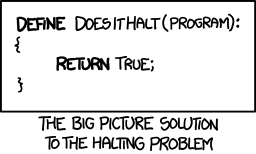
Halting Problem

I found a counterexample to the claim that all things must someday die, but I don't know how to show it to anyone.
18 Sep 11:18

How to Turn an Enemy Into a Friend (rerun)

by Scott Meyer

In today's Asking the Wrong Guy, Rick answeres the question everyone has wanted to ask: "Are you really the Emperer of the Moon?"

Thanks to everyone who has looked at Missy's new comic project!


17 Sep 23:33

Photo


17 Sep 23:28

Kiva - Kiva Lending Team: Atheists, Agnostics, Skeptics, Freethinkers, Secular Humanists and the Non-Religious

Kiva - Kiva Lending Team: Atheists, Agnostics, Skeptics, Freethinkers, Secular Humanists and the Non-Religious:

Os “times” do Kiva são uma funcionalidade bem legal. Um exemplo especialmente bom é o time dos ateístas e semelhantes, que podem fazer doações sob esta identificação. Fica aí a dica!

(Dá para fazer outros times interessantes também, como times de amigos, de torcedores, times em homenagem a pessoas queridas ou falecidas. São bastantes possibilidades!)

17 Sep 22:03

fuckyeahvintageillustration: ‘Cinderella flees the ball’,...


fuckyeahvintageillustration:

‘Cinderella flees the ball’, artist unknown. Published 1916 in ‘The tatler & bystander’, an illustrated newspaper.

Source

17 Sep 22:02

Tempo

by Daniel Lafayette

Quadrinho que fiz para Revista da Cultura. O tema era “tempo”

.


17 Sep 21:43

September 16, 2013


Hey geeks! If you want a nice poster of the comic about raising a geek, it's only available for 2 more days. I will probably not keep this in store, so this is the only way to get it for relatively cheap.
17 Sep 21:23

Potro orfão adota urso de pelúcia como mãe

O potro Breeze foi encontrado sozinho por um agricultor na beira de uma estrada horas depois de seu nascimento. Ele foi levado para um santuário em estado de choque e gravemente desidratado. O local cuida de potros e éguas e fica em Littlehempston, no extremo sul da Grã Bretanha.

Depois de se recuperar, o burro começou a demonstrar sinais de carência. “O filhote estava sentindo falta de uma coisa vital, sua mãe”, disse o diretor executivo do local, Syra Bowden, para o jornal The Sun.

Para resolver o problema, funcionários colocaram junto com Breeze uma urso de pelúcia gigante que é capaz de ficar sentado. Desde então, o cavalo nunca mais se separou do urso.

Ler a matéria na íntegra | Curta A Boa Notícia do Dia | Siga no Twitter 

17 Sep 21:17

mscucumbermelon: harspoon: mscucumbermelon: sometimes i feel...

Adam Victor Brandizzi

Pronto, o Tumblr já compensou todo o investimento de angel investors que recebeu.


mscucumbermelon:

harspoon:

mscucumbermelon:

sometimes i feel i look good until i see myself in a mirror and

This is my sister. 

this is what I have to deal with

god stacey i’m trying to be cool on the internet go away

Melhores pessoas na Internet.

16 Sep 09:15

Lillie McCloud: 54-Year-Old Grandmother A Hit On ‘X Factor’

by Nathan Francis

Lillie McCloud: 54-Year-Old Grandmother A Hit On 'X Factor'

Lillie McCloud doesn’t fit the typical profile of an X Factor contestant, but the 54-year-old grandmother may now be a force in the competition after shocking judges with a powerhouse performance.

McCloud showed up for the Orlando audition of the singing contest, delivering an amazing renditionof the gospel song “Alabaster Box.” The performance was so good that it even had the notoriously hard-to-please judge Simon Cowell smiling.

Simon said Lillie McCloud has an “incredible voice,” and compared her to Gladys Knight. The other judges were equally impressed, with Demi Lovato saying McCloud reminded her of Whitney Houston.

“Where have you been hiding?” asked judge Kelly Rowland.

McCloud wasn’t the only surprising performance on the Wednesday’s premiere of The X Factor. Alex and Sierra, a couple attending the University of Central Florida, turned in a folksy version of Britney Spears’ song “Toxic” that also earned the praise of judges.

But the night clearly belonged to Lillie McCloud.

After the episode aired, the grandmother of seven said she hasn’t exactly been hiding in obscurity, but has had a hard time finding her big break.

“I have been trying not to hide,” Lillie told the Orlando Sentinel. “I’ve been working in Miami nightclubs, on South Beach for several years. I’ve been recording. I couldn’t get beyond dance artist. I had some recordings as a dance artist. I never had this opportunity to branch out.”

Even though she’s been working her whole life to reach this moment, Lillie said it’s still a bit hard to take it all in.

“I feel like a superhero,” she said. “This is unusual. Does this happen to a 54-year-old? This is not normal. This not every day that something like this happens to someone like me. A couple of weeks ago I was home cooking with a baby in one hand and a baby in the other. This time I’m ready for it.”

Fans will now get a chance to see more of Lillie McCloud, who has advanced to the next round of the competition.

Lillie McCloud: 54-Year-Old Grandmother A Hit On ‘X Factor’ is a post from: The Inquisitr

16 Sep 09:12

Roughing It

by Greg Ross
Adam Victor Brandizzi

Aliás, um amigo meu me disse que até hoje militares não usam guarda-chuva em serviço.

The Duke of Wellington forbade officers to carry umbrellas into battle. On Dec. 10, 1813, during the Peninsular War, he saw a group of Grenadier Guards sheltering from the rain and sent an angry message: “Lord Wellington does not approve of the use of umbrellas during the enemy’s firing, and will not allow the gentlemen’s sons to make themselves ridiculous in the eyes of the army.” He later reproved their commander, saying, “The Guards may in uniform, when on duty at St. James’s, carry them if they please, but in the field it is not only ridiculous but unmilitary.”

Spectacles were not allowed in the British army until 1902. “There is little doubt that England will soon realize that she must take her place in company with the Continental people and furnish glasses as they do,” the Medical News had opined that March. It quoted ophthalmologist John Grimshaw, who had asked invalided South African soldiers whether their eyes had given them trouble in shooting on the veldt.

“Fightin’ all day, sir, and never saw a Boer,” one had replied. “Yes, sir, we simply blazed away at the kopjes on the chance of hittin’ a Boer or two.”

16 Sep 09:09

Photo


16 Sep 09:07

o dia em que allende quase criou uma outra internet

by T. C. Soares

Há quarenta anos, o presidente eleito Salvador Allende foi deposto num golpe de Estado no Chile. Em 11 de setembro de 1973, sitiado no palácio presidencial, sob fogo de tropas golpistas lideradas pelo general Augusto Pinochet, Allende teria se suicidado, marcando o início de uma ditadura que se estenderia por 17 anos.

Os horrores do regime de exceção chileno, marcado por dezenas de milhares de mortos e torturados e por centenas de milhares de exilados (e pelo enriquecimento meteórico de seu ditador) são conhecidos, tema de livros e reportagens e estudos. Não menos conhecida é a participação do governo dos EUA nisso tudo. E são coisas que não devem ser esquecidas mesmo.

Mas este texto trata de algo não tão conhecido do governo Allende: a criação de uma rede de comunicação que poderia ter sido o começo de outra internet.

Numa matéria recente da revista inglesa Red Pepper, é resgatada a história da Cybersyn (sigla que remeteria ao nome “Sinergia Cibernética”), um sistema de comunicação desenvolvido por Allende para descentralizar o fluxo e a gestão de informações e mercadorias.

A revista britânica lembra que, pouco antes de cair, Allende enfrentava um desafio: de um lado, construir um governo de esquerda que não emulasse o centralismo do modelo soviético; do outro, a ofensiva de uma direita interna (e continental) que, por conta da guerra fria, se delineava em traços bastante agressivos. Nesse esforço de elaborar uma estrutura de governo que permitisse gerenciamento horizontal, em rede, o grupo de gestores de Allende foi buscar inspiração no trabalho de um cientista britânico chamado Stafford Beer. No Guardian, Beer é lembrado da seguinte maneira:

Parte cientista, parte guru da administração, parte teórico social e político, (Beer) era alguém que havia ficado rico mas cada vez mais frustrado com a Grã-Bretanha dos anos 50 e 60. Suas idéias sobre as semelhanças entre os sistemas biológicos e artificiais — a maior parte delas expostas em seu livro “The brain of the firm” — fizeram dele um consultor junto a empresas e políticos britânicos. No entanto, esses clientes não costumavam adotar as soluções que recomendava do modo que ele gostaria, o que o levou a assinar cada vez mais contratos no exterior.


Na verdade, Beer se interessou tanto pelo projeto que foi para o Chile trabalhar com a equipe de Allende. Sob as ideias do pesquisador britânico, o governo do Chile implementou, entre 1971 e 1973, uma rede de comunicação que se desenharia como o sistema nervoso do sistema produtivo chileno, do chão de fábrica a escritórios de gerenciamento e gabinetes de governo. Uma arquitetura baseada em máquinas de telex e linhas telefônicas ligadas a computadores que, em sua versão beta, chegaram a interligar mais de um quarto da infraestrutura econômica do país. Uma rede cuja coordenação central ficaria delegada a um grupo de sete gestores alocados numa Sala de Operações com visores e cadeiras futuristas vermelhas.

a sala de controle do projeto cybersy (sério caras)

a sala de controle do projeto cybersyn (sério caras)

O mais louco é que, pelo que levantei, parece que o sistema funcionava mesmo. Quando, em 1972, o Chile ficou travado com uma greve de transportes organizada pela oposição chilena com a ajuda da CIA, a Cybersyn foi acionada e permitiu que o governo reordenasse a produção e o tráfego de mercadorias ao redor do país. No texto da Red Pepper, eles explicam:

Quando o governo enfrentou, em 1972, uma greve de pequenos empresários conservadores apoiados pela CIA e um boicote de empresas privadas de caminhão, o abastecimento de alimentos e combustíveis ficou perigosamente baixo. O governo enfrentou sua mais grave ameaça frente ao golpe. Foi então que a Cybersyn se realizou de fato, e o governo de Allende percebeu que o sistema experimental poderia ser usado para contornar os esforços da oposição. A rede permitiu que seus operadores levantassem informações imediatas de locais onde a escassez estivesse maior, bem como onde se encontrariam os motoristas que não participavam do boicote, mobilizando ou redirecionando meios de transporte próprios.

Hoje isso pode parecer nada demais, mas em 1972 era mais ou menos como inventar uma nova versão do Google.

Na verdade, esse flerte da cibernética com o socialismo não é invenção chilena. O pai da coisa toda, Norbert Wiener, era bastante crítico da ideia de horizontalidade homem-máquina, e defendeu até o fim a ideia de que sistemas cibernéticos deveriam ser geridos essencialmente por agentes humanos, adaptados como ferramentas voltadas ao combate à desigualdade social — esse viés socialista fez dele, inclusive, um pesquisador bastante celebrado na União Sociética.

No fim, porém, a noção do que seria o ideal de interação homem-máquina defendida por Wiener acabou, em meados do século passado, obscurecida pela de seu parceiro de pesquisas tornado rival, John von Neumann, que acreditava numa lógica cibernética baseada numa igualdade de condições entre homens e máquinas – o que, ao longo do processo da evolução tecnológica, permitiria que os computadores se portassem como organismos que viessem a automatizar os espaços da interação humana. Mais ou menos como o que rola com os bots na Wikipedia, por exemplo.

Enfim. O bacana da internet é que você está sempre aprendendo alguma coisa nova.

15 Sep 12:36

Civet coffee: why it's time to cut the crap

When I introduced civet coffee to the UK it was a quirky novelty. Now it's overpriced, industrialised, cruel – and frequently inauthentic. That's really hard to stomach

I am today launching a campaign (pdf) aimed at ending an industry that I created. That trade is in kopi luwak, AKA civet coffee – otherwise known as "wolf", "cat", and "crap" coffee, and the most expensive coffee in the world.

Over the past 20 years Kopi Luwak has become the ultimate bling coffee, a celebrity in its own right, stocked by every aspiring speciality retailer worldwide, and appearing on CNN News, Oprah, and The Bucket List (a Hollywood film with Jack Nicholson and Morgan Freeman, no less).

To my regret, I was the one who started it all ...

I first read a description of kopi luwak buried in a short paragraph in a 1981 copy of National Geographic Magazine. Ten years later, in 1991, as coffee director of Taylors of Harrogate, I was the first person to import kopi luwak into the west – a single kilogramme. I didn't sell it through the company, but thought, perhaps naively, that its quirky, faintly off-putting origins from a wild animal roaming Indonesian coffee estates might be of interest to the local newspaper and radio in Yorkshire where the company was based. It proved to be so much bigger than that – national news, TV and radio fell over themselves to cover it. Kopi luwak put Taylors – and me – on the map.

Genuine Indonesian kopi luwak is collected from the droppings of a wild cat-like animal called the luwak (the common palm civet, Paraxorus Hermaphroditus), a shy, solitary nocturnal forest animal that freely prowls nearby coffee plantations at night in the harvest season, eating the choicest ripe coffee cherries. It can't digest the stones – or coffee beans – of the cherry, so craps them out along with the rest of its droppings. The beans are collected by farm workers. Cleaned and washed, they have acquired a unique and highly prized taste from their passage through the luwak's digestive tract and the anal scent glands they use for marking their territory. Being wild, hard to collect, variable in age and quality, and very rare, kopi luwak is not a commercially viable crop, but just an interesting coffee curiosity. That's why I bought some.

But nowadays, it is practically impossible to find genuine wild kopi luwak – the only way to guarantee that would be to actually follow a luwak around all night yourself, one experienced coffee trader told me. Today, kopi luwak mainly comes from caged wild luwaks, often kept in appalling conditions. A Japanese scientist recently claimed to have invented a way of telling whether kopi luwak is fake or genuine. He'd have been better off inventing a way of telling whether the beans come from wild or caged animals.

Coffee companies around the world still market kopi luwak along the lines of that original quirky story involving a wild animal's digestive habits, many claiming that only 500 kilogrammes are collected a year, a scarcity that justifies its huge retail pricetag (usually between $200-400 a kilo, sometimes more). In fact, although it's impossible to get precise figures, I estimate that the global production – farmers in India, Vietnam, China and the Philippines have all jumped on the bandwagon, too – is at least 50 tonnes, possibly much more. One single Indonesian farm claims to produce 7,000kg a year from 240 caged civets.

So kopi luwak is now rarely wild: it's industrialised. Sounds disgusting? It is. The naturally shy and solitary nocturnal creatures suffer greatly from the stress of being caged in proximity to other luwaks, and the unnatural emphasis on coffee cherries in their diet causes other health problems too; they fight among themselves, gnaw off their own legs, start passing blood in their scats, and frequently die.

Wild luwaks – the trapping of which is supposed to be strictly controlled in Indonesia – are caught by poachers, caged and force-fed coffee cherries in order to crap out the beans for the pleasure of the thousands who have been conned into buying this "incredibly rare" and very expensive "luxury" coffee.

The kopi luwak trade makes big bucks, and it attracts big-spending consumers. For example, if you're struggling to find a suitable present for your friendly neighbouring Russian oligarch's birthday, how about buying a 24-carat-gold foil bag of Terra Nera for £6,500 at Harrods? It won't be Indonesian kopi luwak you're buying, but one of the numerous other crap coffees that have now sprung up worldwide – Thai elephants, Brazilian jacu birds, and Bonobo monkeys have all been press-ganged into servicing consumers' insatiable desire for the weird and ostensibly wonderful.

In the case of Harrods, its latest variant is produced by the Peruvian uchunari, a long-snouted Andean animal about the same size as a luwak. Naturally, it's supposed to come from well-treated animals, be incredibly rare, and – until the next absurd luwak alternative comes along – is now the most expensive coffee in the world.

As all these bewildering developments seem to have sprung from my original humble purchase, I feel as if long ago I must have inadvertently put my finger on the pulse of some monstrous zeitgeist, a grotesque cancer that constantly mutates into yet more vile and virulent forms. I'm fully expecting celebrity-digested designer crap coffee to be next down the line. One way for former stars to revitalise a flagging film career, I suppose, or perhaps for a Turner prizewinning artist to comment on the vacuity of our consume-at-all-costs age.

Come to think of it, perhaps I could actually do the digesting myself? It would be an appropriate conclusion to my complicity in the rise and fall of this utterly preposterous, utterly hideous trade.

Tony Wild is a coffee consultant and author of Coffee: A Dark History


theguardian.com © 2013 Guardian News and Media Limited or its affiliated companies. All rights reserved. | Use of this content is subject to our Terms & Conditions | More Feeds

15 Sep 12:36

asuka-shinji: by kuzu

14 Sep 21:13

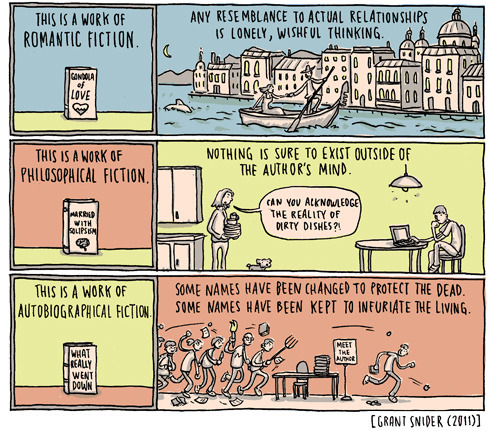
nevver: Works of Fiction


grant snider @grantdraws


grant snider @grantdraws

nevver:

Works of Fiction

14 Sep 10:44

Get Out of Jail Free

by Greg Ross

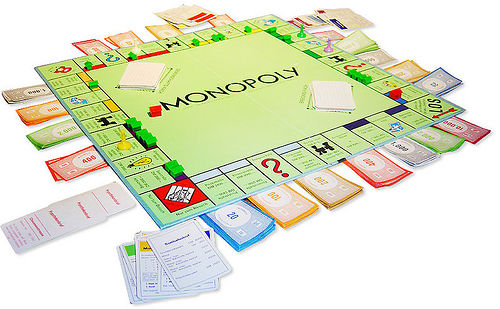
http://en.wikipedia.org/wiki/Image:Monopoly_Game.jpg

In 1941, as the British War Office searched for ways to help Allied prisoners escape from German POW camps, it found an unlikely partner: John Waddington Ltd., the U.K. licensee for Monopoly. “Games and pastimes” was an approved category of item to be included in care packages sent to captured soldiers, so Waddington’s set about creating special sets to be sent to the camps.

Under the paper surface of each doctored board was a map printed on durable silk showing “escape routes from the particular prison to which each game was sent,” Waddington’s chairman Victor Watson told the Associated Press in 1985. “Into the other side of the board was inserted a tiny compass and several fine-quality files.” Real French, German, and Italian currency was hidden in the stacks of Monopoly money.

MI-9, the intelligence division charged with helping POWs escape, smuggled the games into prison camps, where prisoners would remove the aids and then destroy the sets in order to prevent their captors from divining the scheme.

“It is not known how many airmen escaped thanks to these Monopoly games,” writes Philip Orbanes in The Game Makers, his 2004 history of Parker Brothers, “but 35,000 POWs did break out of prison camps and reach partisans who helped them to safety.”

(Thanks, Ron.)

14 Sep 01:19

Almost Home

by Greg Ross
Adam Victor Brandizzi

Deveras curioso, mas até natural para quem compreende distribuições de probabilidades.

A drunk man arrives at his doorstep and tries to unlock his door. There are 10 keys on his key ring, one of which will fit the lock. Being drunk, he doesn’t approach the problem systematically; if a given key fails to work, he returns it to the ring and then draws again from all 10 possibilities. He tries this over and over until he gets the door open. Which try is most likely to open the door?

Surprisingly, the first try is most likely. The probability of choosing the right key on the first try is 1/10. Succeeding in exactly two trials requires being wrong on the first trial and right on the second, which is less likely: 9/10 × 1/10. And succeeding in exactly three trials is even less likely, for the same reason. The probability diminishes with each trial.

“In other words, it is most likely that he will get the right key at the very first attempt, even if he is drunk,” writes Mark Chang in Paradoxology of Scientific Inference. “What a surprise!”

13 Sep 22:34

notmusa: idk why i don’t draw charlie more, i love drawing...


notmusa:

idk why i don’t draw charlie more, i love drawing charlie

13 Sep 22:23

Photo


13 Sep 22:22

breathesuniverse: The Cosmos is all that is or ever was or ever...


breathesuniverse:

The Cosmos is all that is or ever was or ever will be. Our feeblest contemplations of the Cosmos stir us — there is a tingling in the spine, a catch in the voice, a faint sensation as if a distant memory, of falling from a height. We know we are approaching the greatest of mysteries.

Carl Edward Sagan

13 Sep 14:39

Slideshow

Adam Victor Brandizzi

Uma grande VDD? ( ) sim ( ) no geral, sim ( ) concerteza

Points to anyone who hacks the Flickr devs' computers to make their text editors do this when you click on anything.
13 Sep 08:17

Photo


13 Sep 00:44

buddhacaksus: GERMANY


buddhacaksus:

GERMANY

13 Sep 00:04

cofeecigarettes: cj-twig: i want kids but i dont wanna be pregnant or give birth but i dont wanna...

cofeecigarettes:

cj-twig:

i want kids but i dont wanna be pregnant or give birth but i dont wanna adopt either because i want them to be mine do you see my problem

basically you want to be a father

this is the most accurate thing i ever read
12 Sep 11:10

Photo