Shared posts

03 Oct 13:17

New Savage Love: Figuratively Pissed

by Dan Savage
by Dan Savage
092921_Savage_Figuratively_Pissed.jpg
Joe Newton
I’m worried this may be above your pay grade. LOL. My boyfriend and I have been together for nearly five years. When we first got together, he shared a fetish with me, which has honestly gotten out of hand. I’m not close-minded and I genuinely love pleasing people, and my approach to sex has always been, “Whatever turns you on, turns me on!” But his fetish has crossed the line from kink to obsession. Not to mention the onus of his “fetish” falls entirely on me.

So, the big reveal: my boyfriend is a urophiliac. But not just your garden variety one. If he doesn’t get to watch me pee every single time he gets angry. The first two years of our relationship were terrifying because if I peed while he was at work, he would throw a fit of epic proportions. So, I would hold it in. This caused UTIs and other problems. But he still insists that I must hold it in for as long as possible so I can give him “a strong stream” every time. I also have to let him watch me poop, which is embarrassing as hell, because I pee when I poop. If I need to pee in the middle of the night, I have to wake him up—which makes him mad—so instead of waking him up I hold it in all night. It has gotten to the point where his obsession has become mine. But it’s not sexy for me.

03 Oct 12:58

5 Lessons Evergrande Taught Us About The Chinese Economy

by Greg Rosalsky
The halted under-construction Evergrande Cultural Tourism City, a mixed-used residential, retail and entertainment development in Taicang in China

Here's what a troubled property developer tells us about the Chinese economy.

(Image credit: Vivian Lin/AFP via Getty Images)

03 Oct 12:52

Top Five: Sept. 30, 2021

by Glasstire

Glasstire counts down the top five art events in Texas. For last week’s picks, please go here.

From Paul Kremer’s series “Great Art in Ugly Rooms”

1. Paul Kremer: 13 Tips and Tricks for Decorating with Fine Art
September 30 – November 20, 2021
Opening reception Thursday Sept. 30, 7pm-10pm
Pablo Cardoza Gallery (Houston)

Note: This exhibition marks the reopening of Pablo Cardoza’s space. 

From Pablo Cardoza Gallery:

“1. Good news: Anything can be art (no, really). There’s no official committee sitting around a long table determining what is and what is not art — especially not when it comes to making a dramatic statement.
2. You don’t need to be knowledgeable or undertake an art course to decorate your space with paintings. Displaying any type of art not only spruces up your walls, but makes you feel more attractive and shows people that you have a touch of style and personality.
3. High-quality fine art pieces range in price from $8 thousand to $200 million, and many famous artists are willing to produce unique art pieces for decorating your home.
4. A famous artist can come up with a style that reflects each room’s function in your house. Make sure to request that the artist use colors that match your existing decor. Alternatively, correlate patterns in your desired artwork with what you have in your home for a matching look.
5. Although you should display artwork about food in your kitchen, other rooms such as the living room are more flexible and versatile. NOTE: A dining room wall decoration arrangement is best hung slightly lower, to enjoy looking at it most while you are sitting down.
6. Lots of home offices have wood-paneled walls, and they are perfect surfaces for hanging pictures. Other suggestions? A laundry room, bathroom, mudroom, or even your beloved man-cave!
7. ‘It can be hard to visualize how a combination of art will look on the wall, so it helps to sketch out your plan on graph paper or use a computer program to layout your art,’ Kremer says.”

(Etc.)

Lisette Chavez

2. Lisette Chavez: From the Horse’s Mouth
September 14 – October 14, 2021
Palo Alto College of Fine Arts (San Antonio)

From Palo Alto College of Fine Arts:

From the Horse’s Mouth is a collection of drawings and mixed-media sculptures created by Lisette Chavez. This body of work was inspired by Chavez’s concern with technology and its effect on communication and traditions. It shares the importance of Latinx community narratives through visual interpretations, while preserving Latinx heritage and storytelling in an age of increasing technological distraction.”

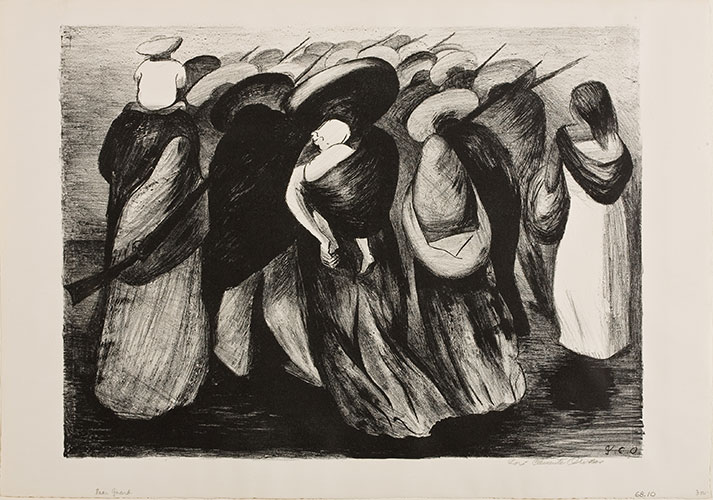
José Clemente Orozco (1883–1949), Rear Guard, 1929.

3. Image & Identity: Mexican Fashion in the Modern Period
September 19 – January 9, 2022
The Meadows Museum, SMU (Dallas):

From the Meadows Museum:

“….curated by the museum’s Center for Spain in America (CSA) Curatorial Fellow Akemi Luisa Herráez Vossbrink. Featuring photographs, prints, books and gouaches from the 19th and 20th centuries, this exhibition will explore Mexican fashion through images of everyday scenes, festivities, regional types and occupations. Building on a theme developed in the Meadows’s larger fall exhibition, Canvas & Silk: Historic Fashion from Madrid’s Museo del TrajeImage & Identity will also show how national identity formation is reflected in fashion and is often accompanied by a resurgence in the popularity of indigenous dress. Works in Image & Identity are drawn from the collections of the Meadows Museum and SMU’s DeGolyer Library, named after Everette L. DeGolyer, Sr. who, with his son, collected maps, books, manuscripts, and photographs related to Mexican exploration and history. Artists featured in the exhibition include Alfred Briquet, Carlos Mérida, Diego Rivera, José Clemente Orozco, Jerry Bywaters, Paul Strand and Manuel Álvarez Bravo.”

4. Road Soda: A Texas Road Trip Traveling Exhibition
September 25 – October 30, 2021
MASS Gallery (Austin)

From MASS Gallery:

“This summer MASS Gallery decided to do things a little differently. MASS members curated a show of Austin artists and sent the work on a road trip around Texas. The work, which is completely housed in a 20x20x20 FedEx box, has traveled from Austin, to Houston, to Galveston, To Dallas, to Lubbock and back to Austin.

“At each destination, friends of MASS unpacked, displayed, and documented the artwork in the new environments before sending them packing to their next stop. Now home in Austin, MASS is displaying the artwork, the photographs and a Road Soda Zine on September 25th, 2021.

Road Soda features work from Austin artists: Claudia Aparicio Gamundi, Adrian Armstrong, Zoe Berg, Sev Coursen, Alex Diamond, Andie Flores, Alexis Mabry, Payton McGowen, Kevin Muñoz, and Ariel Spiegelman.

“Hosts of the traveling exhibition include Rigoberto Luna and Jenelle Esparza of Presa House Gallery in San Antonio, Dennis Nance of Galveston Arts Center and Nick Barbee of Galveston Historical Foundation, Tamara Johnson and Trey Burns of Sweet Pass Sculpture Park in Dallas, and Danielle Demetria East of East Lubbock Art House.”

Mylan Nguyen

5. Mylan Nguyen: Nahualito
October 2 – November 15, 2021
Terrain Dallas:

From Terrain Dallas:

“Terrain Dallas hosts Nahualito, a mixed-media installation depicting a ceramic procession of Nahuales created by artist Mylan Nguyen.

“Mylan Nguyen is a multidisciplinary artist working in several mediums including ceramics, illustration, printmaking, and installation. Enjoying the alchemy of these process based mediums, she creates cute and playful characters and narratives in her works through which she explores themes of magic, healing, and interconnectedness. Nahualito continues her exploration of these themes and draws on her  multicultural heritage to revisit and reclaim the history of the Nahual.

“Inspired by an interest in the Mexican folklore of the shapeshifting Nahual, Mylan will incorporate stories she has gathered of Nahuales as she creates the individual characters that form the installation. Nahuales are described often as evil mischievous brujx (witches) but also as wise healers and protectors. The duality of this narrative resonates with Mylan’s multicultural upbringing and parallels her feelings of being between two identities.

“The ambiguity of the Nahuales in form and identity is captured in Mylan’s installation. Placed throughout the Terrain site, each Nahual is meant to emulate cuteness and draw the viewer in to further explore what she understands as their true nature. Each Nahual sculpture ranging in many sizes is considered by the artist to be an amulet, talisman, or altar incorporating stories and symbols meant to provide healing, transformation, and laughter.”

The post Top Five: Sept. 30, 2021 appeared first on Glasstire.

03 Oct 12:49

interviewing from a parked car, asking employees to solve problems on their own, and more

by Ask a Manager

This post, interviewing from a parked car, asking employees to solve problems on their own, and more , was originally published by Alison Green on Ask a Manager.

It’s five answers to five questions. Here we go…

1. Is it bad to interview from a parked car?

What are your thoughts on virtual interviews in a car (parked, of course)? Recently a hiring manager told me a candidate interviewed from their car, and he was very put off. I thought perhaps the candidate was on a lunch break and that was the only private space they had. He thought it seemed more like they were running errands and squeezed this interview into their day, thus they did not take it very seriously. In general, is this a real snafu?

What on earth? No. People interview from their cars all the time because it’s the only private place they have to take a call. When there’s video involved, it make sense to acknowledge your surroundings (“Apologies for the background — I’m calling from my car since I don’t have anywhere quiet to take this call at work”) but it’s not a shocking faux pas if you don’t.

Also, even if they were squeezing in the interview in between errands … so? How is that different than squeezing it in between work meetings? Does he need them to clear an entire half-day for a 30- or 60-minute call to show appropriate deference to him? He’s an ass.

2. Should employees try to solve problems on their own before coming to me?

Am I wrong, as a manager, to think that my associates should exhaust all other avenues before asking me a question? These are professional, highly-compensated individuals.

I got upset for someone recently for asking me where the pencils are. He had to walk past six other people before getting to my office. But if I’m wrong, I need to change my attitude quickly.

I wouldn’t say people need to exhaust all other avenues before asking you a question, as a general rule. You don’t want people to spend half a day searching for an answer to something that you could tell them off the top of your head if you’re available. And you don’t want people to feel that the barrier for approaching you for help is prohibitively high.

But it’s reasonable to expect that they’ll at least attempt to solve basic problems like “where are the pencils” without involving you. If there’s a pattern of you getting those kinds of questions, that’s worth addressing (which probably means first reflecting on whether you’ve inadvertently trained them to be dependent on you, and then laying out clearer expectations for what sorts of problems people should first try to solve on their own).

3. My boss wants me to push back my start date at my new job so I can stay here longer

I’ve been working for a small company for three years. I came into a disaster and worked really hard to get things set up to work correctly/at all. But my boss doesn’t trust easily, even with years of relationship building. Many of my tasks were very rote. I told him that I was pursuing advanced skills and certification and was bored with the data entry work. I earned full certification in July.

I told my boss that I was seeing a lot of interest in my skills before I earned the certificate and requested a raise in February. He came through in July, just before I completed the certificate.

Then I was asked to train the part-time personal assistant of our owners to do the grunt work. This person is lovely and tries really hard, but has no understanding of my field or our sort of business. So not a net win.

Then my certificate came through, and my LinkedIn blew up. I accepted a great new role! Pay raise, bonus, and benefits, which my current job can’t offer. Opportunities to dig into higher level stuff and room for growth!

OldBoss is NOT HAPPY. He told me I should have told him I was looking, and given him six months notice to find and train up my replacement. (I don’t think my job requires anything like six months of training, if you hire an experienced professional.) Some of what I do is complex, but most of it is not.

Failing that, he wants me to ask my new job for a 3-4 weeks notice period. How much of a faux pas is it to go back and say, “Hey, my old job asked me for a bit more time. Can my start date be X?”

Don’t do it. It’s not a big deal to ask for a start date three to four weeks out; people do that all the time and if an employer can’t do it, they’ll let you know. But going back after your start date was already set and they’ve probably been planning around it is an inconvenience. There might be times when you need to do it anyway, because of reasons of yours. But doing it just because your old boss wants you to doesn’t warrant that.

And for the record, your old boss is ridiculous. Six months of notice? No. That is wildly outside what’s reasonable to ask or expect. Two weeks is standard. Some jobs ask for four weeks. Expecting six months is unheard of. (Occasionally some people offer six months — when their situations allow it and their employers have earned that kind of notice by making it safe to give it — but expecting it is outside of any professional norm that exists in the U.S.)

And the purpose of a notice period isn’t to train your replacement anyway. In most jobs, two weeks won’t even cover the time it takes to hire! A notice period is for wrapping up your work, transitioning key info to whoever will be filling in temporarily, and leaving documentation for the next person — that’s it.

Tell your old boss you’re sorry but you don’t have flexibility with the start date for the new job but you’re leaving behind plenty of documentation for someone to take over (and then do that) and go start your new job on the date you planned without guilt.

4. Should I mention my former homelessness in an interview?

I’m in the beginning stages of searching for a job and I’d love your input on whether it’s appropriate to mention that I was homeless at a job interview.

For context, I was homeless between the ages of 15 and 20 (I’m 29 now). My family was extremely impoverished. This period of time is the reason I was a “mature student” by the time I went to college. I was also able to take back many life skills from that period in my life. It’s the reason I’m resilient and have a growth mindset — I quite literally came from nothing to be where I am today. It’s also a huge reason I have such empathy for those around me. Everyone is fighting a battle we know nothing about.

I’ve always treated this like my dirty little secret. I’m afraid it would sound like a sob story to an interviewer. I’m also afraid that this period of time is so far in my past that it may be considered no longer relevant, even though it continues to affect me to this day. Should I keep this period of time under wraps, or would I be able to mention it briefly when an interviewer asks about my history or strengths?

I don’t think it’s going to sound like a sob story. I do think it risks making some people uncomfortable, because some people are Very Uncomfortable with homelessness. You might decide you’re fine with that risk because you rightly don’t want to work for someone who would have that reaction. But you also might not have the luxury of that option, or just might not feel like taking that on.

All that said … usually when interviewers ask about your history or strengths, they’re asking about work history and work strengths. Even though there’s a direct line between this history and your work strengths now, stronger interview answers will usually (not 100% of the time, but usually) cite examples from work — so you might mention resilience and a growth mindset but illustrate them with examples from your work life.

But please don’t feel this a dirty secret. You might strategically decide when to share it and when not to, but anyone who would find it off-putting is revealing something unflattering about themselves, not about you.

5. Personalize your cover letters!

This is an observation, not a question, about cover letters that’s consistent with your advice, but I just want to reinforce it from my current experience. I’m a VP over a division that has several open positions, ranging from entry-level for new college graduates to executive level with a healthy six-figure salary. At every level, we are flooded with cover letters from people who repeat the info on their resume and make no effort to communicate why they are interested in THIS position at THIS organization.

For context, we are the headquarters for a large nonprofit organization in a mid-size city. The city has a lot to offer, but we aren’t Austin, TX — this isn’t a hot destination where you assume people want to move just because they want to be here. So when we get applications from people around the country who all have similar qualifications, a candidate stands out when they give some indication that they have a particular interest in being here, in this city or at this organization. At least make the effort! “I’ve always been interested in aviation and would love to live in Dayton, birthplace of Orville Wright!” or “I can’t wait to try Kansas City barbeque.” With a nonprofit, it’s even easier — say that our mission matters to you and why.

I was most amazed by a candidate who has volunteered for us for several years in another city — and is a current volunteer — and didn’t mention anything about that in her cover letter! I had dismissed her resume until another person pointed it out at the end of her resume under “volunteer experience.” I was gobsmacked! It would have put her over the top with me right away, but she almost got passed over.

Amen. Cover letters, man.

02 Oct 11:56

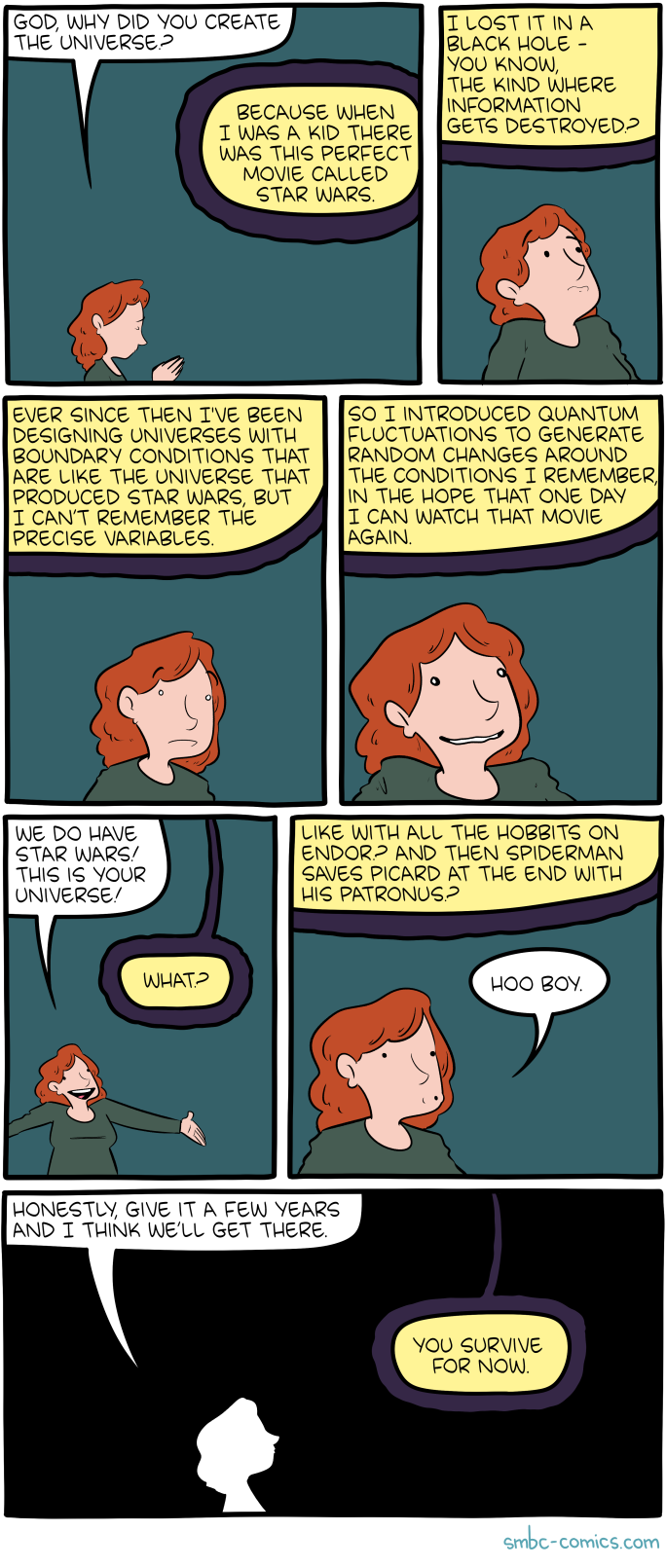
Saturday Morning Breakfast Cereal - Movie

by tech@thehiveworks.com


Click here to go see the bonus panel!

Hovertext:
I'm available to write this script for free in 30 minutes.


Today's News:
02 Oct 11:54

Endangered

The list includes polio, Guinea worm, and this one particular enterovirus strain that they've been tracking out of spite after it went around the lab a few years ago.
30 Sep 16:52

Health workers get panic buttons as COVID deniers get violent

by Beth Mole
A woman in personal protective gear operates machinery.

Enlarge / A health care worker treats a patient inside a negative pressure room in the COVID-19 intensive care unit at Freeman Hospital West in Joplin, Missouri, on Tuesday, Aug. 3, 2021. (credit: Getty | Bloomberg)

Hospitals in several states are ramping up security and even providing wearable panic buttons to staff amid a wave of violent attacks sparked by COVID-related misinformation, denialists, and conspiracy theorists.

In a hospital in Branson, Missouri, as many as 400 staff members will have panic buttons added to their identification badges after assaults on staff members tripled amid the pandemic. Assaults rose from 40 in 2019 to 123 in 2020, the Associated Press reported. The numbers for 2021 have not been released. When pressed, the panic buttons will immediately alert hospital security and trigger a tracking system to locate the endangered worker.

Jackie Gatz, vice president of safety and preparedness for the Missouri Hospital Association, told the AP that, in addition to panic buttons, hospitals are also adding extra security cameras and having security personnel wear body cameras. A hospital in Springfield, Missouri, added security dogs, as well as panic buttons. Gatz noted that staff are also receiving training on de-escalation and physical protection tactics, such as keeping a hospital bed between a nurse and an agitated person.

Read 7 remaining paragraphs | Comments

30 Sep 11:40

Buoyancy, Joy, and Damage: Niki de Saint Phalle at the Menil Collection

by Melissa L. Mednicov

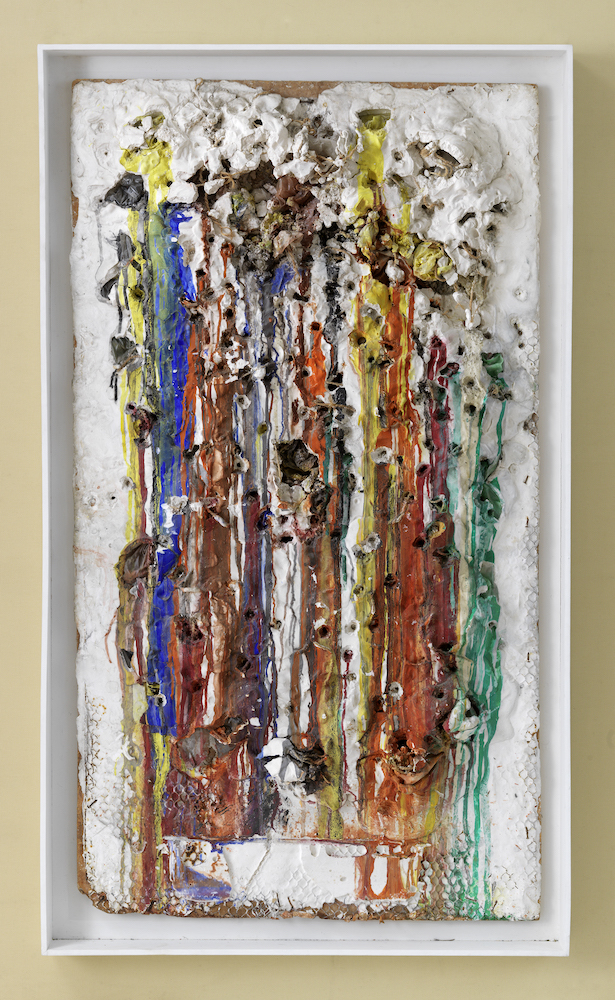
Niki de Saint Phalle, Grand Tir – Séance de la Galerie J, 1961. Paint, plaster, wire mesh, string, and plastic on chipboard, 56 1⁄4 x 30 1⁄4 x 2 3⁄4 in. (143 x 77 x 7 cm). Private collection, Courtesy Niki Charitable Art Foundation and Galerie Georges-Philippe & Nathalie Vallois, Paris. © Niki Charitable Art Foundation. All rights reserved. Photo: André Morin

Niki De Saint Phalle in the 1960s, co-curated by Michelle White and Jill Dawsey at the Menil Collection in Houston, delivers a gut punch. Her work lingers long after the time spent in the gallery is over. The exhibition, with its focus on the sixties, traces a crucial period in Niki de Saint Phalle’s career — a decade in which her work manifests an interrogation of gender, identity, ambition, and societal constraints. Works such as her tirs (“shooting paintings”) and Nana figures (usually large sculptural figures, although some small ones are also included) inhabit the Menil Collection’s galleries, bringing buoyancy and damage. Included in the exhibition is an archival room, featuring video footage, a model for Hon (perhaps her most well-known work), and ephemera from the period such as the artist’s interactions with Dominique and John de Menil. Saint Phalle, a member of the mostly French Nouveaux Réalistes, uses societal debris — its toys and junk, the stuff that then becomes the debris of expectations, cluttering the mind and society’s crevices.  

Niki de Saint Phalle during a shooting session at Impasse Ronsin, Paris, 1962.
© André Morain

The shooting paintings (tirs) are made through a kind of painterly violence. Niki de Saint Phalle (and others, as she invited collaborators to participate in these works, such as Jasper Johns, whose collaboration is included in the exhibition) would shoot the canvas with a rifle, sometimes with plastic bags of paint underneath the surface and other times with spray paint hanging in front of the assemblage. The gunshots exploded the paint — allowing the gun and chance to be collaborators. These works, upon close looking, at times appear as leaking, disemboweled bodies (and we call artists’ works their “body of work”); the deflated paint bags suggest the punctured stomach or intestines of the work. The use of a rifle makes violence and trauma legible components to the process. The colorful drips of paint reference and critique previous popular (and male-dominated) art movements such as abstract expressionism.

Installation View at The Menil Collection. Photo by Paul Hester

Installation View at The Menil Collection. Photo by Paul Hester

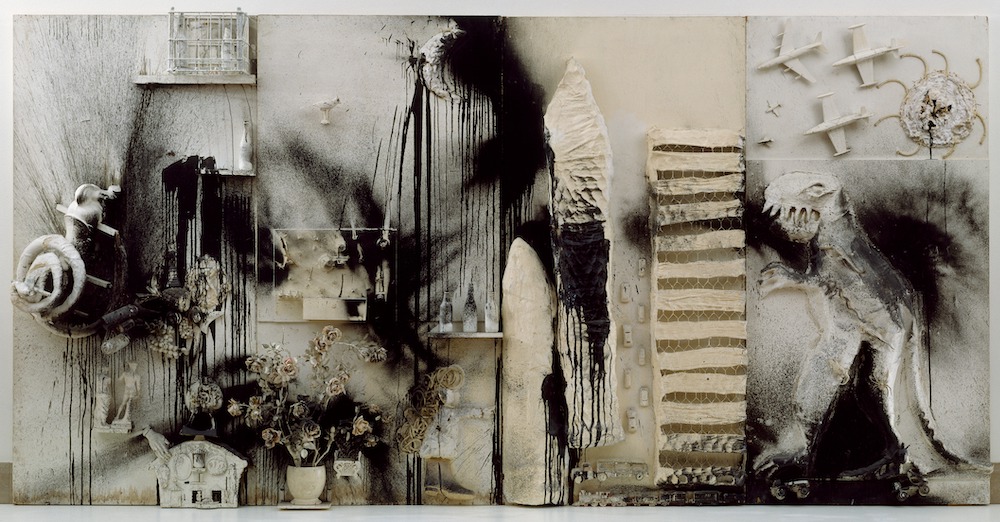
As the curators and others have expounded, Niki de Saint Phalle’s work takes “women empowerment” to the forefront and directly challenges the patriarchy of European culture (and American culture in a somewhat shared cultural ethos, as co-curator Michelle White also discusses in her catalogue essay “Outside World: Niki de Saint Phalle’s Tirs and American Art, 1961-1963”). Saint Phalle’s work cogently shows, through both her subjects and materials, how expectations of women in the sixties — demure, sexy, mother, wife, lover — are produced by consumer culture and society. When you enter the exhibition space, Assemblage (Figure with Dartboard Head) (ca. 1962) immediately introduces you to these concepts, a “portrait” whose face is a target head and a wire heart and a “body” made of children’s toys, gendered in the time period — baby dolls for girls, plastic military men for boys — and a soda bottle bicep against the steeple-like backing. Consumer, societal, and religious expectations coalesce in the bandaged, body-like form. These kinds of materials populate the exhibition and are continually “shot at” in her work. In another room, M.O.N.S.T.R.E. (1964; a collaboration with Jean Tinguely) comes alive (barely) every 30 minutes — a decrepit and fossil-like dinosaur, made, in part, of machine and of plastic play things. Other works in the same room, Valentine (ca. 1963), Red Dragon (1964), and Gorgo in New York (1962), to cite only a few, show how the materiality of the objects, the materials, and popular culture that make expectations and empty promises (such as those of romantic love in Valentine, or how gendered roles in childhood toys create expected modes of being, in adulthood), are made into monsters. 

Niki de Saint Phalle, Gorgo in New York, 1962. Paint, plaster, wire, and objects on wood, 95 3/4 × 193 × 19 1/2 in. (243.2 × 490.2 × 49.5 cm). The Museum of Fine Arts, Houston, Gift of D. and J. de Menil, 62.47. © Niki Charitable Art Foundation. All rights reserved

Additionally, shooting paintings such as Old Master (1961) placed alongside Tir (Old Master) Séance Galierie J (1961) make evident (if there was a doubt) how those same systems exist for women within art systems and art historical canons, disrupting the staid, ostentatious gilded frames one would expect from an Old Master work (further amplified by the Menil’s white gallery walls). 

Installation View at The Menil Collection. Photo by Paul Hester.

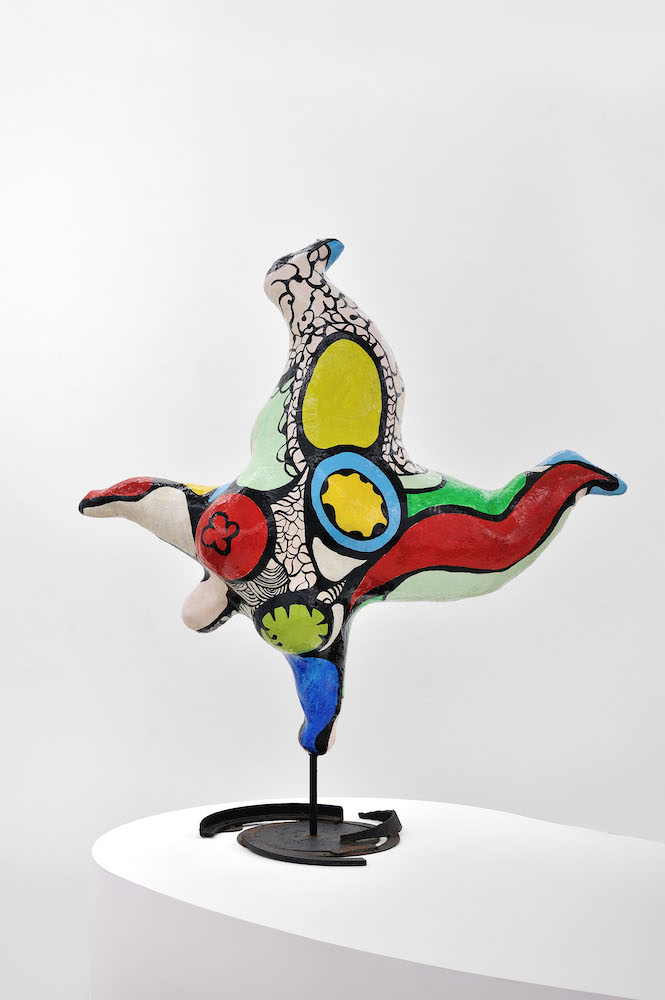
One room of the exhibition is dedicated to her larger sculptures, including the Nanas which Saint Phalle described as “expressions of joy.” The monumental women’s bodies expand, taking up space (something women weren’t usually supposed to do) and calling attention to that expansion through bright paint. The archival room handily reminds you of the how abrasive these large bodies were in the sixties; a 1968 Life Magazine article about the artist describes the Nanas (in this case the inflatable version) as “a great balloon of a girl, rounded in the all the wrong places… .” 

Niki de Saint Phalle, Bathing Beauty, 1967. Painted polyester resin, joined iron base by Jean Tinguely, 64 15/16 × 64 15/16 × 35 1/16 in. (165 × 165 × 89 cm). Private collection, USA, Courtesy of Galerie Mitterrand, Paris. © Niki Charitable Art Foundation. All rights reserved. Photo: Rebecca Fanuele, 2014

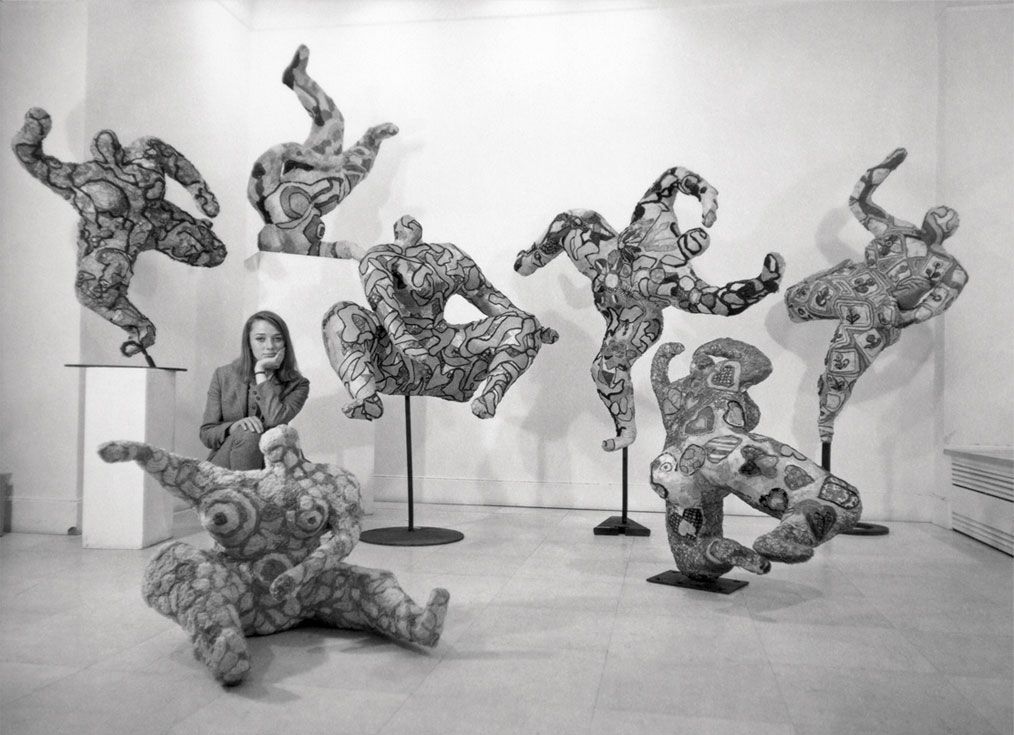
Earlier sculptures inhabit the same room as the Nanas and challenge gendered notions of societal modes of beauty and marriage and the role of women such as The Bride (or Miss Haversham’s Dream or When You Love Somebody) (1965), large and foreboding in her bridal gear not the least because of the romantic generational terror Dickens’ creation portends after her heartbreak. These sculptures, such as Lucrezia (1964), also use the same children’s playthings (baby dolls, military men, teddy bears, horses) to teach children, from the start, their gendered roles. These works, along with other Nana figures in the room, trace the origins and development from these earlier works to the monumental Nana figures that continued after the 1960s.

Niki de Saint Phalle posing with her Nanas at Galerie Alexandre Iolas, Paris, 1965. © André Morain

Niki de Saint Phalle’s works offer up the gristle of society, its pains and joys. In some of the video footage, she describes her work and her intention as an artist to inhabit a space outside of the elitism or snobbery of the traditional art space. Within the Menil Collection, a Houston art space predicated on access to the public, her works appear to belong. Her work is clear and precise, a provocative invitation to look closely. In the 1960s, Niki de Saint Phalle’s work described the conditions of life in and under patriarchy. You can’t unsee or unknow its damage in the exhibition. Her work resonates, reverberates, and continues today. 

****

“Niki De Saint Phalle in the 1960s” is on view at the Menil Collection, Houston, through January 23, 2022. The exhibition is co-curated by Michelle White, Senior Curator, The Menil Collection, Houston, and Jill Dawsey, Curator, Museum of Contemporary Art San Diego. My thanks to Curatorial Assistant Molly Everett for sharing her insights about the exhibition.

The post Buoyancy, Joy, and Damage: Niki de Saint Phalle at the Menil Collection appeared first on Glasstire.

30 Sep 11:35

Comic for 2021.09.29

New Cyanide and Happiness Comic
30 Sep 11:35

GUESS WHO?: Aches and Pains of an Aging Body Edition

by Alice Lahoda

There is a picture of a full game board entitled “Guess Who?: Aches and Pains of an Aging Body Edition.” The game board shows 24 upright cards representing the following age-related health problems: 1. eye strain. 2. joint pain, localized. 3. neck only turns left. 4. joint pain, everywhere. 5. intestines feel like someone's making popcorn down there. 6. headache, tried so hard to remember why you entered a room that it hurt. 7. skin just doesn't feel right. 8. headache, one hard cider two days ago. 9. acid reflux, midnight pickles. 10. crunchy spine. 11. cold tooth. 12. shoulder doing that weird thing again. 13. ankle, too tight. 14. can't! stop! burping!. 15. headache, children's laughter. 16. warm scalp. 17. physical effects from twenty-plus years of untreated anxiety. 18. acid reflux, saw an Olive Garden commercial. 19. ankle, too loose. 20. chronic stress, existence. 21. repeatedly clicking elbow, exactly 152 clicks until the pain arrives. 22. four-oh-four error: brain not found. 23. pointer finger, pointed too hard. 24. it would just be easier to list everything that doesn't hurt: left wrist holding up OK.

Is your pain in your ankle?
No.

After the first move, the following two cards are eliminated: 13. ankle, too tight. 19. ankle, too loose.

Did your pain appear after sleeping weirdly one time in your thirties and then stay with you for the rest of your life?
No.

The following three cards are eliminated: 3. neck only turns left. 12. shoulder doing that weird thing again. 21. repeatedly clicking elbow, exactly 152 clicks until the pain arrives.

Does your pain go away after a warm bubble bath?
No.

The following three cards are eliminated: 2. joint pain, localized. 6. headache, tried so hard to remember why you entered a room that it hurt. 11. cold tooth.

Do you have the time and energy to draw yourself a warm bubble bath, or is it ultimately more trouble than it’s worth?
More trouble than it’s worth.

Does your pain move around your body in a way that makes it hard to pinpoint?
No.

The following three cards are eliminated: 4. joint pain, everywhere. 7. skin just doesn't feel right. 17. physical effects from twenty-plus years of untreated anxiety.

Would your pain still be an issue if you stopped reading Twitter until three a.m. every night?
Yes.

The following two cards are eliminated: 1. eye strain. 22. four-oh-four error: brain not found. There are eleven remaining cards on the game board.

Does your refusal to give up fried food and sugary alcoholic beverages make your pain worse?
No.

The following three cards are eliminated: 5. intestines feel like someone's making popcorn down there. 8. headache, one hard cider two days ago. 14. can't! stop! burping!

Does yoga ease your pain?
Unclear.

Have you tried yoga to ease your pain?
No.

Do you want everyone to stop recommending yoga for your pain even though you know it would probably work wonders?
Yes.

Would your pain disappear if you could go back in time and yell at your twenty-year-old self until they agree to stand up straight and stop treating your spine as if it’s covered by a lifetime warranty?
No.

The following card is eliminated:10. crunchy spine.

Could your pain be prevented if you paced yourself in Couch-to-5K instead of thinking, “I bet I can just run the 5K,” and immediately discovering that isn’t the case?
No.

Is the source of your pain at all traceable to the time in college when you jumped out a second-story window on a dare?
More likely than not.

Does capitalism make your pain worse?
It definitely doesn’t help!

The following card is eliminated:20. chronic stress, existence.

Do children make your pain worse?
They definitely don’t help!

The following two cards are eliminated: 15. headache, children's laughter. 23. pointer finger pointed too hard.

Is your pain specific, or is it more of an abstract concept?
Abstract concept.

The following three cards are eliminated: 9. acid reflux, midnight pickles. 16. warm scalp. 18. acid reflux, saw an Olive Garden commercial. Only one card remains: 24. it would just be easier to list everything that doesn't hurt: left wrist holding up OK.

Is your pain: “It would just be easier to list everything that doesn’t hurt: left wrist is holding up OK”?
Yes!

Want to play again?
Sorry, I can’t. My left wrist just started hurting from flipping all the cards down too quickly.

- - -

All images created by the author via Canva PRO

30 Sep 11:31

Saturday Morning Breakfast Cereal - Free Will

by tech@thehiveworks.com


Click here to go see the bonus panel!

Hovertext:
The important thing is you feel like it matters to you!


Today's News:
30 Sep 11:30

Two-Factor Security Key

The bruises on my fingertips are my proof of work.
29 Sep 17:50

can my company make me have child care when I work from home, wedding officiants, and more

by Ask a Manager

This post, can my company make me have child care when I work from home, wedding officiants, and more , was originally published by Alison Green on Ask a Manager.

It’s five answers to five questions. Here we go…

1. Can my company require me to have child care while I’m working from home?

I work for a very small, fully remote (as in, remote even not during a pandemic) startup. There are maybe three dozen employees, tops. Today we had a company meeting and the HR director told everyone that our company requires childcare (she cited the company handbook, but these rules seemed to be flexible/non-existent during most of the pandemic). She said, “Just because we’re a remote organization doesn’t mean it’s not a workplace.”

Which, okay, fine. I do not have childcare, nor have I ever used it—it would bankrupt me. For most of my career, I was a full-time freelancer and able to make my own hours work for me around my kids’ schedule. I moved to this company for the pay, benefits, and stability. My productivity level remains the same, and I’ve even been promoted while working here.

I’m just wondering if a company can legally require childcare without subsidizing it? I feel like they can’t tell employees how to spend their money and raise their children, period, but especially not when it doesn’t affect our job performance and they’re not offering a financial contribution to childcare.

Yes, a company can require remote employees to have child care during their work hours. In fact, before the pandemic, that was bog standard — most companies with remote workers had policies requiring that employees have separate child care if they had young kids because they didn’t want people trying to do both (as so many parents saw last year, it’s incredibly hard/impossible to do both). That fell by the wayside last year because it had to — with schools and daycares closed, there was literally no way for most people to have separate child care, so companies had to be flexible on it or they wouldn’t have been able to employ parents at all.

Employers have been slowly moving back toward pre-pandemic policies on this. It’s not yet back to where it used to be because child care availability is still very low in many areas, but we’ll almost certainly return to those policies once conditions allow for it. If you’re not able to find child care right now because of closures and shortages, that’s something you should talk to your employer about. But if you’re saying you wouldn’t have child care regardless (even in pre-pandemic conditions and with no availability issues in your area) and you want to supervise/care for little kids during work hours, most employers will rightly object to that (it’s similar to how they also wouldn’t okay you working a second job during your hours for them). If your job is one where you have a ton of flexibility with your hours, you might be able to make it work. But it’s a really, really normal policy for employers to have … or at least it was before Covid blew everything up.

Caveat: if your kids are old enough that simply having an adult on the premises is all that’s needed, none of the above applies. These policies are generally about young kids who require more supervision.

2. My manager is upset when I don’t answer her calls, even when I’m in the bathroom

I’m a full-time graduate student and took on a fellowship through my school doing administrative data work for a local organization for 20 hours a week. The position is mostly remote, and the understanding is that I work part-time while I’m taking a full-time class load. I work a few hours a day, and I’m having trouble deciding if my supervisor is being unfair or if I need an attitude adjustment.

My supervisor and I get along well and the work is going fine, but she calls me once or twice a day while I’m on the clock. I’ve picked up most times, but have missed her call twice (and called her back; she calls two or three times in a row when I miss her call) over the past two weeks. This annoys her, and she says she expects me to be by my phone or computer at all times when I’m on the clock. Though I privately thought it was unreasonable, I agreed, and now find myself anxious about using the bathroom or answering the door, and resent feeling surveilled. I don’t think this is sustainable and it doesn’t help me complete my work, but also wonder if I’m being unreasonable — I am on the clock for only a few hours a day, after all.

I want to let her know something to the effect of “I’ll do my best to answer your calls when I’m on the clock, but would appreciate your giving me a few minutes to call back in case I’m in the bathroom or answering the door.” I feel silly even having to say that, but wanted your thoughts on whether my grievance is fair, and how you would approach this with a new manager.

You’re not being unreasonable at all! Of course you will occasionally miss a call because you’re in the bathroom or dealing with an emergency or any of the other things that come up in life.

Related story: I once worked with someone who told her remote employees exactly what your boss told you after one of them missed her call due to being in the bathroom — and it was widely considered a hallmark of how warped her expectations were. In her defense, she backed off as soon as it was pointed out to her; her own boss was an incredible tyrant and that pressure tends to trickle down.

Anyway, I’d say this to your manager: “I thought more about our conversation the other day and can’t realistically say I will never miss a call. I focus exclusively on work during my hours for you but occasionally I will need to use the bathroom. If you call and don’t reach me, please assume that’s the case and I’ll call you back within a few minutes.” My hunch is that she’s worried, unreasonably, that you’re not really in fully attentive work mode during the hours they expect you to be working and she isn’t thinking about things like the bathroom; you might just need to spell it out. But if that doesn’t work, asking, “How would you like me to handle bathroom breaks then?” likely will.

3. I don’t want my new hire working extra hours

I manage a fully remote team. It can be difficult to draw a line between work and life when you work from home. So I try to promote and emphasize the importance of work-life balance within my group. For example, I don’t send emails outside of traditional work hours, I’m flexible about appointments, and I encourage my team to use all their vacation time before year-end.

I have a new employee, Jolene. Day 3 of her first week, Jolene said she would work on something “later tonight, after dinner.” I reminded her then that I don’t expect her to work on this project at night – if she ever needs more time on something, she can let me know.

Today is Monday of her second week, and she just told me how much time she spent reviewing her notes over the weekend. How can I make it clear that Jolene is not responsible for working on these (not-high-priority) projects outside of traditional work hours? (And working nights and weekends does not impress me.)

I’m worried that she will start telling other individuals on my team about her late hours, and they’ll think the expectation is changing for them. I also don’t want her to get burned out, right as she’s getting up to speed.

For context, Jolene has freelanced for a while, and this is her first full-time job in about five years. I wonder if she is still suffering from the old “Cult of Busy.”

Saying that you don’t expect her to work those hours isn’t the same as telling her she shouldn’t.

So: “I’m sorry for not being clearer. I feel strongly that I don’t want you or anyone else on our team working evenings or weekends —  in part because once one person is doing that, the rest of the team starts feeling pressure to do it too. If you’re ever finding you need to work extra hours to keep up with your workload, come talk to me and we’ll figure out how to reprioritize things.” (If she might occasionally need to work extra hours, add “except in unusual circumstances which will only come up a few times a year” or otherwise adjust accordingly.)

4. How do I respond to an apology for misgendering me?

I recently had a situation where someone misgendered me in a meeting, and they followed up with an apology email. It made me realize that I don’t really know how to appropriately respond to an apology like this (or even apologies in general). My conditioning tells me to tell the apologizer that it’s okay, but that isn’t true. I appreciate the apology and forgive them for it, but I don’t know how to express that in a way that’s both professional and not cold.

This is definitely not specific either to misgendering or to emailed apologies for me, but both of those factors make navigating this more difficult for me.

“Thank you, I appreciate it.”

That accepts the apology without implying that whatever happened was okay.

5. I don’t think my daughter’s stepmother should officiate at her wedding

My daughter is getting married in March 2022 and the stepmom has barged her way in to being the officiant. I’m the mother of the bride and this offends me, as the stepmom has never been a part of my daughter’s life and in fact has tried to separate us.

I write a work advice column but what the hell, I’ll answer this.

This isn’t your wedding. It’s your daughter’s. She gets to decide who will officiate, and she’s decided her stepmom will. Whatever you think of the decision, it’s hers and her fiancé’s to make, not yours.

If you choose to make this a point of contention and stress for her during an already stressful time, you’re likely to weaken your relationship with your daughter rather than strengthening it. The most loving and smartest thing you can do is to support whatever she decides and stay out of the rest of it. Showing grace will make you much more likely to be someone she’s glad to have nearby on her wedding day, instead of another problem she needs to solve.

29 Sep 17:39

I Wish I'd Been Born a Piller (VOY S2E18)

by shows@maximumfun.org (Adam Pranica and Benjamin Harrison review Star Trek)
29 Sep 17:39

The Introduction from the Texas Abortion Bounty Hunter’s Handbook

by Wendi Aarons and Omar L. Gallaga

Thank you for your interest in saving the lives of precious, little six-week-old embryos all across our great state of Texas. By committing to join our army of vigilante reproductive monitors, you’ll help us in the moral fight against floozies, infant-choking medical quacks, and Nancy Pelosi.

Abortion bounty hunting is not what the mainstream media would have you believe. Legally detaining an evil host body and delivering her to the law like she’s a member of the James Gang is not “snitching.” In Texas, “snitches” most certainly do not get “stitches”; they get lucrative cash awards and possibly even prizes for their God-fearing work.
This handbook, which is completely free of charge,1 will teach you five important steps to bounty hunt the pro-infanticide travesties being performed against God, Jesus, and Governor Greg Abbott:

1. How to know if a woman is about to get raped before she does.

2. Identifying when an abortion is about to go down.

3. Ways to file a lawsuit against the “Doctor,” partners, friends, family members, abortion fund volunteers, and the Uber driver involved in the crime.
4. How to collect your $10,000 bounty (not from the state, but from those listed in #3 via civil lawsuit).
5. The perfect Bible verses to yell while bounty hunting, and not just that “Strike down upon thee with great vengeance!” one from Pulp Fiction, which, frankly, is a little played out.

Before you commit to this honest and not at all abhorrent work, you should ask yourself these important questions:

  • Do I want to insert myself into the most personal and painful decision a woman can make about her future?
  • Can I overlook the fact that the “heartbeat law” that claims an embryo’s heartbeat can be heard at six weeks’ gestation is actually noise from an ultrasound machine because no heart valves have formed yet?
  • Do I know a lawyer who doesn’t get too bogged down in legal jargon like “precedent” and “due process,” and who salivates at a quick and dirty civil suit like you’re waving fatty Texas brisket under their nose?
  • Have I decided what to spend my $10,000 on and is it another jet ski?
  • Am I willing to petition lawmakers to help the woman forced to give birth by the state take care of her child via health care, child care, and social services? (LOL, kidding—just a little Texas humor, y’all.)

If this all makes perfect sense to you and not like something from a rejected season of The Handmaid’s Tale, then read on, patriot. We’re pleased to welcome you into the ranks of Texans fighting for the rights of the recently conceived, even if it’s too early for a woman to know she’s pregnant, and even if it’s at the expense of everyone else’s privacy and reproductive rights. And while 54 percent of Texans don’t want to run back the clock on Roe v. Wade, old white Republican men need those evangelical votes and urgently require our help before they go the way of the dodo.

Spot ’em, tag ’em, bring ’em in, and get that $10,000. Let’s turn the Right to Life into your Right to Cash In.

- - -

1 Paid for by taxpayer funds from the great citizens of the even greater State of Texas.

- - -

The Lilith Fund.

28 Sep 21:02

a coworker prayed for my fiancé’s death so we didn’t invite her to our wedding … and now there is drama

by Ask a Manager

This post, a coworker prayed for my fiancé’s death so we didn’t invite her to our wedding … and now there is drama , was originally published by Alison Green on Ask a Manager.

A reader writes:

My fiancé, “Ted,” has worked for 10 years on a small, very close-knit team, all of whom seem to get along exceptionally well. All the team members and spouses/partners socialize outside of work together as well, and we consider them all to be close friends. We thought they felt the same.

A few months ago, on the way to a work event, Ted and his coworker/best friend “Bob” were involved in a serious car accident and were rushed to the ER. Everyone waited anxiously for hours as they both underwent surgery. Thankfully, they both recovered.

When Ted returned to work, a team member, “Sally,” told him she had a confession to make. She said that while they had been in surgery, she prayed that if God had to let one of them die, she hoped it would be him. (WTF?!?)

Ted was shocked and asked why. He said she gushed on and on about what a “saint” Bob is. (Her examples were that Bob gives her great advice on her struggling marriage and has loaned her money when she was in a tight spot.) She finished by saying, “No disrespect to you, but Bob is in a class by himself. You have to admit you can’t measure up to that” and walked away.

Ted was truly devastated to learn that she felt this way, but he tried to attribute it to the stress of the situation and did his best to put it behind him. He never told anyone else on the team what she said and tried to continue on at work as if nothing had happened, but his relationship with Sally hasn’t recovered. He is still deeply wounded by her comments.

Although Ted appears to be a confident person, underneath he is fairly insecure. He truly thought Sally was a good friend. So in addition to causing him a lot of pain, this has also rattled his confidence. Now he’s wondering if all his team members secretly feel the way she does. Ted and Sally have always seemed to have a warm, cordial relationship and he can’t understand why she would say such a hurtful thing. Ted is now constantly measuring himself against Bob and questioning why he isn’t as “good.”

I suggested that perhaps Sally has a crush on Bob or feels closer to him for reasons that have nothing to do with Ted. But he is convinced that thinks she sees him as a “second tier” man and worries that others do too.

Our wedding is coming up soon and the venue strictly limits the number of guests. When it was time to send out invitations, Ted invited the rest of the team and their spouses but did not invite Sally and her husband. I expressed my concern that this would cause more problems, but he replied that since we could only have a limited numbers of guests, he’d prefer to spend our special day with another pair of close friends who “genuinely love and appreciate” us rather than a woman with whom his relationship is now severely strained.

Two weeks ago, I got a call from another team member, “Alice,” asking me if I had forgotten to send an invitation to Sally. I explained that because the venue is small, we simply couldn’t invite everyone.

Alice then told Ted that if we didn’t invite Sally, she and the other women on the team wouldn’t attend either. Ted told her that since the invitations have already gone out, there is no way to add Sally and her husband now unless we “uninvited” two other guests, which we can not do.

Now all the women on the team, including Sally, are freezing Ted out. They refuse to speak to him except when forced to, which is really starting to adversely impact the collaborative work the team does and hampering Ted’s ability to do his job. The men on the team have sided with Ted, saying they feel we have the right to invite (or not invite) whomever we want to our own wedding. This has caused an even further rift in the team.

Everyone is questioning Ted about why we didn’t invite Sally, but he doesn’t feel it’s his place to explain why he doesn’t want her to attend and just keeps repeating that the decision was due to the venue size limitations.

The manager of the team works at another site, and because the team has previously worked so well together, has historically been fairly hands-off, and is oblivious to what is happening now. But if the work continues to suffer, she’s going to notice and ask what’s going on.

What, if anything, should Ted do? Should he preemptively go to the manger to give her a heads/up, or will that make it even worse to be seen as “tattling”? Is there anything he can do to “fix” this on the team, before it erodes their work product even more?

I did weaken and called the venue, who grudgingly said they would be willing to accommodate one more couple. Should we break down and invite Sally to the wedding for the sake of harmony at work?

What a mess.

I completely understand why you wouldn’t want Sally at your wedding! She prayed your fiancé would die. Maybe not exactly … but pretty close to it. And then for some reason, she felt the need to tell him. Why?! She should have kept it to herself; there was no need to inform Ted and if she hadn’t, presumably life at work would have just gone on as before. So Sally sounds like a bit of a nut.

However.

I’m not a fan of pressuring people into wedding invitations, but you also can’t exclude one person from a tight-knit group and expect that not to send a message and cause drama. You’ve got to either invite the whole group, or invite fewer of them so you’re not leaving out just one person, or leave out the one person and accept that it’s going to be A Thing. You and Ted chose the latter option but are hoping it won’t cause drama, and that’s not realistic.

It’s especially not going to happen when no one knows why Ted is upset with Sally. From what they can see, they had a close, tight-knit group of work friends and now Ted has randomly and hurtfully decided to exclude one person for no reason.

I get that he’s trying to blame it on the venue size, but that doesn’t really work when you’ve excluded one person from a “tier” of wedding guests. It wouldn’t work if he had excluded one uncle or one niece, and it doesn’t work when you exclude one of a very close team of colleagues. People are going to read something into it and be hurt.

The drama that it’s causing is pretty excessive — coworkers freezing him out and refusing to speak to him except when forced, to the point that it’s affecting their work, is a weirdly intense reaction (as well as inappropriate and unprofessional). That’s likely a sign that the boundaries on this team were messed up before any of this happened, and that’s why the wedding invitations are functioning as a bomb rather than more like an exploding soda can.

And again, in theory you should be able to invite whoever you want to your wedding and exclude anyone you don’t want there. And you can! You just can’t do it without consequence, and that’s what you’re seeing now.

As for what to do, if Ted wants to stick to his decision, he’s probably better off just being matter-of-fact about why: “Normally we would have loved to have the whole group, but when Bob and I were in the hospital Sally told me she prayed for me to die if one of us had to. So we’re not asking her to celebrate our wedding with us.” Then at least people would have context. It will probably cause a different kind of drama, but if Ted can stay matter-of-fact about it (“it is what it is and we can still work together fine, but it didn’t make sense to ask her to be at the wedding”) it’s probably a better option than the drama of No One Knows Why Ted Did Such an Unkind Thing.

Frankly, it might also be an opportunity to clear the air with Sally. It sounds like she might have no idea why Ted didn’t invite her. He could sit down with her and say, “I’m sorry this has gotten so out-of-hand. I should have spoken to you earlier. I was really hurt by what you said to me after Bob’s and my accident. I’d thought we were close friends, and I haven’t been able to get past you telling me that you prayed I’d die if one of us had to. It’s why we didn’t ask you to be at our wedding, but I’m realizing that I should have talked with you about it earlier.”

It’s possible that conversation could move things to a much better place. Maybe Sally didn’t realize how her remark came across and maybe she’ll be mortified in hindsight. Maybe it’ll turn out she was addled by painkillers when they talked and this is the latest in her long and embarrassing list of discoveries of things she said that day. Maybe they’ll have the sort of conversation that will make Ted happy to extend a wedding invitation to her. Who knows. But looking at where things stand now, not talking to her about it seems like the worse option. And just giving in and inviting her without having that conversation first doesn’t seem likely to fix things at this point.

28 Sep 20:48

Figure Out Your Life

by Mary Kelly

what to do with the rest of your life cover

What to Do With the Rest of Your Life
Catalyst
1981

We have had a couple of books authored by the organization Catalyst. This non-profit advocated for women in business. They published career advice for women in the 1970s and 1980s. If you have been a long time reader of this blog, you might remember this particular book.

It felt like this book was more about introspection and finding your “perfect” career path. It was definitely published with nice, privileged, ladies in mind. See the bottom paragraph on the introduction page.

Like I have commented before, this very much is for that 1% of working women that have resources and a nice safety net. I doubt that the single mother trying to make ends meet has time to have an introspective meditation on career satisfaction.

Really, just get in there and weed those career advice books.

Mary

what is catalyst

personal biography

work values

goals

self evaluation

The post Figure Out Your Life appeared first on Awful Library Books.

28 Sep 20:46

Comic for 2021.09.28

New Cyanide and Happiness Comic
28 Sep 20:46

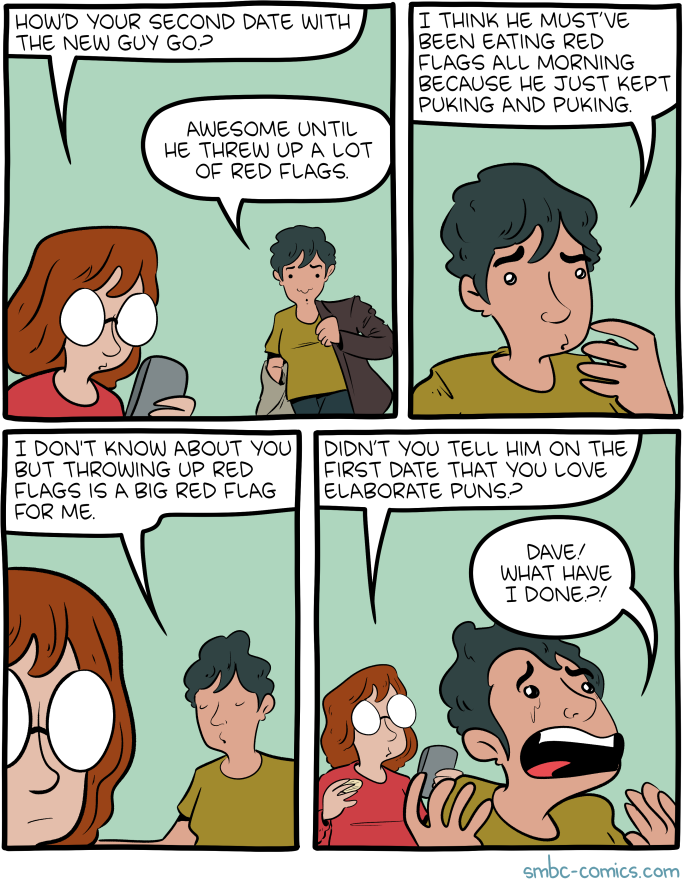
Saturday Morning Breakfast Cereal - Red Flag

by tech@thehiveworks.com


Click here to go see the bonus panel!

Hovertext:
Dave, all alone, vomits himself to sleep that night.


Today's News:
28 Sep 20:35

Students Don't Know What Files And Folders Are, Professors Say

by BeauHD
University students in courses from engineering to physics are having to be taught what files and folders are, The Verge reports, because that's not how they've grown up using computers. Whenever they need a file, they just search for it. PCGamer summarizes the findings: "I tend to think an item lives in a particular folder. It lives in one place, and I have to go to that folder to find it," astrophysicist Catherine Garland said. "They see it like one bucket, and everything's in the bucket." Strange as it may seem to older generations of computer users who grew up maintaining an elaborate collection of nested subfolders, thanks to powerful search functions now being the default in operating systems, as well as the way phones and tablets obfuscate their file structure, and cloud storage, high school graduates don't see their hard drives the same way. "Students have had these computers in my lab; they'll have a thousand files on their desktop completely unorganized," Peter Plavchan, an associate professor of physics and astronomy at George Mason University, told The Verge. "I'm kind of an obsessive organizer ... but they have no problem having 1,000 files in the same directory. And I think that is fundamentally because of a shift in how we access files." As The Verge points out, "The first internet search engines were used around 1990, but features like Windows Search and Spotlight on macOS are both products of the early 2000s [...] While many of today's professors grew up without search functions on their phones and computers, today's students increasingly don't remember a world without them." This isn't necessarily a bad thing, or a reason to recoil in horror because how dare the youth of today do things differently, why the very idea. "When I was a student, I'm sure there was a professor that said, 'Oh my god, I don't understand how this person doesn't know how to solder a chip on a motherboard,'" Plavachan said. "This kind of generational issue has always been around." And Garland, the astrophysicist teaching an engineering course, has started using her PC's search function to find files in the same way her students do. "I'm like, huh ... I don't even need these subfolders," she said.

Read more of this story at Slashdot.

27 Sep 20:49

our employee forged the owner’s signature on his mortgage documents

by Ask a Manager

This post, our employee forged the owner’s signature on his mortgage documents , was originally published by Alison Green on Ask a Manager.

A reader writes:

I have a remote medical billing job that I have been doing for the last seven years. The owner of the billing company, John, is a wonderful person who goes above and beyond for me and for his two other employees who are on-site. For context, I have run a highly successful medical practice for the last 25 years, so I am the go-to person whenever the owner of the billing company has questions/concerns.

Recently, one of the other two employees (Rob) approached John, said that he was moving out of state, and requested to work remotely. The request was denied, for various valid reasons. (The reasons could be a whole other letter to you, trust me!) Rob acknowledged this and gave his two-week notice.

This past Monday, when Rob’s last day was this upcoming Friday, he called John and confessed to having forged John’s signature on two mortgage documents for the new house he was purchasing out of state. The documents “verified” that John was still his employer, and that Rob was still making his salary and would continue to be an employee at that salary in the future. Which is a total lie, as Rob was going to be out of work come this Friday.

John immediately told Rob that he was terminated and that he was contacting his lawyer, and to send him the documents that were forged. Upon receiving them and consulting with his attorney, he advised Rob to contact his mortgage lender to explain that the documents were forged, and to amend them, and to send proof of this back to him. He also told Rob to not come back to the office until the next morning, at which point he wanted Rob to turn in his keys and computer login info to the other employee there, who is considered to be the office manager.

Rob then went back to the office LATER that night and deleted several files from his work computer, and then when he came in the next morning to turn in his keys/login info, he somehow managed to delete about 100 other files from his computer, claiming that while he was gathering his personal belongings, he somehow unplugged his work computer and had to plug it back in. When confronted by John about this, he lied and said he hadn’t done anything, even though John had a record of it through computer logs. When presented with the evidence contradicting his lies, he continued to say he hadn’t deleted any files.

I should note that John is going through a major medical issue with his wife, and could not be there to monitor any of Rob’s actions when Rob came to the office to turn in his keys/login info, as John was at the hospital with his wife. The timing on all of this was horrible!

John is reluctant to do anything more right now, other than chalk this up to a “lesson learned” when it comes to hiring someone he considered to be a “friend,” as he originally hired Rob because he knew him and felt bad when Rob was let go from his previous job. I have told John to check all client accounts for issues, and while I know there is no way Rob has embezzled from the company (we don’t ever get checks/money at the office), I still feel that Rob should face some consequences for what he did. John feels differently and I know it is because he has so much going on right now in his personal life (he told me so).

I know that if I was to push John harder, he would report Rob to the proper authorities and Rob would be in serious trouble. What would you suggest be done at this point?

If John wanted to report Rob’s actions, I’d have no beef with that.

But he doesn’t want to, and I don’t think you need to push him. It sounds like he has bigger priorities right now, and I don’t think there’s a moral imperative to ensure that Rob face justice.

I understand the impulse! It’s natural to want to see people face consequences for outrageous behavior, especially when they’ve lied to your face. But it’s not your job to dole out justice.

(For what it’s worth, though, Rob’s reaction is kind of fascinating! First he confessed what he did to John, and then he got petulant when Jonn had a reasonable reaction to it.)

John or his lawyer should contact the mortgage lender and inform them that John’s signature was forged on the documents they received; that’s just setting the record straight.

But ensuring Rob faces consequences … if John doesn’t want to deal with it, he doesn’t need to.

That said, there will be consequences: For one thing, Rob just got fired from his job and destroyed any chance of a good reference. And informing the mortgage lender that John’s signature was forged is highly likely to have some consequences too.

You’re right that now you can’t assume Rob acted with integrity in anything else, so someone needs to check whether he really did things he said he did and otherwise examine his work for problems. Bring in professional outside help to recover those computer files, too.

But the most important thing to do is what John is doing — to look for lessons to take forward. Of course, sometimes people say “lesson learned!” when they’re not really processing the lesson for next time, so if you have the kind of relationship that allows for it, you might nudge him in that direction: Were there red flags about Rob previously? Did John cut him more slack because he was a friend? Did Rob think he could get away with fraud because he misunderstood their relationship and, if so, did John contribute to that misunderstanding in the way he managed him? Were there things John/the company could have done differently to change the outcome?

John doesn’t need to do all that reflection right now if he’s got his hands full … and with his wife in the hospital, it sounds like he does. But ideally he’d do it before the next hire.

27 Sep 20:45

my employee relocated and didn’t tell me

by Ask a Manager

This post, my employee relocated and didn’t tell me , was originally published by Alison Green on Ask a Manager.

A reader writes:

I run an online business and we have not worked in office since March 2020. Like many Covid-remote workers, we saw some living situations shift: moving in with family, caring for parents, working in remote locations. That worked very well for us and I’m grateful. Our current return-to-work date is before the end of the year, when everyone is expected to be in office three days a week.

One of my employees, Margot, is immunocompromised and left NYC (where we’re based) to be in Texas and live with her dad. She got really sick every winter in NYC (pre-Covid, I had no idea about her compromised immune system; she didn’t want anyone to pity her) and her doctor said that with Covid, she should not live in cold-weather climates; the vulnerability is too great. Margot kept me posted at every step: when she wanted to be in Texas temporarily, when her doctor recommended it long-term, when she gave up her apartment. She knew she was taking a risk, because our company’s policy on working in Texas wasn’t defined, but she had multiple conversation with me and with HR to ensure that everyone was on the same page.

Another employee, Frank, moved to Cleveland. Unlike Margot, I learned about Frank’s plans after the fact. On a Zoom call, I noted a different background. “Oh, we’re in Cleveland for a while. We’re close to my wife’s family and staying in an AirBnb.” As Covid extended, the background changed again: “We got a short-term lease. We weren’t thrilled with our apartment anyway.” Then, I learned through others on my staff that his wife has gotten a job there. That he’s updated his license at the Ohio DMV. When I asked him about this, he said yes, he would like to stay in Cleveland but was waiting to see what our policy was; others at our parent company were in similar situations.

It took corporate a long time to weigh in — they surveyed the circumstances of everyone at the company, at all of our brands — and the bottom line is this: Those brands that allow an employee to work outside our headquarter cities must seek permission and pay the annual fees to incorporate — about $20K, which will hit my brand’s bottom line.

In short, I’m cool with doing that for Margot but not for Frank. Margot and Frank have very different roles: Margo is behind the scenes and handles organizational issues for our brand, but Frank’s role has a profile in our industry and it reads very weird for him to be based in Cleveland — a city that has nothing to do with what we do. The uncertainty of Covid really impacted/slowed my reaction, as did Frank’s boiling-frog approach to relocation without discussion or even a heads up, but now I’m clear: I don’t want his role to be based in Cleveland and I don’t want to pay an additional $20K a year for his decision.

So: Yes for Margot, no for Frank — and I’m willing to lose him as an employee. Am I being fair?

It’s not inherently unreasonable to decide that you’re willing to do it for one employee but not another, or for one job but not another. Different jobs have different needs, and some jobs can be based anywhere and some can’t. Some employees are just as effective when they’re based remotely and some aren’t. And some employees contribute enough that they’re worth paying an extra $20K a year to accommodate their move, and some aren’t.

If it really doesn’t make sense for Frank’s job to be based in Cleveland, it’s not unfair to make that your decision.

But before you do, I’d really interrogate your reasons. Is it genuinely about Cleveland, or is it about how Frank handled his move? If he had kept you informed every step of the way like Margot did, would you be making a different decision now?

If the reality is that yeah, you’d feel differently if he had operated more like Margot did, I’d cut him some slack there. The last year and a half has been weird, and a lot of people didn’t realize that “we’re working remotely for now” isn’t the same thing as “you can work from wherever you want.” Even aside from management concerns with that, not everyone knows that there are legal and tax reasons why an employer might not allow it — if an employer has employees living in a different state, they have business nexus there and may be required to pay taxes in that state, set up workers comp insurance there, and more. So many people relocated during the pandemic without realizing that (or with their companies turning a temporary blind eye to it because of the pandemic) that it’s easy to see how someone could conclude this is a thing people can just go ahead and do now.

It doesn’t sound like Frank tried to hide his move from you; he just didn’t proactively volunteer it. When you inquired, it doesn’t sound like he tried to avoid telling you; he told you he hoped to stay in Cleveland but was waiting to hear what your policy was. That’s pretty reasonable.

You still get to decide that the job just can’t be in Cleveland. You also get to decide that Frank isn’t valuable enough to you to pay $20,000 more every year to keep him. But if your decision is mostly driven by annoyance that he didn’t communicate as much as Margot did, I’d let that go*.

*Unless it’s part of a pattern with Frank not communicating enough. If it is, that’s not likely to improve when he’s working remotely from another state.

27 Sep 20:40

Clowns, the Fun Makers

by Holly

Clowns Fun Makers coverClowns: The Fun Makers
Boring
1980

Submitter: This book has not circulated since 1999, and I can see why. The photos are pretty boring. Plus being a history book on the topic of clowns that is now over 40 years old – it’s time to replace and update.

Holly: Or, as Mary says, “Clowns: The Nightmare Makers.” I guess if your last name is Boring and you’re a writer, you find something fun to write about. It’s basically just a history of clowns and circus entertainers (ending at 1980, obviously). Not the worst thing I’ve ever seen, but definitely old and…well, boring.

Red Unit: Ringling Show

Felix Adler

Patrick Burden

The Wallendas

The post Clowns, the Fun Makers appeared first on Awful Library Books.

27 Sep 20:39

Comic for 2021.09.27

New Cyanide and Happiness Comic
27 Sep 20:38

Saturday Morning Breakfast Cereal - On Off

by tech@thehiveworks.com


Click here to go see the bonus panel!

Hovertext:
The weirdest thing is this works even when you know it's a trick.


Today's News:
27 Sep 20:37

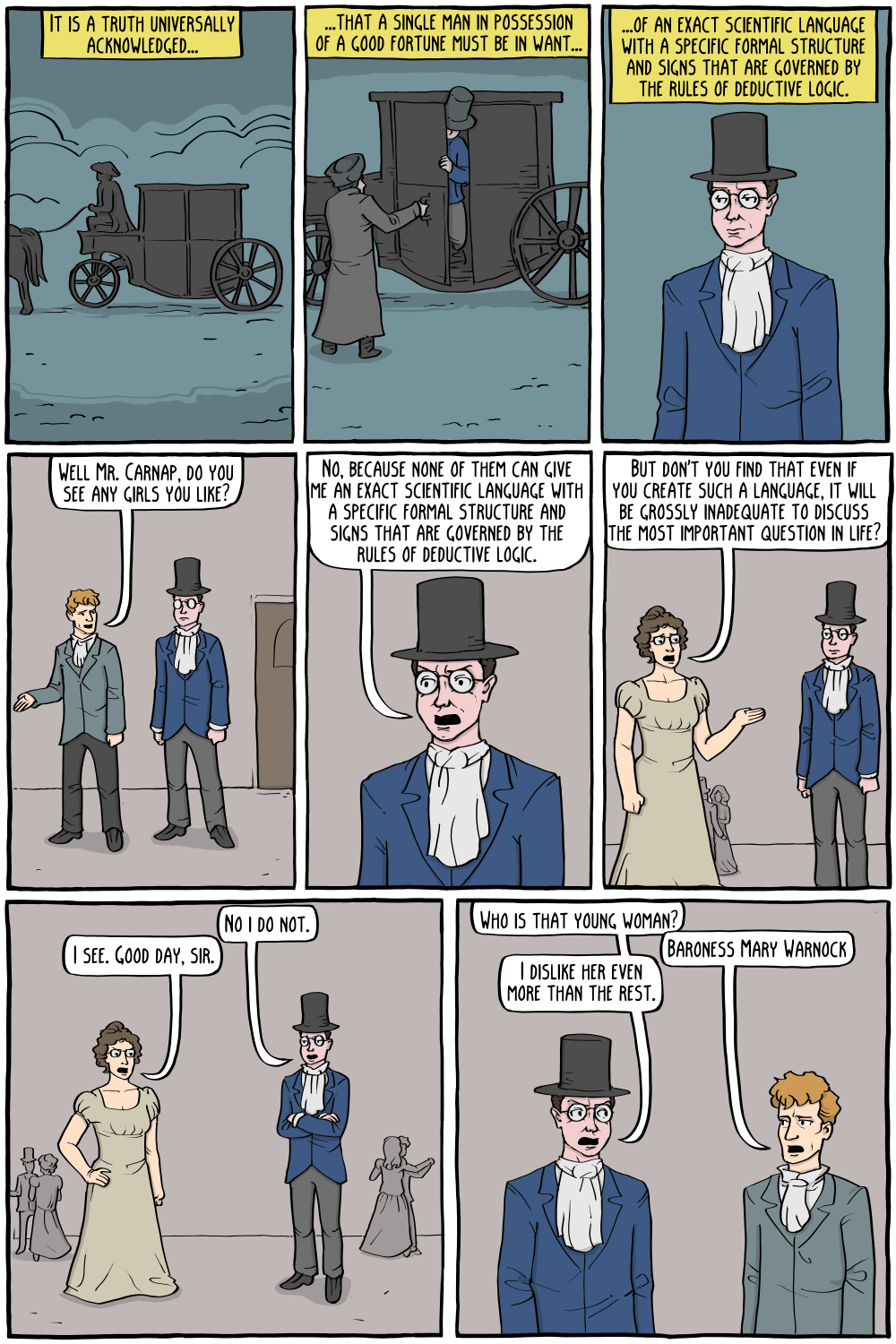
Pride and Prejudice and Logical Positivism

by Corey Mohler
"It is a truth universally acknowledged... "

"...that a single man in possession of a good fortune must be in want..."

"...of an exact scientific language with a specific formal structure and signs that are governed by the rules of deductive logic."

Description: Carnap gets out of his carriage to attend a ball.

Carnap's friend: "Well Mr. Carnap, do you see any girls you like?"

Carnap: "No, because none of them can give me an exact scientific language with a specific formal structure and signs that are governed by the rules of deductive logic."

Mary Warnock: "But don't you find that even if you create such a language, it will be grossly inadequate to discuss the most important question in life?"

Carnap: "No i do not."
Warnock: "I see. Good day, sir."

Carnap: "Who is that young woman?"
Friend: "Baroness Mary Warnock"
Carnap: "I dislike her even more than the rest."


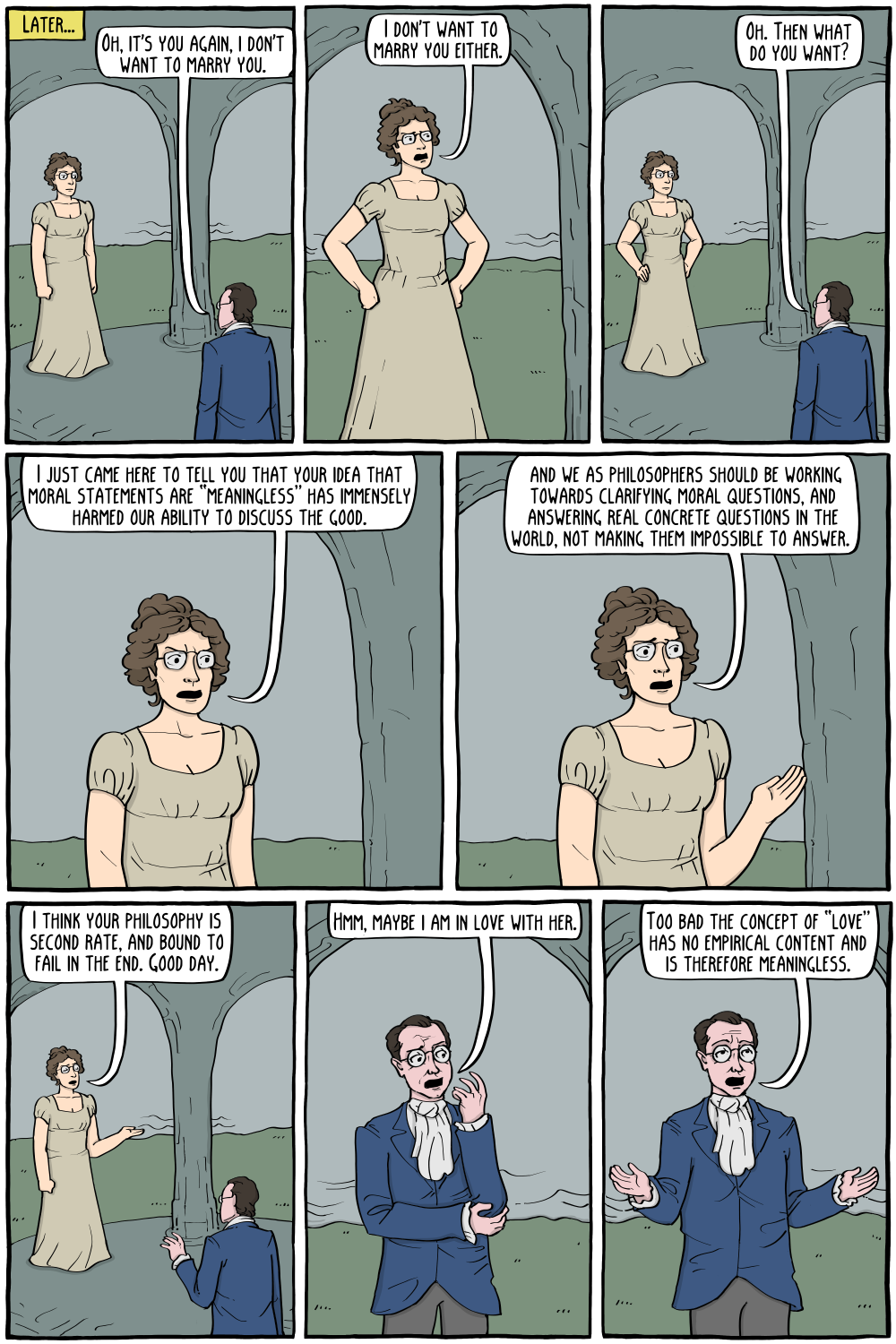
"Later...Mary Warnock comes in out of the rain to Carnap's Villa"

Carnap: "Oh, it's you again, I don't want to marry you."

Warnock: "I don't want to marry you either. "
Carnap: "Oh. Then what do you want?"

Warnock: "I just came here to tell you that your idea that moral statements are “meaningless” has immensely harmed our ability to discuss the good."

Warnock: " and we as philosophers should be working towards clarifying moral questions, and answering real concrete questions in the world, not making them impossible to answer. "

Warnock: "I think your philosophy is second rate, and bound to fail in the end. Good day."

Carnap: "Hmm, maybe i am in love with her."
Carnap: "Too bad the concept of “love” has no empirical content and is therefore meaningless."
27 Sep 16:29

Awkward Zombie - Small Time

by tech@thehiveworks.com

New comic!

Today's News:

Plus all the cigarettes and used needles were up on top of the refrigerator, where I can't reach.

27 Sep 16:26

Saturday Morning Breakfast Cereal - Lesion

by tech@thehiveworks.com


Click here to go see the bonus panel!

Hovertext:
I was compelled to make this by unpopular request.


Today's News:
27 Sep 16:25

Saturday Morning Breakfast Cereal - Temptation

by tech@thehiveworks.com


Click here to go see the bonus panel!

Hovertext:
Of course to be more accurate, all the immaterial soul can do is ogle.


Today's News:
27 Sep 16:23

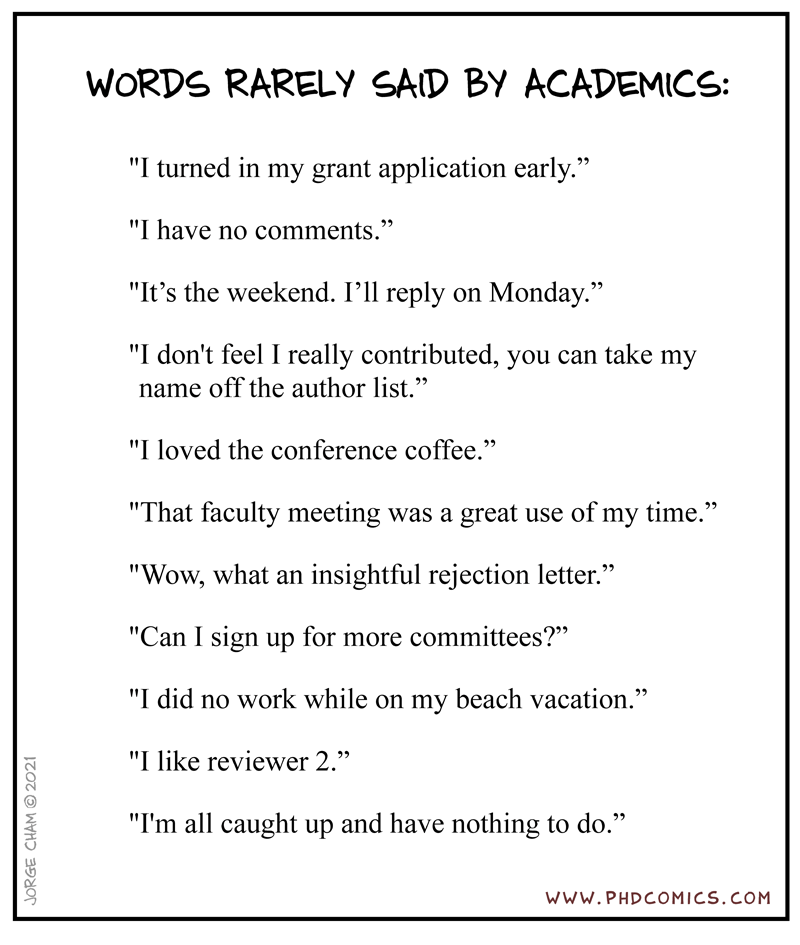
09/24/21 PHD comic: '...Said No Academic Ever.'

Piled Higher & Deeper by Jorge Cham
www.phdcomics.com
Click on the title below to read the comic
title: "...Said No Academic Ever." - originally published 9/24/2021

For the latest news in PHD Comics, CLICK HERE!