By a coincidental set of circumstances, my mother-in-law has become BFFs with the wife of one of my managers. I didn’t find out until I was in the process of getting hired at my job and when I was told, I’ll be honest, it made me nervous because my MIL is nosy.
Recently, my MIL has informed me that said manager told her he would not hire me as a manager because of my attendance. (If this is exactly what he said, I’m a little confused because I’ve not applied for a manager position.) I know my attendance right now isn’t the greatest but I am working on it. I don’t know if this is relevant, but I was having a lot of car trouble and was having to try to get rides to work.
It feels wrong for him to talk about me and my attendance to my MIL. I’m also wondering how much other stuff has been said about me and is this even legal? I live in Georgia if that matters.
It’s legal. There aren’t many workplace privacy laws in the U.S. and none prevent a manager from gossiping about someone’s attendance or what jobs they think a person is or isn’t suited for. (Of course, there are defamation laws, but the bar to meet that is very high and wouldn’t apply here; you’d need to show that the statement was false and also caused you injury.)
But it’s wrong! Your manager shouldn’t be gossiping about you to your mother-in-law. Depending on your relationship with your boss, you might be able to explain you’re in an awkward situation due to his wife’s friendship with your in-law and ask if he’d be discreet in the future about discussing you. (You shouldn’t need to ask, of course! But sometimes people
don’t think things like this through and a nudge can help. Not always, but sometimes.) Alternately, you could consider asking HR to take it up with him although you’d need to consider what you know of how they operate and what the repercussions might be for your relationship with your manager afterwards. Which sucks, but is the reality of it.
You could also try asking your mother-in-law not to discuss you with your boss, pointing out that it’ll be far easier for you if there’s a firewall there. Or at the very least, if they do talk about you, perhaps she can be convinced not to pass it along to you. This, of course, will depend heavily on what your mother-in-law is like.
2. My team gave bad feedback about me as a manager
I am the manager of a small department. I like to think I have a good, open relationship with all of them but the results of a recent survey showed that over 50% of the team responded negatively on questions regarding their immediate supervisor (me). This has hit me hard as I try to go above and beyond for my team. I rarely deny time off, often covering shifts on my own time; I say hello and goodnight to every team member every day; and I always try to find something non-work related to talk about with the team. What can I do to build these relationships to level I thought they were?
What was the specific feedback they gave? Usually when people have concerns about their manager, it goes beyond stuff like saying hello and goodbye and chit-chatting; it’s generally more substantive stuff like not getting useful feedback, not feeling they have clear expectations or being subjected to unreasonable ones, not feeling you advocate for them to upper management, being micromanaged or not getting enough guidance, feeling their work goes unrecognized, not feeling their input is heard, and so forth. (I’m not saying it’s necessarily anything on that list, just giving a sampling of what management issues often look like.) Hopefully the survey contained specifics; if not, it’s worth talking to people one-on-one to get a better understanding of their concerns.
For what it’s worth, the fact that you listed mostly fluffy stuff as what you’re getting right makes me think you might not have given enough thought or attention to what you need to be doing as a manager, and that itself could be where the problem is!
3. I asked for a promotion and a raise and it was denied — now what?
I finally worked up the courage for the first time in my 15+ year career to ask for a promotion and a raise, and it was denied. Now what? There was nothing I could do to work towards this or prove it was warranted, I was just given the company line of “we can’t give off-cycle promotions at this time.” I actually love my job, but I’m severely underpaid and am doing more work and have more responsibilities than my peers with more senior titles. I love my boss and I don’t want to leave, but I’m being undervalued and feel dejected after I finally worked up the courage to ask for this. Where should I go from here?
Ask your manager what a path to promotion would look like — what would you need to do to get promoted in the future, and what’s a realistic timeline for that? And since they mentioned they can’t give off-cycle promotions, make sure you know what that cycle is and how far in advance of it you should broach the topic again.
If you don’t get a clear answer, then assume that for whatever reason a promotion isn’t going to happen there and that you’ll need to look outside the organization to get one. (Which isn’t to imply that you can’t do that regardless of what your manager says. If you’re underpaid and overworked, it makes sense to look at what else is out there. You don’t have to leave if you don’t find something you like better, but you should at least look.)
4. Should slacking off 15 years ago be counted against someone running for office now?
A former coworker (Sam) is a candidate in the upcoming election for county clerk. Sam did a good job and got along well with coworkers when I worked with them. When they left for a new position, their duties were divvied out to the rest of the team until someone could be hired to fill the position. The project I was assigned to cover should have been started a couple months before Sam left. When I took over, we were close to the first of three deadlines and their work for that deadline should have been almost done. In reality, Sam had barely started so I had to scramble. I later found out that Sam had slacked off on other tasks and projects in their final couple of months.
This happened almost 15 years ago and it looks like Sam has held roles of more responsibility since then. I don’t know what was going on for Sam in those last few months. Maybe they had personal things going on that made doing their work extremely challenging. Maybe they saw no need to do more than make themselves look busy because they were planning to leave. If Sam had been struggling, they could have asked for help. They did not. Instead, they did very little work and let everyone think they were doing their job.
Should I vote for Sam because I do think they can do the job if they set their mind to doing it? That would mean giving them the benefit of the doubt that they had a valid reason back then for not doing their work and not asking for help. I’d need to assume that they have changed in the last 15 years and would not do that now. Or should I not vote for Sam because they slacked off once before when reaching the end of their time in a job and they might do so again? I’m leaning toward not voting for them – but am I being too harsh?
I don’t think slacking off one time 15 years ago means that Sam is likely to do it again. 15 years is a really long time. Plus, who knows what was going on with Sam then. If you otherwise knew them to be conscientious and responsible, I’d assume something else might have been going on to explain what happened at the end.
That said, you can vote or not vote for Sam for any reasons you want! If you don’t have faith in them or just have a bad taste in your mouth from when you worked together, they’re not owed your vote. (If you were thinking of actively campaigning against Sam because of what happened when you worked together, I’d discourage that, but that’s not what we’re talking about.)
5. Demotion in title but raise in pay
I’m in a strange situation at work. We have pay scales and titles which are standardized by a department outside our control. Recently, that department has decided that our pay scales should increase — I will get a very large raise along with everyone else in my department.
However, the pay raise is accompanied by a change in the list of available titles. The titles available within my pay scale are a clear and obvious demotion — think “Director of Technology” being changed to “Technology Aide” or “Technology Tactician.” I am not comfortable with this.
There is some potential for wiggle room on the titles, but it will require my department head to advocate strongly in favor of my preference, and it’s still not certain to work. My department head will probably be willing to try, but I need to know if I’m being unreasonable before I push. I’ve gotten feedback from some friends that a raise is preferable to a good title, and I should drop the issue. Do you have any advice?
Assuming the new title doesn’t more accurately reflect your job than the old one did, yes, it’s worth pushing back on. Point out that it’ll read as a demotion outside the company and for the rest of your career. Also, in some cases a lower-level title can make it harder to get things done with people outside your organization; if that’s the case here, mention that too.
An American tourist has been taken into custody after officials say he damaged two ancient Roman sculptures at the Vatican, with authorities saying the man grew angry when he was not allowed to see the pope. What do you think?
Sex with Sue, a new documentary about Sue Johanson, the beloved Canadian sex educator who informed and redefined a generation's ideas about sex, looks back at the 92-year-old's life and legacy — and introduces audiences to the social media sexologists who've taken up her mantle.
by Natalia Contreras, Votebeat and The Texas Tribune
The Texas nonprofit has spread voter fraud conspiracy theories for years. Konnech Inc. accuses the organization of defamation and computer fraud in a lawsuit.
It's easy to take backwards compatibility for granted on PC, so much so that we rarely even use the phrase "backwards compatibility". Most old games will simply run, and for everything else there's usually a compatibility mode built into Windows or DOSBox to get it going.
This didn't happen by accident, as an old blog post by a former Microsoft programmer explains. When Microsoft wanted users to switch to Windows 95, for example, they went so far as to add specific code that looked for SimCity and, if it was running, changed how memory allocation worked so that the game wouldn't crash.
Most deaths were in Lee County, where local officials delayed hurricane evacuations until the day before the storm hit. Leaders in other nearby counties ordered evacuations a day earlier.
(Image credit: Ricardo Arduengo/AFP via Getty Images)
On Friday, October 7, the Internet Archive filed a reply brief against the four publishers that sued Internet Archive in June 2020: Hachette Book Group, HarperCollins Publishers, John Wiley & Sons, and Penguin Random House. This is the final brief in support of our motion for summary judgment (our previous motions can be found here and here) where we have asked the Court to dismiss the lawsuit because our lending program is a fair use.
The lawsuit was filed against Internet Archive in 2020 because of “anger among publishers” about digital lending by libraries. The publishers are urging the court to declare that “controlled digital lending is not a defense to copyright infringement” and is unlawful under United States law. They allege that controlled digital lending deprives them of the opportunity to obtain millions of dollars in additional “revenues from both public and academic libraries” through expensive ebook licensing schemes. Unwilling to confront library lending on its own terms–as an obviously not-for-profit exercise in expanding access to information–they claim that our lending is “commercial” and “does not serve the type of ‘educational purpose’ recognized under the Copyright Act.”
As the reply brief explains, the Internet Archive is indisputably a non-profit organization whose free lending program–like all library lending–serves a noncommercial, educational mission: to expand access to knowledge. And there is no evidence that controlled digital lending harmed their sales or profits at all–as the brief argues, “rather than making use of their unfettered access to more than a decade of empirical data, [the publishers] simply assert that market harm is ‘self-evident.’” Indeed: “All that CDL does, and all it can ever do, is offer a limited, digital alternative to physically handing a book to a patron. Libraries deciding how to meet their patrons’ needs for digital access to books are not making a choice between paying ebook licensing fees or getting books for free. Libraries pay publishers under either approach—but digital lending lets libraries make their own decisions about which books to circulate physically, and which to circulate digitally instead. That choice means that librarians can continue to maintain permanent collections of books, to preserve those books in their original form for future generations, and to lend them to patrons one at a time, as they have always done. “
So, we were just talking about the Supreme Court agreeing to take some cases that could determine the future of the internet (as in, potentially ruining it), but before that it may be on the path to could destroy some of the basics of art. Next week, the Supreme Court will be hearing oral arguments in the Andy Warhol Foundation v. Lynn Goldsmith case. We’ve been writing about this case for a few years now, and it’s so important that we filed an amicus brief with the Supreme Court in the case to highlight some of our concerns regarding what will happen if they get this wrong (we don’t do that very often).
There’s a lot of background here, but it’s worth understanding it to understand what’s at stake in the case — so I’m going to just copy and paste the background stuff from our 2019 article when the district court made the right call (before the 2nd Circuit screwed it all up). Here’s the background:
Photographer Lynn Goldsmith took a bunch of photos of Prince in 1981. In 1984, Vanity Fair magazine (owned by Conde Nast) licensed Goldsmith’s photographs for an article the magazine was doing about Prince. The magazine then commissioned Andy Warhol to do a painting of Prince based on Goldsmith’s photographs. That resulted in this 1984 spread:
Apparently Warhol actually created a bunch of paintings based on Goldsmith’s photographs, most of which have been sold, and a few of which are now in the Warhol museum. You can see all the images in the original complaint in this case.
After Prince died, Vanity Fair reran its article, and then teamed up with some other Conde Nast publications, and put out a special magazine called “The Genius of Prince” using one of Warhol’s other portraits.
There was some procedural oddness in all of this — because Goldsmith claims that she knew about none of this until after that “The Genius of Prince” magazine came out (even though she had licensed a photograph to Vanity Fair, it appears that there was some confusion about that, and at least Goldsmith claims she was never aware of the Warhol portrait based on her photograph back in the 1980s). Goldsmith contacted the Andy Warhol Foundation about the portrait, arguing that it was infringement. The Foundation then filed for declaratory judgment against Goldsmith. It made a bunch of arguments, including that the statute of limitations (three years) had run out, but most of the case focused on the 2016 magazine, which made it still well within the statute of limitations.
Anyway, as noted, the district court made what seems clearly the right call: this is obviously transformative fair use, and not infringement. Unfortunately, the 2nd Circuit (which historically has been pretty good on fair use) decided to flip over the table and say “nope, not fair use.” As we said, this was an example of actual cancel culture, in that it was literally using the power of the law to cancel some important culture.
The Warhol Foundation appealed to the Supreme Court, and they agreed to take the case (which is why we filed our amicus brief). The oral arguments are next week. But for this article, I wanted to highlight a fantastic article in The Atlantic by Paul Szynol saying that if the Supreme Court upholds the 2nd Circuit ruling it could wreck American art.
That may sound like hyperbole, but it’s well argued. This is a hugely important case that will have wide reverberations regarding whether or not creators can rely on fair use in the future.
If you head over to Google Scholar, you’ll be greeted with an invitation to “stand on the shoulders of giants,” an old (as in medieval) homage to the trite but essential idea that art and science build on existing work. (Google presumably uses it because Newton referenced it in one of his letters.) If you’re a jazz musician, you channel a rich library of standards. If you’re an architect, you apply principles from earlier periods (or, in some tongue-in-cheek cases, other areas of culture). If you code, you leverage existing libraries. And so on. No one starts from scratch; no one creates in a vacuum: “A hundred times every day,” Einstein wrote, “I remind myself that my inner and outer life are based on the labors of other men, living and dead.”
But what if you’re barred from the building blocks that would allow you to create your project?
This is so, so important and… so, so little understood at times. It’s also, somewhat oddly, something that often seems to be understood by new artists… but forgotten by more established ones. Everyone learns to create by copying others and then building, changing, modifying, putting our own stamp on things. That’s how basically all creativity works. Even if you’re doing something truly new and different (and it would be hard to argue that’s true in this particular case), you have to truly understand what’s been done to know how to do something different.
Copyright has always been messy around this. So much of learning to be creative relies on, basically, infringing on copyrights. Most of the time this is ignored — in what’s known as copyright toleration. But lately, copyright toleration seems to be getting wiped out by greedy copyright holders who want to get paid for every little use. And, now they’re looking to take fair use down with them.
Szynol does such an amazing job highlighting just how fundamental all of this is to culture:
One of the favorite shibboleths among advocates of free expression is that ideas are as free as the air. By itself, though, that maxim leaves out the reason for its own importance. Ideas need to remain free, because ideas like to connect to other ideas. They like to find different media, different combinations, different modes of expression, different audiences. The invitation to stand on the shoulders of giants is literally built into stained glass at the Chartres Cathedral, making the glass itself an example of the kind of meld that happens when ideas remain free to join other bodies. To a large degree, fair use lets that happen by allowing not only ideas but their expressions to meld, too. It’s not just Warhol and Prince. Fair use is the doctrine that allows us to record broadcast materials, permits filmmakers to incorporate clips of existing materials into their projects, and makes it possible for Google to show thumbnails of images when we do a search. Without it, our cultural experience would be markedly different, and certainly not better.
As he also notes, this entire case is really about those who view art as expression vs. those who see art as property. This is the key point we tried to raise in our amicus brief. Copyright long ago became the land that the 1st Amendment forgot. Just by screaming “copyright” entire industries were able to stop judges from even considering the 1st Amendment implications of the law, and the ability to use copyright to silence expression in the name of protecting “property.”
But copyright (in the US at least) was never meant to be a “property” right. It was created to benefit the public, and that meant by giving them access to works.
And, as the article notes, in this case, the expression is clearly different and quite transformative from the original (a key aspect of American fair use):
Warhol’s image transforms prince from the vulnerable and uncomfortable three-dimensional person we see in Goldsmith’s photo into a floating, two-dimensional, disembodied face emerging from smooth, richly saturated color. The same faint sadness lingers in both images, but, aesthetically, the two are far apart. Warhol’s image isn’t a mere replica, in other words—it adds substantial expressive content that conceptually and aesthetically distinguishes it from Goldsmith’s image. The similarities that are there are, in turn, immaterial: They’re mostly the mere result of Prince looking like, well, Prince, rather than Goldsmith’s interpretation of him.
Even if the two images were the same, moreover, their meanings would still be different. Goldsmith’s image highlights Prince’s androgyny and vulnerability. Warhol’s underscores the cold commodification of cultural icons. New meaning is the touchstone of conceptual art—it’s why Duchamp’s urinal isn’t a urinal anymore—and the touchstone of a fair-use analysis, too: If the secondary user adds new meaning, the use is eligible for the fair-use exception. And of course Warhol has to invoke Prince—and the photo of Prince—if he wants to comment on both the musician and the way he’s portrayed in the media.
There’s also a really good discussion on the impact big Supreme Court cases on fair use can have on culture (which you should go read…). But the bigger point is that he notes that Lynn Goldsmith probably doesn’t think she’s trying to destroy fair use and wreck American art, but that might be the end result either way.
The Goldsmith camp could argue that it’s not attacking the broader doctrine of fair use but merely a single use that isn’t fair in the first place. That argument would be persuasive if this kind of use had already been deemed outside the bounds of the doctrine. But it hasn’t been; indeed, that’s precisely the question. Goldsmith is asking the Court to banish this type of use, and, by virtue of that prohibition, to constrain the doctrine itself. The challenge is directed not only at these images or this particular type of use, in other words, but at the shape and structure of fair use itself—which, from the perspective of anyone who advocates for free and open expression, is an attack on fair use itself.
This process usually happens out of sight, in courtrooms, private settlements, studios, and edit rooms. When content creators remove elements because they worry about lawsuits, they cover up their tracks, and we don’t see the empty spaces left behind. We don’t know what we don’t see, so we don’t miss it. But a diminished fair use leads to diminished content and a diminished cultural experience. And, to quote Roger Waters, is this the life we really want?
So, off we go. Next week the Supreme Court gets to hear the arguments, and hopefully decides to overturn the 2nd Circuit and go back to supporting fair use, and recognizing it as a basic building block of culture.
This is a wild and hopeful story: grad students at Northeastern successfully pushed back against invasive digital surveillance in their workplace, through solidarity, fearlessness, and the bright light of publicity. It’s a tale of hand-to-hand, victorious combat with the “shitty technology adoption curve.”
What’s the “shitty tech adoption curve?” It’s the process by which oppressive technologies are normalized and spread. If you want to do something awful with tech — say, spy on people with a camera 24/7 — you need to start with the people who have the least social capital, the people whose objections are easily silenced or overridden.
That’s why all our worst technologies are first imposed on refugees -> prisoners -> kids -> mental patients -> poor people, etc. Then, these technologies climb the privilege gradient: blue collar workers -> white collar workers -> everyone. Following this pathway lets shitty tech peddlers knock the rough edges off their wares, inuring us all to their shock and offense.
20 years ago, if you ate dinner under the unblinking eye of a CCTV, it was because you were housed in a supermax prison. Today, it’s because you were unwise enough to pay hundreds or thousands of dollars for “home automation” from Google, Apple, Amazon or another “luxury surveillance” vendor.
Northeastern’s Interdisciplinary Science and Engineering Complex (ISEC) is home to the “Cybersecurity and Privacy Institute,” where grad students study the harms of surveillance and the means by which they may be reversed. If there’s one group of people who are prepared to stand athwart the shitty tech adoption curve, it is the CPI grad students.
Which makes it genuinely baffling that Northeastern Senior Vice Provost for Research David Luzzi decided to install under-desk heat sensors throughout ISEC, overnight, without notice or consultation. Luzzi signed the paperwork that brought the privacy institute into being.
Students throughout ISEC were alarmed by this move, but especially students on the sixth floor, home to the Privacy Institute. When they demanded an explanation, they were told that the university was conducting a study on “desk usage.” This rang hollow: students at the Privacy Institute have assigned desks, and they badge into each room when they enter it.
As Privacy Institute PhD candidate Max von Hippel wrote, “Reader, we have assigned desks, and we use a key-card to get into the room, so, they already know how and when we use our desks.”
So why was the university suddenly so interested in gathering fine-grained data on desk usage? I asked von Hippel and he told me: “They are proposing that grad students share desks, taking turns with a scheduling web-app, so administrators can take over some of the space currently used by grad students. Because as you know, research always works best when you have to schedule your thinking time.”
That’s von Hippel’s theory, and I’m going to go with it, because Luzzi didn’t offer a better one in the flurry of memos and “listening sessions” that took place after the ISEC students arrived at work one morning to discover sensors under their desks.
This is documented in often hilarious detail in von Hippel’s thread on the scandal, in which the university administrators commit a series of unforced errors and the grad students run circles around them, in a comedy of errors straight out of “Animal House.”
After the sensors were discovered, the students wrote to the administrators demanding their removal, on the grounds that there was no scientific purpose for them, that they intimidated students, that they were unnecessary, and that the university had failed to follow its own rules and ask the Institutional Review Board (IRB) to review the move as a human-subjects experiment.
The letter was delivered to Luzzi, who offered “an impromptu listening session” in which he alienated students by saying that if they trusted the university to “give” them a degree, they should trust it to surveil them. The students bristled at this characterization, noting that students deliver research (and grant money) to “make it tick.”
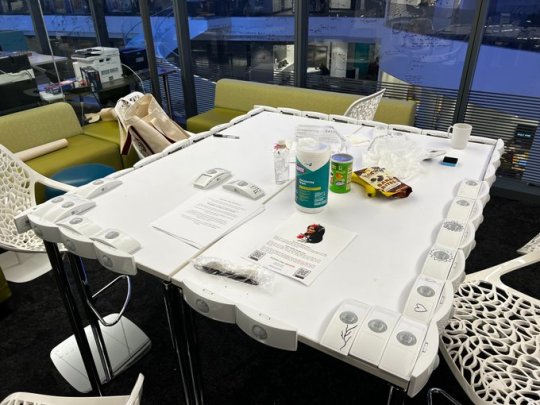
[Image ID: Sensors arrayed around a kitchen table at ISEC]
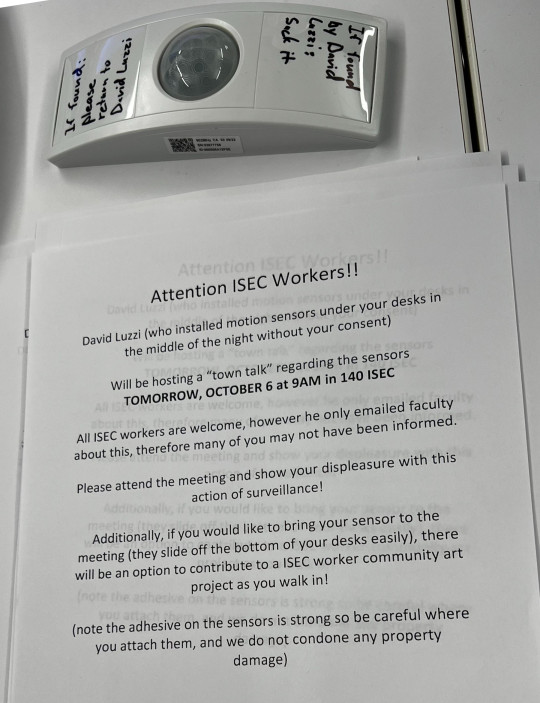
The students, believing Luzzi was not taking them seriously, unilaterally removed all the sensors, and stuck them to their kitchen table, annotating and decorating them with Sharpie. This prompted a second, scheduled “listening session” with Luzzi, but this session, while open to all students, was only announced to their professors (“Beware of the leopard”).
The students got wind of this, printed up fliers and made sure everyone knew about it. The meeting was packed. Luzzi explained to students that he didn’t need IRB approval for his sensors because they weren’t “monitoring people.” A student countered, what was being monitored, “if not people?” Luzzi replied that he was monitoring “heat sources.”
Remember, these are grad students. They asked the obvious question: which heat sources are under desks, if not humans (von Hippel: “rats or kangaroos?”). Luzzi fumbled for a while (“a service animal or something”) before admitting, “I guess, yeah, it’s a human.”
Having yielded the point, Luzzi pivoted, insisting that there was no privacy interest in the data, because “no individual data goes back to the server.” But these aren’t just grad students — they’re grad students who specialize in digital privacy. Few people on earth are better equipped to understand re-identification and de-aggregation attacks.
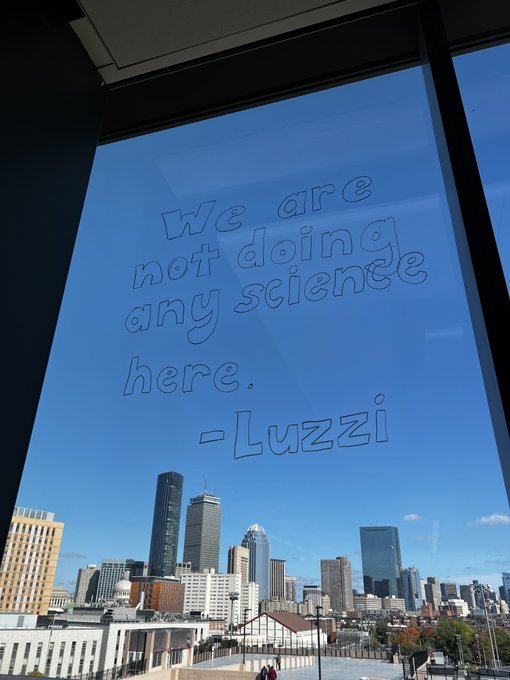
[Image ID: A window with a phrase written in marker, ‘We are not doing science here’ -Luzzi.]
A student told Luzzi, “This doesn’t matter. You are monitoring us, and collecting data for science.” Luzzi shot back, “we are not doing science here.” This ill-considered remark turned into an on-campus meme. I’m sure it was just blurted in the heat of the moment, but wow, was that the wrong thing to tell a bunch of angry scientists.
From the transcript, it’s clear that this is where Luzzi lost the crowd. He accused the students of “feeling emotion” and explaining that the data would be used for “different kinds of research. We want to see how students move around the lab.”
Now, as it happens, ISEC has an IoT lab where they take these kinds of measurements. When they do those experiments, students are required to go through IRB, get informed consent, all the stuff that Luzzi had bypassed. When this is pointed out, Luzzi says that they had been given an IRB waiver by the university’s Human Research Protection Program (HRPP).
Now a prof gets in on the action, asking, pointedly: “Is the only reason it doesn’t fall under IRB is that the data will not be published?” A student followed up by asking how the university could justify blowing $50,000 on surveillance gear when that money would have paid for a whole grad student stipend with money left over.
Luzzi’s answers veer into the surreal here. He points out that if he had to hire someone to monitor the students’ use of their desks, it would cost more than $50k, implying that the bill for the sensors represents a cost-savings. A student replies with the obvious rejoinder — just don’t monitor desk usage, then.
Finally, Luzzi started to hint at the underlying rationale for the sensors, discussing the cost of the facility to the university and dangling the possibility of improving utilization of “research assets.” A student replies, “If you want to understand how research is done, don’t piss off everyone in this building.”
Now that they have at least a vague explanation for what research question Luzzi is trying to answer, the students tear into his study design, explaining why he won’t learn what he’s hoping to learn. It’s really quite a good experimental design critique — these are good students! Within a few volleys, they’re pointing out how these sensors could be used to stalk researchers and put them in physical danger.
Luzzi turns the session over to an outside expert via a buggy Zoom connection that didn’t work. Finally, a student asks whether it’s possible that this meeting could lead to them having a desk without a sensor under it. Luzzi points out that their desk currently doesn’t have a sensor (remember, the students ripped them out). The student says, “I assume you’ll put one back.”
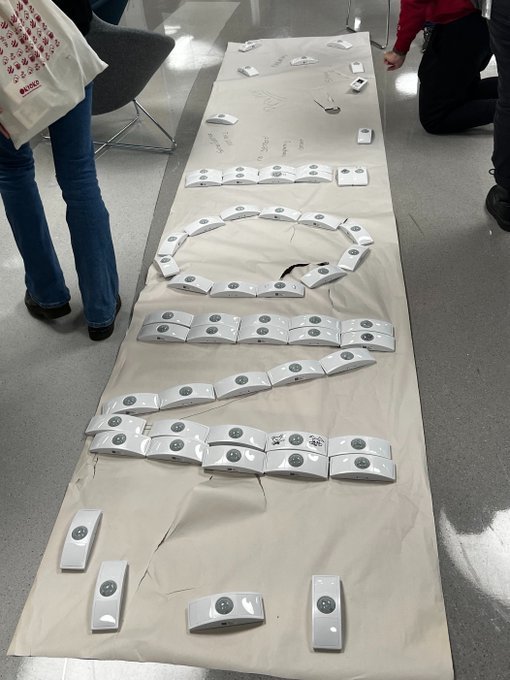
[Image ID: A ‘public art piece’ in the ISEC lobby — a table covered in sensors
spelling out ‘NO!,’ surrounded by Sharpie annotations decrying the
program.]
They run out of time and the meeting breaks up. Following this, the students arrange the sensors into a “public art piece” in the lobby — a table covered in sensors spelling out “NO!,” surrounded by Sharpie annotations decrying the program.
Meanwhile, students are still furious. It’s not just that the sensors are invasive, nor that they are scientifically incoherent, nor that they cost more than a year’s salary — they also emit lots of RF noise that interferes with the students’ own research. The discussion spills onto Reddit:
Yesterday, Luzzi capitulated, circulating a memo saying they would pull “all the desk occupancy sensors from the building,” due to “concerns voiced by a population of graduate students.”
The shitty technology adoption curve is relentless, but you can’t skip a step! Jumping straight to grad students (in a privacy lab) without first normalizing them by sticking them on the desks of poor kids in underfunded schools (perhaps after first laying off a computer science teacher to free up the budget!) was a huge tactical error.
A more tactically sound version of this is currently unfolding at CMU Computer Science, where grad students have found their offices bugged with sensors that detect movement and collect sound:
The CMU administration has wisely blamed the presence of these devices on the need to discipline low-waged cleaning staff by checking whether they’re really vacuuming the offices.
While it’s easier to put cleaners under digital surveillance than computer scientists, trying to do both at once is definitely a boss-level challenge. You might run into a scholar like David Gray Widder, who, observing that “this seems like algorithmic management of lowly paid employees to me,” unplugged the sensor in his office.
This is the kind of full-stack Luddism this present moment needs. These researchers aren’t opposed to sensors — they’re challenging the social relations of sensors, who gets sensed and who does the sensing.
[Image ID: A flier inviting ISEC grad students to attend an unadvertised ‘listening session’ with vice-provost David Luzzi. It is surmounted with a sensor that has been removed from beneath a desk and annotated in Sharpie to read: ‘If found by David Luzzi suck it.’]
Jeffie Brewer at his studio. Photo courtesy of the Artist
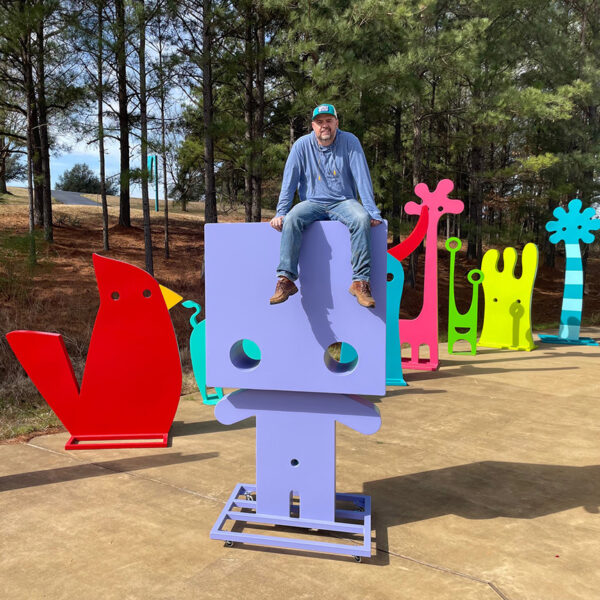
If you have been anywhere near the downtown area of Palestine, Texas since the spring, you must have stumbled upon at least one of Nacogdoches-based sculptor Jeffie Brewer’s works. They’re large in size and bright in color, and there’s practically no way to miss them.
Coming Home, organized by the Dogwood Arts Council and unveiled at this year’s Dogwood Art and Music Festival in March, features 13 large-scale outdoor works by Brewer around the town’s center as part of its ongoing Art Tracks sculpture project. Ranging from a yellow dog to a turquoise unicorn, the artist’s stylized steel sculptures are placed in highly visible locations throughout downtown.
A Palestine native, Brewer grew up the son of former local junkyard owners. It was during this upbringing where he developed both a love for the banal and a variety of industrial skills, ultimately influencing his present-day artistic career.
“Jeffie’s being from Palestine was super special, as we are celebrating ten years of the Art Tracks program,” said Dogwood Arts Council president Greg Gunnels. “Each sculpture has a story and gives one a reason to pause.”
“Cardinal” by Jeffie Brewer
Described by the artist as a self-portrait, a purple robot, along with a striped sculpture resembling an unknown creature, frame the city’s “Historic Downtown” mural near a seating area. Several other works, such as a six-foot-tall turquoise pig and a seven-and-a-half-foot-tall red cardinal, are placed around in communal green spaces on concrete pads. Forming somewhat of a trail, all of the sculptures are within walking distance of one another.
Initially started in 2012 by the organization Palestine Tomorrow, Art Tracks has been a popular annual exhibition of outdoor sculpture, attracting both artist participants and visitors from far and wide. After recently being helmed by the city for a few years, Art Tracks has now become the sole responsibility of the newly-formed Dogwood Arts Council.
Coming Home is far from Brewer’s first foray into public art. In addition to private collections throughout the United States, his work can be found in several public spaces, including municipal public art collections. Brewer has also been featured in several outdoor exhibitions, including Color Field, which was organized by the Crystal Bridges Museum of American Art in 2019 and traveled to The Baker Museum in Florida before concluding at the University of Houston.
“Pag” by Jeffie Brewer
“Public art is my mitzvah,” said Brewer. “I placed one of my first big pieces several years ago in a park. I was cleaning up and packing my truck when I noticed these two kids running in circles around the piece, laughing and hugging it in a general state of bliss. Since then, I have seen this act out countless times with young lovers, pondering seniors, and confused fellow rednecks.”
“I have always tried to use my sense of humor in most of what I do — straddling the line of whimsy and whatever,” Brewer continued. “I make stuff that makes me happy, and I hope it translates to others.”
Coming Home will remain on view through early 2024. A list of the featured sculptures along with accompanying descriptions written by the artist can be found here.
President Biden has stooped to a new low: giving a blanket pardon to everyone with a federal marijuana possession charge just one month before the midterm elections.
Anyone with a basic understanding of slimy DC politics can see right through this ploy for the corrupt quid pro quo that it is. The Biden administration is trying to rig the vote by doing things people want them to do.
The exchange is as simple as it is shameless. First, President Biden embraces a policy that a supermajority of Americans support. Then, just weeks later, if his scheme goes according to plan, those same Americans will show up in droves to vote for Democrats. And that’s not the end of it. If Democrats win in November (God forbid), they’ll go right back to relentlessly advocating for legislation that helps the American people—a demographic group that, sure enough, makes up their core constituency.
It’s transparent political patronage, the system working exactly as intended. Hoodwinking the American people by not hoodwinking them.
But we shouldn’t be surprised. This cynical pandering from the Biden administration is par for the course.
The president egregiously overreached his executive power to cancel half a trillion dollars in student debt—freeing up his elitist college-educated base to steal our elections by participating in them.
He rubber-stamped the outrageously expensive Inflation Reduction Act, with climate provisions that will ensure a future for America’s youth. Funny coincidence: America’s youth just so happen to be reliable Democrat voters.
And he’s cut unemployment in half since he took office, which is the biggest distraction of them all. The more Americans are preoccupied with well-paying jobs that enable them to live fulfilling, prosperous lives, the less time they’ll have to realize they should be furious about critical race theory, pronouns, and/or Black mermaids.
Now, he’s implemented this disgracefully reckless policy on marijuana just as early voting is beginning in dozens of states. It’s diabolical. If he wants to make the American people forget why they were mad at him, it’s hard to devise a better strategy than encouraging marijuana use.
Of course, the president is not alone in this unscrupulous con. It seems the entire Democrat establishment has gotten the memo. In an election cycle when Republicans have nominated dog-killing TV quacks, Neo-Nazi-endorsed replacement theorists, and pro-life abortion-funding child-abandoners, Democrats have stacked the deck against conservatives by nominating experienced public servants who seem genuinely committed to building a just, fair world. It is deeply unjust and unfair.
And, as always, the media is playing a complicit role in the radical left’s propaganda campaign. They’ll publish headlines about how President Biden’s approval rating has been on the upswing for months. They’ll spend hours on breathless coverage claiming Americans are virulently opposed to the overturning of Roe v. Wade. They’ll share polls that indicate the incumbent party might win the midterms for the first time in a generation due to right-wing overreach and continued Trump fatigue. And we as a society allow them to say these things for no reason other than their being true.
Do the Democrats really believe that they can bribe voters into supporting them by keeping their campaign promises?
Do they think the working class is gullible enough to be fooled by a few extraordinarily popular policies?
Are they seriously convinced that a nebulous concept like “materially improving people’s lives” will distract people from kitchen-table issues that everyone understands—like the Federal Reserve’s culpability for inflation as a result of imprudent interest rate policy?
One would hope that Americans would not be so selfish as to pursue their collective interest. But that’s exactly what they’ll do if they elect more Democrats in November.
CHICAGO—With the season about to start, reporters at The Onion’s downtown offices stated Friday that this is our annual headline about hockey. So here you go, sources confirmed. The cultural presence of the National Hockey League basically requires us to do at least one headline about hockey each season, reporters…
It’s time to get into the spirit of Halloween and Monster Madness or “Munster” Madness today. Every October, I like to do something a little different. This time I’ll be checking out some NEW horror and monster movies. And by NEW I mean, they just came out! This is exciting for me, because it gives me an excuse to watch brand new stuff, instead of always just going into my familiar rolodex, digging into classic horror and things from the past. Which I enjoy and will continue to do, but today’s pick is equally nostalgic as its a reboot of the classic 60s show by Rob Zombie, The Munsters!
“During the 1930s, art flourished in Texas, and Modernism, that most current of art movements at the time, made its way to the Lone Star State, even as the depression dug in and the dust bowl grew. But Texas is vast and varied, so the Modernism(s) that took root in the major cities and academic centers in the state was varied too.
In Houston and Dallas, Modernism became the central focus for two small groups of local artists, made up mostly of youngsters, along with their forward-looking mentors: in Houston, the Cherry-McNeill Group; and the Dallas Nine (plus) up north.
Though not even 250 miles apart, the approaches to Modernism of the two groups in the two cities were markedly different, and were in some respects a microcosm of the different paths to Modernism on the national level.”
“The Chinati Foundation/La Fundación Chinati will present its 35th annual Chinati Weekend in Marfa, Texas, from Friday, October 7 through Sunday, October 9, 2022. The weekend offers one of the rare times visitors may wander the entire collection at their own pace, as part of a weekend-long, free, public program that honors a tradition of hospitality inaugurated by Chinati’s founder, the artist Donald Judd. A focus of Chinati Weekend 2022 will be the restored John Chamberlain Building, which is part of the newly designated downtown Central Marfa Historic District.”
Gabriel Dawe, “Plexus No. 41,” work in progress at Talley Dunn Gallery.
“With this exhibition, Dawe brings together his studio practice and his site-specific work to create an immersive and glorious environment. Ode to Futility marks Dawe’s first monumental site-specific installation at the gallery alongside new sculptural works by the Mexican-born, Dallas-based artist.
Spanning one hundred feet in length, Dawe’s most recent Plexus installation transforms the Main Gallery through a complex system of multicolored sewing thread that creates spellbinding chromatic environments and challenges our perceptions of space and color. For the first time, Dawe has created an environment resplendent with a variety of media, as he intermingles his sculptural works, mixed media works, and a site-specific installation together in one exhibition.”
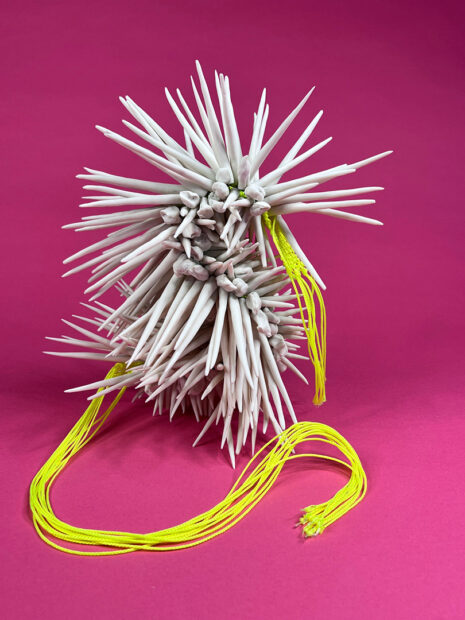
“For Dallas-based Jen Rose, art is a practice of constant experimentation: question everything. This philosophy is apparent in the diversity and volume of her output, as is her tenacity and devotion to technically difficult materials. But, it is her use of multiples that persists through her evolving bodies of work.
ARTIST STATEMENT
My use of multiplicity in non-traditional craft media began after the unexpected loss of my father. In response to my grief, I created an exhibition of one thousand octopus tentacles that projected from the wall. Hand-making each porcelain tentacle created a meditative studio experience that gave my mind room to heal during the 12-month process of making this piece.
I learned some core lessons about my studio practice when I returned to clay in 2015. I learned that creating multiples and assembling them into installations allows me to work in small bursts throughout the day. I don’t need a large window of time to create work and this makes me impressively productive. I learned that process is critical to my practice and I enjoy developing the process just as much as seeing the finished product. I also learned that freedom comes from structure. I generally see the finished installation in my mind before I ever step into the studio, but the structure and routine required to execute the piece balances my mind.”
Karla García, installation view of “La Línea Imaginaria.” Photo courtesy of the artist.
5. Karla García: La Línea Imaginaria
Franklin G. Smith Gallery at Chamizal National Monument (El Paso)
August 29 – November 30, 2022
(Note: the portion of the exhibition on view at the Museo de Arqueología e Historia El Chamizal in Juárez will run through November 27.)
From the organizers:
“La Línea Imaginaria is a binational exhibition of pieces including sculpture, photography, videos, and drawings by artist Karla García. The installation features the cactus form in clay as an interpretation of Mexican cultural history. The sculptures are created with raw terracotta clay to honor the US-Mexico borderland. With objects on display at the same time in both Chamizal National Memorial in El Paso and Parque Público El Chamizal in Ciudad Juárez, La Línea Imaginaria connects the two parks and their respective cities.”
Sharing an elevator with four teens who keep jumping up and down to scare me
Air Force One (the one that got hijacked, from the movie)
A Volkswagen Beetle packed way over the fifteen-clown capacity
Being launched out of a cannon
Any plane referred to as a “flying machine”
Any car referred to as a “jalopy”
The S.S. Minnow during a sea squall
Working the Frialator in the back of a food truck as it screams down a potholed New England road
Riding a camel through the desert when I forgot to apply sunscreen and I’m already halfway through the one Riptide Rush Gatorade I packed
The Orient Express (the one with the murder on it, from the movie)
When a baby deer is trying to cross a slippery frozen pond on its little stick legs
Literally any time machine
Parasailing through a lightning storm in my favorite chainmail
Running up the down escalator
But NOT running down the up escalator—that’s dangerous and someone could get hurt
Smuggling myself inside my friend’s suitcase so we could get half-price on spring break flights
Buses that can’t go under fifty miles per hour
Traveling the ocean inside a whale’s mouth
A handbasket on its way down to hell
The MBTA Orange Line
The purple Ford Escort I drove in high school that never once got an oil change, because my dad was like, “You need to learn to do things for yourself,” and I was like, “Okay,” and then I avoided it because I was too anxious, and a few weeks later when Dad said, “Did you ever get your oil changed?” I said, “Yeah, of course.”
“The first reviews of the recently launched, self-branded ‘conservative dating app,’ The Right Stuff are in… Some common reviewer complaints include that the app is short on women… and that answering a profile prompt about January 6 led to contact from law enforcement.” — Gizmodo, 10/5/22
- - -
I like to think I’m a pretty normal, conservative-leaning guy who believes LGBT people are possessed by Satan, all abortions should be punishable by public stoning, and vaccines were invented by Jews to make men’s foreskins fall off so that all guys with penises will be circumcised and forced to convert to Judaism. You know, just center-of-the-road right-wing stuff.
But I’ve always had a hard time meeting women on dating apps, maybe because liberal women have been brainwashed by Queer Eye to believe that men should be able to clear the unrealistically high bar of having the basic ability to regulate their emotions and be able to make a decent omelet.
So when I heard about a new dating app called The Right Stuff, aimed at helping conservatives meet each other (and thus out-procreate the minorities trying to replace us), you can imagine how excited I was to meet the Q to my Anon. But then I opened the app and hardly saw any women, and I couldn’t help but wonder: Where are all the alt-right, anti-choice, male-subservient women on this dating app?
Look, I’m not a picky guy. All I’m looking for is a woman who is intelligent, funny, and attractive, who believes God created women to help men with stuff they’re naturally bad at, like empathy, and who enjoys shooting wild animals from a helicopter. So where are the millions of women I imagine fit that exact description if not on this app?
It’s not like my political views are that out there. I just happen to subscribe to the traditional belief that women belong in three places: the home, the home goods section of HomeGoods, and Home Depot (but only the paint department, because the rest of the store is strictly guy territory). So it’s strange that every time I sign into this app, the only people I see are like-minded guys and a woman who claims to be Marjorie Taylor Greene’s cute younger sister, but who I’m pretty sure is a sexbot. Is it really that difficult to find a woman whose only ambitions in life are to gratify me sexually at my whim, be a vessel for my offspring, and then die? Is that so much to ask?
I want what everyone else in life wants: someone to wake up in the morning next to, someone to bathe and spoon-feed me when I’m old (and also when I’m young and middle-aged), and someone to hold my hand while we commit heinous acts of domestic terrorism against people whose beliefs don’t align perfectly with ours. But I guess some women would rather be left alone to snuggle under a warm blanket while sipping mulled cider, watching Gilmore Girls, and petting their cat. Alas, some people just choose to act against their own best interests.
I’ve always subscribed to that age-old conservative aphorism “a wife is like a mother who’s your same age.” Someday I hope to meet a woman who wants to be my wife-mother, which I would think would be every woman’s dream.
In the meantime, I guess I’ll go back to scrolling Tinder and Hinge, since The Right Stuff is mostly just ads for camo gaiters and dick pills. I also have to respond to the email I got from the FBI. Apparently bragging about pepper spraying women police officers on January 6 isn’t the pickup line I thought it would be.

/https://static.texastribune.org/media/files/744a7a42cc24ba44177580c44658222d/2022Elections-registervote-leadart-v1.png)




/https://static.texastribune.org/media/files/6a5088411e9c9013725f2c53ea68400f/Hays%20County%20Election%20Test%20EL%2008.jpg)









!["Friction-driven static electrification is familiar and fundamental in daily life, industry, and technology, but its basics have long been unknown and have continually perplexed scientists from ancient Greece to the high-tech era. [...] To date, no single theory can satisfactorily explain this mysterious but fundamental phenomenon." --Eui-Cheol Shin et. al. (2022)](https://imgs.xkcd.com/comics/easy_or_hard.png "\"Friction-driven static electrification is familiar and fundamental in daily life, industry, and technology, but its basics have long been unknown and have continually perplexed scientists from ancient Greece to the high-tech era. [...] To date, no single theory can satisfactorily explain this mysterious but fundamental phenomenon.\" --Eui-Cheol Shin et. al. (2022)")