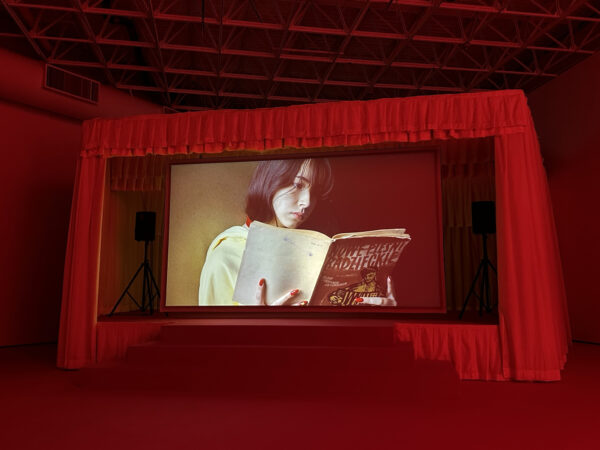
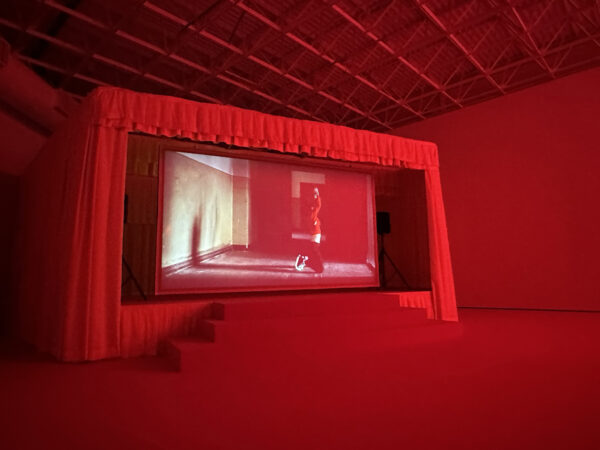
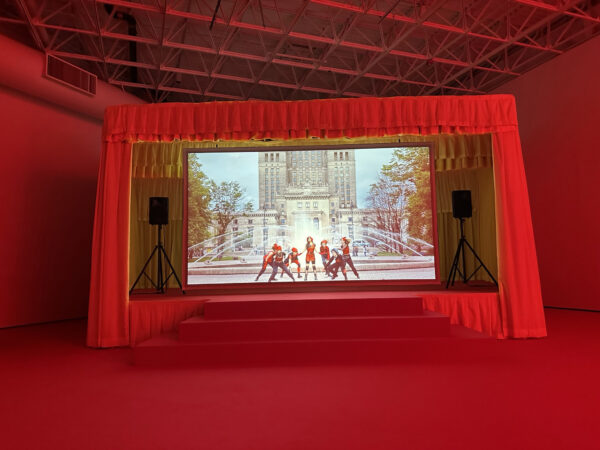
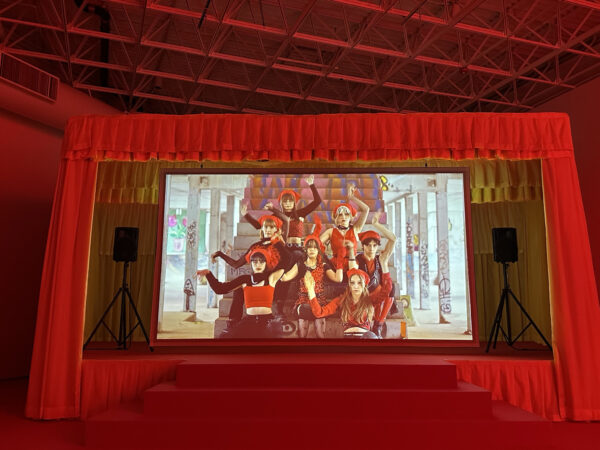
Diane Severin Nguyen,”IF REVOLUTION IS A SICKNESS,” on view at the Contemporary Arts Museum Houston.
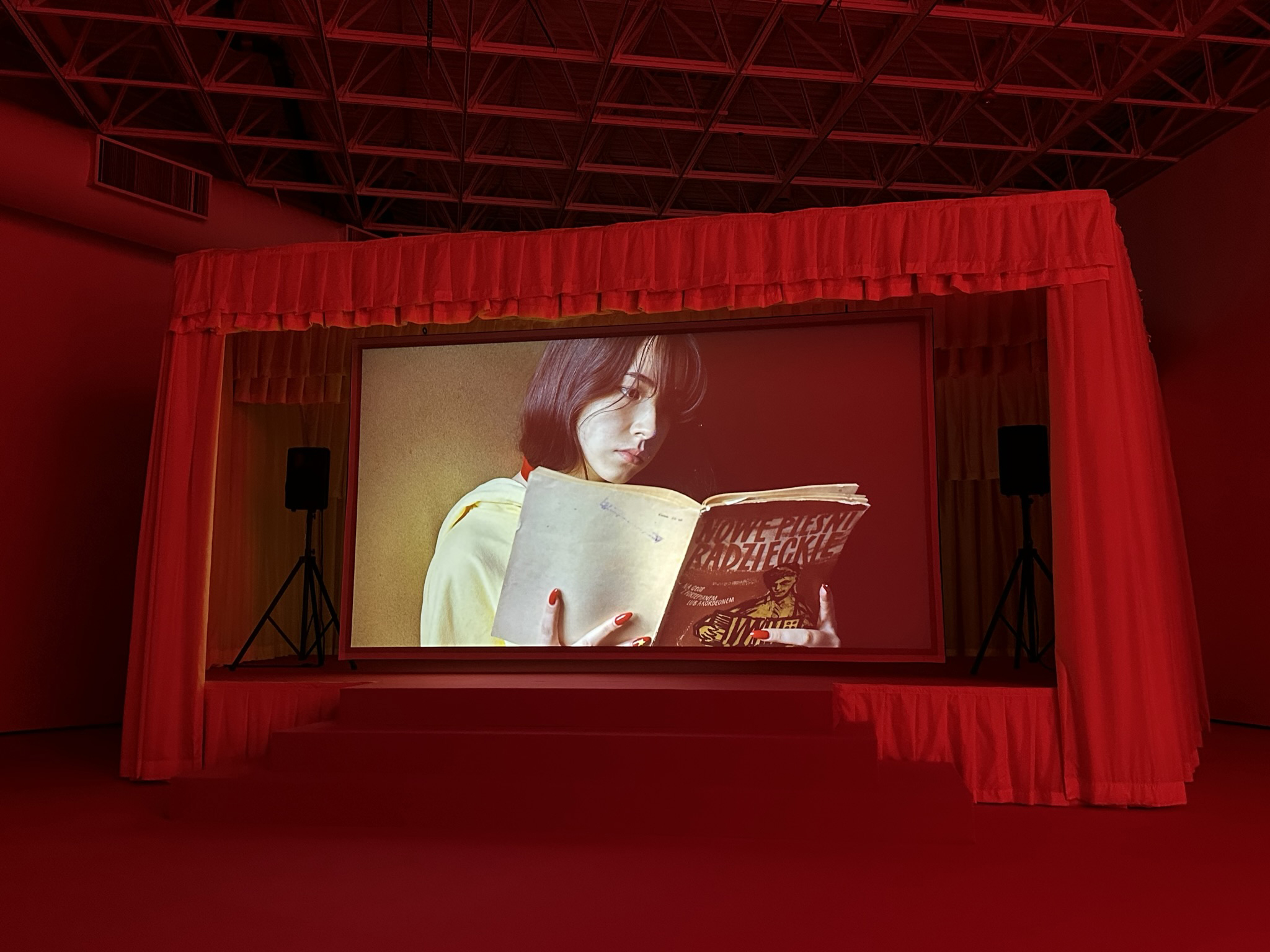
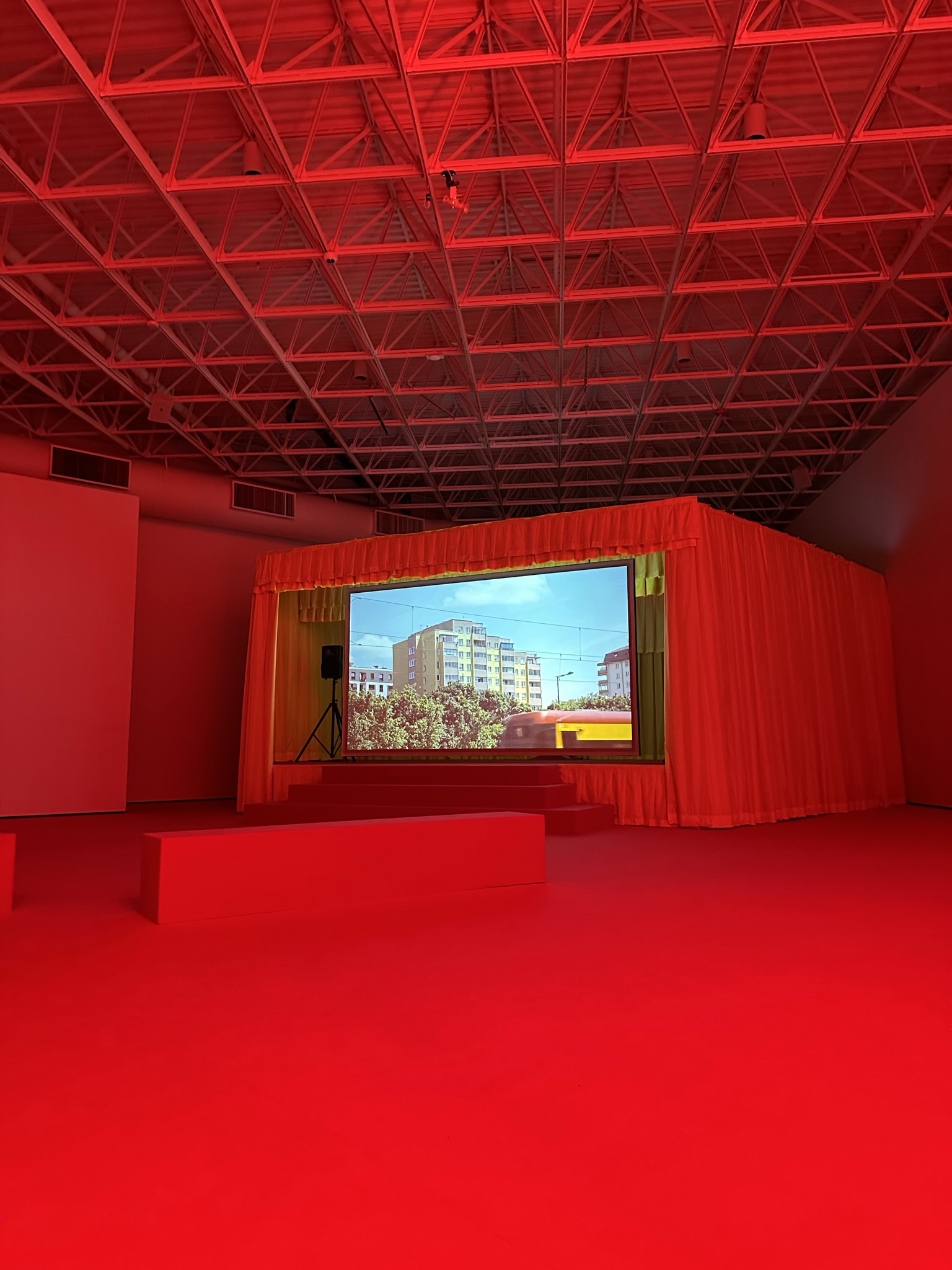
Diane Severin Nguyen’s video installation IF REVOLUTION IS A SICKNESS blends introspective filmmaking and revolutionary narration with a full-length original K-Pop song and choreography, using the music as a means of exploring the complicated relationship between East and West. Nguyen chose to set the film in Poland due to the complicated social dynamics in the country borne from having migrant communities from both North and South Vietnam, and the large K-Pop fan community in Warsaw.
The film follows the story of Weronika Nguyen, an orphaned half-Polish and half-Vietnamese child, through three phases of birth/infancy, childhood, and adolescence. The first phase features a man delivering revolutionary narration in Polish while child Weronika explores a desolate landscape, alone. The loneliness is suffocating until young Weronika finds music, at which point she begins to practice singing and dancing as if it is the only thing keeping her alive. As she morphs into teenage Weronika — a real biracial Polish-Vietnamese individual Nguyen found on Instagram — the landscape becomes urban, industrialized, and increasingly Stalinist.
The narration is picked up by a Vietnamese woman, urging Weronika not to fall prey to the temptations of the capitalist city (represented by a sequined gold cap that seems to simultaneously taunt and motivate Weronika as she holds it in her manicured hands). She continues to practice singing and dancing in eerie concrete structures, calling to mind the isolating trainee system used in the K-Pop industry: management companies audition prospective talent and provide food, housing, education, and singing/dancing instruction to the accepted “trainees,” who they routinely expect to drop out of school to focus on the industry. Some children are as young as nine when they begin their K-Pop training, with their promised “debuts” five to ten years in the future. Only a minority of prospective idols make it that far, however.
Diane Severin Nguyen,”IF REVOLUTION IS A SICKNESS,” on view at the Contemporary Arts Museum Houston.
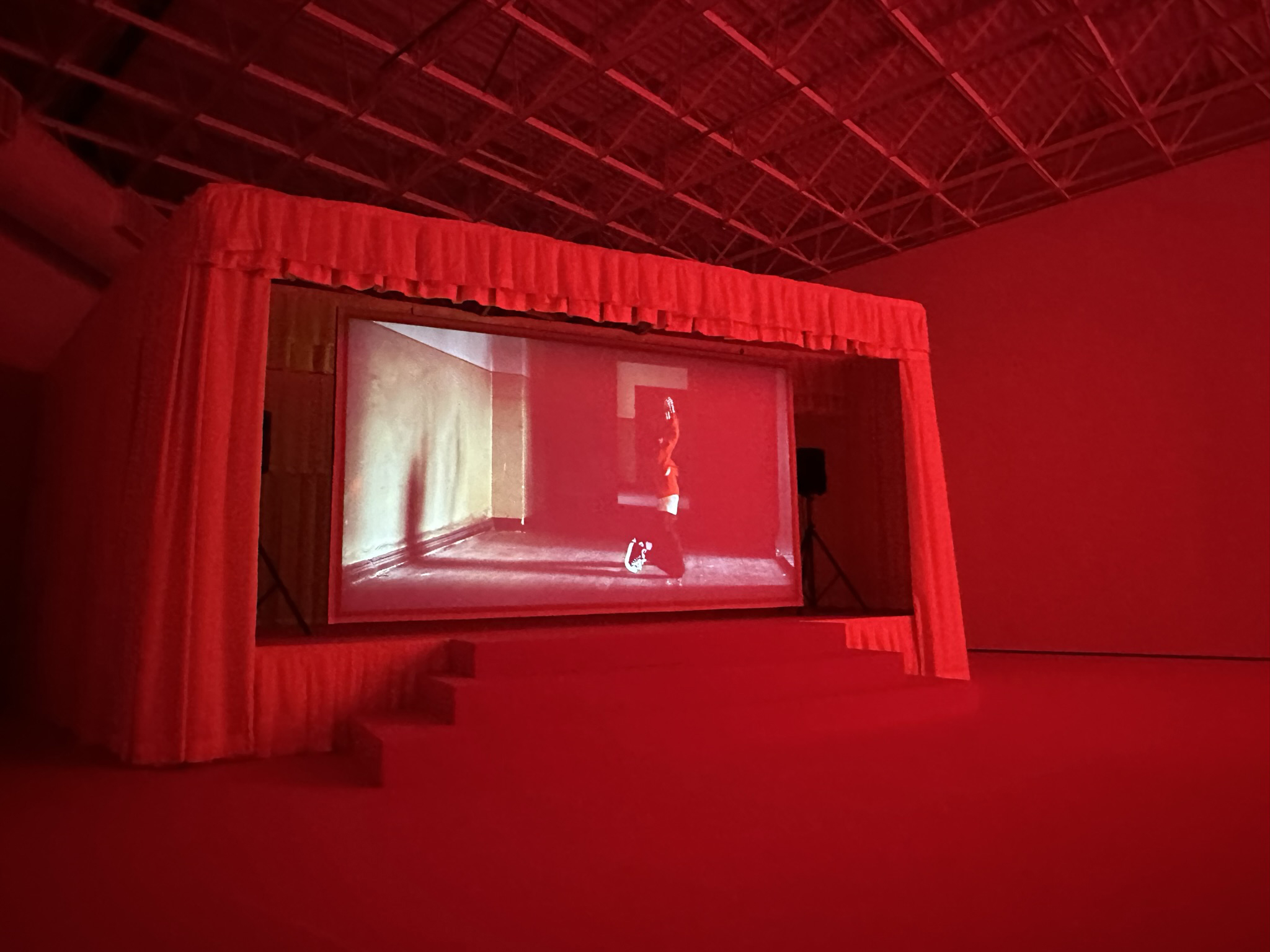
The penultimate phase of Nguyen’s film draws a direct parallel with this system. Weronika is now surrounded by a group of trainees — others similarly motivated by music. Nguyen has the group explore both the bleak landscape and contradictory cityscape, creating a sense of community for Weronika, as together they conquer the locations of her past. The group of dancers train with military precision, like they are set to go into battle — as if they are guerilla fighters. Their battle is, of course, K-Pop.
In the past few years, K-Pop has become a global phenomenon. Since PSY’s viral hit “Gangnam Style,” Korean pop music has entered the international mainstream slowly but surely, before exploding with the arrival of industry giants BTS and Blackpink. The latter, a four-piece girl group dubbed “the biggest girl group in the world” (and named Time’s 2022 Entertainers of the Year), currently holds the record for the most viewed music video from a Korean act, with DDU-DU-DDU-DU sitting at a hefty 1.9 billion views.
Diane Severin Nguyen,”IF REVOLUTION IS A SICKNESS,” on view at the Contemporary Arts Museum Houston.
For a globally successful music act, Blackpink has a surprisingly limited discography. When they do release new music, the content is overwhelmingly hypercapitalist. Their lyrics promote a live fast die young mentality, detail how skinny the members are, and describe the ultra-wealthy lifestyle of the members. At the center of Blackpink’s success is the catchy slogan: “BLACKPINK IN YOUR AREA.” It exemplifies Blackpink’s advertising strategy: anyone anywhere can be like Blackpink and participate in the moment. Blackpink’s 2018 song “Forever Young” proudly proclaims: “BLACKPINK IS THE REVOLUTION.”
This “revolution” has erupted worldwide, uniting pop fans from all over the globe. Online forums allow people from completely different hemispheres to gush about the Blackpink members, while some fans take it further and meet up in person, forming friendships, dance troupes, or fanclubs. In a post-social media age, the commodities one enjoys have become status and personality signifiers. K-Pop as a commodity has served as a scaffolding for both real and virtual communities — however, what does it mean when the foundation of an interpersonal relationship is a capitalist commodity, and why did Nguyen choose this as the center of her piece?
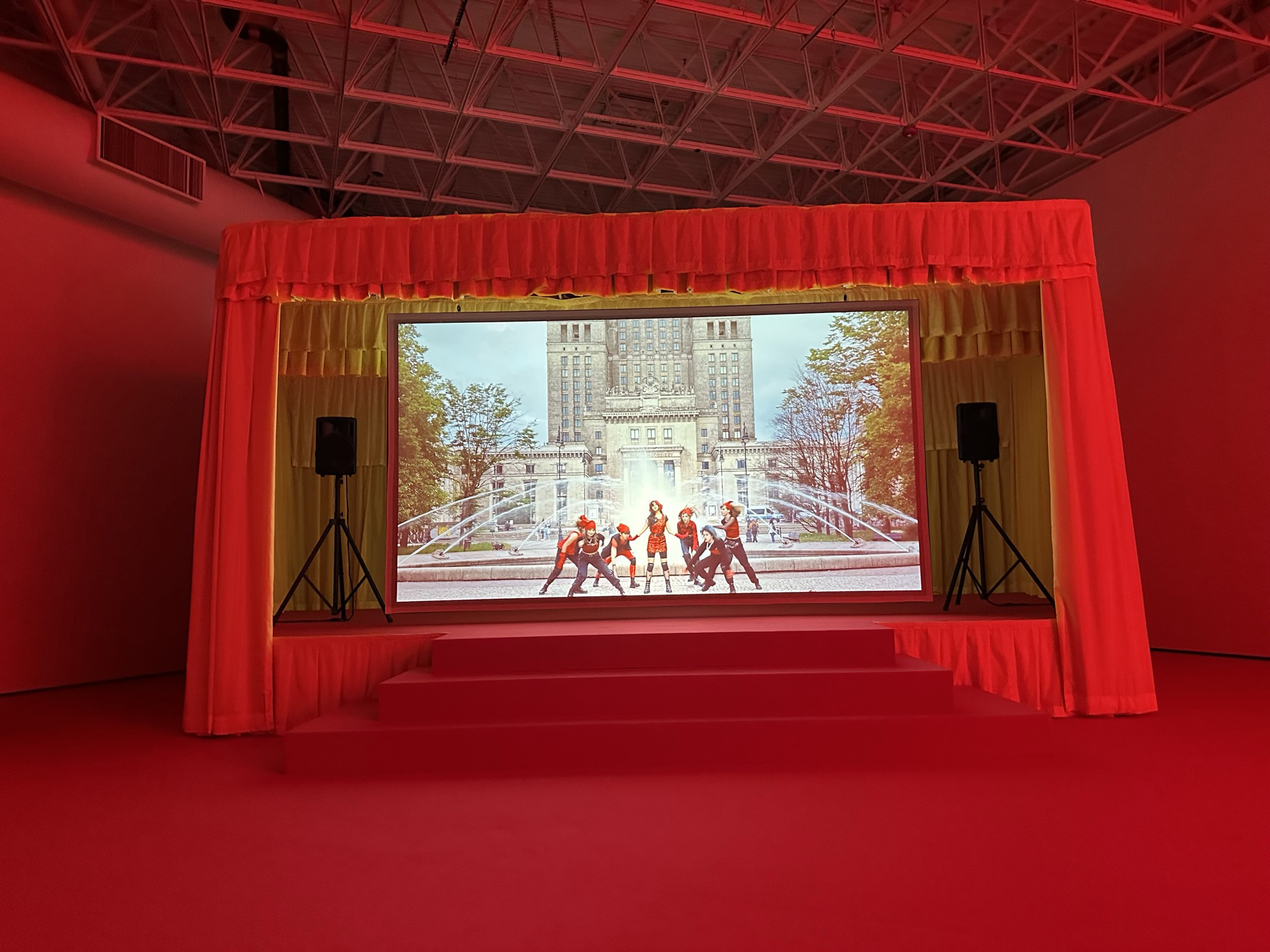
The climactic final sequence of the film is a full-length original K-Pop song with choreography, developed in collaboration with Majesty Dance Team, a K-Pop fan community based in Warsaw. The lyrics, in English, are various revolutionary cries, illustrating pleas of the forgotten worker and advocating for collectivism. Majesty Dance Team created original choreography for the film, which draws heavily from K-Pop choreography, particularly that of Blackpink. The dancers bend the industrial landscape to their whim, making the statement that their community is strong, dynamic, and revolutionary, especially in the almost verbatim Blackpink-style cry that repeats itself throughout the song: “THIS IS THE REVOLUTION.”
Diane Severin Nguyen,”IF REVOLUTION IS A SICKNESS,” on view at the Contemporary Arts Museum Houston.
In creating a direct parallel to Blackpink, Nguyen questions the popularity of the pop group and makes the viewer consider what has drawn these “trainees” to K-Pop. In Nguyen’s film (and in the reality of the extremely competitive K-Pop industry), the answer is clear: money. Weronika does not turn to K-Pop training until she is tempted by the gold sequined cap in the second phase. In the film, this desire for capitalistic gains is unnatural, as communicated by the eerie, cult-like training imagery of the third phase.
In reality, many trainees sign themselves into slave-like contracts with the hope of becoming even half as successful as Blackpink. The four members of Blackpink come from privileged backgrounds, whereas prospective trainees (with situations similar to the poor orphan Weronika) are routinely preyed upon by abusive management companies. The majority of K-Pop idols are in slave-like contracts that encourage starvation diets, overbooked schedules, and intense physical training for little (if any) monetary return. This is the case for LOONA member Chuu, who realized her idol contract was a way for her company to put her and her other band members in endless debt while the company reaped the benefits of their success.
In the chorus, the trainees sing: “I pray for death and eternal fame” and “lose yourself to the new image,” calling direct attention to the unobtainable capitalist content of K-Pop songs. This, combined with the dancer’s red, yellow, and black costumes, their sometimes out of sync dance moves, and their not ultra-polished realistic beauty poses, questions if reaching for this unattainable ideal is worth the performers’ time. It also asks why youth subcultures cannot rally around something more substantive that could better unite the East and West: communism.
Diane Severin Nguyen,”IF REVOLUTION IS A SICKNESS,” on view at the Contemporary Arts Museum Houston.
K-Pop itself has a contradictory relationship with Western pop — the idol format is generated from the Western pop market, in which performance, spectacle, and catchiness reignsupreme. Blackpink itself encapsulates this relationship: two members of the group came to South Korea to pursue K-Pop — Rosé was raised in Australia, and Lisa in Thailand. Weronika Nguyen sits in this paradoxical space as well, especially as a biracial half-Asian character.
For Asian men and women worldwide, K-Pop has become an elusive path to riches, stardom, and eternal praise. Nguyen’s cinematography captures this appeal and how seductive it is to young people, while also highlighting the fraught and ironic dichotomies of East-West, collective-individualist, and rural-urban. The dynamic filmmaking communicates Nguyen’s wariness of K-Pop as a community building commodity and warns the viewer that relentless pursuit of capital is unfulfilling, instead directing the audience towards the pursuit of revolutionary ideology and community support in times of loneliness and need. Nguyen’s film ends with one last Blackpink-style cry: “Revolutionary youths of the world: UNITE!”
IF REVOLUTION IS A SICKNESS and other works by Diane Severin Nguyen are on view at the Contemporary Arts Museum Houston through February 26, 2023. The show is supported by programming throughout the months of January and February.
Hi all. We’re jumping in here with a quick update on the storm system associated with a cold front that will move through Houston on Tuesday afternoon. Put simply, we are more concerned about the potential for tornadoes to develop ahead of, and along with a line of showers and thunderstorms at that time.
This morning, if you recall, we said we would assess whether a Stage 1 flood alert is warranted for Tuesday’s storms. After a discussion, Matt and I don’t think that is necessary. Most of the region will likely see 1 to 3 inches of rainfall, which is manageable for area roadways, even if it comes down in some heavy bursts. Some areas may see higher totals, and low-lying areas may briefly flood. But these storms should sweep through the area during the afternoon and then be gone. Showers and thunderstorms will be possible ahead of the main line of storms. However, we expect the main event to come with the line itself, which should reach west (Katy) and northwest areas (Tomball) around 2 to 4 pm, downtown an hour later, and push off the coast by around sunset.
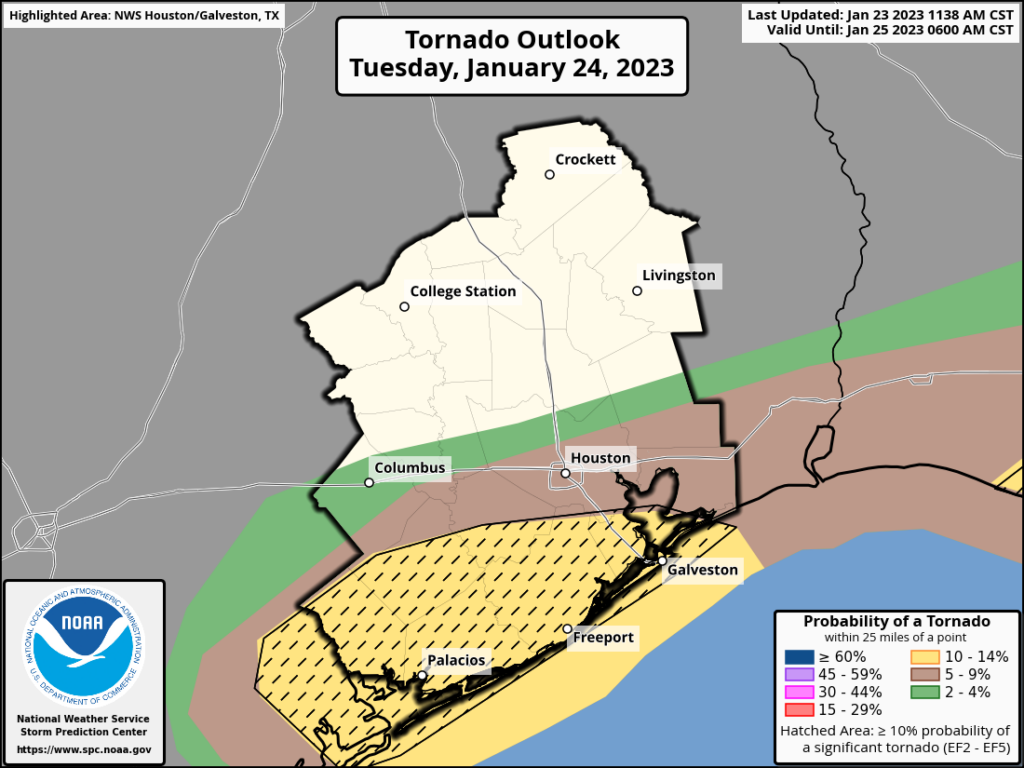
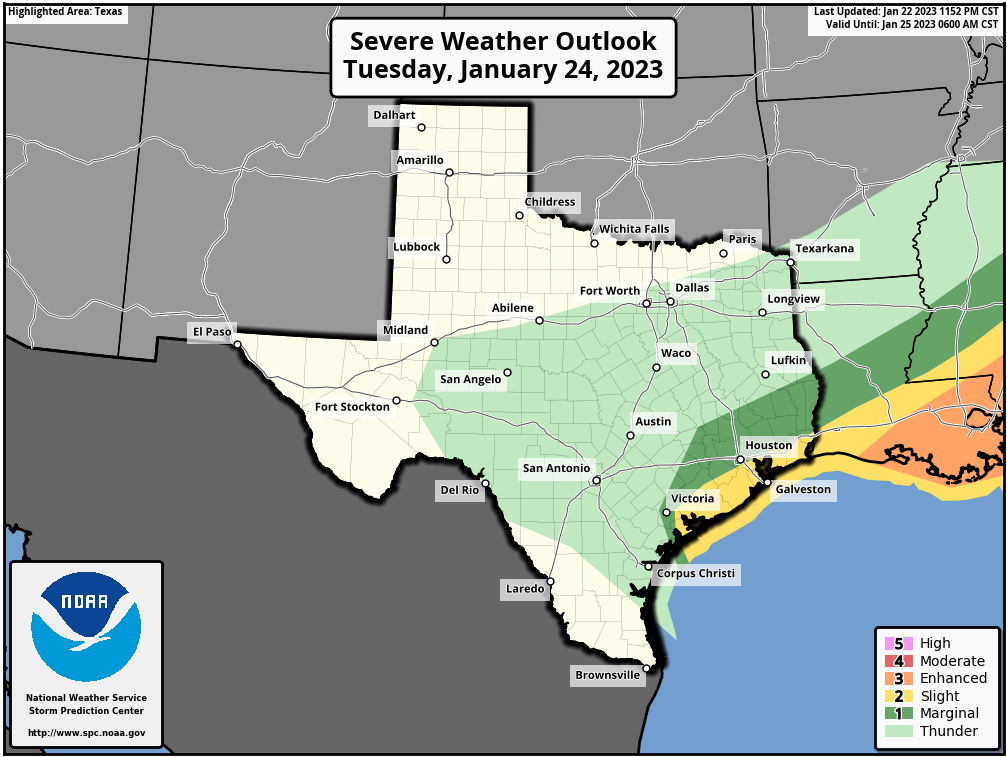
Tornado outlook for Tuesday. (NOAA)
Our post this morning also mentioned strong wind gusts, particularly along and south of Interstate 10. This forecast remains the same. Areas such as Brazoria and Galveston counties may see gusts up to 50 mph. What has changed is the tornado threat. High resolutions models indicate conditions may become favorable for rotation, which increases the likelihood that tornadoes may form. This threat is reflected in an update from the NOAA Storm Prediction Center this afternoon, which highlights an area of greatest risk south of Houston (yellow area in the map above). I know the mention of “tornadoes” freaks some people out, but it is important to remember that twisters in our region are usually short-lived, and have fairly narrow tracks. Your odds of being directly impacted are rather low, even during an event such as we will see tomorrow.
The worst of this should be over for most of the metro area by the evening rush hour on Tuesday, but that will be something to monitor. The bottom line is this: Tomorrow is a day to be weather aware in the Houston community, especially from around noon to sunset. After that time skies will be clearing, and sharply colder air moving in from the north. Then we’ll get a few days of very solid winter-like weather.
Our next update will be posted by 7 am CT on Tuesday.
Florida is barring high school students from taking a new advanced placement course on African American studies, claiming the lessons run “contrary” to state law and that it “significantly lacks educational value.” What do you think?
Atari 2600 programming techniques are fascinating. The hardware is so very limited, and programmers must use every possible trick to scrimp and save the last CPU cycle and byte of RAM. For a refresher on the 2600 hardware, check out my previous Atari overview. The console’s longevity is remarkable, with new games and demos still being produced today – over 100 new titles last year alone. The quest for the ultimate Atari 2600 programming techniques has continued all this time, in order to wring out maximum performance.
Atari programming requires racing the beam, updating graphics registers just before the instant they’ll be used to paint the next pixels on the current scan line. With only 76 CPU cycles per scan line, there just isn’t enough time for the poor 6502 to do very much. Want to update the foreground color multiple times at different horizontal positions? OK, but there might not be enough time remaining to also update the pixel bitmap during the scan line, or set the sprite positions. It’s a series of difficult tradeoffs and code optimization puzzles.
More Hardware Makes Things Better?
To create better-performing Atari games, programmers may need to think outside the box – literally. The 2600 console consists of a 6502 CPU (actually a 6507), a 6532 RIOT, and an Atari custom graphics chip called TIA. But what about the game cartridge? What’s inside that? The Atari’s designers envisioned cartridges as simple 4KB ROMs in a protective plastic shell, but there’s no reason aside from cost why there couldn’t be other hardware inside a cartridge too.
Within a few years after the Atari’s 1977 release, game publishers began including a small amount of 7400-type glue logic or a simple PLD inside game cartridges, in order to assist with bank switching. The Atari only provides 4KB of address space for game cartridges, but with this extra hardware inside, publishers were able to make 8KB and 16KB games using custom bank-switching schemes. Some later cartridges also included additional RAM to augment the paltry 128 bytes available in the Atari. This provided more storage space to create larger games, but didn’t help improve the Atari’s CPU or graphics performance.
Pitfall II and the DPC Coprocessor
Activision’s Pitfall was one of the most popular games for the Atari 2600. For the sequel Pitfall II, expectations were high, and the game’s designer David Crane did something that had never been done before: put a full-blown coprocessor inside the game cartridge. Crane’s DPC (Display Processor Chip) added two additional hardware sound channels, a music sequencing capability, a hardware random number generator, and a graphics streaming capability with built-in options for masking, reversing, or swizzling the bits.
That’s an appealing collection of features, but the graphics streaming capability is probably the most interesting. To understand how it can help improve graphics performance, let’s first look at some hypothetical code without DPC. Imagine that the game code wants to read bytes from a graphics table in ROM and stuff them into the TIA’s GRP0 register (the pixel bitmap for sprite 0) as quickly as possible, in order to create different patterns at points on the scan line. The code might look like this:
; setup
lda #>DrawData ; an address in ROM
sta GfxPtr ; a pointer in RAM page 0
lda #<DrawData
sta GfxPtr+1
This requires a total of 10 CPU cycles for every repetition of read, write, and increment of the index register. During those 10 CPU cycles, the electron beam will move 30 pixels horizontally, so in this example it would only be possible to update the pixel bitmap every 30 pixels. This limits the number of objects or patterns that can be displayed in the same horizontal row of the screen.
The DPC provides some extensions to speed up this process. From my study of the chip, it works like this:
Writing to a special pair of addresses in the cartridge’s address space will set up a graphics stream pointer
Reading from a special address will return the next byte from the stream pointer, and increment the pointer
Using the DPC, the previous example could be rewritten something like this:
; setup

lda #>DrawData  ; an address in ROM

sta BytePtr     ; special addr in cartridge address space

lda #<DrawData

sta BytePtr+1
; kernel

lda NextByte    ; 4 - special addr in cartridge address space

sta GRP0         ; 3

lda NextByte    ; 4

sta GRP0         ; 3

lda NextByte    ; 4

sta GRP0         ; 3
This reduces the total number of CPU cycles for every repetition from 10 down to 7, enabling the pixel bitmap to be updated every 21 pixels instead of only every 30 pixels – quite a nice improvement.
Pitfall II was released in 1984. Despite the major effort that doubtless went into designing the DPC chip, Pitfall II was the only game to ever use it. No other Atari 2600 games from the original Atari era 1977-1992 ever included a DPC or other coprocessor. The DPC was an impressive one-off, and remained the pinnacle of Atari 2600 hardware acceleration tech for 25 years, until rising interest in retrogaming eventually rekindled interest in the Atari console.
21st-Century Hardware
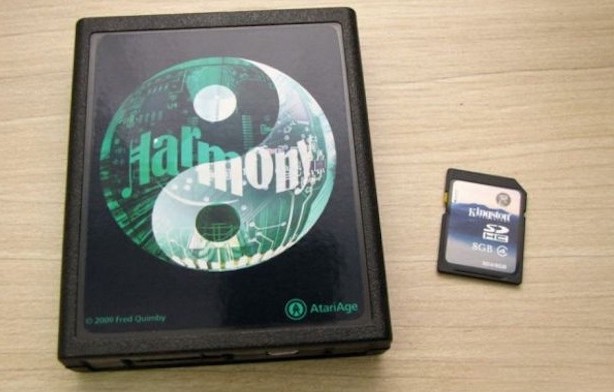
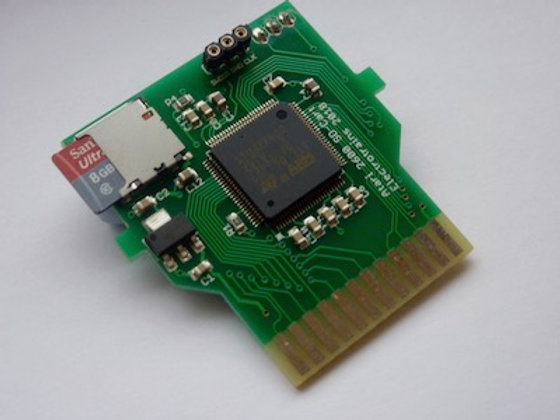
The Harmony Cartridge for Atari 2600 was first released in 2009. Harmony is a bit like my BMOW Floppy Emu Disk Emulator, but for Atari game cartridges instead of Apple floppy disks. Inside the cartridge is an ARM microcontroller and an SD card reader, and the hardware loads Atari game ROMs from the SD card and then emulates a standard ROM chip, including any necessary bank switching logic or extra RAM that may have existed in the original game cartridge.
The original function of Harmony was simply to be a multi-ROM cartridge, but for Pitfall II, Harmony’s designer was also able to use the ARM microcontroller to emulate David Crane’s DPC chip. Before long, he and a few collaborators began to share ideas for a new coprocessor design, like DPC but even more powerful, and emulated by Harmony’s ARM chip. While this wouldn’t do anything to benefit the library of original Atari games, it would open up new possibilities for the active community of Atari 2600 homebrew game developers. The coprocessor design they eventually created is called DPC+.
I haven’t looked at DPC+ in detail, so I may be misstating the specifics, but I’ve seen three features that look particularly interesting.
FastFetch – Atari programs often include time-critical sequences that load a byte from zero page RAM (3 CPU cycles), write the byte to a TIA register (3 CPU cycles), and repeat. Six total CPU cycles per iteration. For drawing fixed graphics patterns, the load from zero page RAM can be replaced with a load of an immediate value into a register, which reduces the total to five clock cycles but means the graphics data must a constant. That constant value is part of the program, which is stored in ROM, which is emulated by the Harmony cartridge. Harmony is able to perform a bit of trickery here, so when the program performs an immediate load of the constant value, Harmony actually supplies data from the graphics stream instead. This makes it possible to draw dynamic graphics data while still enjoying the five-cycle performance of drawing constant graphics data.
Bus Stuffing – The data bus output drivers on the NMOS 6502 (and 6507) chip are non-symmetric. They drive logical 0 bits strongly to near 0 volts, but logical 1 bits use a weak pull-up to 5 volts. If the CPU is outputting a 1 on the data bus, external hardware can safely overdrive the bus with a 0 without damaging the CPU – something that would be dangerous with a symmetric push-pull output driver. For time-critical code loops, Harmony uses this technique to eliminate CPU graphics data reads entirely. The CPU program just performs a long series of write instructions, repeatedly writing the value $FF (binary 11111111) to TIA registers, while Harmony pulls down the appropriate data bus lines to create the next byte of the graphics stream. This reduces the number of CPU cycles needed per iteration to a mere three cycles.
ARM Code Execution (ACE) – Still not fast enough? Harmony also enables the Atari’s 6502 program to upload and execute arbitrary code on Harmony’s 32-bit 70 MHz ARM microcontroller. Compared to the 8-bit 6502 running at 1 MHz, that’s a dramatic performance improvement for compute-heavy code.
Aside from DPC+, Harmony also supports other coprocessor models called CDF and CDFJ, which are further extensions of DPC+. I haven’t looked at these.
Harmony is no longer the only player in this space, and since 2018 some interesting alternatives have appeared. UnoCart 2600 is conceptually very similar to Harmony, but is open source and uses a more capable microcontroller. To my understanding, UnoCart 2600 supports bus stuffing and ACE, although ACE code for Harmony isn’t directly compatible with the UnoCart 2600 due to the differing memory maps of the microcontrollers on the two cartridges. UnoCart 2600 does not support other DPC+ extensions, which I think is because Harmony is a closed source design and its maintainers have chosen not to share the tech details needed for DPC+ emulation. Most recently and intriguingly, PlusCart has appeared as an UnoCart 2600 spin-off that loads game ROMs over WiFi instead of from an SD card. It’s the golden age of retro-Atari products.
When is an Atari no longer an Atari?
Thanks to Harmony and similar devices, within roughly the past 10 years, there has emerged a large and growing library of “hardware accelerated” homebrew Atari games. With the extra support of the coprocessor in the Harmony or UnoCart cartridge, these games are able to create graphics and sound that are much more impressive than anything that was possible back in the 1980s.
This all leads to the question I’ve been grappling with. When an Atari 2600 game console from 1977 is hot-rodded with a 32-bit coprocessor running at 100+ MHz, is it still an Atari 2600? Should games that target this augmented hardware still be considered Atari 2600 games?
Here’s my small editorial. There are no right or wrong answers about this, and everyone should be encouraged to do whatever they find to be most fun. From a technical standpoint I find Harmony and its siblings to be impressively clever, fascinating to study, and I wish I’d thought of these ideas myself. And the multi-ROM cartridge capability is extremely convenient for any modern game collector who doesn’t want to store hundreds of physical game cartridges.
As for the DPC+ coprocessor and similar hardware acceleration extensions, they make me feel… conflicted? Uneasy? When it comes to retrocomputing, I’m something of a hardware purist. For me, the appeal of the Atari 2600 comes from trying to make the most out of its limited hardware capabilities. By adding new 21st-century hardware with new performance-enhancing capabilities, it’s effectively moving the goalposts. I can compare two Atari games that target the original hardware, and if the first game looks visually more impressive than the second, I’ll know the first programmer did a better job. But if one of the games uses a coprocessor with extra hardware capabilities, then it’s no longer a fair comparison. Eventually I hope to try writing my own Atari game, and I’ll probably target the original hardware without any coprocessor extensions, so that I can fairly compare my efforts against the classic Atari games of the 1980s.
In the 15 years I’ve been writing Ask a Manager, I’ve heard about some really bad bosses. There was the boss who crashed an employee’s wedding (and then wrote her up for having him escorted out!), the boss who told bizarre lies about all her employees, and even the boss whose negligence killed someone’s horse. But the bosses who stand out are the ones who are openly abusive to the people they manage.
At Slate today, I wrote about abusive bosses — and why companies need to stop tolerating them. You can read it here.
I’ve been working as an executive assistant to a CEO for just over a year now. For the most part, he’s great and we have a lovely relationship, but he can be a bit brutal about taking time off. He never takes any PTO himself and has often declined my requests for time off because we’re too busy, regardless of what is actually going on.
About a month ago, I asked to use PTO for a Thursday that was still about three weeks away. He told me it could be tough since (as usual) we’re in a busy time, but if I really wanted the day off, I could take it. I did.
A couple of days before my scheduled day off, a coworker asked me what I had planned for my PTO day, and I told them the truth — a couple of friends and I love the royals, and we took the day off to binge watch the new Harry and Meghan Netflix series together.
This got back to my boss who really didn’t love that I was taking a day off for that. He told me that, had he known this was what I had planned, he wouldn’t have approved the day off because it isn’t something important and it’s really hard on him when I’m not in the office.
We ended up compromising, with me working a half day from home. But I’m curious — should why I want a day off matter? To me, it’s my time to use and if I want to devote a day of PTO to Netflix, that’s up to me. But does he have a point when he says I shouldn’t be away from the office for “unimportant” reasons?
No, he does not have a point.
You receive paid time off as part of your compensation package. The expectation is that you will use it and that you will be permitted to use it — just like the expectation is that you will receive the other things that are part of your compensation, like your salary and your health insurance.
I have no doubt that your CEO’s life is a little less convenient when you’re not there. That is the nature of hiring humans who do not work 24/7 and who are entitled to days off and personal lives. If he doesn’t like that, he has several options: he could hire multiple assistants so there’s always coverage, or he could have you cross-train someone to assist him when you’re out, or he could hire a temp, or he could learn to make do when you’re using the benefits that are part of your compensation package, or he could build an army of robots. Those are his only options.
It is not reasonable — not even slightly reasonable — to think that people who work for you shouldn’t use their company-allotted PTO unless they have a “good enough” reason.
(And really, any reason is a “good enough” reason. Wanting to relax and enjoy some leisure time is a good enough reason. Wanting to nap on the couch all day is a good enough reason. Wanting to make tiny clay models of your favorite insects is a good enough reason. The time is yours, and you are 100% in charge of what you use it for.)
To be clear, there are some very limited exceptions to this. If you want a day off to build a fort for your cats (I do) in the middle of your company’s busiest week of the year, a manager might reasonably choose to treat that request differently than if you needed the day for your sister’s wedding. But those times should be the exception, not the norm. The vast majority of the time, as long as you’re scheduling your days off with a reasonable amount of notice, at functional companies you can use them for whatever you want.
At a minimum, it sounds like you should stop sharing what you’ll be doing with your time off (with your boss, obviously, but also with coworkers since you now know it can make its way back to him). But you should also consider saying this to your boss: “I want to make sure we’re on the same page about my use of PTO. The X weeks of PTO I get per year is an important part of my compensation to me. I of course won’t schedule it for times we know will be especially difficult, but the reality is that we’re always busy so it’s never going to feel convenient. The solution obviously can’t be that I never get time off, so can we talk about systems to put in place so that you have enough coverage when I’m out?”
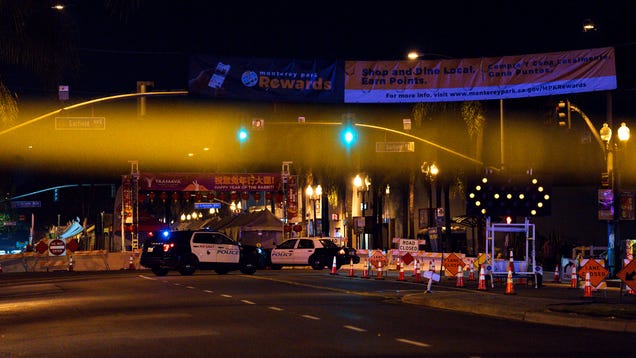
MONTEREY PARK, CA—In the hours following a violent rampage in California in which a lone attacker killed 10 individuals and injured 10 others, citizens living in the only country where this kind of mass killing routinely occurs reportedly concluded Monday that there was no way to prevent the massacre from taking…
When you drive in the winter, you have to deal with a lot of foggy windshields. What's the best way to make that fog go away? Some people will tell you to blast the heat, others to turn on the air conditioning. Who's right? And when should you just hit that "defrost" button instead? I'll explain.
To defog in cold weather, turn on the heat and the air conditioning
I’ll go into a more detailed, scientific explanation in a minute, but the short answer is that to defog the windshield quickly in cold weather, you want to turn on the heat and the air conditioning.
Yes, you can do both at once. If you have a dial that adjusts temperature, put it on the hottest setting. Then look around for a button that turns the AC on or off. Click it so it’s on.
Some cars have a button that does everything for you. My car has a windshield defrost button that does the following:
Points the blower at the windshield
Turns the blower on full blast and raises the temperature
Turns the AC on
Turns recirculation off
This is exactly what you want to do if you’re managing the controls yourself: heat on, AC on, and make sure the air is getting blown full blast on the windshield (look for the windshield icon instead of the one with the arrows pointing at the person). Turning off recirculation helps because you’ll be pulling in dry air from outdoors instead of recirculating the slightly humid air inside.
How to defog your windshield in hot weather
If you're reading this on a sweltering summer day, just turn on your windshield wipers. The fog is on the outside of your windshield, so you can just wipe it away.
What is the difference between defrosting and defogging?
OK, some definitions. Fog is made of tiny droplets of water that have condensed onto the windshield. You'll find this anytime you have a difference in temperature between two sides of the glass. The fog forms on the warmer side (which is the inside of your car, in winter).
Frost, on the other hand, is a layer of ice. You'll see it most commonly on the outside of your car, and it's what you scrape off with an ice scraper. In very cold weather, the fog on the inside of your windshield can freeze, giving you frost on the inside. Treat this the same as fog.
The rear defrost button in your car heats up a set of wires embedded in the glass. They melt the ice on the back window.
The front defrost button in your car will defrost the windshield by heating it up, and defog it by drying out the air to evaporate the fog. It's both a defogger and a defroster.
Check your car's manual for specifics on what settings your car has and how they work. The rear defrost button is very common, even in old cars; the front defrost button is a newer development but still commonly available.
The science of defogging
There are two things going on here, in the short term (seconds to minutes) and the long term (the rest of your drive).
Heat prevents fogging (and frost)
In the long term, you can prevent fogging by making sure both sides of the windshield are the same temperature. The fog on your windshield accumulates for the same reasons as a cold drink “sweating” on a hot day. When one side of the glass is significantly colder than the other, moisture from the warm air will condense on the warmer side of the glass (because the glass is cold compared to the warm air).
This means that in winter, you’ll get condensation from the warm indoor air onto the still-cold windshield. If you can warm up the windshield enough, it will stop being able to pull moisture out of the air.
In summer, it’s the opposite. If you’ve chilled the inside of the car but outdoors it’s 100 degrees, you can get moisture from the outside air condensing on your windshield. This is not a defogger situation, though: The condensation is outside, so you just wipe it off with the windshield wipers.
A/C dries up the fog that is already there
So why isn’t heat alone enough to do the job? Well, for one thing, sometimes it’s just too cold to keep the windshield warm enough to prevent fogging. But more importantly, you need to defog the windshield, not just prevent future fog. That’s why you turn on the air conditioning.
Air conditioners don’t just chill the air; they dry it out. When you run the heat and the A/C at the same time, you get hot, dry air. This starts warming the windshield while also drying up the moisture. Put the AC and heat on full blast, and often the whole windshield will clear up in seconds.
If you've heard the advice to open your windows, that can help for a similar reason: a blast of cold dry air will help to dry up the fog. But the air conditioning will usually do the same job quicker, without making your entire car cold. So I'd stick with the A/C.
How to prevent foggy car windows
Since windshield fog is caused by moisture inside the car, keeping the inside of your car dry will help. If you’ve tracked a lot of snow and slush into the car, clean it out.
You can also start warming up the windshield before it’s time to drive. If you have a remote starter, great! But even if not, the first step in getting your car ready to drive in the winter should be turning on the car and getting it warmed up. Put the heat on the windshield while you brush and scrape the outside.
And finally, consider cleaning the inside of your windshield, because clean glass doesn’t fog as easily. No, not with your hands or with those fast-food napkins you found under the seat; skin oils and miscellaneous grease and dirt will only make the problem worse. Use a proper glass cleaner like Windex.
My general rule of thumb for kids nonfiction is that it shouldn’t be older than the age of the kid. Please don’t write us about all your examples of the exceptions. I get it. There are probably thousands of exceptions. But I digress…
This book was brought to me by one of my co-workers. Topic is fine, but this particular book was old and tired looking. (As I am old and tired looking, I feel qualified to judge.)
In this example, the date published makes me question the following:
Is the instructional component and other content appropriate for the age group?
Are the tools/equipment/materials available and safe? (Beware of products/materials that are no longer available.)
Do any of the projects or commentary use outmoded or inappropriate language when describing people or things?
Are the projects something kids would be interested in now? (Not 40 years ago.)
Again, I am not saying that just because it’s old, doesn’t make it an automatic weed, however it does mean we need to check further.
Mary (who is old and tired looking but still hanging on)
There is no way to spin Saturday’s lousy weather in Houston, which was just a dreary day. But the second half of the weekend made up for it with some spectacularly sunny weather. If you caught sunset on Sunday night and did not go inside right away, then you were able to enjoy an additional celestial treat. The setting Sun was followed by a lovely, very thin crescent Moon on Sunday evening. A little higher in the sky, there was the bright light of Venus. Just to the right of Venus there was a considerably fainter “star.” This was, in reality, Saturn.
Looking ahead to this week, our immediate concern is the potential for severe weather on Tuesday, particularly near the coast, with the passage of the next cold front. After that we’ll see sunny skies and sharply colder nights through the rest of the work week, with a warm-up by the weekend.
Monday
Today should be pretty nice, with mostly sunny skies and high temperatures near 60 degrees. Winds will be light, out of the northeast, at 5 to 10 mph. However, later today and tonight, winds will start to shift to come from the east, and turn more gusty. This increased atmospheric moisture will support the development of clouds tonight, and should hold overnight lows at about 50 degrees.
Tuesday
An upper-level disturbance will approach our region on Tuesday and really stir up the atmosphere. As this low pressure system nears to Houston region it may be intensifying, leading to a line of strong showers and thunderstorms as it sweeps through the region during the afternoon hours.
Severe weather outlook for Tuesday and Tuesday night. (NOAA)
Starting out during the morning hours, we’ll see scattered showers and thunderstorms. Winds will shift from the east, to south, to finally come from the west as the front approaches and then passes through the Houston area. I think the line of storms will probably reach areas such as Katy between about 1 to 3 pm, the downtown area about 2 to 4 pm, and push off the coast by 4 to 6 pm. These storms are going to bring three things: Strong winds, especially near the coast, where gusts will reach 40 to even 50 mph; briefly intense, heavy rainfall; and the potential for some isolated hail and perhaps a tornado or two. As the low pressure system will likely be intensifying as it moves into Houston, the strongest and most severe weather appears likely to develop south of Interstate 10, in areas such as Brazoria and Galveston counties.
We are closely monitoring the potential for street flooding, as these storms will likely produce widespread accumulations of 1 to 3 inches of rainfall, with higher isolated totals. We are not quite ready to issue a Stage 1 flood alert, but it’s something we may do later this afternoon as we see more data. The bottom line is that conditions in Houston on Tuesday afternoon may briefly turn fairly nasty. Winds become northerly on Tuesday after the front’s passage, dropping lows to around 40 degrees in Houston.
Wednesday and Thursday
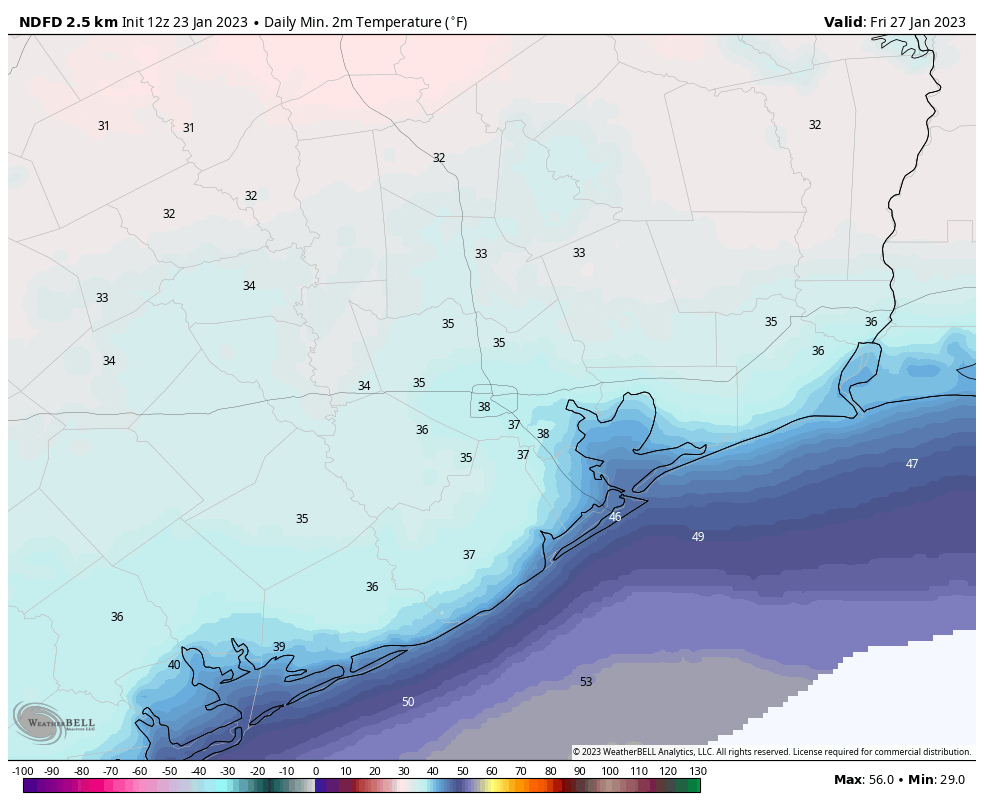
These will be cold winter days (for Houston). Look for mostly sunny skies, breezy northerly winds, and highs in the mid-50s. Both nights will drop into the upper 30s in Houston, with colder conditions further inland. We cannot entirely rule out a freeze for some far inland areas.
The low-temperature forecast for Thursday night looks chilly. (Weather Bell)
Friday
Highs should climb to around 60 degrees on Friday, so a bit warmer, with mostly sunny skies. Lows Friday night will only drop into the mid- to upper-40s as a more southerly flow returns.
Saturday and Sunday
The forecast for the weekend is a little bit blurry, but I do think we’ll see a healthy chance of showers, although it’s difficult to pinpoint when, or how much rain. Chances, for now, look best south of Interstate 10. Temperature wise, I think we’ll be back to highs of around 70 degrees, with lows just in the 60s. Hopefully we’ll get some more clarity on the weekend forecast in a day or two.
Next week
The broad trend supports a cooler pattern again for next week, but the details are understandably lacking. There is perhaps a 1-in-4 chance of seeing some substantially colder weather later next week, with lows near freezing, but my guess is that we’ll probably see something milder than that. I only mention this because some readers have been asking whether winter is over yet. My short answer is: “I don’t think so.”
I’ve been kicking around the idea of using the on-board FPGA in my Yellowstone Universal Disk Controller as a general-purpose Apple II coprocessor. With an FPGA on a peripheral card connected to the 6502 address and data buses, I can’t make the CPU run any faster, but maybe I can make calculations faster by offloading them to some type of coprocessor that’s constructed within the FPGA. As a simple example, I could implement a fast PicoBlaze soft-CPU or something similar, and provide a way for the 6502 to run/halt the PicoBlaze and read/write from its memory space. The 6502 could upload a short PicoBlaze program and its required data, wait for the PicoBlaze to finish running, and then read the results back out.
The existing Yellowstone hardware can already do this. It would just be a matter of firmware development.
What would this be useful for? I’m not sure. But the Yellowstone firmware already implements a very simple taste of this idea, because I needed it in order to achieve the disk timing requirements. It’s not a coprocessor, but it’s an extension that shaves a few clock cycles where they’re most valuable. There’s a specific magic address in the Yellowstone card’s address space, and when the 6502 reads from that address, Yellowstone performs automatic GCR decoding of the most recent disk byte.
I had a crazy idea to use this like a classic computer hardware emulator, except that the Apple II wouldn’t be emulating an older computer but a newer one. The 6502 program could just sit in a tight loop reading bytes from the FPGA coprocessor and writing them into the Apple II frame buffer, so whatever appeared on the screen would be the result of the coprocessor program. It would still be limited by the Apple’s physical screen resolution and color palette, but panning around a larger virtual screen should be possible. And conveniently I’ve already implemented a Macintosh Plus FPGA core, so in theory we could see MacOS running on an Apple II? Or more realistically, this scheme could turn an Apple II into something like a Commodore 64, or a 1980s video game console. Probably impractical for any serious use, but at least it would make interesting discussion for r/vintagecomputing!
Oscar-nominated actor Alec Baldwin will be charged with involuntary manslaughter in the fatal shooting of cinematographer Halyna Hutchins, whom he killed while rehearsing with a pistol on the New Mexico set of the Western movie Rust. What do you think?
Do you aspire to work in local government? Perhaps you dream of hearing the lively exchange of ideas at a public forum, or helping the community by trapping a rogue possum that's been terrorizing the golf course. Maybe you just want to shine shoes.
Well if you're looking for career advice, then this week's "Saturday Night Live" is here to deliver it. The latest Weekend Update featured guest appearances from Leslie Knope, the regional director of the National Parks Service Midwest Branch, and April Ludgate, longtime employee of the Parks and Recreation department in the charming town of Pawnee, Indiana.
Host Aubrey Plaza, who was an actual intern in the "SNL" set design department before going on to play a sulky office intern in "Parks and Recreation," reprised her role from the show alongside Amy Poehler's Leslie Knope. Poehler was part of the regular "Saturday Night Live" cast during Plaza's internship and also founded the Upright Citizens Brigade Theatre, where Plaza's comedy career began, so the two of them go way back (Poehler also popped up during Plaza's opening monologue).
So, what advice did April and Leslie have to offer about working in local government?
'Get A Job As A Garbage Man Or Something'
In an unexpected turn of events, April was actually more enthused about government work than Leslie during their appearance on the Weekend Update desk. Ms. Ludgate offered handy tips like "be a dog catcher and just say you couldn't find any" and "drive a bus, you don't have to be on time." (As a regular bus user, the accuracy of that one hurts.)
Leslie, it turns out, is a "Saturday Night Live" superfan -- so much so that Colin Jost's efforts to get her to actually talk about her job at the Parks Service didn't yield much success (though her lust for Joe Biden did make a reappearance). Poehler is no stranger to the Weekend Update desk, having been a co-anchor for several years alongside Tina Fey and Seth Meyers, but fortunately she maintains the integrity of the Parks and Recreation Cinematic Universe by emphasizing, "I used to watch this when Seth Meyers did it by himself with no one else."
"Parks and Recreation" wrapped up its seven-season run in 2015, but the cast and writers returned for "A Parks and Recreation Special" in 2020 as a charity fundraiser during the early days of the COVID-19 pandemic. While this may only have been a brief return, it's always good to see Leslie and April again.
Rich Osthoff told NPR that Santos — who went by Anthony Devolder — set up a GoFundMe campaign to raise money for the veteran's dog in 2016. Santos never delivered the cash. The dog died months later.
I first learned about Texas’ post office murals in 2011, while I was working at an art gallery in Houston that focused on early Texas art. On my desk sat a book called TheTexas Post Office Murals: Art for the People by Philip Parisi, which has since become my guidebook on this journey. These aren’t just any murals — they are the product of President Franklin D. Roosevelt’s 1930s New Deal efforts to provide tangible relief to working Americans, including artists. I have a great fondness for the Works Progress Administration (WPA) era, in which the federal government, among many other projects, sponsored the production of art for public consumption during the Great Depression. (Art nerd alert: I should point out that the post office mural project was technically funded by the Section of Fine Arts.)
I suppose what I find so fascinating about projects like the murals is that the U.S. government recognized the value of art in bringing beauty and inspiration into the daily lives of ordinary citizens (which is hard to believe in today’s political climate, when arts funding is usually first on the chopping block). What could be more democratic than placing art into the public space of a post office, which was oftentimes the social gathering place for small or rural communities in the early 20th century? So, my discovery that I could easily access these WPA-era relics within my home state kicked off a lifelong mission to visit and photograph as many of the murals as I can during my travels around Texas.
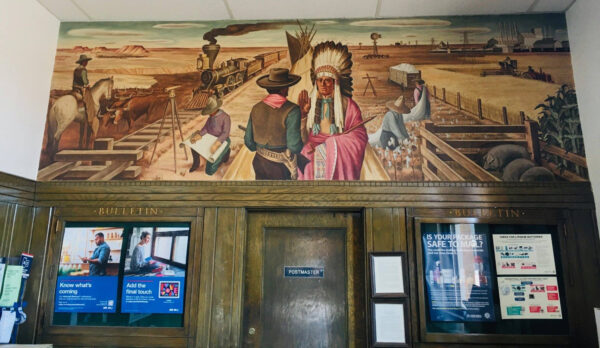
Originally, the federal government commissioned 106 artworks for 69 Texas post offices and federal buildings. Several of these have been lost or irrevocably damaged. In 2004, when Parisi published his compendium, he counted 61 murals he was able to view and document. Although some of the murals can be found in larger cities (ex: Fort Worth, Dallas, San Antonio), many are sprinkled throughout small-town Texas (ex: Anson, Eastland, Hamilton). And that’s one of the many treats about this project: getting to encounter the small communities and town squares of the Lone Star State that I wouldn’t normally experience. Although each mural is different, I can often find my hidden treasure shortly after the GPS has guided me to the heart of the town; it’s sort of like being pulled into a magnetic forcefield. Somewhere just off the square or town center sits an unassuming, 1930’s-designed post office. Enter the front door and look for the original postmaster’s door. Right above that door you find your prize: the post office mural.
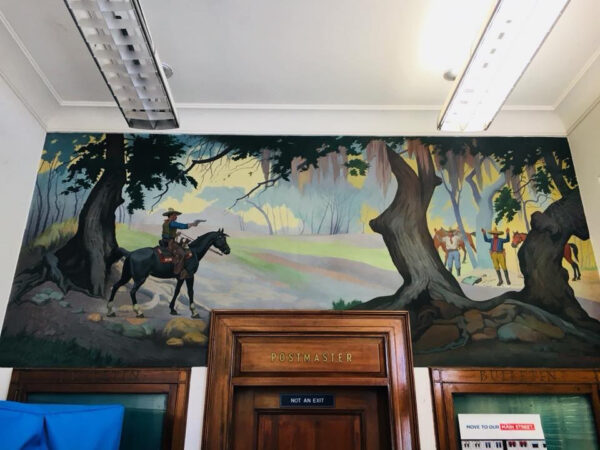
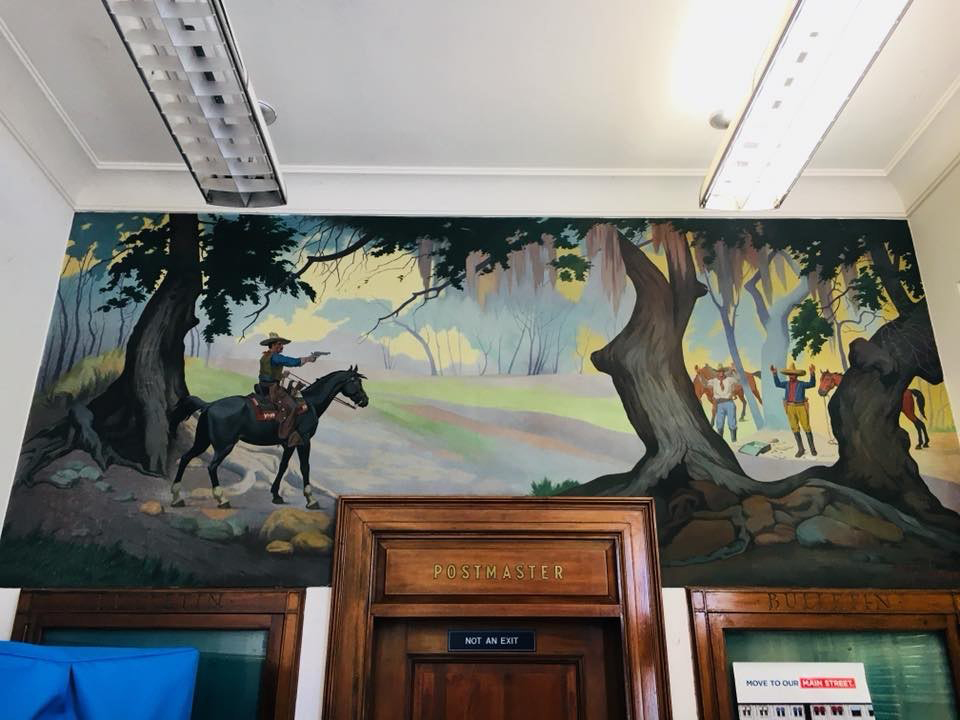
Smithville, TX. Minette Teichmueller, “The Law – Texas Rangers,” 1939. Image courtesy of Leslie Thompson.
The style and subject matter of each mural is simple and direct — no previous art experience or knowledge is necessary to appreciate the paintings. Most murals represent the town’s key industry, defining features, history, or the spirit of the region. Are you a history buff? Then visit El Paso’s mural, which portrays a montage of the settling of that region, from the explorations of Spain’s Coronado and his conquistadors, to the vaquero and subsequent Anglo settlers. Or take a stroll through Amarillo and see what I consider to be the granddaddy of all Texas post office murals, due to its size and scope. This collection of six mural panels shows a timeline of the development of the Texas Panhandle, with another appearance of Coronado on his quest to find the legendary Seven Cities of Gold in nearby Palo Duro Canyon, all the way to the establishment of the local industries of cattle, oil, and agriculture.
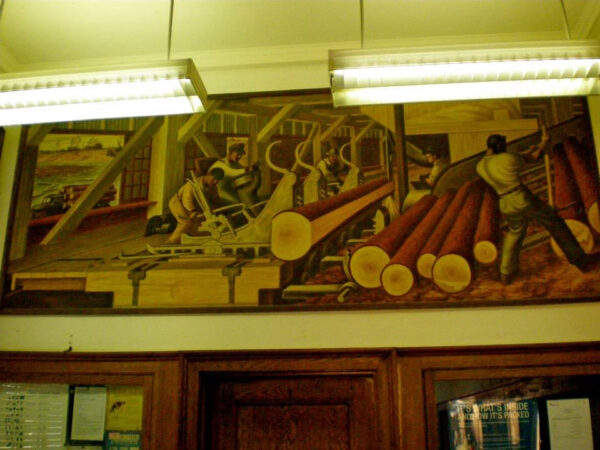
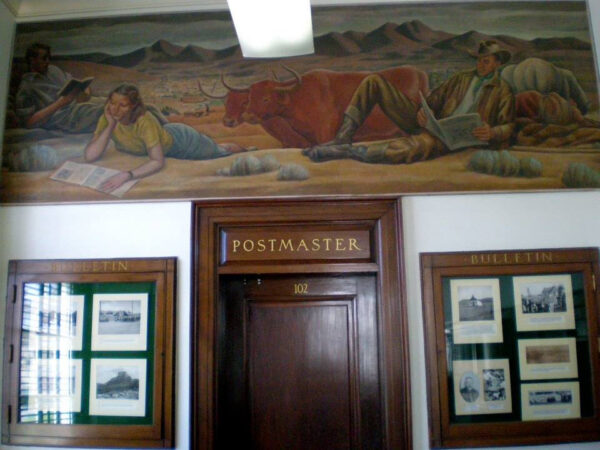
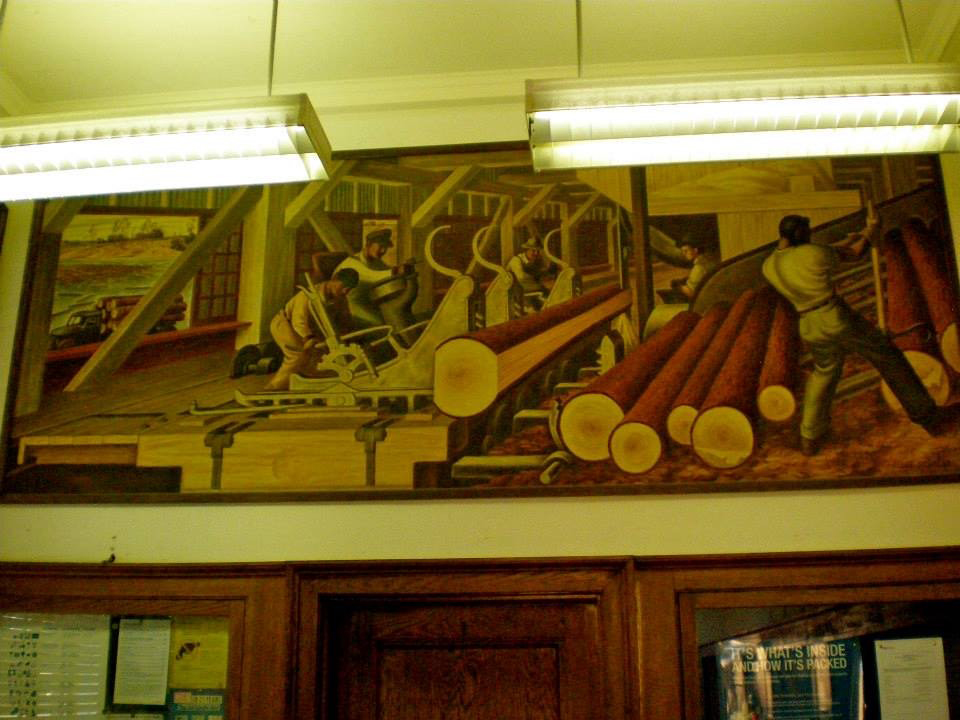
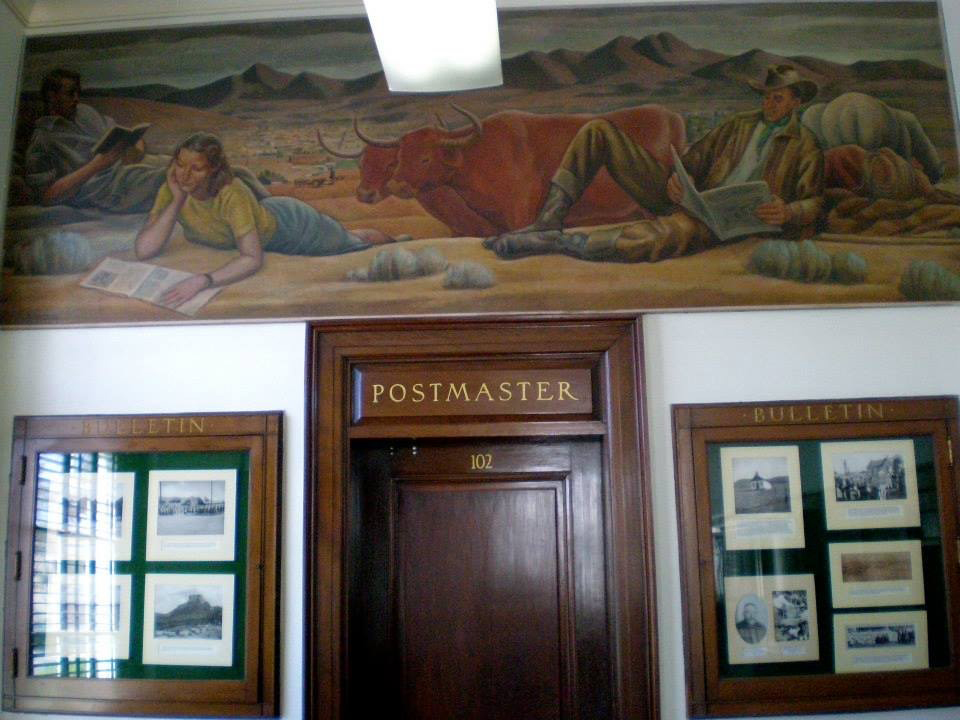
What best represented a town’s identity in the 1930s and 1940s? Gather your clues by looking at post office murals in Trinity in East Texas, where its lumber industry loomed large, or Alpine in far West Texas where the college (now Sul Ross State University) was as much a point of pride for its citizens as the nearby mountainous landscape. And what’s one of the most classic symbols of the Lone Star State? The longhorn, everpresent, makes its appearance in several Texas post office murals.
Trinity, TX. Jerry Bywaters, “Lumber Manufacturing,” 1942. Image courtesy of Leslie Thompson.
Alpine, TX. José Moya del Pinto, “View of Alpine,” 1940. Image courtesy of Leslie Thompson.
Who painted these murals? Artists not only from Texas but from all across the country, as each selection was made through a competition of anonymous submissions. A roster of familiar names (depending on your knowledge of early Texas art) includes:
Otis Dozier (a member of the Dallas Nine)
Peter Hurd (the New Mexico artist who married into the famous Wyeth family)
Tom Lea (an El Paso-based artist)
Joe De Yong (a mentee of the iconic Western artist Charles Russell)
Alexandre Hogue (a member of the Dallas Nine)
Ward Lockwood (who organized the art department at UT Austin)
Jerry Bywaters (a member of the Dallas Nine and former director of the Dallas Museum of Fine Art, now the Dallas Museum of Art)
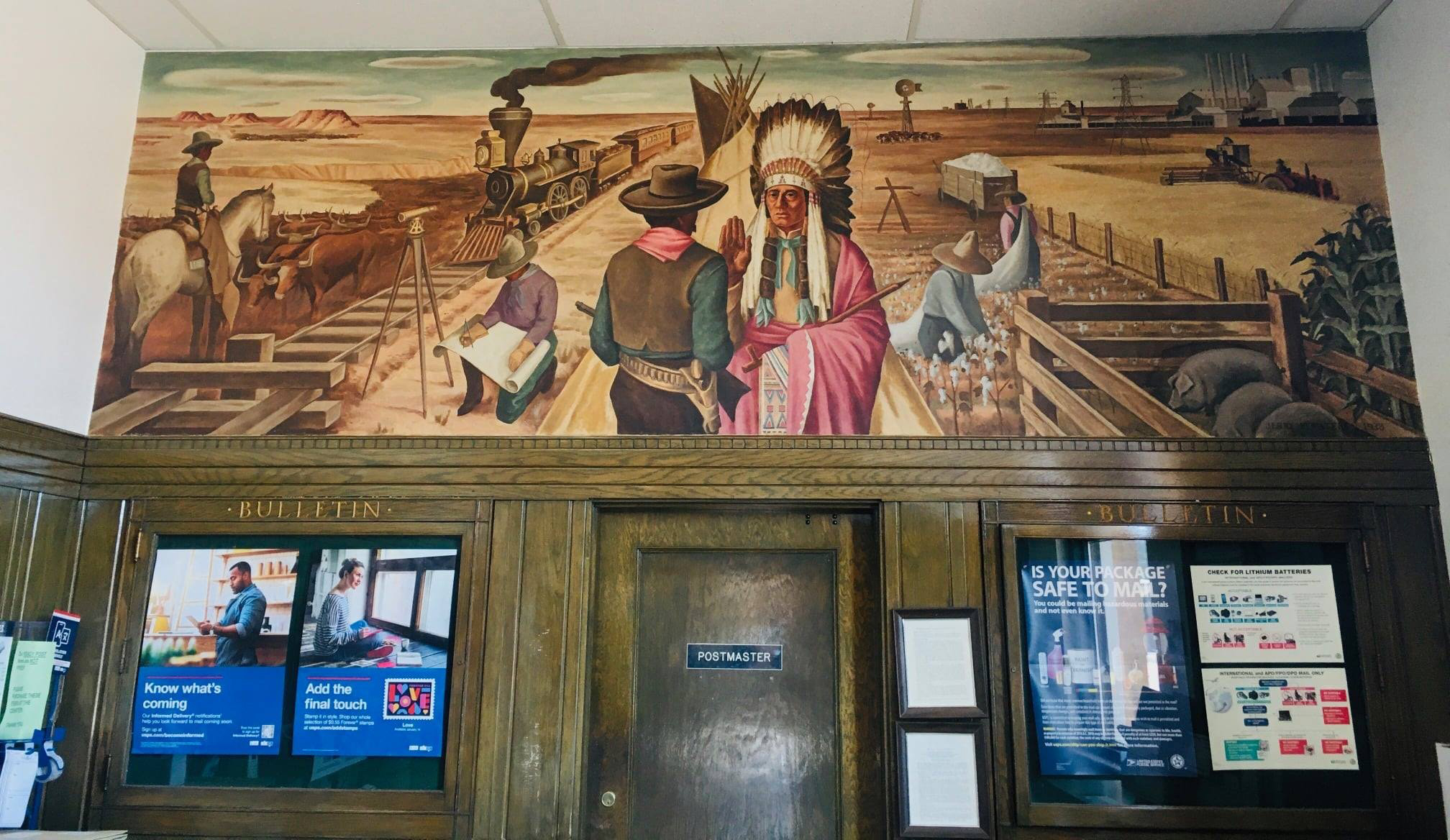
Quanah, TX. Jerry Bywaters, “The Naming of Quanah,” 1938. Image courtesy of Leslie Thompson.
If you plan on starting a post office mural journey, a word of advice: be flexible. Not all murals remain in their original location. The Arlington post office building has been through many iterations, the most recent of which (the last time I checked) is as a branch of Worthington National Bank. When I visited the bank long ago, the mural still hung above the original postmaster’s door (which now houses offices for the bank’s employees). But within the last few years, in an effort to better preserve the mural, the 1941 painting moved to the Amon Carter Museum of American Art, where it’s on display across from the museum store. Similarly, the Odessa mural (which, full disclosure, remains my favorite PO mural I’ve visited to date), moved from the town’s post office to the local Ellen Noël Art Museum, which restored the painting. Today, while the Odessa museum undergoes an expansion, the mural is on display down the highway in Midland at The Museum of the Southwest.
Odessa, TX. Tom Lea, “Stampede,” 1940. Image courtesy of Leslie Thompson.
As of this writing, I’ve visited 23 Texas post office murals (and a few more just beyond the borders of the state). Each visit carries not only a unique memory of the mural, but of my journey to the mural and the people and sites I encountered along the way. I hope you’ll join me in this short series as I take you around different corners of the state, exploring the hidden treasures of small town Texas through its post office murals.
Hovertext: I hate drawing crowds, but I love portraying humans as lemmings.
Today's News:
I know no reads this blog, but I just wanted to paste the shockingly positive reviews Bea Wolf has gotten so far. More are on the way, but are under wraps for now. Thanks unending to all of you for putting me in a position to have the intellectual time to develop the skills to create such a risky book, and for the financial and career stability to then actually take the risk. <3
"Glorious, accurate, profoundly silly and hilariously profound."
â Neil Gaiman
"As haunting, hilarious and perplexing as the ancient stories one hears around the campfire, castle or cafeteria."
â Lemony Snicket
"It's Seuss and Dahl's mutant offspring, gorgeous and darkly witty."
â Mary Roach
"An instant classic. Like nothing I have ever seen. The unforgettable characters within Treeheart and their death-defying (and extremely funny) heroics now have a permanent place in my brain.
This combination of impossibly charming art and boundlessly thrilling and hilarious text is a required addition to your family's library.
I love this so much."
â Nathan Pyle
âThis is true bardic glory, a wild embrace of absurdity and witâ¦â
â Bulletin of the Center for Children's Books, Starred Review
âReaders will wish they could pledge their plastic swords to defending Treeheart and the sanctity of wild childhoods everywhere.â
Try out my quantum mechanics course (and many others on math and science) on Brilliant using the link https://brilliant.org/sabine. You can get started for free, and the first 200 will get 20% off the annual premium subscription.
That the Gulf stream might collapse is one of the scariest consequences of climate change for us here in Europe, at least if you believe the headlines. In this video I'll explain why the Gulf stream can't collapse, what the headlines really mean, and what climate change might do to Europe.
00:00 Intro 00:49 Westerlies and Easterlies 04:12 The Gulf Stream 06:32 The Jet Streams 08:52 The AMOC 11:34 What Might Happen? 13:07 Learn Physics With Brilliant