In the 15 years I’ve been writing Ask a Manager, I’ve heard about some really bad bosses. There was the boss who crashed an employee’s wedding (and then wrote her up for having him escorted out!), the boss who told bizarre lies about all her employees, and even the boss whose negligence killed someone’s horse. But the bosses who stand out are the ones who are openly abusive to the people they manage.
At Slate today, I wrote about abusive bosses — and why companies need to stop tolerating them. You can read it here.
I’ve been working as an executive assistant to a CEO for just over a year now. For the most part, he’s great and we have a lovely relationship, but he can be a bit brutal about taking time off. He never takes any PTO himself and has often declined my requests for time off because we’re too busy, regardless of what is actually going on.
About a month ago, I asked to use PTO for a Thursday that was still about three weeks away. He told me it could be tough since (as usual) we’re in a busy time, but if I really wanted the day off, I could take it. I did.
A couple of days before my scheduled day off, a coworker asked me what I had planned for my PTO day, and I told them the truth — a couple of friends and I love the royals, and we took the day off to binge watch the new Harry and Meghan Netflix series together.
This got back to my boss who really didn’t love that I was taking a day off for that. He told me that, had he known this was what I had planned, he wouldn’t have approved the day off because it isn’t something important and it’s really hard on him when I’m not in the office.
We ended up compromising, with me working a half day from home. But I’m curious — should why I want a day off matter? To me, it’s my time to use and if I want to devote a day of PTO to Netflix, that’s up to me. But does he have a point when he says I shouldn’t be away from the office for “unimportant” reasons?
No, he does not have a point.
You receive paid time off as part of your compensation package. The expectation is that you will use it and that you will be permitted to use it — just like the expectation is that you will receive the other things that are part of your compensation, like your salary and your health insurance.
I have no doubt that your CEO’s life is a little less convenient when you’re not there. That is the nature of hiring humans who do not work 24/7 and who are entitled to days off and personal lives. If he doesn’t like that, he has several options: he could hire multiple assistants so there’s always coverage, or he could have you cross-train someone to assist him when you’re out, or he could hire a temp, or he could learn to make do when you’re using the benefits that are part of your compensation package, or he could build an army of robots. Those are his only options.
It is not reasonable — not even slightly reasonable — to think that people who work for you shouldn’t use their company-allotted PTO unless they have a “good enough” reason.
(And really, any reason is a “good enough” reason. Wanting to relax and enjoy some leisure time is a good enough reason. Wanting to nap on the couch all day is a good enough reason. Wanting to make tiny clay models of your favorite insects is a good enough reason. The time is yours, and you are 100% in charge of what you use it for.)
To be clear, there are some very limited exceptions to this. If you want a day off to build a fort for your cats (I do) in the middle of your company’s busiest week of the year, a manager might reasonably choose to treat that request differently than if you needed the day for your sister’s wedding. But those times should be the exception, not the norm. The vast majority of the time, as long as you’re scheduling your days off with a reasonable amount of notice, at functional companies you can use them for whatever you want.
At a minimum, it sounds like you should stop sharing what you’ll be doing with your time off (with your boss, obviously, but also with coworkers since you now know it can make its way back to him). But you should also consider saying this to your boss: “I want to make sure we’re on the same page about my use of PTO. The X weeks of PTO I get per year is an important part of my compensation to me. I of course won’t schedule it for times we know will be especially difficult, but the reality is that we’re always busy so it’s never going to feel convenient. The solution obviously can’t be that I never get time off, so can we talk about systems to put in place so that you have enough coverage when I’m out?”
MONTEREY PARK, CA—In the hours following a violent rampage in California in which a lone attacker killed 10 individuals and injured 10 others, citizens living in the only country where this kind of mass killing routinely occurs reportedly concluded Monday that there was no way to prevent the massacre from taking…
When you drive in the winter, you have to deal with a lot of foggy windshields. What's the best way to make that fog go away? Some people will tell you to blast the heat, others to turn on the air conditioning. Who's right? And when should you just hit that "defrost" button instead? I'll explain.
To defog in cold weather, turn on the heat and the air conditioning
I’ll go into a more detailed, scientific explanation in a minute, but the short answer is that to defog the windshield quickly in cold weather, you want to turn on the heat and the air conditioning.
Yes, you can do both at once. If you have a dial that adjusts temperature, put it on the hottest setting. Then look around for a button that turns the AC on or off. Click it so it’s on.
Some cars have a button that does everything for you. My car has a windshield defrost button that does the following:
Points the blower at the windshield
Turns the blower on full blast and raises the temperature
Turns the AC on
Turns recirculation off
This is exactly what you want to do if you’re managing the controls yourself: heat on, AC on, and make sure the air is getting blown full blast on the windshield (look for the windshield icon instead of the one with the arrows pointing at the person). Turning off recirculation helps because you’ll be pulling in dry air from outdoors instead of recirculating the slightly humid air inside.
How to defog your windshield in hot weather
If you're reading this on a sweltering summer day, just turn on your windshield wipers. The fog is on the outside of your windshield, so you can just wipe it away.
What is the difference between defrosting and defogging?
OK, some definitions. Fog is made of tiny droplets of water that have condensed onto the windshield. You'll find this anytime you have a difference in temperature between two sides of the glass. The fog forms on the warmer side (which is the inside of your car, in winter).
Frost, on the other hand, is a layer of ice. You'll see it most commonly on the outside of your car, and it's what you scrape off with an ice scraper. In very cold weather, the fog on the inside of your windshield can freeze, giving you frost on the inside. Treat this the same as fog.
The rear defrost button in your car heats up a set of wires embedded in the glass. They melt the ice on the back window.
The front defrost button in your car will defrost the windshield by heating it up, and defog it by drying out the air to evaporate the fog. It's both a defogger and a defroster.
Check your car's manual for specifics on what settings your car has and how they work. The rear defrost button is very common, even in old cars; the front defrost button is a newer development but still commonly available.
The science of defogging
There are two things going on here, in the short term (seconds to minutes) and the long term (the rest of your drive).
Heat prevents fogging (and frost)
In the long term, you can prevent fogging by making sure both sides of the windshield are the same temperature. The fog on your windshield accumulates for the same reasons as a cold drink “sweating” on a hot day. When one side of the glass is significantly colder than the other, moisture from the warm air will condense on the warmer side of the glass (because the glass is cold compared to the warm air).
This means that in winter, you’ll get condensation from the warm indoor air onto the still-cold windshield. If you can warm up the windshield enough, it will stop being able to pull moisture out of the air.
In summer, it’s the opposite. If you’ve chilled the inside of the car but outdoors it’s 100 degrees, you can get moisture from the outside air condensing on your windshield. This is not a defogger situation, though: The condensation is outside, so you just wipe it off with the windshield wipers.
A/C dries up the fog that is already there
So why isn’t heat alone enough to do the job? Well, for one thing, sometimes it’s just too cold to keep the windshield warm enough to prevent fogging. But more importantly, you need to defog the windshield, not just prevent future fog. That’s why you turn on the air conditioning.
Air conditioners don’t just chill the air; they dry it out. When you run the heat and the A/C at the same time, you get hot, dry air. This starts warming the windshield while also drying up the moisture. Put the AC and heat on full blast, and often the whole windshield will clear up in seconds.
If you've heard the advice to open your windows, that can help for a similar reason: a blast of cold dry air will help to dry up the fog. But the air conditioning will usually do the same job quicker, without making your entire car cold. So I'd stick with the A/C.
How to prevent foggy car windows
Since windshield fog is caused by moisture inside the car, keeping the inside of your car dry will help. If you’ve tracked a lot of snow and slush into the car, clean it out.
You can also start warming up the windshield before it’s time to drive. If you have a remote starter, great! But even if not, the first step in getting your car ready to drive in the winter should be turning on the car and getting it warmed up. Put the heat on the windshield while you brush and scrape the outside.
And finally, consider cleaning the inside of your windshield, because clean glass doesn’t fog as easily. No, not with your hands or with those fast-food napkins you found under the seat; skin oils and miscellaneous grease and dirt will only make the problem worse. Use a proper glass cleaner like Windex.
My general rule of thumb for kids nonfiction is that it shouldn’t be older than the age of the kid. Please don’t write us about all your examples of the exceptions. I get it. There are probably thousands of exceptions. But I digress…
This book was brought to me by one of my co-workers. Topic is fine, but this particular book was old and tired looking. (As I am old and tired looking, I feel qualified to judge.)
In this example, the date published makes me question the following:
Is the instructional component and other content appropriate for the age group?
Are the tools/equipment/materials available and safe? (Beware of products/materials that are no longer available.)
Do any of the projects or commentary use outmoded or inappropriate language when describing people or things?
Are the projects something kids would be interested in now? (Not 40 years ago.)
Again, I am not saying that just because it’s old, doesn’t make it an automatic weed, however it does mean we need to check further.
Mary (who is old and tired looking but still hanging on)
There is no way to spin Saturday’s lousy weather in Houston, which was just a dreary day. But the second half of the weekend made up for it with some spectacularly sunny weather. If you caught sunset on Sunday night and did not go inside right away, then you were able to enjoy an additional celestial treat. The setting Sun was followed by a lovely, very thin crescent Moon on Sunday evening. A little higher in the sky, there was the bright light of Venus. Just to the right of Venus there was a considerably fainter “star.” This was, in reality, Saturn.
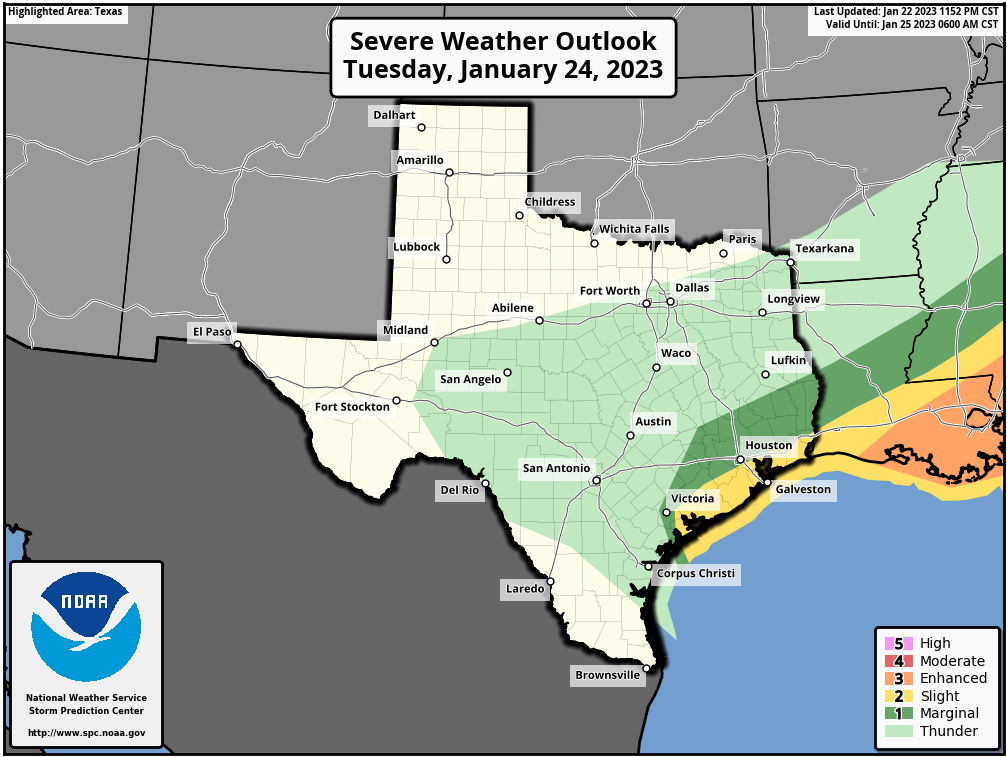
Looking ahead to this week, our immediate concern is the potential for severe weather on Tuesday, particularly near the coast, with the passage of the next cold front. After that we’ll see sunny skies and sharply colder nights through the rest of the work week, with a warm-up by the weekend.
Monday
Today should be pretty nice, with mostly sunny skies and high temperatures near 60 degrees. Winds will be light, out of the northeast, at 5 to 10 mph. However, later today and tonight, winds will start to shift to come from the east, and turn more gusty. This increased atmospheric moisture will support the development of clouds tonight, and should hold overnight lows at about 50 degrees.
Tuesday
An upper-level disturbance will approach our region on Tuesday and really stir up the atmosphere. As this low pressure system nears to Houston region it may be intensifying, leading to a line of strong showers and thunderstorms as it sweeps through the region during the afternoon hours.
Severe weather outlook for Tuesday and Tuesday night. (NOAA)
Starting out during the morning hours, we’ll see scattered showers and thunderstorms. Winds will shift from the east, to south, to finally come from the west as the front approaches and then passes through the Houston area. I think the line of storms will probably reach areas such as Katy between about 1 to 3 pm, the downtown area about 2 to 4 pm, and push off the coast by 4 to 6 pm. These storms are going to bring three things: Strong winds, especially near the coast, where gusts will reach 40 to even 50 mph; briefly intense, heavy rainfall; and the potential for some isolated hail and perhaps a tornado or two. As the low pressure system will likely be intensifying as it moves into Houston, the strongest and most severe weather appears likely to develop south of Interstate 10, in areas such as Brazoria and Galveston counties.
We are closely monitoring the potential for street flooding, as these storms will likely produce widespread accumulations of 1 to 3 inches of rainfall, with higher isolated totals. We are not quite ready to issue a Stage 1 flood alert, but it’s something we may do later this afternoon as we see more data. The bottom line is that conditions in Houston on Tuesday afternoon may briefly turn fairly nasty. Winds become northerly on Tuesday after the front’s passage, dropping lows to around 40 degrees in Houston.
Wednesday and Thursday
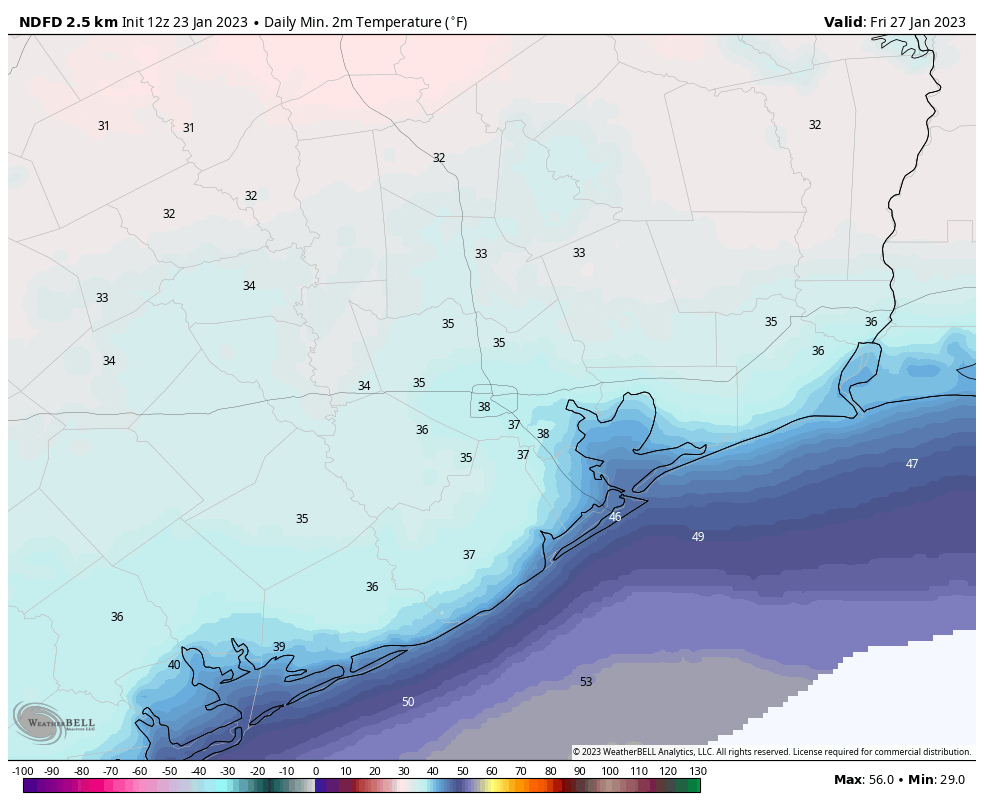
These will be cold winter days (for Houston). Look for mostly sunny skies, breezy northerly winds, and highs in the mid-50s. Both nights will drop into the upper 30s in Houston, with colder conditions further inland. We cannot entirely rule out a freeze for some far inland areas.
The low-temperature forecast for Thursday night looks chilly. (Weather Bell)
Friday
Highs should climb to around 60 degrees on Friday, so a bit warmer, with mostly sunny skies. Lows Friday night will only drop into the mid- to upper-40s as a more southerly flow returns.
Saturday and Sunday
The forecast for the weekend is a little bit blurry, but I do think we’ll see a healthy chance of showers, although it’s difficult to pinpoint when, or how much rain. Chances, for now, look best south of Interstate 10. Temperature wise, I think we’ll be back to highs of around 70 degrees, with lows just in the 60s. Hopefully we’ll get some more clarity on the weekend forecast in a day or two.
Next week
The broad trend supports a cooler pattern again for next week, but the details are understandably lacking. There is perhaps a 1-in-4 chance of seeing some substantially colder weather later next week, with lows near freezing, but my guess is that we’ll probably see something milder than that. I only mention this because some readers have been asking whether winter is over yet. My short answer is: “I don’t think so.”
I’ve been kicking around the idea of using the on-board FPGA in my Yellowstone Universal Disk Controller as a general-purpose Apple II coprocessor. With an FPGA on a peripheral card connected to the 6502 address and data buses, I can’t make the CPU run any faster, but maybe I can make calculations faster by offloading them to some type of coprocessor that’s constructed within the FPGA. As a simple example, I could implement a fast PicoBlaze soft-CPU or something similar, and provide a way for the 6502 to run/halt the PicoBlaze and read/write from its memory space. The 6502 could upload a short PicoBlaze program and its required data, wait for the PicoBlaze to finish running, and then read the results back out.
The existing Yellowstone hardware can already do this. It would just be a matter of firmware development.
What would this be useful for? I’m not sure. But the Yellowstone firmware already implements a very simple taste of this idea, because I needed it in order to achieve the disk timing requirements. It’s not a coprocessor, but it’s an extension that shaves a few clock cycles where they’re most valuable. There’s a specific magic address in the Yellowstone card’s address space, and when the 6502 reads from that address, Yellowstone performs automatic GCR decoding of the most recent disk byte.
I had a crazy idea to use this like a classic computer hardware emulator, except that the Apple II wouldn’t be emulating an older computer but a newer one. The 6502 program could just sit in a tight loop reading bytes from the FPGA coprocessor and writing them into the Apple II frame buffer, so whatever appeared on the screen would be the result of the coprocessor program. It would still be limited by the Apple’s physical screen resolution and color palette, but panning around a larger virtual screen should be possible. And conveniently I’ve already implemented a Macintosh Plus FPGA core, so in theory we could see MacOS running on an Apple II? Or more realistically, this scheme could turn an Apple II into something like a Commodore 64, or a 1980s video game console. Probably impractical for any serious use, but at least it would make interesting discussion for r/vintagecomputing!
Oscar-nominated actor Alec Baldwin will be charged with involuntary manslaughter in the fatal shooting of cinematographer Halyna Hutchins, whom he killed while rehearsing with a pistol on the New Mexico set of the Western movie Rust. What do you think?
Do you aspire to work in local government? Perhaps you dream of hearing the lively exchange of ideas at a public forum, or helping the community by trapping a rogue possum that's been terrorizing the golf course. Maybe you just want to shine shoes.
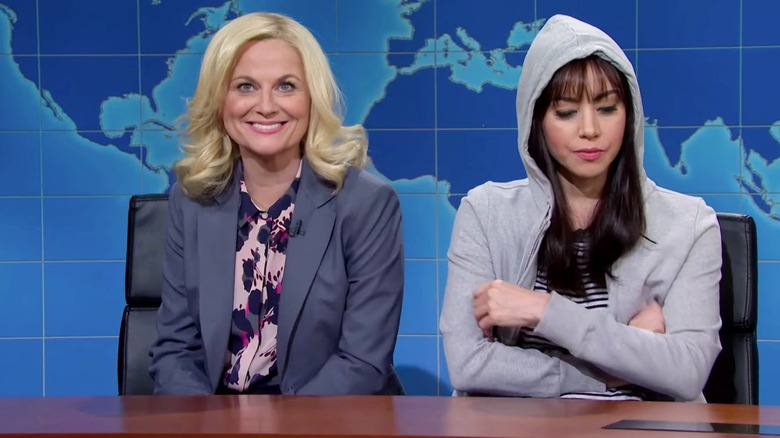
Well if you're looking for career advice, then this week's "Saturday Night Live" is here to deliver it. The latest Weekend Update featured guest appearances from Leslie Knope, the regional director of the National Parks Service Midwest Branch, and April Ludgate, longtime employee of the Parks and Recreation department in the charming town of Pawnee, Indiana.
Host Aubrey Plaza, who was an actual intern in the "SNL" set design department before going on to play a sulky office intern in "Parks and Recreation," reprised her role from the show alongside Amy Poehler's Leslie Knope. Poehler was part of the regular "Saturday Night Live" cast during Plaza's internship and also founded the Upright Citizens Brigade Theatre, where Plaza's comedy career began, so the two of them go way back (Poehler also popped up during Plaza's opening monologue).
So, what advice did April and Leslie have to offer about working in local government?
'Get A Job As A Garbage Man Or Something'
In an unexpected turn of events, April was actually more enthused about government work than Leslie during their appearance on the Weekend Update desk. Ms. Ludgate offered handy tips like "be a dog catcher and just say you couldn't find any" and "drive a bus, you don't have to be on time." (As a regular bus user, the accuracy of that one hurts.)
Leslie, it turns out, is a "Saturday Night Live" superfan -- so much so that Colin Jost's efforts to get her to actually talk about her job at the Parks Service didn't yield much success (though her lust for Joe Biden did make a reappearance). Poehler is no stranger to the Weekend Update desk, having been a co-anchor for several years alongside Tina Fey and Seth Meyers, but fortunately she maintains the integrity of the Parks and Recreation Cinematic Universe by emphasizing, "I used to watch this when Seth Meyers did it by himself with no one else."
"Parks and Recreation" wrapped up its seven-season run in 2015, but the cast and writers returned for "A Parks and Recreation Special" in 2020 as a charity fundraiser during the early days of the COVID-19 pandemic. While this may only have been a brief return, it's always good to see Leslie and April again.
Rich Osthoff told NPR that Santos — who went by Anthony Devolder — set up a GoFundMe campaign to raise money for the veteran's dog in 2016. Santos never delivered the cash. The dog died months later.
I first learned about Texas’ post office murals in 2011, while I was working at an art gallery in Houston that focused on early Texas art. On my desk sat a book called TheTexas Post Office Murals: Art for the People by Philip Parisi, which has since become my guidebook on this journey. These aren’t just any murals — they are the product of President Franklin D. Roosevelt’s 1930s New Deal efforts to provide tangible relief to working Americans, including artists. I have a great fondness for the Works Progress Administration (WPA) era, in which the federal government, among many other projects, sponsored the production of art for public consumption during the Great Depression. (Art nerd alert: I should point out that the post office mural project was technically funded by the Section of Fine Arts.)
I suppose what I find so fascinating about projects like the murals is that the U.S. government recognized the value of art in bringing beauty and inspiration into the daily lives of ordinary citizens (which is hard to believe in today’s political climate, when arts funding is usually first on the chopping block). What could be more democratic than placing art into the public space of a post office, which was oftentimes the social gathering place for small or rural communities in the early 20th century? So, my discovery that I could easily access these WPA-era relics within my home state kicked off a lifelong mission to visit and photograph as many of the murals as I can during my travels around Texas.
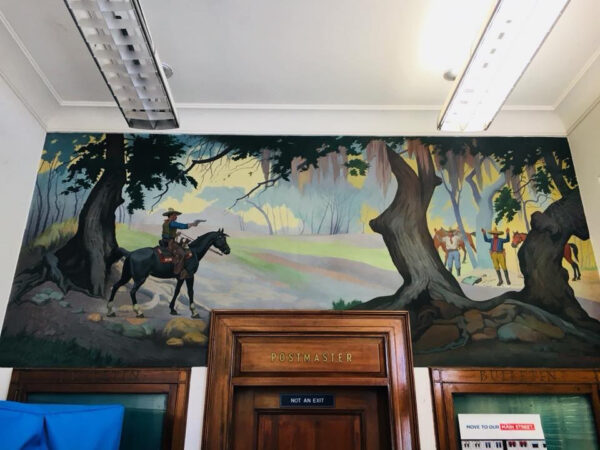
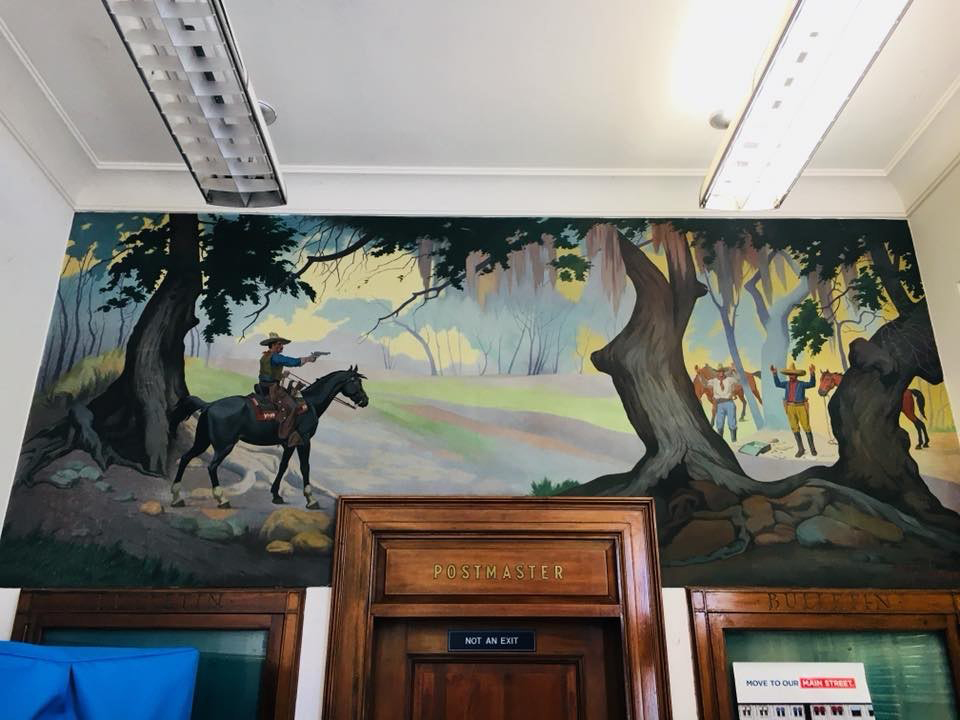
Originally, the federal government commissioned 106 artworks for 69 Texas post offices and federal buildings. Several of these have been lost or irrevocably damaged. In 2004, when Parisi published his compendium, he counted 61 murals he was able to view and document. Although some of the murals can be found in larger cities (ex: Fort Worth, Dallas, San Antonio), many are sprinkled throughout small-town Texas (ex: Anson, Eastland, Hamilton). And that’s one of the many treats about this project: getting to encounter the small communities and town squares of the Lone Star State that I wouldn’t normally experience. Although each mural is different, I can often find my hidden treasure shortly after the GPS has guided me to the heart of the town; it’s sort of like being pulled into a magnetic forcefield. Somewhere just off the square or town center sits an unassuming, 1930’s-designed post office. Enter the front door and look for the original postmaster’s door. Right above that door you find your prize: the post office mural.
Smithville, TX. Minette Teichmueller, “The Law – Texas Rangers,” 1939. Image courtesy of Leslie Thompson.
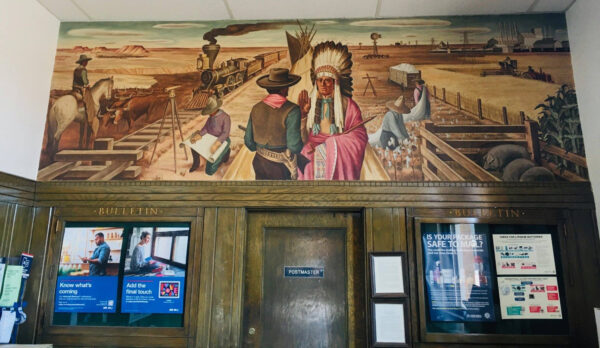
The style and subject matter of each mural is simple and direct — no previous art experience or knowledge is necessary to appreciate the paintings. Most murals represent the town’s key industry, defining features, history, or the spirit of the region. Are you a history buff? Then visit El Paso’s mural, which portrays a montage of the settling of that region, from the explorations of Spain’s Coronado and his conquistadors, to the vaquero and subsequent Anglo settlers. Or take a stroll through Amarillo and see what I consider to be the granddaddy of all Texas post office murals, due to its size and scope. This collection of six mural panels shows a timeline of the development of the Texas Panhandle, with another appearance of Coronado on his quest to find the legendary Seven Cities of Gold in nearby Palo Duro Canyon, all the way to the establishment of the local industries of cattle, oil, and agriculture.
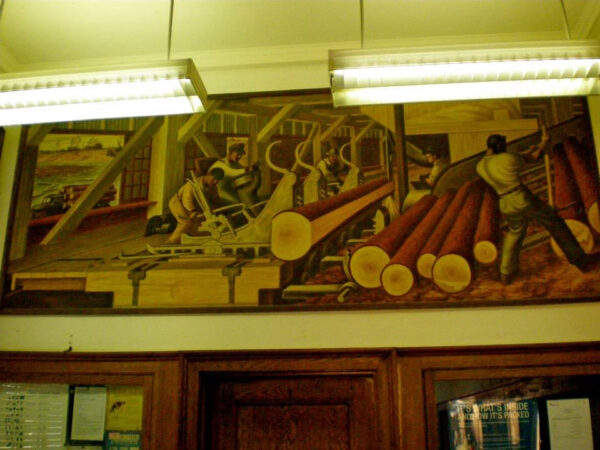
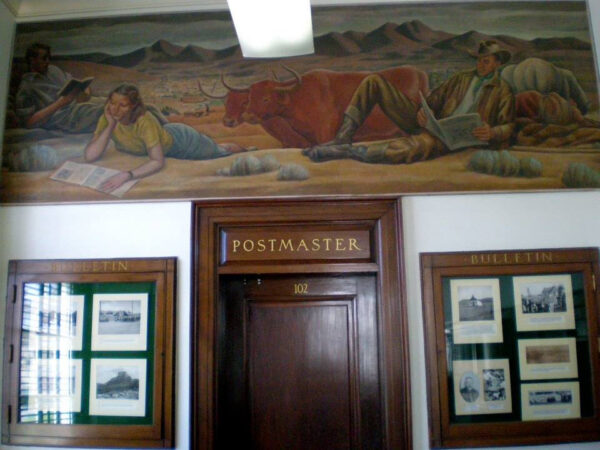
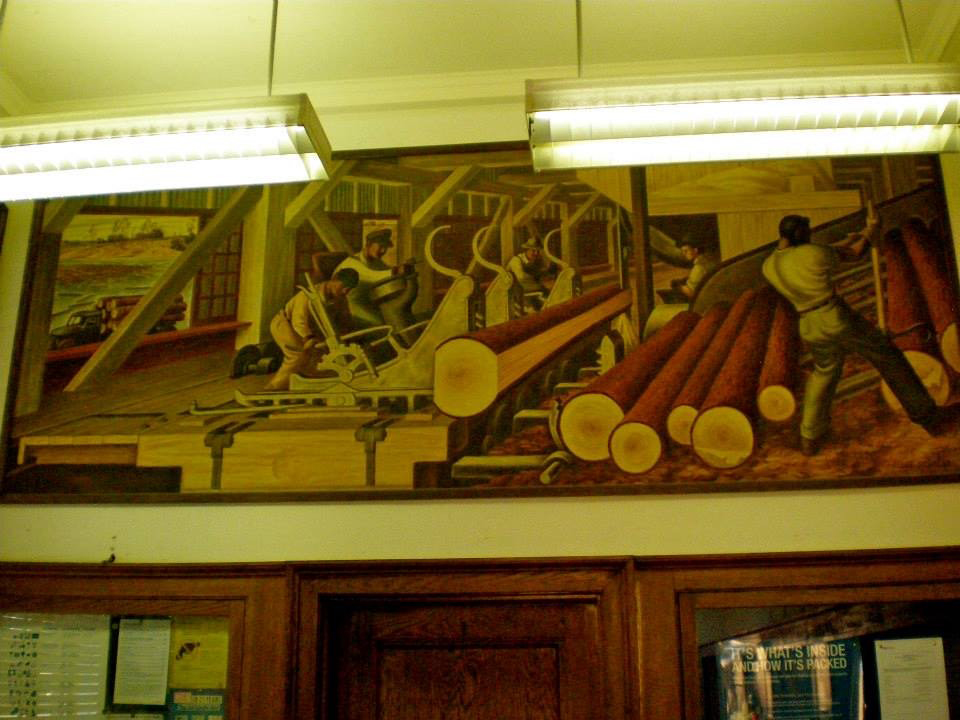
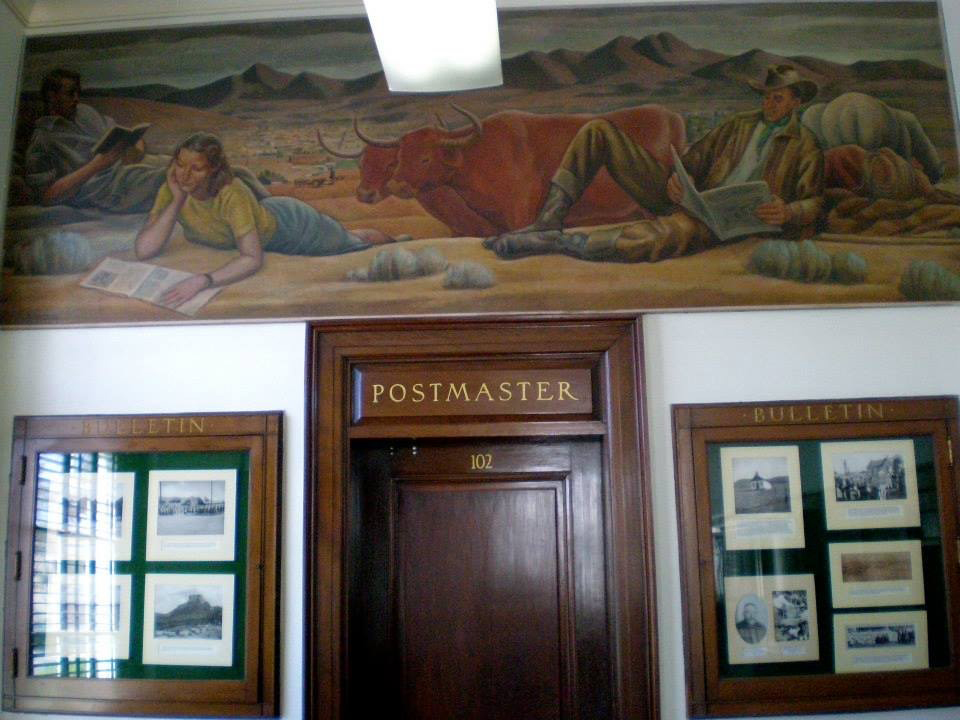
What best represented a town’s identity in the 1930s and 1940s? Gather your clues by looking at post office murals in Trinity in East Texas, where its lumber industry loomed large, or Alpine in far West Texas where the college (now Sul Ross State University) was as much a point of pride for its citizens as the nearby mountainous landscape. And what’s one of the most classic symbols of the Lone Star State? The longhorn, everpresent, makes its appearance in several Texas post office murals.
Trinity, TX. Jerry Bywaters, “Lumber Manufacturing,” 1942. Image courtesy of Leslie Thompson.
Alpine, TX. José Moya del Pinto, “View of Alpine,” 1940. Image courtesy of Leslie Thompson.
Who painted these murals? Artists not only from Texas but from all across the country, as each selection was made through a competition of anonymous submissions. A roster of familiar names (depending on your knowledge of early Texas art) includes:
Otis Dozier (a member of the Dallas Nine)
Peter Hurd (the New Mexico artist who married into the famous Wyeth family)
Tom Lea (an El Paso-based artist)
Joe De Yong (a mentee of the iconic Western artist Charles Russell)
Alexandre Hogue (a member of the Dallas Nine)
Ward Lockwood (who organized the art department at UT Austin)
Jerry Bywaters (a member of the Dallas Nine and former director of the Dallas Museum of Fine Art, now the Dallas Museum of Art)
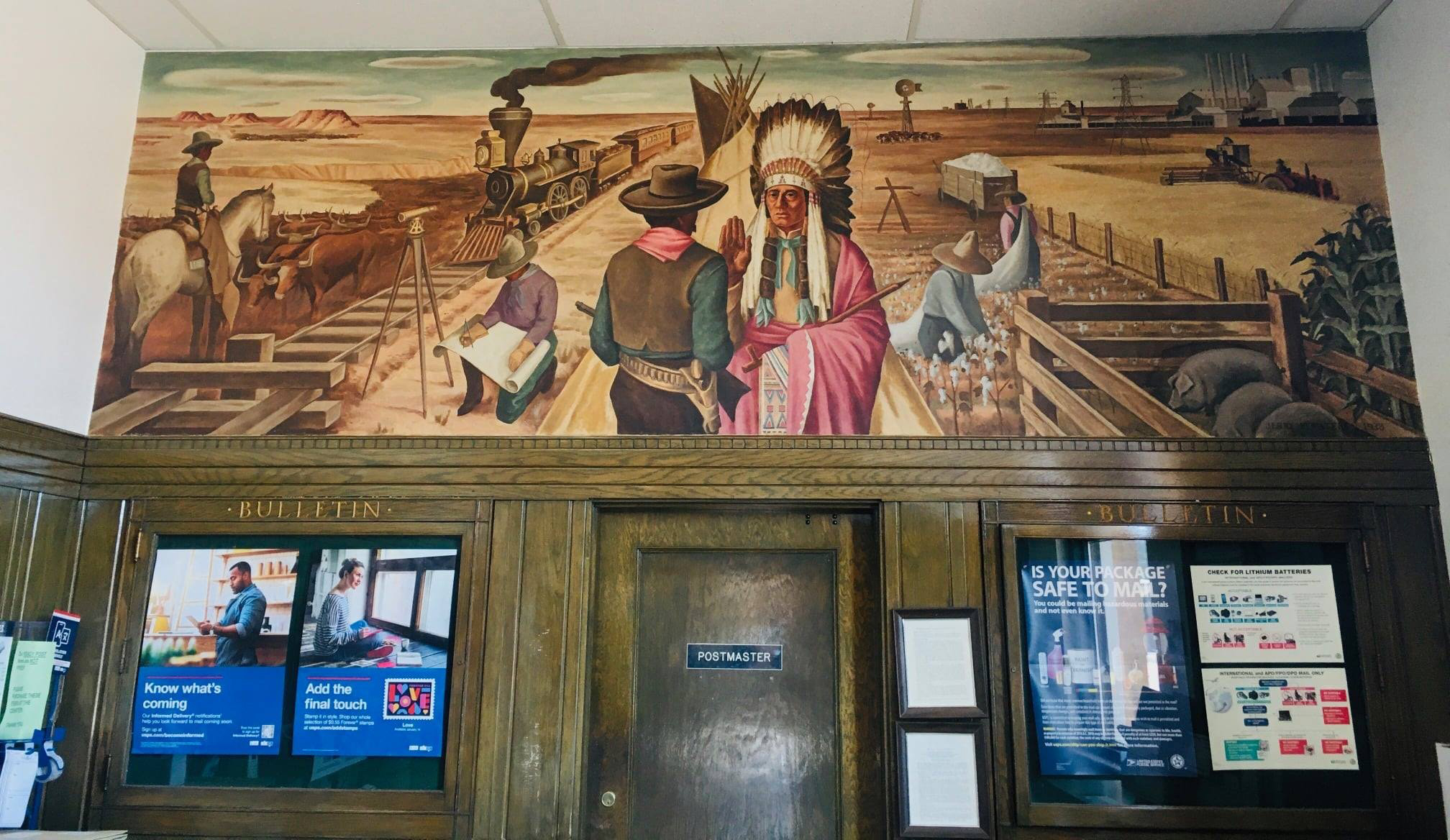
Quanah, TX. Jerry Bywaters, “The Naming of Quanah,” 1938. Image courtesy of Leslie Thompson.
If you plan on starting a post office mural journey, a word of advice: be flexible. Not all murals remain in their original location. The Arlington post office building has been through many iterations, the most recent of which (the last time I checked) is as a branch of Worthington National Bank. When I visited the bank long ago, the mural still hung above the original postmaster’s door (which now houses offices for the bank’s employees). But within the last few years, in an effort to better preserve the mural, the 1941 painting moved to the Amon Carter Museum of American Art, where it’s on display across from the museum store. Similarly, the Odessa mural (which, full disclosure, remains my favorite PO mural I’ve visited to date), moved from the town’s post office to the local Ellen Noël Art Museum, which restored the painting. Today, while the Odessa museum undergoes an expansion, the mural is on display down the highway in Midland at The Museum of the Southwest.
Odessa, TX. Tom Lea, “Stampede,” 1940. Image courtesy of Leslie Thompson.
As of this writing, I’ve visited 23 Texas post office murals (and a few more just beyond the borders of the state). Each visit carries not only a unique memory of the mural, but of my journey to the mural and the people and sites I encountered along the way. I hope you’ll join me in this short series as I take you around different corners of the state, exploring the hidden treasures of small town Texas through its post office murals.
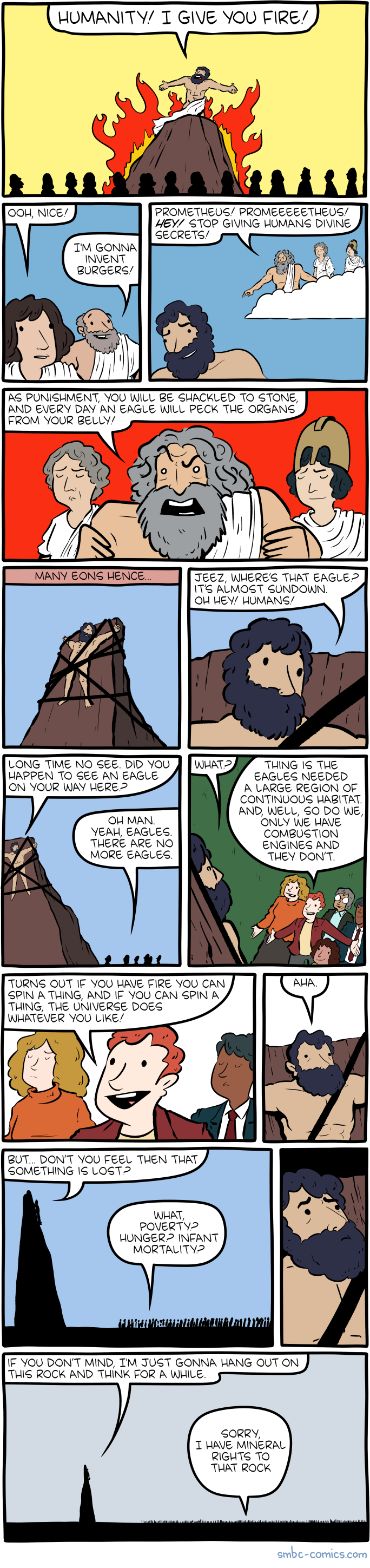
Hovertext: I hate drawing crowds, but I love portraying humans as lemmings.
Today's News:
I know no reads this blog, but I just wanted to paste the shockingly positive reviews Bea Wolf has gotten so far. More are on the way, but are under wraps for now. Thanks unending to all of you for putting me in a position to have the intellectual time to develop the skills to create such a risky book, and for the financial and career stability to then actually take the risk. <3
"Glorious, accurate, profoundly silly and hilariously profound."
â Neil Gaiman
"As haunting, hilarious and perplexing as the ancient stories one hears around the campfire, castle or cafeteria."
â Lemony Snicket
"It's Seuss and Dahl's mutant offspring, gorgeous and darkly witty."
â Mary Roach
"An instant classic. Like nothing I have ever seen. The unforgettable characters within Treeheart and their death-defying (and extremely funny) heroics now have a permanent place in my brain.
This combination of impossibly charming art and boundlessly thrilling and hilarious text is a required addition to your family's library.
I love this so much."
â Nathan Pyle
âThis is true bardic glory, a wild embrace of absurdity and witâ¦â
â Bulletin of the Center for Children's Books, Starred Review
âReaders will wish they could pledge their plastic swords to defending Treeheart and the sanctity of wild childhoods everywhere.â
Try out my quantum mechanics course (and many others on math and science) on Brilliant using the link https://brilliant.org/sabine. You can get started for free, and the first 200 will get 20% off the annual premium subscription.
That the Gulf stream might collapse is one of the scariest consequences of climate change for us here in Europe, at least if you believe the headlines. In this video I'll explain why the Gulf stream can't collapse, what the headlines really mean, and what climate change might do to Europe.
00:00 Intro 00:49 Westerlies and Easterlies 04:12 The Gulf Stream 06:32 The Jet Streams 08:52 The AMOC 11:34 What Might Happen? 13:07 Learn Physics With Brilliant
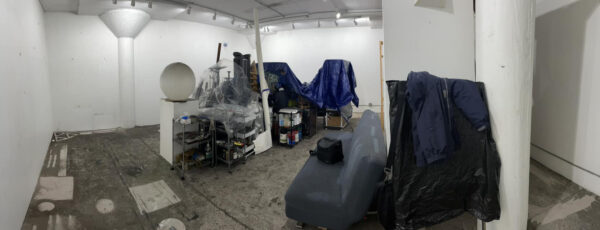
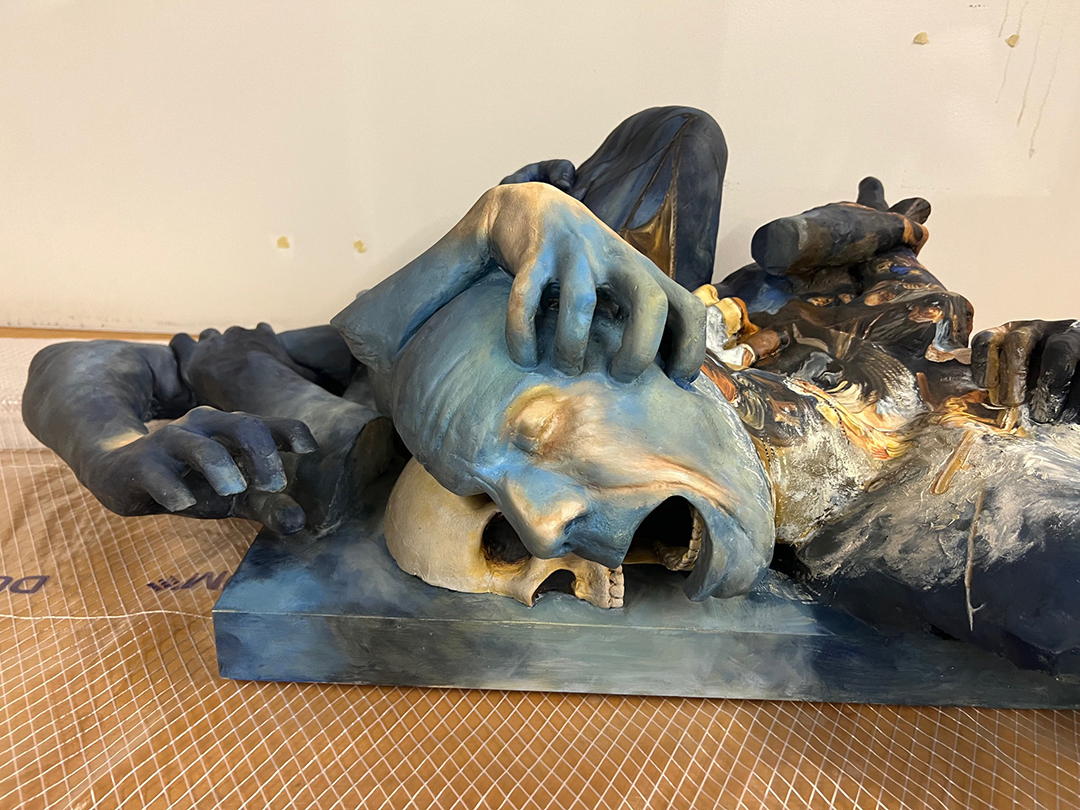
A month after Winter Street Studios, the 75,000-square-foot building that is part of the Sawyer Yards artist studio complex in Houston, suffered severe damage due to arson, over 100 artists are still dealing with the fallout. Artists have lost equipment, materials, and years of work, including pieces that had already been sold but not delivered and works that were destined for exhibitions.
In a press release from the Houston Arts Alliance (HAA), artist Taylor Blaine stated, “We received an email that there was a fire around 7:45 am on Tuesday [December 22, 2022]. In the next 3 hours, we learned that it was arson. It has been a roller coaster.”
Cary Reeder, who maintained a studio at Winter Street, told Glasstire that she originally assumed the fire was minor and perhaps caused by a space heater or an electrical short. She only realized the severity of the damage after entering the building to retrieve a painting she had sold that morning. She left immediately because she was in shock.
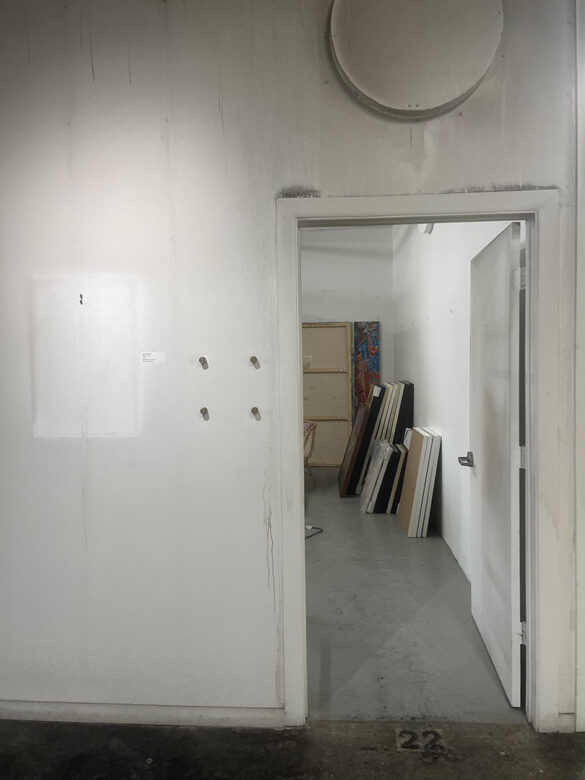
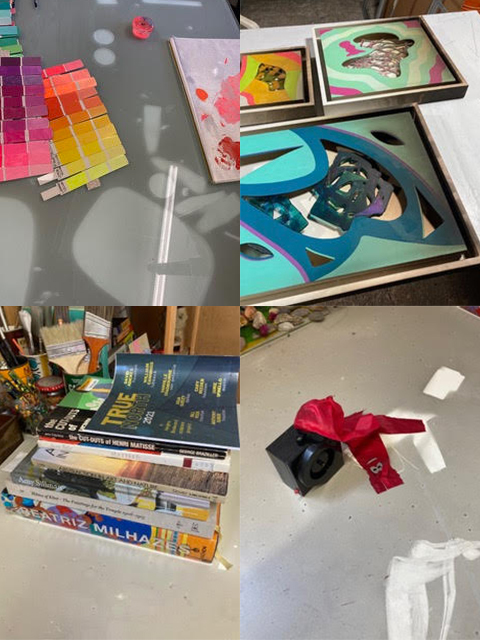
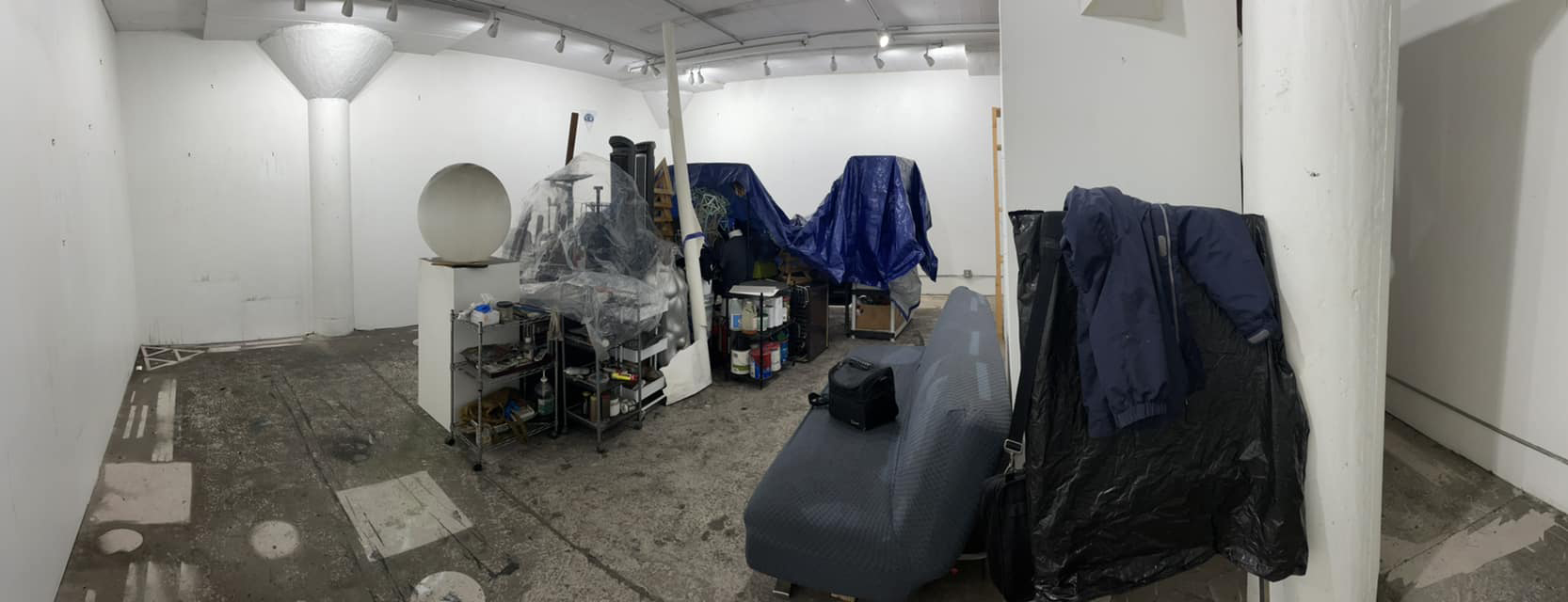
Images of Cary Reeder’s studio after the December fire.
Ms. Reeder, who has a pre-existing lung condition, explained, “I was terrified to go back into the building because I was dealing with/still am dealing with a lung infection that pulmonologist number 3 is still trying to figure out. The landlord offered to have my things moved so I wouldn’t have to go in the building, but my studio is my sanctuary and my artworks are my children, so I declined that offer.”
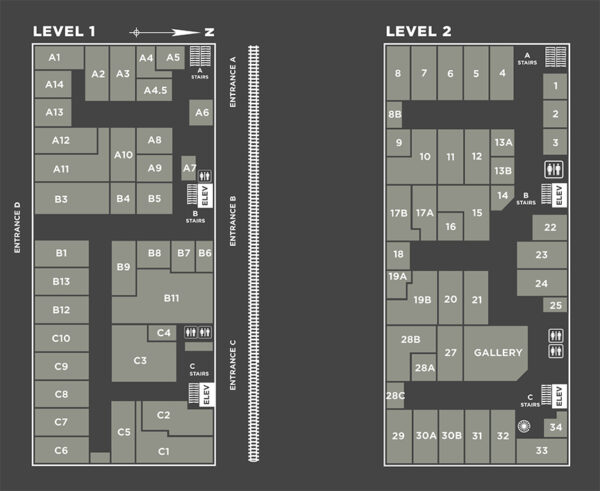
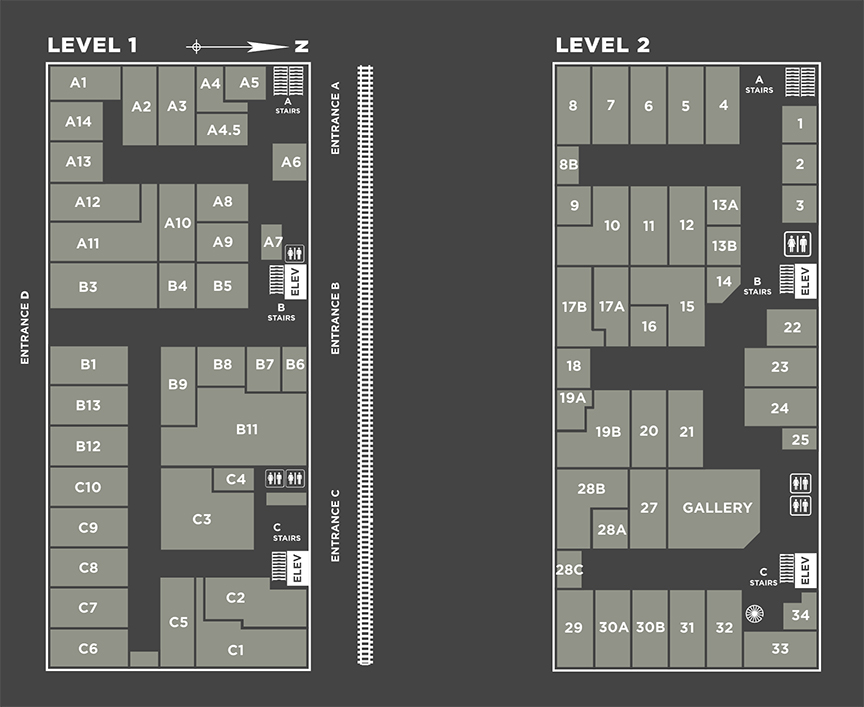
Winter Street Studios’ floor plan
All artists in the 77 studios spaces at Winter Street have been affected. Sections A and B of the building will be cleaned, with the goal of having artists back in these spaces sometime next month. However, section C, which is where the fire originated and comprises 10 ground level studios and approximately 12 spaces on the second floor, sustained structural damage and will take at least six months to repair.
For weeks, artists have been assessing damage to their artwork and personal effects, and have been packing up their studio contents. To advise artists through this process, HAA brought in TX-CERA, a group of volunteer conservators the organization works with. TX-CERA’s members, who have been trained by the National Heritage Responders (a group created by the American Institute of Conservation), visited artists’ studios, assessed damage, and provided guidance on how to clean and remove soot, which is oily and difficult to clean. Since those initial in-person meetings, the conservators have also been available to advise artists 24/7 by phone.
Laura Spector, whose artwork was damaged in the fire, told Glasstire that while the emergency conservators’ insight was extremely helpful, they informed her that it may take one to two years to get her artwork 80% repaired. Ms. Spector is slated to have a solo exhibition in Georgetown this September, and all of her works, which had been completed prior to the fire and were stored in her studio, have such significant damage that they need to be completely repainted.
Ms. Spector said, “…this is a very terrifying experience. Not only have I lost my art studio and about 20% of my artwork, I put myself in danger every time I go back to the studio to empty out my belongings.”
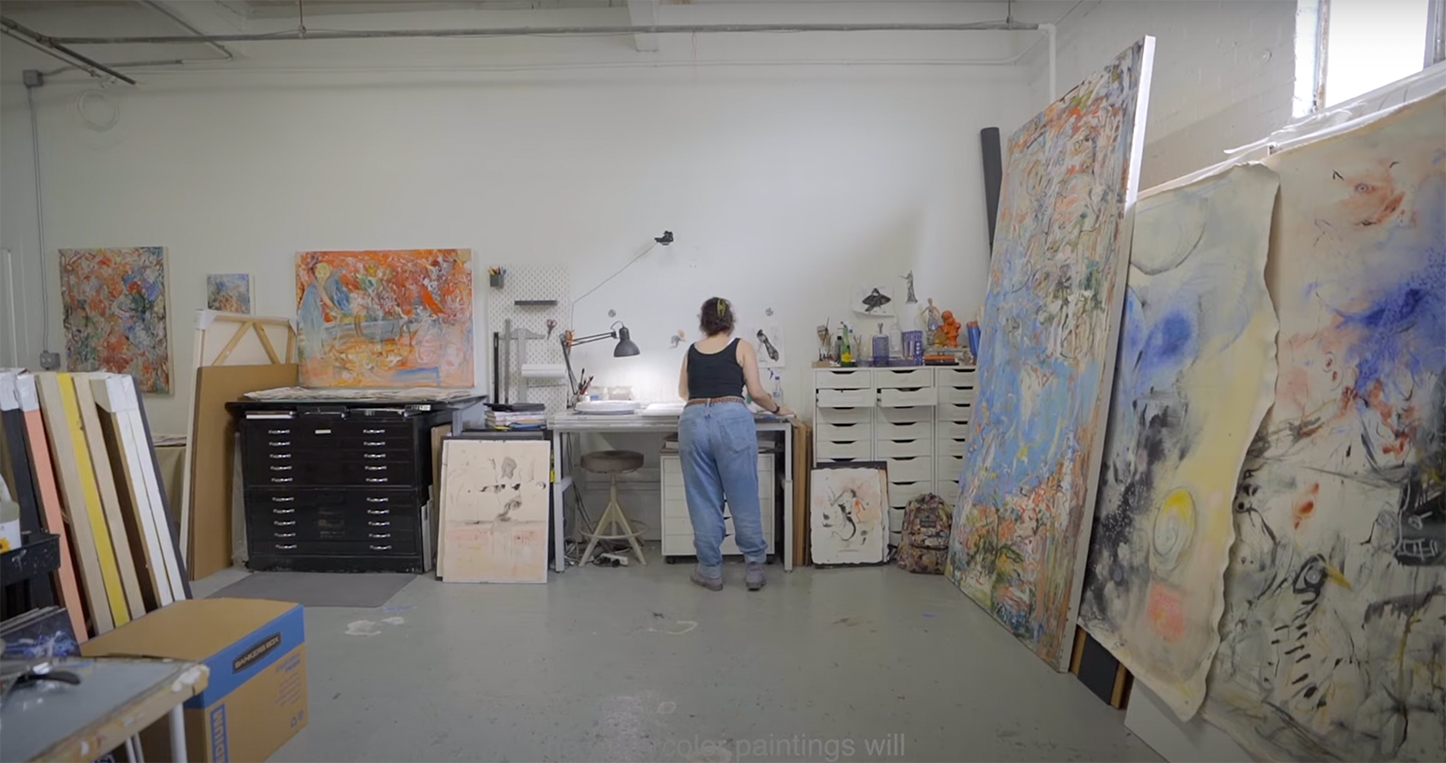
Vincent Fink’s studio
In a social media post, Vincent Fink also explained that his restoration efforts have not been 100% successful: “I’ve read up and gotten professional advice but some efforts have already been made and didn’t completely heal the work. I am moving onto secondary and tertiary methods but I might need to recreate some works or just sell them as they are. I am considering having some kind of sale of this nature… I spend anywhere from 50 to 200 hours on any given piece. So the destruction to my studio has set me back considerably, especially on my latest works.”
Erika Alonso told Glasstire, “I have barely begun the clean-up process. As in, I haven’t. I am at a standstill with my insurance claim; I took photographs, but am still unable to move my studio contents. This is the first time I’ve ever had to make an insurance claim and it’s a whole other level of frustration and uncertainty. I’m starting to realize that the recovery is going to be a very, very long process.”
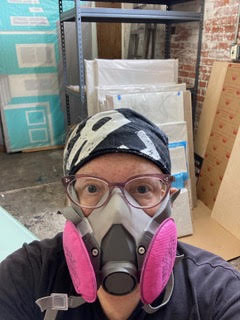
Cary Reeder wears a respirator as she cleans her studio.
Because soot, which has permeated all areas of the building, is toxic, artists have been donning Tyvek suits, respirators, and gloves to undergo the work of cleaning, packing, and moving their studios. HAA confirmed that TX-CERA volunteers will be onsite at Winter Street Studios this Saturday from 3 pm to 5 pm to hand out free Personal Protective Equipment (PPE) and other supplies to artists.
Aside from bringing in TX-CERA, HAA has also activated its Emergency Relief Fund. HAA’s Director of Disaster Services, Lauren Hainley, stated in a press release, “To many artists and creatives, their studio is a sacred space. Our research shows that Houston undergoes a federally declared disaster every 9 months on average. This means that Houston artists are particularly vulnerable to catastrophes. During my tenure at HAA, we have worked diligently to advocate for artists and to set up processes that will enable us to better assist artists. In this case, the Disaster Services team was able to activate the Emergency Relief Fund in less than 12 hours.”
HAA told Glasstire that as of Thursday, January 19, there has been nearly $48,500 donated to the fund, though the 53 applications submitted by Winter Street artists document a total of $1,125,000 in damages.
As of Friday, January 20, HAA has distributed funds of $750 or $1,500 via direct deposit to 24 applicants. The remaining applications are still pending review by a group of panelists, which includes artists and conservators. If artists have questions about receiving funds, HAA encourages them to contact Lauren Hainley at lauren@haatx.com.
A fundraiser will be held tomorrow, January 21 at the Silver Street Studios Warehouse from 11 am to 3 pm. Over 100 artworks will be for sale, with 100% of the proceeds benefiting the Winter Street relief fund. The event has been organized by Sawyer Yards, HAA, and Fresh Arts.
When asked if any additional funds would be made available for affected artists, Houston Mayor Sylvester Turner told Glasstire: “We are a city that helps one another. When tragedy strikes, we always come through for those who are in need. The loss of property at Winter Street Studios is saddening but we should look at it as a chance to help. As Mayor of the City of Houston, I am doing my part in finding resources to help the affected artists.”
Despite the efforts of HAA, Ms. Spector feels strongly that “the Winter Street Studio artists are in desperate need of an advocate.” On Wednesday, January 18, Ms. Spector created a public Facebook Group as a venue for affected artists and volunteer conservators to continue discussions about cleaning and stabilizing damaged artwork. Along with the artists’ conservation needs, they face many other hurdles, including storing work, purchasing new equipment, and relocating their studios either temporarily or permanently.
Ms. Reeder has found a new studio a few blocks away and does not plan to return to Winter Street, though she has fond memories of the space. She remarked, “I need to put this chapter behind me and start anew. I am looking forward to getting back to art making, whenever that will be, and already have an idea for an exhibition involving Tyvek suits. We’ll see.”
January 21, 2023: This article has been updated to include Mayor Sylvester Turner’s quote about the Winter Street fire, and his attempt to find additional resources for affected artists.
A security vulnerability report arrived that showed that if you loaded a specially-crafted file into a file viewer, the file viewer crashed. This was filed as a denial of service against the file viewer.
And indeed, the crafted file did cause the viewer to crash: The file format internally consists of several recursive structures, and in the crafted file, those structures contained loops. The viewer didn’t have any detector for infinite loops, so its recursive parser crashed with a stack overflow.
Let’s run through the usual questions.
Who is the attacker? The attacker is presumably somebody who sends you a crafted file and tricks you into viewing it.
Who is the victim? The victim is the person running the viewer and is unable to view the file.
What has the attacker gained? The attacker prevented the victim from viewing the file.
Now, another way to prevent the victim from being able to use the viewer to view a file is to send them a file full of garbage, or even simpler: Don’t send them the file in the first place. But that’s so obviously pointless that it’s presumably not what the finder was reporting.
Maybe what the attacker gained is that the victim’s file viewer program crashed, and the victim therefore lost any unsaved data. But this is a file viewer program. There is no unsaved data at all, since it never modifies the file. All the victim has to do to recover is to relaunch the file viewer program. The crash is not persistent, and it’s certainly not unrecoverable. You recover by just running the program again!
Therefore, all the attacker really accomplished was to annoy the user briefly. They could also have done that by tricking the user into viewing a file that contained the message “Ha ha, I annoyed you!”
A similar security vulnerability report came in that claimed to have identified a denial of service attack against a file editor: Loading a crafted file into the file editor caused the file editor to crash.
What happened is that the file is corrupted in a specific way that causes a helper function to say, “Nope, I can’t parse this,” and return a null pointer to represent the error. But the caller of the helper function didn’t check whether the call succeeded and tried to use the resulting null pointer. Therefore, this is a guaranteed null pointer crash, with no ability to control the read-from pointer. No chance for memory modification or information disclosure. Worst case is data loss and denial of service.
But does it even get you that much?
Before you load a new file, this particular program will prompt you to save your changes to the old file before it closes the old file and opens the new one. So there is no loss of data here: The user was given a chance to save their unsaved data. Any unsaved data would have been lost anyway even if the new file were not corrupted.
That leaves denial of service. The program crashes trying to load the crafted file, but the user can just launch it again. There is no permanent corruption, the relaunch of the program proceeds as usual. This is just a bug in the file editor program. The user will say, “Oh, well. I guess I’m not opening that file any more.” All you managed to do was annoy the user momentarily.
A third security vulnerability report came in that claimed to have identified a denial of service attack against Windows logon. The finder claimed that if a user set up their user profile with a crafted image with a crafted file name, then the image would come out garbled on the logon screen. The finder included a copy of the problematic image, as well as instructions on how to set it as the profile picture.
What the finder didn’t explain was why this was a denial of service, or why there was really any issue at all.
I guess an attacker can set a crafted image as their profile image, thereby preventing their image from displaying correctly on the logon screen. But so what? Just create an image filled with static or other garbage, and set it as your profile image. But why stop at garbage? If you don’t want people to know what you look like, then upload a blank picture, or a picture of a cow. You can even try to impersonate somebody else: Upload a picture of a celebrity, or your boss!
Who is the attacker? The attacker is presumbly the person setting the crafted profile picture.
Who is the victim? The victim is, I guess, everybody else who is looking at the profile picture.
What has the attacker gained? Unclear. This doesn’t let them do anything they couldn’t already do by much more conventional means.
Nothing has been gained here. Nobody is even slightly annoyed!¹
In all of these cases, what the finder identified was a bug. Thanks for reporting the bug, and we’ve assigned it to the component owners. But these bugs have no security consequences. You could have gotten the same result by just using a file full of random garbage.
¹ Okay, if you upload a picture of your boss, you might annoy people who mistake you for your boss. And you might annoy your boss.
A security vulnerability report arrived that went something like this:
Windows is vulnerable to remote code execution as follows:
Modify the file %USERPROFILE%\AppData\Local\Contoso\BlahBlah and add this line to the PlugIns section.
Run the contoso.exe program.
The contoso.exe program loads its configuration from the BlahBlah file.
When the Contoso app starts, it tries to create a plug-in from the object you configured in PlugIns section, passing the initialization data you also specified in the PlugIns section.
By crafting the initialization data, you can get the system-provided object to run a command controlled by the attacker.
That’s all very interesting, but what is the vulnerability?
They never said.
The fact that the system-provided object can be induced into executing a command based on its initialization data is not surprising in this case: The initialization data for this particular system-provided object contains a serialized COM object, and deserializing it would naturally end up creating whatever you serialized.
My guess is that the finder was excited that they could modify a file in a way that leads to code execution when a program is run. But let’s look at our usual questions.
Who is the attacker?
The attacker is presumably somebody who is able to modify the configuration file.
Who is the victim?
The victim is presumably the user whose configuration file got modified.
What has the attacker gained?
Actually, if you look back at the earlier two questions, you’ll see that the attacker and the victim are the same person!
In order to modify a user’s files, you have to be that user or an administrator. In all cases, you haven’t gained any privileges beyond what you already had. If you’re the user, then you are attacking yourself. If you’re the administrator, well, it’s not interesting that the administrator can attack any user.
If you already had the power to modify the user’s files, then you don’t need to go to all the work of editing an obscure configuration file for a program the user might not even run. Just drop a batch file in the user’s Startup folder.
WASHINGTON—Pointing at each other and shouting as huge grins formed on their faces, Supreme Court Justices Samuel Alito and Clarence Thomas shared a long laugh this week after discovering they had both leaked the decision in Dobbs v. Jackson Women’s Health Organization. “Wait, you leaked the Dobbs majority opinion to …
New Zealand Prime Minister Jacinda Ardern, who gained international praise for her adept response to the nation’s worst mass shooting and pandemic, will step down, saying she no longer had “enough in the tank” to do the job justice. What do you think?
Submitter: If your idea of a romantic hero is a dude with anger management issues, zero people skills, and a bad case of lice, then here is the book for you! This is the tale of a lady who marries an impoverished misogynist and scrubs his entire castle. Despite the fact that he does not maintain his estate, she is somehow able to produce elaborate multi-course feasts. There’s a ghost, too, so maybe any kind of realism was too much to expect.
Also, we’re an academic library. Every book its reader notwithstanding, how in the name of S.R. Ranganathan did this get into our collection?
[Images, below:] 1 cheesy book cover with bad font (for a good 10 minutes, I thought the title was The Famine); 1 page of lice; 1 page of the most disgusting living-dining room situation in print; and 1 page of a downright miraculous meal.
Holly: Oh, Jude. Jude Deveraux was super popular back in the day. The cover DOES look like The Famine!

















 The Taming

