won't pull the graphic for some reason. Jeb's PAC has more money than the Democrats, and their PACs put together.
As Wednesday's FEC filing deadline approaches, we compiled what we know about how much the 2016 campaigns have raked in -- and how much the outside organizations supporting them have raised.
The outside groups (which can bring in unlimited amounts of money) are DRAMATICALLY outraising the actual campaigns (which are restricted to $2,700 per donor for the primaries and another $2,700 per donor for the general election).
The GOP outside groups that have released their figures have raised a whopping $203.5 million, versus a combined $53 million from the campaigns themselves. That's nearly a 4-to-1 ratio.
And that's compared with the $60.4 million the Democratic campaigns have raised, versus $24.3 million from the Dem outside groups.
I don’t think everyone knows just how excited I am about Genderalia!
Here is everything you need to know!
“We are a diverse group of college students and graduates from Oglethorpe University. Our first feature production, Genderalia, is a social documentary created and conceptualized by Gaoya Yang and is scheduled to be released this fall.
Genderalia is a film about gender roles and their impact on peoples’ lives. This documentary will serve as a vessel for the unheard voices speaking out about gender roles in our society.”
Please support us through the following social media outlets where you can find out more about the film and stay posted on the production progress…
This artist's impression shows exoplanet GJ 436b, which is surrounded by a massive gas cloud that streams behind the planet like a comet's tail for millions of miles.
Credit: Mark Garlick/University of Warwick
A Neptune-size planet appears to be masquerading as a comet, with a gargantuan stream of gas flowing behind it like a comet's tail.
The bizarre find is the first of its kind ever discovered by astronomers. The strange, cometlike planet, known as GJ 436b, is orbiting a red dwarf star and is about 22 times as massive as Earth. Astronomers detected the giant gas cloud around the planet using NASA's Hubble Space Telescope and Chandra X-ray Observatory.
"I was astonished by the mere size of the cloud of gas escaping from the planet," said study lead author David Ehrenreich, an astronomer at the observatory of the University of Geneva in Switzerland. [The Strangest Alien Planets]
Alien Planet Quiz: Are You an Exoplanet Expert?
Astronomers have confirmed more than 800 planets beyond our own solar system, and the discoveries keep rolling in. How much do you know about these exotic worlds?
0 of 10 questions complete
Alien Planet Quiz: Are You an Exoplanet Expert?
0 of questions complete
GJ 436b, located about 33 light-years from Earth in the constellation Leo, is a kind of world known as a warm Neptune. Such planets, at about 10 to 20 times the mass of Earth, are about the mass of "cold Neptunes" such as Uranus — and, naturally, Neptune — but they are as close, or closer, to their stars than Mercury is to our sun. With an orbit of only about 3 million miles (4.8 million kilometers), "GJ 436b is 33 times closer to its star than Earth is to the sun, and 13 times closer than Mercury," Ehrenreich told Space.com.
The cloud of gas around GJ 436b, made up mostly of hydrogen, has a circular head that surrounds GJ 436b, and a tail trailing behind the planet. The diameter of the head is about 1.8 million miles (3 million km), or five times the width of the host star, which is about half that of the sun, Ehrenreich said. The length of the tail is uncertain, because the research team's observations do not cover it entirely, but their computer models suggest it could be about 9.3 million miles (15 million km) long.
Although prior research has predicted that other gas giants should be blowing off cometlike tails, based on how hot they must be due to their proximity to their stars, "GJ 436b is the first planet for which a cometlike tail is confidently detected," Ehrenreich said. (A previous study revealed indirect evidence of a rocky world that appears to be disintegrating around its host star, creating a cometlike tail of material behind the planet. That study used data from NASA's Kepler space telescope, which observed scattering of the light from the planet's host star.)
The scientists estimated that GJ 436b is currently blowing off up to 1,000 tons of gas per second. This means that GJ 436b is currently losing about 0.1 percent of its atmosphere every billion years, which is far too slow a rate to deplete its atmosphere in the lifetime of its parent red dwarf star. However, when the star was more active in its infancy, the researchers estimated that GJ 436b could have lost 10 percent or more of its atmosphere during its first billion years.
Recently, another team of researchers suggested that GJ 436b might possess a helium-rich sky depleted of hydrogen. "However, in order to be really hydrogen-poor and helium-rich, the atmosphere of GJ 436b should have represented a very small fraction of the planet['s] initial mass, around one-thousandth," Ehrenreich said. "In such a case, the whole atmosphere would have been gone today, which as we measure is not the case."
Ehrenreich noted that the Kepler spacecraft, as well as NASA's upcoming TESS space mission and the European Space Agency's future CHEOPS and PLATO spacecraft "are poised to find thousands of system like GJ 436 in the coming years." This suggests that many other planets with cometlike tails could soon be discovered.
Artist's impression showing the warm, Neptune-size exoplanet GJ 436b at the beginning of its transit across the surface of its parent star, a red dwarf that is half the diameter of the sun. The planet is 33x closer to its parent star than the Earth is to the sun, heating the atmosphere to the point where it expands and escapes the planet attraction. The star is, however, 40x fainter than the sun, allowing the evaporating atmosphere to form a giant cloud surrounding and trailing the planet, much like a comet. Credit: D. Ehrenreich / V. Bourrier (Université de Genève) / A. Gracia Berná (Universität Bern)
The scientists now plan to investigate less massive planets, such as "super-Earths" and "mini-Neptunes" to see if they might also have puffy atmospheres and cometlike tails.
"We're going to study one such object in the course of next year with Hubble, and have proposed to observe several more," Ehrenreich said.
The scientists detailed their findings online today (June 24) in the journal Nature.
We’re sometimes asked how the early modern recipe books we cook from ended up in library collections. It varies: some were purchased directly by the library, others were gifts. However they made it into holdings like the Kislak Center’s, we feel fortunate that they did. As I looked over the provenance notes for UPenn Ms. Codex 205, I saw a familiar name. The book was a gift from Esther Bradford Aresty, part of the Esther B. Aresty Collection of Rare Books on the Culinary Arts. Aresty (1908-2000) was a culinary historian and cookbook collector who donated her collection of 576 printed volumes and 13 manuscripts, ranging from the fifteenth to twentieth century, to the University of Pennsylvania. (For more on Aresty’s remarkable life and collecting, see here and here. Penn also holds Aresty’s papers, which I’m looking forward to digging into soon.) Aresty’s collection has already informed this project: of the recipe books we’ve cooked from so far, UPenn Ms. Codices 252, 625, 627, and 631 were also her gifts.
In her first book, The Delectable Past: The Joys of the Table – from Rome to the Renaissance, from Queen Elizabeth I to Mrs. Beeton. The Menus, the Manners – and the most delectable Recipes of the past masterfully recreated for cooking and enjoying today (1964), Aresty transcribed and updated over 700 recipes from the volumes in her collection in order to make them widely accessible: “The more I wandered around in those precious volumes, the more I wanted to share them with others” (9). The chapters begin with “Antiquity to the Middle Ages – The Delicious Beginnings” and end with “Late 19th-Century America – Cooking Lessons Well Learned,” each detailing several recipes and images. Aresty didn’t include any recipes from Ms. Codex 205, but it’s listed in the index as part of her collection at the time. She describes The Delectable Past as “the result of my adventuring through their pages.” Adventuring through the pages: what a perfect way to describe the experience of reading old cookbooks, or encountering older texts more generally.
Aresty characterized her method as one of updating: “I’ve tried to adapt the recipes in the simple style that made them such a delight to read and follow. … With few exceptions, they are all easy to prepare, and rely on a subtle twist, or nuance, or combination, rather than laborious preparation. Though canned soups and other commercially prepared products have not been specified, they may be substituted wherever you deem proper.” And she encouraged experimentation: “You may arrive at some individual effects of your own while using the recipes in The Delectable Past. All have been tested in my kitchen, but your imagination can take over in many of them. After all, the same recipe will produce varying though equally good results in different hands. Yours may be better than mine” (12). As I read Aresty’s words, with Ms. Codex 205 sitting to one side, I felt like I’d found a kindred spirit. I’m looking forward to more adventuring in Aresty’s collection.
UPenn Ms. Codex 205 begins with a handy table of contents of its recipes. I looked no further as soon as I saw #66: Beer Cakes. Beer Cakes? I had to try these.
This recipe book was probably compiled from the last few decades of the eighteenth century into the first of the nineteenth. Recipe #130 is dated 1791; #162 is dated 1801. The last page of the book details the diet plan “Mr. Whilby of Wallington Norfolk” used to raise his calves in the winter of 1777. (Now, there’s a sentence I’ve never written before.) There is also a loose letter tucked into the volume, dated February 1808, from “AB” to Mrs. Edward Browne, copying the recipe for “A Sweet Jar” that’s also written into the book. The first 109 recipes (including the Beer Cakes) are written in one hand, then the rest of the book continues in at least six hands.
The Beer Cakes call for “old Beer” – a very efficient way to use beer that might be past optimal drinking stage. Interestingly, this is the first early modern baking recipe I’ve noticed that calls for beer. I’m now curious about how common this was, so I’ll be on the lookout for more. The beer used would probably have been purchased; by the late eighteenth century, the earlier prevalence of home brewing had been largely displaced by industrialized beer production. (For more background, see, e.g., The Oxford Companion to Beer, ed. Garret Oliver [2011], and I. S. Hornsey, A History of Beer and Brewing [2003].)
I wasn’t the only one who found these Beer Cakes delicious, apparently: note the bookworm holes in the upper right-hand corner of the recipe page.
The Recipe
66. Beer Cakes
a Pound of Flour, 1/2 Pd. Butter, 1/2 Pd. Sugar, a few
Seeds, mix all together into a very stiff Paste, with
old Beer, roll and bake them on Tin Sheets.
Our Recipe
[halved from the original]
1/2 lb. flour (I used half white whole wheat and half all-purpose flour, about a scant 1 c. each)
1/4 lb. sugar (1/2 c.)
1/4 lb. butter (1 stick), room temp.
1 tsp. caraway seeds*
scant 1/2 c. beer, added in increments**
Heat oven to 350F. Line two baking sheets with parchment.
Combine all ingredients except the beer in a large bowl and mix with a spatula until relatively smooth. (You could easily do this in a stand mixer. I was feeling old school.) Add about half the beer and blend, gradually adding more as needed until you have a cohesive, stiff dough. It should be just wet enough to hold together but not so wet that it becomes soft and sticky. If it’s too wet, just add a bit more flour.
Lightly flour your surface and rolling pin, then roll out the dough to about 1/4″ thickness. (The day I made these was pretty humid – see: Philadelphia summertime – so I found that refrigerating the dough for about 10 mins. before rolling it out made the process of transferring cookies onto the baking sheets much easier.) Cut them out in shapes of your choice. My handy 2″ circle yielded 46 cookies. Transfer to lined baking sheets and bake for 12 mins., or until dry to the touch and golden brown on the bottom. (Your kitchen will smell like beer. Not at all unpleasant.) Remove to a wire rack and let cool.
*A note about “a few Seeds”: Other “seeded” recipes we’ve made have called for caraway seeds. I also looked at several print and manuscript recipes for Seed Cakes, all of which use caraway. So, I feel fairly certain that caraway seeds are accurate for the Beer Cakes. However, you could certainly experiment – poppy? Sesame?
**A note about the beer: I didn’t have any “old Beer” lurking at the back of my fridge – just as well, because I knew exactly which beer I wanted to use for this recipe. Philadelphia’s very own Yards Brewing Company produces three Ales of the Revolution, based on colonial brewing recipes. I was curious about how much the flavor of the beer would come out in the cookies, so I experimented by splitting the batch and making half with Thomas Jefferson’s Tavern Ale and half with Poor Richard’s Tavern Spruce. (I also made another batch with a lager, for additional experimentation. Same results.) I couldn’t really taste a difference, probably because the amount of beer in the recipe isn’t that large and the caraway seeds dominate; I definitely couldn’t taste the piney-ness that characterizes the Tavern Spruce. But I didn’t mind having the leftover beer with my cookies.
The Results
Favorite recipe since Maccarony Cheese! Of the other “cakes” recipes we’ve tried, they’re most similar to the Desart Cakes, which I also liked very much. But the addition of butter and especially of beer give these a depth and richness that can be unusual for early modern cookie-cakes. (They’re still beige, of course. Marissa and I have started thinking of this project as the realm of beige baked goods.) They don’t really taste like beer, but they have a richness and a nice crumb that’s less dense than the Desart Cakes. I’ll be making these again.
Esther Aresty, I raise a beer cake to you and your adventuring. Thank you.
(425): I feel sorry for the person who's phone number is 704-1776 cause from now on I'm giving that number to every guy I never wanna talk to again. Happy Independence Day.
The Algorithm Auction is the world’s first auction celebrating the art of code. The auction includes rare memorabilia and software licenses related to a range of important and historic code.
Can code be considered art? What responsibility do we have to preserve it? What is at stake in all of this? What follows is an edited version of the conversation, moderated by O’Brien.
super sad this isn't a thing in the midwest. boys can want to be pretty too dammit!
By Starla Long time Femulate readers will recall regular contributor Starla, who perused online high school yearbooks and clipped any womanless events she found memorialized in those volumes. (You can view her collection of clips here.) Starla is back with her theory regarding the reasoning for the existence and popularity of womanless beauty pageants in the Deep South.
Those of you who have followed Stana’s blog for any length of time know that she shares my obsession with “civilian” womanless beauty pageants. It has been fascinating for me to seek out and discover many of these increasingly elaborate events as they have evolved over the last few years.
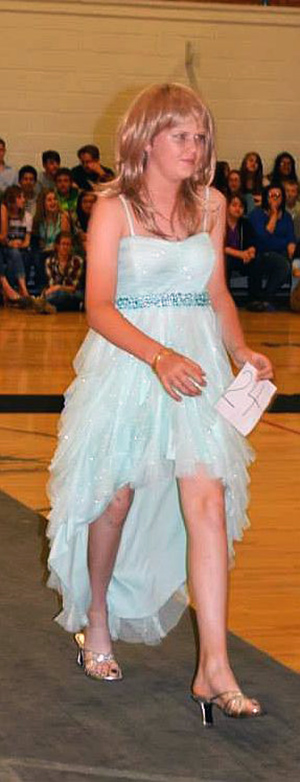
What has fascinated and intrigued me is that in recent years, the vast majority of the most elaborate and “realistic” pageants (in which the goal is to faithfully mimic girls and not to make fun of them with grotesque parodies), especially at the high school and middle school levels (and even occasionally elementary school), tend to take place in just two states: Alabama and Mississippi.
Yes, in two of the most religious and conservative states in the union, where gays and trans people encounter hostility and harsh judgment, people seem willing and eager to parade their tween and teen sons on a stage in up-to-date gowns, excellent wigs or natural hairstyles, perfect makeup, and high heels, and revel in the event.
Yet the cruel irony is that if any of those same young boys came home one day and announced that they were trans and want to actually become girls, those same parents would probably be horrified!
From a purely geographic standpoint, it’s not hard to imagine this phenomenon being concentrated in certain areas. After all, it's not unusual for any school fundraising or spirit building event to spread from school to nearby school. In this case, it’s also telling that while womanless pageants are held throughout the South, the few really top-notch and realistic events outside of Alabama and Mississippi tend to take place in border areas adjacent to those states. A good example is the annual pageant held at Ernest Ward Middle School, which is in the extreme northwest panhandle of Florida, just a few miles from the Alabama border. (Here in Florida, we tend to say that culturally, everything north of Gainesville is really Georgia and everything west of Tallahassee is really Alabama!)
The degree of attention to detail and realism in some of these pageants is remarkable. One recently discovered Mississippi event (in Kozciusko) had a dress shop owner bragging on her Facebook page that she had supplied dresses to four of the young male entrants in a local pageant (including her own 14-year-old son who, she proudly announced, had won the pageant). No thrift shop bargains or hand-me-downs – these were current fashions.
In many womanless events elsewhere, footwear tends to be male shoes, flip-flops, or bare feet. In these Deep South pageants, the boys almost uniformly wear stylish high heels and, judging from the ease with which they walk in them, they have practiced in them for some time. We’re talking about 3-to-4 inch heels on some of these! How many 12 to 16-year-old boys do you know who can walk gracefully in heels?
Makeup is done lavishly and professionally – one tween boy in an Alabama pageant looked like he had gotten a full M•A•C makeover. Nails are almost always painted – some even wear fake nails. A few of the pictures I’ve found show boys in open-toed shoes and it is apparent that their toenails have also been nicely painted. (This is the sort of obsessive detail that most audience members wouldn’t even be able to see from their vantage point.)
The outfits are nicely accessorized with earrings, necklaces, bracelets, even rings. Not grandma’s old junk jewelry – stuff that would look right at home on any female pageant contestant.
And the parents – these same parents who trash Caitlyn Jenner on their Twitter feeds or fight to keep transgender students from using gender-appropriate bathrooms (if they allow trans kids at all in their schools), or encourage county clerks to ignore the SCOTUS ruling and refuse marriage licenses to gay couples, nevertheless revel proudly (and often, not ironically or jokingly) in their son winning or placing high in a womanless event. They will brag on how pretty their son looked and how they looked totally feminine. While simultaneously, their Facebook accounts feature hunting trips, NASCAR, scripture quotations, and proud, defiant and conspicuous display of the rebel flag.
What’s going on here?
Well, maybe they truly see no irony. For them, dressing in drag for a womanless pageant is a fun frolic, a tradition, an innocent pastime having no relation to those heathen LGBT folks. It’s even a sort of rite of passage – I’ve seen more than one parent or grandparent congratulate their young’un on his “first” womanless pageant. (Implying that there will be more to come.)
But the lengths to which they take these things! I’ve corresponded with a fellow womanless beauty pageant enthusiast who has even attended some of these events and talked to some of the parents. Believe it or not, in the most extreme examples, they have worked for weeks on finding the perfect dress, experimenting with makeup, and drilling their son in pageant deportment. This is not something they throw together two days before the event – this is serious business to many!
I strongly suspect that many of the mothers who go all-out for these events are established “pageant Moms” who have daughters who compete. Then when it’s Johnny’s turn to be “prettied up,” they just apply the same level of intensity and attention to detail to their boys as they do to their girls.
Or they may be “wannabes” – I’ve noted a few cases in which a Mom freely admitted that they had no daughters and despaired of ever having the fun of preparing their kin for a pageant – until their son’s school held such an event and they were able to lavish their machinations on him! Beauty pageants, especially child pageants are big in the Deep South – it should perhaps not be surprising that much of this enthusiasm and borderline fanaticism spills over into the womanless pageant world.
As for the realism of the femulations, that, too, may be explainable.
Traditionally, the South has viewed their girls and women with an inordinate degree of chivalry, seeing them as precious gems to be honored and celebrated for their femininity. To lampoon girls in a womanless pageant with an exaggerated and homely burlesque of the “fairer sex” would be anathema to them. If their boys are going to portray girls for an evening, they will do so in a way that honors and celebrates their beauty and special status.
What about the young men and boys who don female garb for these events? Well, in the region in question, they seem to enjoy the experience for the most part. This doesn’t necessarily signify anything profound. Dressing up for a womanless pageant is not going to turn a boy trans, though it may help to confirm and solidify an existing propensity or desire to crossdress in someone who’s already wired that way and provides a safe and fun way to indulge those stirrings in a socially acceptable context.
However one theorizes about this phenomenon, it is a fascinating window on the unique and contradictory culture of Dixie!
What kind of rivalry are we going to have, and how will our first two humiliating losses determine the nature of that rivalry? You know what, screw that: why does rivalry have to feel this way? As with most things, Friedrich Nietzsche has some opinions about it.
How much reverence has a noble man for his enemies!—and such reverence is a bridge to love.—For he desires his enemy for himself, as his mark of distinction; he can endure no other enemy than one in whom there is nothing to despise and very much to honor! In contrast to this, picture "the enemy" as the man of ressentiment conceives him—and here precisely is his deed, his creation: he has conceived "the evil enemy," "the Evil One," and this in fact is his basic concept, from which he then evolves, as an afterthought and pendant, a "good one"—himself!
— Friedrich Nietzsche, On the Genealogy of Morals
I've never felt a rivalry like this. I don't mean I don't know of any, or I've never seen one: I mean I've never felt it. "Rivalry" even feels like an inadequate term for what is much more bilious and far less sportsmanlike. What it's like for the players, I'll never know. But for a fan, seeing a Harrison Red Bull supporter becomes like seeing a version of yourself who has made a horrible error and who persists in mocking you for not having made the same one yourself. It's like Freud's "narcissism of minor differences," in which the other who disturbs you most, pushes you deepest into fits of disgust, is the one who differs from you only very slightly—or in the case of a derby, only plays a few miles away. Harrison downplays the extent to which we are rivals, which is, of course, merely a tactic in pursuit of the very rivalry they disown. And in all probability the players on either team can't be bothered about who is based in New York and who in New Jersey, the foundation on which much of the banter is built. You sort of have to assume that, for them, it's all about the history on the pitch. But even that history is building, and fast. Pick your poison: Liverpool-Everton, Brazil-Uruguay, Catholic-Protestant; we're on our way.
This kind of rivalry is a feeling that is as hard to shake as it is hard to explain, as visceral as it is inexplicable. And it has all the arbitrary intensity of a moral system—though let's hope not quite as many atrocities will be committed in its name.
Nietzsche tells us (to reduce it) that moral systems arise from some act of definition by rejection: the good, the holy, the clean is always us; the bad, the evil, the dirty is always them. Assuming he's right, the reasons to be wary of this tendency are clear and numerous. Racism, religious persecution, homophobia—about every strike against the human race you can think of but Nicholas Cage, the explanation for whom continues to elude.
What's worse, and what I personally find so disturbing about The Genealogy of Morals, is that in Nietzsche's hands this type of moral self-definition is naturalized. Like the hunting instinct in the bird of prey, it's an act that's hard-wired into us on the level of species, and is thus very difficult to condemn as simply as we want to. At worst these instincts are with us still as "bad conscience," a kind of self-loathing in which these instincts, unable to unleash themselves in the wilderness, are turned against the self in the guise of a moral self-condemnation.
I say "at worst," because although the cultural and deep-psychological expressions of "bad conscience" may be inevitable, there are workarounds for the less subliminal expressions of these instincts. I'd hardly be the first to suggest either that sports are just a legitimization of the violence we'd otherwise condemn, or (what amounts to the same thing) that sports are an acceptable container for competition and violence that prevents them from spilling over into real life. But the spectator doesn't have any place in that schema: violence committed by a spectator is still just violence. And this is where rivalry comes in. Instead of acting as a container for violence, sporting spectatorship cordons off the kind of unthinking condemnation of an entire swath of people that, outside of an arena, is monstrous. It's catharsis for our baser instincts scaled up to encompass entire fan communities.
The baser instincts, though, also give rise to certain foundational aspects of culture—but containing rather than eliminating those instincts (which would anyway be impossible) allows us to hang on to the cultural self-definition we gain from concepts like "good" and "evil." Note the ending of this week's passage: inventing "the Evil One" is a route to inventing the "good one," which in context means inventing our conception of ourselves. This is hardly a cause for celebration in Nietzsche's view, but in a sporting or spectatorial context we can find room to reclaim what we want to.
For one, it's a way of building community; an arbitrary community, but we're in an age when pretty much every community is arbitrary. To put it slightly more optimistically, it's one way of finding a community in a city as big as New York, in which community is often lost because of sheer scale.
But rivalry, and supporting a club generally, also makes it uniquely justifiable to pick a side without thinking too hard about the consequences. Rivalry lets you say without complication, "This is good, that's bad, we're us and you're out in the cold, twerp." It exposes the arbitrariness of picking a side and revels in it, but it does so without allowing any harm to come of doing so. Outside of arena, uncontained, that's called nationalism and it's dangerous; but since you don't have to reckon with the draconian immigration laws or criminal foreign policy of a football club, saying "I'm with you no matter what" is a reasonable act. Sport spectatorship is unique in that it allows for uncomplicated partisanship regarding what happens on the field. And rivalry is just the ultimate expression of uncomplicated partisanship.
Return one more time to the passage. Note that the construction of the good/bad or good/evil binary depends on the relative positions of the two groups: the dominant group defines its opposites as "bad" or "lowly," the dominated group of ressentiment defines its opposite as "evil." City's been swatted this year, and the final meeting will, at best, only let us save face—they've taken two out of three. But we're in a unique position in relation to our own rivalry as a new team: the terms are being established over the next few seasons. What kind of shape is this eventually going to take? Are we going to be the "good one" to their "Evil One"? Or the "good" to their "bad"? Is this the start of our frustrating inability to overcome them, or their one moment in the sun before we come into our own and usurp the New York throne?
Remember, I'm a partisan, so I have my theories. I just hope we can think of our own equivalent of St. Totteringham's Day in time for the end of next season.
***
Every week, Ninety-Plus of Blue discusses one NYCFC match by way of one literary quotation. The goal each time is the same: to say something true about both and, hopefully, to understand both better as a result. In tracing NYCFC from its first kickoff, this blog is developing an (admittedly bizarre) hybrid genre that combines literary analysis with sports writing. Put another way, it's what happens when aesthetics meets aesthetic football.
In case you dont understand, when LGBT people say they feel uncomfortable with people posting rainbows over their icons whilst not being supportive of LGBT people in the least this is exactly what they mean