
×You need to sign in to continue.
Arnvidr
Shared posts
11 Oct 06:50
Comic for October 11, 2015
ArnvidrZing!
Dilbert readers - Please visit Dilbert.com to read this feature. Due to changes with our feeds, we are now making this RSS feed a link to Dilbert.com.
Tertiarymatt likes this
10 Oct 11:35
They
by jon
ArnvidrGuns again.

Guns! They sure are good at making it easy to kill a lot of people quickly. It’s a good thing they’re well regulated.
See you Monday for more laffs.

The post They appeared first on Scenes From A Multiverse.
Tertiarymatt, Tindalostalbot likes this
10 Oct 11:17
Why the World is Getting Weirder and Faster
by n1
HughPickens.com writes:
It used to be that airliners broke up in the sky because of small cracks in the window frames. So we fixed that. It used to be that aircraft crashed because of outward opening doors. So we fixed that. Aircraft used to fall out of the sky from urine corrosion, so we fixed that with encapsulated plastic lavatories. The list goes on and on. And we fixed them all. So what are we left with? According to Steve Coast that just leaves the weird events like disappearing 777s, freak storms and pilots flying into mountains. Engineers have been hammering away at the remaining problems by creating more and more rules. [ Ed note: Link is to a playboy.com article. ]
"As illustration, we created rules to make sure people can't get into cockpits to kill the pilots and fly the plane into buildings. That looked like a good rule. But, it's created the downside that pilots can now lock out their colleagues and fly it into a mountain instead. This is a clean and understandable example of why adding more layers, and more rules, to a problem doesn't always work," says Coast. "The worry should be we end up with so many rules we become sclerotic like Italy or France. We effectively end up with some kind of Napoleonic law – everything is illegal unless specifically made legal."
According to Coast the primary way we as a society deal with the mess of over-regulation is by creating rule-free zones. It's essentially illegal for you to build anything physical these days from a toothbrush (FDA regulates that) to a skyscraper, but there's zero restriction on creating a website. Hence, that's where all the value is today. To paraphrase Peter Thiel, new technology is probably so fertile and productive simply because there are so few rules. "If you are starting a computer-software company, that costs maybe $100,000," says Thiel. But "to get a new drug through the FDA, maybe on the order of a billion dollars or so."
Read more of this story at SoylentNews.
09 Oct 10:55
Buni
by Ryan Pagelow
ArnvidrVampy birds.

Lani Evitts, Tertiarymatt and one other like this
09 Oct 09:00


"Metal Studies" Academic Karl Spracklen claims that folk metal is racist and sexist
by BreadGod
ArnvidrJesus titty-fucking christ. The response to the study linked at the very end might be worth a read too, but requires signing in to facebook.

Have I ever told you how much I hate academics? And by academics, I don't mean scientists i.e. people who do work that provides some actual practical value to the real world. I'm talking about people from the "studies". You know, women's studies, gender studies, shit like that. They basically get paid to come up with ridiculous bullshit and make outrageous claims which they then use as justification for pushing their authoritarian ideas. That brings me to a guy named Karl Spracklen. He is an academic who specializes in "Metal Studies" at Leeds Beckett University in England, and he recently published a study where he claims that folk metal is racist and sexist.
Not only is Karl Spracklen's "study" heavy on assumptions and light on facts, but it's also fundamentally flawed for one key reason: he assumes that folk metal is an exclusively european phenomenon. Folk metal simply means you incorporate your culture's folk music into the metal. Since metal is a global genre, it's no surprise that folk metal can be found all over the world, which means you end up with all sorts of different flavors of folk metal. Hell, just look south of the American border. I managed to find plenty of Mexican metal bands that incorporate Aztec and Mayan folk music into their work, such as Yaotl Mictlan, Camaxtli Yoxippa, and Cabrakaan.
Look further south to South America. The countries down there produce so much folk metal that someone made a massive compilation featuring the best folk metal that South America has to offer. You can listen to the compilation on the Paganvs Info youtube channel. Now let's look across the Pacific Ocean. China has a rich history of incorporating their nation's music into metal, the most famous example of which is Tengger Cavalry. Even in the Middle East there are band's that take their culture's music and mix it with metal, such as Al-Namrood and Narjahanam.
I managed to find all of these bands with just ten minutes of searching. Karl would have known just how diverse folk metal is if he had bothered to leave his ivory tower and look at Metal Archives. I could just end the article right here, but let's see what this cuck has to say.
A new study from Leeds Beckett University has revealed how the metal music subgenre of folk metal is not only a fantasy space for young, white European men but also an important example of how heavy metal can be seen to normalise masculinity and ‘whiteness’ and perpetuate sexism and racism.
In the very first paragraph they use a weasel word. Bad form from someone who calls himself an academic. "Can be seen to perpetuate sexism and racism." Well, does it or doesn't it? "Well, I don't have any proof that folk metal perpetuates sexism and racism, but it can be seen to perpetuate those things." Karl claims that folk metal can be seen to perpetuate sexism and racism, but does it? That's another thing you need to understand about social justice warriors: they never give a straight answer.
The study, published by Professor Karl Spracklen in a special issue of the journal Metal Music Studies on gender, race and class, edited by Rosemary Lucy Hill (University of Leeds), Caroline Lucas and Gabrielle Riches (Leeds Beckett, pictured) argues that folk metal, through its lyrics and stage clothes centred on myths of warriors, preserves an old-fashioned power structure where white, male Europeans are superior.
In other words, Karl attempts to apply critical theory to metal. As I've pointed out in the past, the theory of critical theory is simply to criticize. They don't offer up any alternatives or solutions, they just attack. This article doesn't link to the study, but after a bit of searching, I managed to find it. Problem is, you have to pay 18 bucks for it. Yes, you have to pay 18 bucks for a short PDF. What a fucking ripoff. Guess we'll just have to go with what the article says.
“Through the study, I found that although women fans of heavy metal enjoy folk metal with the same kind of passion and intensity as male fans, and there is no doubt they find identity and belonging through the music, the heart of folk metal is predominantly masculine. The warrior myth that folk metal is focused on is normalising this masculine predominance in our modern day world- men still have enormous social, cultural and political power.
This shit sounds like something Anita Sarkeesian would write. So just because men are successful socially, culturally and politically, you automatically assume that folk metal is all about "normalizing masculine dominance"? Folk metal bands don't make music in order to enforce the patriarchy or some dumb bullshit like that, they write music in order to entertain. I'm pretty sure folk metal bands know the intention of their music better than you. If folk metal bands were actually interested in "normalizing masculine dominance", then bands like Arkona wouldn't even exist, much less become popular.
“Folk metal’s obsession with warriors and cultural purity, displayed through tales of Vikings and dressing up as Vikings on stage, reduces belonging and identity in a muti-cultural, cosmopolitan society to a few exclusive myths. It is showing white men how to be white men and showing women and ethnic minorities their place in European society.”
Funny how you mention multiculturalism. Last time I checked, multiculturalism has failed. For those who don't know, multiculturalism is the idea that all cultures merit equal respect. This means that middle eastern culture, which spends most of its time treating women like cattle and killing homosexuals, deserves just as much respect as western culture. Multiculturalism is incredibly popular over in Europe. Here in America, immigrants are expected to assimilate to American culture. There is no such expectation over in Europe. Instead, Europeans believe that they should respect the cultures that immigrants bring with them, even when those immigrants use their home country's culture as an excuse to kill cartoonists and blow up bombs on city buses.
Multiculturalism has predictably led to disaster. Just look at what happened to Sweden. They wanted to prove just how tolerant and progressive they are by letting in hundreds of thousands of immigrants from Africa and the middle east and made no attempt to assimilate them. Sweden is now the rape capital of Europe, and most of those rapes are committed by African and middle eastern immigrants against native Swedish women. The point I'm trying to make is, if you believe that fundamentally incompatible cultures can live together peacefully, then you're in for a rude awakening.
Let's get back to the subject at hand. Karl proceeds to talk about leisure spaces and the various bands he covered in his study. After some meandering bullshit, he ends the article by saying:
“In my research I argue that folk metal serves as a comfortable leisure space for those that have lost power in recent decades: the white European, working class men who have faced challenges to their assumed privileges from women, globalisation, immigration and postmodernity. However, at the same time it should not be easily dismissed in this way, and I believe it remains central to the idea of heavy metal as a form of leisure that makes masculinity and whiteness the norm.”
So what have we learned today? According to Karl Spracklen, racism means white people taking pride in their cultural heritage and sexism means men taking pride in their masculinity. All other races are allowed to take pride in their cultural heritage, but when white people do it, that means they are nazis who want to kill anyone who a has skin tone darker than a peach. Women can be proud to be women, but if men are proud to be men, then that means they are evil misogynists who want to oppress all women.
When it comes right down to it, this "study" is yet another attempt at browbeating metalheads into submitting to social justice. People like Karl Spracklen believe that if they just call metalheads bigoted enough times and keep publishing bullshit "studies" like this claiming that metalheads are bigoted then we will eventually surrender to their will and let them turn metal into nothing more than a propaganda tool. The only proper response to people like Karl Spracklen is to tell them to fuck off. Metalheads are already doing that. This response from Edwin Sebastian Marc is my favorite.
08 Oct 01:51
RIAA Chief Says DMCA is “Largely Useless” to Combat Music Piracy
by martyb
ArnvidrI had the same reaction to this now as I did when I first read it a few days ago: "below-market deals". How can they be below-market if the market doesn't pay you any more?
Phoenix666 writes:
Cary Sherman, the chairman and CEO of the Recording Industry Association of America, has some choice words about the current state of US copyright law. He says that under the Digital Millennium Copyright Act, rightsholders must play a game of whack-a-mole with Internet companies to get them to remove infringing content.
But that "never-ending game" has allowed piracy to run amok and has cheapened the legal demand for music. Sure, many Internet companies remove links under the DMCA's "notice-and-takedown" regime. But the DMCA grants these companies, such as Google, a so-called "safe harbor"—meaning companies only have to remove infringing content upon notice from rightsholders.
Sherman added:
Compounding the harm is that some major online music distributors are taking advantage of this flawed system. Record companies are presented with a Hobson’s choice: Accept below-market deals or play that game of whack-a-mole. The notice and takedown system—intended as a reasonable enforcement mechanism—has instead been subverted into a discount licensing system where copyright owners and artists are paid far less than their creativity is worth.
If the RIAA is tired of playing whack-a-mole, perhaps it's time for them to greet their new mole overlords.
See our previous stories: Why the Record for DMCA Takedown Notices to Google was Smashed Yet Again and Fair-Use Proponents Score Early Win in DMCA Copyright Case.
Read more of this story at SoylentNews.
08 Oct 01:51

Login ID, userid and password all considered to be "metadata"
Permalink | Comments | Email This Story


GCHQ's Karma Police: Tracking And Profiling Every Web User, Every Web Site
by Glyn Moody
One of the very first revelations from the Snowden leaks was a GCHQ program modestly entitled "Mastering the Internet". It was actually quite a good name, since it involved spying on vast swathes of the world's online activity by tapping into the many fiber optic cables carrying Internet traffic that entered and left the UK. The scale of the operation was colossal: the original Guardian article spoke of a theoretical intake of 21 petabytes every day. As the Guardian put it: For the 2 billion users of the world wide web, Tempora represents a window on to their everyday lives, sucking up every form of communication from the fibre-optic cables that ring the world.
But the big question was: what exactly did GCHQ do with that huge amount of information? Two years later, we finally know, thanks to a new article in The Intercept, which provides details of another major GCHQ program called "Karma Police" -- the name of a song by Radiohead, with the repeated line "This is what you'll get, when you mess with us". A GCHQ document obtained by Snowden indicates that Karma Police goes back some years -- at least to 2008. It provides the following summary of the project's aims: KARMA POLICE aims to correlate every user visible to passive SIGINT [signals intelligence] with every website they visit, hence providing either (a) a web browsing profile for every visible user on the internet, or (b) a user profile for every visible website on the internet.
Profiling every (visible) user, and every (visible) Web site seems insanely ambitious, especially back in 2008 when computer speeds and storage capacities were far lower than today. But the information that emerges from the new documents published by The Intercept suggests GCHQ really meant it -- and probably achieved it. As of 2012, GCHQ was storing about 50 billion metadata records about online communications and Web browsing activity every day, with plans in place to boost capacity to 100 billion daily by the end of that year. The agency, under cover of secrecy, was working to create what it said would soon be the biggest government surveillance system anywhere in the world.
That's around 36 trillion metadata records gathered in 2012 alone -- and it's probably even higher now. As Techdirt has covered previously, intelligence agencies like to say this is "just" metadata -- skating over the fact that metadata is actually much more revealing than traditional content because it is much easier to combine and analyze. An important document released by The Intercept with this story tells us exactly what GCHQ considers to be metadata, and what it says is content. It's called the "Content-Metadata Matrix", and reveals that as far as GCHQ is concerned, "authentication data to a communcations service: login ID, userid, password" are all considered to be metadata, which means GCHQ believes it can legally swipe and store them. Of course, intercepting your login credentials is a good example of why GCHQ's line that it's "only metadata" is ridiculous: doing so gives them access to everything you have and do on that service.
Login ID, userid and password all considered to be "metadata"
The trillions of metadata records are stored in a huge repository called "Black Hole". In August 2009, 41 percent of Black Hole's holdings concerned Web browsing histories. The rest included a wide range of other online services: email, instant messenger records, search engine queries, social media, and data about the use of tools providing anonymity online. GCHQ has developed software to analyze these other kinds of metadata in various ways: SOCIAL ANTHROPOID, which is used to analyze metadata on emails, instant messenger chats, social media connections and conversations, plus “telephony” metadata about phone calls, cell phone locations, text and multimedia messages; MEMORY HOLE, which logs queries entered into search engines and associates each search with an IP address; MARBLED GECKO, which sifts through details about searches people have entered into Google Maps and Google Earth; and INFINITE MONKEYS, which analyzes data about the usage of online bulletin boards and forums.
In order to connect these different kinds of Internet activity with individuals, GCHQ makes great use of information stored in cookies: A top-secret GCHQ document from March 2009 reveals the agency has targeted a range of popular websites as part of an effort to covertly collect cookies on a massive scale. It shows a sample search in which the agency was extracting data from cookies containing information about people's visits to the adult website YouPorn, search engines Yahoo and Google, and the Reuters news website.
Clearly the above activities allow incredibly-detailed pictures of an individual's online activities to be built up, not least their porn-viewing habits. One tool designed to "provide a near real-time diarisation of any IP address" is called, rather appropriately, Samuel Pepys, after the famous 17th-century English diarist.
Other websites listed as "sources" of cookies in the 2009 document are Hotmail, YouTube, Facebook, Reddit, WordPress, Amazon, and sites operated by the broadcasters CNN, BBC, and the U.K.'s Channel 4.
The extraordinary scale of GCHQ's spying on "every visible user" raises key questions about its legality. According to The Intercept story: In 2010, GCHQ noted that what amounted to "25 percent of all Internet traffic" was transiting the U.K. through some 1,600 different cables. The agency said that it could "survey the majority of the 1,600" and "select the most valuable to switch into our processing systems."
Much of that traffic will be from UK citizens when they access global services like Google or Facebook, which GCHQ has admitted it defines as "external platforms", and which is thus completely stripped of what few safeguards UK law offers against this kind of intrusive surveillance by GCHQ.
This means that it is certain that many -- perhaps millions -- of UK citizens have been profiled by GCHQ using these newly-revealed programs, without any kind of warrant or authorization being given or even sought. The information stored in the Black Hole respository, and analyzed with tools like Samuel Pepys, provides unprecedented insights into the minutiae of their daily lives -- which Web sites they visit, which search terms they enter, who they contact by email or message on social networks. Within that material, there is likely to be a host of intimate facts that could prove highly damaging to the individual's career or relationships if revealed -- perfect blackmail material, in other words. Thanks to other Snowden documents, we know that the NSA had plans to use this kind of information in precisely this way. It would be naive to think it would never be used domestically, too.
It's frustrating that it has taken over two years for these latest GCHQ documents to be published, since they reveal that the scale of British online surveillance and analysis is even worse than the first Snowden documents indicated, bad as they were. They prove that the current calls for additional spying powers in the Snooper's Charter are even more outrageous than we thought, since the UK authorities already track and store British citizens' online moves in great detail.
When Edward Snowden handed over his amazing trove of documents to journalists to release as they thought best, he also placed a huge responsibility on their shoulders to do so as expeditiously as possible. If, as seems likely, there are yet more important revelations about the scale of US and UK spying to come, it is imperative that they are published as soon as possible to help the fight against those countries' continuing attempts to bolster mass surveillance and weaken our freedoms.
Follow me @glynmoody on Twitter or identi.ca, and +glynmoody on Google+
Permalink | Comments | Email This Story
08 Oct 01:42
Will 'Chip and Pin' Credit Card Technology Really Increase Security? (Video)
by Roblimo
ArnvidrShut up Jerry, your country is a century behind on card technology, the chips are so much more convenient it's not even funny. NFC stuff is coming, but you can't stay behind forever.
The answer seems to be: sort of, a little, but not a whole lot, according to Jerry Irvine, who is a member of the U.S. Chamber of Commerce Cybersecurity Leadership Council and CIO of Chicago-based Prescient Solutions. More security theater? It sounds that way when Jerry starts reeling off the kinds of attacks the new cards will do nothing to prevent. Even so, October 1 is the date after which merchants are supposed to be liable for fraudulent purchases made with old-style cards, and are supposed to have point of sale terminals that accept "chip and PIN" cards.


Read more of this story at Slashdot.
Ronald.phillips likes this
08 Oct 01:33
 The latest documentary about Kurt Cobain's life Montage Of Heck came out earlier this year but has produced plenty of offshoots since. Foremost, a purported Cobain solo album is being released by the documentary team, and this week we got a peek at the rumored tracklist and heard the first song, "More »


Kurt Cobain Montage of Heck: The Home Recordings Tracklist Revealed
by Stereogum
ArnvidrAnd there we have it! Director says he's not aware of any of this being released even on bootlegs before, but that's false. Still, this seems like something I definitely need to get.
The latest documentary about Kurt Cobain's life Montage Of Heck came out earlier this year but has produced plenty of offshoots since. Foremost, a purported Cobain solo album is being released by the documentary team, and this week we got a peek at the rumored tracklist and heard the first song, "More »
Tertiarymatt and -1 others like this
07 Oct 14:52
Backpack to school
by PIDJIN.NET



Tertiarymatt, Adam Victor Brandizzi and one other like this
06 Oct 21:35
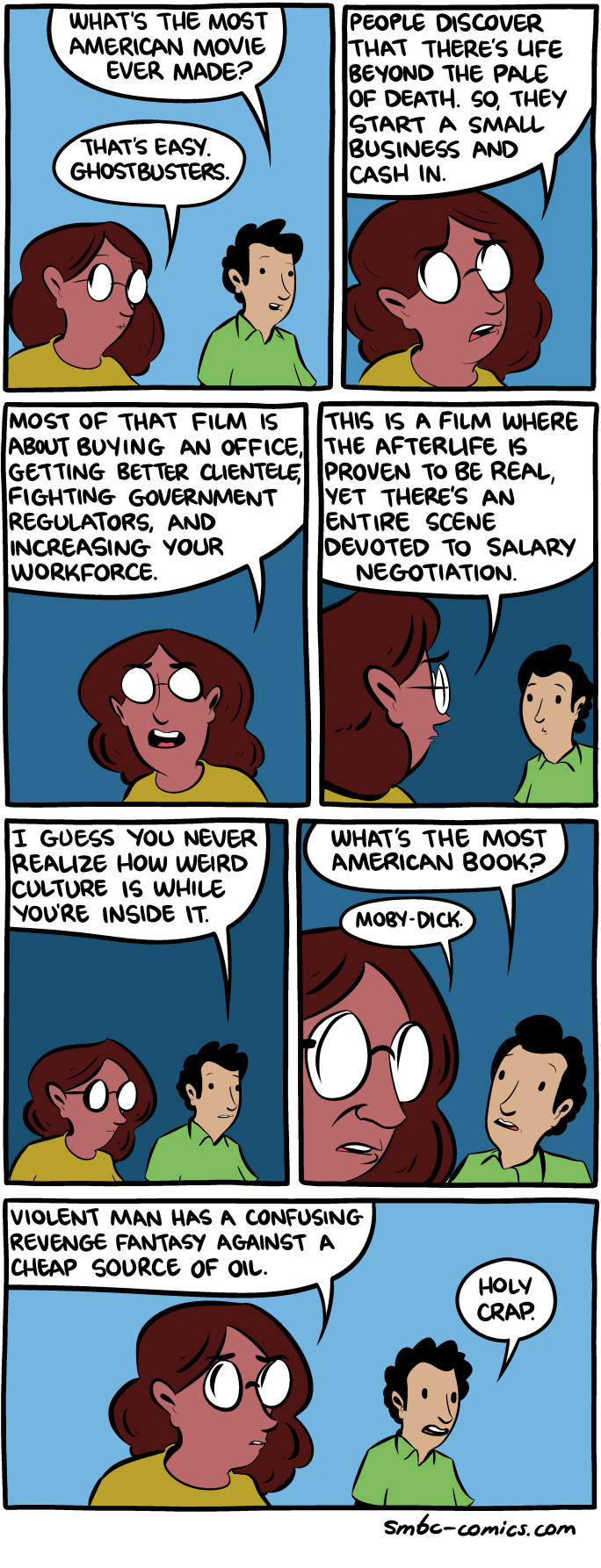
New comic!
Today's News:
Saturday Morning Breakfast Cereal - The Most American Movie
by admin@smbc-comics.com
Arnvidrmurica?
Hovertext: The most American ballet is PRO WRESTLING.
New comic!
Today's News:
Oh GOD Seattle is almost upon us. There are only about 90 general admin tickets left, so buy soon to lock a spot!
Matthew Mellott, Adam Victor Brandizzi and 7 others like this
06 Oct 20:25
 Twenty-one years after his death, Kurt Cobain's first official solo single is here. In the process of making his recent documentary Kurt Cobain: Montage Of Heck, director Brett Morgen unearthed a whole bunch of Cobain's previously unheard home recordings, and those recordings are being released next month as a Kurt Cobain solo album under … More »


Kurt Cobain – “Sappy”
by Stereogum
ArnvidrI wonder if this album will actually have anything "new".
Twenty-one years after his death, Kurt Cobain's first official solo single is here. In the process of making his recent documentary Kurt Cobain: Montage Of Heck, director Brett Morgen unearthed a whole bunch of Cobain's previously unheard home recordings, and those recordings are being released next month as a Kurt Cobain solo album under … More »
Tertiarymatt likes this
06 Oct 06:29
Why Bother
by jon

Remember, folks, gun laws can’t work because laws don’t work. Otherwise we’d have laws.
Have a fantastic Monday!
![goat-rfv[1]](http://amultiverse.com/wp-content/uploads/2014/07/goat-rfv1-450x187.png)
The post Why Bother appeared first on Scenes From A Multiverse.
Tindalostalbot likes this


05 Oct 17:49


Sharknodon vs Tarantulla
by Kristian

Aww, adorable! Also, this comic is indeed an homage to the demented work of horror manga artist Junji Ito.
Tertiarymatt, Cooper Griggs and one other like this






02 Oct 08:55
Bat Hobby
by Doug

Nananananananana Batman!
Tertiarymatt, Cooper Griggs and one other like this

30 Sep 18:29


Deafheaven attacked by the metal press for saying a naughty word
by BreadGod

Let me make one thing clear: I hate Deafheaven. I think their music is a bunch of wimpy hipster bullshit that has no originality, no impact, and no substance. I made this point very clear in my review of SUN BAT HER. Despite this, I still support their right to speak freely, even if what they say offends people. That brings me to today's story.
It all started when a twitter user named @shallowrewards used twitter's advanced search feature to dig through Kerry McCoy's old tweets to find instances of him using the word faggot. You can view the tweet here. (I also archived it in case it gets deleted.) I have a feeling that this person misspelled "@shallowretards" when he was creating his twitter profile. These tweets are devoid of context. Who is he talking to? What were the conversations like beforehand? Was he just fucking around? Hell, how do we know if these tweets are even real? What if they've been photoshopped? None of these questions are ever asked. @shallowretards just finds instances of Kerry McCoy using the word faggot and says, "Yep. Time to go on a witch hunt." If there's anything social justice warriors love more than forcing their authoritarian ideology onto everyone, it's taking shit out of context.
This non-story was first reported on by ThePRP. It was then reported on by MetalSucks. MetalCucks would be a far more appropriate name for them given just how easily offended they are by dumb bullshit. Axl Rosenberg talks down to Kerry McCoy as if he were an unruly child. This is especially obvious when he says "he definitely needs to apologize and immediately stop using the word in any context". You hear that, Kerry? You need to repent for your sins and submit to social justice! Axl then links to a petition which demands that Deafheaven be removed from the Pitchfork Festival in Union Park. Here's what it has to say:
Pitchfork.com, organizers of the annual Pitchfork Festival in Union Park, continue to lend financial and social support to the popular music ensemble Deafheaven. A founding and still-performing member of this group has a documented history of using violent, homophobic slurs since at least 2010. Festival-goers, and businesses who rely on the Pitchfork Festival as an annual revenue boost and marketing hub, demand that the site cease their continued support of this band, until such time as meaningful reparations are enforced, and a substantial effort to promote healing and tolerance in our communities is undertaken.
Translation: "Kick Deafheaven off your festival because muh feels."
Last time I checked, the petition had a pathetic 54 signatures. It looks like no one is taking this shit seriously. Except for the metal press, that is.
I wish I didn't have to write about this retarded bullshit, but all the major metal outlets like Metal Injection and SPIN are going with the same narrative: Kerry McCoy is a horrible person for using a naughty word and he must be punished for his heinous crimes. That leaves me no choice but to speak out and give a dissenting opinion. Most metal journalists say that he is not allowed to use the word faggot, but I am here to say that he should be free to say whatever he wants. I am also here to object to the metal press's condescending treatment of gay people. Seriously, stop treating gay people like helpless children. Stop trying to shelter them from the real world. Stop getting offended on behalf of people who, in all likelihood, don't give a shit.
Luckily, I'm not alone in this. I've read the comments on MetalSucks, Metal Injection, SPIN, and other places, and from what I can tell, metalheads are getting sick and tired of the social justice bullshit that is being forced down their throats by metal journalists. Metalheads are getting sick and tired of being dictated down to by the moral busybodies in the metal press. Ever since Shayne Mathis angrily demanded that the entire metal scene stop using the word faggot, metalheads have grown to hate the metal press. Like gaming journalists before them, metal journalists have become far more interested in pushing their authoritarian political agendas onto everyone than they are in actually talking about metal. Metalheads, on the other hand, just want metal journalists to do their fucking jobs and talk about the metal. Metalheads have had enough of the pearl clutching, the bullshit moral panics, and the self-righteous indignation, and now they're fighting back against it. Metal journalists told metalheads to check their privilege. Metalheads responded by telling them to fuck off.

29 Sep 17:05
The Commission's report also ignores the obvious in its desire to right the internet's wrongs: laws are already in place to deal with much of the "cyber violence" the commission aims to prevent. The report lists six areas where women are subjected to "cyber violence," almost all of which are already addressed by criminal and civil statutes.
But the solution isn't the construction of an entirely new legal framework, especially not one built on the assumption that "cyber violence" is equivalent to physical violence. We've similarly seen the disastrous results of laws written solely to address new issues like cyberbullying and revenge porn. The former tends to replace actual harm and malicious intent with highly-subjective measurements. The latter tends to criminalize acts that aren't revenge porn, thanks to sloppy wording and legislative grandstanding.
There may be some measured steps that could be taken to mitigate the problems the Commission is targeting, but the wording contained in the report strongly suggests a measured approach isn't what the Commission has in mind.
It also attempts to shoehorn in the unproven claim that video game violence leads to actual violence and does so citing perhaps the worst "source" available -- an article that leads off by quoting Lyndon Larouche uncritically.
A governing body that grants far too much deference to countries that abuse their own population thinks it can clean up the internet. There are few direct attacks on free speech in the report, but that's probably more due to the UN's restricted definition of free speech ("Freedoms of expression should be and must be guaranteed and protected, when they are used for common justice, common purpose…") than the Commission's concerns about undue limits on expression.
Even if you firmly agree with the report's assertion that "cyber violence" disproportionately affects women and that new measures need to be put in place to rein this in, you can't -- in good conscience -- applaud the UN's involvement. This is a governing body that routinely turns a blind eye to physical violence targeting women and allows countries with atrocious human rights records to guide policy decisions. This sort of issue cannot be solved with blanket directives issued by a governing body that is routinely ignored by its member states and whose deference to even the worst "stakeholders" continually undercuts the ideals it claims to promote.
UPDATE: Ken White has written a follow-up piece stating that he was wrong to cut the UN Broadband Commission's report as much slack as he did the first time around.
First off, he points out how dangerous this could be, considering it's the Broadband Commission that's behind this report. As he notes, there are several authoritarian regimes fighting for more control of the internet -- which of course means more control of their citizens. A set of internet rules handed down by the UN will be leveraged against their weakest citizens and misused to shut down dissent, no matter how noble the original goal.
He also points out that the quote pulled from the Lyndon Larouche-touting anti-videogame screed almost singlehandedly undercuts the credibility of the entire report. It's just that bad.
Permalink | Comments | Email This Story


UN Broadband Commission Releases Questionable Report On 'Cyber Violence' Against Women
by Tim Cushing
The UN's Broadband Commission has just released a report on "Cyber Violence Against Women and Girls." That this has been put together by the Broadband Commission rather than something more directly related to either law enforcement or human rights should be the first warning flag. This indicates the UN feels the responsibility for "cyber violence" should be borne by ISPs and social media platforms, rather than those actually committing the acts detailed in the report.
Ken White at Popehat has written a long and thoughtful piece on the report that's well worth reading, even with his admission that he may cut the authors of the document too much slack. White discusses what's wrong with the Commission's aims, using the presupposition that its assertions about "cyber violence" towards women are true. Even granting the Commission this generous benefit of a doubt, there's still a lot that's worrying about the Commission's proposals and assumptions.
Perhaps the biggest concern is that the UN is behind it. While the concept of the United Nations is noble, the execution has been an ongoing disaster. The governing body has been far too willing to humor the whims and predilections of countries whose track records on speech and human rights are generally abysmal. This is the unavoidable outcome of "uniting" disparate nations. Because there's no way to please everyone, the UN has settled for a grade school-esque "everybody gets a turn" fairness. That leads directly to this sort of thing:
I don't trust the UN on free speech issues. You shouldn't either. In a world where Iran wins a seat on the UN's Commission on the Status of Women, people who care about women's rights should also be skeptical. Pro-censorship forces continually pressure the UN for international laws and norms restricting speech — for instance by demanding laws outlawing blasphemy. Allow me some unabashed American exceptionalism: that's a bad thing. The United States' vigorous approach to protecting free speech and rejecting blasphemy laws is good, and foreign norms that encourage blasphemy laws often used to persecute religious and ethnic minorities are bad.No one should want the UN to take up this battle. Those looking to see free speech respected won't find much to like about the UN's involvement. Countries where actual violence is routinely perpetrated against women, along with cultural oppression, won't be talked into a national change of heart just because the UN has decided to shelter women from online violence. ISPs aren't going to be receptive to additional directives that require them to more heavily police their users, especially when the targeted content isn't as easy to recognize and curtail as the report makes it appear.
The Commission's report also ignores the obvious in its desire to right the internet's wrongs: laws are already in place to deal with much of the "cyber violence" the commission aims to prevent. The report lists six areas where women are subjected to "cyber violence," almost all of which are already addressed by criminal and civil statutes.
HackingThis isn't to say that legal systems already in place are handling the digital version of these criminal and civil violations perfectly. They aren't. We only need to look at sexting prosecutions to get a general idea of how badly this goes when laws written to serve a different purpose are stretched to address unforeseen modes of behavior.
Impersonation
Surveillance/Tracking (i.e., stalking)
Harassment/Spamming
Recruitment (sex trafficking)
Malicious Distribution (defamation, revenge porn, etc.)
But the solution isn't the construction of an entirely new legal framework, especially not one built on the assumption that "cyber violence" is equivalent to physical violence. We've similarly seen the disastrous results of laws written solely to address new issues like cyberbullying and revenge porn. The former tends to replace actual harm and malicious intent with highly-subjective measurements. The latter tends to criminalize acts that aren't revenge porn, thanks to sloppy wording and legislative grandstanding.
There may be some measured steps that could be taken to mitigate the problems the Commission is targeting, but the wording contained in the report strongly suggests a measured approach isn't what the Commission has in mind.
[R]hetorically, the report advocates a "zero tolerance for violence against women" mantra. I understand and share the anti-violence sentiment, but experience teaches that framing a response to a problem as "zero tolerance" leads to terrible results. That's not a problem with "women's issues," it's a problem with any perceived social ill. Telling people to take a "zero tolerance" approach effectively tells them to suspend critical judgment when addressing a problem. It doesn't lead to treating a problem seriously; it leads to treating a problem anxiously. When applied to something as complicated as the internet, that's potentially disastrous.The report suggests "partnerships" between private industry and governing bodies, something that never works out well. The Commission hesitates to advocate government censorship, but does so disingenuously by suggesting that "voluntary" measures enacted under pressure from multiple governments are actually still voluntary. And it completely ignores the fact that any such systems put into place will be gamed immediately by the people they're meant to target, along with any number of trolls that game systems simply to game systems.
It also attempts to shoehorn in the unproven claim that video game violence leads to actual violence and does so citing perhaps the worst "source" available -- an article that leads off by quoting Lyndon Larouche uncritically.
It is the “New Violence,” as Democratic Presidential pre-candidate Lyndon LaRouche was the first to precisely characterize it at the time. It is the use of Nintendo-style games, and related means, to transform young children and adolescents, as well as law-enforcement personnel into “Samurai”-style programmed killers.That's not the quote that makes it into the report. What it does quote is almost innocuous compared to the content surrounding it.
There is widespread representation of VAWG in mainstream culture, including in contemporary and popular music, movies, the gaming industry and the general portrayal of women in popular media. Recent research on how violent video games are turning children, mostly boys, into ‘killing zombies’ are also a part of mainstreaming violence. And while the presentation and analysis of this research is beyond the scope of this paper, the links to the core roots of the problem are very much in evidence and cannot be overlooked.To call this alarmist screed "research" is beyond laughable. Even if you can somehow accept the assertion that violent video games are crafting a generation of "killing zombies," you're left with with the author's other assertions, which veer off into inadvertent satire.
Nintendo of America, Inc.: Manufactures Pokémon, Game-Boys, and equipment for satanic video games.The report also quotes a report on harassment of Indian women via WhatsApp (with cited URL actually being a file path on some UN's employees C: drive). The report itself notes that the study was severely limited and that "no sweeping generalizations should be made." The Broadband Commission apparently failed to read that part of the report.
[...]
Hasbro Interactive: Official U.S. distributor of Pokémon (abbreviation for “Pocket Monsters”), the killing game designed for toddlers beginning at 2 and 3 years old; Dungeons and Dragons, the medieval satanic and magic fantasy game; Risk II, a “ruthless quest for world domination".
The use of WhatsApp instant messaging, for example, has become, according to some reports, the latest harassment tool of choice in countries like India and Malaysia, and increasingly around the world.Diving into every citation would likely uncover more problems in the assumptions drawn by the Broadband Council. (For instance, the Pew report quoted in the paper conveniently ignores the research center's finding that men experience online harassment more often than women, although they are less likely to be sexually harassed or stalked.) Even if the sources were impeccable, the Commission's ultimate goals would still be questionable.
A governing body that grants far too much deference to countries that abuse their own population thinks it can clean up the internet. There are few direct attacks on free speech in the report, but that's probably more due to the UN's restricted definition of free speech ("Freedoms of expression should be and must be guaranteed and protected, when they are used for common justice, common purpose…") than the Commission's concerns about undue limits on expression.
Even if you firmly agree with the report's assertion that "cyber violence" disproportionately affects women and that new measures need to be put in place to rein this in, you can't -- in good conscience -- applaud the UN's involvement. This is a governing body that routinely turns a blind eye to physical violence targeting women and allows countries with atrocious human rights records to guide policy decisions. This sort of issue cannot be solved with blanket directives issued by a governing body that is routinely ignored by its member states and whose deference to even the worst "stakeholders" continually undercuts the ideals it claims to promote.
UPDATE: Ken White has written a follow-up piece stating that he was wrong to cut the UN Broadband Commission's report as much slack as he did the first time around.
First off, he points out how dangerous this could be, considering it's the Broadband Commission that's behind this report. As he notes, there are several authoritarian regimes fighting for more control of the internet -- which of course means more control of their citizens. A set of internet rules handed down by the UN will be leveraged against their weakest citizens and misused to shut down dissent, no matter how noble the original goal.
He also points out that the quote pulled from the Lyndon Larouche-touting anti-videogame screed almost singlehandedly undercuts the credibility of the entire report. It's just that bad.
This is the equivalent of submitting a serious proposal to Congress advocating for changes in the federal budget and, for the proposition that the NASA budget should be reduced, linking to sites that claim that the moon landing was faked.Some may point out it's a single citation, from which only a few words were pulled. But this seems to indicate there are other media forms the UN would like to control.
One bad citation wouldn't normally destroy the credibility of an entire report. If any one can, this one does. It's used to support a drop-in that violent movies and video games are something the UN might want to look at. It is so freakishly inappropriate that I can only imagine four scenarios: (1) there are no sensible people involved in the preparation and approval of the report, (2) any sensible people involved with the report did not read the report any more carefully than I did, (3) the people behind the report believe this Jack Thompson/Tipper Gore/Jack Chick malarkey, or (4) the people behind the report don't particularly care about the reliability of the sources for their pronouncements.White also spends more time discussing the Commission's problematic definition of "cyber violence," which seems to be about evenly split between things that aren't actual violence and things that are already criminal acts in most countries. This is where the report is the most dangerous. It's attempting to leverage vague wording and foregone conclusions to grant the UN increased speech-policing powers -- an idea no one should be in a hurry to support.
Permalink | Comments | Email This Story
29 Sep 15:16


Good Boy
by Jason Poland
ArnvidrPhilosophy.

This is one good boy right here. Today’s comic is inspired by a sweet tweet sesh with Zack! Zack is one of the Three Very Fine Moderators of the Toilcore tumblr, (the other two are Keith and me!)
Follow Zack, Follow Keith and of course, Toilcore is a Very Good tumblr to follow, yes indeed, so please follow that, too.
BTW, I just reordered a batch of Robbie and Bobby books--they should be here in a bout a week–I’ll let you know as soon as they get here!
Tertiarymatt likes this

28 Sep 05:36
G-G the book - G-G on Facebook - G-G on Twitter

Ryan Stonecipher, Tertiarymatt likes this


