Shared posts

12 May 01:18

Evolving Toward a Universal Blood Type

by CoolHand

theronb writes:

According a summary in Chemical & Engineering News of a much more technical paper in the Journal of the American Chemical Society (referenced in the C&EN summary):

Hospitals keep stores of universal, type O blood for situations when a patient with an unknown blood type needs an emergency transfusion. The other types—A, B, and AB blood—can trigger a potentially fatal immune response in an unmatched recipient. Now, bioengineers have taken a step on the path toward making all blood universal—by broadening an enzyme’s ability to remove antigens on the surface of red blood cells (J. Am. Chem. Soc. 2015, DOI: 10.1021/ja5116088).
The quest for universal blood has tempted researchers since the discovery in the 1980s of coffee bean enzymes that could turn type B blood into O. The four main blood types each have distinctive sugar chains on the surface of their red blood cells.

Soylentils will note the intersting link to coffee.

Meanwhile, other scientists have claimed to have developed an enzyme that convert other blood types to that of the universal donor.

“We produced a mutant enzyme that is very efficient at cutting off the sugars in A and B blood, and is much more proficient at removing the subtypes of the A-antigen that the parent enzyme struggles with,” said David Kwan, the lead author of the study and a postdoctoral fellow in the Department of Chemistry. Their job, however, is not yet done. Whilst the enzyme was able to remove the vast majority of antigens from type A and B blood, they were not able to remove all of them. As the immune system is incredibly sensitive to blood groups—so much so that even small amounts of residual antigen can trigger an immune response—the scientists must first be certain that all antigens are absent.

Read more of this story at SoylentNews.

11 May 15:04

yesterday i realized two things: i am an adult, and this is Not Going To Get Better.

Arnvidr

Names. They don't like it in my brain.

archive - contact - sexy exciting merchandise - search - about
← previous May 11th, 2015 next

May 11th, 2015: Hey guess what! TCAF was amazing and awesome, as it always is. I had a great time, met some great readers, had some great conversations, and got some great comics. In conclusion, TCAF every day, the end.

Hey guess what again! A bunch of my discontinued shirt designs are now RE-CONTINUED, thanks to a new site called T Shirt Diplomacy, which also has... aliens designing shirts too? And friends! And this INCLUDES the Professor Science shirt!

– Ryan

11 May 09:24

May, 11th

Arnvidr

Hidden Door Level: Public


May, 11th

11 May 08:29

Comic: A Recognized Phenomenon

by tycho@penny-arcade.com (Tycho)
Arnvidr

Lousy kids

New Comic: A Recognized Phenomenon
11 May 05:52

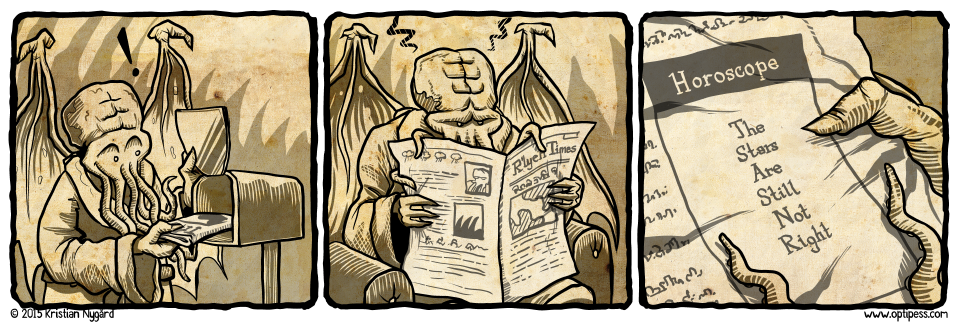
R’lyeh Times

by Kristian

The rest of the newspaper contains articles that would make any human go instantly insane, like “Get Your Beach Bod Ready for Summer With These Arcane Workout Tips”.

Aw, probably the saddest comic I’ve ever made. But, like they say in the Journey song, don’t stop believing. His time WILL come. (On an infinitely long timespan, I mean. Probably not in our lifetime, unfortunately.)

09 May 20:03

Gorgeous Freeman: Episode 1 – The Suit is a rather great Garry’s Mod video

by Stephany Nunneley
Arnvidr

Well that was weird.

Your Saturday “Just for Fun” post is a bit early today, only because you need to watch this video right away: it’s a Garry’s Mod creation from the rather great Antoine Delak called Gorgeous Freeman: Episode 1 – The Suit.

Hopefully you aren’t at work, because your boss may not appreciate some parts of it. Or maybe they would.

Anyway, enjoy it. I know I did.

Thanks, Reddit.

09 May 17:44

Photo

Arnvidr

It's tough you know.


08 May 23:22

Are You a Gamer or a Casual Gamer?

Arnvidr

Uh-huh

08 May 23:22

7 Excuses For Not Using Linux -- And Why They're Wrong

Arnvidr

In summary: if you don't like linux, you might be a creationist.

Many excuses for not using Linux are merely rationales for resisting change.
08 May 15:16

Faith Healer Adam Miller Sues Over Critical YouTube Video, Guaranteeing It Tons Of Attention

by Mike Masnick
Arnvidr

Hehehehehheheheheeh

Oh boy. Today in Streisanding, we've got a lawsuit filed by Adam Miller, a faith healer, against Stephanie Guttormson, supposedly over claims of copyright infringement and defamation, though neither claim holds up under much scrutiny. Instead, this looks like a typical SLAPP suit, in which Miller is upset about a video that mocks him and his faith healing and decides to sue over it. Enter Stresiand Effect. The video is currently up, and the view count is rapidly escalating. At the time the lawsuit was filed (according to the lawsuit) it had about 1,500 views. Now it's much more: There's nothing too surprising in the video, but it basically uses one of Miller's own promotional videos and intersperses some commentary and criticism. The lawsuit... is... well... a joke. First, he claims copyright infringement, though this is pretty obviously fair use. It's being used for criticism and commentary, and in order to make that work, it needs to show clips of the video. Miller's lawyer tries, weakly, to present a few arguments to try to get around fair use, including arguing that it's commercial use. Of course, as we keep repeating, commercial use does not mean that you can't have fair use. Tons of fair use involves commercial use. And, even given that, it's ridiculous to argue that this is "commercial use." The best the lawsuit can do is claim that the inclusion at the end of the video of a couple of "advertisements" makes it commercial. That, alone, probably isn't even enough to claim this is "commercial use," (which is generally more about selling the actual work or directly profiting). Plus, it's not even accurate. The "advertisements" aren't really advertisements at all, but rather a friendly acknowledgement of who sent her the video, with a link to that guy's own website and audio bookstore, with a mention that Guttormson appears on that guy's podcast every so often.

The lawsuit also claims too much of the original video was used, but there's little evidence to support that. Guttormson comments on basically every clip in the video, so it's hard to see how she's using "more of the original work than was necessary" as the lawsuit claims.

The lawsuit also alleges, as part of the copyright claim, that "Guttormson is liable for the actual harm caused to Mr. Miller as a result of Guttormson’s infringement and statutory damages." That's an interesting claim, but completely bullshit in the copyright context. The "actual harm" has to be over the copyright. Unless there was "actual harm" in Miller no longer being able to license/sell that video to a third party because they felt they could see it all for free through Guttormson's video (a crazy claim), then there's no actual harm. If the commentary in Guttormson's video, which mocks Miller's wacky faith healing nonsense, created "actual harm," well, that's not a copyright issue and is unrelated to any copyright claim.

The lawsuit also makes some claims about how the video itself was never actually released, but rather was password protected in Miller's wife's account. So the lawsuit alleges that Guttormson must have "hacked" into Eve Miller's account. In the video itself, however, as mentioned above, Guttormson notes that it was actually David Smalley who sent her the video. And while it's not entirely clear, from the comment threads under the video, it certainly sounds like Miller's video was most likely publicly available somewhere online. The evidence of "hacking" here seems really weak. And if there was hacking, the evidence that it was Guttormson is non-existent.

As for the defamation claims... there are only two specific things called out in the lawsuit. The first is this:
As just one example, Guttormson explains what happens at an appointment with Mr. Miller, “You will be fed faith-based bullshit.” This statement is false and defamatory; Mr. Miller’s work does not require a client to hold any faith, and he has worked with non-believers and atheists.
Um. Okay, it appears that Miller's lawyer is misrepresenting what "faith-based" means in this context. Guttormson isn't saying that those seeing Miller are expected to "have faith in a certain religion." She's saying that the treatment by Miller is not evidence based but is based on someone's blind "faith" in Miller being able to actually do something. And, besides, Miller's own words show that he's pitching a bunch of faith-based quackery. In the video clip, he himself explains the process, noting talking first about how he talks to people who come to them about things that happened in their childhood, like "traumas" that might explain their illnesses (really) and then says:
And then after we get through this, we put them on the table, and great holy spirit comes and breaks up dark cellular structure that creates any illness. Because I believe that illnesses are of a dark path.
That's like the definition of "faith-based" right there.

The other "defamation" claim is about the title of the video, which refers to Miller as a "con man." For the most part, courts don't consider phrases like that defamatory though (there are some exceptions, but it very much depends on context and if they're alleging a very specific thing, rather than a general insult). The link there is from Perle & Williams on Publishing Law and notes:
As Dean Prosser observed, "[A] certain amount of vulgar name-calling is tolerated on the theory that it will necessarily be understood to amount to nothing more." Thus, "communism" is too amorphous a characterization to be actionable, as is the term "grifter." The term "crook" has been held by one court to be a word of general disparagement rather than an allegation of specific criminal conduct, and thus was not slander; a restaurant critic's remark that a restaurateur was a "pig" and a television news editorial that referred to a chiropractor as a "quack" and a "cancer con artist" were held to be expressions of opinion; the words "those bastards" were held "mere epithets... as terms of abuse and opprobrium" and as such were not actionable for defamation; referring to a judge as "incompetent," "arrogant," "biased," and "one of the 10 worst judges in New York" was not held to be defamatory; calling a stockholder a "silly, stupid, senile bum" was not held to be slanderous; referring to Carl Sagan as a "butt-head astronomer" was held not libelous; and referring to a masonry contractor as a "shithead" was held not actionable....
In short, the likelihood that calling Miller a "con artist" is "defamation," let alone "defamation per se" as the lawsuit alleges, is... quite unlikely.

Even more to the point, this was a video that almost no one had seen. And now, because of this lawsuit, not only are tons more people checking it out, even more people will start investigating Adam Miller and the claims he makes about his "healing" services. Miller's website has gone down, but a quick look through the internet archive shows that it's chock-full of quackery (note to Miller's lawyer: that's not defamatory, so buzz off):
What this healing work is...

The Great and Holy Beings, such as Mother Mary, Jesus, Buddha, Quan Yin, Saint Germain, Archangel Michael and many others come into a person's body and transmute with light every single cell and raise the vibratory rate. In other words, diseases or injuries in the body have a very low, darkened vibration and when a Holy Being works with any person it changes the cellular structure permanently and the issue that is being worked on will never come back. This work is permanent. It is important to understand that Adam Miller is not a conduit, or psychic or related to any other work on the planet. This work is a result of Adam's death experience. Adam Miller would never claim to do this work himself. It is done by Holy Beings only.
So, uh, yeah. And he's the one claiming that "faith-based bullshit" is defamatory? Yikes.

Meanwhile, before filing the lawsuit, it appears that Miller posted another video announcing his response to the video above. In it he notes that a lawsuit is being prepared. But he also has a bunch of his "happy clients" give testimonials or complain about Guttormson, claiming that what she said was, like, really mean and "unprofessional." If Miller had merely posted his response including such testimonials, that would be perfectly fine. You deal with speech you dislike with more speech. But suing someone with bogus claims of defamation and copyright infringement? When you're spewing quackery? Not only is that going to flop in court, it's just going to lead a lot of people to examine what you're selling yourself...

Permalink | Comments | Email This Story


08 May 15:07

A New Dope – Part V

by Adam

2015-05-08-A-New-Dope---Part-V

08 May 15:06

Photo


08 May 13:54

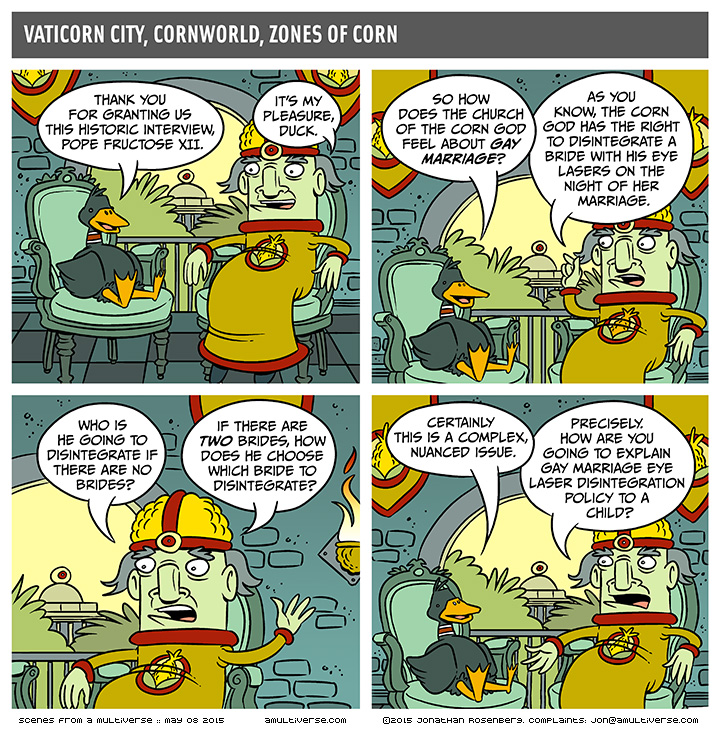
Into the Cornhole

by jon
Arnvidr

A new perspective.

2015-05-08-Into-The-Cornhole

Hey Everyone! I’m going to be exhibiting at TCAF this weekend! it’s at the Toronto Reference Library this Saturday and Sunday. I’ll be signing books and prints and such with the Topatoco gang, tables 286-291, up on the second floor.

Please come say hello! I am okay at conversation and social skills.

Oh, also: On Saturday at 4pm over at The Pilot I’ll be speaking on this panel:

Comics Reportage in the Internet Age
Short, non-fiction reportage is making waves on the internet in 2015. Short, sharp, personal comics pieces can get to the heart of an idea quickly and in a way that was previously only the domain of political gag cartoons. Eleri Harris, associate editor of The Nib, is joined by an incredible array of contemporary cartoonists including Jess Fink (We Can Do It), Dan Berry (Make Then Tell), Ed Piskor (Hip Hop Family Tree), and Jon Rosenberg (Scenes from a Multiverse), to discuss what it takes to make timely and relevant reportage on the internet.

So come and check it out! I think it’s going to be a really good panel.

goat-monolith-pic[1]


The post Into the Cornhole appeared first on Scenes From A Multiverse.

08 May 13:53

Why?

by Doug
Arnvidr

Ooops

08 May 06:48

Easy kill

08 May 06:47

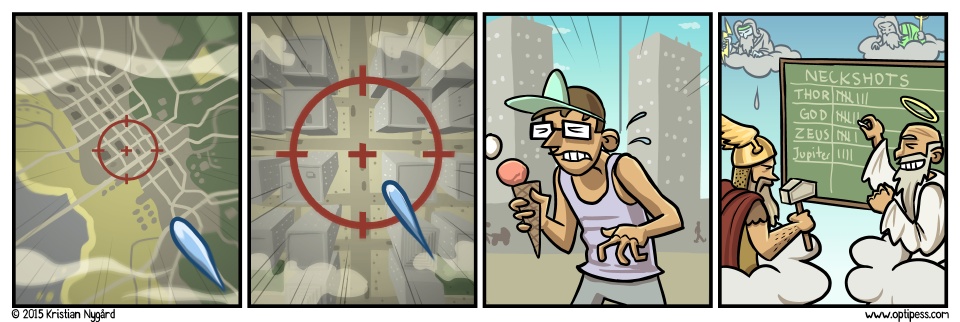
Deity Drops

by Kristian
Arnvidr

Thor is winning.

Whoever Wins, We Lose.

They also have a more relaxed game which involves hitting much easier targets: bald men.

08 May 06:44

Photo


08 May 06:44

Photo


07 May 18:12

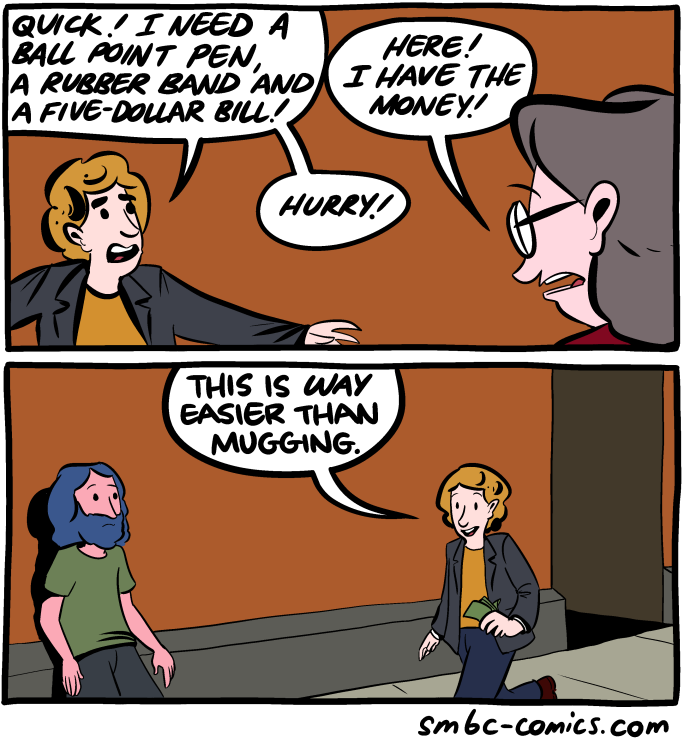
Saturday Morning Breakfast Cereal - Quick!

by admin@smbc-comics.com

Hovertext: Get creative, people!


New comic!
Today's News:
07 May 14:08

honkTumblr — Twitter — Facebook— Buy my books

Arnvidr

Genius

07 May 06:45

A New Dope – Part IV

by Adam

2015-05-07-A-New-Dope---Part-IV

07 May 04:09

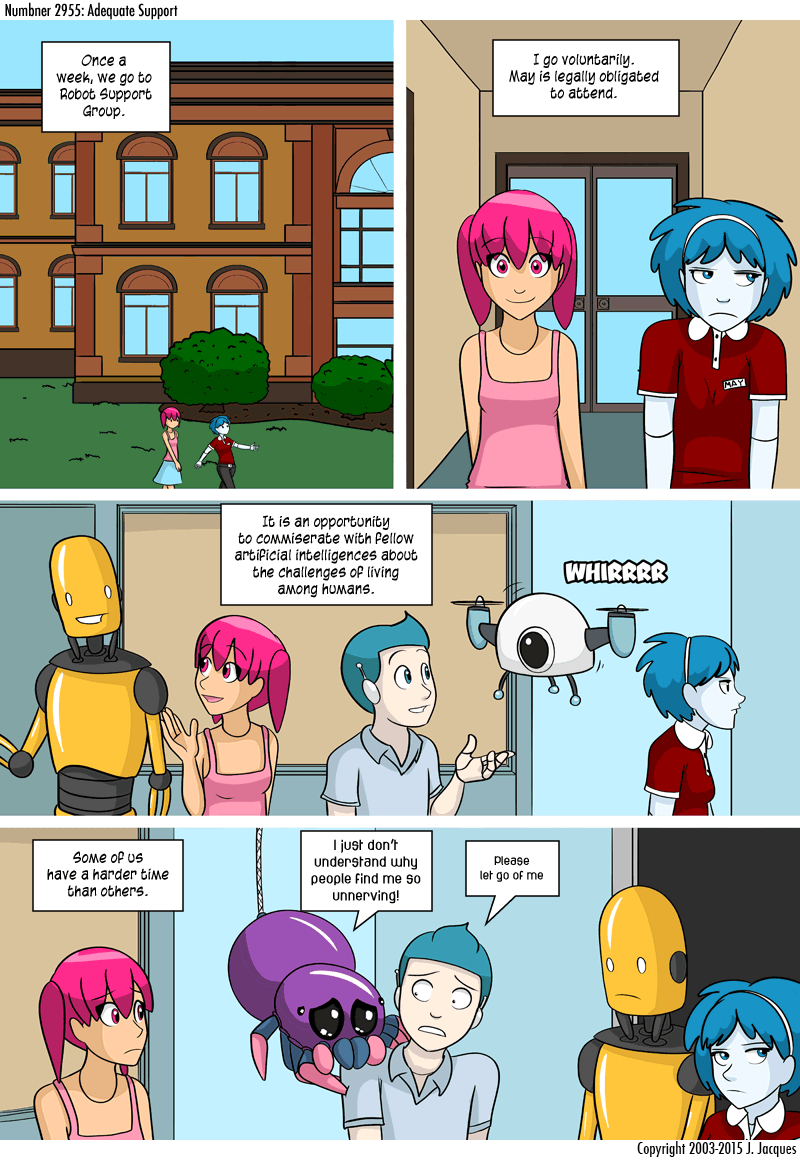
Adequate Support

Arnvidr

Spiderbot, spiderbot, does whatever spiderbot does.


Ads by Project Wonderful! Your ad could be here, right now.

I will be at TCAF this weekend! You should totally come say hi!

07 May 04:03

harlanTumblr — Twitter — Facebook— Buy my books

06 May 21:06

In The Information Age, It's More Important To Expand The Pie Than Eat The Whole Damn Pie

by Mike Masnick
Arnvidr

Twitter stagnating?

Mathew Ingram recently wrote a fantastic post about Twitter's big mistake a few years back, basically killing off its openness for developers. He builds his argument off of an interesting post from Ben Thompson, arguing that Twitter has lost its strategic focus. Both articles are great, and I recommend them both. In the early days, Twitter was almost completely open. Many of its most useful features and services came from others building on top of it. The very idea of the "@" symbol was the invention of a user. Same with the retweet. Now both are core to Twitter's identity. And, of course, third-party services were what made Twitter usable in the first place. The service didn't really ever take off for me until I used Tweetdeck -- which was a third party service until Twitter bought it. Thankfully, I can still use Tweetdeck (though not on mobile) because Twitter's actions killed off most competitors (and, because of this, Tweetdeck still lags in fixing some basic things -- like an autoscroll problem I've complained about for years). As Ingram notes, Twitter made a big strategic shift, as it started to fear its own openness and worry that it may have resulted in the dreaded "someone else profiting" off of Twitter's foundation:
Namely, a crucial turning point in Twitter’s evolution that arguably helped put it where it is today, both in a positive sense (it is a publicly-traded $25-billion company) and a negative one (its growth potential is in question and its strategy doesn’t seem to be working). And that turning point happened about five years ago, when Twitter decided to turn its back on the third-party ecosystem that helped make it successful in the first place.

This process began gradually, with the acquisition of Tweetie — which became Twitter’s official iOS client — and restrictions on what third parties could do with tweets, including selling advertising related to them. But it escalated quickly, and arguably became an all-out war with Twitter’s moves against Bill Gross, the Idealab founder and inventor of search-related advertising, who was busy acquiring Twitter clients and trying to build an ad model around the public Twitter stream. The idea that someone could monetize Twitter before Twitter itself got around to doing so was what one investor called a “holy shit moment” for the company.
We see this sort of thing in all sorts of areas -- especially around "intellectual property." People have a very emotional "holy shit moment" pretty frequently when they see "someone else" making money by leveraging something that they feel some sort of ownership attachment to, whether or not there's any legitimate basis for that attachment. So many of the intellectual property fights we see stem from that general feeling of "Hey, that's ripping me off!" even if the actions of those third parties may not have any real impact on the originating content, service or idea.

In the internet era, however, this is almost always the wrong decision. The internet thrives based on the flow of information. You want information to flow more broadly, rather than to hoard it. Historical economics is based on worlds of scarcity, and in worlds of scarcity it makes sense to hoard resources, as they are valuable by themselves. Yet, in worlds of abundance you want the opposite. You want abundant or infinite resources to flow freely because they do something special: they increase the value of everything else around them. You want openness, not closed systems. You want sharing, not hoarding. You want copying, not restrictions. Because all of those things increase the overall pie massively, even if some of that pie (or even large portions) are captured by others.

As Ingram notes, at least some at Twitter recognized this at the time. An early influential employee at Twitter, its chief engineer Alex Payne, wrote about how he tried to persuade the company to go in that direction:

Some time ago, I circulated a document internally with a straightforward thesis: Twitter needs to decentralize or it will die. Maybe not tomorrow, maybe not even in a decade, but it was (and, I think, remains) my belief that all communications media will inevitably be decentralized, and that all businesses who build walled gardens will eventually see them torn down. Predating Twitter, there were the wars against the centralized IM providers that ultimately yielded Jabber, the breakup of Ma Bell, etc. etc. This isn’t to say that one can’t make quite a staggeringly lot of money with a walled garden or centralized communications utility, and the investment community’s salivation over the prospect of IPOs from LinkedIn, Facebook, and Twitter itself suggests that those companies will probably do quite well with a closed-but-for-our-API approach.

The call for a decentralized Twitter speaks to deeper motives than profit: good engineering and social justice. Done right, a decentralized one-to-many communications mechanism could boast a resilience and efficiency that the current centralized Twitter does not. Decentralization isn’t just a better architecture, it’s an architecture that resists censorship and the corrupting influences of capital and marketing. At the very least, decentralization would make tweeting as fundamental and irrevocable a part of the Internet as email. Now that would be a triumph of humanity.

But he lost that argument to those who wanted to keep the pie smaller, but to capture more of it for themselves. That may have helped the company go public, but it has put the company in a serious bind today. One in which Wall Street is profoundly disappointed that what Twitter is capturing for itself "isn't enough" and the innovations that the company needs to keep growing and innovating are much harder to come by. Sure, it does things like Vine and Periscope -- both of which it bought out in infancy -- but to do so it's had to hamstring other third-party developers like Meerkat.

Ingram also highlights another Ben Thompson post on what Twitter might have been had it gone down this more open path (he wrote this after the whole Meerkat thing):
I would argue that what makes Twitter the company valuable is not Twitter the app or 140 characters or @names or anything else having to do with the product: rather, it’s the interest graph that is nearly priceless. More specifically, it is Twitter identities and the understanding that can be gleaned from how those identities are used and how they interact that matters.

If one starts with that sort of understanding — that Twitter the company is about the graph, not the app — one would make very different decisions. For one, the clear priority would not be increasing ad inventory on the Twitter timeline (which in this understanding is but one manifestation of an interest graph) but rather ensuring as many people as possible have and use a Twitter identity. And what would be the best way to do that? Through 3rd-parties, of course! And by no means should those 3rd-parties be limited to recreating the Twitter timeline: they should build all kinds of apps that have a need to connect people with common interests: publishers would be an obvious candidate, and maybe even an app that streams live video. Heck, why not a social network that requires a minimum of 140 characters, or a killer messaging app? Try it all, anything to get more people using the Twitter identity and the interest graph.
There's a more fundamental premise at work here. In the information era, spreading more information increases the pie massively and opens up many more opportunities. The challenge is that many others can also take advantage of many of those opportunities, but as the core player in the space, a company like Twitter has a clear and natural advantage, even if it did what Payne had wanted to do many years ago and give up the underlying control altogether.

This is, unfortunately, a profoundly difficult concept for many to grasp -- especially when they're in the midst of it. Hell, even as someone who regularly talks about this very idea, I still get the initial emotional pang of being upset when I see someone else get success with an idea that I had first (whether or not they got it from me). It's only natural to have that visceral reaction. The real question is what do you do about it. Do you fret? Do you try to control? Or do you realize that in broadening these ideas and sharing them more widely, it creates greater opportunities across the board?

It's impossible to know what would have happened had Twitter taken a different path. But it seems clear that remaining a more open platform (or even moving to a fully distributed one), would have resulted in a tool that was much more useful today, with a much larger audience and much greater innovation. It's too bad we didn't get to live in that world.

Permalink | Comments | Email This Story


06 May 18:13

Europe Vows To Get Rid of Geo-Blocking

by Soulskill
Arnvidr

Sweet!

AmiMoJo writes: The European Commission has adopted a new set of initiatives for digital technologies that aims to improve access to online services for everyday users. Among other things, Europe vows to end geo-blocking, which it describes as "a discriminatory practice used for commercial reasons," and lift other unwarranted copyright restrictions. Consumers will have the right to access content they purchased at home in other European countries. "I want to see every consumer getting the best deals and every business accessing the widest market – wherever they are in Europe," Commission President Jean-Claude Juncker says.

Share on Google+

Read more of this story at Slashdot.

06 May 15:48

A New Dope – Part III

by Adam

2015-05-06-A-New-Dope---Part-III

06 May 08:39

If my dogs were a pair of middle-aged men

by Matthew Inman
Arnvidr

Excellent.

05 May 10:18

A New Dope – Part II

by Adam

2015-05-05-A-New-Dope---Part-II

05 May 07:54

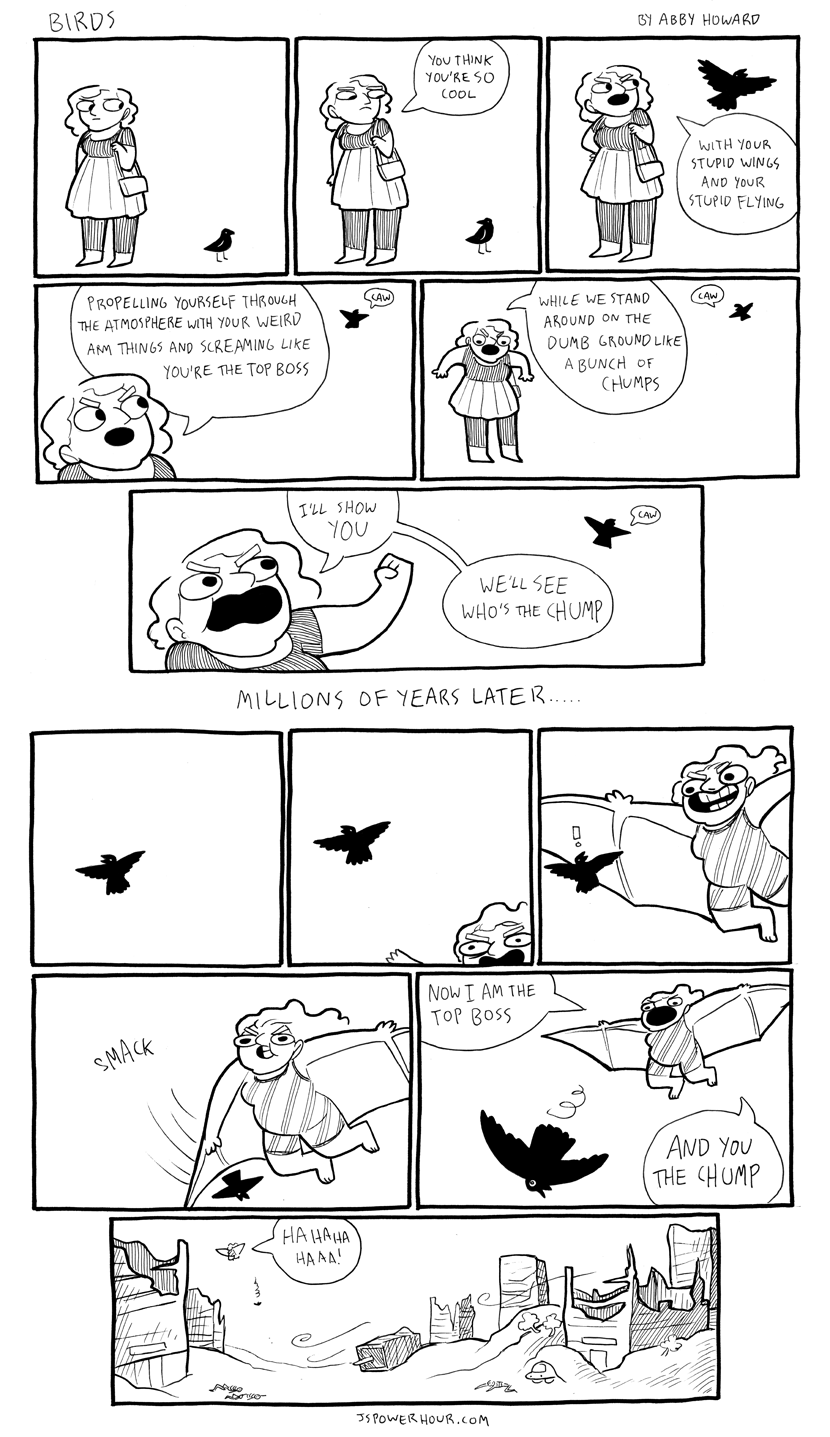
Who Is The Top Boss

Arnvidr

The birbs

Top_boss-small

Who is truly the top boss? Is the quest to be top boss merely a distraction from the soon to be wreckage of our human race? We are all dying, and when we are dead, who will be top boss then

04 May 11:58

A New Dope

by Adam
Arnvidr

Fart Wars coming up

2015-05-04-A-New-Dope

Since today is “May the 4th Be With You” and with the upcoming Star Wars Episode VII The Force Awakens I decided it was time for me to draw my version of Star Wars. So all this week I’ll be retelling George Lucas’ epic saga of Star Wars Episode IV A New Hope, only with more fart jokes.