More video games!
Check out this awesome NERF Vulcan sentry gun built by YouTuber BrittLiv! Wanna make your own? Take a look at the original design by Bob Rudolph on Instructable!
Submitted by: Unknown (via Instructable)
But while Descartes's overall view has been rightly rejected, there is something profoundly right about the connection between privacy and the self, something that recent events should cause us to appreciate. What is right about it, in my view, is that to be an autonomous person is to be capable of having privileged access (in the two senses defined above) to information about your psychological profile your hopes, dreams, beliefs and fears. A capacity for privacy is a necessary condition of autonomous personhood.To get a sense of what I mean, imagine that I could telepathically read all your conscious and unconscious thoughts and feelings -- I could know about them in as much detail as you know about them yourself -- and further, that you could not, in any way, control my access. You don't, in other words, share your thoughts with me; I take them. The power I would have over you would of course be immense. Not only could you not hide from me, I would know instantly a great amount about how the outside world affects you, what scares you, what makes you act in the ways you do. And that means I could not only know what you think, I could to a large extent control what you do.
That is the political worry about the loss of privacy: it threatens a loss of freedom. And the worry, of course, is not merely theoretical. Targeted ad programs, like Google's, which track your Internet searches for the purpose of sending you ads that reflect your interests can create deeply complex psychological profiles -- especially when one conducts searches for emotional or personal advice information: Am I gay? What is terrorism? What is atheism? If the government or some entity should request the identity of the person making these searches for national security purposes, we'd be on the way to having a real-world version of our thought experiment.
But the loss of privacy doesn't just threaten political freedom. Return for a moment to our thought experiment where I telepathically know all your thoughts whether you like it or not From my perspective, the perspective of the knower -- your existence as a distinct person would begin to shrink. Our relationship would be so lopsided that there might cease to be, at least to me, anything subjective about you. As I learn what reactions you will have to stimuli, why you do what you do, you will become like any other object to be manipulated. You would be, as we say, dehumanized.

When freemium services ask customers to pay, they benefit from the endowment effect - one of many fun examples of how we all fail to live up to the perfectly rational expectations economists set for us.
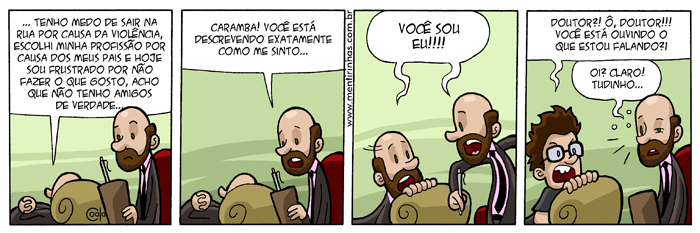 Freud explica.
O post Mentirinhas #465 apareceu primeiro em Mentirinhas.

A man’s wife disappears and he’s accused of killing her. At the trial, his lawyer tells the jury, “Ladies and gentlemen, I have amazing news. Not only is my client’s wife actually alive, but she’ll walk through that door in ten seconds.”
An expectant silence settles over the courtroom, but nothing happens.
“Think about that,” the lawyer says. “The fact that you were watching the door, expecting to see the missing woman, proves that you have a reasonable doubt as to whether a murder was actually committed.”
He sits down confidently, and the judge sends the jury off to deliberate. They return in ten minutes and declare the man guilty.
“Guilty?” says the lawyer. “How can that be? You were all watching the door!”
“Most of us were watching the door,” says the foreman. “But one of us was watching the defendant, and he wasn’t watching the door.”
Albener PessoaLink 5 : uma "obra de arte" com um trailer e diagramas de Feynman. WTF!?!
1. U.S. productivity growth, back to (slow) form.
3. I would dispute some of the comparisons and reasoning in this post, but still it is an interesting look at whether increased immigration has led to less economic freedom.
4. Reihan on how ACA is evolving, some say unraveling.
5. What is in Prince’s fridge?, and we need the future now.
6. The podcast feed for Tim Harford’s new Pop-Up Ideas series.
7. Grave sites of famous economists, a list.
8. Is the logic of comparative advantage overrated?
Albener PessoaAvisa a Dilma
I don’t have deep background knowledge on this particular hospital, but here is a new and interesting article:
An Oklahoma City surgery center is offering a new kind of price transparency, posting guaranteed all-inclusive surgery prices online. The move is revolutionizing medical billing in Oklahoma and around the world.
Dr. Keith Smith and Dr. Steven Lantier launched Surgery Center of Oklahoma 15 years ago, founded on the simple principle of price honesty.
“What we’ve discovered is health care really doesn’t cost that much,” Dr. Smith said. “What people are being charged for is another matter altogether.”
Surgery Center of Oklahoma started posting their prices online about four years ago.
Click here to see the online prices at Surgery Center of Oklahoma.
The prices are all-inclusive quotes and they are guaranteed.
“When we first started we thought we were about half the price of the hospitals,” Dr. Lantier remembers. “Then we found out we’re less than half price. Then we find out we’re a sixth to an eighth of what their prices are. I can’t believe the average person can afford health care at these prices.”
Their goal was to start a price war and they did.
Their first out-of-town patients came from Canada; soon everyday Americans caught on.
Here is a bit more:
Dr. Smith said federal Medicare regulation would not allow for their online price menu.
They have avoided government regulation and control in that area by choosing not to accept Medicaid or Medicare payments.
I would like to know more about this example (maybe Cherokee Gothic can go buy something there), but the article is here and some further coverage is here. For the pointer I thank Jake Seliger and also Craig Fratrik and Timothy Miano.
Here is one recent report of falling salaries in public institutions, and, on the bright side, universities are having trouble filling some of those slots:
Public university professors don’t enter the profession to get rich. But some faculty are having trouble paying bills, and have even qualified for foods stamps, Olson said. “For somebody to go five to seven years beyond college to obtain a Ph.D. degree and to realize that you are in need of federal assistance to make ends meet — and that’s for a tenure-track position –” is devastating.
Adding what some view as insult to injury, a recently published database of public employee salaries shows that some professors earn less than their colleagues at local high schools without doctorates.
Yet how would they feel about actual poor people? The article focuses on University of Wisconsin, Stevens Point, and serves up the following numbers:
Faculty salaries averaged $67,000 for full professors; $57,100 for associate professors; and $51,900 for assistant professors during the 2012-13 academic year.
Assuming he can get there, of course. Currently it’s down to Venezuela, Bolivia, or Nicaragua. Dylan Matthews argues for Venezuela, on the grounds that the other two countries are much poorer and have lower life expectancies. He says Snowden should put up with the much higher crime rate (by the way “0.2 percent of Caracas residents [are] killed each year.”)
But Snowden is not playing a Rawlsian game here, he is going to these countries as Edward Snowden. I say seek out Santa Cruz, Bolivia, which is much richer than Bolivia as a whole and safer than Venezuela at least. Sloths hang from the trees. Also keep in mind that much of Snowden’s income may be coming from abroad, whether it be from Wikileaks or book royalties or civil libertarian well-wishers or sources unknown. That militates in favor of the cheaper, lower wage country and Bolivia fits the bill. Nicaragua is quite nice, and attracts some notable expats (pdf), but if you can’t travel abroad choose a larger country.
Finally, Venezuela has had some pro-American tendencies in its history and those could return. Bolivia seems to have a more or less stable indigenous (semi) democratic majority, plus the hijacking of Morales’s plane may give the Snowden issue a resonance in Bolivia for some time to come.
If he loves the beach, however, Leon, Nicaragua is a charming town.

Albener Pessoavia firehose
Albener Pessoafunny (via firehose)
Hilarious teen magician
Seriously watch this, I laughed so hard.
This guy is like god took all the sarcasm in the world and condensed it into one person
oh my god i feel like my humor spleen just ruptured everywhere.
Albener PessoaPara os paranoicos (via firehose)
If, like me, you’re unsettled by the recent government(s) snooping you are probably looking for ways to secure your on-line activities. One obvious way is to use SSL/TLS whenever possible. If you use Firefox or Chrome, HTTPS Everywhere can help.
Sadly, even if you believe in the security of SSL/TLS, there is, for most sites, a single point of failure. When the client and server negotiate to agree on an encryption key, the negotiation is encrypted by the site’s static key. That means that if the key is later broken or exposed and, like the NSA, you have saved HTTPS sessions, you can retroactively decrypt them all.
What’s needed is perfect forward secrecy (PFS). That means that if one session is decrypted, the others are still safe. For SSL/TLS, perfect forward secrecy requires you to change the key used to encrypt the session negotiation for each session. All of this is beautifully explained by Michael Horowitz over at Computer World. Because he goes into reasonable detail, the article is a bit long but well worth reading. I urge you to take the time to give it a look.
Netcraft also has an excellent article on PFS that covers much of the same material and gives more information on the support that various browsers provide for it. It explains why some browsers, such as Safari, which support PFS nevertheless fail to apply it for some sites. Definitely worth reading.
As users, of course, there is little we can do except encourage the sites we use to implement it. Currently Google and a few smaller sites do this but most do not. That’s probably because you get a performance hit when you implement perfect forward secrecy. One happy note for the paranoid among us is that DuckDuckGo is now using PFS with all the major browsers.
Those of us who are technologits are in a position to make things better. Whenever we can, we should push to use SSL/TLS with PFS on our Web sites. That may mean making a case to management or beefing up the server if needed. Not easy, of course, but well worth it if it helps secure the Web and keep the Nosy Parkers at bay.


These men are all terrorists. None of them are Muslim. None of them were labelled ‘terrorists’ by the mainstream media, who instead chose to use the terms ‘mentally ill’, ‘shooter’, ‘killer’ and other names much tamer than that normally reserved for Muslim perpetrators.
1. James Holmes: Aurora cinema shooting, 2012.
Death count: 24
- Ex-roommate publishes a study of why Holmes may have turned out so wrong
- CBS News further highlight the fact that he was ‘mentally ill’
2. Adam Lanza: Sandy Hook kindergarten shooting, 2012.
Death count: 27 (excluding himself)
- Huffington Post insist that he was not, unbelievably, under the influence and was, amazingly, acting of his own accord
- An in-depth analysis of the personality and psyche of Adam Lanza
3. Anders Breivik: Oslo shooting, 2011.
Death count: 77
- NPR try to wrap their heads around why he might have done it
- New York Times consistently refers to him as ‘Mr. Breivik’
4. James von Brunn: Holocaust Memorial shooting, 2009.
Death count: 1
- Guardian provides evidence that he is an anti-Semite, a white supremacist and affiliated with a racist organisation, yet never once refers to him as a terrorist
- Washington Post emphasises his old age and offers insight from his relatives
The final one shares the same death toll as the recent Woolwich murder. Yet why, in both articles (and in all articles listed in this post regarding all of these perpetrators) is the word ‘terrorist’ never once mentioned? Whereas the Woolwich murderer, who is Muslim but linked with no violent organisation, was instantly labelled a terrorist and sparked strong anti-immigration protests in the UK.
I smell an absurd double standard.