 |
|
Adivinha o que vai alargar em seguida, moça! =D
|
Shared posts
23 Aug 21:51
Para colocar a camisinha, comece pela cabecinha
by O Criador

23 Mar 23:59

This one raises a couple of quite urgent questions: Where did...
This one raises a couple of quite urgent questions: Where did they go, and are they still in the house?
Follow on Twitter @BadRealtyPhotos


31 Jan 16:44
Electrical Repair
by Doug

Here are more books for dummies.
Tadeu, Cooper Griggs likes this
20 Jan 17:18
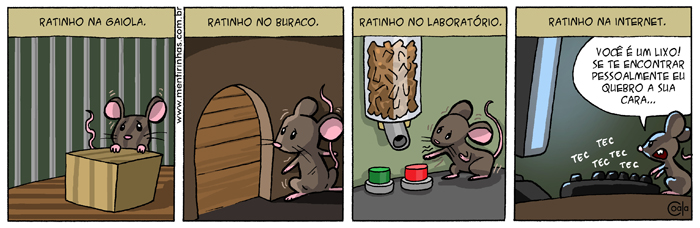
Mentirinhas #564
by Fábio Coala
Carla Castilhos, Albener Pessoa and one other like this
17 Jan 22:10

The marginal cost of cryptocurrency — does the price of Bitcoin have to fall so much from contestability?
by Tyler Cowen
Robert Sams writes:
This is also why it doesn’t make sense to speak of new cryptocurrencies expanding the aggregate crypto money supply without limit (or limited only by the fixed costs of creating one). What matters is how the aggregate hashing power, which is scarce, gets distributed over the set of extant cryptocurrencies. The above reasoning predicts that hashing power will not spread itself arbitrarily thinly, keeping MC well-above 0. (The distribution currently looks more like a power law.)
Much (something?) hinges on this point. If I understand the argument correctly, the claim is that the market will not consist of a large number of thinly hashed cryptocoins, because those coins will not be secure. There is an aggregate amount of hashing power, and it gets distributed in a quite concentrated fashion and that helps prop up the value of Bitcoin and limit the number of truly viable alternatives. Sams emailed me:
Ignoring any desired technical differences among the various coins, it’s optimal for users to coordinate on one, not b/c of some network effect but b/c spreading hashing costs over lots of coins eventually results in no coin having much security. At the margin, a user will choose the higher hashing coin between two otherwise identical ones.
In the (implicit) model of my earlier post, there is always a bribe to be paid to new cryptocurrency adopters — out of the seigniorage created by the founders of new cryptocoins — that will encourage a larger number of active cryptocoins. (And total hashing power is somewhat elastic in supply, contrary to how I am interpreting Sams.) How actively will those coins be hashed? I am not sure it matters. There will be two margins: the cost of doing more hashing of existing coins, and the cost of creating additional cryptocurrency through “bribing out of seigniorage.” In equilibrium those two marginal costs should be equal, adjusting of course for the possible heterogeneity of outputs, as you are not getting exactly the same services. To the extent “security” is an issue, the initial bribe for using a new cryptocurrency needs to be that much larger. If no bribe is big enough to induce some defection, I wonder how Bitcoin got started in the first place (which didn’t even have the benefit of the same kind of explicit upfront bribery).
My view is that if bootstrapping can happen once — as it did with Bitcoin — it can and will happen again. In which case we are back to contestability limiting the value of Bitcoin. I am not sure how much Sams and I are disagreeing. At the end he coins (sorry) a new theorem:
So maybe here is a new theorem: the value of a cryptocurrency will converge to its optimal level of hashing costs?
In any case, do read Sams’s entire post, it covers many cryptocurrency issues of interest.
17 Jan 13:23
Enterro de Nelson Ned terá presença de Mula Sem Cabeça e políticos honestos
by Sensacionalista
Após a morte de Nelson Ned, 2014 veio mostrar que tudo pode acontecer. Já confirmaram presença no enterro do anão:
- Mula Sem Cabeça;
- ET de Varginha;
- Flamenguistas com todos os dentes;
- Corinthianos com ensino médio completo;
- Políticos honestos;
- Médicos que não dizem “virose”;
A assessoria de imprensa divulgou que a lista completa será divulgada no site oficial do cantor até as 18:00 horas de hoje.
16 Jan 23:53
Large numbers of patients in South Africa with untreatable tuberculosis are discharged into community
Substantial numbers of patients in South Africa with extensively-drug resistant TB and totally resistant TB, who have exhausted available treatment options, are being discharged from hospital, potentially exposing the wider community to infection, according to new research published in The Lancet.
16 Jan 23:48
CERN contest to give students access to accelerator’s proton beam
by John Timmer

Thanks to the European physics research center CERN, up to 30 high school students will be able to provide an exceptional answer when asked "what did you do over your summer vacation?" CERN is running a contest that will give a team of students the chance to use the output of one of its proton accelerators. If you or your child ever had some creative ideas about what you could smash with a bunch of 25GeV protons, now's your chance to speak up.
While the LHC is still shut down for upgrades, it's only the last step of a long chain of accelerators that feeds the collider protons already moving fairly quickly. One of them is the Proton Synchrotron. When it was built, the Proton Synchrotron was at the cutting edge of high-energy physics, but it was soon eclipsed by even larger machines. Since then, however, it's been used as an intermediary in CERN's accelerator chain, feeding 25GeV protons into lower energy experiments or into larger accelerators that boost them to higher speeds.
CERN is now allowing groups of students aged 16 and up to design an experiment that they can do with the protons from the Proton Synchrotron. The team with the winning proposal will get to fly nine of its members to Geneva at CERN's expense, where the team will get to help put their proposal into action. Proposals will be judged by whether they're creative and have a good scientific foundation, as well as whether they're technically feasible (sorry, no smashing protons into sharks). Anybody interested in taking part has to act quickly—the contest closes at the end of the month.
.png)


16 Jan 23:21
1349 – Explicando as aparições
by Carlos Ruas

Breno Barbosa, Damiani.guilherme and 2 others like this

16 Jan 21:16


Frazer-Nash apresenta táxi londrino Metrocab
by Ricardo de Oliveira

A Frazer-Nash – em parceria com a Ecotive – apresentou em Londres sua proposta de táxi com propulsão híbrida, batizado de Metrocab. O modelo tem consumo médio de 32 km/litro graças ao uso de um motor 1.0 movido por GNV e outro elétrico.

As baterias de lítio garantem ao Metrocab da Frazer-Nash autonomia de 563 km. A velocidade máxima do táxi híbrido plug-in é de 128 km/h. Além do sistema de propulsão ecológico, o modelo ainda dispõe de configuração interna para até sete pessoas. A empresa diz que o preço será competitivo.

A noticia Frazer-Nash apresenta táxi londrino Metrocab foi publicada no site Notícias Automotivas - Carros.
16 Jan 00:21
OpenBSD Foundation At Risk Of Shutting Down
The OpenBSD Foundation is running into a situation of lack of funding to the point that they can't even cover their electricity costs and may be forced to suspend or reduce their operations without additional help...
15 Jan 23:28


Outra idéia JENEAL: cadeado Bluetooth
by Carlos Cardoso

O nome desse negócio é, como você pode ver, TEO. É um cadeado com uma bateria que — juram — duram um ano, e programado e acessado via smartphone. Ele utiliza Bluetooth, então basta ter o app instalado no celular.
Você também pode compartilhar acesso a outras pessoas, assim se alguém quiser usar algo protegido pelo cadeado, não precisa mais ir até a gaveta da cozinha e pegar a chave. Basta ligar o celular, instalar o app, se cadastrar no sistema, adicionar você, te contactar para confirmar a requisição de amizade, pedir o acesso, receber o acesso, ir até o cadeado, executar o app e abrir o negócio.
Eu adoro como no futuro tudo será muito mais prático.
O projeto está no Kickstarter, e prevê um custo unitário de US$ 79,00 — perfeitamente razoável se você nunca comprou um cadeado na vida, e também não conhece o conceito de dinheiro.
Claro, o bom mesmo dessa “internet das coisas” vai ser quando esse monte de tralha desnecessariamente conectada começar a ser hackeada. Lembre-se, uma época tinha gente que se divertia queimando fax, mandando uma folha preta em loop para um número qualquer. Imagine agora que você vai poder abrir cadeados, descongelar geladeiras e ligar microondas remotamente…
Fonte: TC.
The post Outra idéia JENEAL: cadeado Bluetooth appeared first on Meio Bit.
15 Jan 23:26


Google pagando jumbocat para funcionários
by Carlos Cardoso

No final do Século Passado surgiu uma empresa que tentou quebrar o monopólio das barcas e aerobarcos na travessia Rio-Niterói. Usavam duas embarcações de classe catamarã, com o inacreditavelmente ingênuo nome de… Jumbo Cat. Com medo da concorrência a Barcas S/A entrou na Justiça, tanto fez que a Transtur acabou falindo, para desespero de quem queria uma travessia rápida sem pagar a fortuna dos aerobarcos ou sofrer a muvuca das barcas. Agora os Jumbocats voltam a ser polêmica, graças ao Google.
A empresa contratou o serviço de um catamarã para transportar seus funcionários através da Baía de São Francisco, e as autoridades não estou gostando, pois o serviço é computado como transporte privado e isso rende só US$ 50,00 por atracagem. Estranhou? Eu explico.
Mountain View, onde fica a sede do Google é subúrbio, fica a 64 km de São Francisco, e a galera jovem e descolada não quer morar no fim do mundo, mesmo que topem trabalhar lá. Querem morar em São Francisco, Oakland, em Alameda, onde estão os nuclear weassels. Quem não gosta disso é a população local, que viu suas cidades invadidas por um bando de geeks endinheirados, o preço dos imóveis foi pras alturas, a infraestrutura local fica sobrecarregada e a entrada tributária gerada por esses novos moradores simplesmente não compensa. O resultado? Manifestações de amor assim:

Isso foi em Oakland. Com direito a pedra quebrando janela do busão do Google e tudo. A coisa chegou a um ponto onde as prefeituras estão pensando em cobrar para que as empresas usem os pontos de ônibus municipais. Isso se traduz, no caso do Google, em US$ 100 mil por ano. Por ônibus. Daí a alternativa do Jumbocat.
O que fica evidente é que administração municipal é bem mais complicado do que em SimCity. E que, em países de verdade, mesmo empresas bilionárias não conseguem sempre tudo que querem.
The post Google pagando jumbocat para funcionários appeared first on Meio Bit.
15 Jan 23:21
Interesting Spy Stories Today
by Kevin Murray
Albener Pessoa"500 Years of History Shows that Mass Spying Is Always Aimed at Crushing Dissent"
Private Eye Sky Spies
 Click-bait, or cold reality? The headline for Robinson Meyer’s article in the Atlantic about three Silicon Valley start-ups and their plans to make money off satellite photography of the earth is “Silicon Valley’s New Spy Satellites.” Very soon, it’s likely that it will be substantially easier to buy recent, high-resolution imagery of the Earth’s surface... the message they send together is simple: We’re all spies now. (more)
What Will Anna Chapman Do Next? Former spy Anna Chapman, who was sent back from the United States to Russia in a major spy swap in 2010, is going to present her own clothing line at a fashion show in the Turkish resort of Antalya. (more) (Anna's adventure timeline)
500 Years of History Shows that Mass Spying Is Always Aimed at Crushing Dissent (more)
Boycott Of RSA Security Conference Builds In Wake Of NSA Spy Scandal (more)
Click-bait, or cold reality? The headline for Robinson Meyer’s article in the Atlantic about three Silicon Valley start-ups and their plans to make money off satellite photography of the earth is “Silicon Valley’s New Spy Satellites.” Very soon, it’s likely that it will be substantially easier to buy recent, high-resolution imagery of the Earth’s surface... the message they send together is simple: We’re all spies now. (more)What Will Anna Chapman Do Next? Former spy Anna Chapman, who was sent back from the United States to Russia in a major spy swap in 2010, is going to present her own clothing line at a fashion show in the Turkish resort of Antalya. (more) (Anna's adventure timeline)
500 Years of History Shows that Mass Spying Is Always Aimed at Crushing Dissent (more)
Boycott Of RSA Security Conference Builds In Wake Of NSA Spy Scandal (more)
firehose likes this
15 Jan 23:20
British Spies – Licensed to Speed
by Kevin Murray
British spies are to be given a "license to speed", allowing the likes of James Bond to drive fast with impunity in the name of national security.
 Transport minister Robert Goodwill was to announce the motoring law changes on Monday, which will hand spooks the same exemption as the police, fire service and ambulance drivers.
Officers in the MI5 and MI6 domestic and foreign intelligence agencies will be able to break the speed limit on surveillance and covert operations once they have completed a training course in high-speed driving. (more)
 Transport minister Robert Goodwill was to announce the motoring law changes on Monday, which will hand spooks the same exemption as the police, fire service and ambulance drivers.
 Officers in the MI5 and MI6 domestic and foreign intelligence agencies will be able to break the speed limit on surveillance and covert operations once they have completed a training course in high-speed driving. (more)
15 Jan 23:19
Infographic - The Relative Cost of Surveillance
by Kevin Murray
Ashkan Soltani, a privacy and security researcher who has been working with the Washington Post on the Snowden files, has published a graphic that illustrates how technology has greatly reduced the barriers to performing surveillance. Soltani included the graph in a paper published in the Yale Law Journal...
The cost comparison involves the several location surveillance techniques of physical pursuit by foot and in vehicles, location tracking using a radio beeper, a GPS device, or a cell phone.
A few examples for understanding the chart:
• Tracking a suspect using a GPS device is 28 times cheaper than assigning officers to follow him.
• Tracking a suspect using cell phone data is 53 times cheaper than physical covert pursuit.
• Tracking a cell phone is twice as cheap as using a GPS device. (more)
 |
| Click to enlarge. |
The cost comparison involves the several location surveillance techniques of physical pursuit by foot and in vehicles, location tracking using a radio beeper, a GPS device, or a cell phone.
A few examples for understanding the chart:
• Tracking a suspect using a GPS device is 28 times cheaper than assigning officers to follow him.
• Tracking a suspect using cell phone data is 53 times cheaper than physical covert pursuit.
• Tracking a cell phone is twice as cheap as using a GPS device. (more)
15 Jan 23:19
Your Automobile is Very Likely Spying on You
by Kevin Murray
...but Republicans and Democrats in the U.S. Senate are uniting to put a stop to unfettered snooping via the "black boxes," or "event data recorders," placed in your car by automakers.
 Is your car spying on you? If the vehicle is a fairly new model it probably is, thanks to a "black box" that collects data about what’s going on in your car. And there’s no off switch or way to opt out. By September all new cars sold in the United States will be required to have black boxes, or as they’re more formally called, "event data recorders."
"The amount of data that they record is vast. And it's not capped," said Nate Cardozo, a staff attorney with the Electronic Frontier Foundation (EFF).
That’s just one way new technology installed in automobiles is invading our privacy. At the 2014 Consumer Electronics Show (CES) last week, Google and a handful of automobile manufacturers, including Audi, GM, Honda and Hyundai, announced a partnership designed to bring the Android mobile platform to vehicles. Those devices are capable of broadcasting your location, Web pages you may have looked at, stores you shopped in and much much more. Chevrolet, for example, showed off a camera mounted on the windshield that records the driver’s point of view and a microphone in the cabin records any noises made in the car.
...Consider what Ford’s top sales guy James Farley said at a CES event: "We know everyone who breaks the law. We know when you’re doing it. We have GPS in your car, so we know what you’re doing." Farley quickly retracted his impolitic remarks, but they give you insight into how seriously some automakers take your privacy. (more)
Is your car bugged?
See if you are on the list.
If so, read this.
~Kevin
"The amount of data that they record is vast. And it's not capped," said Nate Cardozo, a staff attorney with the Electronic Frontier Foundation (EFF).
That’s just one way new technology installed in automobiles is invading our privacy. At the 2014 Consumer Electronics Show (CES) last week, Google and a handful of automobile manufacturers, including Audi, GM, Honda and Hyundai, announced a partnership designed to bring the Android mobile platform to vehicles. Those devices are capable of broadcasting your location, Web pages you may have looked at, stores you shopped in and much much more. Chevrolet, for example, showed off a camera mounted on the windshield that records the driver’s point of view and a microphone in the cabin records any noises made in the car.
...Consider what Ford’s top sales guy James Farley said at a CES event: "We know everyone who breaks the law. We know when you’re doing it. We have GPS in your car, so we know what you’re doing." Farley quickly retracted his impolitic remarks, but they give you insight into how seriously some automakers take your privacy. (more)
Is your car bugged?
See if you are on the list.
If so, read this.
~Kevin
14 Jan 17:05
Florida Man Is Shot to Death for Texting During Movie Previews
by John Gruber
Frances Robles, reporting for the NYT:
An argument over texting at the movies ended in a cellphone user’s death, when a retired police officer in the audience shot him at a theater near Tampa, Fla., on Monday afternoon, the authorities said. […]
The killing underscored the increased debate about when to use smartphones in public.
On Twitter, Billmon writes:
When someone is shot in cold blood over texting, and NYT thinks the issue is smart phones, safe to say we’ve gone completely nuts as a country.
Update, 2:20a EST: The “underscored” sentence has been removed from the story. It got a lot of attention while it was there, though.
14 Jan 10:13


Documentary trailer for Fantastic Four movie Marvel wanted to forget
by Meredith Woerner
Albener PessoaO filme ta pronto pro proximo Nerdmeeting. O documentario quem sabe para um futuro encontro (via Firehose)
In 1994, monster movie maker Roger Corman made a $2 million adaptation of The Fantastic Four, was never released in theaters for obvious reasons. But now the documentary DOOMED! The Untold Story of Roger Corman's The Fantastic Four will show you the lunacy that is this creation, and all the bananas behind-the-scenes goings on. Watch the trailer now.
    
|

13 Jan 16:34
Study of 225 terrorism cases inside the United States since the Sept. 11, 2001, attacks has concluded that the bulk collection of phone records by the National Security Agency “has had no discernible impact on preventing acts of terrorism.”
 |
submitted by InternetPropagandist [link] [105 comments] |