Retraction challenges
Nature 514, 7520 (2014). doi:10.1038/514005a
Cleaning up the literature can be difficult.
Retraction challenges
Nature 514, 7520 (2014). doi:10.1038/514005a
Cleaning up the literature can be difficult.
Nature Physics 10, 762 (2014). doi:10.1038/nphys3081
Authors: Saulo D. S. Reis, Yanqing Hu, Andrés Babino, José S. Andrade Jr, Santiago Canals, Mariano Sigman & Hernán A. Makse
Networks in nature do not act in isolation, but instead exchange information and depend on one another to function properly. Theory has shown that connecting random networks may very easily result in abrupt failures. This finding reveals an intriguing paradox: if natural systems organize in interconnected networks, how can they be so stable? Here we provide a solution to this conundrum, showing that the stability of a system of networks relies on the relation between the internal structure of a network and its pattern of connections to other networks. Specifically, we demonstrate that if interconnections are provided by network hubs, and the connections between networks are moderately convergent, the system of networks is stable and robust to failure. We test this theoretical prediction on two independent experiments of functional brain networks (in task and resting states), which show that brain networks are connected with a topology that maximizes stability according to the theory.
Nature Photonics 8, 751 (2014). doi:10.1038/nphoton.2014.222
Author: Jacopo Bertolotti
Exploiting the 'memory' properties of scattered light allows for single-shot imaging through thin opaque layers, including biological tissue.
Nature Photonics 8, 784 (2014). doi:10.1038/nphoton.2014.189
Authors: Ori Katz, Pierre Heidmann, Mathias Fink & Sylvain Gigan
Nature Photonics 8, 755 (2014). doi:10.1038/nphoton.2014.220
Authors: John M. Dudley, Frédéric Dias, Miro Erkintalo & Goëry Genty
Nature Photonics 8, 745 (2014). doi:10.1038/nphoton.2014.241
Smartphones that have been cleverly 'accessorized' are starting to offer a convenient and cost-effective alternative to conventional laboratory-based imaging and sensing equipment.
Nature Photonics 8, 808 (2014). doi:10.1038/nphoton.2014.227
Ori Katz and Sylvain Gigan explain to Nature Photonics how a well-known astronomy technique has been adapted for imaging through turbid media, with great potential for bio-imaging applications.
"it is wrong to say, as some critics do, that there is no objective evidence for homeopathy. There is, but most of it is of rather poor quality. Even at its best there is evidence for only a small effect, and when an effect is as small as this it may not be there at all. It is also disturbing that the better the quality of a trial the less likely it is to show a positive effect. I conclude that there are no firm answers to questions about the efficacy of homeopathy to be found in the research that has been done up to now".Trad.: È sbagliato dire, come fanno alcuni critici, che non c'è nessuna prova oggettiva per l'omeopatia. C'è, ma quasi tutta di scarsa qualità. Nella migliore delle ipotesi, c'è prova solo di un piccolo effetto e quando un effetto è così piccolo potrebbe anche non esistere. È anche fastidioso notare come se gli studi sono di buona fattura vi è meno possibilità di notare un effetto positivo [dell'omeopatia].Posso concludere che nelle ricerche fatte fino ad oggi, non esiste risposta certa sull'efficacia dell'omeopatia.
Homeopathy has not been proved to work but neither has it been conclusively disproven – it is of course notoriously difficult to prove a negative. My own assessment of homeopathy is that, while it is impossible to say categorically that all the remedies are without objective effect, any effect there may be is small and unimportant. The great majority, at least, of the improvement that patients experience is due to non-specific causes.
Trad.: Non è mai stato provato che l'omeopatia possa funzionare ma non è stato provato nemmeno che non funzioni ma come si sa è notoriamente difficile provare un dato negativo. La mia opinione personale sull'omeopatia è che, se è impossibile dire con certezza che nessun rimedio sia efficace, qualsiasi effetto è piccolo e senza importanza. Almeno la grande maggioranza dei miglioramenti che riportano i pazienti, è dovuta a cause non direttamente collegate [all'omeopatia].
 |
| Il declino delle prescrizioni di omeopatia nel servizio sanitario inglese. |
Occorre anzitutto non limitarsi ai contenuti della scienza, ma approfondirne i principi e la metodologia. I giovani studenti non hanno un’idea della complessità del più semplice organismo vivente mentre dovrebbero conoscere i meccanismi che sottintendono alle funzioni biologiche. Se sapessero le difficoltà nello stabilire i rapporti di causa ed effetto forse, a differenza degli attuali adulti non crederebbero agli indovini, all’omeopatia, agli oroscopi come pure alle terapie miracolose inclusa Stamina.
What if everything was antimatter, EXCEPT Earth?
Sean Gallagher
This one doesn't end well for us. But—unlike most scenarios involving the word "antimatter"—the end is surprisingly slow and drawn-out.

The whole universe is matter, as far as we can tell. No one is sure why there's more matter than antimatter, since the laws of physics are pretty symmetrical, and so there's no reason to expect there to be more of one than the other.[1]Although when it comes down to it, there's no reason to expect anything at all.
It's possible that galaxies are made of antimatter, and we just haven't noticed because we haven't tried to touch them. This is a cool idea, but if there are zones of matter and zones of antimatter, we should see a telltale gamma-ray glow from the boundary between the zones. So far, we haven't seen that, although another telescope might help.

If the rest of the universe were swapped out for antimatter, we'd be in trouble. Outer space isn't really "space";[2]As far as I know, it really is "outer", for what that's worth. it's full of a thin gas.[3]Technically, plasma.[4]Technically, there's also a substantial quantity of solid grains of dust.[5]Look, there's a bunch of little bits that are hard to see, ok?.[6]Ok, they're not always hard to see.
The Earth's magnetic field protects us from the solar wind, and would protect us from an anti-solar wind, too. A tiny fraction of the particles from the Sun do reach the Earth, funneled down by our magnetic field, and create the aurora. In this scenario, the aurora would get a lot brighter, but most of the time not bright enough to really cause problems.
Meteorites would be the real problem.
The Earth sweeps up space dust as it travels around its orbit.[7]Unfortunately for us, antimatter is probably attracted to matter by gravity. About 100 tons of dust per day enters the atmosphere in the form of tiny grains, most weighing about 10^-5 grams. An additional similar average per-day amount arrives in giant clumps all at once.
This inflow of antimatter dust would collide with the top of our atmosphere and be annihilated. The interactions between the nuclei and antinuclei and protons and antiprotons would be complex,[8]A lot of the energy would be carried away by neutrinos. but the end result would be a lot of gamma rays, which would turn into a lot of heat. This steady flow of material would be worst around dawn, when your house was facing in the direction of Earth's motion.
The heat and light added by the antimatter would most likely be enough to tip the Earth into a "runaway greenhouse" scenario, turning the Earth into something resembling Venus.
But the big asteroids would get us first. Even a relatively small object like the Chelyabinsk meteor would deliver as much energy as the meteor that killed the dinosaurs.[9]Although it would deliver it to the top of the atmosphere, so in some ways it wouldn't be as bad. Fairly large asteroids enter the atmosphere every few months—mostly unnoticed. If they were all antimatter, each one would trigger a tremendous pulse of energy in the sky and ignite a massive firestorm.[10]If an antimatter meteor is large enough, encountering a cloud could launch some of it backward without completely destroying it. However, it's hard to come up with a practical scenario in which a meteor would exhibit this effect in Earth's atmosphere—unless it were so large that it would have basically destroyed the planet anyway.
Right now, it's still an open question whether any significant percentage of the stuff in the sky is made of antimatter. It's probably not, but we'd need to build another orbiting gamma-ray telescope to really be sure.
However, it's easy to use a telescope to rule out one possibility: That everything in the sky is antimatter.

If you have a telescope, maybe you can get that result published.
Author(s): T. Baumgratz, M. Cramer, and M. B. Plenio
A quantified measure of quantum coherence — a necessary resource of quantum information — has been proposed using a similar approach to that established for entanglement and quantum reference frames.
[Phys. Rev. Lett. 113, 140401] Published Mon Sep 29, 2014
| Piled Higher & Deeper by Jorge Cham |
www.phdcomics.com
|
|
 |
||
|
title:
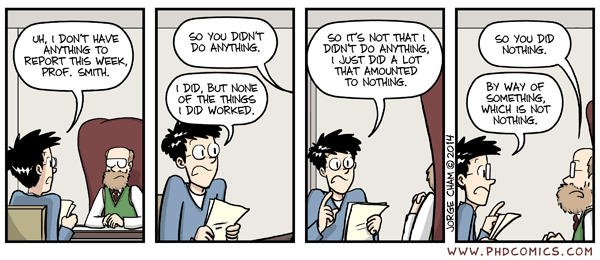
"Nothing" - originally published
9/26/2014
For the latest news in PHD Comics, CLICK HERE! |
||
A fundamental insight in the theory of diffusive random walks is that the mean length of trajectories traversing a finite open system is independent of the details of the diffusion process. Instead, the mean trajectory length depends only on the system's boundary geometry and is thus unaffected by the value of the mean free path. Here we show that this result is rooted on a much deeper level than that of a random walk, which allows us to extend the reach of this universal invariance property beyond the diffusion approximation. Specifically, we demonstrate that an equivalent invariance relation also holds for the scattering of waves in resonant structures as well as in ballistic, chaotic or in Anderson localized systems. Our work unifies a number of specific observations made in quite diverse fields of science ranging from the movement of ants to nuclear scattering theory. Potential experimental realizations using light fields in disordered media are discussed.
env x='() { :;}; echo vulnerabile' bash -c "echo prova"Diffusion quantum Monte Carlo is introduced at an elementary level. We highlight the strengths of the method in addressing important issues associated with quantum many-body systems, such as those associated with the ground-state energy and pair-distribution function. 4He clusters trapped on a graphite surface are simulated as an example of the method. A sample program and documentation for developing simulation projects are provided.
Jacopo.bertolottiIl referendum nasce da profonde cause sociali, storiche e politiche. “Non ce ne fotte un cazzo del Royal Baby!”
Gli scozzesi rinunciano all’indipendenza. Prima devono imparare a vestirsi.
Finalmente la Scozia ha avuto il suo referendum. Hanno usato il retro delle schede del divorzio.
Il popolo scozzese si è espresso: “No all’indipendenza dal Regno Unito”. C’è voluta tutta la notte per capirlo.
Gli scozzesi hanno votato NO alla domanda “Should Scotland be an independent country?”. Che in italiano suonerebbe “Sei favorevole all’abrogazione dell’art. 87236/53A che regolamenta i limiti della sovranità dei territori a nord del Vallo di Adriano?”

Altissima l’affluenza alle urne. Succede quando le alternative sono diverse tra loro.
Il referendum nasce da profonde cause sociali, storiche e politiche. “Non ce ne fotte un cazzo del Royal Baby!”
È scozzese l’uomo che scoprì la penicillina dalla muffa. Mentre pensava a come cucinarla.
Il premier inglese Cameron felice per il risultato del referendum. Risparmieranno i soldi dell’invasione.
Cameron ai giornalisti: “Uniti siamo migliori”. Che stronzo a dirlo proprio a loro.
La regina Elisabetta ha atteso l’esito del voto in un castello scozzese. Insieme a sua madre.
Gordon Brown aveva detto: “Votate pensando ai vostri figli”. Anche in Sicilia fanno appelli simili.
Paul McCartney firma un appello che invita i britannici a rimanere uniti. Poi è arrivata Yoko Ono.
Salvini: “Se avesse vinto il sì, noi leghisti ci saremmo messi il kilt”. Ogni scusa è buona per mettere in mostra i coglioni.
(Secondo molti l’indipendenza della Scozia avrebbe costituito un pericoloso precedente. Tipo Braveheart per Barbarossa)
La Scozia produce il 20% del pesce e il 60% del petrolio europei. Adesso si tratta solo di smettere di mischiarli.
I giornali titolano: “La Gran Bretagna respira”. Dev’essere ripartito Salvini.
Vola la moneta inglese. Da noi successe ai tempi di Craxi.

Indagato il padre di Renzi. Berlusconi voleva una prova d’amore.
Il padre di Matteo Renzi sarebbe colpevole di bancarotta fraudolenta. Ma quello è il meno.
Tiziano Renzi si difende: “Quella sera io e mia moglie avevamo bevuto”.
Lotta al virus ebola, Obama invia tremila soldati in Africa. Punta al Nobel per la medicina.
Il governo della Sierra Leone invita i cittadini a chiudersi in casa. Ma così non ripartirà mai l’economia!
Con il vaccino sviluppato in Italia si ottiene l’immunità all’ebola per dieci mesi. Poi subentra la prescrizione.
Angela Merkel annuncia nuove sanzioni contro Mosca. Renzi le chiamerebbe riforme.
Al Bano: “In Russia chiedono a me perché vogliamo fargli la guerra”. Per dire il credito che ha la Mogherini.
Il governo di Kiev verso l’accordo con Putin. Poroshenko vedrà gli ucraini un fine settimana sì e uno no.
Kiev vorrebbe un muro al confine russo. Così la smettono di bucargli i palloni.
Sondaggi, la popolarità di Napolitano scende dal 90% al 40%. Nemmeno il tempo di ambientarsi gli danno.
Ladro usa una banana per rapinare un negozio. Poi si lamentano se i carabinieri scivolano.
Abruzzo, ucciso un altro orso con una fucilata alle spalle. Addio tappeto.

Imprenditore spara e uccide due operai. Be’ dai, almeno non si è suicidato.
Pretendono il pagamento degli arretrati ma il titolare li uccide. Ecco a cosa serve un agente.
Jovanotti trova un cagnolino: “Adottatelo”. Ancora una volta ci scarica addosso i suoi problemi.
Sciolto il sangue di San Gennaro. Ok, sai fare altro?
Uomo entra correndo nel giardino della Casa Bianca. “Abbiamo vinto in Normandia!”
Intruso sfugge alla sicurezza e raggiunge l’ingresso della Casa Bianca. Renzi è diventato premier così.
Scoperto enorme buco nero al centro di una galassia. Ma la responsabilità sarebbe del dio precedente.
Taranto, operaio Ilva muore schiacciato. Dall’aria.
Il writer Blu raffigura i poliziotti come maiali, il sindaco Marino fa censurare il suo murales. Si sa che gli animalisti sono tipi permalosi.
La biglietteria della stazione di Ostia chiusa per topi. Rispetto agli ospedali la normativa è più severa.
Solo una donna su due sa dov’è la vagina. L’amica in bagno serve a dare indicazioni.
Il gip di Torino dispone il sequestro delle attrezzature scientifiche di Stamina. Cioè la collezione completa di Esplorando il corpo umano.
Agenzia di collocamento tedesca arriva in Puglia. Presto, nascondetevi!
Intervistata l’ultima assaggiatrice di Hitler. Adesso lavora per D’Alema.
[qui la seconda parte]
[qui la terza parte]
Autori: masss, pirata21, cabajos, bipo, lowerome, venividiwc, è un mondo difficile, montales, ‘lfoda, pirata21, mercà, acid rain, semola, stark, lucagian, il mago di floz, miguel mosè, birraallaspinoza, veek81, cityman, milingopapa, mestmuttèe, novevonbismarck, misterdonnie, narcolessico, zxc80, enricocameriere, sisivabbe, doctorc, serpicone e george clone.
Illustrazioni: stracotto, sciscia, here to avenge laika.
Not so long ago, on a website not so far away, an opinion was expressed: creativity was being suppressed in science. On the surface, the statistics support this: younger researchers are getting progressively less of the funding. Older researchers, it is asserted, tend to propose less risky and less innovative research. As with any good opinion in science, Nobel prize winners are wheeled as supporting cast. But, is it really true? Are we truly suppressing the creative side of science?
The answer is, overwhelmingly, no. Scientific papers are a crude measure for scientific progress, but never have more papers being produced per year than now. Clearly, something creative is going on here. If you don't like scientific papers, simply look at technological progress: your smartphone would not have nearly as much punch without the creativity of scientists; antiviral drugs were not found lying about on the ground; experimental stem-cell therapies were not accidentally attempted. Behind all of these new things lies a decade or more of scientific research. But, you know, thats not creative at all.
Maybe a lack of creativity manifests if we restrict ourselves to more fundamental breakthroughs, like... finding exoplanets, brown dwarfs, the anisotropy in cosmic microwave background, the Higgs Boson, Bose Einstein Condensates, or the acceleration of the rate of expansion of the universe. Not to mention very clever experiments that test the very nature of reality itself, like Wheeler's delayed choice experiment, and Bell inequality tests. Oh wait, all of those have happened in the last 20 years. Some have even garnered Nobel prizes for their work.
Author(s): Christopher Ferrie and Joshua Combes
A classical model is proposed that exhibits the same anomalous weak values as a quantum system, suggesting that weak values are not inherently quantum.
[Phys. Rev. Lett. 113, 120404] Published Thu Sep 18, 2014
My 12-year-old daughter is proposing an interesting project. She is planning to attach a number of helium balloons to a chair, which in turn would be tethered by means of a rope to a Ferrari. Her 13-year-old friend would then drive the Ferrari around, while she sits in the chair enjoying uninterrupted views of the countryside. Leaving aside the legal and insurance difficulties, my daughter is keen to know the maximum speed that she could expect to attain, and how many helium balloons would be required.
Phil Rodgers, Cambridge, UK
Thanks for getting your dad to send in this question! He said not to worry about the "legal and insurance difficulties," so I think it's safe to assume he's taken care of all that.
Note to police: If you've recently taken into custody two unidentified underage drivers, a stolen Ferrari, and a bunch of helium balloons, the person you're looking for is Phil Rodgers in Cambridge, UK.
Okay, on to your question:
Have you ever run with a balloon? It doesn't point straight up. The air rushing past you pushes it down:

How high the balloon goes depends on which force is stronger--the balloon's buoyancy pulling upward, or the wind dragging the balloon backward. If the drag is too strong, the balloon will stay low to the ground and you won't get a good view.

To figure out how fast you can go, let's first figure out how big our cluster of balloons (or one big balloon, which is probably easier) needs to be to lift you.
People your age weigh an average of 43 kilograms, which means you need a balloon 4 meters wide to lift you—that's about the size of a car. (If you don't weigh 43 kilograms, you can put your weight into this formula.)
A 4-meter balloon will be large enough to cancel out your weight. But that's not enough. It just means you wouldn't fall or float—so you'd be towed along the ground behind the car.
To float upward, you need a bigger balloon. A 5 meter balloon will produce 71 kilograms of lift[1]Usually, physics people will make a big deal about how weight and force are different from mass, but in this case, I'm going to resist the urge, because it's easy to just think of everything in terms of weight. (here's the formula!). That's enough to cancel out your 43-kilogram weight, plus a few kilograms for the chair and balloon itself.
The balloon will be dragged backward by the air. The faster your friend drives, the more the air will drag the balloon back. You can use this formula to figure out how much "weight" will pull backward on the balloon for different speeds and sizes. Just change the "20 mph" (driving speed) and "5 meters" (balloon size) in the formula.
If the upward pull from the helium is stronger than the backward pull from the wind, the balloon will float at a high angle. If the backward pull is stronger than the upward pull, the balloon will float at a low angle. If you're using a 5-meter balloon, even if you drive only 10 mph, the balloon will float pretty low behind you.
Fortunately, there's a solution: You can make the balloon bigger. As you make the balloon bigger, the buoyancy starts to win out over the drag.[2]The reason is that the buoyancy equation uses diameter^3 but the drag equation uses diameter^2, so if you make diameter bigger, the buoyancy equation grows more.
If you use a 10 meter balloon, the buoyancy is strong enough that you can drive at 20 or 25 mph and still stay pretty high off the ground. A 15 meter balloon is even better; it would let you go 30 mph while still getting a good view.[3]You could make the cable longer, so that even a low angle still gets you high off the ground. But the cable won't be straight; it makes a curve called a catenary. At a low enough angle, making the cable longer would just mean part of it would drag on the ground.
Unfortunately, there's a problem with using larger and larger balloons.
A 15-meter helium balloon plus a 12-year-old can lift 1,895 kilograms. But a Ferrari 458 (plus a 13-year-old) only weighs 1,532 kilograms.

The solution to all this is to ditch the helium. You don't need a balloon. All you need is a kite or a parachute—a surface to act as a wing and redirect that incoming air to push you upward.
In other words, see if your dad will take you parasailing.
| Piled Higher & Deeper by Jorge Cham |
www.phdcomics.com
|
|
 |
||
|
title:
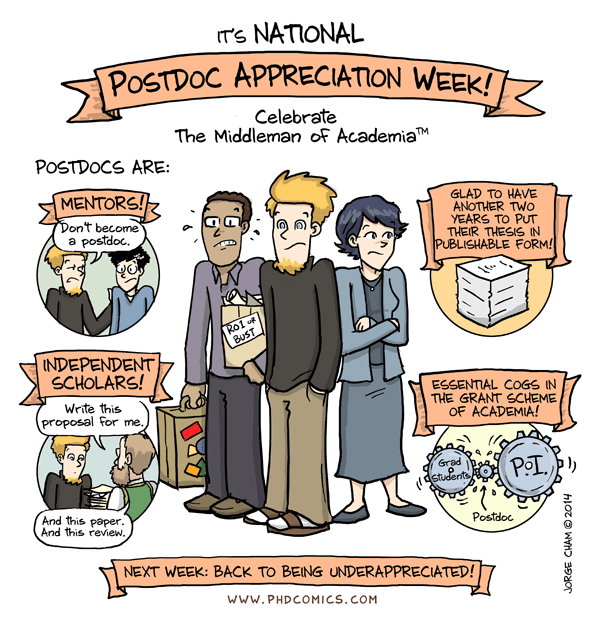
"Postdoc Appreciation" - originally published
9/17/2014
For the latest news in PHD Comics, CLICK HERE! |
||
A bug quietly reported on September 1 appears to have grave implications for Android users. Android Browser, the open source, WebKit-based browser that used to be part of the Android Open Source Platform (AOSP), has a flaw that enables malicious sites to inject JavaScript into other sites. Those malicious JavaScripts can in turn read cookies and password fields, submit forms, grab keyboard input, or do practically anything else.
Browsers are generally designed to prevent a script from one site from being able to access content from another site. They do this by enforcing what is called the Same Origin Policy (SOP): scripts can only read or modify resources (such as the elements of a webpage) that come from the same origin as the script, where the origin is determined by the combination of scheme (which is to say, protocol, typically HTTP or HTTPS), domain, and port number.
The SOP should then prevent a script loaded from http://malware.bad/ from being able to access content at https://paypal.com/.
Read 10 remaining paragraphs | Comments
Article
Carnot efficiency is the highest theoretically possible efficiency that a heat engine can have. Verley et al. use the fluctuation theorem to show that the Carnot value is the least likely efficiency in the long time limit.
Nature Communications doi: 10.1038/ncomms5721
Authors: Gatien Verley, Massimiliano Esposito, Tim Willaert, Christian Van den Broeck
Jacopo.bertolottiEhi, nice!
Oh, wait. It costs like a new liver. Ok, nevermind.
It’s been many years in the making, and today I’m excited to announce the launch of Mathematica Online: a version of Mathematica that operates completely in the cloud—and is accessible just through any modern web browser.
In the past, using Mathematica has always involved first installing software on your computer. But as of today that’s no longer true. Instead, all you have to do is point a web browser at Mathematica Online, then log in, and immediately you can start to use Mathematica—with zero configuration.
Here’s what it looks like:

It’s a notebook interface, just like on the desktop. You interactively build up a computable document, mixing text, code, graphics, and so on—with inputs you can immediately run, hierarchies of cells, and even things like Manipulate. It’s taken a lot of effort, but we’ve been able to implement almost all the major features of the standard Mathematica notebook interface purely in a web browser—extending CDF (Computable Document Format) to the cloud.
There are some tradeoffs of course. For example, Manipulate can’t be as zippy in the cloud as it is on the desktop, because it has to run across the network. But because its Cloud CDF interface is running directly in the web browser, it can immediately be embedded in any web page, without any plugin, like right here:
Another huge feature of Mathematica Online is that because your files are stored in the cloud, you can immediately access them from anywhere. You can also easily collaborate: all you have to do is set permissions on the files so your collaborators can access them. Or, for example, in a class, a professor can create notebooks in the cloud that are set so each student gets their own active copy to work with—that they can then email or share back to the professor.
And since Mathematica Online runs purely through a web browser, it immediately works on mobile devices too. Even better, there’s soon going to be a Wolfram Cloud app that provides a native interface to Mathematica Online, both on tablets like the iPad, and on phones:

There are lots of great things about Mathematica Online. There are also lots of great things about traditional desktop Mathematica. And I, for one, expect routinely to use both of them.
They fit together really well. Because from Mathematica Online there’s a single button that “peels off” a notebook to run on the desktop. And within desktop Mathematica, you can seamlessly access notebooks and other files that are stored in the cloud.
If you have desktop Mathematica installed on your machine, by all means use it. But get Mathematica Online too (which is easy to do—through Premier Service Plus for individuals, or a site license add-on). And then use the Wolfram Cloud to store your files, so you can access and compute with them from anywhere with Mathematica Online. And so you can also immediately share them with anyone you want.

By the way, when you run notebooks in the cloud, there are some extra web-related features you get—like being able to embed inside a notebook other web pages, or videos, or actually absolutely any HTML code.
Mathematica Online is initially set up to run—and store content—in our main Wolfram Cloud. But it’ll soon also be possible to get a Wolfram Private Cloud—so you operate entirely in your own infrastructure, and for example let people in your organization access Mathematica Online without ever using the public web.
A few weeks ago we launched the Wolfram Programming Cloud—our very first full product based on the Wolfram Language, and Wolfram Cloud technology. Mathematica Online is our second product based on this technology stack.
The Wolfram Programming Cloud is focused on creating deployable cloud software. Mathematica Online is instead focused on providing a lightweight web-based version of the traditional Mathematica experience. Over the next few months, we’re going to be releasing a sequence of other products based on the same technology stack, including the Wolfram Discovery Platform (providing unlimited access to the Wolfram Knowledgebase for R&D) and the Wolfram Data Science Platform (providing a complete data-source-to-reports data science workflow).
One of my goals since the beginning of Mathematica more than a quarter century ago has been to make the system as widely accessible as possible. And it’s exciting today to be able to take another major new step in that direction—making Mathematica immediately accessible to anyone with a web browser.
There’ll be many applications. From allowing remote access for existing Mathematica users. To supporting mobile workers. To making it easy to administer Mathematica for project-based users, or on public-access computers. As well as providing a smooth new workflow for group collaboration and for digital classrooms.
But for me right now it’s just so neat to be able to see all the power of Mathematica immediately accessible through a plain old web browser—on a computer or even a phone.
And all you need do is go to the Mathematica Online website…
Jacopo.bertolotti15 m long swimming dinosaur. 'nuff said